Federal Agencies May Soon Lose Power to Regulate Independently of Trump’s Will
SCOTUS has signaled a willingness to no longer insulate agency personnel from decisions made by the executive branch.
By Sasha Abramsky ,
Published
December 17, 2025
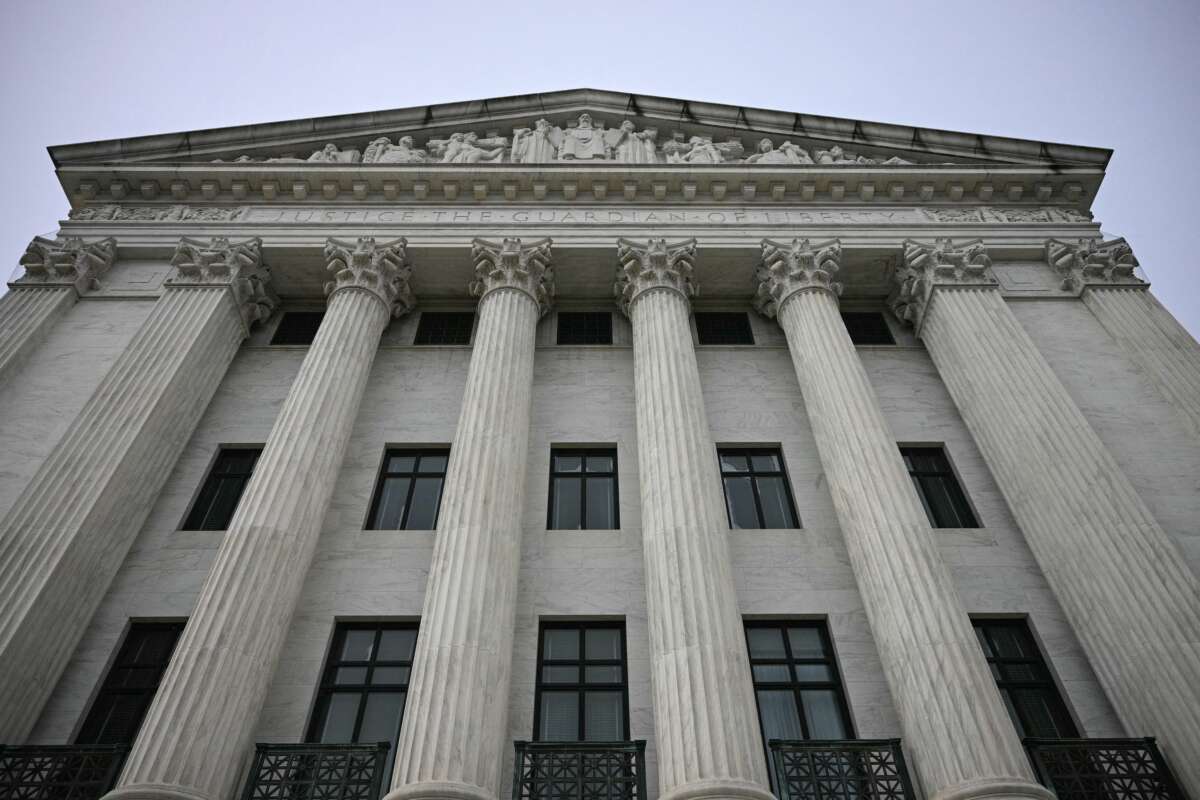
A view of the rear side of the U.S. Supreme Court as the court hears arguments in the case over Donald Trump's dismissal of Federal Trade Commission commissioner Rebecca Slaughter in Washington, D.C., on December 8, 2025. The case is being closely watched due to its broader implications concerning the president's powers to fire the heads of independent government agencies.Jim WATSON / AFP via Getty Images
The U.S. Supreme Court heard arguments this month in a case that could dramatically strengthen presidential authority over federal regulatory agencies for the decades to come.
The case, Trump v. Slaughter, grew out of President Donald Trump’s firing of a Federal Trade Commission (FTC) board member, Rebecca Slaughter, a Democrat — whom Trump himself had appointed during his first term in office — without cause. Slaughter sued, arguing that Congress had set up the FTC to be independent from presidential pressure, and that Trump was exceeding his authority by firing her. For months, the case has been wending its way through the court system, and a decision in the case is not likely to come down until June or July.
Slaughter is one of five FTC commissioners who are each appointed to seven-year terms. Historically, the FTC, established by President Woodrow Wilson in 1914, has had a balance of Democratic and Republican commissioners and has aimed to regulate trade, prevent unfair business practices, and enforce antitrust legislation, in a generally evenhanded and non-partisan manner. In March, Trump summarily fired Slaughter and the other Democrat on the commission, saying in a terse email that their ongoing employment was “inconsistent with the Administration’s priorities.”
Several top personnel at other agencies whom Trump had also targeted for political reasons initiated their own lawsuits against the president. Lower courts pushed back against these firings; but in May the Supreme Court allowed the firings to go into temporary effect while the court debated the merits of the cases. Upon hearing Slaughter’s case, many of the justices, three of whom owe their jobs to Trump, seem to have concluded that the president ought to have the authority to fire, on a whim, any commissioner he chooses. Pair this with their earlier ruling essentially giving the commander-in-chief immunity for any actions carried out in an “official capacity” — no matter how criminal they might be in other circumstances — and the Supreme Court looks to be setting the stage, with a ruling next summer, for the creation of an imperial presidency with virtually limitless powers.
To get there, the Supreme Court would, once again, have to shed well-established legal doctrine, as it did when overturning the constitutional right to abortion access. After all, there is precedent, going back to the FDR-era Humphrey’s Executor v. United States, upholding the constitutionality of regulatory structures created by Congress that place dozens of government agencies outside of direct, partisan, executive political control.
Related Story
The U.S. Supreme Court heard arguments this month in a case that could dramatically strengthen presidential authority over federal regulatory agencies for the decades to come.
The case, Trump v. Slaughter, grew out of President Donald Trump’s firing of a Federal Trade Commission (FTC) board member, Rebecca Slaughter, a Democrat — whom Trump himself had appointed during his first term in office — without cause. Slaughter sued, arguing that Congress had set up the FTC to be independent from presidential pressure, and that Trump was exceeding his authority by firing her. For months, the case has been wending its way through the court system, and a decision in the case is not likely to come down until June or July.
Slaughter is one of five FTC commissioners who are each appointed to seven-year terms. Historically, the FTC, established by President Woodrow Wilson in 1914, has had a balance of Democratic and Republican commissioners and has aimed to regulate trade, prevent unfair business practices, and enforce antitrust legislation, in a generally evenhanded and non-partisan manner. In March, Trump summarily fired Slaughter and the other Democrat on the commission, saying in a terse email that their ongoing employment was “inconsistent with the Administration’s priorities.”
Several top personnel at other agencies whom Trump had also targeted for political reasons initiated their own lawsuits against the president. Lower courts pushed back against these firings; but in May the Supreme Court allowed the firings to go into temporary effect while the court debated the merits of the cases. Upon hearing Slaughter’s case, many of the justices, three of whom owe their jobs to Trump, seem to have concluded that the president ought to have the authority to fire, on a whim, any commissioner he chooses. Pair this with their earlier ruling essentially giving the commander-in-chief immunity for any actions carried out in an “official capacity” — no matter how criminal they might be in other circumstances — and the Supreme Court looks to be setting the stage, with a ruling next summer, for the creation of an imperial presidency with virtually limitless powers.
To get there, the Supreme Court would, once again, have to shed well-established legal doctrine, as it did when overturning the constitutional right to abortion access. After all, there is precedent, going back to the FDR-era Humphrey’s Executor v. United States, upholding the constitutionality of regulatory structures created by Congress that place dozens of government agencies outside of direct, partisan, executive political control.
Related Story

SCOTUS Has Given Trump Favorable Rulings in 90 Percent of Cases, Report Finds
The report stated that, unlike the Supreme Court, lower courts are “engaged in a bipartisan fight for the rule of law.” By Chris Walker , Truthout October 24, 2025
But the six members of the court who make up the hard-right majority have time and again made a point of casting precedent aside over the past three years while showing scant respect for legal history. Their questions during the oral arguments on December 8, 2025, indicated deep suspicion of the concept of insulating unelected agency personnel from decisions made by the executive branch. Chief Justice Roberts, who has long been in favor of expanding executive powers, led the charge, decrying the Humphrey’s Executor ruling as being a “dried husk,” and making it clear that he felt regulatory agencies were unfairly encroaching on powers that ought to reside with the executive. Gorsuch argued the Humphrey’s Executor case was “poorly reasoned.” The other four members of the “conservative” majority added in their criticisms.
Sonia Sotomayor’s counterargument that the Trump administration is asking the court to “destroy the structure of the government” seemed to be met with utter disregard, and the Supreme Court’s right-wing majority also seemed unconcerned by Democracy advocates’ warning that Trump is seeking untrammeled power over every aspect of the federal system.
If the Federal Reserve is included in the ruling, Trump may decide to stack the institution with people willing to obey a presidential order to drastically reduce interest rates no matter the broader economic conditions.
Over the past century, more than 20 government agencies have been created by Congress to independently enforce and interpret regulations that impact a huge swath of U.S. society. These agencies include the National Labor Relations Board, the Federal Election Commission, the Securities and Exchange Commission, the Consumer Product Safety Commission, the Equal Employment Opportunity Commission (EEOC), the Merit Systems Protection Board, and many other agencies that help shape the business, workplace, financial, environmental, and electoral regulatory systems in the United States. Each of them has its own board, and each of its board members would be at risk of being fired if they do not bend to Trump’s dictates, should the administration’s arguments in Slaughter prevail at the Supreme Court.
Trump has already moved against commissioners from several of these agencies whom his team deems not to be fully aligned with his MAGA vision. He has also attempted to remove Lisa Cook from her position on the Federal Reserve, which historically has been largely walled off — with bipartisan support — from the day-to-day rough and tumble of D.C. politics, as a way to protect the stability of the financial system from the political whims and short-term needs of leaders seeking to create economic boom conditions in the run-up to elections.
It is unclear if the Supreme Court will seek to carve out an exception for the Federal Reserve and a few other agencies, or if it will simply issue a blank check to Trump to fire at will anyone who opposes his demands. If the Federal Reserve is included in the ruling, Trump may decide to stack the institution with people willing to obey a presidential order to drastically reduce interest rates no matter the broader economic conditions. The outcome could be catastrophic: Many economists, including current Federal Reserve chair Jerome Powell, warn that, over the long run, politically motivated cuts of interest rates will turbo-charge inflation and undermine the country’s ability to borrow in the bond markets to cover the gap between what it raises in taxes and what it spends.
Imagine a National Labor Relations Board stacked with members who believe any and all trade union organizing to be suspect.
And even if the Fed is excluded, the damage done through a Trumpian assault on other agencies would be profound. Imagine a Federal Election Commission stacked with MAGA figures who believe any election that goes against them is inherently illegitimate, and who have flirted with the idea of declaring a national emergency and using the military to seize ballot boxes in states like California. Imagine a National Labor Relations Board stacked with members who believe any and all trade union organizing to be suspect. Imagine an EEOC board dominated by members persuaded of the lie that white males are the most discriminated-against group within the U.S. labor force, and who are keen to use their positions to push back against women and people of color in positions of authority in the workplace.
Without a crystal ball, we can’t know exactly how it would all play out. But it’s a fair bet that, in a post-Humphrey’s Executor world, regulations that provide ordinary people at least a mild defense against the worst of oligarchic rule would be cast aside by newly MAGAfied regulatory agencies. And, given his track record, it’s unlikely that Trump would use the expanded powers bestowed on him by the Supreme Court with anything like judicious moderation.
This article is licensed under Creative Commons (CC BY-NC-ND 4.0), and you are free to share and republish under the terms of the license.

Sasha Abramsky
Sasha Abramsky is a freelance journalist and a part-time lecturer at the University of California at Davis. Abramsky’s latest book, American Carnage: How Trump, Musk, and DOGE Butchered the US Government, is available for pre-order now and will be released in January. His work has appeared in numerous publications, including The Nation, The Atlantic Monthly, New York Magazine, The Village Voice and Rolling Stone. He also writes a weekly political column. Originally from England, with a bachelor’s in politics, philosophy and economics from Oxford University and a master’s degree from the Columbia University Graduate School of Journalism, he now lives in Sacramento, California.

No comments:
Post a Comment