Tuesday, September 27, 2022

Is The Nuclear Waste Problem Overblown?

  • Nuclear energy is finally gaining some political momentum.

  • While the amount of nuclear waste generated from energy operations is fairly small, many communities shun the idea of storing it themselves.

  • Recycling could prove to be a potential solution to the world’s nuclear waste issue.

In the previous article, I discussed some of the developments that are taking place to make nuclear power safer, such that major accidents like those at Chernobyl and Fukushima are simply no longer possible. But the other major issue nuclear opponents generally raise is what to do with the radioactive waste that is generated during the production of nuclear power.

I posed this question to Dr. Kathryn Huff, the Assistant Secretary at the Department of Energy’s (DOE) Office of Nuclear Energy.

Addressing Nuclear Waste

The good news is that the amount of waste generated is generally small. In fact, nuclear plants have simply stored the waste on-site, but that isn’t a long-term solution to the problem.

The storage of nuclear waste is always a hot political topic. Many communities don’t want waste stored in their vicinity, and some even object to the waste being transported through their towns. That has hampered projects like the proposed Yucca Mountain nuclear waste disposal facility in Nevada, which was been studied as a potential storage facility since the 1970s.

Dr. Huff explained that nuclear waste is currently being stored onsite at nuclear plants, but the DOE is restarting the initiative to find a storage facility. Such permanent storage facilities are the approach favored by several other nations.

In fact, Finland is currently developing the world’s first permanent disposal site for high-level nuclear waste on an island off Finland’s west coast. The waste will be buried in about 100 tunnels about 1,400 feet underground. The facility is projected to hold all of Finland’s nuclear waste until about the year 2100, and is meant to contain spent fuel rods for 100,000 years. The design relies on multiple barriers designed to prevent water from reaching the waste and carrying it into the water supply. It is expected to begin operating next year.

A different approach is recycling nuclear waste to recover fissile and fertile materials for additional power production from nuclear power plants. Reprocessing nuclear waste allows for the recovery of plutonium, which is then mixed with depleted uranium oxide to make fresh fuel.

This process reduces the volume of high-level waste (HLW) by about 85%, while extracting up to 30% more energy from the uranium. It also reduces the amount of uranium that has to be mined.

Recycling policies are in place in France, some other European countries, as well as Russia, China, and Japan.

Dr. Huff explained that these policies work in France because the same entity is responsible for all parts of the nuclear process — from the reactor, waste, and repository. That is not the case in the U.S., and that complicates efforts to deal with this issue. Thus, this is more of a long-term option for the U.S.

Ramping up Nuclear Power

Finally, I asked Dr. Huff what the U.S. is doing to kick start nuclear power in the U.S., and push U.S. technology to the rest of the world.

She said that political support for nuclear power is improving. The bipartisan infrastructure law allocated $6 billion into current reactors and $2.5 billion more into new reactor designs. There are initiatives for nuclear-powered hydrogen, and production tax credits for clean energy including nuclear. The goal is a doubling by 2050 of nuclear in the U.S.

The International Energy Agency (IEA) also believes the world will need to double nuclear production by 2050 as it decarbonizes. So, what is the U.S. doing to aid these efforts?

The DOE- International Affairs Office has an international nuclear cooperation office. There has been a lot of interest in U.S. nuclear designs from Eastern Europe because of energy security concerns. Dr. Huff noted that we have built American reactors in China, but they want to commercialize their own technologies (which were clearly influenced by U.S. designs).  

Dr. Huff noted that not all options are appropriate for replacing retiring coal plants. Energy planning models show the grid's need for second to second energy balance. A day-to-day view might cause you to believe you needed less storage than you actually need, but short-term balancing requires fast responding power.

Nuclear plants are physically similar-sized and of the same energy output and reliability as coal plants. The grid is set up for those switchouts. The workforce is also compatible. Similar kinds of skilled trades work at coal plants that would be needed at nuclear power plants.

Coal price renaissance: how long can it last?
Nelson Bennett - Business in Vancouver | September 26, 2022 |

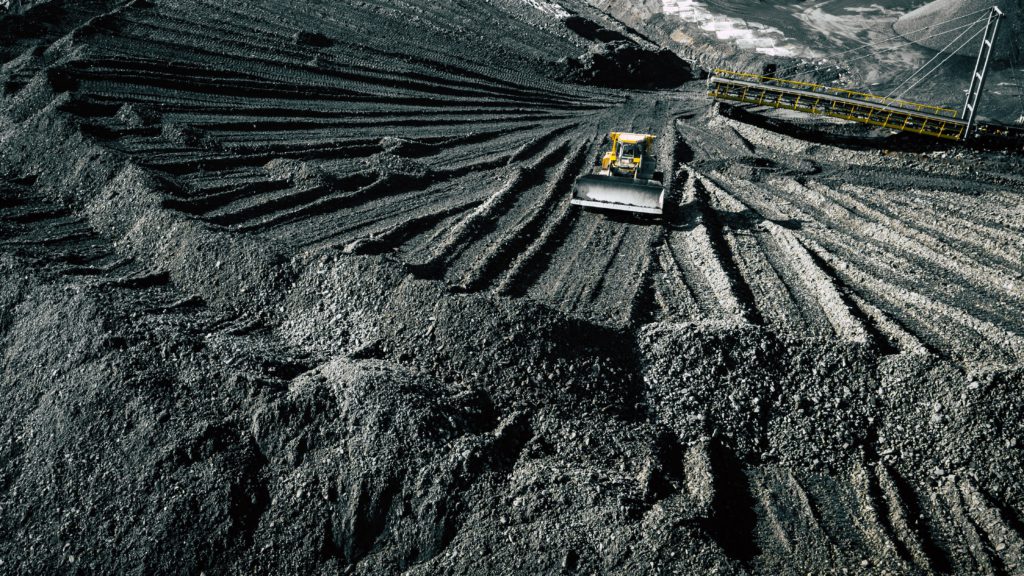
Open pit coal mine. (Stock Image)

Over the last year and a half, the renaissance of coal – both kinds – has been gobsmacking.


No one saw coal prices of $400 to $600 per tonne coming, including those in the coal industry.


“If, a year ago, fifteen months ago, you had said to people thermal coal could be $440, and coking coal could be $600, they’d call the ambulance and recommend a nice doctor,” Neil Bristow, managing director of H&W worldwide Consulting, said Thursday at a recent Coal Association of Canada conference.


“Who would believe it?”


While Russia’s invasion of Ukraine has roiled energy markets and driven up coal prices, the reality is that thermal coal prices had been surging months before the invasion, as Europe was already in a self-induced energy shortage and resorting back to coal power.

Five or six years ago, thermal coal sold for about $60 to $80 per tonne, Bristow said. Even before Russia invaded Ukraine, thermal coal prices had soared to around $200 per tonne.

“The fundamentals that caused those prices to increase in Q3 and Q4 of 2021 are still there, and they’ve only been exacerbated by the sanctions on Russian coal,” said Ernie Thrasher, CEO of Xcoal Energy and Resources.


Never in Bristow’s lifetime has he seen thermal coal (burned to produce power) worth more than metallurgical coal, which is used to make steel, but it is now.

Metallurgical coal (also called coking or steelmaking coal) briefly touched $600 per tonne, Bristow said, but has since settled down to about $270 per tonne. That’s still a high price, but less than thermal coal at the moment, which is well above $300 per tonne.

The usual market forces of supply and demand that would normally see producers responding to high prices with increased production simply isn’t happening with coal.

In the U.S., the coal mining industry is half the size it was a couple of decades ago, and simply can’t suddenly reverse coarse. Australia’s coal production peaked in 2016 and it seems unlikely it can respond to the sudden demand for thermal coal either. B.C. is a major producer and exporter of metallurgical coal, but Canada exports little if any thermal coal.

Xcoal estimates the UK and Europe alone will need to find 47 million tonnes of coal that used to come from Russia. It’s unlikely to come from the U.S.

“There’s just not much the U.S. can do,” Thrasher said. “We’ve basically dismembered our coal industry.”

Even if American coal mines could increase production, there is limited coal terminal capacity for exports, which is why coal produced in Montana and Wyoming is shipped through B.C. export terminals. And right now, one of those terminals — Westshore — has been paralyzed by a strike.

“There is just no elasticity in the supply chain that’s allowing people to respond to these prices, and the old adage of the best thing for high prices is high prices is not holding true,” Thrasher said.

In total, Xcoal estimates the global coal supply gap at 96 million tonnes.

“These high coal prices are occurring at a time when the Chinese economy is just dead flat on its back,” Thrasher added. If China’s economy were to suddenly recover and grow, that would put even more pressure on both thermal and coking coal prices.

“Who can supply 96 million tonnes to fill that gap?” Thrasher wondered. “It’s probably only China and India. There’s just not a lot of other countries in the world where there’s the ability to produce the coal that needs to fill this gap.”


As for steelmaking coal, which is B.C.’s second most valuable export, a global recession might cool demand and temper prices somewhat. But Bristow predicts prices will remain high over the next few years, as there simply not enough new metallurgical coal mines being built.

“My models do not show enough coking coal to meet the demand in the world after about 2027, 2028,” Bristow said. “We desperately need new mines.”

“I’m going to be bold and say it will not stay $400 or $500 a tonne for very long,” Thrasher said of coking coal prices. “But I think the days of seeing sub-125, 150 dollars per metric tonne of coking coal for any period of time are in the rear-view mirror, and it’s because the coal simply is not being produced.”

Thrasher said he can envision stagflation resulting from the shortage of coal, if there is a global recession.

“If we get into a major global economic slowdown, it certainly is going to put a damper on our products,” Thrasher said. “The question is, if you go back and look at those supply shortfalls, will a 5% global economic slowdown be enough to solve the problem if you’re 10% short in energy supply? You basically have a stagflation environment where the global economy is crashing but you still need energy and the energy prices stay high.

“It will affect thermal more than coking coal. It could be something we haven’t seen in 40 or 50 years.”

(This article first appeared in Business in Vancouver)
Europe suspects sabotage as mystery gas leaks hit Russian pipelines

By Anna Ringstrom and Stine Jacobsen - Reuters - TODAY

Nord Stream 2 landfall facility in Lubmin
© Reuters/FABRIZIO BENSCH

STOCKHOLM/COPENHAGEN (Reuters) - Europe was racing on Tuesday to investigate possible sabotage behind sudden and unexplained leaks in two Russian gas pipelines under the Baltic Sea, infrastructure at the heart of an energy crisis since Russia invaded Ukraine.

Poland's Prime Minister Mateusz Morawiecki said the leaks were caused by sabotage, while Denmark's prime minister and Russia, which slashed its gas deliveries to Europe after Western sanctions, said it could not be ruled out. But who might be behind any foul play, if proven, and a motive were far from clear.


The logo of Nord Stream is seen at the headquarters of Nord Stream AG in Zug

Sweden's Maritime Authority issued a warning about two leaks in the Nord Stream 1 pipeline, the day after a leak on the nearby Nord Stream 2 pipeline was discovered that prompted Denmark to restrict shipping and impose a small no fly zone.

Both pipelines have been flashpoints in an escalating energy war between European capitals and Moscow that has pummelled major Western economies, sent gas prices soaring and sparked a hunt for alternative energy supplies.

"Today we faced an act of sabotage, we don't know all the details of what happened, but we see clearly that it's an act of sabotage, related to the next step of escalation of the situation in Ukraine," Mateusz Morawiecki said during the opening of a new pipeline between Norway and Poland.

Denmark's Prime Minister Mette Frederiksen said sabotage could not be ruled out. "We are talking about three leaks with some distance between them, and that's why it is hard to imagine that it is a coincidence," she said.

Kremlin spokesperson Dmitry Peskov said the leaks affected the energy security of the entire continent.

Neither pipeline was pumping gas to Europe at the time the leaks were found amid the dispute over the war in Ukraine, but the incidents will scupper any remaining expectations that Europe could receive gas via Nord Stream 1 before winter.

"The destruction that occurred on the same day simultaneously on three strings of the offshore gas pipelines of the Nord Stream system is unprecedented," said network operator Nord Stream AG.

Although neither was in operation, both pipelines still contained gas under pressure.

Gazprom, the Kremlin-controlled company with a monopoly on Russian gas exports by pipeline, declined to comment.

"There are some indications that it is deliberate damage," said a European security source, while adding it was still too early to draw conclusions. "You have to ask: Who would profit?"

A second European source, when asked if there was specific intelligence indicating sabotage, said: "Not specific yet, but it seems this pressure failure can only happen when a pipe is completely cut. Which pretty much says it all."

Russia slashed gas supplies to Europe via Nord Stream 1 before suspending flows altogether in August, blaming Western sanctions for causing technical difficulties. European politicians say that was a pretext to stop supplying gas.

The new Nord Stream 2 pipeline had yet to enter commercial operations. The plan to use it to supply gas was scrapped by Germany days before Russia sent troops into Ukraine in February.

A note by the Eurasia Group said unplanned leaks to undersea pipelines were rare.

"The multiple undersea leaks mean neither pipeline will likely deliver any gas to the EU over the coming winter, irrespective of political developments in the Ukraine war," it said. "Depending on the scale of the damage, the leaks could even mean a permanent closure of both lines."

MALFUNCTION OR SABOTAGE?

European gas prices rose on the news of the leaks, with the benchmark October Dutch price up almost 10% on Tuesday. Prices are still below this year's stratospheric peaks, but remain more than 200% higher than in early September 2021.

"(Of) concern is the security aspect of pipelines across the EU, as this appears to be sabotage.... and will only exacerbate supply concerns for the coming winter," said Refinitiv analyst Timothy Crump.

The leaks happened just before the ceremonial launch on Tuesday of the Baltic Pipe carrying gas from Norway to Poland, a centrepiece of Warsaw's efforts to diversify from Russian supplies.

Norway's Petroleum Safety Authority (PSA) had also urged oil companies on Monday to be vigilant about unidentified drones seen flying near Norwegian offshore oil and gas platforms, warning of possible attacks.

A spokesperson for the Swedish Maritime Administration (SMA) said there were two leaks on Nord Stream 1, one in the Swedish economic zone and another in the Danish zone, adding that both were in an area northeast of the Danish island Bornholm.

"We are keeping extra watch to make sure no ship comes too close to the site," a second SMA spokesperson said.

Vessels could lose buoyancy if they enter the area, and there might be a risk of leaked gas igniting over the water and in the air, the Danish energy agency said, adding there were no risks associated with the leak outside the exclusion zone.

The leak would only affect the environment in the area in which the gas plume in the water column is located, it said, adding that escaping greenhouse gas methane would have a damaging impact on the climate.

The Danish authorities asked that the level of preparedness in Denmark's power and gas sector be raised after the leaks, a step that would require heightened safety procedures for power installations and facilities.

(Reporting by Reuters bureaus; Writing by by Matthias Williams; Editing by Edmund Blair and Jan Harvey)
Low Lake Mead Water Levels Now Revealing Ancient Volcanic Eruptions

Lake Mead's receding water levels are now revealing ancient volcanic eruptions from millions of years ago.


In this combination image, a file photo of Lake Mead
 and an artists impression of an active volcano© iStock / Getty Images


Robyn White - 

Lake Mead is the biggest man-made reservoir in North America, formed by the Hoover Dam. Its water levels are rapidly evaporating due to the ongoing megadrought gripping the southwestern United States.

The lake, which lies across Nevada and Arizona, has made headlines in recent months due to the multitude of gruesome discoveries being made at its bottom, as the water continues to disappear. Multiple sets of human remains have been uncovered since May, and shipwrecks once concealed by the water are also emerging.

Scientists from the University of Nevada, Las Vegas have now discovered samples of ash within the lake from volcanoes that erupted millions of years ago.

According to a study published by the Geological Society of America, these samples were found in sedimentary rocks that haven't been seen since the Hoover Dam was first constructed in the 1930s. The ash comes from volcanoes that erupted in states as far away as as California, Wyoming and Idaho. According to a press release on the findings, these volcanoes erupted as long 12 million years ago.

Scientists determined that the ash was from outside Nevada as nearby volcanoes would have been extinct at the time of the eruption. Scientists said in the study that volcanic eruptions can have a huge impact on environments far away from the source.

Most of the ash discovered is between 6 million and 12 million years old. Some is from more recent times, having been deposited 32,000 years ago.

According to the study, the health threats from these eruptions may still be ongoing in the area.

Eugene Smith, a UNLV emeritus professor of geology involved in the study, said in the press release that ash from even moderately explosive eruptions can travel hundreds of miles from the source.

"[This blankets] entire areas with anywhere from a centimeter to several meters of the heavy material," Smith said. "Although the Las Vegas Valley is currently very far away from any active volcanoes, we can and will have ash from these volcanoes fall over Southern Nevada in the future. Even a couple of millimeters of ash, when wet, is incredibly heavy and can take down power and telecommunications lines. It can block roadways. It is easily remobilized by wind and water. When inhaled, the incredibly tiny but sharp glass grains in the ash can cause significant, chronic lung conditions such as silicosis."

There are four possible sources for the ash, identified by scientists. They include the Snake River Plain-Yellowstone hotspot track, which has been active for 15 million years, and the volcanoes of Walker Lake, which is known for producing huge earthquakes across Nevada and California in 2019 and 2020.

"Studying the past can help you plan for the future," Lab manager at the UNLV College of Sciences' Cryptotephra Laboratory for Archaeological and Geological Research, Racheal Johnsen, said in the press release. "The ash layers we study come from volcanoes long extinct. However, studying them has helped us determine just how often the Las Vegas area was inundated with ash over time and may help us prepare for future events from active volcanoes far from us."
Plants evolved even earlier than we thought, exquisite 3D fossils suggest
published 1 day ago

These organisms have survived virtually unchanged through 5 mass extinctions and half a billion years.

A composite view of Protocodium sinense, a new species of green algae from more than 541 million years ago. To the left is an external view of the fossil, followed by a view through the outer layer (green) and an image of the inner core (gold). 
(Image credit: Cédric Aria)

The oldest green algae preserved in three dimensions may hint that plants originated earlier than previously believed.

The fossils are older than 541 million years, putting them in the late Ediacaran period (635 million to 541 million years ago). This was at the cusp of the Cambrian period (541 million to 485.4 million years ago) when life suddenly diversified in a flash known as the Cambrian Explosion. The fossils are tiny — only half a millimeter in diameter — but are preserved in exquisite detail, down to the bumpy tubular structures that line their outer layers and the masses of delicate filaments that make up their core. They come from Shaanxi province in China, which was a shallow sea in the late Ediacaran.

Green algae are members of the plant kingdom that emerged at least a billion years ago, but the new finding, which shows that a diversity of modern-looking algae species existed earlier than thought, may push back the origin of the plant kingdom perhaps another 100 million years, the researchers reported Sept. 21 in the journal BMC Biology. The ancient algae are surprisingly complex, and almost identical to a modern genus of seaweed called Codium.

"Discovering something so close to Codium in the Ediacarian is likely going to push this origin of green algae and certainly the origin of the entire plant kingdom further back in time," said study co-author Cédric Aria, a postdoctoral researcher in ecology and evolutionary biology at the University of Toronto and Royal Ontario Museum.

A modern analogue

The specimens come from a rich deposit of fossils known as the Gaojiashan biota, a number of which are preserved in three dimensions rather than being squished flat. The study's co-authors from Northwest University in Xi'an, China, asked Aria to take a look at the five algae specimens, which didn't match anything else seen from the late Ediacaran elsewhere in the world.

An external and internal view of the late Ediacaran green algae. (Image credit: Shu Chai, Cédric Aria and Hong Hua)

Aria and his colleagues soon realized from the fossils' structure that they were green algae, but the researchers couldn't find anything similar in the known species of ancient algae, so they started combing through more recent species. That's when they discovered that the ancient algae looked almost exactly like the modern Codium. (Green algae comes in many forms, from single-celled plants to complex multicellular seaweed.) Other than the fact that the ancient algae were about half the size of a modern unicellular Codium, the algae were identical, Aria told Live Science.

"That was certainly a surprise," he said. "It was really a Eureka moment."

Read more: What are algae?

It's generally thought that species from before the Cambrian Explosion were relatively simple, Aria said. But the new discovery of such a complex green alga from over 541 million years ago suggests more diversity in the Ediacaran than expected. It may be time to reevaluate some of the two-dimensional fossils from this era to see if they, too, could be Codium, Aria said.
Tough plants

The researchers named the new species Protocodium sinese, which means, roughly, "first Codium from China." The algae is a survivor, Aria said. The fact that it has remained basically unchanged since the late Ediacaran suggests that this group of green algae figured out their evolutionary niche early and somehow managed to hang on through five mass extinctions and more than half a billion years of change. Today, Codium species are invasive in many places, outcompeting native seaweeds and algae.

RELATED CONTENT


7 plants you can eat if you're stranded in the wild

635 million-year-old fossil is the oldest land fungus

Unusually Large 2-Billion-Year-Old Microbe Fossils Reveal Clues About Our Ancient World

"It had a winning hand early on and just kept it," Aria said.

The new alga species was not a direct ancestor of today's land plants. By the late Ediacaran, Green algae had already split off from the branch that would later give rise to land plants. The new study does suggest that this split — and perhaps the advent of plant life in general — is deeper in history than previously believed. Scientists try to calculate the timing of organisms branching off from one another using inferences from the genomes of modern species and the rate of mutations seen in the paleontological record. If early green algae were more diverse than believed, it's likely that the entire evolutionary process started earlier than scientists thought, too, Aria said.

Originally published on Live Science
Fracking won’t work in UK says founder of fracking company Cuadrilla

Chris Cornelius says geology is too challenging and government’s support is merely ‘soundbites’


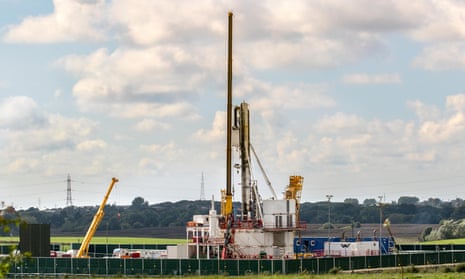
Caudrilla fracking rig under construction in Lancashire in 2017
. Photograph: MediaWorldImages/Alamy


Fiona Harvey 
Environment correspondent
THE GUARDIAN
Wed 21 Sep 2022

Fracking in the UK will be impossible at any meaningful scale and will not help with the energy price crisis, the founder of the UK’s first fracking company has warned.

Chris Cornelius, the geologist who founded Cuadrilla Resources, which drilled the UK’s first modern hydraulic fracturing wells in Lancashire, told the Guardian that he believed the government’s support for it is merely a “political gesture”.


“I don’t think there is any chance of fracking in the UK in the near term.”

He said that when Cuadrilla had operated here, it had discovered that the geology of the UK was unsuited to widespread fracking operations. “No sensible investors” would take the risk of embarking on large projects here, he said. “It’s very challenging geology, compared with North America [where fracking is a major industry].”

Unlike the gas-bearing shale deposits in the US, the shale resource in the UK is “heavily faulted and compartmentalised”, making it far harder to exploit at any scale.

Liz Truss, the prime minister, has made clear she supports fracking and will lift the moratorium that has been in place since 2019, though it remains to be seen where and how sites will be licensed. She has said she hopes to see gas from fracked sites as soon as six months from now.

But Cornelius said that “would not happen”. Truss’s decision to give the green light to fracking “is not going to have an impact” on the UK’s energy supply, he told the Guardian in an interview. “It makes good soundbites but I can’t see anything happening,” he said.

In the longer term, he said it was possible there could be a few localised operations, but they would be small and could not make a meaningful contribution to the UK’s energy needs. “They will never be at scale, because the capital costs are a huge issue,” he said.

Writing in today’s Guardian, Cornelius and his former colleague, Mark Linder, who handled public affairs for Cuadrilla in its early days, said the UK was over-regulated, having “singled out the energy sector for regulations that impede operations that are standard in agriculture and other industries”. But Cornelius said it was unlikely this would change and that frackers would not be given the “social licence” to operate.

Cuadrilla, founded in 2007, was the first company to use modern hydraulic fracturing and horizontal drilling technology in the UK on dense shale rocks, first at a site in Lancashire in 2011 and carrying on until 2018. Shale rocks, containing tiny pockets of methane, are blasted with a mixture of sand, water and chemicals to create fissures through which the gas can escape, to be siphoned off at the surface.

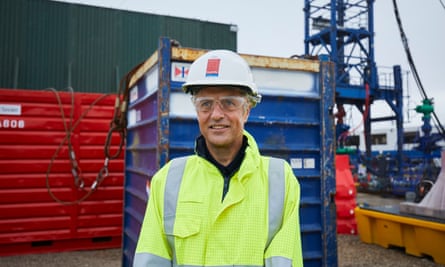
Cuadrilla’s chief executive, Francis Egan. The company has spent ‘hundreds of millions of pounds’ in its effort to start a fracking operation. 
Photograph: Christopher Thomond/The Guardian

However, Cuadrilla quickly ran into problems, including its failure to report damage to an exploratory well, and as public awareness of fracking grew, protests started at sites and potential sites. In 2018, an earth tremor of magnitude 1.5 at its site near Blackpool caused fracking to be halted. In February this year, the company said its wells – the only two wells to be horizontally drilled and hydraulically fracked in the UK – would be “plugged and abandoned”, in accordance with instructions from the regulator.

Cornelius resigned from Cuadrilla in 2014, after Lord Browne, former chief of the oil company BP, took over the chairmanship. Browne left in 2015. The company declined the opportunity to comment on Cornelius’s views.

Cuadrilla has spent “hundreds of millions of pounds”, according to its chief executive, Francis Egan, in its efforts start up a fracking operation. However, the company never produced any gas for sale.

Egan welcomed the announcement this month that the moratorium would be lifted, but the company has not yet said whether it will unseal any wells.

Cornelius, an academic geologist, remains a staunch defender of fracking – “it has been used safely around the world, across the US, with no problems” – and of shale gas, but said the geology of the UK and the densely populated nature of the British countryside made it impossible to set up a commercially viable fracking business here.

For Truss to promote fracking was “primarily a political decision – they have to be seen to be doing something”, said Cornelius. “It does not make economic sense. I do not think sensible people are putting money in this.”

He added: “This is a sad situation. It is a let-down. There was an opportunity 10 years ago to look at this [fracking] sensibly, but that opportunity has now gone. It was worth looking at then, but it’s not practical now.”

Writing in today’s Guardian, Cornelius and Linder call for investment in key technologies they say are more likely to produce energy than fracking, including geothermal energy and tidal power.

Cornelius, who in 2014 also attempted to start fracking under the Irish Sea with a project known as Nebula, which never became operational, is involved in a geothermal consortium called Triassic Power, which is evaluating the potential of using the hot water found underground in certain geological formations in the UK as an energy source. He has no business interest in tidal power.
Wet'suwet'en hereditary chiefs plan rally at legislature over Coastal GasLink
Wet'suwet'en Hereditary Chief Namoks (John Ridsdale), centre, leads a protest march against fracking in Vancouver, on Monday, August 15, 2022. 
THE CANADIAN PRESS/Darryl Dyck

Ian Holliday
CTVNewsVancouver.ca Reporter
Published Sept. 26, 2022 8:00 a.m. MDT

Hereditary chiefs of the Wet'suwet'en First Nation and their supporters are planning a rally at the B.C. legislature on Tuesday to "make an important announcement" about their efforts to stop a natural gas pipeline under construction on their territory.

"The Hereditary chiefs will issue formal public comment about a recent incident of being denied access to ancestral lands by Coastal GasLink," reads a news release issued Friday to announce the gathering.

"The gathering will also address current colonial governments’ failure to fulfill commitments to Wet’suwet’en rights and title as agreed in a memorandum of understanding signed in May 2020."

The rally is scheduled to begin at 3 p.m. Tuesday, with a news conference scheduled for 4 p.m.

The Coastal GasLink project involves the construction of a 670-kilometre pipeline that will carry natural gas across northern B.C. to the LNG Canada terminal in Kitimat. Once at the terminal, the gas will be liquefied and shipped to international customers.

In August, the company said the project was 70 per cent compete.

Dozens of protesters and Indigenous land defenders have been arrested along the pipeline's route through unceded Wet'suwet'en territory since a 2019 B.C. Supreme Court order issuing a temporary injunction against interference with pipeline construction.

While Coastal GasLink has agreements with all of the elected First Nations leaders along the pipeline's route, many Wet'suwet'en hereditary chiefs remain opposed to the project.

In early 2020, opposition to the pipeline led to nationwide protests and blockades.

More recently, police have set up "roving patrols" along forest service roads near the pipeline construction site after a February incident in which police say 20 people "armed with axes" attacked workers and destroyed property at the site.

After a recent visit to Wet'suwet'en territory, BC Green Party leader Sonia Furstenau and MLA Adam Olsen questioned the degree of surveillance from RCMP in the area, which Olsen described as "oppressive" and Furstenau said is "constant" for the people who live there.


RELATED STORIES

Colombians rally against Petro's policies

Tuesday, September 27th 2022 
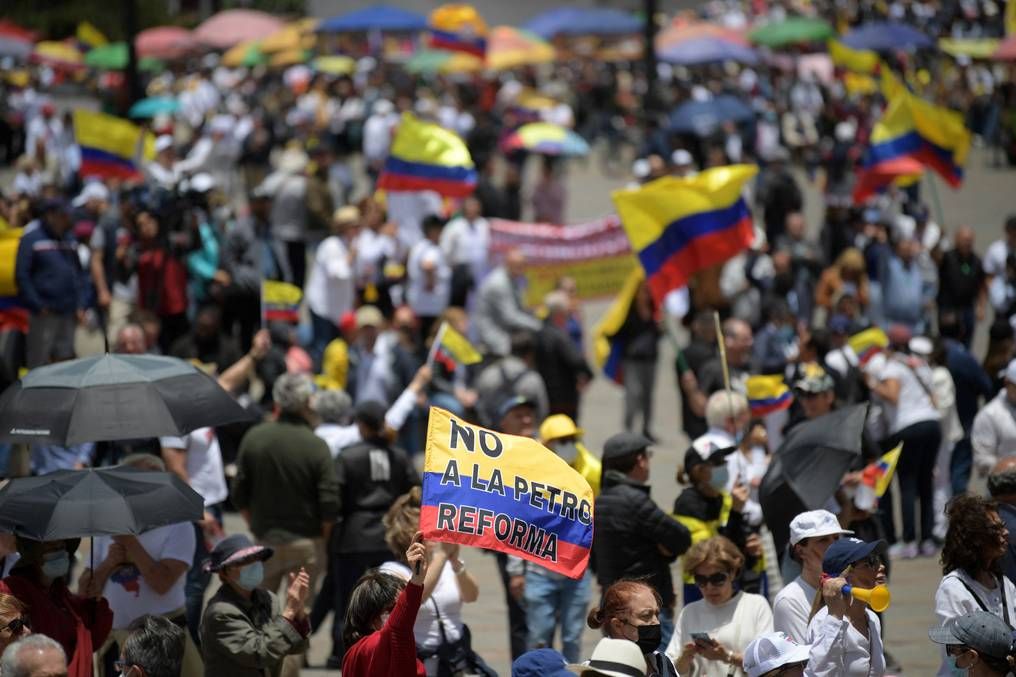
The so-called “Great National March” was staged in more than 20 cities nationwide

Thousands of Colombians took to the streets Monday to protest against the reforms proposed by President Gustavo Petro, a former guerrilla leader who came into power less than two months ago.

The so-called “Great National March” was staged in more than 20 cities nationwide and also in the United States, Mexico, Panama, and Switzerland. It was the first demonstration against the country's first-ever leftwing leader who has been head of state for less than two months.

In Bogota, people gathered mainly at the National Park and at the Plaza and Monument of the Fallen. Most were carrying Colombian flags and wearing white T-shirts. An encore is scheduled for October 24, organizers told reporters.

Interior Minister Alfonso Prada said Petro's government respected the people's right to protest and that public order would be “maintained peacefully.”

”The opposition called for today (Monday) a national day of protest. This government will respect the right of all citizens to social protest. Expressions of nonconformity will always be welcome and heard,” Prada said on Twitter.

Demonstrators argued that Petro's proposed tax reform will affect the poorest. Finance Minister José Antonio Ocampo seeks to raise 25 trillion pesos annually (about US$ 5.55 billion), to reduce the social debt.

“They have told the country that this reform was for the 4,000 richest Colombians, but it seems to be for 48 million Colombians,” a demonstration leader was quoted as saying. With Petro in office, some of his campaign promises are not quite as he said they would be. The demonstrations are also against the labor and electoral code reforms Petro intends to get through Congress next year. The latter would entail the creation of a body with the power to cancel any political party “in an arbitrary manner under criteria that they themselves will create,” the protest leader argued.

During the protest, Petro was at the border with Venezuela as the barriers were officially lifted. Nicolás Maduro did not attend the event. After that, Petro ordered all college degrees of Venezuelans to be validated within Colombia through the speediest mechanism available while hoping for reciprocity on Maduro's part.

Colombia gov't agrees to ease tax changes to oil, mining

Reuters

Publishing date:Sep 26, 2022 

BOGOTA — Colombia’s government agreed on Monday to modify a tax reform proposal under debate in congress and continue to allow oil and mining companies to deduct royalty payments from their taxes in the wake of a wave of industry criticism.

The government has agreed to back continued royalty deductions in exchange for raising income taxes on extractive industries by 5% and increasing an export tax to 20% for oil and coal sold above certain threshold prices, Finance Minister Jose Antonio Ocampo told journalists.

Colombia’s new leftist President Gustavo Petro has said he wants to raise 25 trillion pesos (some $5.6 billion) in tax revenue in 2023, before eventually adding about $11.5 billion annually for social programs to government coffers.

But clauses which would have prevented energy companies from offsetting taxes with royalty payments came under heavy criticism from producers who said they may make investment inviable.

“The agreement will trade non-deductibility (of royalties) for 5 extra points on income tax. It’s a surcharge, like for the financial industry,” Finance Minister Ocampo said.

The threshold for the export tax on oil will now be $71 per barrel, compared to a previous $48 per barrel.

Coal exports will see the duty levied when prices are above a 20-year average, though Ocampo did not give an exact figure.

Gold exports will not be included in the program as initially planned.

The reform may not raise 25 trillion pesos in additional income next year, Ocampo said, though he did not give more details.

Meanwhile a proposal to raise taxes on gasoline will be scrapped, and more changes to the bill are expected next week.

Thousands marched earlier on Monday to urge changes to the reform, which would also raise taxes on those earning more than $2,259 per month, about 10 times the minimum wage, and eliminate exemptions. (Reporting by Carlos Vargas; Writing by Julia Symmes Cobb; Editing by Kenneth Maxwell)

Why does work feel so dysfunctional right now? A psychologist, labor expert and CEO weigh in

Published Mon, Sep 26 2022
Jennifer Liu@JLJENNIFERLIU

Peopleimages | Istock | Getty Images

Dysfunction in the Covid-era workforce has reached a fever pitch.

If you’ve talked to anyone about work in the last month, you’ve probably discussed quiet quitting (or setting boundaries), the not-so-quiet backlash from bosses, and even warnings of quiet firing (or managing out).

Railroad workers prepared to go on strike. Starbucks workers are unionizing. Teachers and nurses, burned out beyond belief in year three of the pandemic, say they’re reaching a breaking point.

All the while, the Great Resignation has become less of an anomaly as sky-high turnover every month has become the new norm. Even worries of a looming recession and mounting layoffs haven’t shaken workers’ confidence.

The power struggles between workers and bosses may have buzzy catchphrases now, but they’re really nothing new, says Sharon Block, professor and executive director of the Labor and Worklife Program at Harvard Law School.

“I’m not sure that work is any more dysfunctional now for many workers than it’s been in the past,” she tells CNBC Make It. What has shifted, though, is that the tight labor market of the last year-plus gives workers the upper hand to vocalize, even push back on, the unaccommodating ways work gets done. On an existential level, people are re-thinking how they fill their time (including spending less of it at work).

“The experiences of the pandemic have brought these conversations of dysfunction to the fore,” Block says. “More workers are speaking up and speaking out about the quality of their jobs in a way they haven’t before.”

Work has always been dysfunctional, our tolerance for it just got lower

Workers are still quitting in droves during the Great Resignation. Roughly 4 million people, or 3% of the workforce, have voluntarily left their jobs each month since April 2021. But with more than a year of headline-making turnover, the novelty of the moment is becoming more of the new normal, says Anthony Klotz, an organizational psychologist and UCL management professor who coined the term “Great Resignation” in 2021.

Despite high quits in the recovering Covid economy, Klotz agrees that today’s disruption in the workforce is similar to levels seen as recently as in 2019, then the tightest labor market on record.

“In many ways work was dysfunctional in 2019,” Klotz says. That was the year the World Health Organization officially recognized work burnout as an occupational hazard, for example. And workplace diversity, equity and inclusion efforts reignited during the pandemic address disparities that have long existed.

“There were people who felt like the world of work wasn’t sustainable in 2019, and then the pandemic happened,” he says.

Call it the Great Reawakening or Great Reshuffle (Klotz is fine with all of the Great Resignation offshoots, by the way), but it’s clear workers aren’t just walking away from bad jobs. They’re walking toward and rebuilding new ways of working. For example, remote work has given people a “glimmer of hope” that work can look different than it did in 2019, Klotz says.

The discord we’re seeing, then, is vocal pushback from employees — emboldened by a tight market and, yes, social media fervor — not wanting to return to traditional models of work, Klotz says.

“I don’t know if there’s more dysfunction so much as, in many cases, we’re saying: No, we’ve seen a better path, or we have this opportunity right now, to make the world of work better,” he says. “And there’s a frustration with people in power who aren’t seizing that opportunity.”

Is anyone happy at work?

Trends like the Great Resignation and quiet quitting are loud warnings that, to put it simply, people don’t like how work is done, according to Jon Clifton, CEO of Gallup and author of “Blind Spot: The Global Rise of Unhappiness and How Leaders Missed It.”

“Humanity is trying to figure out every way possible to get away from work,” he says. “The problem is the work environments that are created.”

While 20% employees around the world are thriving at work, according to Gallup, another 19% of workers are “downright miserable,” Clifton says.

“It’s not that they’re just emotionally detached,” he explains. “They’re angry about what’s happening at their workplace.” People who are miserable at work report more stress, anger, worry and even physical pain than people who are unemployed.

Clifton says many of the executives he speaks with think the biggest thing driving people to quit is long hours. But Gallup polling indicates people are quitting because of unfair treatment in the workplace.

The best way to keep people from “running” from work, Clifton says, is to create better work environments that address workers’ basic but unmet needs: clear expectations of the job, proper materials for people to do their best work, opportunities to learn and grow, and managers that guide them through it all.

At the end of the day, workers want respect and recognition, Clifton says: “There’s still an overwhelming amount of executives who think their employees are automatons, that you can give them all the same assignments and they should be able to do them with the same ability. That’s not true. Human beings are emotional, and there’s a gap in appreciation.”

A ‘quiet exploitation’ through coinciding crises

Beyond outright resignations, quiet quitting has caught fire as a polarizing way to signal that workers are no longer bending over backwards to go above and beyond at work when it doesn’t suit them.

Block, the Harvard professor, describes the trend as “troubling” as far as what it signals about worker sentiments, but a reasonable response given the circumstances.

Worker wages have remained stagnant for years, though productivity (and CEO paychecks) spiked during the pandemic, “so there’s this quiet exploitation where workers are contributing more and more to the economy and not seeing the benefits as they’re seeing corporate profits rise,” Block says.

“Everyone is making money off of their work, and they’re not getting return on the investment of their labor. To call that out and say, you know what, I don’t necessarily need to go above and beyond if that effort isn’t going to be valued — that’s not quiet quitting. It’s standing up for yourself.”

Other dissatisfied employees are actively shaping workplace changes through a so-called union boom, with first-ever unions forming at Amazon, Starbucks, Apple, Google, Microsoft, REI and Trader Joe’s since 2021.

Some 71% of Americans now approve of labor unions, the highest level since 1965, according to Gallup. And the National Labor Relations Board reported a 57% increase in union election petitions filed during the first six months of fiscal year 2021.

Recent unionization efforts are centered around issues that have been on the table for decades, like access to paid leave, Block says. “You’re just seeing an increase in the wherewithal to actually stand up and talk about these issues.”


‘The genie’s out of the bottle’

Today, the Covid-era workplace is at another juncture. President Joe Biden declared the pandemic over, companies are ending their Covid sick leave, and corporate bosses are renewing calls to return to offices. Meanwhile, there were 424,339 reported Covid-19 cases and 2,973 deaths from the virus in the past week, according to Johns Hopkins University.

The Fed just made a “jumbo” interest rate hike, stoking another wave of recession fears. It could dampen some labor movement efforts and quiet some workplace discord if people are worried about their job security.

“There is certainly reason to believe tight labor market is contributing some to this increase in organizing,” Block says, “and the Fed has made clear their desire to rein in the labor market as a strategy to bring down inflation. It could take some of the wind out of the sails of union organizing.”

But she’s cautiously optimistic recent union wins will be enough momentum to keep workers advocating for better conditions: “The genie’s out of the bottle.”
Climate change is causing hurricanes to intensify faster than ever


Angela Fritz and Rachel Ramirez
CNN
Published Sept. 26, 2022 

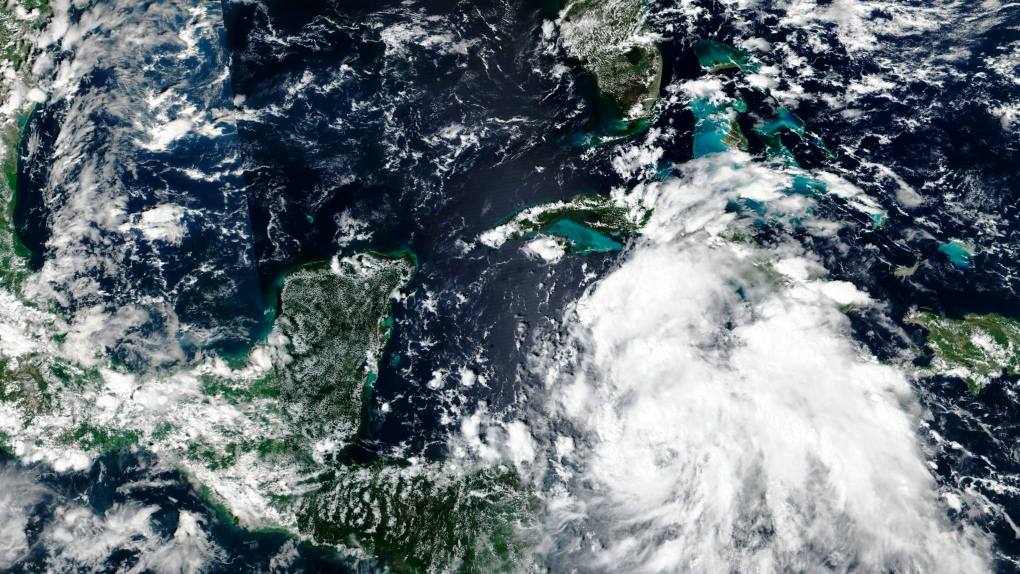
Hurricane Ian is strengthening rapidly in the Caribbean as it passes over the ultra-warm waters of the Caribbean and the Gulf of Mexico. The National Hurricane Center had predicted the system would rapidly intensify from a tropical storm to at least a category 4 hurricane in less than 72 hours.

It is an unprecedented forecast, experts told CNN, but one scientists say is becoming more likely as the climate crisis advances, pushing ocean temperatures higher and laying the groundwork for tropical storms to explode at breakneck pace into deadly major hurricanes.

Rapid intensification is precisely what it sounds like -- a hurricane's winds strengthening rapidly over a short amount of time. Scientists have defined it as a wind speed increase of at least 35 mph in 24 hours or less.

The phenomenon played out with breathtaking speed in the Philippines this weekend. Super Typhoon Noru exploded in strength on its final approach toward the Pacific island nation, going from the equivalent of a category 1 hurricane to a category 5 overnight as residents around Manila slept.

Noru's rapid intensification right before landfall -- which was not predicted -- likely meant locals had no time prepare for the much stronger storm.

Hurricane Ian's has been in the forecast for days, giving Cuba and Florida the benefit of time. Winds in the storm increased from 45 mph Sunday evening to 80 mph late Monday morning, and more strengthening is in the forecast. Ian could intensify into at least a category 4 before it makes landfall in Florida midweek.

Rapid intensification has historically been a rare phenomenon, according to Allison Wing, an assistant professor of atmospheric science at Florida State University.

It "is really sort of at the extreme end of how quickly storms can intensify," Wing told CNN. "Only something like 6% or so of all forecast time periods have those types of rapid intensification rates observed associated with them. And so it's something that's by definition, a rare event. Sometimes it only happens a few times per season."

Live updates: Florida braces for Hurricane Ian

But human-caused climate change is stacking the deck in favor of more intense storms. So not only are they generating more rainfall and larger storm surge -- they are also more likely to be stronger and are intensifying faster.

"Climate change is increasing both the maximum intensity that these storms can achieve, and the rate of intensification that can bring them to this maximum," said Jim Kossin, a senior scientist at the Climate Service. "The intensification rates in Noru and Ian are good examples of very rapid intensification, and there have been many others recently."

Two ingredients must come together for rapid intensification to occur, Kossin told CNN. The first is that upper-level winds around the hurricane need to be weak -- strong winds can prevent a storm from intensifying or even tear a storm apart.

The second is that warm ocean water must extend well below the surface, going hundreds of feet deep, to provide enough fuel for the hurricane to strengthen.

More than 90 per cent of global warming over the past 50 years has taken place in the oceans, according to the National Oceanic and Atmospheric Administration. The past five years have been the warmest on record for the world's oceans.

Scientists have shown humans are the dominant cause of the relentless warming trend. Planet-warming emissions from fossil fuels trap heat in the atmosphere, creating an energy imbalance. The oceans, in turn, absorb 90 per cent of the excess heat, which has led to an alarming increase in temperature.

And much of that warming has happened in the top levels of the ocean where hurricanes get their energy, said Jeff Masters, a meteorologist at Yale Climate Connections.

"Hurricanes and typhoons are heat engines, which means they take heat energy from the oceans and convert it to the kinetic energy that are winds," Masters told CNN. "So if you increase the amount of heat energy in the ocean by warming it up, you're going to increase not only the maximum intensity they can get, but also the rate at which they get to that maximum intensity."

A 2019 study found that Atlantic hurricanes in particular showed a "highly unusual" increase in rapid intensification from the 1980s to the early 2000s -- a trend that could only be explained by human-caused climate change. And, concerningly, scientists found that the most significant changes were happening to the strongest storms, making the most life-threatening hurricanes even more dangerous.

"Climate change increases the odds that you'll get a rapid intensifier," Masters said.

Some of the United States' most devastating recent hurricanes were ones that rapidly intensified right before landfall -- something Hurricane Ian is not expected to do. Most recently, Hurricane Ida in 2021 strengthened from a category 1 to a strong category 4 in the 24 hours before it made landfall in Louisiana and left a trail of destruction in its wake from the Gulf Coast to the Northeast.

Forecasters are getting better at seeing the signs of this phenomenon before it happens, though, which gives people along the coast more time to prepare for the worst.

Kossin said there are several reasons for this. One is that meteorologists are becoming more confident in the computer forecast models, which are improving at seemingly light speed. The other is that they have seen more extreme cases of rapid intensification in recent years, which makes it easier to forecast them in the future.

Masters told CNN it all adds up to better forecasts.

"The forecasts are unprecedented primarily because the [National] Hurricane Center is getting better at doing their job," Master said. Weather models "have gotten so much better. And our techniques for forecasting are getting better."


This Sept. 25, 2022 satellite image released by NASA shows Hurricane Ian over Caribbean Sea moving near the Cayman Islands and closer to western Cuba. (NASA Worldview, Earth Observing System Data and Information System (EOSDIS) via AP)