Friday, January 20, 2023

Fact check: Global temperatures have steadily risen over the past century, contrary to post

The claim: Global temperatures haven’t risen despite increasing greenhouse gas emissions

A Jan. 4 Facebook post (direct linkarchive link) claims global temperatures have remained consistent over the past hundred years.

“Not much has happened, except that world temperatures have been at a standstill for most of this century despite increasing emissions,” the text in the post reads.

The post was shared more than 25 times on Facebook.

Our rating: False

Global temperatures have steadily risen over the past century, according to data from NASA and the National Oceanic and Atmospheric Administration. The rise has resulted in an overall increase of nearly two degrees. Climate scientists say greenhouse gases are the main culprit behind global warming.

Greenhouse gas emissions contribute to global warming trend, climate scientists say

Howard Diamond, NOAA's climate science program manager, said the claim is unsupported by any legitimate scientific evidence.

The earth’s temperature has risen by about 0.14 degrees per decade since 1880, according to NOAA data. The rate of warming since 1981 is more than twice that, at a rate of .32 degrees per decade.

"That rise in temperature is unmistakable and is as clear as day," Diamond said in an email. "In some parts of the world, particularly at the higher latitudes towards the poles, the warming is much more accelerated."

The global warming trend has resulted in an overall increase of nearly 2 degrees across the globe since 1880. That level of temperature rise is consistent in reports from multiple major climate agencies.

Earth's average surface temperature in 2022 tied with 2015 as the fifth-warmest on record, according to the latest NASA data.

Most of the warming since 1950 has been caused by human emissions of greenhouse gases, which have continued to increase over the past century, according to the Environmental Protection Agency.

This amount of global warming has already caused consequential environmental changes, according to climate researchers. Scientists have observed sea-level rise, reduced sea ice and changes in weather patterns like drought and flooding.

Fact check: False claim the term 'global warming' was rebranded to 'climate change'

USA TODAY reached out to the Facebook user for comment.

Our fact-check sources

Thank you for supporting our journalism. You can subscribe to our print edition, ad-free app or electronic newspaper replica here.

Our fact-check work is supported in part by a grant from Facebook.

This article originally appeared on USA TODAY: Fact check: Greenhouse gases behind increase in global temperatures

India's Adani partners with Leyland, Ballard to make hydrogen fueled electric truck


Auto Expo 2023 in Greater Noida

Tue, January 17, 2023 

(Reuters) - India's Adani Enterprises Limited (AEL) said on Tuesday that it has signed an agreement with Ashok Leyland and Canada's Ballard Power to launch a pilot project to develop a hydrogen fuel cell electric truck (FCET) for mining logistics and transportation.

The project led by Adani, will have Ballard supply the fuel cell engine, while Indian truck maker Ashok Leyland will provide vehicle and technical support for the project.

The FCET is scheduled to be launched in India in 2023, the flagship company of Adani Group said in a release.

Hydrogen, made by splitting water with an electrical process called electrolysis, can be used as a fuel. If the devices that do that, electrolysers, are powered by renewable energy, the product is called green hydrogen.

In the next ten years, the Adani Group – led by Asia's richest man Gautam Adani – has plans to invest more than $50 billion in green hydrogen and associated ecosystems for a capacity of up to 3 million tons of green hydrogen annually, AEL said.

The Indian government had recently approved an incentive plan of 174.9 billion rupees ($2.11 billion) to promote green hydrogen and had set green hydrogen consumption targets for some industries earlier this month.

Indian companies such as Reliance Industries, Indian Oil, NTPC, Adani, JSW Energy, ReNew Power and Acme Solar have big plans for green hydrogen.

Adani has a tie-up with French energy company TotalEnergies as part of a deal to form a new green hydrogen project in India.

India plans to go net zero carbon emissions by 2070.

(Reporting by Biplob Kumar Das in Bengaluru; Editing by Shailesh Kuber)


Reversing abortion drug's approval would harm public interest, U.S. FDA says


Used boxes of Mifepristone pills, the first drug used in a medical abortion, fill a trash can at Alamo Women's Clinic in New Mexico

Tue, January 17, 2023
By Brendan Pierson

(Reuters) - President Joe Biden's administration is urging a judge to reject a request by abortion opponents for a court order withdrawing federal approval for the drug used in medication abortions - which account for more than half of U.S. abortions - citing potential dangers to women seeking to end their pregnancies.

The U.S. Food and Drug Administration's filing to U.S. District Judge Matthew Kacsmaryk, made available online on Tuesday, came in a lawsuit in Texas by anti-abortion groups challenging the agency's approval of the drug mifepristone in 2000 for medication abortion.

"The public interest would be dramatically harmed by effectively withdrawing from the marketplace a safe and effective drug that has lawfully been on the market for twenty-two years," lawyers for the FDA said in the filing to Kacsmaryk, who is based in Amarillo.

Mifepristone is available under the brand name Mifeprex and as a generic. Used in conjunction with another drug, it is approved to terminate a pregnancy within the first 10 weeks of a pregnancy. The FDA on Jan. 3 said the government for the first time will allow mifepristone to be dispensed at retail pharmacies.

Medication abortion has drawn increasing attention since the U.S. Supreme Court last June overturned its landmark 1973 Roe v. Wade decision that had legalized abortion nationwide. Nearly all abortions, including medication abortions, are now banned in 12 states, and 16 states that permit some abortions also had laws restricting medication abortion as of November, according to the Guttmacher Institute, a research group that supports abortion rights.

"No abortion is safe, and chemical abortions are particularly dangerous," said Julie Blake, senior counsel at the conservative legal group Alliance Defending Freedom, which represents the plaintiffs in the lawsuit. "The FDA, by approving chemical abortion drugs for home use, puts a woman or girl's life at risk."

The American College of Obstetricians and Gynecologists and the American Medical Association said in a joint letter to the Biden administration last June that "robust evidence exists regarding the safety of mifepristone for medication-induced abortion."

Anti-abortion groups including the Alliance for Hippocratic Medicine and the American Association of Pro-Life Obstetricians and Gynecologists sued the FDA in November, saying the agency improperly used an accelerated process to approve mifepristone and failed to study its risks for minors adequately.

In its court filing, the FDA said there was no basis for second-guessing the FDA's judgment. The FDA said that pulling the drug would force patients seeking abortions in many cases to undergo unnecessary and more invasive surgical abortion. That would result in longer wait times and would carry risks for some patients including those intolerant to anesthesia, the FDA added.

In support of its position, the agency submitted declarations from abortion providers. For example, non-profit Maine Family Planning said it would have to eliminate abortion services at 17 of its 18 clinics if mifepristone were no longer available.

Mifeprex maker Danco Laboratories on Friday also asked to intervene in the lawsuit to protect its ability to sell the drug.

(Reporting By Brendan Pierson in New York; Editing by Will Dunham and Alexia Garamfalvi)


DAVOS 2023
WEF: ‘We have everything we need to speed up the energy transition. It’s time to tackle humanity’s greatest challenge’


Krisztian Bocsi - Bloomberg - Getty Images

Jeremy Jurgens
Tue, January 17, 2023 at 1:55 AM MST·6 min read

If you’ve followed recent climate headlines, you know the climate news is tough. The plans we have won’t meet much-needed targets. We’re cutting emissions but not making headway fast enough. Experts agree: Our current pledges will keep us on track for a 2.5-degree Celsius rise by the end of the century, a shift that will multiply the climate calamities we’re already experiencing.

Only urgent action can help us reverse the trend. The good news is that for the first time in history, humanity has a reason to feel optimistic about our capacity to change course for the better.
Poised for progress

There has not been a time in history when humanity has been better positioned to finally mitigate the damage it has caused to the climate. Since the start of industrialization 230 years ago, humanity has released more than 2 trillion tons of carbon dioxide into the atmosphere. For much of that time, we’ve been either unaware or unwilling to accept our impact on this ever-warming planet.

However, in recent years, there’s been a critical shift. Today, in the climate science community, 97% agree humans created global warming–a consensus that wasn’t always a given. Around the world, society’s trust in climate science has surged. We no longer need to waste time debating whether there is a crisis.

As a result, we are free to build solutions. Today, technology is transforming our lives at shorter and shorter intervals–and the engineers and leaders powering these changes are more likely than ever to truly understand the need to prioritize the health of our planet.

There are now more engineers and scientists than at any point in history, with expertise more broadly distributed around the world. And with continued advances in A.I., computing capacity, sensors, and other capabilities, they have powerful tools to develop new technology and improve the efficiency of existing systems. These technologists and executives (specializing in everything from A.I. to satellites) have the know-how and motivation to further slash emissions and develop clean energy solutions.

That combination of will and way can be powerful–and we’ve already seen its potential. In the 1990s and 2000s, as the climate crisis intensified, a new focus emerged on renewable energy sources, including solar and wind, which cleared the way for technological advancements, improved manufacturing, and special subsidies that lowered barriers to entry. Solutions like solar photovoltaics and onshore wind power became scalable, accessible, and affordable (with costs falling by 82% and 39% over the last decade).

In the coming years, we can expect advanced energy systems to progress even further as the cost of new renewables falls at an even greater speed. By 2027, the International Energy Agency predicts 2,400 GW growth in renewable power capacity–an 85% acceleration from the previous five years. This expansion is expected to create a diverse energy mix, with low-carbon systems such as solar, wind, biomass, nuclear, and hydrogen offering clean and secure energy.
A paradigm shift

Leaders need to build momentum by taking the first steps in exploring and implementing new technologies. They’ll need to explore the edge of their businesses to transform the core. This will require three key changes:

Mindset. Leaders can only build for the future they can imagine. They’ll need to reset their understanding of what is currently possible, the speed at which advances are taking place, and how costs will likely evolve. Leaders don’t need to look for moonshots–we have the technology we need to make progress.

Practices. Our current business landscape is optimized for a world we aren’t planning to support–one that is built to reward old practices. Decades-old investment criteria that were designed for extractive industries need to be updated to scale a new generation of sustainable technologies.

Systems perspective. A new mindset and new sets of behaviors can be transformational as leaders operate with a systems approach. They’ll need to forge new partnerships inside and outside of their organizations and create new business models which reshape entire sectors and value chains.

Businesses that make these key changes can maximize the big opportunities we have now to further the energy transition.

For instance, advanced renewables such as hydrogen have clear potential. Hydrogen produces only water as a by-product (unlike fossil fuels which produce many pollutants, including carbon dioxide) and its use is already increasing thanks to a significant boost in public and private investments. While low-emission hydrogen use remains low overall, demand is growing–particularly in hard-to-abate areas such as shipping, aviation, and heavy industry.

In India, three of the largest industrial players are actively pursuing hydrogen, showing us a glimpse of what could happen next. Last year, a subsidiary of India's Reliance Industries, announced a partnership with the Danish energy firm Stiesdal to produce hydrogen more cheaply through electrolysis technology.

With such partnerships in place, it’s not a question of when but rather by how much companies will drop the cost curve for both electrolyzers and hydrogen production.

To be sure, scaling hydrogen will not be easy. Using it to power ships or heat homes requires massive quantities of the fuel which, as some experts have pointed out, is only as clean as the methods that produce it.

No aspect of the energy transition is without challenges: Electrification requires a rethink of the grid and batteries require an unprecedented improvement in how we manage the world’s rare earth supply.

Each low- and no-carbon energy solution we pursue will require massive change–from innovative funding models to new regulatory environments that support shifts in how economic sectors operate.

History has also given us a glimpse of what’s ahead: New efficiencies will emerge with a range of new technologies and processes at an increasingly faster pace. And while complications will never disappear, the core commitment to new mindsets, practices, and systems thinking will help us maintain momentum.

Leaders, technologists, and policymakers have what they need to move nimbly and overcome any number of climate challenges. It’s time we truly tackle the biggest challenge humanity has ever faced.

Jeremy Jurgens is the managing director of the World Economic Forum. This article is part of the World Economic Forum’s Annual Meeting 2023.

The opinions expressed in Fortune.com commentary pieces are solely the views of their authors and do not necessarily reflect the opinions and beliefs of Fortune.
Davos 2023: Brazil lacking world aid to fight climate change-Silva


Brazil's President Luiz Inacio Lula da Silva speaks during the inauguration ceremony of the new Banco do Brasil President Tarciana Medeiros, in Brasilia

Tue, January 17, 2023 


Marina Silva
Brazilian environmentalist and politician


DAVOS, Switzerland (Reuters) -Brazil's Environment Minister, Marina Silva, said on Tuesday that international investments have not materialized as contributions to help her country reduce deforestation in the Amazon and contribute to fighting global climate change.

She said Brazil has regained the trust of the European Parliament with regards to resistance to the EU trade deal with South America's Mercosur bloc.

Speaking at the World Economic Forum (WEF), Silva said Brazil's new government that took office on Jan. 1, was rebuilding Brazil's environmental agencies and policies that were "completely dismantled" by the previous administration.

Silva said President Luiz Inacio Lula da Silva had offered to hold the COP30 climate summit in the Amazon region in 2025 to show its commitment towards curbing in climate change.

"There is good global regulation but the investments are lacking and the $100 billion that the wealthy countries had committed are still not here. We need to have resources for mitigation actions and also for adaptation now," she said.

"The responsibility of preserving the Amazon rainforest is not ours alone," she added.

Silva said Brazil needs partnerships and technological support.

"We can cut down deforestation in the Amazon to zero but if the rest of the world still emits CO2, Amazonia is going to be destroyed all the same," the minister said.

Silva later told reporters the new government has overcome European distrust of Brazil's handling of the Amazon rainforest, and will "revisit" the free trade accord with Mercosur.

Lula has said he wants to renegotiate parts of the agreement that have taken 20 years to negotiate, to add environmental and human rights guarantees.

She said the Inter-American Development Bank, headed by Brazil's Ilan Goldfajn, was keen to finance sustainability projects, while actor Leonardo DiCaprio's foundation was looking to raise and invest $100 million in the Amazon.

Silva and Finance Minister Fernando Haddad represented Brazil at the WEF and discussed the country's economic, social and environmental roadmap in a panel.

(Reporting by Alessandra Galloni in Davos, Anthony Boadle and Eduardo Simoes in Brazil; Editing by Andrew Heavens and Bernadette Baum)
CHINA PARTY AT DAVOS
China tells the world that the Maoist madness is over – we can all make money again

Ambrose Evans-Pritchard
THE TELEGRAM
Tue, January 17, 2023 

Chinese President Xi Jinping waves after his speech as the new Politburo Standing Committee members meet the media following the 20th National Congress of the Communist Party of China, at the Great Hall of the People in Beijing, China October 23, 2022.
 REUTERS/Tingshu Wang

China has extended the olive branch to Western democracies and global capitalists alike, promising a new era of detente after the coercive “wolf warrior” diplomacy of the last five years.

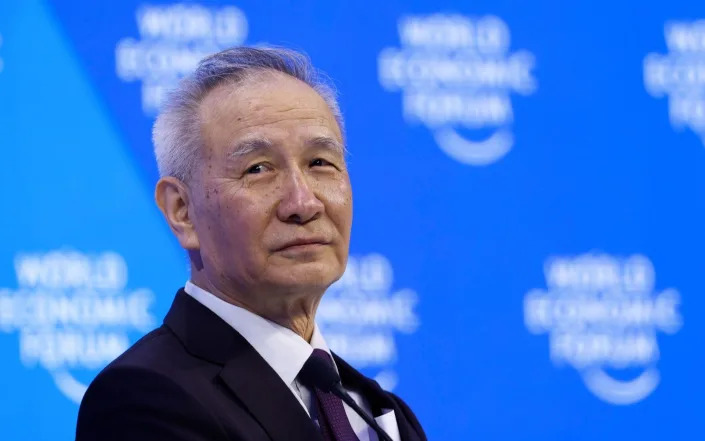
Vice-premier Liu He, the economic plenipotentiary of Xi Jinping’s China, told a gathering of business leaders and ministers in Davos that China is back inside the tent and eager to restore the money-making bonhomie of the golden years.

“We must let the market play the fundamental role in the allocation of resources, and let the government play a better role. Some people say China will go for the planned economy. That’s by no means possible,” he said.

“All-round opening-up is the basis of state policy and the key driver of economic progress. China’s national reality dictates that opening up to the world is a must, not an expediency. We must open up wider and make it work better,” he told the World Economic Forum.

The choice of Liu He as messenger of conciliation is lost on nobody. Both an economic moderniser and a graduate of Harvard’s Kennedy School of Government, his charm offensive in Davos hits two global constituencies at the same time.

It is a subtle way of telling the world that the neo-Maoist fever of Xi Jinping’s second term has subsided since the 20th Party Congress in October. Xi’s third term is going to be a giant pivot back to international harmony.

China is calling off its ruinous assault on technology companies – the country’s most dynamic entrepreneurs, but also the regime’s most powerful political foes. The green shoots of the next Chinese economic boom are already emerging.


Liu He, China's vice premier, on the opening day of the World Economic Forum (WEF) in Davos, Switzerland, on Tuesday, Jan. 17, 2023. The annual Davos gathering of political leaders, top executives and celebrities runs from January 16 to 20. 
Photographer: Stefan Wermuth/Bloomberg - 

“The technology sector is moving full steam ahead. We’re seeing the inflows come back through our China Connect and have got a hundred tech companies lining up to go public,” said Nicolas Aguzin, head of the Hong Kong Stock Exchange. The Hang Seng tech index is up 60pc from its nadir last year.

Aguzin said in Davos that China’s “remediation process” – a euphemism for the political purge of big business – has run its course. The Chinese people have accumulated $2 trillion in excess savings and are raring to go with an enormous spending spree.

It will act as a countercyclical buffer for the world as Europe and America struggle with recessionary forces. “China’s post-Covid reopening is the most positive catalyst for global markets this year,” he said.

Vice-premier Liu He’s conciliatory pitch is also a signal that China will return to its longstanding position as a stakeholder of the existing Davosian global order rather than a revisionist power determined to overthrow it.

“We need to uphold an effective international economic order. We have to abandon the cold war mentality,” he said, pledging a push for “economic re-globalisation”. There was not a whiff of criticism of the US or the West. No speech of this kind has been delivered by a top Chinese leader for years.

It goes well beyond the first signs of a tentative thaw at a US-China summit late last year, suggesting that China’s 20th Party Congress marked a watershed moment in Chinese strategic thinking. Whether it is authentic or tactical remains to be seen.

In a sense, the new policy is a recognition by the Communist Party that the democracies are not as weak as they looked a year or two ago. The West still controls the machinery of global finance, technology transfer, and maritime trade. The war in Ukraine has revealed that it can be remarkably unified and has a backbone of steel when seriously provoked.

Xi’s profession of friendship “without limits” for Vladimir Putin is surely an embarrassment he would rather forget – though there are some advantages for Beijing in a dependent Russia with nowhere else to turn. Russia’s military has been exposed as a paper tiger. Its value as an ally is enormously degraded.

Above all, Xi Jinping discovered that the US controls the global supply of advanced semiconductor chips, the primary fuel of the 21st century technological economy.

Without that you are nothing. China’s repeated efforts to close the chip gap have all faltered, and the latest has just been abandoned due to prohibitive costs.

Ursula von der Leyen, the European Commission’s president, struck a more sceptical tone in Davos. Speaking immediately before Liu He, she accused China of actively trying to poach European green-tech companies with subsidies, labour dumping and regulatory arbitrage, while systematically obstructing foreign access to its internal market.

“Competition on net zero must be based on a level playing field. We will not hesitate to open investigations if markets are being distorted by such subsidies,” she said.

The White House remains wary of the softer Chinese tone. The violation of the 1984 accords on Hong Kong is now an irreversible fact. Military islands are still being developed in the territorial waters of other countries in the South China Sea. It will take more than words to repair that diplomatic damage.

Deng Xiaoping long pursued a policy of “bide your time and hide your strength”. When Xi Jinping abandoned this restraint and switched suddenly to a posture of impatient menace he revealed what China might be like as the global hegemon.

This reached its apotheosis in pandemic triumphalism. It was not an attractive spectacle. Switching back even more suddenly to global happy talk will be a hard sell.

Liu He said China’s property bust had pushed the economy close to a systemic crisis, requiring a “blood transfusion” and massive state bail-out of the mortgage system to restore confidence. The worst is now over and the economy should be back to pre-pandemic trend growth of 5pc or more this year.

Officially, growth was 3pc last year. The proxy measure of Capital Economic suggested that it was far worse, with output contracting almost 7pc in November (year-on-year), before Beijing threw in the towel on zero-Covid. By this measure GDP is barely higher than it was before the pandemic.

A V-shaped economic rebound is now on the cards. China’s property curbs – the “three red lines” – have largely been lifted. All levers of policy are stimulative.

For the rest of the world, the implications are bittersweet. The risk is that surging Chinese demand for oil, gas, and commodities risks setting off another round of imported inflation before Europe and America have fully recovered.

Strap your belts for another turbulent year.

Chinese Foreign Minister Qin Gang calls on Israel to stop worsening Palestine issue with provocation

Mon, January 16, 2023 

Chinese Foreign Minister Qin Gang has called on Israel to refrain from provocations that could worsen the situation with Palestine, saying Beijing supports a fair and permanent solution to the issue.

"China is deeply worried" about the recent escalation of tensions between Israel and Palestine, Qin said in the Egyptian capital Cairo - his last stop on a five-nation African tour and first overseas trip since taking office in December.

"Israel should stop all incitement and provocation and avoid any unilateral actions that might lead to aggravation of the situation," the Chinese diplomat said at a joint press briefing on Sunday with Egyptian counterpart Sameh Shoukry.

Qin also called for "maintaining the status quo" at Jerusalem's most important holy site - after an ultranationalist Israeli cabinet minister visited the site known to Jews as the Temple Mount and to Muslims as the Noble Sanctuary - or the Al-Aqsa Mosque - Islam's third holiest shrine.


The Al-Aqsa Mosque in Jerusalem is Islam's third holiest shrine. Photo: dpa alt=The Al-Aqsa Mosque in Jerusalem is Islam's third holiest shrine. Photo: dpa>

The visit by Itamir Ben-Gvir, Israel's national security minister, was seen by Palestinians as a provocation and drew widespread condemnation from across the Muslim world.

Qin called on all concerned to maintain calm and restraint to prevent further escalation of tensions.

He said the Palestinian issue concerned regional peace and stability as well as international fairness and justice, and that China attached great importance to it, according to state news agency Xinhua.

Qin also noted that Chinese President Xi Jinping had put forward proposals on resolving the Palestinian issue on many occasions, urging the international community to firmly support the "two-state solution" and adhere to principle of "land for peace" to promote peace talks, expand humanitarian and development assistance to Palestine, and promote an early, just and lasting solution to the issue.

Qin said China had responded to Arab and Palestinian demands by supporting the UN Security Council in holding an emergency public meeting last week on the Palestine issue, and had pushed the council to play its due role in the matter.

He said the cause of the worsening situation between Israel and Palestine was that peace talks had stagnated and the "two-state solution" had not been implemented - referring to China's long-held ideal of an Israeli state and a Palestinian state in harmonious coexistence.

"The international community should increase its sense of urgency, put the Palestine issue at the top of the international agenda, and promote the resumption of peace talks between Israel and Palestine," Qin said.

Shoukry said the two ministers had "discussed the Palestinian cause, as well as the political and economic consequences of the Russia-Ukraine war regionally and internationally".

"That's in addition to the updates on the Grand Ethiopian Renaissance Dam issue," he added, referring to a US$4.6 billion hydropower project being built by Ethiopia on the Blue Nile, on which Egypt is heavily dependent for its water supply. China supports an Africa-led mediation process to resolve the dispute between Ethiopia, Sudan and Egypt.

Qin also met separately on Sunday with Egyptian President Abdel Fattah el-Sisi and secretary general Ahmed Aboul-Gheit of the Arab League, which is headquartered in Cairo.

The meeting with Aboul-Gheit came weeks after the first China-Arab States Summit, held in the Saudi capital Riyadh last month during Xi's tour of the region.

Calling the summit a success, Qin said China "firmly supports Arab countries in solving regional security issues via solidarity and coordination".

China supported a greater role for the Arab League in promoting peace and stability in the Middle East, he added.

Arab countries are a major source of China's oil and Beijing has lately increased its investments in the region, especially in the petroleum industry and in the reconstruction of countries destroyed by war, such as Iraq and Syria.

At his meeting with Qin, Egyptian President Sisi said he looked forward to the return of tourists from China following its recent border reopening, and invited Chinese companies to invest in the north African nation.

Chinese companies are already building massive projects in Egypt under Beijing's Belt and Road Initiative - such as a new administrative capital in Cairo and the Suez Canal special economic zone.

Qin said China would continue to develop its investments in Egypt's infrastructure, promote and speed up cooperation projects, as well as "advance belt and road cooperation and promote more fruitful implementation of the China-Arab States Summit's outcomes in Egypt".

Qin criss-crossed Africa for his first foreign trip since being named to replace the veteran Wang Yi as China's foreign minister on December 30.

His first stop was Ethiopia in the Horn of Africa, where he unveiled the Chinese-funded African disease control centre headquarters.

He next travelled to Gabon and Angola in central Africa and then further west to Benin, before rounding off his trip in Egypt.

Paul Nantulya, a China-Africa expert with the Africa Centre for Strategic Studies at the National Defence University in Washington, said Qin was hitting two birds with one stone in Cairo.

He said Egypt was a major power in Africa and enjoyed a "strategic cooperative partnership" with China, one of only seven African states to be accorded that highest level of engagement in bilateral ties.

Egypt is also an African Union heavyweight, as one of the "big five" that contribute most to its budget. This was a major criterion for how China prioritised and ranked its partners in Africa, Nantulya explained.

The meeting with the Arab League secretary general was "part of China's push to expand its ties in North Africa and the larger Arab world", he said.

Qin's trip to Egypt came close on the heels of Xi's visit to Saudi Arabia in December and the China-Arab States Summit, held up as the Middle East's version of the long-standing Forum on China-Africa Cooperation.

"It is interesting to see that China's latest push in the Arab world is occurring at the same time as the US seems to be pivoting, again, to Asia," Nantulya said.

This article originally appeared in the South China Morning Post (SCMP), the most authoritative voice reporting on China and Asia for more than a century. For more SCMP stories, please explore the SCMP app or visit the SCMP's Facebook and Twitter pages. Copyright © 2023 South China Morning Post Publishers Ltd. All rights reserved.

Copyright (c) 2023. South China Morning Post Publishers Ltd. All rights reserved.
Exclusive: Countries along migrant route to U.S. experiencing ‘enforcement fatigue,' DHS documents show

Jana Winter
·Investigative Correspondent
Tue, January 17, 2023 

Migrants seeking asylum in the United States line up for food at a makeshift encampment in Matamoros, Mexico, near the U.S.-Mexico border, on Dec. 29, 2022. (Reuters/Daniel Becerril)

The increasing influx of migrants to the U.S. border with Mexico is causing “enforcement fatigue” in Central and South American transit countries, according to Department of Homeland Security and Customs and Border Patrol documents obtained by Yahoo News, and almost all will not be able to handle an expected surge should Title 42 restrictions be lifted in the coming months.

“Multiple countries in Central and South America reported having limited resources and are requesting assistance from the United States as well as international partners to support migrants already in country, stating they are unable to provide migrants with basic social service requirements,” states a December DHS assessment. It is based largely on State Department communiqués from countries that migrants pass through on their way to the U.S., where they camp as they await policy changes, or where they are removed to if they are denied entry into the U.S.

Mexico, Guatemala, Honduras, Costa Rica and Panama are facing limitations on capacity at migrant shelters, with some countries having to shutter shelters due to lack of funding, the DHS report states. The assessment notes that these countries are unable to handle the increase of migrants heading to the U.S. that is expected if and when Title 42 restrictions are lifted.

“There are at least 35,200 migrants in northern Mexican border cities waiting to cross into the United States once Title 42 concludes,” states a Dec. 31 CBP internal report obtained by Yahoo News.

“Central and South American transit countries also face changing legislative actions that have reduced or eliminated their ability to detain or repatriate individuals who have entered their country without proper documentation — effectively creating an avenue for continued migration towards the United States,” the DHS report says.

This Dec. 15 assessment was produced by the department’s Intelligence Enterprise’s Migration Indicators and Warnings Cell Migrant Fusion Cell, and is based on State Department cables provided to CBP and DHS on the impact of the end of Title 42 in each central and South American transit country. A copy of this report was obtained by Yahoo News.

Young migrants from Guatemala traveling without adults walk toward a border patrol transport vehicle after being smuggled across the Rio Grande river from Mexico into Roma, Texas, on Nov. 8, 2022. (Reuters/Adrees Latif)

Used by the Trump administration during the first year of the coronavirus pandemic to stem the flow of migrants into the U.S., Title 42 is a clause of the Public Health Services Law that allows the government to block the entry and deport individuals from other countries during a public health emergency. During the first two years in office, President Biden allowed Title 42 expulsions to continue, but has since sought to wind down the policy. Title 42 has been used to expel “2.4 million migrants” along the Southwest border, according to the DHS report, “of which 1.4 million were Mexican nationals.”

In early December, 19 Republican-led states sued the Biden administration to try to keep Title 42 in place past a scheduled end date of Dec. 21. The U.S. Supreme Court will hear arguments in the case in February, but has opted not to block the policy in the meantime.

The expectation of both parties in the case is that rescinding the policy will result in a dramatic spike in the number of migrants attempting to cross into the U.S. from Mexico. Those fears are echoed in the government documents obtained by Yahoo News.

“As the public health order is scheduled to terminate on 21 December, CBP anticipates an increase in the number of migrants encountered along the SWB—above the already high levels we currently experience. This initial surge will likely be comprised of migrants who are currently waiting in Northern Mexico,” the DHS report states.

On Jan. 5, the White House and DHS announced new enforcement policies that the administration hopes will reduce the number of migrants heading to the U.S. ahead of the lifting of Title 42 restrictions. The new policies include the launch of an app, CBP One, which allows migrants, thousands of whom are currently camped out on the Mexican side of the border, to book an appointment with CBP at the border in advance of their arrival. The U.S. also announced it would use expedited removal authority to more quickly expel migrants waiting for a court date after crossing into the U.S. It also granted expanded parole for migrants from three countries. Mexico agreed to accept 30,000 migrants per month from four nations if they are not accepted into the U.S.

A migrant from Venezuela at a shelter in Ciudad Juarez, Mexico, uses his phone to access the U.S. Customs and Border Protection (CBP) CBP ONE application, to request an appointment at a land port of entry to the U.S., on Jan.12. (Reuters/Jose Luis Gonzalez)

The Biden administration’s expanded parole announcement prompted “concerns for authorities and confusion in migrants,” according to an internal CBP report dated Jan. 11, a copy of which was also obtained by Yahoo News. Officials in Baja California and Sonora, Mexico, voiced concern about managing daily returns of approximately 200 migrants with nationalities not eligible for expanded parole. Between Jan. 1 and Jan. 5, Mexico’s Migration National Institute apprehended an average of 2,795 irregular migrants a day, with only 114 being repatriated back to their country of origin. The U.S., Mexico and Canada are also working on a one-stop-shop website where migrants can see which country’s asylum or other immigration programs they may be eligible for. The U.S. is planning on several outreach campaigns targeting potential migrants, two officials said.

DHS and CBP did not respond to multiple requests from Yahoo News for comment.

Alan Bersin, a former Homeland Security official who served during the Obama administration and was nicknamed the "border czar,” suggested that enforcement fatigue in Mexico and other Central American countries would have little impact on the Biden administration's newest border initiatives.

“The key — and it’s a promising one — to the Biden proposals is their objective to reduce activity at the Southwest Border Line," Bersin told Yahoo News in an email. "By creating legal pathways into the United States through an asylum and parole ‘application’ process based away from the border, the new policies aim to impact the migrant/smuggler incentive calculation significantly and decrease the number of people who simply show up at the border line seeking relief."

An estimated 2,000 Venezuelan migrants continue to wait for Title 42 exceptions at the encampment along the Rio Grande River in Matamoros, Mexico, hoping for the opportunity to enter the U.S., according to a CBP Indications and Warnings Daily report produced by CBP’s Office of Intelligence and dated Jan. 11. Tensions over migrant center closures elsewhere in Mexico helped lead to riots at the Mexican Commission for Refugee Assistance in Tapachula on Jan 3. Other CBP documents note that the number of assaults against border patrol agents in El Paso, Texas, doubled from 2021 to 2022.

Asylum seekers in Matamoros wait in line to put their name on a list to get called when it is their turn to seek asylum in the U.S., on Dec. 22, 2022. This was the day after Title 42 had been expected to be lifted. (Veronica G. Cardenas/AFP via Getty Images)

The December DHS assessment, which is not public, also offers new details on what the South and Central American countries on the migrants' route are telling the U.S. government. Panama, Costa Rica and Guatemala said they are at capacity, lack funding or otherwise cannot handle the increase of migrants headed to the U.S. anticipated when Title 42 is lifted.

CBP documents, also obtained by Yahoo News, provide further detail, including a severe lack of staffing for vast areas of terrain on the Mexican side of the border. Only 11 agents from Mexico’s immigration agency, for instance, are deployed along the entire border with Arizona, one CBP document says.

Other recent DHS and CBP internal documents obtained by Yahoo News shed light on some of the issues being faced by countries on the route to the U.S.

“The Costa Rican government is reportedly overwhelmed by the migration surge as well as the related health, education, and security costs, and they emphasize the need for increased burden sharing by the international community, according to U.S. government reporting,” the Dec. 15 DHS assessment states.

In late July, 2022, the government of Panama notified the U.S. that it will begin limiting long-term detention for known or suspected terrorists and other special interest migrants, citing lack of funding and overcrowding and “lack of specific justifications for prolonged detention.”

Panama also notified the U.S. that detaining migrants costs between $55 and $65 per day. Should Title 42 be lifted, the subsequent flood of people is likely to result in much higher expenses, too.

Mexico’s immigration authority installed 234 checkpoints in southern Mexico, which has led to an increase in apprehensions. But even now, with Title 42 still in place, only a small percentage of those detained end up being sent back to their home country.

“The Government of Mexico has expressed concern regarding its limited capacity to apprehend, detain, and/or shelter the current levels of irregular migrants and asylum-seekers — with officials in Nuevo Laredo stating they are unprepared for a surge once the United States rescinds Title 42,” according to U.S. government reporting.

— Caitlin Dickson contributed reporting
Mexican mayor doubles down on accusation of alleged femicide cover-up


Mexico City’s Mayor Claudia Sheinbaum interviewed in Mexico City


Tue, January 17, 2023 
By Sarah Morland

MEXICO CITY (Reuters) - Mexico City's mayor renewed her criticism of a nearby state prosecutor for allegedly covering up the killing of a 27-year-old woman, a day after federal prosecutors issued an expert opinion saying the victim died from a blow to the head and not a result of alcohol intoxication as originally reported.

"Today, I again accuse Morelos' state prosecutor of covering up Ariadna's femicide," she said, adding that punishment must be meted out for those who "willfully concealed the truth." Claudia Sheinbaum, the mayor of Mexico's sprawling capital city, wrote on Twitter Tuesday morning.

She also called for the prosecutor's office to be sanctioned, without elaborating further.

Ariadna Lopez's body was found off a Morelos highway in late October a day after she was reported missing from Mexico City some 50 miles (80 km) away, in a case that sparked mass outrage.

The case highlights Mexico's longstanding problem with deadly violence against women, including femicide, or the murder of women or girls on basis of their gender.

Morelos prosecutors within days concluded she died when her oxygen supply was cut off as a result of alcohol intoxication, despite family members pointing to visible bruises on Lopez's body.

A second autopsy from Mexico City forensic experts in November concluded blunt force trauma was responsible for her death, while an investigation found footage from the apartment where she was last seen that showed a person carrying a woman's body to a car. Two suspects were later detained by police.

Federal prosecutors on Monday issued an expert opinion concluding Lopez died from a blow to the head, saying they could not support the assessment of the Morelos prosecutor's office.

In a Tuesday statement, the prosecutor's office in Morelos defended its autopsy and dismissed federal officials' conclusion that head trauma was the cause of death as "a respectable opinion" but not legally binding.

It added it had not been formally asked to provide information, but highlighted that its forensic team was made of "professional women" who took gender into account.

The prosecutor's office in Morelos told Reuters on Tuesday denied cover-up allegations, adding it was up to the judicial system to decide which autopsy should prevail.

The federal prosecutors advised that a criminal investigation should continue under Mexico City authorities.

Morelos is known for high rates of violence against women in a country which averages about 20 women killed each day. According to government data, very few cases result in sentences, while many of those that do cite lesser offenses that do not conclude the killing was intentional.

More than 70 cases of femicide were reported last December alone, according to official data.

(Reporting by Sarah Morland; Additional reporting by Carolina Pulice; Editing by David Alire Garcia and Aurora Ellis)
Columbia activist December Harmon announces U.S. Senate bid

Columbia Daily Tribune
Mon, January 16, 2023 

December Harmon announced she is running for the U.S. Senate in 2024.

A Columbia community activist, self-described as a "foul-mouth, no-nonsense radical liberal," aims to make a change in Washington D.C.

December Harmon made the announcement Monday on the Martin Luther King Jr. holiday that she is seeking a seat in the U.S. Senate in 2024, a move that could unseat Republican Sen. Josh Hawley if successful.


She said her aim is not to defeat Hawley, though, in her announcement, but to "fight the rise of fascism in America."

"I'm a millennial and I feel like the Nazi uprise — Charleston, Jan. 6, the book-banning, the people-banning (trans), the history banning (CRT), renewed state control of women — all happened under our watch. I believe we have a responsibility to fix it."

She currently is in a field of two against fellow Democrat Lucas Kunce, a U.S. Marine veteran who previously had sought the nomination in hopes of flipping the seat previously held by Roy Blunt, who retired from the Senate. He announced his candidacy on Jan. 6. He aims to unseat Hawley, as well.

He previously ran for the U.S. Senate last year, but was defeated in the primary in August by Democrat Trudy Busch Valentine, who herself would lose out on the seat to former Missouri Attorney General Eric Schmitt.

Harmon is known for her community activism as member of the Columbia Citizens Police Review Board, and speaking at abortion rights rallies in Columbia.

More: Rep. Cori Bush pushes for change at Columbia reproductive rights rally

"I saw corruption in our city government and in policing practices. ... I realized fighting white supremacy and fighting the government turned out to be the same thing," she said. "It's why I chose Martin Luther King Jr. Day to remind everyone of the fight that still is going on. The fight for freedom from oppression."

Harmon has a variety of issues she hopes to tackle in Washington, noting it as "The Playbook for Fighting Fascism" on her campaign website. Topics include police brutality and climate change, in support of the Green New Deal, along with codifying abortion access, gun control and among others.

She also would like to see the voting age lowered from 18 to 16.

"They work. They pay taxes. Why do young adults not have a say when they contribute their labor like everybody else?"

She said she is running because she felt "abandoned by the (Democratic) party in the name of civility. Now, I'm running for all the people the Democratic establishment left behind."

She recognizes her candidacy is an uphill battle of David versus Goliath proportions.

"I'm not rich. ... If we don't come together now to fight in 2024, for the Senate and the presidency, we might not get another chance," she said.

Harmon wants to be a new kind of a candidate for Missouri as a Christian, Black, lesbian, asexual woman, touting the New Left ideology.

"I'm the liberal Fox News warned you about," she said in the announcement.

This article originally appeared on Columbia Daily Tribune: Columbia activist announces U.S. Senate run to unseat Sen. Josh Hawley