Friday, February 17, 2023

Magnesium – a promising candidate for rechargeable batteries

Staff Writer | February 16, 2023 |
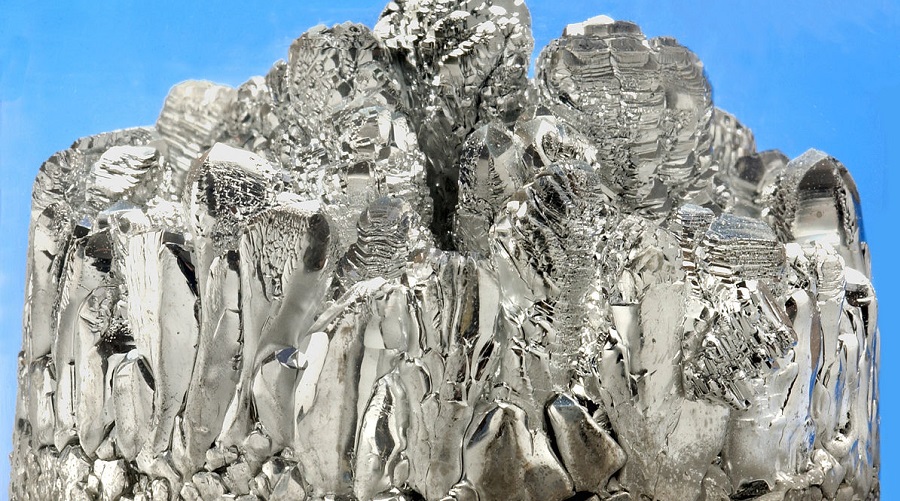
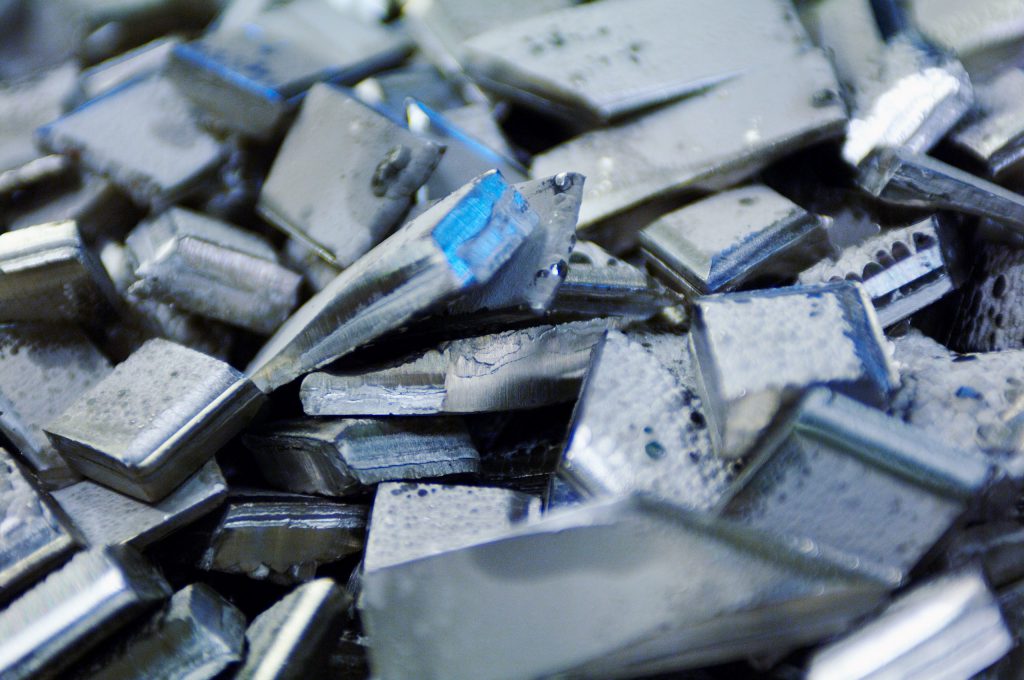
Crystalized magnesium. (Reference image by CSIRO, Wikimedia Commons).

A research team at the Tokyo University of Science has achieved some success in its search for new cathode materials for magnesium batteries.


In particular, the researchers are focusing on ways to improve the performance of cathode materials based on the magnesium-vanadium system.

In a paper published in the Journal of Electroanalytical Chemistry, the group explains that they worked with the Mg1.33V1.67O4 system but substituted some amount of vanadium with manganese, obtaining materials with the formula Mg1.33V1.67−xMnxO4, where x goes from 0.1 to 0.4. While this system offered high theoretical capacity, more details about its structure, cyclability, and cathode performance needed to be analyzed to understand its practical utility.

Accordingly, the researchers studied the composition, crystal structure, electron distribution, and particle morphologies of Mg1.33V1.67−xMnxO4 compounds using X-ray diffraction and absorption, as well as transmission electron microscopy. The analyses showed that Mg1.33V1.67−xMnxO4 has a spinel structure with a remarkably uniform composition.

Next, they conducted a series of electrochemical measurements to evaluate the battery performance of Mg1.33V1.67−xMnxO4, using different electrolytes and testing the resulting charge/discharge properties at various temperatures.

The team observed a high discharge capacity for these cathode materials—especially Mg1.33V1.57Mn0.1O4—but it also varied significantly depending on the cycle number. To understand why this happened, they analyzed the local structure near the vanadium atoms in the material.

“It appears that the particularly stable crystal structure along with a large amount of charge compensation by vanadium leads to the superior charge/discharge properties we observed for Mg1.33V1.57Mn0.1O4,” lead researcher Yasushi Idemoto said in a media statement. “Taken together, our results indicate that Mg1.33V1.57Mn0.1O4 could be a good candidate cathode material for magnesium rechargeable batteries.”

Idemoto said that through future research and development, magnesium batteries could surpass lithium-ion batteries thanks to the former’s higher energy density.

The scientist pointed out that, in addition to the potential to realize higher battery capacities, magnesium is considered a promising candidate for rechargeable batteries because the metal is safer for battery chemistries than lithium and is more abundant.

Thus, his research aims to address the low voltage window that Mg ions provide, as well as the unreliable cycling performance observed in Mg battery materials.

South32 sees China manganese demand up as half-year profit falls

Reuters | February 16, 2023 

Construction site in China (Stock Image)

Diversified miner South32 Ltd pointed on Thursday to signs of rising Chinese demand for steel-making material manganese, while reporting a 44% drop in first-half underlying earnings driven by inflation and falls in prices for its key commodities.


The result slightly beat analyst’s expectations.

The company, the world’s biggest producer of manganese, said the steel market in China had just begun to warm up following the end of pandemic controls there late last year. A pick-up in property-related steel demand from China would underpin higher manganese prices in coming months, chief executive Graham Kerr told Reuters.

“Real estate is probably still the sluggish market at the moment. That hasn’t quite taken off yet compared to the industrial side,” he said.

However, fresh buying of steel from that sector should erode stockpiles and help lift manganese prices to around $6.20 per dry metric tonne over the next three months from around $5.90 currently, he said. As more supply from South Africa appeared, prices would fall back towards $5.20 to $5.30, he said.

Headquartered in Perth, South32 was spun off from mining giant BHP Group in 2015. It also produces aluminum, lead, zinc, nickel and coking coal and copper.

Underlying earnings for the six months ended Dec. 31 were $560 million, compared with $1 billion a year earlier and ahead of a Visible Alpha consensus of $550 million.

South32 logged $127 million in cost rises linked to general inflation across its Australian, South African and Columbian operations.

Kerr said inflation was particularly acute in Australia’s labour market, where competition for highly paid workers such as jumbo drill operators was fierce. Lithium developments in Western Australia and mine-sustaining projects by iron ore majors were driving up demand for such workers.

Also, he said, some people no longer wanted fly-in, fly-out (FIFO) jobs, in which workers live at a mine for perhaps two weeks then go home for a week.

“That’s a function of a number of things: people coming out of Covid and making decisions around lifestyle. Some don’t want to do FIFO anymore,” he said.

“We are also losing some of our jumbo operators to places like Africa because they are chasing the dollars, so that’s the inflation driver.”

Kerr expects Australia’s labour market to stay tight for another 12 to 18 months.

The company expanded its capital management programme for the second half of its financial year by $50 million to $2.3 billion, leaving $158 million to be returned to shareholders by Sept. 1. It declared an interim dividend of 4.9 cents per share, down from 8.7 cents in the prior year and slightly below Citi’s expectation of 5.7 cents.

The shares closed 0.9% higher at A$4.66.

South32 separately said its vice-president of finance, Sandy Sibenaler, would become chief financial officer.

The company left its full-year 2023 production guidance unchanged.

(By Melanie Burton and Archishma Iyer; Editing by Shailesh Kuber and Bradley Perrett)
Mitsubishi Materials targets more mines to triple copper output by 2030
Reuters | February 16, 2023 | 

The Zafranal porphyry copper-gold deposit in southern Peru owned by Teck Resources, AQM Copper and Mitsubishi Materials Corp. Credit: AQM Copper

Japan’s Mitsubishi Materials Corp aims to more than triple its copper concentrate output through equity holdings by 2030, possibly through buying stakes in early and mid-stage mining development projects, its president said on Thursday.


“We will be targeting projects that have considerably progressed in terms of the development stage, and those that are in the early stage,” President Naoki Ono told a news conference, when asked about investment plans for copper mines.

Under a mid-term business plan unveiled last Friday, the company plans to invest 250 billion yen ($1.9 billion) by 2030 in the resource recycling business which include copper mining and smelting.

Mitsubishi Materials, which owns stakes in several copper mines including Los Pelambres and Mantoverde in Chile, aims to boost its copper concentrate production to 500,000 tonnes a year by fiscal 2030 from 150,000 tonnes now.

Japan’s third-biggest copper smelter also plans to expand its smelting capacity in Japan by about 30% by 2030, Ono said.

“We will also consider mergers and acquisitions in rare earth and lithium-ion battery recycling,” he said.

($1 = 133.9200 yen)

(By Yuka Obayashi; Editing by Jason Neely)
CRIMINAL CAPITALI$M
Trafigura nickel fraud would not happen at Glencore, CEO says
Bloomberg News | February 16, 2023 |

Refined nickel at Glencore’s Nikkelverk refinery in Norway. 
Credit: Glencore

Glencore Plc has no exposure to the Indian businessman accused by rival Trafigura Group of perpetrating a nickel fraud of more than half a billion dollars.


Gupta and his companies are “not a counterparty of our company,” Glencore Chief Executive Officer Gary Nagle told journalists on Wednesday. “So we do not have any exposure to that group.”

Trafigura last week accused Prateek Gupta and companies connected to him of perpetrating a “systematic fraud” against it, after finding that nickel cargoes it had bought from him in fact contained no nickel.

In a dig at Glencore’s longstanding rival, Nagle said that his company’s controls meant that he could be sure it would not be hit by a similar situation.

“We have very strong controls and systems in the company, and we are very confident that an incident like that would not be able to happen at Glencore,” he said.

Court filings showed that shortcomings in Trafigura’s controls meant it paid Gupta’s companies hundreds of millions of dollars for cargoes of nickel without always having insisted on certificates verifying the contents, Bloomberg reported earlier this week. The trading house believes it’s likely that none of the 1,104 containers it bought from Gupta actually has any nickel inside.

Gupta and his companies have not responded to requests for comment.

(By Jack Farchy)

Related article: Trafigura faces $577 million loss on alleged nickel fraud
Newcrest to trial 4G LTE, 5G technologies underground at Cadia Valley

Staff Writer | February 16, 2023 | 

Newcrest’s Cadia Valley Operations is the largest underground mine in Australia. 
Credit: PHE Pty Ltd.

Newcrest (ASX: NCM) (TSX: NCM) will trial advanced 4G Long-Term Evolution (LTE) and 5G mobile technologies to assess the potential of cellular delivery of data and video to support a smarter, safer and more sustainable underground mine operation.


The trial will take place at its Cadia Valley Operations (CVO), located bout 20 km from the regional city of Orange, New South Wales, Australia. Cadia is home to one of Australia’s largest gold mining operations, comprising the Cadia East underground panel cave mine and the Ridgeway underground mine (currently in care and maintenance).

In partnership with Ericsson and Telstra Purple, Newcrest will deploy a private 4G LTE and 5G trial network in its underground operations at Cadia in the coming months.

This announcement follows previous engagements where the trio worked to improve communications coverage, performance and safety with private 4G LTE at the Lihir mine in Papua New Guinea, and more recently for surface operations at Cadia Valley.

Speaking at the Sweden-Australia Sustainable Mining Summit in Sydney earlier this week, CVO general manager Aaron Brannigan said modern mining is a data-driven business, with technology and digitalization creating new levels of productivity and safety, greater efficiency and reduced environmental impact.

“In the ongoing quest for productivity, efficiency and safety, Newcrest must use every tool at our disposal to boost performance at site while continuing to ensure that everyone at our mines gets home safely at the end of the day,” Brannigan said.

“With 4G and 5G mobile technologies potentially offering better performance and capabilities than Wi-Fi, this trial will help Newcrest to assess its viability for greater coverage, capacity and functionality to support advanced underground automation, our Connected Worker strategy and future growth at Cadia,” he added.

The underground trial will utilize Ericsson’s Private 5G (EP5G) solution for Industry 4.0 enterprises to assess different cellular approaches for coverage and capacity needs and deployment economics. It will include the use of various 4G and 5G radio types, massive- and multi-user MIMO (multiple-input-multiple-output) advanced antenna systems for high-density and high-capacity connectivity requirements, and Uplink Booster technology derived from custom-made Ericsson Silicon system-on-a-chip 5G processors to increase uplink signal strength and data throughput.

“5G connectivity will be instrumental in enabling advanced teleremote and autonomous technologies, which are integral to industries such as mining. We’re delighted to be working with Newcrest and Telstra Purple to trial Ericsson’s 4G LTE and 5G solutions, and enable Newcrest to develop know-how on how to best deploy them underground,” said Emilio Romeo, Ericsson’s head of Australia and New Zealand.
Congo demands $17bn more in infrastructure investments from China deal

Reuters | February 16, 2023 

State mining company Gecamines headquarters. (Image courtesy of Gecamines).

Congo’s state auditor has demanded an additional $17 billion of investments from a 2008 infrastructure-for-minerals deal with Chinese investors that is currently being renegotiated, documents seen by Reuters on Thursday showed.


President Felix Tshisekedi’s government has been revisiting the deal struck by his predecessor Joseph Kabila under which Sinohydro Corp and China Railway Group Limited agreed to build roads and hospitals in exchange for a 68% stake in Sicomines, a cobalt and copper joint venture with Congo’s state mining company Gecamines.

Under the Sicomines deal, the Chinese investors committed to spending $3 billion on infrastructure projects, but the state auditor – Inspection Generale des Finances (IGF) – demanded that commitment be increased to $20 billion, to reflect the value of the mining concessions that Gecamines contributed to the deal.


A Sicomines official did not immediately reply to a request for comment. He has previously defended the deal, saying it had driven development for Congo’s people and that Sicomines would invest more as production increased.

So far, Sicomines has only spent $822 million on infrastructure investments, according to the IGF report seen by Reuters. The auditor also called for an “immediate” $1 billion investment from Sicomines, and a commitment to 50% of the workforce on infrastructure projects being Congolese.

Among a list of 16 demands, the IGF called for the “renegotiation of the Convention to adjust and balance the duties and benefits of both parties and bring them into line with the value of their respective contributions”.

The auditor also demanded that Gecamines be given a bigger stake in Sicomines. It currently has a 32% holding.

Congo’s finance minister Nicolas Kazadi told Reuters last month that the government expects to reach an agreement on the Sicomines deal this year.

(By Stanis Bujakera, Sonia Rolley and Helen Reid; Editing by Mark Potter)
De Beers confident talks will deliver a Botswana diamond deal

Reuters | February 16, 2023 

De Beers’ Damtshaa mine in Botswana. Image source: De Beers Group

De Beers is confident of maintaining its long-standing partnership with Botswana, a company official told Reuters on Thursday, but said some of the negotiations to agree new terms were complex.


Botswana President Mokgweetsi Masisi on Sunday threatened to walk away from talks on the extension of De Beers’ mining rights in the country unless it got a larger share of revenues.

De Beers’ Vice President-Corporate Affairs (Global Sightholder Sales) Otsile Mabeo told Reuters by email the company was “confident that our successful partnership will continue” and said that “the arrangement must make economic and strategic sense for both parties”.

Anglo American Plc’s De Beers is in talks with the Botswana government to extend mining rights that expire in 2029, as well as a 2011 diamond sales agreement that expires in June this year.

“It’s important to note that our negotiations span more than just the sales agreement, they also include the future mining rights for Debswana, which are more complex and require more time to land on the finer details,” Mabeo said.

Under the current deal, Debswana – a 54 year-old joint venture between De Beers and the Botswana government – sells 75% of its output to De Beers, while 25% goes to the state-owned Okavango Diamond Company. Botswana supplies 70% of De Beers’ rough diamonds.

Last year, Debswana’s diamond sales hit a record $4.588 billion, compared to $3.466 billion in 2021. Diamond sales, almost entirely from Debswana, account for two-thirds of Botswana’s foreign currency receipts and a fifth of its gross domestic product.

Botswana government officials were not immediately available to comment, but Lefoko Moagi, Botswana’s mines minister, told Reuters earlier this month he hoped a deal would be reached before the June deadline.

“A lot has been done, and what is left is material, but it is not insurmountable, it is in our best interests that we resolve that by the deadline,” Moagi said on the sidelines of last week’s Cape Town indaba mining conference.

(By Brian Benza; Editing by Nelson Banya and Barbara Lewis)
TAKE THAT U$A
China to scrutinize Ford-CATL deal to ensure core technology isn’t shared


Bloomberg News | February 16, 2023 

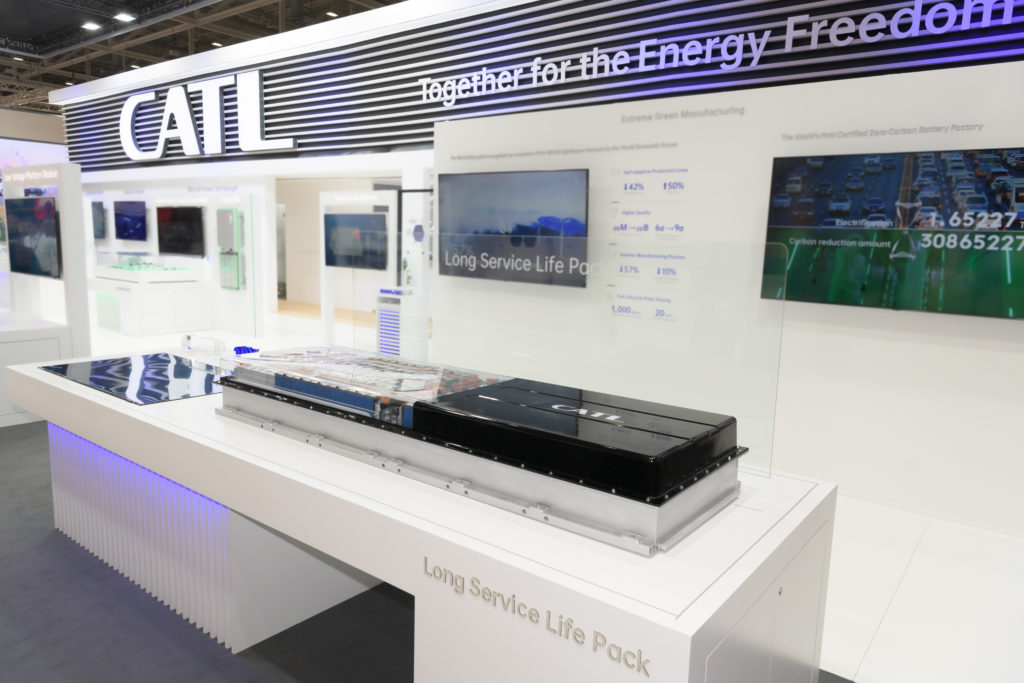
CATL’s newly introduced Long Service Life Pack. Credit: CATL

China will scrutinize Ford Motor Co.’s recent agreement with Contemporary Amperex Technology Co. Ltd. to ensure the Chinese battery giant’s core technology isn’t handed over to the US carmaker, people familiar with the matter said. The move is another sign of heightened US-China geopolitical tensions complicating business deals.


Ford said Monday the tie-up would see CATL’s lithium iron phosphate, or LFP, battery technology licensed for use in a new $3.5 billion electric-vehicle battery plant that Ford will run and control in southwest Michigan.

While Beijing is pleased the deal showcases China’s prowess in the EV battery space, officials are concerned that competitive aspects of CATL’s technology could be given to or accessed by the American automaker, the people said, asking not to be named discussing Chinese government deliberations.

Senior Chinese leaders asked for the extra scrutiny, given the sensitivity of the deal and the current state of tensions between Washington and Beijing, the people said. The findings will be presented to the top leadership, but the format and timeframe for that process isn’t yet known, they added.

One of the people said it’s unlikely to result in the tie-up being blocked.

The plan, which has already been examined by lower-level officials in China, is getting this extra layer of national-level scrutiny because of the significance of the deal and its implications for US-China relations, the people said.

Representatives from China’s Ministry of Commerce, the National Development and Reform Commission and the Ministry of Industry and Information Technology didn’t immediately respond to requests for comment Thursday. Representatives for Ningde, Fujian-based CATL also didn’t reply to a request for comment.

“We are not aware of any outreach by Chinese government officials on this matter,” Ford said in an emailed statement.

Control of key technologies has become a significant front in the standoff between the world’s two biggest economies, with the US moving aggressively to restrict China’s access to chipmaking and other strategic capabilities. President Joe Biden put China’s domination of EV batteries in his sights with his signature climate bill — the Inflation Reduction Act — which means electric cars made with a certain amount of China-linked materials miss out on lucrative consumer tax credits.

The IRA has met with significant pushback from the world’s top battery makers, of which CATL is No. 1. China controls vast swathes of the supply chain for battery materials and CATL is a leader in LFP battery technology and production.

Officials in China will also check that individuals sanctioned by the country as part of its tit-for-tat with the US aren’t involved in the Ford-CATL project, seen as a boost for Michigan’s once-dominant automotive industry. China has sanctioned a range of individuals amid frictions with the US, including former Commerce Secretary Wilbur Ross, a raft of Trump administration staff and top executives at Boeing Co. and defense contractor Raytheon Technologies Corp.

A subsidiary of Raytheon and Lockheed Martin Corp. were sanctioned on Thursday for selling arms to Taiwan.

The Ford plant will be the first in the US to produce LFP batteries, which are less expensive and should make its EVs more affordable, Lisa Drake, Ford’s vice president of EV industrialization, told reporters after the factory announcement earlier this week. CATL will help set up the Michigan plant and have staff there, Drake said.

Criticism of deal


The arrangement is being seen as a possible template for how automakers in the US can still secure tax advantages while benefiting from China’s battery prowess.

It’s drawn criticism in the US at a time of heightened geopolitical tensions with China, inflamed by an alleged Chinese spy balloon that flew over America before being shot down.

Virginia Governor Glenn Youngkin pulled his state from consideration as a location for the factory, calling it a “Trojan horse” for the Chinese Communist Party, while US Senator Marco Rubio has called for a Committee on Foreign Investment in the US (CFIUS) review of the licensing agreement.

China has banned or restricted some military or dual-use technologies from export in the past. But while satellite, pharmaceutical and agricultural tech are covered on an export-ban list, battery making doesn’t appear on it.

More often on the receiving end of bans and restrictions from other countries when it comes to investment and tech use, China has also acted to thwart deals.

Ride-hailing giant Didi was made to delist from the New York Stock Exchange and Tiktok parent Bytedance’s US IPO plans were indefinitely postponed in 2021 after Beijing launched investigations into their data security, including concerns Chinese user and location information could be accessed by foreign entities if overseas investors had a stake in the companies.

(With assistance from Linda Lew, Danny Lee and Keith Naughton)
GLOBALIZATION REDUX
Ghana mining fund mulls multi-million investment in Atlantic Lithium

Cecilia Jamasmie | February 17, 2023 |

Atlantic Lithium has projects in Ghana and Côte d’Ivore. (Image courtesy of Atlantic Lithium.)

Australia’s Atlantic Lithium (LON: ALL) (ASX: A11) said on Friday that is engaged in talks with Ghana’s state-owned Minerals Income Investment Fund (MIIF) for funding of up to $30 million.


The exploration and development company is developing the Ewoyaa project in central Ghana, which would be the country’s first lithium mine.

Atlantic says the operation, which is expected to begin production in the second half of 2024, has the potential to generate nearly $5 billion in revenue over its 12.5-year lifetime.

The MIIF confirmed plans to take an equity stake in Atlantic Lithium and said the company had agreed to list on the Ghana Stock Exchange. Atlantic Lithium said only that discussions were ongoing, adding that there was no certainty an investment will be made.

A resource update for Ewoyaa, released early February, shows a mineral resource estimate (MRE) of 35.3 million tonnes at 1.25% lithium oxide (Li2O), including 28-million tonnes in the measured and indicated categories.

READ NOW: RANKED — World’s largest clay and hard rock lithium projects

That 79% of the resource that now falls within the measured and indicated categories is made up of 3.5-million tonnes at 1.37% Li2O in the measured category and 24.5-million tonnes at 1.25% Li2O in the indicated category.

Ghana, known for its gold and cocoa production, has long sought to diversify its exports, and Atlantic Lithium, previously known as IronRidge Resources, believes that mining the battery metal could be a partial solution.

Prices for the ultra-light metal have surged about 10 times since the start of 2021 to almost $80,000 per tonne, reflecting supply shortages and higher demand from the car industry.

IronRidge changed its name and spinned of its gold assets into a separate company to focus on production of the battery metal, key for the batteries that power EVs and high tech devices.
Teck said to plan coal spinoff to focus on metals

Bloomberg News | February 16, 2023 | 

Greenhills is one of the five steelmaking coal operations Teck Resources has in the Elk Valley, British Columbia. (Image courtesy of Teck Resources.)

Teck Resources Ltd. is planning to separate its multibillion-dollar steelmaking coal business to focus more on industrial metals, according to people familiar with the matter.


The Canadian miner is expected to make an announcement on the spinoff as early as next week, the people said, asking not to be identified as the matter is private. Deliberations are ongoing and no final decision has been made, the people said.

Shares rose 9.9% to C$61.79 at 10:55 a.m. in Toronto before trading was halted. That marks the highest intraday price in 12 years.

Teck has been weighing options for its coal division for over a year in a strategic shift toward mining more of the metals such as copper that are crucial to the global energy transition. Metallurgical coal is used in steelmaking, which is among the most polluting industries and faces significant pressure from policymakers.

The company declined to comment.

Teck, which is scheduled to report earnings next week, is one of the world’s largest exporters of metallurgical coal. The company produced more than 24 million metric tons in 2021 from four different operations in western Canada, according to its filings. The business accounted for 55% of the company’s gross profit.

Teck has been exploring options for the business since at least September 2021, when people familiar with the matter said the business could be worth about $8 billion.

A coal spinoff would leave Teck with a suite of copper and zinc mines across the Americas, including the Quebrada Blanca 2 copper project in Chile that has long been admired by some of its biggest rivals. It also owns a stake in the Antamina copper and zinc operation with BHP Group and Glencore Plc.

The world’s biggest miners are increasingly looking to exit fossil fuels. Rio Tinto Group has exited coal altogether, while Anglo American Plc has sold out of thermal coal. BHP divested some of its thermal coal and quit oil and gas altogether. BHP and Anglo still have large met coal operations, the sort of coal Teck is looking to hive off.

Attractive target

Separating the coal business would likely make Teck an attractive target for large mining companies such as BHP and Rio Tinto that have been hunting for takeovers to expand in industrial metals — providing the family that controls the shares would be willing to sell.

Teck’s standalone base metals business would make a very attractive M&A target should the controllers ever decide to sell, Citibank analyst Alexander Hacking said in a note Thursday.

“The question going forward is whether additional value can be surfaced by splitting the company, at the expense of the diversification and scale benefits,” RBC Capital Markets analyst Sam Crittenden said in a Thursday note. “We don’t see an obvious buyer for the met coal business so this would largely be a standalone met coal business.”

Bloomberg reported last month that the world’s biggest producers have rediscovered an appetite for mega deals, after years of staying on the sidelines.

(By Thomas Biesheuvel, Dinesh Nair and Jacob Lorinc)


Teck, PolyMet launch NewRange Copper 
Nickel JV to advance Minnesota projects

Staff Writer | February 15, 2023 | 

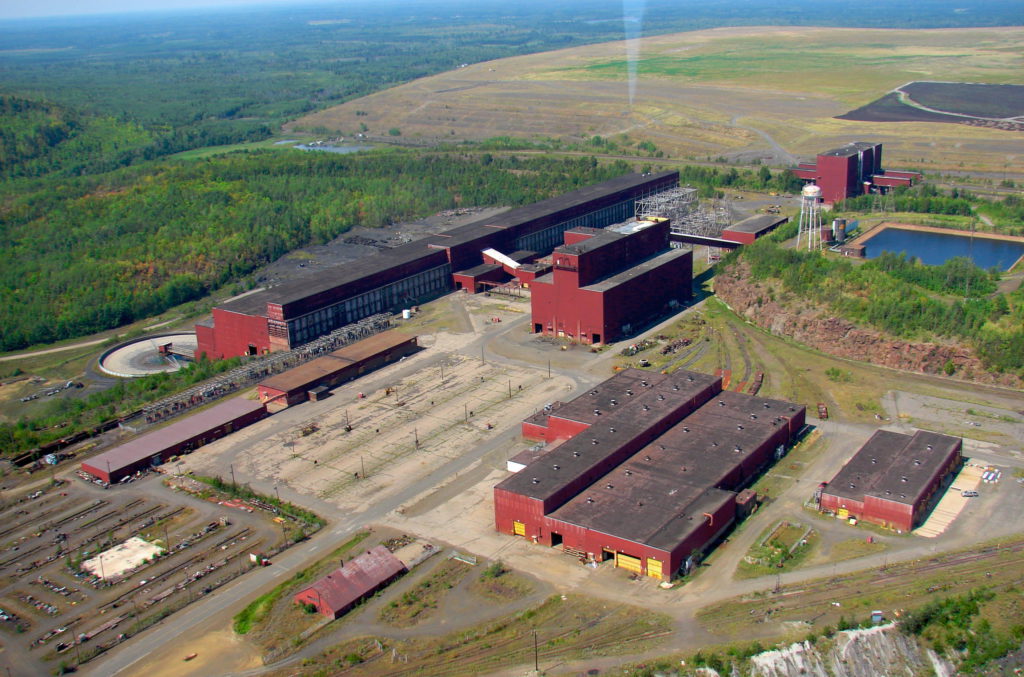
The NorthMet plant site is the former LTV Steel taconite processing site. PolyMet Mining photo

Teck (TSX: TECK.A, TECK.B; NYSE: TECK) and PolyMet (TSX: POM; NYSE: PLM) have launched the NewRange Copper Nickel joint venture with the aim to supply critical minerals for the clean energy transition across North America. Together, they plan to become the second nickel producer in the US.


NewRange holds both the NorthMet and Mesaba copper, nickel, cobalt, and platinum group metal deposits, two significant clean energy critical mineral resources located in northeastern Minnesota.

The two resources contain measured and indicated resources of 637 million tonnes and 2 billion tonnes for NorthMet and Mesaba respectively, and additional inferred resources of 400 million tonnes and 1.3 billion tonnes respectively.

In total, the two assets represent approximately one-half of the known 7.25-billion-tonne Duluth Complex resource in northeastern Minnesota.

NorthMet is expected to produce 29,000 tonnes of ore per day over a 20-year permitted mine life, with first production targeted for 2026. Over its first full five years of operations, it is expected to deliver annual payable production of 30,000 tonnes of copper, 3,600 tonnes of nickel, 58,000 oz. of palladium, and 12,000 oz. of platinum. Estimates for Metsaba are currently unclear.

PolyMet and Teck are responsible for funding their pro rata share of costs related to the NorthMet and Mesaba projects. The owners have committed to an initial work program with an estimated budget of $170 million to maintain permits, update feasibility cost estimates, and undertake detailed engineering to position NorthMet for a development decision following permit clearances, and to advance Mesaba studies.

Glencore has committed to support PolyMet’s respective portion of NewRange’s initial $170 million work program and certain other costs and expenses in the amount of approximately $100 million.

“NewRange Copper Nickel has potential to be a modern, multi-generational operation that will support North America’s acceleration to a carbon-neutral future, build a better quality of life for people, and diversify and create significant economic benefits for northern Minnesota and beyond,” said Tannice McCoy, the newly appointed general manager of NewRange following a 21-year career with Teck.
Peru protests jolt mine activity with Las Bambas, Antapaccay hit hardest

Reuters | February 16, 2023 | 

Las Bambas mine. (Image by MMG).

Peru’s top copper mines are starting to see activity hit harder by protests and blockades in the country’s southern Andes, power data reviewed by Reuters shows, with Chinese-owned Las Bambas and Glencore PLC’s Antapaccay currently worst affected.


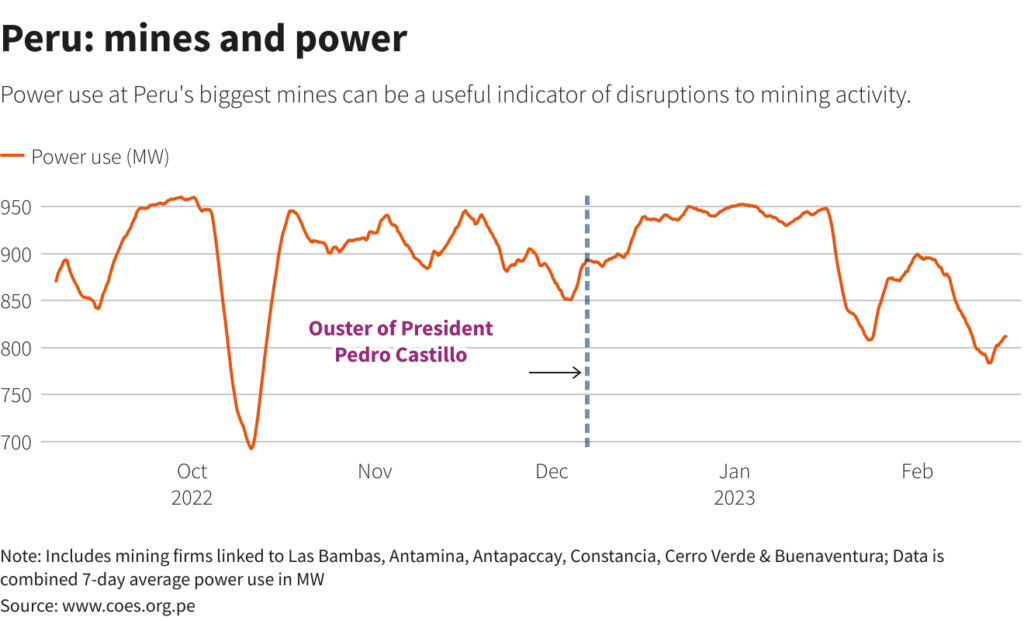
The South American country, the world’s no. 2 producer of the red metal, has been roiled by protests since the Dec. 7 ouster of President Pedro Castillo, though mining operations had generally remained resilient until this month.


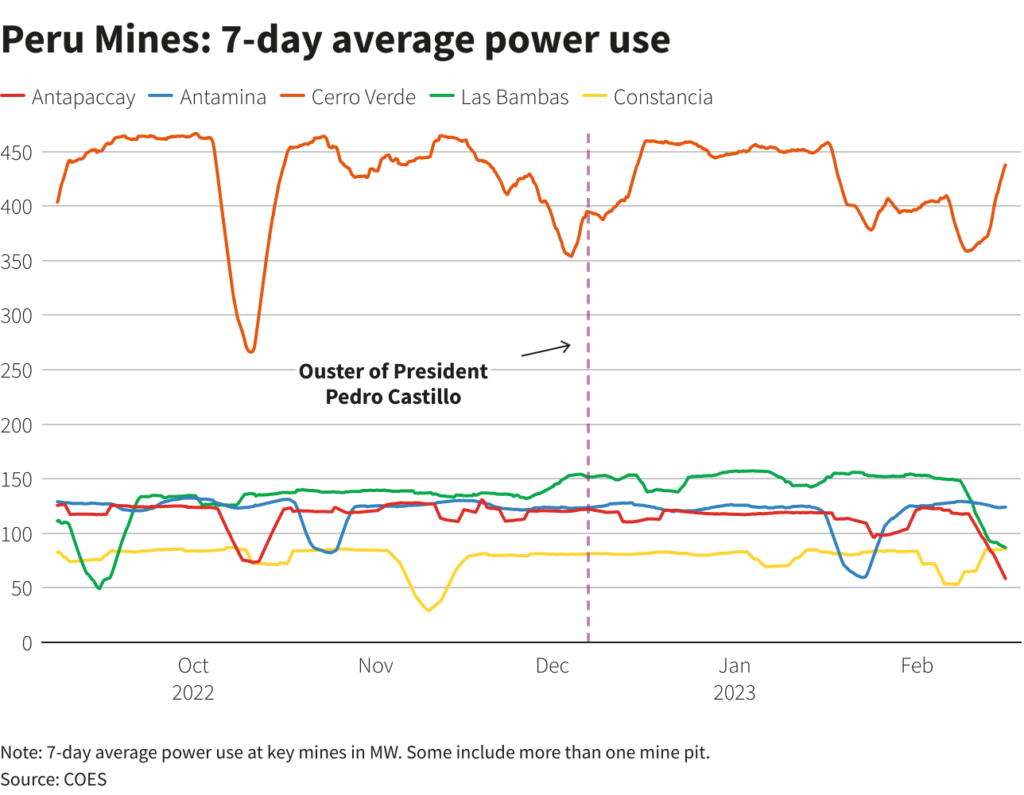
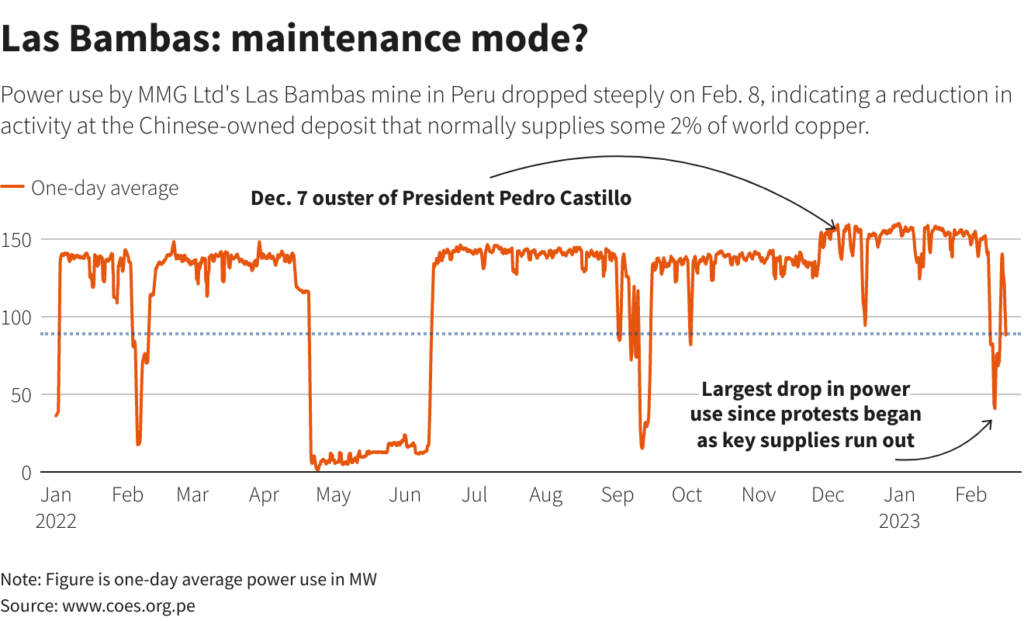
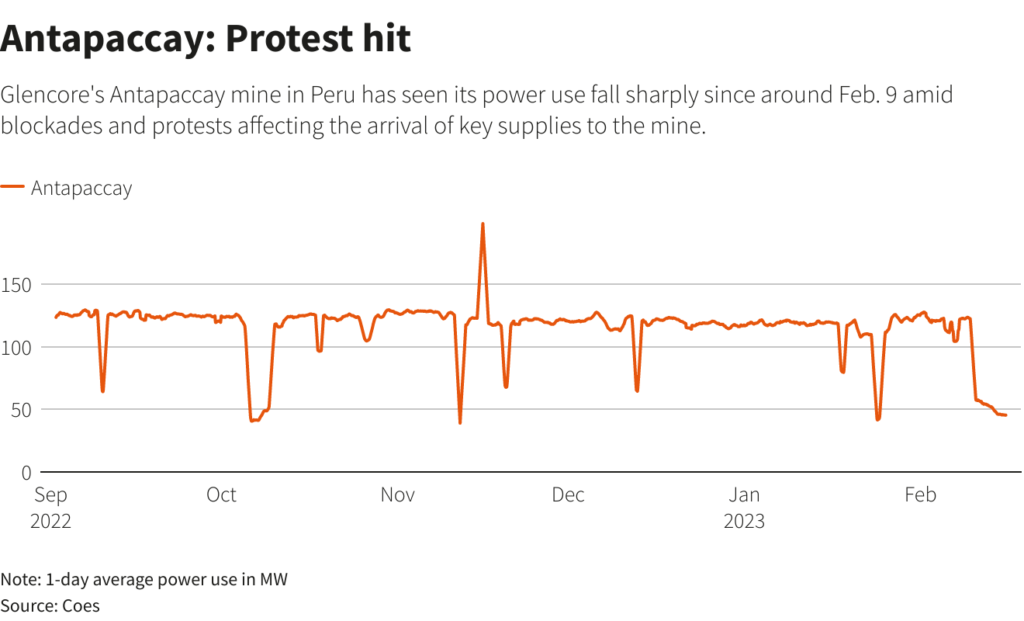
However, a Reuters analysis of daily power use data from COES, which represents firms in Peru’s energy sector, shows that at least two key mines are now regularly only drawing half their normal power as key supplies needed for mining operations run out, suggesting they are in ‘care and maintenance’ mode.


Those are MMG’s Las Bambas, Peru’s third largest copper mine, and Glencore’s Antapaccay, which have both been hit by blockades on a key mining corridor highway. Latest data up until Thursday showed both at half normal power usage.

Miners in Peru, however, have a long history of dealing with community protests which have at times caused long shutdowns, something not yet seen in the current nationwide anti-government protests where nearly 50 people have died in clashes.

The data backs this up, suggesting that mines are at times getting some supplies through the blockades, with Las Bambas in recent days see-sawing between full and half power use.


A source familiar with the matter told Reuters on Thursday that protesters had temporarily lifted blockades a day earlier on a key section of the mining corridor in Condoroma, Cusco, used by Las Bambas, Antapaccay and Hudbay’s Constancia.

They were, however, threatening to resume the blockade on Friday, the source added, underscoring the current uncertain environment which has hit the arrival of supplies to mines and transport of copper concentrate for export.

Antapaccay said on Monday that five fuel trucks had been attacked and vandalized while on route to the mine.


Representatives from Las Bambas, Antapaccay and Constancia were not immediately available to comment on whether they were receiving inputs for their operations or sending their concentrates in the two-day window with the blockades eased.

Other key mines including Peru’s largest copper mine Antamina, co-owned by Glencore, BHP Group, Teck Resources Ltd and Mitsubishi Corp, appear to be still drawing near normal levels of power, despite some temporary disruptions in recent months.

An analysis of power use by six key mine operators shows that combined electricity use levels have dropped overall since mid-January, with the biggest slide this month.

“The longer that the supply of raw materials remains hostage to the protests the higher the risk that affected mines either run at limited capacity or halt production entirely,” Capital Economics said in a note this week.

“Anecdotal reports and high frequency data suggest that ongoing civil unrest in Peru is beginning to choke off activity at key copper mines. But, if recent history is anything to go by, output can rebound rapidly so long as closures are brief.”


(By Marco Aquino and Adam Jourdan; Editing by Diane Craft)