Wednesday, May 31, 2023

G7 Should Be Shut Down


This is an undemocratic body that uses its historical power to impose its narrow interests on a world that is in the grip of a range of more pressing dilemmas. writes Vijay Prashad.


Leon Golub. U.S., “Vietnam II,” 1973.

By Vijay Prashad
Tricontinental: Institute for Social Research
May 27, 2023


During the May 2023 Group of Seven (G7) summit, the leaders of Canada, France, Germany, Italy, Japan, the United Kingdom and the United States visited the Hiroshima Peace Memorial Museum, near where the meeting was held. Not doing so would have been an act of immense discourtesy.

Despite many calls for an apology from the U.S. for dropping an atomic bomb on a civilian population in 1945, U.S. President Joe Biden has demurred. Instead, he wrote in the Peace Memorial guest book: “May the stories of this museum remind us all of our obligations to build a future of peace.”

Apologies, amplified by the tensions of our time, take on interesting sociological and political roles. An apology would suggest that the 1945 bombings of Hiroshima and Nagasaki were wrong and that the U.S. did not end their war against Japan by taking the moral high ground.

An apology would also contradict the U.S. decision, backed fully by other Western powers over 70 years later, to maintain a military presence along the Asian coastline of the Pacific Ocean (a presence built on the back of the 1945 atomic bombings) and to use that military force to threaten China with weapons of mass destruction amassed in bases and ships close to China’s territorial waters.

It is impossible to imagine a “future of peace” if the U.S. continues to maintain its aggressive military structure that runs from Japan to Australia, with the express intent of disciplining China.


Tadasu Takamine, Japan, Still frame from: “God Bless America,” 2002.

U.K. Prime Minister Rishi Sunak was given the errand to warn China about its “economic coercion” as he unveiled the G7 Coordination Platform on Economic Coercion to track Chinese commercial activities.

“The platform will address the growing and pernicious use of coercive economic measures to interfere in the sovereign affairs of other states,” Sunak said.

This bizarre language displayed neither self-awareness of the West’s long history of brutal colonialism nor an acknowledgement of neocolonial structures — including the permanent state of indebtedness enforced by the International Monetary Fund — that are coercive by definition.

Nonetheless, Sunak, Biden and the others preened with self-righteous certainty that their moral standing remains intact and that they hold the right to attack China for its trade agreements.

These leaders suggest that it is perfectly acceptable for the IMF — on behalf of the G7 states — to demand “conditionalities” from debt-ridden countries while forbidding China from negotiating when it lends money.



Kent Monkman, Canada, “The Scream,” 2017.

Interestingly, the final statement from the G7 did not mention China by name, but merely echoed the concern about “economic coercion.” The phrase “all countries” and not China, specifically, signals a lack of unity within the group.

European Commission President Ursula von der Leyen, for instance, used her speech at the G7 to put the U.S. on notice for its use of industrial subsidies: “We need to provide a clear, predictable business environment to our clean tech industries. The starting point is transparency among the G7 on how we support manufacturing.”

One complaint from Western governments and think tanks alike has been that Chinese development loans contain “no Paris Club” clauses.


The Paris Club is a body of official bilateral creditors that was set up in 1956 to provide financing to poor countries who have been vetted by IMF processes, stipulating that they must pledge to conduct a range of political and economic reforms in order to secure any funds.

In recent years, the amount of loans given through the Paris Club has declined, although the body’s influence and the esteem its strict rules garner remain. Many Chinese loans — particularly through the Belt and Road Initiative — refuse to adopt Paris Club clauses, since, as Professor Huang Meibo and Niu Dongfang argue, it would sneak IMF-Paris Club conditionalities into loan agreements.


“All countries,” they write, “should respect the right of other countries to make their own choices, instead of taking the rules of the Paris Club as universal norms that must be observed by all.” The allegation of “economic coercion” does not hold if the evidence points to Chinese lenders refusing to impose Paris Club clauses.

Francesco Clemente, Italy, “Sixteen Amulets for the Road (XII),” 2012–2013.

G7 leaders stand before the cameras pretending to be world representatives whose views are the views of all of humanity. Remarkably, G7 countries only contain 10 percent of the world’s population while their combined Gross Domestic Product is merely 27 per cent of global GDP.

These are demographically and increasingly economically marginalised states that want to use their authority, partly derived from their military power, to control the world order.

Such a small section of the human population should not be allowed to speak for all of us, since their experiences and interests are neither universal nor can they be trusted to set aside their own parochial goals in favour of humanity’s needs.


Elisabeth Tomalin, U.K., “Head,” ca. 1920.

Indeed, the agenda of the G7 was plainly laid out at its origin, first as the Library Group in March 1973 and then at the first G7 summit in France in November 1975.

The Library Group was created by U.S. Treasury Secretary George Schultz, who brought together finance ministers from France (Valéry Giscard d’Estaing), West Germany (Helmut Schmidt), and the U.K. (Anthony Barber) to hold private consultations among the Atlantic allies.

At the Château de Rambouillet in 1975, the G7 met in the context of the “oil weapon” wielded by the Organisation for Petroleum Exporting Countries (OPEC) in 1973 and the passage of the New International Economic Order (NIEO) in the United Nations in 1974.

Schmidt, who was appointed German chancellor a year after the Library Group’s formation, reflected on these developments: “It is desirable to explicitly state, for public opinion, that the present world recession is not a particularly favourable occasion to work out a new economic order along the lines of certain U.N. documents.”

Schmidt wanted to end “international dirigisme” and states’ ability to exercise their economic sovereignty.

The NIEO had to be stopped in its tracks, Schmidt said, because to leave decisions about the world economy “to officials somewhere in Africa or some Asian capital is not a good idea.”

Rather than allow African and Asian leaders a say in important global matters, U.K. Prime Minister Harold Wilson suggested that it would be better for serious decisions to be made by “the sort of people sitting around this table.”

Louise Rösler, Germany, “Street,” 1951.

The private attitudes displayed by Schmidt and Wilson continue to this day, despite dramatic changes in the world order.

In the first decade of the 2000s, the U.S. — which had begun to see itself as an unrivalled world power — overreached militarily in its War on Terror and economically with its unregulated banking system.

The war on Iraq (2003) and the credit crunch (2007) threatened the vitality of the U.S.-managed world order. During the darkest days of the credit crisis, G8 states, which then included Russia, asked surplus-holding countries of the Global South (particularly, China, India and Indonesia) to come to their aid.

In January 2008, at a meeting in New Delhi, French President Nicolas Sarkozy told business leaders,

“At the G8 summit, eight countries meet for two and a half days and on the third day invite five developing nations — Brazil, China, India, Mexico and South Africa — for discussions over lunch. This is [an] injustice to [the] 2.5 billion inhabitants of these nations. Why this third-grade treatment to them? I want that the next G8 summit be converted into a G13 summit.”

There was talk during this period of weakness in the West, that the G7 would be shut down and that the G20, which held its first summit in 2008 in Washington, D.C., would become its successor.

Sarkozy’s statements in Delhi made headlines, but not policy. In a more private — and truthful — assessment in October 2010, former French Prime Minister Michel Rocard told U.S. Ambassador to France Craig R. Stapleton, “We need a vehicle where we can find solutions for these challenges [the growth of China and India] together — so when these monsters arrive in 10 years, we will be able to deal with them.”

The “monsters” are now at the gate, and the U.S. has assembled its available economic, diplomatic, and military arsenals, including the G7, to suffocate them.

The G7 is an undemocratic body that uses its historical power to impose its narrow interests on a world that is in the grip of a range of more pressing dilemmas. It is time to shut down the G7, or at least prevent it from enforcing its will on the international order.


Fabienne Verdier, France, “Branches et Bourgeons, Étude Végétal” — “Branches and Buds, Nature Study,” 2010.

In his radio address on August 9, 1945, U.S. President Harry Truman said:

“The world will note that the first atomic bomb was dropped on Hiroshima, a military base. That was because we wished in this first attack to avoid, insofar as possible, the killing of civilians.”

In reality, Hiroshima was not a “military base.” It was what U.S. Secretary of War Henry Stimson called a “virgin target,” a place that had escaped the U.S. firebombing of Japan so that it could be a worthwhile testing ground for the atomic bomb.

In his diary, Stimson recorded a conversation with Truman in June about the reasoning behind targeting this city.

When he told Truman that he was “a little fearful that before we could get ready the Air Force might have Japan so thoroughly bombed out that the new weapon [the atomic bomb] would not have a fair background to show its strength,” the president “laughed and said he understood.”

Two-year-old Sadako Sasaki was one of 350,000 people living in Hiroshima at the time of the bombings. She died 10 years later from cancers associated with radiation exposure from the bomb.

The Turkish poet Nazim Hikmet was moved by her story and wrote a poem against war and confrontation. Hikmet’s words should be a warning even now to Biden against laughing at the possibility of renewed military conflict against China:

I come and stand at every door
But none can hear my silent tread
I knock and yet remain unseen
For I am dead for I am dead.

I’m only seven though I died
In Hiroshima long ago
I’m seven now as I was then
When children die they do not grow.

My hair was scorched by swirling flame
My eyes grew dim my eyes grew blind
Death came and turned my bones to dust
And that was scattered by the wind.

I need no fruit I need no rice
I need no sweets nor even bread
I ask for nothing for myself
For I am dead for I am dead.

All that I need is that for peace
You fight today you fight today
So that the children of this world
Can live and grow and laugh and play.



Vijay Prashad is an Indian historian, editor and journalist. He is a writing fellow and chief correspondent at Globetrotter. He is an editor of LeftWord Books and the director of Tricontinental: Institute for Social Research. He is a senior non-resident fellow at Chongyang Institute for Financial Studies, Renmin University of China. He has written more than 20 books, including The Darker Nations and The Poorer Nations. His latest books are Struggle Makes Us Human: Learning from Movements for Socialism and, with Noam Chomsky, The Withdrawal: Iraq, Libya, Afghanistan, and the Fragility of U.S. Power.

This article is from Tricontinental: Institute for Social Research.

The views expressed are solely those of the author and may or may not reflect those of Consortium News.
THIRD WORLD U$A
‘Nowhere to go’: Low-income tenants lack options as old mobile home parks razed

ANITA SNOW Associated Press
May 27, 2023


PHOENIX — Alondra Ruiz Vazquez and her husband were comfortable in Periwinkle Mobile Home Park for a decade, feeling lucky to own their mobile home and pay about $450 a month for their lot in a city with spiraling rents.

But now they and dozens of other families have until May 28 to leave the Phoenix park, which nearby Grand Canyon University purchased seven years ago to build student housing. Two other mobile home communities are also being cleared this spring for new developments in a city where no new parks have been built in more than 30 years.

Alondra Ruiz Vazquez walks outside her home at the Periwinkle Mobile Home Park on April 11 in Phoenix. Residents of the park are facing an eviction deadline of May 28 due to a private university's plan to redevelop the land for student housing. Matt York, Associated Press

“I'm here, well, because I have nowhere to go,” said Isabel Ramos, who lives at Periwinkle with her 11-year-old daughter. “I don't know what's going to happen.”

The razing of older mobile home parks across the United States worries advocates who say bulldozing them permanently eliminates some of the already limited housing for the poorest of the poor. Residents may have to double up with relatives or live in their cars amid spiking evictions and homelessness, they warn.

“Mobile homes are a much bigger part of our affordable housing stock than people know,” said Mark Stapp, who directs Arizona State University's master's degree program in real estate development. “Once it’s gone, a lot of people will have no place to go.”

A recent survey by the National Low Income Housing Coalition showed a U.S.-wide shortage of 7.3 million affordable rental homes for extremely low-income renters, defined in Arizona as a a three-member household making $28,850 or less.

Industry groups estimate that more than 20 million people live in some 43,000 mobile home parks across the United States.

“We are in the deepest affordable housing crisis we’ve ever experienced,” said Joanna Carr, acting head of the Arizona Housing Coalition. “Housing for many people is getting completely out of reach. It’s very dire.”

Ken Anderson, president of the Manufactured Housing Industry of Arizona, said trying to bring an old park up to modern standards can be cost-prohibitive for owners, requiring replacement of electrical and sewage infrastructure for newer homes.

At least six such communities have been torn down in Arizona in the last 18 months, he said, adding that Grand Canyon University “bent over backwards” to help residents more than other park owners.

“A lot of these parks are 70 years old,” said Anderson, noting an uptick in demolitions of older communities for redevelopment. “It’s going to be a big problem down the line.”

Efforts under way to revitalize old mobile homes have limits. Despite their name, most aren't truly mobile, and moving them can be very costly. The oldest homes are often too decrepit to move at al

The Department of Housing and Urban Development recently announced $225 million in grants to governments, tribes and nonprofits to preserve mobile homes, but the money can only be used to replace, not repair dwellings built before 1976, which are common at older parks.

Vermont earlier this year announced a mobile home improvement program to be funded by $4 million in federal money. It aims to help park owners prepare vacant or abandoned lots for new mobile homes, and help mobile homeowners install new foundations and make their dwellings more habitable.

In Riverdale, Utah, the last of about 50 families at Lesley's Mobile Home Park must leave by the end of May for construction of new apartments and townhouses.

“The state laws don't protect us," said Jason Williams, who sold his mobile home for half what he asked for and will now live in a motorhome.

Cities often don't like older parks because unlike other housing they don't generate property taxes for municipal services. Rundown parks can also be eyesores, depressing the worth of nearby properties even as the value of the land the mobile homes sit on has increased exponentially.

In Phoenix, Grand Canyon University said in a statement it “waited as long as it could” to build new student housing after buying Periwinkle in 2016.

Many park residents are Spanish-speaking immigrants earning minimum wage as landscapers or restaurant workers. There are also retirees living on Social Security.

The Phoenix City Council this spring decided to let the eviction proceed, but set aside $2.5 million in federal funds to help mobile home park residents facing eviction in the future.

CEO Mike Trailor of the nonprofit Trellis, who once headed the Arizona Department of Housing, said the organization is working with the university to help Periwinkle families find apartments and arrange to move mobile homes that can be moved.

Still, Phoenix activist Salvador Reza said most families face uncertain futures.

“Some of them might move in with another family, with an uncle or aunt," said Reza. "Some might go out into the streets and become part of the homeless.”

A new law in Arizona recently increased state funds for owners forced to move their mobile homes because of redevelopment to $12,500 for a single-section dwelling and $20,000 for a multi-section.

Those who must abandon their home because of precarious condition can now get $5,000 for a single-section home and up to $8,000 for a multi-section.

Periwinkle resident Graciela Beltran said it’s not enough.

“They want my house?” she asked, her voice cracking. “Give me a house that is equal to mine. I am not asking for anything more.”
Former OpenAI Employee Recounts Traumatic Experience Witnessing Disturbing Content During ChatGPT Training

By Komal Banchhor
May 27, 2023
    
Cover Image Source: Pexels | Photo by Sanket Mishra

Artificial Intelligence (AI) has become an integral part of our daily lives, powering various applications and services. Behind the scenes, there are countless hours spent on training and fine-tuning AI models to ensure they perform effectively and safely.

However, recent reports shed light on the traumatic experiences faced by AI specialists involved in training ChatGPT, an AI language model developed by OpenAI. The employees, contracted by OpenAI through an AI annotation company called Sama, worked on a process known as "Reinforcement Learning from Human Feedback," and they have now come forward to share their distressing encounters
.
Image Source: Pexels | Photo by Hatice Baran

As mentioned by The U.S. Sun, Richard Mathenge, one of the AI specialists, spoke to the news publication Slate about his experience training ChatGPT. Mathenge revealed that he dedicated nine hours a day, five days a week, to training the model and that the nature of the tasks assigned to him and his team was deeply troubling.

They were exposed to explicit and disturbing text repeatedly to label it as inappropriate content. While this process helps ensure that language models are safe for public use, it took a toll on the mental well-being of the trainers.

The explicit texts reportedly included passages related to heinous crimes like child sexual abuse and bestiality. Mathenge expressed concern for his team, noticing signs of emotional distress and disinterest in their work. He shared that his team members were not ready to engage with such explicit and distressing content, indicating the detrimental impact it had on their psychological well-being.
Image Source: Pexels | Photo by Matheus Bertelli

Mophat Okinyi, another member of Mathenge's team, revealed that he continues to suffer from medical issues resulting from the training experience. Okinyi experiences panic attacks, insomnia, anxiety, and depression, and he believes that these conditions directly stem from the traumatizing tasks he had to undertake. He even attributes the disintegration of his family and his wife leaving him to the toll that this job took on his mental health.

The AI specialists involved in training ChatGPT feel that the support they received during the process was inadequate. They believe that more comprehensive wellness programs and individual counseling should have been provided to address the emotional challenges they faced.

OpenAI, in response to the concerns raised, stated that they had previously understood that wellness programs and counseling had been offered, workers had the option to opt out of distressing work, exposure to explicit content had limits, and sensitive information was handled by specially trained workers. However, the employees argue that the support fell short of their needs.

Image Source: Pexels | Photo by Laurence Dutton
Mathenge explained that a counselor did report to duty at one point but he was "not professional" or even qualified to deal with the situation. The counselor reportedly asked, what Mathenge called, "basic questions" like "What's your name" and "How do you find your work," questions that did not in any way help the employees deal with the unique challenges they faced at work.

It is important to recognize the immense contributions made by these AI specialists in training ChatGPT and in the success achieved by the model. Despite the traumatic experiences they endured, they take pride in their work. However, it is crucial for organizations like OpenAI and AI annotation companies such as Sama to prioritize the well-being of their human trainers. Steps must be taken to ensure that comprehensive support systems are in place to address the emotional toll of training AI models, including adequate counseling, mental health resources, and limitations on exposure to explicit and distressing content.
UK army officers forced electric shock treatment on gay soldiers

Ellen Milligan - Bloomberg News (TNS)

LONDON — Gay British soldiers were subjected to electric shock treatment in an effort to “cure” them of their homosexuality, according to a damning investigation into historic homophobia in the U.K. armed forces.

Military personnel were still being referred to doctors for conversion therapy as recently as the 1990s, according to anonymous testimony in a government-commissioned review seen by Bloomberg and slated for publication next month. The study contains more than a thousand anonymous submissions detailing the use of electrodes, blackmail and sexual assault against gay personnel between 1967 and 2000.


“I was sent to see a psychiatrist at a hospital where they put these electrodes in my head and showed me pictures of men and gave me nice feelings and they then showed me pictures of women and gave me electric shocks,” one unnamed victim of the policy said. “I had some type of bruising/burn marks where they put the electrodes.”

The Ministry of Defence declined to comment on specific allegations included in the report, which they said had been submitted to ministers. “We are proud of our LGBT+ veterans and grateful for their service in defense of our nation,” a government spokesperson said.

The shocking revelations cast light on the damage inflicted on thousands of gay, lesbian and trans personnel over more than three decades by a ban on them serving in the military, despite homosexuality being legal since 1967. The report piles moral pressure on Prime Minister Rishi Sunak to publicly apologize for the historic policy, and to compensate those affected by it for loss of earnings, distress caused, and denial of their pension rights.

Another veteran, who served in the Royal Air Force, testified that they were sent to a psychiatric ward to be interrogated about their sexuality while seated on a commode. Electrodes were attached to their head and used to take a reading of their brain while medical staff drank lager. They were told they had a “shadow” on their brain, which explained their sexuality.

Referrals of young male personnel for what was referred to as “the cure” were still taking place as recently as the mid-1990s, according to testimony from a civilian doctor who served at various military bases from 1993 to 2004. The medic recounted how a sergeant accompanied one of the men, who explained he’d told his superiors he was gay and had been told to book medical treatment. The doctor refused to provide such treatment and sent him on his way, but never knew what became of the young recruit.


‘Traumatized’


The review was commissioned last year during Boris Johnson’s premiership, with a remit to take testimony from those affected by the blanket ban on gay people in the armed forces that ran until January 2000.

Terence Etherton, the cross-bench member of the House of Lords who led the probe, said in the report that military personnel were told if they consented to taking drugs and undergoing electro-compulsive treatment to convert them, they may be permitted to remain in the military.

It left many “severely traumatized” as a result, he said.

Though the government has promised to introduce a law banning conversion therapy, it’s yet to publish a draft bill. An Equality Hub spokesperson for the government said it remains “committed to protecting people at risk from conversion practices.”

Uncomfortable past


The report into homophobia in the military follows a trend in recent years of the U.K. unpicking its often uncomfortable history spanning recent years and past centuries. The legacy includes slavery and colonialism as well as misogyny and racism and touches on some of the nation’s most famous institutions.

In March, the owner of the Guardian newspaper issued an apology for the role played by the newspaper’s founders in transatlantic slavery and announced a decadelong program of restorative justice. In 2020, the Black Lives Matter movement sparked calls to remove the presence of statues of figures from the Britain’s imperial past, resulting in the statue of slave trader Edward Colston in Bristol being pulled down, triggering a row over the country’s colonial legacy.

Also in March, an investigation found that London’s Metropolitan Police is a breeding ground for racism, sexism and homophobia, while this year the country’s biggest business lobby group, the Confederation of British Industry has been engulfed in a scandal that includes allegations of rape and sexual harassment.

Meanwhile, Prince Harry and Meghan Markle have voiced concerns about racism in the royal family, while the Koh-i-Noor diamond that’s featured in previous coronations but is now widely seen as a symbol of the U.K.’s colonial past was excluded from King Charles III’s coronation earlier this month.

Blackmail, assault

It’s an issue that divides politicians even within Sunak’s own Cabinet. Home Secretary Suella Braverman last week criticized those who favor “decolonizing the curriculum, demanding reparations, denigrating our heroes, tearing down statues,” in a speech widely seen as a pitch to be the next Conservative Party leader.

The latest report includes a core recommendation that Sunak should make a public apology in Parliament for the historic ban on gay and trans military personnel.

Some of the testimony details the after-effects on veterans of their treatment by the military. One woman who joined the navy at 17 in 1991 said she was discharged in 1997 after disclosing she was gay. It led to alcohol-dependency and gravely affected her mental health.

Another female veteran said she was assaulted by two senior male colleagues, and was placed into a psychiatric ward and later dismissed after she complained. Another said that when her superior tried to assault her, he told her he would have her kicked out of the Army because he knew she was gay.

Interview techniques

Other veterans said they were followed by military detectives, even while off-duty. One recounted how in 1995, on a visit to their hometown to see friends at a local gay pub, military police officers showed up, seemingly looking for gay soldiers. Another veteran described being interviewed by the Special Investigation Branch for eight hours and wasn’t allowed to access the toilet or get water until she admitted she was gay.

The accounts “paint a vivid picture of overt homophobia at all levels of the armed forces...and of the bullying that inevitability reflected it,” according to Etherton.

A spokesperson for the government said it will “carefully consider the findings and respond in due course.” They didn’t say whether the prime minister would accept the recommendation to apologize.

©2023 Bloomberg L.P. Visit bloomberg.com. Distributed by Tribune Content Agency, LLC


You Call It “Florida,” I Call It “The Problem of Extinction Age Fascism”

What Do Politics Gone Haywire in an Age of Extinction Look Like? Take a Hard Look at Florida, and Then the World


Image Credit: Alyssa Pointer. Follow her here.

America’s got a problem. A Ron DeSantis problem. And we need to talk about it. What do I mean by that? It’s not what you think. Well, it’s not just what you think, really. I mean it in a bigger way. If you wanted an example of what negative, ruinous politics look like during the Age of Extinction, take a hard look at Florida.

DeSantis’s abuses of power are by now well established. A classic demagogue right down to, LOL, book bans. Criminalizing teachersdoctorsparents. Attacking kids. Building parallel institutions — reconstructing universities, constructing special police forces. The list goes on and on.

But the problem here is bigger than that. Much bigger.

DeSantis is 44 years old. He’s not going to win the next election. But he’s going to be around, a plague on America, for the next half a century. At some point, given enough backing from crackpot billionaires, a gullible media, and what we’re going to discuss next…he very well could win. Imagine that something happens to Trump, who’s getting well up there in years. Who’s the GOP front-runner then?

But it’s not even time scales that are the issue. It’s that DeSantis’s formula is working. It’s a template of regressive politics, modern day fascism, and it’s working all too well. Extinction Age fascism? Look no further than…Florida.

How long does Florida have? It’s anyone’s guess, given current rates of warming and sea level rise. Certainly, within the next decade or two, things will get…difficult. Very, very difficult. Already, insuring a home is problematic, expensive, if you can find someone to insure it at all.

And yet people are flocking to Florida. Why is that? Because of DeSantis’ formula. He’s cut taxes to the bone. Florida’s a handful of states with no state income tax.

Why does that work? Think about it. Time are tough. Incredibly tough. Real incomes are falling. Prices are skyrocketing. That, too, is an Extinction effect — climate change means we’re now running out of food, water, clean air, at a civilizational level, and so of course a relentless, never-ending inflationary wave is hitting us. That $5 or $10K you can save on state income tax? It’s a big deal, to most Americans. And so it’s not just people who are moving to Florida. It’s businesses, too. DeSantis knows he can attack Disney because, for example, plenty of hedge funds have moved in, as have health “insurers.”

DeSantis has made Florida economically attractive. At least in the short term. In an Age of Extinction, every penny you can save counts. Now, of course, it hardly takes a genius to see the problem that arises next: without a tax base, good luck having working infrastructure. And so Florida has some of the nation’s worst…from schools, to dams, to drinking water and so forth. But the long run doesn’t matter in this form of negative politics. It’s just about amassing power, now.

As people move to Florida, of course, there’s the threat of demographic change unseating a figure like a demagogue. But that threat’s often a hollow one, because — well, think about why those people moved there in the first place. For the short term gains. So if someone comes along and says, hey, I’m going to raise your taxes, so we can have decent infrastructure, and by the way, I’m going to undo all those book bans…how many votes are they really likely to garner?

This is how negative politics works. The economic short-termism goes hand in hand with the…fascism, more or less. I don’t know what else, really, to call book bans, criminalizing teachers, “don’t say gay,” and all the rest of it. It’s textbook neo-fascism, really, especially when you understand that the, uh, LOL, Nazis, began their attacks on civil society in much the same way.

So. Florida shows us a template of negative politics in the Age of Extinction. It goes like this. Hook people — who are growing poorer, fast, as inflation bites, and real incomes fall — with low, low taxes. Meanwhile, corrode institutions, norms, and values, scapegoat innocents, do the whole fascist shuffle down into the abyss. And trust that by and large, people will look the other way. After all, you’ve made a bargain with them: you’re going to give them those low taxes, and they’re going to let you…do your thing.

Meanwhile, while this dance of folly goes on, nobody’s planning for the inevitable, which is, LOL, in a place like Florida, already happening. Good luck getting insurance on that new home. But what does it matter? Remember, you’re just in it for the short term.

The effect of this kind of bargain on a society is inimical. Once you’ve hooked people, you amass power, and your ability to enact your regressive agenda only grows. The threat of demographic change isn’t much of a risk to you, the demagogue, because you know as long as you offer people the economics they want, they won’t challenge you much on social issues. So as people move in, and businesses do, you’re seen as more of a leader, you get more dark money, more influence, more airtime, and so on. You rise in stature and in power as a demagogue.

Does that make a little bit of sense? Let me try to put that in context. History’s not going to care very much about Florida, but those moments when it does remember it, it’s going to be to teach a lesson. Here was a place that was one of the most threatened by climate change. And instead of acting, in a positive way, a constructive one, it reacted. It chose negative politics. It was seduced by a demagogue, who used implosive economics to consolidate the political power to enact a regressive social agenda. It was consumed by hate, bigotry, rage, and supremacy, instead of doing anything — anything — about the threat that wasn’t just looming, but on its shores. And despite all that…people and businesses poured in.

All that’s a warning. To the rest of us. About just how desperate and cruel and crazy these times really are. You’d think that all of that — all of it, from climate change to not being able to insure against it to the outright bigotry and hate — would stop people from heading to Florida’s shores, but you’d be wrong. History’s going to chuckle at that. It’s like watching people’s head straight into the maw of the dragon, into the jaws of the lion, into the cyclone. But this is where we are.

Now. The problem is that this formula, as insane as it is, works. You can see it working. People and businesses are pouring into Florida. Despite the risks and costs of…well…everything. And as it works, it’s likely to spread. That’s the real Ron DeSantis Problem. Not even really the man himself, as weird and creepy and gross as he is, not to mention his, LOL, friends. It’s that he’s cracked the code on a negative politics in the Age of Extinction.

So what happens if it does spread, the DeSantis formula? You see, it’s easy enough to see it doing just that. Demagogues across America, or even the world, learning that they can lure people in with an artificially sweet economic deal, using those population flows to consolidate power, using that power to advance ultra regressive, neo-fascist agendas, to please the fanatics and lunatics, who have now been given badges, guns, titles, powers of immunity, and to “investigate,” to punish, to criminalize.

Let me go back to the “artificially sweet economic deal” part, because it’s the linchpin of this mess. Contrast DeSantis with, for example, Biden. Biden’s investing heavily in making America a leader again, in clean manufacturing, energy, semiconductors. To do that, he’s raised taxes on the wealthy and on business. And…nobody cares. Americans don’t appreciate it one bit. They like Biden about as much as they like a washed up celebrity — they’re by and large negative, verging on indifferent. Meanwhile DeSantis might earn scorn and ire — but in political terms, he’s doing pretty well. Not against Trump, but in the sense of having cracked a code, unearthed a formula, that consolidates his own power. His ability to abuse it.

That’s an artificially sweet economic deal, of course, because all Floridians are really doing — LOL, new ones and old ones — is deferring costs, which get more ruinous every day they’re put off. Insurance is hard to come by precisely because nobody much who’s thinking this through wants to pay the costs of what’s obviously on the way, from sea level rise to hurricanes to failing energy grids to heatwaves to ruined harvests.

Those costs will have to be paid, and at the point when they have to be, even in the extreme form of mega-weather, these population flows will probably reverse, fast. But by then, a figure like DeSantis will have leveraged his way to power at a national level as he’s doing now. The artificially sweet deal — it’s staggering costs will be paid by the average Joe and Jane, and its benefits reaped by demagogues.

Meanwhile, as all that happens, all those regressive policies will be solidified. Hey, I don’t like it, shrug, but wheee — I’m on my jet-ski!! I’m not paying any taxes!! Never mind reality’s going to come crashing down on this fantasy shortly. By then, the demagogues will be pushing this kind of hate and bigotry at a national level, because, like I said, the template works.

And that is the real problem here. Let me try to crystallize it as clearly as I can. We are now in the Age of Extinction. And something perverse is happening. Instead of the center rising, the far right is ascendant, even making inroads into Canada, Sweden, Finland, Italy, bastions of social democracy (well, maybe not anymore.) Why is that? DeSantis is the one who’s figured out the template and formula best and first. People are getting poorer. Hook them with an artificially sweet economic deal. They’ll look the other way while you do your dirty work. They might fret here and there, but nobody will seriously challenge you, because, well, that deal is just too sweet. Maybe a lot of those suckers will even get radicalized along the way, and end up hating all those “groomers” and “pedophiles.” Either way, you’re free to implode democracy. The danger is that the rest of these fanatics figure all this out, and start to copy DeSantis. Then we have a global negative politics in an Age of Extinction, and that is a very big deal indeed. So far, we’re not quite there — we just have angry people putting fairly incompetent demagogues into power. But DeSantis is way, way ahead of the rest of them — which is why he’s got all these new friends, like billionaires buying platforms for him to announce Presidential runs.

This is the trap politics in an Age of Extinction falls into. Is falling into. As people get poorer, they’re lured in with fantasies that nobody much will have to pay for anything, and things can go on as they were. Erasing your own tax base is one way to deal with the problem of permanently falling living standards thanks to climate change — but it’s not a very good one, because, LOL, it won’t work for very long. But it’ll work for long enough. Long enough for the demagogue. The lunatics and fanatics backing him. The bigots and supremacists who want to implode democracy. As people get poorer, they’re seduced like this — and ultimately, they turn on one another. In that process of implosion, demagogues surf the chaos, and peace, prosperity, nonviolence, equality, truth, liberty — they all become distant memories.

The problem, in other words, isn’t just DeSantis. It’s the code he’s cracked, for a negative politics in an Age of Extinction. In any sane world? Florida’d be one of the world’s heaviest investors in figuring out how to develop, at light speed, everything from clean energy to green agriculture. But in this world? It’s one of the globe’s foremost laboratories for 21st century authoritarianism, for Extinction Age fascism, for demagoguery, lunacy, extremism, and folly. Think about that for a second, because history will, now and then, and chuckle. Those guys were facing all that…and they did what?

Umair
May 2023

Written by umair haque

·Editor for  Eudaimonia and Co


Twitter's launch of DeSantis' presidential bid underscores platform's rightward shift under Musk

ALI SWENSON
 Associated Press
May 27, 2023

Florida Governor Ron DeSantis launches 2024 presidential campaign amid technical glitches

CNN's Steve Contorno reports on the rocky start of Ron DeSantis' presidential campaign announced on Twitter.

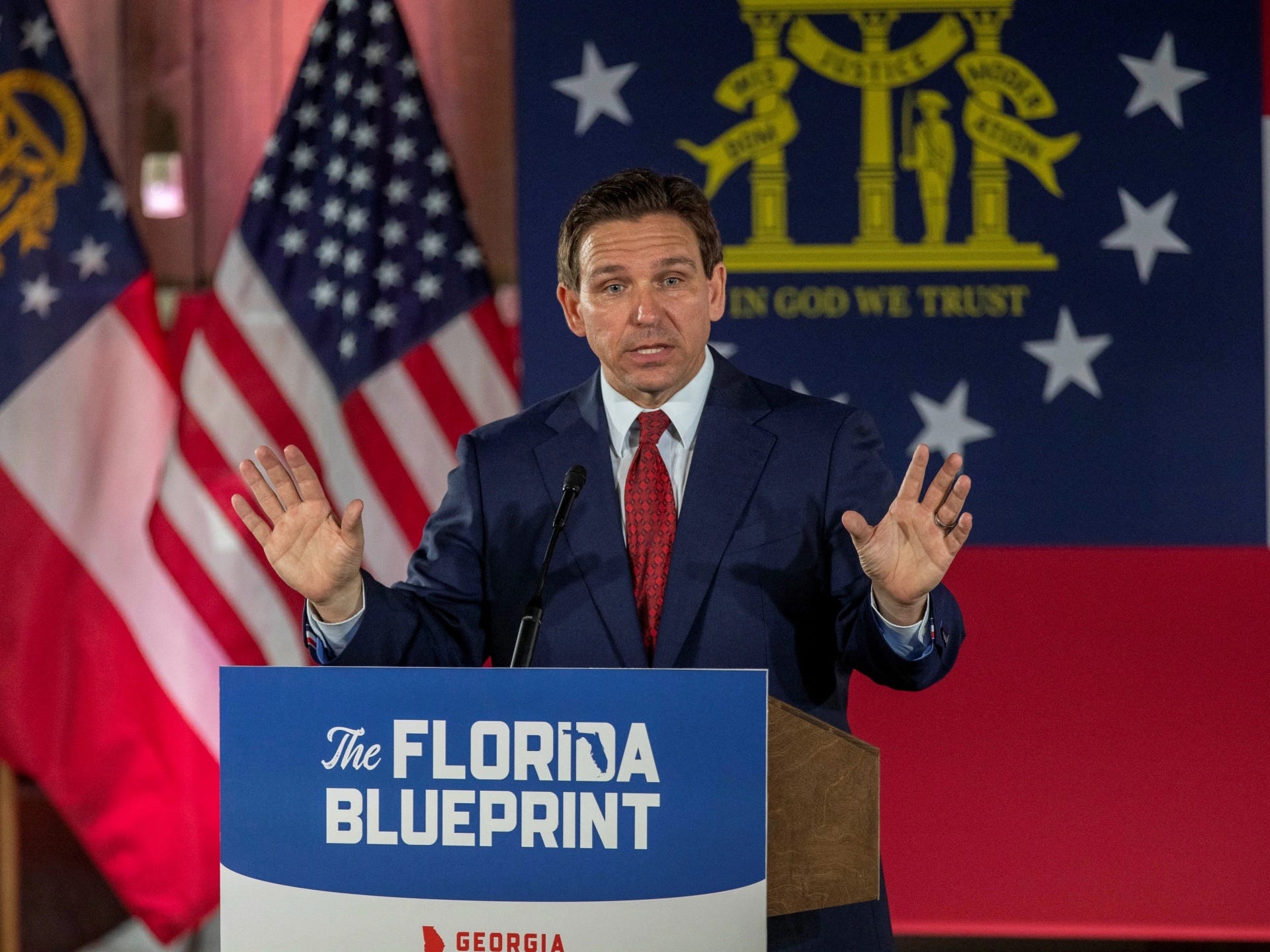
NEW YORK — Two years ago, signing a bill intended to punish Twitter and other major social media companies, Florida Gov. Ron DeSantis blasted the platforms as "suppressing ideas” during the COVID-19 pandemic and silencing conservative voices.

What a turnaround.

The new Elon Musk-owned version of Twitter helped DeSantis launch his bid for the Republican presidential nomination Wednesday. Though it was marred by technical glitches and skewered by the candidate's critics, the forum nevertheless underscored Twitter's unmistakable shift to the right under Musk, who bought it for $44 billion and took over in October.

“The truth was censored repeatedly, and now that Twitter is in the hands of a free speech advocate, that would not be able to happen again on this Twitter platform,” DeSantis said during the Twitter Spaces event.

Musk, co-hosting the event, responded to the praise by saying, “Twitter was indeed expensive, but free speech is priceless.”

While Musk has promoted his platform as a haven for free expression, the site has been flooded with extremist views and hate speech since he bought it and fired or laid off roughly 80% of its staff.

That is raising alarms that Twitter — heavily used by candidates and government agencies, including those providing voting information — will become an open forum for conspiracy theories, fake content and election misinformation as a bitterly divided country heads into the 2024 presidential election.

President Donald Trump speaks with Florida Gov. Ron DeSantis as he arrives at Southwest Florida International Airport on Oct. 16, 2020, in Fort Myers, Fla. Evan Vucci, Associated Press

Many Republicans have hailed Musk's takeover of Twitter as creating one of the last mainstream online spaces where they can share their views without fear of removal. Prominent figures in conservative media, like former Fox News host Tucker Carlson and the podcasts hosts of The Daily Wire, say they plan to start streaming content on the site.

Democrats and anti-hate watchdogs, meanwhile, say Musk's partisan comments and policy changes have effectively given a megaphone to far-right extremists.

Since Musk bought Twitter, he has overhauled the site’s verification system, removing safeguards against impersonation for some government accounts and political candidates. He also has personally indulged in far-right conspiracy theories on the site, reinstated accounts with a history of extremist rhetoric and gutted the team that had been responsible for moderating the content flowing across the platform.

That has coincided with a deluge of conspiracy theory rhetoric, according to the Anti-Defamation League, which reported that QAnon hashtags surged 91% on Twitter between May 2022 and May 2023, with about three-fourths of those messages posted after Musk's takeover.

Several believers of the baseless QAnon theory, centered on the idea that former President Donald Trump is waging a secret war against “deep state” enemies and pedophiles, have committed acts of violence, including the attack on the U.S. Capitol on Jan. 6, 2021.

Musk’s decision to reinstate influential Twitter accounts with a history of spreading extremist views also has created spaces in their tweet reply threads where users are sharing antisemitic tropes, conspiracy theories and other types of hate, the ADL reported Wednesday.

The group's vice president Yael Eisenstat, who leads its Center for Technology and Society, said Musk’s content moderation choices have “served to silence marginalized voices” by giving harassers and internet trolls free reign.

“It is one thing to say we want free speech on the platform,” she said. “It’s another thing to say we are going to allow extremists — conspiracy theorists — to contribute to normalizing this kind of rhetoric and antisemitism and racism.”

Twitter didn’t provide comment after repeated requests. It sent automated replies instead, as it does to most media inquiries.

Musk's free speech rhetoric also has attracted conservatives who have been knocked off other platforms — or fired, in the case of Carlson.

Shortly after his ouster, Carlson went on Twitter May 9 to announce that he would be doing some version of his show on that platform. It’s still not clear what that would entail, or when he would start.

“There aren’t many platforms left that allow free speech,” Carlson said in a two-minute message viewed more than 132 million times. “The last big one remaining in the world, the only one, is Twitter, where we are now."

Free speech and truth aren’t the same thing, however, and Carlson had been accused of spreading misinformation on his Fox show, most recently about the Jan. 6 Capitol insurrection.

DeSantis has been a frequent guest on Fox News, and on the night of his presidential campaign announcement he appeared on the network for an interview — after the Twitter event.

Though DeSantis' Twitter launch was severely delayed with site crashes and strained servers, his choice to debut his campaign on the platform illustrates that Fox will have more competition as a Republican kingmaker. His campaign said it had taken in $1 million online in the first hour after the announcement. Fox's ratings have declined dramatically during its 8 p.m. Eastern hour, which Carlson used to fill

The Daily Wire, whose podcast hosts include popular conservative influencers such as Ben Shapiro and Candace Owens, said Tuesday that it would bring its shows to stream on Twitter starting next week.

At the same time, Wednesday's botched live event with DeSantis calls into question whether Musk’s ambitions to turn Twitter into a destination for politicians, businesses and others to make big announcements is realistic. For one, only about half a million people listened to the DeSantis webcast. A similar announcement on television would attract millions of people.

The other snag: Twitter’s audience size. Less than a quarter of U.S. adults use Twitter, according to Pew Research Center, and most of them rarely tweet, if at all. The site’s most active users are power players, politicians, public figures and journalists, which raises doubts about whether Musk’s desire to reach voters directly, without traditional media as a go-between, can succeed.
Superman towers over the Kremlin: Reiner Riedler’s best photograph

‘This is from my Fake Holidays eries, taken at the Kremlin Palace hotel in Turkey. I found an entertainer dressed as Superman and asked him to pose by the pool. You’d end up in prison if you did this in the real Red Square’

Interview by Graeme Green
THEGUARDIAN
Wed 31 May 2023 

This photo is part of my Fake Holidays series. At the beginning of the project, more than 15 years ago, I went to Lara Beach in Antalya, Turkey, where there is one luxury five-star hotel after another, all along the coastline. On the other side of the road were the tents of the workers who had built the hotels. Luxury hotels are like little ghettoes. You take your plane and your taxi, then you are in the middle of an isolated luxury area.

The Kremlin Palace hotel, where this photo was taken, has an exact copy of Saint Basil’s Cathedral in Red Square, Moscow. I have been to Moscow and seen the original church, which is a focal point – all tourists take a picture there. But here in Turkey, there is a swimming pool in front of the cathedral. I was fascinated. There were many Russian tourists.

I saw a weird guy, an astronaut, walking around the pool. “What’s happening here?” I asked. It turned out the hotel had a huge room with costumes for the entertainers who perform for the tourists. Superman was one of them. I found him by the pool and immediately asked to take his picture. I took about three shots. I chose the photo point, in front of the church with the pool between us, then asked Superman to jump. It was a very childish approach, perhaps, but he did it. The way he jumped was perfect. I felt in the moment: “That’s the picture.”
There is an entire industry manipulating us through our surroundings

It quite often happens that when I take a picture, I know it’s strong, but when I go home and look more closely, I understand its more complex meaning. This was one of those times. When I saw the image on my computer screen, I understood what it was about. There is the No 1 tourist site in Moscow, which stands for the entire history of the Russian empire, and then you have Superman on that famous square, jumping over Saint Basil’s Cathedral. It is Superman, representing American power, rising above what represents the Russian empire.

It would have been impossible to take a photo like this in the real Red Square and, now, I think you would end up in prison. In 2006, it was more simply a funny image: the collision of two worlds in one picture. The Crimean crisis happened much later, in 2014, and we were a long way away from the Ukraine conflict. If I look at the picture now it has a different meaning: I relate it to the political situation nowadays and it is getting more and more interesting. I loved the image before, but some images take their time to develop their whole impact.

My Fake Holidays project was inspired by seeing how many European cities were creating artificial beaches. I first came across one in Hamburg, Germany; they had put sand on the street and set up palm trees, and there was an inflatable swimming pool. I took off my shoes and put my feet into the sand. I felt immediately transported – just touching the sand reminded me of beach holidays when I was a child. I was fascinated by the idea that we can be so easily manipulated by our surroundings. There’s a whole industry doing it, like Disney – the mother of all leisure parks. I took photographs all over Europe, China, the United States, Japan … I was fascinated by the facades of happiness.


In my heart, I still feel like a documentary photographer. I am reflecting what I see with my photographs. The representation of reality with photography is a beautiful idea, but photography is changing a lot these days. We have artificial intelligence. Last month, an AI image was selected for the first time for a photo contest. But the most beautiful thing with photography is that reality is so strong. If you go out for a walk with a camera, you can’t imagine what you will find until you find it.


Reiner Riedler’s CV

Born: Gmunden, Austria, 1968.
Trained: Photography at Höhere Graphische Bundes-Lehr und Berufsanstalt, Vienna.
Influences: “Taryn Simon, Paul Graham, Wolfgang Tillmans.”
High point: “In the pandemic, I had a lot of time to think about my work. When I received a substantial grant for a film project, it was a very special moment because it marked the beginning of a new creative era for me: a step from photography to the moving image. I love these moments that give a new direction out of nowhere.”
Low point: “Being completely broke and hungry at the beginning of my studies.”
Top tip: “I believe in the importance of documenting. Photography doesn’t have to submit to trends.”

Reiner Riedler’s work is part of Civilization: The Way We Live Now, Saatchi Gallery, London, from 2 June to 17 September. For more of Reiner’s work, see www.photography.at and Instagram @riedlerreiner

Hundreds were killed in the Tulsa race massacre. Are we already forgetting them?

On the 102nd anniversary of the killings, efforts for justice in Greenwood are buried under hollow symbolism

After white rioters torched Black businesses in the Greenwood district, authorities detained thousands of Black people. 
Photograph: Science History Images/Alamy

Victor Luckerson
THE GUARDIAN
Wed 31 May 2023 

This year, on the 102nd anniversary of the Tulsa race massacre, television crews won’t descend upon Greenwood, the neighborhood where as many as 300 Black people were murdered by a white mob in 1921. Thousands of protesters won’t march through the streets chanting “justice for Greenwood”, as they did following the murder of George Floyd in May 2020. Joe Biden won’t be on hand to declare Greenwood a symbol of the “American spirit”, as he did on the centennial of the race massacre in 2021.

Despite the pop culture awareness delivered by HBO’s Watchmen and Lovecraft Country, Greenwood risks going it alone once again. All too often, that’s been the normal state of play in the neighborhood known across the United States as “Black Wall Street”.

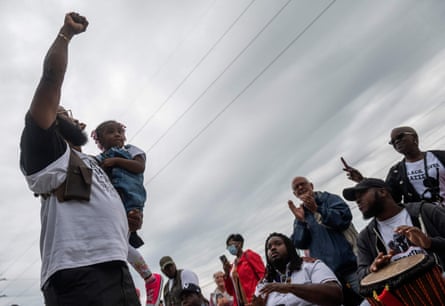
A man raises a fist after a soil dedication ceremony on the centennial of the massacre. Photograph: Andrew Caballero-Reynolds/AFP/Getty Images

When I first arrived in Tulsa in 2018, on the 97th anniversary of the race massacre, Greenwood felt diminished. A lively Black district once filled with regal homes, raucous nightclubs and stately churches had been reduced to a block and half of humble storefronts and a community center in need of refurbishment. What’s worse, much of the land previously occupied by Black people had been replaced by white-controlled enterprises: high-rise apartments, a large college campus for Oklahoma State University, and even a sports stadium. On my first night in Greenwood, more people on the block were trying to catch the opening inning of a minor league baseball game than acknowledging the lives of people who had been slain on the land where that stadium now sits.


Greenwood is full of these kinds of chilling contradictions. Sidewalk plaques commemorating businesses burned down during the massacre now serve as welcome mats for glittering new office buildings. The highway that bisected the neighborhood in 1967, destroying dozens of homes and businesses, has been “beautified” with a mural, attracting Instagram likes rather than material gains for Greenwood’s progeny. The neighborhood’s historical fame has become a kind of albatross slung over Black Tulsans’ necks, as efforts at building concrete pathways toward justice are buried under hollow symbolism.


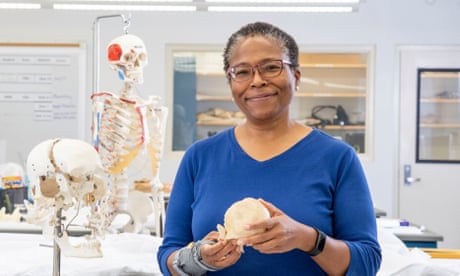
‘I work with the dead. But this can help the living’: the anthropologist investigating the Tulsa race massacre

It’s easy for visitors – and visiting journalists – to become distracted by the symbols, beautiful as some of them are. But after my first trip to the neighborhood, I realized the only way to really understand Greenwood was to become part of it. So I moved to Tulsa a few days after my 30th birthday and rented a house a half-mile walk from the neighborhood. I began excavating Greenwood’s past, analyzing land transactions and lawsuits filed in the aftermath of the race massacre and conducting oral history interviews with people whose families were devastated by the attack. I spoke to families who have called the place home for generations. I also sought to chronicle Greenwood’s present, covering protests, court hearings and debates on the floor of the Oklahoma state legislature, all mechanisms for restoring justice to a community that’s been deprived of it for so long.


01:09'Ain't Gonna Let Nobody Turn Me Around': reverend sings with Tulsa race massacre survivors – video

Three years after the murder of George Floyd, police violence remains one of the most urgent concerns for Black Tulsans. Tiffany Crutcher, a descendant of race massacre survivors, has been an ardent police reform activist ever since her twin brother, Terence, was killed while unarmed by a Tulsa police officer in 2016. Following Terence’s death, she moved back home to Tulsa to pursue activism, spending years trying to needle the Tulsa city council and the city’s Republican mayor, GT Bynum, into taking police oversight seriously.

The summer of 2020 seemed to offer a breakthrough; as the nation reeled from Floyd’s murder at the hands of police in Minneapolis, local protests in Tulsa brought thousands into the streets, blocking highway traffic and forcing a negotiation with the mayor. In those heady, turbulent days, Bynum promised to take on the police union, notorious for eschewing oversight and citizen intervention at all costs. But the season of change was short-lived in Tulsa, as elsewhere; Bynum ultimately walked back his plan to institute an independent monitor to oversee the police, instead supporting a “liaison” who would lack any disciplinary power.

Terence Crutcher, right, with his twin sister, Tiffany. Photograph: AP

Crutcher has watched this retrenchment with concern, but she remains undeterred. She now heads the Terence Crutcher Foundation, a local non-profit she launched a year after her brother was killed. Her work has shifted from trying to convince city leaders of the value of her agenda to taking it to the people themselves. “It looks like knocking on doors and listening to neighbors to understand what’s important to them,” she says of her advocacy. “I think it looks like bringing them along in this fight to advance policy, and giving them ownership for their own communities.” The foundation recently purchased a 65,000-square-foot shopping center just north of Greenwood, which it hopes to fill with small businesses and non-profits that can help transform Black Tulsa’s economic fortunes.

Another descendant of massacre survivors, Regina Goodwin, is determined to restore Greenwood’s physical landscape by removing the I-244 overpass from the neighborhood. As a child, Goodwin saw her family’s Greenwood Avenue office building destroyed to make room for the highway; a few years later, her home was bulldozed during urban renewal programs. Now Goodwin, a state legislator representing the Greenwood district, is calling for freeing up about 30 acres of land in and around the neighborhood for commercial and residential development benefiting the community’s historic residents.

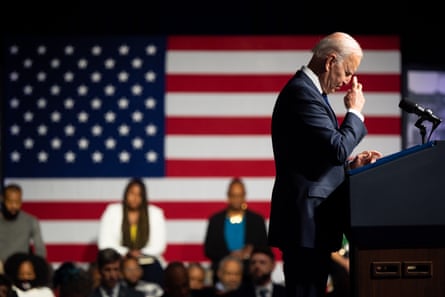
Joe Biden silently prays during a moment of silence in Tulsa in 2021. 
Photograph: Brandon Bell/Getty Images

One idea being weighed is converting the property into a land trust owned by the community as a whole, so that previous patterns of gentrification aren’t repeated. “Everybody thinks it’s crazy,” Goodwin says. “This big piece of concrete, that’s all folks have known all their lives. But if you constructed it, you can deconstruct it.” Her plan gained a major boost in February, when the US Department of Transportation selected Greenwood as one of 49 communities that will receive federal grant funding to conduct a feasibility study on potentially removing the highway. On a personal level, Goodwin knows the pain Greenwood has endured, but she’s also become adept at using some of the tools that engineered Greenwood’s destruction to power its restoration.

In addition to the massacre descendants, three people remain who lived through the horror themselves, and they too seek justice. Since 2020, three survivors of the Tulsa race massacre have been seeking restitution through a lawsuit against the city of Tulsa, other government agencies, and the Tulsa Chamber of Commerce (massacre descendants were dismissed from the case last summer). The eldest of the survivors, Viola Ford Fletcher, marked her 109th birthday this May in a Tulsa county courtroom, where her attorneys were fending off a motion filed by the city to dismiss the case.
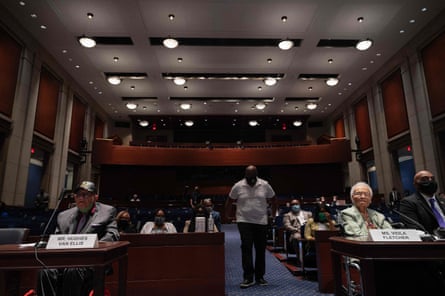
Hughes Van Ellis, left, a Tulsa race massacre survivor, and Viola Ford Fletcher, the eldest living survivor, testify on Capitol Hill in May 2021.
 Photograph: Jim Watson/AFP/Getty Images

During the hearing, the lead attorney, Damario Solomon-Simmons, listed iconic Greenwood landmarks that had been destroyed during the race massacre, including the Stratford Hotel and the Dreamland Theater, and argued that the survivors had suffered through the destruction of many vital community institutions. “We just want the opportunity – they just want the opportunity – to have their day in court,” Solomon-Simmons said. “There were over 10,000 people who suffered during the massacre. They’re the three that’s left.” A decision on whether to dismiss the case or let it proceed to
ANTIFASCISTS TREATED WORSE THAN NEO-NAZI'S
German leftists jailed for string of violent attacks on alleged neo-Nazis

Student ‘Lina E’, 28, and three male accomplices sentenced amid chaotic court scenes for attacks that injured 13
The defendant Lina E with her lawyers in the courtroom in Dresden
The defendant Lina E with her lawyers in the courtroom in Dresden. Photograph: Jens Schlueter/AFP/Getty Images

Philip Oltermann in Berlin
THE GUARDISN
Wed 31 May 2023

A 28-year-old female German student and three accomplices have been found guilty of carrying out a string of attacks on members of Germany’s neo-Nazi scene, in one of the most high-profile trials of a group of militant leftists since the days of the Baader-Meinhof group.

The woman, who in keeping with Germany’s strict privacy laws was referred to only as “Lina E”, was sentenced on Wednesday to five years and three months in prison amid chaotic scenes at a court in Dresden, eastern Germany.

Three co-accused men aged between 28 and 37 were given sentences ranging from two years and five months to three years and three months, over either membership of or support for a criminal organisation.


At least five more members of the anti-neo-Nazi network, including Lina E’s partner, are believed to be at large and continuing to operate underground, with a report by Germany’s criminal police office attesting the group displayed levels of professionalism last seen in the days of the Red Army Faction.

Colloquially known as the Baader-Meinhof group, the Red Army Faction, was a militant leftwing urban guerrilla network that carried out explosives attacks and assassinations in western Germany from 1970 to the early 90s. Many of its members have since vanished and never faced trial.

The charge sheet against Lina E and her accomplices listed six violent attacks in the eastern states of Thuringia and Saxony between August 2018 and the summer of 2020 that injured 13 people, two of them in a life-threatening manner.

The victims were mostly well-known rightwing extremists, or people the group perceived to be thus. Leon R, a barkeeper who was charged earlier this month with forming a rightwing extremist outfit, was attacked with hammers, clubs and pepper spray at his bar in the town of Eisenach in late 2019.

In at least one case the victim’s ideological affiliation seemed to have been less clear. Masked attackers beat up a 31-year-old in Leipzig’s Connewitz district in January 2019 because he wore a black hat by Greifvogel, a German clothing brand popular in rightwing extremist circles. In court, the man described the hat as a gift from a friend and insisted that he had long ago turned his back on a neo-Nazi scene he had belonged to as a teenager.

During the trial, which started in September 2021, Kassel-born Lina E became a modern icon in German leftwing and anarchist circles. The graffitied slogan “Free Lina” is a regular sighting on buildings in Berlin, Hamburg and Leipzig.

Scenes at the Dresden court were raucous from the moment Lina E entered the room with about 100 supporters cheering her appearance from the galleries and the judge having to appeal for quiet to read his reasoning.

Some of the group’s supporters in the gallery heckled “Fascist friends!”, voicing the allegation that the German justice system has in the past been wilfully blind when considering rightwing militants’ crimes.

The judge himself appeared to acknowledge “deplorable” deficiencies in trials in which neo-Nazi supporters have been let off lightly. He described rightwing extremism as posing the greater threat to the country, but said even Nazis had inalienable rights, as reprehensible as their ideology may be.


His verdict against the main accused was more lenient than the eight years in prison called for by the prosecutor. Nonetheless, leftwing groups have called for protests against the ruling on Saturday, when rallies will be held in Dresden and Leipzig.

CRIMINAL CAPITALI$M; NATIONALIZE PG&E
California utility avoids trial for 2020 wildfire that killed four

Pacific Gas and Electric will pay over $50m for rebuilding and civic penalties and continue initiatives to reduce wildfire risks

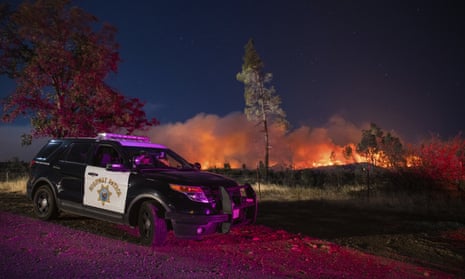
A California Highway Patrol officer watches flames that are visible from the Zogg Fire on Clear Creek Road near Igo, Calif., on Monday, Sep. 28, 2020. (AP Photo/Ethan Swope)The 2020 Zogg fire originated east of Redding, California, when a dead tree fell on power lines. Photograph: Ethan Swope/AP

Dani Anguiano in Los Angeles
THE GUARDIAN
Wed 31 May 2023 

One of the largest utilities in the US has avoided a trial for a deadly 2020 wildfire that sparked when a tree fell on one of its power lines in rural northern California.

A Shasta county judge on Tuesday dismissed manslaughter and other criminal charges against Pacific Gas and Electric related to the Zogg fire, which killed four people as they tried to flee the fast-moving blaze that destroyed the towns of Igo and Ono.


Firefighting goats could be furloughed due to California employment law


The trial – a rare occurrence as PG&E has typically settled criminal cases – had been scheduled to start in Shasta county next week, and would have served as a public reckoning for a company that has already paid out billions in damages for wildfires started by its power equipment.

As part of a settlement to avoid a trial, PG&E has agreed to pay $45m to groups focused on rebuilding efforts and a $5m civil penalty, and to continue initiatives to reduce the risk of wildfires.


The district attorney, Stephanie Bridgett, said in an interview with the Guardian that she did not agree with the judge’s decision to drop the charges, but that her office fought for a resolution that would help the community.

“Our goal originally was to prosecute [PG&E] criminally – to get a criminal conviction and force change that way,” she said. “This resolution does bring a lot of needed things into our community to prevent future fires, to make changes that need to be made within PG&E but also to have the personnel and services to respond better in the future.”

The settlement will fund fuel mitigation efforts, a scholarship program to increase the number of local firefighters, a large animal evacuation center and memorials to honor those who killed in the fire, among other efforts.

PG&E must also move some of its infrastructure underground, install new weather monitoring stations and meet regularly with the district attorney’s office to ensure it is complying with the agreement.

“The agreement reflects our continuing commitment to making it right and making it safe. We stand behind our thousands of trained and experienced coworkers and contractors working every day to keep Californians safe,” Patti Poppe, the company’s CEO, said in a statement.

PG&E has been subject to intense scrutiny in recent years for its role in causing devastating and deadly wildfires in California. The company has been accused of repeatedly prioritizing shareholder profits over ensuring the safety of its infrastructure.

In recent years, PG&E equipment set off 31 wildfires that wiped away entire towns and killed 113 people. The company pleaded guilty in 2020 to more than 80 counts of manslaughter for its role in the 2018 Camp fire, which destroyed the town of Paradise.

In Shasta county, the 2020 disaster started during a windstorm when a gray pine with defects that led to it being marked for removal fell on power lines in the rugged mountainous terrain east of Redding. Fueled by fire-friendly conditions, the blaze raced through the tiny towns and scattered homes in the foothills, consuming more than 56,000 acres (23,000 hectares), taking out hundreds of homes and forcing people to immediately evacuate.

Four people died trying to escape the fire: Alaina Mcleod, 46, and her eight-year-old daughter, Feyla; Kenneth Vossen, who was badly burned as he sought refuge at a pond on his rural property; and Karin King, 79-year old animal advocate and retiree.

The case, Bridgett said, was about getting justice for the victims and forcing change in order to save lives and ensure that PG&E doesn’t “continue the practices that led to the fire in the first place”.

The judge who dropped the charges said in his ruling that the tree falling on company infrastructure did not necessarily mean PG&E had been negligent. “The fact that the tree fell does not itself equate to gross negligence or recklessness,” the judge stated. That ruling was in contrast with another local judge who determined earlier this year there was enough evidence that the utility should stand trial for manslaughter.

PG&E had previously settled with the California public utilities commission for $150m after the regulatory agency alleged that “the tree that caused the fire was not removed in time because of PG&E’s poor recordkeeping”.

SHUT IT DOWN
Canada's Marineland theme park charged over its handling of black bears

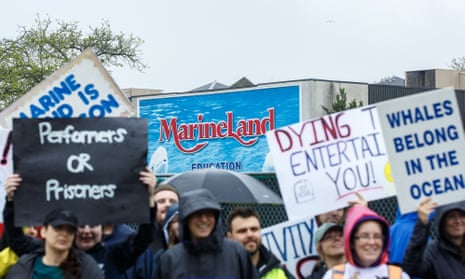
Protestors stand outside Marineland in Niagara Falls, Ontario in May 2023.Protestors stand outside Marineland in Niagara Falls, Ontario, in May 2023. Photograph: Canadian Press/Shutterstock
Park has long been a target of activists who have sought to shut it down over the lack of care given to its captive animals

Leyland Cecco in Toronto
THE GUARDIAN
Wed 31 May 2023 

A theme park in Canada is facing charges for its handling of black bears in captivity, placing fresh scrutiny on a park that animal rights activists have long sought to shut down.

Ontario’s ministry of the solicitor general said on Wednesday it had laid the charges against Marineland, an amusement park on the Canadian side of Niagara Falls. The province said the park had failed to comply with an order related to its captive American black bears.

The province did not provide additional information about the charges, laid under a section of the law allowing provincial inspectors to issue an order to help animals that may be in distress.

It is unclear how many bears remain at the facility. In 2016, the province’s animal welfare agency charged Marineland with five counts of cruelty, including failing to provide adequate and appropriate food and water for its 35 American black bears. The next year, it faced six more counts of cruelty.

Marineland, which has long been a target for activists who argue the park has a moral responsibility to release the animals it keeps in captivity, did not immediately respond to a request for comment on the new charges.

The charges are the latest in a string of high-profile incidents at the park.


Death of ‘world’s loneliest orca’ sparks calls for change

Two months ago, a captive whale named Kiska, dubbed the “world’s loneliest orca” died from a bacterial infection after spending four decades at Marineland. In a video clip before her death, the 47-year old whale is seen drifting listlessly in her tank.

Marineland continues to advertise its beluga whales, some of which it has sold in recent months to aquariums in the United States for “research purposes”, according to the export permits.

In December 2022, Ontario prosecutors stayed animal cruelty charges against Marineland following allegations it was using dolphins and whales for entertainment, violating a federal law that bans cetacean captivity.

The previous year, Ontario’s Animal Welfare Services found all marine mammals at Marineland were in distress due to poor water quality, a claim the park disputes. The province says an inspection of the facility’s waters, which began in 2021 remains ongoing.

In 2019, the park came under scrutiny after Marineland said two deer were killed in a stampede allegedly caused by a father and son taunting the animals. Days after the stampede, the park announced that a heart attack was believed to be the cause of death for an 18-year-old walrus named Apollo. Apollo was the fourth walrus to die in the park over a two-year period. The last remaining walrus, a female called Smooshi, was recently moved to SeaWorld Abu Dhabi.

SEE