Friday, June 30, 2023

Singapore Holds First LGBTQ Rally Since Gay Sex Decriminalized

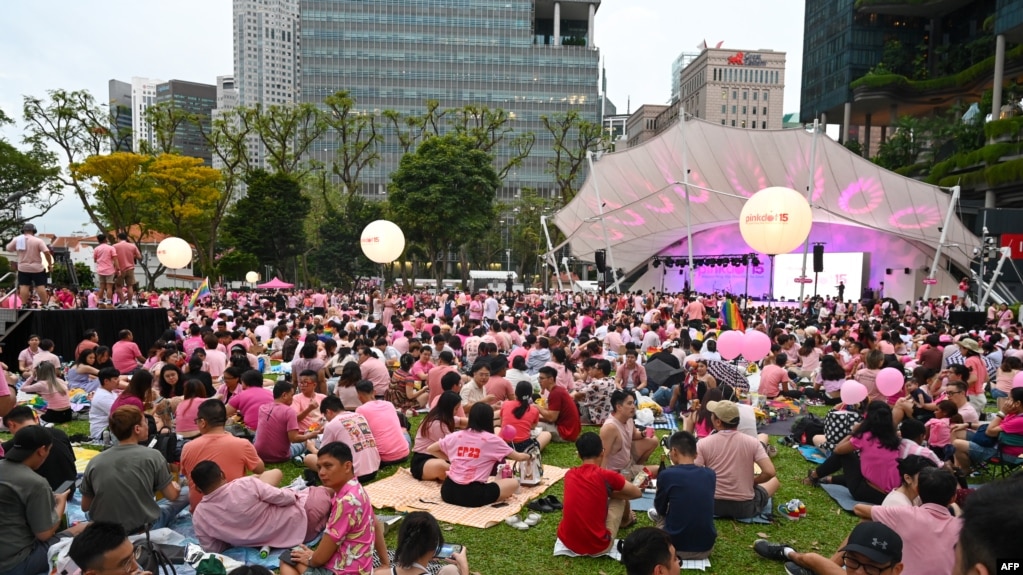
Supporters attend the annual Pink Dot event in a public show of support for the LGBTQ community at Hong Lim Park in Singapore, June 24, 2023.

SINGAPORE —

Hundreds of people wearing pink attended Singapore's annual "Pink Dot" LGBTQ rally on Saturday, the first to be held since the city-state decriminalized gay sex last year.

Brandishing rainbow flags and sporting glittery makeup, participants gathered in a downtown park -- the only place in Singapore where protests are allowed without a police permit.

"I'm celebrating today because it's been a really long fight," said Ernest Seah, a gay 58-year-old artist and teacher, while sitting on a pink inflatable couch. "And you know, it's great that love wins and the government understands that."

Singapore's parliament last year repealed a British colonial-era law that penalized sex between men with up to two years in jail, although the statute was not actively enforced.

But at the same time lawmakers passed a constitutional amendment bolstering the existing definition of marriage as between a man and a woman.

Supporters form the word 'Family' during the annual Pink Dot event in a public show of support for the LGBTQ community at Hong Lim Park in Singapore, June 24, 2023.

The amendment essentially closed the door on any future legal challenges that could establish equal marital rights for LGBTQ people.

Describing the mood as one of "celebration and joyousness", Pink Dot's spokesperson Clement Tan said it was a "relief" to hold the rally with the law no longer on the books.

He declined to specify what Pink Dot, one of Singapore's leading LGBTQ advocacy groups, would focus on next.

"We recognize that post repeal, people need a moment to breathe," he said.

"Our goal has always been about slowly progressing, and LGBTQ equality, whatever form that looks like," he added. "So repeal was something that was important to us, but it's by no means the end of the work that needs to happen. There's a much longer road ahead of us."

The theme for Saturday's rally -- "A Singapore for All Families" -- sought to push back against pressure from conservative groups who fear decriminalizing gay sex will erode "family values.”

"It shouldn't really matter what families look like in Singapore. Most certainly not what the government defines as worthy of recognition. We believe that everyone should stand in the sun," Tan said.

Singapore's "Pink Dot" gay rights rally started in 2009 and has regularly attracted sizable crowds despite a backlash from some quarters.

Organizers did not release figures on the crowd size Saturday, but an AFP reporter estimated more than a thousand attended.

Open support for gay rights is growing, aided by changing social norms among the younger generation.

The percentage of Singaporeans who agree that same-sex couples should be allowed to marry has increased to 32 percent, up from 27% last year, a survey released this month by market research firm Ipsos found.
Climate change affects everyone – so it's time to unite

Calls in London this week for 'radical collaboration' reflect an understanding that global warming knows no borders


THE NATIONAL
EDITORIAL


The National Climate Clock at Piccadilly Circus in central London, part of London Climate Action Week. The clock provides a stark warning that there are only six years and 24 days left to limit global warming to 1.5°C above pre-industrial levels. PA


A defining aspect of climate change is its universality. Although it disproportionately affects poorer nations, global warming leaves no part of our planet untouched. It stands to reason, therefore, that action to mitigate it, to help afflicted communities and to transition to a cleaner, greener economy also needs to be worldwide.

This has been reflected in comments coming out of a high-level climate event in the UK this week. London Climate Action Week heard from Sheikha Shamma bint Sultan, the president and chief executive of the UAE Independent Climate Change Accelerators, who made the apt observation that a borderless approach is needed to tackle the problems posed by global warming.

“Currently, there is a $3 trillion to $3.5 trillion gap in annual investment made towards the UN Sustainable Development Goals and climate in developing countries,” she told the Climate Investment Summit at the London Stock Exchange. “This will simply not be achievable if we continue to work in silos.”

The borderless approach Sheikha Shamma envisioned – something she termed “radical collaboration” – would include all sectors, and ensure that the voices of young people, women and marginalised communities are heard. This is an important dynamic to maintain as the world gets ready for Cop28 in the UAE later this year.


However, this requirement for unity is matched also by the need to balance urgency and optimism in the climate fight. Speaking on the opening day of the London event earlier this week, Razan Al Mubarak, the UN Climate Change High-Level Champion for Cop28, warned against climate conversations “drowning in the doom and gloom”.

Emphasising “communication, with collaboration”, Ms Al Mubarak rightly pointed out that “you will not have a green transition without a socio-cultural transition underpinning it”. To push forward this societal change, people will need to feel that all is not lost, that they have agency in this crisis and that their actions, no matter how small, can play a positive role.

Luckily, there are plenty of examples of progress to draw upon. The UN has said that human action to repair the planet’s ozone layer is working, and this protective shield above the Earth that absorbs ultraviolet radiation from the Sun could recover in decades. Earlier this month, Swiss citizens voted to adopt laws to tackle climate-change laws. Meanwhile, demand for electric cars is booming, with sales expected to leap 35 per cent this year after a record-breaking 2022, according to the International Energy Agency. Closer to home, this week the UAE agreed on closer co-operation with the UK to keep global warming targets within reach.

But those targets still need to be in people’s minds. In London this week, Britain’s King Charles III presided over the inauguration of a countdown clock that will mark the deadline set in the 2015 Paris Agreement to limit global temperature rises to less than 1.5°C above pre-industrial levels. Dr Sultan Al Jaber, Cop28 President-designate, also attended the event. Dr Al Jaber has said a key goal of Cop28 is to keep this target within reach. It is a prudent presentation of the fact that there is not an infinite amount of time to put the brakes on global warming.

King Charles and Dr Al Jaber were also involved in a round-table event at London's Guildhall with key leaders on climate action. There, Pascal Soriot, chief executive of AstraZeneca, said pollution and climate change were claiming millions of lives each year.

“And some people would think OK, well this is something that is happening in faraway countries due to flooding, drought, extreme temperatures,” he added, “but it is actually here, it’s affecting us all.”

The work being done in London and at other international climate events should go some way to building up the unity required before Cop28 begins in earnest. More engagement means more people breaking out of the “silos” that Sheikha Shamma referred to, and that can only be a good thing.

Published: June 29, 2023, 
Envoy emphasizes China's endeavor to promote international human rights cause

(Xinhua) June 30, 2023

GENEVA, June 29 (Xinhua) -- China has always been committed to safeguarding international solidarity, promoting the building of a community with a shared future for mankind, and building a better world together, a Chinese envoy said here Wednesday.

Chen Xu, permanent representative of China to the UN Office at Geneva and other international organizations in Switzerland, made the remarks at the ongoing 53rd session of the UN Human Rights Council, emphasizing that unity, rather than division, and cooperation, rather than confrontation, are essential for promoting the healthy development of the international human rights cause.

The session held an interactive dialogue with the Independent Expert on human rights and international solidarity Wednesday afternoon.

During the dialogue, Chen pointed out that 30 years ago, the World Conference on Human Rights adopted the Vienna Declaration and Programme of Action with a determination to take a new step for the commitment of the international community to work harder and continue to engage in international cooperation and solidarity for the progress of human rights.

Citing the statement of the Independent Expert on human rights and international solidarity, which highlighted that international solidarity is not only a right but also a duty, Chen called on all countries to contribute to the healthy development of the international human rights cause with practical actions by abiding by the purposes and principles of the UN Charter, carrying out human rights exchanges and cooperation on the basis of equality and mutual respect, and jointly opposing the practice of politicizing and instrumentalizing human rights issues.

(Web editor: Zhang Kaiwei, Liang Jun)


ICYMI
Google will block news in Canada because it doesn't want to pay publishers

Google says it will be "harder for Canadians to find news online" and "for journalists to reach their audiences" after Ottawa brings law requiring tech companies to pay for news content.


AFP

Canada's measure builds on Australia's New Media Bargaining Code, a world first, that made Google and Meta pay for news content on their platforms. / Photo: AFP

Google has become the latest Silicon Valley giant to block Canadian users from seeing local news on its platform after Ottawa passed a bill requiring tech companies to pay for such content.

The Online News Act became law last week, aiming to support a struggling Canadian news sector that has seen hundreds of publications close in the last decade.

It requires digital giants to make fair commercial deals with Canadian outlets for the news and information that is shared on their platforms or face binding arbitration.

In a statement on Thursday, Google said the new law is "unworkable" and that the government has not given it a reason to believe "structural issues with the legislation" would be resolved during its implementation.

In a blog post, Google added that it will be "harder for Canadians to find news online" and "for journalists to reach their audiences."

People in the country will, however, still be able to access news from Canadian sites by typing their respective web address directly into a browser or through apps.

Google's announcement comes after the failure of last-ditch talks with the government aimed at bringing the company onboard.

Tech giant Meta announced last Thursday that it, too, would block Canadian news on Facebook and Instagram.

The two companies, who dominate online advertising, have been accused of draining cash away from traditional news organisations while using their content for free.

"We have informed the government that we have made the difficult decision that... we will be removing links to Canadian news from our Search, News, and Discover products and will no longer be able to operate Google News Showcase in Canada," Google said.

Heritage Minister Pablo Rodriguez, who introduced the bill last year, has said the platforms have no obligations under the act immediately and that the government was open to consulting with them on the regulatory and implementation process.

Meta and Google said the proposals were unsustainable for their businesses and for months signalled possibly ending news availability in Canada unless the act was amended.

Canada's federal government has pushed back against suggestions to make changes, and Prime Minister Justin Trudeau in June accused the companies of using "bullying tactics."


'Not just a problem for journalists'

Deputy Prime Minister Chrystia Freeland, a former journalist, said "the loss of revenues flowing out of newsrooms in Canada is not just a problem for the journalists who are affected, it's a problem for the whole country."

"To have a strong culture, to have a healthy society, to have healthy politics, we need great, well-paid journalists," she said.

An October 2022 report by Canada's parliamentary budget watchdog estimated the Online News Act would see Canadian newspapers receive about $250 million per year from digital platforms.

Canada's measure builds on Australia's New Media Bargaining Code, a world first, that made Google and Meta pay for news content on their platforms.

Google has argued Canada's law is broader than those in Australia and Europe, saying it puts a price on news story links displayed in search results and can apply to outlets that do not produce news.

The search engine giant had proposed that the displaying of news content, rather than links, be a basis for payment and that only businesses that produce news according to journalistic standards are eligible.

Washington, D.C. among worst air quality in world

Washington, D.C. on Thursday had some of the most polluted air in the world. More than 100 million Americans are under air quality alerts as smoke from Canadian wildfires continues to grip the U.S. CBS News congressional correspondent Scott MacFarlane has the latest on the thick haze in the nation's capital.


"EVIL COMES FROM THE NORTH"
TWIN PEAKS 😱


Canada wildfires again bring more unhealthy air to North America

Smoke from raging Canadian wildfires hangs over US Midwest and parts of East Coast, creating hazy skies and worsening air quality, making for dangerous, unhealthy conditions for millions of Americans.


REUTERS
Smoky haze from the wildfires in Canada blankets Chicago, Illinois, on June 28, 2023. / Photo: Reuters

Smoke from Canada's worst-ever wildfires was severely impacting air quality across Ontario and at least 15 US states, with monitors warning that over one hundred million people face potentially unhealthy conditions.

Chicago, Detroit and Cleveland recorded some of the worst air quality in the United States on Wednesday, with residents told to stay inside or limit outdoor activity as smoke blanketed huge swaths of the country just weeks after communities suffered similar disruptions from Canada's hundreds of active forest fires.

Canada's most populous city Toronto was a 10 out of 10 — "high risk" — on Environment Canada's air quality health index, while Swiss-based monitoring company IQAir pegged it as the worst air quality of any major city in the world.

Alerts were issued from Ontario to northern US states Minnesota and Michigan, across to New York and down to the southeastern states of North Carolina and Georgia, the latest dangerous air conditions in much of North America's Great Lakes and Mid-Atlantic regions.

The air quality alerts come as much of the US South and Midwest bakes under a brutal heat wave that is affecting several million Americans, with the National Weather Service issuing a heat index forecast as high as 46 Celsius on Wednesday in northern and central Texas.

The suburbs of Chicago, whose metropolitan area is home to more than nine million people, posted a "very unhealthy" air quality index, or AQI, of 285 mid-day on Wednesday, according to AirNow.

US President Joe Biden's Air Force One touched down in the Windy City on Wednesday "through a thick layer of smoke and haze," according to a White House pool report, ahead of an economic speech there.

He then flew by presidential helicopter on a short trip to the speech location, offering a bird's-eye view of the dangerous air conditions.

"Air Quality in Chicago is still very unhealthy today. Please limit time outdoors," Chicago's emergency management office post on Twitter.

AirNow showed the Detroit area, with 4.3 million people, recording a "hazardous" AQI touching 306, before dropping off slightly.

An AQI of 301 or above reflects "emergency conditions" that are likely to affect everyone, according to the US Environmental Protection Agency.

'Code Red'


The wildfires — the largest ever recorded in Canada — have raged for two months, darkening Canadian and US skies with smoke and haze that contain tiny dangerous particles considered especially harmful for people sensitive to pollution.

"Unhealthy levels of smoke are expected for a wide swath of the Midwest today, the US National Weather Service said.

"Wildfire smoke from Canada will reduce air quality over parts of the Upper/Middle Mississippi Valley, Great Lakes, Western Ohio Valley, Central Appalachians, and Mid-Atlantic, prompting Air Quality Warnings over the area."

In New York City, where noxious haze three weeks ago disrupted flights and forced the cancellation of outdoor events, officials on Wednesday warned that air quality is expected to deteriorate again this week.

New York's Metropolitan Transit Authority said it would offer free KN95 masks at its subway and train stops.

The state of Pennsylvania also declared a "Code Red" on air quality for Wednesday.

The wildfire smoke has drifted across the Atlantic Ocean and over European countries including Portugal and Spain.

But air quality there remained mostly fair on Tuesday, "because most of the smoke that reached Europe was higher in the atmosphere, where it is less likely to affect human health," according to US space agency NASA's Earth Observatory.

The wildfire smoke was also bearing down once more on the US capital Washington, a situation that NASA scientist Ryan Stauffer, who studies air pollution and the ozone, called "absolutely brutal."

Scientists say human-induced climate crisis is helping drive the increased rates of wildfires, heat waves and intense weather systems.

Unprecedented wildfires ravage Canada, displacing thousands

Devastating fires rage from east to west in Canada. Wildfires in Canada surpass annual carbon emissions record, reports the European observatory Copernicus.


More than 7.8 million hectares of land have been burnt this year, an area nearly the size of Austria / Photo: AP Archive.

From east to west, Canada is in the grips of an unprecedented wildfire season and its peak, which usually comes in July or August, has not even been reached.

No province has been spared, not even Quebec and Nova Scotia in the east, which don't normally see large blazes.

Here's a brief overview of what Emergency Preparedness Minister Bill Blair said Tuesday was "Canada's worst wildfire season on record" by the numbers.

Close to 500 active fires

A total of 490 wildfires were burning on Tuesday, more than half of which were considered out of control. These started in Western Canada in early May, prompting a state of emergency in Alberta and evacuations of tens of thousands of people

A few weeks later, as rains brought some relief to Western Canada, firefighting efforts shifted to Nova Scotia on the Atlantic Coast and Quebec, unaccustomed to the massive scale and strength of this year's blazes.

Today, Quebec remains the top hotspot in the country, with 112 active fires and the smoke spreading as far as the United States and Europe.

In total, more than 100,000 people were displaced by wildfires across Canada.

Wildfire smoke from Canada crosses the North Atlantic and reaches Spain pic.twitter.com/xCC9gfmdMt— TRT World Now (@TRTWorldNow) June 28, 2023

7.8 million hectares scorched

In a typical year, about 7,500 wildfires burn more than 2.5 million hectares of forests in Canada. So far this year, more than 7.8 million hectares (19 million acres) - an area almost as big as Austria - have been scorched.

In Quebec, 1.3 million hectares have burned so far, compared to an average of less than 10,000 annually over the past decade. The area burned in the last 25 days exceeded the combined total over the past 20 years.

Carbon emissions high

Carbon emissions released by the wildfires have already exceeded the Canadian annual record, according to the European observatory Copernicus.

Since early May, they have generated nearly 600 million tons of CO2, equivalent to 88 percent of the country's total greenhouse gas emissions from all sources in 2021, it reported.

Canadian fires alone in 2023 now account for over 10 percent of global carbon emissions from forest fires in 2022 (1,455 megatons).


EU’s values should dictate an ethos of hospitality

MARY LAWLOR 
20th June 2023

Violations of the rights of migrants and the silencing of human-rights defenders stem from a mindset of security and control.
Non-governmental search-and-rescue organisations, such as Sea-Watch, have found their humanitarian activities criminalised (Sea-Watch)

On June 14th, off the coast of Greece, a fishing boat carrying hundreds of people seeking to come to Europe sank. At time of writing, 104 people have reportedly been rescued, 81 bodies have been found and up to 500 people remain missing. What exactly happened is still being uncovered—by investigative journalists and human-rights defenders (HRDs)—but some things are already clear.

It is clear that this tragedy could have been avoided. The Greek authorities were alerted to the boat’s distress by the activist group Alarm Phone hours before it capsized. The Hellenic Coastguard was in contact with the passengers on board and had an obligation under international law to intervene, given the clear overcrowding and unseaworthiness of the ship.

It is clear that the disaster was a product of political decisions. While Greece and the European Union, including through Frontex, its border and coastguard agency, have placed the blame for the catastrophe on people-smugglers, they are not the reason people choose to embark on extremely dangerous routes in the hope of reaching the EU. So long as there are no safe, legal and accessible routes for people to take when fleeing conflict and the effects of climate change, or seeking to reunite with loved ones or to search for a better life, there will be a business for smugglers. Only states can open these routes. They choose not to do so.

It is clear that the EU and its member states are prepared to accept the deaths of people at Europe’s borders. This is not the first shipwreck at the edge of the EU—far from it. In October 2013, at least 400 people died when two ships sank off the coast of Lampedusa, Italy. In response, the then president of the European Commission, José Manuel Barroso, said that ‘we believe that the European Union cannot accept that thousands of people die at its borders’. The Italian government launched Mare Nostrum, a search-and-rescue operation which rescued more than 150,000 people but was ended after only a year. Since then, more than 24,000 people have died attempting to cross the Mediterranean, 18,380 along its central route.

No accountability


During that time, EU search-and-rescue capacity has been reduced and solidarity, including through civilian search and rescue, repressed. While so-called smugglers are prosecuted, there is no accountability for these mass human-rights violations. These are not accidents. Alongside systematic pushbacks, they are crimes committed with impunity.

Across the EU and at its borders, human-rights defenders who refuse to accept this situation have for years been taking action in solidarity with migrants, refugees and asylum-seekers. Their work saves lives and protects human dignity, yet it is being repressed, undermined and obstructed by states, while they themselves are criminalised, smeared and threatened.

Why is this happening?

The EU has placed migration and international protection within a paradigm of security and control, with little or no space for consideration of human rights. This is clear in the member states’ recent agreement of a new position on asylum, which, if it becomes law, will consolidate some of the most problematic aspects of the EU’s existing asylum system—notably the Dublin rules linking asylum claims to place of entry and the use of border procedures—while adding new rules designed to deter people from coming to the bloc and facilitating returns.

Respect for dignity

Yet the EU is founded on respect for human dignity and human rights. Article 2 of the Treaty on European Union states that here ‘pluralism, non-discrimination, tolerance, justice, solidarity and equality between women and men prevail’. All member states are bound by the European Convention on Human Rights. They are obliged to respect the Charter of Fundamental Rights of the European Union, which protects inter alia the right to seek asylum. They are all signatories to the major conventions of international human-rights law.

Human-rights defenders across the union are insisting on the obligations that flow from these agreements, and they have a right to do so—to ensure that human rights are respected, protected and fulfilled where they are routinely and callously violated and ignored.

As United Nations special rapporteur on the situation of human-rights defenders, I am mandated to support defenders by promoting the implementation of the UN’s Declaration on HRDs, which was agreed by all its member states at the General Assembly 25 years ago. Article 1 of the declaration states that everyone has the right to strive for the protection and realisation of human rights. Article 12.1 reinforces this, affirming the right to take peaceful action against violations of human rights.

Criminalisation of HRDs


EU states are among the strongest supporters of human-rights defenders and the HRD declaration. Yet since I took up my mandate three years ago, I have formally raised cases of retaliation against migrants’ rights defenders with the governments of Greece, Italy, Poland, Latvia, Cyprus and France. Most of these cases have concerned criminalisation, meaning both the opening of criminal investigations and proceedings against defenders, and the deliberate, systematic conflation of their work with criminal activity through public discourse and leaks via the media.

Other cases have involved administrative restrictions or sanctions placed on organisations, which also form part of the criminalising narrative defenders face, as well as legislative changes making it more difficult—in some cases practically impossible—for migrants’ rights groups to do their work.

While this retaliation is being carried out by individual states, it cannot be reduced to their national context. The laws most frequently used to criminalise defenders stem from the EU’s ‘Facilitator’s Package’, the legal framework adopted by the EU in 2002 to define the offence of facilitating an unauthorised entry, transit or residence and to set out related criminal sanctions. While seeking to address people smuggling, this contains important inconsistencies with international standards and has provided a basis for the criminalisation of solidarity.

Article 12.2 of the HRD declaration places an obligation on states to protect people exercising these rights from retaliation. When it comes to migrants’ rights defenders, EU states—with the general acquiescence of the EU’s institutions—are however doing exactly the opposite. Violations of the rights of migrants, refugees and asylum-seekers are taking place on a scale which, as the Council of Europe commissioner for human rights, Dunja Mijatović, said yesterday, is now ‘so frequent that they hardly register in the public consciousness’.

At least some EU states appear comfortable with this, and the silencing and smearing of human-rights defenders has become a tactic to ensure things don’t change.


Mary Lawlor  was appointed United Nations special rapporteur on the situation of human-rights defenders in 2020. This year, her mandate was extended for a further three years.


SCAB AIRLINE
Ryanair—on the side of Europe’s citizens?

DARRAGH GOLDEN 
27th June 2023 

The low-cost carrier has presented a petition to the European Commission attacking the right to strike.

A Ryanair plane on the tarmac at Marseille Provence airport last month—the company presents itself as the traveller’s friend
 (page frederique / shutterstock.com)

While in 2021 the pandemic brought a €335 million loss to Ryanair, last year the low-cost airline returned a near-record €1.4 billion profit, which it expects to exceed in 2023 by carrying an unprecedented number of passengers. In 2022 the airline carried a record 168 million.

This summer’s strikes scheduled by French air-traffic controllers (ATC) could however dampen Ryanair’s profit expectations. On June 6th, 400 Ryanair flights—one in eight—were cancelled as a result of strike action. Some 220 flights had been cancelled over the May bank holiday weekend. In a video posted on Facebook, the Ryanair chief executive, Michael O’Leary, decribed the impacts of the strikes by French ATC staff as ‘completely unacceptable’.

Ryanair wants the European Union to force France to allow flights in its airspace when ATC workers are on strike. In March, two executives from the carrier travelled to Brussels to announce the launch of a petition urging the European Commission to mandate French ATC unions to engage in arbitration instead.

Long-running battle

When it comes to strikes, there has been a long-running battle between the commission and the European Transport Workers’ Federation (ETF) and the ATCEUC, which represent ATC workers at the EU level. The ETF and ATCEUC rebuff any measures significantly encroaching on the right to strike—article 153(5) of the Treaty on the Functioning of the European Union clearly states that the right to strike is excluded from EU competencies.

In 2016, Ryanair was central to creating Airlines for Europe (A4E), bringing all the companies together under one association with the principal objective of lobbying the commission on issues such as ATC strikes. Meaningful engagement with its counterparts, such as the ETF, through social dialogue was considered unacceptable and excluded from A4E’s remit. The counterpart of ATCEUC, CANSO, is similarly reluctant to engage meaningfully.

Covering the petition launch in Brussels, Politico wrote: ‘If a petition receives 1 million signatures from seven different EU countries, the Commission is required to officially consider it.’ This is a mis-reference to the European Citizens’ Initiative (ECI)—an idea advanced by civil-society organisations which eventually found its way into the Lisbon treaty, addressing the EU’s democratic deficit by allowing civil society to call on the commission to propose legislation on a specific issue. The first to clear all the hurdles was a European Public Services Union petition, ‘Right2water’.

Not only did Ryanair roll out a major public-relations campaign on its petition. Each passenger checking in using the Ryanair app was urged to sign. Aften ten weeks, at the end of May O’Leary delivered the petition, signed by 1.1 million Ryanair passengers, to the commission.

O’Leary referred to the signatories as ‘EU citizens’. But this was not an official ECI: a proxy European consumers’ initiative, it called for ATC unions to issue 21-day notice of strike action and 72-hour notice of employee participation.

Considerable influence

Ryanair is mimicking not only the ECI but also the distinctive abuse of political influence by mega-technology firms such as Amazon. These companies—including Uber, Meta, Apple, Google and Microsoft—wield considerable influence over politicians and policy-makers by presenting themselves as defenders of the public interest. The political scientists Kathleen Thelen and Pepper Culpepper have termed this ‘platform power’, which they define as ‘the most significant change in business power in 21st century capitalism’.

Ryanair has jumped on the bandwagon by presenting itself as representative of EU citizens, on the populist pretext of defending the right to free movement. Of course, this is done to exploit political advantages by mobilising consumers in the name of profit. What the commission should do is urge the resource-rich airlines—especially via A4E—and CANSO to pursue genuine social dialogue, rather than masquerading as supporters of concerned citizens.


Darragh Golden  is a postdoctoral researcher on the project Labour Politics and the EU’s New Economic Governance Regime at University College Dublin. The author acknowledges funding from the ERC under the Horizon 2020 research programme (grant agreement 725240).


Public services key to a Europe ‘beyond growth’

LIVIA SPERA, SUSAN FLOCKEN, JAN WILLEM GOUDRIAAN 
and 1 MORE 
23rd June 2023

Europe must reject a return to austerity and support the workers who promote social wellbeing.

Pythagoras’ theorem may not have changed but teachers had to reinvent their methods during the pandemic 
(Drazen Zigic / shutterstock.com)

From health workers, carers, teachers and police officers to transport workers, civil servants, energy workers and many more, this United Nations Public Service Day is a valuable moment to recognise the crucial role public-service workers play in building thriving communities. Yet, buffeted as we are by a seemingly endless wave of crises—each deemed ‘unprecedented’ in turn—we need to reassess the decisions that have created the world in which we find ourselves. It is a world where many workers struggle to deliver the quality public services which form the basis of inclusive societies—those that put the wellbeing of all, not the few, centre-stage.

Last month, the European Parliament hosted a landmark, Beyond Growth conference. As European trade-union federations representing public-service workers across Europe, we believe that this concept, of going ‘beyond growth’ towards wellbeing within planetary boundaries, may hold the key to a different Europe.

Many who spoke during the conference stressed the role of ‘universal basic services’ at the core of an alternative—moving away from the commercialisation of public services and commodification of all aspects of life, reclaiming democratic public control and imagining an economy orientated towards human rights that works for people and the planet. With the European Parliament elections a year ahead, the political parties are well-advised to take up these concepts and demand that the next European Commission’s work programmes be based on this perspective.
Sharp contrast

It stands in sharp contrast to policies governments and the commission pursued until the pandemic. The commission imposed co-ordinated austerity measures, making the situation worse as public investments and funding were cut. The pandemic changed this, and the European Union and its member states showed the power instead of collective action for the common good and well-financed welfare states and public services. The crisis underlined how the public depend on public services. Public-service workers became visible and services of public interest proved how critical they are for society.


More than that, Covid-19 proved once more that public finance is needed to maintain transport, education, health and social care and to ensure their provision to the highest quality. This benefits all of us as users of public services. Throughout the pandemic, public-service workers were on the front lines, risking their health and wellbeing to ensure the safety and care of our communities. Health and care workers worked tirelessly, supporting the most vulnerable while facing shortages of personnel and resources.

Teachers adapted their teaching methods to continue providing quality education in the most challenging circumstances and to allow all students to benefit so that none be left behind. Transport workers maintained essential mobility, police ensured public safety and Europe’s civil servants worked diligently to keep government services running. Energy workers powered our homes and businesses, ensuring our digital connectivity. They showed unwavering dedication and deserve our utmost respect and support.

Austerity coming back

But austerity seems to be coming back. Latest Eurostat indicators show the EU entering a technical recession, with negative growth over two quarters, amid public expenditure being reduced.

It is crucial that lessons are learned from past mistakes. Yet new economic governance rules proposed by the commission, were they in operation, would imply, according to the European Trade Union Confederation, shaving more than €45 billion from the annual budgets of 14 member states. This the ETUC says could fund a million nurses or 1.5 million teachers, deficits among whom have major implications for the quality of care or education.

Due to such austerity policies in the past, our members have seen their wages frozen—in some cases for over a decade—with the effects still being felt. These workers are now suffering the impact of the cost-of-living crisis, making it impossible for many—such as workers in home- and childcare, most of whom are women—to make ends meet. This explains the many strikes, such as that by Romanian teachers in recent weeks, as well as health and care workers’ actions and those of public-transport workers across Europe.

All are united in opposing new austerity policies and their consequences: they need decent wages to match their rising expenses. Yet 11 EU governments have criticised even the modest reform proposals of the commission, seeking more robust targets for reducing public debt. Our federations agree this is not the way forward.

These austerity policies have already had adverse effects on workers, including inadequate wages and workforce reductions, as well as a detrimental impact on the quality of services. They combine with the relentless drive to push public services—which should be treated as public goods—towards commodification, resulting in some cases in their privatisation. The EU ‘liberalisation’ of electricity and rail is biting back as companies cannot deliver on the core requirements of furnishing public services.
Paradigm shift


Instead of a return to failed neoliberal policies and austerity, the ‘beyond growth’ idea represents a paradigm shift in economic thinking. It goes beyond a narrow focus on economic indicators, such as gross domestic product, and instead emphasises the wellbeing of society, holistically conceived.

Public Service Day was designated by the UN to celebrate the workers who dedicate their lives to serving the community. Our members’ contributions do go beyond growth: they ensure the smooth functioning of our society, they enable social cohesion and they provide essential services to all citizens. Our members make it possible for all to realise and enjoy their human rights, including the rights to mobility, education, safe communities and care.

By embracing the ‘beyond growth’ perspective, the EU can champion policies that value the work of public-service workers and foster a sustainable future. Our federations support massive public investment to promote the status of public services, to make that future happen and to deliver a just transition. Yet unless it rejects austerity and marketisation, the EU can forget essential public investments in green and digital infrastructures.

Investing in workers is an investment in the wellbeing of communities. The EU must champion policies that promote fair wages, decent working conditions and a skilled workforce. Public funding must be subject to social conditionalities and not wasted on tax avoiders, exploiters of our environment or violators of workers’ rights.
Ownership matters

As members of the global union movement, we support the ‘Our Future is Public’ Santiago declaration. This calls for universal access to equitable, gender-transformative and high-quality public services as the foundation of a fair and just society. Ownership of resources and services matters: what is essential to dignified lives should be out of private control. The EU internal market is complete and there is no need to open up any further sectors. The citizens’ panels in the context of the Conference on the Future of Europe came to a similar conclusion.

As the EU faces a recession, let us learn from past mistakes and prioritise the wellbeing of public-service workers: by investing in workers, valuing their contributions, ensuring the attractiveness of public-service work and championing fair and sustainable public policies, the EU can lead the way in building a just and equitable society. The challenges faced by these workers during the pandemic and the cost-of-living crisis should serve as a rallying cry for change. The ‘beyond growth’ perspective—with the demands of the Our Future is Public movement at its core—paves the way forward.


Livia Spera is the general secretary of ETF, the European Transport Workers' Federation.


Susan Flocken is the general secretary of ETUCE, the European Trade Union Committee for Education.


Jan Willem Goudriaan has been general secretary of the European Federation of Public Service Unions (EPSU) since 2014.


Nigel Dennis is the head of office of EuroCOP, the European Confederation of Police unions.


Profit-driven inflation—the policy implications

RONALD JANSSEN 
SOCIAL EUROPE
30th June 2023


It’s time to strengthen labour in the face of inflation, not to continue trying to weaken it.
Far from driving inflation, wages have lost their purchasing power as a result of it (Alexandros Michailidis / shutterstock.com)

‘You never want a serious crisis to go to waste.’ Many businesses have taken this famous aphorism to their hearts when confronting the events that disrupted economic activity over the past few years: reopening after the pandemic, bottlenecks in key global supply chains, soaring energy prices, the war in Ukraine, failing harvests. Corporations did not simply pass on more expensive input costs as higher sales prices—they often charged extra to boost profits.

In its latest Economic Outlook, the Organisation for Economic Co-operation and Development adds to the already overwhelming evidence that almost all OECD economies have experienced increasing profit shares in the midst of a ‘cost of living’ crisis (see graph). The fact that domestically generated inflation did not start with wages and labour markets but was driven by business hiking sales prices, to boost profits, has important implications.

The share of gross profits (gross operating surplus) in GDP increased in most countries since 2019
Source : OECD

Room for wage growth

There is substantially more room than is recognised for non-inflationary nominal wage growth. The rule of thumb to estimate what is compatible with the central bank’s price-stability target is to add to the latter trend labour-productivity growth. Assume businesses will pass on wage-cost increases per unit of output—thereby discounting productivity growth—in sales prices. If unit wage costs increase in line with the price-stability target, there is no inflationary pressure to overshoot it.

This rule of thumb does not apply where initial profits are substantial: high profits can provide a buffer to neutralise pressure on inflation from more robust wage increases. Nominal-wage dynamics can then exceed the rule of thumb without endangering price stability.

Profit-price spirals however bring into question the narrative currently used to explain inflation. According to this story, high inflation results from excess aggregate demand—implicitly due to wage push putting upward pressure on prices—and will endure unless demand is dampened. And in the early postwar decades high-demand / high-pressure economies experienced a risinglabour share of income as the bargaining position of workers was much stronger, yet today we are observing the opposite: profit shares are rising.

A more convincing narrative is that recent supply-side disruptions and bottlenecks generated monopoly power on product markets. Knowing that competitors were facing the same problems, of soaring input costs and material shortages for key production inputs, individual firms were in a position to hike prices without having to fear losing market share as production for the entire sector was constrained. Sales prices thus ended up being raised over and above higher input costs.

Cuts in real wages

This monopoly power, and the pressure it generates on inflation, is temporary. Supply-side disruptions are now largely behind us, as is business’ extreme pricing power. Firms again need to be attentive to the risk of competitors preying on their market share and think twice before indulging in price gouging.

With businesses no longer benefiting from radical pricing power, firms will see themselves forced to reduce the additional profit margins they have come to capture. If they do not and try instead to raise prices again to meet demands for higher wages, they risk losing market shares to competitors that attenuate profit margins instead. This enhances the case for stronger wage growth.

Profit-price spirals have redistributed income from labour to business. This clearly shows in cuts in real wages while dividends paid by the world’s 1,200 largest firms rose by 8.5 per cent in 2022, to a record $1.56 trillion. The backdrop is a decades-long trend of falling labour shares, with growth in real median wages systematically lagging behind productivity trends. To restore some fairness, nominal wage growth needs to pick up, so that purchasing power lost to business can be transferred back to workers.

Disciplining workers


While the role of profits in co-driving the cost-of-living crisis is well documented, there is a failure fully to grasp the consequences for economic policy. Policy, including the OECD Economic Outlook, continues to be based on the (mis)conception that the root of inflation is to be found in tight labour markets and excess aggregate demand.

Despite the evidence on corporate profiteering, the priority thus remains to prevent wage growth from picking up in any substantial way. The basic idea, in line with decades of orthodox economic thinking, is still to steer the economy into recession, to weaken the bargaining position of trade unions and discipline workers into accepting that they have simply become poorer.

This will not go well. It will not only thrust labour markets that have just recovered from the Covid-19 shock into another crisis. Blocking workers’ efforts to recover the purchasing power lost to business will entrench the recent increase in inequality, in favour of profits, for years to come. Calling for wage restraint at a time of record profits will make policy-makers look like the guardians of inequality and the enemies of inclusion. None of this bodes well for the future of already-fragile democracies.
Stronger collective bargaining

What should policy-makers do instead? They should start by acknowledging that the recent increases in profits and profit margins open up the possibility of stronger nominal wage growth without endangering price-stability targets.

This recognition should be complemented by policy reforms that allow a redistribution from profits to wages to be set in motion. That means supporting stronger collective bargaining, so that the margins for non-inflationary wage growth which do exist can be effectively mobilised.

Furthermore, and as argued in the 2022 OECD Employment Outlook, it implies promoting social dialogue—in particular tripartite concertation. Then trade unions, employers and governments can shape a balanced sharing of the cost-of-living crisis, which restores purchasing power while remaining alert to the risk of self-sustaining inflation.


Ronald Janssen is senior economic adviser to the Trade Union Advisory Committee of the Organisation for Economic Co-operation and Development. He was formerly chief economist at the European Trade Union Confederation.
WOMEN HOLD UP HALF THE SKY
Peng Liyuan calls for joint actions to promote women's full development

(Xinhua) 10:52, June 30, 2023

BEIJING, June 29 (Xinhua) -- Peng Liyuan, wife of Chinese President Xi Jinping and special envoy of the United Nations Educational, Scientific and Cultural Organization (UNESCO) for the advancement of girls' and women's education, called for pulling strengths from all sides to promote full development of women.

Peng made the remarks via video link at the China-Africa Women's Forum on Thursday.

China and Africa are a community with a shared future, standing together through thick and thin, Peng said, adding women are important members of the big China-Africa family.

Over the years, under the framework of the Forum on China-Africa Cooperation, women from China and Africa have written a splendid chapter of shared progress through solidarity and cooperation, Peng said.

In different places across Africa, women from China are working with African sisters in medical teams, on peacekeeping missions, at infrastructure construction sites and in technical training programs. They work side by side to make a better life and contribute to a stronger China-Africa friendship, she added.

Peng said she has maintained friendly exchanges and cooperation with the Organization of African First Ladies for Development to offer love and hope.

Both China and Africa place high importance on advancing women's causes, she said.

China has taken a range of measures to strengthen the legal system protecting women's rights and interests, empower women with better education, support women's entrepreneurship and innovation, and deliver healthcare services to women and children, to foster a favorable environment for women's full development.

In Africa, countries are working hard to improve women's working and living conditions, help them get rid of poverty, and encourage women's participation in the management of the country and society, Peng said, adding these worthy efforts have produced positive results.

China and Africa will continue to march ahead together, with love and action, on the journey of advancing the development of women, she said.

Given the many challenges facing women's development, the need for solidarity and cooperation is greater than ever, Peng said.

"I am ready to work with you to carry forward the spirit of the Beijing World Conference on Women and the Global Leaders' Meeting on Gender Equality and Women's Empowerment, pull strengths from all sides to promote women's full development, and contribute to the building of a China-Africa community with a shared future in the new era," she added.

The China-Africa Women's Forum, jointly held by the All-China Women's Federation and the people's government of Hunan Province, opened Thursday in Changsha, capital of Hunan.
(Web editor: Zhang Kaiwei, Liang Jun)