Wednesday, October 11, 2023

TSB unable to figure out why ferry Confederation ran aground off N.S. last September


CBC
Tue, October 10, 2023

MV Confederation had 217 passengers and 36 crew members on board when its rudder malfunctioned as the ferry left Caribou, N.S., bound for Prince Edward Island on Sept. 4, 2022. (Carolyn Ryan/CBC - image credit)

The Transportation Safety Board of Canada has issued its final report after its investigation of why MV Confederation ran aground last September off Caribou, N.S.

But the biggest mystery remains just that: what caused its rudder to stop responding to the steering system and take the ship starboard (or right) into shallow waters, rather than port (or left) to keep it within the navigable channel between Nova Scotia and Prince Edward Island.

"The investigation determined that, at the time of the occurrence, the steering controls, steering gear, and rudder blade were functioning as designed," said the final report, released Tuesday.

"The TSB was unable to determine why the vessel did not respond to hard-to-port rudder inputs by the quartermaster."

The ferry operator, Northumberland Ferries Ltd., sent a statement to CBC News saying the control system was thoroughly inspected with Transport Canada and Lloyd's Register Classification Society personnel present over the winter, adding: "We have explored all avenues to rule out a re-occurrence."

All circumstances reviewed

The independent investigators at the Transportation Safety Board of Canada get involved whenever there is a safety incident involving a boat or aircraft, as well as occurrences on railroad tracks or involving pipelines.

In this case, the board said there were two things the Northumberland Ferries could have done better the morning of Sept. 4, 2022.
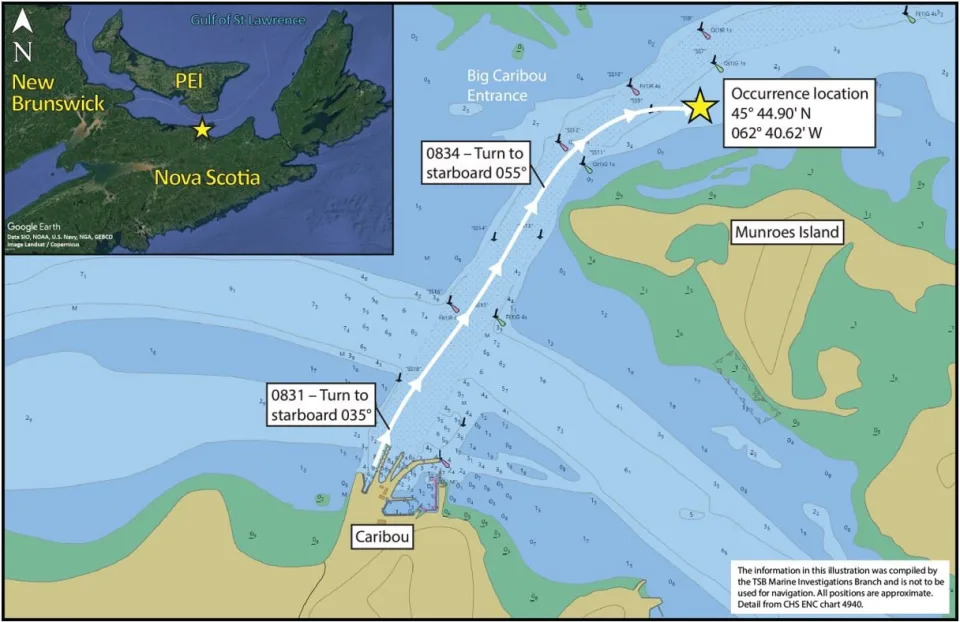

A map provided in the TSB report shows the course MV Confederation took last September before running aground as the tide fell off northern Nova Scotia. (Transportation Safety Board)

The boat's rudder did not work as expected starting at around 8:35 a.m., but the Joint Rescue Co-ordination Centre did not receive a report about the incident until 10:02 a.m. — not from the ship or the ferry company, but "from a concerned third party."

The TSB has reported on a number of recent occurrences in which a delay in reporting an incident affected the response. — Transportation Safety Board of Canada

The report noted: "Early reporting of a potential need for help gives SAR [search and rescue] resources the time to assess the situation and make preliminary and contingency plans.… The TSB has reported on a number of recent occurrences in which a delay in reporting an incident affected the response."

One of those was the 2006 sinking of the ferry Queen of the North in British Columbia, the board's report said.

"Two passengers were unaccounted for and have since been declared dead. During and subsequent to the evacuation, difficulties were encountered in obtaining accurate passenger counts."

"The call from the vessel could have and should have occurred earlier," the statement from Northumberland Ferries said. "It's a learning we have taken very seriously."

As well, the TSB pointed out that the ship's captain had an accurate count of 217 passengers on board, but "NFL shore staff informed the JRCC that the Confederation was carrying 130 passengers and 20 crew members." The ship's master didn't get an accurate count of the 26 crew members on board until nearly three and a half hours after the incident began.

"The Fire and Boat Drills Regulations require that, before a passenger vessel sails, the master is to be provided with the number of persons on board and with details of persons who have declared a need for special care or assistance during an emergency," the report said.

"This will assist the master and crew in responding to an incident and will also help outside agencies with their response."
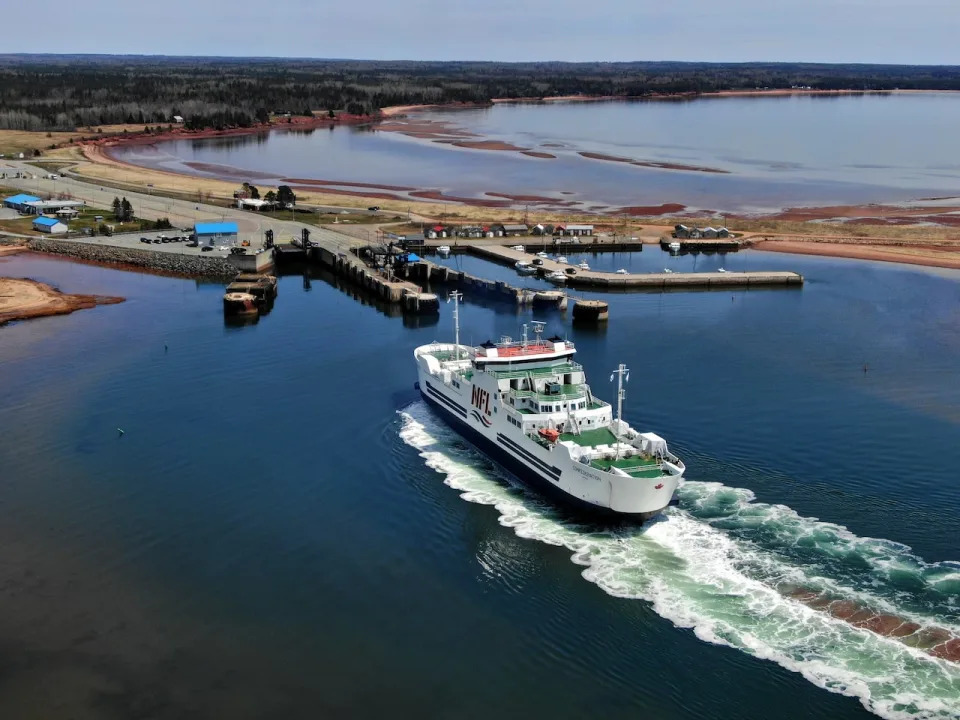
The MV Confederation is currently the only ferry operating between P.E.I. and Nova Scotia. MV Confederation is shown approaching Wood Islands, P.E.I., in this file photo. (Kevin Baillie)

The Northumberland Ferries statement said ship officials did have an accurate count that day, "but then another source provided different numbers. In hindsight, this led to some unnecessary confusion, which could have been prevented. Regardless, the vessel had an accurate count."

After the ferry grounded, the TSB report noted, two passengers were taken off onto a fishing boat by means of a ladder because they had a flight to catch. The rest stayed on board until the ship could move again with the help of a tugboat's towline as the tide rose, at around 3 p.m., and the vessel arrived back in Caribou for unloading at 4:18 p.m.

The TSB said the ferry company did carry out a number of actions in the months after the incident, including these:

The steering system was examined while it was in dry dock over the winter.


"The company's safety management manual was revised to include an external accident reporting guide," which includes a requirement that the Canadian Coast Guard be notified in an emergency.


Northumberland Ferries brought in more training and a program of periodic drills and exercises.

"This report is a fair and accurate representation of what did and didn't happen on that day," the company statement said. "As a company, NFL welcomes reports such as this and we support and appreciate TSB's goals of improving safety in our industr
Belgium's prime minister says his country supports a ban on Russian diamonds as part of sanctions

The Canadian Press
Wed, October 11, 2023


BRUSSELS (AP) — Belgium’s prime minister said his country, which has the biggest interest in the global diamond trade in the European Union, is supporting a ban on Russian diamonds as part of sanctions targeting President Vladimir Putin’s government for its war against Ukraine.

This came during Ukrainian President Volodymyr Zelenskyya’s visit to Brussels on Wednesday. He has repeatedly asked for such a move since the start of Russia’s invasion in February 2022.

For months, the Group of Seven advanced economies and the EU have been working on a way to trace and restrict the trade in Russian diamonds to prevent it from skirting the sanctions. Russia exports about $4 billion worth of rough diamonds a year, nearly a third of the world’s total, according to various estimates.

Asked when the ban will enter into force, Belgian Prime Minister Alexander De Croo said, "the goal is ... January 1st of 2024.”

According to The Antwerp World Diamond Centre, the world’s most important diamond trading hub, 84% of all rough diamonds mined worldwide are traded in the Belgian city, making it the most important gateway to the world for Russian diamonds.

“It has taken some time, because we want to avoid that diamond’s ban would be circumvented,” De Croo said, sitting next to Zelenskyy.

“If you only do it on the wholesale markets, then it will be traded to other diamond centers in the world," he added. "And we will still have it in our shops, and it would make no difference for Russia. This full traceability and this full banning on the retail markets is the only way to make sure that Russia is not financing the war anymore with those diamonds.”

Diamond imports from Russia to the EU have not been hit by the 27-nation bloc’s measures so far, which have hurt many sectors of the Russian economy, including the lucrative gas and oil.

In Belgium, the diamond sector accounts for 6,600 direct jobs and 26,000 indirect jobs, with annual trade amounting to 37 billion dollars. Diamonds represent about 5% of total Belgian exports to the EU and 15% outside the European bloc.

___

Follow the AP’s coverage of the war at https://apnews.com/hub/russia-ukraine

Samuel Petrequin, The Associated Press
Veteran activist fined for 'fascism' article after comparing Putin's Russia to '1984'

Mark Trevelyan
Updated Wed, October 11, 2023 at 8:52 a.m. MDT·4 min read


By Mark Trevelyan

LONDON (Reuters) -Veteran Russian rights activist Oleg Orlov was convicted and fined on Wednesday for "discrediting" the armed forces after telling a Moscow court that Russia had descended into a totalitarian state resembling George Orwell's "1984".

Orlov, 70, was defending himself in a case based on a November 2022 article in which he wrote that Russia under President Vladimir Putin had descended into fascism.

Far from repenting of that statement, he defiantly used his closing speech to declare that Russians were living in Orwell's dystopian world as their country waged war on its neighbour while claiming to support freedom, peace and security.

"There is still no concept of 'thought crime' in the Russian criminal code; citizens are not yet punished for doubting the correctness of state policy if it was expressed in a whisper in their own apartment; they are not punished for an incorrect facial expression. Yet," he said.

"But if someone expresses such doubt outside his apartment, denunciation and punishment may follow," said Orlov, a leading member of the Memorial human rights group that was disbanded by Russia in 2021 but won a share of the Nobel Peace Prize the following year.

He asked aloud how Russia had thrown off communism in the 1990s, only to "slide into a new totalitarianism".

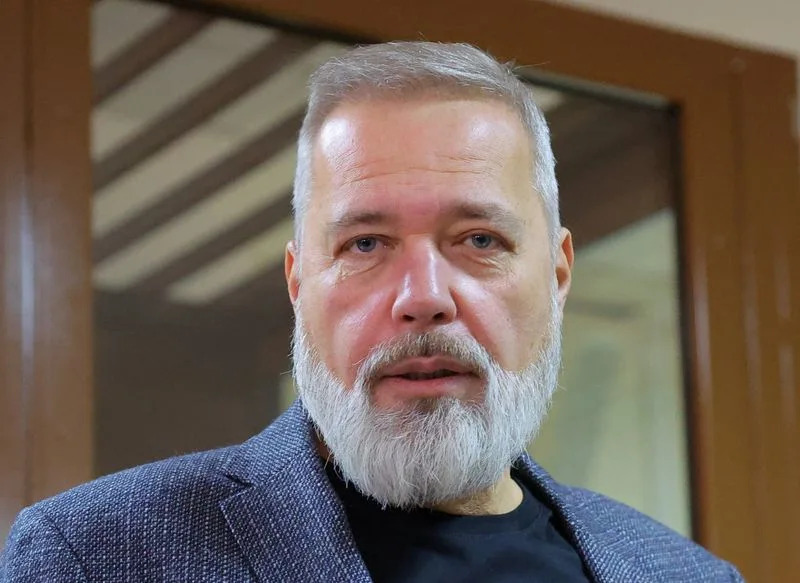
Orlov was supported in court by Dmitry Muratov, co-winner of the Nobel prize in 2021, whose Novaya Gazeta newspaper was forced to shut down soon after Russia's invasion of Ukraine.

Muratov said that just as dissident Andrei Sakharov had predicted that the 1979 invasion of Afghanistan would lead the Soviet Union to disaster, so Orlov was justified in warning that Russia was following a path towards self-destruction in Ukraine.

'DARK FORCES'

"Why does the state take a tax on lives without asking the consent of its citizens? Shakes out their lives like grain from the peasants after the revolution?" Muratov said.

"We see that Sakharov was right, absolutely right back then, warning that the USSR would undermine its existence, and Orlov is right now, warning about the danger of dark, pro-fascist forces."

Orlov's and Muratov's lengthy statements to the court amounted to a devastating critique of Putin's decision to go to war in Ukraine from two of Russia's most internationally respected figures.

The Kremlin says its "special military operation" was justified by the need to protect Russian-speakers in Ukraine from "genocide" and to "demilitarise" and "denazify" the country - arguments rejected by Kyiv and its Western allies as a false pretext for an imperial-style war.

The prosecution in Orlov's case said the fact that the court hearing was open to the media, and that Muratov had been allowed to speak despite being designated a "foreign agent" by the state, showed that freedom of speech was protected in Russia.

But it said such rights were accompanied by obligations, including a duty to obey laws. It said it was impermissible to carry out "provocations aimed at splitting civil society".

Based on Orlov's age and state of health, however, the prosecution said it was seeking to have him fined, rather than asking for the prison sentence of up to three years that it could have sought under laws passed soon after Russia's invasion of Ukraine last year.

The judge ordered a fine of 150,000 roubles ($1,500), lower than the 250,000 roubles the prosecutors had demanded.

Orlov, in his speech, said Russians had the right under the constitution to hold a different opinion from Putin.

"Where is it defined that our commander-in-chief (Putin) always rightly understands not only the interests of Russia, but the interests of its citizens?" Orlov asked in his closing speech at a trial which began in June.

"And if the ideas of a part of Russia's citizens about their own interests don't match those of the commander-in-chief, don't they have the right to talk about this?"

"But in that case, the president is no longer a president, but a spiritual and secular leader... Or are Russia's top officials now infallible, like the Pope?"

(Editing by Gareth Jones and Jonathan Oatis)

Russian authorities fine a human rights advocate for criticizing the war in Ukraine

Russia Crackdown
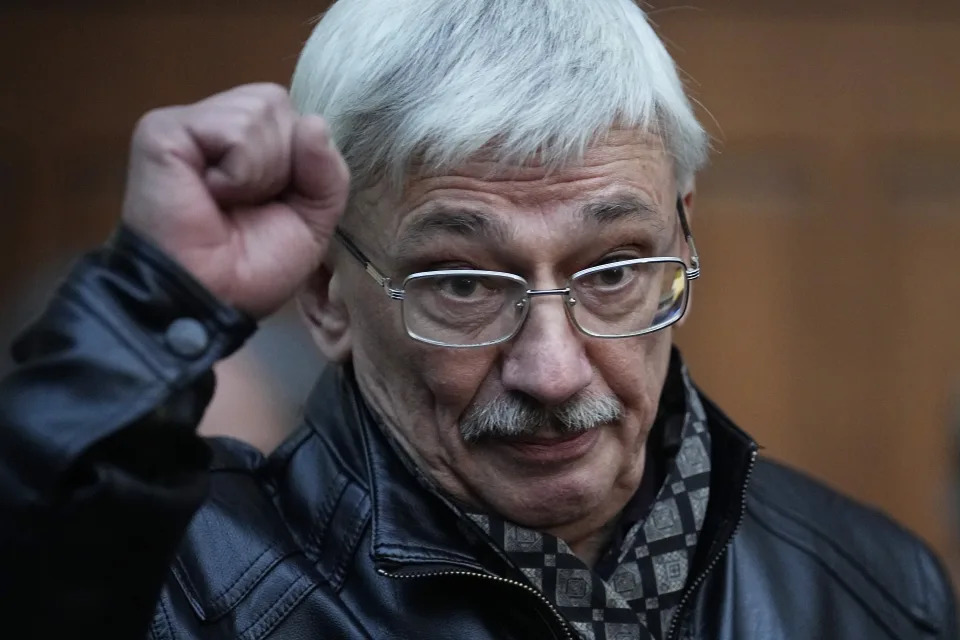
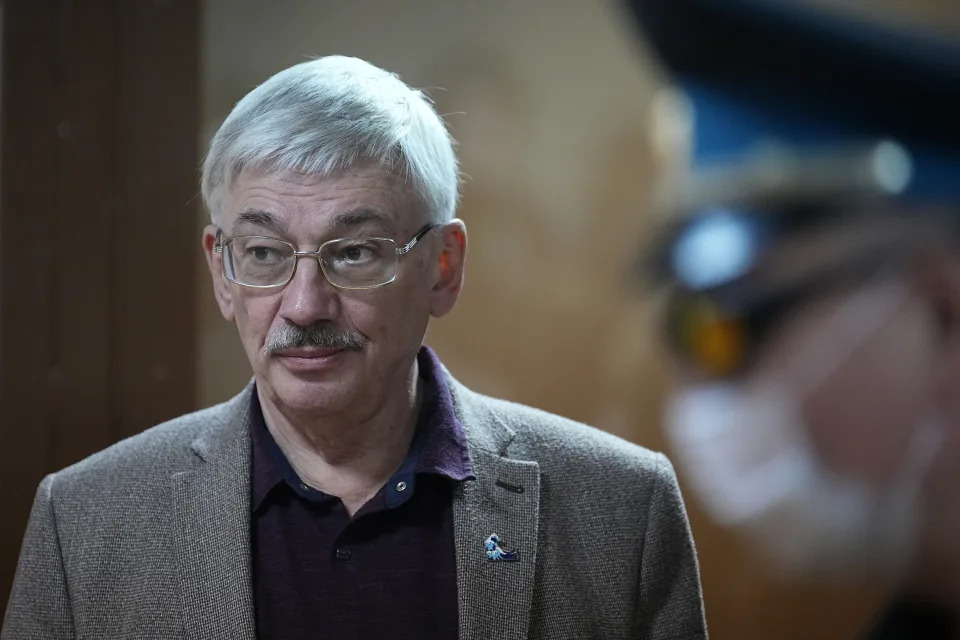
Oleg Orlov, a member of the Board of the International Historical Educational Charitable and Human Rights Society 'Memorial' (International Memorial) gestures after a court session in Moscow, Russia, Wednesday, Oct. 11, 2023. The court ordered Orlov, co-chair of the Nobel Peace Prize-winning human rights group Memorial, to pay a fine of nearly $1,500 on the charges of "discrediting" the Russian military in his criticism of Russia's campaign in Ukraine. (AP Photo/Alexander Zemlianichenko)
\

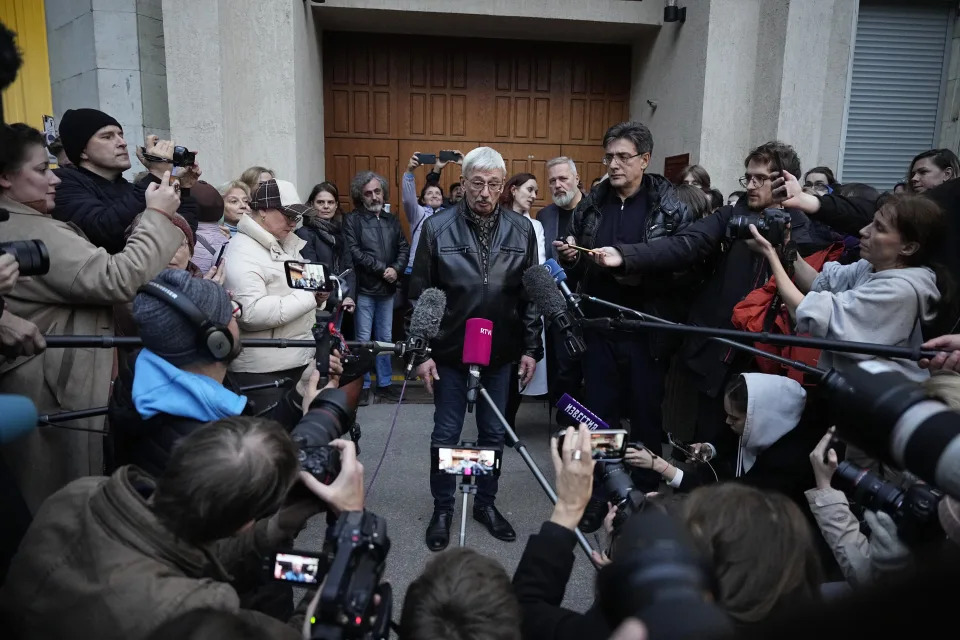
Oleg Orlov, a member of the Board of the International Historical Educational Charitable and Human Rights Society 'Memorial' (International Memorial) speaks to journalists after a court session in Moscow, Russia, Wednesday, Oct. 11, 2023. The court ordered Orlov, co-chair of the Nobel Peace Prize-winning human rights group Memorial, to pay a fine of nearly $1,500 on the charges of "discrediting" the Russian military in his criticism of Russia's campaign in Ukraine. (AP Photo/Alexander Zemlianichenko)

DASHA LITVINOVA
Updated Wed, October 11, 2023

TALLINN, Estonia (AP) — Human rights advocate Oleg Orlov was fined about $1,500 on Wednesday for criticizing the war in Ukraine, the latest step in a relentless crackdown on activists, independent journalists and opposition figures.

Orlov, co-chairman of the Nobel Peace Prize-winning human rights group Memorial, was convicted of publicly “discrediting” the Russian military after a Facebook post in which he denounced the invasion of Ukraine.

A law adopted shortly after the Kremlin sent troops across the border made it a criminal offense if committed repeatedly within a year; Orlov has been fined twice for antiwar protests before facing criminal charges.

A Moscow court began hearing the case in March, and Orlov faced up to five years in prison if convicted. In closing arguments Wednesday, however, the prosecution asked the court to impose a fine of 250,000 rubles (about $2,500).

“Thank God!” gasped Orlov's wife when she heard that in court, according to the Russian news outlet Mediazona.

Several hours later, the judge delivered the verdict and ordered Orlov to pay an even lower fine — 150,000 rubles (about $1,500).

Memorial, one of the oldest and the most renowned Russian rights organizations, was awarded the 2022 Nobel Peace Prize along with imprisoned Belarusian activist Ales Bialiatski and the Ukrainian organization Center for Civil Liberties.

Memorial was founded in the Soviet Union in 1987 to ensure that victims of Communist Party repression would be remembered. It has continued to compile information on human rights abuses and track the fate of political prisoners in Russia while facing a Kremlin crackdown in recent years.

The group had been declared a “foreign agent,” a designation that brings additional government scrutiny and carries strong pejorative connotations. Over the years, it was ordered to pay massive fines for alleged violations of the ”foreign agent” law.

Russia’s Supreme Court ordered it shut down in December 2021, a move that sparked an outcry at home and abroad.

Memorial and its supporters have called the trial against Orlov politically motivated. His defense team included Dmitry Muratov, editor-in-chief of the independent newspaper Novaya Gazeta and winner of the Nobel Peace Prize in 2021.

Addressing the court Wednesday, Orlov rejected the charges and stressed he does “not regret” speaking out against the war. He called the punishment the prosecution asked for “extremely lenient,” compared with long prison terms handed to other activists and opposition figures, and “a small price to pay for expressing a position I believe to be true.”

After the verdict was announced, he left the courtroom applauded by his supporters. Orlov promised to appeal the “soft, but unlawful and unjust” sentence and urged his supporters not to forget about political prisoners who have to spend years behind bars.

After invading Ukraine in February 2022, the Kremlin doubled down on suppressing dissent, adopting legislation effectively outlawing any criticism of what it insisted on calling its “special military operation.”

Since then, nearly 8,000 Russians have faced misdemeanor charges and over 700 people have been implicated in criminal cases for speaking out about or protesting the war, according to the OVD Info human rights and legal aid group.

The authorities have also used the new law to target opposition figures, human rights activists and independent media. Top critics have been sentenced to long prison terms, rights groups have been forced to shut down operations, independent news sites were blocked and independent journalists have left the country, fearing prosecution.

Many of those exiles have been tried, convicted and sentenced to prison terms in absentia. The scale of the crackdown has been unprecedented in post-Soviet Russia.

___

Follow AP's coverage of the war in Ukraine at https://apnews.com/hub/russia-ukraine


Oleg Orlov, a member of the Board of the International Historical Educational Charitable and Human Rights Society 'Memorial' (International Memorial) speaks to journalists after a court session in Moscow, Russia, Wednesday, Oct. 11, 2023. The court ordered Orlov, co-chair of the Nobel Peace Prize-winning human rights group Memorial, to pay a fine of nearly $1,500 on the charges of "discrediting" the Russian military in his criticism of Russia's campaign in Ukraine. 


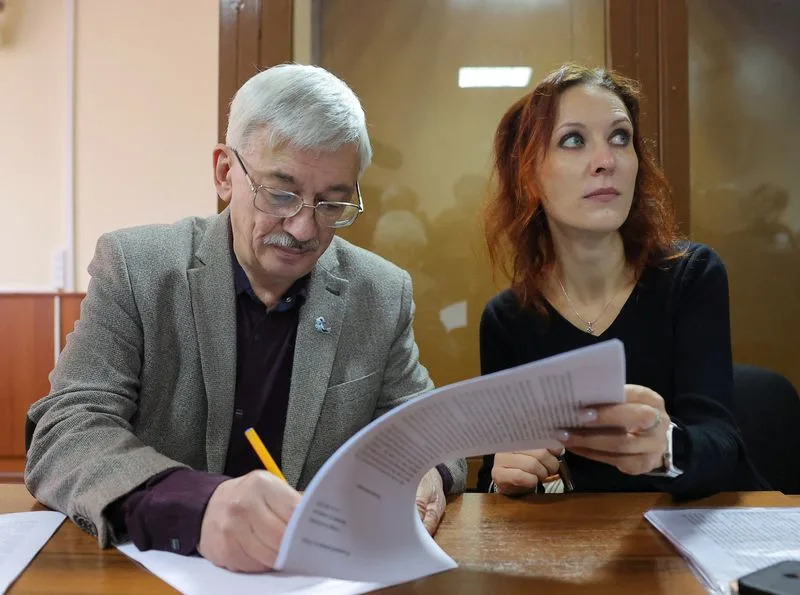
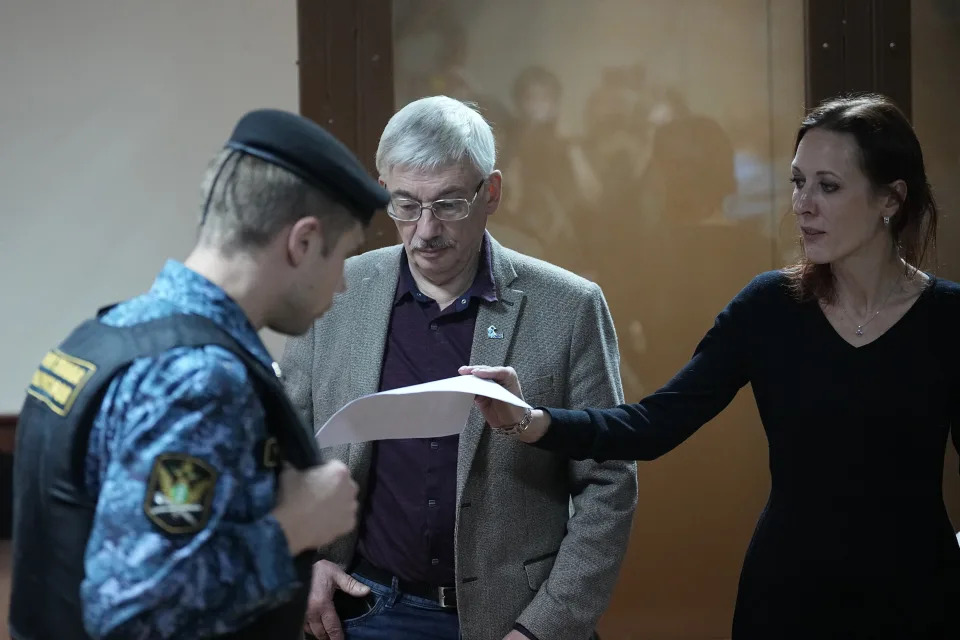
Oleg Orlov, a member of the Board of the International Historical Educational Charitable and Human Rights Society 'Memorial' (International Memorial), centre, looks on as his lawyer Yekaterina Tertukhina, right, holds a document after a court session in Moscow, Russia, Wednesday, Oct. 11, 2023. The court ordered Orlov, co-chair of the Nobel Peace Prize-winning human rights group Memorial, to pay a fine of nearly $1,500 on the charges of "discrediting" the Russian military in his criticism of Russia's campaign in Ukraine. 

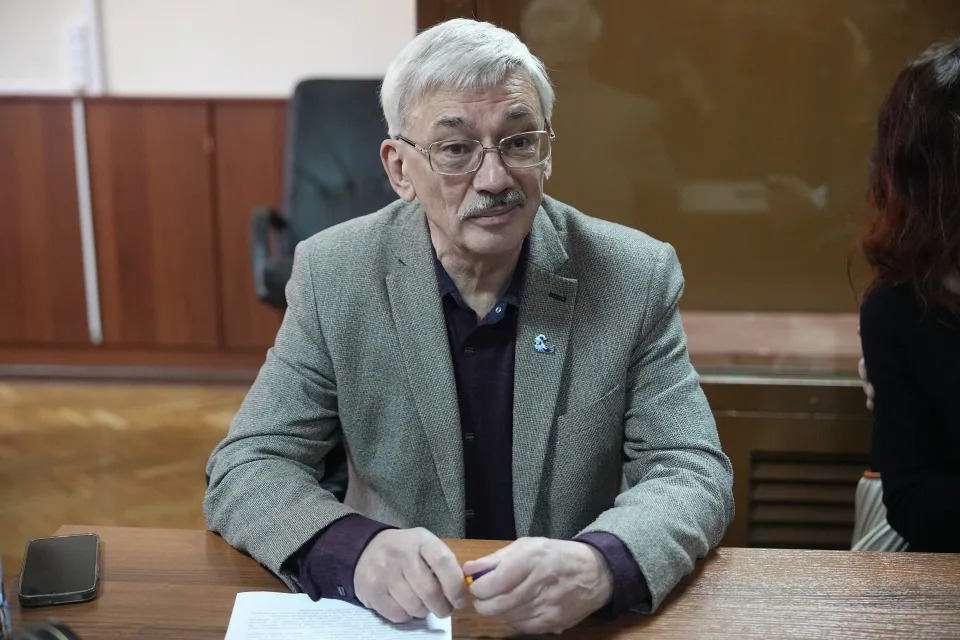
Oleg Orlov, a member of the Board of the International Historical Educational Charitable and Human Rights Society 'Memorial' (International Memorial) sits at a courtroom prior to a session in Moscow, Russia, Wednesday, Oct. 11, 2023. Orlov, the co-chair of the Nobel Peace Prize-winning human rights group Memorial, is on trial on charges of "discrediting" the Russian military in his criticism of Russia's campaign in Ukraine and could face up to five years in prison if convicted. 

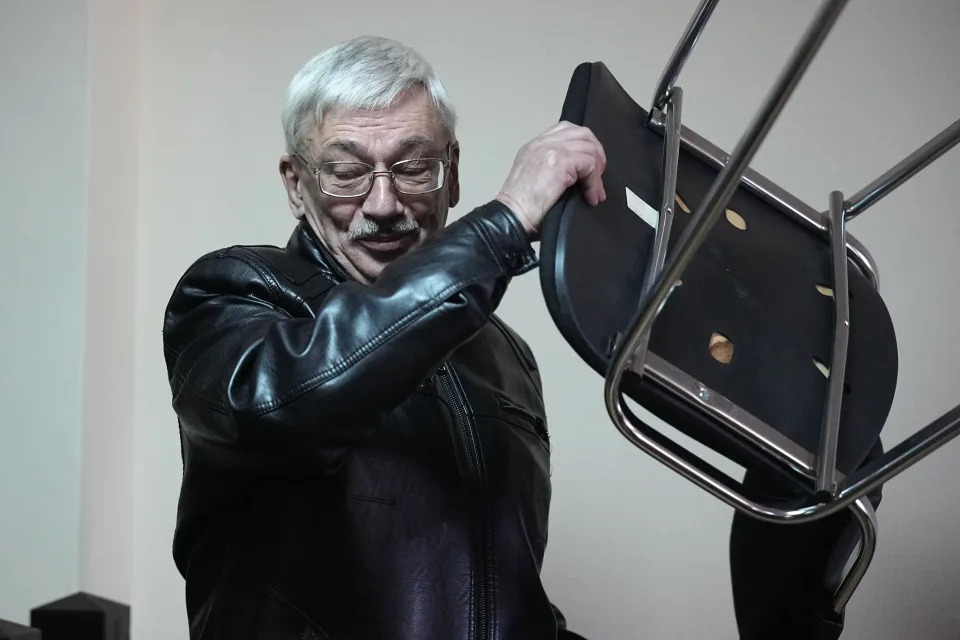
Oleg Orlov, a member of the Board of the International Historical Educational Charitable and Human Rights Society 'Memorial' (International Memorial), centre, carries a chair, as Nobel Peace Prize awarded journalist Dmitry Muratov, editor-in-chief of the influential Russian newspaper Novaya Gazeta, left, speaks to journalists at a courtroom prior to a session in Moscow, Russia, Wednesday, Oct. 11, 2023. Orlov, the co-chair of the Nobel Peace Prize-winning human rights group Memorial, is on trial on charges of "discrediting" the Russian military in his criticism of Russia's campaign in Ukraine and could face up to five years in prison if convicted. 


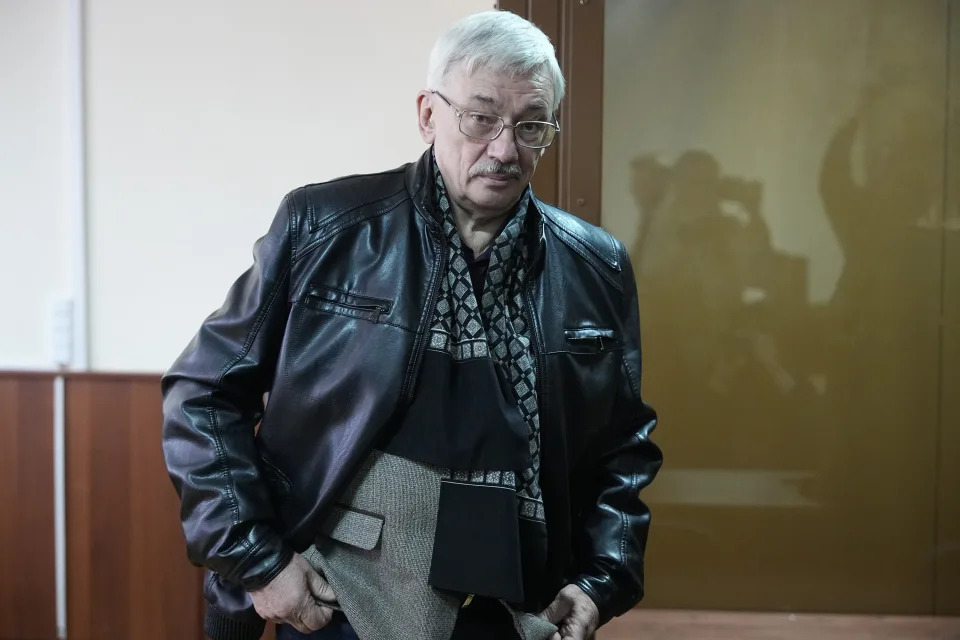
Oleg Orlov, a member of the Board of the International Historical Educational Charitable and Human Rights Society 'Memorial' (International Memorial) stands at a courtroom prior to a session in Moscow, Russia, Wednesday, Oct. 11, 2023. Orlov, the co-chair of the Nobel Peace Prize-winning human rights group Memorial, is on trial on charges of "discrediting" the Russian military in his criticism of Russia's campaign in Ukraine and could face up to five years in prison if convicted. 


Oleg Orlov, a member of the Board of the International Historical Educational Charitable and Human Rights Society 'Memorial' (International Memorial) carries a chair at a courtroom prior to a session in Moscow, Russia, Wednesday, Oct. 11, 2023. Orlov, the co-chair of the Nobel Peace Prize-winning human rights group Memorial, is on trial on charges of "discrediting" the Russian military in his criticism of Russia's campaign in Ukraine and could face up to five years in prison if convicted. 


Oleg Orlov, a member of the Board of the International Historical Educational Charitable and Human Rights Society 'Memorial' (International Memorial), left, and his lawyer Yekaterina Tertukhina speak to journalists at a courtroom prior to a session in Moscow, Russia, Wednesday, Oct. 11, 2023. Orlov, the co-chair of the Nobel Peace Prize-winning human rights group Memorial, is on trial on charges of "discrediting" the Russian military in his criticism of Russia's campaign in Ukraine and could face up to five years in prison if convicted. 


Oleg Orlov, a member of the Board of the International Historical Educational Charitable and Human Rights Society 'Memorial' (International Memorial) stands at a courtroom during a session in Moscow, Russia, Wednesday, Oct. 11, 2023. Orlov, the co-chair of the Nobel Peace Prize-winning human rights group Memorial, is on trial on charges of "discrediting" the Russian military in his criticism of Russia's campaign in Ukraine and could face up to five years in prison if convicted. 

(AP Photo/Alexander Zemlianichenko)

How climate crisis will force 40 million girls into child marriage by 2050

Stuti Mishra
Tue, October 10, 2023 

The number of girls at extreme risk of facing the devastating impact of both climate crisis and child marriage is set to increase to nearly 40 million by 2050, a new report has warned.

While an estimated 29.9 million adolescent girls reside in countries where the risks of both early marriage and life-changing climate disasters are highest, this number is expected to increase about 33 per cent.

“The risks to girls are real. It’s the risk of sexual harassment and abuse girls face in the chaotic aftermath of a disaster, where overcrowding and lack of safe services leave them exposed,” said Shruti Agarwal, a senior adviser at Save the Children.

“It’s being forced to marry before they reach 18, as families are pushed into poverty by years of droughts and forced to make impossible decisions about which mouths to feed. The global climate crisis is already changing girls’ lives and futures. Yet despite these unequal impacts, less than 2 per cent of national climate plans across the globe mention girls,” she added.

“Current spending almost ignores children entirely – this needs to change.”

Nations in sub-Saharan Africa and South Asia, particularly Bangladesh, Chad, and Guinea, which are highly vulnerable to climate crisis and already reeling under mounting impacts, are going to be most severely impacted, the report released by global NGO Save the Children on Tuesday warned.

The report titled “Girls at the centre of the storm: Her planet, her future, her solutions” was published on the eve of the International Day of the Girl Child.

The research highlights the connection between increasing climate-related disasters and how it is creating emergency hotspots for girls’ rights, exacerbating the challenges faced by girls in these regions.

Poverty, gender inequality, conflict, and hunger further compound the issue, making girls more vulnerable to both child marriage and the impacts of the climate crisis.

Girls married young are far less likely to stay in school, with lifelong economic impacts. They are often isolated, and they are at higher risk of physical and sexual violence. Child brides are also at greater risk of experiencing dangerous complications in pregnancy and childbirth, the NGO said.
Planned B.C. gold mine near Quesnel passes environmental assessment

VICTORIA — Plans for a gold mine near Wells, in B.C.'s Cariboo region, took a significant step forward with the granting of an environmental assessment certificate.

Canadian Press
B.C. Environment and Climate Change Strategy Minister George Heyman speaks during an announcement at Burns Bog, in Delta, B.C., on Monday, June 29, 2020. Plans for a gold mine east of Quesnel in British Columbia's Interior took a significant step forward with the granting of an environmental assessment certificate. 
THE CANADIAN PRESS/Darryl Dyck


VICTORIA — Plans for a gold mine near Wells, in B.C.'s Cariboo region, took a significant step forward with the granting of an environmental assessment certificate.

Environment Minister George Heyman and Mines Minister Josie Osborne said in a statement Tuesday that it has given approval for Osisko Development Corp. to build and operate the underground Cariboo Gold mine, east of Quesnel, provided the project receives all its required permits.

The certificate comes with 22 conditions, including establishing a new drinking water supply for Wells, minimizing impacts to the Barkerville woodland caribou herd, noise requirements and hiring 75 per cent of workers from the region, if possible.

When completed, the mine is expected to produce about 25 million tonnes of ore over 16 years and employ 500 workers during its operation and up to 300 during construction.

The mine is the first to be assessed from start to finish under the province's 2018 Environmental Assessment Act which created a new process that includes more participation from First Nations

In a document laying out their reasons for making the decision, the ministers say Lhtako Dene Nation and Williams Lake First Nation provided notices of consent, and Xatśull First Nation said they do not oppose the project but consider consent an "ongoing process."

The ministers say the benefits of the project outweigh the costs, and it is in the public interest.

Granting of the certificate comes after a nearly three-year review led by the provincial Environmental Assessment Office.

The ministers say the conditions on the certificate give them the "confidence to conclude that Cariboo Gold will be carried out such that no significant adverse effects are likely to occur."

The government says construction costs are expected to contribute an estimated at $588 million to the economy over four years, and the operations another $466 million.

A 200-person work camp will be built at the project site, which is about the current size of the community of Wells.

This report by The Canadian Press was first published Oct. 10, 2023.

Provincial decision looms for Cariboo Gold Mine at edge of Wells, B.C.

Residents divided over plans for large mine building at edge of their 220-resident community

In a small town, historic buildings are seen with mountain murals painted on them, in front of which a sign says "No Industrial Parking" and directs industrial traffic to a parking lot.
A sign from Osisko Development's Barkerville Gold Mines is seen in Wells, B.C., on Oct. 7, 2023. The 220-resident district municipality, roughly 100 km southeast of Prince George, is divided over the company's proposed Cariboo Gold Mine. (Kate Partridge/CBC)

The tiny community of Wells, B.C., will soon learn if it will be home to a new gold mine — one that's divided the historic gold-rush district of just 220 residents.

After it passed its environmental review last month, the proposed $588-million Cariboo Gold Mine is awaiting a final decision from provincial cabinet ministers, who have until Wednesday to say yes or no.

Particularly divisive has been Osisko Development's plan to build a 36-metre-high, 200-metre-long mining building at the southern entrance of the community, within municipal limits.

"There have been a few friends lost," said Gabe Fourchalk, Wells' former mayor and an equipment contractor for the mining firm. "With change, there comes a little bit of fear … some people are worried.

"In a small town, everybody is so, so close-knit."

A black mining train car sits in a mine shaft with a wooden welcome sign behind it reading, 'Welcome to Historic Wells.'
A wooden sign and mine shaft welcome visitors to the historic gold mining community of Wells, B.C. (Kate Partridge/CBC)

Located roughly 100 kilometres southeast of Prince George, the community is best known for Barkerville Historic Town and Park, a gold mining museum and National Historic Site.

It's a major local employer at which many residents have worked as re-enactment actors, guides, or vendors.

Fourchalk and his father served as its Gold Rush-era blacksmiths for years. He resigned as mayor in 2021, citing mine-related divisions.

"You're always gonna have some ups and some downs, but overall this is a fantastic project," he told CBC News. "It's kind of fundamental that we have a little bit of the arts, culture, tourism and industry. 

"It all brings in the money that people need in a small town to survive."

A banner says "Osisko Development" in front of a pickup truck parked outside a heritage green building.
A truck parks outside the office of Osisko Development in Wells, B.C., on Oct. 7,2023. The firm wants to build a new gold mine at the edge of the community of 220 residents. (Kate Partridge/CBC)

Another longtime Barkerville museum employee, Dirk Van Stralen, owns the local Sunset Theatre and is an elected councillor in Wells. 

He said he only opposes the mine's location at the community's edge.

"The majority of the town are in favour of the mine," he told CBC News. "Just not the design of this particular proposal … the equivalent of four Costcos stacked inside the town site itself.

"It would turn our town into, effectively, an industrial site. Please revisit this design — move it 400 metres south."

Plans for above-ground structures are overlaid on a photograph of the area around a small town, in a rural forested area with mountains in the background.
Plans for above-ground structures at the proposed Cariboo Gold Mine are overlaid on a photograph of the area around the district of Wells, B.C., with a population of nearly 220. (Submitted by Barkerville Gold Mine)

'Past and future that's all laced with gold'

Osisko Development said it is has consulted extensively with the community, and will bring local investments and more than 450 jobs over the mine's 16-year lifespan, according to revised plans filed last year.

The underground mine would run 24 hours a day, all year, processing roughly 4,000 tonnes of ore a day, the company's filings state — from which it hopes to extract at least two million ounces of gold.

"We have strived, since its early conception, to do mining better and change the legacy left in Wells by past mining activities," the company wrote in a B.C. Environmental Assessment Office document. "Since 2016, we have engaged with our Indigenous partners and the local communities.

"Those exchanges help shape our project."

In a statement sent to CBC News on Saturday, the company said it already shortened the building's height by one-third, based on public concerns, and ended plans for a mine portal and water treatment plant beside Wells.

But company spokesperson Philip Rabenok said alternative locations have "no basis from a technical or environmental sustainability perspective." The current site is already disturbed by mining, he said, whereas the alternatives are on endangered species habitat and would require trucks to haul ore through Wells.

Resident CJ Johnston, who used to serve as the district's tourism and development officer, now works as a Barkerville Gold Mines contractor as driver, first aid attendant and cashier.

She said a "loud" minority oppose the mine under what she called a pretext of wanting to relocate its building.

"There's no chance of changing the location of the service building," she said, adding the building is so large because it is meant to address local concerns about noise, light and dust from a mine so close to residences.

"The horse has already left — why are you bothering to close the barn door?

"Do I want to have a great big, honking building in front of Wells? Probably not. But I want to be a part of … what that service building looks like."

Proposed mine has some Wells residents digging in

She said it's ironic mine opponents only live in Wells because of its gold-related tourism industry.

"Not one drop of tourism in Wells would be there without gold," she said. "An operating mine … could connect between our past and future that's all laced with gold."

Van Stralen said many in the community are wary of a mining industry that, in the past, has left little but economic loss — and toxic pollution — after past mines closed.

"We understand the privilege of living where we do is a result of gold mining," he said. "But mining itself has not lasted as long as the tourism economy that has sprung up in its absence."

A satellite map is overlaid with buiding plans in a rural forested area next to a small village.
A satellite map shows plans for above-ground structures proposed for the Cariboo Gold Mine at the edge of Wells, B.C., a district of 220 residents. (Submitted by Barkerville Gold Mines)

'Not in my front yard'

He takes issue with the accusation that residents opposed to the proposal are just saying "not in my backyard" (NIMBY) because they're afraid of change.

"It's actually 'NIMFYism,'" he said. "Which is 'not in my front yard.' Because that's actually what's being proposed." 

B.C.'s Environmental Assessment Office said in a statement Cariboo Gold Mine is the first project to go through the province's newly revamped review process for such operations. 

It issued requirements for Osisko to mitigate its impacts, after hearing from First Nations, a local Community Advisory Council, as well as concerns from Northern Health Authority over air quality impacts.

"I'm glad it's in the hands of the government now to make their decision," Fourchalk said. "It's out of everybody else's hands.

"I'm sure they're going to make the right choice."

Mining trucks drive past a small town with snow on the ground.
In a winter 2020 photograph, ore-carrying trucks from Barkerville Gold Mines drive by businesses in the district of Wells, B.C., which has a population of 220 people. (Submitted by Dave Jorgenson)

Corrections

  • An earlier version of this article cited Osisko Development’s 2019 application, which stated the mine would cost $330 million, operate for 11 years and provide more than 300 jobs. In October 2022, the company revised those plans, estimating it would cost $588 million, operate for 16 years and provide 459 jobs during operation.
    Oct 09, 2023 1:14 PM PT

ABOUT THE AUTHOR

David P. Ball

Journalist

David P. Ball is a multimedia journalist with CBC News in Vancouver. He has previously reported for the Toronto Star, Agence France-Presse, The Globe & Mail, and The Tyee, and has won awards from the Canadian Association of Journalists and Jack Webster Foundation. Send story tips or ideas to david.ball@cbc.ca, or contact him via social media (@davidpball).


B.C. first province to sign individual health deal with feds, worth $1.2 billion

The Canadian Press
Tue, October 10, 2023


Health Minister Mark Holland announced today that British Columbia is the first province to sign a tailored funding agreement with the federal government as part of the $196-billion health accord the prime minister offered provinces earlier this year.

The deal will see the federal government shift $1.2 billion to B.C. over three years.

In exchange, the province developed a plan to increase patient access to team-based family health care and mental health and addictions services.

The province has also agreed to work with the First Nations Health Authority to improve access to culturally appropriate and trauma-informed treatment and care.

The one-on-one deal is part of a national health accord that Prime Minister Justin Trudeau offered provinces in February in response to the ongoing health-care crisis.

So far, all provinces and territories have agreed to the deal in principle, with the exception of Quebec.

This report by The Canadian Press was first published Oct. 10, 2023.

The Canadian Press
UCP ABSTENICE MORALITY KILLS
More than 1,100 people died from toxic drugs in Alberta so far in 2023


By Paula Tran Global News
Posted October 10, 2023 
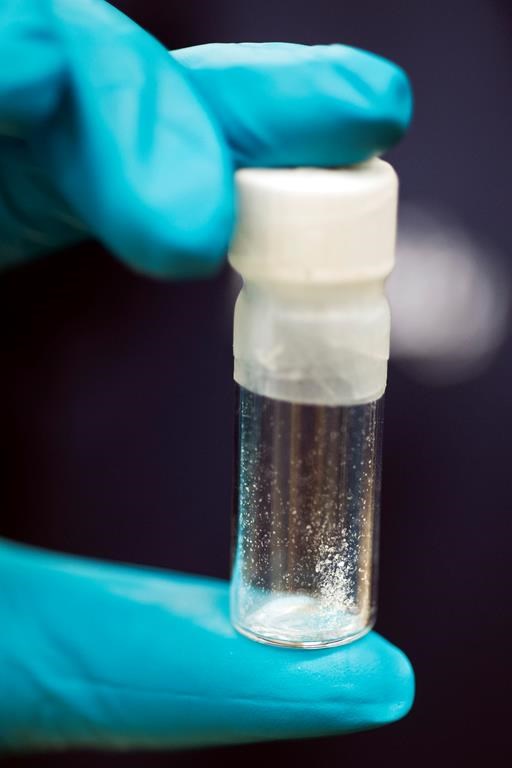
A vial containing 2mg of fentanyl, which will kill a human if ingested into the body, is displayed at the Drug Enforcement Administration (DEA) Special Testing and Research Laboratory in Sterling, Va., on Aug. 9, 2016. More than 1,100 people died from toxic drugs in Alberta this year, much higher than pre-pandemic numbers in the same time period. (AP Photo/Cliff Owen, File). 

More than 1,100 people died from toxic drugs in Alberta this year, much higher than pre-pandemic numbers in the same time period.


According to the province’s substance use surveillance system, 161 people died from toxic drugs in July 2023.

This brings the total number of deaths to 1,104 for the first seven months of the year, more than 21 per cent higher compared with the same seven-month period last year.

However, it is still a lot higher than pre-pandemic numbers: this year’s numbers are 169 per cent higher compared with the same seven-month period in 2019.

Most drug poisonings in July happened in Calgary, which recorded 52 deaths. Edmonton and the South Zone (which includes Lethbridge and Medicine Hat) recorded 62 and 27 deaths, respectively.

However, the fatality rate is highest in the South Zone, which saw 101.2 deaths per 100,000 people in July. Edmonton recorded 49.3 deaths per 100,000 people in July, while Calgary recorded 34.6 deaths per 100,000 the same month.
STORY CONTINUES BELOW ADVERTISEMENT


Global News reached out to Alberta’s Ministry of Mental Health and Addictions with a request for comment.

“The nationwide addiction crisis remains a big concern for our government, which is why we have created the Alberta Model, making recovery readily available for any Albertan,” said Hunter Baril, the ministry’s press secretary, in an email to Global News.

“These facilities, along with any other publicly-funded treatment centre offer addiction treatment at no cost. Financial barriers should never hold someone back from accessing the life-saving treatment they need.

“Albertans know a compassionate and dignified approach is the right path forward for those suffering from the deadly disease of addiction.”

Mental health and addictions critic Janet Eremenko said while treatment is a good option for those who want it, the United Conservative government is not doing enough to meet the demand.

“This overemphasis on treatment is actually narrowing the scope of services and program at a point where we need to be expanding it significantly,” Eremenko told Global News.

“We need to be throwing every resource and initiative and expertise at this issue that we can in order to save lives. If we’re only looking at treatment, we are absolutely failing to address a massive component of this issue, which is around the toxic drug supply that is killing people.”

But many advocates say the number of toxic drug deaths may be a lot higher.

Danielle English, a harm reduction advocate, said a huge backlog at the coroner’s office means toxic drug deaths are not accurately recorded because a lot of deaths are still under investigation.

According to data from the Alberta government, 7062 people died of unknown causes since 2019.


A Statistics Canada report said Alberta and British Columbia had higher-than-expected excess deaths throughout much of 2022. The report also said drug deaths and alcohol poisoning have risen since the pandemic was declared in 2020, and young people were disproportionately represented in these numbers.

“The moms that I talked to who are waiting for autopsy reports from their children who have passed, it could take up to a year for them to get that information,” English said.

“So many deaths that get listed as unknown or unsolved that have to be investigated further. I think that will really impact that number.”

English said the United Conservative government’s focus on abstinence-based recovery programs will make the problem worse.

A study published by Portland State University in 2022 suggests abstinence-based programs often utilize shame and stigmatization to coerce adolescents to abstain from drug use. This concept, along with zero-tolerance policies, removes adolescents from their communities rather than providing them with proper resources and support.


“I’ve been in rehab several times. And I will say that the time in my life when I was managing my use with abstinence-based programming was the time that I was at the most risk for relapsing alone in my apartment,” she said.

“When I felt like I couldn’t be open and honest with health care professionals about my use, my use became something that was hidden and something that was not being managed by my doctors.

“I truly believe that abstinence-based programming would have killed me sooner than toxic drug supply because it forced me to lie to the medical professionals in my life and it forced me to lie to my community.”

English also said the lack of harm reduction programs and safe supply means more drug users will die from the toxic drug supply.


In Calgary, there is only one safe injection site for the entire city. That safe injection site is not equipped to help drug users who choose to inhale their drugs instead, English said.


Many drug users also suffer from medical trauma which prevents them from seeking help. Jennifer Jackson, a registered nurse and an assistant professor at the University of Calgary, previously told Global News institutionalized treatment isn’t the first option for many, especially for residential school survivors and those experiencing homelessness.

“Drug users do advocate for how they want to use (health-care) services, but (medical professionals) don’t listen to them and talk down to them,” English said.

“I’ve been to hospitals experiencing withdrawal and they told me if they admitted addicts they would have no beds for ‘real people.’

“You don’t have an advocate or somebody who is there for you. You don’t have a peer support worker. You don’t have a constant social worker. That’s not changing.”

Harm reduction and safe supply needed

English said accessible harm reduction programs and safe supply are two of the most effective solutions for the toxic drug crisis.

An article published by John Hopkins University said harm reduction is a way to provide services to help with drug addiction, including treatment options. They are part of the same process, the article reads.

British Columbia is the first province to pilot a three-year drug criminalization project, which allows adults to possess 2.5 grams of cocaine, heroin, MDMA and methamphetamine without arrest or confiscation.

“When we have no safe supply, people are going to get (drugs) from elsewhere. And when they get it from elsewhere, they have no regulation and no support,” English said.

“It is more expensive to go to the bar and buy a beer than it is to buy it at the liquor store. But why do people go to a bar? Because of community. They pay the extra $6 because there’s community and safety. That’s a safe supply. That’s safe consumption.”

English noted that drug users must be given the choice of whether or not they go into treatment.

“Forced treatment means forced deaths, and they don’t work. They will go back to what they know because there is no housing, no support. And it breaks their trust,” she said.

“If you give a bed to someone who is forced to be there, it will take away a bed from someone who wants to be there.”

It is also important to treat drug users with respect and see them as human beings, she said.

English said many policymakers don’t consult with drug users before creating recovery programs or passing new regulations.

“I’m 33 and it has taken me till I was 33 to have safe employment, to be able to speak openly about this and to be able to identify as a drug user without fearing persecution because we don’t listen to drug users, we don’t see what would help them,” she said.

“We need to include drug users in the conversation. If we were talking about, you know, how to make insulin more accessible, we would interview people who had diabetes. Why do we not do the same for drug users? We know what we need and we are never consulted.”

Situation 'heartbreaking' as 1,168 more Albertans die of drug poisoning: physician

CBC
Tue, October 10, 2023 

A man waits to enter the Safeworks supervised consumption site at the Sheldon M. Chumir Health Centre in Calgary on Aug. 26. (Jeff McIntosh/The Canadian Press - image credit)

Since the start of the year, 1,169 Albertans have died of drug poisoning deaths, including 168 in the month of July, according to new data from the province's substance use surveillance system.

The number of deaths recorded over the first seven months of the same period last year was 1,021, making this year's figure a 14.5 per cent increase.

For those working at street level, including Calgary family physician Bonnie Larson, such numbers were to be expected.

"The numbers are hard, difficult, heartbreaking, but not surprising, because I am out there on the frontline in Calgary anyway, and seeing firsthand the impact of all of it. It's a complicated landscape," Larson said.

There were 57 drug poisoning deaths in Calgary in July, compared to 58 in Edmonton. So far this year, Calgary has seen the most deaths across the province, with 419 in the first seven months of the year compared to Edmonton's 376.

The province has already set several grim records amid the crisis. Alberta poisoning deaths in April due to opioids hit 194, the highest number since the province started collecting data in 2016.

The surveillance system is updated on a monthly basis as data is received from the Office of the Chief Medical Examiner, according to the province. Data is usually received about eight weeks after the end of the month.

What drug testing and wastewater testing is revealing right now is that there's a higher amount of drugs such as carfentanil in the supply than ever before, according to Dr. Monty Ghosh, an addictions specialist who practises in both Edmonton and Calgary.

"The drug supply is incredibly toxic, and it keeps shifting week by week. It's very hard to predict what's happening with the drug supply. And so I'm not surprised by these numbers," Ghosh said.

"If you look at some of the predictions that Health Canada is making in terms of the modelling … these numbers are just going to continue to rise."


Dr. S. Monty Ghosh is an addiction and internal medicine specialist, as well as an assistant clinical professor at the University of Calgary and The University of Alberta. He conducts research, policymaking, and advocacy for individuals experiencing homelessness, addiction, and a history of corrections, and for other vulnerable or stigmatized populations.Less

Dr. Monty Ghosh, an addictions specialist who practises in both Edmonton and Calgary, says it will be very difficult to control the ongoing overdose crisis until the toxic drug supply is controlled. (S. Monty Ghosh)

The presence of contaminants in the drug supply means that a co-ordinated, multi-pronged response must be deployed, in Ghosh's view.

"We really need to have a system in place where we can alert people to the toxic drug supply. We need to have a system in place where people are aware of the substances that they're using," Ghosh said.

"We also need to limit the toxic drug supply as a whole, if we can."

In a statement, a spokesperson for Mental Health and Addiction Minister Dan Williams highlighted the province's commitment to its recovery-oriented model of care.

"Since 2019, more than 10,000 treatment spaces have been added and are helping free Albertans from the deadly disease of addiction, with more on the way through the opening of 11 recovery communities throughout the province," Hunter Baril wrote.

"These facilities, along with any other publicly funded treatment centre, offer addiction treatment at no cost. Financial barriers should never hold someone back from accessing the life-saving treatment they need."

CBC News has requested more information on how many people are currently waiting on beds, how many people accessed treatment last year, and how many people completed treatment in 2022.


2 years in, Yukon's supervised consumption site is a proven success, officials say

CBC
Tue, October 10, 2023 

Whitehorse's supervised consumption site. When the facility opened in September 2021, Yukon became the 6th jurisdiction in Canada to open such a facility. When it comes to harm reduction, officials say the site has exceeded expectations. 
(Anna Desmarais/CBC - image credit)

Yukon's first supervised consumption site for drug users is exceeding expectations and saving lives, according to the territorial government and the non-profit that helps run the facility.

The site, at 6189 Sixth Ave. in Whitehorse, opened a little over two years ago and was designed to provide a safer and more hygienic environment for people to use drugs under the supervision of qualified medical staff.

"We've exceeded what we had initially thought the reach was going to be," said Brontë Renwick-Shields, executive director of the Blood Ties Four Directions Centre. The organization operates the site in partnership with the Yukon government.

"It's just been very positive in terms of the way that it's increased the health and well-being of people who use drugs in our community."

When it opened in September 2021, Yukon became the sixth jurisdiction in Canada to open a supervised consumption site. About eight months later, the Yukon facility added an area for users who inhale their drugs and Renwick-Shields said that made a big change.

"We knew that without the smoke room, the use of the site would be limited because at the site right now approximately 95 per cent of consumptions are smoking," she said.

"As soon as that opened, we started to see like a significant increase in uptake in the site. And that of course builds over time."

Brontë Renwick-Shields, director of Blood Ties Four Directions, recalled that supervised consumption centers were not new to Canada. Health and Social Affairs Minister Tracy-Anne McPhee said the opening was delayed by renovations and a lack of staff.
Brontë Renwick-Shields, director of Blood Ties Four Directions, speaks at the opening of the site in 2021 as Yukon Health and Social Services Minister Tracy-Anne McPhee looks on. (VINCENT BONNAY/RADIO-CANADA)

As of the end of last month, there had been 6,869 visits to the site by 382 different people. There had been 6,008 consumptions on site.

Renwick-Shields also said last week that facility staff had responded to 51 overdoses since opening, and all were successfully dealt with.

The usage of the site continues to increase, Renwick-Shields says, with as many visits in the last six months as in the previous 18 months. She chalks that up a growing familiarity and trust in the facility, rather than an significant increase in the number of drug users.

"The majority of folks, [drug use] is something that's been a part of their life for a while," she said.

"The concept of using substances in a space that was safe, and where there won't be police interference was really foreign to folks, and that took a lot of time for us to build trust that wouldn't happen in that space."

The supervised consumption center will also allow those who so wish to obtain help and advice concerning addiction treatment, mental health services and housing assistance.
The supervised consumption site also allows those who so wish to obtain help and advice concerning addiction treatment, mental health services and housing assistance. (VINCENT BONNAY/RADIO-CANADA)

She says more people are also using Blood Ties' drug-testing service, and she believes that's because they can now consume those drugs at the same place. Before, people would have to go elsewhere to consume the drugs after testing.

'We're becoming a leader'

Cameron Grandy, director of the Yukon government's Mental Wellness and Substance Use Services, agrees that the facility has proven to be a success when it comes to harm reduction.

"We get phone calls now from sites down south who are looking to maybe put in a smoking room. We're becoming a leader in how do you effectively run a site that has maybe indoor inhalation but is also an integrated care site."

To Grandy, the initiative fits well with the spirit of the territory's substance use health emergency strategy, a broad-ranging, 60-page "road map" released in August, 17 months after the territorial government's declaration of a substance use emergency in the Yukon.

Cameron Grandy is Yukon's director of mental wellness and substance use services.
Cameron Grandy is Yukon's director of mental wellness and substance use services. 'It's exceeded expectations in terms of the trust that's been built,' he said. (George Maratos/CBC)

He points to the fact that the site allows those who so wish to then access other addictions or mental health resources.

"There isn't one approach ... there's a really non-judgmental, safe, and meet-you-where-you're-at approach, and that kind of can branch into other different options for folks," he said.

"Again, it's exceeded expectations in terms of the trust that's been built in, in how quickly people have felt comfortable using that, and the lives that have been saved."

The facility has also been responsive to feedback, he says — for example, by shifting its opening hours from 10 a.m. to 7 p.m., to instead be noon to 9 p.m. That's because people were looking to access the site later in the evening, he said.

The next step will be to open the facility seven days a week, something that should soon be approved, according to Grandy. Right now, the site is open Monday to Friday only.

Once the new schedule is approved, additional staff would need to be hired and trained and neither Grandy nor Renwick-Shields could say exactly how long it all might take.

"So can't give a date, but very soon," Grandy said.

"I think that's really important for the clientele, that we serve to make it more consistent, seven days a week, and adding a couple of additional resources — just because of the volume of individuals and frequency with which they're using the site."
Nova Scotia paramedics reject contract offer

CBC
Tue, October 10, 2023 

Several paramedics said the three-year contract with a wage increase of about 20 per cent over the life of the deal did not do enough to address long-standing concerns about work-life balance. (Robert Short/CBC - image credit)

Paramedics in Nova Scotia have voted down a contract offer they received last week from the provincial government.

Several paramedics, who weren't authorized to publicly discuss the terms of the offer, said it was for a three-year contract with an increase of about 20 per cent over the life of the deal. They expressed concern, however, that the contract did not do enough to address long-standing concerns paramedics have voiced about work-life balance.

Charbel Daniel, the executive director of provincial operations for Emergency Health Services, said in a statement that recruitment and retention of frontline staff was the focus of contract talks with the International Union of Operating Engineers Local 727, and that the agreement offered "a substantial wage and benefits package."

The current contract expires at the end of the month and talks about a new deal started in June.

"We will not be providing any further comment until we have engaged in further discussions with our union partners," Daniel said in the statement.

"We appreciate the difficult work our frontline staff do each and every day, and the invaluable contributions they offer to the health-care system."

'This is a fair financial package'

A recent auditor general's report said 25 per cent of daily ambulance shifts go unstaffed because there are not enough people available to work. The report also found that paramedics are often working well beyond their scheduled hours and it's difficult for them to get approved vacation time.

Speaking to reporters in Halifax on Tuesday, Premier Tim Houston said the government put forward "a very attractive financial offer," but union members would make their decisions.

"It's not that uncommon that [a contract offer] comes back for another round and that's the process and we respect that process," he said.

Houston said the government is "tough but fair" in the way it negotiates and he pointed to recent deals reached with the province's nurses and doctors as evidence.

"This is a fair financial package. There's always issues — internal issues within the organizations that guide the members — but we'll just kind of move forward."

IUOE Local 727 represents paramedics, clinical transport operators and members of the Life Flight team.

Officials with the union did not respond to multiple calls and emails seeking comment.