Saturday, December 30, 2023


Self-reported frequency of adding salt to food and risk of incident chronic kidney disease

JAMA Network Open

Peer-Reviewed Publication

JAMA NETWORK


About The Study: In this study of 465,000 individuals, a higher self-reported frequency of adding salt to foods was associated with a higher risk of chronic kidney disease in the general population. These findings suggest that reducing the frequency of adding salt to foods at the table might be a valuable strategy to lower chronic kidney disease risk in the general population. 

Authors: Lu Qi, M.D., Ph.D., of Tulane University in New Orleans, is the corresponding author. 

 To access the embargoed study: Visit our For The Media website at this link https://media.jamanetwork.com/

(doi:10.1001/jamanetworkopen.2023.49930)

Editor’s Note: Please see the article for additional information, including other authors, author contributions and affiliations, conflict of interest and financial disclosures, and funding and support.

http://jamanetwork.com/journals/jamanetworkopen/fullarticle/10.1001/jamanetworkopen.2023.49930?utm_source=For_The_Media&utm_medium=referral&utm_campaign=ftm_links&utm_term=122823


New agent regulates serotonin production


Berlin based Start-up aims to bring down high levels of Serotonin


Business Announcement

MAX DELBRÜCK CENTER FOR MOLECULAR MEDICINE IN THE HELMHOLTZ ASSOCIATION

Trypto Therapeutics 

IMAGE: 

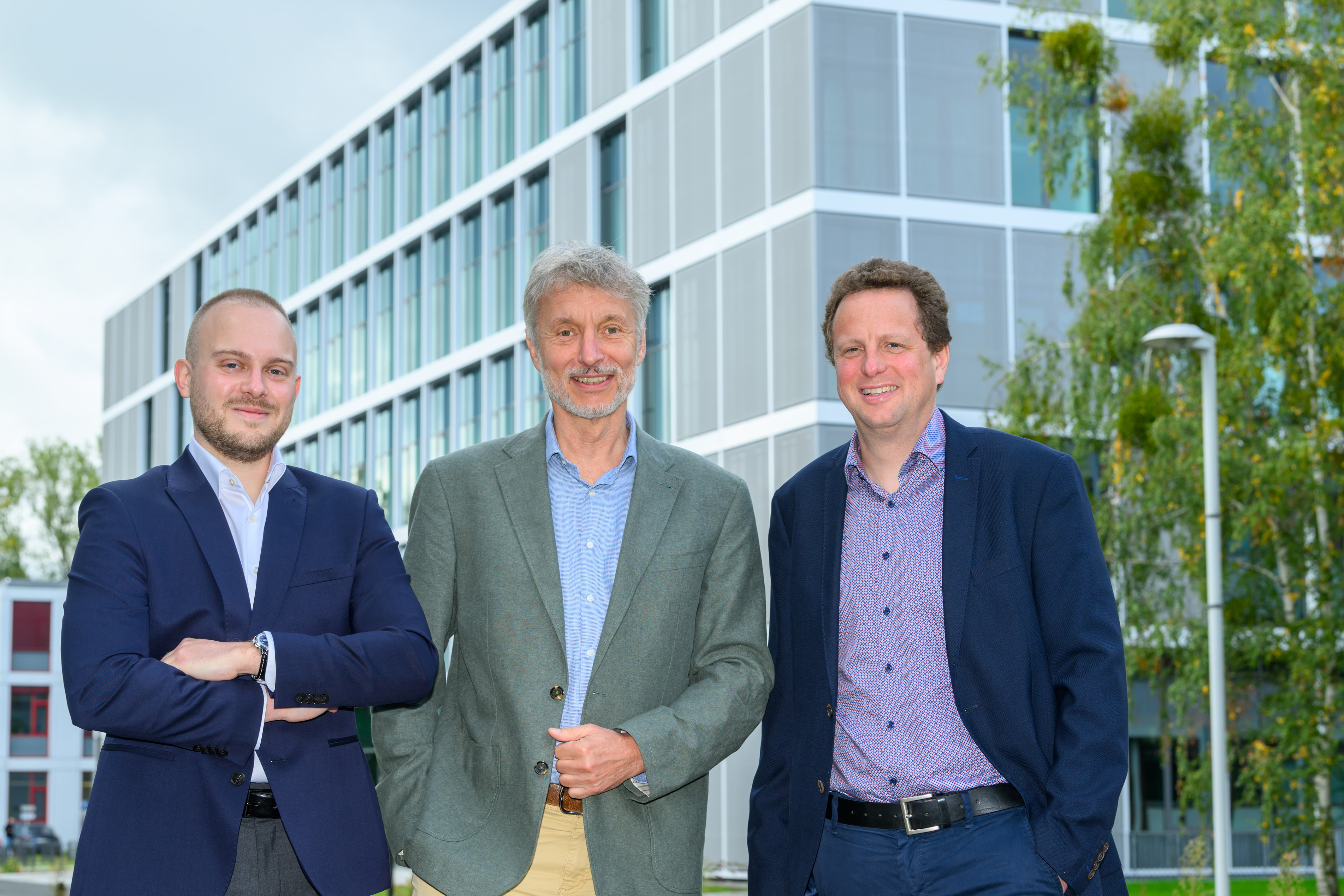
Radoslaw Wesolowski (left), Michael Bader (center) and Dr. Edgar Specker have teamed up to develop a potential therapeutic agent that influences serotonin levels.

view more 

CREDIT: PETER HIMSEL / CAMPUS BERLIN-BUCH GMBH


Serotonin makes you feel good. This neurotransmitter known as the “happiness hormone” regulates mood, sleep, and appetite. It also plays a key role in the gastrointestinal tract, where it is involved in regulating intestinal movement and the release of fluids that are important for the digestion and absorption of nutrients.

But too much serotonin causes health problems. An oversupply of the hormone can disrupt normal bodily functions and trigger various diseases. Professor Michael Bader and Dr. Edgar Specker have developed a drug that specifically lowers serotonin levels. Bader leads the Molecular Biology of Peptide Hormones Lab at the Max Delbrück Center, while Specker heads the Compound Management Core Facility at the Leibniz-Forschungsinstitut für Molekulare Pharmakologie (FMP). “We have now founded Trypto Therapeutics to bring our new therapeutic agent to the market,” says Bader. Along with the two scientists, biotech entrepreneurs Dirk Pleimes and Dr. Radoslaw Wesolowski are also involved in the new company. Max Delbrück Center and the FMP have an equity stake in the spin-off.

Stopped by the blood-brain barrier

Scientists don’t know exactly why serotonin production gets out of whack. An exception is carcinoid syndrome, a tumor disease in which hormone-producing cells release inordinate amounts of serotonin. Carcinoid syndrome is often associated with diseases like pulmonary hypertension, intestinal diseases, and heart valve fibrosis. However, they can also occur in patients without carcinoid syndrome. As different as these diseases are, elevated serotonin is involved in the development of all of them.

This is where the molecule that Bader and Specker discovered and further developed in the FMP’s compound library comes into play. It is called TPT-004 and inhibits an enzyme found in gastrointestinal tract cells, called tryptophan hydroxylase (TPH), that plays a role in serotonin synthesis. Lower TPH activity means less serotonin circulating through the body. The researchers showed that the administration of TPT-004 improves the health of rats with pulmonary hypertension. They were also able to prove that this molecule cannot cross the blood-brain barrier in mice. This is important because serotonin is also produced in the neurons – a process that should not be blocked because the brain requires the neurotransmitter to function properly.

Venture capital needed to move forward

A great deal of funding has gone into developing the TPH inhibitor so far – through the Max Delbrück Center’s Pre-GoBio funding scheme, through various lines of funding from the German Federal Ministry of Education and Research (BMBF) and, most recently, through the Max Delbrück Center’s SPOT spin-off support program. “We’ve received around €4.5 million in total,” says Bader. “But public third-party funding is not enough to take the next step. We need venture capital to do this. That’s why we founded Trypto Therapeutics.”

The scientists first plan to develop a method for producing their therapeutic agent in pure form in sufficient quantities so that it can be used in human clinical trials. They will also carry out a toxicity study in order to investigate the risks and possible side effects of the compound. Only then will it be possible to conduct a phase I clinical trial on a small group of healthy volunteers. “If we successfully complete the phase I trial, we will then decide whether to conduct a subsequent phase II study or sell the whole thing,” says Bader. The researchers initially want to test the drug on patients with pulmonary hypertension. If this works, they want to examine whether TPT-004 helps treat other diseases associated with elevated serotonin levels. Their development pipeline also includes new inhibitors for other enzymes.

Joint press release by Max Delbrück Center and FMP


Further information


Contacts

Professor Michael Bader
Head of the lab “Molecular Biology of Peptide Hormones”
Max Delbrück Center
+49 (0)30 9406 2193
mbader@mdc-berlin.de

Christina Anders
Editor, Communications Department
Max Delbrück Center
+49 (0)30 9406 2118
christina.anders@mdc-berlin.de or presse@mdc-berlin.de


Max Delbrück Center

The Max Delbrück Center for Molecular Medicine in the Helmholtz Association (Max Delbrück Center) is one of the world’s leading biomedical research institutions. Max Delbrück, a Berlin native, was a Nobel laureate and one of the founders of molecular biology. At the locations in Berlin-Buch and Mitte, researchers from some 70 countries study human biology – investigating the foundations of life from its most elementary building blocks to systems-wide mechanisms. By understanding what regulates or disrupts the dynamic equilibrium of a cell, an organ, or the entire body, we can prevent diseases, diagnose them earlier, and stop their progression with tailored therapies. Patients should be able to benefit as soon as possible from basic research discoveries. This is why the Max Delbrück Center supports spin-off creation and participates in collaborative networks. It works in close partnership with Charité – Universitätsmedizin Berlin in the jointly-run Experimental and Clinical Research Center (ECRC), the Berlin Institute of Health (BIH) at Charité, and the German Center for Cardiovascular Research (DZHK). Founded in 1992, the Max Delbrück Center today employs 1,800 people and is 90 percent funded by the German federal government and 10 percent by the State of Berlin.


Leibniz-Forschungsinstitut für Molekulare Pharmakologie (FMP)

What keeps us healthy, what makes us sick? How does a drug reach the right site of action in the body and thus spare patients from side effects? And how can viruses and bacteria be prevented from entering cells? To answer these questions, researchers at the Leibniz-Forschungsinstitut für Molekulare Pharmakologie (FMP) investigate biochemical processes in the body and study the molecular causes of diseases. Based on these findings, scientists can also specifically search for active substances and thus develop the basis for the medicine of tomorrow. Interdisciplinary teams from the fields of biochemistry, chemistry, physics, and medicine work together in a unique working environment on the Campus Berlin-Buch. The FMP is part of the Forschungsverbund Berlin e.V. (FVB), which legally represents seven non-university research institutes - members of the Leibniz Association - in Berlin.


AI

Machine learning methods to protect banks from the risks of complex investment products


Peer-Reviewed Publication

KEAI COMMUNICATIONS CO., LTD.

Performances of the proposed method compared to optimal strategy 

IMAGE: 

PERFORMANCES OF THE PROPOSED METHOD COMPARED TO OPTIMAL STRATEGY

view more 

CREDIT: CANNELLI, L., NUTI, G., SALA, M., AND SZEHR, O.


Artificial Intelligence (AI) is frequently touted as a silver bullet to solve complex modeling problems. Among its many applications, it has been investigated as a tool to manage risks of complex investment products—so-called derivative contracts—in the investment banking area. Despite the multiple positive reports in this area, concerns have been raised about their practical applicability.

In a new study published in The Journal of Finance and Data Science, a team of researchers from Switzerland and the US explored whether reinforcement learning RL agents can be trained to hedge derivative contracts.

"It should come as no surprise that if you train an AI on simulated market data, it will work well on markets that are reflective of the simulation, and the data consumption of many AI systems is outrageous," explains Loris Cannelli, first author of the study and a researcher at IDSIA in Switzerland.

To overcome the lack of training data, researchers tend to assume an accurate market simulator to train their AI agents. However, setting up such a simulator leads to a classical financial engineering problem: choosing a model to simulate from and its calibration, and making the AI-based approach much like the standard Monte Carlo methods in use for decades.

“Such an AI can also be hardly considered model-free: this would apply only if enough market data was available for training, and this is rarely the case in realistic derivative markets,” says Cannelli.

The study, a collaboration between IDSIA and investment bank of UBS, was based on so-called Deep Contextual Bandits, which are well-known in RL for their data-efficiency and robustness. Motivated by operational realities of real-world investment firms, it incorporates end of day reporting requirements and is characterized by a significantly lower training data requirement compared to conventional models, and adaptability to the changing markets.

"In practice, it's the availability of data and operational realities, such as requirements to report end-of-day risk figures, that are the main drivers that dictate the real work at the bank, instead of ideal agent training," clarifies senior author Oleg Szehr, whom, prior to his appointment at IDSIA, was a staff member at several investment banks. “One of the strengths of the newly developed model is that it conceptually resembles business operations at an investment firm and thus is applicable from a practical perspective.”

Although the new method is simple, rigorous assessment of model performance demonstrated that the new method outperforms benchmark systems in terms of efficiency, adaptability and accuracy under realistic conditions. “As often the case in real life, less is more—the same applies to risk management too,” concludes Cannelli.

###

Contact the author: Oleg Szehr, Dalle Molle Institute for Artificial Intelligence (IDSIA) – SUPSI/USI, oleg.szehr@supsi.ch

The publisher KeAi was established by Elsevier and China Science Publishing & Media Ltd to unfold quality research globally. In 2013, our focus shifted to open access publishing. We now proudly publish more than 100 world-class, open access, English language journals, spanning all scientific disciplines. Many of these are titles we publish in partnership with prestigious societies and academic institutions, such as the National Natural Science Foundation of China (NSFC).


Extremes of mobility: Lessons from Los Angeles' transportation policy unveiled in new book


Book Announcement

WORLD SCIENTIFIC

Extremes of Mobility: Development and Consequences of Transport Policy in Los Angeles 

IMAGE: 

COVER FOR "EXTREMES OF MOBILITY: DEVELOPMENT AND CONSEQUENCES OF TRANSPORT POLICY IN LOS ANGELES"

view more 

CREDIT: WORLD SCIENTIFIC


The development of transportation policy in Los Angeles is a story of extremes. New book by director and founder of the independent Center of Automotive Management (CAM) at the University of Applied Sciences in Bergisch Gladbach, sheds light on the city’s extreme shifts in mobility policies and their enduring consequences. From boasting the world's largest regional rail network in the 1920s to its current status as a symbol of car-oriented mobility, the city's journey reflects global trends, offering invaluable insights for policymakers worldwide.

The book, tracing the history of transportation policy in Los Angeles up to the present day, reveals the pitfalls of supply- and infrastructure-oriented approaches. Despite massive investments in a local public transport system since the 1990s, traffic problems persist, exemplifying the self-reinforcing cycle of increasing demand and worsening congestion. The findings underscore the need for a nuanced understanding of the spatial, social, and economic interdependencies inherent in transport policy.

One crucial revelation from the analysis is the counterintuitive impact of road expansion. Contrary to expectations, Extremes of Mobility: Development and Consequences of Transport Policy in Los Angeles demonstrates that the supply-oriented expansion of expressways and motorways exacerbates traffic congestion rather than alleviating it. Los Angeles serves as a cautionary tale for other cities globally, as similar trends of spatial separation between living and working unfold, leading to increased commuting distances and traffic woes.

The global relevance of Los Angeles' experience is underscored by comparisons with Germany, where commuter numbers have surged to a new high of 20.3 million in 2022. The challenges faced by major German cities, such as Munich, mirror those of Los Angeles, emphasizing the universal applicability of the lessons drawn from the extreme case study. The book concludes that a sustainable solution to metropolitan region problems demands a holistic understanding of transport's origins, spatial dynamics, and social and economic impacts. Policies emphasizing infrastructure expansion or commuter incentives without considering these factors risk perpetuating ecologically and socially detrimental patterns that are challenging to reverse.

Extremes of Mobility: Development and Consequences of Transport Policy in Los Angeles retails for US$88 / £80 (hardcover) and is also available in electronic formats. To order or know more about the book, visit http://www.worldscientific.com/worldscibooks/10.1142/13474.

###

About the Author

Stefan Bratzel is director and founder of the independent Center of Automotive Management (CAM) at the University of Applied Sciences in Bergisch Gladbach. After completing his studies in political science and later earning his doctorate, Bratzel worked in and around the auto industry. Among other positions, he has held posts as a project manager at the Daimler subsidiary smart, as program manager Automotive at the Telefonica/Sonera subsidiary Group3G, and as the head of Business Development Automotive at PTV AG. Since April 2004, he has worked as a senior lecturer and course program director for automotive management at the University of Applied Sciences in Bergisch Gladbach (Cologne area). In his research, Stefan Bratzel deals with the conditions for success and survival of automobile manufacturers and suppliers as well as future questions of mobility. Based on empirical studies, he examines the innovation trends in the automotive industry and the evolving mobility ecosystem. As a well-known industry expert, he is one of the most cited automobile economists in Germany in the press, radio and television.

About World Scientific Publishing Co.

World Scientific Publishing is a leading international independent publisher of books and journals for the scholarly, research and professional communities. World Scientific collaborates with prestigious organisations like the Nobel Foundation and US National Academies Press to bring high quality academic and professional content to researchers and academics worldwide. The company publishes about 600 books and over 170 journals in various fields annually. To find out more about World Scientific, please visit www.worldscientific.com.

For more information, contact WSPC Communications at communications@wspc.com.


Unraveling the evolutionary origins of umami and sweet taste preferences

A genome-wide survey reveals a high level of diversity in how taste receptors evolved among vertebrates

Peer-Reviewed Publication

KINDAI UNIVERSITY

Phylogenetic tree and the revised classification of TAS1R members. 

IMAGE: 

A NEW STUDY LED BY RESEARCHERS FROM KINDAI UNIVERSITY IDENTIFIED FIVE NEW GROUPS OF UMAMI AND SWEET TASTE RECEPTORS WITHIN THE TAS1R FAMILY (TAS1R 4, 5, 6, 7, AND 8) AND ALSO DIVERSITY IN TAS1R2 AND TAS1R3 GENES.

view more 

CREDIT: HIDENORI NISHIHARA FROM KINDAI UNIVERSITY

The perception of taste is one of the most important senses and helps us identify beneficial foods and avoid harmful substances. For instance, our fondness for sweet and savory foods results from our need to consume carbohydrates and proteins. Given their importance as an evolutionary trait, researchers around the world are investigating how taste receptors originated and evolved over a period of time. Obtaining these insights into the feeding behavior of organisms can help them paint a picture of the history of life on Earth.


One of the important tastes in our taste palette is umami, or the savory taste, which is associated with proteins that form a vital part of the diets of many organisms. The taste receptor type 1 (T1R) detects sweet and umami tastes among mammals. This taste receptor is encoded by the TAS1R, a family of genes, including TAS1R1, TAS1R2, and TAS1R3, and comes from a common ancestor of bony vertebrates. However, this gene pattern is not observed in coelacanth and cartilaginous fishes, where 'taxonomically unplaced' TAS1R genes have been identified, suggesting an incomplete understanding of the evolutionary history of taste receptors.

Now, however, a research team led by Associate Professor Hidenori Nishihara from Kindai University and Professor Yoshiro Ishimaru from Meiji University, Japan, have identified five new, previously undiscovered groups within the TAS1R family. This discovery is a result of a genome-wide survey of jawed vertebrates including all major fish groups.

The study was published in Nature Ecology & Evolution on December 13, 2023 and included the contributions of Senior Assistant Professor Yasuka Toda from Meiji University, Professor Masataka Okabe from The Jikei University School of Medicine, Professor Shigehiro Kuraku from the National Institute of Genetics, and Project Associate Professor Shinji Okada from The University of Tokyo.

“Our study revealed that as compared to most modern vertebrates, the vertebrate ancestor possessed more T1Rs. These findings challenge the paradigm that only three T1R family members have been retained during evolution,” says Prof. Nishihara.


The novel taste receptor genes, named TAS1R4, TAS1R5, TAS1R6, TAS1R7, and TAS1R8 by the researchers, were categorized based on their distribution among species with a common ancestor. The researchers found TAS1R4 genes to be present in lizards, axolotl, lungfishes, coelacanth, bichir, and cartilaginous fishes, but absent in mammals, birds, crocodilians, turtles, and teleost fishes. Moreover, axolotl, lungfishes, and coelacanth were found to have TAS1R5. The researchers observed a close evolutionary relationship between TAS1R5TAS1R1, and TAS1R2, indicating a shared ancestry between these genes. The cartilaginous fishes possess TAS1R6 exclusively. Notably, the researchers found that TAS1R6 evolved from the same ancestral gene that led to TAS1R1TAS1R2, and TAS1R5 genes. While axolotl and lizards possess TAS1R7,  bichir and lungfishes possess TAS1R8. The researchers determined that these two genes originated in the common ancestor of jawed vertebrates.

In addition to these new genes, the study revealed diversity in the existing TAS1R genes. For instance, they found that TAS1R3 of bony vertebrates could be divided into TAS1R3A and TAS1R3BTAS1R3A was present in tetrapods and lungfishes, while TAS1R3B was identified in amphibians, lungfishes, coelacanths, and ray-finned fishes. Additionally, the genome survey found TAS1R2 to have diversified into two distinct groups (TAS1R2A and TAS1R2B), challenging the conventional idea that TAS1R2 forms a single gene group.

“We found that the TAS1R phylogenetic tree comprises of a total of 11 TAS1R clades, revealing an unexpected gene diversity,” adds Prof. Nishihara.


The findings also suggest that the first TAS1R gene appeared in jawed vertebrates around 615–473 million years ago. The gene then underwent several duplications to produce nine taste receptor genes (TAS1R1,2A, 2B, 3A, 3B, 4, 5, 7, and 8) in the common ancestor of bony vertebrates. Over time, some of these genes were lost in different lineages, with mammals and teleosts retaining only three TAS1Rs (TAS1R1TAS1R2A, and TAS1R3A in mammals).

In addition to shedding light on the evolutionary history, the findings also have practical applications. Explaining these to us, Prof. Nishihara says, “These findings make it easier for us to deduce the taste preferences of diverse vertebrates. This, in turn, can have potential applications such as the development of pet foods and attractants tailored to the preferences of fish, amphibians, and reptiles.


Evolution of the TAS1R family of genes during vertebrate evolution.