Sunday, February 04, 2024

Hamas demands Israel release Marwan Barghouti, a man some Palestinians see as their Nelson Mandela

AP 
Feb 04, 2024 

JERUSALEM (AP) — He's viewed by some Palestinians as their Nelson Mandela, and he's a prime candidate to become their president in the future. He's also the highest-profile prisoner held by Israel.

Now Marwan Barghouti's freedom is at stake in cease-fire negotiations between Hamas and Israel. Hamas leaders demanded Friday that Israel release Barghouti, a leader of the militant group’s main political rival, as part of any deal to end the fighting in Gaza.
Catch the complete coverage of Budget 2024 only on HT. Explore now!

The demand brings new attention to Barghouti, who plays a central role in Palestinian politics even after spending more than two decades behind bars. His release could lay the groundwork for his eventual election to national office.

Hamas' gambit to free him appears to be an attempt to rally public support for the militant group as well as a recognition of his status as a uniquely unifying Palestinian figure.

“Hamas wants to show to the Palestinian people that they are not a closed movement. They represent part of the Palestinian social community. They are trying to seem responsible,” said Qadoura Fares, who heads the Palestinian Ministry of Prisoner Affairs in the occupied West Bank and has long been involved in negotiations over prisoner releases.

Senior Hamas official Osama Hamdan called for Barghouti's release as international mediators try to push Israel and Hamas toward an agreement after nearly four months of war.

Israel is seeking the release of more than 100 hostages still held by Hamas in Gaza. Hamas is demanding an end to Israel's devastating military offensive and the release of thousands of Palestinian prisoners.

The war broke out Oct. 7, when Hamas fighters crossed into Israel, killing some 1,200 people and dragging 250 hostages back to Gaza. The Hamas attack triggered an Israeli ground and air campaign that has killed more than 27,000 Palestinians, according to local health officials, and triggered a humanitarian catastrophe in Gaza.

Over 100 hostages were released during a weeklong truce in November. Israel estimates 136 hostages remain in captivity, though 20 have been pronounced dead. With protests calling for the hostages' immediate release sweeping Israel, and fears that time is running out to bring them home safely, pressure is mounting on Prime Minister Benjamin Netanyahu to reach a deal.


For Palestinians, the plight of their imprisoned loved ones is deeply emotional. While Israel considers “security prisoners” to be terrorists, Palestinians widely see them as heroes battling Israeli occupation. Virtually every Palestinian has a friend, relative or acquaintance who has been imprisoned.

The Israeli human rights group HaMoked says Israel is currently holding nearly 9,000 security prisoners. Hamas seeks the release of all of them. But in his remarks Friday, Hamdan mentioned only two by name — Barghouti and Ahmad Saadat.

Saadat heads a small faction that killed an Israeli Cabinet minister in 2001 and is serving a 30-year sentence for allegedly participating in attacks.

Palestinians see the 64-year-old Barghouti, a member of Palestinian President Mahmoud Abbas’ Fatah party, as a natural successor to the 88-year-old Abbas, who leads the internationally recognized Palestinian Authority, the self-ruled government that administers parts of the Israeli-occupied West Bank.

Abbas, whose forces in Gaza were overrun by Hamas in 2007, hopes to regain control of the territory after the war. But he is deeply unpopular because of corruption within the authority and because of his security coordination with the Israeli army.

Palestinians have not held elections since 2006, when Hamas won a parliamentary majority.

Fares, a Barghouti supporter, said that if Barghouti is released, he could become a consensus candidate in a round of new elections that Hamas, Fatah and other Palestinian factions could rally behind. A wartime opinion poll published in December showed Barghouti to be the most popular politician among Palestinians, ahead of both Abbas and Hamas' leader, Ismail Haniyeh.

Israelis see Barghouti as an arch-terrorist, and convincing Israel to free him will be an uphill battle.

Barghouti, a leader in the West Bank during the second Palestinian uprising in the early 2000s, is serving five life terms for his role in several deadly attacks. During that uprising, Palestinian militants carried out deadly suicide bombings and shooting attacks in Israel and the Palestinian territories, targeting buses, restaurants, hotels and Israelis driving in the West Bank, eliciting crushing Israeli military reprisals.

In 2002, Barghouti was arrested on multiple counts of murder. He did not offer a defense, refusing to recognize the court’s authority. Since then, he has repeatedly thrust himself into the spotlight.

In 2021, he registered his own list for parliamentary elections that were later called off. A few years earlier, he led more than 1,500 prisoners in a 40-day hunger strike to call for better treatment in the Israeli prison system. From jail, he has continued to call for a Palestinian state in the West Bank, Gaza and east Jerusalem — lands Israel seized in the 1967 war.


Barghouti was born in the West Bank village of Kobar in 1962. While studying history and politics at Bir Zeit University, he helped spearhead student protests against the Israeli occupation.

He emerged as an organizer in the first Palestinian uprising, which erupted in December 1987, but Israel eventually deported him to Jordan. He returned to the West Bank in the 1990s, as part of interim peace agreements that were meant to pave the way for a Palestinian state but got bogged down by the end of the decade when a second uprising erupted.

Barghouti was seen as political leader of the armed wing of Fatah at the time.

Israel has previously rejected calls to free him. It refused to include him in a 2011 exchange of more than 1,000 Palestinian prisoners for a single soldier held captive in Gaza by Hamas, said Fares, who was party to the negotiations. Yehya Sinwar, the current Hamas leader in Gaza and a mastermind of the Oct. 7 attack, was freed in that exchange.


The 2011 negotiations revolved around the release of a single hostage. With the lives of over 100 hostages now hanging in the balance, there is more pressure than ever on Israel to release Palestinian prisoners. That may make conditions ripe for a deal that could simultaneously win Barghouti’s release and bolster Hamas’ standing among Palestinians.

“Hamas is more strong and more clever than ever before," Fares said. “They understand how necessary it is for the Palestinian people to have consensus."


Who Is Marwan Barghouti, and Why Is He Israel’s Most Important Prisoner?

Many Palestinians and Israelis consider him the only person who can lead the way to a two-state solution. Maybe that’s why Netanyahu won’t release him.

TAL COHEN/AFP/GETTY IMAGES
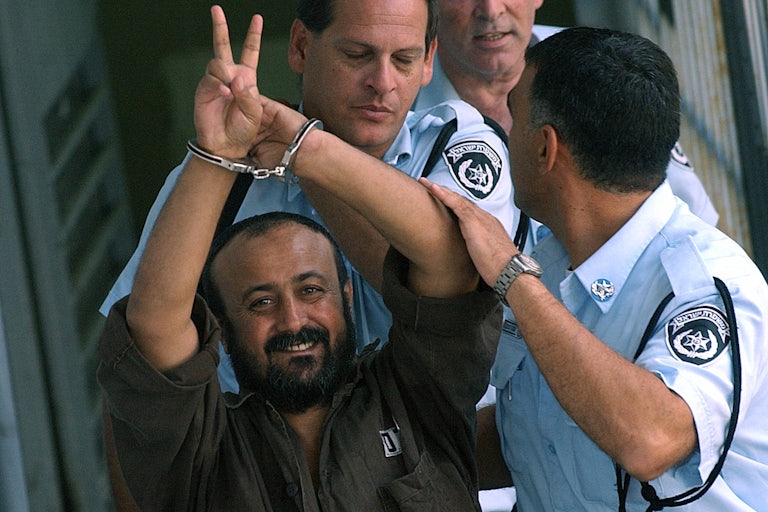
Marwan Barghouti in 2003, returning to jail after appearing before a Tel Aviv court

Jo-Ann Mort
January 30, 2024

Marwan Barghouti is Israel’s most celebrated prisoner and, by all accounts, the person most likely to succeed Palestinian Authority president and PLO leader Mahmoud Abbas whenever the Palestinian Authority—and the PLO—holds elections. Since 2002, he has been serving five life sentences plus an add-on of 40 years for his role in the Second Intifada. Barghouti was convicted of the direct murder of five Israeli citizens and for planning additional murders as the head of the Tanzim, the military wing of the nationalist Fatah party (also Abbas’s party), during the 1990s Second Intifada. Since then, he has renounced violence. In 2012, for example, in his court hearing, he spoke in Arabic, telling the Palestinian people to fight for “peaceful popular resistance of the occupation.”


There is faint hope that he could be released soon, as part of a deal with Hamas for the Israeli hostages. More likely, he will be released by a post-Netanyahu government if there is any hope for a two-state solution to the Israel-Palestinian crisis. There is simply no other leader who can deliver this scenario. Indeed, his prisoner status gives him extraordinary gravitas among the Palestinian people. He is also seen as not corrupt, unlike the current leadership of Abbas and those around him.

Once he is released, it will be difficult for an Israeli government to defy momentum toward a two-state option. In a recent Haaretz interview, Ami Ayalon, a former head of Israel’s Shin Bet security services, stressed not only that it was in Israel’s security interest to agree to a Palestinian state but that Barghouti must be released to negotiate and lead this state. “Marwan is the only Palestinian leader who can be elected and lead a united and legitimate Palestinian leadership toward a path of mutually agreed separation from Israel,” he told the Israeli newspaper.

Every poll since his imprisonment shows Barghouti to be the favorite to lead the Palestinian people in a free election. The most recent survey by Ramallah-based pollster Khalil Shikaki shows the same. When I met with Shikaki in January, in his Ramallah office, he told me: “Barghouti remains the most popular by far. We have never seen Barghouti losing, even during wartime, when Hamas gains ground.” No other Fatah leader can claim the same
.
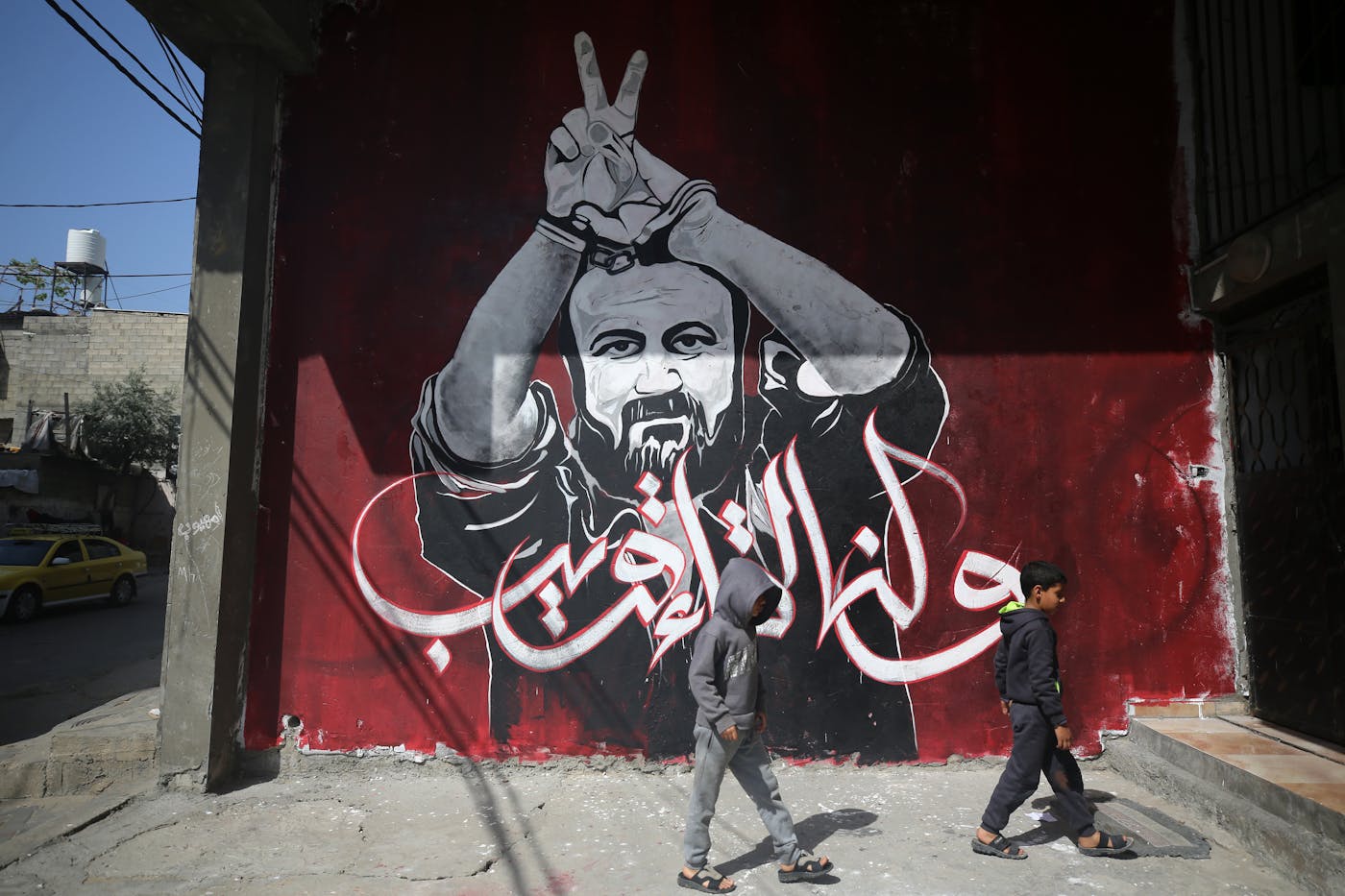
A mural of Marwan Barghouti in a refugee camp in the northern Gaza Strip on April 16MAJDI FATHI/NURPHOTO/GETTY IMAGES

Journalists are not permitted to interview Barghouti in prison. His wife, Fadwa Barghouti, herself a noted Fatah leader, women’s activist, and lawyer, hasn’t seen him in 18 months. Once heading a thriving legal practice, since her husband’s imprisonment she is active full-time keeping him in the public eye and advocating globally for his release. Barghouti’s closest political ally is Qadora Fares, who spent 13 years in Israeli prisons for his activities during the Intifada. The current commissioner of the Palestinian Commission of Detainees and Ex-Detainees Affairs for the Palestinian Authority, he oversees family needs and rehabilitation of prisoners kept in Israeli jails and is himself a popular political leader with the grassroots. Once called “the Fatah Young Guard,” he and Barghouti are now in their late fifties. Fares is a veteran of earlier peace initiatives, and today he still stands by all of them. So does Barghouti, Fares told me when I visited him at his office in Ramallah.

One of the most important documents never to be implemented was a 2006 “Prisoners’ Letter” co-authored by Barghouti on behalf of Fatah, Hamas, and other Palestinian factions inside the Israeli prisons, which offered an outline for a two-state solution. At the time, it made headlines precisely because Barghouti was able to negotiate it with the Hamas and more radical factions in prison. While it clearly articulates two states, it is likely more sweeping in other details than anything the Israeli government could accept, but the two-state declaration in it is clear. When I asked Fares if it is still relevant, he said, emphatically, “Yes, yes, yes.”

An earlier document, the Geneva Initiative of 2003, negotiated by former Israeli Justice Minister Yossi Beilin and former Palestinian Authority Minister Yassar Abed Rabo, also outlines a two-state solution roughly along the 1967 lines, with a refugee-return formula that is more likely to be accepted by an Israeli government than the prisoners’ document. It has been used by Israel’s shrunken peace camp as an aspirational model for years.

Fares, who signed Geneva at the time, told me that if Barghouti had objected to his signing, he would not have done so. Fares thinks that “Geneva, if you have a serious partner in Israel, will be accepted by the Palestinian majority, including Hamas.”

This initiative makes the parameters of an agreement clear, according to Fares, with “solutions—Jerusalem, refugees, borders, economic cooperation, everything. Some people criticize us because of the exchange of border swaps.” The compromise is to split Palestine. “All this land is Palestine,” he told me. “But when we signed the agreement, it became Palestine and Israel, OK? If you accept the principle of splitting it, OK ... if we want to check which kind of solution I find there, if tomorrow I became the representative of Palestinians, I will sign this.”

Today, there is a completely different opportunity than existed 20 or so years ago: to include all of the Arab states, most importantly Saudi Arabia, in an agreement sponsored by the kingdom and called the Arab Peace Initiative, which offers Israel full peace from regional governments with a Palestinian state. Though it was originally promoted by the Saudis in 2002, Benjamin Netanyahu’s government ignored it, and until recently Netanyahu (lured into a sort of unreality regarding the Palestinians thanks to the Trump strategy regarding the Abraham Accords, which gave Israel agreements with several Gulf States minus Palestinian recognition) thought that Israel could amend the agreement for peace with Saudi minus a Palestinian state. (As recently as at the 2023 U.N. General Assembly plenum, Netanyahu held up a map that included all of Israel’s neighbors minus a future Palestine.) That was highly unlikely, to say the least, but October 7 shattered it completely.

According to Fares, who also agrees with this Saudi initiative, “it’s been accepted by Marwan.” But for Israel to engage, there will have to be a new government. He adds: “First of all, the Israelis have to say that they decide to end the occupation, and they want to cooperate with the Arab world, with the Palestinian people. If there is an international effort, a real serious effort to react to a serious political process that will lead to end the occupation and to build our own state, I think that the behavior of Hamas, the policies of Hamas, the decision will be different.” That’s because “the Hamas political leadership understands that the Palestinian-Israeli conflict has to find a solution one day.” One hopes that Fares’s optimism could be warranted, though it’s difficult to imagine a shaken and frightened Israeli public buying it. Regardless, a political resolution promoting two viable states, with a strong Palestinian leader—with the overt support of the leading Arab states—could someday be a positive outcome of the Hamas attacks on October 7.

That’s also why Fares’s comments about a demilitarized Palestine were of vital importance. This is something that all Israeli political factions (and the United States) demand—and, though it’s unstated, the Arab states will also probably demand it. “If I am at peace with Israel, with Jordan, with Egypt, with the international community, and I need the support of the international community to rebuild our state … to act according to the Palestinian people’s interest, I have to think about an army?” he quips. “I have to create in Palestine what is most necessary … we have to build hospitals, schools, universities—to rehabilitate everything. We have around us here in the region a lot of strong armies. What have they done? Nothing. So it should be invested in education.… Let me imagine that I am a dominant person in the Palestinian leadership. And we are an independent state. Let us prepare the plan for the first five years.… For what do I need the army?”

So, returning to the awful moment in which we still find ourselves, why, I ask, did Hamas attack on October 7? Fares surmises that “it was because Netanyahu was telling Israel and the world that there is no Palestinian issue. That there could be a ‘new Middle East’ without finding a solution.” He continued: “The Palestinian Authority in Ramallah is a weak one … Netanyahu wants to bring it in as part of his administration indirectly.” As has been widely documented, Netanyahu thought he could stave off an independent Palestinian state by, as Fares characterized it, “taming Hamas.” It’s common knowledge now that Netanyahu had been allowing funding from Qatar to Hamas’s military and governing arm in Gaza for years—as a means of defanging Fatah.

Meanwhile, at the war’s start, Barghouti was moved to Ayalon Prison and placed in solitary confinement for five days. The Israeli authorities claimed that Barghouti wrote a letter supporting October 7. He and his wife deny this vehemently, as does Fares. This was used as an excuse to isolate him, where “his cell was dark 24 hours daily,” Fares said. Barghouti has been given minimal food, his mattress taken away during the day, and sleep deprived by blasting music. “They tried to humiliate him when they tied his hands to his back. They want his head to be close to the ground,” Fares explained. Partly due to the family hiring one of Israel’s leading human and civil rights attorneys, he is now back in Rimonim Prison in the center of Israel.

According to Fares and others quite close to Barghouti with whom I met, Marwan’s resolve remains. “He’s a true, true believer in the two-state solution,” someone very close to the family stressed to me during my recent Ramallah visit. Barghouti has become a bit of a legend among both the Palestinian people and, increasingly, the Israeli security establishment. The only way to test the promise of his leadership will be for a visionary Israeli leader to take the bold but necessary step to release him.

Jo-Ann Mort @ChangeCommNYC
Jo-Ann Mort often writes about Israel-Palestine and progressive issues. She is co-author of Our Hearts Invented a Place: Can Kibbutzim Survive in Today’s Israel?

Time to Free Palestine’s Nelson Mandela

Marwan Barghouti has been in an Israeli prison since 2002.


BY JEROME KARABEL
OCTOBER 20, 2023

BERNAT ARMANGUE/AP PHOTO
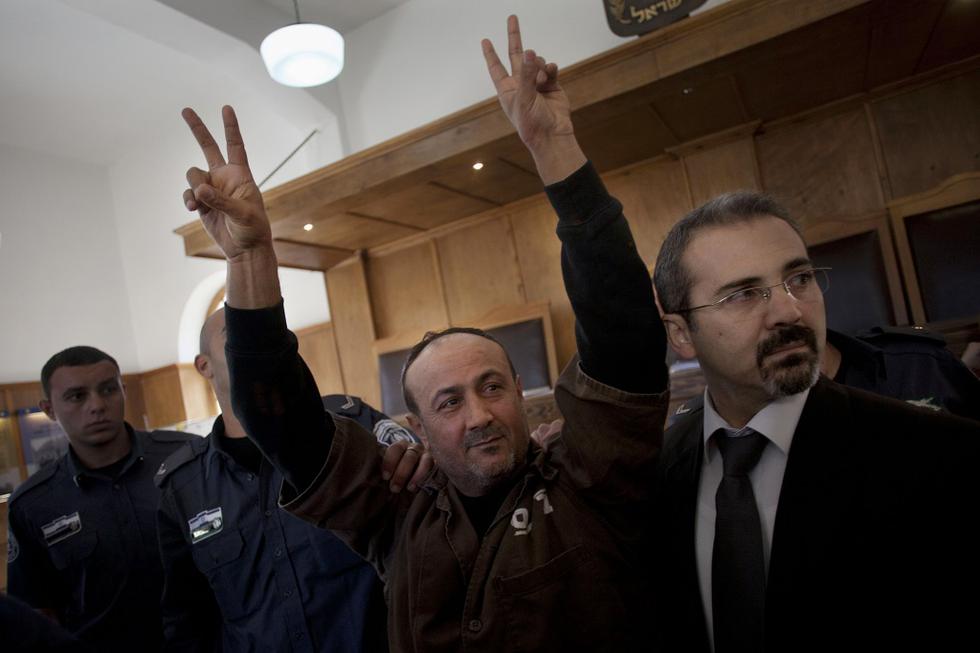
Imprisoned Palestinian leader Marwan Barghouti is seen here making the victory sign in front of the media during a January 25, 2012, appearance in a Jerusalem court.


After Hamas’s brutal massacre of over a thousand Israeli civilians and Israel’s massive military response, peace may appear inconceivable. Certainly, few would blame those unwilling to forgive the shocking violence of days past. Yet peace does not demand forgiveness of the unforgivable—and shattering events have a way of producing unanticipated consequences.

A prisoner exchange—which historical patterns suggest is likely—could, despite it all, reopen a path to peace. In 2011, Prime Minister Benjamin Netanyahu traded 1,027 Palestinian prisoners (280 of them serving life sentences) to obtain the release of a single Israeli soldier captured five years earlier. Israel now claims that Hamas holds 199 hostages. Meanwhile, an estimated 5,200 Palestinians languish in Israeli jails—and among them is one man who may hold the key to peace: Marwan Barghouti, considered by some to be Palestine’s Nelson Mandela.

Though Israeli authorities labeled Barghouti a “terrorist” after Israeli courts convicted him on five counts of murder, the idea of releasing him is far from a fringe position: Indeed, Alon Liel, formerly Israel’s most senior diplomat, has proposed just that. Deeming him “the ultimate leader of the Palestinian people,” Liel believes “he is the only one who can extricate us from the quagmire we are in.”

More from Jerome Karabel

As early as 2008, polling data revealed that Barghouti was far more popular among Palestinians than any other possible leader, including President of the Palestinian Authority Mahmoud Abbas and Hamas leader Ismail Haniyeh. But his very popularity was a problem for Prime Minister Netanyahu.

As Hebrew University professor Dmitry Shumsky has pointed out, it has long been the unannounced policy of Netanyahu to undermine the more moderate Palestinian Authority by bolstering Hamas, which shares his hatred of the two-state solution. As confirmed by a former Israeli Cabinet minister, Netanyahu actually propped up Hamas, approving the channeling of substantial funds from Qatar to the radical Islamist organization. Paradoxically, then, there has been a de facto alliance between the hard-line Netanyahu and Hamas, long irreconcilably opposed to the existence of Israel.

In this context, the popular and charismatic Barghouti has posed a unique threat to Israel and its persistent claim that it had no plausible interlocutor with whom to negotiate. The influential Israeli newspaper Haaretz captured the underlying dynamic well as far back as 2012, stating flatly in an editorial, “If Israel had wanted an agreement with the Palestinians it would have released him from prison by now. Barghouti is the most authentic leader Fatah has produced and he can lead his people to an agreement.”

Both Mandela and Barghouti arrived at a hard-won recognition that, after years of relentless struggle, they would have to learn to live with their longtime enemy.

The parallels between Barghouti and Mandela, while imperfect, are striking. Barghouti has spent 27 years in prison and in exile—precisely the number of years Mandela spent in a South African prison. While imprisoned, Mandela’s convictions drove him to learn Afrikaans, the language of his captors. Barghouti, in turn, has spent his time in jail becoming fluent in Hebrew. Critically, both men advocated for peaceful coexistence with—not the annihilation of—their adversaries.

One should not romanticize. Neither Mandela nor Barghouti were devotees of Mahatma Gandhi or Martin Luther King Jr.’s nonviolent philosophy; both believed that armed resistance to oppression was sometimes justified. As early as 1953, Mandela advocated armed resistance; classified by the South African regime as a “terrorist,” he six times refused offers of release conditioned in part on his renunciation of violence. And while Barghouti rejected violence in the early years of the Oslo peace process, claiming in 1994 that “the armed struggle is no longer an option for us,” he later embraced armed struggle as he watched Israel expand settlements in the West Bank and consolidate control. But by 2012, Barghouti admitted that the turn to violence during the Second Intifada had been a grave error, and has repeatedly stated that he supports only unarmed resistance.

Crucially, both Mandela and Barghouti arrived at a hard-won recognition that, after years of relentless struggle, they would have to learn to live with their longtime enemy. Recognizing, as he put it in his eulogy of Mandela, that they must “defy hatred and … choose justice over vengeance,” Barghouti supports, in exchange for an end to the Israeli occupation that began in 1967, permanent peace between Israel and Palestine as “independent and equal neighbors.” As such, he stands in stark contrast to Hamas’s leader, Ismail Haniyeh, who steadfastly refuses to recognize Israel.

Like Mandela, Barghouti earned the respect of his people through decades of sacrifice and commitment to the cause. And despite his over two decades in prison, Barghouti remains popular among Palestinians in both Hamas-controlled Gaza and the Fatah-controlled West Bank. Indeed, a December 2022 poll by the Palestine Center for Policy and Survey Research showed that if Barghouti were to run in a presidential election, he would defeat Haniyeh in a landslide victory.

Barghouti’s release would hardly guarantee an expeditious or smooth peace agreement between the Israelis and Palestinians; entrenched animosity and the continued occupation of Palestine by more than half a million Israeli settlers spread out over 199 settlements and 220 outposts may well prove insurmountable. Excruciating concessions must be extracted from both sides, necessitating a receptivity to compromise that would no doubt arouse fierce, and possibly violent, backlash. Yet both the Israelis and the Palestinians must ultimately choose: either an endless escalation of the cycle of violence and hatred or a grudging recognition that they must find a way to live together.

Though the intensifying conflict between Hamas and Israel is a genuine tragedy, the exchange of prisoners that will likely follow the carnage presents a historic opportunity that neither side can afford to miss: Israel must free Marwan Barghouti, the only Palestinian with the authority and vision to bring peace within the ambit of possibility.

JEROME KARABEL  professor of sociology at the University of California, Berkeley, is the author of ‘The Chosen: The Hidden History of Admission and Exclusion at Harvard, Yale, and Princeton’ and several other books.
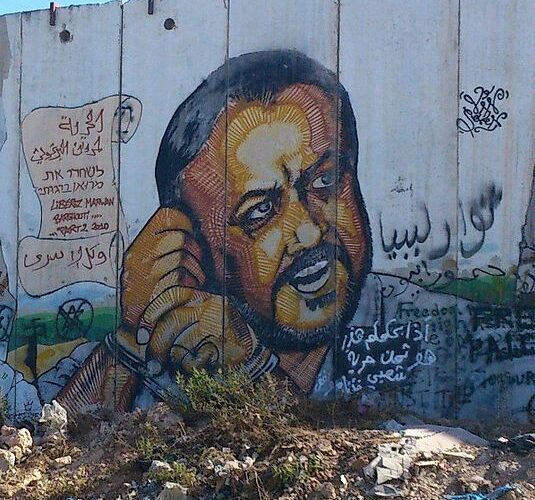

Marwan Barghouti, born in the West Bank village of Kobar in 1962, is a prominent and popular political figure associated with Fatah, currently serving five life sentences in an Israeli prison. He is a member of the Fatah Central Committee, and of the Palestinian Legislative Council (PLC).

Often described by Palestinians as the ‘Palestinian Mandela’ he is viewed as one of the strongest leadership candidates to succeed Mahmoud Abbas and is expected to run in the July 2021 presidential elections. Together with Nasser Kidwa, he also co-leads the ‘Freedom‘ list which will be competing in the May 2021 legislative elections.

In the run-up to the First Intifada, Barghouti was a student leader at Bir Zeit University involved in popular protests. He was deported by Israel to Jordan in May 1987 and was only allowed to return to the West Bank in 1993 as part of the Oslo Accords. The following year, in 1994, he became secretary-general of Fatah in the West Bank. During the Second Intifada, he allegedly directed military attacks against Israeli targets. Israel accuses him of having established the al-Aqsa Martyrs Brigades (AMB) at the time.

Barghouti was arrested and sentenced by an Israeli military court in 2002 to five consecutive life sentences for orchestrating attacks on Israelis. Since his imprisonment, Barghouti has been active in the prisoners’ movement and has published various articles from prison to communicate with the outside world. While in prison, he helped draft the 2006 National Conciliation Document of the Prisoners — which he co-signed with Abdulkhaleq al-Natsheh (Hamas), Bassam Sa’adi (PIJ), Abdel Rahim Mallouh (PFLP), and Mustafa Badarneh (DFLP). In 2017, he led a large-scale hunger strike to demand improved rights and conditions for prisoners.

Ben Siesta via Wikimedia CommonsCC BY-SA 3.0.


U.S. admits it hasn’t verified Israel’s UNRWA claims, media ignores it

Secretary Blinken admits that the U.S. has been unable to investigate the “evidence” presented by Israel claiming 13 of UNRWA’s 13,000 Gaza employees participated in October 7. Biden took Israel’s word for it anyway.
FEBRUARY 3, 2024 
MONDOWEISS
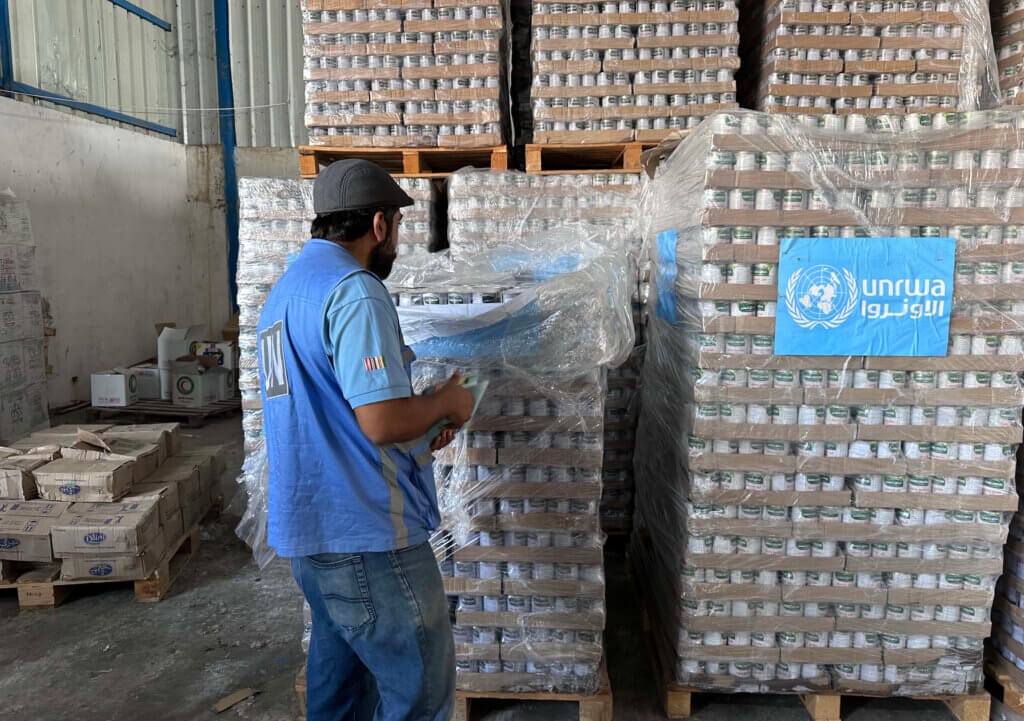
WORKERS OF THE UNITED NATIONS RELIEF AND WORKS AGENCY FOR PALESTINE REFUGEES (UNRWA) PREPARE MEDICAL AID FOR DISTRIBUTION TO SHELTERS, DEIR AL-BALAH, NOVEMBER 4, 2023. (PHOTO: SULIMAN EL-FARA/APA IMAGES)


In the latest demonstration of the boundless cruelty of U.S. President Joe Biden and his despicable administration, they have turned the backbone of what little aid Palestinians in Gaza receive into a political football, to be toyed with and batted around while jeopardizing that support for people who are already near the edge of what any human, however brave, can possibly endure.

It’s the latest in what feels like an eternal cycle of the United States and Israel beating up on the UN Relief and Works Agency (UNRWA) for political gain. There have been many hearings on Capitol Hill over the years bashing UNRWA and calling for either a complete structural overhaul of the agency or its dismantlement and absorption into the larger United Nations High Commission for Refugees (UNHCR).

The root of the attacks, prior to October 7, 2023, has been UNRWA’s unique mission which is to provide humanitarian assistance — including food, housing, medical aid, and the role that has taken up the bulk of its budget for years, education — to Palestinian refugees exclusively. Because of this mandate, Israel and its supporters blame UNRWA for the definition of “refugee” in the Palestinian context, which includes not only those made refugees by the 1948 and 1967 wars, but also their descendants born into refugee status.

Many on the pro-Israel and Israeli right and center believe doing away with UNRWA would essentially allow Israel to do away with Palestinian refugees because they believe UNRWA is the only thing maintaining that generational definition.

They’re wrong, of course. International law is clear on this point, as the UN states: “Under international law and the principle of family unity, the children of refugees and their descendants are also considered refugees until a durable solution is found. Both UNRWA and UNHCR recognize descendants as refugees on this basis, a practice that has been widely accepted by the international community, including both donors and refugee-hosting countries. Palestine refugees are not distinct from other protracted refugee situations such as those from Afghanistan or Somalia, where there are multiple generations of refugees, considered by UNHCR as refugees and supported as such. Protracted refugee situations are the result of the failure to find political solutions to their underlying political crises.”

There’s no ambiguity there, but that hasn’t stopped the controversy. UNRWA has been routinely accused of keeping Palestinians as refugees, not giving them the tools to move on to an independent lifestyle as individuals. This is a key ideological component in the denial of Israel’s responsibility for the ongoing dispossession of Palestinians. It absolves Israel of all responsibility for the ongoing poverty and hopelessness that decades of dispossession, occupation, and siege have wrought on Gaza and the West Bank.

Yet, while American politicians don’t think twice about trying to score points by bashing UNRWA, Israelis have always known that they need the agency, despite all their hateful rhetoric about it. For years, Israel would bash UNRWA mercilessly in the media, but would always tell the United States that its operations were necessary, especially in Gaza. Without UNRWA, Israel would be expected to ensure that a humanitarian catastrophe did not ensue, so Israel needs the agency.

In 2018, emboldened by a reckless U.S. administration under Donald Trump, Netanyahu suddenly changed that position and called for the U.S. to dramatically cut its support of UNRWA. Trump eagerly did so. When Netanyahu made that sudden shift, it surprised and disturbed many in his own government who disagreed with the decision. Just about the only positive step Joe Biden took when entering office was to restore UNRWA’s funding. But Trump’s action made the question of UNRWA’s funding even more politically charged than it had always been.

Unable to investigate


The old cycle seems to be playing out again, but this time, the highly charged politics in Washington are more intricate.

On January 26, Israeli allegations against a dozen UNRWA employees surfaced. The agency immediately fired nine of them and said that two others were dead, hoping their swift and pre-emptive action would stave off rash U.S. actions. Nonetheless, the United States and a host of other countries immediately suspended funding for UNRWA, over the actions of 12 of over 30,000 employees, 13,000 of whom are in Gaza.

It’s worth pausing over that last fact for a moment. Twelve out of 13,000 Gaza employees have caused all of this, and it’s based on evidence that has not been made public. You’d never know that from much of the media coverage, which is, once again, treating Israeli allegations as proven facts. Nor could you tell by the U.S. response. Secretary of State Antony Blinken stated, “We haven’t had the ability to investigate [the allegations] ourselves. But they are highly, highly credible.”

That is a stunning statement. They are simply taking Israel’s word for it, and on that basis, they are suspending aid to nearly two million people who need that aid more than anyone in the world.

Recall that Israel, in October 2021, labeled six Palestinian organizations as being connected to “terrorist groups,” specifically referring to the Popular Front for the Liberation of Palestine (PFLP). The “evidence” Israel presented was so threadbare that European countries dismissed it as baseless, and even the Biden administration, which has repeatedly supported Israeli claims based on no evidence that turned out to be false, could not accept the Israeli charges, though it avoided explicitly calling out Israel’s attempted deception.

Yet now, Israel has presented a “dossier” that contains its case against the twelve UNRWA workers. The actual evidence has not been made public, and even the United States, as noted above, has admitted it can’t verify the Israeli claims. But the U.S. suspended UNRWA’s funding anyway and led seventeen other countries to follow suit.
Not in Israel’s immediate interests

Israel saw matters going in a worrisome direction, however. The funding suspension will still allow UNRWA to operate through February, so there is time to reverse these decisions. And Israel is concerned that if that does not happen, the humanitarian situation will become so dire that Europe and maybe even the United States will not be able to resist the pressure from outraged populations and finally be forced to press for a permanent ceasefire.

Not only would UNRWA’s humanitarian efforts be shut down, but the UNRWA infrastructure that other groups use to distribute aid would also become unavailable. That will significantly accelerate the already crisis-level state of starvation, malnutrition, exposure, infections, curable diseases, lack of clean water, and all the other conditions that are killing Palestinians with accelerating speed, but much more quietly than Israeli bombs and bullets.

Fearing it could be pressed into ending its military operations, an Israeli official told The Times of Israel, “UNRWA is currently the international organization that plays the most dominant role in the entry and delivery of humanitarian aid into Gaza, and because there currently is no alternative, Israel is not pushing to shut down UNWRA.”

The Israeli official made clear what the Netanyahu government’s reasoning was. “If UNRWA ceases operating on the ground, this could cause a humanitarian catastrophe that would force Israel to halt its fighting against Hamas. This would not be in Israel’s interest and it would not be in the interest of Israel’s allies either.”

The United States quickly got the message. Even before the Israeli official spoke to The Times of Israel, U.S. Ambassador to the United Nations Linda Thomas-Greenfield shifted the American tone. “We need to look at the organization, how it operates in Gaza, how they manage their staff and to ensure that people who commit criminal acts, such as these 12 individuals, are held accountable immediately so that UNRWA can continue the essential work that it’s doing,” she said.

It’s not clear what “held accountable” means in this context since UNRWA has already fired the workers in question and even signaled it is open to criminal prosecution of anyone in “acts of terror.” Thomas-Greenfield also said that “fundamental changes” would be needed for funding to be restored. That’s a vague bit of wording that has been used many times in the past in reference to UNRWA. It’s unclear what it means here, exactly, but the general thrust of her speech was that funding should be restored.

“We shouldn’t let [the allegations] cloud the great work that UNRWA does,” Thomas-Greenfield said. “UNRWA has provided essential humanitarian assistance to the Palestinian people and UNRWA is the only organization on the ground that has the capacity to continue to provide that assistance.”

So, it would seem that the United States is prepared to back off of UNRWA and restore the funding, right? And then the other countries, who followed the U.S. down this rabbit hole, would follow it back out.

Well, it might not be that simple. As with everything during an election year, politics make this more complicated.

On January 30, the House Committee on Foreign Affairs held a hearing about UNRWA. The committee heard from one witness, Mara Rudman, who critiqued UNRWA but argued for President Biden’s “pause” on funding, rather than killing the agency. She said, “Is UNRWA, or any of the UN entities perfect? Far from it. The recent termination of 12 UNRWA employees who allegedly participated in the horrific Hamas attacks of October 7, provides one of the more extreme examples. It also shows the need for the ongoing oversight the Biden administration displayed in communicating to the UN that action and thorough investigation was required. For the services UNRWA provides to a desperate population, however, there is no substitute at this time.”

The termination of the twelve employees was a pre-emptive act of desperation and panic. UNRWA was not shown the evidence — merely accusations about the workers. But in this time of incomprehensible human suffering in Gaza, they wanted to do all they can to avoid the worst, so they fired the nine workers who remain alive. It shows how dedicated they are to their mission.

UNRWA submits lists of all its employees in the West Bank and Gaza to Israel. Somehow, Israel had no problem with these twelve, despite their supposedly extensive knowledge of the membership of Hamas and other Palestinian groups. None of this seems to bother Rudman much.

But she was the best of the witnesses, by far. The other three were Richard Goldberg of the Foundation for the Defense of Democracies, a far-right pro-Israel think tank; Marcus Sheff, CEO of IMPACT-se, a right-wing Israeli institution that leads the propaganda campaign against allegedly inflammatory Palestinian textbooks; and Hillel Neuer of the far-right UN Watch, a group whose mission is to paint the UN as a cesspool of antisemitism.

Their testimony was as biased as one might expect.

Biden’s incompetence and mindless cruelty


For Biden, the hearings, as well as the general tone and tenor in Washington after years of bashing UNRWA, present a problem. If he doesn’t restore UNRWA’s funding, conditions in Gaza will grow much worse very quickly, and calls for a ceasefire will be overwhelming, as will Biden’s downward trend in polls. If he restores UNRWA’s funding, he will find himself under attack from Republicans as well as some Democrats.

In the wake of the hearing this week, one of Israel’s leading advocates in Congress, Brad Schneider (D-IL), bluntly stated, “We have to replace UNRWA with something else. I support getting rid of UNRWA.”

Not to be outdone in anti-Palestinian animus, the ever-eager AIPAC shill, Ritchie Torres (D-NY) tweeted, “UNRWA, long funded by your tax dollars, has been governing Gaza at the behest of Hamas so that Hamas, which sees governing as a distraction, could dedicate itself to murdering Jews in Israel.”

Had Biden and Secretary of State Antony Blinken not reacted in knee-jerk fashion to the unsubstantiated Israeli allegations, this would be less of a problem. They could have noted that UNRWA immediately fired the workers in question, that it had launched an investigation, and that its work was needed now more than ever. Biden could then have talked about reviewing UNRWA over the coming weeks and months, and made some political show of it without jeopardizing the aid to Gaza, which even the Israeli government doesn’t want to see cut.

But nothing is as familiar to Joe Biden as the own-goal. By suspending the aid to UNRWA, he now has to take positive action to restore it, which will leave him even more vulnerable to bipartisan attack.

Netanyahu, for his part, is not going public with his desire to see UNRWA’s funding continued for a while until a more convenient time for it to be decimated. On the contrary, he is maintains his public call for UNRWA to be terminated, despite the message he conveys more quietly. He is very likely content to undermine Biden as much as he can.

Even government officials from both the Biden administration and the Netanyahu government have been forced to acknowledge the crucial role UNRWA plays. That this has become a political hot potato is not just a testament to Biden’s incompetence, but also to his mindless cruelty and unquenchable hostility to the Palestinian people.

Targeting UNRWA: Whose gain?!

February 3, 2024 

Displaced Palestinians queue to receive aid in front of the United Nations Relief and Works Agency for Palestine Refugees (UNRWA) center in Rafah in the southern Gaza Strip on January 28, 2024
[AFP via Getty Images]

by Dr Mohsen M. Saleh

MohsenMSaleh1


As of writing this article, 17 countries in addition to the European Union (EU) have suspended their funding to the United Nations Relief and Works Agency for Palestine Refugees in the Near East (UNRWA). These countries cover 78.4% of UNRWA’s annual funding, according to the latest announced budget of UNRWA (actual 2022 spending), which is about $921 million out of a total of $1.175 billion. This suspension was made under the pretext of Israeli claims that 12 UNRWA employees in the Gaza Strip (GS) participated in the October 7th, 2023 attack (Operation al-Aqsa Flood) on the Gaza envelope. According to Israeli claims, ten of them belong to Hamas, and one to Islamic Jihad Movement in Palestine (PIJ). There are reports that two of them have died.
Condemnable haste

It’s significant that these 17 countries swiftly responded to Israeli claims without verifying them neutrally, particularly considering Israel’s adversarial stance towards UNRWA, aiming to undermine it. Furthermore, even if the claim was true, it’s unjustifiable to penalize an extensive international institution like UNRWA. Punitive measures, if necessary, should be directed at individuals responsible, not at an organization serving six million Palestinian refugees, including over 1.5 million in GS, with 13 thousand employees solely in GS. No country or institution can guarantee the absence of employees with conflicting beliefs or commitments. They would not accept international sanctions solely based on allegations made by opposing parties against employees in their ministries or institutions.Regarding the 17 countries that suspended their support for UNRWA, they are: US, UK, Canada, France, Switzerland, Netherlands, Germany, Sweden, Italy, Austria, Romania, Estonia, Iceland, Finland, Japan, Australia and New Zealand.

Read: UNRWA’s funding crisis and Gaza’s humanitarian future
UNRWA: Heavy responsibilities and ongoing targeting

Established by UN General Assembly Resolution 302 on 8/12/1949, UNRWA was created to provide care and employment opportunities for Palestinian refugees. Over 54 years later, it remains a crucial witness to the 1948 Nakbah and subsequent displacement of Palestinian people. Serving millions of Palestinian refugees, UNRWA provides vital educational, health, and relief aid, particularly as many still face urgent needs and continue to suffer displacement. Operating in regions such as GS, the West Bank (WB), Jordan, Syria, and Lebanon.The UN General Assembly typically and strongly renews UNRWA’s mandate. The last renewal decision was in December 2022, where 157 countries voted in favour, with Israel as the sole objection and ten countries abstaining. The mandate extends until 30/6/2026.UNRWA typically faces financial strains and revenue deficits, navigating from one crisis to another to meet its basic obligations. Moreover, the Israeli occupation persists in its efforts to hinder UNRWA’s operations and dismantle it, aiming to silence the refugees who testify to its injustices. The administration of former U.S. President Donald Trump responded to Israeli pressure by halting its support for UNRWA in 2018, but President Biden’s administration reinstated support in 2021.


Palestinians stand at the entrance of the UNRWA-run University College for Educational Science Ramallah city in the occupied West Bank on January 29, 2024. [JAAFAR ASHTIYEH/AFP via Getty Images]
Is it a deliberate scheme?!

Initial reports suggest that the current targeting of UNRWA corresponds with a plan drafted by the Israeli Ministry of Foreign Affairs, leaked via Israeli Channel 12 on 28/12/2023, citing official sources. The plan, summarized by the Times of Israel newspaper the next day, aims to terminate UNRWA’s operations in GS, with intentions to extend this termination to other operational areas. The plan is structured into three stages: First stage: “Demonization” of UNRWA among donor entities by accusing it of alleged cooperation with Hamas (Accused of “terrorism”) in GS. Second stage: Reducing UNRWA operations, amid a search for a different organization to replace it. Third stage: “All of UNRWA’s duties would be transferred to the body governing Gaza following the war” (assuming it will replace Hamas and will be acceptable to Israel).
Questions:

It’s noteworthy that the Israeli campaign against UNRWA commenced only about four weeks after the plan was leaked. The rapid reaction of 17 countries to these accusations suggests their readiness to appease Israel without proper verification procedures. Why the haste? Moreover, questions arise regarding UNRWA Commissioner-General Philippe Lazzarini’s decision to dismiss the 12 UNRWA employees before verifying the allegations against them, whereas procedural fairness dictates that investigations should precede any decision concerning them.

‘Attacks on UNRWA are about squeezing the Palestinians’: MEMO in Conversation with Chris Gunness

Secondly, a pressing question emerges for the UN and donor countries: why haven’t they taken action against the Israeli occupation, which bombed approximately 145 UNRWA facilities (nearly half of those in GS: Schools, centres, etc.), resulting in destruction or damage, and rendering 18 UNRWA health centres out of 22 inoperable. This extensive destruction of UNRWA’s infrastructure led to the squandering of hundreds of millions of dollars from donor countries. Thirdly, why have donor countries remained silent about the killing of 152 UNRWA employees during the Israeli war on GS thus far?!These are all crimes of much greater magnitude than the allegations being disseminated by the Israel.

So, how can these parties be surprised that some UNRWA employees embrace the spirit and ideology of resistance? After all, the overwhelming majority of Palestinians support the resistance, and the enduring plight of displacement, homelessness, oppression, and deprivation has persisted for 76 years. In a place like GS, where residents have endured a suffocating siege for 17 years and faced intermittent wars, is it surprising that some UNRWA employees identify with the resistance? They find themselves living in constant insecurity, exposed to bombings, with their homes potentially destroyed, their families killed, or displaced once again. And then they are expected to relinquish their identity, humanity and emotions!!

Finally, the swift actions of these countries serve the interests of the Israeli aggression on GS and align with the Israeli vision to tighten the screws on Palestinian refugees and erase them, and to close the largest international institution tasked with their welfare.Therefore, all countries, institutions, parties, forces and figures supporting the Palestinian people should hasten to fulfil their duties to stop the conspiracy against UNRWA and the Palestine issue.

Source: Alzaytouna


Civilians are in Crisis in Gaza – Donors Must Restore Funds for UNRWA


February 3, 2024

Joint statement from humanitarian NGOs:


“The U.S. decision to temporarily pause funding for UNRWA will dramatically weaken the backbone of the humanitarian response for 2.2 million Palestinians in Gaza. It is important to ensure a thorough investigation into the grave allegations by the Israeli government that 12 UNRWA employees directly participated in the heinous attacks on October 7, and to ensure full transparency and accountability going forward. But the investigation and any subsequent accountability measures must not derail the critical, lifesaving work of UNRWA in Gaza and throughout the region.

The plain reality is that UNRWA’s humanitarian role in this crisis is indispensable and cannot remotely be replaced by any other aid organization. UNRWA employs more than 13,000 staff in Gaza, of whom 152 have been killed since the fighting began. This funding pause also poses major problems for UNRWA’s mission and its more than 30,000 staff throughout the wider region. It is imperative that the United States and other donors resume support to UNRWA as rapidly as possible to avoid damaging the Gaza aid operation at a critical time.

The allegations made against the former UNRWA staff are deeply serious and merit credible investigation. UNRWA has taken appropriately swift action to fire the accused individuals and notify the U.S. government and other donors, and Secretary-General Guterres immediately launched an investigation. There should be prompt accountability for any individuals proven to be involved, and if the investigation finds larger systemic breakdowns, those too must be addressed.

But the civilians who depend on UNRWA for lifesaving aid at a time of enormous peril and suffering should not be punished as a result. Other aid agencies cannot replicate UNRWA’s central role in the humanitarian response in Gaza, and amidst the current crisis many will struggle to even maintain their current operations without UNRWA’s partnership and support. Over 1 million displaced Palestinians are sheltering in UNRWA facilities across Gaza. UNRWA’s 13,000 staff in Gaza far outstrip the collective capacity of the rest of the humanitarian sector in the territory. Their role in the facilitation and delivery of lifesaving humanitarian aid at scale in this crisis has been heroic. UNRWA’s supply of vital shelter, food, and basic services like sanitation, as well as the use of infrastructure by other aid organizations, is irreplaceable. UNRWA staff have faced near impossible conditions for months: in addition to the UNRWA staff killed by military strikes, at least 360 people in UNRWA shelters have been killed by strikes; more than 1,300 have been injured; and 145 UNRWA installations have been damaged. UNRWA workers continue to serve their community amid this unprecedented violence.

The undersigned NGOs call on the United States and international donors to rapidly resume funding for UNRWA, while simultaneously supporting a rigorous and credible investigation of the allegations. Accountability is crucial but can and must be achieved without further devastating Gaza’s civilian population.
Signatories:


CARE
Interaction
International Rescue Committee
Mercy Corps
Norwegian Refugee Council
Oxfam
Refugees International
Save the Children


House Foreign Affairs Committee holds hearing on UNRWA

According to the Wall Street Journal, at least 12 United Nations Relief and Works Agency employees participated in the Oct. 7 massacre.


By Alexandra Miller
SCRIPPS
Feb 1, 2024

The terror links run deep within the United Nations Relief and Works Agency (UNRWA) in Gaza, and the United Nations knew about it, according to U.N. Watch Executive Director Hillel Neuer.

Neuer says his organization has been submitting reports ranging from 10-200 pages to the United Nations for years, and that the reports identified specific UNRWA employees who had made antisemitic and threatening comments.

He detailed one specific instance in his testimony to the House Foreign Affairs Committee Tuesday afternoon.

“An UNRWA teacher said ’By Allah anyone who can kill and slaughter any Zionist and Israeli criminal and doesn’t do so doesn’t deserve to live. Kill them and pursue them everywhere. They are the greatest enemy. All Israel deserves is death.' This is an UNRWA teacher on Facebook. We sent it to the U.N. They did nothing," he said.

According to the Wall Street Journal, at least 12 UNRWA employees participated in the Oct. 7 massacre, including killing, kidnapping, coordinating logistics and procuring weapons. Seven of them were teachers. Nine have been fired, 2 are dead and one is still being identified.

Israeli intelligence, which Secretary of State Antony Blinken has said is very credible, says that 1,200 UNRWA employees have ties to Hamas and other terror groups, and half of them have families who are involved in these groups. Former UNRWA Deputy Chief Leni Stenseth is accused of visiting Yahya Sinwar, the mastermind of Oct. 7, to reaffirm her solidarity with him.

Neuer told the Committee he has evidence of a Telegram chat of 3,000 UNRWA teachers praising Oct. 7 and other terror attacks.

The hearing also spent a lot of time focusing on what happens at UNRWA schools.

Marcus Sheff, CEO of IMPACT-se, said that the Palestinian Authority removed any discussion of peace from the curriculum, and “what remained was a curriculum centered on jihad.”

Sheff said UNRWA didn’t have to accept the PA’s curriculum, but chose to do so.

Various experts on the panel detailed curriculum and sentiment from instructors teaching students to hate Israel and Jews.

Committee member Rep. Darrell Issa told Scripps News he supports dismantling the organization.

“I’m willing to scrap it," he said. “I’m not willing to give U.N. leadership the ability to build a new one. No expectation that there would be different people or different teaching. When you have 3,000 teachers agreeing to teach hate, you have a problem that was too broad.”

UNRWA provides an immense amount of aid to the Palestinian people, aid needed right now as the war rages. For that reason, Professor Mara Rudman says while shutting down the organization may be the correct strategy, it can’t be done quickly.

“It’s not gonna happen by flipping a switch,” she told members of Congress.

Some members of Congress and other experts say there are other organizations on the ground in Gaza that could utilize those funds instead.


British Palestinian academic predicts Zionism's defeat in Israel-Palestine conflict

'They do not want to learn any lessons from defeat of America in Vietnam or defeat of France in Algeria or defeat of racism in South Africa, says Azzam Tamimi


Gülçin Kazan Döger |04.02.2024 
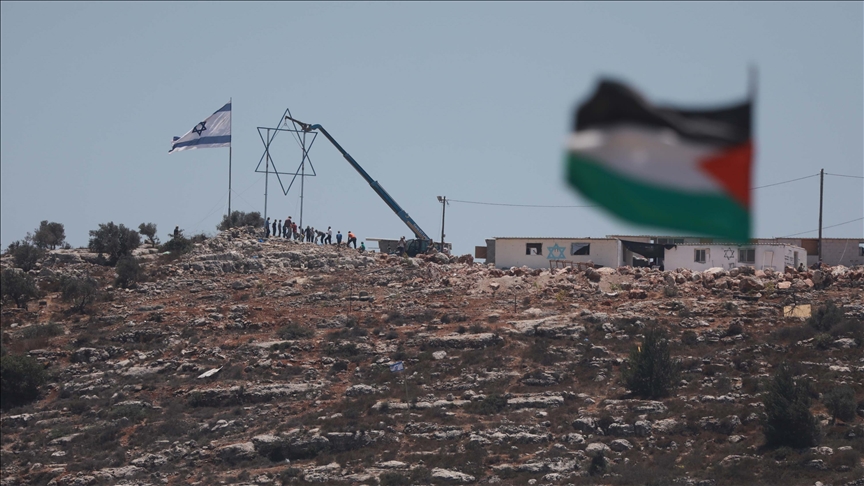
Palestinians protest against Jewish settlements in Beita district of Nablus, West Bank on July 02, 2021 ( İssam Rimawi - Anadolu Agency )

ISTANBUL

British Palestinian academic Azzam Tamim said akin to historical events like the US defeat in Vietnam and France in Algeria, Zionism is destined for defeat in Palestine, in an interview with Anadolu.

He underscored a reluctance to learn from past geopolitical outcomes.

The British academic and activist of Palestinian origin, shared his perspective on the current Israel-Palestine conflict that has been unfolding for four months.

"They do not want to read what happened in history. They do not want to learn any lessons from the defeat of America in Vietnam or the defeat of France in Algeria or the defeat of racism in South Africa," said Tamimi.

Tamimi discussed parallels between the current situation in Gaza and historical instances like apartheid in South Africa as he critiqued the international community's stance.

He accused countries of arrogance and reluctance to learn from history.

By framing the events in Gaza as a new chapter in an unstoppable global struggle, he noted a rising global uprising against Zionism, even among Jews in the diaspora.

"The same thing will happen in Palestine. Zionism eventually will be defeated and these governments will be sorry for what they have done and what they are doing," he said.

Tamimi, who is the Managing Editor and host of Al-Hiwar television, based in London, reflected on his family's experiences during the Nakba, or Catastrophe, when Palestinians were forced from their lands in 1948, and offered insights into the current conflict.

Born in 1955 in Hebron in Palestine, Tamimi recounted how his family was displaced from Beersheba to Hebron following the establishment of Israel in 1948.

He emphasized that many Palestinians do not recognize Israel's right to exist in any part of Palestine. "Most Palestinians would tell you they do not recognize that Israel has the right to exist on any part of Palestine," he said.

Tamimi described the Nakba as an integral part of their history.

"From what my parents used to tell us, my grandparents used to tell us, from what we read in the memoirs of people who wrote about those experiences, it was indeed a catastrophe.

"My siblings and I guess all the Palestinians of my generation -- we grew up hoping that one day the wrong that was done to our people will be corrected, and one day we shall return," he said.

Tamimi shared stories of his family's displacement and the symbolic nature of the keys to their homes in Palestine hanging on the wall. He highlighted the ongoing resistance, with his father actively participating in the war to prevent the establishment of a Zionist state.

He noted the period after World War I when the League of Nations granted the mandate for Palestine to the United Kingdom in 1922.

"They (the British Mandate) used some of the ancient Ottoman laws as well for their own benefits to favor Jewish immigrants over the indigenous population, giving them land and enabling them to have privileges that were not given to the Palestinians," he said.

"So, the British Mandate was an opportunity for the Zionist movement to establish itself and move many of its institutions from Europe into Palestine," he added.

Tamimi also drew attention to the influx of Jewish immigrants to Palestine, particularly from Europe, and he highlighted the abrupt displacement experienced by Palestinians and their struggle against an external force that claimed their land.
Thousands gather in France, Switzerland to call for immediate cease-fire in Gaza

In Paris, Gaza rally merged with demonstration against French government's much-contested immigration law

Ümit Dönmez, Feiza Ben Mohamed
04.02.2024


PARIS

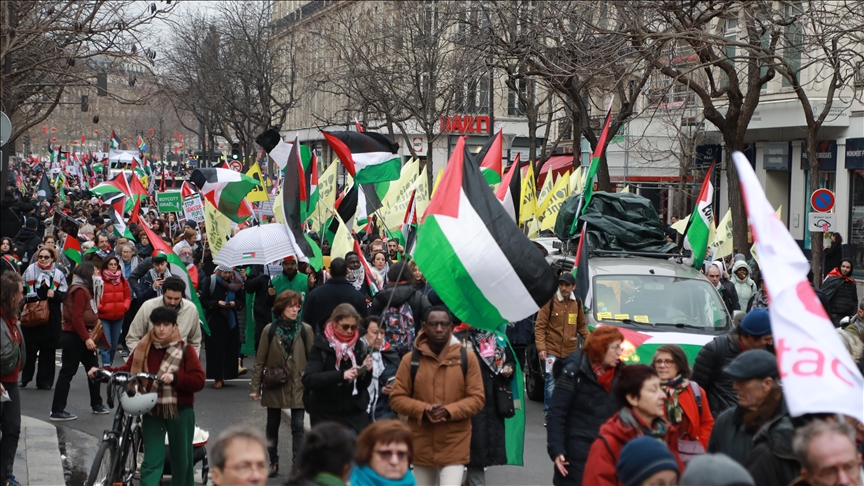
Thousands of people on Saturday gathered in France and Switzerland to call for an immediate cease-fire in the Gaza Strip.

In Paris, hundreds of protesters, carrying Palestinian and South African flags, denounced the ongoing Israeli attacks on Gaza, according to an Anadolu correspondent.

Criticizing French President Emmanuel Macron for “complicity” in Israel's attacks on Palestinians, the protesters urged the government to work toward peace in the Middle East.

The rally that started in the afternoon merged with another demonstration held at the same time against the much-contested immigration law.

The immigration law, which was accused of being influenced by the far-right, was adopted by the parliament in December, and partially approved by the Constitutional Council last week.

In Geneva, thousands of protesters marched through the city center in support of the people of Gaza.


They also expressed solidarity with the UN agency for Palestinian refugees (UNRWA).

The multilingual march ended at the UN Geneva Office.


In Berlin, 2,000 Palestinian supporters rallied at Potsdamer Platz against Israel's Gaza attacks.

Demonstrators, including many Germans, carried Palestinian flags and banners that had slogans that read: "Stop the genocide in Gaza" and "Germany finances, Israel bombs."

The protest continued to Schlossplatz Square, with signs demanding an end to the killing and criticism of German politicians.

David Kusel condemned the "horrific" Gaza situation and demanded an immediate cease-fire, aid delivery and a two-state solution.

He told Anadolu that he criticizes Israel's hindrance to peace through illegal settlements, terming the belief in eliminating Palestinians as an "incredible atrocity."

Israel launched a deadly offensive on the Gaza Strip on Oct. 7 that has killed at least 27,238 Palestinians and injured 66,452 following a surprise attack by the Palestinian resistance group, Hamas. Nearly 1,200 Israelis are believed to have been killed in the Hamas attack.

The Israeli offensive has left 85% of Gaza’s population internally displaced amid acute shortages of food, clean water and medicine, while 60% of the enclave’s infrastructure has been damaged or destroyed, according to the UN.

In December, South Africa filed a genocide case against Israel at the International Court of Justice.

On Jan. 26, the court found South Africa's claim that Israel is committing genocide plausible. The court issued an interim order urging Israel to stop obstructing aid deliveries into Gaza and to improve the humanitarian situation.

*Writing by Nur Asena Erturk in Ankara

Silent march held in Vienna in solidarity with victims of Israeli attacks on Gaza

Carrying Palestinian flags and banners with messages ‘Freedom for Gaza’ and ‘No to Genocide,’ protesters gather in front of Vienna State Opera

AÅŸkın KıyaÄŸan |04.02.2024 - 
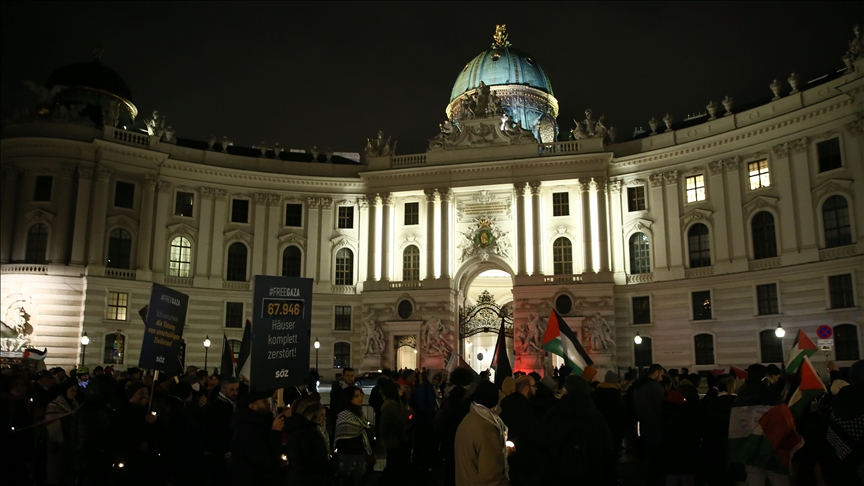
Demonstrators, holding banners and Palestinian flags, gather in front of the State Opera building to held silent march for nearly 28 thousand Palestinians who lost their lives as a result of Israel's attacks on Gaza since Oct. 7 in Vienna, Austria on February 03, 2024.


VIENNA

A silent march was organized in Austria's capital Vienna to express solidarity with more than 27,200 Palestinians who lost their lives in Israeli attacks on Gaza over the past four months.

Protesters, carrying Palestinian flags and banners with messages such as “Freedom for Gaza” and “No to Genocide,” gathered in front of the Vienna State Opera building.

The organizers of the demonstration said that around 28,000 people are known to have lost their lives in Gaza, with an unknown number of casualties under the rubble of bombed buildings.

The organizers said that the demonstration was a "march of sorrow" where no slogans would be changed, with participants lighting candles.

Starting from in front of the State Opera building, the demonstrators passed through the historic first district to make their way to the front of the Votive Church.