Sunday, February 04, 2024

MEXICO

The Zapatista irruption of 1 January 1994: new internationalism and political redefinitions


WEDNESDAY 31 JANUARY 2024, 
BY JOSE ROSTIER
INTERNATIONAL VIEWPOINT

The state of Chiapas is one of the most landlocked and poor in Mexico. So when, on January 1, 1994, the Zapatista Army of National Liberation (EZLN, founded in 1983) took control of several towns by force, it was impossible to imagine the impact of this insurrection. However, it would mark the entire second half of the 1990s and largely participate in the redefinition of the radical left on a global scale.

The radical left was then at a critical moment in terms of programme and strategy. The fall of the Berlin Wall in 1989 definitively ended the period of the so-called “real communism” model of the former Soviet bloc. Neo-liberalism seemed to be triumphant and, despite its absurdity, the theory of the “end of history” predicting an omnipresent modern capitalist model under the American banner was invading the intellectual space.

The date chosen by the Zapatistas was directly linked to this neoliberal offensive, since it marked the entry into force of NAFTA, the great common market of North America desired by George Bush, with the anchoring of Mexico to American expansionism. As in Colombia, the last Mexican guerrillas only appeared as instruments of desperate self-defence for overexploited rural populations in the face of authoritarian states and the paramilitary militias linked to them.

Mexico, governed for 65 years by the PRI (Institutional Revolutionary Party) and long considered a “perfect dictatorship”, nevertheless, since the 1985 earthquake, no longer had the stability that had previously characterized it. Traumatized by state inaction during this catastrophe, Mexican civil society had progressed in self-organization and self-confidence, while political alternatives (the PRD, social-democrat, and the PAN, ultra-liberal ) seemed possible.

THE OPENING OF A NEW POLITICAL SPACE


It was this framework, appearing closed to revolutionary alternatives, that the EZLN exploded.

Militarily, however, only a few thousand poorly armed fighters “declared war” on the Mexican head of state and stood up to his army for a few days, before withdrawing into the Chiapas forests. The objective was not a seizure of power by arms, considered by the Zapatistas as both impossible and politically harmful ("We believe that he who conquers power by arms should never govern, because he risks governing by arms and by force" wrote Subcomandante Marcos), but the appeal to Mexican society. They pulled it off: faced with the state’s counter-offensive, it was the massive mobilization of the Mexican social movement and international solidarity that would tip the scales and transform the insurrection into a national movement with global repercussions. A million people demonstrated in Mexico City, imposing a ceasefire on January 12 and forcing the state to abandon any immediate crushing of the rebellion.

The EZLN, through its “Lacandon forest declarations”, proposed forms and slogans of struggle going beyond Chiapas, around the essential demands of “work, land, housing, food, health, education, independence, freedom , democracy, justice and peace.” The EZLN very quickly announced that it would renounce the use of weapons and build a movement of autonomy from the state. This would be reduced to setting up a “low intensity” war with periods of political negotiations (San Andrés Accords of 1996, not respected by the Mexican state). The EZLN took the opportunity to enter into a rich dialogue with the rest of Mexican society, experimenting with various tactics by constantly relying on the always mobilized and extremely politicized Zapatista rural communities.

In 1996, an attempt at a national political front (the FZLN) was made, without much success. Several Zapatista “caravans” crisscrossed the country, relying on civil society and the Mexican indigenous movement, powerfully revived by the San Andrés Accords, of which the recognition of indigenous rights was a key point.

In March 2001, to defend these rights, 23 Zapatista commanders travelled across the country in a “march of the colour of the earth” to go to Mexico City, welcomed by massive popular support. Commander Esther was able to speak at the Mexican Congress, a powerful image of an indigenous woman addressing the entire country, before the government ceased all dialogue and resumed the military offensive .

“FROM THE MOUNTAINS OF THE MEXICAN SOUTH-EAST”, AT THE HEART OF POLITICAL DEBATES

At the same time, the Zapatistas were strengthening the autonomy of communities already living partially in self-sufficiency, over an area the size of Belgium, and bringing together around 200,000 inhabitants in Zapatista “support bases”. State institutions, colonialist, corrupt and of poor quality, were rejected. Education (emancipatory), health (with respect for the traditions of the population), electrification: it was autonomously and with the help of international solidarity that the Zapatista Indian populations would now manage their daily lives while fighting against the paramilitary militias, the oppressive presence of the army, and “major projects” of ecocidal development such as the Puebla Panama Plan aimed at economic “development” of Central America, in particular through the capitalist grabbing of peasant lands.

These autonomous spaces, in permanent exchange with the country’s indigenous and urban activists and the international revolutionary movement, thus became places of politicization and democratic experimentation, enriching through practice the ideological bases of the EZLN. These bases, a mixture of Marxist, libertarian and anti-colonialist Amerindian ideas, would in turn irrigate the global left.

Beyond the media influence of Subcomandante Marcos and his political-poetic texts, the Zapatistas popularized critical examination of ideas and experiences coming from anti-capitalism, political anti-racism, anti-colonialism, ecology, internationalism and feminism. The affirmation of respect for homosexual rights was a striking example of the capacity of this society struggling, although very influenced by Catholicism, to place itself at the forefront of emancipatory thought. Accused of homosexuality by the government in 1996, Marcos responded with a scathing text: “Yes, Marcos is gay. Marcos is a gay man in San Francisco, a black man in South Africa […] a woman alone on the subway at 10 p.m. […] Marcos is all the untolerated, oppressed minorities who resist, explode and say: “Enough is enough !”

The Zapatista experience thus placed itself early on at the heart of the redefinition of an alternative and unifying project in the global left, concretely integrating progressive experiments: revolutionary women’s law, restorative and non-carceral justice, system of emancipatory education...

THE BIRTH CERTIFICATE OF ALTER-GLOBALIZATION

International support for the Zapatista struggle was vital in its confrontation with the Mexican state. But it reciprocally encouraged a new concrete internationalism which would largely fuel the following struggles. Since 1994, peace “observers” have been appearing in Zapatista communities to prevent military and paramilitary interventions. Encouraged by the appeals of the Zapatistas, welcomed by a local associative network and concretely sharing the daily life of indigenous populations in struggle, tens of thousands of activists, often young, discovered international solidarity in concrete terms, the violence of racism and colonialism, the difficulties and the richness of the construction of a democratic and political power, autonomous from the state.

In 1996, the EZLN organized the Intergalactic Meetings for humanity and against neo-liberalism in the middle of the autonomous zone, where 5,000 activists gathered. from 42 countries. This early “world social forum” was followed by other meetings on the scale of the Mexican, indigenous, or international social movement (Meetings of the Zapatista peoples with the peoples of the world in 2006 and 2007). Although the Zapatista call for a new International (the “Sexta”) did not have any convincing results, Chiapas nevertheless became a place of convergence and development for an entire generation of activists: the generation that would later define itself around the internationalist “alter-globalization” wave by opposing the summits of the capitalist powers, sometimes successfully, as during the G7 in Seattle in 1999, and proposing its own counter-summits, the first in Porto Alegre in 2001.

AN EXPERIENCE STILL ALIVE BUT FACING NEW CHALLENGES


The Mexican state has, thirty years after the insurrection, failed to put an end to the autonomy of the Zapatista communities, despite numerous rises in tension and sometimes fatal attacks, often carried out by paramilitaries, as during the assassination of Commander Galeano in 2014. To nourish internationalism, fight against any isolation and strengthen the education of its cadres and their capacity for development, the Zapatistas organized “voyages for life” in 2023. Not hesitating to take a stand in favour of peoples in struggle (recently in support of Gaza), the EZLN nevertheless hammers home to those who wished to support them a simple message: to best support our struggle, mobilize to build revolutionary movements in your own country.

But in a Mexico increasingly plagued by violence and drug cartels, new challenges have arisen for resistance communities in Chiapas, subject to increasingly frequent attacks. After suspending their public activities last November, the Zapatistas are preparing to address their supporters on the occasion of the thirtieth anniversary of their insurrection. Like our planet in crisis, Zapatism needs new momentum linked to the international dynamics that our struggles must urgently build.

January 23, 2024

Translated by International Viewpoint from l’Anticapitaliste.


ATTACHED DOCUMENTSthe-zapatista-irruption-of-1-january-1994-new_a8399.pdf (PDF - 915.4 KIB)
Extraction PDF [->article8399]

Mexico
Chiapas: thirty years of insurrection!
Chiapas: Blockades and Forced Displacement
AMLO’s Mexico: Fourth Transformation?
Adolfo Gilly, Great Latin American Left Intellectual, Dead at 94
Polarization and protest in Ciudad Juárez
Global Justice
Call for a global counter-summit of social movements to the IMF-WB Annual Meetings
Genoa didn’t last for only 48 hours
Samir Amin, or the raison d’être of a new internationalism
The abuses of the World Social Forum: Towards the end of the process?
Rights to Water and Land, a Common Struggle Movements
NORTH OF IRELAND

Smoke and Mirrors – The Unionist Miracle – What’s really happening in the North of Ireland?


SATURDAY 3 FEBRUARY 2024, 
BY JOSEPH HEALY
INTERNATIONAL VIEWPOINT

For two long years the North of Ireland has been in a state of political paralysis following the elections for the Assembly in 2022 when, for the first time in its history, the “Protestant state for a Protestant People”, produced an election victory for Sinn Fein and Irish nationalism. The hissy fit thrown by the DUP in refusing to return to the Assembly and taking second place as the smaller party with Michelle O’Neill as First Minister was seen as essential by DUP leaders and activists in order to appease the base. However, it would need to be based on some serious political grounds and not just betray the naked sectarian panic in losing control of the political apparatus for the first time in a century. That excuse was the Northern Ireland Protocol.

The DUP, known locally in the North of Ireland as the Dumb Unionist Party, had made strategic error after error. Firstly, in being an enthusiastic supporter of Brexit, when most in the North of Ireland were opposed to it, especially the young. Secondly, in swallowing Johnson’s promise of “no border in the Irish Sea”, which he enthusiastically sold to them as part of his over ready Brexit, which all can now see never defrosted in the middle. Johnson’s deal resulted in the Northern Ireland Protocol, which in order to protect the region’s unique status as having access to both the EU and UK markets, meant that goods coming from Britain needed to be checked to ensure that they were not destined for the Irish Republic and the EU across the guaranteed open border between the two parts of Ireland.

Jeffrey Donaldson, decided to take a stand on this declaring that it was effectively treating the North of Ireland in a different way from the rest of the UK state. No Border in the Irish Sea festooned lampposts in the hard line Unionist areas of Belfast and the old Unionist cry of No Surrender echoed across the Loyalist areas of the North of Ireland.

The Windsor Protocol, negotiated last year between the UK and the EU took the wind out of the DUP’s sails as it demonstrated that the UK government was more interested in a harmonious relationship with the EU than the concerns of the DUP. The British government told the DUP that there would be no further change and that some aspects of the Protocol had been softened with the assent of the EU. This clear sidelining of the DUP further enraged the base but they began to lose more and more support across the region as public services crumbled.

The recent huge public services strike, where DUP negotiators going to meet the NI Secretary of State, were heckled by strikers and told to go back to work, was very bad optics for the party. The result of the two year stalemate has been a lack of funding from Westminster, resulting in a situation in the NHS where it is in far worse state than other regions of the UK state and where public sector salaries lie far behind those of England, Wales and Scotland, resulting in a huge haemorrhaging of NHS staff across the border to the Irish Republic where they are paid far higher wages. For the public in the North of Ireland this has become the dominant political issue and much of their anger is directed at the DUP.

The political fact remained that the DUP, if it returned to the Assembly under Sinn Fein, would have to demonstrate some concrete victory after a two year boycott. This resulted in the current so called deal which is effectively no real change in the Windsor Agreement and was only backed by 53% of the DUP Executive, leaving Donaldson in a very exposed position and there is still talk of a possible split in the party.

Despite Donaldson’s claims, the protocol remains, as streamlined by the Windsor Framework. The Irish Sea border remains. Donaldson is highlighting the issue of checks on goods but there was never a problem with trade between the North of Ireland and GB, because the EU doesn’t care what goes into GB. The EU does care what goes into the single market and that is why the red lane exists under the Windsor Agreement.

As a recent article in The Irish News by Brian Feeney stated: “Speed is of the essence to get the deal over the line before there’s time for the DUP dissidents to see through the smoke and mirrors. Once done, no-one will notice any difference in everyday life. Except for one aspect, and it’s a fairly consequential one: There’ll be a Sinn Fein first minister in the person of Michelle O’Neill.”

The whole thing has been a piece of political theatre to assuage the fears of the Unionist base but essentially it is like Canute trying to hold back the tide as the Unionist tide in the North of Ireland retreats. The Loyalist hard men have threatened to block the roads of the region this Friday but they are a much reduced force compared to their heyday in the 70s when the Loyalist Workers force managed to paralyse the North of Ireland and bring down the Sunningdale Power Sharing Agreement.

For the DUP’s base hearing Mary Lou Mac Donald, President of Sinn Fein, tell the UK media that “Irish unity is within touching distance” is the real gall. With a Sinn Fein woman as First Minister in the North and a potential Sinn Fein government soon in the South, led by another Irish nationalist woman, Donaldson’s band aid on trade is a poor substitute for the loss of power which has over the last decade been the undoing of Unionism as the clock ticks down on the end of the partitionist dream.

1 February 2024

Source: Anti*Capitalist Resistance.

ATTACHED DOCUMENTSsmoke-and-mirrors-the-unionist-miracle-what-s-really_a8402.pdf (PDF - 908.5 KIB)
Extraction PDF [->article8402]


Analysis

Those who campaigned to 'take back control' did not appreciate Brexit might give more power to those seeking Irish unity

The new first minister represents a party that does not acknowledge Northern Ireland's six counties as separate from the 26 counties in the Republic of Ireland. The historic moment has huge implications, David Blevins writes.

David Blevins
SKY NEWS
Senior Ireland correspondent 
@skydavidblevins
Saturday 3 February 2024 1
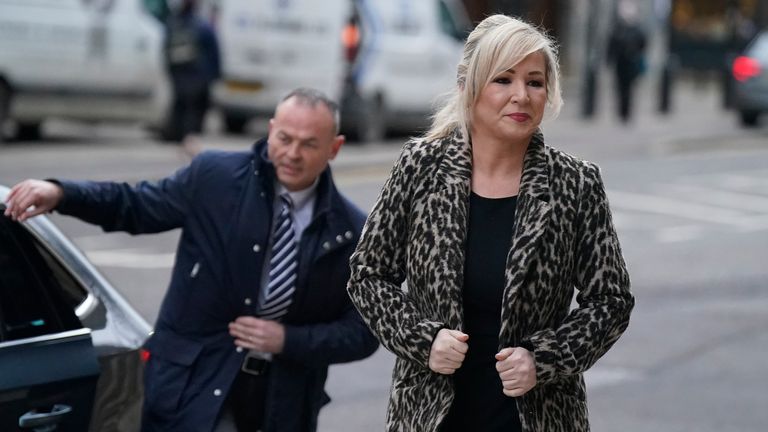
Image:Michelle O'Neill. Pic: PA


It was dubbed "a Protestant parliament for a Protestant people" but 90 years later, there is a Catholic in the office of the first minister.

When Sinn Fein's Michelle O'Neill accepted the nomination, in the Irish language, a nationalist held the highest title in devolved government for the first time.


The sense of history was palpable at Stormont as members of the Northern Ireland Assembly filed back into the chamber after two years of stalemate.

She won't have more authority than she had as deputy first minister - the two most senior posts are codependent under power sharing - but it's hugely symbolic.

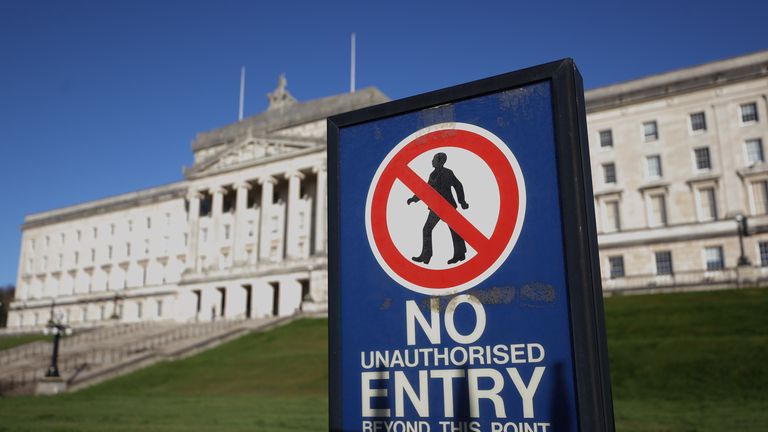
Parliament Buildings in the Stormont Estate represent decades of Unionist dominance. There are six floors inside and six pillars outside representing Northern Ireland's six counties.


But the new first minister represents a party that does not acknowledge those six counties as separate from the 26 counties in the Republic of Ireland.

Image:Parliament Buildings on the Stormont Estate. Pic: PA

The Irish words 'Sinn Fein' are literally translated as 'ourselves' or 'we ourselves', expressing a desire for the whole island to be separate from the UK.

MORE ON NORTHERN IRELAND


Adam Boulton: With Michelle O'Neill becoming Northern Ireland's first nationalist leader, is a united Ireland within 'touching distance'?


Northern Ireland's new first minister Michelle O'Neill 'contests' claim Irish unity is 'decades' away


The party refuses to take its seats at Westminster but regards power sharing at Stormont as a halfway house on the road to a united Ireland.

The Democratic Unionist Party (DUP), with whom it shares power, views it differently - quick to point out Sinn Fein is "administering British rule" at Stormont.

Nevertheless, the party long described as "the political wing of the IRA" has certainly come a long way since its 'Smash Stormont' election campaign in 1982.

Read more:
Why Northern Ireland's new first minister is hugely symbolic

Angry exchanges at Stormont

It was Ms O'Neill's predecessor, the former IRA commander Martin McGuinness, who made the transition from guns to government when he became deputy first minister.

But her elevation will boost the party's hopes of making history in the Republic by having its leader, Mary Lou McDonald, elected taoiseach (prime minister).

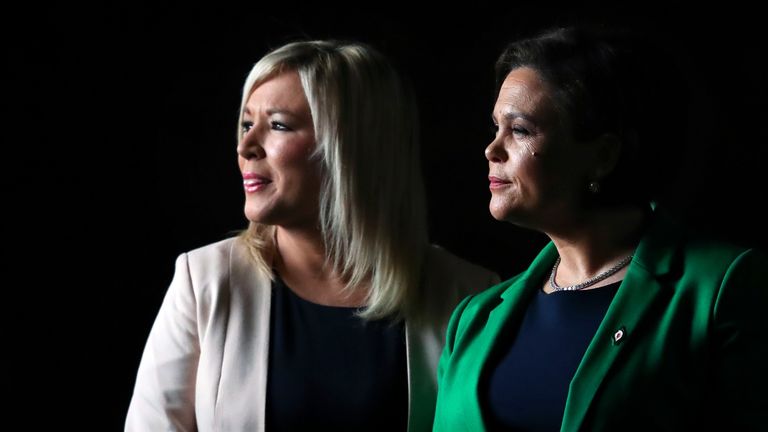
Michelle O'Neill (L) and Mary Lou McDonald (R). Pic: PA

The sense of occasion on the hill overlooking Belfast did not prevent angry exchanges, not between power-sharing partners, but between the DUP and hardline Unionists.

The Traditional Unionist Voice party rejects Sir Jeffrey Donaldson's claim his deal with the UK government removes the Brexit border in the Irish Sea.

But those who campaigned to "take back control" did not appreciate that Brexit might give more control to those seeking to get Irish unity done.


Is fascism returning? Part One: The previous century

Dr Helmut Hubel, in this first part of his analysis of fascism, charts the rise of fascism in the last century.


By Dr Helmut Hubel
4 February 2024

Heraclitus - Marble at Victoria and Albert Museum - Afshin Taylor Darian - Flickr - CC SA 2 0


The Greek philosopher Heraclitus in the 5th century BC is said to have summarized his teaching with the statement: “No man ever steps in the same river twice, everything flows”, meaning: “History does not repeat itself”.

There are many definitions of fascism. This one is from Oxford Reference on Wikipedia:
“Fascism is a far-right form of government in which most of the country’s power is held by one ruler or a small group, under a single party”.

With respect to Fascism, the question to ask is:


Are the events of the last 16 years following the financial crisis of 2007/08 a repeat of those leading up to and following the crash of 1929?

The financial crisis of 2007/08 was precipitated by the collapse of the housing market in the United States which led to a severe contraction of liquidity. This caused a global crisis, resulting in the collapse of numerous investment and commercial banks worldwide and causing a loss of more than 2 trillion US Dollars from the global economy. Many countries suffered severely from economic depression and rising unemployment. The Greek economy, to give just one dramatic example, virtually collapsed and had to be reanimated with drastic measures by the other Euro member states. Already in those days experts spoke of the “most severe economic crisis” since 1929/30. At the same time we witnessed the rise of right extremist parties and proto-fascist politicians like Trump, Farage, Wilders and Höcke gaining prominence both in Europe and the United States.

So how does this compare with what happened some hundred years ago?
The Rise of Fascism in Germany

A social-political consequence of that 1929 crisis was the rise of right-wing political parties, capitalizing on the tremendous frustrations of the unemployed and offering “easy solutions” by naming scapegoats to be responsible for all the hardships. One country, suffering most drastically, was Germany with a rise of unemployment from 1.9 million in 1929 to 5.6 in 1932.

Historians agree that the financial crisis of 1929 accelerated the Nazi party’s gaining power, first in the Federal State of Thuringia (1930) and then in Berlin (1933). However, it was not the beginning but rather the culmination of the Nazi party’s path to power. In 1923, some three years after its defeat in World War One, Germany was suffering from the Versailles Treaty’s enormous, unbearable war reparations, the French occupation of the industrial Ruhr region and the months-long general strike lead to a hyper-inflation, with one US Dollar rising up to 4.2 billions of Marks in November 1923. Gustav Stresemann, becoming Chancellor on 13 August 1923, managed to stop this crisis by introducing a new currency, the ‘Rentenmark’, and seemed to have stabilized the Weimar Republic in the following years.

Sebastian Haffner (aka Raimund Pretzel), in this memoirs ‘Geschichte eines Deutschen’, written in 1939 but only published in 2000, after his death, states (page 53): “The year 1923 finished off Germany”. Hitler’s coup attempt in November 1923 in Munich quickly collapsed, leading him to pursue a strategy of ‘seeking power by political means’. Haffner describes the years between 1924 and 1929 as a seemingly stable interlude to the catastrophe to come only later.

Haffner, a trained lawyer, emigrated to the UK in 1939 because of his Jewish girlfriend and his distaste of the Nazis. He soon became a popular commentator in ‘The Observer’. He also published a book ‘Germany: Jekyll and Hyde, A Contemporary Account of Nazi Germany’ (1940), which explained Hitler’s rule and discussed options of how to fight him. Even Prime Minister Winston Churchill was impressed by Haffner’s analysis.

It was a combination of tremendous popular frustrations after a lost major war (1918), the almost complete breakdown of civil life (1923) and renewed major socio-economic hardship (post 1929) which led to Hitler’s rise to power.

What makes Haffner’s observations so special is the fact that he stresses the psychological, even spiritual, consequences for many German citizens. In his view, the experience of war and the devastations afterwards destroyed the “souls” of a large segment of the younger generation, which made them “ready” for the “fantastic crimes” the Nazis would commit later.
Fascism in other European countries in the 1920s-30s
Mussolini and Hitler in Munich – Marion Doss on Flickr – CC BY-SA 2 0

Italy’s deep economic, social and political crisis after WWI led to Benito Mussolini’s ‘March on Rome’ in October 1922, which became the blueprint for Hitler’s coup attempt in November 1923. It was the first extreme right-wing movement after the devastations of the ‘Great War’ and its success inspired not only Hitler but later also General Franco in Spain. Right-wing or explicit fascist movements could be traced in many other European countries and the United States as well. Yet, they didn’t succeed, because these political systems proved to be more resilient and were lucky to have better leaders who managed to overcome the most pressing economic problems, like President Roosevelt with his “New Deal” in the United States (1933-38).

Nevertheless, there is good reason to argue that the terrible devastations of WWI and the tremendous socio-economic problems did cause a major crisis in the world’s most developed countries and that this resulted in the rise and growth of extreme right-wing and fascist movements, severely damaging the existing political systems and paving the way for Hitler’s Germany to start WWII.

Ed: Part Two out shortly.

We want to hear your views. Please send any comments to editor@westenglandbylines.co.uk

Dr Helmut Hubel is a retired Professor of International Relations at the Friedrich Schiller University of Jena/Germany. He held Visiting Professorships in the USA, Finland and the Ukraine and spent many visits to Russia and Israel. His areas of specialization, documented in numerous books and articles, were the European Union, Soviet Union/Russia, Ukraine, Northern Europe, Israel and the USA. He now lives with his wife in Cheltenham and Stuttgart.
Netherlands police arrest hundreds of climate activists demanding fossil fuel ban

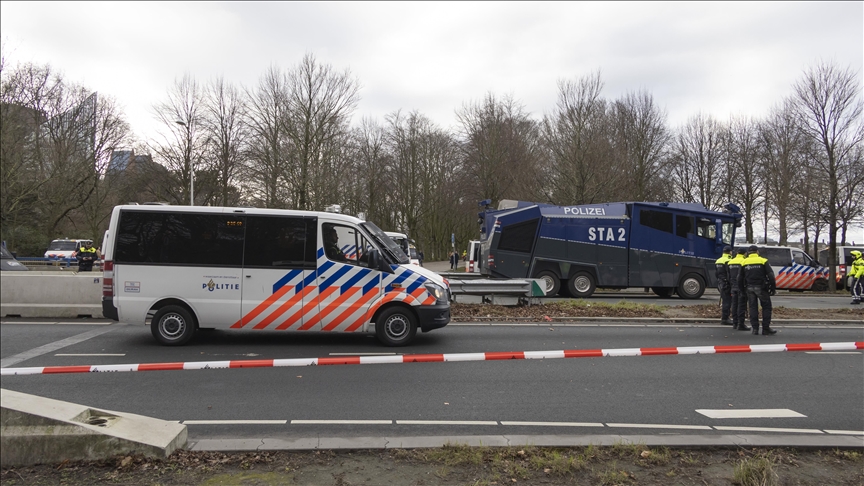
Protesters block A12 road in The Hague, calling for end to subsidies; vow to continue until government takes action

Abdullah Aşıran |04.02.2024 - AA
Police officers take security measures while hundreds of climate activists block the final section of the A12 main road leading to Parliament, staging a sit-in protest and protesting the end of fossil fuel use in The Hague, Netherlands on February 03, 2024


THE HAGUE, Netherlands

Police in the Netherlands arrested hundreds of climate activists in the Hague who were protesting and blocking the main road leading to parliament and demanding an end to fossil fuel use.

Organized by the Extinction Rebellion environmental group, demonstrators gathered despite police barriers, blocking the last section of A12, the entrance to the city, causing traffic disruptions on connecting routes.

Protesters, advocating for the cessation of oil, coal and gas usage, criticized the government's fossil fuel policies. Carrying banners and signs that read: "Stop fossil fuel subsidies", "Climate is full", and "I stand here for my children," demonstrators staged a sit-in on the road.

The activists announced they would continue road closure protests until the government lifts fossil fuel subsidies.

Environmental activist Yolanda Schuur told Anadolu that they demand an end to fossil fuel subsidies.

Schuur pointed out that the cessation of fossil fuel subsidies has not yet occurred. "Fossil fuel subsidies amount to approximately 46.5 billion per year.

“The phased plan to end them should have been presented to the House of Representatives at the end of last year, but we are still waiting for it," she said.

Highlighting the worsening climate crisis, Schuur stated: "We will return to the A12 main road and sit there until fossil fuel subsidies are lifted."​​​​​​​


Greens congress choose veteran duo to take them to EU elections

By Euronews
Published on 03/02/2024 - 


MEPs Terry Reintke and Bas Eickhout received staunch support from the majority of the party.

The European Green Party on Saturday chose two of its most well-known EU lawmakers to take them to the European Parliament elections in June.

German MEP Terry Reintke and Dutch MEP Bas Eickhout were both backed by Green party congress delegates in Lyon — getting 55 percent and 57 percent of the votes, respectively.

The choice is a safe one - both Eickhout and Reintke are senior figures in the Greens' group in the European Parliament.

Speaking to Euronews, Eickhout said Europe had fallen behind the likes of the US and China when it came to green innovation.

"China is doing very clear industrial policies. Look at how they deal with the electric car. America, United States investing a lot of money in green innovation. So the green race is on. And Europe was at the forefront," he said. "If you want a future where you have a future job then you need the Green Deal."

Eickhout spearheaded the group's efforts on the Green Deal legislative package. Reintke, for her part, has been particularly active on issues like the rule of law in Poland and Hungary, as well as the protection of minority rights and gender equality. Reintke became the political group’s co-leader in 2022.

The Greens have been extremely vocal on their desire to strengthen the EU's Green Deal to combat climate change. The deal pledges net zero emissions of greenhouse gases by 2050.

Reintke, 36, is running for her third term in office, while Eickhout, 47, is hoping for his fourth.
Israeli minister likens UK's David Cameron to Nazi appeaser in online rant
OF COURSE HE IS,HE SUPPORTS ISRAEL

Amichai Chikli likened David Cameron to Neville Chamberlain, the British PM who appeased Hitler, after he said the UK may support a Palestinian state.

The New Arab Staff
04 February, 2024

Amichai Chikli believes Cameron is akin to Neville Chamberlain merely for saying that the UK could potentially recognise a Palestinian state [Getty]


Israel’s Diaspora Affairs Minister Amichai Chikli compared the UK’s potential backing of a Palestinian state to the British government’s historic appeasement of Nazi Germany in a social media rant on Friday.

In a post on X, Chikli shared a photo comparison of UK Foreign Minister David Cameron waving alongside the picture of former British prime minister Neville Chamberlain holding up a copy of the 1938 Munich Agreement that let Nazi Germany annexe parts of Czechoslovakia to avoid war.

Chamberlain had infamously declared the agreement with Hitler meant “peace in our time”.

“Hello to David Cameron, who wants to bring ‘Peace in Our Time’ and grant the Nazis who committed the atrocities of October 7th a prize in the form of a Palestinian state as a token of recognition for murdering babies in their cribs, mass rape and abducting mothers with their children, Chikli wrote.

Chikli, who is a member of Israeli Prime Minister Benjamin Netanyahu’s Likud Party, was reacting to Cameron’s suggestion on Thursday that the UK could recognise a Palestinian state once Israel's war on Gaza is over.


As an Israeli official, Chikli’s deliberate failure to differentiate Palestinian civilians from those who carried out the 7 October attacks might be of particular interest in light of the International Court of Justice’s (ICJ) 26th of January ruling.

The ICJ’s ruling called for Israel to curb and penalise any direct and overt calls to genocide with regard to Gaza, which includes the use of language that suggests collective guilt and punishment.

Cameron's statement that the UK would recognise a Palestinian state only if Hamas was no longer in the Palestinian territory highlights Chikli's unwillingness to make a distinction between the Palestinian organisation and the general Gazan population.


Israel has claimed its military assault is part of an effort to “crush” and “eliminate” Hamas in Gaza. However, the ICJ ruled that there are plausible grounds for Tel Aviv engaging in genocide, with over 27,000 Palestinians killed and much of the enclave left “uninhabitable” by the Israeli military’s ground and air campaign.

Despite the UK’s strong support for Israel, Cameron doubled down on earlier suggestions that the British government could recognise a Palestinian state, the creation of which is openly opposed by the Israeli government.
Hundreds of protesters in Israel demand early elections, release of hostages

Protests held in cities of Haifa, Rehovot, according to Israeli media

Rania R.a. Abushamala | AA
04.02.2024


JERUSALEM

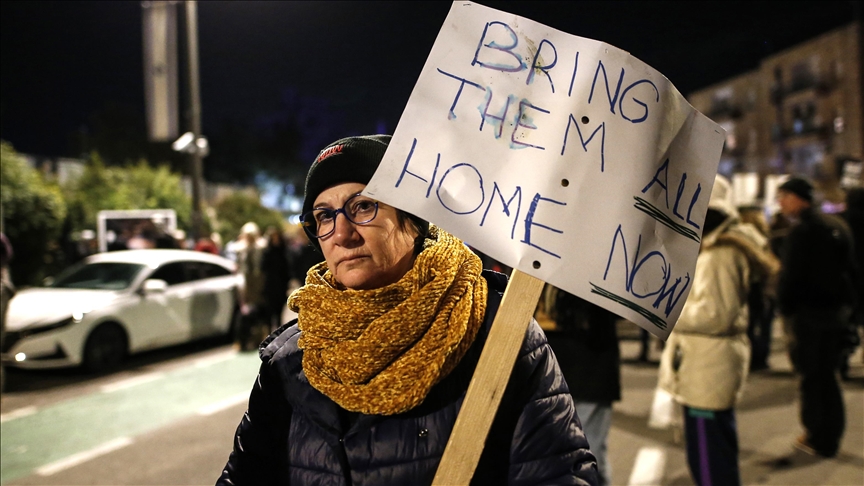
Hundreds of Israelis took to the streets of Haifa and Rehovot against the government of Prime Minister Benjamin Netanyahu, demanding early elections and the release of hostages held in Gaza, local media reported on Saturday.

The protesters, gathered at Horev junction in the city of Haifa, were carrying banners with slogans such as “Elections Now” and “Save the Hostages,” according to Israeli newspaper Yedioth Ahronoth.

In the city of Rehovot, dozens of people protested in front of the Weizmann Institute of Science, chanting slogans against Netanyahu, according to the newspaper.

Israelis have been protesting almost daily, demanding early elections and the release of hostages in Gaza, but major demonstrations are held on Saturdays.

Israeli officials estimate that there are around 136 hostages still held in Gaza since Hamas launched an attack on Israel on Oct. 7, 2023.

Palestinian resistance factions, led by Hamas, captured around 239 people in towns and cities near Gaza and last November exchanged dozens of them with Israel during a seven-day humanitarian pause.

In return, Palestinian prisoner institutions reported that Israel released 240 Palestinian prisoners from its jails during the pause, including 71 women prisoners and 169 children.

Israel launched a deadly offensive on the Gaza Strip on Oct. 7 that killed at least 27,238 Palestinians and injured 66,452 following a surprise attack by Hamas. Nearly 1,200 Israelis are believed to have been killed in the Hamas attack.

The Israeli offensive has left 85% of Gaza’s population internally displaced amid acute shortages of food, clean water and medicine, while 60% of the enclave’s infrastructure has been damaged or destroyed, according to the UN.


*Writing by Rania Abu Shamala​​​​​​​
Silwan faces escalating home demolitions in fight against messianic settlers

Home demolitions in East Jerusalem are rampant, but none more than in Silwan, where messianic settlers backed by the state are attempting to establish fanciful
 “archaeological” parks on top of Palestinian homes.
MONDOWEISS
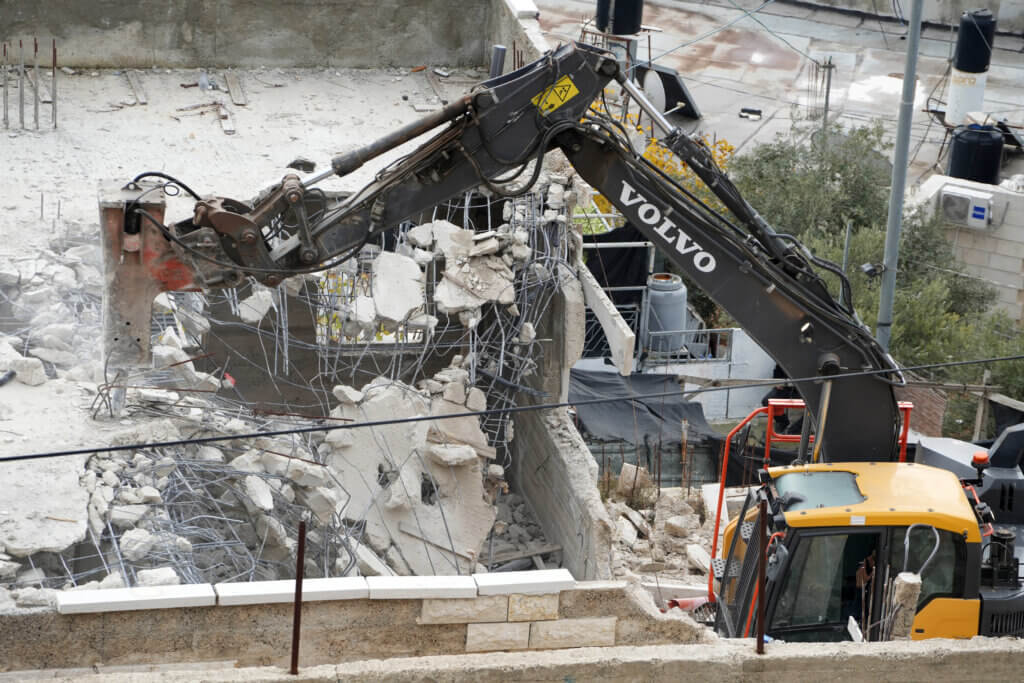
ISRAELI BULLDOZERS DEMOLISH A PALESTINIAN HOME IN SILWAN ON JANUARY 4, 2023. (PHOTO: SAEED QAQ/APA IMAGES)


“He’s the snake’s head,” Fakhri Abu Diab could hear the Israeli police officer mumble to a municipal clerk.

Moments earlier, someone was throwing hard hand blows against the metal door. Fakhry understood who it was; no one knocks with such a coarse manner except the Israeli police.

As he opened the door, half a dozen men, some in police uniform, entered the Abu Diab residence in the Bustan neighborhood in Silwan. Their unannounced visit was to deliver a demolition notice in person.

The notice, dated January 31, 2024, signed by the Jerusalem municipality “supervisor” of the division responsible for “building demolitions,” warned the addressee, Fakhri, that he had ten days to vacate his home.

A day earlier, a municipal crew accompanied by the police came by and informed him that his home would be knocked down soon. A contractor was among the men who came to examine the building slated for demolition. That’s when he sensed it was serious.

Fakhri Abu Diab, 62, has been a leading figure in a decades-old struggle to defend Silwan from the menace of well-funded Israeli settlers and the designs of the Israeli-run Jerusalem municipality. Both the settlers and the City share a common purpose: changing the character of East Jerusalem by establishing a Jewish majority. His home was first issued a demolition order in 2012.

As early as 2004, officials at the Jerusalem municipality began contemplating plans for the Bustan neighborhood in Silwan, citing the area as an important cultural site for Israel, believing it to be the same site where King David established his kingdom. An archaeological national park was deemed crucial, and demolition orders were issued to the Palestinian residents there the following year.

Today, the Bustan neighborhood is home to some 1,500 Palestinians. Fakhri says that 116 are at risk of forcible displacement.

Over the years, the residents tried to reason with the Jerusalem municipality. They proposed a town plan that would see the establishment of a “King’s Garden” alongside housing for the residents in Bustan. But in 2023, the municipality finally rejected the proposal, stating that it had its own plan and demanded the residents sign off on it. Should they refuse, it would demolish their homes.

“I feel unsettled, afraid. For the first time, I feel helpless,” Fakhry told Mondoweiss wearily.

Twelve people reside in the Abu Diab compound: Fakhri and his wife, Um Muhammad, their son Muhammad, his wife, and their six children.

“When the bulldozers come, they don’t just demolish a home; they demolish my past, my future, our dreams, our lives.”

Doubtful intentions

The advocate for the Bustan residents, Ziad Qawar, told Mondoweiss that the municipality’s plan would gorge 80% of the neighborhood and leave the rest for the residents. However, the extent to which the residents can utilize the remaining 20% for housing is vague.

Adv. Qawar questioned the logic and legality behind the municipality’s intent to demolish people’s homes for the sake of creating an archaeological park.

“Lots of details are unknown. We do not know who will have ownership [of the land and buildings]. We do not understand the scope of the building allowed for housing,” he said. “Who is this garden for? Is it for the general public or the settlers?”

The Bustan inhabitants gathered at City Hall, which is filled with settlers who aim to take over their homes and land in order to add another settlement to the existing colonization of Silwan.

“We asked the municipality many times to disclose the details [of the plan], but regretfully, they weren’t revealed. This project is part of a larger plan that leads to the destruction of the Al-Aqsa Mosque to build a [Jewish Third] Temple,” Qawar added.

Feeble support


Throughout the years, foreign diplomats and former heads of state visited Silwan to express support for its residents in the face of forcible displacement, a war crime under international law.

In 2015, Fakhri recalled meeting former U.S. President Jimmy Carter, who at the time was part of a delegation of The Elders, an independent group of international leaders founded by Nelson Mandela in 2007 to promote peace, justice, human rights, and a sustainable planet.

“Israel is above the law,” Fakhri quoted Carter during that meeting. “I usually rely on an interpreter, but I remember Carter saying this phrase clearly.”

Now, he questions the effectiveness of these high-level calls, suspecting that they had made him the target of vengeful Israeli officials.

In 2023, several diplomats from Europe, Australia, Canada, Turkey, and Mexico visited Fakhry at his home and listened to the threats surrounding this particular neighborhood in Silwan.

Even American diplomats visited Silwan. Hady Amr, the Special Representative for Palestinian Affairs, and George Noll, Chief of the U.S. Office of Palestinian Affairs in Jerusalem, came to Silwan in 2022 and 2023, respectively. More recently, in January 2024, U.S. Deputy Assistant Secretary of State Andrew P. Miller met Fakhri in the Bustan.

Fakhri now presumes the demolition notice he received was a message: that he cannot rely on outside help to save his home and neighborhood.

“The fact that they’re trying to penalize him personally shows you the nature of the people we’re dealing with. They are, in my view, gangsters and war criminals,” said Angela Godfrey-Goldstein.

Arieh King, the Deputy Mayor of Jerusalem who heads the nearby settlement Ma’ale Zeitim at Ras al Amud, overlooking the Bustan, is one of the leading forces pushing for the expansion of the “City of David” park — by developing the Bustan as The King’s Garden biblical theme park.

The infamous Deputy mayor is notorious for being a disciple of the fascist and ultra-nationalist Rabbi Meir Kahana, who preached “transfer” or ethnic cleansing. King is backed by the far-right Finance Minister and self-described “fascist” Bezalel Smotrich, and his political bedfellow Itamar Ben-Gvir, the Minister of Public Security, who called for demolitions to be carried out over Ramadan and urged Netanyahu not to acquiesce to international pressure.

Fakhri remains hopeful, however, that the international community will intervene to stop Israel from demolishing his home and the entire Bustan neighborhood. He believes that diplomatic pressure is finally being “invoked” against Israel, taking stock of Biden’s recent Executive Order sanctioning Israelis engaging in “harmful activities that threaten the peace, security, and stability of the West Bank.”

Those Israelis were four Jewish settlers linked to escalating violence against Palestinian civilians in the West Bank. Some speculate that Biden’s Executive Order might eventually reach pro-settler Jerusalem City officials like Arieh King, who actively seek to forcibly transfer the Palestinian population out of East Jerusalem.

“It’s time that the Jerusalem municipality understands it’s part of the problem and that Palestinians want to live normal lives, and it’s time they allowed them to,” Godfrey added.

Forcible displacement

Demolitions are occurring everywhere in occupied East Jerusalem, including Sur Baher, Jabal al-Mukabbir, and al-Essawiya.

But the area in East Jerusalem with the bleakest prospects, bar none, is Silwan, arguably bearing the full brunt of the Jewish settler movement’s hostile designs in East Jerusalem. The Bustan isn’t the only neighborhood in Silwan at risk of forcible displacement. Residents of Batn al-Hawa, the neighborhood overlooking the Bustan, are facing eviction orders after settler organizations obtained ownership claims from Israeli courts.

The Israeli settlement watch group Peace Now says settlers intend to uproot an entire community in East Jerusalem based on exercising laws that Israel affords to its Jewish citizens only. The Jerusalem municipality, according to two Israeli NGOs monitoring planning and zoning in East Jerusalem (Ir Amim and Bimkom) points to a deliberate policy that impedes the development of Palestinian neighborhoods in the City. This strategy has led Palestinians of East Jerusalem to move from the City center to the periphery, frequently jeopardizing their residency status.

Nearly half of demolitions carried out so far this year by Israeli forces were in occupied East Jerusalem. The rest occurred in Area C of the West Bank, where Israel enjoys complete control per the Oslo Accords.

According to the UN, Israel displaced 33 people and demolished 18 structures in January 2024 in the East Jerusalem area.

The year 2023 marked the highest number of demolitions in the occupied West Bank since the UN began recording these types of actions. The number of Palestinians displaced in 2023 was 2,247 people, with 1,169 structures destroyed. East Jerusalem accounted for 20 percent of the demolitions, with 733 people displaced.

Ir Amim’s 2021 “Planned Negligence” paper states that, since 1967, Israel has instituted a “consistent policy of rampant discrimination in the realms of building and planning, stemming from a policy of demographic control that seeks to constrain the Palestinian population of Jerusalem.” As a result, a third of Palestinians, some 100,000 individuals, were compelled to move out of central East Jerusalem and relocate to the “slums” of Shu’fat refugee camp and Kufur Aqab, on the wrong side of the separation wall. These two areas are densely packed urban environments that fall within the Jerusalem municipality but do not receive municipal services like urban planning and infrastructure, turning them into a marginalized no-man’s land.

History, Olive Trees And Football: What Keeps Palestinians Strong

Despite the horrific war in Gaza and the unprecedented number of casualties, millions of Palestinians in the Middle East and around the world took a brief respite from their collective pain to watch their national football team make history in Doha.

The Palestinian team, also known as Fada’ii - the freedom fighter - scored a decisive win against Hong Kong on January 23. Even though the ‘Lions of Canaan’ finished in third place, following Iran and the UAE, they still managed to make it to the round of 16 of the AFC Asian Cup for the first time in history.

Like the FIFA World Cup, also held in Doha in November 2022, Palestine was present in all AFC games, where Palestinian flags were waved by thousands of Arab fans.

Palestinian players came to Doha from Palestine itself, and also from throughout the Middle East - in fact, the world. They include the Chilean Palestinian player, Camilo Saldaña, and the likes of Oday Dabbagh, a Jerusalemite who is currently playing professionally in Belgium.

Sports, for Palestinians, is a symbol of unity but also persistence. Very few sports teams in the world have been through what these youth have experienced, whether in the form of direct harm to them and their families, or through their association with the Palestinian collective.

Yet, the fact that they can, against all odds, attend games, participate in tournaments, equalize against such prestigious teams as the UAE, and even win, is a sign that the Palestinian nation will never be erased, not 75 years after the Nakba, or a thousand years from now.

A very long distance away, another Palestine-linked team, the Chilean Deportivo Palestino, continues to express its historic connection to Palestine, despite the distance, different geopolitical spaces, culture and language.

Before FIFA admitted Palestine as a member in 1996, Deportivo Palestino served, at a more symbolic level, as the Palestinian national team in exile. Its players donned football jerseys adorned with Palestinian cultural symbols and other historical references to Palestine - a map, the colors of the flag and so on.

Quite often, the players would enter the Primera Division stadiums wearing the iconic Palestinian black and white keffiyeh.

Palestino is over 100 years old, and the history of the Palestinian community in Chile is older than this. It was Palestinian Christians, not Muslims, who established the community there, which refutes the claim that the so-called Palestinian-Israeli conflict is one over religion.

While faith and spirituality are critical signifiers in the Palestinian national identity, Palestinians are driven by the kind of values which allow them to find their common ground, whether they are in Gaza, Jerusalem, Santiago or Doha.

While Palestinians, like the vast majority of people around the world, are football fanatics, for them sports is not just about sports.

Imagine a football field brimming with Palestinians from different religious, geographic, political, cultural and ideological backgrounds. They come, whether as fans or players, motivated by a single objective, celebrating their culture while emphasizing their national continuity, as an immovable reality despite the ongoing attempts aimed at its erasure.

Here, other symbols become relevant: The flag, as a banner that unifies all Palestinians despite political factionalism; the keffiyeh, the ancient peasant symbol, used to fight colonialism over the course of many decades; the map, presented without lines, walls, fences or zones, to remind them that they belong to a single historical narrative, and so on.

In fact, there is more to symbolism. Arab and Muslim masses, all rallying around Palestinians in their quest for freedom and justice, also send a strong and unmistakable message: Palestinians are not alone; they are, in fact, part and parcel of cultural, geographic, historical and spiritual continuity that spans many generations, national flags and even borders.

While millions of people are currently feeling the pain of Gaza, expressing unprecedented solidarity with the suffering civilian population, Arab masses feel that pain at a whole different level. It feels as if the Arab and Muslim peoples have internalized the pain of Gaza as if it were their own. In many ways, it is.

Yet, despite the indescribable pain and suffering of millions of innocent civilians, there is always that historic certainty that Palestine will, as it has always done, ultimately prevail over its torment and tormentor.

Here, no other symbolism can serve the role of the powerful metaphor as that of the olive tree. It is as old as history, as rooted as hope and, despite everything that this tree continues to endure in the land of Palestine, it will continue to produce some of the world’s best olive oil.

Palestinian farmers do not simply see their olive orchards as a source of income but as a source of strength and love. The late Palestinian poet, Mahmoud Darwish, wrote in his seminal poem, “The Second Olive Tree”: “If the Olive Trees knew the hands that planted them, Their Oil would become Tears”.

One day, Palestine will become a reality, free of pain, suffering and tears. But even then, Palestine will continue to be a generator of meaning that will keep future generations as conscious of their past as they are eager for the future.

Dr. Ramzy Baroud is a journalist, author and the Editor of The Palestine Chronicle. He is the author of six books. His latest book, co-edited with Ilan Pappé, is ‘Our Vision for Liberation: Engaged Palestinian Leaders and Intellectuals Speak Out’. His other books include ‘My Father was a Freedom Fighter’ and ‘The Last Earth’. Baroud is a Non-resident Senior Research Fellow at the Center for Islam and Global Affairs (CIGA). His website is www.ramzybaroud.net

© Scoop Media