Tuesday, February 20, 2024

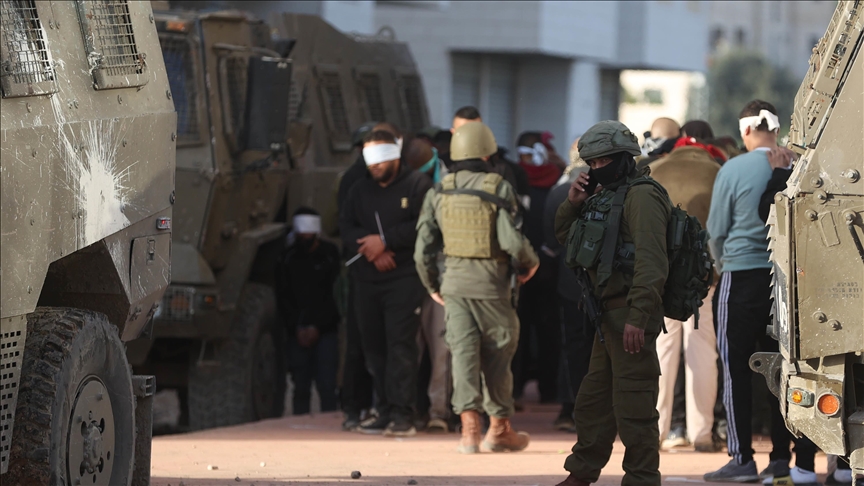
Israel detains 20 Palestinians from West Bank, bringing total arrests since Oct. 7 to 7,120

Palestinian detainees in Israeli jails exceed 9,000, including 606 others classified as 'unlawful combatants' arrested from Gaza


Qais Abu Samra |20.02.2024

( Issam Rimawi - Anadolu Agency )


RAMALLAH, Palestine

The Israeli army on Tuesday detained 20 more Palestinians from areas across the occupied West Bank and East Jerusalem.

According to a joint statement by the Prisoners and Ex-Prisoners Affairs Authority and the Palestinian Prisoner Society, the new arrests brought the total number of Palestinians detained by the Israeli forces since Oct. 7 to nearly 7,120.

The arrests mainly concentrated in the cities of Hebron, Bethlehem, Nablus, Ramallah, Jericho, and East Jerusalem.

During the Israeli arrest campaigns, the Israeli forces beat and abused Palestinians and damaged their homes and properties, the statement also said.

The two rights groups said earlier that the total number of Palestinian detainees in Israeli jails exceeds 9,000, including 3,484 held under administrative detention with no trial or charge, and some 606 others classified as "unlawful combatants" arrested in Gaza.

Tensions have been high across the West Bank since Israel launched a deadly military offensive against the Gaza Strip after a cross-border attack by Hamas on Oct. 7.

At least, 399 Palestinians from the West Bank have been killed by the Israeli forces and settlers since Oct. 7, in addition to over 4,440 others injured.

Israel stands accused of genocide at the International Court of Justice, which in an interim ruling in January ordered Tel Aviv to stop genocidal acts and take measures to guarantee that humanitarian assistance is provided to civilians in Gaza.

*Writing by Ahmed Asmar
Israel 'apartheid' against Palestinians worse than South Africa's: Pretoria

"It is clear that Israel's illegal occupation is also being administered in breach of the crime of apartheid. It is indistinguishable from settler colonialism," South Africa tells the world's top court.


REUTERS

International Court of Justice holds public hearings on the legal consequences of Israel's occupation of the Palestinian territories in The Hague. / Photo: Reuters

Israel is applying an even more extreme version of apartheid in the Palestinian territories than experienced in South Africa before 1994, Pretoria told the world's top court.

"We as South Africans sense, see, hear and feel to our core the inhumane discriminatory policies and practices of the Israeli regime as an even more extreme form of the apartheid that was institutionalised against black people in my country," said Vusimuzi Madonsela, South Africa's ambassador to the Netherlands, where the International Court of Justice (ICJ) is based, on Tuesday.

An unprecedented 52 countries are taking the stand at the ICJ, which has been asked to provide a non-binding "advisory opinion" on the legal implications of Israel's occupation of Palestinian territories.

"It is clear that Israel's illegal occupation is also being administered in breach of the crime of apartheid... It is indistinguishable from settler colonialism. Israel's apartheid must end," said Madonsela.

He said South Africa had a "special obligation" to call out apartheid wherever it occurs and ensure it is "brought to an immediate end."

The case is separate from a high-profile case brought by Pretoria against Israel for alleged genocide during its current offensive in Gaza.

In that case, the ICJ ruled that Israel should do everything in its power to prevent genocidal acts in Gaza and allow in humanitarian aid.

The hearings kicked off on Monday with three hours of testimony from Palestinian officials, who accused the Israeli occupiers of running a system of "colonialism and apartheid".

Palestinian Foreign Minister Riyad al Maliki urged the judges to call for an end to the occupation "immediately, totally and unconditionally."


The ICJ rules in disputes between states.

However, it can also be asked to provide a legal opinion on a topic of international law.

The United Nations asked it in December 2022 to provide guidance on the "legal consequences arising from the policies and practices of Israel in the Occupied Palestinian Territory, including East Jerusalem."

When the ICJ rules in contentious cases between states, its judgement is binding but it has little means of enforcement. It ordered Russia to stop its military campaign in Ukraine, for example.

In contrast, an advisory opinion is completely non-binding but would likely add to the mounting international pressure on Israel over its Gaza offensive.

The court will rule "urgently" on the affair, probably by the end of the year.

Israel is not participating in the oral hearings but sent a written contribution in which it described the questions the court had been asked as "prejudicial" and "tendentious."

It said the case that opened on Monday was "aimed at harming Israel's rights to defend itself from existential threats."
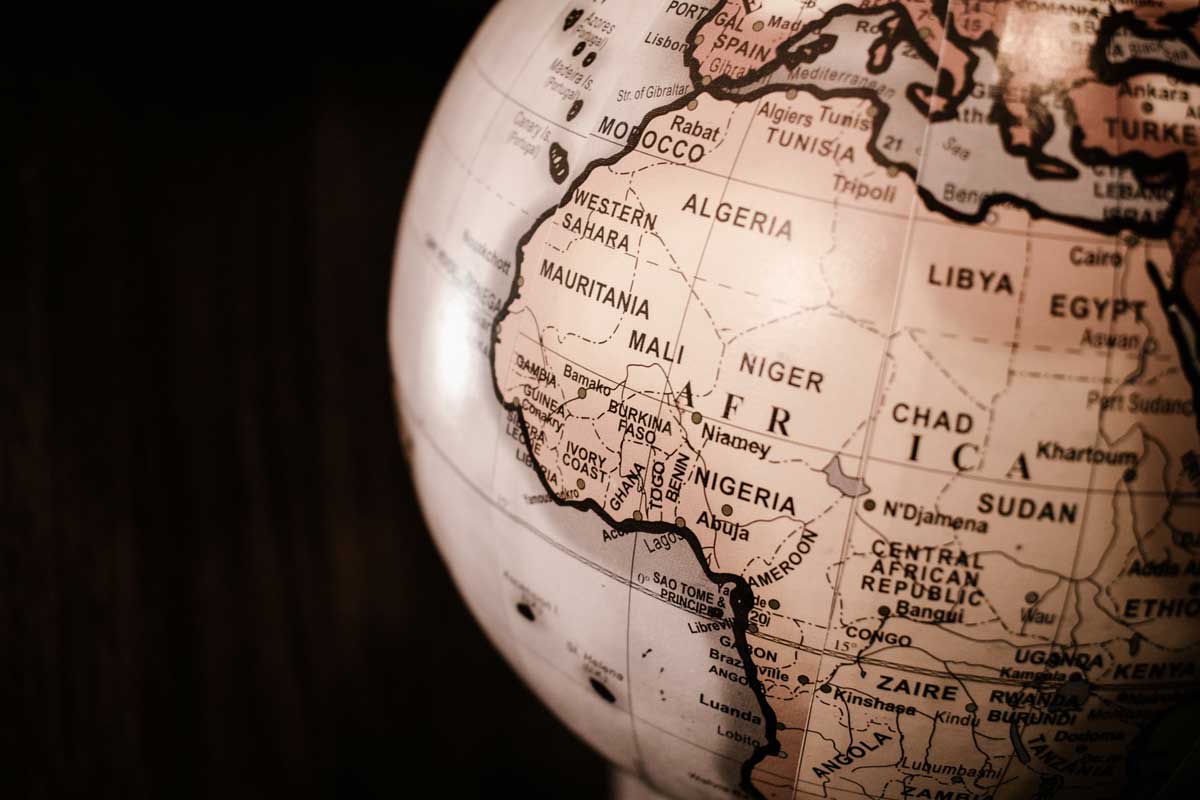
China’s Rise and the end of West’s Colonial Ambitions

The West has maintained dominance and authority for centuries, spanning from the period of colonial expansion to the age of globalization.


BY DR. PRANAB KUMAR PANDAY
FEBRUARY 20, 2024
photo: Unsplash

Western countries have historically influenced the discourse about power and control globally. The West has maintained dominance and authority for centuries, spanning from the period of colonial expansion to the age of globalization. Given China’s significant growth in global power, a crucial issue emerges: Will China’s ascent signal the conclusion of the West’s imperial aspirations?

The West’s colonial objectives for centuries were driven by the ambition for economic dominance, territorial expansion, and cultural influence. This period was demarcated by the use of resources, the suppression of native populations, and the imposition of Western standards and ideologies. Asia, Africa, and the Americas were the regions most affected by Western imperialism, continuing exploitation and persecution at the hands of colonial powers.

Nevertheless, the global landscape is experiencing a considerable revolution in the 21st century. China, formerly inactive, has suddenly ascended to demonstrate its power and change the global framework. China has appeared as a formidable enemy to Western supremacy through its rapid economic growth, technological advancements, and strategic investments.

China’s economic strength is critical in its ascension to eminence. China is leading significant infrastructure projects in Asia, Africa, and Europe through efforts such as the Belt and Road Initiative (BRI). China is increasing its economic influence and strengthening relationships with partner countries through investments in ports, railroads, and telecommunications networks. This contrasts abruptly with the exploitative practices employed by colonial powers, which prioritized extraction above development.

China’s focus on mutually beneficial collaboration and unity among poor countries offers a positive contrast to the West’s sometimes condescending attitude towards international relations. China opposes Western supremacy in global governance by promoting a multipolar world order centered on mutual respect and non-interference. It advocates for collaboration and cooperation among states, moving away from unilateral domination towards a more inclusive and fair global system.
China’s technological progress is altering the global power dynamics, enhancing its economic might. China is rising as a leader in disciplines such as artificial intelligence, renewable energy, and space exploration. China’s technology advancement not only boosts its competitiveness but also challenges the West’s belief in its technological supremacy.

China’s dedication to diplomacy and multilateralism is enhancing its impact on the global arena. The Asian Infrastructure Investment Bank (AIIB) and the Shanghai Cooperation Organization (SCO) are promoting more cooperation and solidarity among countries. China is establishing itself as a responsible global actor by supporting causes including climate change mitigation, poverty reduction, and public health improvement. China’s approach contrasts with the West’s history of independent activities and military interventions, which boosts China’s soft power and international reputation.

China’s fast expansion is evident, but it is too early to proclaim the end of the West’s colonial aspirations. China’s increasing influence may disrupt existing power structures, yet relics of colonialism endure in other manifestations. Current economic disparity, cultural supremacy, and geopolitical conflicts are clear indications of the lasting impact of Western domination.
China’s behavior in international affairs has sparked worries about its commitment to ideals of sovereignty, human rights, and environmental sustainability. Western democracies and human rights organizations have criticized the Chinese government for its suppression of dissent, forceful territorial claims in the South China Sea, and environmental policies.

China’s Belt and Road Initiative has received acclaim for its ability to stimulate economic growth, as well as backlash for its debt-trap diplomacy and lack of transparency. Critics contend that China’s infrastructure projects tend to put its strategic objectives over the actual needs and ambitions of partner nations, raising doubts about the sincerity of China’s intentions.
The future trajectory of global power dynamics is uncertain due to the complex geopolitical landscape. China’s rise may suggest a shift from Western dominance, but it’s crucial to recognize that the effects of colonialism cannot be eradicated abruptly. Western colonial ambitions may adapt in response to new situations, leading to the creation of new obstacles to a more equitable and inclusive global system.

China’s rise has had a multifaceted influence on the West’s colonial ambitions, making it a nuanced issue that defies a binary solution. An in-depth analysis of historical legacies, geopolitical tendencies, and global power relations is crucial. To manage this changing environment, it is crucial to promote collaboration and communication that goes beyond basic East versus West storylines. It is crucial to have a common vision of a fairer and more affluent world as we progress in this ever-changing environment. China’s rise is a major influence on the global arena, offering a robust alternative to the West’s imperial ambitions. China is challenging current power dynamics and advocating for a more equitable and inclusive global system through an emphasis on economic collaboration, technological advancement, and diplomatic partnerships.

Dr. Pranab Kumar Panday
The writer is a Professor in the Department of Public Administration at the University of Rajshahi.


Gold hydrogen: a near limitless supply of clean fuel?

Huge deposits found in northern France but major energy companies are holding back, for now


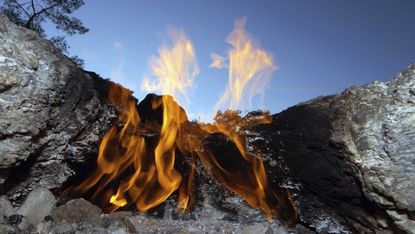
The perpetual flames of Turkey’s Mount Chimaera is caused by the release of natural hydrogen
(Image credit: imageBROKER/Shutterstock)

BY CHAS NEWKEY-BURDEN, THE WEEK UK

Start-ups are scrambling to discover sources of so-called "gold hydrogen" after experts said the low-cost, low-impact energy could be an environmentally friendly game-changer.

A recent discovery means that the planet could contain "near-limitless clean fuel", said New Scientist, but experts are also urging caution as the hype builds.

So what is gold hydrogen, how much of it could be under our feet and is it really as useful as has been claimed?

How is hydrogen currently obtained?

Hydrogen will be an "essential fuel in years to come", said the BBC, because it does not produce CO2 when used as a fuel or in industrial processes. But the "big drawback", according to the Carbon Trust, is that less than 1% of current global hydrogen production is emissions-free.

Currently, we have to make hydrogen ourselves, which involves using energy and producing pollution. Grey and blue hydrogen are produced by splitting methane into carbon dioxide and hydrogen, with the CO2 captured and stored in the latter case. Black hydrogen is produced by partially burning coal and there's also pink hydrogen, made using nuclear energy.

Green hydrogen, "that elusive 1%", said the BBC, is created through the electrolysis of water into oxygen and hydrogen, but it is "relatively expensive and in short supply". So this is where gold hydrogen could come in.

What is gold hydrogen?

New geological research suggests that "cheap and plentiful supplies" of naturally occurring hydrogen could be "found right under our feet", wrote David Waltham, a geophysics professor at Royal Holloway, University of London, on The Conversation.

Gold hydrogen, also sometimes known as white hydrogen, is a naturally occurring gas trapped in pockets under the ground – in much the same way as oil and natural gas.

It is produced when the gas occurs naturally deep underground and can be harvested through drilling, with no need to expend energy on synthesis.

It is "colourless and odourless", explained New Scientist, and has "good environmental credentials" because it "burns cleanly, producing nothing but water".

Where has it been found?

In October 2023, researchers at the French National Centre of Scientific Research discovered a "particularly large reservoir" of natural hydrogen in northeastern France’s Lorraine coal basin, wrote Waltham.

The reservoir may contain 250 million tonnes of naturally occurring hydrogen – enough to provide almost as much energy as the UK's largest oil field. It may represent the largest naturally occurring deposit of the gas ever found, enough to meet current global demand for more than two years.

Other, smaller reservoirs have been found in Spain and across Europe, as well as in Mali, Namibia, Brazil and the US. None has been discovered in the UK but experts are actively considering whether to search.

Ultimately, according to modelling by the US Geological Survey, there could be trillions of tonnes available, and if just a fraction of that could be recovered, it would be enough to meet our projected hydrogen demand for many centuries to come.

'Wait-and-see' attitude


Despite the exciting possibilities, there are "reasons to be cautious", said New Scientist, because "the true amount of hydrogen the planet contains, as well as how much might be feasible to extract, remains uncertain".

The gas is found in large volumes, so it needs to be compressed or converted into other chemicals, such as liquid ammonia, before it can be easily moved. This process could require the construction of new pipelines, which is a significant undertaking.

That's why experts are still debating whether gold hydrogen will turn out to be an over-hyped fad or a potentially game-changing discovery.

"So far," said the BBC, "the major energy players are holding back", with just start-ups getting involved. Oil giants are "very interested" but they're "currently sitting on the sidelines, watching, taking a bit of a wait-and-see attitude", Geoffrey Ellis, from the US Geological Survey, told the broadcaster.

There is also the danger that exploiting natural hydrogen deposits "could be used as an excuse to foot-drag" on the need to cut greenhouse gas emissions immediately, said Waltham. So there's a "long way to go" before we can say for sure how useful these stores will be.


Imperialist United States to send Kenyan cops to Haiti

Imperialism has never helped people in Haiti


In Haiti just after the earthquake in January 2010 
(Flickr/ RIBI Library)


The US wants to send 1,000 Kenyan police into Haiti in its latest criminal act. Imperialist intervention has never helped people in Haiti. The “official” reason the US, Haitian and Kenyan ruling classes provide is that Haiti needs help tackling gang violence to stabilise the state.

Government officials from Haiti and Kenya met in the US to set a deadline for the deployment of Kenyan police forces. But this private meeting comes after the Kenyan high court blocked the deployment as unconstitutional three weeks ago. The court said the Kenyan government lacks the legal authority to send police outside of Kenya.

But ruling classes in the US, Haiti and Kenya are pushing ahead anyway. And they won the support of the United Nations security council last year. Ekuru Aukot, Kenyan opposition leader, brought the court case forward. He blasted the Kenyan government for using the deployment to prop up its international image and gain favour with Western countries such as the US.

And the Kenyan police have a history of violence and murders. Otsieno Namwaya, east Africa director for Humans Rights Watch, said, “Kenya should not be seen to be exporting its abusive police to other parts of the world.” Corruption The Haitian government is also rife with corruption.

Amid infighting from the Haitian ruling class, different elements developed their own armed supporters to fight over the state. But sometimes these escape rulers’ control, with police officers often being found in gangs. These gangs are now being blamed for the turmoil in Haiti.

In reality, it is the Haitian and US state that have encouraged paramilitaries that previously defended their interests. This wouldn’t be the first time ordinary people in Haiti have suffered from imperialist “deployments” and relentless US pressure. Throughout the 20th century, the US crushed Haiti with dictatorships that destroyed resistance. In the 21st century it’s no different.

In 2010 the US used a devastating earthquake as an excuse to deploy 17,000 soldiers. This caused a cholera outbreak killing 10,000 people. And a UN force deployed from 2004 to 2017 committed terrible atrocities. Soldiers carried out sexual violence under the guise of providing medicine, clothes and food. Imperialism and the national ruling class are to blame for misery in Haiti where half the population lives below the poverty line.


South Korean doctors walk out to protest government policy, causing many surgery cancellations


THE ASSOCIATED PRESS

February 20, 2024 

Photo/Illutration


Medical workers walk inside a general hospital in Gwangju, South Korea, Feb. 19, 2024. (Yonhap via AP)

SEOUL--South Korean trainee doctors collectively walked off their jobs Tuesday to escalate their protest of a government medical policy, triggering cancellations of surgeries and other medical treatments at hospitals.

The Health Ministry urged them to return to work immediately, saying they must not endanger the lives of patients to fight the government.

As of Monday night, more than half of the 13,000 trainee doctors in South Korea were confirmed to have submitted resignations en masse to protest a government push to increase the number of medical students. A total of 1,630 of them have left their work sites, according to Health Ministry records.

More trainee doctors are expected to follow suit. Under a decision made by their association last week, trainee doctors at the country’s five major hospitals were supposed to walk off collectively on Tuesday.

At the center of the dispute is a recent government announcement that it would raise medical school admissions by 2,000 from next year. The government says it’s urgent to have more doctors to address what it calls a shortage of doctors, given the country’s fast-aging population.

But the plan triggered a strong backlash from many doctors, who say the 2,000 new admissions are too many to be handled by medical schools and that resources must be used to resolve other issues first. They say producing too many doctors would also lead to unnecessary medical treatments due to increased competition among doctors. But their critics argue that doctors mainly worry their incomes would drop if there were more doctors.

Most of the 13,000 trainee doctors work at 100 hospitals across South Korea, assisting senior doctors during surgeries and treating patients. If their walkouts are prolonged or joined by senior doctors, that could cause disruptions at those hospitals and in South Korea’s overall medical service, observers say.

South Korea has a total of 140,000 doctors. The Korea Medical Association said Monday it plans to hold rallies to support trainee doctors’ collective action but hasn’t determined whether to launch strikes.

At Seoul’s Asan Medical Center, a nurse said it’s unclear how long senior doctors could solely perform surgeries and other treatments without the assistance of trainee doctors. The nurse, who requested anonymity citing the sensitivity of the issue, said that trainee doctors typically handle skin incision and disinfection during surgeries at the direction of senior doctors and manage data on hospital computers.

She said her hospital plans to delay the planned acceptance of some cancer patients and to release inpatients early. Other Asan hospital officials said Tuesday that an unspecified number of trainee doctors didn’t come to work but noted some are still working. They said the hospital is rearranging planned surgery schedules by reviewing the conditions of patients.

Vice Health Minister Park Min-soo said authorities have received 34 public complaints related to the trainee doctors’ walkouts – 25 of them over the cancellation of surgeries. Other cases include hospitals refusing to treat patients and canceling planned medical treatments.

“If you leave your patients to oppose a government policy despite knowing what your collective action would cause, that can’t be justified at all,” Park said. “We appeal to trainee doctors to return to patients. An act of endangering the lives of patients to express your opinions is something that you must not do.”

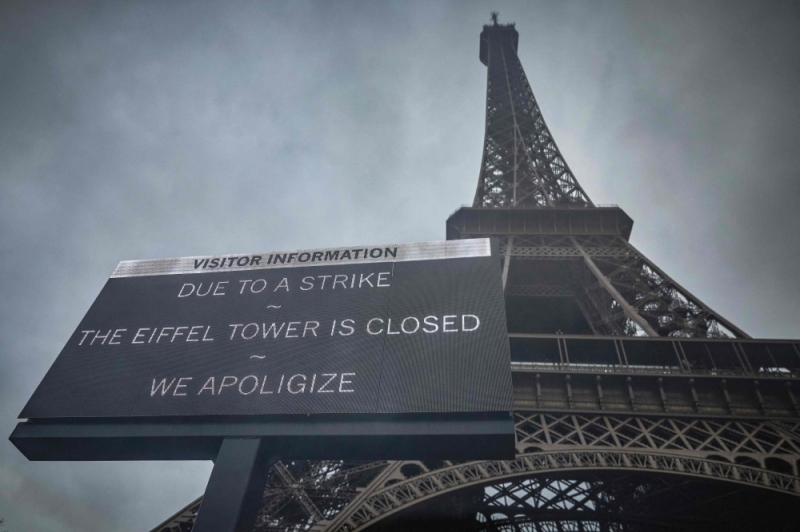
Eiffel Tower closed again as staff extend strike, says union
The Eiffel Tower, one of the world’s top tourist attractions, will remain closed for a second straight day today as staff extend a strike, a union representative told AFP. — AFP pic

PARIS, Feb 20 — The Eiffel Tower, one of the world’s top tourist attractions, will remain closed for a second straight day today as staff extend a strike, a union representative told AFP.

The strike started yesterday in protest over the way the monument is managed financially.

The tower’s operator, SETE, said on its website that “visits of the monument will be disrupted on Tuesday”.

It advised ticket holders to check its website before showing up, or to postpone their visit. E-ticket holders were asked to check their e-mails for further information.

The stoppage is the second strike at the Eiffel Tower within two months for the same reason.

Unions have criticised operator SETE for its business model that they say is based on an inflated estimate of future visitor numbers, while under-estimating construction costs.

The Eiffel Tower — Paris’s most famous landmark — attracts nearly seven million visitors a year, around three-quarters of them foreigners, according to its website.

During the Covid pandemic numbers dropped sharply due to closures and travel restrictions, but recovered to 5.9 million in 2022. Last year, it attracted 6.3 million visitors.

Visitor numbers to Paris are expected to swell this summer as the French capital hosts the Olympic Games.

In a joint statement Monday, the CGT and FO unions called on the city of Paris “to be reasonable with their financial demands to ensure the survival of the monument and the company operating it”.

Alexandre Leborgne, a representative for the hard-left CGT labour union, told AFP that city hall, which is the majority owner of the monument, “refuses to negotiate for now”.

A worker assembly would in a vote on Tuesday confirm the extension of the strike, called by the CGT and FO unions, he said. — AFP


Tribal bloodshed shines spotlight on strategically vital Papua New Guinea domestic security issues


THE ASSOCIATED PRESS

February 2024

Photo/IllutrationPeople take part in looting and arson during protests over a pay cut for police that officials blamed on an administrative glitch, in Port Moresby, Papua New Guinea January 10, 2024 in this screen grab obtained from social media video. (Leo Manuai/via Reuters)

MELBOURNE--A tribal clash in Papua New Guinea’s remote highlands in which at least 26 people were killed has put a growing internal security problem under the microscope in the strategically vital South Pacific island nation that has garnered closer military attention from the United States and China.

The rival powers are increasingly keen to strike security pacts with the developing nation whose international significance has grown in tandem with China’s increased regional influence.

Here’s a look at some key issues surrounding Papua New Guinea’s internal security concerns:

Papua New Guinea is the most populous South Pacific island nation after Australia and was a colony of that near neighbor until independence in 1975.

The government estimates Papua New Guinea’s population at around 10 million people, although a United Nations study, based on data including satellite photographs of roof tops, estimated in 2022 it could be as high as 17 million. An accurate census has not been held in the nation in decades.

It’s a diverse country rich in resources including gold, nickel and natural gas with more than 800 Indigenous languages. Most of the population scrapes by as subsistence farmers.

Civil unrest in the capital Port Moresby and Lae, the nation’s second most populous city, made headlines last month when at least 15 people were reportedly killed during rioting and looting in street protests over a public service pay dispute.

But tribal warfare has a long history across the country and is becoming more lethal with an influx of illegal modern firearms in the highlands and increasing use of mercenary sharpshooters.

Some villagers accuse security forces of taking bribes from tribal warlords to help defeat rivals who don’t pay for protection.

The latest tribal battle occurred in gold-rich Enga province. Another hotspot for tribal violence is Hela province. Both are among resource-rich western areas of the country where tribal conflict has escalated in recent decades, said Paul Barker, executive director of the Port Moresby-based policy thinktank Institute of National Affairs.

Natural resources create jealousies and conflicts around how the wealth should be distributed, who was entitled to mining royalties and which landowners deserved compensation.

Other traditional triggers for tribal conflict include accusations of sorcery following sudden deaths such as car wrecks and payback for casualties from previous tribal wars.

Joe Biden was to become the only sitting U.S. president to ever visit Papua New Guinea in May last year but cancelled at short notice to focus on debt limit talks in Washington, D.C. U.S. Secretary of State Antony Blinken took Biden’s place and signed a new security pact that sparked Papuan student protests over concerns that it undermined the country’s sovereignty.

Chinese President Xi Jinping had visited in 2018 when Port Moresby hosted the Asia-Pacific Economic Cooperation leaders’ summit.

The United States and its influential ally in the region, Australia, have been rapidly building bridges with Papua New Guinea and its island neighbors in response to China signing a security pact with the Solomons Islands in 2022 that raised the prospects of a Chinese naval foothold being established in the South Pacific.

China later failed in an ambitious attempt to get 10 Pacific island nations including Papua New Guinea, the Solomons’ nearest neighbor, to sign a sweeping deal covering everything from security to fisheries.

Australian and Papuan prime ministers signed a security pact in December that strengthened Australia’s place as the preferred security partner in the region.

The main dividend for Papua New Guinea was the help Australia offered to address its internal security concerns by increasing the police force from 6,000 to 26,000 members and to support the court and prison systems.

But Papua New Guinea’s Foreign Minister Justin Tkatchenko revealed last month that his government had begun early talks with China on its offer of policing assistance weeks after the street riots in Port Moresby and Lae.

Papua New Guinea had previously said the United States and Australia were its preferred security partners while China would remain an economic partner.


Hundreds are set to descend on Tahiti for Olympic surfing. Can locals protect their way of life?


THE ASSOCIATED PRESS

February 20, 2024 

Photo/IllutrationA surfer rides a wave in Teahupo'o, Tahiti, French Polynesia, Jan. 13, 2024. The world-famous surf spot is set to host the 2024 Paris Olympics surfing competition. (AP Photo)

TEAHUPO’O, French Polynesia--Peva Levy said he felt a powerful, natural energy known as “mana” when he surfed Teahupo’o’s waves on a piece of plywood for the first time, rushing down a crumbling white surf in front of an untouched volcanic beach several years before the steady streams of surfers started arriving when the village got its first asphalt road over fifty years ago.

“It was a secret spot,” the surfer and Tahitian native remembered, as he stood on the pristine beaches of Teahupo’o on the island’s south side, waves crashing off in the distance. “But it was not a secret spot for a long time.”

Teahupo’o has since achieved world renown among surfers — the roaring wave garnered a reputation for its ferocious power — and will be home to the 2024 Paris Olympics surfing competition, scheduled from July 27 to Aug. 4.

The island in French Polynesia is an overseas territory of the European nation. The decision to host part of the Games here has thrust unprecedented challenges onto a small community that has long cherished and strives to protect a way of life more closely connected to wild lands and crystal-clear ocean than the fame promised by an Olympic stage. And while organizers are trying to adjust their plans to conserve the local environment, ensuring that the village of Teahupo’o stays a village is proving to be a struggle for locals.

The original proposed scale of the Olympic site – which called for new roads, housing units and even an aluminum judging tower that required drilling into the reef – caused a significant local backlash. Environmental and surf communities banded together to protect Teahupo’o’s culture, its corals and its marine life.

“It was too much for us, a big change. And it was just for, like, one week” of competition, Levy said, who’s also a member of the local environmental organization Vai Ara O Teahupo’o.

Though it’s known throughout the surfing world, there is not one surf shop in Teahupo’o, with the town forgoing most of the development that’s usually a staple at popular surf destinations. At the end of the village’s road lies its sole snack bar which is only open for lunch and serves fish caught that morning. Kids spend the afternoon surfing as families watch from the black sand beaches. At night, the distant roar of waves barreling down onto the reef lulls the town to sleep.

“We loved this place because it was still wild, there were not many people over here. There was a lot of fish all around, and that good mana,” Levy said.

In response to criticism, now 98% of Olympic housing will be within the homes of locals, with athletes accommodated on a cruise ship anchored nearby. The size of the judging tower has been scaled back and new infrastructure plans are being drawn up to minimize the need for new construction.

But concerns remain: Environmentalists and local fishers fear that drilling into the coral reef could attract ciguatera, a microscopic alga that infects fish and makes people sick if eaten, and many sustain themselves by what they catch in the ocean.

Mormon Maitei, 22, makes a living from spearfishing in the lagoons, feeding his family and selling what he has left over. “The lagoon is our refrigerator, it’s where we get our dinner from,” he said.

The sought-after shape of the waves could be affected, too, islanders say, if the reef were to fissure and lose the shape that the waves rely on to form.

“If it does crack and break off, there will be no more wave over here, it will be finished for us,” said Levy.

In December, local fears were confirmed when a barge razed sections of coral on its way to the construction site on the reef. A video of the damage spread on social media, provoking an outcry.

Cindy Otcenasek, the president of Via Ara o Teahupo’o, called the destruction deeply hurtful. “In Polynesian culture, gods are present everywhere, in the coral, in the ocean,” she said. “The ocean is considered to be the most sacred temple.”

“The fish live around the corals so if we break a coral, we break a home,” she said.

Olympic organizers expressed their concern over the incident.

“It was awful for us,” said Barbara Martins-Nio, a senior event manager for the Paris 2024 Olympic and Paralympic Games Organization Committee. “Tahitians have this special relationship with nature, with their lands, and it was like a bomb for us.”

Martins-Nio said that their interactions with local groups are now improving, and the organizing team has taken a step back on several issues and are better involving local groups so that construction work is fully transparent.

Despite the fears, some on the island still see the Games as an opportunity. Much of the local population is in favor of the Games, the economic benefits it could bring and the standing it will give their little corner of French Polynesia.

Born and raised in Teahupo’o, Gregory Parker’s morning routine consists of watching the waves crash along the horizon from his beachfront bungalow while smoking a cigarette. But while the Games are in town, he’s willing to sacrifice that for a bit of spare cash by renting it out.

His family owns a significant portion of properties in the village that are regularly rented out to the international surf community during the annual World Surf League competition, and he intends to do the same for the Olympics.

“I will try to live at my daughter’s house during the Games. If she also rents out her house, I have a tent,” Parker said. “It’s not hard for two weeks, and given all the money I will make, it’s worth it.”

In January this year, just months before the Games, a small group of local surfers bobbed up and down in the water, awaiting the perfect wave, when 21-year-old Kauli Vaast, who’s competing in this year’s Olympics, spotted it forming.

He’s quick to slide his board into one of the glassy tubes, gliding out before the wave thunders down onto the reef, a monstrous spray of lapping white froth raining down behind him.

“Magical things happen here, you feel this energy and you must show respect,” said Vaast. “It is so important to show respect in these types of places where you face mother nature.”

Vaast learned how to surf on these waves at just eight years old, nearly 40 years after Peva Levy first felt the wave’s mana. Mana that many islanders feel — and want to preserve.

“We hear a lot about the infrastructure and heritage that will be left by the Olympic Games, but we already have an ancestral heritage,” said Via Ara o Teahupo’o’s Otcenasek. “Teahupo’o is the land of God before being the land of the Games.”