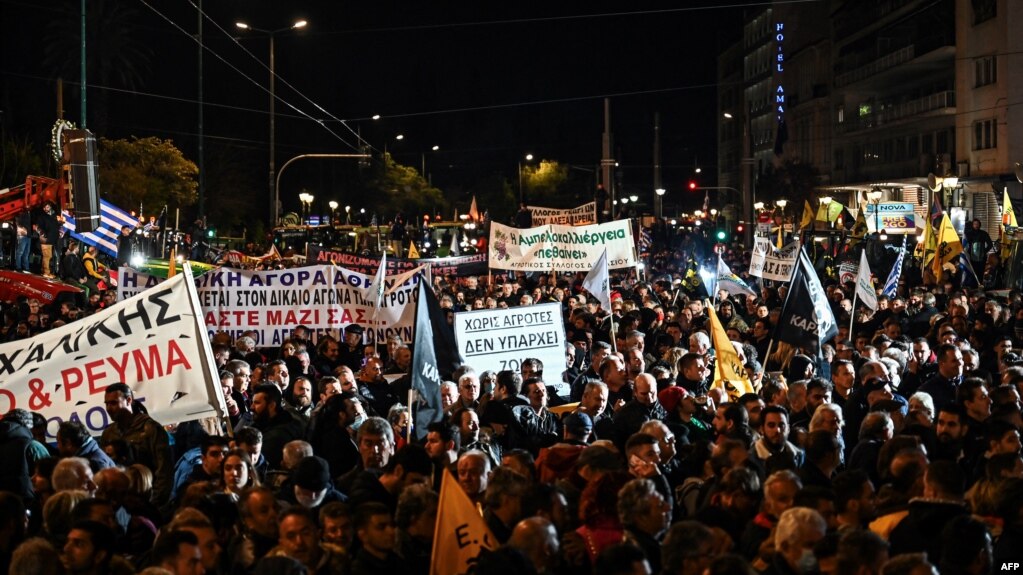
WORKERS OF THE WORLD UNITE AGAINST ZIONISM
Indian port workers refuse to handle Israel weapon shipments
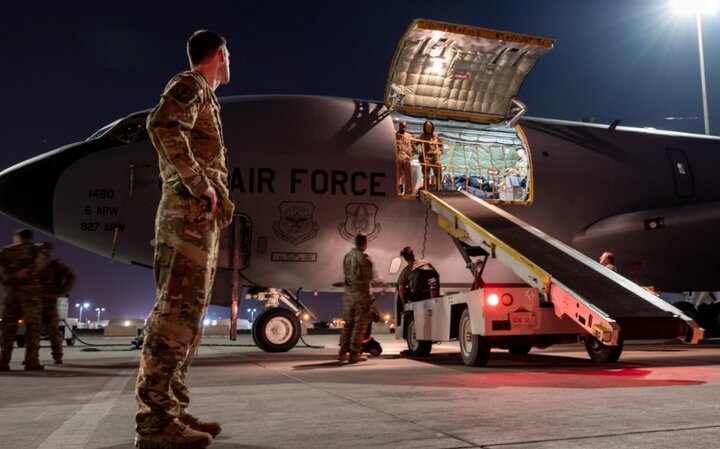
This decision follows recent reports of Indian-manufactured drones being transported to Tel Aviv.
The Water Transport Workers Federation of India (WTWFI) issued a statement on 14 February declaring their stance to “refuse to load or unload weaponised cargoes” from Israel or any other country involved in the “war in Palestine”.
“We, the Port workers, part of labour unions, would always stand against the war and killing of innocent people like women and children,” a statement by the Union said.
“Women and children have been blown to pieces in the war. Parents were unable to recognise their children killed in bombings that were exploding everywhere,” it added.
The Union, comprising over 3,500 employees at 11 government-owned ports in India, called for an “immediate ceasefire”, while adding, “Loading and unloading these weapons helps provide organisations with the ability to kill innocent people.”
Moreover, WTWFI’s General Secretary, Narendra Rao, affirmed that the resolution aligns with the World Federation of Trade Unions, and the collective choice was made during a meeting with international trade unions in Athens at the onset of the war.
Rao stated, “We decided then that we would do our bit and not handle any weapon-laden cargo, which will go on to assist Israel to kill more women and children as we are seeing and reading every day in the news.”
He said the statement was issued ‘to express solidarity with Palestine’.
Since 7 October, Israel has been waging a devastating war on the Gaza Strip, resulting in tens of thousands of casualties, most of whom are children and women, in addition to an unprecedented humanitarian catastrophe and a noticeable deterioration in infrastructure and properties, according to Palestinian and international data. This has led to Israel facing charges of violations of the Genocide Convention before the International Court of Justice.
Dock Workers: Block Military Cargo to Israel Against the Genocidal War on Palestinians in Gaza!
FEBRUARY 21, 2024

Photograph by Nathaniel St. Clair
The massacre of Palestinians in Gaza is escalating as the misnamed Israel Defense Forces (IDF) continue their carnage, flattening whole neighborhoods and committing mass murder of civilians. Yemen and Southern Lebanon have now been drawn into the war. More than 35,000 Palestinians, mostly children and women, have been killed and 67,000 seriously injured according to the Euro-Med Human Rights Monitor (4 February).[1] The United States is co-responsible for this genocide underway, as all the heavy (500-2,000-lb.) bombs causing the mass slaughter and all the warplanes from which they are dropped are made in the U.S.A. Without U.S. weaponry, the Zionist militarists would be stymied. “Genocide Joe” Biden’s pretense of concern about civilian casualties is nothing but cynical crocodile tears. This is a U.S./Israel war.
Hospitals, universities and residential buildings are being deliberately targeted. Ambulances have been destroyed and medical workers killed, recently including those seeking to rescue a 6-year-old girl trapped in a car where her parents were killed by Israeli fire. Israel has cut off food, water, medical supplies, electricity and fuel, allowing only a trickle of humanitarian aid to enter. United Nations authorities report that 90% of Gaza’s 2.2 million people have been driven from their homes, and nine out of ten have less than one meal a day. Now, based on an Israeli claim, the U.S. along with Australia, Britain, Canada, France, Finland, Germany, Italy, the Netherlands and Switzerland have stopped funding the U.N. Relief and Works Agency (UNRWA), making them complicit in the Zionist campaign to obliterate the Palestinian people in the Gaza Strip.
How can this monstrous slaughter be stopped? In December, the South African government brought charges of genocide against Israel before the International Court of Justice (ICJ), a toothless body that in a January 24 ruling called for Israel to change its war policy to protect civilians. This predictably had zero effect. In the U.S., the Center for Constitutional Rights and Defense for Children International – Palestine brought a case last November against war criminals Biden, U.S. Secretary of State Blinken and Pentagon Chief Austin, calling to enjoin the defendants from “providing, facilitating or coordinating military assistance or financing to Israel.” (One of the Palestinian American plaintiffs, Monadel Herzallah, will be speaking at a labor forum against the genocidal war on Gaza at ILWU Local 10 on February 24.) On January 31, a federal judge in Oakland ruled that he didn’t have jurisdiction, but echoed the ICJ ruling that “it is plausible that Israel’s conduct amounts to genocide.” So much for the courts.
Now Israeli forces are poised to escalate the slaughter by attacking Rafah, where over a million Gazans are concentrated. On the Israeli-occupied West Bank, from October 7 to date at least 390 Palestinians have been killed by Israeli soldiers and fascistic settlers, and thousands arrested. Backing the Israelis up, there are some 50,000 U.S. troops in the region and 19 warships in the eastern Mediterranean and Red Sea, from which U.S. warplanes and missiles are bombing targets in Yemen, Syria and Iraq and threatening Iran. Working people the world over should be demanding that Israel get out of Gaza and the West Bank entirely and that the U.S. and its allies get the hell out of the Middle East. As a first step, unions should use their muscle to stop all Western arms shipments to Israel, Egypt, Saudi Arabia and anywhere else in the region.
Labor on Gaza: Paper Resolutions But Not a Lot of Action
Last October 18, the Palestinian General Federation of Trade Unions (PGFTU) issued an urgent appeal notably “calling on trade unions in relevant industries: 1) To refuse to build weapons destined for Israel. 2) To refuse to transport weapons to Israel. 3) To pass motions in their trade union to this effect,” as well as to take action against companies complicit with the Israeli siege, to pressure governments to stop military trade with Israel “and, in the case of the U.S., stop funding it.” In response, on October 30, five Belgian transport unions issued a joint statement saying they were refusing to load or unload arms shipments heading to the war zone. And on November 6, the Barcelona dock workers’ union announced it would “not permit activity in our port of ships containing war materiel,” while calling for a ceasefire in Gaza.
In Britain, Canada and elsewhere unions have passed motions and there have been protests outside Israeli companies, notably the “defense” contractor Elbit. In Italy, rank-and-file dock unions in Genoa and other ports actually stopped operations with Israeli ships and held a national one-day strike against the war on Gaza on November 17 that shut down hundreds of warehouses in logistics hubs. In Sydney, the Maritime Union of Australia (MUA) joined protests against Israeli ZIM Lines ships and has called for an immediate ceasefire. In January, the 20-million-member International Transport Workers’ Federation (ITF) issued a statement, “Global Unions Call for Unified Action Following IJC Ruling on Gaza Genocide Case.” Sounds good, but there is no call for labor action, just an appeal to the U.N. and “world leaders.”
In the United States, beginning in October the United Electrical Workers (UE) circulated a petition to other unions with demands for a ceasefire and restoration of food, fuel, water and electricity to Gaza, demands that were taken up by the United Auto Workers (UAW), American Postal Workers Union (APWU), National Nurses Union (NNU), Service Employees (SEIU), Painters (IUPAT), Flight Attendants (AFA) and even the American Federation of Teachers (AFT) and National Education Association (NEA). But these appeals were not opposed to Israel’s war on Gaza as such, and in the case of the UAW specifically were rendered moot by its endorsement of warmonger Democrat Biden, who has emphatically backed and enabled the Israeli slaughter, for president. The rest of the liberal union leaders will certainly follow suit.
As for the national AFL-CIO, after first quashing a ceasefire call by a local labor council in Washington State last October, on February 8 it issued a statement that begins by “condemn[ing] the attacks by Hamas,” does not oppose the Israeli assault on Gaza, and calls for the release of Israeli hostages held in Gaza but not for freeing the more than 8,000 Palestinians held hostage in Israeli prisons. In short, this is a pro-war statement – but what else can you expect from the outfit whose international “labor” operations in conjunction with U.S. intelligence agencies earned it the nickname “AFL-CIA” in much of the world?
What About the ILWU?
While hundreds of Palestinian civilians are wantonly slaughtered by the mass-murdering IDF occupation forces every day, while the specter and reality of this genocidal war horrifies millions around the world, what has come from the titled officers of the International Longshore and Warehouse Union (ILWU) has been a thundering silence. This is no accident. It goes hand-in-hand with the action (and inaction) on union matters by the ILWU International leadership under Bob McEllrath (2006 to 2016) and currently Willie Adams. The common denominator is class collaboration. Where McEllrath focused on cooperation with the shippers’ Pacific Maritime Association (PMA), Adams has set his sights higher, seeking a seat at the White House table, literally, and dock jobs threatened by automation or Palestinians facing genocide be damned.
At the beginning of November, as outrage was building over the Israeli forces’ massive slaughter in Gaza, several ILWU locals were working on resolutions of solidarity with the besieged Palestinians. On November 3, a ship of the U.S. Military Sealift Command, the Cape Orlando, rumored to be headed to Israel, docked in Oakland where it was met by hundreds of protesters responding to a call of the Arab Resource and Organizing Committee (AROC). I and others headed to the docks to express solidarity with the protest, which lasted for 12 hours before police forced demonstrators away from the bollards so the crew could let the lines go. As the ship arrived in Tacoma the next day, 1,000 pro-Palestinian demonstrators blocked the dock. Longshore workers did not cross their picket line. Soldiers were brought in to work the ship.
Then on November 6, the ILWU International Executive Board (IEB) met in San Francisco, chaired by President Adams. ILWU Local 5 in Portland put forward a resolution citing ILWU’s proud history of convention resolutions and longshore actions protesting Israeli attacks on Palestinians. It called for a ceasefire and “upholding and amplifying our Union’s long history of solidarity with the people of Palestine.” But some Locals objected and a motion was introduced to table the resolution, which was accepted by the chair and passed. Even so, on November 18 Local 10 in the Bay Area unanimously passed a resolution recalling the local’s repeated refusal – in 2010, 2014 and 2021 – to work Israeli Zim Line ships when there were protests in defense of Palestinians, and expressing “our determination to take action in their defense.”
It is also reported that ILWU Locals 6 (Bay Area warehouse) and 8 (Portland longshore) as well as the San Francisco and Southern California regions of the Inland Boatman’s Union in the Marine Division of the ILWU have bucked the IEB’s kibosh and called for a ceasefire in Gaza.
The shameful blocking of a resolution calling for an end to the slaughter in Gaza was a 180° turn from the ILWU’s history of solidarity. Ever since the militant 1934 West Coast waterfront and San Francisco general strike, the ILWU’s founding president, Harry Bridges, was hounded by the government, which tried to deport him four times, especially during the “Red Scare” at the height of the anti-Soviet Cold War. In 1949, an ILWU strike shut down Hawaiian ports for six months. In 1953, the union undertook a general strike that paralyzed the islands to protest the conviction of regional director Jack Hall and six others as Communists under the Smith Act, on charges (later overturned) of conspiracy to overthrow the territorial government.
Every ILWU president since Bridges has confronted either the bosses’ courts, the cops or the feds. But government hostility didn’t stop union members from opposing and undertaking militant action against U.S.-backed oppressor regimes. In 1984, Local 10 undertook a historic boycott of the Nedlloyd Kimberley, a ship from apartheid South Africa, which after the Local leadership bowed before a court injunction was taken up by community protesters who continued to block the ship for several more days, an action that was hailed by South African anti-apartheid fighters in South Africa.
In 2002, in the build-up to the Iraq war President George Bush II threatened to send troops to occupy West Coast ports if the ILWU walked out during contract bargaining. Democratic senator Diane Feinstein called on Bush to invoke the Taft-Hartley Act, which he did. In April 2003, ILWU longshore workers respected the lines of anti-Iraq war protesters in the Port of Oakland, who were viciously attacked by the police using concussion grenades, rubber bullets, wooden dowels and tear gas. A number of protesters were hospitalized and scores arrested, including myself as the Local 10 business agent on the scene. Then on May Day 2008, acting on a Local 10 resolution, the ILWU shut down every port on the Pacific Coast demanding an end to the U.S. war on Afghanistan and Iraq – the first strike by U.S. workers against a U.S. war since 1919.
ILWU Tops Swing Hard to Starboard on Israel-Palestine
But today it’s different. ILWU president Willie Adams clearly disagrees with the union’s longstanding defense of Palestinian rights. This is not new. In 2006, when he was secretary- treasurer of the ILWU International, Adams travelled to Israel on a trip sponsored by an evangelical Christian pro-Zionist group. He wrote an article for the ILWU newspaper, The Dispatcher, fulsomely praising Israel with no mention of the oppression of Palestinians in the giant open-air prison that is the Gaza Strip, or of the attacks by fascistic Zionist settlers against the Palestinian people in the West Bank. When Adams asked Dispatcher editor Steve Stallone for his opinion of his article. Stallone told him: “It’s problematic. It conflicts with the ILWU’s official position established by its highest decision-making body, the convention.”
Stallone showed Adams union resolutions of the 1988 and 1991 ILWU conventions defending Palestinian rights and criticizing Israeli attacks. Shortly after, Stallone was fired, in good part for his critique of Adams’ pro-Zionist article, which was challenged in the Dispatcher by a letter to the editor from 38 angry members in Canada and the U.S. The firing, engineered by newly elected International president Bob McEllrath and Adams, both from the conservative leaderships of the Pacific Northwest locals of the ILWU, was an early marker of the union’s rightward trajectory. It revealed a top-down bureaucratic tendency to undo democratically decided political positions. This was reflected in deepening capitulation to the shipping bosses “at home,” as successive longshore contracts failed to defend longshore and clerks’ jobs from the threat of automation.
Another stark example was McEllrath’s sabotage of the struggle in 2012 to unionize a scab export grain terminal (EGT) being constructed in Longview, Washington. He ordered Local 21 to drop plans to occupy the site and then saddled it with a contract leaving the control tower fully in the hands of management. Meanwhile, the union accepted a $20 million dollar fine over its job actions in the Port of Portland, Oregon, stemming from an ill-advised dispute with the IBEW over a couple of reefer jobs. It even went into bankruptcy proceedings rather than shutting down the coast in response to this attack. But more on that later.
The ILWU’s sharp right turn was reflected in the bargaining over the 2022 Pacific Coast Longshore Contract Document (PCLCD), especially over relations with the federal government. Adams sat in a photo op for President Biden on the deck of the USS Iowa in June 2022, before the expiration of the previous contract. He dutifully vowed not to strike, abandoning the ILWU’s historic program of “no contract, no work” and surrendering labor’s leverage in the bargaining. Then, in an unprecedented move, he invited U.S. acting secretary of labor Julie Su into the contract negotiations with the employers’ PMA. Adams kept members working without a contract for a year, when the ILWU was not facing a no-strike clause and could have walked out at any time. Instead, the union leadership kept the “wheels of commerce rolling.”
Adams brags that he’s the first ILWU president to meet at the White House with a U.S. president. After the six-year2022-28 PCLCD was finally ratified last August, Adams was rewarded with a visit to Washington to be photographed with Biden, in which the Democratic president praised the contract as “a good deal for the United States of America.” Adams was back at the White House for another photo op in November, when he applauded Biden’s “Global Labor Directive,” which the ILWU president said will “reverse decades of labor-hostile trade deals” like the North American Free Trade Agreement (NAFTA). What a fraud! Biden voted for NAFTA and helped Democratic president Bill Clinton fast-track that job-killing deal through Congress in 1993.
ILWU on the ILA Warpath
For decades, the West Coast ILWU traded on its reputation as the “progressive” U.S. dock workers union. The ILWU courageously opposed the Korean War at its height, and refused to send arms to the Pinochet dictatorship in Chile in 1978 and to the military junta in El Salvador in 1980. At the same time, the union leadership was careful not to cross vital “red lines” of the imperialist rulers. Thus, the ILWU marched in demonstrations against the Vietnam War, but even as it struck against the PMA in 1971 it continued to move war cargo. And as Jimmy Carter’s anti-Soviet war drive went into high gear in 1980-81, social-democratic ILWU president Jimmy Herman denounced the Soviet Union over the CIA-funded, Polish nationalist Solidarność, Ronald Reagan’s favorite “union.”
The International Longshoremen’s Association (ILA) on the East and Gulf Coasts, on the other hand, has backed every U.S. imperialist war. Yet in 2022 the ILWU joined the ILA in support of the U.S./NATO-provoked imperialist war in Ukraine, refusing to work Russian ships. And now both unions are mum about the genocidal war by Israel and the U.S. against the Palestinians in Gaza. They are not alone. The International Dockworkers Council (IDC), which in 2014 and 2021 issued sharp denunciations of Israeli massacres in Gaza, has said nothing about the genocide currently under way. The only recent “action” by the IDC, now headed by Dennis Daggett (son of ILA president Harold Daggett), was a statement in November against “any kind of war or confrontation” that didn’t even mention Gaza, and a January visit to Pope Francis in the Vatican, where likewise no mention of Gaza was reported.
In contrast to the complicit silence of the ILA and ILWU leaders in the U.S., the Canadian section of the ILWU on December 20 issued a brief statement calling for a ceasefire in Gaza and expressing “solidarity with the Palestine General Federation of Trade Unions.” It did not, however, call for any specific action, such as boycotting war materiel. Not coincidentally, the week before, the Canadian government voted for a ceasefire resolution in the United Nations. In January, Canadian ILA Locals 273 (St. John, New Brunswick) and 1953 (St. John’s, Newfoundland) took a stand for a ceasefire in Gaza. The reality is that almost all trade-union leaderships are part of a privileged labor bureaucracy that is ultimately beholden to the capitalist-imperialist rulers. Occasionally some may break ranks, particularly when they as well as the workers organizations they lead are under attack. But mostly that will reflect divisions in the ruling class, as with “antiwar” Democrats over Vietnam.
Many liberals are calling for a ceasefire in a desperate effort to put an end to the horrifying slaughter of the people of Gaza, even though they don’t oppose the U.S./Israeli war as such. But precisely because of the latter, they are condemned to impotence in the face of the kill-crazed Zionist warmongers who will not stop, nor will Biden stop them. Plus any “negotiated ceasefire” would leave the Israeli occupiers in place, which is intolerable to the people of Gaza. And the besieged Palestinians have a right to defend themselves against the murderous Israeli onslaught. Rather than seeking in vain to pressure Biden and the Democrats in Congress, what’s needed is to use labor’s power to block the imperialist war machine. Dock workers are at the choke point for transporting military cargo. We can stop it. The bureaucrats will say that violates the contract. But ILWU Local 10 has done it before, and it can do so today against the genocide in Gaza.
What’s needed is a leadership that is prepared to wage sharp class struggle against the bosses, on the docks and beyond. With that, we can impose workers’ control over automation, help win organizing drives for Amazon workers, fight racist police repression and strike a powerful blow against imperialist and Zionist wars. In this global economy, port workers hold an awesome power if they are organized and armed with a program and leaders willing and able to use it. The supply chain problems during and after the pandemic made the importance of the ports clear to the imperialist rulers, which is one big reason why ILWU leaders are suddenly getting invites to the White House to chitchat in front of the cameras. Class-conscious union leaders would say instead: government hands off! To unchain workers’ power, we need to break with the Democrats and all capitalist politicians and build a workers’ party on a class-struggle program.
Genuine solidarity with the besieged and massacred Palestinian people must demand, as did motions last December by Painters Local 10 and Ironworkers Local 29 in Portland, Oregon, “the immediate end to Israel’s bombing of Gaza; for Israel to vacate Gaza and the West Bank, and to end all arming and funding for it now.” In Oakland on January 13, AROC called for a “Port Shutdown for Palestine,” to “Stop Military Aid to Israel!” and for “Ceasefire Now!” A couple thousand protesters were mustered, starting at 5 a.m. and going till 4 p.m. The PMA evidently realized that if they ordered up longshore workers while all the terminal gates were picketed, the workers would not cross. So employers didn’t even order longshore workers from the union hiring hall. The next time, it should be the ILWU itself that initiates the action, as it did in the apartheid ship boycott in 1984.
The Palestine General Federation of Trade Unions has called on transportation unions to refuse to touch arms to Israel. We must honor their request, now! War cargo to Israel – too hot to handle! Defend the Palestinians, defeat the war on Gaza!
Notes.
[1] While Gaza Health authorities report 27,700 killed at this time (February 10), the figures cited above include those who have been reported missing for 14 days, mostly buried under the rubble.
This first ran in The Internationalist.
How Nations Could End Israeli Genocide: Stop the Weapons; Stop the Oil; Stop the Tech

If the nations of the world–particularly the United States and the Arab countries–wanted to stop Israel’s slaughter, torture and ethnic cleansing in Gaza, they could do so tomorrow with suspension of oil, arms and technology imports and exports to Israel. Though “Free Palestine” “and Let Gaza Live” protesters may shut down bridges, occupy train stations and march by the millions in cities across the globe, key governments–the US, UK, Germany, Canada, Turkey, UAE, Saudi Arabia, Jordan and India– continue to keep commerce humming, monarchies in place and an empire standing even in the midst of what the World Court ruled was a plausible case of genocide. Members of the United Nations would do the world a favor if they followed the lead of South Africa at the International Court of Justice to condemn both in deed and action the crimes of Israel.
STOP THE WEAPONS
First the good news.
US Labor for a Ceasefire
In a February press release, seven national unions and over two hundred local unions announced the formation of the National Labor Network for Ceasefire (NLNC) to “end the death and devastation” in the Middle East, and to build support for the ceasefire among unions around the country. According to the NLNC, Unions calling for a ceasefire represent over 9 million union members, more than half the labor movement in the United States. The seven national unions include: American Postal Workers Union (APWU), the Association of Flight Attendants (AFA-CWA), the International Union of Painters and Allied Trades (IUPAT), the National Education Association (NEA), National Nurses United (NNU), the United Auto Workers (UAW), and the United Electrical Workers (UE).
Whether the NLNC will join CODEPINK, Teachers Against Genocide, Doctors Against Genocide and other organizations on Capitol Hill opposed to President Biden’s request for a $95 billion war spending supplemental–$14 billion for weapons for Israel–seems unlikely–though not impossible–in an election year when the specter of another Trump union-busting presidency casts a fearful shadow. The AFL-CIO, representing 12.5 million workers, voted in January to endorse Biden’s re-election.
The NLNC joins the Democratic Party of five states: Texas, Hawaii, New Mexico, Arizona and Washington–and over 40 cities calling for a ceasefire.
Italy, Spain & Belgium Suspend Arms
Until recently Italy was responsible for five percent of Israeli weapons purchases–helicopters and naval artillery–over the last ten years. Italian Foreign Minister Antonio Tajani claims, however, that Italy stopped all weapons shipments to Israel following that nation’s collective punishment of Gaza for October 7th.
If true, Italy joins Spain and Belgium, which have also suspended arms sales or ammunition shipments to Israel during its bombardment of Gaza.
Dutch Court Says No
In mid-February, a Dutch appeals court instructed the Netherlands to stop sending F-35 fighter jet components to Israel. “The court finds that there is a clear risk that Israel’s F-35 fighter jets might be used in the commission of serious violations of international humanitarian law,” ruled the court in response to a lawsuit filed by Oxfam and other human rights groups.
The court ruled the Dutch government had seven days to halt the supply of fighter jets and eight weeks to appeal.
UK Outrage
Human rights organizations, the Global Legal Action Network in the UK and Al-Haq, in Ramallah, have taken legal action against the UK to halt arms sales to Israel totaling over $600-million since 2015, with the UK sending F-35 fighter jets to Israel for its assault on Gaza.
Palestinian rights activists, among them two Israeli dissidents Stavit Sinai and Ronnie Barkan were put on trial in the UK in January after the Bristol-area office of Elbit UK was sprayed with red paint, its windows sledgehammered. Elbit UK is a subsidiary of Elbit Systems, an Israeli-based company that manufactures 500 pound bombs, artillery shells and drones for Israel’s genocide Gaza. Sinai, who lives in Germany but flew to England for the protest, said, “Taking action outside of the country where the crimes are taking place… has been proven to be extremely efficient to exert pressure on the perpetrators.”
Pushback in Canada
In an Open Letter (2/5/23) to Mélanie Joly, Canada’s prime minister, over a dozen organizations, including the Anglican Church of Canada, Human Rights Watch and Oxfam Canada, demanded Canada halt its weapons and military hardware sales to Israel that have totaled more than $100 million during the past decade. Canada’s foreign ministry insists it has not issued any permits for “full weapon systems for major conventional arms or light weapons to Israel for over 30 years.” Ceasefire advocates argue their government is not being transparent about the parts it supplies for missiles and bombs while continuing “to approve arms exports since October 7 despite the clear risk of genocide in Gaza.”
U.S. as Biggest Arms Exporter to Israel
Chief among those governments that aid and abet Israeli genocide is the United States, which has has a history of raiding the treasury to subsidize its proxy in the oil and gas rich Middle East. According to the State Department, the US has handed Israel’s military apparatus over $130-billion dollars since 1948, when Zionist terrorists destroyed over 500 villages, burning some to the ground, to establish a Jewish state on Palestinian land.
The State Department proudly asserts US subsidies have made the Israel Defense Forces (IDF), known to critics as Israel Occupation Forces (IOF), “one of the world’s most capable, effective militaries …”
Since October 7th, the US has supplied Israel with 15,000 bombs, 57,000 artillery shells and one-hundred 2,000 pound bunker busters to penetrate deep underground tunnels beneath apartments, hospitals and refugee camps, turning densely populated neighborhoods into graveyards.
War Profiteers
In a report entitled, “The Companies Profiting from Israel’s 2023-2024 Attacks on Gaza,” the American Friends Service Committee documents the role of US military contractors in aiding and abetting genocide in Gaza:
Raytheon (RTX), headquartered in Waltham, MA, outfits the Israeli military with air-to-surface missiles for its F-16 fighter jets, as well as internationally-banned cluster bombs and bunker busters. Northrop Grumman, based in Falls Church, VA, furnishes Israel with Longbow missile delivery systems while Lockheed Martin, its main office in Bethesda, MD, supplies Israel with Hellfire missiles, F-16 and F-35 fighter jets, their engine parts maintained by Pratt & Whitney, a Farmington, CT company that in 2015 signed a 15-year contract with the Israeli military.
“Pratt & Whitney is humbled and honored by the confidence Israeli leadership has placed in us and we look forward to working with local industries to provide continued, long-term support to the Israeli warfighter,” said Bennett Croswell, president, Pratt & Whitney Military Engines.
China as producer of F-35 parts for the US
A deeper dive into the weapons supply chain suggests China could play a decisive role in stopping the genocide by shutting down production of magnets used in Honeywell-supplied turbo machine pumps and circuit boards for the F-35 fighter jets bombing Gaza. In 2022, the Pentagon–upon realizing the F’35’s parts were manufactured in China– placed deliveries of the parts on hold only to reverse itself two days later with a waiver for parts deemed too critical to block.
What if … ?
What would happen if US military contractors acceded to the demands of anti-war protesters in Massachusetts, California and Arizona holding demonstrations and die-in’s in front of Raytheon’s offices? If Congress and the White House pulled the plug on the annual near $4 billion subsidy for the Israeli military? If universities followed through on student resolutions, such as the measure passed at the University of California at Davis, to divest from companies profiting off the Israeli occupation?
Since the US provides Israel with roughly 15% of its military budget, Israel Prime Minister Benjamin Netanyahu and his far-right coalition might have to rethink their campaign of Palestinian erasure or step up their shopping elsewhere, perhaps in Germany which has increased its weapons exports to Israel tenfold since October 7th, with permit approvals close to $323 million, according to Reuters.
Arab complicity with Israeli genocide
In June, 2023, a few months before the Hamas raid, on the eve of a normalization agreement with Saudi Arabia, Israel’s Defense Ministry reported the country had in 2022 exported over $12 billion in military products–drones, missile, rockets, air defense systems– with almost a quarter of the sales to Arab countries party to the Abraham Accords, bilateral normalization agreements. The Israel Defense Ministry would not identify its arms clients, but signatories and supporters of the Abraham Accords include the United Arab Emirates, Bahrain, Morocco and Sudan.
Mint Press’ Minar Adley reports Morocco is building a military intelligence base for Israel in Afso on the border with Algeria, a country that has resoundingly condemned Israel’s genocide and pushed the UN Security Council to support a ceasefire. In “Why Morocco will not cut ties with Israel,” the Atlantic Council’s Sarah Zaaimi argues that despite massive street heat and a Moroccan consulate in Gaza, the government of Morocco will not break with Israel because the relationship is “a matter of national security for a monarchy that’s succeeded in surviving for twelve centuries.” Elbit Systems, Israel’s largest weapons manufacturer, plans to construct two weapons factories in Morocco, while Elbit Systems has established Elbit System Emirates in the UAE to promote “long term cooperation” with the Israeli military.
CNN reports that in January the US–under the radar, without fanfare or press—sealed a deal with Qatar to continue operating for another ten years the US’ largest military base in the Middle East. The base that can house up to 10,000 troops Is a “pivotal hub for the US Central Command’s air operations in or around Afghanistan, Iran and across the Middle East.” Next door, at US naval headquarters in Bahrain, the US Fifth Fleet– stationed in the Red Sea with 7,000 US sailors–takes its cue from a command center.
Let’s not overlook India …
India tops the list as the largest importer of weapons from Israel, accounting for over 40% of Israel’s exports, but the relationship is not limited to imports from israel. According to Middle East Eye, India co-produces weapons with Israel while coordinating joint military drills. For Indian leader Nadrendra Modi, a right-wing nationalist bent on violent subjugation of India’s 20 percent Muslim population, Israeli Prime Minster Benjamin Netanyahu’s brutal treatment of the Palestinians raises few concerns. In fact, Israel’s 75-year history of Palestinian erasure serves as a model for Indian nationalists spewing hateful rhetoric, forming lynch mobs and looting and torching Muslim homes.
AlJazeera reports an estimated 130 countries, including Colombia, have purchased drones and spying technology from Israel, though Israel suspended weapons shipments to Latin America after Colombia’s left-leaning President Gustavo Petro, a former Marxist revolutionary, declined to condemn the Hamas October 7th attacks, later comparing Israel’s destruction in Gaza to the heinous actions of Nazi Germany.
STOP THE OIL
First the good news (well sort of …)
Yemen’s Houthis launched a solidarity blockade of Red Sea shipments to Israel resulting in an 85% drop in activity at Israel’s port of Eilat. Unfortunately, the Answar Allah’s demands for a ceasefire and commitment to uphold the UN Convention on Genocide has resulted in US bombings of the impoverished nation’s capital Saana, one of the oldest cities in the Middle East.
Oil: From Azerbaijan through Turkey to Israel
Despite Turkish President Erdoigan’s tough anti-Israel rhetoric, Turkey remains a principal oil supplier to Israel with miles of pipelines that deliver oil from Azerbaijan and Kazakhstan, suppliers of anywhere from 40- 60% of Israel’s oil, through Turkey’s port of Ceyhan in the Eastern Mediterranean. Earlier, on October 21st, the tanker Seaviolet reportedly carried one million barrels of oil from Muslim Azerbaijan to Israel’s port of Eilat on the Red Sea, though since then Yemen’s Houthis have blockaded Red Sea shipments to israel.
So how is oil reaching Israel now?
British Petroleum, which has drilled for oil in Azerbaijan for three decades, is cumventing the Red Sea blockade to ship crude oil via the Horn of Good Hope in Africa, but there’s a more efficient solution for those intent on undermining the UN Convention on the Prevention and Punishment of Genocide.
“Zionist Land Bridge”
Mint Press News cites Israel’s Hebrew Television Station Channel 13 reports that Jordan, Saudi Arabia, Egypt and the UAE are together undermining the Houthis’ efforts to block the Bab el-Mandeb Strait, the passageway to the Suez Canal for a quarter of global trade, including oil to Israel. Rather than reroute ships through the treacherous waters of Africa’s Cape of Good Hope –adding a month and a million dollars in fuel to the journey–the four Arab countries have established land corridors, with goods first unloaded at the ports of Dubai and Bahrain, then transported overland on highways from the UAE to Saudi Arabia, then onto Jordan until the cargo reaches Israel via the 115-mile long Jordan Highway overlooking the Dead Sea.
While Israel imports almost all of its oil, it also exports crude to Bulgaria, India, Italy, Palestine and Australia, according to the Observatory of Economic Complexity (EOC), a data visualization tool developed at the MIT Media Lab.
A Gas Grab
For months there’s been speculation that Israel viewed October 7th as an opportunity to ethnically cleanse Gaza in order to exploit the coastal area’s natural gas resources. To grab the goods, however, Israel would first have to remove the Palestinians who might claim title. In keeping with a plan hatched by the euphemistically named Defense Ministry, Israel told a million Palestinians to go south to Rafah for safety, only to bomb residential buildings while ramping up for a ground invasion of the city that straddles Egypt. Palestinian-rights advocates say this “go south” edict is to push Gazans further south into the scorching Sinai desert, into Egypt’s lap, into tent cities, into an exile reminiscent of the first Nakba in 1948 when Israel drove 750,000 Palestinians from their land to bar them from ever returning.
The pieces of the puzzle come together.
In February Israel approved gas exploration licenses to six Israel and international companies for natural gas exploration in Palestine maritime areas off the coast of Gaza. Several organizations–Al Mezan Center for Human Rights and the Palestinian Center for Human Rights–warn Israel it had better cancel those contracts or face the consequences for violating international law. In a world, however, where Israel repeatedly violates international law–including orders from the World Court to stop killing Palestinians and provide massive humanitarian aid— it’s unlikely those contracts will be canceled any time soon unless there is a tsunami of civil unrest or a collective uproar in the 193-member UN General Assembly. Under the Uniting for Peace resolution the General Assembly could with a 2/3rd’s vote (129 members) exert enormous pressure by sanctioning Israel and suspending it from UN activities.
STOP THE TECH
First the good news …
Internal dissent rocks Google in the United States, where employees waving Palestinian flags shut down Market Street (12/14/23) in San Francisco to protest Google’s Project Nimbus, a 1.2 billion contract with the Israeli military for cloud computing engineered by Google and Amazon. Months earlier, before October 7th, hundreds of Amazon and Google tech workers protested the contract in four cities across the country with signs reading, “No Tech for Apartheid.” In an open letter, anonymous employees in 2021 charged the Nimbus contract greenlights “unlawful data collection on Palestinians, and facilitates expansion of Israel’s illegal settlements on Palestinian land.”
Multinational corporations like Microsoft, Google, IBM and Intel all have offices in Israel. Google’s 8,000 square mile campus in Tel Aviv occupies eight floors of Electra Tower, with one floor reserved for Google’s “Campus Tel Aviv,” a hub for entrepreneurs and start up companies. Hewlett-Packard–a target of the global BDS movement– profits off the Israeli occupation with biometric identification-hand and facial recognition–used at checkpoints throughout the West Bank, where excruciating wait times can take Palestinians all day to reach family in a village 30 miles away.
A boycott of Israel’s technology-computers, electronics, cybersecurity software–could send Israel’s economy into an inflationary spiral, for high tech contributes 18% of the gross domestic product, employs over 12% of the workforce, accounts for half the country’s exports and contributes 30% of the tax base, according to CNN.
Israel’s surveillance technology includes Pegasus spyware that can invade your cell phone, capture text messages and collect passwords, border drones that monitor the movement of migrants across the Mediterranean, thermal cameras that can see through walls during police raids and facial recognition software for cameras at checkpoints and borders.
One of Israel’s biggest trading partners is the European Union, which in 2018 purchased Elbit Systems drones to track and collect intelligence on asylum seekers. Critics charge the use of these drones without offering rescue operations for refugees risking their lives violates the UN Convention on the Law of the Sea. The Euro-Mediterranean Human Rights Monitor has long wanted the contracts canceled. Professor Richard Falk, Chair of Euro-Med’s Board of Trustees, said the purchase is outrageous considering the “repressive and unlawful ways” drones are used to oppress Palestinians in the occupied territories.
In the UAE, where dissent is outlawed and labor unions forbidden, those who might protest their country’s cozy relationship with Israel risk prison and torture, so it’s not surprising that the royal family easily welcomed an Israeli tech hub to Abu Dhabi in 2022 and announced plans for a UAE technology institute in Haifa come 2024. “We will work on some of the most interesting challenges in AI and at the same time contribute to the vision of scientific collaboration articulated in the Abraham Accords,” writes Yoelle Maarek, the soo-to-be director of the center, who previously worked as an executive at Google, IBM, Amazon, and Yahoo.
Another top shopper for Israeli tech is India, which, according to the New York Times, bought Pegasus Spyware in 2017 to keep tabs on opponents of Modi’s ultra-nationalist regime.
And it’s no secret that Saudi Arabia is one of Israel’s best customers for Israeli tech used to hack the phones and spy on people deemed enemies of the state. Though the planned normalization agreement between Saudi Arabia and Israel is off the table for now, Saudi Arabia’s 620-billion Public Investment Fund (PIF) continues to invest in Israeli tech start-ups.
Coming attractions on the tech market …
The Israeli military says it’s relying on an artificial intelligence-based system called Habsora (the Gospel) to “produce targets at a fast pace” in Gaza, where to date Israel has killed over 28,000 and wounded over 68,000 people. Richard Moyes, a researcher for Article 36, a team of policy experts based in the UK, discounts the accuracy of AI algorithms, telling The Guardian, “We’re seeing the widespread flattening of an urban area with heavy explosive weapons, so to claim there’s precision and narrowness of force being exerted is not borne out by the facts.”
WHAT IT’S GOING TO TAKE
If nations anywhere in the supply chain are serious about ending genocide in Gaza and preventing a wider war, they can invoke the S in BDS and sanction Israel, prohibiting imports and exports of oil, weapons and technology. If the US, Canada, UK, Germany, India and the Arab countries complicit in Israel’s slaughter refuse to reverse course–if they insist on aiding and abetting genocide in the face of the International Court of Justice’s condemnation and global outrage over Israel’s slaughter, then it’s time for other countries to expose Israel and its abetters in a criminal tribunal on the floor of the United Nations to put the criminals, from Biden to Netanyahu, on trial for genocide.
Until that time, CODEPINK joins the global call to the UN General Assembly to sanction Israel as it brazenly violates International Court of Justice orders to stop killing and wounding Palestinians and start providing massive humanitarian aid. Our New York City delegation, which has encouraged countries to file declarations in support of South Africa’s case at the ICJ, delivers a strategic message as the delegation visits the UN missions: “NO MORE WEAPONS, OIL OR TECH FOR ISRAEL.”
It may be cliche to say, “If there’s a will, there’s a way,” but the truth is the collective power of the world–or even a sliver of the world–could stop the slaughter tomorrow.