Friday, May 17, 2024

Rights group urges Thailand to stop forcing dissidents to return to countries they fled for safety

GRANT PECK
Updated Thu, May 16, 2024 


Thailand Transnational Repression
FILE - An activist holds a photo of Thai dissident Wanchalearm Satsaksit during a rally in front of Cambodian Embassy in Bangkok, Thailand, Monday, June 8, 2020. Wanchalearm, has been abducted in Phnom Penh, Cambodia, a human rights group said Friday, June 12, 2020 raising concern that a mysterious campaign targeting exiles for disappearance or death may have been revived. A leading international human rights organization on Thursday, May 16, 2024, criticized the Thai government for helping its authoritarian neighbors by expelling political dissidents who fled to Thailand for safety and forcing them to return to their home countries. 
(AP Photo/Sakchai Lalit), File)

BANGKOK (AP) — Human Rights Watch urged the Thai government to stop forcing political dissidents who fled to Thailand for safety to return to their home countries, where they may face torture, persecution or death.

The international rights group analyzed 25 cases that took place in Thailand between 2014 and 2023. It said in the report Thursday that Thai authorities violated international law by expelling the dissidents, many of whom were registered with the United Nations as refugees and were awaiting resettlement in third countries.

Many of the cases involved the forcible repatriation of Cambodians, with the suspected involvement of Cambodian security personnel. But the group also listed cases where dissidents from Vietnam, Laos and China were tracked down and abducted, or forcibly disappeared or killed.

The report said Laos, Cambodia and Vietnam, in return, cooperated with Thailand to spy on Thai dissidents who had fled their own homeland to escape political repression.

Human Rights Watch called this a quid-pro-quo form of transnational repression “in which foreign dissidents are effectively traded for critics of the Thai government living abroad."

Asked about the group's findings, Thai Foreign Ministry spokesperson Nikorndej Balankura said Thailand is committed to respecting and upholding humanitarian principles, including not forcing asylum-seekers and refugees to return to countries where they might face persecution or where their lives or freedom might be endangered.

Separately, the Foreign Ministry has now ratified the International Convention for the Protection of all Persons from Enforced Disappearance, which will come into effect on June 13.

The ministry said that ratification means that Thailand will now be party to eight of the nine core international human rights treaties.

Human Rights Watch called the ratification a positive step but said that Thailand must take action to match its words.

“The best way Thailand can show its commitment is by opening fresh investigations into cases of enforced disappearances,” she said. “Their families deserve justice.”

Thailand's military ousted an elected government with a coup in 2014, and military and military-backed rule remained until an elected civilian government led by Prime Minister Srettha Thavisin took office last year.

“The Srettha administration should launch an investigation into these allegations of harassment, surveillance and forced returns of asylum seekers and refugees in Thailand. It should investigate the disappearance of Thai anti-junta activists in other Southeast Asian countries," Elaine Pearson, director of Human Rights Watch’s Asia Division, told The Associated Press.

"I think there is an opportunity to end this practice and for the Srettha administration to show it is different from the previous military-led government," she added.

She noted that the Thai government is currently seeking a seat on the U.N. Human Rights Council “and that comes with responsibilities to protect human rights.”

The report cited nine cases of Thai activists in Laos and Cambodia who disappeared or were killed in mysterious circumstances. It said most of the reported cases have not been resolved or seen anyone prosecuted.

The mutilated bodies of two missing activists were found in late 2018 floating in the Mekong River. In 2020, a young Thai activist, Wanchalearm Satsaksit, was snatched off the street in the Cambodian capital Phnom Penh and never heard from again.

Thai authorities have repeatedly denied any connection with such events.

Freedom House, a U.S.-based democracy promotion organization founded in 1941 that tracks transnational repression, warns that the practice “is becoming a ‘normal’ phenomenon as more governments around the world use it to silence dissent.″

“Some attacks are unilateral, but most involve cooperation with or exploitation of host country institutions,” it says on its website about the subject. “

The most common forms of physical transnational repression—detentions and unlawful deportations at the origin state’s request—entail co-optation of the host country’s institutions. Most renditions also involve close collaboration with host country authorities to illegally transfer people to the origin country.”

Dr. Francesca Lessa, an associate professor in International Relations at University College London, said there were some parallels with the way autocratic leaders in Latin America made agreements to work together to eliminate political opponents on each other's soil in the late 1970s to 1980s.

“Whether they follow right or left ideologies, these autocratic governments consider opposition and dissent as constituting a threat to their survival in power and, thus, to be eliminated, whatever the means required,” Lessa told the AP.


Arab League calls for UN peacekeepers in Palestinian territories

Ali Choukeir
Thu, May 16, 2024 

Bahrain's Crown Prince and Prime Minister Salman bin Hamad al-Khalifa greets Saudi Crown Prince Mohammed bin Salman (-)

The Arab League on Thursday called for a UN peacekeeping force in the Palestinian territories and an international peace conference at a summit dominated by the war between Israel and Hamas.

In a concluding statement following a meeting in Manama, the 22-member grouping called for "international protection and peacekeeping forces of the United Nations in the occupied Palestinian territories" until a two-state solution is implemented.

It also adopted calls by host Bahrain's King Hamad and Palestinian president Mahmud Abbas to "convene an international conference under the auspices of the United Nations, to resolve the Palestinian issue on the basis of the two-state solution".


The meeting of Arab heads of state and government convened in Bahrain more than seven months into the conflict in Gaza that has convulsed the wider region.

The Gaza war broke out after Hamas's attack on southern Israel which resulted in the deaths of more than 1,170 people, mostly civilians, according to an AFP tally of Israeli official figures.

The militants also seized about 250 hostages, 128 of whom Israel estimates remain in Gaza, including 36 the military says are dead.

Israel's military retaliation has killed at least 35,272 people, mostly civilians, according to the Hamas-run Gaza's health ministry, and an Israeli siege has brought dire food shortages and the threat of famine.

- 'Open wound' -

The league also separately, called for an "immediate" ceasefire in Gaza and an end to forced displacement in the Palestinian territory.

Abbas told the summit his rival Hamas gave Israel "pretexts and justifications" to wage war on Gaza with its October 7 attack.

Hamas voiced its "regret over the remarks" asserting the attack had "placed our Palestinian cause at the forefront of priorities, achieving strategic gains".

It also welcomed the league's final statement and urged "brotherly Arab states to take the necessary measures to compel the (Israeli) occupation to stop its aggression".

Speaking at the summit, UN Secretary-General Antonio Guterres described the Gaza war as "an open wound that threatens to infect the entire region", calling for "the immediate and unconditional release of all hostages".

Guterres said "the only permanent way to end the cycle of violence and instability is through a two-state solution".

In response to the calls for peacekeepers, a UN spokesman said any creation of a mission would be dependent on "a mandate from the Security Council" and "acceptance by the parties of the UN presence".

This, the secretary-general's deputy spokesman said, "is something that would need to be established and those are not things we take for granted”.

The so-called "Manama Declaration" issued by the Arab nations also urged "all Palestinian factions to join under the umbrella of the Palestine Liberation Organization", which is dominated by Abbas's ruling Fatah movement.

It added that it considered the PLO "the sole legitimate representative of the Palestinian people".

- Red Sea attacks -

It is the first time the bloc has come together since an extraordinary summit in Riyadh, capital of neighbouring Saudi Arabia, in November that also involved leaders from the 57-member Organisation of Islamic Cooperation, based in the Saudi city of Jeddah.

While in November leaders declined the approval of punitive steps against Israel, Kuwaiti analyst Zafer al-Ajmi told AFP the meeting in Manama differed from recent summits.

Western public opinion has become "more inclined to support the Palestinians and lift the injustice inflicted on them" since Israel's creation more than 70 years ago, Ajmi said.

Meanwhile, Israel had failed to achieve its war objectives including destroying Hamas and was now mired in fighting, he said.

In a campaign they say is in solidarity with Palestinians amid the Gaza war, Yemen's Iran-backed Huthis have launched a flurry of attacks on vital shipping lanes in the Red Sea and Gulf of Aden since November.

The summit in Bahrain "strongly condemned the attacks on commercial ships", saying they "threaten freedom of navigation, international trade, and the interests of countries and peoples of the world".

The declaration added the Arab nations' commitment to "ensuring freedom of navigation in the Red Sea" and surrounding areas.

An Arab-Israeli war in 1967 saw Israel seize the Palestinian territories of the West Bank, east Jerusalem and the Gaza Strip.

Israel later annexed east Jerusalem, and successive Israeli governments have encouraged Jewish settlements in the Palestinian territories.

Under international law, the Palestinian territories, including Gaza, remain occupied, and Israeli settlements in east Jerusalem and the West Bank are considered illegal.

Arab League calls for 'immediate' cease-fire in Gaza, establishment of Palestinian state

Ehren Wynder
Thu, May 16, 2024 

Bahrain's King Hamad bin Isa Al Khalifa makes a speech as he leads the 33rd Arab League Summit in Manama in Bahrain on Thursday. Photo by Bahrain News Agency/UPI

May 16 (UPI) -- Leaders at the 33rd Arab League summit on Thursday condemned the Israeli offensive in Gaza and called for the "immediate" withdrawal of forces from the region.

Bahrain's King Hamad bin Isa Al Khalifa presided over this year's summit, which took place in Bahrain's capital of Manama. The meeting covered numerous ongoing conflicts in Libya, Sudan, Syria and Yemen, in addition to the war in Gaza.

Saudi Crown Prince Mohammed bin Salman, who headed last year's summit, gave an opening speech in which he reiterated his country's support for the establishment of a Palestinian state and called on international leaders to halt the "Israeli aggression against Gaza."

The crown prince also noted Houthi rebel attacks on shipping vessels in the Red Sea and said it is essential to protect the area from actions that affect maritime commerce.

Hamad stressed the need to adopt a unified Arab and international position to end the conflict in the Middle East and for "the full recognition of the State of Palestine and accepting its membership in the United Nations."

Bahrain's King Hamad bin Isa al-Khalifa, center, poses with Arab leaders ahead of the 33rd Arab League Summit in Manama in Bahrain. Photo by Bahrain News Agency/UPI

This year's Arab League summit comes against the backdrop of the Israeli war against Hamas in Gaza in response to the terror group's Oct. 7 attack, which killed more than 1,170 people in southern Israel.

Gaza's Health Ministry reported Israeli military operations have killed at least 35,272 people and created serious food shortages.

Bahrain's King Hamad bin Isa Al Khalifa, right, receives Saudi Arabia's Crown Prince Mohammed bin Salman in Manama in Bahrain on Thursday ahead of the 33rd Arab League. Photo by Bahrain News Agency/UPI

Also in attendance on Thursday were Egyptian President Abdel Fattah al-Sisi, King Abdullah II of Jordan, Palestinian Authority President Mahmoud Abbas, Emir Tamim bin Hamad Al Thani of Qatar and United Arab Emirates Vice President and ruler of Dubai Sheikh Mohammed bin Rashid Al Maktoum.

Al-Sisi accused Israel of avoiding efforts to reach a cease-fire with Hamas and continuing its assault on Rafah along the Gaza-Egypt border.

Saudi Arabia's Crown Prince Mohammed bin Salman makes a speech opening the 33rd Arab League Summit in Bahrain. Photo by Bahrain News Agency/UPI

He also accused Israel of using the Rafah border crossing "to tighten the siege on the Strip."

"[Egypt] renews its rejection of the displacement or forced displacement of Palestinians," he said.

Bahrain's King Hamad bin Isa Al Khalifa, right, receives Palestinian Authority President Mahmud Abbas in Manama in Bahrain ahead of the 33rd Arab League. Photo by Bahrain News Agency/UPI

Syrian President Bashar al-Assad rejoined the summit for a second time this year. The Arab League suspended Syria's membership in 2011 over the government's brutal treatment of Arab Spring protesters.

Also present was U.N. Secretary General Antonio Guterres, who called for an "immediate humanitarian cease-fire and unimpeded access for humanitarian assistance throughout Gaza" and an "immediate and unconditional release of all hostages."

Bahrainian officials receive Egypt's President Abdel Fattah al-Sisi (C) ahead of the 33rd Arab League. Photo by Bahrain News Agency/UPI

"In its speed and scale, it is the deadliest conflict in my time as Secretary-General - for civilians, aid workers, journalists and our own U.N. colleagues," he said of the Gaza war.

Thursday's summit was the second Arab League gathering since the launch of the Israeli campaign into Gaza.

The 33rd Arab League Summit meets in Manama, Bahrain, on Thursday. It was the second league meeting since the outbreak of the Israeli incursion into Gaza. Photo by Bahrain News Agency/UPI

Just a month after the outbreak of the war, Riyadh hosted an emergency summit where leaders rejected Israel's claims that it was acting in self defense and called on the U.N. Security Council to adopt "a decisive and binding resolution" to halt the operation.

The agenda for Thursday's summit also covered joint Arab action in the political, economic, social, cultural, media and security fields.

Participants also adopted the "Bahrain Declaration," a proposal drafted on Tuesday calling for a U.N.-backed international peace conference on the Israeli-Palestinian conflict to be held in Manama.

Attendees also discussed reactivating the Arab Peace Initiative, which Saudi Arabia proposed and was adopted at the 2002 league summit.

The initiative proposes full diplomatic relations with Israel and Arab states in exchange for Israel withdrawing from Palestinian territories occupied in 1967 and the establishment of a Palestinian state based on the 1967 borders.


Palestinian president calls on Arab countries for financial support

Reuters
Thu, May 16, 2024 

 Palestinian President Abbas, in Ramallah

DUBAI (Reuters) - The Palestinian government has not received the financial support it had expected from international and regional partners, President Mahmoud Abbas said at an Arab League summit on Thursday.

"It has now become critical to activate the Arab safety net, to boost the resilience of our people and to enable the government to carry out its duties," Abbas said.

Funding of the Palestinian Authority, the body which exercises limited governance of the occupied West Bank, has been severely restricted by a dispute over transferring tax revenue Israel collects on behalf of the Palestinians.

Funding from international donors has also been squeezed, falling from 30% of the $6 billion annual budget to around 1%, former Palestinian Prime Minister Mohammad Shtayyeh has said.

(This story has been corrected to say that Mohammad Shtayyeh is a former Palestinian prime minister, in paragraph 4)

(Reporting by Ali Sawafta and Tala Ramadan; Editing by Michael Georgy and Bernadette Baum)
UNC System is likely to ban DEI, but what exactly is it? One scholar’s view

RIGHT WING REVANCHISM

Kyle Ingram
Thu, May 16, 2024 


In recent years, diversity, equity and inclusion programs at colleges and universities have come under fire from conservatives, who allege that they promote divisive ideologies, drain campus resources and stoke tension on campus.

DEI programs across the country have become the target of state legislatures and university governing boards alike, who have defunded or banned them — sometimes eliminating employees in the process.

In North Carolina, the UNC System is poised to severely restrict DEI programs next week at a meeting of the Board of Governors. In anticipation of the vote, the UNC-Chapel Hill Board of Trustees voted this month to divert the $2.3 million it spends on DEI to campus police instead.

To examine the origin of DEI programs and what they do, The News & Observer spoke with Shaun Harper, a professor of education, business and public policy at the University of Southern California.

Harper, who studies DEI programs and has testified before Congress about them, published a report in March alongside 11 other scholars titled “Truths about DEI on College Campuses.”

In our interview, Harper rebutted claims that DEI could represent “divisiveness, exclusion and indoctrination,” as UNC Trustee Marty Kotis said this month. Rather, Harper said his research has found the programs ultimately benefit students and account for small portions of university budgets.

Furthermore, he said the loss of DEI offices could significantly hinder the ability of universities to deal with incidents of discrimination and harassment on campus — a responsibility they are required to uphold by federal law.

The following interview has been edited for length and clarity.

Q: How long have DEI programs been around?

A: They (universities) started investing in them in the 1970s. Many predominantly white and historically white institutions of higher education didn’t start to diversify — or start to admit Black students, specifically — until the late ‘60s, early ‘70s. What happened is that many Black students started showing up on these campuses without any support, and because they had not been there historically, the staff and administration didn’t know how to create a welcoming and inclusive environment for those students.

So, they started creating these offices of Minority Affairs — that’s what they were called in the beginning. Then over time, they shifted to ethnic culture centers and to offices of Multicultural Affairs. The Multicultural Affairs shift was intended to signify that it’s not just (for) Black students and students of color, but it’s also students with disabilities, veteran students, LGBTQ students and so on. Then eventually, Multicultural Affairs evolved into what we now call diversity, equity and inclusion.

Many people misunderstand DEI initiatives to be sort of a post-George Floyd murder phenomenon — like something that just was created within the past four years. That’s just not true. These kinds of initiatives have been around for 50 years.

Q: What about the backlash to DEI. Is that a post-2020 phenomenon?

A: Yeah, it is. Even though George Floyd’s murder was not the catalyst for the DEI initiatives themselves, because they have really been longstanding in higher education, George Floyd’s murder was in fact, the catalyst for a reckoning with structural and systemic racism in the United States, including in these higher education institutions. It forced a long overdue conversation that many Americans weren’t ready to have.

Then, fast forward to September 2020, when then-President Donald Trump signed an executive order, banning diversity, equity and inclusion programming and initiatives in our government and our nation’s military. That had a chilling effect on DEI on college campuses, because it was confusing to public institutions, because they were like, ‘Well, we’re not a federal agency, but we do receive tons of federal funds for financial aid and for research.’

Joe Biden reversed that executive order on his first day in office in 2021, but by that time the seed had already been planted. Christopher Rufo (a conservative activist) did an interview with Politico in which he tells the truth about how he and others began a movement deliberately in 2021 to tear down DEI everywhere it exists. That was a politicized, well-orchestrated, well-funded movement.

Q: As they currently stand, what sorts of services do DEI programs offer to students on college campuses?

A: They offer programming, counseling and advising for veteran students, for students with disabilities, for low-income students, students who are first in their families to attend college, for women and for students of color and LGBTQ students.

I deliberately went in that order because people who very deliberately attempt to dupe Americans about what DEI is and what it does, they kind of start and stop with ‘Oh, it’s about race and transgender students and gay and lesbian students,’ without understanding that it’s about all of those other student populations as well.

Let me add two more to the list that I think are really important: international students. Many institutions rely on them as full-paying students who don’t qualify for federal financial aid and who come and they write really big checks to be on our campuses. They, too, are among the students who are served by DEI programs.

But then there’s one more: students who are in the religious minority on their campuses. Jewish students, Muslim students and other students from religious backgrounds that are underrepresented.

Antisemitism is a problem on college campuses, full-stop. There’s no ifs, ands or buts about it — so too is Islamophobia. But in recent months, there has been an attempt to weaponize antisemitism on college campuses as a part of the movement to defund DEI. In other words, unfounded claims have been made that all DEI programs are antisemitic — they are the absolute opposite of that. In fact, it’s DEI officers and programs that actually help to make campuses inclusive for Jewish students, Muslim students and students whose religious identities and faiths are underrepresented. So what a shame that antisemitism has been misused as a political football.

Q: In the cases you’ve studied in your report, where universities or states have banned DEI programs, what has been the fallout?

A: What was lost was the support and protections for all those student groups and groups of employees. Jobs were lost as the people who do that important work to make campuses safe, equitable and inclusive were let go and their roles were eliminated. Infrastructure was lost. Experts worked for, in some instances, decades to build infrastructure that was so immediately torn down.

In that report, please take a look at Mitchell Chang’s (a UCLA professor and DEI administrator) essay. One of the things that I appreciated most about his essay is that he lays out the process of what happens if someone files a complaint of antisemitism, sexism, racism or some other form of discrimination and harassment — he lays out the actual process that colleges and universities are mandated to do by federal law when a complaint is filed.

Well, the elimination of DEI programs makes institutions incredibly susceptible to being out of compliance when these things occur on their campuses — because who’s gonna do that work? The people who were banning DEI were not thinking about the full scope of what’s all included, including these investigations and due processes that the federal government requires when there is a complaint or allegation of antisemitism, racism, sexism and so on.

What’s going to happen (if) a predominantly white fraternity at UNC-Chapel Hill decides to host a blackface party or a south of the border deportation party and the campus is in uproar because students of color are feeling parodied and attacked? What’s going to happen when white nationalists show back up on campuses spreading propaganda that is antisemitic, racist and homophobic? Who is going to do the work of helping the campus heal from that devastation?

In 2016, a fan wore a Barack Obama mask on his face and a noose around his neck to a University of Wisconsin home football game. In September 2020, a man was arrested for painting racist messages on multiple campus buildings. In May 2023, a white student posted a video to social media in which she threatened to ‘haunt every (expletive) little (racial slur)’ and ‘make them pick (expletive) cotton in the fields all day until they (expletive) die of thirst.’

DEI professionals are often involved in investigations of incidents like these. They usually lead campus recovery efforts to turn these crises into teachable moments and to help create policies to reduce the risk of recurrence. What will UW, UNC-Chapel Hill and other institutions do without these people?

Q: Some critics of DEI argue that it accounts for too much of universities’ budgets. What did you find in your research about that?

A: It’s almost laughable. When you talk to people who work in any office that is connected to what we call DEI, they will tell you without blinking that their work is chronically underfunded. So this whole notion that millions upon millions of dollars are being wasted and that there’s this so-called “DEI bloat” on college campuses is an absolutely ridiculous exaggeration.

In 2023, the Wisconsin state legislature proposed cutting 188 (DEI) jobs. That sounds like a lot of jobs, right? But that’s across 13 campuses for a total of $32 million. Now, again, anybody who sees $32 million is like ‘Wow, that’s a lot of money,’ but $32 million in the context of the University of Wisconsin system’s budget is less than one half of 1%. Furthermore, those DEI employees account for less than 1% of all of the employees across the system.

Q: The UNC System’s proposed policy would defund DEI programs while allowing them to be “redirected to initiatives related to student success and well-being.” How does that policy compare to other university systems that have banned DEI?

A: It’s pretty much in line with what everyone else is doing, both in terms of approach and semantics. Here’s one thing we know for sure about so-called ‘student success’ efforts: a rising tide does not raise all boats.

We know that already from prior programs and efforts on campuses that were intended to support all students but left behind international students, Muslim students, Latino students and so on. These various student populations have population-specific needs, issues, and expectations of their institutions. Therefore, doing the same thing for all of them in a race-less way or in a way that doesn’t account for their veteran status and all that comes with that, is guaranteed to fail — is guaranteed to under-serve them.

Q: The UNC-Chapel Hill Board of Trustees recently voted to divert all DEI funds into campus police and public safety programs. What are your thoughts on that?

A: It almost renders me speechless. It’s not unimaginable, but nonetheless wild is all I can say about it.

Here’s yet another example of how DEI is being used as a political football. I suspect the reason why these funds are being diverted to campus policing is clearly in response to the recent wave of student protests on campuses.

Would they have done that three months ago? Probably not. They probably still would have gone ahead with defunding DEI, for sure, and they probably would have done so under the guise of reallocating those monies to student success efforts. But the policing part? No. As recently as three months ago, that wouldn’t have even been on the table.

(Editor’s note: UNC BOT Chair David Boliek told The N&O that the policy was in consideration before pro-Palestinian student demonstrations began on campus.)

Q: University leaders in NC seeking to ban DEI have referred to it as ‘divisive’ or ‘indoctrination,’ what is your response to that criticism?

A: It’s so paradoxical for a higher education institution to have people making policy about a thing that they themselves have not experienced. It’s almost like writing a scathing critique of a book that one hasn’t read or a movie that one hasn’t watched.

It makes me wonder how many of these DEI programs have trustees and governors actually sat in on and participated in themselves? Were they all terrible and divisive? And did they all qualify as indoctrination? If so, who were the presenters, how were those presenters identified? What did the surveys say amongst other people who participated? Did everybody experience them as divisive and indoctrination?

In the Spotlight designates ongoing topics of high interest that are driven by The News & Observer’s focus on accountability reporting.

Hawaii study shows almost 75% of Maui wildfire survey participants have respiratory issues

AUDREY McAVOY
Updated Wed, May 15, 2024 


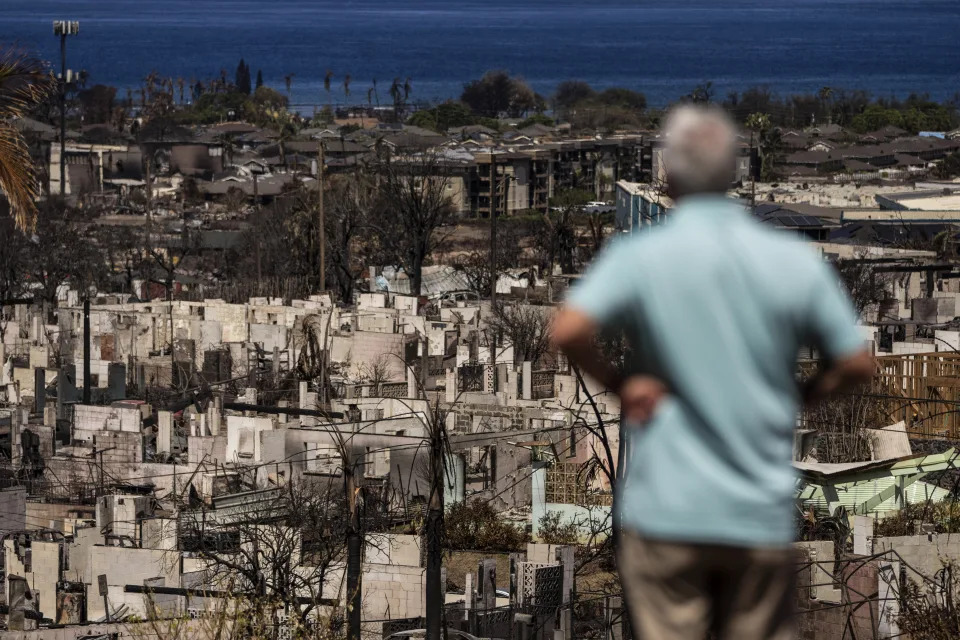
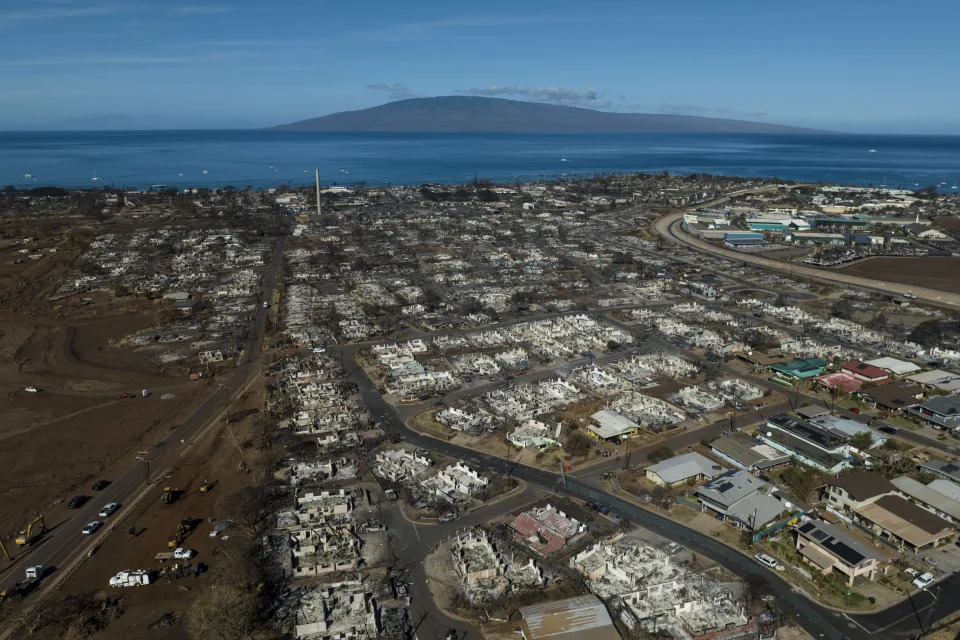
A general view shows the aftermath of a wildfire in Lahaina, Hawaii, Thursday, Aug. 17, 2023. A University of Hawaii study examining the health effects of last year's deadly wildfires on Maui found that up to 74% of participants may have difficulty breathing and otherwise have poor respiratory health, and almost half showed signs of compromised lung function. (AP Photo/Jae C. Hong, File)


HONOLULU (AP) — A University of Hawaii study examining the health effects of last year's deadly wildfires on Maui found that up to 74% of participants may have difficulty breathing and otherwise have poor respiratory health, and almost half showed signs of compromised lung function.

The data, gathered from 679 people in January and February, comes from what researchers hope will be a long-term study of wildfire survivors lasting at least a decade. Researchers released early results from that research on Wednesday. They eventually hope to enroll 2,000 people in their study to generate what they call a snapshot of the estimated 10,000 people affected by the fires.

Dr. Alika Maunakea, one of the researchers and a professor at the university's John A. Burns School of Medicine, said those who reported higher exposure to the wildfire tended to have more symptoms.


Many study participants hadn't seen a doctor, he said. Some study participants said they weren’t able to because clinics had burned down or because they prioritized getting housing, jobs and food after the disaster. Maunakea urged people exposed to the wildfires to get checked.

“There might be some problems that might manifest in the future," he said. "Please see your doctor. Just pay more attention to your health because of this.”

Two-thirds of study participants lived in Lahaina at the time of the fires. About half of the participants reported daily or weekly exposure to smoke, ash or debris.

The Aug. 8 blaze killed at least 101 people, making it the deadliest wildfire in the U.S. in more than a century. It burned thousands of buildings, displaced 12,000 residents and destroyed the historic town on Maui.

The report shows Maui doesn't have enough pulmonary health specialists to care for those who will need this expertise, said Ruben Juarez, a professor of health economics at the university and one of the study's leaders. Researchers are talking with Hawaii's congressional delegation to figure out how to bring these resources to Maui, he said.

Maunakea said researchers want to avoid the higher cancer and death rates experienced 20 years later by people affected by the Sept. 11, 2001, attacks.

“We'll hopefully be able to prevent this tragedy from compounding to higher mortality rates in the future, like we saw with other events like 9/11,” Maunakea said.

Dr. Gopal Allada, an associate professor of medicine specializing in pulmonary and critical care at the Oregon Science & Health University who wasn't involved in the research, said it would have been great if the study participants had undergone similar lung function tests before the fire. But he acknowledged that wasn't possible, as is often the case in similar studies.

He hopes the researchers will get funding to continue their research over time.

Allada noted most scientific studies on the health effects of wildfires have focused on what happens to people in the days and the week of exposure and less is known about the long-term effects.

He commended the researchers for showing there's a problem and for collecting data that can influence policymakers.

“This is important work that hopefully influences policymakers and people who control budgets and where trainees train and that sort of thing,” he said.

Maui fires left victims food insecure and with health issues, survey finds

Li Cohen
Thu, May 16, 2024 

It's been nine months since deadly wildfires scorched across the Hawaiian island of Maui, killing dozens of people and leaving the historic town of Lahaina in ashes. And according to a new study, people are still feeling the effects of those fires — with many food insecure and at risk for serious health issues.

The public health report, conducted by researchers at the University of Hawai'i Economic Research Organization and the John A. Burns School of Medicine, looks at the lingering impacts of the August 2023 fires that killed 101 people. Researchers will monitor and analyze these impacts for at least a decade, but already found significant issues in its first sampling of fire victims, which was conducted in February.

Researchers surveyed 679 people, two-thirds of whom lived in Lahaina during the fires. Nearly half of those surveyed reported seeing a decline in their health compared with a year ago, which researchers said "could deteriorate further if difficulties in accessing care and lack of health insurance are not addressed." Among those issues are complications with residents' cardiovascular health.

"Exposure to smoke, ash, and debris is strongly associated with worse physical health outcomes and reported symptoms," the report says. "Approximately 74% of participants face a heightened risk of cardiovascular diseases due to elevated or prehypertension levels. Kidney function may be compromised in 8-20% of participants, and up to 60% may suffer poor respiratory health."

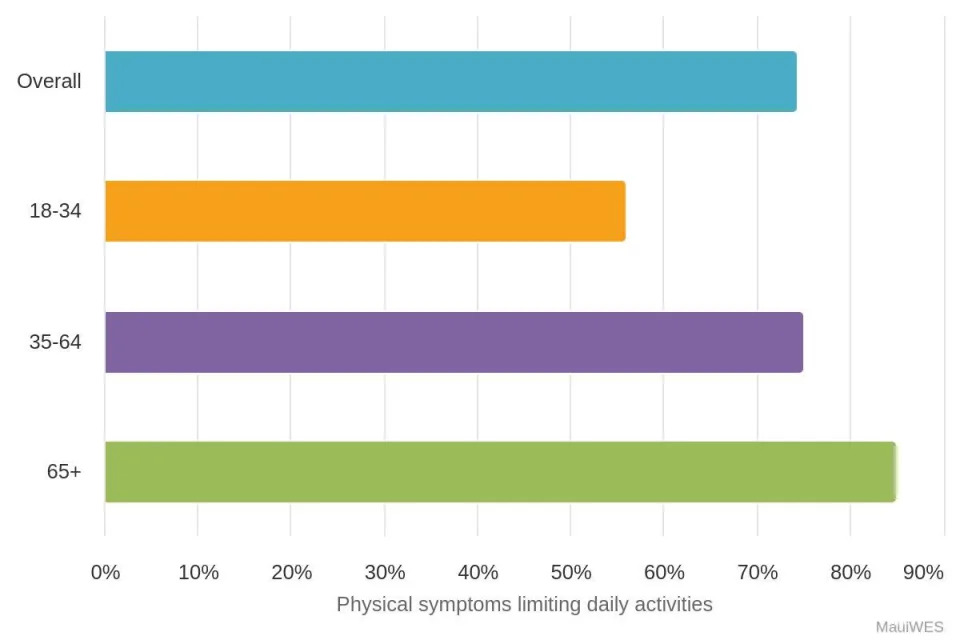
More older adults seem to be affected physically, with 85% of those ages 65 and older reporting physical symptoms have limited their daily activities, including moderate and vigorous exercise, carrying groceries, climbing one flight of stairs, bending, walking or bathing.

MauiWES results from February 2024 show that older adults are seeing physical symptoms since the Maui wildfires in 2023 that are taking a toll on their ability to conduct daily activities. / Credit: MauiWES

Researchers also found a "notable increase in depression," among other mental health issues. Roughly 30% of participants reported feeling moderate or severe anxiety and a slightly larger percentage reported feelings of low self-esteem. Less than 4.5% said they suffered suicidal thoughts following the fires. These numbers were "significantly higher than state and local averages," researchers said, noting that the mental health impact seemed to extend beyond those who were physically exposed to smoke, ash and debris.

Having enough to eat is also a major concern, with nearly half of households in February's survey experiencing food insecurity, a rate researchers said is higher than those previously observed both locally and across the state. This impact is at least somewhat tied to employment issues also experienced since the fires. Nearly half of surveyed victims lost their jobs because of the fires, 20% of whom are still unemployed. Three-quarters of those surveyed make less money than they did before the fires.

"By studying impacts now, we're in a position to prevent short- and long-term conditions such as lung disease and cancer, which our population is already more susceptible to," researcher Alika Maunakea said.

Maunakea said many of those who reported being more exposed to the fires seem to have more symptoms, and that many of those who participated in the study haven't seen a doctor. Many say they haven't received care because their clinics were destroyed in the fires or because other essentials – like food and housing – took priority.

"There might be some problems that might manifest in the future," he said, according to the Associated Press. "Please see your doctor. Just pay more attention to your health because of this.'

As the study continues, researchers say they hope to enroll 2,000 people to participate.

Nikima Glatt, who lived in Lahaina when the fires swept through, told CBS affiliate Hawaii News Now that she worked in the burn zone during the re-entry period.

"I was a runner. I was a skater. I used to exercise a lot," she said. "And now it's difficult for me to do normal things that I used to."
North Carolina could ban face masks for medical reasons in public

Lauren Irwin
Wed, May 15, 2024 


The North Carolina state Senate voted along party lines Wednesday to ban anyone from wearing masks in public, even for health reasons.

Republican supporters of the ban said it would help law enforcement crack down on protesters who wear masks. They say demonstrators are abusing COVID-19 pandemic-era practices to hide their identities following a wave of pro-Palestine protests nationwide and at North Carolina universities.

The bill goes even further and repeals an exception that’s been state law since the early stages of the pandemic that allows people to wear masks in public for health and safety reasons.

Thirty senators voted in favor of House Bill 237, while 15 opposed it and five were absent.

Democrats raised concerns about the bill, particularly for those who are immunocompromised or those who may want to continue to wear masks during cancer treatments, WRAL News reported.

State Sen. Sydney Batch (D) is a cancer survivor and shared with her fellow senators how her family wore masks to protect her and her weakened immune system during treatment.

She and other Democrats proposed ways to amend the bill so police could still crack down on protesters but continue to have legal protections for health concerns, but they were shot down, the outlet reported.

GOP Sen. Buck Newton brushed off the concerns, saying no one saw “Granny getting arrested in the Walmart pre-COVID” and thinks law enforcement will use “good common sense” when applying the law, The Associated Press (AP) reported.

The AP noted that the state’s general statutes on masking date back to the 1950s in an attempt to curb Ku Klux Klan membership, when the state passed a public masking ban.

Under the bill, if a person is arrested for protesting while masked, it would elevate the classification of a person’s crime, either a misdemeanor or felony, to one class higher.

It now heads to Gov. Roy Cooper’s desk. Cooper, a Democrat, could veto the bill, but the North Carolina Republican Party has a supermajority and can override the expected veto.


Opinion

The party of ‘freedom’ wants to ban mask-wearing for health reasons in NC | Opinion


the Editorial Board
Wed, May 15, 2024 


The party of freedom doesn’t want to let you wear a mask to protect your own health in public.

Republican legislators have proposed a bill that would remove the health and safety exception to North Carolina’s existing ban on mask-wearing in public, which has been in place since the 1950s. That exception was added in 2020, during the COVID-19 pandemic, but lawmakers say that it is no longer needed. Try telling that to immunocompromised people, or the elderly, or anyone else who might want to mask up to protect themselves or others.

GOP Sen. Buck Newton, the bill’s primary sponsor, suggested that those who choose to wear a mask in public for health reasons could still do so despite the law changing, because authorities have “good common sense.”

“This was not a problem pre-COVID,” Newton said in a committee hearing. “We didn’t see Granny getting arrested in the Walmart pre-COVID. Frankly, I don’t think we’re going to see that when we pass this legislation, and I think those that are suggesting otherwise are stoking fear.”

The intent of the bill, Newton said, is merely to crack down on those who may wear a mask to hide their identities while committing crimes in public, and it is not intended to punish anyone who wears a mask for the sake of their health.

That argument in itself is the sign of poorly crafted legislation. If lawmakers do not intend to make something illegal, they should not write a law that makes that thing illegal and then expect authorities, businesses and the public to obey some unwritten rule that the law should not be enforced as such. That creates ambiguity and confusion, and leaving it up to authorities to use their “common sense” to determine which mask wearers are potentially criminals and which are simply being conscious of their health opens the door to a whole host of other problems.

The bill is titled “Unmasking Mobs and Criminals,” and it’s likely not a coincidence that it comes after a wave of pro-Palestinian protests on college campuses in North Carolina and across the country. Many of those protesters were wearing masks. The bill enhances penalties for those who are wearing a mask while committing a crime. In effect, that could mean that a protester arrested for vandalism or trespassing could receive a harsher punishment simply because they were wearing a mask while protesting.

This is, plain and simple, a ridiculous bill. It should make everyone uncomfortable, regardless of whether or not you personally wish to wear a mask in public. It may be true that this was not a problem before COVID, and nobody was arresting “Granny” or chemo patients for masking up in public. But the exception lawmakers crafted during COVID also hasn’t been a problem, certainly not enough to justify taking away people’s freedom of choice. Or is “freedom” only what Republican lawmakers want it to be?


North Carolina bill to stop protesters from using masks to hide identities advances without health exemption

Danielle Wallace
Thu, May 16, 2024 

North Carolina bill to stop protesters from using masks to hide identities advances without health exemption

Republican lawmakers in North Carolina are pushing forward with their plan to repeal a pandemic-era law that allowed the wearing of masks in public for health reasons, a move spurred by anti-Israel demonstrations that have included masked protesters camped out on college campuses.

The legislation – House Bill 237 – cleared the state's Senate on Wednesday in a 30-15 vote along party lines despite several attempts by state Senate Democrats to change the bill. The bill, which would raise penalties for someone who wears a mask while committing a crime, including arrested protesters, could still be altered as it heads back to the House.

Opponents of the bill say it risks the health of those masking for safety reasons. Those backing the legislation say it is a needed response to the protests, including those at the University of North Carolina at Chapel Hill that escalated to police clashes and arrests. The bill also further criminalizes the blockage of roads or emergency vehicles for a protest, which has occurred during anti-Israel demonstrations in Raleigh and Durham.

"It's about time that the craziness is put, at least slowed down, if not put to a stop," Wilson County Republican Sen. Buck Newton, who presented the bill, said on the Senate floor Wednesday.


An Anti-Israel protester seen wearing a mask and carrying a Palestinian flag on the University of North Carolina in Charlotte campus on April 24, 2024

"There seems to be a fundamental misunderstanding of what this bill does and how the law operates, and it’s no wonder that so many folks are scared," Newton added, according to NC Newsline, questioning the motivations of those against the legislation. "I think some of us are wondering what the real motivations are of folks on the other side of the House, scaring the bejesus out of everybody and making them feel like if they have a need at times to wear masks because they’re immunocompromised somehow, they’re going to get arrested.

Most of the pushback against the bill has centered around its removal of health and safety exemptions for wearing a mask in public.

The health exemption was added at the start of the COVID-19 pandemic along largely bipartisan lines. This strikethrough would return public masking rules to their pre-pandemic form, which were created in 1953 to address a different issue: limiting Ku Klux Klan activity in North Carolina, the Associated Press reported, citing a 2012 book by Washington University in St. Louis sociology professor David Cunningham.

Democratic lawmakers repeated their unease about how removing protections for people who choose to mask for their health could put immunocompromised North Carolinians at risk of breaking the law. Legislative staff said during a Tuesday committee that masking for health purposes would violate the law.

"You're making careful people into criminals with this bill," Democratic Sen. Natasha Marcus of Mecklenburg County said on the Senate floor. "It's a bad law."

"Is it really that you find masked chemo patients that threatening? Something about them makes you really angry?" Marcus added, according to WRAL. "Or is this, more likely, a desire to score some political points with the anti-mask crowd during an election year, at the expense of vulnerable people?"

Anti-Israel protesters on the UNC Charlotte campus on April 25, 2024.

Simone Hetherington, an immunocompromised person who spoke during Wednesday's Senate Rules Committee, said masking helps her protect herself from illnesses and fears the law would prevent that practice.

"We live in different times and I do receive harassment," Hetherington said about her mask wearing. "It only takes one bad actor."

But Republican legislators continued to express doubt that someone would get in legal trouble for masking because of health concerns, saying law enforcement and prosecutors would use discretion on whether to charge someone. Newton said the bill focuses on criminalizing masks only for the purpose of concealing one's identity.

"I smell politics on the other side of the aisle when they're scaring people to death about a bill that is only going to criminalize people who are trying to hide their identity so they can do something wrong," Newton said.

Three Senate Democrats proposed amendments to keep the health exemption and exclude hate groups from masking, but Senate Republicans used a procedural mechanism to block them without going up for a vote.

Future changes to the bill could be a possibility, but it would ultimately be up to the House, Newton told reporters after the vote, according to the AP. Robeson County Republican Sen. Danny Britt also said during an earlier committee that he anticipated "some tweaking." House Rules Committee Chairman Destin Hall, a Caldwell County House Republican, told reporters before the Senate vote that the House planned to "take a look at it" but members wanted to clamp down on people who wear masks while committing crimes.

The masking bill will likely move through a few committees before hitting the House floor, which could take one or two weeks, Hall said.

The Associated Press contributed to this report.

Repeal of health exemption from NC’s mask ban passes Senate, sending bill to House

Avi Bajpai
Wed, May 15, 2024


The North Carolina Senate voted to repeal a health and safety exception to the state’s longstanding ban on wearing masks in public, and enhance penalties for wearing a mask while committing another crime.

Senators approved the bill, which was introduced as a substitute to existing legislation last week and cleared two committees this week, in a 30-15 vote along party lines Wednesday afternoon.

A key point of contention over the bill has been the provision that removes an exception for health and safety from the law banning mask-wearing in public that dates back to 1953. Republicans have said the pandemic-era exception is no longer necessary, but Democrats have pushed back, arguing that lawmakers should just increase penalties for people who use masks to commit crimes, and leave the health exception alone.

There’s also been strong pushback from critics who say the bill is clearly an “anti-protest” measure that is a response to recent pro-Palestinian protests on college campuses, where masks have been common.

In addition to repealing the health and safety exception, and increasing criminal penalties for those who are found to have worn a mask to hide their identity while committing another crime, the bill also imposes new penalties for participating in demonstrations that are intended to block traffic.

Speaking against the bill on the Senate floor Wednesday afternoon, Democratic Sen. Sydney Batch said that the bill, as it is currently written, would leave immunocompromised people at risk.

Amendments offered by Batch and two other Democrats, Sen. Lisa Grafstein and Jay Chaudhuri, were rejected by the GOP-controlled chamber.

Democratic Sen. Natasha Marcus, who said she, like other lawmakers, had heard from many people concerned about whether they would be able to continue wearing masks to protect themselves, said that Democrats are in favor of cracking down on people who conceal their identities to commit crimes, but also want to “protect the health of the people of North Carolina.”

During a meeting of the Senate Rules Committee on Wednesday morning, GOP senators said that discussions were ongoing about potential changes to the bill once it arrived in the House. The changes would address the concerns raised by Democrats and others that taking out the health exception would make masking for that reason illegal.

Republicans pointed to the fact that for nearly 70 years, masking in public was illegal, but there were no incidents that came to mind of a person ever being arrested or prosecuted for wearing a mask for health reasons. Several people who wear masks because they are immunocompromised or have other medical problems that require them to wear one when in public, addressed committees this week with concerns about what the bill would mean for them.

House Speaker Tim Moore told reporters earlier in the day that he hadn’t read the bill yet, but echoed the argument that GOP senators had made: that the bill isn’t meant to target or penalize people who wear masks to protect their own health or the health of others, but rather, people who are “trying to willfully conceal their identity to engage in some sort of conduct that’s a problem.”

“If someone is going to come out and they’re going to protest, and they’re going to be in a public space out there, they ought to not be able to hide their identity, and I don’t care what cause it is they’re advocating for,” Moore said.

Asked about Proud Boys who have protested in public wearing different kinds of face coverings — an example that was raised earlier in the day during the Senate Rules Committee — Moore said: “I don’t care who it is, anybody who’s going to be out protesting should not be able to conceal their identity, period. I mean that just should not happen, whether it’s right, left, sane, insane — I don’t care.”

NC Senate approves bill making it a crime to wear a mask in public

Ahmed Jallow
Wed, May 15, 2024 

An airline passenger waiting for his flight looks at his phone while wearing a protective face mask. Legislation making its way through the North Carolina legislature would make mask wearing in public illegal. (Photo by Carol Coelho/Getty Images)

The North Carolina Senate approved an amended version of House Bill 237 on Wednesday evening that would prohibit the wearing of masks in public.

The controversial bill, which would also increase criminal penalties for those who commit crimes while wearing a mask in public, comes in the wake of protests that have erupted on college campuses across the country in response to the Israel-Hamas conflict.

If it becomes law, the bill will also create a new offense for blocking traffic, a tactic used in some recent protests. The votes were cast 30 to 15 along party lines and it now heads back to the house for concurrence.

Sen. Buck Newton (R-Greene, Wayne and Wilson), who sponsored the Senate “committee substitute” for the bill, said it aims to reinstate a law that existed before the COVID-19 pandemic.

The Senate rejected three amendments to the bill proposed by Wake County Democratic Senators Sydney Batch, Lisa Grafstein and Jay Chaudhuri.

Amendments offered by Batch and Grafstein would have reinstated a health reason exemption and allowed mask-wearing unless the wearer was using the mask for criminal purposes.

Batch said as someone who was immunocompromised during medical treatment, she opposes any provision that makes mask-wearing more difficult for people with health concerns. “We are now trying to turn back time and ignore science and allow individuals who want to protect themselves or to protect their loved ones from wearing a mask,” said Batch.

“We talk a lot about freedoms in this chamber, I hear it all the time. I should have the freedom, my children should have the freedom and my husband should have the freedom to wear a mask in order to protect and save my life without fear of being arrested and charged with a class one misdemeanor, which is exactly what this bill would do.”

“There seems to be a fundamental misunderstanding of what this bill does, and how the law operates and it’s no wonder that so many folks are scared,” said Newton, questioning the motivations of those opposed to the bill.

“I think some of us are wondering what the real motivations are of folks on the other side of the house, scaring the bejesus out of everybody and making them feel like if they have a need at times to wear masks because they’re immunocompromised somehow, they’re going to get arrested.”

Laws dating back to the 1950s that were enacted, at least in part, as responses to groups like the Ku Klux Klan, prohibit wearing a mask in public in North Carolina, with exceptions. Those exceptions were expanded during the COVID-19 pandemic to include people wearing masks for health reasons. Newton’s bill would remove that specific exception.

Newton said a Senate committee investigation found no documented arrests or prosecutions for wearing masks solely for health reasons under the previous law.

Senate Democratic leader Dan Blue of Wake County expressed concern that law enforcement could use the law as a pretext to pull over drivers. “If you got the mask on and it’s against the law to be wearing a mask, you’ve created probable cause for any police officer to stop you,” Blue said.

Advocates and organizations including Disability Rights NC, Emancipate NC, and the ACLU of North Carolina spoke out against the bill at a Tuesday committee hearing, criticizing both the mask ban and provisions that target protesters.

“This bill is part of a broader attack on democracy we are seeing at the state legislature, while lawmakers who support these attacks on the right to protest are also leading efforts to make it harder to vote and to participate in the legislative process,” said Elizabeth Barber, the policy director of the ACLU of North Carolina.

In a statement released Tuesday, the North Carolina NAACP decried the measure as “a dangerous bill that threatens the fundamental right to protest in North Carolina.”

“This legislation seeks to impose severe penalties on protesters, particularly targeting those who block traffic or wear masks,” the statement read. “By criminalizing these protest tactics, the bill aims to silence marginalized communities and stifle legitimate expressions of dissent.”

The bill now returns to the House for concurrence in Senate changes.

NC Senate passes bill restoring mask restrictions

Michael Hyland
Thu, May 16, 2024 a

NC Senate passes bill restoring mask restrictions

RALEIGH, N.C. (WNCN) – The state Senate on Wednesday passed a bill that would bring back pre-COVID restrictions on wearing masks.

The bill, titled “Unmasking Mobs and Criminals,” passed along party lines by a margin of 30-15 and comes amid recent protests on college campuses. Republicans say the aim is to stop people from wearing masks to conceal their identities while committing crimes.

However, the bill goes further than that and would repeal an exception that’s been in state law since the early days of the COVID-19 pandemic that allows people to wear masks for health and safety reasons. Doing so would become illegal again.

“If I were not permitted to wear a mask in public, it would greatly limit which spaces I could visit. And, for me, this is an access issue,” Quisha Mallette, of the North Carolina Justice Center, told lawmakers as she urged them to oppose the measure.

During debate on the Senate floor, Democrats raised concerns about the impact on people who are immunocompromised who may want to continue to wear masks.

Sen. Buck Newton (R-Wilson) accused Democrats of trying “to scare the bejesus out of everybody.”

Referencing the recent protests, he said, “There’s a whole crowd of people running around out there taking advantage of this mask hangover from the pandemic.”

Republicans voted down three amendments Democrats offered, including one by Sen. Sydney Batch to allow an exception to wear masks for preventing the spread of contagious diseases.

“You’re plowing down this field without really knowing what all the implications are,” said Sen. Dan Blue (D-Wake).

The bill contains other provisions including increasing penalties for people who wear masks while committing other crimes and could lead to people who block streets or highways more than once being charged with a felony. It also makes protest organizers liable if people block streets and prevent emergency vehicles from getting to someone in need, resulting in injury or death.

The bill goes to the House next.

Copyright 2024 Nexstar Media, Inc. All rights reserved. This material may not be published, broadcast, rewritten, or redistributed.
5 Israeli soldiers killed by friendly fire in northern Gaza

MAJORITY OF BATTLEFIELD DEATHS 

TANKS ROLL OVER INFANTRY


Mithil Aggarwal
Updated Thu, May 16, 2024 


The Israeli military said Thursday that five soldiers were killed and seven others were injured in a friendly fire incident in northern Gaza amid renewed battles in the area against regrouped Hamas militants.

The Israel Defense Forces said it had opened an investigation into the deadly incident, which it said happened when the soldiers were hit by tank crossfire in Jabalia.

While battles raged in the north, Israel's defense minister said more troops would join the ground operation in Rafah, where an intensifying assault has sent hundreds of thousands of Palestinians fleeing the southern Gaza city where they had sought refuge.


"An initial investigation into the deaths of five IDF soldiers reveals that IDF tanks, located dozens of meters away, identified a weapon and fired shells at an IDF force nearby," the IDF said in a statement.

"This force had entered the northern part of Gaza and occupied buildings along a logistic route. The tanks fired two shells for unclear reasons, resulting in seven more soldiers being injured, three severely."

The statement added that the IDF "is probing why the shells were fired and if the soldiers were mistaken for armed militants." The troops were members of the 202nd Battalion of the Paratroopers Brigade.

Seven months into its war aimed at eliminating Hamas, Israeli forces are again engaged in intense fighting in areas of northern Gaza that the IDF said earlier had been cleared, renewing doubts over the government's strategy in the war.

Prime Minister Benjamin Netanyahu has come under growing pressure from the U.S. to lay out a plan for postwar Gaza, and on Wednesday he faced rare public criticism over the issue from within his own War Cabinet.

In a nationally televised statement, Defense Minister Yoav Gallant challenged Netanyahu over what he said was his refusal to discuss the issue. He said that would lead to Israel’s being forced to rule over the Palestinian enclave again, which he said he opposed. "We must make tough decisions for the future of our country, favoring national priorities above all other possible considerations, even with the possibility of personal or political costs," Gallant said.

Still, Netanyahu insists the focus must be on invading Rafah, where his troops have intensified operations since Israel called on residents of the city's east to evacuate last week.

After he conducted an assessment Wednesday on the Gaza border near Rafah, Gallant said that “additional troops will join the ground operation in Rafah."

“This operation will continue as additional forces will enter" the area, he said, according to a transcript his office provided a day later. "Several tunnels in the area have been destroyed by our troops and additional tunnels will be destroyed soon. This activity will intensify.”

At least 600,000 people fled parts of Gaza's southernmost city, where more than 1 million Palestinians sought shelter, according to the United Nations, with 100,000 more people displaced in northern Gaza.

The U.N.’s top court opens two days of hearings Thursday into South Africa's call to halt Israeli operations in Rafah.

The slow increase in the flow of aid into the strip over recent months could also be wiped out by Israel's assault on Rafah, U.S. Secretary of State Antony Blinken said Wednesday, with one critical aid crossing shut and another restricted.

U.S. Central Command said early Thursday it had successfully anchored a temporary humanitarian pier to a beach in Gaza to increase the flow of aid.

“Trucks carrying humanitarian assistance are expected to begin moving ashore in the coming days,” it said in a post on X.

This article was originally published on NBCNews.com


5 Israeli soldiers killed in Gaza by their own army's tank fire

Haley Ott
Updated Thu, May 16, 2024

5 Israeli soldiers killed in Gaza by their own army's tank fir


The Israel Defense Forces said five of its soldiers, all between 20 and 22 years old, were killed by Israeli tank fire in northern Gaza on Wednesday evening. An initial internal investigation found that two tanks fired at a building in the Jabalia refugee camp where the soldiers had gathered. The building was being used by the deputy commander of the battalion, according to an IDF statement.

"It appears that the tank fighters, from the ultra-Orthodox paratrooper company 'Hatz,' identified a barrel of a weapon coming out of one of the windows in the building, and directed each other to shoot at the building," the IDF statement said.

"This is a very difficult incident, the work environment is under very complex operational stress and in a very crowded area," IDF spokesperson Daniel Hagari said on Thursday. "We are in the middle of the investigation, we will learn the lessons. Maintaining the security of our forces is a central task."

The incident came as Israeli Defense Minister Yoav Gallant, after a situational assessment at the Gaza border in Rafah, said more Israeli troops would be entering Gaza.

"Several tunnels in the area have been destroyed by our troops and additional tunnels will be destroyed soon," Gallant said Wednesday. "This activity will intensify – Hamas is not an organization that can reorganize, it does not have reserve troops, it has no supply stocks and no ability to treat the terrorists that we target. The result is that we are wearing Hamas down."

Israeli defense chief calls for "day after" plan in Gaza

As IDF operations continued, Gallant publicly challenged Israeli Prime Minister Benjamin Netanyahu this week about his post-war plans for the Gaza Strip.

In addition to military action, Gallant said in a televised statement that "the establishment of a governing alternative in Gaza" in the wake of almost 20 years of Hamas rule was also crucial to Israel's stated objective of dismantling the group. "In the absence of such an alternative, only two negative options remain: Hamas' rule in Gaza or Israeli military rule in Gaza."

Gallant said he would oppose the latter scenario and urged Netanyahu to formally rule it out.

Israel plans to "destroy Hamas." If that happens, who will lead the Palestinians in Gaza?

He said he had been trying to promote a plan to create a "non-hostile Palestinian governing alternative" to Hamas since October, but that he'd received no response from the Israeli cabinet.

Gallant has previously suggested the Palestinian Authority (PA), which administers the Israeli-occupied West Bank, could have a role in governing Gaza after the war. Netanyahu has dismissed that suggestion, also floated by the United States, as have various members of the PA.

On Tuesday, IDF spokesperson Daniel Hagari was asked if the lack of a post-war strategy for Gaza was hindering military operations there.

"There is no doubt that an alternative to Hamas would generate pressure on Hamas, but that's a question for the government echelon," he said.