Friday, May 17, 2024

Thames Water’s biggest investor cuts value of its stake to zero

Jillian Ambrose
Fri, 17 May 2024

Thames Water supplies about a quarter of the UK’s population.
Photograph: Dan Kitwood/Getty Images

Thames Water’s biggest investor has slashed the value of its stake in the company to zero in the latest sign of an escalating financial crisis for Britain’s biggest water supplier.

The Canadian pension fund Omers issued a “full writedown” of its 31.7% stake in Thames’s troubled parent company in its annual report published on Friday, signalling that it believes its share is worth nothing.


The latest blow to the water supplier, which serves about a quarter of the UK’s population, marks a precipitous decline for a company that Omers valued at £700m at the end of 2022 and £990m at the end of 2021.

Related: The Guardian view on Britain’s dirty waterways: a failure of industry and regulation | Editorial

Omers signalled that Thames is now worthless a day after Michael McNicholas, a managing director at Omers Infrastructure, quit his role as non-executive director of Thames Water.

The decision to raze the value of Thames has emerged weeks after Omers, and the company’s other shareholders, refused to give the company £500m of emergency funding after branding its business plan “uninvestable”.

Alongside Omers, Thames shareholders include the British university staff pension scheme USS and the BT Pension Scheme manager Hermes. None have taken a dividend from Thames since they bought into the business in 2017.

The water company is now racing to avoid a multibillion-pound taxpayer-backed bailout after its parent company, Kemble, defaulted on its debt, raising fears that the company could face a significant restructure or even collapse.

Thames could be placed into special administration, which would result in the government stepping in and temporarily renationalising the company. This outcome would probably fuel critics of the Conservative government who argue the water company’s plight represents the failure of Margaret Thatcher’s privatisation agenda.

The Guardian revealed last month that under radical plans being drawn up in Whitehall, codenamed Project Timber, ministers would turn Britain’s biggest water company into a publicly owned arm’s-length body.

The plans, overseen by Defra and the Treasury, a new public corporation would be formed to hold the water monopoly, modelled on the company that built the £18.8bn Crossrail project, while Thames’s vast liabilities would be assumed into the government’s debt pile.

The water regulator, Ofwat, is reportedly working on rescue plans for Thames that could lead to the water company’s regional monopoly being dismantled and sold off to neighbouring rival suppliers under a scheme codenamed Project Telford.

Ofwat has tasked the former private equity banker Adrian Williams with overseeing the rescue bid, according to the Telegraph, in a last-ditch attempt to save the company from collapsing under the weight of a more than £15bn debt pile.

Under the plan, Thames could be split into two smaller suppliers: one covering London and the other supplying water services to Thames Valley and Home Countries regions. The company may end up being split up into as many as “a dozen” smaller companies, according to the report.

An Ofwat spokesperson said: “Safeguards are in place to ensure that services to customers are protected, regardless of issues faced by the shareholders.”

The strain on Thames’s finances was laid bare last month in a revised plan submitted by the water company to Ofwat, which revealed that the annual interest bill on its borrowings is expected to rise to about £3bn by 2030.

Thames was privatised in 1989 with no debt. In the decades since the water supplier has taken on more debt to help fund its infrastructure projects while paying large dividends to investors, most notably the Australian investment bank Macquarie.

The government was approached for comment.

 Post-Brexit rules on antibiotic use on farms water down EU laws, experts say

Fiona Harvey
 Environment editor
THE GUARDIAN
Thu, May 16, 2024 

One concern is that it will still be possible to give antibiotics prophylactically to large groups of animals.Photograph: David Tadevosian/Alamy


New rules intended to reduce the use of antibiotics in farming in the UK have been criticised as too lax and weaker than their equivalent under EU laws.

The updated regulations come into force on Friday. They ban the routine use of antibiotics on farm animals, and specifically their use to “compensate for poor hygiene, inadequate animal husbandry, or poor farm management practices”.

Experts, however, say there are loopholes in the legislation that are closed off under EU laws in place since 2022, and by which the UK would be bound if it were still a member state.

Ministers repeatedly promised, before and after Brexit, that farming and food standards in the UK would not be watered down after leaving the EU. The Guardian, however, has revealed numerous examples of environmental rules that have been weakened, from regulations on air pollution and water quality to pesticide use and agricultural emissions.

This latest divergence is of particular concern because the overuse of antibiotics in farming has dire consequences for human health. The UK’s former chief medical officer Sally Davies said in an interview with the Guardian earlier this week that antibiotic overuse was leading to the rise of near-invincible superbugs that pose a severe threat to human health, making previously minor ailments deadly and threatening to make routine operations unsafe.

About two-thirds of antibiotics globally are used on farm animals, and they are often used indiscriminately either to promote growth or to try to prevent infections that arise from overcrowding, poor management and insanitary conditions on factory farms.

The EU has taken strong steps to clamp down on overuse on its farms. Prof Roberto La Ragione, the head of the school of biosciences at the University of Surrey and a fellow of the Royal College of Pathologists, said preventing overuse was of vital importance.

“Antibiotics are critical to human and animal medicine, but the emergence of resistance is a global concern,” he said. “Therefore we must reduce their use to help stop the emergence and spread of resistance.

“We know that animal health and welfare are inextricably linked with our own, so it is vital that antibiotic resistance is tackled in humans and animals, and we can all play a part, from the scientific community to pet owners, vets, doctors, pharmacists, companies, farmers and the government.”

Under the new rules, it will still be possible to feed antibiotics prophylactically to large groups of animals, a practice campaigners say is effectively the same as, and just as dangerous as, routine use. The guidelines say this prophylaxis should only be “in exceptional circumstances”, but questions in parliament by the shadow minister Daniel Zeichner elicited a response from the farming minister Mark Spencer that this would include “where there would be a risk of infection or severe consequences if antibiotics were not applied”.

Coílín Nunan, a scientist adviser at the Alliance to Save Our Antibiotics, said this meant widespread prophylactic use on large groups of animals would still occur frequently, because when animals are kept in highly intensive conditions there is often significant risk of infection.

EU rules ban antibiotics for group prophylaxis, which is limited to an individual animal only.

Nunan said: “Unfortunately the government has deliberately weakened the legislation in comparison to the EU, and this will allow some poorly run farms to keep on feeding large groups of animals antibiotics, even when no disease is present.

“We are also concerned the ban on using antibiotics to compensate for inadequate animal husbandry and poor farm management practices may not be properly implemented.”

The Alliance to Save Our Antibiotics wants the government to ban group prophylaxis, introduce mandatory data collection from farms on their use of antibiotics, set tougher targets for the reduction of farm antibiotic use and improve animal welfare and husbandry standards.

UK farming and veterinary oversight continue to be in turmoil after Brexit. There is a shortage of vets, and higher workloads as a result of the changes to animal certification and increased bureaucracy related to animal exports and imports.

A spokesperson for the Veterinary Medicines Directorate said: “We do not support the routine use of antibiotics, including where antibiotics are used to compensate for inadequate farming practices. However, a blanket ban of prophylaxis could be harmful to animal health and welfare, while also increasing the risk of diseases spreading.”
Governments must back plant farming — there's no two ways about it

Dr Carys Bennett
Fri, May 17, 2024 


As sea levels and temperatures rise, weather events worsen, and an increasing number of species face extinction, it’s more important than ever that we do more than pay lip service to reducing our environmental footprint — and that we do it without meat in our mouths.

We could have once been forgiven for not realising that animal agriculture — which encompasses not only meat but also egg and dairy production and co-products like leather and wool — is a leading driver of climate destruction, second only to fossil fuels.

But now it seems that every second scientific study warns us of the huge environmental toll that comes with commodifying animals.

Just recently, a first-of-its-kind report by researchers at Harvard, New York, Leiden, and Oregon State universities that surveyed 210 climate specialists from 48 countries revealed that experts agree: to meet climate goals, we must rapidly reduce livestock emissions and globally shift to a plant-based diet.

Yet despite the writing on the wall, world leaders continue to prop up the meat industry.
You're not just harming animals, you're harming farmers

Prior to Brexit, UK farmers were dependent on massive EU subsidies, and the government has been quick to reassure them that this level of support will continue.

But such crutches don’t just harm animals and the planet; they also hobble farmers by perpetuating reliance on a food system that contributes to the destruction of a dying planet — which cannot sustain such a system — preventing them from future-proofing their livelihoods.


This isn’t about being anti-farm but anti-harm. The world needs farmers. But we don’t need to farm animals.


Britain's Prime Minister Rishi Sunak during the annual National Farmers' Union (NFU) conference, at the ICC in Birmingham, February 2024 - Adrian Dennis/ Pool Photo via AP

A 2022 survey revealed that 80% of Scottish farmers were receptive to moving beyond farming animals, but they needed financial support to do so.

More than 1 billion animals are slaughtered for food annually in the UK. Even if we choose to turn a blind eye to the suffering those individuals endure on filthy factory farms and at blood-soaked slaughterhouses, there’s no denying that farming animals are wasteful.

To protect caged animals, we are suing the European Commission


How we treat animals is — and will be — key to our own survival

The National Food Strategy shows that 85% of agricultural land in the UK is used to grow crops to feed farmed animals — not humans.

Considering that it takes around 25 calories of grain to produce one calorie of beef, it’s clear that animal agriculture is inherently inefficient.
Change starts on our plates

Research shows that a global shift to a plant-based diet would reduce land use for agriculture by 75%, allowing for a more efficient farm-to-human pipeline as well as a decrease in deforestation.

It would also encourage rewilding and stem biodiversity loss. One analysis found that even just lowering meat consumption in the UK would offer a climate benefit equivalent to taking 8 million cars off the roads, while another study revealed that ending animal farming entirely could sequester the equivalent of up to 10 years of greenhouse gas emissions from all human activities.

This isn’t about being anti-farm but anti-harm. The world needs farmers. But we don’t need to farm animals.

As conscientious consumers, we must not ignore the importance of what — or rather who — is on our dining table.

The UK has one of the world’s most inventive vegan markets, where an abundance of everything from locally grown apples to meatless steaks is widely available. There is still time to turn the climate catastrophe around — and change starts on our plates.

Dr Carys Bennett is Senior Corporate Projects Manager at PETA UK.


euronews.com 

 Loblaw's participation in grocery code 'a big step in the right direction': Trudeau

The Canadian Press
Fri, May 17, 2024 


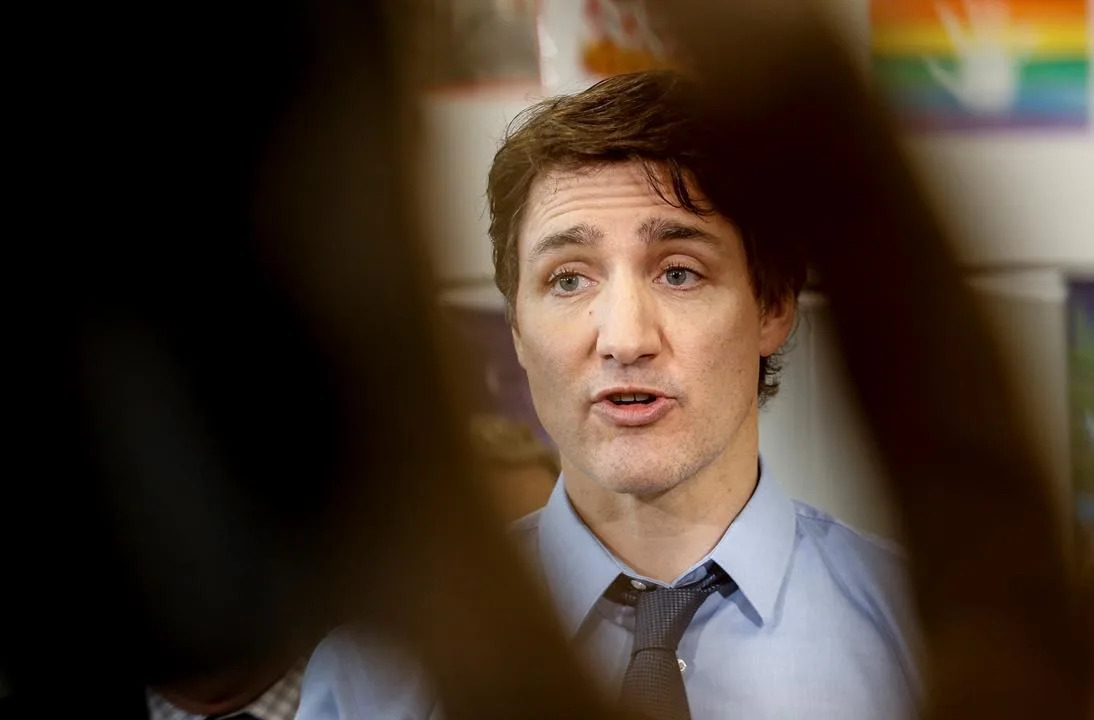
WINNIPEG — Prime Minister Justin Trudeau says with the biggest Canadian grocer now on board, the grocery code of conduct is much more likely to succeed.

"The fact that Loblaws is now on board means that there's a lot more chances that it's going to move forward, which is what this government has been pushing for for a long time," said Trudeau on Friday, speaking to media after a news conference in Winnipeg.

On Thursday, Loblaw said it would sign on to the grocery code of conduct after months of negotiations to clarify parts of the agreement.

"The code now is fair, and it will not lead to higher prices," Loblaw CEO Per Bank said.

The code is meant to level the playing field for suppliers and smaller retailers in the Canadian food industry.

Seeing the grocers sign on to the code is "a big step in the right direction," Trudeau said.

Last December, Loblaw said it wouldn’t sign the code as it stood then over concerns it would raise prices for Canadians.

In recent months, pressure has mounted for governments to make the code, which is meant to be voluntary, into law so that all the grocers have to participate.

The grocers, including Loblaw, have pushed back on allegations that they profited off of food inflation.

Metro and Empire, the other two big Canadian grocers, have already committed to the code, but they have also said that it won't work unless all major players are on board.

Walmart Canada, which also expressed concern last December that the code would raise prices for Canadians, has not committed to signing it. The company said Thursday that it's reviewing the latest version.

Michael Graydon, the chairman of the interim board for the code, said Thursday that Costco has had "some inquiries around certain aspects" of the code, but he hopes it will also sign on.

In February, Pierre Riel, chief operating officer of Costco Wholesale Corp.’s international division, told a House of Commons committee studying food prices that if the code is well-defined and its principles are consistent with the wholesaler’s own principles, it will participate.

But at that time, Riel said Costco didn’t have enough detail on how the code would work.

The news of Loblaw's participation in the code came amid a month-long boycott by some shoppers of all stores owned by the company, as frustration over food prices and industry concentration climbs.

This report by The Canadian Press was first published May 17, 2024.

Companies in this story: (TSX:L)

The Canadian Press
Ottawa to make pathway for newcomers who lack official status, speed up deportations

The Canadian Press
Fri, May 17, 2024 


OTTAWA — Prime Minister Justin Trudeau says some immigrants to Canada who lack official status need a pathway to help them stay, while in other cases Ottawa must speed up deportation procedures.

His comments come as advocates for gender and sexual minorities say the lack of a regularization program is leaving people without official status in Canada subject to exploitation.

"People who aren't here regularly need to be supported and taken care of," Trudeau told reporters Friday in Winnipeg.


"There needs to be either a pathway towards regularization and citizenship, which I know the (immigration) minister is working on. In some cases, we need to accelerate deportation proceedings,"

The Liberals pledged in late 2021 to "explore ways of regularizing status for undocumented workers who are contributing to Canadian communities." Trudeau said he had no timeline for when this will actually be put into effect.

Immigration, Refugees and Citizenship Canada defines undocumented people as those who have overstayed a temporary visa, remained in Canada following a rejected asylum claim, or arrived in Canada without contacting authorities

The office of Immigration Minister Marc Miller said Friday he is on track to present a proposal to his fellow cabinet ministers before Parliament rises for its summer break next month.

"There's a balance in making sure that the integrity of our immigration system holds," Trudeau said.

"That's one of the reasons why Canadians are, unlike so many other countries in the world, continuing to be positive towards immigration — because our immigration system is rigorous."

Immigration, Refugees and Citizenship Canada says there is no accurate count of how many undocumented immigrants reside in Canada, though it notes academic sources have estimated the number to be as many as 500,000 or as few as 20,000.

"Undocumented migrants live in fear of being detected and removed, and many are extremely vulnerable due to their very limited access to health care and social services," reads briefing material the department prepared for November 2022 testimony to Parliament.

The Migrant Rights Network raised the issue Friday to mark International Day Against Homophobia, Biphobia and Transphobia, noting that gender and sexual minorities are disproportionately represented among foreigners who don't have legal status in Canada.

Swathi Sekhar, a lawyer with the advocacy group Rainbow Railroad, said this is in part due to discrimination within legal systems and volunteer groups created to protect refugees.

"There are LGBTQI+ people that are being deported to places where they may be killed," she said at a news conference in Toronto.

"This kind of regularization scheme could literally be life-saving for many LGBTQI+ migrants who are in this country."

Sarom Rho of the group Migrant Workers Alliance for Change called for a regularization program without a cap on the number of eligible people, adding that Trudeau should "immediately stop all deportations."

She said people are being abused by employers and denied healthcare. "Queer, undocumented people are facing deportation to countries where same-sex relationships are criminalized, conversion therapy still exists, and in some cases death penalties are legalized."

Charles Mwangi, a bisexual man from Kenya, said he has lived in Canada for just under five years despite having a refugee claim and appeal denied. He is slated for his last appeal next month.

"I fear for my life back home because I will be killed," said Mwangi, who has worked off the books in a care home and suddenly lost his job with no recourse. He said he's also faced arbitrary rent hikes, because he can't seek help from authorities.

An undocumented healthcare worker from Uganda who goes by the name Jane said she cannot return to her country, which passed a law last year that jails people who identify as gender and sexual minorities, and calls for the death penalty for certain same-sex acts.

"When I walk down the streets and I see police, my heart starts racing because I'm afraid to be stopped and deported," said the woman, who withheld her last name for safety reasons.

She said she's lived in Canada for seven years but is still abused by colleagues who have legal status, because they assign her more work than what she's paid for. "They used my situation to exploit me. They had the right to talk to their bosses because of their status, but I didn't," she said.

The Immigration Department has already run short-term pilot projects, such as a Guardian Angels program during the COVID-19 pandemic that allowed 8,500 pending and failed refugee claimants who worked in direct patient care, or their family members, to get permanent residency.

Another program for the Greater Toronto Area called the Public Policy for Out-of-Status Construction Workers, had allowed 441 workers and 588 dependants to access permanent residency as of last August.

This report by The Canadian Press was first published May 17, 2024.

Dylan Robertson, The Canadian Press


Posthaste: Canada's standard of living on track for worst decline in 40 years


Pamela Heaven
Thu, May 16, 2024

Measuring a country’s growth can be contentious.

Measure Canada’s gross domestic product by aggregate and it doesn’t look so bad, but measure it by person or per capita and it’s dismal.

For example, between 2000 and 2023 Canada had the second highest rate of aggregate GDP growth in the G7, but one of the lowest growth rates per person.

When a country has had a population surge as Canada has, economists say measuring by person gives a better picture of its standard of living, and according to a new study by Fraser Institute that standard is headed for its biggest decline in 40 years.

The study by Grady Munro, Jason Clemens, and Milagros Palacios looks at the three worst periods of decline and recovery of real GDP per person in the country since 1985. They are between 1989 and 1994, years that included a recession, between 2008 and 2011, the aftermath of the great financial crisis, and this last that began in 2019.

This latest period is unique because even though GDP per person recovered for one quarter in mid-2022, it immediately began to decline again, and by the end of 2023 was well below where it was in 2019.

“This lack of meaningful recovery suggests that since mid-2019, Canada has experienced one of the longest and deepest declines in real GDP per person since 1985,” said the study’s authors.

Between April of 2019 and the end of 2023, when the last data was available, inflation-adjusted per-person GDP fell 3 per cent from $59,905 to $58,111. That is surpassed only by the declines in 1989 to 1992, when GDP per person fell 5.3 per cent and in the financial crisis, when it fell 5.2 per cent, says the study.

The latest decline has lasted 18 quarters, making it the second longest in the past 40 years. Only the decline of 1989 to 1994, which lasted 21 quarters, was longer.

Key, though, are signs that it is not over yet. GDP per person in the fourth quarter of 2023 was down 0.8 per cent from the quarter before, suggesting it is still on a downward track, said the study.

“The decline in incomes since Q2 2019 is ongoing, and may still exceed the downturn of the late 1980s and early 1990s in length and depth of decline,” said the authors.

“If per-capita GDP does not recover in 2024, this period may be the longest and largest decline in per-person GDP over the last four decades.”

Fraser Institute is not alone in flagging this problem. In a recent article for the Financial Times, Ruchir Sharma, chair of Rockefeller International, identified Canada as one of the countries that has suffered a steep decline in real per-capita income growth and a drop in their share of global GDP.

A leader among the so-called “breakdown nations,” Canada’s GDP per capita has been falling 0.4 per cent a year since 2020, the worst rate among 50 developed economies.

“Widely admired for how it weathered the global financial crisis of 2008, [Canada] missed the boat when the world moved on, driven by Big Tech instead of commodities,” wrote Sharma. “New investment and job growth are being driven mainly by the government.”

Not only does Canada lag most developed economies, Canadian provinces also fall far behind almost all U.S. states, said Trevor Tombe, a professor of economics at the University of Calgary, in a column last year for the Hub.

Ontario last year had a per-person level of economic output similar to Alabama, said Tombe. The Maritimes were below Mississippi, and Quebec and Manitoba lag West Virginia.

Canada’s strongest economy, Alberta beat the U.S. average, but ranked 14th overall.

“It’s roughly comparable to New Jersey and Texas, but 13 per cent below California and nearly one-quarter below New York,” wrote Tombe.
'Huge increases': Economists sound alarm over impact of Canada population growth on housing market

Working population in first 4 months this year surpassed already unprecedented numbers for 2023


John MacFarlane
·Senior Reporter
Fri, May 17, 2024 

Toronto’s population increase from January to April was 67 per cent higher in 2024 than in 2023. In Vancouver and Montreal, population growth this year was more than double last year’s.
 (Photo by Roberto Machado Noa/LightRocket via Getty Images)


Canada’s working population has increased dramatically in the first four months of 2024, obliterating the unprecedented numbers recorded in 2023 and threatening to raise pressure on a housing market already strained by rapid population growth.

Statistics Canada labour force data show the country’s working-age population grew by 411,400 people in the first four months of 2024, a 47 per cent increase over the same period in 2023 and nearly quadruple the average for those four months from 2007 to 2022.

Canada’s population boom in 2023 amplified concern about the country’s housing crisis, prompting the federal government to introduce plans to significantly reduce new arrivals. Economists at the National Bank, who pointed to the population increase in a note on Wednesday, say the 2024 trend is likely to make things worse before they get better.

“With that kind of population growth, perhaps we're going to see some resilience in home prices in the country,” said Matthieu Arseneau, the bank’s deputy chief economist. “And we expect the vacancy rate — already at the record low in Canada at the end of 2023 — to decrease further, perhaps to be lower than or close to the one per cent level.”

Arseneau says he and other economists found the population data even more surprising than the unexpectedly strong job numbers in labour market data last week. The bank’s best guess, he says, is that Ottawa’s various plans to reduce population growth have prompted many people to come to Canada before they take effect.

“We suspect that by announcing some measures down the road perhaps you have a boom in demand in the short term because of that,” Arseneau said.

The labour force data are striking. The monthly increase in national working-age population in January was the highest on record at 125,500, while April reached 111,800, the second highest. To put those numbers in perspective, the average growth for the first four months of the year from 2007 to 2022 was just over 110,000.

In Montreal, Toronto and Vancouver, the growth is even higher. Toronto’s population increase from January to April was 67 per cent higher in 2024 than in 2023. In Vancouver and Montreal, population growth this year was more than double last year’s.

“Those are huge increases,” said Arseneau. “We know that those cities are the main entrance for immigration. So that explains why it's higher than the national average.”

The 3.2 per cent increase in Canada’s population in 2023 marked the fastest pace of growth since 1957. It has been a flashpoint of recent political and economic debate, particularly its impact on housing, prompting a number of policy measures this year. In January, federal Immigration Minister Marc Miller reduced the number of international student visas by 35 per cent. In March, he announced a first-ever cap on temporary residents, with the intention of reducing their share of the overall population from 6.2 per cent to around five per cent.

In an emailed statement, Immigration, Refugees and Citizenship Canada (IRCC) says it could not comment on population data originating from another government department, but that "it would be too early to see any data stemming from recently announced changes to temporary resident policies."

The statement notes that "application processing can also vary over the course of a year and as a result, there can be periods of higher processing which would cause an increase in landings for a particular timeframe.

"While population growth through immigration increases demand for housing, infrastructure and services, it also contributes significantly to the supply of labour, including to the construction sector to build new homes and support the healthcare sector. Temporary and permanent economic immigration pathways play a complementary role in helping address Canada’s labour market shortages."

Sales data released Wednesday by the Canadian Real Estate Association had some positive signs for affordability, with slower sales keeping prices down and increasing the number of homes on the market. But accelerated population growth will not be a helpful factor, Arseneau says, noting that “the affordability problem for first-time home buyers is already very acute.”

“We are expecting rate cuts in the second half of this year,” he said. “We doubt that's going to improve affordability given the magnitude of the population growth.”

The growth spurt is also creating a more challenging picture for interest rate cuts, Arseneau says. Increased demand for rental units, which are already in short supply, could drive rental prices higher, and rising rents would consequently push Consumer Price Index numbers higher. Data released in April showed rent jumping by 8.5 per cent in March, Arseneau notes. “So that's the tricky part,” he said. “That's a difficult situation for the central bank to cope with — inflation coming from the housing sector.”

The IRCC statement acknowledges the "acute challenges related to housing" and says the agency is "pursuing strategies that support Canada’s continued need for immigration while leading the national effort to solve Canada’s housing crisis.

"We need all levels of government at the table with us on this," the statement continues. "At the federal level, we are aligning our immigration policies with measures taken to address housing and infrastructure challenges. To this end, the 2024-2026 Levels Plan strikes the right balance between supporting Canada’s economic prosperity, staying true to our humanitarian tradition, and developing a more sustainable approach to levels planning with our partners."

National Bank’s economists say they now expect the working-age population to grow by three per cent in 2024, exceeding the 2.3 per cent rise in 2023. The bank’s projection sees the explosive growth in the first four months of 2024 tapering off as the year goes on, before the government’s measures to slow growth take hold. But the effects of strong population growth in 2023 and 2024 are likely to resonate beyond 2025, Arseneau says.

“I think that for the next five years in Canada, the big challenge will be to cope with this housing shortage that we have,” he said. “And it will take several years to alleviate pressure on the housing market given this population boom over two years.”

John MacFarlane is a senior reporter at Yahoo Finance Canada. Follow him on Twitter @jmacf. Download the Yahoo Finance app, available for Apple and Android.

Modi’s anti-Muslim rhetoric taps into Hindu replacement fears that trace back to colonial India

Archana Venkatesh,
 Clemson University
 THE CONVERSATION
Fri, May 17, 2024 

Indian Prime Minister Narendra Modi is popular but divisive. Ritesh Shukla/Getty Images


The world’s largest election is currently under way in India, with more than 960 million people registered to vote over a period of six weeks. Spearheading the campaign for his Bharatiya Janata Party, incumbent Prime Minister Narendra Modi is spending that time crisscrossing the country, delivering a message he hopes will result in a landslide victory for the Hindu nationalist party.

He is a popular figure but also a divisive one. Modi’s speeches are drawing heat for their anti-Muslim rhetoric. At a campaign rally on April 21, 2024, he referred to Muslims as “infiltrators.”

He later doubled down on these remarks, suggesting that if India’s largest opposition party, the Indian National Congress, came to power, the wealth of Hindus would be snatched and given to communities that “have too many children,” a seemingly lightly veiled reference to Indian Muslims.


Such language represents a fear that Modi and the BJP have stoked many times before: that Muslims will become a numerical threat to India’s Hindu-majority population.

Modi has since claimed that he did not explicitly target Muslims in his speech, but his words – widely recorded and disseminated – have certainly been taken that way.

To some onlookers, the rhetoric is an indication that not all is well in the BJP campaign as it seeks to secure a two-thirds supermajority in Parliament. By appealing to the party’s Hindu base, the argument goes, Modi is trying to counter voter apathy in the face of high youth unemployment and rising economic inequality.

As a historian of public health in India, I believe it is important to shed light on the specific origins of anti-Muslim rhetoric and how it fits long-standing fears of Muslim population growth and the erosion of the Hindu majority in India.
Fears of a Muslim takeover

Demographic fears in India are tied to political and administrative representation and have been since the days of British colonialism.

In 1919, the British granted Indians limited franchise; Indian legislators were allowed to create policy in certain fields, such as health care and education, but not on law and order.

After the 1931 census, Indian leaders – mostly Hindus, but also some Muslims – and British officials began to express concern about the seemingly rapid rate of population growth in India, which at the time was increasing by over 1% annually.

These leaders, in common with similar efforts around the globe, began to push new birth control methods toward Indian women.

But to successfully induce large numbers of women to embrace family planning practices, colonial officials and Indian administrators had to contend with the fact that Indians of all religions were suspicious of birth control propaganda.

These suspicions stemmed from cultural practices shared by both Hindu and Muslim communities that informed women’s status in society, including child marriage, the seclusion of women and polygamy.

Policies that tried to interfere with the traditional lives of Indian women, including birth control, were widely considered harmful instances of colonial control.
Role of British colonizers

While the British used these cultural practices and suspicions to suggest that all Indians were responsible for rapid population growth and associated poverty and hunger, Hindu nationalist groups created a different narrative. These fringe groups, which emerged as a political force in the 1930s, popularized the idea that practices encouraging population growth were particularly prevalent among the Muslim population.

At the same time, there were growing tensions between the Indian National Congress party and the Muslim League, which was founded in 1906 but began to demand a separate homeland for Indian Muslims in the late 1930s.

Divisions existed in Indian society prior to British rule. By classifying Indians into categories based on caste and religion, however, British colonial rulers made these identities and divisions more rigid, pitting various communities against one another.

Communal tensions allowed the British to uphold the idea that without the control and surveillance of colonial rule, Indians were incapable of self-government and liberal democracy.

Though the British left the new nation-states of India and Pakistan in 1947, increasing Hindu-Muslim tensions after partition continued to inform family planning propaganda in independent India.

Hindu nationalists had expected the creation of a single nation with Hindu majority rule. As such, they saw the creation of Pakistan – a homeland and nation-state for South Asian Muslims – as a massive failure of the Indian freedom movement and a loss for India.

Additionally, post-partition leadership and administrators in India were for the most part drawn from Hindu men and some women, since the majority of educated and elite Muslim classes ended up in Pakistan.

As a result, colonial-era perceptions of Muslims continued to inform the way Indian policymakers and administrators created and implemented health care and education policy. In particular, preexisting perceptions of Muslim hyperfertility in Indian policymakers’ minds became more deeply entrenched with partition.
Population control programs

As India launched its first major population control program in 1951, administrators at all levels of governance assumed that uptake of birth control would be lower in Muslim communities than Hindu communities.

In actuality, the factors that influenced the rate of uptake of IUDs, oral contraceptives and tubectomies in postindependence India were governed more by geography – whether women lived in rural or urban areas, and were from the country’s north or south – and class status.

Since 1951, population control has been one of the major goals of Indian policymaking as part of a program to reduce poverty and improve public health. But the continued assumption that Indian Muslims are unwilling to participate in population control practices has led to the public perception of Islam as “superstitious” or “backward.”

Research has shown that Indian Muslim communities across the nation have felt the effects of this stereotyping, especially in northern India. Muslims reported being disproportionately targeted by population control initiatives. These concerns among the Muslim community intensified with the aggressive forced sterilization program carried out by the Indian state under Prime Minister Indira Gandhi in the 1970s.
Using religion for politics

Modi’s party, the BJP, was formed in 1980 but failed to win significant elections until the 1990s.

Several people on top of the 16th century Babri Mosque five hours before the structure was completely demolished in December 1992. Douglas E. Curran/AFP via Getty Images

The main focus of their organizing in the 1980s and 1990s was to demand the demolition of a mosque commissioned by Mughal emperor Babur in Ayodhya, traditionally regarded as the birthplace of Hindu deity Rama.

In tandem with this campaign, the BJP promoted fears of Muslim demographic dominance in India, tying demands for “taking back” the land on which the Babri Masjid was built with fears of a Muslim majority.

But such fears are unfounded. Despite the Muslim minority growing from 11% in the mid-1980s to 14% today, their representation in Parliament has actually declined, from 9% in the mid-1980s to 5% today.

Since the BJP came to power in India in 2014, party leaders have relied on the historic fears of imagined Muslim population growth to help them win successive elections at the state and national level and pass legislation such as the Citizenship Amendment Act, which discriminates against Muslims. BJP leaders have accused Muslim men of forcibly converting Hindu women to Islam through “love jihad,” a conspiracy theory that Muslim men deceptively seduce Hindu women to increase their demographic strength.

Modi’s latest statement referring to “those who have too many children” is the latest iteration of a long history of Hindu demographic fears – and has proven to be a lasting one.

This article is republished from The Conversation, a nonprofit, independent news organization bringing you facts and trustworthy analysis to help you make sense of our complex world. It was written by: Archana Venkatesh, Clemson University

U.S. Justice Department formally moves to reclassify marijuana as a less dangerous drug in historic shift

LINDSAY WHITEHURST
Updated Thu, May 16, 2024 


WASHINGTON (AP) — The Justice Department on Thursday formally moved to reclassify marijuana as a less dangerous drug, a historic shift in generations of U.S. drug policy.

A proposed rule sent to the federal register recognizes the medical uses of cannabis and acknowledges it has less potential for abuse than some of the nation’s most dangerous drugs. The plan approved by Attorney General Merrick Garland would not legalize marijuana outright for recreational use.

The Drug Enforcement Administration will next take public comment on the proposal in a potentially lengthy process. If approved, the rule would move marijuana away from its current classification as a Schedule I drug, alongside heroin and LSD. Pot would instead be a Schedule III substance, alongside ketamine and some anabolic steroids.

The move comes after a recommendation from the federal Health and Human Services Department, which launched a review of the drug’s status at the urging of President Joe Biden in 2022.

Biden also has moved to pardon thousands of people convicted federally of simple possession of marijuana and has called on governors and local leaders to take similar steps to erase convictions.

“This is monumental,” Biden said in a video statement, calling it an important move toward reversing longstanding inequities. “Far too many lives have been upended because of a failed approach to marijuana, and I’m committed to righting those wrongs. You have my word on it.”

The election year announcement could help Biden, a Democrat, boost flagging support, particularly among younger voters.

The notice kicks off a 60-day comment period followed by a possible review from an administrative judge, which could be a drawn-out process.

Biden and a growing number of lawmakers from both major political parties have been pushing for the DEA decision as marijuana has become increasingly decriminalized and accepted, particularly by younger people. Some argue that rescheduling doesn’t go far enough and marijuana should instead be treated the way alcohol is.

Democratic Senate Majority Leader Sen. Chuck Schumer of New York applauded the change and called for additional steps toward legalization.

The U.S. Cannabis Council, a trade group, said the switch would “signal a tectonic shift away from the failed policies of the last 50 years.”

The Justice Department said that available data reviewed by HHS shows that while marijuana "is associated with a high prevalence of abuse,” that potential is more in line with other Schedule III substances, according to the proposed rule.

The HHS recommendations are binding until the draft rule is submitted, and Garland agreed with it for the purposes of starting the process.

Still, the DEA has not yet formed its own determination as to where marijuana should be scheduled, and it expects to learn more during the rulemaking process, the document states.

Some critics argue the DEA shouldn’t change course on marijuana, saying rescheduling isn’t necessary and could lead to harmful side effects.

Dr. Kevin Sabet, a former White House drug policy adviser now with the group Smart Approaches to Marijuana, said there isn’t enough data to support moving pot to Schedule III. “As we’ve maintained throughout this process, it’s become undeniable that politics, not science, is driving this decision and has been since the very beginning,” Sabet said.

The immediate effect of rescheduling on the nation’s criminal justice system is expected to be muted. Federal prosecutions for simple possession have been fairly rare in recent years.

Schedule III drugs are still controlled substances and subject to rules and regulations, and people who traffic in them without permission could still face federal criminal prosecution.

Federal drug policy has lagged behind many states in recent years, with 38 states having already legalized medical marijuana and 24 legalizing its recreational use. That’s helped fuel fast growth in the marijuana industry, with an estimated worth of nearly $30 billion.

Easing federal regulations could reduce the tax burden that can be 70% or more for marijuana businesses, according to industry groups. It also could make it easier to research marijuana, since it’s very difficult to conduct authorized clinical studies on Schedule I substances.

___

Associated Press writers Zeke Miller in Washington and Joshua Goodman in Miami contributed to this report.

___

Follow the AP's coverage of marijuana at https://apnews.com/hub/marijuana.


DEA Moves To Reclassify Marijuana as a Schedule III Drug

C.J. Ciaramella
Thu, May 16, 2024

The Justice Department formally, finally, proposed to stop lying about marijuana today after decades of insisting the drug is comparable to heroin and ecstasy—and more dangerous than cocaine and methamphetamine.

The Drug Enforcement Administration (DEA), in a proposed rule sent to the Federal Register, moved to change marijuana's status from a Schedule I drug under the Controlled Substances Act—considered by the government to be highly abuse-prone drugs with no medical value—to a Schedule III drug. Recreational marijuana possession and use would remain illegal under federal law, and any new cannabis-based medications would still require approval from the Food and Drug Administration.

President Joe Biden directed the Justice Department and the Department of Health and Human Services (HHS) in 2022 to review marijuana's status as a Schedule I drug. In 2023, HHS recommended that marijuana be moved to Schedule III, which includes drugs with a medium risk of abuse and accepted medical use.

On the campaign trail in 2020, Biden promised to "decriminalize the use of cannabis," but despite lamenting the injustices of marijuana convictions and the barriers they create, and despite the continuing collapse of public support for marijuana prohibition, Biden still opposes full-scale legalization. Instead, his administration has focused on mass pardons and other measures that largely leave those injustices in place.

As Reason's Jacob Sullum wrote earlier this month, after news of the impending proposal first broke, rescheduling marijuana may allow for more medical research and be a good election-year talking point for Biden, but it won't end the continuing federal prohibition of cannabis:


Rescheduling marijuana will not resolve the conflict between the CSA and the laws of the 38 states that recognize cannabis as a medicine, 24 of which also allow recreational use. State-licensed marijuana businesses will remain criminal enterprises under federal law, exposing them to the risk of prosecution and forfeiture. While an annually renewed spending rider protects medical marijuana suppliers from those risks, prosecutorial discretion is the only thing that protects businesses serving the recreational market.

Even if they have state licenses, marijuana suppliers will be in the same legal position as anyone who sells a Schedule III drug without federal permission. Unauthorized distribution is punishable by up to 10 years in prison for a first offense and up to 20 years for subsequent offenses. That is less severe than the current federal penalties for growing or distributing marijuana, which include five-year, 10-year, and 20-year mandatory minimum sentences, depending on the number of plants or amount of marijuana. But distributing cannabis, with or without state permission, will remain a felony.

But even getting the DEA to acknowledge that marijuana is not a drug on par with LSD and heroin is a victory of sorts.

In 2012, Barack Obama's head of the DEA, Michele Leonhart, refused to say whether drugs like crack cocaine and heroin were worse than marijuana, only offering the weak response that "all illegal drugs are bad."

Chuck Rosenberg, who followed Leonhart as head of the DEA, also equivocated when asked the same question in 2015: "If you want me to say that marijuana's not dangerous, I'm not going to say that because I think it is," Rosenberg said on a conference call with reporters. "Do I think it's as dangerous as heroin? Probably not. I'm not an expert."

Rosenberg clarified his statements a week later, saying, "Heroin is clearly more dangerous than marijuana."

Still, the federal government decided to keep embarrassing itself for nearly another decade before moving to drop marijuana from Schedule I.

The DEA's rescheduling proposal will now go through a public comment period.

The post DEA Moves To Reclassify Marijuana as a Schedule III Drug appeared first on Reason.com.
China's BYD just unleashed a hybrid pickup truck that has no rival in America — see the Shark

A BYD SharkBYD

OMG! IT LOOKS LIKE A TRUCK

Benjamin Zhang
Wed, May 15, 2024 


China's BYD Auto launched its all-new Shark plug-in hybrid pickup truck in Mexico on Tuesday.


The BYD Shark's hybrid drive system puts out 430 horsepower and has 62 miles of all-electric range.


The Shark starts at $54,000 in Mexico but is not for sale in the US.


BYD introduced its new Shark plug-in hybrid pickup truck in Mexico on Tuesday. It's the company's first truck and the first product launched outside its home market, China.

Mexico is growing in importance for BYD's global strategy as it aims to gain a foothold in North America — even as the company has made clear in recent months that it does not plan to enter the US market any time soon.

As a result, the Shark will not be available in the US but will go on sale in Mexico with a starting price of roughly $54,000 USD, or 899,980 pesos.

Therefore, the midsize Shark hybrid will be aimed squarely at major global players like the Toyota Hilux and Nissan Navarra.

In the US, the BYD Shark would have competed against midsize pickup stalwarts like the Toyota Tacoma, Chevrolet Colorado, Nissan Frontier, and Ford Ranger.

However, there are no plug-in hybrid midsize pickup trucks on sale in the US. The Tacoma does offer a hybrid but does not have the ability to be plugged in.

The Shark is built on BYD's Super Hybrid Off-road Platform.

The BYD Shark's hybrid system.BYD

The BYD Sharks' power comes from a longitudinally mounted 1.5-liter, turbocharged four-cylinder engine and two electric drive motors. Together, they produce a total system output of 430hp.

According to BYD, the Shark can make the run from 0-62 mph in just 5.7 seconds

As a result of the hybrid system, the Shark does not have a traditional mechanical all-wheel-drive system.

Instead, it sends power to the rear axle via an electric drive motor.

The Shark comes with a 29.6 kWh battery pack.

A BYD Shark hybrid pickup truck.BYD

According to BYD, the Shark has an all-electric range of 62 miles. The company also claims the pickup has a maximum combined range of 522 miles with the battery fully charged and a full tank of gas.

According to BYD, the Shark can tow up to 2,500 kg or 5,512 lbs.

A BYD Shark hybrid pickup truck.BYD

Don't expect to do much towing with just the battery, though.

Aesthetically, the Shark's aggressive looks are the work of BYD's design team led by Wolfgang Egger.

A BYD Shark doing a product demonstration drive at the launch event.BYD

According to BYD, Egger, the former chief designer at Audi and Alfa Romeo, sought inspiration from the aquatic predator for which the truck is named. In fact, the front grille was inspired by the open mouth of a shark.

At 215 inches in length, the Shark is a few inches longer than the Ford Ranger SuperCrew and the standard-wheelbase Nissan Frontier. However, it's about a foot shorter than the extended-length versions of the Frontier and the long-bed Toyota Tacoma.

Inside, the Shark's cabin is highlighted by a head-up display, a 10.25 LCD digital instrument display, and an impressive 12.8-inch central infotainment screen.

The BYD Shark's cabin.BYD

The 12.8-inch screen can change orientation from portrait and landscape. It's also equipped with Apple CarPlay and Android Auto as well as built-in apps for navigation, karaoke and music streaming.

The Shark is also equipped with a 540-degree panoramic view camera.

The BYD Shark's 12.8-inch infotainment screenBYD

BYD's 540-degree panoramic camera system is a 360-degree camera coupled with a 180-degree undercarriage view camera. The undercarriage camera is designed to help drivers get a better view of the terrain while offroading.

The Shark comes with a suite of advanced safety features, including adaptive cruise control, lane keep assist, and automatic emergency braking.

Like Tesla's Cybertruck, the Shark's features can be controlled via smartphone which can also serve as a key.

The BYD Shark's digital keyBYD

Tesla has long pioneered the use of its mobile app as an NFC key for vehicles.

The Shark's hybrid system can be used to power campsites or worksites.

The BYD Shark hybrid powers a video projector.BYD

Most electric trucks these days are rife with electrical outlets for the job site or campsite.


The incredible rise of Chinese Tesla rival BYD, which just unveiled a Cybertruck competitor


Camilo Fonseca,Ana Altchek
Wed, May 15, 2024 

The Seal U is one of BYD's latest electric-vehicle offerings.Anusak Laowilas/NurPhoto via Getty Images

The Chinese automaker BYD briefly eclipsed Tesla as the world's top seller of electric vehicles.


Even though it doesn't have access to the US market, BYD's affordable EVs are popular in China.


Here's how a little-known Chinese brand proved it could go toe-to-toe with an industry giant.

BYD may not be a household name in America, but it recently made itself known in a big way.

For a brief moment earlier this year, the Chinese automaker unseated Tesla as the world's top seller of electric cars.

Even though you won't see a BYD car in America (yet), the company has built an affordable brand that's popular in China and elsewhere.
ADVERTISEMENT


It also just announced a Cybertruck competitor, the BYD Shark.

Here's the story of the company that proved it could outsell Elon Musk.

BYD doesn't stand for anything — officially.

The BYD nameplate is associated with the slogan "Build Your Dreams," but that came after the company was formed.picture alliance

Wang Chuanfu and a cousin founded BYD in 1995. Then a 29-year-old government researcher, Wang came from a family of rice farmers. He earned a university scholarship and eventually moved to the Special Economic Zone in Shenzhen to start his new company.

The "YD" in the name came from Yadi, the village in Shenzhen where the company originally was, one South Korean newspaper reported. The "B" was added later as a promotional tool, the report said. Wang has said in interviews that, taken together, the BYD name doesn't stand for anything in particular.

It was only later that Wang derived the slogan "Build Your Dreams." The company has also acquired another nickname: "Bring Your Dollars."

The company was originally a cellphone-battery manufacturer.

Chinese Vice President Hu Jintao testing a Samsung cellphone in the 1990s. Samsung was one of BYD's earliest customers.Kim Jae-Hwang/AFP via Getty Images

The company's original business wasn't cars. It was cellphone batteries. BYD challenged the established Japanese suppliers Toyota and Sony by providing a cheaper alternative. By 2002, companies such as Motorola, Nokia, Sony Ericsson, and Samsung were all using BYD batteries.

They started making cars in 2003.

A BYD F3DM.Peter Parks/AFP via Getty Images

BYD moved into the car business after buying Xi'an Tsinchuan, a failing state-owned automaker that was then an arm of the defense contractor Norinco, the South China Morning Post reported.

The company launched its first car in 2005. The BYD F3 was a compact sedan that resembled the Toyota Corolla. It sold for as little as 40,000 yuan, or about $5,850.

Warren Buffett was a key early booster.

Wang Chuanfu welcomed the investors Charlie Munger, Warren Buffett, and Bill Gates to celebrate the launch of the BYD M6 in 2010.Visual China Group via Getty Images

The billionaire investor Warren Buffett was one of the high-profile names who took an interest in BYD early on. Looking to invest in China's booming car market, Buffett toured BYD's headquarters.

The Wall Street Journal reported that while the Berkshire Hathaway tycoon was there, Wang took a sip of battery fluid to prove how clean his batteries were. Buffett was so impressed by the experience that he offered to buy 25% of the company.

Wang declined that offer, but Buffett was not deterred. Berkshire Hathaway acquired a 10% stake in BYD — for $232 million — in 2008.

Their first electric car drew scorn from Elon Musk.

A BYD E6.Stan Honda/AFP via Getty Images

The company debuted its first fully electric vehicle, the E6, in 2010. Benefiting from Chinese government subsidies, it was able to compete with its Japanese counterparts.

But not everyone was impressed. Tesla CEO Elon Musk laughed in a 2011 interview when asked whether he considered BYD a serious rival to Tesla.

"Have you seen their car?" he said. "I don't think they make a good product. I don't think it's particularly attractive. The technology is not very strong."

BYD's hybrid cars turned it into a titan of Chinese automakers.

Chuanfu introduced the BYD Qin in 2012.AP Photo/Alexander F. Yuan

BYD established itself as one of the top automakers for hybrid vehicles in China in the 2010s. Its most popular offering was the Qin, introduced in 2012, which became one of the best-selling cars in China.

That wasn't the only offering that propelled BYD to prominence, however. The company also released the Tang, a hybrid SUV, and partnered with Daimler AG (now Mercedes-Benz) to make its Denza line.

BYD took the EV crown from Tesla — briefly.

A BYD Atto 3.Athit Perawongmetha/Reuters

Even though most of its sales in the fourth quarter of 2023 came from the Chinese market, BYD made headlines across the globe when it seemingly did the impossible — it unseated Tesla as the world's top seller of electric cars.

The Chinese automaker rode the EV wave on the back of its new Seagull, which debuted for 73,000 yuan, or about $10,000, as well as its Song, Qin Plus, Dolphin, Yuan Plus, and Han EVs.

Tesla reclaimed the crown in the first quarter of 2024, though both companies saw steep declines in their sales.

BYD's Shark takes aim at Tesla's Cybertruck

The BYD Shark is supposed to represent an actual shark, according to the launch event. BYD Auto México

The Shark, unveiled on Tuesday, is the latest model offered by BYD.

It's a midsize hybrid pickup truck, and the cabin's design fuses outdoor functionality with modern style and durability.

The truck has more than 430 horsepower, or 170 less than Tesla's all-wheel-drive Cybertruc. BYD says it can accelerate from zero to 100 kilometers an hour, or about 62 miles an hour, in roughly 5.7 seconds. The vehicle has five seats and a maximum towing capacity of 2,500 kilograms, which is just more than 5,500 pounds. That's about half of the Cybertruck's towing capability.

Designed for everyday trips and off-road driving, the Shark has three terrain modes: sand, mud, and snow.

It also has built-in features to make camping and off-roading more accessible. The vehicle offers bidirectional charging, according to BYD's site.

While the Shark isn't in direct competition with the Cybertruck as a hybrid model that doesn't sell in the US, it may entice EV fans looking for a more traditional pickup design. It's also priced competitively at about $53,451, which is lower than Cybertruck's $60,990 starting price tag.

Don't expect to see a BYD car on American roads anytime soon.

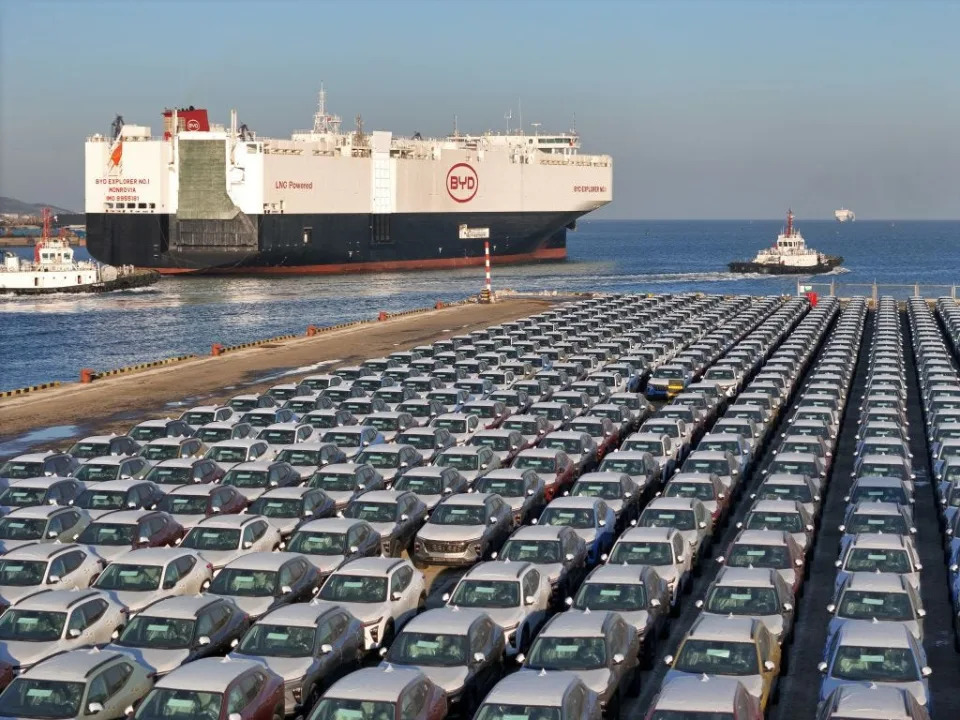
New BYD cars waiting to be loaded onto a ship in China's Shandong province.
Future Publishing

For a time, it looked as if we were just a few years away from getting Chinese electric cars in the United States. A BYD executive said as much in 2017, and the company even hired Leonardo DiCaprio as a brand ambassador for English-speaking customers.

Since then, BYD has expanded overseas. The Chinese automaker is planning a factory in Mexico — alarming US officials — and even created its own shipping fleet in a bid to cut down on export costs.

But the company says it has abandoned its plans of selling its EVs to Americans. Analysts have pointed to geopolitical tensions and trade barriers between the two countries, as well as the slumping demand for EVs in the United States.