Monday, December 02, 2024

The Democrats Loss of the Working Class was Fifty Years in the Making


 December 2, 2024
Facebook

Image by Vinicius “amnx” Amano.

One month out after Donald Trump and the Republicans beat Kamala Harris and the Democrats, the reasons for the electoral defeat are still being debated. Yet, while it is possible that Harris could have won, but for several mistakes that she made, it is not clear that any Democrat could have won this election. In fact, the roots of Harris’s and the Democratic losses in 2024 are deep going back at least to three previous Democratic presidents.

Contrary to conventional wisdom, the 2024 presidential race was close. Had Harris picked up approximately 124,000 votes in the critical swing states of Michigan, Pennsylvania, and Wisconsin, she would have been an electoral college winner for the presidency. This is comparable to how in 2016 Hilary Clinton would have won the presidency had she picked up 90,000 more votes in the same three states, or had Trump won 43,000 more votes in 2020 in Arizona, Georgia, and Wisconsin.

Some might argue that had she picked a different vice-presidential candidate, such as Josh Shapiro from Pennsylvania, which might have made a difference. Or that had she developed a better narrative or broken with Biden sooner, perhaps the results would have been different. But the roots of her and the Democratic Party’s failure to win, and especially to lose the working class, go back decades.

It started in the 70s and 80s, when the US economy was restructuring away from manufacturing. The jobs that were lost belong to the working class and with the new economic employment opportunities going to those who were college educated. As manufacturing disappeared from the US, the gap between the rich and poor accelerated, starting in the eighties up to the present. The Democrats did little to address this growing inequality, and in fact, embraced it and the new economy and the new workers who would be the winners.

The first major mistake was under Bill Clinton. His endorsement and support for NAFTA clearly demonstrated an indifference to how free trade would hurt the working class and people of color. The enthusiasm there and among the Clinton Democrats for free trade drowned out critics who said that unless the agreement protected the working class, it would have hurt them, even though it generated, perhaps overall greater net worth for the business community. NAFTA had winners and losers, and it favored the business community, as well as eventually favoring those college, educated, trained individuals who were to benefit from the new internet based intellectual service economy, of which NAFTA was part.

The second mistake was with Barack Obama. In 2008 as the global economy collapsed due to bank failures in the United States, initially, George Bush pushed through TARP, the Troubled Asset Relief Program, to help bail out banks. Once in office, Obama continued that approach to bail out the too big to fail. His Treasury Secretary, Tim Geithner, when asked at one point about all the hundreds of thousands or millions of homeowners who were going to lose their houses, he demonstrated a tin ear by saying that that would have to happen to save the banks.

Finally, under Joe Biden, his support for the working class was supposedly what led him to defeating Donald Trump in 2020. It was probably less that and more that Trump mishandled the pandemic. But among Biden’s signature achievements was the Inflation Reduction Act, a commitment of hundreds of billions of dollars to transition the United States to the green economy with green jobs. Yet again, these were not jobs that were going to benefit the working class that used to support the Democratic Party. Instead, it would go to those with different skill sets, and not necessarily in areas such as Pennsylvania, Michigan, or Wisconsin, where Democrats needed votes.

Three Democratic presidents, three critical choices that demonstrated a turning away from the working class. What is not surprising is that they finally abandoned the Democrats en masse in 2024 what is more surprising is that they did not do it sooner. As the Democrats regroup, they need to think about these broader and deeper structural choices that the party made and how it has walked away from the working class under each Democratic President for the last fifty years.

David Schultz is a professor of political science at Hamline University. He is the author of Presidential Swing States:  Why Only Ten Matter.

CRYPTOZOOLOGY

Could this be the cause of the Loch Ness Monster sightings?


Sarah Hooper
 December 1, 2024
Alan McKenna believes ‘standing waves’ could be mistaken for the mythical creature (Picture: Pen News)

A natural phenomenon could be behind countless sightings of the elusive ‘Loch Ness Monster’ over the years, an expert has said.

Alan McKenna, founder of Loch Ness Exploration (LNE), believes ‘standing waves’ might explain alleged sightings of the mythical monster.

He said: ‘A standing wave occurs when two boat wakes of the exact same frequency and amplitude are moving in opposite directions on the loch surface. When the two boat wakes finally meet and interfere with one another the results have the potential to create a standing wave.’

The peaks of these standing waves, rising above the otherwise calm waters, could be mistaken for ‘humps’ above the surface.


Footage captured by Mr McKenna shows the phenomenon occurring where a river meets the loch on its southern shore, at Fort Augustus.

But capturing a standing wave caused by boat wakes out on the open water is a greater challenge.

One of the most famous photos of ‘Nessie’ was taken in 1934 (Picture: Getty)

Alan said: ‘The waves and the boat wake need to be identical. So with all that in mind, there’s now a lot more to consider here such as the boat itself, its size, the direction of travel and its current speed.

‘A small boat with a smaller engine will most definitely produce a wake different from a much larger boat. It’s a complex procedure, especially in open water, but it can happen.’

Mr McKenna now hopes to record the phenomenon happening out over the deep heart of the loch.

He said: ‘Ali Matheson, skipper of Deepscan, frequently reports standing waves, but more so in the small marina within Urquhart Bay also known as Temple Pier. That’s all fine and well, but it’s more difficult to capture a standing wave in open water.

‘We know that standing waves exist and they have been reported but what we don’t have is the footage showing a natural standing wave in motion.’

Mr McKenna helped to launch LNE, and follows daily reports by locals to find out what’s behind the sightings.
Standing waves in the lake could easily be mistaken for something else 
(Picture: Pen News)

When it comes to the existence of the fabled beast, however, Alan is keeping an open mind.

The 37-year-old said: ‘If there are any unknown animals in Loch Ness then they certainly don’t play by the rules. It’s the perfect habitat for a shy animal with 23 miles of cold dark water and around 750ft deep.

‘You could be swimming next to a 200ft submarine below the surface and not even notice it right in front of you, it’s that dark!’

Over the years, some have believed giant eels, long-necked seals, Greenland sharks, large sturgeons and other animals could be mistaken for ‘Nessie’.

Mr Mckenna said: ‘Truth be told, none of us have the correct answer and that’s what keeps this mystery going.’

LNE is an independent voluntary research group focused on Loch Ness, its natural environment, and its ecology, as well as the mythical monster.
Quarter of voters think UK is doing too much to support Ukraine

Exclusive

Voters appear to be split over giving more support to Ukraine should Donald Trump withdraw US backing

A serviceman of 24th mechanised brigade named after King Danylo rests as he attends an exercise, amid Russia’s attack on Ukraine, in Donetsk (Photo: Oleg Petrasiuk/Press Service of the 24th King Danylo Separate Mechanized Brigade of the Ukrainian Armed Forces/Reuters)

By Richard Vaughan
December 2, 2024 
iNEWS


Support for the Ukraine war effort among Britons appears to be waning, polling shows, as President Volodymyr Zeleksny has signalled he is willing to broker a peace deal with Russia.

A survey by BMG Research conducted for The i Paper suggests that voters are increasingly likely to state that the UK is giving “too much” support to Ukraine, nearly three years after Vladimir Putin’s invasion.

According to the figures, more than a quarter – 26 per cent – of respondents said they felt the UK was doing too much to back Kyiv, a rise of 11 percentage points since August 2022 and an eight point rise since the question was most recently asked in February 2023.

As such, the country is split on whether the UK should step up support for Ukraine if the US decides to pull its military and aid funding after Donald Trump takes office.

The research shows that just under a quarter – 23 per cent – believe the Government should increase support if the Trump administration withdraws support, while the same number think the UK should follow suit and pull its own backing for Ukraine.

Just over four in 10 voters – 41 per cent – said the support the UK was currently given was the right amount, while 19 per cent said it was too little, down from 25 per cent in 2023.

The figures come as Zelensky has said he would be willing to cede territory lost to Russia in order to end the “hot war” if it meant the remainder of Ukraine is taken under the “Nato umbrella”.

Pat McFadden, Chancellor of the Duchy of Lancaster, said he “can’t predict” if Ukraine would be part of the Nato alliance in the future, but added the country must be “free to make decisions about its own future”.

He added that any application would “have to be considered properly by Nato in the future”.

Asked if the UK would back a deal that would see Russia keeping control of areas such as Crimea if the Ukrainians agreed, Mr McFadden said: “The principle that we would approach anything around that would be that Ukraine’s got to be free to make its choices.

“We don’t want to see Ukraine coerced into accepting a deal that it doesn’t want, and we want them to be free to make their own choices.”


It comes as the Government has launched a new Defence Industrial Strategy, which ministers hope will help boost UK growth and help to meet the Ministry of Defence’s target of spending 2.5 per cent of GDP on defence.

Under the proposals set out by Defence Secretary John Healy, the new strategy will place deterrence at the heart of the Government’s approach, “to ensure adversaries know the UK has an industrial base that can innovate at a wartime pace”.

Read Next

Britons want closer ties with EU over Trump trade deal, poll shows


It follows comments from Healy in which he said the UK’s armed forces are “not ready to fight” in a war.

Speaking ahead of an investment summit on Monday, the Defence Secretary will say: “Our defence sector should be an engine for jobs and growth, strengthening our security and economy.

“That requires a defence industry that is better and more integrated – one that can keep our Armed Forces equipped, innovating at a wartime pace, and ahead of our adversaries.

“National security is the foundation for national stability and growth.

“We are sending a signal to the market and to our adversaries: with a strong UK defence sector we will make Britain secure at home and strong abroad.”
Trump’s oil tariffs and their global impact
Published December 2, 2024
DAWN
US President-elect Donald Trump attends a viewing of the launch of the sixth test flight of the SpaceX Starship rocket, in Brownsville, Texas, US, November 19, 2024 — Reuters File Photo


Among the executive orders to be signed on day one of his incoming presidency, the maverick US President-elect Donald Trump has threatened to impose a 25 per cent tariff on all imports from Canada and Mexico. The tariff would also be levied on crude oil until these countries stop the inflow of illegal “immigrants and drugs fentanyl into the US”.


Canada and Mexico are the two top sources of US crude oil imports, accounting for around a quarter of the total oil US refiners process into fuels like gasoline and heating oil, according to the US Department of Energy.

The US imported about 5.2 million barrels per day (bpd) of crude and petroleum products from Canada and Mexico in 2024. Out of it, more than 4m barrels of oil came from Canada, and data from the US government’s statistical arm, the Energy Information Agency, showed that, as per a Canada Energy Regulator report in August, 97pc of Canadian crude oil exports went to the US. Most of this oil travels through pipelines to US oil refineries in the Midwest.

Canada is deeply dependent upon the US for its oil exports. If President-elect Trump goes ahead with his “adventure”, it could be disastrous for Canada and its oil-producing provinces. When the expansion of Canada’s Trans Mountain pipeline, carrying crude from the oilfields of Alberta to the refiners on the US west coast materialised earlier this year, the US imports of crude oil from Canada hit a record high of 4.3m bpd this July.

US tariffs on Canadian crude could raise global prices, hurting importers like Pakistan

Since then, refiners on the US West Coast have become an even bigger buyer of Canadian oil. Analysts say that the US west coast refineries are adapted to process heavy sour crude imported from Canada. These facilities, especially in the US Midwest and Gulf Coast, have invested heavily in equipment to process Canadian heavy crude.

This reliance means that imposing tariffs could increase costs for these US refiners and push fuel prices higher for American consumers — an outcome Trump is unlikely to favour, given his focus on affordability.

Although sources told Reuters that Trump does not intend to exempt crude oil from the proposed tariffs, oil pundits are confused about whether Trump’s threat is a bargaining chip in negotiations with its neighbours or whether he is serious about it.

The move also has some negatives for the US. Toronto’s Commodity Context analyst Rory Johnston emphasised, “Prospects of Trump imposing tariffs on Canadian barrels are extremely slim.”

America’s top oil trade groups are also saying that imposing tariffs would be a mistake. “Across-the-board trade policies that could inflate the cost of imports, reduce accessible supplies of oil feedstocks and products, or provoke retaliatory tariffs have the potential to impact consumers and undercut our advantage as the world’s leading maker of liquid fuels,” said a spokesperson for the American Fuel and Petrochemical Manufacturers group, which represents oil refiners.

The American Petroleum Institute, meanwhile, told the media, in response to a question about the threatened tariffs, that keeping up the trade of energy across borders is important.

“Canada and Mexico are our top energy trading partners, and maintaining the free flow of energy products across our borders is critical for North American energy security and US consumers,” said API spokesperson Scott Lauermann.

Oil industry analysts and traders also warned the move would likely raise oil prices for US refiners, squeezing margins and driving up the cost of fuel.

The stakes are high for Canada, the world’s fourth-largest oil producer. The tariff promise has sparked alarm here. The Canadian Chamber of Commerce has warned that such a policy could take a $30 billion toll or even more on the Canadian economy.

With the US “almost” being the sole buyer of Canadian crude, refiners in the United States are offered a considerable price discount. The discount is somewhere around 20pc. This vulnerability stems from Canada’s limited pipeline infrastructure and export options.

If the tariff is levied, Canadian oil producers would be left with few options. Without alternative markets or sufficient transportation capacity to reach global buyers, much of Alberta’s oil would face bottlenecks. Much of this oil will remain stranded.

That would result in a gaping hole in the total global supplies available. On a global scale, this could also be read from a different perspective. If the US purchase of Canadian crude heavy oil is reduced, some other producers will step in to meet the US requirements. However, that would result in tightness in the global markets, as Canada will not be able to send its oil to other export destinations.

This could result in higher crude oil prices globally. For oil importers, Pakistan included, that will be bad news, come Jan 20.

Published in Dawn, The Business and Finance Weekly, December 2nd, 2024

World’s Richest Man Pays to Screw America


 December 2, 2024
Facebook

Youtube screengrab.

Elon Musk and Vivek Ramaswamy are partnering to create and new US government agency, the Department of Government Efficiency (DOGE).

Musk underwrote the Trump campaign with $200 million in donations (AP estimate) and his own brand of buying votes.

Supposedly, the acronym comes from Musk’s favorite cryptocurrency, the Doge. Whatever. When Heather Cox Richardson says the name of the pending Musk/Ramaswamy agency, she pronounces it doggy. She’s authoritative enough for me.

So yes, Musk paid for his new appointment, which represent a colossal conflict of interest, as that agency reportedly, avowedly, will shut down many regulations that currently govern aspects of Musk’s enormous US government contracts. Getting his new powers involved corruption–a person really isn’t supposed to pay to acquire powers in the US federal government. Can there be a shred of doubt that corruption won’t feature in nullifying EPA regulations on SpaceX, Tesla, and other Musk holdings?

But that is just toxic foreplay. Musk and Ramaswamy tell Forbes they will cut some $2 trillion in US federal spending (sparing all the contracts with Musk-owned corporations, no doubt). What do they intend to defund?

They will get rid of the Consumer Financial Protection Bureau, which tells us, “We protect consumers from unfair, deceptive, or abusive practices and take action against companies that break the law.” Thanks, Elon, for planning to deep-six this one.

Goodbye, Department of Education. Populist demagogues like Trump have railed against such an unwanted department for decades, clearly tired of spending funds on schools that serve marginalized communities

DOGE will get really vicious with organizations like Planned Parenthood, which averages approximately $50 million a year in federal funding. Reproductive help for women is almost certainly taking that hit.

Musk will make headlines when he and Ramaswamy end the $535 million federal support for public radio and TV. They actually called that “unauthorized spending,” even though Congress authorized it. You may not get public TV–so long, Sesame Street–but you will get a full display of gaslighting.

The Veterans Administration health care funding is targeted by Musk–interesting, a white South African deciding the US military veterans should stop getting healthcare.

The World Bank and the International Monetary Fund imposed “austerity” measures on some poor countries that were not managing to repay loans and the impacts were severe, with poverty increased and government services decreased, even eliminated. The targeted countries–such as Greece, Kenya, and many more–reacted with cries of extreme pain and many of those harmful punishing policies were curtailed.

Musk says his DOGE will inflict hardship. Many Americans will lose their jobs, both inside the government and outside–the government contracts with many companies and when DOGE decides those contracts are not going to be honored, the losses will be severe in some quarters. Add to that the rising consumer prices that are widely predicted from Trump’s tariffs on Canada, Mexico, and China (and possibly everyone else), and the American lifestyle may be in for the biggest shock since 1929.

When Trump was desperately seeking votes from retirees and those who love them, he promised not to cut Social Security, and even added that he would stop the practice of the IRS taxing Social Security. We will see if Musk lets him keep that promise.

It is astonishing that, in a roaring Biden-Harris economy that is benefiting literally every class of Americans, Trump garnered more votes than Harris and will throw wrenches into many of the gears of that economy, if Musk succeeds.

Tom H. Hastings is core faculty in the Conflict Resolution Department at Portland State University and founding director of PeaceVoice

BUYING ANOTHER POLITICIAN
Elon Musk is ‘preparing’ to donate £78,000,000 to help support Nigel Farage

Sarah Hooper
Published December 1, 2024
Nigel Farage and his Reform UK party could be in for a big payday from Elon Musk (Picture: Getty/AP)

Elon Musk has made his views on UK politics clear – during the Southport riots this summer, he slammed Keir Starmer for not protecting ‘all communities’.

After supporting Donald Trump through the US election, it seems he’s now preparing to start meddling in British politics, beginning with a rumoured £78,000,000 donation to Nigel Farage.

The Times reported that there is a ‘credible’ prospect that Musk could give Farage a big financial boost to help Reform UK.

Musk has seemingly alluded to his thoughts on British politics before, after sharing links to the petition for another election which went viral last week, writing: ‘The people of Britain have had enough of a tyrannical police state’.
The video player is currently playing an ad.

If Farage gets the money, there are concerns that it could ‘obliterate’ the state of British politics and the Conservative Party itself, before new leader Kemi Badenoch gets her footing.

Farage said this weekend: ‘All I can say is that I’m in touch with him and he is very supportive of my policy positions.
Musk has cosied up to many politicians in recent years (Picture: Reuters)

‘We both share a friendship with Donald Trump and Trump has said good things about me in front of Musk. We’ve got a good relationship with him.’

Musk has been cosying up to many top right-leaning politicians – even landing a ‘top’ new position in the US government.

Trump confirmed Musk would head a new department aimed at creating a more efficient government.

The position, if legitimate, would hand even more influence to the world’s richest man.

In a statement, the president-elect said Musk and former Republican presidential candidate Vivek Ramaswamy ‘will pave the way for my Administration to dismantle Government Bureaucracy, slash excess regulations, cut wasteful expenditures, and restructure Federal Agencies’.

Trump said the new department will realize long-held Republican dreams and ‘provide advice and guidance from outside of government’, signaling the Musk and Ramaswamy roles would be informal, without requiring Senate approval and allowing Musk to remain the head of electric car company Tesla, social media platform X and rocket company SpaceX.

Musk Might Donate $100M to Help Farage Become UK PM

By Jeremy Frankel | Sunday, 01 December 2024 
NEWSMAX

X owner Elon Musk might be preparing to give $100 million to Nigel Farage in order to transform British politics, leading U.K. business executives and Conservative Party officials believe, The Times reported.

Musk suggested last week that Farage's Reform Party should form the next government.

This could remove the Conservative Party as the main challenger to Labour before the new leader of the opposition, Kemi Badenoch, has made her mark, and lead to an almost limitless number of anti-government advertisements from Reform.

The donation from Musk would likely be made through the British branch of X, which allows Musk to bypass rules regarding foreign donations to a political party, The Times reported.

Farage said he didn't know if Musk would donate but that he is in touch with him regularly.

"All I can say is that I'm in touch with him and he is very supportive of my policy positions. We both share a friendship with Donald Trump and Trump has said good things about me in front of Musk," he said.

"We've got a good relationship with him."

Jeremy Frankel is a Newsmax writer reporting on news and politics.


FREE PAUL WATSON

The Call of the Southern Ocean

Paul Watson – Source: Paul Watson Foundation

One person who can speak the captor’s language is Paul Watson, founder of the Sea Shepherd Conservation Society and more recently, the Paul Watson Foundation. Paul is a man on a mission and has been for most of his adult life.  

In an interview Paul summarised his philosophy: “We are part of the earth, not lord and master over it. We have to respect the interrelationships with all other species.”

In 2005, equipped with a couple of boats and a crew of volunteers, Paul set sail for the Southern Ocean to stop illegal Japanese whaling. International law prohibits commercial whaling in the area, and Paul and his volunteers intervened. They saved eighty whales from being killed. Honing their skills, they saved a further 500 during the 2006/7 hunting season. Paul and his crew remained in the chilly southern waters until the Japanese whaling fleet finally withdrew in 2018. It was a resounding victory for defenders of animal rights, and validation of the use of direct action.

Paul should have been thanked for enforcing marine law – instead, he was arrested in July of this year on a dubious alert notice issued by Japan and executed by Greenland, a territory of Denmark. The arrest centres on historic claims of  interference with Japan’s whaling fleet, the fleet that was operating illegally.

Paul’s next court hearing is on Monday December 2nd, when Japan will seek his extradition. Coincidently, Monday is his seventy-fourth birthday. It appears the nets of oppression so readily used in our seas and oceans are now reaching onto our shores, ensnaring those who dare speak in a language the captors understand.

©2024 Sul Nowroz – Real Media staff writer

WAR IS RAPE
Left behind in Kenya, children of British soldiers struggle to find their identity

Jenerica Namoru, 29, poses for a photo with her five-year old daughter Nicole, in Nanyuki, Laikipia county, Kenya, Sunday, July 27, 2024.
 (AP Photo/Desmond Tiro) more >

By Desmond Tiro - Associated Press - Sunday, December 1, 2024

NANYUKI, Kenya — Margaret Wandia became pregnant after a week-long relationship with a British soldier training near her community in Kenya. They met while she worked at a bar in her early 20s. She knew little about him. He left her with a biracial child.

Now that son is 26, and he is part of an effort by a Kenyan lawyer to take a number of such children to Britain. The goal is to confront authorities over hundreds of such cases reported over the years, and to find the fathers and seek their support.

It is a long shot after years of attempts by human rights groups to hold the British military and its personnel accountable for their actions during weeks of training in Kenya - including alleged rapes - and the children they leave behind.

The countries’ $44 million defense cooperation agreement was renewed in 2021. It allows up to 10,000 British forces to train for eight weeks in Kenya every year. Kenya’s biracial children are part of broader concerns about the British mission, notably the persistent allegations of rape of local girls and women.

Like many biracial children in largely conservative Kenya, Wandia’s son, Louise Gitonga, said he has felt excluded by society and left out of education and employment opportunities for being “too white.”

“I have an identity crisis that has driven me to alcoholism,” the unemployed Gitonga told The Associated Press at his home in the central town of Nanyuki. “Everywhere I pass, people call me a white man. Others call me an albino. These names cause me a great deal of pain and hurt.”

His mother recalled taking him to boarding school and being asked to pay higher fees for her white child. She later married a local farmer, Paul Wachira, who acknowledged the challenges of raising a biracial child.

“At times, I had to hide him from the rest of the family during gatherings to avoid many questions, as he looked very different from his siblings,” Wachira said.

Kenyan lawyer Kelvin Kubai represents 10 such children of visiting British forces. He asserted that not all of their parents’ relationships were consensual. In collaboration with a British law firm he declined to name, he hopes to take some of the children to Britain next year and go to court.

“You know, such children do not know the circumstances under which they were born,” Kubai said.

He hopes they’ll obtain citizenship. According to British law, children born to British citizens are eligible for British citizenship and care of both parents if they are below 18. Seven of the children Kubai represents are under 18. For those older than 18, the trip is a quest for identity and support.


Kubai is also raising money - $4,600 so far - to conduct DNA testing to help find the children’s fathers.

The identity crisis affects children born to white fathers. Kubai said he has yet to come across children of Black British fathers. “They would not be easy to spot and not face discrimination,” he said.

A British High Commission spokesperson in a statement to the AP said it and the British military training mission in Kenya “cooperate fully with local child support authorities where there are claims relating to paternity.” Those authorities didn’t respond to questions.

But Kenyan mothers and civil society groups have long said British authorities have been little or no help.

Jenerica Namoru, 29, has a 5-year-old after dating a British man with the training mission. The man’s name appears on the birth certificate as the father after he consented and shared his documentation for the process.

Namoru said the man initially accepted the child and communicated with her but refused to send financial support. She sought help at the British Army Training Unit Kenya offices. She said they wouldn’t listen.

“At times, they even blocked me from entering the gate,” she said. She’s now being represented by Kubai.

Biracial children in the area around the British training site date back to the 1960s when Kenya was under British rule. Those born decades ago are also part of current efforts to seek justice and support.

David Mwangi Macharia, 68, bears the nickname “British” due to his light skin color. He said his mother had a relationship with a British soldier. He works as a night guard and part-time mason after dropping out of primary school due to being ridiculed and discriminated against.


“(Kenyans) always think that I cannot do menial jobs despite the fact that I am not educated,” Macharia said. He has even found it difficult to get along with his darker-skinned siblings.

Attempts to hold visiting British forces accountable have long gained little traction, Kenyans say.

Marion Mutugi, a commissioner with the Kenya National Commission on Human Rights, said the relationships between British soldiers and local women range from consensual to transactional to forced.

The commission says it has documented over 200 rape cases involving British troops between 1983 and 2003, and it continues to collect data.

Britain’s defense ministry dismissed the rape cases as “not genuine,” and an investigation by the Royal Military Police in 2007 did not lead to compensation or justice for the victims, the KNCHR said in a report to Kenya’s parliament protesting a past renewal of the countries’ defense agreement.

“(Authorities) also interfere with investigations by compromising the local community. The human rights defenders on the ground are threatened and intimidated by both the BATUK and the Kenyan forces and Kenyan officials to ensure that justice is not reached,” Mutugi said.

“Our take at the commission was that they wanted to put a Band-Aid on a wound instead of lacerating, dealing with it and operating on it,” the commissioner added.

The British High Commission has said it was looking into the allegations. Kenyan authorities have never responded to the allegations.

The most well-known case is that of Agnes Wanjiru, was killed in 2012 after an evening in the company of British soldiers. An inquest in 2019 concluded that Wanjiru was murdered by British soldiers but no suspect has been charged. A public hearing by the Kenyan parliament’s defense committee, which started in May, has revived investigations.


Kubai said he hopes to provide Kenyan children of British soldiers a much-needed sense of identity.

“What we are bringing in the UK court is not just the issue of rape, it is the issue of these children who happen to be prisoners of an identity they did not chose for themselves,” he said.

___

The Associated Press receives financial support for global health and development coverage in Africa from the Gates Foundation. The AP is solely responsible for all content. Find AP’s standards for working with philanthropies, a list of supporters and funded coverage areas at AP.org.


... Against. Our Will. Men, Women and Rape. SUSAN BROWNMILLER. Fawcett Columbine • New York. Page 5. Sale of this book without a front cover may be unauthorized. If ...


Bee-killing pesticide widespread in England's rivers, analysis finds


A bee collecting pollen in the city of Bristol

MORNING STAR
Monday, December 2, 2024

CHEMICALS highly harmful to wildlife and human health are widespread in England’s rivers, research published today has found.

Neonicotinoid pesticides, which are lethal for bees, have been found in 85 per cent of tested rivers, according to analysis by the Rivers Trust and Wildlife & Countryside Link.

The groups looked at Environment Agency data on rivers tested between 2023 to 2024.

All five of the neonicotinoids analysed for were detected at sites on the River Waveney and River Wensum in the east Midlands, but only 27 sites were tested, compared with 43 in 2020-22, signalling strained resources at the environmental regulator.

According to experts at the University of Sussex, a single teaspoon of the pesticide is enough to kill 1.25 billion bees.

Neonicotinoid pesticides have already been restricted in Britain, but have been granted “emergency” authorisations every year since 2021.

During its election campaign, Labour pledged to fully ban the chemicals, which have already been prohibited in the EU.

But British Sugar and the National Farmers’ Union have applied for authorisation to use a type of neonicotinoid on sugar beet crops to combat yellow virus.

Barnaby Coupe, senior land use policy manager at the Wildlife Trusts, warned: “Pollinating insects like bees are the foundation of a healthy ecosystem and essential for pollinating crops.

“These chemicals are banned because they are extremely harmful for soils, water, wildlife and human health.

“The evidence is clear that the environmental risks from neonicotinoids are far too great: there is no place in modern society for them to be used.”

A Defra spokesperson claimed: “This government has been clear that we will change existing policies to ban the use of neonicotinoid pesticides that threaten bees and other vital pollinators.”
Why are doctors wary of wearables?

Dr Helen Salisbury wonders if wearable tech is creating more hypochondriacs


Zoe Kleinman
Technology editor•@zsk
BBC
Oura
Smart rings have built-in sensors that monitor the wearer's heart rate and other health issues

Wearable tech – currently dominated by smart watches - is a multi-billion dollar industry with a sharp focus on health tracking.

Many premium products claim to accurately track exercise routines, body temperature, heart rate, menstrual cycle and sleep patterns, among others.

Health Secretary Wes Streeting has talked about a proposal to give wearables to millions of NHS patients in England, enabling them to track symptoms such as reactions to cancer treatments, from home.

But many doctors – and tech experts – remain cautious about using health data captured by wearables.

I’m currently trying out a smart ring from the firm Ultrahuman – and it seemed to know that I was getting sick before I did.

It alerted me one weekend that my temperature was slightly elevated, and my sleep had been restless. It warned me that this could be a sign I was coming down with something.

I tutted something about the symptoms of perimenopause and ignored it - but two days later I was laid up in bed with gastric flu.

I didn’t need medical assistance, but if I had – would the data from my wearable have helped healthcare professionals with my treatment? Many wearable brands actively encourage this.

The Oura smart ring, for example, offers a service where patients can download their data in the form of a report to share with their doctor.

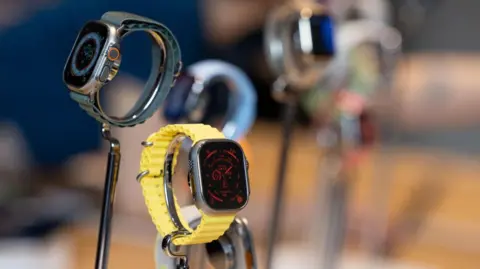
Apple's Watch dominates the wearable tech sector

Dr Jake Deutsch, a US-based clinician who also advises Oura, says wearable data enables him to “assess overall health more precisely” – but not all doctors agree that it’s genuinely useful all of the time.

Dr Helen Salisbury is a GP at a busy practice in Oxford. She says not many patients come in brandishing their wearables, but she’s noticed it has increased, and it concerns her.

“I think for the number of times when it’s useful there’s probably more times that it’s not terribly useful, and I worry that we are building a society of hypochondria and over-monitoring of our bodies,” she says.

Dr Salisbury says there can be a large number of reasons why we might temporarily get abnormal data such as an increased heart rate, whether it’s a blip in our bodies or a device malfunction - and many of them do not require further investigation.

“I’m concerned that we will be encouraging people to monitor everything all the time, and see their doctor every time the machine thinks they’re ill, rather than when they think they’re ill.”

And she makes a further point about the psychological use of this data as a kind of insurance policy against shock health diagnoses. A nasty cancerous tumour for example, is not necessarily going to be flagged by a watch or an app, she says.

What wearables do is encourage good habits - but the best message you can take from them is the same advice doctors have been giving us for years. Dr Salisbury adds: “The thing you can actually do is walk more, don’t drink too much alcohol, try and maintain a healthy weight. That never changes.”


The Apple Watch is reported to be the world’s best-selling smart watch, although sales have slowed lately.

Apple didn't comment, but the tech giant uses true stories of people whose lives have been saved because of the heart tracking function of the device in its marketing, and anecdotally I have heard plenty of those too. What I haven’t heard however, is how many cases of false positives there are.

In many cases when patients present their data to healthcare professionals, clinicians prefer to try to recreate it using their own equipment, rather than simply trust what the wearable has captured.

There are several reasons for this, says Dr Yang Wei, associate professor in wearable technologies at Nottingham Trent University – and they’re all very practical.

“When you go to hospital, and you measure your ECG [electrocardiogram, a test that checks the activity of your heart], you don’t worry about power consumption because the machine is plugged into the wall,” he says.

“On your watch, you’re not going to measure your ECG continuously because you drain your battery straight away.”

In addition, movement – both of the wearable itself on a wrist, for example, and general movement of the person wearing it - can “create noise” in the data it collects, he adds, making it less reliable.

Helen Salisbury
Dr Helen Salisbury wonders if wearable tech is creating more hypochondriacs

Dr Wei points to the ring on my finger.

“The gold standard to measure the heart rate is from the wrist or direct from the heart,” he says. “If you measure from the finger, you’re sacrificing accuracy."

It is the role of software to fill in such data gaps, he says - but there’s no international standard for wearables here - for either the sensors and software that power wearable devices, or for the data itself, and even what format it is gathered in.

The more consistently a device is worn, the more accurate its data is likely to be. But here’s a cautionary tale.

Ben Wood was out for the day when his wife received a series of alarming notifications from his Apple Watch, telling her he had been in a car crash. It advised her to text him rather than call because he may need to keep the line clear for the emergency services.

The alerts were genuine, and sent to her as his emergency contact – but in this case unnecessary. Ben was out at a race track driving some fast cars. He admitted that he “wasn’t very gifted” at it – but said he felt safe at all times.

“The boundaries between incident and alert need to be managed carefully,” he wrote in a blog post. “I’m curious to see how device-makers, emergency services, first responders and individuals think about this technology in the future.”

Pritesh Mistry, digital technologies fellow at the Kings Fund, agrees that there are significant challenges around folding current patient-generated data into our healthcare systems, and adds that the discussion has already been going on for several years in the UK without any clear resolution.

He says there’s “a good case to be made” for the use of wearables in the UK government’s current drive to push care out of hospitals and into community settings.

“But without that underpinning foundation of technology enablement in terms of the infrastructure, and supporting the workforce to have the skills, knowledge, capacity and confidence, I think it’s going to be a challenge,” he adds.