Wednesday, December 04, 2024

Maryland Offshore Wind Projects Receive Final BOEM Approval
offshore wind farm
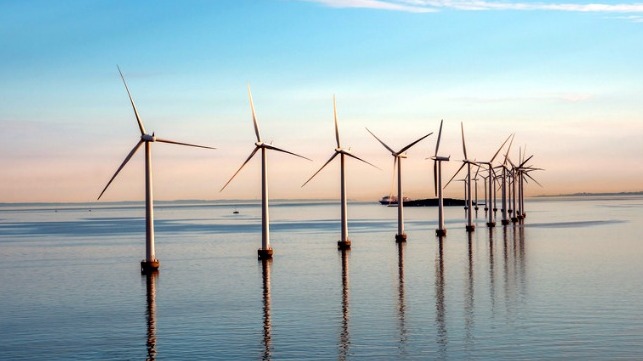
BOEM approved another large offshore US wind farm ahead of the end of the Biden administration (file photo)

Published Dec 3, 2024 4:45 PM by The Maritime Executive


The Bureau of Ocean Energy Management (BOEM) announced its approval of the Construction and Operations Plan for the Maryland Offshore Wind project. This is the final approval needed from BOEM for the project which has also received approvals from Maryland and recently the National Marine Fisheries Service.

“This project will power over 718,000 homes and support almost 2,680 jobs annually over seven years,” said BOEM Director Elizabeth Klein. The bureau noted that it is the approval of the nation’s tenth commercial-scale offshore wind energy project.

The Maryland Offshore Wind Project comprises a lease area located approximately 8.7 nautical miles offshore of Maryland and approximately 9 nautical miles from Delaware. U.S. Wind, a partnership between Italy’s Renexia and American investment firm Apollo Global Management, won its lease for nearly 47,000 acres in August 2014.  

“After more than four years of rigorous and robust analysis, we are thrilled to have secured this final BOEM approval,” said Jeff Grybowski, CEO of US Wind CEO. “US Wind’s projects will produce massive amounts of homegrown energy and will help satisfy the region’s critical need for more electricity, all while supporting good local jobs.”

The Department of the Interior issued its Record of Decision for the projects in September 2024 clearing the way for today’s approval of the Construction and Operations Plan. The approved project includes the multiple-phase construction and operation of up to 114 wind turbine generators, up to four offshore substation platforms, one meteorological tower, and up to four offshore export cable corridors. Two phases, known as MarWin (which was proposed as 300 MW with 22 turbines) and Momentum Wind (proposed for 800 MW with up to 55 turbines), are moving forward while the company has proposed a third phase. The first two projects also have offshore renewable energy certificates from the State of Maryland.

US Wind in July 2024 applied with Maryland to increase the total capacity of the company’s offshore wind portfolio by more than 600 MW, for a total of 1,710 MW. In total, US Wind’s application sought the authority to sell just under 7 million megawatt hours of offshore wind energy to Maryland annually, supporting the 1,710 MW build-out of the company’s entire federal lease area, with 840 MW proposed for OREC Round 1 and 870 MW proposed for OREC Round 2. US Wind said it would provide a critical foundation for Maryland to achieve its 8.5 GW goal.

The company has also committed to establishing Maryland’s first offshore wind factory – Sparrows Point Steel – in Baltimore County and facilitates the development of Maryland’s first offshore wind cable manufacturing facility in Baltimore City, Hellenic Cables.

It would be Maryland’s first offshore wind energy projects. The state also approved two phases for Ørsted's Skipjack Wind project that would have provided 966 MW. The company however in January 2024 withdrew its agreements saying, the proposed two-phase project was “no longer commercially viable because of today’s challenging market conditions, including inflation, high interest rates, and supply chain constraints.” Ørsted said it would reposition Skipjack Wind and in the future seek new state and federal approvals.


Akselos and ABS Partner to Drive Innovation in Floating Offshore Wind
Akselos
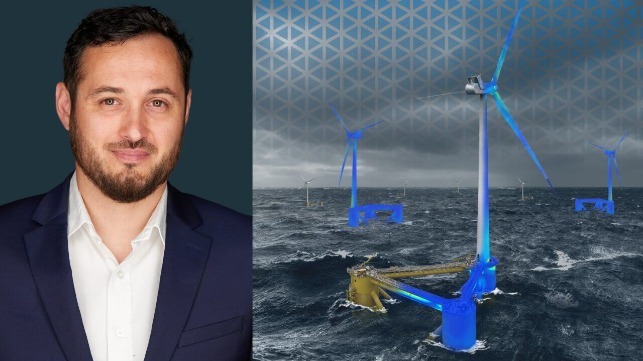
Guillaume Lechaton, Wind and New Energies Director at Akselos

Published Dec 2, 2024 12:19 PM by The Maritime Executive

[By: Akselos]

Akselos, the world’s leading provider of Structural Performance Management (SPM) software, and the American Bureau of Shipping (ABS), a global leader in classification and technical advisory services, have signed a Memorandum of Understanding (MoU) to advance the engineering, design verification, certification, and classification phases of floating wind projects.

Under this MoU, ABS and Akselos will collaborate to deliver best-in-class solutions for the floating wind sector, both in the U.S. and globally. This collaboration combines ABS's expertise in floating wind certification and classification with Akselos' advanced structural risk mitigation and optimisation technology. The partnership specifically targets the crucial design phase of floating offshore wind projects, aligning efforts to optimise costs and enhance efficiency, while simultaneously ensuring structural integrity.

The partnership will support the overarching goal set by the Floating Offshore Wind Energy Shot, which aims to reduce the cost of floating offshore wind energy by over 70%, reaching $45 per megawatt-hour by 2035 for deep-water sites far from shore.

“Our floating wind alliance with ABS, a leader in offshore certification and classification, is a strategic step to add value to this very promising yet challenging industry,” said Guillaume Lechaton, Wind and New Energies Director at Akselos. “By combining ABS's expertise with Akselos’ advanced simulation tools, we aim to create a framework for more reliable, robust, and cost-efficient solutions for designers and operators.” 

“Partnering with ABS, a leader in offshore certification builds upon years of collaboration in the upstream sector. It will further strengthen our offering by merging our simulation expertise with ABS’s industry leadership, ensuring safe, reliable, and high-performing FOWT designs”, said David Knezevic, Akselos' Chief Scientific Officer.

“The safe, sustainable, reliable and fit-for-purpose infrastructure required for the floating offshore wind market is crucial for the growth and evolution of the industry. Enabling enhanced technology solutions will aid in the reduction of LCOE, levelized cost of energy, and support decision making by financial and insurance institutions. The partnership between ABS and Akselos will support the ever-growing need for renewable offshore energy, cementing our position in the offshore wind market and continue to support the design, construction and installation of Floating Wind,” Rob Langford, Vice President, Global Offshore Renewables, ABS.

This MoU reinforces Akselos' commitment to delivering cutting-edge technologies that address the challenges of complex engineering environments, paving the way for increased innovation and reliability.

The products and services herein described in this press release are not endorsed by The Maritime Executive.


BOEM Identifies Environmental Measures for NY Bight Wind Energy Development
offshore wind farm
BOEM continues its efforts for offshore wind as the industry faces uncertainty udner the new administration (file photo)

Published Dec 2, 2024 6:56 PM by The Maritime Executive


The Bureau of Ocean Energy Management today issued a Record of Decision identifying environmental measures expected to be applied to future wind energy development of the six lease areas offshore New York and New Jersey in an area known as the New York Bight. The bureau continues to push forward offshore wind projects with some experts saying the goal is to secure as much of the development before the end of the Biden administration in January 2025.

The six lease areas in the New York Bight cover over 488,000 acres and were sold in a record auction at the peak of interest in offshore wind energy receiving total bids of over $4.3 billion. BOEM continues to estimate that full development of the six lease areas could generate up to 7 GW of offshore wind energy, enough to power up to two million homes.

For the first time, BOEM conducted a regional analysis of offshore renewable energy development and operations over multiple lease areas designed to expedite the projects in the NY Bight. BOEM reported in January 2024 that it decided to take this step to complete a Programmatic Environmental Impact Statement (PEIS) because of the close proximity of the six lease areas and the timing of when BOEM expects to receive future project plans for review.  

The Draft PEIS analyzed programmatic avoidance, minimization, mitigation, and monitoring measures that BOEM may require as conditions of its approval for any proposed offshore wind projects in the New York Bight. It was followed in October with the completed environmental review to assess potential wind development activities within six wind lease areas. The Proposed Action for the PEIS identified avoidance, minimization, mitigation, and monitoring measures that BOEM reported it may require as conditions for approval for activities proposed by lessees in the individual construction and operations plans submitted for these six lease areas. Additional environmental analyses specific to each proposed project would build on the PEIS.

Today’s record of decision identifies 58 previously applied avoidance, minimization, mitigation, and monitoring measures BOEM plans to apply across the six lease areas. To reduce potential environmental impacts, developers can consider these measures in the Construction and Operations Plans they submit to BOEM for subsequent review.

The six lease areas went to many of the leading developers in the industry. Bluepoint Wind, a partnership between Ocean Winds (a joint venture of EDP Renewables and ENGIE) and Global Infrastructure Partners (GIP), has one of the leases. Attentive Energy is part of France’s TotalEnergies while Community Offshore Wind was set up as a joint venture between RWE and National Grid Ventures. 
Atlantic Shores Offshore Wind Bight was a partnership between Shell New Energies US and EDF-RE Offshore Development, while Invenergy partnered with energyRe on another one of the leases and the final lease went to Vineyard Mid-Atlantic, an extension of Vineyard which has investments from Copenhagen Infrastructure Partners.

Some of the projects have submitted early proposals to state regulators in New York and New Jersey but all are in the survey and planning stages. TotalEnergies, citing the political uncertainties, last week however said it planned to shelve its project. The others could use the work developed by BOEM to submit their individual environmental studies and construction and operation plans to BOEM. 

Donald Trump during the presidential campaign renewed his opposition to offshore wind saying he would stop the industry. Industry groups however point out progress during the first Trump administration and hope to be able to continue development of renewable energy projects, possibly at a slower pace.


Sri Lanka Prepares to Launch Bidding for its First Offshore Wind Farms
iStock wind farm image
iStock

Published Dec 1, 2024 10:04 PM by The Maritime Executive


Sri Lanka is planning to issue tenders for the development of two 500 MW offshore wind farms, according to Ceylon Electricity Board (CEB) Chairman Tilak Siyambalapitiya. CEB is currently carrying out feasibility studies along the Sri Lankan west coast, specifically in the Mannar and Puttalam areas, which have been identified as suitable for offshore wind development. The studies will be complete by 2027, paving the way for bidding rounds in the following year.

“We have commenced a comprehensive study to prepare a roadmap for deploying offshore wind turbines. Backed by the World Bank, the initiative has completed a pre-feasibility study this year. The findings recommend targeting 1,000 MW of offshore wind development in the initial phase. Power generation is anticipated to start by 2030,” Siyambalapitiya told local media.

The World Bank estimates that Sri Lanka's total offshore wind potential is about 56GW, with the western and southern coasts having the most suitable wind speeds and technical conditions. Two areas near Mannar Island and Puttalam were identified to be suitable for fixed-bottom foundations, with moderate wind speeds averaging 8-9 m/s.

Out of the 56 GW of offshore wind potential, 27 GW of capacity is located in water depths of less than 50 meters, where fixed-bottom turbines are suitable. The rest of the 29 GW is floating wind capacity, located in deep waters of between 50-1,000 meters.

Sri Lanka has identified offshore wind as an important component of its carbon-neutral future. Last week, the Asian Development Bank (ADB) approved a $200 million loan to upgrade Sri Lanka’s power sector infrastructure, facilitating greater integration of renewable energy.

While Sri Lanka’s total installed power generation capacity reached 5.2 GW in 2023, about 50 percent of the country’s electricity generation came from thermal power plants. But in its updated nationally determined contribution, Sri Lanka has set an ambitious target of 70 percent electricity generation from renewables by 2030 and carbon neutrality in the power sector by 2050.  


IMO Gives Bravery at Sea Award to Survivors of Houthi Attack

Fire aboard the Marlin Luanda (Marine Nationale)

Published Dec 3, 2024 8:33 PM by The Maritime Executive


The captain and crew of the tanker Marlin Luanda, who were attacked by Houthi terrorist earlier this year, have been granted the IMO Award for Exceptional Bravery at Sea. 

On January 26, the Marlin Luanda was under way in the Gulf of Aden with a cargo of 84,000 tonnes of Russian-origin naphtha, bound for South Korea. That evening, Houthi forces hit the Marshall Islands-flagged ship with an anti-ship ballistic missile, sparking a fire. 

Capt. Avhilash Rawat mustered his crew at the port lifeboat station, as the starboard lifeboat had been destroyed in the explosion. Meanwhile, the crew's fire teams fought the fire with foam monitors and hoses. Even after using up all of their foam supplies, and after the fire had spread to an adjacent tank, they continued to fight the blaze using seawater alone.

After about four hours, the tanker Achilles arrived on scene to assist, followed by the French frigate FS Alsace, the U.S. Navy destroyer USS Carney and the Indian Navy's INS Visakhapatnam. These responders supplied the Luanda's crew with more foam to keep fighting the fire, which kept re-igniting despite extinguishing efforts. 

Capt. Rawat was advised to abandon ship by expert consultants, but he and his crew stayed in the fight to preserve the vessel, at great personal risk. The crewmembers were eventually aided by trained marine firefighters from INS Visakhapatnam, who boarded the vessel and helped put out the last of the blaze. The vessel survived and transited safely to a port of refuge under its own power. 
 
On Monday, Captain Rawat?was at the IMO's annual award ceremony to receive the medal and certificate. "I want to take this opportunity to thank my entire crew for their exceptional courage, professionalism, and unwavering dedication. Your support and trust were invaluable during those critical hours, and together, we overcame challenges that seemed insurmountable," he said. "As we sail through both calm and stormy waters, let us remember that it is our unity, skill, and determination that strengthen us and keep us committed to the work we do." 

Captain Brijesh Nambiar (Indian Navy) and the crew of the?INS Visakhapatnam were also awarded letters of commendation for their contributions to the firefighting effort onboard?Marlin Luanda. 

IMO also granted this year's Award for Exceptional Bravery at Sea to Captain Jorge Fernando Galaviz Fuentes?and the crew of the tugboat?Pemex Maya. Capt. Galaviz and crew exhibited "outstanding courage, seamanship skills and resolve displayed in the rescue of six shipwrecked persons from four different vessels, in extreme weather and heavy seas caused by a hurricane," IMO said. 

On October 25, 2023, Hurricane Otis rapidly intensified ahead of landfall and hit Acapulco as a Category 5 storm. Wind speeds exceeded 160 knots and wave heights were in the range of 16 feet. 

The Pemex Maya's crew prepared to wait out the storm in the shelter of the Bay of Santa Lucia. However, at great risk to their own safety, they departed the area to assist other vessels in distress during the peak of the hurricane. 

At 0230 hours, in the dark of night, Pemex Maya maneuvered towards light signals from three people in lifejackets and successfully retrieved them from turbulent waters. Shortly after, the crew rescued another survivor who was found clinging to a piece of wood without a lifejacket. 

Two more survivors were spotted an hour later, wearing life jackets and drifting in the water. The Pemex Maya used life buoys to reach and haul both of them to safety. 

In each case, the Pemex Maya had to execute precise and hazardous movements in high winds and waves, and the crew had to reach and retrieve each survivor in extremely rough water. Each one of these evolutions would be a challenge for any crew, and Pemex Maya successfully carried out six of them back-to-back, in darkness and in the middle of a hurricane.  

At dawn, with the worst of the storm over, the?Pemex Maya?anchored in Acapulco. The survivors were in shock but otherwise in good health, and were transferred ashore for treatment.

"In those moments of uncertainty, our strength did not come only from preparation but from a shared commitment: to safeguard lives, even at the risk of our own," said Captain Jorge Fernando Galaviz Fuentes. "United as a maritime community, we are capable of overcoming any storm."

The IMO also issued dozens of letters of commendation, including nine for the good Samaritans and first responders who rescued survivors of the Lahaina wildfire on Maui, Hawaii in August 2023.  


Two Destroyers Defend U.S. Merchant Ships From Houthi Missile Barrage

An SM-3 interceptor launched by a U.S. Navy destroyer (USN file image)

Published Dec 1, 2024 11:34 PM by The Maritime Executive


Over the course of Saturday and Sunday, two U.S. Navy destroyers shot down half a dozen Houthi-launched munitions while escorting U.S.-flagged merchant ships through the Gulf of Aden. The successful transit illustrates the service's defensive capabilities, but also shows the Houthis' continued ability to target passing shipping at will - despite multiple rounds of U.S. airstrikes on the group's bases in Yemen.  

According to U.S. Central Command, destroyers USS Stockdale and USS O'Kane were escorting three U.S. merchant ships through the Gulf of Aden on Saturday when they came under fire. The destroyers shot down three anti-ship ballistic missiles, three attack drones and one anti-ship cruise missile over the course of two days. 

"These actions reflect the ongoing commitment of [Central Command] forces to protect U.S. personnel, regional partners and international shipping against attacks by Iran-backed Houthis," CENTCOM said in a statement. 

Houthi spokesman Yahya Saree identified the target vessels as the product tanker Stena Impeccable, the boxship Maersk Saratoga and the bulker Liberty Grace. As of Monday morning, all three vessels were in port at Djibouti, where the U.S. maintains a military base. 

"The strikes were accurate and direct," said Saree. "The [Houthis] will continue to carry out their military operations at an escalating pace . . . [and] will not stop except by stopping the aggression and lifting the siege on the Gaza Strip." 


Video: HMM Containership and Greek Tanker Collide off Spain

tanker damaged in collision
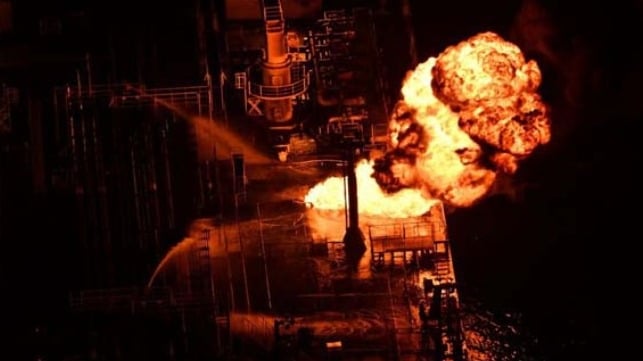
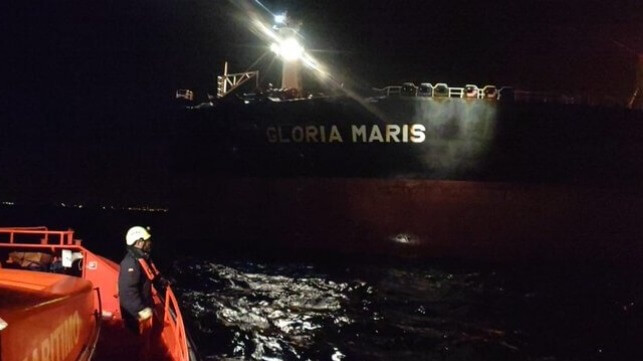
Tanker and containership ordered held after they collided near Algeciras (Salvamento Maritimo)

Published Dec 3, 2024 12:50 PM by The Maritime Executive


Spanish authorities are detaining an HMM containership and a Greek-managed crude tanker after the vessels collided off the port of Algeciras early this morning, December 3. Both vessels remained seaworthy and the authorities are reporting no injuries or pollution at this time. There are 24 crewmembers on the containership and 25 on the tanker.

One of the largest containerships in the world, the HMM St. Petersburg (229,000 dwt) was inbound to Europe after a six-week trip from Yantian, China diverting around Africa and skipping a scheduled port call in Colombo, Sri Lanka. There is no information about the load aboard the vessel which was built in 2020 as one of the HMM’s new largest class of containerships but it has a rated capacity of 23,964 TEU. The ship is registered in South Korea.

The crude oil tanker Gloria Maris (156,620 dwt) registered in Liberia was outbound from Cartagena, Spain where it had departed on November 30. It had offloaded a cargo of 147,564 tonnes of crude and was in ballast awaiting its next assignment.


Spain’s Salvamento Maritime reports it was notified of the collision by the tanker at approximately 0520 this morning. The two vessels were approximately 8.9 miles southeast of Algeciras. It dispatched two patrol boats to assess the situation.

An initial inspection is reported to show structural damage to both vessels. Images show the bow of the tanker crushed. Pictures online appear to show a dent in the starboard side of the HMM containership amidship near the deckhouse and bridge. After determining there was no immediate danger, the Captain of the Port of Algeciras permitted the HMM containership to proceed to its berth in the port. The tanker was ordered to wait in the anchorage.

The Port Captain is leading the initial investigation to clarify the cause of the incident. Further safety checks have also been ordered before the vessels will be permitted to depart Algeciras.


Malaysia Evacuates Crew from Burning Car Carrier

car carrier fire
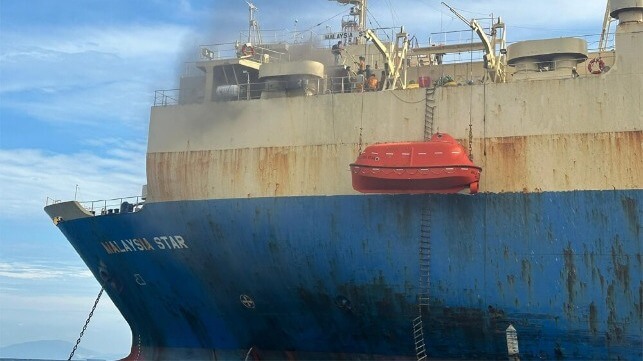
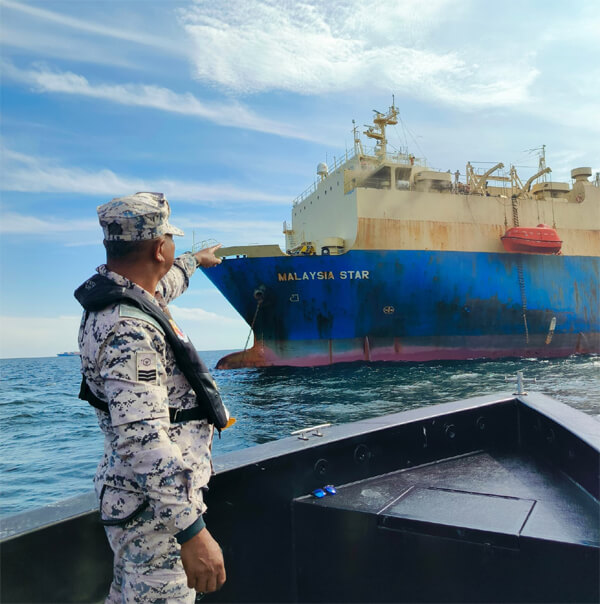
Crew was evacuated from the burning car carrier (photos Malaysia Maritime)

Published Dec 3, 2024 6:43 PM by The Maritime Executive


[Brief]  The Malaysian Coast Guard reported the evacuation of 19 crewmembers from a car carrier that caught fire on December 2. The crew of 18 Filipinos and one Malaysian were safely removed and transferred to shore by a Malaysian patrol boat.

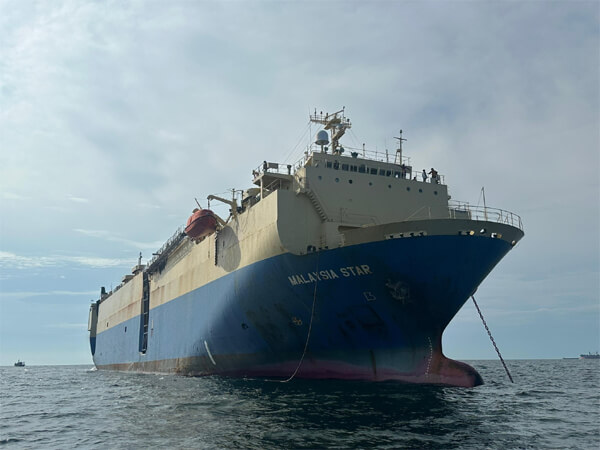
The vessel named Malaysia Star (9,300 dwt) was traveling within Malaysia from Port Klang to Kota Kinabalu in the northern part of the island of Borneo when it experienced problems. The fire was reported at 0840 local time Monday morning and the vessel dropped anchor approximately 9 nautical miles from Tanjung Laboh, Batu Pahat Johor, near the southern tip of the peninsular on the Malacca Strait.


Fire fighting efforts were reported to be continuing after the vessel was evacuated (Malaysia Maritime)


Malaysia Star is a locally owned and registered car carrier built in China in 1992. It has a capacity of 1,466 vehicles. 

Two Malaysia Maritime patrol boats and a vessel from the Marine Police Force were dispatched to the vessel. Pictures show smoke coming from the vessel with the authorities reporting the fire was near the vessel’s fuel tanks. The crew was removed from the vessel due to the dangers.

The fire fighting effort was reported to be continuing. The cause of the fire was not known, but the vessel has been cited during Port State inspections. In June the authorities in Bangladesh identified issues with the fire detection system and fire dampers. In two prior Port State inspections the authorities listed deficiencies with oil and dirty mixtures from the machinery spaces.


Photos: Grounded Freighter Sinks Off Egypt's Red Sea Coast

HEPCA
Courtesy HEPCA

Published Dec 2, 2024 4:00 PM by The Maritime Executive


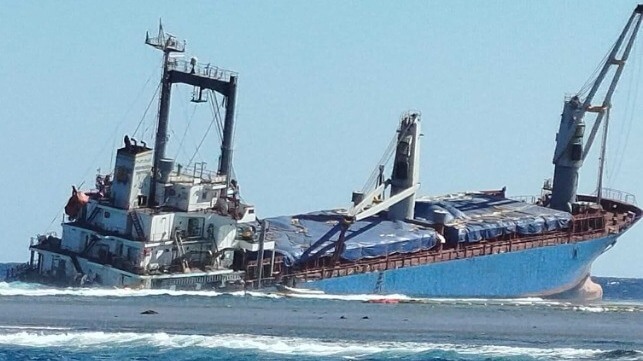
On Monday, the grounded cargo ship VSG Glory sank just off Egypt's Red Sea coast, threatening to spill fuel in a region famous for its coral reefs.

On Nov. 22, the 300-foot coastal freighter VSG Glory was under way from Hodeidah to Port Tawfiq when she ran aground on a reef near El Quseir, just off the coast from two luxury resorts. The area is known for its near-shore diving attractions, including coral gardens and submerged caverns, and tourism is a major part of the local economy. She was reportedly carrying 70 tonnes of fuel oil in her tanks, and light pollution was reported shortly after the grounding. All crewmembers were safely evacuated. 

Egypt's authorities have responded to the grounding with a substantial pollution control effort. According to local environmental advocacy group HEPCA, two large ships arrived at the site to pump out the vessel’s tanks, and as of Saturday, 250 tons of contaminated water and fuel had been removed. As the list increased, the response team worked to bring in additional pumping capacity, and divers were sent down to attempt to weld up penetrations in the hull. Nearly a dozen agencies and organizations are involved in the response, including Egypt's defense ministry. 


However, the VSG Glory was in rough shape: photos taken Saturday show that the freighter was down by the stern, with water up to the main deck level. Reuters reported that she had a hull penetration nearly two feet long in the engine room.

By Monday, just the bow of the ship was visible above the waves, and the stern had slipped off the reef into deeper water. 


Lightering Planned After Bulker Stuck in St. Lawrence Fails to Budge

grounded bulker St. Lawrence River
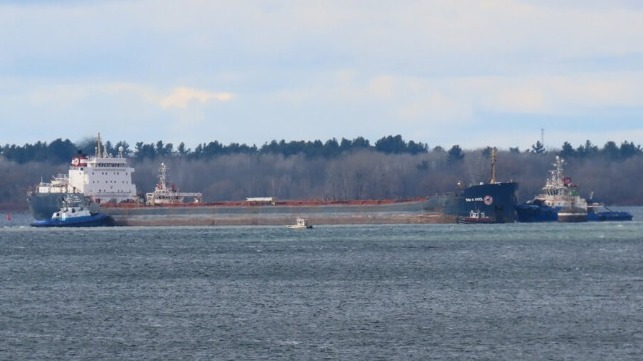
Tugs failed to refloat the bulker Tim S. Dool (SeawayNNY photo on X)

Published Dec 2, 2024 5:57 PM by The Maritime Executive


Officials report a new plan is being developed after the Canadian bulker Tim S. Dool (28,471 dwt) failed to budge in several refloating attempts on the St, Lawrence River southwest of Montreal. The vessel has been stuck for more than a week.

The bulker which has a capacity for over 28,000 metric tons and is loaded with Canadian wheat went aground on the river midday on November 23. A survey confirmed that there was no significant hull damage, pollution, or water ingress. The crew aboard the vessel did not report any injuries, but the ship was firmly stuck on the U.S. side of the river near Massena, New York. The vessel is located outside the navigation channel, and the St. Lawrence Seaway continues to operate normally with no interruptions to traffic.

At the beginning of last week, reports said the ship was trying to free itself with locals saying that had seen the water churning and smoke coming from the funnel. But the ship built in 1967 and operated by Algoma Central Corporation on the Great Lakes would not budge.


They sent for reinforcements while the U.S. Coast Guard, Canadian Coast Guard, the Great Lakes and St. Lawrence Seaway Development Corporation, and the National Response Corporation coordinated efforts to complete an underwater survey to assess the feasibility of safely pulling the vessel free. Three tugs coming from Quebec completed the two-day trip, and on Friday, November 29, they tried to refloat the bulker. The Tim S. Dool still would not budge.

The U.S. Coast Guard and the St. Lawrence Seaway Management Corporation report plans are being made to remove part of its cargo to lighten the ship before another attempt to refloat it is made. Barges will have to be brought along the river for the lightering effort which is expected to take several days.

For now, the vessel has become a local tourist attraction with river watches enjoying a rare view of a Great Lakes bulker stuck.


Portugal plans to hold delayed lithium tender in 2025

Reuters | December 3, 2024 |
Portuguese Parliament building. Credit: Wikimedia Commons

Portugal’s government plans to launch a long-delayed tender of lithium prospecting licences in 2025 as it seeks to make the country a top European supplier of critical metals for the green transition, it said on Tuesday.


The center-right government, which took over in April, said that the international tender for lithium prospecting will target six areas in the north and center of the country.

The previous Socialist administration initially planned an auction in 2018 but concerns about the environmental and social impact of lithium mining have led to multiple delays to the auction.


Environment Minister Maria da Graca Carvalho said that the tender is part of Portugal’s plans to meet Europe’s goals to ensure greater security and reduce dependence on imports of critical materials from countries such as China.

“Our intention is to move forward with the tender in 2025,” she told journalists, adding that the government wants to speed up the licensing processes for projects, “but will be demanding in assessing the environmental impacts.”

With some 60,000 tonnes of known reserves, Portugal is Europe’s biggest lithium producer but its miners sell almost exclusively to the ceramics industry and are only now preparing to produce the higher-grade lithium for use in electric vehicles.


Portugal’s environmental agency APA has already given its initial approval to lithium extraction at the Barroso mine, owned by London-based company Savannah Resources, and at the Montalegre mine of the local firm Lusorecursos, both in the north of the country.

The start of exploration in both mines is scheduled for 2027 as they still need licensing authorizations for the concrete projects.

Lithium miners around the globe are struggling with low prices for this ore, which have fallen by more than 45% so far this year, largely due to overproduction from China and a drop in demand for EVs.

China supplies two-thirds of processed lithium globally and, according to International Energy Agency data, it has also taken a huge lead in powering EVs, controlling 85% of global battery cell production.

Carvalho also said that the government intends to launch tenders for new copper and gold prospecting licences next year.

Portugal already has the sixth-largest copper mine in Europe, operated by Toronto-based Lundin Mining. It had stopped actively exploring for gold more than 30 years ago.

(By Sergio Goncalves; Editing by Aislinn Laing and Mark Porter)
McEwen’s Los Azules copper project gets key environmental approval

Staff Writer | December 3, 2024 |


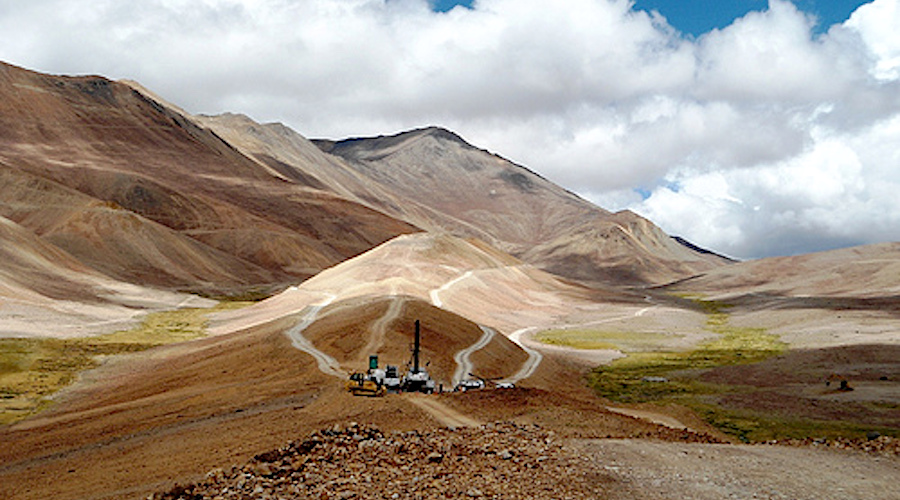
Los Azules copper project in San Juan, Argentina.
 (Image courtesy of McEwen Mining.)

McEwen Mining (NYSE: MUX) (TSX: MUX) announced Tuesday that the environmental impact assessment (EIA) for its Los Azules copper project has been approved by Argentina’s San Juan province, paving the way for its construction as early as 2026.


Commenting on the project’s environmental approval, Robert McEwen said: “Our commitment to modern, sustainable and regenerative mining practices at Los Azules is reflected in our PEA and EIA, and we continue this work through our upcoming definitive feasibility study.”

According to a preliminary economic assessment released last year, the Los Azules project is anticipated to produce approximately 322 million lb. of copper in cathodes over an estimated 27-year life. Current copper resources are 10.9 billion lb. in ore that grades 0.40% copper in the indicated category and 26.7 billion lb. in material averaging 0.31% copper in the inferred category.

The deposit is located about 80 km west-northwest of the town of Calingasta and 6 km east of the border with Chile, at an elevation of 3,500 metres in the Andes Mountains.
Green copper

Aside from its production profile, the Los Azule project is also being developed as “a multi-generational green copper asset,” as McEwen Mining describes on its website.

In an interview with The Northern Miner earlier this year, Rob McEwen said he envisions Los Azules “a leader in sustainability, innovation and economic viability.” The mine would use less than a quarter of the water required by conventional copper processing methods, emit less than half the carbon and consume less than half the power.

VIDEO: Rob McEwen, maverick mining legend & green copper visionary

Additionally, all the electricity is to come from renewable sources, provided by the Argentine state-owned company YPF Luz. The project also has the backing of Nuton, a Rio Tinto (NYSE: RIO; LSE: RIO; ASX: RIO) venture that has developed a propriety heap leaching technology that is being tested by many other copper mine developers. Nuton recently upped its stake in McEwen Copper, the subsidiary holding the Los Azules project, by investing $35 million.

The approval of its environmental impact study, says McEwen Mining, highlights the support for this project and copper mining as a whole in the province of San Juan. The company first submitted the IEA in April 2023, which was compiled by engineering company Knight Piesold and supported by a team of 22 experts.

“This milestone propels Los Azules forward and highlights its transformative potential for the province and Argentina’s mining industry,” Michael Meding, VP and general manager of the McEwen Copper unit, said.

Meding recently told Reuters that the key environmental permit for Los Azules was due in four to six weeks, and once received, the company would start planning for construction around the end of 2025. He also said it plans to raise $2.5 billion to fund the construction.

Now with the EIA approval in place, the next step for the Los Azules project is the definitive feasibility study, which is expected in the first half of 2025.

Shares in McEwen Mining shot up 10.5% to C$12.96 on Tuesday morning in Toronto following its receipt of this key approval. The stock surge gives the company a market capitalization of C$685.9 million.
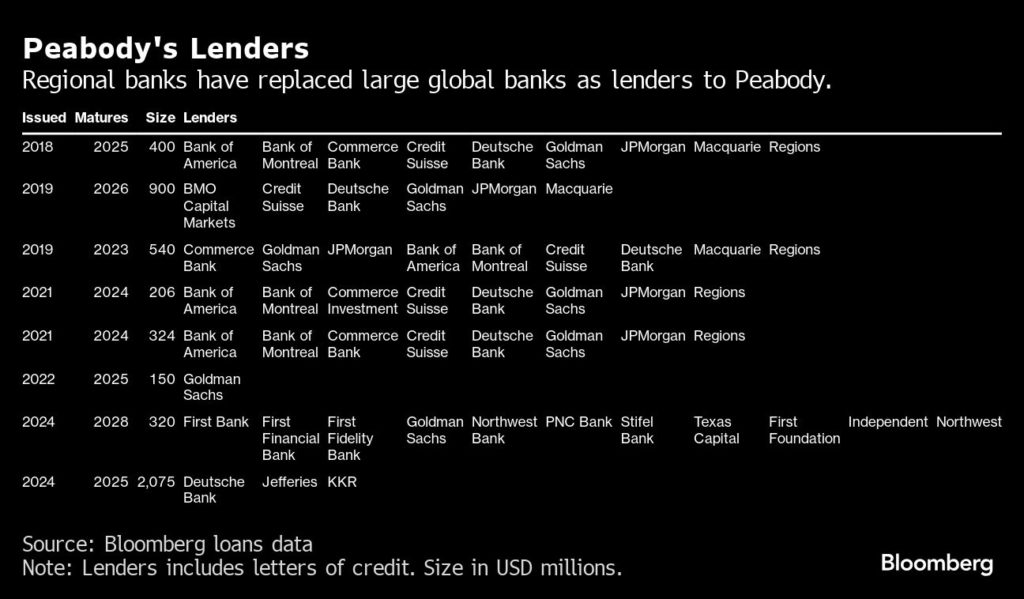
Deutsche Bank sticks out among financiers of Peabody’s coal loan

Bloomberg News | December 2, 2024 | 

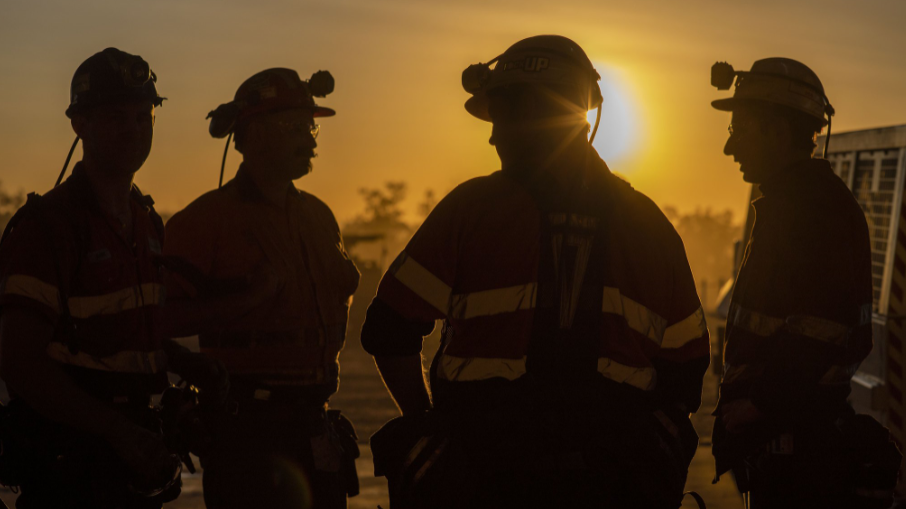
Workers at Grosvenor mine (Credit: Anglo American)

When Peabody Energy Corp. agreed to buy the coal assets of Anglo American Plc, only one European lender joined the US investment bankers and private credit specialists financing the deal: Deutsche Bank AG.


Peabody obtained a $2.1 billion bridge loan to help it pay for the acquisition, according to a Nov. 25 filing. Behind that loan are divisions of KKR & Co., a unit of Jefferies Financial Group Inc. and Deutsche Bank. Of the firms providing financing, only Deutsche Bank has published an explicit policy on coal.

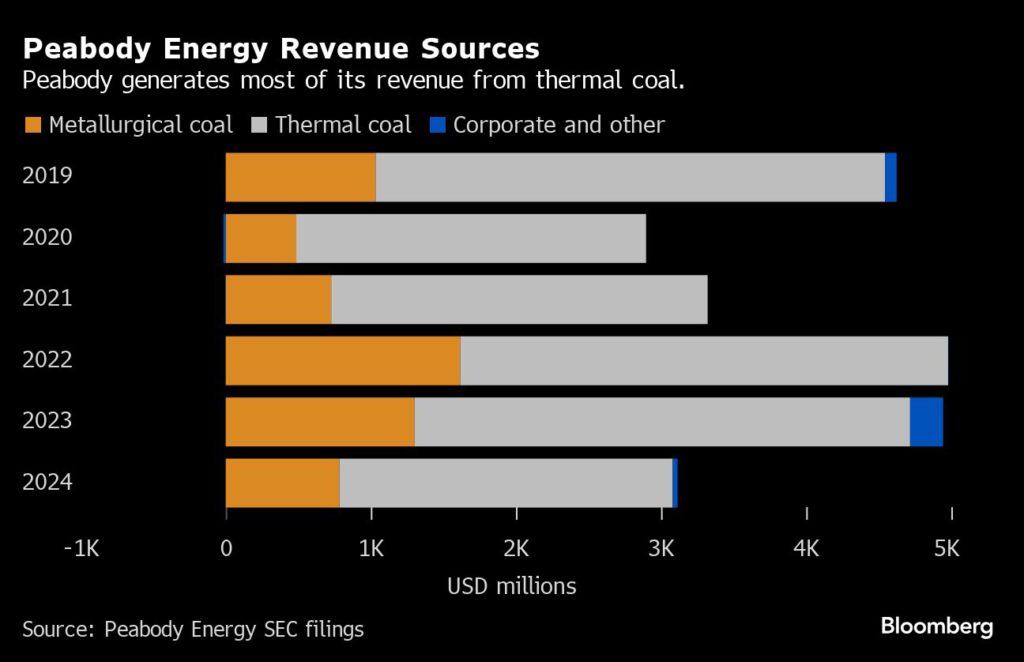
At issue is the extent to which the financing crosses a line at the German bank, whose exclusion policy singles out the thermal coal used for heating and electricity. The mines Peabody is acquiring produce mostly metallurgical coal, which is used in the manufacture of steel. But the company produces both types of coal across its operations and one of the mines being acquired produces thermal coal.

A spokesperson for Deutsche Bank said any business it does involving coal is closely analyzed and all transactions are in line with its exclusion policy.

But climate activists say the distinction between different grades of coal is arbitrary, and ultimately irrelevant when it comes to measuring environmental damage.

“Coal is coal regardless of its end use,” said Cynthia Rocamora, an industry campaigner at climate nonprofit Reclaim Finance. All types are “extremely polluting and need to be phased out,” she said.


Coal that’s broadly classified as metallurgical — often called met coal — can be sold in thermal-coal markets. In fact, it’s something that happens regularly for lower quality metallurgical products like pulverized coal injection (PCI) and semi-soft coking coal, according to Alexandre Claude, chief executive of DBX Commodities, a dry-bulk tracking firm.

The switch was particularly common in 2022 after Russia’s invasion of Ukraine upended pricing. From Europe to Asia, utilities took delivery of met coal to fire power plants as the cost of thermal coal surged.

Vic Svec, vice president of investor relations at Peabody, said “a small amount of crossover volumes by any metallurgical coal producer is always possible.” He also said there’s a “very high probability” that the coal from the mines Peabody is acquiring from Anglo American will go to steel markets.

In a February filing with the US Securities and Exchange Commission, Peabody said it “may market some of its metallurgical-coal products as a thermal-coal product from time to time.”

Details of the Peabody loan


Peabody secured a commitment letter from Deutsche, Jefferies and KKR to provide up to $2.08 billion to finance its acquisition of Anglo American’s coal mines. Peabody said in its public disclosure that the bridge loan facility isn’t expected to be drawn in full if future equity offerings and additional debt placement are successful. The company’s expectation is that it will “reduce the bridge commitments through such offerings or financings, possibly to zero, prior to the closing date.”

In practice, most met-coal mines produce some thermal coal as a byproduct meaning companies can’t reasonably claim to be pure-play met-coal producers. And since money is fungible, financing one type of coal asset can end up bankrolling the other.

However, coal producers and the financial institutions backing them have long sought to distinguish between metallurgical and thermal coal. Most banks and asset managers treat the former as a more acceptable risk because of the role it plays in the production of the steel needed to enable the clean-energy transition.


In reality, metallurgical coal can be up to three times as polluting as thermal coal, according to Wood Mackenzie, an energy consultancy. It’s also possible to produce steel without coal. So-called green steel can be manufactured using alternative energy sources, with BloombergNEF estimating that the combination of hydrogen and recycling will help spur a tenfold increase in production through 2030. That’s why some financial firms have started to adjust exclusion policies beyond just thermal coal.

Data collected by Reclaim Finance show that of 99 banks it analyzed, nine have adopted metallurgical coal policies, including BNP Paribas SA and Macquarie Group Ltd. And Zurich Insurance Group AG became the first insurer to add restrictions on metallurgical coal mining earlier this year. Meanwhile, 372 of 386 financial firms analyzed by Reclaim Finance have policies targeting thermal coal only.

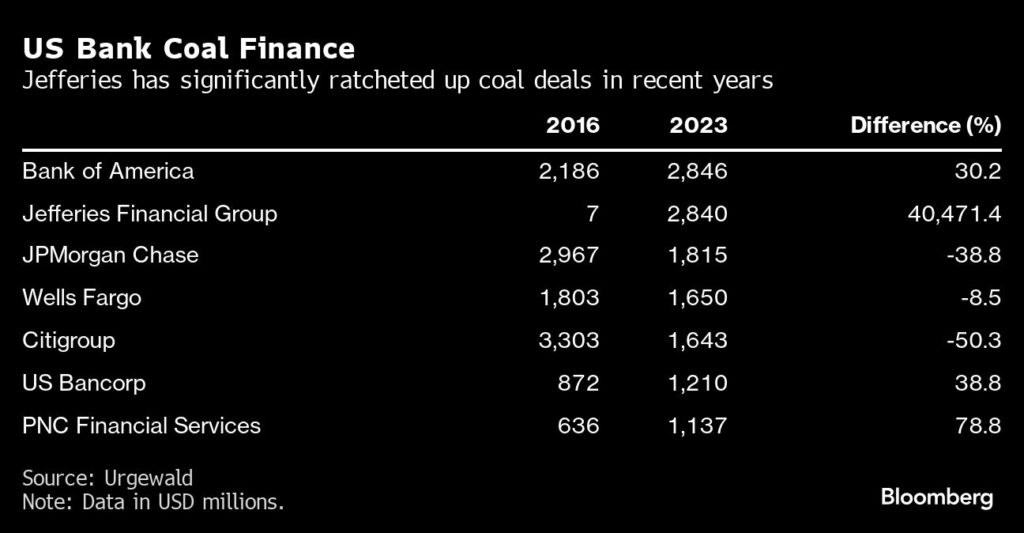
Data compiled by nonprofit Urgewald show that US and Chinese banks provide the most coal finance, with Jefferies standing out as having significantly ratcheted up deals in recent years.


In Europe, Deutsche Bank made smaller cuts to its coal exposure between 2016 and 2023 than peers, Urgewald data show. For example, while UBS Group AG and BNP reduced their exposure over the period by 77% and 67%, respectively, Deutsche Bank cut its coal financing by just 4%. To be sure, Deutsche’s starting point in 2016 was meaningfully lower. But by the end of 2023, it was financing 50% more coal than BNP, and 29% more than UBS, the data show.

At the same time, thermal-coal companies that diversify into metallurgical production are finding it easier to get financing. Whitehaven Coal Ltd., one of Australia’s largest producers of the commodity, gained better access to insurers after announcing its move into met coal, Bloomberg has reported.

And Peabody, which had seen large banks such as JPMorgan Chase & Co., UBS and Bank of America Corp. retreat from its financing in recent years, is now finding that it has easier access to capital.

“We see expanding access to all aspects of the investment community based on the dramatic transformation of Peabody into a company with three-quarters of its cash flows coming from metallurgical coal,” Svec said.

Some banks, including Goldman Sachs Group Inc. and Jefferies, have stuck with the company throughout, according to data compiled by Bloomberg.

Spokespeople for Macquarie, JPMorgan, Goldman Sachs, Bank of America, Jefferies and UBS, which took over Credit Suisse last year, declined to comment.


Nonprofits also have identified instances in which companies have downplayed the portion of coal production that’s thermal. Whitehaven Coal, for example, “greatly overestimated” its metallurgical, or coking, coal output at two mines in Australia, according to Market Forces, a nonprofit, and Energy & Resource Insights, a consultancy. And Bharat Coking Coal Ltd., a subsidiary of Coal India Ltd. that says it specializes in metallurgical coal, sent 68% of its production to power-sector customers in the financial year ended March 31, according to its annual report.

A spokesperson for Whitehaven declined to comment. Bharat didn’t respond to a request for comment.

“Given the uncertainty of what the end use is going to be for each type of coal, a safe approach is to just restrict financing for any type,” said Rocamora of Reclaim Finance. “The differentiated approach between met and thermal coal shouldn’t exist.”

(By Natasha White)
Steel industry will take more time to decarbonize, says Vale CEO

Reuters | December 3, 2024 |

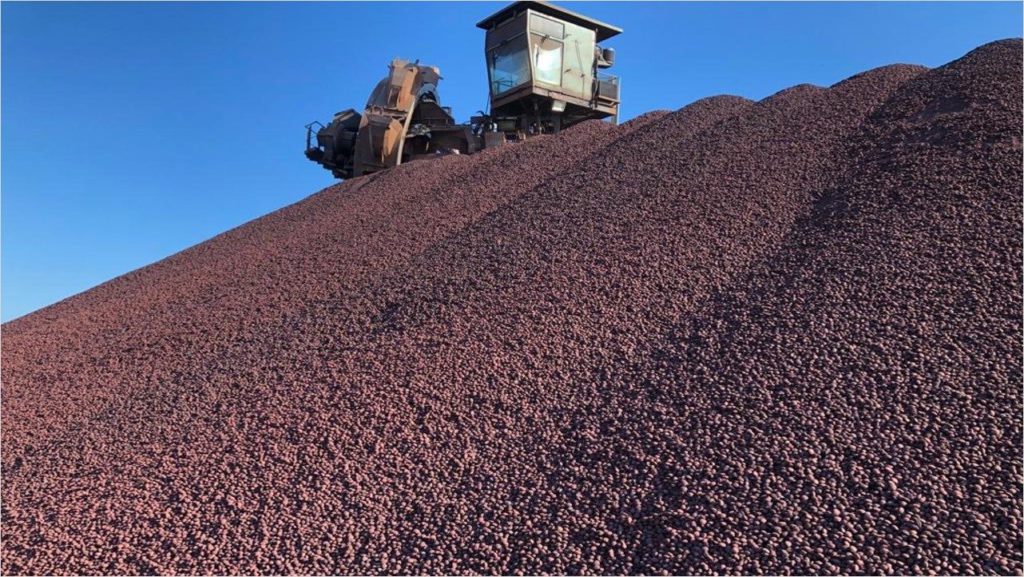
Iron ore briquettes stockpile. Credit: Vale

The steel industry will take more time than initially thought to adopt production models that reduce their carbon footprint, due mainly to higher costs associated with those models and a challenging global market for steelmakers.


“It has been hard for them to transition to lower-carbon products, hard to maintain the business in a profitable way,” said Gustavo Pimenta, chief executive of Vale SA, one of the world’s largest suppliers of iron ore.

“It is going to happen (the decarbonization), but it will take more time,” he told reporters at the New York Stock Exchange after the company’s annual investors’ day.

Steel producers around the world have been pressured by increased costs due to high interest rates and lower steel prices on the back of China’s faltering economy. Pimenta said they are looking mostly at staying profitable at the moment, preferring cheaper raw materials.

Vale has been vocal about producing high-quality grades of iron ore that result in lower carbon emissions, but price is a big issue currently, said the CEO.

“Clients at the auto industry, for example, are not willing yet to pay for products that are lower in carbon,” he said.
New guidance

Vale on Tuesday estimated It will produce between 325 million and 335 million metric tons of iron ore in 2025, compared with about 328 million tons this year.

The 2024 figure was within a previously announced 323 million to 330 million ton forecast.

Iron ore weakness to continue into 2025 and beyond, says Fitch Solutions’ BMI

“The iron ore production target and capex (capital expenditure) for 2025 were both in line with our official estimates,” Itau BBA analysts said in a note.

The Brazilian company reiterated it expects to keep increasing iron ore output in the coming years, estimating it to reach between 340 million and 360 million tons in 2026 – unchanged from a previous forecast – and about 360 million tons in 2030.

RBC analysts reacted negatively, saying that although iron ore output and cost projections met expectations, lower iron ore premiums should help trigger consensus downgrades.

“We forecast 2025’s guidance at mid-point will downgrade consensus EBITDA (core earnings) expectations by 12%,” RBC said.

Vale shares were down 0.4% in Sao Paulo late in Tuesday.
Base metals

Vale also said it expects to produce 340,000 to 370,000 tons of copper in 2025, from about 345,000 tons this year.

Vale’s copper production is expected to reach 350,000 to 380,000 tons in 2026, 420,000 to 500,000 tons in 2030, and about 700,000 tons in 2035.

Nickel production, meanwhile, is seen rising from around 160,000 tons this year to between 160,000 and 175,000 tons next year, 175,000 to 210,000 tons in 2026, and 210,000 to 250,000 tons in 2030, Vale added in a securities filing.

Vale also said its sees its capex totalling about $6.1 billion this year, and around $6.5 billion in 2025 and beyond.

(By Gabriel Araujo; Editing by Louise Heavens, Chizu Nomiyama, Alexander Smith and Jonathan Oatis)

The fight over Ghana’s illegal gold rush exposes election risks

Bloomberg News | December 3, 2024 | 
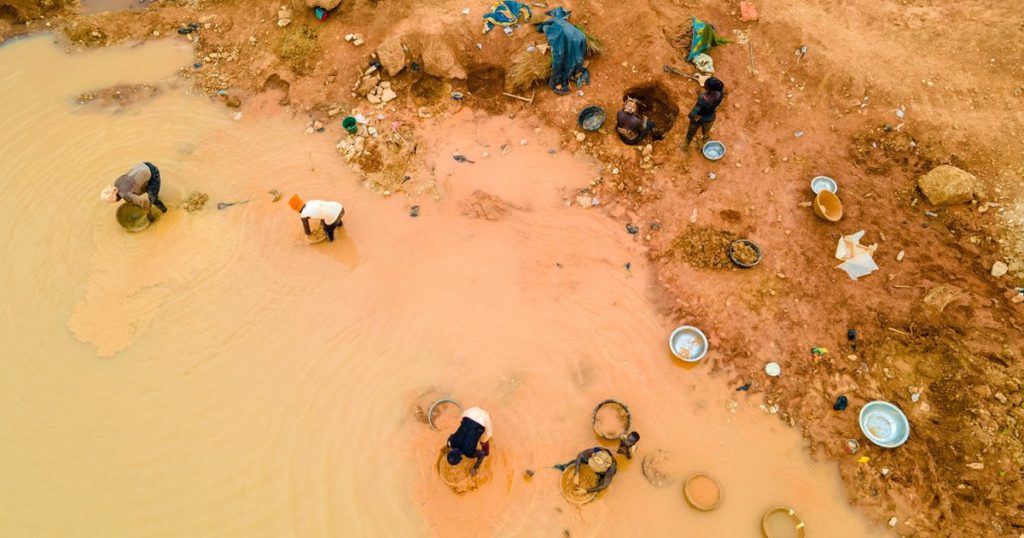
Credit: AeroVision Gh | Shutterstock

There’s no escaping gold in Tarkwa. It’s in the forest. It’s under your feet as you walk the streets of Ghana’s biggest mining town. It’s the economy. Exposed holes in the ground bear witness to attempts at illegally digging out some of the precious metal and a polluted river on the edge of town shows the consequences of the boom in semi-industrial scale mining.


The environmental damage has triggered a wave of protest in the capital Accra demanding a ban on all small-scale mining operations in places like Tarkwa. In turn, anxious local politicians — ahead of national elections on Dec. 7 — have tried to reassure registered mines that they will be shielded from the government’s threat to crack down on illegal activities, which it calls “galamsey”.


“In Accra, they want to ban you, but I’m here to tell you that I support miners,” George Mireku Duker, the deputy mining minister and a local legislator, told managers at four underground mines during site visits in October. Duker acknowledges that illegal mining is a “worry”, but he knows that a voter backlash against the New Patriotic Party government which he is part of could cost him his job on Dec. 7. He won the seat by just 101 votes in 2020.

“The small-scale mining sector employs more than 1 million Ghanaians and large-scale mines employ less than 10,000,” Duker told Bloomberg News. “You want to take their livelihood from them?”

The mines visited by Duker have existed since colonial times and are now operated either privately or for community use by Ghanaians to counterbalance the foreign grip on large-scale mining in the indebted West African country. These artisanal and small-scale (ASM) mines — defined as operations on an area smaller than 25 acres — produced more than a quarter of the four million ounces of gold Ghana officially mined in 2023, estimated to be worth $10.6 billion at today’s prices, up from 10% in 2012.

Equipped with heavy machinery and turbocharged by lax regulation, the ASM sector remains largely informal: by some estimates, as many as 70% of these mines — which have mushroomed in places like Tarkwa — are unregulated.

The illicit gold rush is being powered by surging prices — up by more than a third this year to a record-high of $2,787 an ounce in October — and willing buyers in Dubai and beyond. The impact in Tarkwa is visible: tents at the top of slopes, with threadbare clothes hanging over wood panels hide the activities of a mine at the heart of the town while young men loiter outside Chinese machinery shops, offering their services as operators in exchange for a share of what is found in the rivers.

The line between legal and illegal operators is often blurred. “A lot of people do have a license,” says Ishmael Quaicoe, head of the environmental and safety engineering department at Tarkwa’s University of Mines and Technology, “but their operations don’t conform with what the law asks them to do.”

Demonstrations in September and October focused on the impact of galamsey miners. But when the Trades Union Congress threw its weight behind the campaign it raised the stakes, calling for an outright ban on all small-scale gold mining to halt activity blamed for polluting rivers — one Ghana Water Company facility said in August that 60% of the raw water it treated was affected by illegal mining, depressing cocoa production and destroying forests.


Both main political groups — the governing NPP and the opposition National Democratic Congress —have traded accusations over the mining issue. And with elections around the corner President Nana Akufo-Addo responded to the calls for a ban by threatening to send soldiers to mining towns to crack down on galamsey operations.

He has yet to follow through on that pledge, but the announcement triggered memories of a heavy-handed effort to close down illegal mining in 2017. The ban on ASM mining lasted about two years, but the move backfired on the government, with allies citing it as one of the reasons for the loss of its parliamentary majority in the 2020 elections.

At least 4.5 million people — workers and dependents — rely on gold for their livelihood, according to a 2020 government estimate. So the timing of the protests has created a dilemma for the NPP which polls suggest could be headed for its worst-ever election results on Dec. 7, according to the Accra-based Global Analytics.

For all its mineral wealth, almost 20% of people in Tarkwa-Nsuaem municipality — Duker’s constituency — live in acute poverty, facing multiple deprivations from a lack of clean water to decent shelter, according to the Ghana Statistical Service. A shortage of educational opportunities means young people often gravitate toward the ASM sector’s low-skilled and often dangerous jobs.

“They are already dying from poverty so they don’t hear you when you talk about the dangers of mercury or cyanide,” says Elorm Ama Governor-Ababio who was arrested while participating in a protest by Democracy Hub — the activist organization — in Accra. “You put them through so much trauma that when they see a literal threat to their life they see it as a beacon of hope,” adds Governor-Ababio, who denies any wrongdoing.
Making the good delivery list

School children in Ghana are taught that their country — known as the Gold Coast since British colonial rule — is so rich in the precious metal that the sand glistened as the first Europeans approached shore in the 15th century.

In those early days, Akan traders bartered their gold dust for European alcohol, copper and even clothing. Centuries later Ghana remains Africa’s biggest producer, with major operators such as the UK-based Anglogold Ashanti Plc, Gold Fields Ltd. from South Africa, American miner Newmont Corp and China’s Chifeng Jilong Gold Mining Co. all active.

At the other end of the scale are the ASM operators. Adwoa Pokuaa Boaduo, a mining engineer who wrote a doctoral thesis on the potential for artisanal and small-scale mining reform in Ghana, says a lack of compliance checks makes it relatively easy for licensed gold buyers to purchase from illegal mines, legitimizing their output.

Rosemary Addico, who leads the responsible gold program at Solidaridad’s West Africa — an NGO which encourages miners to follow global best practices — believes the onus should be on the buyers to scrutinize the source: “Once international buyers insist on some requirements, the traders will be more careful about where they are sourcing gold from and how it’s mined.”

For gold to be accepted by the world’s most demanding buyers, including central banks, institutional investors and luxury brands, it must come from refiners on the London Bullion Market Association’s Good Delivery List. The influential trade body doesn’t certify mines, but does make the refiners it accredits responsible for the gold in their supply chains, leaving many loath to accept anything directly from small-scale producers that could jeopardize their place on the list.

There are, however, plenty of other willing buyers of Ghanaian gold with few questions asked. Nana Akwuasi Awuah, the head of the state-owned gold marketing company — and a number of market participants — say metal from the smaller illegal mines often ends up with Dubai refineries. None of these are on the LBMA’s Good Delivery List, though the emirate does have rules requiring refiners to check that gold has been sourced responsibly.

Once imported, the gold can be re-refined and sold as “recycled” bullion to jewelers in India and other markets further east, and even LBMA-accredited refiners, without reference to its origin. The LBMA requires refiners to conduct checks to ensure gold is sourced responsibly, but the reality is that the provenance of recycled gold can be very difficult to determine, according to a 2022 study published on the trade association’s website.

Illegal mining also carries an economic cost for Ghana, which is wrestling with more than $30 billion of external debt and secured a $3 billion bailout from the International Monetary Fund last year.

If the industry was formalized, Ghana would earn more than double its revenue from gold this year, according to Martin Ayisi, the chief executive officer of Ghana’s Minerals Commission, which regulates large and small miners. At least three-quarters of the country’s artisanal and small-scale gold output isn’t captured in export figures at all, he estimates. That’s because it’s either smuggled out by land to neighboring Ivory Coast, Togo and Burkina Faso, which have a lower withholding tax on unprocessed gold, or it’s treated as a transshipment from one of these countries through Ghana, even though it was mined in Ghana all along.

“There are all sorts of schemes to smuggle out the gold,” says Ayisi. “There’s one way to stop it, by further dropping the tax,” which was cut to 1.5% from 3% in 2022, driving an immediate spike in Ghana’s output.
The Dubai connection

In 2023, the United Arab Emirates reported that $3.2 billion of gold (52.9 metric tons net weight) was imported from Ghana. That same year, Ghana reported exporting just $1.7 billion of the metal to the UAE (27.8 metric tons net weight), according to the United Nations’ Comtrade Database. That amounts to a shortfall about $1.5 billion.

Dubai — one of the seven emirates that make up the UAE — has no gold mines, and has positioned itself as a hub for the metal. The LBMA considers the UAE a high-risk jurisdiction and imposes additional checks for any gold sourced from there.

But Safeya AlSafi, the UAE’s acting assistant undersecretary for commercial control and governance at the Ministry of Economy, told Bloomberg News that the shortfall could be due to incorrect information from the country of origin, adding, “I don’t know exactly if there is any actual smuggling. We have a very strict system.”

Billions in African gold smuggled to UAE each year — report

At the Minerals Commission, Ayisi acknowledged challenges recording what leaves Ghana.

Ghana was one of the first countries in Africa to legalize artisanal and small-scale mining, a sector which globally contributes about a fifth of the world’s gold supply, according to a World Gold Council report. Today, most officials agree that further formalization is essential to curb smuggling and reverse the environmental fallout.

The country has now joined a pilot program — along with Peru, the Philippines and Tanzania — to pre-approve some small-scale mines and sell their gold directly to refiners certified by the LBMA. But the lack of financial incentives to operate responsibly gives the miners little reason to join the pilot, critics say.

The LBMA is partly motivated by a desire to secure more “clean” gold for its refiners, who are effectively losing out on a fifth of the global supply because of its stringent sourcing requirements. For governments it means they can sell directly to LBMA refineries, opening up a more formal market for their gold.

“Will we solve all of the evils of the world?,” asks Neil Harby, the LBMA’s chief technical officer. “No, but we’ve got to start somewhere.”

Back in Accra, one of just three of Ghana’s 16 regions that doesn’t produce gold, the anti-galamsey movement is gaining momentum even if the protests have died down as the election focus has shifted to the economy — with inflation above 20% for more than a year — and a lack of jobs, in the country of 34 million. Billboard-sized images of brown rivers and reports of birth defects, allegedly linked to galamsey, have left voters with graphic images of the damage.

Yet neither of the two main parties is in a position to fully capitalize on the anti-ASM anger. Both have at different times clamped down on illegal mining but have also have financially benefitted from “illegalities in the small-scale mining sector,” according to a 2021 report by a former environment minister, Kwabena Frimpong-Boateng.

In 2022 Ghana passed a law that authorized mining in forest reserves earmarked for conservation. Out of these mining licenses, at least four have been granted by the government in reserves given special status due to their rare flora and fauna, according to The Fourth Estate, an investigative project by Ghanaian journalists.

The Frimpong-Boateng report, which accused politicians on both sides of having a conflict of interest, was dismissed by the presidency as lacking evidence. But it prompted a probe by Ghana’s Commission on Human Rights and Administrative Justice that is continuing.

“For about two decades now, parties have been rewarding their loyalists with concessions,” says E. Gyimah-Boadi, founder of the Accra-based non-partisan research network, Afrobarometer. “They are not going to expose themselves by committing to doing anything that will tie their hands.”

Richard Ahiagbah, the director of communications at the NPP rejects the claim, saying that the 2017 ban, shows the government is committed to clamping down on the ASM sector. The NDC also denies any conflict of interest during their own time in office. Samuel Gyamfi, the party’s national communications officer, described the environmental crisis as “unprecedented” and blamed the NPP for it.

For Dora Kowfia, a 54-year-old former artisanal miner, it is a confusing moment. She has has previously backed the NPP, but says that this time she doesn’t know who to vote for. She now sells textile at a roadside stall outside Tarkwa, overlooking the Bonsa river, where the impact of illegal mining is visible in the brown waters.

Asked if she was concerned about the pollution, Kowfia, echoing a widely held view in mining communities in Ghana, says: “Accra is saying ‘stop galamsey’. I want leaders who will either protect it or bring us new jobs.”

(By Yinka Ibukun and Jack Ryan)
Firms launch physical uranium buying for small investors using blockchain

Reuters | December 3, 2024 | 

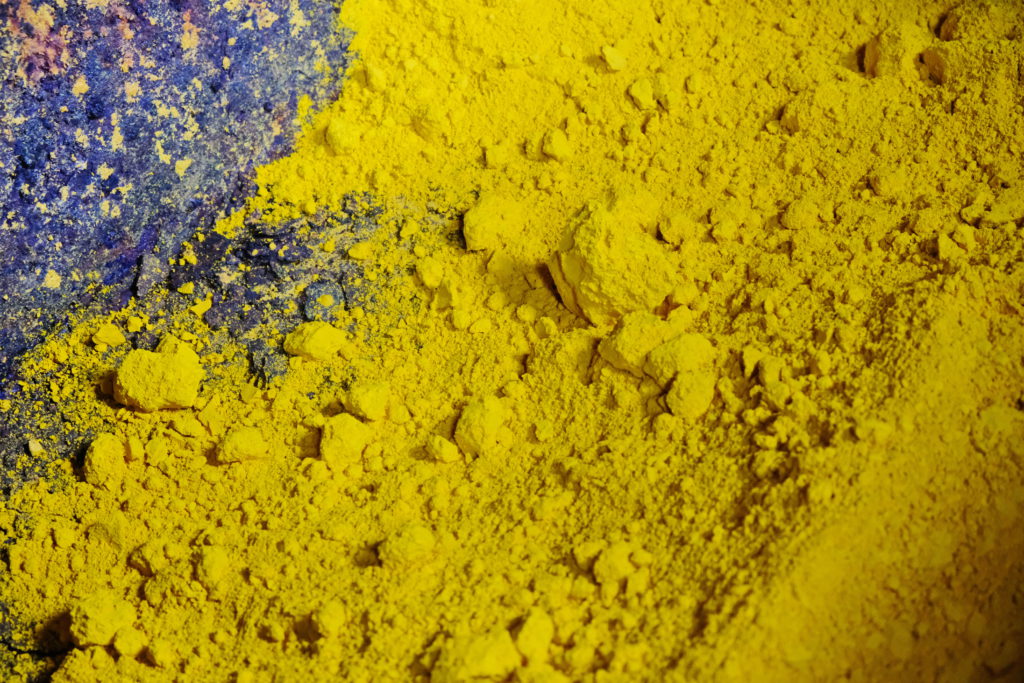
Stock image.

A blockchain platform and a uranium trading company launched a marketplace on Tuesday to allow small investors to buy physical uranium, hoping to boost spot liquidity in the niche commodity.


Uranium has seen a surge in interest from investors and a spike in prices in recent years as miners trimmed output and utilities sought new supplies of mineral that fuels nuclear power.

A surge in electricity demand for artificial intelligence (AI) data centres is also spurring new interest in nuclear plants.

Previously, retail investors could get exposure to the metal by buying shares in mining companies or funds that hold inventories of uranium.

Now they will be able to buy small amounts of physical uranium that will be tokenized on a blockchain and stored in a depository, with the tokens representing a share of the underlying asset.

“This is the democratization of uranium so everyone can buy it,” said Nick Clarke, founder of private trading company Curzon Uranium.

Unlike gold or platinum, which is sold in small bars to investors, the minimum lot for buying uranium oxide or yellowcake is 50,000 pounds, which would cost over $4 million.

The new trading website uses technology from open-source blockchain platform Tezos, with supplies sourced by Curzon.


The physical uranium will be stored in facilities owned by Canadian producer Cameco.

Small investors can get exposure to physical uranium through funds such as Sprott or Yellowcake, but those shares trade on the stock market and can diverge from the uranium price.

The metal has captured investors’ attention after spot prices doubled over 10 months to a peak of $106 a pound in January as top producers Kazatomprom and Cameco cut production guidance. Prices have eased since then to $77.


Nuclear energy has seen more interest to help countries cut their carbon emissions, while several deals have been sealed this year to source power from nuclear plants for AI data centres, including by Google, Amazon and Microsoft.

(By Eric Onstad; Editing by Mark Potter)