Wednesday, December 04, 2024

US lawmakers back Covid Chinese lab leak theory after two-year probe


By AFP
December 3, 2024


US lawmakers concluded a two-year investigation Monday into the Covid-19 outbreak that killed 1.1 million Americans — backing the theory that the virus likely leaked from a Chinese laboratory.

A 520-page report from the Republican-controlled House Select Subcommittee on the Coronavirus Pandemic looked at the federal and state-level response, as well as the pandemic’s origins and vaccination efforts.

“This work will help the United States, and the world, predict the next pandemic, prepare for the next pandemic, protect ourselves from the next pandemic, and hopefully prevent the next pandemic,” panel chairman Brad Wenstrup said in a letter to Congress.

US federal agencies, the World Health Organization and scientists across the planet have arrived at different conclusions about the most likely origin of Covid-19, and no consensus has emerged.

Most believe it to have spread from animals in China, but a US intelligence analysis said last year that the virus may have been genetically engineered and escaped from a virology lab in the Chinese city of Wuhan, where human cases first emerged.

The congressional panel was persuaded by the lab leak theory after meeting 25 times, conducting more than 30 transcribed interviews and reviewing more than one million pages of documents.

The investigation included two days of interviews behind closed doors with Anthony Fauci, the government scientist who became the nation’s most trusted expert in the chaotic early days of the 2020 outbreak.

Fauci’s clashes with former and incoming president Donald Trump over the response sparked fury on the right, and he now lives with security protection following death threats against his family.

Republicans accuse the 83-year-old immunologist of helping to set off the worst pandemic in a century by approving funding passed on to Chinese scientists they accuse of manufacturing the SARS-CoV-2 coronavirus that causes Covid-19.

Among its headline conclusions, the report said the National Institutes of Health had indeed funded contentious “gain-of-function” research — which seeks to enhance viruses as a way of finding ways to combat them — at the Wuhan Institute of Virology.

Fauci angrily denied covering up the origins of Covid-19 before the panel in June, arguing that it would be “molecularly impossible” for the bat viruses studied at the lab to be turned into the virus that caused the pandemic.

But the panel’s report said SARS-CoV-2 “likely emerged because of a laboratory or research-related accident.”

– Angry response in Beijing –


Beijing hit back at the report on Tuesday, saying it had “no credibility” and accusing the United States of using the outbreak for “political manipulation”.

“The authoritative scientific conclusion drawn by the China-WHO joint expert team… is that a laboratory leak is extremely unlikely,” foreign ministry spokesperson Lin Jian told a regular news conference.

“In the absence of any substantive evidence, the so-called US report has concocted leading conclusions, slandered China (and) planted false evidence,” he said.

The probe also found that lockdowns “did more harm than good” and that mask mandates were “ineffective at controlling the spread of Covid-19,” contradicting other research showing that masking in public does reduce transmission rates.

Social distancing guidelines also came under criticism, although travel restrictions were deemed to have saved lives.

Investigators found that Trump’s Operation Warp Speed — the publicly-funded project to develop Covid vaccines — was a “tremendous success” but that school closures would have an “enduring impact” on US children.

LESE MAJESTE

Thai dissident jailed for two more years over royal defamation


By AFP
December 3, 2024

Arnon Nampa, a 40-year-old human rights lawyer and activist, is already serving time in prison - Copyright AFP Lillian SUWANRUMPHA

One of Thailand’s most prominent human rights activists was sentenced to two years in prison Tuesday under the kingdom’s royal defamation law, his fifth conviction on the controversial charges, a legal rights group said.

Thailand has some of the world’s strictest royal defamation laws, which shield King Maha Vajiralongkorn and his close family from criticism and which opponents say have been weaponised to silence dissent.

Arnon Nampa, a 40-year-old human rights lawyer and activist already serving time in prison, was convicted on Tuesday at Bangkok Criminal Court over a 2020 social media post in which he allegedly criticised the king’s authority, according to Thai Lawyers for Human Rights (TLHR).

The latest conviction, his fifth, means he will serve in total more than 16 years in prison, according to TLHR.

Arnon was first jailed for four years in September last year, over a speech he made in 2020 as a leading figure in the kingdom’s youth-led pro-democracy protest movement which called for changes to the lese-majeste law.

On Tuesday, the court found that Arnon’s online remarks had influenced others and said it was “necessary for the state to punish” him, TLHR said on X.

The court said Arnon’s post was “insulting” to the monarch, TLHR added.

Youth-led demonstrations in 2020 and 2021 saw tens of thousands take to the streets, with many demanding changes to the strict lese-majeste laws.

Arnon is among more than 150 activists who have been charged in recent years under those laws, often referred to as “112” after the relevant section of the criminal code.
S.Korea political upheaval shows global democracy’s fragility – and resilience


By AFP
December 3, 2024

Protesters gather outside the National Assembly in Seoul after South Korea President Yoon Suk Yeol declared martial law - Copyright AFP/File Anthony WALLACE


Shaun TANDON

South Korean President Yoon Suk Yeol’s brief imposition of martial law marks a new warning for the worldwide fragility of democracy, even in a country hailed as a model of political transformation.

Yoon’s overnight attempt to shut down political activity, censor media and lock out opposition lawmakers stunned South Korea’s longtime ally, the United States, which said it had no advance warning and issued a statement of concern.

South Korea’s transition to elected rule since a mass uprising in 1987 had been seen as so thorough that the United States increasingly spoke of its ally as a global partner. Meanwhile, Seoul billed itself as a new, ideal hub for international media as China clamped down on Hong Kong.

President Joe Biden had even chosen Yoon as the host in March of his final Summit for Democracy — a signature initiative of the outgoing US leader, who sought to champion liberal values globally, in an unstated repudiation of Donald Trump, who returns to the White House next month.

But observers, while stunned by Yoon, said there were warning signs.

Danny Russel, a top US diplomat for Asia under former president Barack Obama and who earlier served in South Korea, pointed to the deadlock in parliament where the opposition repeatedly sought impeachments against Yoon’s administration.

Yoon’s move “was a complete surprise to me (but) yes, there were very obvious structural forces at work,” he said.

“There is a radically polarized political scene in Korea. The opposition has been pursuing scorched-earth political obstruction tactics,” he said.

But he pointed to the quick, large-scale protests that erupted after Yoon’s declaration as a sign of a vibrant civil society ready to defend democracy.

“One certainly would hope that this would serve as a wake-up call to both the ruling conservative party and the progressive opposition that both sides have gone too far and that there needs to be some process of reconciliation, of dealing with legitimate differences and grievances.”

– Authoritarian tendencies –


Yoon himself had earlier shown signs of authoritarianism.

In a national address last year, Yoon raged against supposed communists who have “disguised themselves as democracy activists, human rights advocates or progressive activists.”

A prosecutor, Yoon narrowly won the 2022 election on a platform of economic reform and advocated close ties with the United States as well as historic rival Japan. But his popularity swiftly slid and the opposition won the National Assembly.

Celeste Arrington, a Korea expert at George Washington University, noted that Yoon had never held elected office before and had become increasingly frustrated.

“This is really an extreme move that may signal, I think, the president’s lack of political experience,” she said.

She said that martial law showed “some cracks in democracy” but that the quick reversal “gives me hope in the health and strength and vibrancy of democracy in South Korea.”

Bruce Klingner, a senior research fellow at the conservative Heritage Foundation, expected Yoon’s career to be over after attempting martial law, which constitutionally can only be imposed for wars or other emergencies.

“Yoon’s action is a damning reversal to decades of South Korean efforts to put its authoritarian past behind it,” he said.

– Democracy stronger? –

The number of democracies worldwide soared starting in the late 1980s as the Soviet Union collapsed and student-led uprisings brought reforms elsewhere.

But globally, democracy has been in retreat for the last 18 straight years, according to the Washington-based group Freedom House, which promotes political liberty.

Democratically elected leaders have taken increasingly authoritarian steps in countries as diverse as India, Turkey and Hungary.

V-Dem, another closely watched democracy index, had most recently ranked South Korea third in Asia after Taiwan and Japan.

In the United States, Trump has rejected long-held norms, refusing to accept he lost to Biden four years ago — culminating in his supporters violently rampaging through the US Capitol.

Trump’s rejection of democracy ultimately worked out for him: campaigning on the rage of 2020, he won last month’s election.

But experts said Yoon’s power play — and its reversal — could in fact show a victory for democratic values.

“Yoon is a deeply unpopular and ineffectual leader, but there was nothing I saw of people being dissatisfied with the way government runs,” Alan Yu, a senior vice president at the left-leaning Center for American Progress, said after a recent trip to Seoul.

Darcie Draudt-Vejares of the Carnegie Endowment for International Peace, said that with the swift response to Yoon, “this crisis may ultimately strengthen Korean democracy by reaffirming civilian control and demonstrating institutional resilience.”


S. Korea’s President Yoon, embattled conservative


By AFP
December 3, 2024

Yoon's popularity has slid since his election in 2022 - Copyright AFP Mauro PIMENTEL

South Korean President Yoon Suk Yeol, who declared martial law on Tuesday, was elected in 2022 as a conservative political novice promising a tougher line on North Korea.

He has not had an easy ride, taking office with some of the lowest approval ratings of any democratically elected South Korean president.

Those ratings dropped even further to 19 percent in the latest Gallup poll last week, with many expressing dissatisfaction over his handling of the economy and controversies involving his wife, Kim Keon Hee.

In declaring martial law the South Korean leader accused the opposition of being “anti-state forces” and said he was acting to protect the country from “threats” posed by the North.

Observers and allies have been left scrambling to make sense of the sudden move.

– Top prosecutor –

Born in Seoul in 1960, Yoon studied law and went on to become a star public prosecutor and anti-corruption crusader, playing an instrumental role in former president Park Geun-hye being convicted of abuse of power.

As the country’s top prosecutor in 2019, he also indicted a top aide of outgoing president Moon Jae-in in a fraud and bribery case that tarnished that administration’s image.

The conservative People Power Party (PPP), in opposition at the time, liked what they saw and convinced Yoon to become their presidential candidate.

He duly won in March 2022, beating Lee Jae-myung of the Democratic Party, but by the narrowest margin in South Korean history.

Yoon was never much loved, and a series of scandals — including his administration’s handling of a deadly Halloween crush of 2022 — have further eroded his popularity.

Critics have blamed Yoon’s administration for food inflation, a lagging economy, and increasing constraints on freedom of speech.

He was also accused of abusing presidential vetoes, notably to strike down a bill that would have paved the way for a special investigation into his wife’s alleged involvement in stock manipulation.

Yoon suffered further reputational damage last year when his wife was secretly filmed accepting a designer handbag worth $2,000 as a gift. Yoon insisted it would have been rude to refuse.

His mother-in-law, Choi Eun-soon, is serving a one-year prison sentence for forging financial documents in a real estate deal. She is due to be released in July.

Yoon was earlier this year the subject of a petition calling for his impeachment, which proved so popular the parliamentary website hosting it experienced delays and crashes.

Local media have reported that Yoon is particularly inspired by British wartime prime minister Winston Churchill.

As president, Yoon has maintained a tough stance against Pyongyang and bolstered ties with Seoul’s traditional ally, the United States.

Last year, he famously sang Don McLean’s “American Pie” during his visit to the White House, to which US President Joe Biden responded, “I had no damn idea you could sing.”

But his efforts to restore ties with South Korea’s former colonial ruler, Japan, did not sit well with many at home, as the issue remains sensitive in the country.

The return of former US president Donald Trump — who had historic but ultimately failed summits with North Korea’s leader Kim Jong Un while in office — may create another layer of tension, experts say.

OECD warns of protectionism weeks before Trump return


By AFP
December 4, 2024


Donald Trump has threatened to slap tariffs of 10 percent on all imports - Copyright AFP -STR
Ali BEKHTAOUI

The OECD warned Wednesday that protectionist trade measures pose a major risk to disrupting the world economy, just weeks before Donald Trump is set to return to the White House.

The Organisation for Economic Cooperation and Development, a Paris-based body that advises industrialised nations on policy matters, never named Trump in its updated analysis of the world economy.

But with the president-elect vowing to slap tariffs on US trading partners after his return to power next month, it was abundantly clear that the OECD was warning about Trump’s possible measures.

While the organisation raised its 2025 global growth forecast to 3.3 percent, it cautioned that “greater trade protectionism, particularly from the largest economies” poses a “downside risk” along with geopolitical tensions and high public debts.

On the campaign trail, Trump threatened blanket tariffs of at least 10 percent on all imports and since his election has vowed to slap 25 percent import tariffs against Canada and Mexico, top US trade partners.

“Increases in trade-restrictive measures could raise costs and prices, deter investment, weaken innovation and ultimately lower growth,” the OECD warned in its economic outlook.

“Further increases in global trade restrictions would add to import prices, raise production costs for businesses and reduce living standards for consumers,” it added.

During his first term in office from 2017 to 2021, Trump slapped tariffs on certain products from China and other trading partners, including the European Union, but on a smaller scale than the measures he has pledged to take upon his return to the White House.

A recent study by the Roland Berger consultancy calculated the cost of the US measures and likely countermeasures by China and the EU at more than $2.1 trillion through 2029.


– ‘Major shocks’ –


Trump is far from the only risk in terms of protectionist measures.

The Covid-19 pandemic and the war in Ukraine showed the dependency of many countries upon global trade, but instead of facilitating the exchange of goods and service many countries have sought to shorten certain supply chains and protect markets.

A spat has also broken out between Brussels and Beijing after the EU imposed import tariffs on Chinese electric vehicles. China has retaliated with tariffs on EU brandy, including cognac.

The OECD noted “the global economy has demonstrated remarkable resilience despite being subject to major shocks such as the pandemic and an energy crisis.”

It even raised its global growth forecast for next year to 3.3 percent, an increase of 0.1 percentage points from its previous outlook in September, due in large part to the strong performance of the US economy.

– Strong US growth –


The OECD now sees the US economy expanding by 2.4 percent next year, up from its September forecast of 1.6 percent growth.

It also raised its forecast of British growth next year by 0.5 percentage points, to 1.7 percent, due to higher public spending planned by the new Labour government.

China’s economy is now expected to expand by 4.7 percent next year, an increase of 0.2 percentage points, while India’s growth forecast was raised 0.1 percentage points to 6.9 percent.

But both France and Germany saw to 0.3 percentage point cuts to their 2025 growth forecasts, to 0.9 percent and 0.7 percent, as both countries face political crises amid mounting fiscal pressure.

The downgraded forecast comes as France’s new minority government faces being brought down Wednesday by lawmakers after it forced through the adoption of the social welfare budget.

Op-Ed: Dunce level policy — Devalue the dollar + tariffs = massive increases in cost of living


By Paul Wallis
December 3, 2024
DIGITAL JOURNAL

America is off track. Immigration and homelessness crisis in large metropolises like Los Angeles is the best example. — Image: © AFP

This is why unemployable sycophantic nobody bozos shouldn’t do economics. The Morons Marathon of US politics has taken yet another IQ nosedive.

The constant tides of talk about proposed tariffs are bad enough. “Tariff” is code for total illiteracy in trade.

A minimum 10% tariff is the benchmark. They’ll add a lot to prices. That will cost you a lot of money you don’t have. It’ll also kill revenue by suffocating demand by volume, simply because things are more expensive.

“But, why?” you ask, clutching your non-existent but expensive ideology in your pseudopods?

It’s mainly because the idiots proposing the tariffs still haven’t got it through their thick heads that the importer pays tariffs, not the exporter.

Everything will cost so much more because you clowns put a tariff on it.

Got it, you ^&&(((&^* godforsaken3 $%&^(% half-witted brain dead fruit flies?

The stylish fruit fly analogy is because fruit fly brains work and yours don’t.

Add to this impending cluster the imbecile idea of a devalued dollar, if you please, Your dollars will be instantly worth less, at a time when the cost of living is truly insane.

Let’s go through the devaluation myths from the last century to explain:

“Devaluing will make our products more competitive.” This particular myth has bankrupted countries many times before. Anyway -What products? You offshored them and a lot of American jobs decades ago. You think you can set up an entire manufacturing sector overnight? Ain’t gonna happen.

“Our foreign currency holdings will be worth more.” Not really. Any fool can play margins and pretend to win. Those currencies also aren’t the world’s default currency, and only a very few of them are stable. It’s a meaningless statement.

“Our dollar debts will cost less because the dollar is worth less.” The exact opposite is the case. You can pay with foreign currency to a point, but not on the global scale of US debts. People holding dollar denominated debts don’t want to lose money. You’re more likely to increase interest rates on borrowing to make up for the decline in the value of currency holdings. Bond yields will also have to respond.

“Volatility will help supercharge the markets.” This one may seem a little obscure. The theory is that high turnover in anything is good for middlemen like brokers, hedge funds, termites, political skanks, etc. So it is, to a point, until constant stress destroys confidence in the market.

Given the other disasters on this list, no confidence will happen sooner rather than later. You and your money will quite rightly move to other markets and take your trillions with you. Any supercharging will be of the getting the hell out variety.

OK, now a bit of analysis.

Do you notice that the outcome of each of these loads of garbage is the exact opposite of what was stated? There’s a reason for that. All of these economic circus tricks have been tried and have failed consistently throughout the 20th century.

One of the reasons South America and Africa are such happy carefree places that everyone is trying to escape policies of this kind.

Bad management of trade, currencies, and a bizarre perspective on how the world does business are all you need.

There’s another, potentially fatal, issue for the US, though. America is locked in to global trade. Disadvantaging itself and its own trading position is stupid. Adding costs is suicidal.

What’s likely to happen is the “Russification” of America. This would be the collapse of corporate and private assets, not state assets. (A heavily devalued billion is not the same thing, Elon.)

Everything crashes. Everyone goes broke. Somebody walks in and buys all those depreciated assets at bargain bin prices. (Almost literally nothing, in the case of the USSR. It was one of the biggest systematic rip-offs in history.)

That’s worked out well, hasn’t it?

We could have another fragmented senile ex-superpower staggering around picking fights with everyone and losing.

Sound familiar?

America used to be truly great. It was the richest, healthiest, most prosperous society in history. You gave it all away to idiotic politics and your own insularity.

You’re doing it again, America.

__________________________________________________
Disclaimer
The opinions expressed in this Op-Ed are those of the author. They do not purport to reflect the opinions or views of the Digital Journal or its members.


TIME OF THE POLYCRISIS

World on fire’: UN seeks $47 bn for aid in 2025


By AFP
December 4, 2024

Tom Fletcher presented the UN's 2025 Global Humanitarian Overview in Geneva - Copyright Cheshire Constabulary/AFP -

Nina LARSON

The UN on Wednesday appealed for more than $47 billion to deliver vital aid next year in a world ravaged by surging conflicts and the climate crisis, but warned many in need would not be reached.

“The world is on fire,” the United Nations’ new humanitarian chief Tom Fletcher told reporters in Geneva, acknowledging he was looking ahead to 2025 with “dread”.

With brutal conflicts spiralling in places like Gaza, Sudan and Ukraine, and as climate change and extreme weather take an ever-heavier toll, the UN estimated that 305 million people globally will need some form of emergency assistance next year.

“We are dealing with a poly-crisis right now globally, and it is the most vulnerable people in the world who are paying the price,” Fletcher said, warning that swelling inequality combined with the convergence of conflict and climate change had created a “perfect storm” of needs.

Launching the Global Humanitarian Overview, Fletcher acknowledged that the UN and its partners would not be able to reach all of those in need.

The annual appeal by UN agencies and partner humanitarian organisations is seeking $47.4 billion for 2025 — slightly less than the appeal for this year — which it said was enough to provide assistance to the 189.5 million most vulnerable people.

“There’s 115 million that we won’t be able to reach” with this plan, Fletcher acknowledged.

– ‘Ruthless’ –

Pointing to significant “donor fatigue” hitting humanitarian operations, he stressed the need for a “realistic” plan, which required prioritisation and making “really tough, tough choices”.

“We’ve got to be absolutely focused on reaching those in the most dire need, and really ruthless.”

As of last month, only 43 percent of the $50 billion appeal for this year had been met.

Underfunding this year has seen an 80-percent reduction in food assistance in Syria, cuts to protection services in Myanmar, and diminished water and sanitation aid in cholera-prone Yemen, the UN said.

Camilla Waszink of the Norwegian Refugee Council described the appeal’s acknowledgement that millions would not be reached as “devastating”.

“When the richest people on Earth can go to space as a tourist and trillions of US dollars are used annually on global military expenditure, it is incomprehensible that we as an international community are unable to find the necessary funding to provide displaced families with shelter and prevent children from dying of hunger,” she said.


– ‘Under attack’ –


Even more than funding woes, Fletcher said the biggest barrier to assisting and protecting people in armed conflict was the widespread violation of international law.

This year has already been the deadliest for humanitarian workers, surpassing the 2023 toll of 280 killed.

The global humanitarian system “is overstretched, it’s underfunded and it’s literally under attack”, he said.

Meanwhille, fears abound that Donald Trump’s looming return to the presidency in the United States — the world’s largest humanitarian donor — could see aid agency budgets cut further.

Fletcher said he planned to spend “a lot of time in Washington” in the coming months to engage with the new administration.

But the “much tougher global climate (is) not just about America”, Fletcher said.


– ‘Unconscionable’ –


A record 123 million people were living displaced from their homes due to conflict by mid-2024, while one in every five children globally is currently living in or fleeing conflict zones, according to UN figures.

“The suffering behind the numbers is all the more unconscionable for being man-made,” Fletcher said.

“Wars in Gaza, Sudan and Ukraine are marked by the ferocity and intensity of the killing, the complete disregard for international law, and the deliberate obstruction of our humanitarian movement’s effort to save lives.”

Numerous old crises remain unresolved, with average humanitarian operations now spanning a decade, the UN said.

“The longer they last, the bleaker the prospects,” Fletcher warned.

Even more worryingly, he said, was how conflicts were increasingly converging with theclimate-induced disasters that are ravaging communities, devastating food systems and driving mass displacement.


Is the human still in the loop?


By Dr. Lauren Dwyer
December 3, 2024
DIGITAL JOURNAL

Image generated by OpenAI's DALL-E via ChatGPT

Lauren is a thought leader in Digital Journal’s Insight Forum 


Accuracy, fairness, and independence have long defined journalistic standards. As newsrooms embrace data-driven processes with open arms, human judgment, independence, and expertise are confronted by algorithmic systems that prioritize optimization over traditional journalistic values.

The rise of algorithms has reshaped journalism, raising urgent questions about journalistic authority and who controls the narrative. Journalistic language is evolving — from informing audiences to appeasing search engines — where traditional values now bow to production demands.

With an increased access to information comes an increased competition to be found, trusted and read. The grounding of human judgment, independence and expertise is now confronted by clouded algorithmic requirements in order to get a journalist’s perspective front and centre.

What difference, if any, do these human standards make when machines become essential members of the news-production team? How are these principles transformed when algorithms are introduced into journalism, influencing everything from story selection to content distribution?
Who decides what we see?

From story selection to distribution, algorithms now shape every stage of the news cycle, guided by audience-engagement metrics. While technology is often seen and understood as objective, algorithms are fundamentally influenced by the values of their human creators and the datasets they have selected.

This becomes particularly controversial when these algorithms are then introduced as a way to prioritize content in the newsroom based on predictions of potential audience engagement.

Social media platforms have become gatekeepers of news, with algorithms deciding what content gets seen. This reliance forces newsrooms to prioritize algorithm-friendly content, often at the expense of journalistic integrity and independence.

The prioritization of sensationalism over depth, or even fact, as well as the offer of personalization, become unintended consequences of adopting an “objective” technology, slowly but surely eroding journalistic integrity in favour of click-driven content.
The battle for impartiality

The algorithmic landscape’s first substantive challenge to journalistic standards lies in exacerbating an already complex tension: the aspiration for impartiality versus the need for engagement.

With algorithms dictating publication and distribution, journalists face mounting pressure to craft stories that inform — and captivate. This balancing act is further complicated by the ways algorithms shape not just distribution but also the content itself. When it comes to the actual articles we read, the impact of algorithms becomes more concerning still as we are seeing a new trend in automated articles created by large language models and algorithmic compilations of content.

Automated journalism excels at summarizing data but lacks the nuance, depth, and critical perspective that define high-quality reporting.

This of course can lead to fears of replacing journalists and eroding diverse human perspectives. In a surprising turn of events, it is precisely the human bias, the lack of perceived objectivity, that gives journalism the edge over tech-generated content.

It is human judgment, contextual understanding and the ethical considerations of journalists that the algorithms cannot replicate. Consider, for example, a breaking news story about a local protest. An algorithm might prioritize articles based on engagement metrics — boosting headlines that feature sensational phrases like “clashes erupt” or “violent riots.” However, a journalist on the ground brings a nuanced perspective: they can recognize the protest’s underlying social and economic issues, interview participants to understand their motivations, and ensure that the coverage reflects diverse voices, not just the most clickable angles.

Algorithms lack the ability to question the narratives it promotes or to see beyond the data. This is where human judgment is indispensable — it ensures that the story isn’t reduced to a sensational headline but instead provides readers with a comprehensive understanding of the event, fostering informed discourse rather than polarization.

Maintaining this positionality in light of the previous argument for click-based sensationalism then becomes a challenge to journalistic authority and authenticity — is it still journalism if accuracy and public interest are challenged by engagement-based models?
The transparency problem

Transparency and disclosure have emerged as central themes in our analysis. As algorithms become more embedded in journalism, the need to openly acknowledge their influence on news production finds itself rising to the forefront.

Despite its growing influence, the industry struggles to disclose algorithmic involvement to audiences. Without proper disclosure, the lines between human editorial judgment and algorithmic decision-making blur, raising serious ethical questions.

We have all heard at this point that bias and transparency are not exactly strong points for algorithms, especially given that they are trained on historical (and historically biased) data. The perpetuation and exacerbation of societal biases and inequalities then becomes even more prevalent in the magnifying glass that is large data models and artificial intelligence.

Disclosure of use of algorithms and AI to generate content and push it to readers is not something that is yet regulated which puts the responsibility back on the company and its readership to determine accountability for transparency and erosion of the human in the loop.

To me, the human in the loop represents more than just oversight — it’s about maintaining a vital connection between technology and humanity. It’s the journalist’s ability to apply ethics, context, and critical thinking to ensure the stories we consume reflect the complexity of the world, not just the calculations of an algorithm and the priorities of the people who created it.

Without this human element, journalism risks losing the empathy and insight that make it more than just a delivery system for information — it becomes the soul of storytelling itself.
Perception is reality in journalism

We are now living in an era where perception often is reality, especially in journalism and media. The way stories are framed, the headlines we scroll past, and the platforms that surface them shape what audiences believe to be true.

Algorithms, designed to optimize for engagement, have exacerbated this phenomenon by prioritizing content that aligns with existing biases, incites strong emotions, or simply keeps users scrolling. In this system, the loudest voices and most sensational stories dominate, while nuance and context are often left behind. The danger is clear: when algorithms amplify perception over fact, they don’t just distort the narrative—they redefine it entirely.

Consider the rise of “fake news” during election cycles or the selective visibility of certain voices in social movements. An algorithm prioritizing divisive content because it drives clicks might inadvertently tilt public perception, making a fringe viewpoint appear mainstream or a misleading headline go viral. In this reality, perception is not just shaped by the truth — it becomes the truth for many consumers.

Without human judgment to interrogate these narratives, journalism risks becoming a tool of manipulation rather than a force for accountability. The human in the loop, then, isn’t just a safeguard; it’s the last line of defense against a world where algorithms define reality.
Redefining journalism in the algorithmic age

The key question isn’t what to do about journalism’s changing landscape — it’s how these shifts reshape news-reporting standards. When algorithms dictate content visibility, core journalistic principles like accuracy, independence, and public trust are forced to adapt. Can these values survive in an engagement-driven system, or must they evolve? As technology continues to dominate, journalism faces a crossroads: reconcile traditional ideals with algorithmic realities, or risk losing its relevance and authority.


Written By  Dr. Lauren Dwyer
Dr. Lauren Dwyer is an Assistant Professor with Mount Royal University's Information Design undergraduate program researching the role of emerging technologies in communication studies. Dr. Dwyer holds a PhD from Toronto Metropolitan University and York University’s joint Communication and Culture program, where she explored how social robots can be designed to enhance human communication and emotional experiences. Formerly SAIT’s Academic Chair for Artificial Intelligence and Data Analytics, she oversaw the development of programs that focus on utilizing data and AI to drive innovation in various fields. Her research interests currently lie at the intersection of emerging technology and human communication, particularly in relation to social robots and artificial intelligence. By approaching these complex topics through a communication studies lens, she has been able to shed new light on the potential impact of technology on human emotions and social connections. Lauren is a member of Digital Journal's Insight Forum.
US ‘disappointed’ after plastic pollution talks collapse: White House

By AFP
December 3, 2024

Nearly 200 countries are in South Korea's Busan for negotiations on a deal to curb plastic pollution - Copyright AFP Roland de Courson

The US government said Tuesday it was “disappointed” after nations negotiating a global treaty to curb plastic waste failed to reach a deal, blaming a “small group” of countries and producers for blocking progress.

Delegates from nearly 200 nations debated for a week in South Korea on how to stop millions of tonnes of plastic waste from entering the environment each year.

The talks were meant to end with the world’s first accord on cutting plastic pollution after nearly two years of discussions, but concluded without an agreement — except to extend talks.

“The United States is disappointed in the lack of a legally binding international agreement fit to meet the moment on addressing plastic pollution,” National Security Council spokesman Sean Savett said in a statement on Tuesday.

“A small group of countries and producers stood in the way of progress to protect their profits and perpetuate an inadequate status quo,” it said.

Plastic pollution is so ubiquitous that microplastics have been found on the highest mountain peak, in the deepest ocean trench and scattered throughout almost every part of the human body.


The talks’ chair Luis Vayas Valdivieso said more time was needed for negotiations – Copyright AFP ADEK BERRY

Delegations seeking an ambitious treaty earlier warned that a handful of countries was steadfastly blocking progress.

A draft text released Sunday afternoon after multiple delays included a wide range of options, reflecting ongoing disagreement.

The talks’ chair Luis Vayas Valdivieso said late Sunday that more time was needed for negotiations.

Countries including oil-producing nations like Russia and Saudi Arabia have pushed back against curbs on production of plastics.

Iran said there was a “huge gap” between parties, while Russia warned that agreeing on a treaty was “being hampered by ambitions on the part of certain parties that are too high.”

Divisions between nations are so deep that they have not yet agreed on how any decision will be adopted — by consensus or majority vote.

Environmental groups have warned that another round of talks could be similarly hamstrung if ambitious countries were not willing to push for a vote.

The world’s top two plastic producers — China and the United States — have stayed relatively quiet about their positions in public.


White U.S. citizens once flooded into Indian Territory, prompting calls for mass deportations


An invasion of white settlers into lands formerly designated as Indian Territory is commemorated at the Oklahoma Land Run monument in Oklahoma City. 
(Russell Cobb)


Russell Cobb
Associate Professor of Latin American Studies, University of Alberta
THE CONVERSATION
Published: December 3, 2024 


The scene at the end of the 19th century in what was known as Indian Territory — at one point encompassing most of the present-day United States west of the Mississippi River — would seem familiar to anyone following the news about the crisis on the U.S.-Mexico border.

Illegal immigrants streamed in, and some leaders had seen enough.

Nationalists among the Chickasaw Nation called for a mass deportation of white U.S. citizens. One Chickasaw leader, Judge Overton Love, wrote that undocumented whites should be “placed under arrest immediately and hustled out of the country with strict orders not to return.”

Muskogee leaders reported intruders to the federal government. U.S. marshals escorted white migrants to Arkansas and hit them with a US$1,000 fine. But they returned, again and again.

D
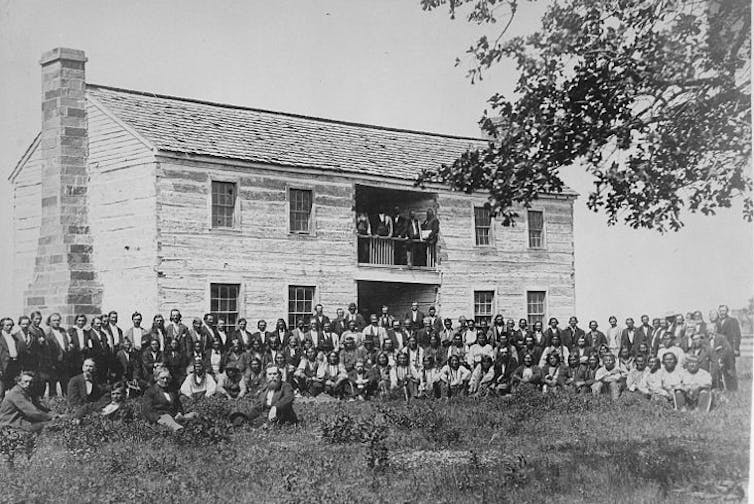
elegates from 34 Indigenous tribes at the Creek Council House in Indian Territory, now called Oklahoma, in 1880. (National Archives)


Illegal invasion


Among those intruders was my great-great-grandfather, Bill Hogan. Bill was an illiterate white sharecropper in Yell County, Ark. He migrated with his family to the Muskogee Nation sometime around 1900, probably following a new railroad line.

The author’s grandfather, William Bethel Hogan, with his horse in Indian Territory around 1900. (Russell Cobb), Author provided (no reuse)

Predatory landowners in the South made life difficult for poor white people like Bill, and nearly impossible for Black people. But freed slaves founded prosperous all-Black towns like Boley, just down the road from Bill’s homestead near Eufaula.

The illegal invasion of sovereign nations by white American citizens occurred all over the West, from Texas to South Dakota. Mexican authorities even worried about a flood of U.S. citizens re-introducing slavery into the republic, and banned U.S. immigration in 1830.

This did nothing to stop the flood of Americans from claiming land. A treaty prohibiting U.S. citizens from settling in the Great Sioux Reservation was blatantly violated by hundreds of gold prospectors in the 1870s.

When Oklahoma became a state in 1907, the U.S. effectively closed a chapter on 100 years of invasions and illegal land seizures in the western United States. A century later, conservative leaders have been claiming the U.S. is now the nation under threat of invasion, conveniently ignoring this long and complicated history.
White supremacy doctrine

It is common to hear that the U.S. immigration system is broken, but it was never fixed. Migration to and from sovereign Indigenous nations, Mexico and even Canada has always been subject to waves of xenophobia and fear. A political wind of change can turn intruders into pioneers, as happened on a massive scale among the Five Tribes in Indian Territory.

Bill Hogan may have been in the Muskogee Nation illegally, but he was accepted by his Muskogee neighbours by 1901. The Indigenous-published Indian Journal reported on his travels around Indian Territory in local news, and his son, Jordan, started to achieve some prosperity. The Hogans intermarried and my grandmother lived with a Choctaw man. She is buried next to a Muskogee family in the Checotah cemetery.

Editors and politicians back in the States noticed this unique mixture of native governance, poor white subsistence farming and Black town-building. They were not impressed. It was anathema to white “civilization.” The tri-racial experiment of Indian Territory was crushed by a doctrine of white supremacy established in new state laws.

Unlike today’s unauthorized immigrants, white intruders had political power and influence to change the law. The Indian Appropriations Act of 1902 made it illegal “to remove or deport any person from the Indian Territory who is in lawful possession of any lots or parcels of land in any town or city…which has been designated as a townsite.”

Just like that, ownership of land now protected white intruders like my ancestor if they owned land. Imagine the shoe on the other foot today: U.S. Congress passes a law protecting unauthorized immigrants from deportation because they own some real estate in an Oklahoma suburb.

A lineup of wagons and mules in the 1930s hitched to posts in Eufaula, Okla., close to where Bill Hogan had his homestead. (Library of Congress/Russell Lee)

There is a crucial difference between Bill Hogan crossing into Indian Territory and the current wave of migrants arriving in the United States. These new “intruders” do not want land.

The few stories of Latin American migrants seeking to claim land through squatters’ rights have little legal credibility. Unlike the settlers that pushed the Cherokees, Chickasaws and others off their allotted lands in Oklahoma, the new migrants are not really settlers at all. They are labourers.
The story of Leo Bennett

The U.S. Marshall tasked with enforcing migration laws in Indian Territory, Leo Bennett, found himself in the crosshairs of some who wanted mass deportation and others who wanted the termination of Indigenous governance.
An undated photograph of Dan ‘Dynamite Dick’ Clifton, an American West outlaw of the late 1800s.

Bennett was married to a Cherokee woman and empathized with Indigenous leaders who resented the intruders. Bennett promised to deport known law-breakers, but he resisted the calls to ban all migrants.

Chickasaw leaders were rightly afraid of people like the notorious outlaw Dan “Dynamite Dick” Clifton. But Dynamite Dick did not represent the majority, and so Bennett would not enforce mass deportation. Most Indigenous leaders agreed with him.

Some of the whites milked cows, ran hotels and serviced the trains. If all whites were deported, they would only return again, hungrier and more determined. Bennett wrote in a local paper that “equity as well as law must be so administered that justice shall be tempered with mercy.” He wanted “fairness toward all concerned,” but fairness, then as now, was easily reframed as weakness.

Those ideals — equity, mercy and fairness — require a historical reckoning over how the United States acquired its contemporary boundaries in the first place. Those ideals also require compassion for newcomers, whether they’re white men from Arkansas in 1901 or a Haitian family in Springfield, Ohio in 2024.

Author
Russell Cobb
Associate Professor of Latin American Studies, University of Alberta
Disclosure statement
Russell Cobb received funding from a SSHRC Connections grant.


Seeking a new way of life under the sea – and a world record


By AFP
December 3, 2024

German engineer Rudiger Koch is attempting to live underwater for 120 days, in a submerged home off the coast of Panama - Copyright AFP MARTIN BERNETTI
Juan José Rodríguez

There are probably easier ways to set a world record, but Rudiger Koch has found his method 11 meters (36 feet) under the sea.

He’s been living in a submerged capsule off the coast of Panama for two months — which means, he told a visiting AFP journalist, he has about two more to go.

“The last time I checked, I was still married,” he joked, as fish swim through bright blue Caribbean waters outside the portholes.

But Koch, a 59-year-old aerospace engineer from Germany, has grander plans than simply notching a record. His stunt, he says, could change the way we think about human life — and where we can settle, even permanently.

“Moving out to the ocean is something we should do as a species,” he told AFP.

“What we are trying to do here is prove that the seas are actually a viable environment for human expansion.”

Koch’s 30-square-meter (320-square-foot) capsule has most of the trappings of modern life: a bed, toilet, TV, computer and internet — even an exercise bike.

The only thing missing? A shower.

His home under the sea is attached through a vertical tube to another chamber perched above the waves, housing other members of his team — and providing a way for food and curious journalists to be sent down.

The underwater chamber, meanwhile, provides a shelter for fish and acts as an artificial reef — providing an environmental benefit.

“In the night, you can hear all the crustaceans,” he said. “There’s the fish out there, and there’s all that stuff, and that wasn’t here before we came.”

– A window into the sea –

On a small bedside table lies Jules Verne’s “Twenty Thousand Leagues Under the Sea,” a 19th century sci-fi classic.

An admirer of the novel’s Captain Nemo, Koch, who went down on September 26, is hoping to come up for air on January 24, surpassing by 20 days the record held by American Joseph Dituri, who spent 100 days submerged in a Florida lake.

Two clocks show how much time has passed — and how much remains.

A narrow spiral staircase leads to the chamber above, the entire contraption located some 15 minutes by boat from the Puerto Lindo coast, off northern Panama.

Four cameras film his moves in the capsule — capturing his daily life, monitoring his mental health and to provide proof that he’s never come up to the surface.

Eial Berja, an Israeli, operates them from the section above, while minding the electricity and back-up generator.

It’s not all easy going, he told AFP, noting that a heavy storm almost put an end to the project.

Outside of the media, Koch’s only visitors have been his doctor, his children and his wife.

Supporting the project is Grant Romundt, from Canada. Both he and Koch have grander visions linked to the libertarian — and at-times controversial — “seasteading” movement that envisions ocean-based communities outside government control.

Though he still has a long way to go to resurface, Koch knows exactly what he’ll do first once he’s back on land: “a shower, a real shower.”


Two Senators Want Navy to Stop Working on Large Unmanned Warship

An LUSV concept released by Austal (Austal)

Published Dec 2, 2024 5:13 PM by The Maritime Executive


Two key senators with defense oversight powers are asking the U.S. Navy to drop its Large Unmanned Surface Vehicle (LUSV) program, one of two major acquisition initiatives aimed at bringing crew-light or crew-free surface combatants into reality. 

According to a letter obtained first by Breaking Defense, Senators Jack Reed (D-RI) and Roger Wicker (R-MS) - the most senior members of the Senate Armed Services Committee - want the Navy to repurpose its LUSV funds for work on the smaller Medium Unmanned Surface Vehicle (MUSV) program. (The Navy uses the terms "vehicle" and "vessel" interchangeably for unmanned craft.)

Their most serious concern is unrelated to either program, and has to do with a missile shortage. Defense planners have been warning for years about a shortage of Mk-41 vertical launch system (VLS) cells due to the retirement of the VLS-heavy Ticonderoga-class cruisers; fewer VLS cells afloat means fewer places to pre-stage missiles for a fight, assuming an abundant supply of missiles. But Reed and Wicker are worried about the opposite problem: they expressed concern the Navy will "have a shortfall in Mk-41 compatible missiles even to outfit all LUSVs." Without missiles to fill them, the VLS cells on any platform would be useless, whether manned or unmanned. 

The senators also expressed concern that LUSV's size and capability requirements put it in about the same class as a manned frigate. The Navy says that it wants a 1,000- to 2,000-tonne ship, but Reed and Wicker said that with a desired payload of up to 32 VLS cells, the unmanned ship could grow as big as 4,000 tonnes - driving up cost, complexity and time to delivery. The letter warned that in its present state, LUSV could face difficulties in securing the appropriations needed to reach production. 

At just 500 tonnes, the MUSV does not have the same funding requirements, and is small and limited enough that it would not compete with traditional manned shipbuilding programs. The senators recommended proceeding with MUSV at a faster pace, acquiring more hulls in FY2025-26. They noted the Navy's previous success with test vessels in the MUSV's size range, like the crewboat-based "Ghost Fleet Overlord" program. 

MUSVs could be coming soon. In June, Naval Sea Systems Command's unmanned office asked industry for ways to deliver a Medium Unmanned Surface Vehicle (MUSV) within the span of a year, a lightning-fast timeline by government procurement standards. The request for information sought options for buying seven MUSV hulls, each shorter than 200 feet and smaller than 500 tons displacement.