Wednesday, December 04, 2024

Archaeological dig at Notre-Dame unearths 2,000 years of history

The tragic 2019 fire at Notre-Dame Cathedral led to major discoveries during restoration work. Archaeologists unearthed treasures dating back from antiquity to the 19th century.


Issued on: 04/12/2024 -
By: Stéphanie TROUILLARD
Archaeologists excavate the floor of Notre-Dame Cathedral after the discovery of a 15th-century sarcophagus, March 15 2022. © Julien de Rosa, AFP


Busts of the crucified face of Christ, the torso of a man wearing a tunic are some of the artifacts on display at the Musée de Cluny, a museum of medieval art in Paris, where visitors can contemplate nearly ten centuries of history. Around 30 fragments from Notre-Dame Cathedral's rood screen, a stone tribune adorned with statues, are being exhibited for the first time. The tribune formed an enclosure between the choir and the nave where the faithful were seated.

“We thought these elements had been lost forever,” said museum's director Séverine Lepape, as she revealed the sculptures, which were made in 1230.

A bust dating from 1230 discovered in 2022 in Notre-Dame’s transept.
 © Stéphanie Trouillard, France 24


‘It's unbelievable’

The remains were unearthed during excavations carried out prior to the reconstruction of the cathedral, after the April 2019 fire.


Around 15 of the medieval sculptures were unearthed during renovation work in the 19th century led by French architect Eugène Viollet-le-Duc (1814-1879) .

Recent excavations following the 2019 fire uncovered around thousand pieces, including 700 fragments, some of which display polychrome traces that are well preserved. "Polychromy is the coloured adornment on the surface. It tells us what people saw when they were confronted with these sculptures before the application of colours disappeared,” said Damien Berné, the curator of the exhibition Making Stones Speak. Notre Dame’s Medieval Sculptures, which ends March 16, 2025.

Pieces of the rood screen painted in blue and accented with gold. © Denis Gliksman, Inrap

Delicate slivers of colour adorn these fragile artifacts: reds, blues, ochres and golds. “The rood screen is an exceptional discovery; the likes of which you only get once every hundred years. When we find a 13th-century sculpture, we're happy, but when we find 1,000, it's unbelievable," said archaeologist Christophe Besnier of the French National Institute for Preventative Archaeological Research (INRAP). "I feel privileged," added the lead archeologist for the February 2022 excavation of Notre-Dame’s transept crossing.

WatchThe renaissance of Notre-Dame Cathedral: Behind the scenes of a monumental restoration

Few opportunities existed before the fire to study the prestigious religious building so closely. During radical restoration work overseen by Viollet-le-Duc beginning in 1843, the architect recorded observations in his journal. But it was not until 1847 that an initial excavation campaign was carried out by Théodore Vacquer on the eastern edge beneath the square in front of Notre-Dame. The construction of a car park under the square in the 1960s also allowed for the discovery of architectural ruins, and for the creation of a crypt that would display the remains.

"From an archaeological point of view, the area was relatively unknown, except for the square. Notre-Dame was considered as a historical monument, not an archaeological site," said Dorothée Chaoui-Derieux, the chief heritage curator who has coordinated all the archaeological operations at Notre-Dame decreed by the State since 2019. "We have carried out around 20 diagnostic or excavation operations as part of this project, which have uncovered nearly 2,000 years of history," she added.

INRAP archaeologists work on skeletons at the burial site discovered in the nave of the Notre-Dame Cathedral on December 8, 2023. © Sarah Meyssonnier, AFP
Rebuilding 2000 years of history

For centuries, different occupations were superimposed on one another. The oldest levels date back to the early antiquity period. A dwelling from the very beginning of the 1st century was unearthed at a depth of 3.50 metres in the Soufflot cellar, in the heart of the cathedral. Remains related to housing and crafts from the Low Roman Empire were discovered under the cathedral’s square.

Read moreNotre-Dame, five years after the flames: A symbol of resilience

The excavations also made it possible to identify remains from the Middle Ages prior to the construction of the cathedral, including a large Carolingian building, dating back to the period when the Carolingian family of aristocrats ruled much of western Europe from 750 to 887.

The foundations of the cathedral were also uncovered for the first time. "This really illustrates the level of activity on the site dating from the very first century up until our era," said Christophe Besnier. "We have collected clues from almost every period. We will be able to reconstruct more than 2,000 years of history on this part of the Île de la Cité," he said, referring to the island on the River Seine where the cathedral is built.
Antique objects found by archaeologists after the discovery of a 14th century lead sarcophagus on March 15, 2022. © Julien de Rosa, AFP

For Besnier, each excavation is unique. Even if the discovery of the rood screen was an exceptional find, he refused to rate the discoveries. "Finding Gallic coins from the end of the 1st century BC in the Soufflot cellar was just as moving," said Besnier.

Chaoui-Derieux agreed. "Maybe they are less spectacular, but the discoveries of Merovingian layers on the south side of the cathedral and the 30-metre-long Carolingian building are just as important from a scientific point of view," he said.
A ‘data mine’

The 2022 discovery of two coffins beneath the nave of Notre-Dame were particularly publicised in French media reports.

While the identification of Canon Antoine de La Porte was made possible by the epitaph on his coffin, the identity of the other occupant remained shrouded in mystery.

In September, archaeologist Éric Crubézy finally announced that it could be the poet Joachim du Bellay, who was buried in the cathedral in the 16th century, according to analyses carried out at the Forensic Institute of the Toulouse University Hospital.

Yet doubts remain, according to Chaoui-Derieux. "The studies are still far from over. There are other signs suggesting this isn’t Joachim du Bellay but another individual."
A 14th century lead sarcophagus discovered in Notre-Dame on March 15, 2022.
 © Julien de Rosa, AFP

Notre-Dame hasn't finished revealing its secrets. Despite the completion of the restoration project, teams of archaeologists are still busy. "The work is not over. There are still important analyses to be carried out over the next two or three years," said Besnier. A year-long effort to stabilise all the fragments of the rood screen and its polychromy is currently underway. The discovery will also lead to a 3D reconstruction.

Read moreMacron takes world on first tour inside Paris’s restored Notre-Dame cathedral

During the work, the rubble left after the fire was also carefully collected and inventoried. "This is considered as archaeological remains which are now accessible to the scientific community," said Chaoui-Derieux. "There are specialists in wood, stone and metal who come to our reserves to take samples of these materials. They will be able to tell us more, especially about the construction of the framework, or about the different phases of restoration. It is a real source of data."

A person holds photographs of archaeological remains after the Notre-Dame fire on November 21, 2024. © Stephane de Sakutin, AFP

The fire that ravaged the cathedral and moved the entire world will have indirectly helped advance research, said Chaoui-Derieux. "It is obvious that no one would have wanted this disaster, but once it happened, we tried to find the silver lining. This is a tragedy which helped us enrich our knowledge."

Read more Notre-Dame set for further restorations, thanks to generous donations

(Translation of the original in French by Sonya Ciesnik.)

Zinc roofers of Paris win UNESCO cultural heritage status


UNESCO on Wednesday added the techniques used by zinc roof restorers on Parisian buildings since the 19th century to its intangible cultural heritage list. Today, these skilled workers are adapting their trade to account for the impact of climate change on the City of Light and hope the newfound status will attract more young people to the trade.


Issued on: 04/12/2024
By: NEWS WIRES
Paris hopes to attract more young people to the zinc roofing trade.
 © Valentine Chapuis, AFP


The UN's cultural organisation on Wednesday added the skills of Parisian zinc roofers and ornamentalists to its list of intangible cultural heritage, calling the French capital a "living archive" of their work.

Zinc roofers and ornamentalists -- those who install and restore the decorations topping the city's buildings -- began honing their craft in the 19th century as the use of the grey metal in construction exploded.

The skills needed to install the zinc covering some 80 percent of the city's iconic rooftops "shape the unique identity of its urban landscape", said UNESCO.

And now these craftsmen are adapting their trade to deal with climate change as city-dwellers complain that the metal roofs trap too much heat in the summer.

The bid to recognise their work was "a way of promoting a heritage that looks to the future", said Delphine Burkli, the mayor of the capital's ninth district, who kickstarted the project in 2014.

For some 6,000 roofers in Paris, their inclusion on the list is a "source of pride", said Gilles Mermet, who organised the UNESCO application.

The hope is that international recognition of their work will attract more young talent to the trade, which is crucial to maintaining the City of Light's unique skyline.

After all, "Paris without its roofs is like Paris without its Eiffel Tower", said Burkli.

(AFP)
BALOCHISTAN IS A COUNTRY

Iran: Tracking the violence in little-known Baluchistan conflict


Issued on: 04/12/2024 


By: Alijani Ershad

In southeastern Iran, civilians find themselves caught in the crossfire between the separatist group Jaish ul-Adl and Iran’s security forces.

The Sunni Muslim separatist group, listed as a terrorist organisation not just by Iran, but by Russia, Pakistan, China and the US, is fighting for the independence of the Iranian province of Sistan and Baluchistan.

While many of the province's ethnic Baluch residents express support for greater autonomy for the impoverished region, many question the use of violence, and the toll it takes on the population.

The France 24 Observers investigated a recent intensification in the violence, documenting 18 deadly attacks in an 8-week period

Georgian police accused of torturing pro-EU protesters

As protests against the Georgian ruling party's postponement of EU accession talks extended to a sixth day, the country's public ombudsman accused police of engaging in "acts of torture" in clashes with protesters.


Issued on: 03/12/2024 - 
By: NEWS WIRES

02:07
Demonstrators doused by police water cannons attempt to leave the protest site in Tbilisi, Georgia, December 3, 2024
© Pavel Bednyakov, AP


Georgia's rights ombudsman on Tuesday accused police of torturing pro-European Union protesters rallying for six consecutive days against the government's decision to shelve EU accession talks amid a post-election crisis.

The country of some 3.7 million has been rocked by demonstrations since the ruling Georgian Dream party announced last week it would halt EU accession talks.

Police on Tuesday evening used water cannon and tear gas on the sixth night of pro-EU protests in Tbilisi after the prime minister threatened demonstrators with reprisals amid a deepening crisis in the Black Sea nation.

Georgia's Prime Minister Irakli Kobakhidze has refused to back down and threatened Tuesday to punish political opponents, accusing them of being behind violence at mass protests.

Protesters gathered outside parliament for a sixth straight night but the crowd appeared slightly smaller than on recent nights, an AFP journalist saw.

Draped in EU and Georgian flags, protesters booed riot police officers and threw fireworks. Police responded by directing hoses at the protesters, with some dancing in the jets and others sheltering under umbrellas.

The police ordered demonstrators to leave through loud hailers and used water cannon to push the crowd away from the parliament.

Then they deployed tear gas against the crowd in a nearby street, causing protesters to cough, with some using saline solution to wash out their eyes.

Police roughly detained some demonstrators, Georgian independent television showed.

Ombudsman Levan Ioseliani said in a statement that most injuries sustained by detained protesters "are concentrated on the face, eyes, and head", adding that "the location, nature, and severity of these injuries strongly suggest that police are using violence against citizens as a punitive measure", which "constitutes an act of torture."

Tensions were already high after October parliamentary elections that saw Georgian Dream return to power amid accusations that it rigged the vote.

Read more‘We need clarity more than ever’: Georgia’s murky elections and the West’s dilemma

But Kobakhidze’s decision that Georgia would not hold EU membership talks until 2028 triggered uproar, although he insisted the country is still heading towards membership.

The mostly young protesters accuse Georgian Dream of acting on Russian orders and fear the ex-Soviet country will end up back under Russian influence.

Demonstrators projected a message Tuesday that read “thank you for not being tired,” onto the parliament building, an AFP reporter saw.

During the latest wave of protests, 293 people have been detained, the interior ministry said Tuesday evening, while 143 police have been injured.

The health ministry said that on Monday evening 23 protesters were injured.

“We want freedom and we do not want to find ourselves in Russia,” 21-year-old protester Nika Maghradze told AFP.

Demonstrators accuse the government of betraying Georgia’s bid for EU membership, which is enshrined in its constitution and supported by around 80 percent of the population.

Nugo Chigvinadze, 41, who works in logistics, told AFP at Tuesday’s protest that he did not believe the prime minister’s claim that the country is still aiming for EU membership.

“Whatever our government is saying is a lie. No one believed it. No one,” he said.

“They are not intending to enter the European Union.”
Court challenge rejected

Pro-EU President Salome Zurabishvili—at loggerheads with the government—has backed the protest and demanded a re-run of the disputed parliamentary vote.

But, intensifying the crisis, Tbilisi’s top court on Tuesday rejected a lawsuit filed by Zurabishvili and opposition parties to overturn the election result.

That announcement came shortly after Kobakhidze—who has ruled out talks with the opposition—vowed to punish his opponents.

“Opposition politicians who have orchestrated the violence in recent days while hiding in their offices will not escape responsibility,” he told a press conference.

International criticism of Georgia’s handling of the protests has grown, with several Western countries saying Tbilisi had used excessive force.
Kremlin-style language

Kobakhidze threatened to punish civil servants who join the protests, after several ambassadors and a deputy foreign minister resigned over the crackdown on demonstrators and the decision to suspend EU talks.

“We are closely monitoring everyone’s actions, and they will not go without a response,” he said.

Using Kremlin-style language, Kobakhidze alleged the protest movement was “funded from abroad”.

He also accused non-government groups—attacked in a repressive pre-election campaign by authorities—of being behind the protests, vowing that they will “not evade responsibility”.

At Tuesday’s demonstration, Tsotne, 28, who works in IT, defied the threats of reprisals, saying: “We know we have to fight. It’s a peaceful protest, of course but I guess as an individual, I’m ready to defend my country here.”


Georgia this year adopted Russian-style legislation designed to restrict the activity of NGOs as well measures that the EU says curb LGBTQ rights.

The laws prompted the United States to slap sanctions on Georgian officials.


But Kobakhidze said his government hoped that the “US attitudes towards us will change after January 20”—when Donald Trump, who has criticised federal support for gender transition, takes office.

Kobakhidze’s threats to the opposition came as more Western leaders criticised Tbilisi’s police response to the protests.

NATO chief Mark Rutte on Tuesday slammed as “deeply concerning” the situation in Georgia, condemning “unequivocally” the reports of violence.

(AFP)
Biden's Hands 'Will Be Bloody' If He Lets Trump Inherit Death Row Cases, Critics Warn


"President Biden came into office committing to abolishing the federal death penalty because of its fundamental flaws. Commuting the federal row is the way he can honor that commitment," said one advocate.

Eloise Goldsmith
Dec 03, 2024
COMMON DREAMS

For weeks, President Joe Biden has faced calls to use his clemency powers to save the lives of federal inmates on death row ahead of a transfer of power to President-elect Donald Trump, who has said he will expand the use of the death penalty.

Biden's inaction on the issue has drawn increased scrutiny following his pardon of his own son, Hunter Biden, clearing the younger Biden of wrongdoing in any federal crimes he committed or may have committed in the last 11 years.

Presidents have broad authority under Article II, Section 2 of the Constitution to grant pardons and reprieves for federal crimes. Biden recently pardoned two Thanksgiving turkeys as part of an annual tradition to highlight these constitutional powers, but he has not issued commutations for the 40 incarcerated men on federal death row. (He did, however, order a moratorium on carrying out federal death sentences in 2021).

"If Biden does not act, there is little doubt that Trump will aggressively schedule executions in his next term. Their blood will primarily be on Trump's hands, but, if Biden does not act to prevent it, his hands will be bloody too," wrote Matt Bruenig, president of the People's Policy Project think tank, reacting to the news of Hunter Biden's pardon.

"The death penalty is a morally-bankrupt and inescapably racist institution" —Yasmin Cader, ACLU deputy legal director

The pardoning of Hunter Biden, who was awaiting sentencing in two federal cases, also prompted scrutiny around pardon actions Biden could take that are not just focused on death row.

"This," wrote Rep. Rashida Tlaib (D-Mich.) in response to a post on X that contrasted Hunter Biden's pardon with the fact that tens of thousands of people are in federal custody for drug offenses.

In 2020, Biden pledged to work to abolish the federal death penalty but, according to the Death Penalty Information Center, "there has been little evidence of anything done in furtherance of this promise."

Pressure to issue clemency was building prior to the announcement of Hunter Biden's pardon.

On November 20, over 60 members of Congress sent a letter to Biden, encouraging him to use his "clemency powers to help broad classes of people and cases, including the elderly and chronically ill, those on death row, people with unjustified sentencing disparities, and women who were punished for defending themselves against their abusers."

During a press conference in November that featured House Democrats and anti-death penalty advocates, Rep. Ayanna Pressley (D-Mass.) said that "those on death row who are at risk of barbaric and inhumane murder at the hands of the Trump administration can have their death sentence commuted and be resentenced to a prison term," according to Oklahoma Voice.

"We're here today to ask him to take another step in that direction and to demonstrate, once again, a very positive consequence of his having been elected our 46th president, and to carry out his clemency powers in a very positive way," Rep. James Clyburn (D-S.C.) said.

Meanwhile, the ACLU has also urged Biden to use the lame duck session to commute federal death sentences—pointing out that Trump has vowed to expand the death penalty, including to non-homicide crimes such as drug-related offenses.


BIDEN DO THE RIGHT THING

PARDON LEONARD PELTIER


 #PARDONLEONARDPELTIER


"The death penalty is a morally-bankrupt and inescapably racist institution. President Biden came into office committing to abolishing the federal death penalty because of its fundamental flaws. Commuting the federal row is the way he can honor that commitment, and prevent irreversible miscarriages of justice," said Yasmin Cader, ACLU deputy legal director and the director of the Trone Center for Justice and Equality.

While Biden so far has granted far fewer pardon and commutation petitions compared to former President Barack Obama, according to the Department of Justice's Office of the Pardon Attorney, he did in 2022 grant full and unconditional pardons to all U.S. citizens convicted of simple federal marijuana possession—a move that was cheered by advocates.

"President Joe Biden can—and must—act now to finish the death penalty reform work his administration began in 2020," the ACLU said last month. "He must commute the sentences of all people on federal death row to stymie Trump’s plans and to redress the racial injustice inherent to capital punishment."

'Monumental Victory': Wisconsin Judge Axes Walker-Era Attack on Union Rights

"All Wisconsinites deserve the opportunity to live in a state that treats all workers with respect and dignity," one state representative said.


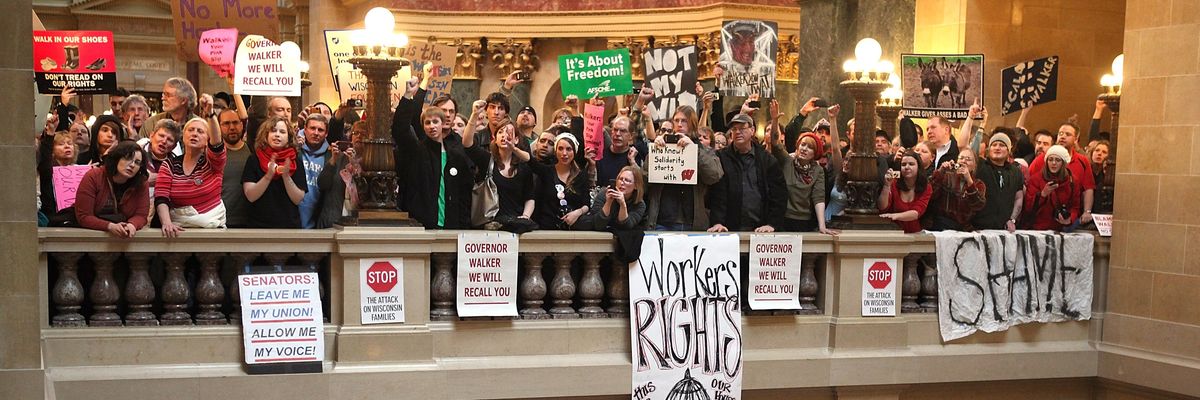
Protestors look up toward the Wisconsin assembly chamber on March 10, 2011 in Madison, Wisconsin during protests against restrictions on collective bargaining rights for public employees.

(Photo: Justin Sullivan/Getty Images)

Olivia Rosane
Dec 03, 2024
COMMON DREAMS


More than a decade after it sparked massive protests in the state capital, a Wisconsin judge on Monday struck down a controversial law that effectively ended public sector collective bargaining in the state.

In his final judgement, Dane County Circuit Judge Jacob Frost crossed out 85 sections of the 2011 law known as Act 10, which was championed by then-Republican Gov. Scott Walker. Frost's ruling restored the union rights of teachers, sanitation workers, nurses, and other public sector employees.

"After 14 years of battling for our collective bargaining rights, we are thrilled to take this step forward," Rocco DeMark, a building service worker and SEIU Wisconsin worksite leader, said in a statement. "This victory brings us immense joy. Our fight has been long, but we are excited to continue building a Wisconsin where we can all thrive."

"We realize there may still be a fight ahead of us in the courts, but make no mistake, we're ready to keep fighting until we all have a seat at the table again."

Act 10 severely weakened the power of public sector unions in Wisconsin by only permitting them to bargain for wage increases that did not surpass inflation. It also raised what public employees paid for healthcare and retirement, ended the automatic withdrawal of union dues, and required workers to recertify their union votes every year.

The law has had a major impact on the Wisconsin workforce. Between 2000 and 2022, no state saw a steeper decline in its proportion of unionized employees, a drop that the nonpartisan Wisconsin Policy Forum partly attributed to Law 10. Unions say that the law has caused a "crisis" for the state's education workforce, as 40% of new teachers leave within six years due to low pay and an unequal wage system. There is also a 32% vacancy rate for state correction officers.

Act 10 had one exception, however: Certain "public safety" employees such as police and firefighters were exempt from the collective bargaining restrictions imposed on "general" employees. It was this division that unions used to challenge the law in November 2023, arguing that it violated the equal protection clause of the Wisconsin Constitution. In July, Frost affirmed that the law was unconstitutional when he struck down an attempt to dismiss the suit. Then, on Monday, he specified exactly which parts of the law would be struck down.

"Judge Frost's ruling is a monumental victory for Wisconsin's working class," Democratic Wisconsin State Assembly Member Darrion Madison toldCourthouse News Service. "All Wisconsinites deserve the opportunity to live in a state that treats all workers with respect and dignity."

The lawsuit was brought by Ben Gruber, Matthew Ziebarth, the Abbotsford Education Association (WEAC/NEA), AFSCME Local 47, AFSCME Local 1215, Beaver Dam Education Association (WEAC/NEA), SEIU Wisconsin, Teaching Assistants Association (TAA/AFT) Local 3220, and Teamsters Local 695.

"Today's decision is personal for me and my coworkers," said Gruber, who serves as president of AFSCME Local 1215. "As a conservation warden, having full collective bargaining rights means we will again have a voice on the job to improve our workplace and make sure that Wisconsin is a safe place for everyone."

The news was also celebrated by state›wide advocacy groups and national leaders.

"We applaud today's ruling as a win for workers' rights and as proof that when we come together to ensure our courts and elected leaders are working on behalf of our rights and freedoms instead of partisan antics, we can accomplish great things," said A Better Wisconsin Together deputy director Mike Browne.

American Federation of Teachers president Randi Weingarten said: "This decision is a big deal. Act 10 stripped workers of the freedom and power to have a voice on the job to bargain wages, benefits, and working conditions. It's about the dignity of work. And when workers have a voice, they have a vehicle to improve the quality of the services they provide to students, patients, and communities."

"Former Gov. Scott Walker tried to eliminate all of that, and it hurt Wisconsin," she continued. "Now, many years later, the courts have found his actions unconstitutional."

Rep. Mark Pocan (D-Wis.) wrote on social media, "I voted against Act 10 more than 13 years ago, and am thrilled our public servants are able to once again organize and make their voices heard."


This is not the first time that Act 10 has been challenged in court, but it is the first time since the state's Supreme Court switched from a conservative to a liberal majority in 2023. Since Republican lawmakers have promised to appeal Frost's ruling, the law's ultimate fate could depend on elections in April 2025, which will determine whether the court maintains its liberal majority, according toThe Associated Press.

As they celebrated, the plaintiffs acknowledged the legal fight was not yet over.

"We realize there may still be a fight ahead of us in the courts, but make no mistake, we're ready to keep fighting until we all have a seat at the table again," Gruber said.

WEAC President Peggy Wirtz-Olsen said: "Today's news is a win and, while there will likely be more legal legwork coming, WEAC and our allies will not stop until free, fair, and full collective bargaining rights are restored."

Betsy Ramsdale, a union leader who teaches in the Beaver Dam Unified School District, said that public sector collective bargaining rights ultimately helped the state.

"We're confident that, in the end, the rghts of all Wisconsin public sector employees will be restored," she said. "Educators' working conditions are students' learning conditions, and everyone benefits when we have a say in the workplace."
46 Senators Call on Biden to Certify Equal Rights Amendment as GOP Control Looms

"There is no excuse for leaving us all unprotected," said one advocate.


A group of men and women march together holding signs while participating in an ERA protest in Pittsburgh, Pennsylvania in 1976.
(Photo: Barbara Freeman/Getty Images)

Julia Conley
Dec 03, 2024
COMMON DREAMS

Emphasizing that the Equal Rights Amendment is the only proposed constitutional amendment that has yet to be certified, 46 U.S. senators have joined the growing national call for President Joe Biden to ensure the proposed statute is part of the Constitution when he leaves office in January.

Reporting on the letter on Tuesday, the Virginia-based publication Style Weekly noted that the state's two Democratic senators—Sens. Mark Warner and Tim Kaine—joined almost the entire Democratic caucus in sending the letter to Biden on November 22. Independent Sens. Angus King of Maine and Bernie Sanders of Vermont signed the letter, but Sen. Joe Manchin (I-W.Va.), who also caucuses with the Democrats, did not.

The ERA was passed by Congress in 1972, and was immediately ratified by 35 states. It took nearly five decades for the amendment to be ratified by three-fourths of U.S. state legislatures, with Virginia becoming the 38th state to ratify it in 2020.

Despite the amendment meeting the ratification requirements, Biden has yet to direct the national archivist, Colleen Shogan, to certify the ERA and publish it in the Federal Register, which would formally cement it as part of the U.S. Constitution.

Once published, the amendment would guarantee legal equality between men and women, and reproductive rights advocates have said it could be invoked by judges to overturn anti-abortion rights laws that have been passed by Republican-controlled state legislatures across the country—an urgent issue as President-elect Donald Trump's second term in office with a GOP-controlled Congress draws near.

"As you are keenly aware," wrote the senators, "after nearly 50 years under the protections of Roe, more than half of all Americans have seen their rights come under attack, with access to abortion care and lifesaving healthcare varying from state to state. A federal solution is needed, and the ERA is the strongest tool to ensure equality and protect these rights for everyone. It would establish the premise that sex-based distinctions in access to reproductive care are unconstitutional, and therefore that abortion bans—which single out women for unfair denial of medical treatment based on sex—violate a constitutional right to sex equality."

The senators noted that state-level equal rights amendments have already been used in Connecticut, New Mexico, Pennsylvania, Utah, and Nevada to protect against "legislative infringements on women's reproductive freedom."

The letter was reported ahead of a virtual town hall scheduled for Tuesday at 7:00 pm ET, when Sen. Kirsten Gillibrand (D-N.Y.) is scheduled to speak about the ERA.


The town hall was organized by the Biden Publish the ERA Alliance, which consists of 20 non-partisan advocacy groups including Doctors for America, Free Speech for People, and the League of Women Voters.

Organizers are also planning rallies in Washington, D.C. on Wednesday and next week.

Kati Hornung, co-founder of Vote Equality U.S. and a leader in the grassroots effort that pushed Virginia to ratify the ERA, told Style Weekly that Biden "campaigned on fixing our constitutional gender equality gap and his campaign even requested to speak at a VAratifyERA event in 2019."

"He is running out of time to tell the national archivist, Colleen Shogan, to do her job," she said. "One hundred seventy million women and girls have been waiting 101 years for this amendment to be added and with the increased threats to our LGBTQIA+ family and friends, there is no excuse for leaving us all unprotected."
For Wall Street-Fueled Philanthropy Industry, Every Day Is Giving Tuesday

"
The financial industry aggressively markets DAFs for uncharitable reasons: advantages as tax avoidance vehicles, especially for complex assets; no payout requirements—and secrecy to donors and grantees alike," said one of the report's authors.


(Photo: Caroline Rojas/Flickr/cc)

Eloise Goldsmith
Dec 03, 2024
COMMON DREAMS

A new report released on this year's philanthropic holiday known as Giving Tuesday details how the "profit motives of the financial services sector have increasingly and disastrously warped how charitable giving functions."

The analysis by the Institute for Policy Studies—titled "Gilded Giving 2024: Saving Philanthropy from Wall Street"—shows how donor-advised funds (DAFs) increasingly serve the economic interests of donors and the Wall Street firms that manage the funds, rather than the interests of nonprofit charities.


Rather than donate to a cause directly, wealthy people have the option to donate to foundations or DAFs, which can be sponsored by for-profit wealth management firms like Fidelity Investments or Charles Schwab. Firms like Fidelity Investments, in turn, benefit from being able to offer this type of service to wealthy clients.

"At last count," according to the report's authors, "DAFs and foundations together take in 35 percent of all individual giving in the U.S." If they continue to grow at the rate they have for the past five years, they're expected to take in half of all individual giving in the country by 2028.

Why is this a problem? For one thing, according to the report, some of the money that's intended for donation is scraped up by the DAFs and foundations, meaning that dollars meant for a cause are diverted elsewhere.

"With each passing year, an additional 2 cents of each dollar donated by individuals is funneled into intermediaries and away from working charities. Assuming that their assets will grow at the same rate they have over the past five years, the assets held in DAFs and foundations will eclipse $2 trillion by 2026," according to the report's authors.

What's more, there is no requirement that DAFs disburse their assets, according to the report's authors—meaning there's no guarantee the money is given to charity, and in practice the money in these accounts tends to move slowly, often generating gains instead of being dispersed.

DAFs also facilitate anonymous giving, because donations from them need only be credited to their sponsors, not the original person directing the contribution, according to Inequality.org, a project of IPS.

The report's authors argue that DAFs are part of a wider “wealth defense industry” — tax lawyers, accountants, and wealth managers whose interests are more geared towards helping their clients increase assets, minimize taxes, maximize wealth transfer to descendants, and net some of those assets for themselves in the form of fees, as opposed to supporting charitable causes.

DAFS are used strategically in this way, for example, by giving donors the ability to dispose of noncash assets, according to the report. In practice, this means that DAF donors can give stocks, real estate and other noncash assets directly to DAFS when markets are doing well, meaning they are able to get income tax deductions from their contribution while side stepping paying capital gains tax on appreciation of those assets.

"The financial industry aggressively markets DAFs for uncharitable reasons: advantages as tax avoidance vehicles, especially for complex assets; no payout requirements—and secrecy to donors and grantees alike," said Chuck Collins, co-author of the report and director of the Charity Reform Initiative at IPS.

Other key insights from the study include:Tech companies are offering DAF-related platforms, apps, and widgets in order to make DAF granting, and by extension charitable giving, more "frictionless." Yet, these companies, also promote DAFs to advisors and donors in terms of tax efficiency and their ability to help investment advisors "maintain AUM"—or assets under management.

That the financial industry is "blurr[ing] the distinction between investment and philanthropy." Investors will talk about philanthropy as part of a wider portfolio of financial behaviors, as opposed to something fundamentally different—"something that, by its nature, requires individuals to relinquish personal interest and control."

The report recommends a number of reforms in order to take back philanthropy from Wall Street, including enacting regulations that would ensure donations reach working charities on reasonable timelines, undertaking {agreement} reforms to eliminate "shell games and tax dodges that financial advisors craft to diminish and delay the flow of funds to qualified charities," organizing a coalition of interested partners that would apply pressure on Congress and state governments to take action, and uplifting good examples of DAF sponsors who facilitate steady and generous giving despite gaps in the law.
'Unsettling New Milestone': Top 12 US Billionaires Now Control $2 Trillion in Wealth

"The oligarchic dozen is richer than ever, and they are endowed with extreme material power that can be used to pursue narrow political interests at the expense of democratic majorities," according to the author of a new analysis.


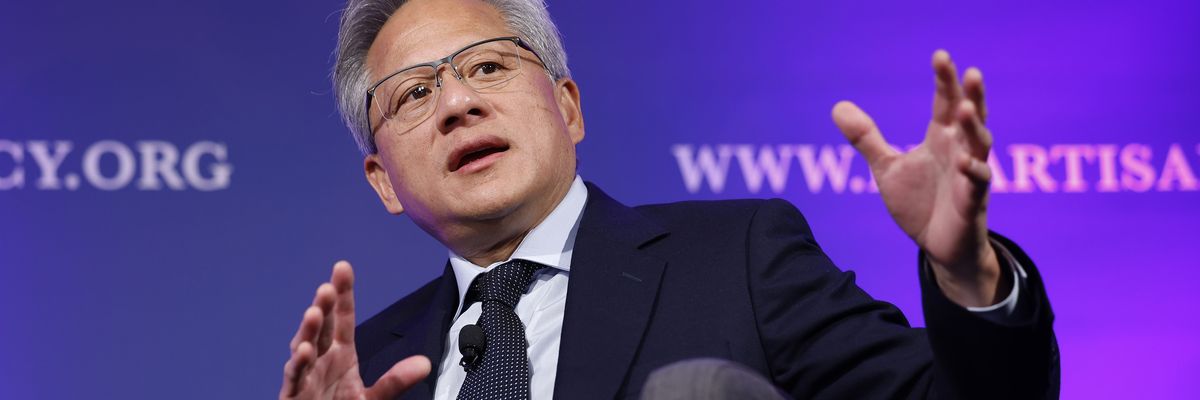
Jensen Huang of Nvidia speaks about the future of artificial intelligence and its effect on energy consumption and production at the Bipartisan Policy Center on September 27, 2024 in Washington, DC.

(Photo by Chip Somodevilla/Getty Images)

Eloise Goldsmith
Dec 04, 2024
COMMON DREAMS

Just 12 U.S. billionaires now have a collective net worth of over $2 trillion—a figure that amounts to a little less than a third of total federal spending in 2023—according to an analysis out Tuesday from Inequality.org, a project of the Institute for Policy Studies (IPS).

The $2 trillion number is also twice the amount of wealth that the top 12 US billionaires held in 2020, according to researchers at IPS, a progressive organization.

The full list of 12 billionaires includes Jeff Bezos, Bill Gates, Mark Zuckerberg, Warren Buffett, Elon Musk, Steve Ballmer, Larry Ellison, Larry Page, Sergey Brin, Jim Walton, Rob Walton, and Jensen Huang.

"This is an unsettling new milestone for wealth concentration in the United States. The oligarchic dozen is richer than ever, and they are endowed with extreme material power that can be used to pursue narrow political interests at the expense of democratic majorities," wrote the author of the analysis, Omar Ocampo, a researcher at IPS.

New to the "oligarchic dozen" is Jensen Huang, the co-founder and CEO of the tech company Nvidia. Nvidia, which became the most valuable publicly traded company this year, has seen its profits jump thanks to the world's ravenous appetite for the artificial intelligence chips that the firm produces. According to the analysis, Huang's personal wealth "has skyrocketed from $4.7 billion in 2020 to $122.4 billion—a mind-boggling 2,504 percent increase—over the last four years."

Each of the billionaires on the list "owns or is a controlling shareholder of a business that is investing billions of dollars in artificial intelligence," according to Ocampo, which raises concerns about their respective carbon footprints.


Fueling AI is energy intensive, and AI data centers in the U.S. are largely powered by fossil fuels, meaning their proliferation poses a threat to the environment and a transition to a green economy.

Ocampo also discusses the political reach of the billionaires on the list. Elon Musk and Jeff Bezos, who respectively own X and The Washington Post, "have both purchased large media platforms, which has granted them the ability to set the terms of public debate with the hopes of influencing public opinion in their favor."

Musk specifically has established himself as a major power broker within the GOP. The billionaire spent hundreds of millions helping to re-elect Donald Trump and is now poised to play a major role in the president-elect's administration, helping oversee a new advisory committee tasked with slashing government spending.

As of early December, Trump had tapped an "unprecedented" total of seven reported billionaires for key positions in his administration, according to a separate piece of analysis by Inequality.org.

"We see the effects of this growing concentration of wealth and economic inequality everywhere—plutocratic influence on our politics, wealth transfers from the bottom to the top, and the acceleration of climate breakdown," Ocampo wrote on Tuesday.


'Right Thing to Do': FERC Delays Controversial LNG Export Terminal


"We are happy about the delay, but these projects don't ever need to be approved and neither does any other LNG facility," one frontline advocate said.


The Seapeak Magellan liquefied natural gas (LNG) tanker at the Venture Global Calcasieu Pass LNG export terminal is seen in Cameron, Louisiana, on September 29, 2022; in the foreground, wetlands that will disappear if the proposed new LNG export terminal is built.
(Photo: Francois Picard/AFP via Getty Images)

Olivia Rosane
Dec 04, 2024
COMMON DREAMS


Frontline communities along the Gulf Coast were granted a "temporary reprieve" last week when the Federal Energy Regulatory Commission moved to pause its approval of the controversial Calcasieu Pass 2 liquefied natural gas export terminal while it conducts an assessment of its impact on air quality.

FERC approved Venture Global's CP2 in late June despite opposition from local residents who say the company's nearly identical Calcasieu Pass terminal has already wracked up a history of air quality violations and disturbed ecosystems and fishing grounds in Louisiana's Cameron Parish, harming health and livelihoods.

"This order reveals that FERC recognizes that CP2 LNG's environmental impacts are too great to pass through any real scrutiny" Megan Gibson, a senior attorney with the Southern Environmental Law Center (SELC), said in a statement on Monday.

"FERC's pause on construction may give us some temporary reprieve, but this project never should have been authorized in the first place."

FERC's decision follows a request for a rehearing of its June decision filed by frontline residents and community groups including For a Better Bayou and Fishermen Involved in Sustaining Our Heritage (FISH) as well as the Sierra Club and the Natural Resources Defense Council. In their request, the groups and individuals pointed to errors the commission had made in its approval decision.

"With this order, it seems FERC is finally willing to acknowledge that it has not done enough to properly consider the cumulative harm on communities caused by building so many of these LNG export terminals so close together," Nathan Matthews, a Sierra Club senior attorney, said in a statement. "Prohibiting construction of CP2 LNG while FERC takes another look at the environmental impact of this massive, polluting facility is the right thing to do."

"Still," Matthews continued, "FERC must take concrete steps to properly evaluate the true scope of the dangers posed to communities from gas infrastructure moving forward and avoid making unwarranted approvals in the future."

FERC's decision comes over four months after the D.C. Circuit Court remanded the commission's approval of Commonwealth LNG, also in Louisiana, over concerns that it had not fully assessed the impacts of that project's air pollution emissions. Now, frontline advocates are urging FERC to do its due diligence as it weighs the environmental impacts of CP2.

"Through the lenses of optical gas imaging, we've seen massive plumes of toxic emissions, undeniable proof that these projects poison the air we breathe," James Hiatt, director of For a Better Bayou, said of LNG export facilities. "Modeling must use the latest data from the most local sources to fully capture the harm these facilities inflict on Cameron Parish. Anything less is a betrayal of our community. FERC must choose justice over profit and stop sacrificing people for polluters."

Gibson of SELC said that FERC had already repeated some of the errors in its CP2 approval in its new order.

"This continued failure to fulfill its regulatory duty is not just an oversight—it is a failure to protect vulnerable communities and our economy from the real potential harms of this massive export project," Gibson said.

FERC's decision comes as the fate of the LNG buildout itself hangs in the balance. The Biden administration's Department of Energy is currently rushing to complete its renewed assessment of whether or not LNG exports serve the public interest. Environmental and frontline groups have argued that they do not because of local pollution, the fact that they would raise domestic energy bills, and their contribution to the climate emergency. CP2 alone would spew 8,510,099 metric tons of carbon dioxide-equivalent per year, which is about the same as adding 1,850,000 new gas cars to the road.

While President-elect Donald Trump has promised to "drill, baby, drill" and is likely to disregard any Biden administration conclusions, a strong outgoing statement against LNG exports would help bolster legal challenges to Trump energy policy.

At the same time, Bill McKibben pointed out in a column on Tuesday that the administration's pause on LNG export approvals while it updates its public interest criteria has acted to slow the industry's expansion, and that FERC's reconsideration of CP2 could add to this delay.

"The vote for the new review is 4-0, and bipartisan," McKibben wrote. "It could slow down approvals for the project till, perhaps, the third quarter of next year. And that's good news, because the rationale for new LNG exports shrinks with each passing month, as the gap between the price of clean solar, wind, and battery power, and the price of fossil fuel, continues to grow."

Ultimately, frontline Gulf Coast advocates want to see the LNG buildout halted entirely.

"I, along with the fishermen in Cameron, Louisiana, know firsthand how harmful LNG exports are, and see the total disregard they have for human life as they poison our families and seafood," said FISH founder Travis Dardar, an Indigenous fisherman in Cameron, Louisiana. "FERC's pause on construction may give us some temporary reprieve, but this project never should have been authorized in the first place. As far as anyone who believes in the fairytale of LNG being cleaner, we have paid with our communities and livelihoods. It's time to break these chains and turn away from this false solution."

Roisheta Ozaine, a prominent anti-LNG activist and founder of the Vessel Project of Louisiana, said that she, as a mother in an environmental justice community, saw "firsthand how LNG facilities prioritize profit over the well-being of our families. Commonwealth and CP2 are no different."

"We are happy about the delay, but these projects don't ever need to be approved and neither does any other LNG facility," Ozane continued. "My children are suffering from health conditions that threaten their daily lives, all while regulatory agencies and elected officials turn a blind eye. It's time for our leaders to put people before profit and prioritize the health of our communities over the pollution that harms us. We deserve a future where our children's health is safeguarded, not sacrificed."