Tuesday, December 10, 2024

French actor outraged as director denies child abuse in court


By AFP
December 10, 2024


French actor Adele Haenel has quit cinema over the French film industry turning a blind eye to sexual abuse - Copyright AFP ALAIN JOCARD


Marie Dhumieres

A French prosecutor Tuesday demanded a filmmaker be put under house arrest for two years over sexually assaulting an actor when she was a child, after his accuser stormed out of the landmark trial over him denying the abuse.

Adele Haenel, 35, has accused filmmaker Christophe Ruggia, 59, of assaulting her in the early 2000s when she was between 12 and 14 and he was in his late 30s, allegations he has called “pure lies”.

The trial since Monday come as France’s film industry is rocked by allegations of sexual abuse.

Haenel, who starred in 2019 drama “Portrait of a Lady on Fire” before quitting cinema, was the first prominent actor to accuse the French film industry of turning a blind eye to the ill treatment.

The prosecutor on Tuesday requested two years detention with an electronic bracelet plus a three-year suspended sentence against the director.

Ruggia directed Haenel in the 2002 movie “The Devils”, a tale of an incestuous relationship between a boy and his autistic sister. It was her first film role.

The film contains sex scenes between the children and close-ups of Haenel’s naked body.

Investigators said before the trial that members of the film crew had told them of their “unease” with Ruggia’s behaviour on set.

Between 2001 and 2004, after shooting the film, the teenager went to see Ruggia nearly every Saturday.

During these visits, she has accused him of caressing her thighs and touching her genitals and breasts.

“He chose to sexually assault her. He had his whole conscience as a man — as an adult — to behave otherwise,” prosecutor Camille Poch said.

She asked that Ruggia also be listed as a sex offender.


– ‘It’s grooming’ –


But Ruggia has rejected these claims.

He told the court earlier on Tuesday that he had in fact sought to protect Haenel from mockery in school over the sex scenes in “The Devils”.

This caused her to be outraged.

“Would you just shut up?” she shouted, banging her hands on the table in front of her.

Haenel marched out and only returned half an hour later with her lawyer, refusing to look at Ruggia.

In 2019, Haenel went public about the assaults, stunning the French film industry, which had been slower than Hollywood to react to the #MeToo movement.

Haenel on Tuesday described “normality that shifted by degrees” into abuse.

“Who was there to say, ‘It’s not your fault. It’s grooming. It’s violence’?” she said.

“You can’t abuse children like that. There are consequences. No one helped that child,” she said, speaking of her younger self.


– ‘Unfortunate gesture’ –


Ruggia’s former partner Mona Achache, 43, told the court about the filmmaker confessing to a single “unfortunate gesture” on one of the Saturday visits.

She said Ruggia told her he had been “madly in love” with the young actress.

“He told me they were watching a film on the sofa, she had rested her head on his lap, and his hand moved onto her breast,” she said.

“It was a version of the story that highlighted his virtue in removing his hand.”

The filmmaker had also said something to his sister.

“I got the impression he felt guilty,” Veronique Ruggia said.

In 2020, Haenel stormed out of the industry’s Cesars award ceremony in protest against a prize awarded to veteran director Roman Polanski, who is wanted in the United States for statutory rape.

Last year, she quit cinema over what she called the French film industry turning a blind eye towards sexual abusers.

Several other allegations have rocked the film sector over the past few years.

Cinema legend Gerard Depardieu, 75, is to stand trial in March accused of sexually assaulting two women. He denies the accusations.

Actor Judith Godreche said this year two French directors — Benoit Jacquot and Jacques Doillon — had both sexually abused her when she was a teenager. Both deny the charges.

Nearly 200 dead in Haiti massacre as voodoo community reportedly targeted


By AFP
December 9, 2024

Police forces take part in an operation against powerful gangs in the city center near the National Palace in Port-au-Prince on July 9, 2024 - Copyright AFP Clarens SIFFROY

Nearly 200 people in Haiti were killed in brutal weekend violence reportedly orchestrated against voodoo practitioners, with the government on Monday condemning an “abject massacre” of “unbearable cruelty.”

The killings were overseen by a powerful gang leader convinced that his son’s illness was caused by followers of the religion, according to civil organization the Committee for Peace and Development (CPD).

“He decided to cruelly punish all elderly people and voodoo practitioners who, in his imagination, would be capable of sending a bad spell on his son,” a statement from the Haiti-based group said.

UN rights commissioner Volker Turk said that at least 184 people were killed in the weekend violence.

Calling the bloody episode an “act of barbarity, of unbearable cruelty,” the office of Prime Minister Alix Didier Fils-Aime said his government “condemns in the strongest terms the abject massacre.”

“This monstrous crime constitutes a direct attack on humanity and the republican order,” it added.

Both the CPD and UN said that the massacre took place in the capital’s western coastal neighborhood of Cite Soleil.

Reached by telephone by AFP, a resident confirmed the brutal attacks and indicated that his 76-year-old father was among the victims.

“The bandits set fire to his body. The family cannot even organize a burial for him since we were unable to recover the body,” he told AFP on condition of anonymity so as not to compromise the safety of other relatives still in the area.

“I also fear for their lives,” he said. “I will try to get them out this Monday.”


– Taken to be ‘executed’ –


“The gang’s soldiers were responsible for identifying victims in their homes to take them to the chief’s stronghold to be executed,” the CPD said.

Haiti has suffered from decades of instability but the situation escalated in February when armed groups launched coordinated attacks in the capital Port-au-Prince to overthrow then-prime minister Ariel Henry.

Gangs now control 80 percent of the city. Despite a Kenyan-led police support mission, backed by the United States and UN, violence has continued to soar.

Turk told reporters in Geneva that the latest killings “bring the death toll just this year in Haiti to a staggering 5,000 people.”

The CPD said that most of the victims of violence waged on Friday and Saturday were over 60, but that some young people who tried to rescue others were also among the casualties.

“Reliable sources within the community report that more than a hundred people were massacred, their bodies mutilated and burned in the street,” it said.

More than 700,000 people are internally displaced in Haiti, half of them children, according to October figures from the UN’s International Organization for Migration.

Voodoo was brought to Haiti by African slaves and is a mainstay of the country’s culture. It was banned during French colonial rule and only recognized as an official religion by the Haitian government in 2003.

While it incorporates elements of other religious beliefs, including Catholicism, voodoo has been historically attacked by other religions.

- - - - 

FOR MORE ON THE ORIGINS OF VOODOO / ZOMBIE MYTH AND IMPERIALISM

SEE MY GOTHIC CAPITALISM
Feb 15, 2005 — The development of capitalism in the 18th and 19th Centuries saw not only bourgeois revolutions but the revolt of slaves and the most successful ...

Full text of "The Horror Of Accumulation And The Commodification ...

https://archive.org › stream › The+Horror+of+Accumul...

Karl Marx GOTHIC CAPITALI$M The Horror of Accumulation & The Commodification of Humanity Gothic Capitalism The Horror of Accumulation and the 
Google announces quantum computing chip breakthrough


By AFP
December 9, 2024

Google says the Willow chip has it confidently on a path to the kind of quantum computing that could tackle seemingly insurmountable real-world problems - Copyright GOOGLE/AFP HO

Google on Monday showed off a new quantum computing chip that it said was a major breakthrough that could bring practical quantum computing closer to reality.

A custom chip called “Willow” does in minutes what it would take leading supercomputers 10 septillion years to complete, according to Google Quantum AI founder Hartmut Neven.

“Written out, there is a 1 with 25 zeros,” Neven said of the time span while briefing journalists. “A mind-boggling number.”

Neven’s team of about 300 people at Google is on a mission to build quantum computing capable of handling otherwise unsolvable problems like safe fusion power and stopping climate change.

“We see Willow as an important step in our journey to build a useful quantum computer with practical applications in areas like drug discovery, fusion energy, battery design and more,” said Google CEO Sundar Pichai on X.

A quantum computer that can tackle these challenges is still years away, but Willow marks a significant step in that direction, according to Neven and members of his team.

While still in its early stages, scientists believe that superfast quantum computing will eventually be able to power innovation in a range of fields.

Quantum research is seen as a critical field and both the United States and China have been investing heavily in the area, while Washington has also placed restrictions on the export of the sensitive technology.

Olivier Ezratty, an independent expert in quantum technologies, told AFP in October that private and public investment in the field has totaled around $20 billion worldwide over the past five years.

Regular computers function in binary fashion: they carry out tasks using tiny fragments of data known as bits that are only ever either expressed as 1 or 0.

But fragments of data on a quantum computer, known as qubits, can be both 1 and 0 at the same time — allowing them to crunch an enormous number of potential outcomes simultaneously.

Crucially, Google’s chip demonstrated the ability to reduce computational errors exponentially as it scales up — a feat that has eluded researchers for nearly 30 years.

The breakthrough in error correction, published in leading science journal Nature, showed that adding more qubits to the system actually reduced errors rather than increasing them — a fundamental requirement for building practical quantum computers.

Error correction is the “end game” in quantum computing and Google is “confidently progressing” along the path, according to Google director of quantum hardware Julian Kelly.


Georgia protests enter 13th night as EU threatens ‘measures’


By AFP
December 10, 2024

Demonstrators rallied for the 13th consecutive day against the government's decision to shelve Georgia's push to join the EU - Copyright AFP Giorgi ARJEVANIDZE


Umberto BACCHI

Pro-Europe protests showed no sign of abating Tuesday, with thousands taking to the streets as the European Union warned it could punish Tbilisi for its crackdown on demonstrators.

Waving EU and Georgian flags and loudly blowing horns and whistles, demonstrators rallied outside parliament for the 13th consecutive day against the government’s decision to shelve its push to join the EU after disputed elections.

“Every day after work we are coming here,” said Sofia Japaridze, 40, an air industry worker.

“All of Georgia, every city, every village, everybody wants (to join) the EU, we don’t want to go back to USSR,” she said.

The Caucasus nation has been mired in turmoil since the ruling Georgian Dream party — accused of moving the country towards Russia — claimed victory in the October 26 parliamentary polls.

The pro-Western opposition has dismissed the vote as rigged, while tens of thousands have protested against alleged electoral fraud.

Prime Minister Irakli Kobakhidze’s shock decision on November 28 to suspend Georgia’s talks to join the EU triggered a fresh wave of demonstrations, which were met with a tough police response.

The crackdown has triggered outrage at home and mounting international condemnation.

On Tuesday, the EU said the bloc’s foreign ministers will discuss “additional measures” against Georgia’s authorities next week after what Brussels called “credible concerns” of torture against demonstrators.

“The persistent democratic backslide and the recent repressive means used by Georgian authorities have consequences for our bilateral relations,” a statement said.


– ‘Planned escalation’ –


The United States, Britain, France and Germany have also voiced indignation at the handling of the protests.

Critics accuse Georgian Dream of creeping authoritarianism.

Security forces have fired tear gas and water cannons to disperse previous demonstrations and arrested more than 400 people since the second wave of unrest began.

Police have raided opposition party offices, and on Saturday dozens of unidentified masked men brutally assaulted opposition figures and journalists near the protest venue.

The State Security Service said Tuesday it expected more trouble ahead of December 14, when Georgian Dream lawmakers are to elect a loyalist to succeed pro-Western President Salome Zurabishvili.

Without providing any evidence, it said violent groups aiming to stop the vote were planning to “escalate” their actions, cause “the deaths of two or three people” and blame the government in a bid at fuelling further protests.

Zurabishvili — who has vowed not to step down until the parliamentary polls are re-run — denounced the agency’s statement as an attempt to “psychologically terrorise people”, according to the Interpress news agency.


– ‘Burning passion’ –


Authorities have been at pains to project an air of normality.

Kobakhidze has repeatedly said police averted an attempted revolution by what he has described as “liberal fascist” opposition groups — in language similar to how the Kremlin refers to dissenters in Russia.

He has shrugged off the demonstrations as insubstantial.

A giant Christmas tree has been set up outside parliament — the main protest venue.

On Monday the city deployed dozens of cleaners and street sweepers to tidy up the area as soon as the demonstrations ended.

But protesters, young and old, have continued to demand a fresh vote and a return to European integration.

On Tuesday, Roland Kalandadze, 25, said he did not think the protests would peter out as they approached a third week.

“There is still fuel and burning passion to it, because there are already a lot of people who suffered, who were put in jail. That motivates us more,” he said.

He expressed the hope the government will be gone “before the new year”.

The previous night demonstrators set alight a coffin containing an effigy of billionaire former premier Bidzina Ivanishvili, widely believed to be pulling the strings of power.

Critics of Georgian Dream are enraged by what they call its betrayal of the country’s bid for EU membership, enshrined in the constitution and supported by some four-fifths of the population.

The party, in power for more than a decade, has advanced controversial legislation in recent years, targeting civil society and independent media and curbing LGBTQ rights.

Brussels has warned that such policies are incompatible with EU membership, while domestic detractors accuse the government of copying Russia’s playbook.

New York appeals dismissed PepsiCo plastic pollution suit

By AFP
December 10, 2024

New York accuses PepsiCo of harming the public and failing to warn consumers of the health and environmental threats posed by its packaging - Copyright AFP/File Allison ROBBERT

New York state this week appealed the dismissal of a pollution lawsuit against soda giant PepsiCo, accusing its single-use plastic packaging of posing a scourge on waterways and public health.

Just over a month ago a state Supreme Court justice threw out the case, saying that allegations were “speculative” and that individual consumers, not the company, were responsible for litter.

In a notice to the court’s appellate division dated Monday but made public Tuesday, New York Attorney General Letitia James said the judge who dismissed the case had “erroneously applied the law and facts.”

The appeal comes amid a major blow in the fight to curb plastic pollution after nations negotiating a global treaty to limit plastic waste failed to reach a deal earlier this month.

In her original complaint, James accused the soda company, which is headquartered in New York and is among the world’s top contributors of plastic waste, of harming the public and failing to warn consumers of the health and environmental threats posed by its packaging.

She also alleged the company had misled the public about the effectiveness of recycling of its products and its efforts in combatting plastic pollution.

The lawsuit pointed out that plastics “cause wide-ranging harms to the public and New York State,” highlighting the presence of microplastics in both humans and fish.

A survey by James’ office found that PepsiCo’s plastic packaging was by far the greatest source of Buffalo River plastic pollution, three times as abundant as the next contributor, McDonald’s.

PepsiCo did not immediately respond to an AFP request for comment. It welcomed the judge’s original decision.

Rival soda maker Coca-Cola, also one of the largest contributors to global plastic pollution, drastically lowered its environmental goals this month, effectively scrapping a pledge to reach 25 percent reusable packaging by 2030, and pushing back dates and amounts for recycling goals, among other reductions.

The United States and China are the world’s largest producers of plastic.

President’s push to scrap gold mining ban causes outcry in El Salvador


By AFP
December 9, 2024

An artisanal miner holds ore extracted from the abandoned San Sebastian mine in Santa Rosa de Lima, La Union department, El Salvador, on December 5, 2024
 - Copyright AFP Daniela RODRIGUEZ

Carlos Mario MARQUEZ

El Salvador’s gang-busting strongman President Nayib Bukele has set out on a new mission: to kickstart his country’s sputtering economy by inviting back the mining companies that were barred seven years ago.

El Salvador was the first country in the world to ban the mining of metals in 2017, warning of the harmful effects of the chemicals used in mining, like cyanide and mercury.

The move by Bukele’s predecessor, former left-wing rebel Salvador Sanchez Ceren, reflected the growing rejection of mining by rural communities in central America, devastated by the industry’s adverse health and environmental effects.

Costa Rica and Honduras have both banned open-pit mining and Panama declared a moratorium on new mining concessions last year after mass protests over plans for a huge copper mine.

But on November 27, the populist Bukele signaled he wanted to change course.

In a series of posts on the social network X he claimed that El Salvador, a country of 6.6 million people, had “potentially” the largest gold deposits per square kilometer in the world.

“God placed a gigantic treasure underneath our feet,” he wrote, arguing that the mining ban was “absurd.”

Bukele cited a study — written by unknown authors and which he did not publish — that he said showed that mining a mere 4 percent of the country’s gold deposits would bring in $131 billion, “equivalent to 380 percent of GDP.”

“If we make responsible use of our natural resources, we can change the economy of El Salvador overnight,” he added a few days later.


– ‘Huge risk’ –


Since El Salvador dollarized its remittances-reliant economy in 2001, it has registered annual growth of between just 2 and 3.5 percent.

Twenty-seven percent of Salvadorans live in poverty, according to the United Nations Economic Commission for Latin America and the Caribbean, and 70 percent of the workforce operates in the informal sector.

Bukele, in power since 2019, took a huge gamble by investing hundreds of millions of dollars of taxpayer money in bitcoin and making the cryptocurrency legal tender in 2021 — the first country in the world to do so.

But most Salvadorans have shunned the cryptocurrency. Additionally, the country’s adoption of bitcoin hampered Bukele’s talks with the International Monetary Fund over a $1.3 billion loan.

He now appears to be pinning his hopes for a recovery on mining.

But he faces a stiff challenge from environmentalists who have won several victories over mining companies.

“It’s one thing to put a mine in the Atacama Desert (in Chile) and another thing to open an open-pit mine in Chalatenango,” said Pedro Cabezas, leader of the Central American Alliance Against Mining.

Chalatenango is a community north of the capital San Salvador that successfully opposed a gold mine project in 2006.

Antonio Pacheco, of the Association of Economic and Social Development NGO, which has pioneered the fight against mining, said that Bukele’s proposal to mine areas along the mighty Lempa River, which supplies water for San Salvador, represented a “tremendous risk” to residents.

– ‘Generate employment’ –

In the former gold mining town of Santa Rosa de Lima, where US miner Commerce Group had its environmental licence revoked in 2006 over river pollution, Bukele’s plan elicited a mixed response.

“I think that this could cause the area to prosper… it would generate employment,” Ruben Delgado, a 55-year-old construction worker, told AFP.

Jose Torres, a 72-year-old artisanal miner who extracts gold nuggets from disused mining tunnels by hand, said he feared losing his income to multinationals.

The nearby San Sebastian River was contaminated by industrial mining, and remains polluted to this day as artisanal mining continues.

Economist Carlos Acevedo, former president of the Central Bank of El Salvador, commented that the “spectacular” figures presented by Bukele created the impression that El Salvador “is sitting on a gold mine.”

He said that the 50 million ounces of gold touted by Bukele as a fraction of the country’s reserves could pay off El Salvador’s external debt — which accounts for 85 percent of GDP — four times over.

But he added that there was “no recipe for generating growth from one day to the next” and that any boon for El Salvador would depend on how much royalties mining companies paid.

ELDORADO

El Salvador sitting on $3 trillion worth of unmined gold, president says

Staff Writer | December 10, 2024 |


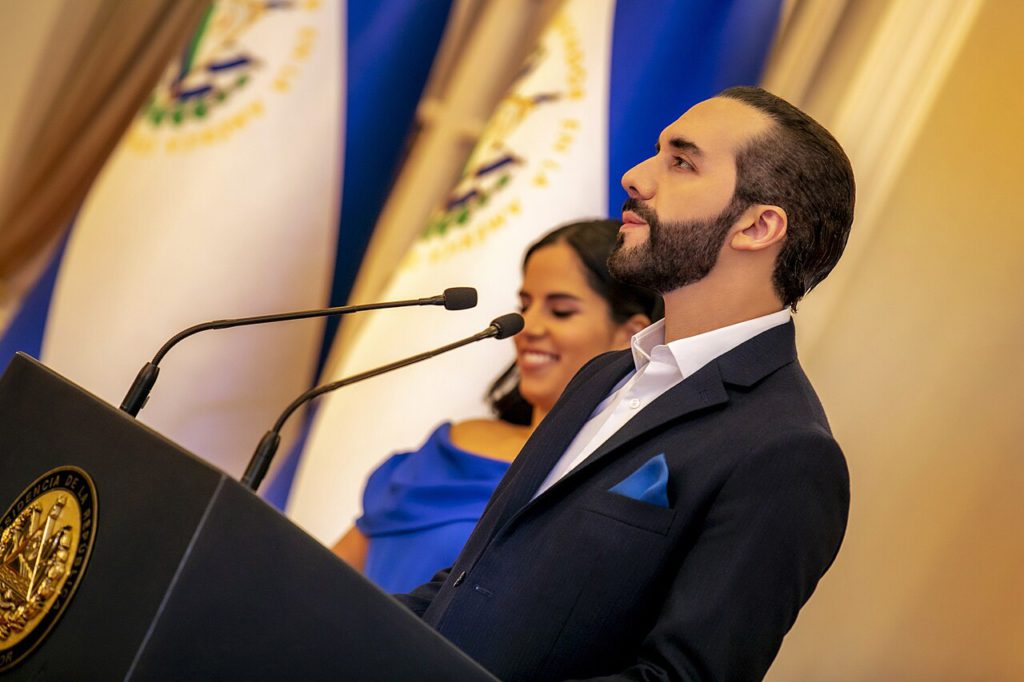
Nayib Armando Bukele Ortez, the 81st president of El Salvador. Credit: Casa Presidencial, Wikimedia Commons

El Salvador, which became the first country in the world to ban metals mining, could be losing out economy-changing wealth due to its massive unearthed gold deposits, says its President Nayib Bukele.


In a speech earlier this week, Bukele said that the Central American nation is sitting on unmined gold worth as much as $3 trillion, which is roughly over 8,800% of its current GDP. “We’ve also found gallium, tantalum, tin and many other materials needed for the 4th and 5th industrial revolution,” Bukele said.

This lost value, Bukele said, could be used to help clean up El Salvador’s rivers. According to government data, about 95% of the rivers in El Salvador are contaminated, and Bukele argues that the focus should be on cleaning up those rivers, instead of preventing further pollution by banning mineral extraction.

His predecessor, former left-wing rebel Salvador Sanchez Ceren, imposed the mining ban in 2017 following pressure from rural communities who had expressed concerns about harmful chemicals like cyanide and mercury used in mining practices.

Now, Bukele, the first President not elected as a candidate of one of El Salvador’s two major political parties since 1989, has set out to revoke this ban. Through his official X account, he has been repeatedly pointing to the massive economic benefits of the nation’s natural resources.

Prior to his recent speech, Bukele made a series of posts highlighting El Salvador’s gold potential, including an uncited study which showed the country has “potentially” the largest gold deposits per square kilometer in the world.


“God placed a gigantic treasure underneath our feet,” he wrote on X, adding that the mining ban was “absurd.”

Bukele went on to say that mining just 4% of the country’s gold deposits would bring in $131 billion, equivalent to 380% of its GDP.

“If we make responsible use of our natural resources, we can change the economy of El Salvador overnight,” he wrote a few days later.

However, as his predecessor and other Central American nations have recently found out, any pro-mining proposal would be met with strong opposition.

“It’s one thing to put a mine in the Atacama Desert (in Chile) and another thing to open an open-pit mine in Chalatenango,” Pedro Cabezas, leader of the Central American Alliance Against Mining, told AFP this week.

A potential lift of the mining ban would not be the first radical change under Bukele’s leadership. In 2021, he passed a law that made bitcoin legal tender, making El Salvador the first nation to do so.


Italian prosecutor says Meta owes more than 887 mn euros in VAT


By AFP
December 9, 2024


An Italian prosecutor argues that Meta's use of personal data amounts to a commercial transaction


 Mike Coppola

A Milan prosecutor on Monday said that Meta, the parent company of Facebook and Instagram, owes more than 887 million euros in value added taxes on estimated revenue it generated in Italy between 2015 and 2021.

Signing up for Facebook and Instagram is theoretically free, but users must accept access to their usage data and personal information, which the prosecutor described as a “synallagmatic contract” in which each side has obligations towards the other.

In Meta’s case, these transactions have “commercial purposes” that justify taxation, even if no actual money changes hands, Milan prosecutor Marcello Viola said in a statement.

The prosecutor said that he suspected the “legal representatives” of Meta’s Ireland-based platform of failing to declare a total of four billion euros ($4.23bn) in income over the period to evade VAT.

It estimated the VAT due at 887.6 million euros. A judge now must decide whether to pursue the case.

Meta told AFP that “we strongly disagree with the idea that providing access to online platforms to users should be charged with VAT.”

It said that the company has “cooperated fully with the authorities on our obligations under EU and local law and we will continue to do so. We take our tax obligations seriously and pay all tax required in each of the countries where we operate.”

The prosecution noted that other Italian public authorities had also come to the conclusion that Meta’s services were not free, including the competition watchdog in 2018, the administrative court of Lazio in 2020 and the Council of State in 2021

US firms up $6.2 bn Micron funding to boost chipmaking

ALL CAPITALI$M IS STATE CAPITALI$M


By AFP
December 10, 2024

The US government's Micron investment aims to bring development and production of advanced memory semiconductor technology to US shores
 - Copyright AFP/File Hector RETAMAL

Beiyi SEOW

US President Joe Biden’s administration finalized nearly $6.2 billion in funding for Micron Technology on Tuesday, firming up a deal to boost domestic semiconductor production before Donald Trump returns to the White House.

The Biden administration has been working to green-light agreements with firms in the chip making supply chain over recent months, hoping to cement it as part of his legacy before leaving office in January.

Once a deal is finalized, funds can start heading to companies when they hit certain milestones.

The Micron investment helps bring development and production of advanced memory semiconductor technology to US shores, said Commerce Secretary Gina Raimondo.

This “is crucial for safeguarding our leadership on artificial intelligence and protecting our economic and national security,” she added in a statement.

The United States has been trying to reduce its dependence on China and other countries for semiconductors.

In this case, Washington is keen to build up a reliable domestic supply of chips that can go into advanced technologies ranging from personal computing to artificial intelligence — including enabling new AI models.

The latest funding comes under the CHIPS and Science Act, a major law passed during Biden’s term aimed at strengthening the US semiconductor industry.


– ‘Stable supply’ –

The Micron deal in particular supports the company’s two-decade plan, including investments of some $100 billion in New York and $25 billion in Idaho, said the Commerce Department.

This should create some 20,000 jobs and help the US grow its share of advanced memory manufacturing, the department added.

Apart from the efforts in New York and Idaho, the Commerce Department also signed a preliminary agreement with Micron for up to $275 million in proposed funding to expand and modernize its facility in Virginia.

The aim is to support a “stable supply” of Micron’s technology, involving chips that are key to the automotive and industrial markets, the department noted.

“Memory chips are foundational to all advanced technologies,” Raimondo said.

“As the only US-based manufacturer of memory, Micron is uniquely positioned to bring leading-edge memory manufacturing to the US,” said Micron President Sanjay Mehrotra in a statement.

The United States used to make nearly 40 percent of the world’s chips but this proportion is now around 10 percent, with none being the most advanced chips.

While the US government has unveiled over $36 billion in grants through the CHIPS Act, some of the funds remain in a due diligence phase and cannot yet be disbursed until agreements are made final.

Stellantis, Chinese firm CATL plan $4bn battery plant in Spain

ByAFP
December 10, 2024

China's CATL is a major vehicle battery maker - Copyright AFP/File Hector RETAMAL
Valentin Bontemps with Frederique Pris in Paris

Car giant Stellantis and Chinese manufacturer CATL said Tuesday they would build a $4.3-billion factory to make electric vehicle batteries in Spain, the latest bid to boost Europe’s troubled EV drive.

They said they aim to start production by the end of 2026 at the site in the northern city of Zaragoza.

It “could reach up to 50 GWh capacity, subject to the evolution of the electrical market in Europe and continued support from authorities in Spain and the European Union”, the companies said in a statement.

The two firms signed an agreement in 2023 to produce battery parts for the manufacture of electric vehicles in Europe.

CATL, which has received robust financial support from Beijing, has launched two other European factories, in Germany and Hungary.

Its chief executive Robin Zeng met late on Monday with Spain’s Prime Minister Pedro Sanchez, ahead of the announcement of the 4.1-billion-euro deal.

In a message on X, the Socialist premier thanked the presidents of the two firms for their “firm commitment” to Spain, adding he was “very pleased”.

During a visit to China in September, Sanchez urged the European Union to “reconsider” a plan to impose tariffs on Chinese electric cars, calling for a “compromise” between the economic powerhouses.

Spanish Economy Minister Carlos Cuerpo called the announcement “excellent news for industry and employment in our country”.

Spain has been playing a growing role in European vehicle production, assembling 1.87 million cars in 2023 — the second-biggest producer in the continent after Germany, according to the European Automobile Manufacturers’ Association.


– Bumpy patch for carmakers –


The announcement comes at a turbulent time in the car industry as countries seek to switch to low-carbon electric vehicles to curb the climate crisis.

Sweden’s financially strained electric car battery maker Northvolt last month announced the resignation of its chief executive Peter Carlsson.

That came hours after the company sought bankruptcy protection in the United States.

The company said in September it was slashing 1,600 jobs — a quarter of its staff — and suspending the expansion of its site as it struggled with strained finances and a slowdown in demand.

The company had been seen as a cornerstone of European attempts to catch up with China and the United States in the production of battery cells, a crucial component of lower-emission cars.

Stellantis’s former chief executive Carlos Tavares also resigned on December 1, with the company signalling differences over how to save the group’s slumping profits.

Like other auto groups, Stellantis has blamed competition from China and the difficult transition to electric cars for much of its troubles.

It announced on November 26 that it was closing a factory at Luton in England with the loss of 1,100 jobs.


– ‘High-quality’ EVs –


Founded in 2011 in Ningde, eastern China, CATL produces more than a third of the electric vehicle batteries sold in the world.

Italian-US-French company Stellantis produces 14 brands including Fiat, Peugeot-Citroen, Opel, Maserati, Chrysler, Ram and Jeep.

The Zaragoza plant will make lithium iron phosphate (LFP) batteries, which are cheaper to produce but less powerful compared with nickel manganese cobalt (NMC) ones, the other current mainstream technology.

The companies said the factory, which will be designed to be completely carbon neutral, would enable Stellantis “to offer more high-quality, durable and affordable battery-electric passenger cars, crossovers and SUVs”.

Stellantis chairman John Elkann said in the statement that the venture “will bring innovative battery production to a manufacturing site that is already a leader in clean and renewable energy”.

Zeng said CATL’s goal was “to make zero-carbon technology accessible across the globe”.

The deal is expected to be closed in 2025, subject to regulation.


Stellantis CEO Resignation Sends Shockwaves Through U.S. Auto Industry

By Metal Miner - Dec 06, 2024


The resignation of Stellantis CEO Carlos Tavares has created uncertainty in the US automotive market.

Tavares' departure could lead to a shift in Stellantis' strategic priorities, impacting dealer relationships, vehicle sales, and steel demand.

The new CEO's approach will be crucial in determining the company's future direction and its impact on the US automotive landscape.


The Automotive MMI (Monthly Metals Index) remained sideways, only moving down 2.58%. There are currently no significant factors within the US automotive market causing much movement in price action, and automotive sector as a whole remains slow. Despite this, concern about incoming tariffs from the new Trump administration remains palpable. While Trump hasn’t threatened tariffs on large automotive manufacturing nations like Japan or Germany, any hot-dipped galvanized steel products coming out of China will be subject to Trump’s proposed tariffs. This could create more market volatility and place pressure on the automotive industry in the long term.

Another noteworthy trend in the US automotive market is a steady increase in imports to the U.S from Vietnam. In recent years, steel imports have been flowing into Vietnam from China, raising suspicions as to whether China is again looking for a country in which to dump steel products. However, this hasn’t caused any major fluctuations in hot-dipped galvanized prices or the US automotive market just yet. Currently, all eyes remain on the new Trump Administration to see what will happen with the proposed tariffs.


Stellantis CEO Carlos Tavares Resigns. What Next?

The resignation of Stellantis CEO Carlos Tavares on December 1 sent shockwaves through the automotive industry, particularly impacting the US market and the steel sector. Tavares’ departure, which was attributed to disagreements over operational strategies and stakeholder relations, raises questions about the future direction of Stellantis and its broader impact on the US automotive market.

Tavares’ exit was driven by deep disagreements with Stellantis’ board over the company’s strategic priorities. According to reports, his push for aggressive cost-cutting and ambitious sales targets sparked friction with dealers, suppliers, and unions.

Critics contended that his approach favored short-term profits at the expense of long-term stability, thus undermining product quality and innovation. During his tenure, Stellantis faced a 20% drop in sales and a €12 billion decline in revenue, which raised alarms about the company’s financial outlook.

Impact on the U.S. Automotive Market

As the parent company of Jeep, Ram and Chrysler, Stellantis holds a key position in the US automotive industry. Therefore, Tavares’ resignation brings a wave of uncertainty that could impact market dynamics. His strict cost-cutting policies had created tension with U.S. dealers, causing dissatisfaction. However, his departure represents an opportunity to rebuild dealer relationships and adopt strategies that better align with their interests.

Stellantis experienced a 17% drop in US sales this year alone. The impact of leadership changes will depend on the new CEO’s approach, which could either stabilize or further unsettle sales. Under Tavares, the company prioritized high-end vehicles. However, the firm’s focus could shift to more affordable models, influencing competition and consumer preferences in the US market.

Potential Effects on Hot-Dipped Galvanized Steel Prices

The automotive industry relies heavily on hot-dipped galvanized (HDG) steel for vehicle manufacturing. As a result, changes in leadership at an American automotive manufacturer as large as Stellantis could impact both demand and pricing. Moreover, leadership transitions might alter production levels, with higher vehicle output potentially boosting HDG steel demand and driving up prices.

Stellantis’ procurement strategies also play a key role in shaping the steel supply chain. A new CEO could redefine supplier relationships, affecting demand and pricing for HDG steel. Of course, the overall sense of uncertainty surrounding Stellantis’ direction may also impact market sentiment, causing price fluctuations as stakeholders anticipate potential shifts in demand.

Moving Forward

Carlos Tavares’ resignation marks a pivotal moment for American automotive manufacturing, with significant implications for both the US automotive market and the industrial metals sector.

The company’s strategic direction under its new leadership will be crucial in determining its market position and influence on HDG steel demand. Stakeholders should closely monitor developments within Stellantis to assess potential impacts on market dynamics and pricing structures.

By Jennifer Kary


GM abandons robotaxi operations derailed by accident

By AFP
December 10, 2024

GM bought the Cruise startup in 2016 and has since poured billions of dollars to make the operation a viable business - Copyright AFP Richard A. Brooks

US auto giant General Motors announced Tuesday it will abandon its robotaxi development efforts after a highly publicized incident last year stymied its progress in the autonomous vehicle field.

The Detroit-based manufacturer plans to merge the Cruise robotaxi vehicle unit with GM’s technical teams to concentrate on developing advanced driver assistance systems for personal vehicles, a statement said.

The company said it abandoned the Cruise project “given the considerable time and resources that would be needed to scale the business, along with an increasingly competitive robotaxi market.”

It marks a major turnaround for GM, which bought the Cruise startup in 2016 and has since spent billions of dollars to make the operation viable.

“A robotaxi business is not General Motors’ core business,” said GM CEO Mary Barra in a call with analysts.

But Barra said GM’s commitment to autonomous technology “is unwavering.”

The halt of operations comes a year after Cruise was forced to suspend all operations in San Francisco after one of its self-driving cars dragged a woman who had first been hit by a hit-and-run driver in the city.

Cruise lost its operating permits from regulators, paused expansions into other states and laid off 900 employees — a quarter of its workforce.

Shortly before the incident, California authorities had allowed for expanded driverless taxi services in San Francisco, giving the go-ahead for Alphabet-owned Waymo and Cruise.

Cruise’s exit confirms Waymo as the dominant player in the business, which was valued at $45 billion after a fundraising round in October, according to Bloomberg.

The company has been expanding its reach and currently runs robotaxi fleets in San Francisco, Phoenix and Los Angeles.

And in a team-up with Uber, the company is planning to offer Waymo robotaxi rides in Atlanta and Austin.

Amazon’s Zoox meanwhile is conducting robotaxi testing in California and Las Vegas, while Elon Musk recently unveiled what he said was a robotaxi capable of self-driving, predicting it would be available by 2027.

GM’s strategic pivot comes as embattled automakers worldwide face mounting pressure to balance investments in emerging technologies with near-term profitability.

The auto giant said that the restructuring is expected to generate annual savings exceeding $1 billion once completed in the first half of 2025.

GM’s share price was up by more than three percent in after hours trading on Wall Street.