James Webb space telescope offers best glimpse ever into the icy planetesimals of the early solar system
New studies of trans-Neptunian objects reveal how their colors and surface reflectance today are linked to their formation locations in the early solar system and more.
image:
Artistic representation of the distribution of trans-Neptunian objects in the planetesimal disk, with overlaid representative spectra of each compositional group highlighting the dominant molecules on their surfaces. Credit: Graphic art by William D. González Sierra for the Florida Space Institute, University of Central Florida
Credit: Graphic art by William D. González Sierra for the Florida Space Institute, University of Central Florida
–
ORLANDO, Dec. 19, 2024 – New studies led by researchers at the University of Central Florida offer for the first time a clearer picture of how the outer solar system formed and evolved based on analyses of trans-Neptunian objects (TNOs) and centaurs.
The findings, published today in Nature Astronomy, reveal the distribution of ices in the early solar system and how TNOs evolve when they travel inward into the region of the giant planets between Jupiter and Saturn, becoming centaurs.
TNOs are small bodies, or ‘planetesimals,’ orbiting the sun beyond Pluto. They never accreted into planets, and serve as pristine time capsules, preserving crucial evidence of the molecular processes and planetary migrations that shaped the solar system billions of years ago. These solar system objects are like icy asteroids and have orbits comparable to or larger than Neptune’s orbit.
Prior to the new UCF-led study, TNOs were known to be a diverse population based on their orbital properties and surface colors, but the molecular composition of these objects remained poorly understood. For decades, this lack of detailed knowledge hindered interpretation of their color and dynamical diversity. Now, the new results unlock the long-standing question of the interpretation of color diversity by providing compositional information.
“With this new research, a more-complete picture of the diversity is presented and the pieces of the puzzle are starting to come together,” says Noemí Pinilla-Alonso, the study’s lead author.
“For the very first time, we have identified the specific molecules responsible for the remarkable diversity of spectra, colors and albedo observed in trans-Neptunian objects,” Pinilla-Alonso says. “These molecules — like water ice, carbon dioxide, methanol and complex organics — give us a direct connection between the spectral features of TNOs and their chemical compositions.”
Using the James Webb Space Telescope (JWST), the researchers found that TNOs can be categorized into three distinct compositional groups, shaped by ice retention lines that existed in the era when the solar system formed billions of years ago.
These lines are identified as regions where temperatures were cold enough for specific ices to form and survive within the protoplanetary disk. These regions, defined by their distance from the sun, mark key points in the early solar system's temperature gradient and offer a direct link between the formation conditions of planetesimals and their present-day compositions.
Rosario Brunetto, the paper’s second author and a Centre National de la Recherche Scientifique researcher at the Institute d'Astrophysique Spatiale (Université Paris-Saclay), says the results are the first clear connection between formation of planetesimals in the protoplanetary disk and their later evolution. The work sheds light on how today’s observed spectral and dynamical distributions emerged in a planetary system that’s shaped by complex dynamical evolution, he says.
“The compositional groups of TNOs are not evenly distributed among objects with similar orbits,” Brunetto says. “For instance, cold classicals, which formed in the outermost regions of the protoplanetary disk, belong exclusively to a class dominated by methanol and complex organics. In contrast, TNOs on orbits linked to the Oort cloud, which originated closer to the giant planets, are all part of the spectral group characterized by water ice and silicates.”
Brittany Harvison, a UCF physics doctoral student who worked on the project while studying under Pinilla-Alonso, says the three groups defined by their surface compositions exhibit qualities hinting at the protoplanetary disk's compositional structure.
“This supports our understanding of the available material that helped form outer solar system bodies such as the gas giants and their moons or Pluto and the other inhabitants of the trans-Neptunian region,” she says.
In a complementary study of centaurs published in the same volume of Nature Astronomy, the researchers found unique spectral signatures, different from TNOs, that reveal the presence of dusty regolith mantles on their surfaces.
This finding about centaurs, which are TNOs that have shifted their orbits into the region of the giant planets after a close gravitational encounter with Neptune, helps illuminate how TNOs become centaurs as they warm up when getting closer to the sun and sometimes develop comet-like tails.
Their work revealed that all observed centaur surfaces showed special characteristics when compared with the surfaces of TNOs, suggesting modifications occurred as a consequence of their journey into the inner solar system.
Among the three classes of TNO surface types, two — Bowl and Cliff — were observed in the centaur population, both of which are poor in volatile ices, Pinilla-Alonso says.
However, in centaurs, these surfaces show a distinguishing feature: they are covered by a layer of dusty regolith intermixed with the ice, she says.
“Intriguingly, we identify a new surface class, nonexistent among TNOs, resembling ice poor surfaces in the inner solar system, cometary nuclei and active asteroids,” she says.
Javier Licandro, senior researcher at the Instituto de Astrofisica de Canarias (IAC, Tenerife, Spain) and lead author of the centaur’s work says the spectral diversity observed in centaurs is broader than expected, suggesting that existing models of their thermal and chemical evolution may need refinement.
For instance, the variety of organic signatures and the degree of irradiation effects observed were not fully anticipated, Licandro says.
“The diversity detected in the centaurs populations in terms of water, dust, and complex organics suggests varied origins in the TNO population and different evolutionary stages, highlighting that centaurs are not a homogenous group but rather dynamic and transitional objects” Licandro says. “The effects of thermal evolution observed in the surface composition of centaurs are key to establishing the relationship between TNOs and other small bodies populations, such as the irregular satellites of the giant planets and their Trojan asteroids.”
Study co-author Charles Schambeau, a planetary scientist with UCF’s Florida Space Institute (FSI) who specializes in studying centaurs and comets, emphasized the importance of the observations and that some centaurs can be classified into the same categories as the DiSCo-observed TNOs.
“This is pretty profound because when a TNO transitions into a centaur, it experiences a warmer environment where surface ices and materials are changed,” Schambeau says. “Apparently, though, in some cases the surface changes are minimal, allowing individual centaurs to be linked to their parent TNO population. The TNO versus centaur spectral types are different, but similar enough to be linked."
How the Research Was Performed
The studies are part of the Discovering the Surface Composition of the trans-Neptunian Objects, (DiSCo) project, led by Pinilla-Alonso, to uncover the molecular composition of TNOs. Pinilla-Alonso is now a distinguished professor with the Institute of Space Science and Technology in Asturias at the Universidad de Oviedo and performed the work as a planetary scientist with FSI.
For the studies, the researchers used the JWST, launched almost three years ago, that provided unprecedented views of the molecular diversity of the surfaces of the TNOs and centaurs through near-infrared observations, overcoming the limitations of terrestrial observations and other available instruments.
For the TNOs study, the researchers measured the spectra of 54 TNOs using the JWST, capturing detailed light patterns of these objects. By analyzing these high-sensitivity spectra, the researchers could identify specific molecules on their surface. Using clustering techniques, the TNOs were categorized into three distinct groups based on their surface compositions. The groups were nicknamed "Bowl," "Double-dip" and "Cliff" due to the shapes of their light absorption patterns.
They found that:
- Bowl-type TNOs made up 25% of the sample and were characterized by strong water ice absorptions and a dusty surface. They showed clear signs of crystalline water ice and had low reflectivity, indicating the presence of dark, refractory materials.
- Double-dip TNOs accounted for 43% of the sample and showed strong carbon dioxide (CO2) bands and some signs of complex organics.
- Cliff-type TNOs made up 32% of the sample and had strong signs of complex organics, methanol, and nitrogen-bearing molecules, and were the reddest in color.
For the centaurs study, the researchers observed and analyzed the reflectance spectra of five centaurs (52872 Okyrhoe, 3253226 Thereus, 136204, 250112 and 310071). This allowed them to identify the surface compositions of the centaurs, revealing considerable diversity among the observed sample.
They found that Thereus and 2003 WL7 belong to the Bowl-type, while 2002 KY14 belongs to the Cliff-type. The remaining two centaurs, Okyrhoe and 2010 KR59, did not fit into any existing spectral classes and were categorized as "Shallow-type" due to their unique spectra. This newly defined group is characterized by a high concentration of primitive, comet-like dust and little to no volatile ices.
Previous Research and Next Steps
Pinilla-Alonso says that previous DiSCo research revealed the presence of carbon oxides widespread on the surfaces of TNOs, which was a significant discovery.
“Now, we build on that finding by offering a more comprehensive understanding of TNO surfaces” she says. “One of the big realizations is that water ice, previously thought to be the most abundant surface ice, is not as prevalent as we once assumed. Instead, carbon dioxide (CO₂) — a gas at Earth’s temperature — and other carbon oxides, such as the super volatile carbon monoxide (CO), are found in a larger number of bodies.”
The new study’s findings are only the beginning, Harvison says.
“Now that we have general information about the identified compositional groups, we have much more to explore and discover,” she says. “As a community, we can start exploring the specifics of what produced the groups as we see them today.”
The research was supported by NASA through a grant from the Space Telescope Science Institute.
The TNOs study authors also included Mario De Prá with FSI, UCF; Bryan Holler with Space Telescope Science Institute; Elsa Hénault with Université Paris-Saclay; Ana Carolina de Souza Feliciano with UCF; Vania Lorenzi with Fundacion Galileo Galilei - INAF; Yvonne Pendleton with UCF; Dale Cruikshank with UCF; Thomas Müller with Max-Planck-Institut für extraterrestrische Physik; John Stansberry with Space Telescope Science Institute; Joshua Emery with Northern Arizona University; Lucas McClure with Northern Arizona University; Aurélie Guilbert-Lepoutre with Laboratoire de Géologie de Lyon: Terre, Planètes, Environnement; Nuno Peixinho with Instituto de Astrofı́sica e Ciências do Espaço, Departamento de Fı́sica, Universidade de Coimbra; Michele Bannister with University of Canterbury; and Ian Wong with the Space Telescope Science Institute.
The centaurs study authors also included Bryan Holler with Space Telescope Science Institute; Mário N. De Prá with FSI, UCF; Mario Melita with Instituto de Astronomía y Física del Espacio (UBA-CONICET), Facultad de Ciencias Astronómicas y Geofísicas (UNLP), Instituto de Tecnología e Ingeniería (UNAHUR); Ana Carolina de Souza Feliciano with FSI, UCF; Rosario Brunetto with Université Paris-Saclay, CNRS, Institut d’Astrophysique Spatiale; Aurélie Guilbert-Lepoutre with Laboratoire de Géologie de Lyon: Terre, Planètes, Environnement, UMR5276 CNRS, UCBL, ENSL; Elsa Hénault with Université Paris-Saclay, CNRS, Institut d’Astrophysique Spatiale; Vania Lorenzi with Fundación Galileo Galilei-INAF, Instituto de Astrofísica de Canarias (IAC); John A. Stansberry with Space Telescope Science Institute, Northern Arizona University, Lowell Observatory; Brittany Harvison with FSI, UCF; Yvonne J. Pendleton with UCF, Department of Physics; Dale P. Cruikshank with UCF, Department of Physics; Thomas Müller with Max-Planck-Institut für extraterrestrische Physik; Lucas McClure with Northern Arizona University; Joshua P. Emery with Northern Arizona University; Nuno Peixinho with Instituto de Astrofísica e Ciências do Espaço, Departamento de Física, Universidade de Coimbra; Michele T. Bannister with University of Canterbury, School of Physical and Chemical Sciences – Te Kura Matū; Ian Wong with NASA Goddard Space Flight Center, American University.
CONTACT: Robert H. Wells, Office of Research, robert.wells@ucf.edu
Journal
Nature Astronomy
Method of Research
Observational study
Article Title
A DiSCo JWST portrait of the primordial Solar System through its trans-Neptunian objects
Article Publication Date
19-Dec-2024
Clever trick to cook stars like Christmas puds detected for first time
Royal Astronomical Society
image:
Astronomers have found evidence of magnetic fields associated with a disc of gas and dust a few hundred light-years across deep inside a system of two merging galaxies known as Arp220 (pictured).
view moreCredit: NASA, ESA, the Hubble Heritage (STScl/AURA), ESA, Hubble Collaboration, and A. Evans (University of Virginia, Charlottesville/NRAO/Stony Brook University)
The missing ingredient for cooking up stars in the same way you might steam your Christmas pudding has been spotted for the first time by astronomers.
Much like a pressure cooker has a weight on top of its lid to keep the pressure in and get your festive dessert dense, moist and ready to eat, merging galaxies may need magnetic fields to create the ideal conditions for star formation.
Until now, however, the existence of such a force had only been theorised rather than observed.
An international team of researchers led by Imperial College astrophysicist Dr David Clements found evidence of magnetic fields associated with a disc of gas and dust a few hundred light-years across deep inside a system of two merging galaxies known as Arp220.
They say these regions could be the key to making the centres of interacting galaxies just right for cooking lots of hydrogen gas into young stars. This is because magnetic fields may be able to stop intense bursts of star formation in the cores of merging galaxies from effectively 'boiling over' when the heat is turned up too high.
A new paper revealing the discovery has been published today in Monthly Notices of the Royal Astronomical Society.
"This is the first time we've found evidence of magnetic fields in the core of a merger," said Dr Clements, "but this discovery is just a starting point. We now need better models, and to see what's happening in other galaxy mergers."
He gave a cooking analogy when explaining the role of magnetic fields in star formation.
"If you want to cook up a lot of stars (Christmas puddings) in a short period of time you need to squeeze lots of gas (or ingredients) together. This is what we see in the cores of mergers. But then, as the heat from young stars (or your cooker) builds, things can boil over, and the gas (or pudding mixture) gets dispersed," Dr Clements said.
"To stop this happening, you need to add something to hold it all together – a magnetic field in a galaxy, or the lid and weight of a pressure cooker."
Astronomers have long been looking for the magic ingredient that makes some galaxies form stars more efficiently than is normal.
One of the issues about galaxy mergers is that they can form stars very quickly, in what is known as a starburst. This means they're behaving differently to other star-forming galaxies in terms of the relationship between star formation rate and the mass of stars in the galaxy – they seem to be turning gas into stars more efficiently than non-starburst galaxies. Astronomers are baffled as to why this happens.
One possibility is that magnetic fields could act as an extra 'binding force' that holds the star-forming gas together for longer, resisting the tendency for the gas to expand and dissipate as it is heated by young, hot stars, or by supernovae as massive stars die.
Theoretical models have previously suggested this, but the new observations are the first to show that magnetic fields are present in the case of at least one galaxy.
Researchers used the Submillimeter Array (SMA) on Maunakea in Hawaii to probe deep inside the ultraluminous infrared galaxy Arp220.
The SMA is designed to take images of light in wavelengths of about a millimetre – which lies at the boundary between infrared and radio wavelengths. This opens up a window to a wide range of astronomical phenomena including supermassive black holes and the birth of stars and planets.
Arp220 is one of the brightest objects in the extragalactic far-infrared sky and is the result of a merger between two gas-rich spiral galaxies, which has triggered starbursting activity in the merger's nuclear regions.
The extragalactic far-infrared sky is a cosmic background radiation made up of the integrated light from distant galaxies' dust emissions. About half of all starlight emerges at far-infrared wavelengths.
The next step for the research team will be to use the Atacama Large Millimeter/submillimeter Array (ALMA) – the most powerful telescope for observing molecular gas and dust in the cool universe – to search for magnetic fields in other ultraluminous infrared galaxies.
That is because the next brightest local ultraluminous infrared galaxy to Arp220 is a factor of four or more fainter.
With their result, and further observations, the researchers hope the role of magnetic fields in some of the most luminous galaxies in the local universe will become much clearer.
ENDS
Images and captions
Caption: Astronomers have found evidence of magnetic fields associated with a disc of gas and dust a few hundred light-years across deep inside a system of two merging galaxies known as Arp220 (pictured).
Credit: NASA, ESA, the Hubble Heritage (STScl/AURA), ESA, Hubble Collaboration, and A. Evans (University of Virginia, Charlottesville/NRAO/Stony Brook University)
Caption: Image showing the intensity of Arp 220 in the Submillimeter Array continuum bands (colour) with polarization vectors overlaid (left). These are rotated by 90 degrees in the image to show the orientation of the magnetic field.
Credit: D.L. Clements et al.
Caption: The Submillimeter Array on Maunakea, Hawaii.
Credit: SMA/J. Weintroub
Further information
The paper 'Polarized Dust Emission in Arp220: Magnetic Fields in the Core of an Ultraluminous Infrared Galaxy' by Dave Clements et al. has been published in Monthly Notices of the Royal Astronomical Society. DOI: 10.1093/mnrasl/slae107. For an advance copy of the paper, please email press@ras.ac.uk
Notes for editors
About the Royal Astronomical Society
The Royal Astronomical Society (RAS), founded in 1820, encourages and promotes the study of astronomy, solar-system science, geophysics and closely related branches of science.
The RAS organises scientific meetings, publishes international research and review journals, recognises outstanding achievements by the award of medals and prizes, maintains an extensive library, supports education through grants and outreach activities and represents UK astronomy nationally and internationally. Its more than 4,000 members (Fellows), a third based overseas, include scientific researchers in universities, observatories and laboratories as well as historians of astronomy and others.
The RAS accepts papers for its journals based on the principle of peer review, in which fellow experts on the editorial boards accept the paper as worth considering. The Society issues press releases based on a similar principle, but the organisations and scientists concerned have overall responsibility for their content.
Keep up with the RAS on X, Facebook, LinkedIn, Bluesky and YouTube.
Journal
Monthly Notices of the Royal Astronomical Society
Method of Research
Observational study
Subject of Research
Not applicable
Article Title
Polarized Dust Emission in Arp220: Magnetic Fields in the Core of an Ultraluminous Infrared Galaxy
Article Publication Date
20-Dec-2024
The Submillimeter Array on Maunakea, Hawaii.
Credit
SMA/J. Weintroub
Image showing the intensity of Arp 220 in the Submillimeter Array continuum bands (colour) with polarization vectors overlaid (left). These are rotated by 90 degrees in the image to show the orientation of the magnetic field.
Credit
D.L. Clements et al.
UPI
Dec. 19, 2024

The International Space Station was photographed by Expedition 56 crew members from a Soyuz spacecraft after undocking on October 4, 2018. Two Russian cosmonauts will perform a spacewalk outside the station on Thursday. File Photo courtesy of NASA/Roscosmos
Dec. 19 (UPI) -- Two Russian cosmonauts will perform a spacewalk outside the International Space Station to install an experiment package on one of the modules on Thursday morning.
Alexey Ovchinin and Ivan Vagner will leave the confines of the ISS to attach the package designed to monitor celestial X-ray sources and new electrical connector patch panels on the station's Poisk module
Cosmonaut Alexsandr Gorbunov will operate the ISS's robotic arm from inside during the spacewalk. The spacewalk is expected to last nearly seven hours.
They are also expected to remove several experiments for disposal. The cosmonauts will relocate a control panel for the European robotic arm.
It marks the space station's 272nd spacewalk for maintenance and upgrades to the orbiting laboratory.
Ovchinin and Vagner have been living in the space station since Sept. 11 on the Soyuz MS-26 mission along with NASA astronaut Doug Pettit.

Indian students examine a full-scale replica of the Mars Rover Opportunity displayed at Visvesvaraya Industrial and Technological Museum in Bangalore, India, on June 13, 2023, after India and the United States agreed to partner on future space exploration. File Photo by Jagadeesh Nv/EPA-EFE
Dec. 18 (UPI) -- The United States and India will partner on space exploration opportunities and begin joint training to space missions planned in the near future.
Indian Ambassador to the United States Vinay Kwatra, U.S. Deputy Secretary of State Kurt Campbell and Principal Deputy National Security Adviser Jon Finer traveled to the Johnson Space Center in Houston to mark the next step in the two nation's cooperative effort in space exploration on Tuesday.
The respective space agencies for the United States and India are working together to "reach new frontiers across all sectors of space cooperation," President Joe Biden and Indian Prime Minister Narendra Modi jointly announced in June 2023.
Indian officials affirmed that nation's commitment by signing the Artemis Accords, which has 51 member nations that are committed to space exploration that benefits all of humanity.
Related
Tom Hanks' 'The Moonwalkers' to have U.S. premier in February at Space Center Houston
Officials for NASA and the Indian Space Research Organization are identifying opportunities for the joint partnership to accomplish significant milestones, such as India's pending return to space.
Two ISRO astronauts will train with NASA astronauts at the Johnson Space Center in Houston to prepare for a joint mission to the International Space Station called the Axiom-4 mission.
That mission might launch in early 2025 but could take longer to get underway.
NASA and ISRO also are working together to launch a NASA-ISRO Synthetic Aperture Radar mission in early 2025.
That mission would launch from India's Satish Dhawan Space Center early next year with the goal of placing a NISAR satellite into low-Earth orbit.
The NISAR satellite would use two NASA- and ISRO-built radar systems to map the surface of Earth's motion twice every 12 days.
The NISAR satellite would make it easier to predict and respond to natural disasters and other hazards and record changes in natural resources and infrastructure on Earth.
The U.S.-India space partnership also will promote partnerships between startups in each nation that would improve situational awareness in space, advance satellite technology and engage in space launches and exploration.
The two nations also have pledged to promote defensive space cooperation and create opportunities for advancing missile and space-launch technologies, including for commercial satellite launches.
Officials for the ISRO on October announced a planned return to the moon in 2028 to collect 6.6 pounds of lunar samples from the moon's south pole.
Biden in October also hosted a White House celebration of the traditional Hindu holiday of Diwali.
The Conversation
December 19, 2024

Blue Moon
A physicist, a chemist and a mathematician walk into a bar. It sounds like the start of a bad joke, but in my case, it was the start of an idea that could reshape how scientists think about the history of the Moon.
The three of us were all interested in the Moon, but from different perspectives: As a geophysicist, I thought about its interior; Thorsten Kleine studied its chemistry; and Alessandro Morbidelli wanted to know what the Moon’s formation could tell us about how the planets were assembled 4.5 billion years ago.
When we got together to discuss how old the Moon really was, having those multiple perspectives turned out to be crucial.
How did the Moon form?
At a conference in Hawaii in the late 1980s, a group of scientists solved the problem of how the Moon formed. Their research suggested that a Mars-size object crashed into the early Earth, jettisoning molten material into space. That glowing material coalesced into the body now called the Moon.
This story explained many things. For one, the Moon has very little material that evaporates easily, such as water, because it began life molten. It has only a tiny iron core, because it was mostly formed from the outer part of the Earth, which has very little iron. And it has a buoyant, white-colored crust made from minerals that floated to the surface as the molten Moon solidified.
The glowing, newly formed Moon was initially very close to the Earth, at roughly the distance that TV satellites orbit. The early Moon would have raised gigantic tides on the early Earth, which itself was mostly molten and spinning rapidly.
These tides took energy from the Earth’s spin and transferred some to the Moon’s orbit, slowly pushing the Moon away from the Earth and slowing the Earth’s spin as they did so. This motion continues today – the Moon still recedes from the Earth about 2 inches per year.
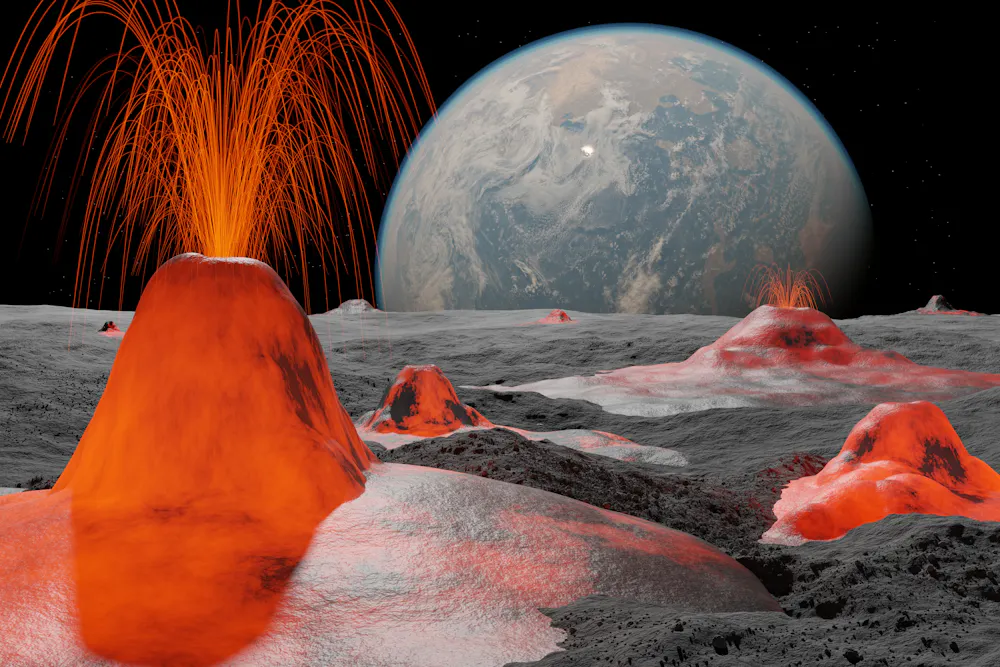
An artist’s impression of what the Moon looked like during the tidal heating event. There would have been intense volcanism everywhere. The early Earth would have loomed much larger in the sky because it was closer. MPS/Alexey Chizhik
As the Moon moved away, it passed through particular points where its orbit temporarily became disturbed. These orbital disturbances were an important component of its history and are a key part of our hypothesis.
When did the Moon form?
When the Moon actually formed and receded away from the Earth is a thorny issue.
Thanks to the Apollo astronauts, scientists have a collection of Moon rocks, which they can measure the age of. The oldest rocks are all about 4.35 billion years old, which is roughly 200 million years after the birth of the solar system.
Many geochemists, like my colleague Thorsten Kleine, suggested (not unreasonably) that the age of these rocks is the same as the age of the Moon.
But people like Alessandro Morbidelli, who study planet formation, didn’t like this answer very much. In their models, planets swept up most of the material floating around the early solar system long before 200 million years had elapsed. A giant, Moon-forming impact as late as the rock samples suggested seemed pretty unlikely.
This is where Kleine, Morbidelli and I came in. We followed up on a suggestion from a 2016 study that found the Moon might occasionally experience extreme heating events during its slow outward journey from Earth.
This heating happens the same way that heating does on Jupiter’s hyperactively volcanic moon Io. The smaller body’s shape gets squeezed and stretched by tides from the big body. And just like a rubber ball warms up if you squeeze it enough, so too do the rocks on Io and the Moon.
All rocks contain little internal clocks – radioactive elements that decay and allow researchers to tell how old the rock is. But here’s the key point: If the Moon warmed up enough, its clocks would lose their memory and would start recording time only once the Moon cooled down again.
So in this picture, the pileup of rocks aged around 4.35 billion years isn’t telling us when the Moon formed, but just when it went through this tidal heating event. That means the Moon’s formation must have happened earlier.
An early formation date satisfies the physicists studying planet formation, while explaining that the later dating recorded from the rocks is due to the tidal reheating.

The Moon started out molten and then cooled down, only to be reheated roughly 100 million years later. This heating event could have reset most of the ages recorded by lunar rocks. Francis Nimmo
What next?
As often happens in science, two groups simultaneously came up with a similar idea. Our group focused on a tidal heating event that happened when the Moon was quite distant from the Earth, while research from Steve Desch at Arizona State University points to an event that happened when the Moon was closer. Sorting out which of these two hypotheses is right will take some time – and maybe neither is correct.
Testing these hypotheses will require more samples from the Moon. Fortunately, China’s Chang’e 6 mission just returned samples from the dark side of the Moon in June 2024. If these samples also show a lot of rocks all having ages of around 4.35 billion years ago, that would be consistent with our story. If the ages are much older, we’ll have to figure out a new story.
Very often in earth and planetary sciences, geochemists and geophysicists end up with different and contradictory hypotheses. This happens partly because these fields use different kinds of measurements, but also because they speak very different scientific languages. Overcoming this language barrier is hard.
Our study is an example of how – sometimes – bridging that linguistic and scientific divide can benefit researchers on both sides.

Francis Nimmo, Professor of Earth and Planetary Sciences, University of California, Santa Cruz
This article is republished from The Conversation under a Creative Commons license. Read the original article.
EU launches flagship satellite project to rival US networks by 2030
The EU's flagship satellite constellation project officially took off Monday, as the bloc signed a concession contract with a European consortium to develop a secure space-based communication system. Due to be fully operational by 2030, it will rival major American networks.
Issued on: 17/12/2024 -

Envisaging a multi-orbital network of almost 300 satellites, Iris² aims to rival US satellite internet service providers such as Elon Musk's Starlink and Amazon's Project Kuiper.
"This cutting-edge constellation will protect our critical infrastructures, connect our most remote areas and increase Europe's strategic autonomy," said European Commission vice president Henna Virkkunen.
The system, developed as a public-private partnership, will serve both governments and private clients.
With an estimated budget of €10.6 billion euro, Iris² is to allow for secure communications for military, defence and diplomatic purposes.
Surveillance, connectivity in natural disaster-hit areas and commercial broadband access are among its other potential uses, according to the European Union.
On Monday, the EU signed a 12-year concession for the implementation of the project with SpaceRISE, a consortium led by France's Eutelsat, Spain's Hispasat and Luxembourg's SES.
Other partners include OHB, Airbus Defence and Space, Telespazio, Deutsche Telekom, Orange and Hisdesat.

The EU's commissioner for defence and space Andrius Kubilius hailed the signing as the launch of "a vision of a stronger, more connected, and more resilient Europe".
"Iris² demonstrates the Union's resolve and commitment to strengthening Europe's space global posture both in terms of security and competitiveness to the benefit of our governments, businesses and citizens," said Kubilius.
More than half of the project's budget will be footed by the EU, with €4.1 billion coming from private investment and €550 million from the European Space Agency (ESA).
The launch comes as the market for high-speed space connectivity, particularly useful for serving isolated regions, has become ultra-competitive.
Ariane 6 rocket debuts successfully restoring Europe's space independence
6,000 satellites
Earlier this year, Starlink claimed to have already put more than 6,000 satellites into orbit, serving 2.6 million customers.
While Iris² counts on a lower number of satellites, its multi-orbital design puts it on par with a constellation of about 1,000 Starlink satellites in terms of performance, EU officials said.
Iris² earth-based infrastructure will be located exclusively in Europe with control centres in Luxembourg, France and Italy. The system will be fully operational by 2030.
"This programme not only addresses today's connectivity needs but also lays the groundwork for Europe's strategic autonomy in a digitalised world," the bloc said in a statement.
Iris² is the EU's third large space project, after the Galileo satellite navigation system and the Copernicus Earth monitoring satellite constellation.
(With newswires)
Agence France-Presse
December 19, 2024
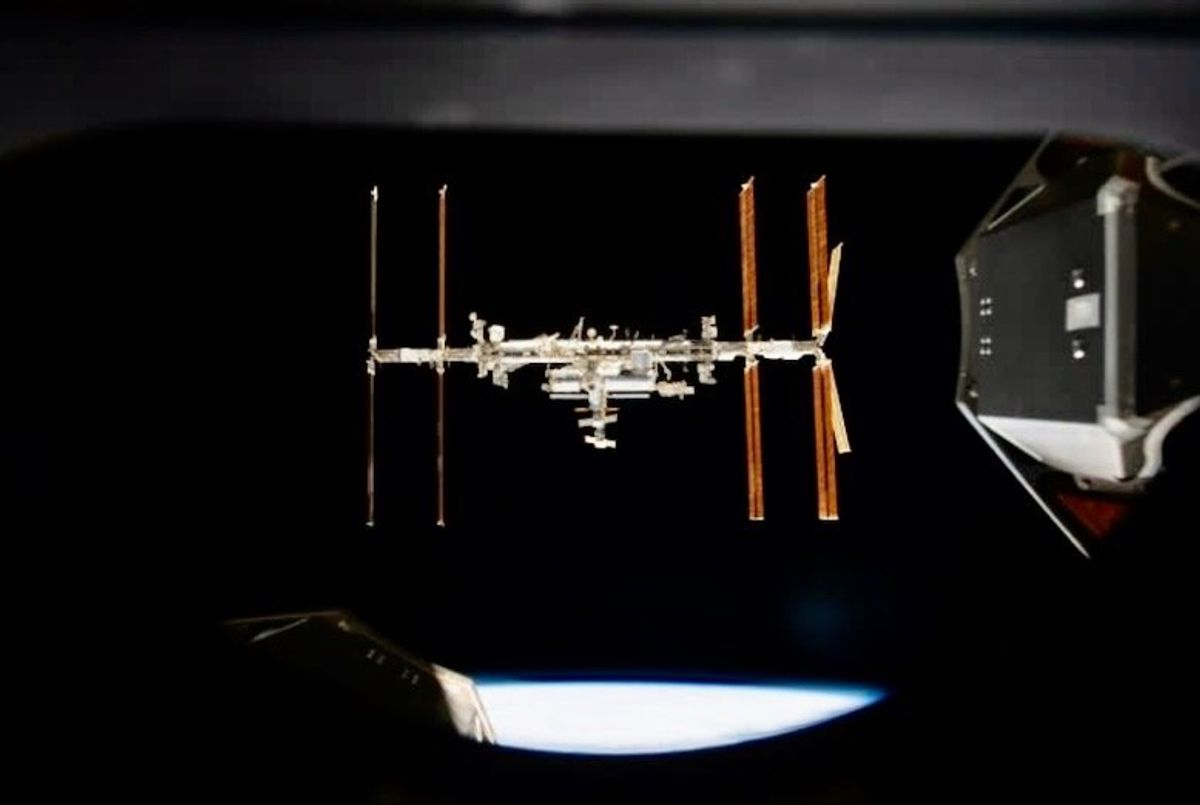
Elon Musk's SpaceX is planning to fly private crew missions to the International Space Station in partnership with a Calfornia-based startup, the two companies said on Thursday.
The missions are contingent on approval by NASA and involve the Vast startup, which also aims to launch the world's first commercial space station as early as next year.
"Enabling payload and crewed missions to the ISS is a key part of Vast's strategy, allowing us to further our collaboration with NASA and global space agencies," Vast's CEO Max Haot said in a statement, which did not provide a timeline.
SpaceX has previously flown three private missions to the orbital laboratory with Axiom Space and is preparing for a fourth.
It has also partnered with Polaris, a venture led by billionaire Jared Isaacman, for two orbital voyages, one of which featured the first spacewalk by non-professional astronauts.
Isaacman has been nominated by President-elect Donald Trump as the next NASA administrator, reflecting an era of expanding public-private partnerships in space.
"I am excited to work with Vast as they build more opportunities and destinations for more people to travel amongst the stars," said Gwynne Shotwell, SpaceX's president and chief operating officer.
Such missions cater to both wealthy individuals and sovereign governments.
The last Axiom mission included astronauts from Italy, Sweden and Turkey, whose seats were sponsored by their respective nations.
Vast also revealed that it is in active discussions with several governments, including the Czech Republic, about future missions.
With the ISS set to be decommissioned in 2030, Vast is among several companies competing to build and launch the world's first commercial space station.
Other contenders include Axiom Space, Voyager Space in partnership with Airbus, and Blue Origin in collaboration with Sierra Space.
© Agence France-Presse
First results from 2021 rocket launch shed light on aurora’s birth
Newly published results from a 2021 experiment led by a University of Alaska Fairbanks scientist have begun to reveal the particle-level processes that create the type of auroras that dance rapidly across the sky.
The Kinetic-scale Energy and momentum Transport experiment — KiNET-X — lifted off from NASA’s Wallops Flight Facility in Virginia on May 16, 2021, in the final minutes of the final night of the nine-day launch window.
UAF professor Peter Delamere’s analysis of the experiment’s results was published Nov. 19 in Physics of Plasmas.
“The dazzling lights are extremely complicated,” Delamere said. “There’s a lot happening in there, and there’s a lot happening in the Earth’s space environment that gives rise to what we observe.
“Understanding causality in the system is extremely difficult, because we don’t know exactly what’s happening in space that’s giving rise to the light that we observe in the aurora,” he said. “KiNET-X was a highly successful experiment that will reveal more of the aurora’s secrets.”
Want more? Read the dramatic story of the KiNET-X mission in 12 short installments that include videos, animations and additional photographs.
One of NASA’s largest sounding rockets soared over the Atlantic Ocean into the ionosphere and released two canisters of barium thermite. The canisters were then detonated, one at about 249 miles high and one 90 seconds later on the downward trajectory at about 186 miles, near Bermuda. The resulting clouds were monitored on the ground at Bermuda and by a NASA research aircraft.
The experiment aimed to replicate, on a minute scale, an environment in which the low energy of the solar wind becomes the high energy that creates the rapidly moving and shimmering curtains known as the discrete aurora. Through KiNET-X, Delamere and colleagues on the experiment are closer to understanding how electrons are accelerated.
“We generated energized electrons,” Delamere said. “We just didn’t generate enough of them to make an aurora, but the fundamental physics associated with electron energization was present in the experiment.”
The experiment aimed to create an Alfvén wave, a type of wave that exists in magnetized plasmas such as those found in the sun’s outer atmosphere, Earth’s magnetosphere and elsewhere in the solar system. Plasmas — a form of matter composed largely of charged particles — also can be created in laboratories and experiments such as KiNET-X.
Alfvén waves originate when disturbances in plasma affect the magnetic field. Plasma disturbances can be caused in a variety of ways, such as through the sudden injection of particles from solar flares or the interaction of two plasmas with different densities.
KiNET-X created an Alfvén wave by disturbing the ambient plasma with the injection of barium into the far upper atmosphere.
Sunlight converted the barium into an ionized plasma. The two plasma clouds interacted, creating the Alfvén wave.
That Alfvén wave instantly created electric field lines parallel to the planet’s magnetic field lines. And, as theorized, that electric field significantly accelerated the electrons on the magnetic field lines.
“It showed that the barium plasma cloud coupled with, and transferred energy and momentum to, the ambient plasma for a brief moment,” Delamere said.
The transfer manifested as a small beam of accelerated barium electrons heading toward Earth along the magnetic field line. The beam is visible only in the experiment’s magnetic field line data.
“That’s analogous to an auroral beam of electrons,” Delamere said.
He calls it the experiment’s “golden data point.”
Analysis of the beam, visible only as a varying shades of green, blue and yellow pixels in Delamere’s data imagery, can help scientists learn what is happening to the particles to create the dancing northern lights.
The results so far show a successful project, one that can even allow more information to be gleaned from its predecessor experiments.
“It’s a question of trying to piece together the whole picture using all of the data products and numerical simulations,” Delamere said.
Three UAF students doing their doctoral research at the UAF Geophysical Institute also participated. Matthew Blandin supported optical operations at Wallops Flight Facility, Kylee Branning operated cameras on a NASA Gulfstream III aircraft out of Langley Research Center, also in Virginia, and Nathan Barnes assisted with computer modeling in Fairbanks..
The experiment also included researchers and equipment from Dartmouth College, the University of New Hampshire and Clemson University.
CONTACTS:
• Peter Delamere, University of Alaska Fairbanks Geophysical Institute, padelamere@alaska.edu
• Rod Boyce, University of Alaska Fairbanks Geophysical Institute, 907-474-7185, rcboyce@alaska.edu
Journal
Physics of Plasmas