Thursday, December 26, 2024

GOOD NEWS

CHART: EV battery metals bill sets new low as lithium, nickel, cobalt price slump continues


Frik Els | December 26, 2024 |

CAPITALI$M IS OVERPRODUCTION

While electric vehicle sales growth has certainly slowed down from the torrid pace of the last few years, the global passenger EV market, including plug-in and conventional hybrids, should easily top 20 million units this year.


In combined battery capacity deployed – a better indicator of battery materials demand than unit sales alone – the electric car market has expanded by a healthy 24% so far this year.

In total, 674.6 GWh of fresh battery power hit the globe’s roads from January through August, according to data from Toronto-based EV supply chain research firm Adamas Intelligence.

Hybrid approach


The rapid electrification of the global car parc comes despite a noticeable swing towards hybrid vehicles, which have inherently smaller batteries and therefore contained metal.

The combined battery capacity of plug-in hybrid vehicles steered onto roads globally for the first time this year is up 71% versus a more sedate pace for full electric passenger vehicles of 17%. At the same time the sales-weighted average battery capacity of plug-ins (PHEVs) is also rising, up 12% this year to 23kWh, more than a third of the average full electric vehicle.

A subset of the PHEV, the extended range EV or EREV where the combustion engine only acts as a charger for the battery, are even bigger users of installed metal. EREVs on average have 39kWh of battery capacity, more than most sub-compact and small cars.

EREV battery capacity and sales have more than doubled in 2024 and were it not for the PHEV market, the many news headlines saying the EV market is in a deep slump, may have carried more weight.
Law of averages

For miners supplying the EV battery industry, the news remain negative however: The latest data tracking sales, battery capacity and chemistry in over 110 countries paired with monthly prices show the weighted average monthly dollar value of the lithium, nickel, cobalt, manganese and graphite contained in the batteries​​ of the average EV is continuing its downward path.

As natural and synthetic graphite, lithium carbonate and hydroxide, and nickel, cobalt and manganese sulphate prices decline further, the raw materials bill for the average EV is now down to $510 compared to $918 in October 2023 and a monthly peak of more than $1,900 at the beginning of last year, according to Adamas Intelligence analysis.
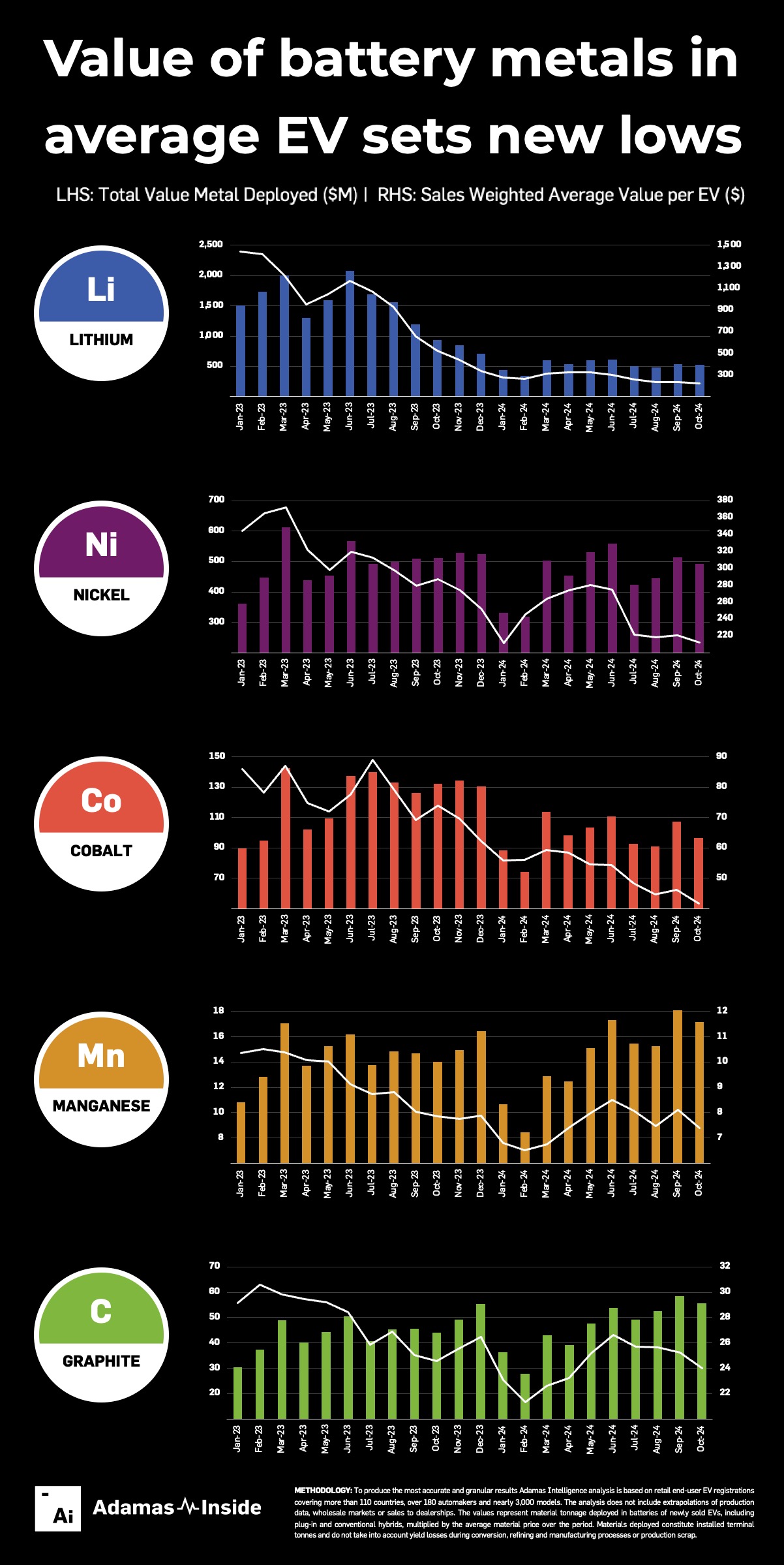


The downtrend is led by lithium where the value per EV for the first ten months of the year is down 74% compared to the same period last year to $276. In October, the latest month with detailed data, the value of installed lithium set a new low of $212. In January of 2023 that figure was $1,444 per average EV.

Cobalt, at just under $42 is 34% below the value reached in October 2023. After a strong start to the year, manganese has now also succumbed to weakness in the battery raw material space, averaging just over $7 per EV battery.

For anode material, graphite loadings and values have held mostly steady at just under $26 per average EV, but the average for 2024 so far is 13% below that of 2023.
Iron phosphate vs nickel

The value of nickel in the average EV battery is down 25% as LFP battery chemistries continue to take global market share. LFP batteries represented 44% of the global total in terms of capacity deployed in GWh in October despite slow build out of LFP battery factories outside China.

That compares to a 33% share during the same month last year, more than offsetting the long-running trend towards high-nickel cathodes, and the growing popularity of NCM batteries for PHEVs where the energy density of nickel-based cathodes makes more sense given the weight of these vehicles.

For a fuller analysis of the battery metals market check out the December issue of the Northern Miner print and digital editions.

* Frik Els is Editor at Large for MINING.COM and Head of Adamas Inside, providing news and analysis based on Adamas Intelligence data.
Panama President sees no immediate risk from First Quantum mine

Bloomberg | December 26, 2024 | 

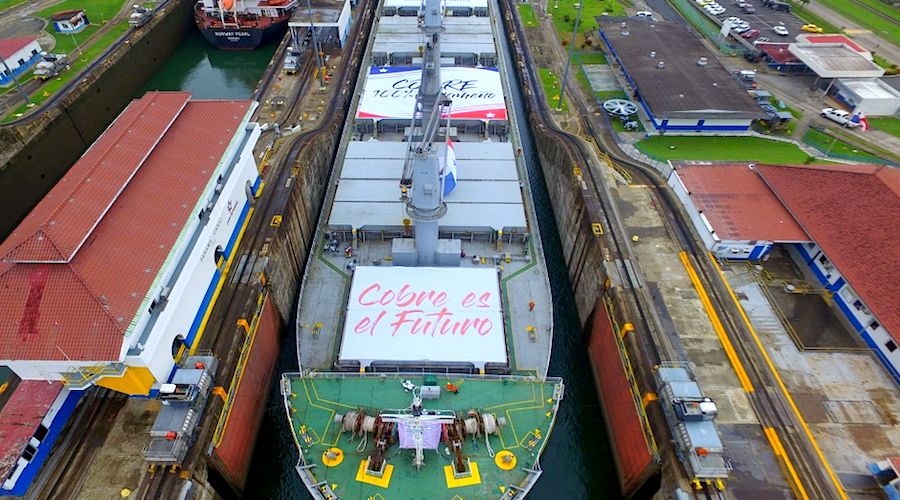
Copper shipments from Cobre Panama mine. (Image courtesy of Cobre Panama.)

Panama’s President Jose Raul Mulino said a government report shows there are no immediate environmental or safety risks from Cobre Panama, the First Quantum Minerals Ltd. copper mine that was shut in 2023.


Mulino cited a recent report conducted by the environment ministry, which examined minerals and other materials stored at the site. Mulino said the government will start to study a “conservation plan” for the mine in January.

“Right now, there is no irreversible contamination,” Mulino said Thursday. “Even though it doesn’t represent an imminent risk for the country at the moment, we can’t leave it abandoned perpetually so that it could eventually cause ecological damage.”

The $10 billion mine was shuttered in 2023 after Panama’s Supreme Court ruled that its operating contract was unconstitutional.

Mulino, who took office in July, ordered the environmental audit of the mine to help determine whether the facility can be reopened temporarily ahead of a possible permanent shutdown.

First Quantum is seeking damages from Panama via two ongoing arbitration cases.


Greek Companies and Tanker Engineers Pay U.S. Over $4.5M in MARPOL Fines

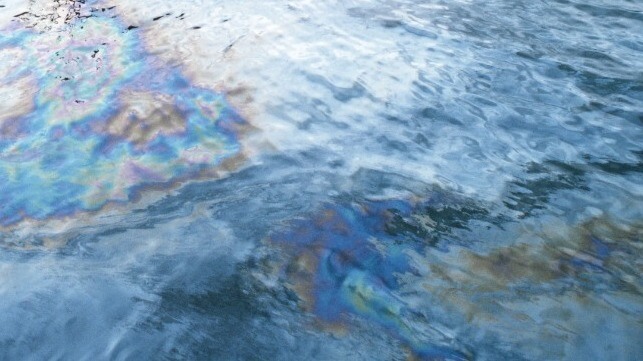
oil on the water
The tanker's owner and operator and two engineers each pleaded guilty to the offenses and attempting to hide it from USCG

Published Dec 24, 2024 1:42 PM by The Maritime Executive


The owner and operator of a Greek product tanker along with two engineers working on the vessel have each pleaded guilty in the latest U.S. Coast Guard MARPOL violation case. The fines totaled more than $4.5 million for offenses including discharging oily waste into the U.S. territorial waters and trying to conceal the crime including falsifying records.

The U.S. Justice Department reported that the chemical tanker Kriti Ruby committed the offenses during port calls in Jacksonville, Florida, and the Port of Newark, New Jersey, in May and September 2022. Built in 2008, the 48,000 dwt Kriti Ruby is registered in Greece.

The owners of the vessel, Avin International, and operator Kriti Ruby Special Maritime Enterprises entered their guilty pleas on December 23. Both companies pleaded guilty to pollution, falsification of records, and obstruction of justice. The owner was ordered to pay $3,375,000 and the operator an additional $1,125,000 with both companies also to serve five-year probation. They will be subject to compliance plans and monitors.

The vessel reportedly discharged oily waste into the sea through its sewage system bypassing the required pollution prevention equipment. In addition to not recording the discharges, the USCG said the crew concealed most of the pumps and hoses used to conduct the bypass operations in a sealed cofferdam.

Kriti Ruby’s former chief engineer and second engineer were also sentenced after having previously pleaded guilty. Former chief engineer Konstantinos Atsalis not only admitted to falsifying the vessel’s oil record book but he also acknowledged that the vessel’s crew had knowingly bypassed required pollution prevention equipment by discharging oily waste from the vessel’s engine room through its sewage system into the sea. Additionally, he admitted that he directed crew members to hide equipment used to conduct these transfers. He was sentenced to time served and a $5,000 fine. 

Sonny Bosito who had been the second engineer on the tanker also pleaded guilty to concealing the pollution by falsifying the records. He was sentenced to time served.

“Prioritizing profits over the environment by discharging oily waste into the sea and working to cover up that pollution is illegal,” said Assistant Attorney General Todd Kim of the Justice Department’s Environment and Natural Resources Division (ENRD). “We are committed to enforcing the law and fighting against maritime pollution.”

The problems came to out during a USCG expanded Port State inspection in September 2022 in Newark. The tanker was cited for deficiencies including blockages in the oil discharge monitoring and control system and the oil filtering equipment. At the time, USCG also reported the oil record book as missing. The Kriti Ruby received a seven-day detention. The vessel was also cited for five additional deficiencies on a subsequent USCG inspection in November 2022 in Philadelphia.


Another Later-Stage Development U.S. Offshore Wind Farm Shelved

offshore wind turbine
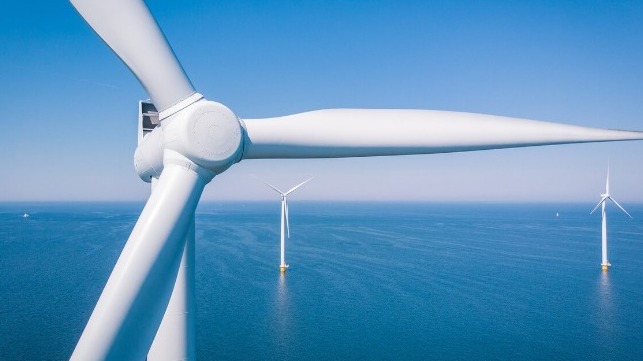
Vineyard Offshore shelved its proposed project after Connecticut decided not to select wind in its current alternative energy solicitation (iStock)

Published Dec 24, 2024 12:49 PM by The Maritime Executive


Vineyard Wind, an affiliate of Copenhagen Infrastructure Partners, confirmed in a brief statement that it is shelving the proposed Vineyard Wind 2 project in response to Connecticut’s decision not to proceed in awarding wind projects after the recent New England tri-state solicitation. The project had been selected by Massachusetts and is in a later stage of permitting at the federal level.

“With Connecticut’s decision today (December 20) not to purchase the remaining 400 MW, we are unable to contract the project’s full 1200 MW at this time. We look forward to advancing this project and participating in future solicitations,” Vineyard Offshore wrote in its response.

Connecticut along with Massachusetts and Rhode Island launched the first multi-state coordinated solicitation earlier this year saying it was in response to the changing market conditions and challenges faced by offshore developers. They provided the opportunity for projects to bid either multi-state or individually. 

Massachusetts and Rhode Island announced in September that they had selected three projects with a total projected capacity of 2.9 GW. The two states will share SouthCoast Wind (which received federal approvals last week) while Massachusetts also selected New England Wind 1 with 791 MW of capacity. It also said it would take 800 MW from the 1,200 MW Vineyard Wind 1 project. It implied it would be sharing the project with another state.

Governor Ned Lamont and Connecticut’s regulators announced Friday that they were proceeding with solar power but decided not to take up any offshore wind in the current round. Lamont generally referenced cost considerations for power while saying the state was not ruling out offshore wind power in the future.

CIP won the lease area which is approximately 29 miles south of Nantucket in a 2018 lease auction. The project has advanced with its Construction draft and Operations Plan on file at the Bureau of Ocean Energy Management. In March 2024, BOEM included Vineyard Wind 2 in its announcement for an environmental impact statement to advance New England’s offshore wind projects. The hearings have been completed and BOEM is working on its report and the EIS. 

Vineyard Offshore CEO Alicia Barton said in September 2024, “We look forward to Connecticut’s forthcoming decision on the remainder of the procurement so that we can begin to deliver important economic and climate benefits to the region.”

Vineyard Offshore is in a joint venture partnership to develop Vineyard Wind 1, which is under construction. It holds the Vineyard Northeast lease off the coast of Massachusetts which is where the second project would be located, as well as Vineyard Mid-Atlantic which includes Excelsior Wind in the New York Bight. It also has a lease area off the coast of Humboldt County in Northern California.

Japan Accelerates Offshore Wind Selecting Consortiums for Two Larger Farms

Japan's Ishikari Bay wind farm
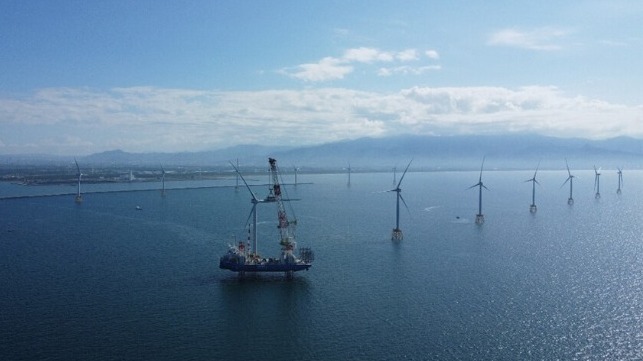
Japan is developing near-shore fixed bottom offshore wind projects before transition to floating wind (JERA)

Published Dec 25, 2024 2:11 PM by The Maritime Executive


Japan Accelerates Offshore Wind with Projects Involving BP, JERA, Marubeni, and Others


Japan selected two consortiums to develop offshore wind projects as it seeks to accelerate its renewable energy programs. Combined the two projects would provide over 1 GW of energy and one could be one of the largest offshore wind farms yet developed in Japan.

The country’s third round solicitation had run during the half of 2024 and was being closely followed in the industry. Previously, Japan attracted Iberdrola and RWE for projects. The winners of this round included BP and JERA, which separately have announced plans to combine their operations, as well as participation in the consortiums from Marubeni, Tokyo Gas, Kansai Electric Power, and others.

The winners were selected jointly by Japan’s Ministry of Economy, Trade and Industry and the Ministry of Land, Infrastructure, Transport, and Tourism. The Ministries highlight the experience of the companies including JERA which has projects in Taiwan and Europe and partner Green Power Investment Co. which managed the entire process for the Ishikari Bay New Port Offshore Wind Farm which started operation in May 2024 with 112 MW and Wind Farm Tsugaru, which started operations in January 2024 with a capacity of 122 MW. The two projects are among the largest in the country currently.

Both the projects selected in this next round are for fixed-bottom wind farms which will be placed closer to shore. Japan’s offshore topography limits the opportunities for fixed-bottom wind farms with the expectation that it will need to deploy floating wind farms to reach its power goals.

One project will be located in the Sea of Japan offshore of Aomori Prefecture in the northern part of Japan’s main island of Honshu. It will consist of 41 turbines manufactured by Siemens Gamesa with a total capacity of 615 MW, making it one of the largest offshore wind power generation projects in Japan. The Tsugaru Offshore Energy Consortium consists of JERA, Green Power, and Tohoku Electric Power.

Slightly further to the south also on the Sea of Japan offshore of Yuza Town in Yamagata Prefecture the second project will consist of 30 Siemens Gamesa turbines for a total capacity of 450 MW. The Yamagata Yuza Offshore consortium consists of Marubeni, BP, Kansai Electric Power, Tokyo Gas, and Marutaka. 

The sites were selected by the government in October 2023. The ministries report the two projects will each start operations in June 2030. The country’s goal is for 10 GW by 2030 and 45 GW by 2040 from offshore wind.


China Reports Building World’s Largest Heavy Lift Vessel

largest heavy lift vessel
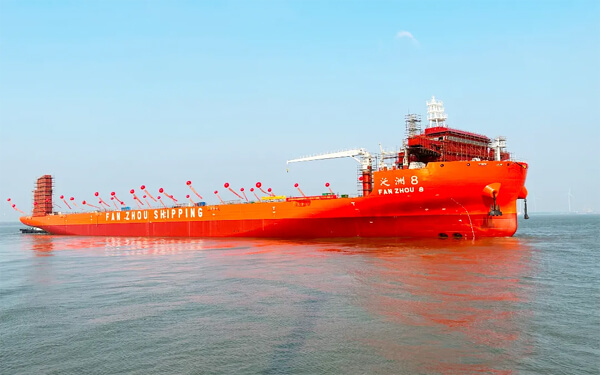
Fan Zhou 8 is reported to have the largest heavy lift capacity (Taizhou Municipal Committee)

Published Dec 25, 2024 3:49 PM by The Maritime Executive


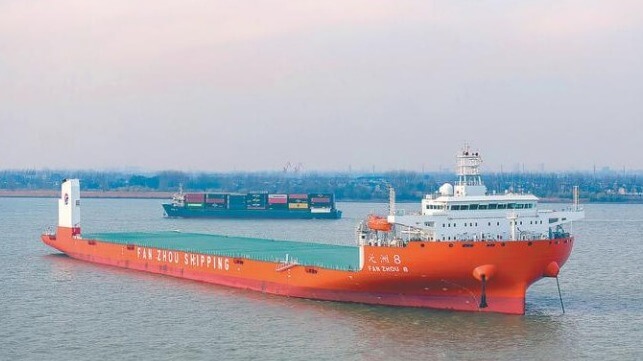
Chinese officials are reporting the successful sea trials of what they are calling the world’s largest heavy lift vessel. Commentators are comparing its lift capacity to that of China’s domestically built aircraft carrier.

Named Fan Zhou 8, the vessel reportedly has a capacity for over 58,000 metric tons of cargo. The massive lift deck is reported to be 11,700 square meters. They report this gives the vessel the capability to transport ultra-large components such as offshore oilfield jackets, platform modules, port machinery, components for offshore wind power, and more.

Built by the Taizhou Zhonghang Shipyard for Jiangsu Fanzhou Shipping, the vessel completed five days of sea trials between December 16 and 20 in the seas east of Shanghai. The ship reportedly achieved a top speed exceeding 15 knots powered by two 8,340 kW main engines and two 1,200 kW bow thrusters. The power plant is fully redundant. During the sea trials, they report it was escorted by tugboats but used its autonomous navigation capabilities. 

Among the other capabilities that are being highlighted for Fan Zhou 8 is the ability to operate in waters with small floating ice. They are calling the vessel polar-ready. The China Classification Society (CCS) highlights among the notations are brake system remote control capabilities, automation notations, and additional green notations that meets the requirements of the Hong Kong Convention and the European Union.


Vessel was launched in October 2024 (CCS)


The ship measures approximately 840 feet (256 meters) in length and with a beam of 167 feet (51 meters). It has a range of 16,000 nautical miles.

China has developed a large fleet of heavy lift vessels. Among the other uses, they deliver ship-to-shore and port cranes fully assembled from China to ports around the world. Analysts also argue that the fleet has critical military capabilities for China’s navy.


New Emissions Barges Readied to Help California Ports Meet New Rules

emission control capture barge
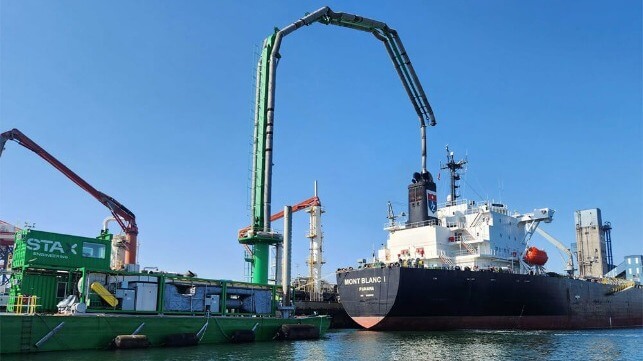
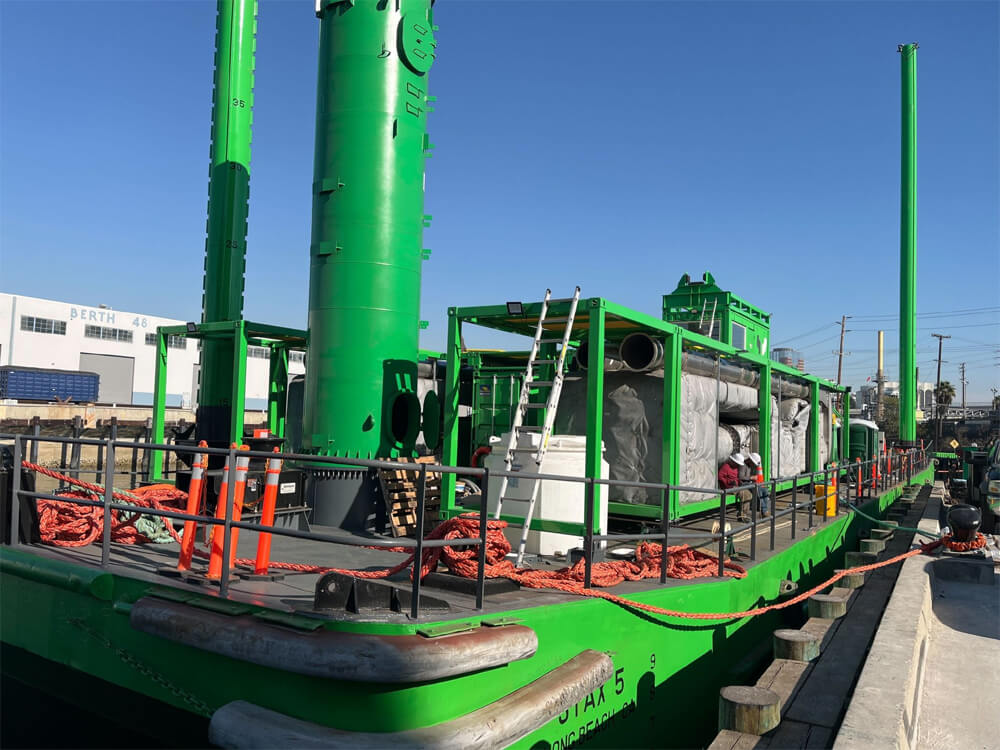
STAX's fifth barge will launch for Shell's tanker terminal in the Port of Los Angeles (STAX)

Published Dec 25, 2024 4:39 PM by The Maritime Executive


Two new emissions filter barges developed by a company called STAX are preparing to enter service. One of the barges will be deployed in an expansion of the service at the Port of Benicia while the other barge will be the first dedicated to tankers at the Port of Los Angeles.

The California Air Resources Board’s (CARB) new regulations that go into effect in 2025 extend the requirements to reduce emissions for on-berth vessels. The rules phase in an expansion to cover more containerships, tankers, and car carriers. Shore power is one alternative while STAX offers a service where a barge is positioned alongside and a cap placed over the funnel to capture exhaust and filter it through the technology on the barge. STAX has been recognized as a grantee of CARB.

The company announced in April 2024 an exclusive agreement with AMPORTS, an automotive ports logistics and processing solutions provider. It was the fourth such agreement in just eight weeks and called for STAX to provide a new barge, its fourth, that will be deployed under an exclusive service agreement with AMPORTS. NYK has announced a partnership with STAX to service its auto carriers at the Port of Benicia.


Fifth barge completing outfitting before its 2025 introduction (STAX)


STAX reports its fourth barge is now complete and will soon be heading to the Port of Benecia. The port is a critical point of entry for vessels from Asia., Europe, and Mexico. At the port, AMPORTS handles roughly 260,000 imported vehicles annually. That equates to approximately 20 percent of the vehicles imported by sea into California.

The company also reports that the finishing touches are placed on its fifth barge which will be deployed in 2025 to the Port of Los Angeles. STAX and Shell Oil Products (Equilon Enterprises) entered into a five-year agreement for STAX to service tankers calling at the Port of Los Angeles’ Shell Mormon Island Terminal.

The agreement anticipates that STAX will provide approximately 1,600 hours of emissions capture and control per year making it the first company to service tankers in California. It projects it will treat more than 150 tons of emissions over the lifetime of the partnership.

STAX highlights that it is providing services at the Ports of Benicia, Log Angeles, Long Beach, and Oakland. The new CARB rules also target smaller commercial port vessels including tugs as they seek to show incremental improvements in emissions in and around California’s ports.

ANOTHER ONE

Bulker Expected to be Stuck for Days After Grounding in St. Lawrence

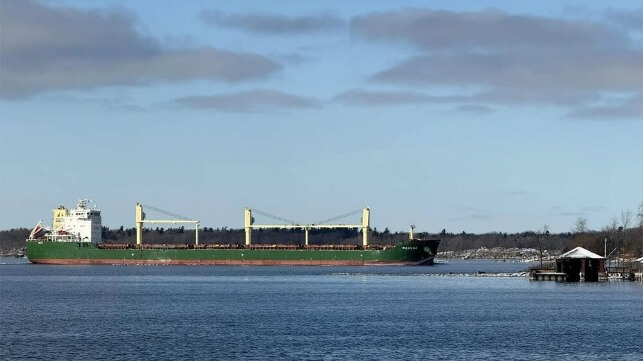
Maccoa is reported to be sideways outside the navigation channel (Holly Crowe-Ortolani/Facebook)
Published Dec 25, 2024 1:09 PM by The Maritime Executive


A dry bulk carrier flagged in Cyprus is facing the prospect of being aground for a few days in Canada’s St. Lawrence River. There is no sign of pollution or water ingress, but the vessel is stuck outside the channel with a spokesperson for the Canadian Coast Guard telling the Montreal Gazette the plan to refloat the ship could be delayed by the Christmas holiday.

The Maccoa (30,898 dwt) departed Montreal at approximately 2300 on December 23 but only made it a short distance to the north on the river to the area of Ile Marie and Vercheres where it became stuck at around 0100 on December 24. The Canadian Coast Guard is reporting the vessel is “sideways outside the navigation channel.” It is not obstructing traffic on the river.

The circumstances of the incident were not reported, but local media is saying the vessel might have experienced a loss of power. There are no reports of injuries or pollution.

The Coast Guard told the Montreal Gazette that it is coordinating with the pilot authority, Transport Canada, and the vessel’s operators for a plan to free the ship. They said it could “take a few days” to finalize the plan.

The ship which is 607 feet (185 meters) in length appears to be riding high without a cargo. It was outbound for Waterford, Ireland. It is managed by Navarone of Greece.

It is not the first time the vessel has had navigation challenges on the St. Lawrence. In 2018, the Transportation Safety Board of Canada issued a report about another incident with the same ship. It was inbound loaded with 18,830 tonnes of salt rock in bulk. The Maccoa had departed Montreal bound for Johnstown, Ontario with a pilot aboard.

The Maccoa in the prior incident was near the Côte Sainte-Catherine Lock in the South Shore Channel of the St. Lawrence Seaway and a bridge crossing the canal failed to be lifted to create clearance. The pilot took a series of maneuvers attempting to slow the ship while staying in the channel. The ship’s bow thruster was not working, and it was moving to the right side of the channel. The pilot was eventually able to regain control but not before the vessel was presumed to have made bottom contact. A later survey reported no damage from touching bottom but the TSB was investigating why the bridge was slow to be raised and why the vessel lost control while attempting to slow in the river.

Earlier this month, another Laker was freed from the river south of Montreal after having been aground for more than three weeks. In that case, the Tim S. Dool required cranes to partially offload its cargo before tugs were able to pull it free and back into the shipping channel.

One Killed in Violent Boat Explosion in Fort Lauderdale

Boat fire
Courtesy Fort Lauderdale Fire Rescue

Published Dec 24, 2024 4:01 PM by The Maritime Executive


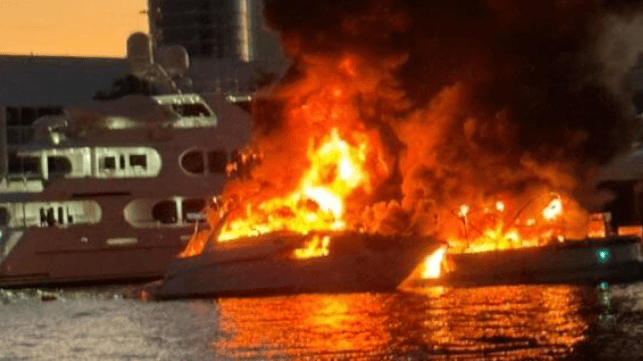
On Monday evening, a small passenger vessel exploded and burned alongside the pier in Fort Lauderdale, Florida, killing one and injuring five. 

Just before 1800 hours, a blast rocked the quay at Lauderdale Marina, a dealership and fuel dock just north of Port Everglades. A 37-foot boat exploded violently when its engines fired up, startling passersby. Security camera video footage showed that the boat's main deck separated from the hull due to the force of the explosion.  

"It was like a boom, kind of, and I turned around and the whole dock was already on fire," one witness told local station WSVN. 

The explosion killed one passenger, identified as Quebec resident Sebastien Gauthier, 40. Gauthier went into the water in the blast, and his body was recovered by a dive team later in the evening. 

The other five passengers of the boat survived the blast and were evacuated to Broward Health Medical Center for treatment, including three people with serious trauma injuries. The boat continued to burn and ignited a second vessel located nearby; both fires were extinguished, and the vessels will be hoisted out of the water for forensic examination. 

An investigation into the cause of the explosion is under way, led by the Florida Fish and Wildlife Commission. It is the second time this month that a boat has exploded at the Lauderdale Marina: the previous blast occurred during fueling, and one person was evacuated for treatment for burns.

 ALT FUELS

China Conducts Its First Ammonia Bunkering Operation with Demonstration Tug

ammonia bunkering for tugboat
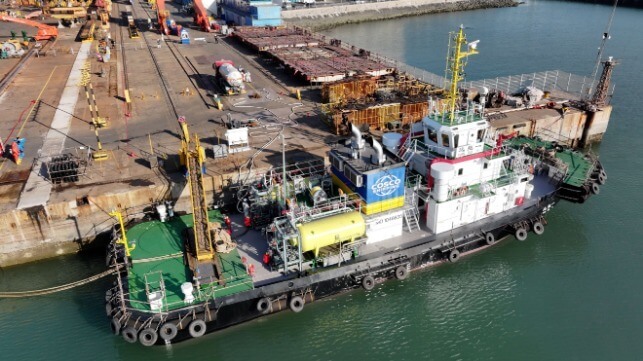
Dual-fuel ammonia tug completed China's first ammonia bunkering operation (COSCO)

Published Dec 26, 2024 3:22 PM by The Maritime Executive


China completed its first domestic ammonia bunkering operation for a vessel and one of only a handful of ammonia bunkers conducted worldwide. It is part of a broader demonstration project launched in China in 2022 to develop an ammonia-fueled tugboat.

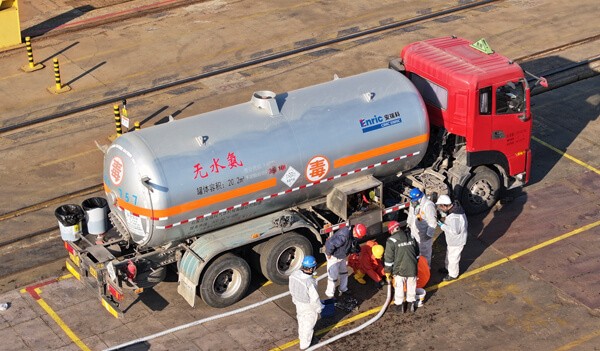
The bunkering operation took place on December 24 in Dalian at the COSCO Shipping Heavy Industries shipyard which has also completed the construction of the tug Yuan Tuo Yi. The fueling was carried out by vehicle in a truck-to-ship method. It lasted two hours but they did not indicate the quantity of ammonia fuel loaded.

According to the reports, the bunkering was undertaken by the Sinopec COSCO Shipping Marine Fuel Supply Company after extensive testing and planning. The company conducted research on the ammonia fueling process, a safety assurance plan, and an emergency response plan in preparation for the bunkering operation.


Bunkering operation was conducted truck-to-ship in Dalian (COSCO)


The tug Yuan Tuo Yi is the result of an extensive research program that included the design and development of the engine and the fuel supply system. The report indicates the project earned Approval in Principle from both the Chian Classification Society (CCS) and ABS for the design of the ammonia-powered tugboat and the ammonia fuel supply systems. CCS conducted product test certification.

Construction of the tug started in January 2024. It employs the CRRC Dachai 12V240HDFA ammonia-diesel dual-fuel engine and a fuel supply system developed by Weihai Heavy Industry Technology. The tug, which measures approximately 125 feet (38 meters) in length had two C-type liquid ammonia storage tanks.

Chinese officials reported in 2023 that they had successfully operated a medium-speed ammonia dual-fuel engine. They indicated an energy substitution rate of over 90 percent and a thermal efficiency of over 40 percent within the stable operating range. Previously, with a single-cylinder engine, they reported reaching 208kW, with ammonia energy accounting for 85 percent. Carbon emissions were reduced by 80 percent.

The world’s first ammonia bunkering for a vessel took place earlier this year in Singapore as part of a test program using an offshore vessel converted by Fortescue. During the summer, NYK fueled its tug with ammonia after a conversion from LNG. U.S.-based Amogy also demonstrated its ammonia-fueled tug using technology that incorporates cracking.

Construction has started on the first ammonia-ready and ammonia dual-fuel large commercial ships which the engine companies work to complete their efforts leading to the commercial introduction of ammonia engines. Infrastructure development is also underway to support the introduction of ammonia as a marine fuel in the coming years.


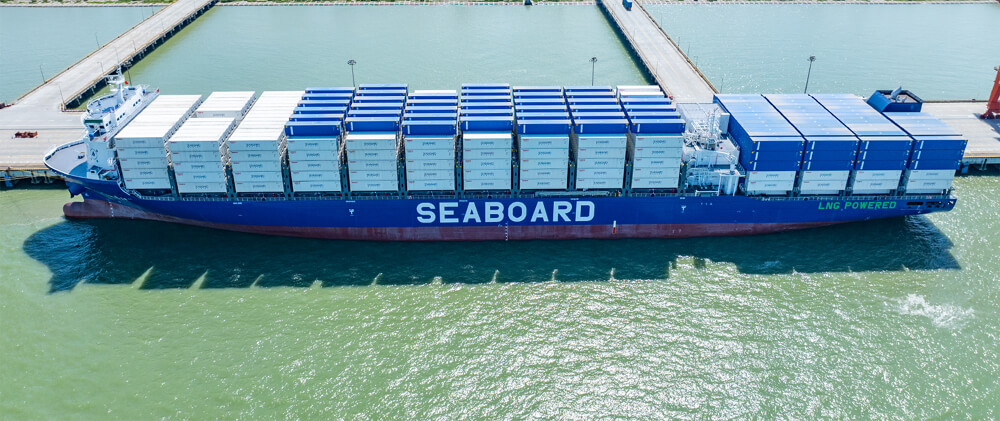
Seaboard Marine Integrates LNG-Fueled Containerships into Fleet

LNG-fueled containership
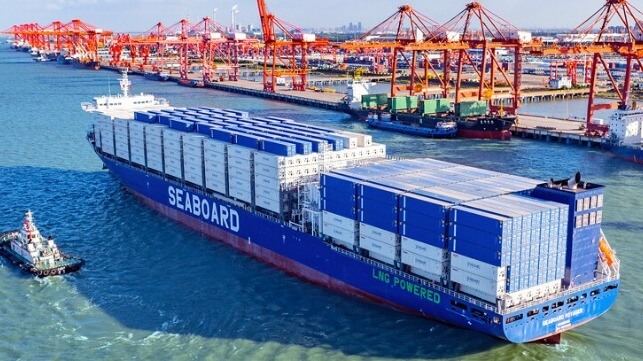
Seaboard Voyager entered service in November followed by Seaboard Victory (Seaboard Marine)

Published Dec 26, 2024 6:47 PM by The Maritime Executive


Miami-based carrier Seaboard Marine is beginning the integration of a new class of innovative LNG-fueled containerships into its fleet servicing South America. The U.S. carrier highlights the advanced features and increased capacity as it placed the first two vessels of its new V-Class into the fleet with a total of six ships of the class due by the end of 2025.

Seaboard is part of a trend among U.S. carriers that have embraced LNG for its environmental properties and efficiency. TOTE claims the honor of introducing in 2018 the first LNG-fueled containership and has continued to expand its fleet. Pasha has also added LNG-fueled vessels including the newbuilds George III and Janet Marie while Matson has also started LNG conversions for its LNG-ready vessels while also ordering new dual-fuel containerships.

HB Hunte of Germany designed the new class of vessels for Seaboard Marine and they were ordered from China’s Taizhou Sanfu Ship Engineering Company. The original order was expanded in 2023 when Seaboard exercised the options for three additional ships. The shipyard highlights they are the largest containerships built by the yard.


Seaboard Victory recently made her first port calls in Peru showing the unique design of the vessels (Seaboard Marine)


Among the unique elements of the design is the first adoption of the double C-type vertical gas tanks. The tanks on the Seaboard vessels are reported to be the world’s largest vertical gas tanks so far deployed on a ship. The vessels also adopt a new bow arrangement.

Taizhou reports the design emphasizes ecological sustainability. The dual-fuel engines, MAN B&W 7570ME-C10, operate on LNG or MGO (marine gas oil). Each ship has two diesel generators and one LNG generator. They have been classed by DNV and are reported to have a design speed of 19.5 knots. 

“The Seaboard Victory marks an exciting milestone as the second ship in our cutting-edge V-Class series of six vessels and the second of eight new LNG-powered ships transforming our fleet,” said Eddie Gonzalez, President and CEO of Seaboard Marine announcing the introduction of the vessel. “Its arrival reflects our dedication to sustainability and delivering exceptional service to our customers.”

Seaboard Victory followed Seaboard Voyager which completed sea trials in August and was integrated into the fleet in November. Seaboard Victory entered service this month recently making her first calls in Callao and Pisco, Peru. The ships join a route between the U.S., the Caribbean, Central and South America.

Each of the vessels has a capacity for 3,500 TEU including over 1,000 reefer plugs. At approximately 52,500 dwt the ships are registered in Liberia.


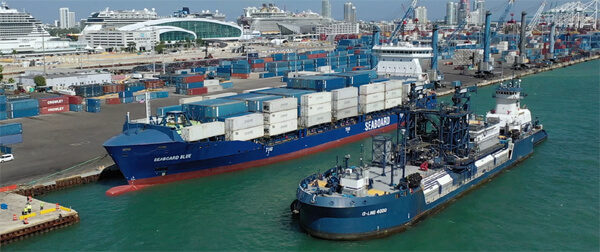
Seaboard Blue is the company's first LNG vessel and became the first LNG cargo ship to bunker at PortMiami (Seaboard Marine)


Seaboard Marine adopted its first LNG-fueled vessel in 2023 with the purchase of the Elbblue (13,200 dwt) which had been built in 2011 and operated for Wessels Reederei as Wes Amelie. She was retrofitted in 2017 for LNG operations. The vessel has a capacity of 1,000 TEU. Operating as Seaboard Blue, she also became in March 2023 the first LNG-fueled containership to bunker at PortMiami, Florida before her inaugural sailing to Honduras and Guatemala.

The company reports it will have a total of eight LNG-powered vessels by the end of 2025. Overall, containerships are the largest segment of LNG-fueled vessels according to DNV’s Alternative Fuels Insight database. It shows a total of 127 LNG-fueled containerships currently in service with an additional 314 on order and deliveries to accelerate over the next four years. By 2028, DNV projects over 400 LNG-fueled containerships in service.

Israel Strikes Houthi Ports, Airport, and Power Stations

burning building in Yemen
Israeli strikes damaged the ports, airport and power station (Yemen TV)

Published Dec 26, 2024 2:08 PM by The Maritime Executive


The Israel Defense Forces issued a statement confirming that the air force struck Houthi targets in Israel’s fourth retaliation against the Houthi drone and surface-to-surface missile attacks. Israel called the strikes precision attacks against the military infrastructure used by the Houthis and to smuggle Iranian weapons into the region.

Israel’s Ministry of Defense and Prime Minister approved the strike plan for the Israel Air Force with unconfirmed reports from Yemen saying as many as 10 targets were struck following similar strikes by Israel a week ago. Israel’s first round of strikes on the port of Hodeidah took place in late September. 

The IDF said the targets were the ports of Hodeidah, Salif, and Ras Kanatib on the western coast of Yemen. They also strike the Sana’a International Airport causing widespread damage and two power stations, Hezyaz and Ras Kanatib. Unconfirmed reports from TV broadcasts in Yemen showed the power stations in flames and many destroyed buildings. Unconfirmed reports from Yemen said the Israeli planes sunk another tugboat in Hodeidah while a tug operating from Salif to assist a tanker at the Ras Issa Oil Terminal was hit. They are saying this killed one crewmember and left three others msising. According to the report, Israel crippled operations across all Houthi-controlled Red Sea ports.


Reuters is citing the Al Masirah TV in Yemen which said two people were killed at the airport and one person died in the strikes on the ports. They are claiming 11 people were wounded in the attacks. Last week, Israel also struck power facilities and reportedly targeted tugs operating in the three ports.

“The Houthis, too, will learn what Hamas and Hezbollah, and Assad’s regime and others learned,” said Israeli Prime Minister Benjamin Netanyahu. The IDF said it will not hesitate to operate at any distance against any threat to the State of Israel and its citizens.

The strikes came as the Houthis have repeatedly said their new phase of operations was focusing on firing missiles into Israel. Yesterday, they released a statement claiming to have fired two missiles into central Israel after days of similar claims.

Media reports said 16 people were wounded in the Tel Aviv area by a Houthi missile. Media reports have indicated numerous air raid sirens being sounded due to the Houthi attacks. Last week, the reports said the Israelis at least partially shot down the Houthi missiles but debris hit an unoccupied school.


The leader of the Houthis, Abdul-Malik Badr al-Din al-Houthi went on the airways saying no matter the pressures, the group will not stop its operations. He called for the public to turn out for a massive demonstration on Friday. The group stages a weekly demonstration on Friday in Sana’a.

The Israelis accused Iran of supporting the Houthis. They said today’s strikes were a further example of the Houthis’ exploitation of the civilian infrastructure for military purposes.