Thursday, December 26, 2024

Airports Around the World Are Going Green

By Felicity Bradstock - Dec 26, 2024


Airports across the globe are transitioning to renewable energy sources, including solar power, to reduce their carbon footprint.

Initiatives like India's Flexible Use of Airspace and the Australian government's renewable energy agreements are contributing to decarbonization efforts.

While progress is being made, a more coordinated global effort is needed to encourage wider adoption of renewable energy across the aviat
ion sector.


Many airports around the globe are now powered by wholly renewable energy, as the aviation and buildings sectors strive to decarbonize in line with aims for a green transition. The International Energy Agency (IEA), the International Civil Aviation Organisation (ICAO), and several other international bodies are encouraging developers to reduce the carbon footprint of their airports to support international climate goals.

The ICAO released a toolkit entitled “A Focus on the Production of Renewable Energy at the Airport Site” that offers developers advice on how to decarbonize airports. It refers to the Paris Agreement aims to keep a global temperature rise this century well below 2 degrees Celsius above pre-industrial levels, which requires significant decarbonization efforts to take place across all sectors.

The document is aimed towards states, civil aviation authorities, and airports, and is “the first in a series of practical and ready-to-use information documents to support the planning and implementation of airport infrastructure projects that envisage significant environmental benefits.” The toolkit has been used by airport developers worldwide to support decarbonization efforts and develop more environmentally friendly airports.

In India, a reported 80 airports are operating on entirely renewable energy. The Airports Council International has accredited airports in Delhi, Mumbai, Hyderabad, and Bengaluru as carbon neutral. The Airports Authority of India (AAI) has supported the installation of solar energy projects on-site at several airports across the country. Multiple airports have adopted green building standards, invested in fleets of electric vehicles (EVs), and installed energy-efficient air conditioning systems, lighting, and other equipment.

According to a press release from the Indian Ministry of Civil Aviation, the government’s Flexible Use of Airspace initiative helped reduce carbon emissions by 90,000 tonnes between 2020 and 2023. The Implementation of 2017 Central Air Traffic Flow Management helped reduce delays and optimize capacity, resulting in lower fuel consumption and a decrease in emissions.

In Australia, CS Energy and Queensland Airports Limited (QAL) recently entered a seven-year agreement to power two of the country’s busiest airports using wholly renewable sources of energy from 2025. Gold Coast and Townsville airports on the east coast of Australia, which handle more than 8 million passengers a year, will be shifting to green in support of sustainable tourism aims. The two airports are set to undergo a significant expansion to prepare them for a significant increase in passenger traffic ahead of the 2032 Olympic and Paralympic Games. QAL has announced aims to achieve net-zero emissions by 2030 by offsetting almost 90 percent of the company’s Scope 1 and Scope 2 emissions.

In June 2024, Investment Fund Managers Investors and Queensland Investment Corporation, which have assets including Sydney and Adelaide airports, signed a $467 million renewable energy pact. The multi-state power purchase agreement will ensure the supply of over 500 GWh of green power annually to the companies’ infrastructure assets.

In the U.K., in 2019, Bristol Airport announced plans to make its operations carbon-neutral by 2025 by using 100 percent renewable energy. The Danish energy company Ørsted agreed to deliver 17 million kWh of annual electricity to the airport, generated from wind power, in a three-year agreement. This was expected to decrease Bristol Airport's carbon emissions by 14,000 tonnes over three years. London Gatwick Airport has also transitioned to using wholly renewable electricity, while Heathrow Airport aims to achieve net-zero emissions by 2050.

In the U.S., in 2019, Chattanooga Metropolitan Airport in Tennessee became the country’s first airport to be powered by 100 percent solar energy. The airport's 2.64-MW solar farm was developed with around $5 million in funding from the Federal Aviation Administration. At the time of the announcement, Terry Hart, the former CEO of the Chattanooga Airport, stated, “This project has immediate benefits to our airport and community, and we’re proud to set an example in renewable energy for other airports, businesses and our region. While generating a local renewable resource, we are also increasing the economic efficiency of the airport.”

In November this year, Boise Airport in Idaho announced that it had also shifted to 100 percent renewable energy sources. The City of Boise signed an agreement to power its airport using energy from the Black Mesa Energy solar project. Indianapolis International Airport is now home to one of the biggest airport-based solar farms in the world, providing enough power to supply 10,000 homes annually. Meanwhile, Denver International Airport produces over 10 MW of power via its solar installations. According to a 2020 study by the University of Colorado, 20 percent of public airports in the U.S. had adopted solar panels in some capacity.

While several airports around the globe have already shifted to green, there is no comprehensive effort for airport developers to transition to wholly renewable energy sources to power facilities. Better international guidelines and stricter national regulations could encourage greater cooperation from airports and help decarbonize facilities.

By Felicity Bradstock for Oilprice.com
Sanctioned Russian LNG Cargo Ends Across-the-World Trip Without Finding Buyer


By Tsvetana Paraskova - Dec 26, 2024


Arctic LNG 2 continues its struggles to sell gas from Russia’s newest but heavily sanctioned LNG export project.

In one of the latest pieces of anecdotal evidence, a sanctioned LNG carrier, which had loaded liquefied natural gas in the Artic in August, traveled for four months around north Europe, the Mediterranean, the Suez Canal, the Indian Ocean, along China’s east coast and north to Russia’s Far East, without finding a buyer for the cargo, tanker-tracking data compiled by Bloomberg showed on Thursday.

The LNG vessel, Pioneer, is sanctioned by the United States and so is the Arctic LNG 2 project, which is now put on ice.

After the journey from Europe to Russia’s Far East, Pioneer was spotted in December offloading the cargo in a Russian floating storage unit near Kamchatka, according to the vessel-tracking data compiled by Bloomberg.

As early as this summer, Russia started shipping LNG from its flagship Arctic LNG 2 project—but not to customers.

The shipments have been made from the Arctic project to floating storage units either in Russia or in European waters, as potential customers are unwilling to buy LNG from the facility, which has seen tightened Western sanctions in the past months.

In August, the U.S. State Department intensified efforts to derail Arctic LNG 2 exports by targeting companies involved in the development of the project and vessels found to have loaded LNG from the facility.

Pioneer was one of three vessels – Pioneer, Asya Energy, and Everest Energy – targeted by the U.S. sanctions in August, as well as their registered owners Zara Shiphoding and Ocean Speedstar Solutions.

Since then, the U.S., the EU, and the UK have further tightened the screws on Russia’s LNG vessels and Arctic LNG 2 exports in a series of additional sanctions.

Located in the Gydan Peninsula in the Arctic, the Arctic LNG 2 project was considered key to Russia’s efforts to boost its global LNG market share from 8% to 20% by 2030-2035.

By Tsvetana Paraskova for Oilprice.com
Can U.S. LNG Exports Really Fill the Gap Left by Russian Gas in Europe?

By ZeroHedge - Dec 26, 2024

The US is already the largest LNG supplier to Europe, and could theoretically replace Russian LNG imports.

Replacing Russian LNG with US LNG could increase shipping costs and European prices.

Europe's decarbonization goals may limit its willingness to make long-term commitments to US LNG.


Samantha Dart, co-head of global commodities research at Goldman, published a note to clients outlining five key questions and answers about the US-EU liquefied natural gas trade. This comes just days after President-elect Donald Trump threatened the EU with a barrage of tariffs unless Brussels ramped up purchases of American LNG.

For context, last Friday, Trump wrote on Truth Social:

"I told the European Union that they must make up their tremendous deficit with the United States by the large-scale purchase of our oil and gas. Otherwise, it is TARIFFS all the way!!!"

Dart told clients that the US is already Europe's largest LNG supplier and a key source of supply growth. She said replacing Russian LNG with US LNG imports could raise shipping costs and European prices to incentivize re-routing cargoes

Europe’s Natural Gas Prices Jump to 2024 High

She said such a shift would have minimal impact on US LNG export revenues, as total export capacity remains fixed, adding exporters with long-term contracts with proposed US LNG projects would benefit. However, Europe's decarbonization strategy may limit the willingness of European companies to make long-term NatGas commitments with US exporters.

Dart laid out key questions and answers about the US-EU LNG trade that help clients understand that US LNG Gulf exports can "theoretically" replace Russian NatGas flowing into the EU. How much US LNG is exported to Europe?

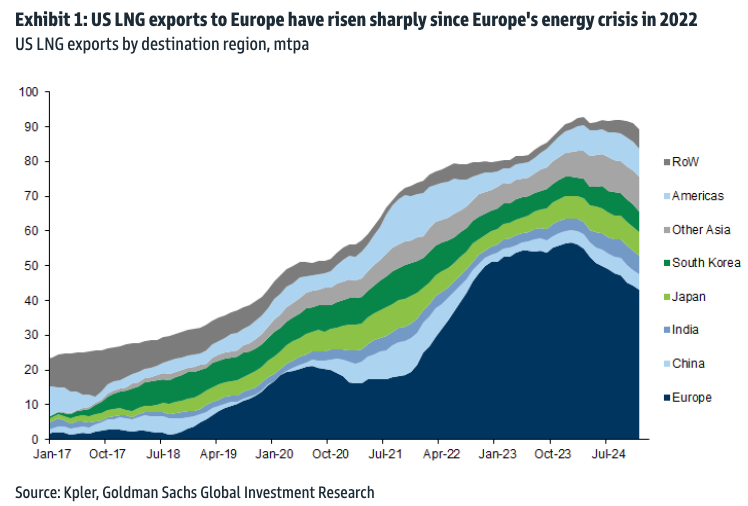
US LNG exports averaged 91 mt over the past year (Dec23-Nov24), of which 47 mt or 51% were delivered to Europe. US LNG exports to Europe have grown significantly in levels and as a share of total US LNG exports since the European energy crisis in 2022, peaking in 2023 (Exhibit 1).

Are US LNG volumes sold in the spot market or are they contracted?

The vast majority of US LNG sales are under contract. That said, US contracts typically have flexible destination ports, in that the buyer is not obligated to deliver to a particular location. This allows buyers of US LNG to re-sell or re-direct cargoes to higher-paying destinations. This was evident during the European energy crisis, when European gas prices increased sharply relative to the rest of the world. Even as total US LNG exports grew, this worked as an effective incentive for US LNG deliveries to non-European destinations to contract by 41%, while European deliveries increased by 197%[1], as seen in Exhibit 1.What portion of European LNG imports come from the US?

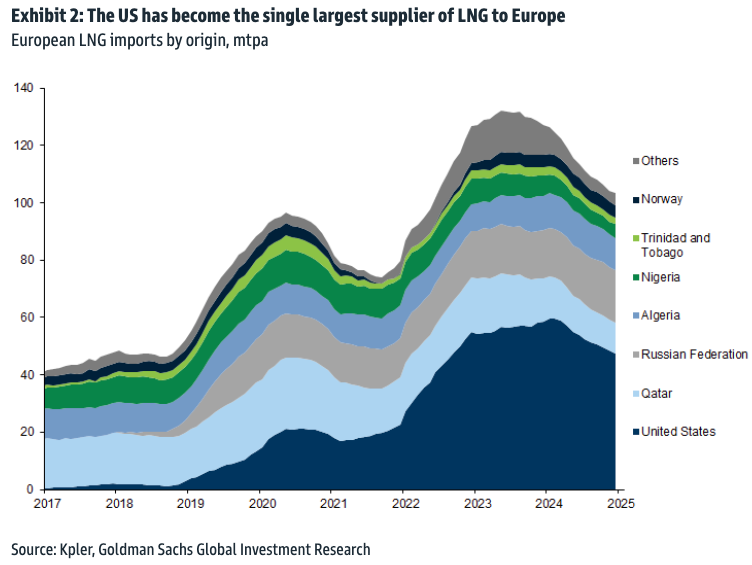
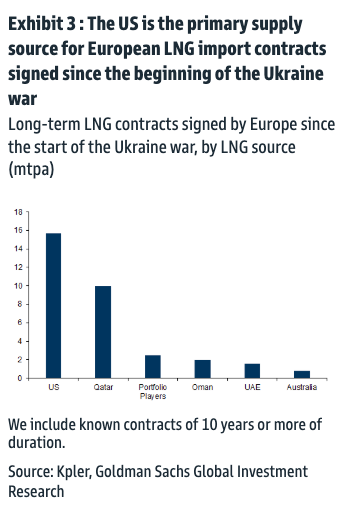
The US has become the single largest source of LNG to Europe, averaging 46% of imports into the region over the past 12 months (Exhibit 2). Most European LNG imports are sourced from Atlantic Basin suppliers to minimize shipping costs. Importantly, the US is also the primary source of likely European LNG import growth, based on long-term LNG contracts signed by European buyers since the start of the Ukraine war. US volumes contracted by European buyers in the period add to just under 16 mtpa, which is more than with any other single supplier globally (Exhibit 3).


Can US LNG replace Russian LNG imports into the EU?

Theoretically, yes. US LNG deliveries to non-EU countries are currently approximately 18 mtpa above the levels observed during the peak of the European energy crisis, suggesting there is enough flexibility in the market to replace Russia's current 17 mtpa of LNG exports to the region. However, such a reallocation of flows might offer little benefit, if any, to Europe or the US. Less optimal routes for LNG deliveries (for example, longer routes for Russian cargoes) would likely lead to higher freight costs. In addition, European import costs might go up in order to motivate the re-route of US cargoes that would have otherwise opted to deliver elsewhere.

Total US LNG exports would also not increase as a result of this reallocation, given that US LNG export capacity would not be impacted in the process.How could Europe support growing US LNG exports?

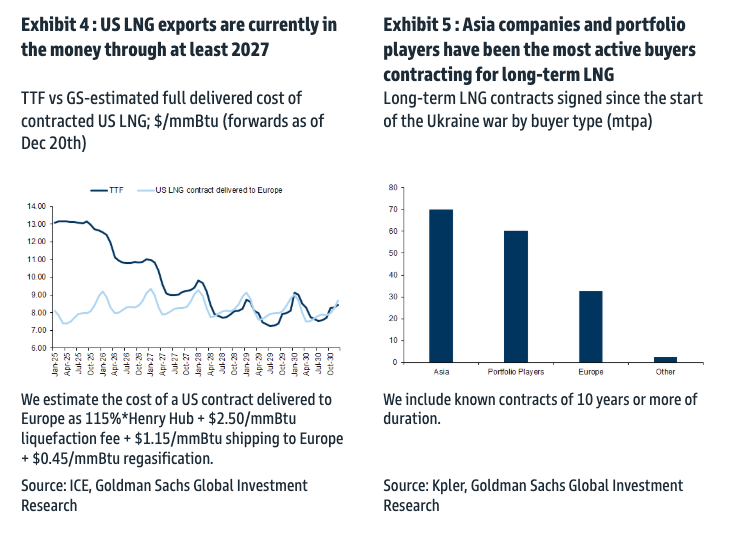
Additional long-term contracting by European buyers with proposed US LNG projects would be the most impactful measure the EU could take to support higher future US LNG exports, as this would increase the likelihood such contracted liquefaction projects reach a final investment decision (FID). As of now, the forward curve for European gas prices suggests new long-term US LNG export contracts are in the money through at least 2027 (Exhibit 4). That said, Europe's decarbonization goals might limit European companies' appetite for long-term commitments to grow natural gas use. In fact, when we look across all long-term LNG contracts signed since the start of the Ukraine war, European companies are far behind Portfolio player companies and Asia importers (Exhibit 5).


It appears that Goldman believes Trump's 'America First' policy of replacing Russian LNG to Europe with American LNG is "theoretically" possible.

By Zerohedge.com
BIDENOMICS

U.S. Oil Production Shattered Records Again in 2024

By Robert Rapier - Dec 26, 2024

The U.S. oil production reached a new record high in 2024, surpassing the previous record set in 2023.

Technological advancements, including precision fracking and enhanced recovery techniques, have played a significant role in increasing productivity.

The record-breaking production has contributed to job creation, economic growth, and strengthened national energy security, but environmental concerns remain.


Despite ongoing concerns about global economic volatility, energy transition policies, and fluctuating demand, the U.S. energy sector has demonstrated its unmatched resilience and innovation.

Building on the record-breaking momentum of 2023, 2024 has proven to be another landmark year for oil production, driven by technological advancements, strategic investments, and favorable market conditions.

A Second Consecutive Oil Production Record


In 2023, U.S. oil production reached a record high, surpassing 12.9 million barrels per day, solidifying the country’s position as the world’s top oil producer. One of my 2024 energy sector predictions was that the U.S. would set a second consecutive record this year.

According to preliminary data from the U.S. Energy Information Administration (EIA), production had averaged 13.249 million BPD year-to-date through December 13, 2024. Cumulative production for the year is estimated at 4.611 billion barrels by that date—just 110 million barrels shy of the previous annual record.

Given that producers have consistently exceeded 13 million BPD since January, the record likely fell by December 22, 2024. Even a conservative scenario of 12 million BPD would delay the milestone by under a day.

This achievement is a testament to the industry’s ability to adapt to shifting demand and market challenges while maintaining high levels of productivity.

The Driving Forces Behind the Production Record

The new record highlights the role of enhanced recovery techniques like precision fracking and improved drilling technologies, which have unlocked greater productivity from key oil fields. The Permian Basin continues to be the powerhouse of U.S. production, contributing a significant share of the growth through its cost-efficient operations.

High demand for U.S. crude oil, particularly from Europe and Asia, has spurred production. Geopolitical tensions and shifting trade dynamics have positioned U.S. oil as a reliable alternative for global markets. Robust pipeline infrastructure and export terminals have further supported this expansion, enabling seamless transportation to international buyers.

At home, steady consumer demand for refined products, supported by healthy refining capacity, has ensured domestic market stability. This dual focus on international and domestic needs highlights the versatility and reliability of the U.S. energy sector.

Economic Benefits and Future Challenges

The shale industry’s growth has provided numerous jobs, strengthened local economies in production hubs, and bolstered national energy security. The economic ripple effects extend from upstream exploration to downstream refining, reinforcing the energy sector’s importance to the broader U.S. economy.

While these achievements are commendable, challenges remain. Addressing environmental concerns and aligning production with long-term sustainability goals will require ongoing investment in emissions-reduction initiatives and cleaner technologies. Balancing these priorities with the need for short-term growth will be key for the sector’s future.

A Testament to Resilience and Innovation

The U.S. oil production record of 2024 is a triumph of adaptability, innovation, and global competitiveness. It underscores the energy sector’s pivotal role in meeting global and domestic energy needs while contributing to economic growth.

With its unparalleled ability to overcome challenges and seize opportunities, the U.S. energy sector has cemented its place at the forefront of the global market—proving once again that resilience and innovation are the hallmarks of its success story.

U.S. crude oil production has demonstrated the sector’s ability to balance growing domestic demand, export markets, and geopolitical uncertainties. This new record reflects not only improved drilling and extraction methods, such as precision fracking and enhanced recovery techniques, but also the continued productivity of key oil-producing regions.

By Robert Rapier

How Canada’s innovation minister is bracing for a US trade war

Story by Steven Overly
• POLITICO

Canada has a warning for President-elect Donald Trump as he looks to launch a trade war with the U.S.’s northern neighbor: Hurting us will help China.

“If you say no to Canada, you're basically saying yes to China when it comes to strategic supply chains,” François-Philippe Champagne, Canada’s minister of innovation, science and industry, said on today’s POLITICO Tech podcast. “I don't think that's what the American people would want.”

Champagne argues that the two nation’s fortunes are inextricably intertwined — after all, they are each other's largest trading partner — and that the U.S. relies heavily on Canada for economic essentials like critical minerals and oil. Plus, the countries have common ambitions in areas like artificial intelligence and nuclear energy where Champagne says they can better compete against China together.

But Champagne’s case has done little to sway Trump so far. Trump has threatened to impose a 25 percent tariff on imports from Canada and Mexico unless they do more to secure the U.S. border from immigrants and drugs. And recently, he has lobbed online insults at Prime Minister Justin Trudeau and at Canada itself, disparagingly referring to it as the 51st state.

“You have to take these comments with a grain of salt, I would say,” Champagne said. “The good thing that I see with [the] president-elect is he talks a lot about Canada, which is a good thing. That means that we matter.”


Still, the tensions over Trump have caused waves in Ottawa. Earlier this week, Canada’s deputy prime minister and finance minister Chrystia Freeland resigned over a split with Trudeau on how to brace for the coming conflict.

POLITICO Tech host Steven Overly spoke with Champagne about the political fallout in Ottawa, whether he still supports Trudeau, and how Canada is bracing for Trump’s return. Listen to the full interview.


Chile files four environmental charges against Anglo American’s Los Bronces copper mine

Reuters | December 23, 2024 | 


Near the tailings facility for Los Bronces copper mine in Chile. (Image courtesy of Anglo American | Flickr.)

Chile’s environmental regulator has filed four charges against the major Los Bronces copper mine, controlled by Anglo American, for noncompliance with environmental permits, the agency said on Monday.


The charges could carry a fine of nearly 17 billion pesos ($17.17 million), according to the Superintendency of the Environment, or SMA.

Los Bronces is one of Chile’s biggest copper mines with output of 255,000 metric tons last year, as well as a key project for Anglo American, which has been a takeover target of larger rival BHP.

Anglo American said in a statement that it was analyzing the accusations to determine its next steps.

One of the charges was deemed “very serious,” the highest of three offense levels, for noncompliance dating back to a 2014 sanction.

At the time, the SMA found that Anglo American Sur, the local unit that operates Los Bronces, failed to resolve acid drainage at the Esteriles Donoso tailings deposit, designed to hold mine waste.


“The company has not implemented a definitive solution … it constitutes a repetition of acts previously sanctioned,” the SMA said.

The tailings deposit is not currently in use, Anglo American said, stating that in October it submitted a request for an environmental permit to fix the issue.

The regulator also filed two charges in the mid-level “serious” category. One was against Anglo American for not designing a mitigation system for acid waters collected downstream of the Esteriles deposit, and another for not taking measures to control seepage in Las Tortolas tailings dam.

The miner said it is “working to optimize the hydraulic barrier approved by the regulator to improve seepage control.”

The SMA also found that Anglo American had not reported to the agency complete data related to water and tailings, a violation it categorized as “minor.”

The miner has 15 days to present a mitigation program, and 22 days to contest the charges.

The SMA earlier this month also filed three charges against Anglo American for violations at its El Soldado copper mine in the Valparaiso region.

($1 = 989.9000 Chilean pesos)

(By Daina Beth Solomon and Fabian Cambero; Editing by Kylie Madry and Matthew Lewis)
CATL to seek Hong Kong listing

Reuters | December 26, 2024 | 


CATL headquarters (Image from CATL)

Chinese battery manufacturer CATL said on Thursday it plans to seek a listing in Hong Kong, a Shenzhen Stock Exchange filing showed.


CATL plans to issue offshore H-shares and apply for a listing on the main board of the Hong Kong Stock Exchange, it said in the filing.


CATL’s board has approved the plan, but the proposal is pending approval from regulators, including the China Securities Regulatory Commission, the company said.

Other details of the plan have yet to be finalized, it added.

The move is aimed at “further promoting the company’s global strategic layout” and improving its competitiveness, it said.

CATL, the world’s top battery maker, has a global market share of roughly 37% in electric vehicle batteries, according to battery market tracker SNE Research.

The company has been weathering the impact of an ongoing price war in China’s EV sector, with an increase in third-quarter profit growth.

(By Ethan Wang, Yukun Zhang, Zhang Yan and Brenda Goh; Editing by Louise Heavens)
Canada’s Seymour lithium project secures $69.5m in financing from EDC

ALL CAPITALI$M IS STATE CAPITALI$M

The non-binding letter of interest (LOI) could lead to a direct lending debt funding package of up to C$100m ($69.5m) 
Credit: BJP7images / Shutterstock. · Mining Technology · BJP7images / Shutterstock.

GlobalData

Mon, December 23, 2024 


Green Technology Metals (GTM) has received a non-binding letter of interest (LOI) from Export Development Canada (EDC) to finance the company’s Seymour lithium project in northwestern Ontario, Canada.

The LOI could lead to a direct lending debt funding package of up to C$100m ($69.5m), bolstering the project's development within Canada's critical minerals supply chain.


GTM has been in discussions with EDC since September 2024, providing key project details and preliminary financial models.

The project’s permitting approvals and final investment decision are expected to be completed in 2025.

The project is expected to start production in 2026 as Ontario’s first mine for battery metal.

Green Technology Metals managing director Cameron Henry said: “This marks the first step in our financing strategy for the Seymour project development and we’re pleased to have achieved this milestone in 2024. EDC’s support potentially increases sourcing flexibility, allows greater access to low-cost direct lending and is non-dilutive to GT1 shareholders.

“We continue to engage with global commercial lenders as part of our broader financing efforts, but the strong indication of interest from EDC validates the robustness of the Seymour Project and further reinforces our strategy to become Ontario’s first lithium producer.”

EDC's support is expected to offer flexible sourcing options and access to low-cost lending, and will not dilute the value for current shareholders.


The financing from EDC is subject to a thorough due diligence process, internal approvals, and standard project finance conditions, including an environmental and social review in line with EDC’s framework.

Following the appointment of financial adviser Endeavour Financial, the Seymour Project has attracted global commercial lenders, enhancing the project's financial structure.

As a financial Crown corporation, EDC focuses on financing solutions for Canadian exporters and has completed over 540 transactions across various sectors, including mining.

"Canada’s Seymour lithium project secures $69.5m in financing from EDC" was originally created and published by Mining Technology, a GlobalData owned brand.
Unlocking shared value for our global energy transition: 3 proven models for LSM-ASM collaboration

James McQuilken - Pact | December 26, 2024 | 


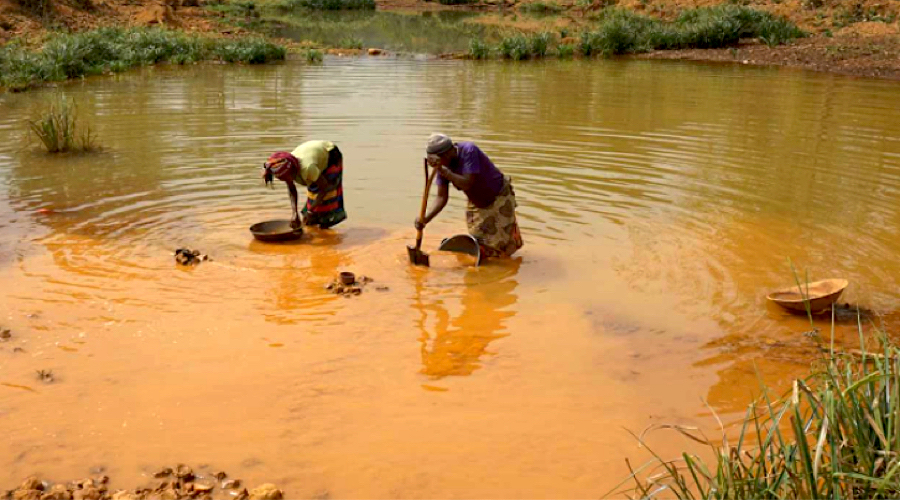
Artisanal miners in Sierra Leone. ( Credit: Pact/ Jorden de Haan.)

Our global energy transition is driving a surge in both large-scale (LSM) and artisanal and small-scale mining (ASM) to meet the soaring demand for critical materials like lithium, cobalt, copper and rare earths. By 2050, up to 6.5 billion tonnes of these resources will be needed — despite efforts to reduce reliance through recycling and innovation — to support technologies like wind turbines, solar panels and electric vehicle batteries.


An increase in mining these critical minerals is necessary to meet the Paris Agreement’s target to limit global warming to below 2oC and ideally 1.5oC and mitigate the most severe and disproportionate impacts on the most marginalized and poor in our society. And it is not just raw materials.

Achieving the Paris Agreement’s climate goals requires not only more mining but also a 175% increase in land use for bioenergy, wind, solar and mining. A 57% rise in water demand for non-fossil fuel energy systems such as nuclear power and hydrogen production, carbon capture and storage and cleaning solar panels is also needed.

As metal prices soar, mining expands into new frontiers, and climate-pressures on land and water use increase, more communities and Indigenous peoples will be impacted as people are attracted to ASM as a vital lifeline in times of economic turmoil. The recent crisis in South Africa highlights this.

In October, hundreds of informal miners, including undocumented migrants stating they had been forced into labor by criminal gangs, became trapped after entering a disused LSM tunnel in search of gold. They remained underground for over two months, fearing arrest or deportation, with police restricting food and water access, despite a court order. After a tense stand-off, more than 150 miners were eventually rescued and, tragically, three bodies recovered.

While ASM remains a largely informal activity driven by poverty, unsupported and vilified leading it open to capture by nefarious actors, these types of LSM-ASM crises are likely to continue. The need for positive, mutually beneficial community-mining relationships is more critical than ever. This is where the Voluntary Principles on Security and Human Rights and partnerships between LSM-ASM and communities come into their own.

Established in 2000, the Voluntary Principles provide a framework for how companies and governments should conduct their security operations at mining, oil and gas sites while respecting human rights. They also support wider industry sustainability aims as global stakeholders demand more tangible community-level impact from mining companies with community engagement shifting from corporate social responsibility “nice-to-haves” to a core business imperative.

To bridge this gap, below are three examples of proven LSM-ASM and community engagement and formalization models that can be utilized in the responsible pursuit of clean energy materials.

Model 1: Direct mining support

One of the most effective partnership models is direct mining support from LSM to ASM operations. This engagement often focuses on formalizing ASM activities and can take various forms—from ceding land, licenses and geological data to ASM miners to providing technical support for safer, more productive and environmentally sound mining practices. Financial partnerships, such as equipment loans and offtake agreements, can also ensure that ASM miners can operate sustainably.

In some partnerships, ASM miners are permitted to operate on LSM concessions. This requires a strong legal framework that allows for ASM’s participation, financial sustainability and supply chain due diligence to meet global responsible mining standards. In other cases, ASM operates outside of LSM concessions. For these partnerships to work, geological deposits must be available for long-term ASM activity with data made available to enable miners to target areas and obtain financing for operations. Existing ASM pre-financing relationships must also be understood as miners are often required to sell minerals back to investors at reduced prices in return for ongoing capital investment. This approach ensures miners can engage directly with LSM, avoiding conflicts and ensuring that they are not beholden to other buyers.

The Mutoshi Cobalt Pilot from 2018 to 2020 in the Democratic Republic of Congo (DRC) exemplifies the benefits of LSM-ASM partnerships. Trafigura and Chemaf collaborated with local ASM cooperative COMIAKOL, supported by international NGO Pact, to provide site access and technical support, improving working conditions and increasing production. Key outcomes included six million work hours with no fatalities, improved working conditions for 70% of participants and enhanced roles and safety for women miners. This pilot underscores the power of LSM-ASM partnerships when all stakeholders align around responsible mining goals.

Model 2: Complementary livelihoods

Complementary livelihood models focus on creating or enhancing non-mining job opportunities for local communities. These programs aim to reduce dependence on ASM while providing stable, complementary income sources. Livelihoods must be relevant to local communities, offer comparable financial returns to ASM or have better working conditions and social acceptance.

As local economies around LSM sites grow, new opportunities for ecosystem services — such as waste collection, land restoration and renewable energy — can emerge. These activities not only reduce informal ASM but also contribute to more sustainable post-mining communities.

At Tanzania’s Geita Gold Mine, security reforms rooted in Voluntary Principles best practices have created livelihoods for over 900 people while improving LSM-ASM relationships. The community policing program has recruited and trained 957 unarmed community police across 32 localities in and around Geita Mine. The mine, in conjunction with the Tanzania Police Force, has built skills, fostered career growth, and curbed collusion and corruption. The community police, working on 12-month terms as agreed with the local community leadership forums, not only benefits the respective communities economically, but also act as the first line of defense, protecting the Geita forest reserve and reducing crime incidents in the Geita Mine area like trespassing, burglary, assault and rape, among others. This innovative model demonstrates how inclusive security can benefit both communities and mining operations.

Model 3: Community development

Community development is a vital component of any successful LSM-ASM partnership. These initiatives can improve working conditions, health and safety standards, and gender equality within ASM communities. LSM can also support broader community development efforts, such as renewable energy access, environmental protection and education, which contribute to overall well-being and sustainability.

In Rwanda, Trinity Metals has placed community development at the core of its operations, doubling its workforce to 5,000 since consolidating three small-scale mines in 2022. With 99% of employees Rwandan and 75% in leadership roles, the company provides livelihoods while boosting tin, tungsten and tantalum production through mechanization and professionalization. Collaborating with local government, Trinity co-funds development projects, including building a bus station, providing medical insurance for 2,000 vulnerable households and supporting farmers’ cooperatives on the concession to improve nutrition and provide food to the mine’s canteen.

The company has also recruited 150 previously informal small-scale miners and unlicensed mineral traders that were operating unauthorized on their concession, integrating them into its workforce and fostering long-term community growth.
Conclusion

The collaboration between LSM and ASM has proven to be a powerful tool for fostering responsible mining practices and driving community-level impact. Practical partnership models, such as direct mining support, complementary livelihoods and community development, offer a path forward for companies looking to meet growing ESG demands while ensuring sustainable, inclusive growth.

As global demand for energy transition minerals and precious metals increases, the need for strong LSM-ASM partnerships will only become more pressing. By working together, LSM and ASM can contribute to local prosperity, national development and global sustainability, creating a mining sector that benefits everyone.

James McQuilken is director of responsible mining at Pact.
Congo frees most of Chinese men held for illegal mining


Reuters | December 26, 2024 | 

Stock image.

Democratic Republic of Congo has freed 14 of the 17 Chinese men arrested on suspicion of running an illegal gold mine in the country, authorities said late on Tuesday.


The men, who are travelling back to China, were detained last week along with others from Congo and neighbouring Burundi after failing to produce the required documents during a crackdown on unlicensed extraction of the minerals in the central African nation.

Jean-Jacques Purusi Sadiki, the governor of South Kivu, the province where the men were arrested, told reporters he was shocked to hear news of their release.

The Chinese miners owed $10 million in unpaid taxes and fines to the government, he added.

Around 60 Chinese nationals were at the site and officials detained the 17 who appeared to be in charge.

The Chinese embassy in Kinshasa has not responded to requests for comment. Burundi’s embassy said it was still waiting for details from its representative in Bukavu.

Bernard Muhindo, South Kivu’s finance minister and acting mines minister, said the intention was to improve the system.

“The idea is not to go on a manhunt, but rather to clean up the mining sector so that reliable partners can work properly and legally,” he told reporters.

The central African country says it has been struggling to stop unlicensed companies and in some cases armed groups from exploiting its rich reserves of cobalt, cooper, gold and other minerals.

Competition over mining operations has fuelled fighting in the region that borders Rwanda.

(By Yassin Kombi and Jessica Donati; Editing by Ed Osmond)