Friday, December 27, 2024

Trump’s ‘Made in USA’ Bitcoin Is Promise Impossible to Keep

LIKE ALL HIS PROMISES

By David Pan

December 26, 2024 

Mining equipment in the test mine of the Cormint Bitcoin mining facility in Fort Stockton, Texas. (Jordan Vonderhaar/Photographer: Jordan Vonderhaar/)

(Bloomberg) -- As Donald Trump prepares to fulfill a lengthy list of campaign promises, the president-elect’s vow to ensure that all remaining Bitcoin is “made in the USA” may prove to be one of the most challenging to keep.

Trump made the pledge in a post on his Truth Social account in June after meeting at Mar-a-Lago with a group of executives from crypto miners, the companies whose massive, high-tech data centers do the work that facilitates transactions on the blockchain in exchange for compensation paid in Bitcoin or other cryptocurrencies. The gathering was a key juncture in Trump’s transformation from a crypto skeptic to one of the industry’s strongest allies.

“It is a Trump-like comment but it is definitely not in reality,” said Ethan Vera, chief operating officer at Seattle-based Luxor Technology, which provides software and services to miners.

While seen widely as a symbolic pledge of support, it’s near impossible in practice since blockchains are decentralized networks in which no one controls or can be banned from participating in the process. On a practical basis, the sector is becoming increasingly competitive as large-scale operations pop up across the world to get a slice of the tens of billions of dollars in revenue generated each year by the industry.

Russian oligarchs, Dubai royal families and Chinese businessmen in Africa are some of the freshest competitors. Deep pockets and access to vast amounts of power are spurring them to join in on the lucrative but energy-intensive process. About 95% of the 21 million Bitcoin that will ever be created have already been minted, though the hard cap on production isn’t expected to be met for about 100 years.


The Bitcoin mining sector in the US has morphed into a multi-billion dollar industry over the last several years as the token saw exponential increases in prices. However, the total computing power generated from US-based miners is well below 50% and it is impossible to power the entire network by domestic companies, according to industry analysts.

While there is no public data to indicate the sources of computing power from each region across the world, large crypto-mining service providers such as Luxor tend to have good insight on the makeup. They have more specific information on mining locations through their software that aggregates computing power to increase chances for miners to get Bitcoin rewards.

US miners such as CleanSpark Inc. and Riot Platforms Inc. were quick to support Trump, banking on the former-president to ease scrutiny on the environmental impact of the high-energy use process, curb competition from overseas and to roll back what they view as restrictive guidelines under the Biden administration. Trump’s support of crypto helped to generate about $135 million in campaign contributions during the last election cycle, the most by any one industry.

“President Trump campaigned on a vision for America to remain the world leader in the next frontiers of technology, from cryptocurrency to AI,” Trump-Vance Transition spokesman Kush Desai said in a statement. “The Trump-Vance administration will work with industry titans and unleash our talent and resources to ensure American leadership and innovation in every facet of the cryptocurrency industry, from mining to end-use solutions.”

Despite rapid expansion in the US and the latest bull run in the crypto market, economic sanctions by the US and rampant inflation in some emerging economies have spurred overseas miners to ramp up their operations even more.

“There is huge growth coming up in a few different markets,” said Taras Kulyk, chief executive of Synteq Digital, which is one of the largest brokers for specialized computers for Bitcoin mining. Eastern European countries such as Kazakhstan are seeing more demand, and “sales into Asia, Africa and the Middle East are all on the rise,” Kulyk said.

Large sales in Asia point to an increase in Bitcoin mining activities in China after a sweeping ban on such operations by the government in 2021. A loosening stance on crypto from Russia is also spurring a resurgence of the industry in the country, according to Kulyk.

For some African and South American countries, margins from Bitcoin mining are much larger compared to their US peers. Pockets of cheap energy are spread across Africa with hydro power-rich Ethiopia being one of the fastest growing crypto mining hubs on the continent. The US dollar-denominated mining revenue has provided a way to keep local operators in countries like Argentina out of the inflation spiral and preserve their savings.

Even US miners have embarked on overseas expansion as power costs in states such as Texas rise. MARA Holdings Inc., the largest miner by market cap, announced plans to form a joint venture with a local firm owned by a sovereign wealth fund in Abu Dhabi. The venture aims to build out one of the largest mining farms in the Middle East.

The operations within the US are not entirely dedicated to domestic miners either. Many miners provide hosting services, in which anyone either from the US or overseas can buy machines and pay the operations to run them and earn Bitcoin.

And there is another headwind Trump risks bringing upon the US miners. A trade war with China would likely raise the cost of Bitcoin mining machines, most of which are manufactured by a Chinese company Bitmain, especially given the fact machines are one of the two major expenses for miners besides electricity. But for many miners, the benefits from Trump outweigh the harm.


“Trump is probably the best thing for Bitcoin mining that could ever happen,” Kulyk said. “He is a pro-energy and pro-economic growth type of president.”

--With assistance from Stephanie Lai.

(Adds comment from a Trump spokesperson in the ninth paragraph.)

©2024 Bloomberg L.P.


'Please take care of us': Pennsylvania Trump voter begs GOP not to cut Social Security

Matthew Chapman
December 26, 2024 
RAW STORY

Social Security Cards and Money (Shutterstock)

Residents of unincorporated New Castle, Pennsylvania, drove a surge in support for Donald Trump in 2024. Now, they're counting on him not to cut their Social Security benefits, The Washington Post reported.

New Castle used to be a booming industrial town, and a century ago it was a bastion of support for Democratic politicians, said the report: "Before Trump won New Castle, the city had last backed a Republican presidential candidate in 1956, when voters narrowly supported Dwight D. Eisenhower (R) over Adlai Stevenson (D), according to Andrei Pagnotta, a resident who has spent years studying the region’s election results. But the city changed dramatically as factories closed and younger residents moved to more vibrant urban areas ... The city’s population of 21,000 is roughly half what it was during its peak in the 1940s."

One resident who plans to switch to the Republican Party and backed Trump despite disagreeing with him on social issues, Lori Mosura, says that she was driven to do so by money being tight. “He is more attuned to the needs of everyone instead of just the rich,” she said. “I think he knows it’s the poor people that got him elected, so I think Trump is going to do more to help us.”

Trump is infamous for having run a series of scams on the vulnerable, including a fake university that defrauded people with promises of training to become a real estate tycoon. His nominee to be attorney general is a former Florida law enforcement official who dropped a probe into that case around the same time a group supporting her candidacy accepted a gift from Trump's charitable foundation, since shut down.

As for her message to Trump now, Mosura said: “We helped get you in office; please take care of us. Please don’t cut the things that help the most vulnerable.”

For his part, Trump has repeatedly pledged not to touch Social Security or Medicare. However, his "Department of Government Efficiency" task force headed up by billionaires Elon Musk and Vivek Ramaswamy has pledged to cut more than $2 trillion from the federal budget, and experts have warned there is no possible way to do this without cutting key entitlement programs like Social Security.

Why CA farmers who backed Trump are 'reckoning with an uncomfortable contradiction'

December 26, 2024
ALTERNET

Once a red state, California has been heavily Democratic since the 1990s. Vice President Kamala Harris narrowly lost the 2024 election to President-elect Donald Trump, but she carried California by 20 percent (according to the Associated Press).

Yet some Californians in the agricultural industry backed Trump because of his promise to lift water restrictions.

In an article published the day after Christmas, Politico's Camille von Kaenel reports that California farmers "could soon enjoy bumper crops" but are "reckoning with an uncomfortable contradiction": Trump " also campaigned on mass deportations of undocumented immigrants, who make up at least half of the state's agricultural workforce."

READ MORE: Musk supporters outraged after he backs importing 'super talented engineers'

Chris Reardon, vice president of policy advocacy for the California Farm Bureau Federation, told Politico, "To say it would have an impact on California would be an understatement. We just don't know yet."

Von Kaenel notes that Trump's incoming second administration is "likely to undo a Biden-era rule that increased labor protections for temporary farmworkers under the H2-A visa."

Antonio De Loera, communications director for the United Farm Workers, told Politico, "Anything that happens needs to first do right by the workforce that is here, the current workforce that has been feeding us for decades."

De Loera continued, "We will not allow that workforce to be discarded and replaced by expansion of an exploitative gap worker program…. The main thing we're doing across the organization is trying to just reassure workers and empower workers, so that they're not scared by this rhetoric into accepting working conditions that are dangerous."

Read the full Politico article at this link.


Americans 'seem to be catching on' to harsh reality of Trump's campaign pledge: columnist

Erik De La Garza
December 26, 2024 
RAW STORY

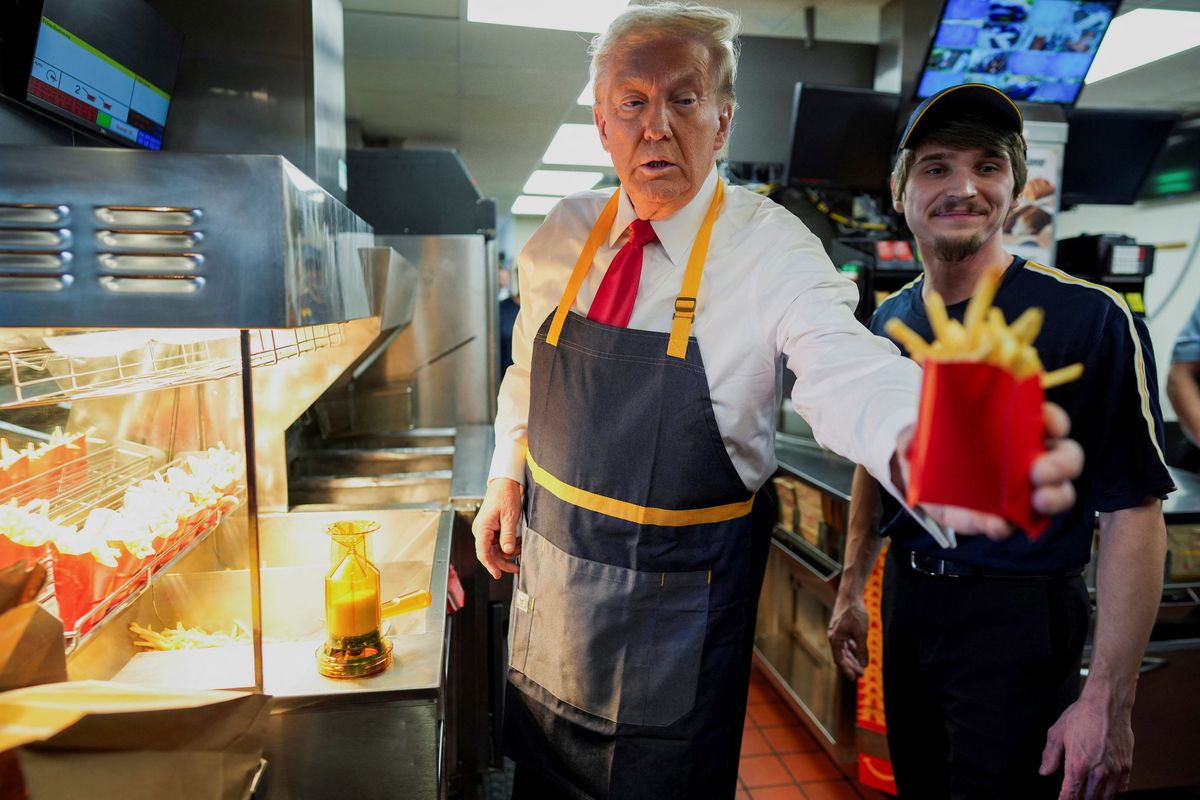
Republican presidential nominee and former U.S. President Donald Trump works behind the counter during a visit to McDonalds in Feasterville-Trevose, Pennsylvania, U.S. October 20, 2024. Doug Mills/Pool via REUTERS

Americans are starting to wise up to the harsh reality that President-elect Donald Trump has no plan – and never did – to cut prices and bury inflation woes, according to a Washington Post columnist.

And that could result in an expensive four years for consumers – many of whom fearing high prices are already stocking up on goods, Catherine Rampell wrote in an opinion piece Thursday for the Post.

“A day late and a dollar short, Americans are realizing that President-elect Donald Trump plans to short them a few dollars. That’s right: Since the election, U.S. consumers have become more likely to say they expect prices to rise next year,” Rampell wrote.

While Trump ran his 2024 campaign on appealing promises to bring everyday prices that have skyrocketed for consumers in recent years down, he acknowledged in a Time magazine interview only after winning that election that he could do no such thing, Rampell reminded readers.

“I’d like to bring them down,” Trump told Time magazine. “It’s hard to bring things down once they’re up. You know, it’s very hard.”

The only thing surprising about the admission from Trump “is that he said it out loud,” Rampell wrote.

“One thing Trump didn’t acknowledge, however, is how his economic agenda — tariffs, deportations, tax cuts, and kneecapping the Federal Reserve — could worsen the problem that voters hired him to solve,” according to the columnist. “But Americans seem to be catching on anyway.”

Rampell pointed to a University of Michigan nationwide survey that measures consumers about their views on the economy. It found a surge in participants since the election reporting “that now is a good time to purchase big-ticket items, because prices will probably rise.”


“We don’t know for sure what’s driving these shifts in consumer views,” Rampell added. “Most likely, Americans are absorbing news coverage of Trump’s proposed tariffs and their potential to raise prices on food, cars, apparel, appliances and other common household purchases.”

Trump’s threats of mass deportations could also drive up fruit, vegetable and dairy prices, she warned. And, Rampell concluded, Trump could easily worsen increased prices consumers are already facing in the face of other geopolitical and supply-chain issues.


'Unacceptable Tragedy': 10,000+ Migrants Died Trying to Reach Spain This Year

"These figures are evidence of a profound failure of rescue and protection systems," said one campaigner.


African migrants prepare to be rescued in the Mediterranean Sea on October 25, 2022.
(Photo: Vincenzo Circosta/AFP via Getty Images)


Brett Wilkins
Dec 26, 2024
COMMON DREAMS

More than 10,000 migrants died while trying to reach Spain this year—a more than 50% increase from 2023—according to a Spanish advocacy group's annual report published this week.

The NGO Caminando Fronteras (Walking Borders) said in its Monitoring the Right to Life—2024 report that 10,457 migrants died en route to Spain via the Atlantic Ocean or the Mediterranean Sea this year. Victims included 1,538 children and adolescents and 421 women. Victims hailed from 28 mostly African nations, with some coming from as far afield as Iraq and Pakistan.

"These figures are evidence of a profound failure of rescue and protection systems," the group's founder, Helena Maleno, said in a statement. "More than 10,400 people dead or missing in a single year is an unacceptable tragedy."

Walking Borders said its report "documents the deadliest period on record, with devastating figures averaging 30 deaths a day," up from an average of 18 deaths per day in 2023.


According to the report:
The Atlantic route, with 9,757 deaths, remains the deadliest in the world. Tragedies have increased, especially on the Mauritanian route, consolidating this country as the main departure point to the Canary Islands. The Algerian route, in the Mediterranean, is the second deadliest according to our records, with 517 victims. The Strait of Gibraltar has taken up to 110 lives, and another 73 have been lost on the Alboran route. In addition, 131 vessels were lost, with all persons on board.

Spain's Interior Ministry said earlier this month that, as of December 15, 57,738 migrants successfully reached the country this year by sea, an all-time high.


Walking Borders denounced what it called "the main causes of this increase in shipwrecks and victims," including "the omission of the duty to rescue, the prioritization of migration control over the right to life, the externalization of borders in countries without adequate resources, the inaction and arbitrariness in rescues, [and] the criminalization of social organizations and families."

The group also noted "the situations of extreme vulnerability" that push migrants "to throw themselves into the sea in very precarious conditions."

These include "violence, discrimination, racism, deportations, and sexual violence," as well as "being forced to survive in extreme conditions" prior to departure.

"The number of victims continues to grow and the act of documenting deaths or preserving the victims' memory carries the threat of persecution and stigmatization," the publication states, adding that the dead migrants' voices "can be heard in this report, crying out at their disappearance and death and questioning their fate. They call for justice and an end to impunity."


Workers Seek Shelter As Hanford Nuclear Complex Issues Leak Alert


By Alex Kimani - Dec 23, 2024, 


Workers at the Hanford nuclear site were ordered to take cover on Friday after a large holding tank with ammonia vapor was discovered to be leaking near the vitrification plant in the 200 East Area. Workers in that area were told to shelter in place with doors, windows and ventilation closed while other workers were told to avoid the 200 East Area. The Hanford Site is a decommissioned nuclear production complex operated by the United States federal government on the Columbia River in Benton County in the U.S. state of Washington

The 200 East Area has a vitrification plant, built and commissioned to treat the tank waste for disposal. The waste was left from the past production of plutonium from World War II through the Cold War for America’s nuclear weapons program. Today, there are 177 underground storage tanks on the Hanford Site, holding about 56 million gallons of highly radioactive and chemically hazardous waste.

The Hanford incident highlights the ongoing challenges of dealing with nuclear waste. Currently, there are thousands of metric tons of used solid fuel from nuclear power plants worldwide and millions of liters of radioactive liquid waste from weapons production sitting in temporary storage containers, some of which have begun leaking their toxic contents. Nuclear waste is notorious for the fact that it can remain dangerously radioactive for many thousands of years.

Thankfully, the world is now closer to finding a permanent solution to its nuclear menace: Finland has built the world’s first deep-earth repository where it will bury nuclear waste for 100,000 years starting 2026. Dubbed ‘‘Onkalo’’, the repository is entombed in a bedrock more than 400 meters below the forests of southwest Finland. The facility sits atop a warren of tunnels sited next to three nuclear reactors on the island of Olkiluoto, approximately 240 kilometers from the capital of Helsinki. The Onkalo project is based on the so-called “KBS-3” method developed by the Swedish Nuclear Fuel and Waste Management Company. KBS-3 is based on a multi-barrier principle whereby if one of the engineered barriers were to fail, the isolation of the radioactive waste is not compromised.

“Basically, the Onkalo project is that we are building an encapsulation plant and disposal facility for spent fuel. And it’s not temporary, it’s for good,” Pasi Tuohimaa, head of communications for Posiva, told CNBC via videoconference. Posiva is tasked with the responsibility of handling the final disposal of spent nuclear fuel rods at Onkalo.

By Alex Kimani for Oilprice.com


Russia Expands Global Nuclear Footprint Despite Western Pushback

By Tsvetana Paraskova - Dec 23, 2024


Russia is looking to maintain its position as “one of the biggest builders of new nuclear plants in the world,” a top envoy of Russian President Vladimir Putin told the Financial Times in an interview published on Monday.

“We are building more than 10 different units around the world,” Boris Titov, Putin’s special representative for international cooperation in sustainability, told FT.

“We need a lot of energy. We will not be able to provide this energy without using . . . nuclear,” the official said.

This type of energy is safe and low-carbon, Titov added.

Russia currently has nuclear power plants under development and construction in countries such as China, India, Iran, Bangladesh, Egypt, and Turkey, among others.

Russia’s ambitions to boost its global influence in nuclear power fleets come as the West seeks to diminish its dependence on Russian nuclear fuel and technology.

Yet, the Western countries will need additional incentives and sanctions on Russia to reduce their dependence on the Russian supply of nuclear fuel, according to French company Orano, one of the top Western suppliers of enriched uranium.

“To entirely disconnect from Russia, we need new capacities, and industrial groups will only invest if they have long-term contracts,” Orano’s CEO Nicolas Maes told the Financial Times in an interview in October.

France’s Orano and Urenco, a consortium created in 1970 by the governments of Germany, the Netherlands, and the UK, are the main Western competitors of Russia’s state-owned nuclear energy firm Rosatom.

Europe has not sanctioned Rosatom or Russian nuclear fuel supplies as dozens of nuclear power stations in the eastern EU member states have been built by Russian companies and supplied with Russian nuclear fuel.

As many countries are now looking to nuclear power to cut emissions and reliance on imports of oil and gas, they would need to cut their dependence on enriched uranium from Russia.

But in order to reduce reliance on Russia, western contractors and suppliers would need visibility over the long-term demand, the chief executive of France’s Orano told FT.


By Tsvetana Paraskova for Oilprice.com

Thursday, December 26, 2024

CRIMINAL CAPITALI$M

Indian Oil Probes Allegations of Albemarle Bribes to State Firm’s Officials

By Charles Kennedy - Dec 23, 2024


Indian Oil Corporation (IOC), a state-owned oil giant, has launched an internal investigation over alleged bribes paid by Albemarle to IOC officials to secure contracts more than a decade ago, Indian media report.

Responding to news articles from last week, IOC said in a statement filed with the local stock exchange that “the Company is neither a party to nor these is any allegation against the Company in relation to the proceedings referred in the said news articles”.

The statement goes on to say that “However, the Company has initiated an internal fact finding review concerning the incident which allegedly occurred in 2009 to thoroughly understand the facts surrounding these allegations and to determine the appropriate steps to be taken.”

Last year, the U.S. Securities and Exchange Commission (SEC) announced that Charlotte-based Albemarle Corporation, a global specialty chemicals company and a top lithium producer, agreed to pay more than $103.6 million to settle the SEC’s charges that it violated the anti-bribery, recordkeeping, and internal accounting controls provisions of the Foreign Corrupt Practices Act (FCPA).

In India, Albemarle used a third-party intermediary to corruptly retain catalyst business with India’s state-owned oil company by avoiding Albemarle being blacklisted, the U.S. Department of Justice said at the time.

“According to the company’s admissions in connection with the Department’s resolution, between 2009 and 2017, Albemarle, through its third-party sales agents and subsidiary employees, conspired to pay bribes to government officials to obtain and retain chemical catalyst business with state-owned oil refineries in Vietnam, Indonesia, and India,” DOJ said.

Albemarle is thought to have obtained profits of approximately $98.5 million as a result of the scheme, according to DOJ.

“Albemarle’s eventual voluntary disclosure of fraud and subsequent efforts to remedy its business practices abroad are a step in the right direction for the company,” said U.S. Attorney Dena J. King for the Western District of North Carolina.

By Charles Kennedy for Oilprice.com
Eni Launches Supercomputer to Improve Oil and Gas Exploration

SO MUCH FOR THE ENERGY TRANSITION


By Irina Slav - Dec 26, 2024


Italy’s supermajor Eni has launched the world’s most powerful supercomputer outside the United States in a bid to boost its oil and gas exploration results, the Financial Times reported, adding that the company will also use the supercomputer “to perform calculations to advance clean energy.”

Eni itself said back in November, when it introduced the supercomputer to the world, that the supercomputer will help it “optimize industrial plant operations, enhance the accuracy of geological and fluid dynamics studies for CO2 storage, develop more efficient batteries, optimize the biofuel supply chain, and develop innovative materials for applications in biochemistry.”

The machine costs more than $100 million and ranks fifth among the world’s biggest and most powerful supercomputers, Eni said back in November.

“A lot of the other companies realised it would be more efficient to rent time on someone else’s supercomputer,” Thunder Said Energy analyst Rob West told the Financial Times in comments on the Eni news. This even includes the U.S. supermajors, Exxon and Chevron, which have been using the supercomputers at the U.S. National Center for Supercomputing Applications.

Eni, however, has decided to stick with proprietary technology driving both its core oil and gas business and, apparently, its expansion into energy transition technology.

For years, Eni has been taking a different approach to conventional and green energy development, unlike any of the other major international oil and gas firms. The Italian major is divesting or creating joint ventures to operate oil and gas assets internationally while grouping some low-carbon initiatives and projects into separate firms.

Key to these spin-offs and the so-called ‘satellite strategy’ are the separate balance sheets of the companies.

“The satellite model is an approach we have built to have additional funding sources to keep together the need to meet demand for traditional products, while also developing new, greener products,” Eni’s chief financial officer Francesco Gattei told Reuters.

By Irina Slav for Oilprice.com
China Plans the World’s Biggest Hydropower Dam in Tibet


By Tsvetana Paraskova - Dec 26, 2024


China has approved the construction of a huge hydroelectric dam in Tibet, which would be the world’s largest hydropower plant with triple the capacity of the current biggest operational project, the Three Gorges Dam, which is also in China.

The Chinese government has now approved the construction of the new project in the lower reaches of the Yarlung Tsangpo River, the longest river in Tibet and the fifth longest in China, state news agency Xinhua reports.

The new mega-dam could produce 300 billion kilowatt-hours (kWh) of electricity annually, three times higher than the annual design capacity of the Three Gorges Dam.


China says that the huge new hydropower dam would align with its peak carbon emissions goals and carbon neutrality targets. The project is expected to boost the development of solar and wind energy resources in surrounding areas, thus creating a clean energy base featuring a complementary mix of hydro, wind, and solar power, the Xinhua agency quoted an official Chinese government statement as saying.

While hydropower can go a long way to provide a part of China’s electricity, periods of drought in recent years have highlighted the continued dependence on coal for reliable power supply in the world’s second-largest economy.

China has the biggest hydropower capacity in the world, at a total of 425 gigawatts (GW). Even in 2022, when drought shrank hydropower output, the country sourced 15% of its electricity from that segment, according to BloombergNEF.

Hydropower has recovered this year from the historic droughts in 2022 and 2023, but hydropower generation has been on a decline since September, leading to higher fossil fuel-powered electricity output.

Although the share of coal in China’s electricity generation has been declining in recent years with the renewables boom, Chinese coal power generation and demand remain strong. Coal still accounts for about 60% of China’s power generation, despite a surge in hydropower earlier this year after abundant rainfall, which reduced the share of coal in the country’s energy mix during the summer.

By Tsvetana Paraskova for Oilprice.com
China’s EV Uptake Is Years Ahead of Targets and Forecasts

By Tsvetana Paraskova - Dec 26, 2024,


For the first time ever, China’s electric vehicle sales are set to outpace traditional car sales on an annual basis in 2025, years in advance of the Chinese authorities’ targets and years ahead of analyst projections, according to the latest industry forecasts provided to the Financial Times by research companies and investment banks.


China’s combined EV and plug-in hybrid sales are expected to jump by around 20% to over 12 million units next year, HSBC, UBS, Morningstar, and Wood Mackenzie have projected.

Next year, the expected sales of the so-called new energy vehicles are set to more than double from the 5.9 million units sold in 2022.

At the same time, sales of conventional cars with internal combustion engines (ICE) are projected to fall by 10% next year to fewer than 11 million vehicles. This means that China will see EV sales outpacing conventional car sales for the full-year 2025, according to the four research firms and banks that have shared their latest insights with FT.

The second half of this year has already seen EVs outselling conventional cars in China. July 2024 was the first month ever in which new energy vehicle sales exceeded ICE car sales. Since July, China has consistently marked months of EV sales holding more than 50% of new car sales.

In November 2024 alone, the Chinese market once again beat its previous record set in October by over 50,000 vehicles, to reach almost 1.3 million EVs sold, EV research house Rho Motion said earlier this month.

The monthly growth in EV sales in November 2024 was almost entirely due to higher number of BEV sales, which rose by over 70,000 units. Most of the growth resulted from monthly increases in sales from Geely, Tesla, and Changan, according to Rho Motion.

Between January and November 2024, China’s EV sales jumped by 40% from a year earlier to 9.7 million units, Rho Motion noted.

Soaring EV sales in China have contributed in part to the weaker-than-expected oil demand in the world’s top crude oil importer. The other major factors have been wobbling economic performance and surging LNG-fuelled trucking.

By Tsvetana Paraskova for Oilprice.com

Nio’s Mass Market Push Draws Scorn as EV Maker Promises a Profit

By Bloomberg News
December 26, 2024 

(Bloomberg, NIO)

(Bloomberg) -- It’s a wonder three little headlights can stir up such debate. But that’s what many netizens in China have been driven to comment on following the launch of Nio Inc.’s newest sub-brand, Firefly.

The electric hatchback was unveiled last weekend at Nio’s annual gathering for its customers, partners and media. The compact car will start from 148,800 yuan ($20,400) and features a rather plain design punctuated by three little round lights at the front and rear, which look more cutesy than chic.

Nio watchers were quick to point out the resemblance to the Honda e and its symmetrical ‘eye-like’ LED headlights, which most said look a lot better. Many derided the car, saying it undermines Nio’s premium eponymous brand and the automaker’s positioning of itself as a luxury marque. (Also over the weekend Nio showcased its most expensive car ever, the ET9, a four-seater sedan meant to take on Porsche’s Panamera series or Mercedes-Benz’s luxury S range.)

But for Nio, passing its 10-year anniversary and yet to turn a profit, heading down into the mass market to ramp up sales volumes may be the most sensible way forward.

Once regarded as one of China’s brightest electric vehicle stars, Nio has had several near-death experiences.


The first came in 2019 after heavy spending on marketing and splashy showrooms failed to generate demand for its ES8 and ES6 electric sport utility vehicles, and the municipal government of Hefei stepped in with a $1 billion rescue package.

Prospects improved in 2021, when Nio recorded some its highest-ever gross margins, but by 2023, Nio was struggling financially again. In July of that year, Abu Dhabi-backed fund CYVN Holdings invested $738.5 million and later acquired shares in Nio from an affiliate of Tencent for $350 million. In December 2023, CYVN committed to invest a further $2.2 billion in return for a 20.1% stake.

According to Nio CEO William Li, the automaker has fallen short of its own expectations for three consecutive years and is now at least two years behind schedule. At home, BYD is a much bigger threat than it was a decade ago while Nio’s overseas expansion plans have encountered a number of setbacks, including, in Europe, tariffs on Chinese EV imports and a slower-than-expected build out of its battery-swap stations.

External factors, including lithium price hikes and Covid lockdown disruptions, have added to the challenge.

Fronting a media scrum earlier this month in Shanghai, Li was peppered with more than 200 questions and was at pains to assure the public. “We survived five years since 2019, and now with a healthy operating cash flow, we can for sure survive longer than another five, don’t worry,” he said.

That may be easier said than done.

Several Chinese EV brands, including WM Motor, have bowed out due to cut-throat competition domestically, leaving car owners in limbo when it comes to after-sales and maintenance. The most recent is Jiyue, a joint venture backed by giant Baidu Inc. and well-established Chinese player Geely Automobile Holdings Ltd.

Shortly after it displayed a new vehicle at the Guangzhou auto show in November and started taking pre-order deposits of 50,000 yuan, management abruptly cut staff, sparking employee complaints and a customer panic.

Nio also needs to spend money to make money, risking the 42.2 billion yuan it had in cash and cash equivalents as of Sept. 30.

Research and development into advanced driving semiconductors is a must, Li has said, calling that a “reasonable business decision” considering the procurement costs from Nvidia Corp. alone this year. Longer term, it will improve Nio’s gross margin and reduce supply chain risks, Li reasons.

Another thing Nio didn’t address as it launches new brands is, beyond price and specs, how they’re that different and the potential cannibalization between them. Will Firefly owners, who may pay as little as 100,000 yuan under a battery-leasing model, be allowed into the clubby Nio Houses, for example, the upmarket social spaces reserved for Nio car owners around the world?

Without those perks that, at least for Nio’s core customer base, are an important draw, it’s uncertain whether the new brands (there’s also Onvo) can translate into higher sales volumes. Nio is well behind larger rivals in China — its deliveries totaled almost 191,000 units for the first 11 months of 2024, versus around 1.6 million for BYD’s pure electric cars.

Nio is projecting to double sales in 2025 to at least 440,000 units, with Firefly adding “several thousand” deliveries per month, according to Li.

That’s still comparatively tiny but Li is bullish, maintaining that “profitability in 2026 is baseline” the EV maker “can’t afford to miss.”

--With assistance from Danny Lee.

©2024 Bloomberg L.P.


GOOD NEWS

Iraq Plans to Slash Gas Flaring


By Charles Kennedy - Dec 26, 2024

Iraq plans to cut gas flaring next year and eliminate the practice of burning off associated gas at oilfields by the end of 2027, government officials have said.

As of the end of 2024, Iraq, which is OPEC’s second biggest oil producer after Saudi Arabia, is capturing around 67% of the gas at its oilfields, Ezzet Saber Ismael, Iraq’s deputy minister for gas affairs told Bloomberg in an interview published on Thursday.

Earlier this week, Iraq’s Prime Minister Mohammed S. Al-Sudani chaired an energy policy meeting, at which officials discussed ongoing natural gas projects, the office of the Iraqi PM said.


“Current progress includes a significant reduction in gas flaring levels, reaching 67%, with projections to achieve 80% by the end of next year and complete elimination of flaring by the end of 2027,” the office of the prime minister said in a statement.

Iraq is one of the top ten countries in the world in terms of gas flaring, alongside Russia, Iran, Algeria, Venezuela, the U.S., Mexico, Libya, and Nigeria, according to estimates from the Global Gas Flaring Tracker Report by the World Bank.

Iraq has recently launched initiatives to reduce gas flaring, aiming to capture and use the natural gas instead of wasting it.

Despite being OPEC’s second-biggest producer and a major crude oil exporter, Iraq is importing natural gas – including from Iran under a special U.S. waiver – to meet its power generation needs.

Last year, Iraq signed a major deal with France’s supermajor TotalEnergies to develop a Gas Growth Integrated Project (GGIP), which includes the recovery of flared gas on three oil fields in order to supply gas to power generation plants.

Commenting on the agreement, the U.S. State Department said that “the United States strongly supports Iraq’s efforts to become more energy secure and minimize harmful emissions.”

“Minimizing the current practice of gas flaring by capturing the massive amounts of methane being burned away will significantly reduce emissions, improve public health for Iraqis, and utilize captured gas to power Iraq’s electrical grid,” the State Department added.

By Charles Kennedy for Oilprice.com
India’s Oil Demand Growth Set to Surpass China’s

By Alex Kimani - Dec 26, 2024


India’s oil demand growth is expected to exceed China’s for the first time in 2024, and continue in 2025. According to Kang Wu, global head of macro and oil demand research at SPGCI, India’s oil demand in the current year grew by 180,000 barrels per day, surpassing China’s growth at 148,000 bpd. India’s oil demand is expected to increase by 3.2% Y/Y in 2025 compared to a 1.7% clip by China.

Over the past couple of decades, China has carried the lion’s share of global oil demand growth thanks to the country’s remarkable economic boom. However, that is beginning to change. The factors that helped sustain China’s rapid growth since the global financial crisis are unlikely to be replicated in the next decade, particularly in sectors of property construction and local government investment. Indeed, China’s economic slowdown has mainly manifested in the property sector’s decline, hardly surprising considering that the industry represented 20 to 25 percent of GDP at its peak.

But China is now poised to lose its prominence in global oil markets.

“China’s role as a global oil demand growth engine is fading fast,’’ Emma Richards, senior analyst at London-based Fitch Solutions Ltd, has told The Times of India. According to the analyst, over the next decade, China’s share of emerging market oil demand growth will decline from nearly 50% to just 15% while India’s share will double to 24%.

But it’s not just a dramatic slowdown in its economy that will make China a less important player in global oil markets. The country’s booming EV sector will rapidly lower oil demand much faster than India’s: China sold 6.1 million EVs in 2022 compared with just 48,000 sold in India. India is nowhere near as aggressive with its clean energy push compared to China. Last year, India’s coal minister declared that the country has no intention of ditching coal from its energy mix any time soon. Minister Pralhad Joshi said that coal will continue to play an important role in India until at least 2040, referring to the fuel as an affordable source of energy for which demand has yet to peak in India.

By Alex Kimani for Oilprice.com