Thursday, January 02, 2025


Suspect "Dark Fleet" Tanker Faces Civil and Criminal Actions in Finland
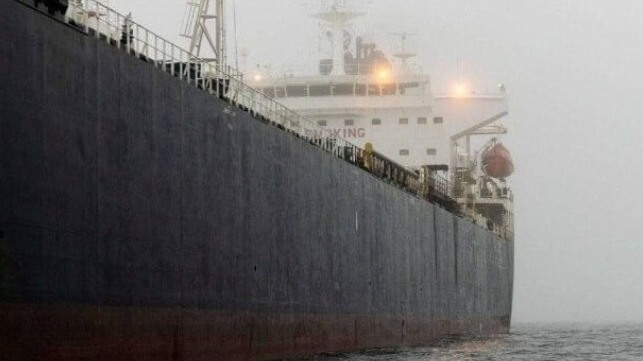
Eagle S (Finnish Border Guard)

Published Jan 2, 2025 5:07 PM by The Maritime Executive


Finnish investigators now have two more possible ways to detain the tanker Eagle S, which is suspected of severing multiple subsea cables in the Gulf of Finland on Christmas Day. In addition to the criminal inquiry initiated by Finnish law enforcement agencies, subsea cable operator Fingrid has asked a court to detain the tanker pending separate civil litigation over the cost of the infrastructure damage, which could potentially result in the seizure and sale of the vessel. Finland's port state control authorities are also planning to inspect the aging "dark fleet" tanker for possible safety deficiencies, dozens of which were identified in previous PSC boardings.

Eagle S's attorney, local maritime lawyer Herman Ljungberg, has dismissed the Finnish criminal inquiry as "speculation" and - on the shipowner's behalf - has called for the vessel's prompt release. A separate civil detention order from the courts and a safety-related detention from the Finnish Coast Guard would complicate the shipowner's appeal and make it more difficult for the tanker to depart. The tanker's cargo of Russian gasoline has also been impounded pending the outcome of a Finnish customs investigation. 

In addition to banning the movement of the tanker, Finland's National Bureau of Investigation has issued a travel ban on eight crewmembers (up from the initial seven named earlier this week) in order to ensure that they remain reachable. These individuals are suspected of criminal acts, but have not yet been formally placed under arrest. The travel ban allows them to continue to work aboard the ship and maintain it in safe operating condition. 

On Dec. 25, Fingrid's EstLink 2 power transmission cable from Finland to Estonia and multiple subsea telecom cables in the Gulf of Finland were suddenly severed. Eagle S's AIS trackline corresponded to the damage sites, and a drag line of up to 50 nm long was found on the bottom. The tanker had an anchor chain in the water, but the chain was missing the anchor - just like the NewNew Polar Bear, a Chinese boxship that cut multiple subsea cables by dragging its anchor along the bottom of the Baltic. 

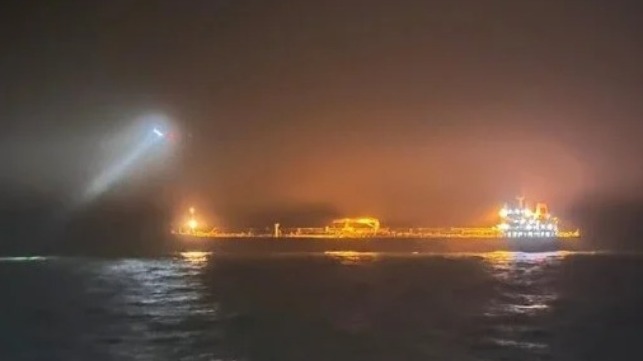
As this was the third potentially ship-related cable damage incident in a year in the Baltic, Finnish authorities acted quickly. They requested Eagle S to divert from international waters and into Finnish territorial seas, and the crew agreed to comply. Finnish police then boarded the vessel in a tactical operation with a military helicopter.
 
Given the repeated occurrence of cable damage incidents in the Baltic, the Finnish Parliament's foreign affairs and defense committees both scheduled meetings for Friday to discuss subsea infrastructure security. Finland's NATO allies met on December 30 for a similar purpose, and reached an agreement to enhance the alliance's military presence in the Baltic. 


Seven Crewmembers From Suspect Tanker Banned From Leaving Finland
Finnish forces boarded the Eagle S at sea in a tactical operation Dec. 25 (Finnish Border Guard)

Published Jan 1, 2025 5:49 PM by The Maritime Executive


Seven crewmembers of the tanker Eagle S, which allegedly damaged subsea infrastructure in the Baltic last week, have been banned from leaving Finland and are suspected of committing a crime. The travel ban allows the suspects to remain working aboard the ship, unlike an arrest.  

"The police have an interest in securing the preliminary investigation and ensuring that the parties involved remain reachable during the investigation. However, the investigation is ongoing and the situation is becoming more specific, meaning that it is possible that the number of people subject to a travel ban will change," said inspector Elina Katajamaki of Finland's Central Criminal Police Office.

The tanker Eagle S has been detained by Finnish authorities in connection with a subsea cable damage incident that occurred on Christmas Day. In a matter of hours on Dec. 25, Fingrid's EstLink 2 power transmission cable and multiple subsea telecom cables were severed. Eagle S's AIS trackline corresponded to the damage sites, and a drag line of up to 50 nm long was found on the bottom. The tanker had an anchor chain in the water and was missing an anchor.

The Eagle S was asked to divert to Finnish territorial seas, and though it was located in international waters, the crew agreed to comply. Finnish police then boarded the vessel in a tactical operation with a military helicopter.

It is the latest of three nearly-identical cable damage incidents in the Baltic over the past year, and it is the first in which the coastal state successfully detained the suspect vessel. The ship has been relocated to a sheltered anchorage at Porvoo for further investigation, and authorities say that on-site forensic work is proceeding more quickly now that the weather is improving.

Legal advice

Eagle S's operator has retained a local maritime attorney, Herman Ljungberg, who claims that the crew have not received fair treatment. In an interview with YLE, he said that the authorities have made it difficult for the crew to access their right to legal advice. 

"Apparently some interrogations have taken place. I have pointed out that they should have legal counsel. The authority decided that they do not need to," Ljungberg told YLE. "The ship's crew has been very effectively prevented from communicating and receiving legal assistance."

Inspector Katajamaki denied this allegation to YLE. "The police have conducted a preliminary investigation according to the letter of the law, meaning everyone has been offered the help they are entitled to receive," she said.

Ljundberg has called for the ship and the crew to be released to carry on with their commercial voyage. 


BP Achieves First Gas at Major West Africa Offshore Project

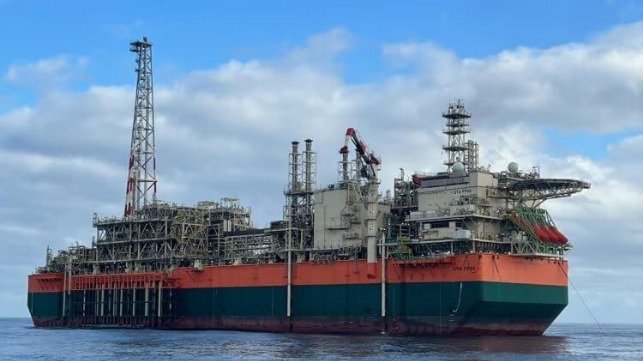
FPSO West Africa
FPSO built in China is the centerpiece of the new project in West Africa (BP)

Published Jan 2, 2025 5:13 PM by The Maritime Executive


Senegal and Mauritania are set to become major producers of natural gas after oil major BP marked a significant milestone with the first gas flow from the offshore Greater Tortue Ahmeyim (GTA) project. It is the first gas development in the new basin offshore Mauritania and Senegal and is expected to put the two West African nations on the map as major hydrocarbon producers.

BP is the operator of GTA, a project that is being developed at a cost of $4.8 billion and which it jointly owns with U.S operator Kosmos Energy, Mauritanian hydrocarbons company SMH, and Senegal’s state-owned Petrosen. The project is one of the deepest offshore developments in Africa, with gas resources in water depths of up to 2,850 meters (9,350 feet). When fully commissioned, GTA Phase 1 is expected to produce around 2.3 million tonnes of LNG annually for more than 20 years.

The first gas from the project is being introduced to the FPSO approximately 40 kilometers (25 miles) offshore, where water, condensate, and impurities are removed. 

“This is a fantastic landmark for this important megaproject,” said Gordon Birrell, BP EVP production & operations. “First gas flow is a material example of supporting the global energy demands of today and reiterates our commitment to help Mauritania and Senegal develop their natural resources.”

The project employs a large FPSO, constructed by China’s COSCO Shipping Heavy Industry yard in Qidong, China. The vessel, which is designed for a 30-year service life, is 70 meters (230 feet) long and has an oil storage capacity is not less than 1.44 million barrels. The living quarters can accommodate 140 people.


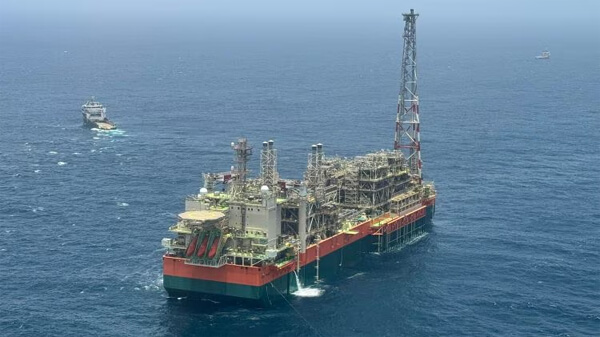
The FPSO being towed into position in June 2024 (BP)


The FPSO arrived at its permanent location offshore Mauritania and Senegal in June 2024. It is expected to process over 500 million standard cubic feet of gas per day.

The gas will be transferred via pipeline to the Gimi FLNG vessel that is moored at the Hub Terminal approximately 10 kilometers (6 miles) offshore where it will be cryogenically cooled, liquefied, and stored before being transferred to LNG carriers for export. Some of the gas will be allocated to help meet growing demand in the two countries.

Owned and operated by Golar LNG, the Gimi can store up to 125,000 cubic meters of LNG. The vessel arrived at the GTA project in February having undergone conversion at Singapore’s Seatrium shipyard. The vessel was converted from a 1975-built Moss LNG carrier and is designed for 20 years of operations on-site without dry docking. It features a liquefaction capacity of 2.7 million tonnes per annum and capabilities to operate near shore in 30 meters (100 feet) of water depth.

The project is based on the 2014 discovery of 120 trillion cubic feet of natural gas across the two countries. The first LNG cargo for export markets is projected in the first quarter of this year.


Ammonium Nitrate Cargo Arrives in Africa Ending Panic Over “Bomb Ship"

bulker offshore
Ruby drew worldwide attention as it sought a port of refuge while loaded with ammonium nitrate (file photo)

Published Jan 2, 2025 1:28 PM by The Maritime Executive


A cargo of nearly 20,000 tonnes of ammonium nitrate fertilizer that drew worldwide attention and created a hysteria over the “bomb ship” quietly arrived in Africa at the beginning of the week. The cargo which was seven times the amount that exploded in 2020 devastating sections of Beirut, Lebanon, became the subject of numerous media reports as the Malta-flagged cargo ship Ruby was repeatedly denied a port of refuge.

The Barbados-flagged cargo ship Zimrida (37,296 dwt) reflects on its AIS signal that it dropped anchor on Monday, December 30, in the Abidjan anchorage in Cote d’Ivoire. The majority of the cargo, which was in bags, was transferred from the Ruby to the replacement vessel in the port of Great Yarmouth in the UK. The Zimrida departed on December 16 and made a provisioning stop in the Canary Islands.

The cargo caused a panic first in Tromsø, Norway after the ship Ruby (37,000 dwt) was permitted to dock in the center of the city after suffering damage during a storm after departing Russia. Norwegian authorities after learning of the cargo ordered the vessel moved to a remote offshore location, which drew the first attention of the media at the beginning of September.

Malta as the vessel’s flag state and DNV as the ship’s class society determined the Ruby while damaged remained seaworthy. It however required immediate repairs due to reports of damage to the hull, propeller, and rudder.

A shipyard in Lithuania won the assignment for the repairs, but the local authorities said the ship would not be permitted to enter the port until the cargo had been offloaded. Sweden and Denmark also placed restrictions on the ship’s movement into the Baltic causing the Ruby to instead divert to an anchorage off England.

Great Yarmouth finally accepted the vessel at the end of October so that the cargo could be transferred to a replacement ship. Even then it caused political controversy and the newspaper the Great Yarmouth Mercury reports at one point local officials contemplated evacuating the city when a portion of the cargo was found to be contaminated.

It was highlighted that the ammonium nitrate was stable and properly packed and stored but the dangers increase when it becomes contaminated. The newspaper says the ship’s fuel had leaked contaminating approximately 300 tonnes. In a carefully planned exercise, accompanied by several tugs, the Ruby put out into the North Sea and dumped the contaminated fertilizer overboard setting out a new controversy and complaints of pollution from environmentalists.

The cargo which was labeled in media reports as a Russian bomb had been destined for Brazil the shipping company’s representatives reported. The cargo instead ended its journey in Africa while the Ruby quietly departed Great Yarmouth on December 5. She was moved to the port of Tyne in England where she remains under repair.


DFDS Signs Jersey, Channel Islands Ferry Contract Despite Brittany's Appeal

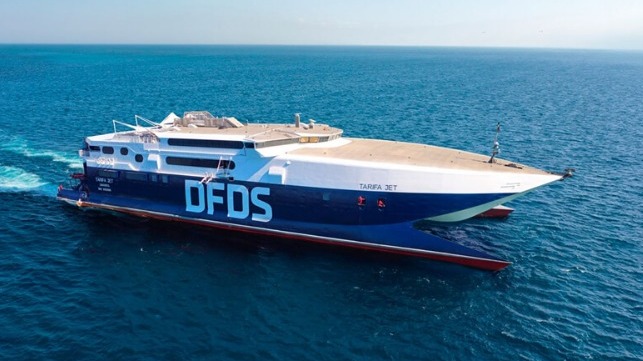
DFDS high-speed ferry
DFDS's service will include two high-speed ferries (DFDS)

Published Jan 2, 2025 5:46 PM by The Maritime Executive


The controversial contract for the Danish ferry company DFDS to take over ferry service to Jersey in the Channel Islands has been completed despite a pending challenge. The contract was awarded at the beginning of December after a competitive bidding process and the selection of the Danes marks the end of more than 60 years of service by Condor Ferries, a UK company that was acquired in December 2024 by France’s Brittany Ferries.

The 20-year contract is due to begin service on March 28, 2025, with DFDS providing both freight and passenger services connecting Jersey of the Channel Islands to the UK and France. DFDS’ Jersey fleet will comprise one Ro-Pax vessel, two high-speed crafts, and a dedicated freight vessel to meet the needs of the island, and support tourism and the hospitality sector in Jersey as well as in France? and the UK with frequent sailings. DFDS also committed to increasing the frequency of ferries to address high demand in peak periods, introducing high-speed ferries to the UK, and investing in three new vessels by 2032.

"We are excited to embark on this journey with Jersey and the local community,” said Torben Carlsen, CEO of DFDS. “The lifeline ferry service is a vital link for the island, and we are fully committed to delivering reliability and an enhanced travel and transport experience for islanders, businesses, and visitors. We look forward to building a strong partnership with Jersey and serving the community.”

The execution of the contract came as Brittany Ferries, which had also bid, announced it would challenge the award to DFDS. Government officials in Jersey told the BBC they were "disappointed" by the pending court challenge but would defend their decision. 

The Royal Court has set hearings for January 13 and 14 for the claims from Brittany Ferries that government officials did not make clear the concerns before the bidding process and did not provide reasons for their concerns about the company’s bid. Brittany Ferries was granted a judicial review while the court rejected wider claims. 

DFDS which dates to 1866 and operates a wide array of routes and ferries said it is committed to Jersey. It looks forward to launching the new service which it says will improve transportation to the islands.


At Least Seven Confirmed Dead in Sinking of Haitian Ro/Ro Freighter

Maelys II is a ro/ro freighter built in 1970 and flagged with an unknown registry. She is owned and operated by a company based in Florida, according to her Equasis record. 

Maerys II
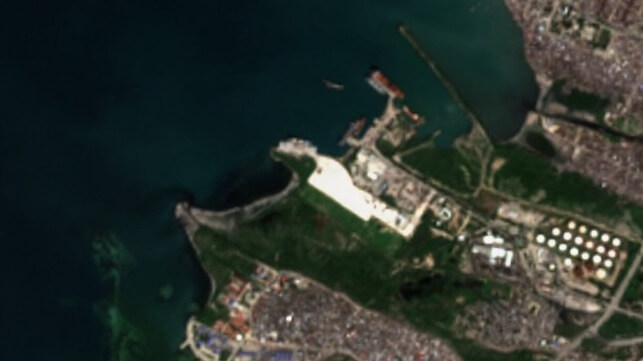
The partially capsized Maerys II (red and white) can be seen at the northeast end of Varreux Terminal, Port-au-Prince, Dec. 28, 2024 (Sentinel-2)

Published Dec 29, 2024 7:42 PM by The Maritime Executive


The toll from the sinking of a domestic ro/ro freighter at Port-au-Prince, Haiti continues to rise as search efforts continue, according to local media. 

On December 23, the freighter Maelys II listed to port and capsized at Port-au-Prince's Varreux Terminal, coming to a rest on her port side. There were 34 trucks aboard at the time of the casualty, and the authorities continued to search the interior compartments throughout the week for missing personnel. "We do not yet have the final death count as there are still bodies inside the ship's hold," a source from the search effort told Le Nouvelliste. 

The cause of the casualty is under investigation.

Photos from the scene show toppled trucks and floating cargo in the water, including a trailer-sized propane tank. The time series imagery suggests that as the vessel listed through 45 degrees, trucks and trailers slid down the deck until they came to rest on the port side, adding more weight to the low side of the ship. 

According to Haiti Libre, some of the deceased may have been looters who boarded the ship to steal cargo while it was gradually rolling to port. Half a dozen small row boats can be seen near the main deck level in images from the scene, each carrying several occupants and undetermined items. 

Terminal Varreux is a multipurpose terminal with a large tank farm for fuel and vegetable oil. It also serves bulk and breakbulk cargoes, as well as ro/ro ships like the Maelys. According to the terminal operator, the freighter was located at a terminal reserved for coastwise cargo transport (cabotage cargo) when she capsized. This means that the wreck is located well away from the berths used by international vessel traffic and should not affect tanker operations, which are important for Haiti's devastated economy. 

"Due to this event, cabotage operations are temporarily suspended, although the supply of the southern peninsula remains a priority," the terminal operator said in a statement. "The Varreux Terminal, its staff and collaborators extend their sincere condolences to the victims' families."

Maelys II is a ro/ro freighter built in 1970 and flagged with an unknown registry. She is owned and operated by a company based in Florida, according to her Equasis record. 


Report: ILA-USMX to Resume Contract Negotiations for East/Gulf Coast Ports

ILA longshore members
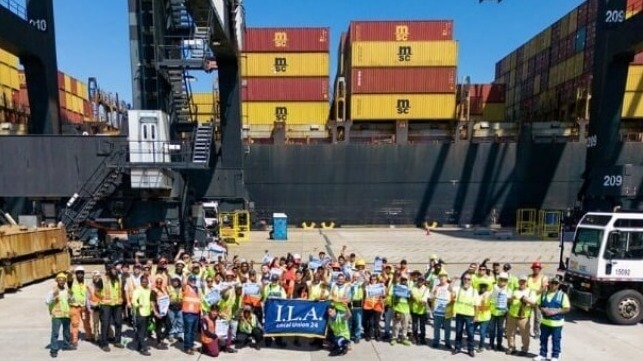
The ILA is posed to go on strike in two weeks over its demands to block automation in the ports (ILA file photo)

Published Jan 1, 2025 3:03 PM by The Maritime Executive


A report from S&P Global’s Journal of Commerce says talks are set to resume between the International Longshoremen’s Association and the terminal operators at U.S. East Coast and Gulf Coast ports represented by the U.S. Maritime Alliance (USMX). This comes after weeks of an impasse between the union and the employers which reportedly centers around the use of semi-automated equipment in the ports.

The union and the association have not confirmed the reports, but sources told the Journal of Commerce that talks are set to resume on January 7. That would be just nine days before the end of the master contract for all the longshoremen handling containers and vehicles at the U.S. ports. The two sides extended the deadline as part of an agreement on wage increases struck in October to end a three-day walkout. The deadline is midnight on January 15 with the union having threatened to resume the strike on January 16, just four days before the inauguration of Donald Trump as the next U.S. president.

Union members are anxious for an agreement because they are waiting for the agreed 60-plus percent wage increase to start. The ILA deferred the implementation of the wage increase until the other issues were resolved in the contract. In addition to the ILA’s firm stance against automation, issues regarding benefits are still to be resolved.

USMX responded to the ILA saying that it was willing to extend the existing contract structure to review proposed automation. The terminal operators contend that they are out of space to expand in most locations and must use new technologies to respond to the need to increase volumes. The current contract establishes a review committee that includes union representatives for any proposed semi or fully automated systems.

Major U.S. ports including the Port of New York – New Jersey currently do not have automated systems for handling containers putting them at a disadvantage to other global ports which have embraced the technology. Ports on the U.S. West Coast which are under a different union have accepted some automation technologies.

The ILA contends the technology is a replacement for jobs and not needed to maintain productivity at the ports. In addition to container handling systems, it objected for example to an automated gate system deployed by APM Terminals in Mobile, Alabama calling it a contract violation.

President-elect Trump met with the union leaders and issued a strong statement in support of the ILA and its fight against automation. He called on the foreign-owned shipping companies to respect the longshoremen in the contract negotiations. President Joe Biden and his administration pressured the USMX to raise its wage offer in October to settle the prior strike.

Carriers and shippers have already begun to prepare for a possible prolonged work stoppage in mid-January. Maersk, CMA CGM, and Hapag-Lloyd have all issued alerts to customers calling for efforts to expedite container movements out of the terminals while saying they would explore the options if a strike paralyzes the ports. Maersk and Hapag have also announced plans for a work disruption surcharge for all containers moving through the U.S. ports.

Trade groups continue to urge the two sides to resolve the contract. They have said a strike would have dramatic impacts on the U.S. economy while Trump has promised to lower costs for the American consumer.


WHAT THE ILA IS FIGHTING AGAINST 


Can U.S. Ports Catch Up with Global

Competition?


By ZeroHedge - Jan 02, 2025,

U.S. ports are lagging behind international counterparts in efficiency, leading to congestion, delays, and increased costs.

Public ownership and political interference are contributing to poor investment decisions and limited competition.

Privatization could introduce much-needed efficiency, competitiveness, and investment, ultimately benefiting businesses and consumers.


The world has watched for decades as U.S. ports have lagged behind their international counterparts. As they have become increasingly plagued by congestion, delays, and rising costs, it becomes increasingly clear that the publicly-owned port authorities are failing to meet the demands of modern global trade. The solution lies in privatization, a much-needed approach that could revitalize our failing ports.

The importance of ports to the U.S. cannot be overstated, as demonstrated by the sheer volume of trade passing through American ports. In 2023, over $2.1 trillion worth of goods, more than 40% of all goods entering or leaving the United States, passed through a port.

However, despite the importance, American ports continue to lack efficiency. This inefficiency manifests in longer vessel turnaround times, lower crane productivity, poor infrastructure management, and limited use of automation. These issues result in supply chain disruptions and thus increased costs for businesses and consumers.

The inefficiency of U.S. ports is illustrated by their poor performance in global rankings. According to the Container Port Performance Index (CPPI), which measures global port efficiency based on various factors, U.S. ports consistently lag behind other developed countries. This inefficiency is particularly evident when examining specific port rankings. For instance, the Port of Houston, which handled over 293 million tons of cargo in 2022, ranked a dismal 327th in the 2023 CPPI. The Port of Los Angeles, one of the busiest ports in the country, ranked 378th, while the Port of Savannah came in at 398th.

These low rankings translate into inefficiencies that impact the entire supply chain. U.S. ports experience longer vessel turnaround times and lower crane productivity compared to global competitors, particularly those in East Asia. This inefficiency is further exacerbated by the limited use of automation in U.S. ports. While automation has been widely adopted in ports around the world, U.S. ports have been slow to embrace this technology, resulting in increased costs.

This inefficiency is due to the inherent flaws of the publicly-owned port authority model. Under the government’s port authority, political considerations often override commercial criteria, leading to poor investment decisions. Insufficient or misplaced investments result in underutilization of existing port assets. Limited competition among ports reduces incentives for efficiency improvements.

Privatizing port operations can introduce much-needed efficiency and competitiveness.

Private operators have stronger incentives to streamline processes. They are more likely to make timely and appropriate investments in port infrastructure and technology. Competition among private companies can lead to more competitive pricing and reduced costs for port users, addressing a key factor in U.S. port inefficiency.

The benefits of privatization are not merely theoretical. Evidence from successful port privatizations around the world demonstrates the potential for significant improvements. For instance, the privatization of the Port of Brisbane in Australia, completed in 2010 for 2.1 billion AUD, successfully achieved the Queensland Government’s objectives and overcame challenges associated with transitioning a government-owned monopolistic asset to the private sector.

A study published in the NBER Digest found that when private equity funds acquire airports from governments, key performance metrics improve significantly. While airports and seaports are different, this study suggests that private ownership can lead to improved infrastructure management and operational efficiency in transportation hubs.

Privatization does not necessarily mean a complete absence of government oversight. Various models of privatization, such as public-private partnerships, can maintain a degree of public involvement while harnessing the efficiency of private sector management.

In conclusion, the inefficiency of U.S. ports under public ownership is a significant drag on the nation’s economy and competitiveness. By embracing privatization, we can unlock the potential of our ports, bringing them in line with global standards of efficiency and productivity. Simply by creating a more competitive port system that benefits businesses and consumers, we can provide a boost to American economic growth, reduce supply chain bottlenecks, and strengthen our position in the global market.

By SchiffGold.com via Zerohedge.com


President Musk Declares War on American Workers

MAGA voters thought they elected an America First government. Tech billionaires think they are running the show.

by Ryan Cooper
THE AMERICAN PROSPECT
January 2, 2025


Alex Brandon/AP Photo
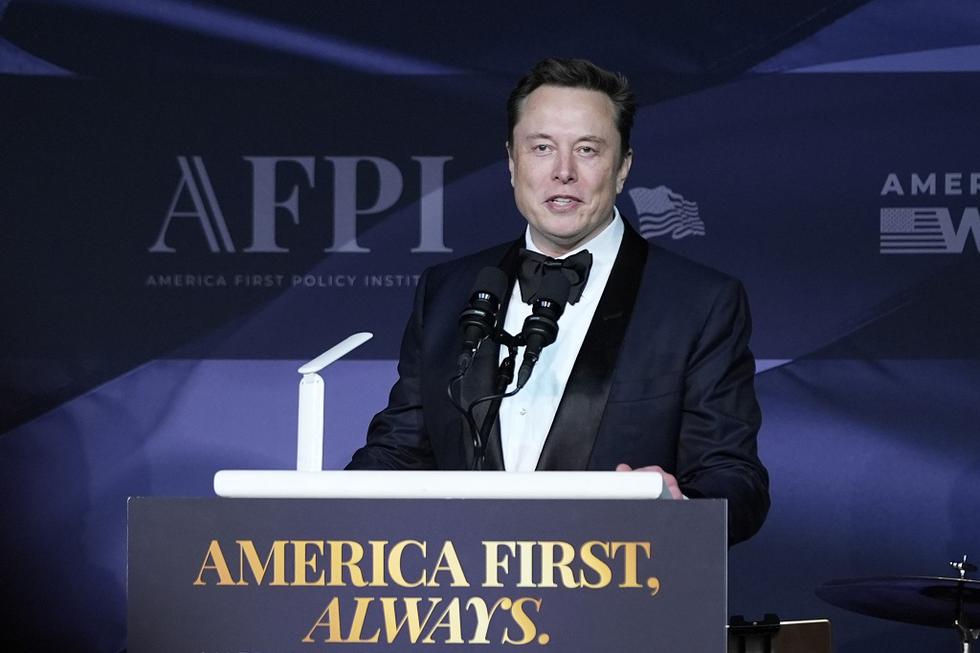
Elon Musk speaks during an America First Policy Institute gala at former President Trump’s Mar-a-Lago estate, November 14, 2024, in Palm Beach, Florida.


Over the holiday season, a nasty fight erupted between different factions of the Republican Party. On one side are the MAGA faithful: the true believers who want mass deportation, “America First” economic autarky, and so on, like Stephen Miller, Laura Loomer, and Steve Bannon. On the other are a handful of Silicon Valley billionaires, above all Elon Musk, who clearly believes he has bought the government lock, stock, and barrel by spending $44.2 billion on campaign contributions and Twitter.

The fight is over immigration policy, specifically the H-1B program, which allows employers to sponsor temporary visas for certain technical workers. MAGA die-hards hate this program because it gives jobs to non-Americans and because most H-1B recipients are not white. Tech billionaires love it because it saves them money and increases their power.

Loomer started the fight by criticizing the appointment of Sriram Krishnan, who had argued in favor of more skilled immigration, as an adviser for Trump’s Office of Science and Technology Policy. Musk responded in cartoon-villain fashion to a small account criticizing him. “The reason I’m in America along with so many critical people who built SpaceX, Tesla and hundreds of other companies that made America strong is because of H1B,” he wrote. “Take a big step back and FUCK YOURSELF in the face. I will go to war on this issue the likes of which you cannot possibly comprehend.”


When Loomer and others kept posting, the self-proclaimed “free-speech absolutist” Musk reportedly stripped verified Twitter status from Loomer and 52 other accounts associated with her organization. So far at least, a distinctly low-energy Donald Trump is siding with Musk. “I’ve been a believer in H-1B. I have used it many times. It’s a great program,” he told the New York Post.

It’s anybody’s guess how immigration policy will shake out in Trump’s second term. But we can be confident that Elon Musk thinks he is the shadow president, and the only thing he cares about is his own money and power.

Oligarchs like Musk and David Sacks say that the H-1B program is vital because Americans are too stupid and lazy to learn technical skills. This is not remotely true—on the contrary, there is currently a sizable surplus of technical labor, as the generation that had “learn to code” as the automatic route to a six-figure salary beaten into them graduates, while the tech industry conducts mass layoffs. Indeed, a major motivation of the “learn to code” dogma was coming from tech company brass enraged at high labor costs.

The real reason the capitalist class loves H-1B is as a weapon of class warfare. First, it provides a pool of highly exploitable labor who have to obey the boss’s every command or risk deportation. Second, that pool provides leverage against domestic workers who have to compete against exploited H-1Bs. Tech oligarchs are always doing this kind of thing. Back in 2015, Apple, Google, Intel, and Adobe paid $415 million to settle a class action lawsuit over a conspiracy to not poach each other’s top talent and thus keep wages down. “I would be very pleased if your recruiting department would stop doing this,” Steve Jobs wrote to Google’s Eric Schmidt in 2007.

In short, the MAGA faithful are not entirely incorrect to say H-1B harms the American working class. However, as Steve Randy Waldman points out, the solution is not to deport all those visa holders, but to fold the program into a streamlined general employment-based visa program (which leads to permanent residency) and give them all green cards so they are not so exploitable. Alas, that kind of sensible immigration reform is not going to happen with Trump as president.

What we can say is that the Republican coalition is deeply split, not only in terms of policy but also in terms of power. As Paul Krugman points out, Trump’s economic agenda is starkly contradictory and absurd—he wants to pass another huge tax cut for the rich and add lots of tariffs, which will mean higher interest rates and a larger trade deficit, but he also wants lower interest rates and to slash the trade deficit. One priority or the other will have to go, or perhaps both if he screws up badly enough.

Relatively recently, the Republican propaganda machine might have convinced the party faithful that whatever Trump ended up doing was good by definition. Surveys of Republican economic sentiment have little to do with the economy, but they measure the party of the president with the accuracy of a seismograph.


But now there is another Republican propaganda machine (Twitter/X) under the sole control of the richest person in the world, who has his own interests that are not at all aligned with the MAGA die-hards, and is also a highly erratic, compulsive online poster. Recall that just before the holidays, Musk blew up a budget negotiation by repeating a bunch of deranged lies about what was in it—but as my colleague David Dayen reported, when it was renegotiated, a bunch of controls on investments in China that would have harmed Tesla’s business were mysteriously absent.

Trump has not even taken office yet, and al
ready we are getting government of the Elon Musk, by the Elon Musk, for the Elon Musk. America 


Ryan Cooper is the Prospect’s managing editor, and author of ‘How Are You Going to Pay for That?: Smart Answers to the Dumbest Question in Politics.’ He was previously a national correspondent for The Week.


CANADA

Declaration on Peace for Climate Justice

Send a letter to the Prime Minister, Minister of Environment and Minister of Foreign Affairs in support of a declaration by the Canada-Wide Peace and Justice Network on peace for climate justice calling for an end to wars and fossil fuels.

***

DECLARATION ON PEACE FOR CLIMATE JUSTICE

End wars and end fossil fuels: Demilitarize, Decarbonize, Decolonize

We are in a climate emergency exacerbated by global conflict. This past summer, out-of-control forest fires raged across Canada and caused mass displacement and destruction. Canadian communities are facing more intense fires, heat waves, flooding and droughts, but are not prepared for these climate-induced disasters. The Canadian government has failed to reduce carbon emissions and adapt to climate change. The federal Commissioner for the Environment and Sustainable Development in the Office of the Auditor General reported that Canada is not on track to cut carbon emissions by at least 40% below 2005 levels and meet its 2030 target.

The Canadian government’s refusal to call for ceasefires for the wars raging in Gaza and Ukraine and continuing to send weapons is shamefully prolonging the conflict, causing human suffering and accelerating the climate crisis. With rising military spending and military emissions, Canada cannot rapidly decarbonize and meet its climate commitments. Since the 2015 Paris Agreement, Canada’s annual military expenditures have increased 95% to $39 billion this year as shown in the North Atlantic Treaty Organization’s (NATO) Defence Expenditures report. Canada is currently ranked 14th highest in the world for military spending and 16th highest for arms transfers.

Canada’s Department of National Defence accounts for over 60% of all federal government emissions. The federal government has recently announced plans to buy new fossil fuel-powered F-35 fighter jets and aerial refuellers, which are like pipelines in the sky. The government is also spending public funds for a new fleet of diesel-powered warships though the oceans are in peril. These weapon systems will lock our country into carbon-intensive militarism for decades without any credible plan to offset those emissions.

The Canadian military’s training and operations with the United States and NATO are intensifying global warming and risking war. Canada routinely deploys warships alongside American and NATO navies in the South China Sea. Canada is leading a NATO battlegroup in Latvia and training force in Iraq. Canada is also militarizing the Arctic, a fragile ecosystem, with air force and navy installations and exercises with the U.S. under the North American Aerospace Defense Command (NORAD).

The military’s claim it can offset its emissions to achieve net zero by 2050 is not a credible climate solution. The wars and weapons have to stop for mitigation. Nuclear energy and small nuclear reactors are also false solutions as they leave behind radioactive waste and risk nuclear weapons proliferation.

In its 6th Assessment Report, the Intergovernmental Panel on Climate Change (IPCC) stated that “International cooperation is a critical enabler of ambitious climate mitigation, adaptation and resilience.” Canada needs to end the wars and weapons exports and cooperate with all countries on averting catastrophic climate change and achieving the United Nations Sustainable Development Goals. Canada must withdraw from NATO and NORAD military alliances that are impeding global cooperation and peace and work with all countries through the United Nations system.

Peace is on the thematic program at the climate summit for the first time. Peace for climate justice means ending the wars against each other and the earth. It means cancelling fossil fuel powered weapons procurement, cutting military spending and converting from a war economy to a green care economy. Peace centres Indigenous land and water defenders and ends settler colonialism and extractive capitalism. A climate of peace is achieved through disarmament, demilitarization, environmental peacebuilding, cooperation, mutual aid and global solidarity. Peace for climate justice is the transformative change needed to secure a livable future.

To prevent catastrophic climate change, biodiversity collapse, mass starvation and war, we are demanding the Trudeau government:

1.   Call for ceasefires for all conflict and support peace plans to end the wars in Gaza, Ukraine, Yemen, Sudan and the Democratic Republic of the Congo

2.       Reduce and re-allocate military spending for climate action and climate finance

3.       Cancel the $74 billion fossil fuel-powered F-35 warplane procurement

4.       Cancel the $3 billion strategic tanker/aerial refueler procurement

5.       Cancel the estimated $5 billion procurement underway for remotely piloted armed drones that would be used by the military both for domestic surveillance and in foreign operations

6.       Cancel the $306 billion diesel-powered warship procurement

7.       Stop the $38 billion NORAD modernization and the militarization of the Arctic

8.       End the export of all arms and military technology

9.       Avoid use of and investment in nuclear energy and small nuclear reactors and join the Treaty on the Prohibition of Nuclear Weapons

10.   Report all greenhouse gas emissions and offsets from the military

11.   Develop a national conversion plan with a just transition for the aerospace and defence sector to transform from a war economy to a green economy

12.   Invest in forest fire fighters, water bombers and green jobs not more soldiers and weapons

13.   Develop non-militarized, civilian natural disaster response systems

14.   Withdraw from NORAD and NATO, the costly carbon-intensive alliances led by the U.S. military, which is the largest consumer of fossil fuel in the world and has launched many terrible wars over natural resources

15.   Invest in environmental peacebuilding, diplomacy and global cooperation to work with all countries to protect the planet, meet the Paris Agreement and achieve the Sustainable Development Goals

Sources:

Campaign Against the Arms Trade (2015) “Arms to Renewables: Work for the Future” report: https://caat.org.uk/publications/arms-to-renewables

Canada, National Defence, CAF Operations and Exercises: https://www.canada.ca/en/services/defence.html

Commissioner of the Environment and Sustainable Development to the Parliament of Canada (2023) Report 6—Canadian Net-Zero Emissions Accountability Act—2030 Emissions Reduction Plan: https://www.oag-bvg.gc.ca/internet/docs/parl_cesd_202311_06_e.pdf

Intergovernmental Panel on Climate Change (IPCC), 6th Assessment Report: https://www.ipcc.ch/

NATO Defence Expenditures Report: https://www.nato.int/cps/en/natohq/topics_49198.htm

Stockholm International Peace Research Institute (2023)

Small Nuclear Reactors: https://www.nationalobserver.com/2023/09/27/news/trudeau-warned-nuclear-weapon-risk-over-emerging-small-modular-reactors

Trends on World Military Expenditure and Trends on Arms Transfers, see www.sipri.org

WILPF Canada, Canada’s Carbon Bootprint: https://wilpfcanada.ca/wp-content/uploads/2021/11/01-Military-Emissions-and-Military-Expenditures_Fact-Sheet.pdf

Parliamentary Budget Officer (2023) “The Life Cycle Cost of Canada’s F-35 Program: A Fiscal Analysis” AND (2022) “The Life Cycle Cost of the Canadian Surface Combatants: A Fiscal Analysis”: https://www.pbo-dpb.ca/en

United Nations Sustainable Development Goals: https://www.un.org/sustainabledevelopment/sustainable-development-goals/


Palestine Peace Not Apartheid

THE EARLIEST REFERENCE TO APARTHEID 

by Jimmy Carter (Author) 

 Format: Kindle Edition

Published  2006 


Read sample


Jimmy Carter

4.7 4.7 out of 5 stars 1,238 ratings

#1 Best Seller in War & Peace

Following his #1 New York Times bestseller, Our Endangered Values, the former president, winner of the Nobel Peace Prize, offers an assessment of what must be done to bring permanent peace to Israel with dignity and justice to Palestine.

President Carter, who was able to negotiate peace between Israel and Egypt, has remained deeply involved in Middle East affairs since leaving the White House. He has stayed in touch with the major players from all sides in the conflict and has made numerous trips to the Holy Land, most recently as an observer in the Palestinian elections of 2005 and 2006.

In this book, President Carter shares his intimate knowledge of the history of the Middle East and his personal experiences with the principal actors, and he addresses sensitive political issues many American officials avoid. Pulling no punches, Carter prescribes steps that must be taken for the two states to share the Holy Land without a system of apartheid or the constant fear of terrorism.

The general parameters of a long-term, two-state agreement are well known, the president writes. There will be no substantive and permanent peace for any peoples in this troubled region as long as Israel is violating key UN resolutions, official American policy, and the international “road map” for peace by occupying Arab lands and oppressing the Palestinians. Except for mutually agreeable negotiated modifications, Israel’s official pre-1967 borders must be honored. As were all previous administrations since the founding of Israel, US government leaders must be in the forefront of achieving this long-delayed goal of a just agreement that both sides can honor.

Palestine Peace Not Apartheid is a challenging, provocative, and courageous book.