Sunday, January 05, 2025

UNRWA Preparing to Shutter Gaza, West Bank Operations Over Israeli Laws

"The laws would cripple the humanitarian response in Gaza and deprive millions of Palestine refugees of essential services in the West Bank, including East Jerusalem," said the agency's leader.
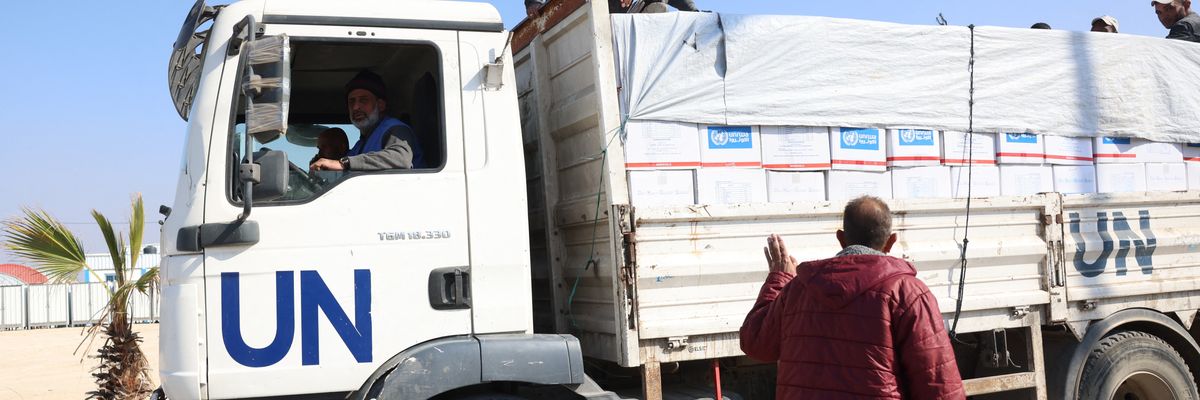

An UNRWA truck transports aid for Palestinians during a tour by the organisation's senior emergency officer in Khan Yunis on December 3, 2024, amid the continuing war between Israel and Hamas.
(Photo: BASHAR TALEB/AFP via Getty Images)


Eloise Goldsmith
Jan 03, 2025
COMMON DREAMS

The United Nations Relief and Works Agency for Palestine Refugees in the Near East, a crucial source of food, water, medicine, and more for Palestinians, is preparing to shut down its offices in the West Bank and Gaza in response to two laws passed by the Israeli parliament that, if enforced, will effectively prevent the UNRWA from operating in those locations.

The laws were passed in October and are set to go into effect at the end of January.

The New York Timesreported Thursday that U.N. officials say they are preparing to wind down UNRWA operations in both locations, a move that Jamie McGoldrick, who oversaw the U.N. humanitarian operation across Gaza and the West Bank until April, told the Times "would be a massive impact on an already catastrophic situation."

"If that is what the Israeli intention is—to remove any ability for us to save lives—you have to question what is the thinking and what is the end goal?" McGoldrick added.

UNRWA and Israel have long had a contentious relationship, but tensions escalated after Israel accused some of the agency's employees of taking part in Hamas' attack on Israel on October 7, 2023. This prompted the U.S.—the largest international funder of the agency, which relies almost entirely on voluntary contributions from donor states—to suspend funding for UNRWA last January. Congress later passed a bill prohibiting UNRWA funding through at least March 2025.

In October, the Israeli parliament passed two bills targeting UNRWA— one that mandates UNRWA "will not operate any missions, won't provide any service, and won't hold any activity—directly or indirectly—in the sovereign territory of the state of Israel," and a second under which the Israeli agency that handles humanitarian issues, the Coordinator of Government Activities in the Territories, will have to cut off contact with UNRWA.

"The laws would cripple the humanitarian response in Gaza and deprive millions of Palestine refugees of essential services in the West Bank, including East Jerusalem," wrote Philippe Lazzarini, the Commissioner-General of UNRWA, in an opinion piece for The Guardian published in mid-December.


UNRWA has provided support to Palestinians for decades and been the backbone of aid response in Gaza since Israel's cataclysmic military campaign on the enclave began in October 2023. It is the largest aid organization operating in the Palestinian territories, according to the Wall Street Journal.

One Palestinian woman in the West Bank told the paper that halting UNRWA's operations is "life or death."

Kenneth Roth, the former the executive director of Human Rights Watch, reacted to this quote on social media Friday, writing that Israeli Prime Minister Benjamin Netanyahu "picks death (for Palestinians)."


Biden Greenlights 'Racist' and 'Sociopathic' $8B Arms Sale to Israel

Multiple human rights organizations and international bodies have accused Israel of committing genocide in Gaza


People demonstrate outside the U.S. Consulate in Tel Aviv, Israel, on November 20, 2024, ahead of a vote by the U.S. Senate on legislation to block offensive U.S. weapons sales to Israel.
Photo by Saeed Qaq/NurPhoto via Getty Images


Common Dreams Staff
Jan 04, 2025

The administration of US President Joe Biden announced on Saturday an arms sale to Israel valued at $8 billion, just ahead of President-elect Donald Trump's return to the White House.

Biden has repeatedly rejected calls to suspend military backing for Israel because of the number of civilians killed during the war in Gaza. Israel has killed more than 45,000 people in Gaza, primarily women and children.

The sale includes medium-range air-to-air missiles, 155mm projectile artillery shells for long-range targeting, Hellfire AGM-114 missiles, 500-pound bombs, and more.

Human rights groups, former State Department officials, and Democratic lawmakers have urged the Biden administration to halt arms sales to Israel, citing violations of US laws, including the Leahy Law, as well as international laws and human rights.

The Leahy Law, named after former Sen. Patrick Leahy, requires the US to withhold military assistance from foreign military or law enforcement units if there is credible evidence of human rights violations.

The Council on American-Islamic Relations (CAIR), the nation’s most significant Muslim civil rights and advocacy organization, today called Biden’s new $8 billion arms deal “racist” and “sociopathic.”

Multiple human rights organizations and international bodies have accused Israel of committing genocide in Gaza. The International Criminal Court (ICC) issued arrest warrants for Israeli Prime Minister Benjamin Netanyahu and former Defense Minister Yoav Gallant for committing war crimes.

The US is, by far, the biggest supplier of weapons to Israel, having helped it build one of the most technologically sophisticated militaries in the world.

CAIR National Executive Director Nihad Awad said on Saturday:

“We strongly condemn the Biden administration for its unbelievable and criminal decision to send another $8 billion worth of American weapons to the government of indicted war criminal Benjamin Netanyahu instead of using American leverage to force an end to the genocide in Gaza.

“Only racists who do not view people of color as equally human, and sociopaths who delight in funding mass slaughter, could send Netanyahu even more bombs while his government openly kidnaps doctors, destroys hospitals, and exterminates the last survivors in northern Gaza.

“If President Biden is actually the person who approved this new $8 billion arms sale, then he is a war criminal who belongs in a cell at The Hague alongside Netanyahu. But if Antony Blinken, Brett McGurk, Jake Sullivan, and other aides are making these unconscionable decisions as shadow presidents, then anyone with a conscience in the administration should speak up now about their abuses of power.”

According to the Stockholm International Peace Research Institute (SIPRI), the US accounted for 69% of Israel's imports of major conventional arms between 2019 and 2023.

On the other hand, incoming President-elect Donald Trump has also pledged unwavering support for Israel and has never committed to supporting an independent Palestinian state.


GLOBAL GENERAL STRIKE

Health Workers Plan Global Day of Action to Demand 'End to the Genocide in Gaza'


"After witnessing 15 months of relentless violence and destruction in Gaza, we can no longer carry on as if everything is normal," said organizer Doctors Against Genocide.


Members of Doctors Against Genocide and allies protest Israel's assault on Gaza, in Washington, D.C. on June 8 2024.
(Photo: Joe Flood/flickr/cc)

Brett Wilkins
Jan 03, 2025
COMMON DREAMS

As Israel's 15-month annihilation of Gaza continues with intensified attacks on medical infrastructure and workers, an international coalition of advocacy groups is planning a #SickFromGenocide global day of action on Monday "to take a stand against the targeted attacks on healthcare."

Organizer Doctors Against Genocide (DAG) and co-sponsors including Healthcare Workers for Palestine, Palestinian Youth Movement, Do No Harm Coalition, Labor for Palestine, Jewish Voice for Peace Health Advisory Council, and others are calling on healthcare workers around the world to take a day of mental health leave "to reflect on the immense moral injury of funding a genocide and engage the most important aspect of treatment: publicly demanding an end to the genocide in Gaza."

Monday's day of action is set to include a "Sick From Genocide" global vigil and pop-up clinics in cities across the United States, whose government gives Israel billions of dollars in weapons support each year.


"For 15 months, we have watched in horror as children and families have been obliterated by unrelenting attacks," DAG said in a statement Friday. "Hospitals, the bedrock of lifesaving care, have been turned into death traps. The recent bombing and burning of Kamal Adwan Hospitaland the arrest of our colleague, the pediatrician Dr. Hussam Abu Safiya,exemplify the deliberate targeting of healthcare workers and facilities—tactics designed to accelerate the annihilation and forced displacement of the Palestinian people in Gaza."


DAG member Dr. Rupa Marya—a University of California, San Francisco professor of medicine who's currently on paid suspension after questioning how to manage students coming to U.S. schools from a zone with an active genocide where military service is mandatory—told Common Dreams this week that healthcare professionals should "take a mental health break to grieve and take care of ourselves. Let's call in sick on January 6th. We are sick from genocide."

"We are burned out from 15 months of these images and our humanity being denied in our places of work, where we are being silenced, we are being framed as 'haters' for standing against a genocide," she advised.

"What we're asking people to do, is get your friends together, and start a pop-up clinic, set up a free clinic in the street," Marya continued. "Are other people sick from genocide? Come, we'll take care of you. Do people need free healthcare? Come, we'll take care of you."


"We need to demand that our institutions of care cut off relationships with a nation that is actively committing genocide," she asserted. "We need to demand that the United States stop sending arms to Israel. We send billions and billions of dollars to Israel to arm itself while we have people not getting healthcare in the United States."

"We have record numbers of people in the streets, many of them who have lost their homes because the most common cause of personal bankruptcy in the United States is medical debt," Marya noted. "So we can't even fund our own healthcare here, while we're sending money to Israel, where they have universal healthcare."

"Let's start showing people what a different healthcare system would look like based in a moral commitment to care, based on our love for our communities, and based on justice," she said. "That is the healthcare system that we need."

"Why are we spending our money destroying another people's healthcare when we can use that money to be taking care of our own here?"

Referring to last month's assassination of UnitedHealthcare CEO Brian Thompson in New York City, Marya added: "And if you don't believe me, look what happened to that CEO. We don't want to see political violence here. We don't want people to have to get murdered for us to understand how desperate people are for healthcare."

"So," she asked, "why are we spending our money destroying another people's healthcare when we can use that money to be taking care of our own here?"
Two Protesters Self-Immolate Over Bhopal Toxic Waste Plan in India

The plan to remove more than 370 tons of toxic waste from Bhopal and transport it to another city has been denounced as a "farce and greenwashing publicity stunt."


A man pours liquid on himself before being set on fire in an apparent self-immolation protest in Pithampur, India on January 3, 2025.
(Photo: Brajesh Rajput/x)

Julia Conley
Jan 03, 2025
COMMON DREAMS

After more than 370 tons of hazardous waste from the deadliest industrial disaster in history arrived in the town of Pithampur in central India, two men were filmed in the city on Friday dousing themselves in liquid before they were set on fire in an apparent self-immolation protest.

The men poured the flammable liquid on themselves in a crowd of protesters and were then set on fire by another demonstrator.

They were taken to a hospital after the self-immolation and are "safe now," the administrative head of Dhar district, where Pithampur is located, told Agence France-Presse.

Note: The below video contains graphic images.


The protest took place 40 years and one month after a chemical disaster at a factory owned by the American company Union Carbide in Bhopal.


On December 2, 1984, a tank storing the toxic chemical methyl isocyanate, which Union Carbide used to produce pesticides, shattered from its concrete casing—allowing about 40 tons of the deadly gas to drift across the city of more than 2 million people.

The disaster killed roughly 3,500 people in the following days from direct exposure to the poisonous chemical, and 25,000 people are estimated to have died overall as the contamination has been linked to deadly illnesses including cancers, lung disease, and kidney disease.

Large numbers of babies have been born with severe disabilities, to parents affected by the gas leak, and a high rate of stillbirths in the area has been reported.


But Union Carbide—now owned by Dow Chemical—and the Indian government have never carried out an operation to remove all the contamination from Bhopal's groundwater, which has been found to contain levels of carcinogenic chemicals that were 50 times higher than what's accepted by the U.S. Environmental Protection Agency.

Dow Chemical has denied liability for the accident, citing a 1989 settlement with the Indian government. The deal also gave about $500 to each person identified as a victim at the time—but nothing was set aside for most people who later developed health problems.

Last month, on the 40th anniversary of the disaster, the Madhya Pradesh high court ordered the government to begin removing the toxic waste and a plan was devised for the transport of more than 370 tons of sealed waste, which would be taken to a plant in Pithampur—150 miles away—and incinerated.

The plan has garnered condemnation from both Pithampur residents and people in Bhopal as well as campaigners who have demanded justice for Bhopal for decades.

The incineration is expected to take six months and to create nearly 1,000 tons of toxic residue, which will be buried in landfills—prompting fears that the damage and public health threats in Bhopal will spread to Pithampur.

The Hindu reported that police used water cannons and batons to disperse some protesters who tried to march toward the facility where the waste was delivered on Wednesday.

In Bhopal, Rachna Dhingra, a coordinator of the International Campaign for Justice in Bhopal, told The Guardian that the plan to move the contamination was a "farce and greenwashing publicity stunt to remove a tiny fraction of the least harmful waste," which had already been placed in containers and moved to a warehouse in 2005.

"There's still 1.2 million tons of poisonous waste leaching into the ground every day that they refuse to deal with," said Dhingra. "We can see for ourselves the birth defects and chronic health conditions. All this does is take the heat off the government and lets the U.S. corporations off the hook."

"It does nothing," said Dhingra, "to help the people in Bhopal who for decades have been seen as expendable."

Bhopal gas tragedy, 40 years on: Indian authorities finish moving toxic waste from site A

 03/01/2025 
FRANCE24-AFP

VIDEO
12:29 min
From the show


Forty years and one month after a deadly gas leak at a pesticide plant killed thousands in Bhopal, India, authorities say the last remaining toxic waste has been removed from the site. Activists say not enough measures are being taken to protect the environment and the population. Four decades after one of the world's worst industrial disasters, new generations of people are still grappling with its fallout and are demanding justice. Our correspondents report.

But first, investigators have lifted the tail section of Jeju Air's Boeing 737-800 from the wreckage, days after South Korea's deadliest plane crash killed 179 people and left only two survivors. The passenger jet belly-landed after reporting a bird strike and collided with a wall off the runway on December 29. Authorities say it could take up to three years to determine the precise cause of the accident.

Meanwhile, five years on from the outbreak of the Covid-19 pandemic, the World Health Organization is urging China to share more data into the origins of the deadly virus to help prevent and prepare for future epidemics.

Plus, we meet the "kung fu nuns" of Nepal's Druk Amitabha Monastery, who showed off their martial arts skills at the reopening of their nunnery that had been closed since the pandemic.

Saturday, January 04, 2025

As Billionaire Wealth Soared in 2024, 35 Children Were Born Into Hunger Every Minute

More than 18 million kids were born into hunger this year, according to a new analysis, as the collective net worth of the world's richest grew to a record $14 trillion.


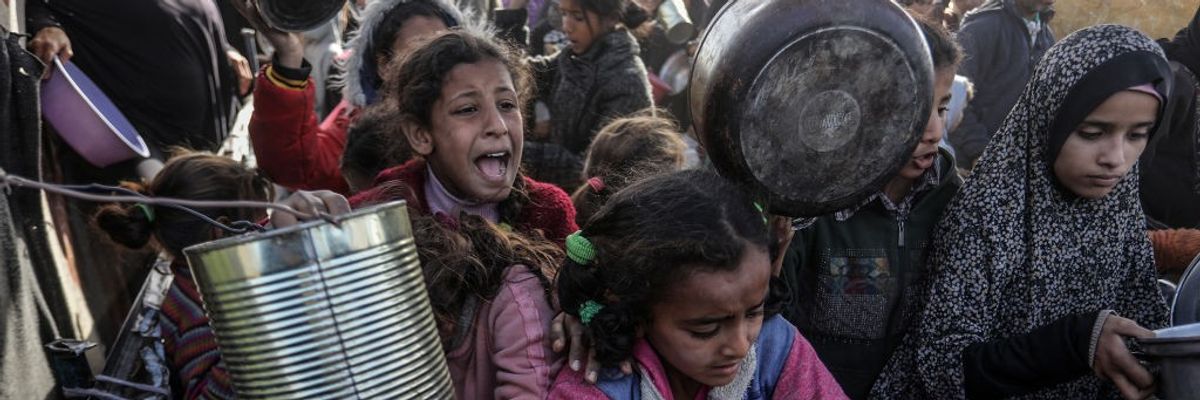
Children line up to receive meals distributed by charity organizations in Khan Younis, Gaza on December 26, 2024.
(Photo: Abed Rahim Khatib/Anadolu via Getty Images)

Jake Johnson
Dec 30, 2024
COMMON DREAMS


An analysis published Monday by the humanitarian group Save the Children estimates that roughly 35 kids across the globe were born into hunger every minute in 2024—a year in which the world's billionaires saw their combined wealth surge to a record high.

At least 18.2 million children were born into hunger this year, according to the new analysis, as war and climate-fueled extreme weather pushed around 800,000 more kids into hunger compared to 2023. Roughly half of all young child deaths worldwide are caused by malnutrition, experts say.

"Over 18 million newborns this year—35 children a minute—were born into a world where hunger is their reality from their first moments of life," Hannah Stephenson, global head of hunger and nutrition at Save the Children, said in a statement Monday. "Hunger knows no boundaries. It erodes childhoods, drains children's energy, and risks robbing them of their futures. Children should be free to play or expand their minds in class. No child should be worrying about when their next meal will be."

"We need immediate funding and safe access to humanitarian lifesaving services for children and families in desperate need of food, nutrition, healthcare, safe water, sanitation and hygiene, social protection, and livelihoods support," Stephenson added. "We have the tools to significantly reduce the number of malnourished children right now, like we have in the past."

Oxfam has estimated that eradicating world hunger entirely would require nations to contribute $31.7 billion more to global efforts to combat food insecurity—a fraction of the collective wealth of the planet's 2,682 billionaires.

According to a UBS study released earlier this month, billionaire wealth has increased by 121% over the past decade, reaching a record $14 trillion this year. Billionaires located in the U.S. saw the largest gains, UBS found, with their combined wealth growing by nearly 28% this year alone.

During that same 12 months, the number of children born into hunger rose by around 5% compared to the preceding year, Save the Children's analysis of United Nations data found.


"Children born into hunger this year include babies born in countries facing a risk of famine or catastrophic conditions of acute food insecurity including South Sudan, Haiti, Mali, and Sudan," Save the Children observed. "In addition, there was a warning in early November of a strong likelihood that famine was imminent or already underway in the northern Gaza Strip and 345,000 people across Gaza could face catastrophic hunger in the coming months."

The group noted that the intensifying climate crisis—which billionaires help fuel with their emission-heavy lifestyles—poses a dire threat to children's access to food worldwide.

"More than 1.4 million babies were born into hunger in Pakistan, one of the world's most climate-vulnerable countries," Save the Children noted. "Pakistan saw the second highest number of babies born into hunger among countries with over 20% undernourishment."
Record Number of Children Living in Conflict Zones in 2024: UNICEF


"Children in war zones face a daily struggle for survival that deprives them of a childhood."


Palestinians, including children, injured in an Israeli attack on Gaza City are brought to Al-Ahli Arab Hospital for treatment on December 28, 2024.
(Photo: Dawoud Abo Alkas/Anadolu via Getty Images)

Julia Conley
Dec 29, 2024
COMMON DREAMS

The record number of children living in conflict zones or forcibly displaced because of global wars "must not be the new normal," said the executive director of the United Nations' children's agency on Saturday.

Catherine Russell, who heads the U.N. Children's Fund (UNICEF), released a sobering statement detailing the effects of conflicts and violence on children worldwide in 2024, revealing that more children than ever were estimated to be living in the midst of violent conflicts or forced to leave their homes due to war in the past year.

Over 473 million children—more than 1 in 6—were affected by conflicts in 2024, including in Gaza, Sudan, Ukraine, and Haiti.

"By almost every measure, 2024 has been one of the worst years on record for children in conflict in UNICEF's history—both in terms of the number of children affected and the level of impact on their lives," said Russell. "A child growing up in a conflict zone is far more likely to be out of school, malnourished, or forced from their home—too often repeatedly—compared to a child living in places of peace... We cannot allow a generation of children to become collateral damage to the world's unchecked wars."


UNICEF said that the U.N. has not yet verified the number of child casualties in worldwide conflicts for 2024. But the latest available data, from 2023, shows a record 32,990 grave violations against 22,557 children.

"With the overall upward trend in the number of grave violations—for example, thousands of children have been killed and injured in Gaza, and in Ukraine, the U.N. verified more child casualties during the first 9 months of 2024 than during all of 2023—this year is likely to see another increase," said UNICEF.

The percentage of children living in conflict zones across the globe has nearly doubled since the 1990s, when it stood at 10%.

The statistics also mean that a record number of children are having their rights violated, including by being forced to halt their educations, missing life-saving vaccines, losing access to routine healthcare, and being critically malnourished.

More than 52 million children were estimated to be out of school this year due to conflict, with educational infrastructure destroyed across Gaza, Sudan, Ukraine, the Democratic Republic of the Congo, and Syria.

More than half a million people are estimated to be living in Integrated Food Security Phase Classification (IPC) Phase 5 conditions—famine—which is defined as 20% of households facing an extreme lack of food, 30% of children suffering from acute malnutrition, or populations seeing two to four deaths each day from starvation.

In the case of Gaza, Israel and the U.S.—which has backed the Israeli assault on the enclave that began in 2023—have vehemently denied that famine has taken hold, even as experts have reported on widespread starvation there.

About 40% of children who are unvaccinated or undervaccinated live in countries affected by conflict, where disruptions to sanitation services and proper nutrition can also make them especially vulnerable to life-threatening and preventable diseases.

Children are also disproportionately represented among global refugees. While children account for 30% of the global population, about 40% of the refugee population and nearly half of people who are internally displaced are children.


"Children in war zones face a daily struggle for survival that deprives them of a childhood," said Russell. “Their schools are bombed, homes destroyed, and families torn apart. They lose not only their safety and access to basic life-sustaining necessities, but also their chance to play, to learn, and to simply be children."

"As we look towards 2025," she said, "we must do more to turn the tide and save and improve the lives of children."
UN Chief's Message to the World as Blistering 2024 Ends: 'We Must Exit This Road to Ruin'

"This is climate breakdown—in real time," said United Nations Secretary-General António Guterres.


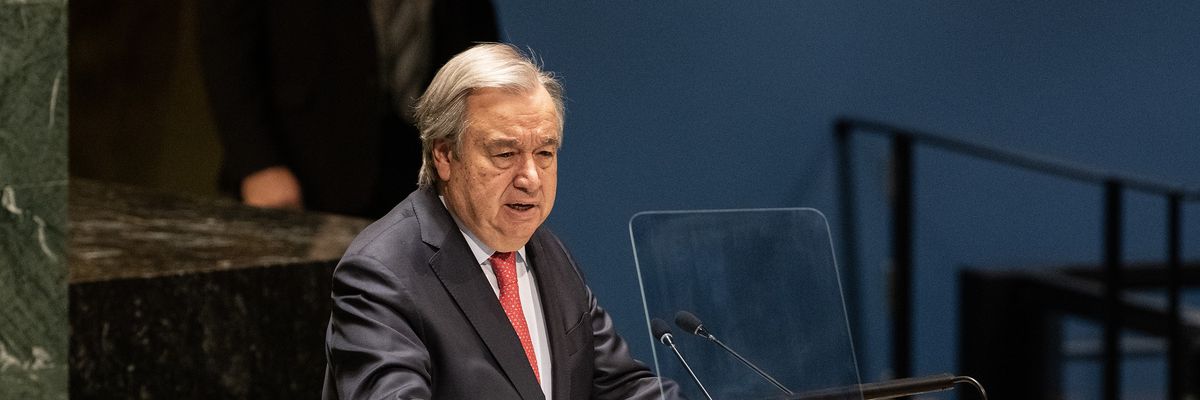
United Nations Secretary-General António Guterres speaks at the U.N. headquarters 
(Photo: Lev Radin/Pacific Press/LightRocket via Getty Images)

Jake Johnson
Dec 30, 2024
COMMON DREAMS

United Nations Secretary-General António Guterres said in a year-end message on Monday that "we have no time to lose" in the face of the worsening global climate crisis, which pushed temperatures to a record high this year and supercharged deadly extreme weather around the world.

"Today, I can officially report that we have just endured a decade of deadly heat," Guterres said in a video message posted to social media. "The top 10 hottest years on record have happened in the last 10 years, including 2024."

“This is climate breakdown in real time. We must exit this road to ruin," he continued. "In 2025, countries must put the world on a safer path by dramatically slashing emissions and supporting the transition to a renewable future. It is essential—and it is possible."


Guterres' call to action came in the waning days of what scientists say is almost certain to be the hottest year on record and the first full year to breach the critical 1.5°C temperature threshold.

Celeste Saulo, secretary-general of the World Meteorological Organization (WMO), echoed Guterres' warning about the dire consequences of the status quo, saying in a statement Monday that "if we want a safer planet, we must act now."

"It's our responsibility. It's a common responsibility, a global responsibility," Saulo said. "Every fraction of a degree of warming matters, and increases climate extremes, impacts, and risks. Temperatures are only part of the picture. Climate change plays out before our eyes on an almost daily basis in the form of increased occurrence and impact of extreme weather events."

Last month, with emissions continuing to surge as the rich nations most responsible for the climate emergency refuse to ditch fossil fuels, world leaders convened for a U.N. climate summit in Azerbaijan that was swarmed by oil and gas lobbyists. The key gathering ended with a deal that climate advocates described as a step backward in the necessary push to rein in fossil fuel emissions.

Climate-denier and fossil fuel booster Donald Trump's looming return to office in the U.S.—the world's largest historical emitter—has campaigners and scientists increasingly concerned about the future of existing global climate agreements such as the Paris accord, from which the president-elect has pledged to withdraw once again.

One recent analysis projected that a second Trump administration could unleash an additional 4 billion tonnes of carbon dioxide equivalent by 2030, which would inflict $900 billion in global climate damages and deal a devastating blow to efforts to forestall runaway warming.

Throughout 2024, Guterres used his role as head of the U.N. to sound the alarm about the world's dangerous trajectory, saying in an October address that "there is a direct link between increasing emissions and increasingly frequent and intense climate disasters."

"We're playing with fire," he said, "but there can be no more playing for time."

Brazil says 2024 was its hottest year on record

China, India, Indonesia, Taiwan and Hong Kong also reported this week that 2024 was their hottest year recorded yet.

By  AFP
January 3, 2025


A thermometer shows a temperature of 39 degrees Celsius (102.2 F) in Sao Paulo, Brazil on March 17, 2024 - Copyright AFP/File Miguel SCHINCARIOL

Last year was Brazil’s hottest on record, its weather agency said Friday, after a record-breaking drought and flooding in the South American country that climate experts have linked to global warming.

The average temperature in 2024 was 25.02 degrees Celsius (77.04 Fahrenheit) — 0.79 degrees above the 1991-2020 average, the National Institute of Meteorology said.

It was the warmest year since records began in 1961, exceeding the 2023 figure of 24.92 degrees Celsius, which was also a record high.

The weather agency said that the “statistically significant trend… may be associated with climate change resulting from rising global temperature and local environmental changes.”

According to a study released last week, Brazil experienced an “alarming” increase in climate disasters between 2020 and 2023, with almost twice as many events each year, on average, as in the previous two decades.

Official data showed an annual average of 4,077 climate-related disasters in the four-year period, including droughts, flooding, violent storms and extreme temperatures, the research by the Federal University of Sao Paulo showed.

The study found a correlation between climate disasters suffered in the country and a warming of ocean surface temperatures.

The United Nations said Monday that 2024 was set to be the hottest year on record for the planet.

China, India, Indonesia, Taiwan and Hong Kong also reported this week that 2024 was their hottest year recorded yet.

2024 was China's hottest year on record: weather agency

Agence France-Presse
January 2, 2025

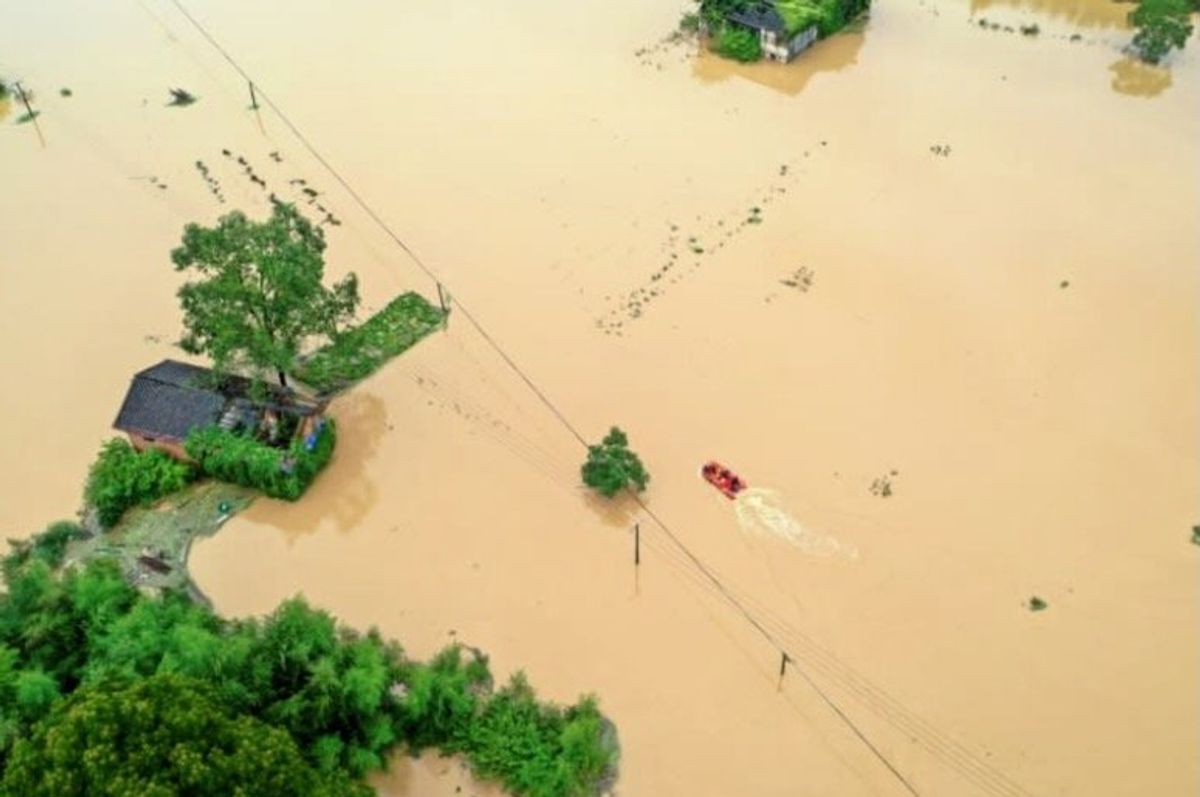
In July, heavy rains caused by Typhoon Gaemi flooded villages in central China's Hunan province (STR)/AFP


by Sam Davies, with Jing Xuan Teng in Shanghai

Last year was China's hottest on record and the past four years were its warmest ever, its weather agency said this week.

China is the leading emitter, in total volume, of the greenhouse gases driving global heating.

It aims to ensure carbon dioxide (CO2) emissions peak by 2030 and be brought to net zero by 2060.

The average national temperature for 2024 was 10.92 degrees Celsius (51.66 Fahrenheit) -- 1.03C. It was "the warmest year since the start of full records in 1961", the China Meteorological Administration said on its news site late on Wednesday.

"The top four warmest years ever were the past four years, with all top 10 warmest years since 1961 occurring in the 21st century," it added.


In 2024, China logged its hottest month in the history of observation in July, as well as the hottest August and the warmest autumn on record.

The United Nations said in a year-end message on Monday that 2024 was set to be the hottest year ever recorded worldwide.

Other countries also recorded temperature records in 2024.


India said on Wednesday 2024 was its hottest year since 1901, while Australia's Bureau of Meteorology said on Thursday that the past year marked its second-warmest year since records began in 1910.

Germany's weather agency said in December that 2024 was the hottest year since records began 143 years ago.

The Czech weather service CHMI said on Thursday that 2024 was "by far the hottest" in Prague since records started in 1775, beating the previous records from 2018 and 2023 by 0.5 degrees.


"It is worth noting that of the 15 warmest years since 1775, 13 were in this century and all 15 after 1990," the CHMI said.
- Extreme weather -

Global warming, driven largely by the burning of fossil fuels such as coal, oil and gas, is not just about rising temperatures but the knock-on effect of all the extra heat in the atmosphere and seas.


Warmer air can hold more water vapor, and warmer oceans mean greater evaporation, resulting in more intense downpours and storms.

Impacts are wide-ranging, deadly and increasingly costly, damaging property and destroying crops.

In central Beijing, finance professional Xu Yici lamented that warmer-than-usual weather had affected the city's traditional winter pastime of ice skating.


"There's no ice in the Summer Palace. I was going to go ice skating at the Summer Palace but I didn't get to do it this year," Xu told AFP.

Dozens of people were killed and thousands evacuated during floods around the country last year.

In May, a highway in southern China collapsed after days of rain, killing 48 people.


Residents of the southern city of Guangzhou experienced a record-breaking long summer, with state media reporting there were 240 days where the average temperature was above 22C (71.6F), breaking the record of 234 days set in 1994.

Sichuan, Chongqing, and the middle reaches of the Yangtze River suffered from heat and drought in early autumn.

But Xue Weiya, an IT worker in Beijing, told AFP he believed "the Chinese government is doing a very good job of protecting the environment, so I don't think the weather... will have a big impact on us".

Globally, 2024 saw deadly flooding in Spain and Kenya, multiple violent storms in the United States and the Philippines, and severe drought and wildfires across South America.


Natural disasters caused $310 billion in economic losses in 2024, Zurich-based insurance giant Swiss Re has said.

Under the 2015 Paris climate accords, world leaders pledged to limit global heating to well below 2.0C above pre-industrial levels -- and to 1.5C if possible.

In November, the World Meteorological Organization said the 2024 January-September mean surface air temperature was 1.54C above the pre-industrial average measured between 1850 and 1900.

© Agence France-Presse


Murder of the Dead. First Published: Battaglia Comunista No. 24 1951; Source ... murderer also of the dead: “But as soon as people, whose production ...

What Were the Most Expensive Climate Disasters of 2024?

"The human suffering caused by the climate crisis reflects political choices. There is nothing natural about the growing severity and frequency of droughts, floods and storms," said the CEO of Christian Aid.


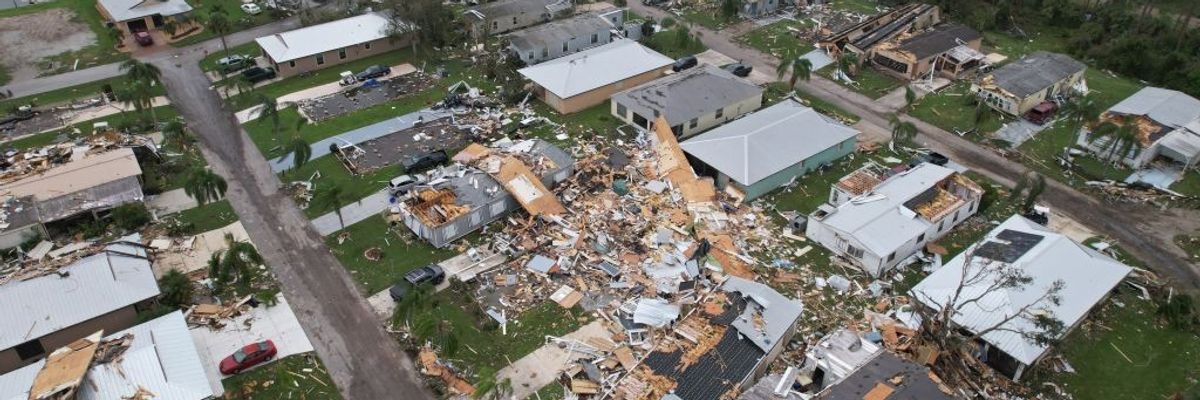
An aerial view shows destruction in Fort Pierce, Florida, in the aftermath of Hurricane Milton on October 10, 2024.
(Photo: John Falchetto/AFP via Getty Images)

Eloise Goldsmith
Dec 30, 2024
COMMON DREAMS


Climate disasters aren't cheap. In 2024, the 10 costliest extreme weather events not only extracted a toll in the form of human lives, but also each cost over $4 billion in economic damages—and some much more—according to a report released Monday from the global group Christian Aid.

"The human suffering caused by the climate crisis reflects political choices. There is nothing natural about the growing severity and frequency of droughts, floods and storms," said Christian Aid CEO Patrick Watt in a statement Monday.

"Disasters are being supercharged by decisions to keep burning fossil fuels, and to allow emissions to rise. And they're being made worse by the consistent failure to deliver on financial commitments to the poorest and most climate-vulnerable countries," he continued.

According to the report, the costliest climate disasters in terms of economic cost this year, in ascending order, were: Valencia floods in Spain; Bavaria floods in Germany; Rio Grande do Sul floods in Brazil; Storm Boris in Central Europe; Hurricane Beryl in the U.S., Mexico, and Caribbean islands; Typhoon Yagi in Southwest Asia; China floods in China; Hurricane Helene in the U.S., Mexico, and Cuba; Hurricane Milton in the U.S.; and U.S. storms in the United States.

Two items on the list—"China floods" and "U.S. storms"—are not a single event. The China floods refer to flood events across China that happened in June and July, and U.S. storms are all storms classified by the global professional services firm Aon as "severe convective storm" for the period between January and September, according to the report.

These U.S. storms, the most expensive climate disaster of 2024, amounted to over $60 billion in economic costs and 88 deaths, per the report. The second costliest, Hurricane Milton, caused 25 deaths and $60 billion in economic losses.

Hurricane Milton, which made landfall in Florida, was made worse by fossil fuel emissions: "In a world without climate change, Hurricane Milton would have made landfall as a Category 2 storm. Instead, it struck as a Category 3 hurricane, with stronger winds and more intense rainfall, causing extensive tornado activity, and damaging infrastructure in regions still recovering from previous hurricanes."

Specifically, "a rapid analysis by Climate Central showed that the unusually warm ocean temperatures, which fueled the hurricane's rapid intensification, were made 400-800 times more likely by climate change over the two weeks preceding the storm," according to the report.

The report's authors also caveat that the losses tallied in the document are likely an undercount. Most of the costs estimates are based on insured losses, meaning that the true financial costs are likely to be even higher (for example, it does not include economic costs stemming from crop production losses). Human costs are also often undercounted, the report's authors state.

Another important piece of context is that economic costs are generally higher in absolute terms for richer countries because the value of infrastructure and private property tends to be higher, living costs are greater, and more is covered by insurance—meaning losses are more calculable in financial terms, per the report. However, the death toll tends to be higher in poorer countries.

The deadliest climate disaster, according to the report, was Typhoon Yagi, which came in as the fifth most expensive climate disaster in terms of economic cost, and caused the deaths of over 829 people. The typhoon struck multiple countries in southeast Asia, causing landslides, flooding, and infrastructure damage in places including the Philippines, Laos, Vietnam, Myanmar, and Thailand. In Myanmar, for example, it devastated entire villages and decimated over 2.3 million hectares of agricultural land.

In its Monday statement, Christian Aid highlighted that "some of the most devastating extreme weather events in 2024 hit poorer nations, which have contributed little to causing the climate crisis and have the least resources to respond."

To that end, the group is calling on Global North countries to increase their commitment to climate finance and cease development of new fossil fuel projects.

The report also includes additional information about disasters that didn't make it into the top ten for economic damages, but are still of note. They include a drought that impacted countries in southern Africa between February and July and floods impacting Afghanistan and Pakistan between March and September.


Murder of the Dead. First Published: Battaglia Comunista No. 24 1951; Source ... murderer also of the dead: “But as soon as people, whose production ...

'Why Would He Stop Now?' Trump Border Czar's Firm Peddles Federal Contracts

"When not presumably working on President-elect Trump's kids-in-cages policy 2.0, does Mr. Homan intend to exploit his new title to steer more lucrative federal contracts to his homeland security clients for his own personal gain?"


Jessica Corbett
Dec 30, 2024
COMMON DREAMS


A watchdog group that has sounded the alarm about various picks for U.S. President-elect Donald Trump's next administration released a Monday report focused on the consulting and nonprofit work of incoming immigration official Tom Homan.

Homan, who was acting director of U.S. Immigration and Customs Enforcement (ICE) during Trump's first term, is set to serve as "border czar," a post that does not require Senate confirmation.

The new analysis by Accountable.US details how Homan's role as border czar could present serious conflicts of interest with his private consulting firm.

"Homan founded Homeland Strategic Consulting LLC," the report explains, "a private consulting firm which touts Trump's endorsement, claims to have secured 'tens of millions of dollars of federal contracts' for clients, and has taken over $83,000 from Jim Lamon, a failed U.S. Senate candidate who was indicted alongside Trump lawyers Rudy Giuliani and John Eastman in Arizona's fake electors case."

"Homan will soon join a growing club of top Trump administration aides with glaring conflicts of interest that create perfect conditions for corruption and insider special treatment at the expense of everyone else."


The watchdog found that the firm's website said last month: "Homeland Strategic Consulting has been extremely successful in assisting small and large companies in business development with both federal and state governments. We provide around-the-clock guidance and subject-matter expertise to help your company discover opportunities, pursue acquisitions, win those opportunities, and assist in the execution of those contracts."

When Commons Dreams tried to access the firm's website on Monday afternoon, it featured a gray page with a message that it "is currently undergoing scheduled maintenance to bring you a faster, more secure, and improved browsing experience."

The report notes that "Homan is also a strategic adviser for the Government Technology & Services Coalition (GTSC), a homeland security industry group of 'midsized company CEOs,'" and on the editorial board of its publication, Homeland Security Today.

Accountable.US further highlighted that "Homan is president and CEO of Border911, a far-right 501(c)(3) nonprofit that claims to fight a 'historic illegal alien crisis' and that the U.S. is under 'attack from the inside.'"

"In possible violation of its tax-exempt status, Border911 was promoting Homan's appearances at Republican political events as of December 2024," the document details. "This includes a state party convention that sold tickets to a VIP reception featuring Homan and a Women's International Republican Club gala in New York City."

"Additionally, Border911 held a sold-out fundraiser in April 2024 at Trump's Mar-a-Lago estate, with Trump confirmed to appear at the event and a $100,000 'presidential' sponsorship tier," the report adds.

The watchdog also pointed out Homan's contributions to Project 2025, a Heritage Foundation-led initiative that includes a sweeping right-wing policy playbook for the next Republican president. Although Trump tried to distance himself from the project during the campaign, he is now expected to pursue many of its proposals.


Homan has long faced intense criticism for his role in the "zero tolerance" policy of the first Trump administration, which forcibly separated thousands of children from their parents at the U.S.-Mexico border. Human rights groups revealed earlier this month that an estimated 1,360 children have yet to be reunited with their families.

This cycle, Trump campaigned on promises of mass deportations and ending birthright citizenship, despite the 14th Amendment to the U.S. Constitution. Announcing the border czar role last month, the president-elect said that "there is nobody better at policing and controlling our Borders" and "Homan will be in charge of all Deportation of Illegal Aliens back to their Country of Origin."

Last week, Homan previewed plans to detain migrant families with children in tents and suggested that Trump should revive mass worksite immigration raids and the "Remain in Mexico" policy that stopped asylum-seekers from entering the United States.

"When not presumably working on President-elect Trump's kids-in-cages policy 2.0, does Mr. Homan intend to exploit his new title to steer more lucrative federal contracts to his homeland security clients for his own personal gain?" Accountable.US executive director Tony Carrk asked in a Monday statement.

"Both Homan's business and nonprofit group have thoroughly milked his connections to the Trump brand before, why would he stop now?" Carrk continued. "Homan will soon join a growing club of top Trump administration aides with glaring conflicts of interest that create perfect conditions for corruption and insider special treatment at the expense of everyone else."

Rolling Stone first reported on the watchdog's Monday publication. Homan told the magazine that "as the incoming border czar I have recused myself from any involvement, discussion, input, or decision of any future government contracts that may be awarded by the government. Therefore, there is no conflict of interest."

Although Homan did not respond to Rolling Stone's question about whether he would name his clients, he said, "I will be filing all appropriate documents as required by ethics rules including financial disclosures."

Homan isn't the only immigration hard-liner planning to join the next Trump administration. The others include family separation architect Stephen Miller, the incoming homeland security adviser and deputy chief of staff for policy; dog-killing Republican South Dakota Gov. Kristi Noem, the nominee for homeland security secretary; and Caleb Vitello, the next acting ICE director.
'A Virtuous Cycle': Local Business Owners Celebrate 2025  U$ Minimum Wage Hikes

“The minimum wage increase will recirculate back into the economy through spending at the main street shops that make up the fabric of our communities,” said one business owner in New York.


An employee of the Frosted Cakerie on Main St. sets up outdoor seating for the day in Joplin, Missouri 
(Photo: Terra Fondriest for The Washington Post via Getty Images).

Eloise Goldsmith
Dec 30, 2024
COMMON DREAMS

With 23 states and the District of Columbia slated to increase their minimum wages by the end of 2025, the national network Business for a Fair Minimum Wage reports that business owners in states around the country are cheering those increases, saying they will boost consumer spending and hiring, increase productivity, help retain employees, and in general strengthen the economy.

According to a statement Business for a Fair Minimum Wage issued on December 12, the following states will have either a planned or indexed minimum wage increase on January 1: Alaska, Arizona, California, Colorado, Connecticut, Delaware, Illinois, Maine, Michigan, Minnesota, Missouri, Montana, Nebraska, New Jersey, New York, Ohio, Rhode Island, South Dakota, Vermont, Virginia, and Washington.

Florida, Oregon, and the District of Columbia will see increases later in the year, and some states like Alaska will experience multiple wage floor increases during 2025, per the statement.

Voters in Alaska and Missouri approved ballot measures in November that greenlit increases to the minimum wage. Hundreds of business owners in those two states worked with Business for a Fair Minimum Wage to support the ballot initiatives, according to the statement.

"Workers are also customers and minimum wage increases boost consumer buying power. They go right back into the economy as increased spending at local businesses," said Holly Sklar, the CEO of Business for a Fair Minimum Wage.

She added: "State raises are vital for workers, businesses, and communities as the federal minimum wage remains stuck at just $7.25, falling further and further behind the cost of living." The federal minimum wage hasn't budged since 2009, when it was raised to $7.25.

One business owner, Erik Milan, whose music store Stick It In Your Ear is based in Springfield, Missouri, praised the state's increase. "Raising Missouri's minimum wage will be good for workers and businesses. When workers in our community are paid more, they can spend more at local businesses ... Thanks to better wages and paid sick time because of Proposition A, businesses will also benefit from lower employee turnover, increased productivity, better health and morale, and better customer service," he said, per the statement.

Because of Proposition A, Missouri will increase the state minimum wage to $13.75 an hour on January 1 for private and non-exempt employees, and then increase it again to $15 in 2026. Beginning in May of this coming year, employers are required to give employees one hour of paid sick time per 30 hours worked.

Over in Alaska, the owner of Waffles and Whatnot in Anchorage, Derrick Green, said that "Alaska's minimum wage increases will help Alaskans thrive ... The more that people can make a living in Alaska, the stronger our businesses and communities will be."

Same as Proposition A, Alaska's Ballot Measure One mandates that workers will be able to earn one hour of paid sick time for every 30 hours worked. Alaska's minimum wage was already set to increase on January 1, and then thanks to Ballot Measure One it will increase again on July 1 to $13 and then again to $14 in July 2026.

The statement from Business for a Fair Minimum Wage in total quotes 11 business owners touting the wage floor increases, including Jessica Galen, owner of Bloomy Cheese & Provisions in Dobbs Ferry, New York.

"The minimum wage increase will recirculate back into the economy through spending at the main street shops that make up the fabric of our communities. It's a virtuous cycle. When we take care of our employees, they take care of us," she said.