Sunday, January 05, 2025

Moldova Meets Electricity Demand Despite Russian Gas Halt

By RFE/RL staff - Jan 03, 2025


Moldova's state-owned energy trader, Energocom, has successfully covered 100% of the country's electricity consumption despite the halt in Russian gas supplies due to a contract dispute with Ukraine.

The breakaway region of Transdniester is receiving electricity from Moldova, but its natural gas reserves are dwindling, leading to shortages in some areas.

Slovakia threatens to retaliate against Ukraine for the halt in Russian gas transit through its territory, including cutting electricity supplies and demanding compensation.


Moldovan state-owned energy trader JSC Energocom says it will cover 100 percent of electricity consumption on January 3, two days after supplies of Russian natural gas abruptly stopped due to the expiration of a supply contract with Ukraine.

Energocom said on January 2 that consumption is expected to be higher by about 10 on January 3, but it will still cover demand. Electricity consumption of the right bank of the Dniester River was fully covered in the first two days of the year, the government's crisis group announced on January 2.

The company says that in addition to local production from heating plants in Chisinau and Balti and local renewable energy sources, electricity will be purchased from outside the country.

The crisis group, established on December 26, said that on January 1 almost half of the country's electricity consumption was covered by imports from Romania and there was no need to activate contingency contracts or unintended flows.

Authorities in Chisinau, meanwhile, confirmed that the breakaway region of Transdniester, which has not been supplied with natural gas since January 1, is being provided with electricity after the power plant serving the region switched to coal-fired operation.

According to public data, Tiraspol has reserves of about 70,000 tons of coal, which could cover consumption of the region for 30 to 50 days.

The municipal administration in Transdniester's capital, Tiraspol, said it has natural gas reserves of about 13 million cubic meters, which is sufficient for about 20 days.

But people in at least 11 communities near Tiraspol had no supply of natural gas, heating and hot water on January 1. The city has set up 30 meeting points where people can gather to warm up and eat hot meals. Meanwhile, about 115,000 households are receiving natural gas supplies only for cooking, according to supplier Tiraspoltransgaz.

"For now, the situation is not critical," one man from the city of Tighina told RFE/RL's Moldovan service on January 2, noting he has been able to cope so far using his electric stove. "For others, maybe, it's worse," he quickly added.

Ukraine’s decision not to renew the contract allowing the flow of Russian gas through its territory deepened a rift between Kyiv and Bratislava.

Slovak Prime Minister Robert Fico said on January 2 that the Slovak government will discuss retaliatory measures, including cutting electricity supplies to Ukraine, lowering aid to Ukrainian refugees, and demanding either the renewal of gas transits or compensation for losses.

"The only alternative for a sovereign Slovakia is renewal of transit or demanding compensation mechanisms that will replace the loss in public finances of nearly 500 million euros,” Fico said on Facebook.

Slovakia has alternative gas supplies, but Fico says Slovakia will lose its own transit revenues and pay additional transit fees to bring in non-Russian gas.

Fico said a Slovak delegation would discuss the situation in Brussels next week and then his ruling coalition would discuss retaliation for what he called "sabotage" by Ukrainian President Volodymyr Zelenskiy.

Zelenskiy said on January 1 that the end of natural gas supplies to Europe via the pipeline traversing Ukraine is a major defeat for Russian President Vladimir Putin after accusing Moscow of “weaponizing energy.”

By RFE/RL

Moldova’s Breakaway Region Idles Industry Without Russian Gas

By Charles Kennedy - Jan 03, 2025, 9:30 AM CST


Days after Russian natural gas stopped flowing to the breakaway region of Transnistria in Moldova, the area shut down all industrial production except food production, Transnistria’s first deputy prime minister, Sergei Obolonik, said.

“All industrial enterprises are idle, with the exception of those engaged in food production - that is, directly ensuring food security for Transdniestria,” said the senior official, as quoted by Reuters.

Transnistria has also cut off the supply of heating and hot water to households after Russia suspended the transit of natural gas via Ukraine at the start of the year.

The move followed a declaration by Ukraine that the country would not renew the transit deal with Gazprom while the war continues.

Russia exported some 2 billion cu m of natural gas to Transnistria, where the gas is used to generate electricity that is then transmitted to Moldova.

Moldova has been trying to fend off Russian influence in the breakaway Transnistria region, a narrow strip of land between the Dniester River and the Ukrainian border, which isn’t recognized by the international community.

Since 2022, however, Transnistria and the central government of Moldova have agreed that all natural gas sent by Russian giant Gazprom to Moldova flows to Transnistria. Following the reports that Ukraine will not renew the transit deal with Gazprom, the Moldovan authorities discussed alternative supply routes with Gazprom, which has agreed to consider these but only after the outstanding debt to Gazprom is paid.

Moldova, meanwhile, is trying to cut its energy consumption by at least 33% to cope with the end of gas deliveries from Russia. For the country, the only alternative to these are imports from neighboring Romania and, per plans, local wind and solar.

At 0500 GMT on New Year’s Day, Russian gas giant Gazprom halted pipeline deliveries to Europe via Ukraine, and the last remaining EU members that were still receiving gas from Russia until December 31 – Austria, Slovakia, and Hungary – lost this source of supply.

By Charles Kennedy for Oilprice.com

Kazakhstan Walks Diplomatic Tightrope Amidst Azerbaijan-Russia Jet Crash Dispute


By Eurasianet - Jan 04, 2025


Russia's accidental shoot-down of an Azerbaijani civilian airliner has caused tension between the two countries.

Kazakhstan is overseeing the crash investigation and is trying to remain neutral despite pressure from both sides.

The incident highlights Kazakhstan's delicate balancing act as it tries to maintain good relations with both Russia and Azerbaijan, both key economic partners.


Kazakhstan is treading delicately as it strives to keep two feuding neighbors happy amid a row over Russia’s accidental shoot-down of an Azerbaijani civilian airliner, which crashed outside the Kazakh city of Aktau. Kazakh officials have little to gain and a lot to lose as they oversee the crash investigation.

Relations between Azerbaijan and Russia remain fraught as Azerbaijani officials await the results of the official crash investigation. Kazakhstan’s vice minister of transportation, Talgat Lastayev, announced December 30 that preliminary findings are expected to be released in late January.

Azerbaijani-Russian tension revolves around the Kremlin’s reluctance to admit Russian air defenses brought the plane down on December 25, killing 38 of the 67 individuals on board. Kazakhstan got caught in the middle because the stricken jet, which had been bound for Grozny in the Russian region of Chechnya, crossed the Caspian Sea to make a crash landing in Aktau. That fact thrust Kazakhstan into a key role in an investigation in which the principal actors – Azerbaijan and Russia – have starkly differing agendas.

In the face of Russian silence over culpability for the crash, Azerbaijani leader Ilham Aliyev has pressed for a transparent probe. At the same time, he has accused Kremlin of trying to cover up its responsibility for the tragedy, pointing out that Russian officials initially offered several “absurd” alternate theories before evidence of the shoot-down came to light. Government-friendly news outlets in Baku even accused Russia of prompting the jet to attempt a landing in Aktau in the hope that it would crash into the Caspian, thus erasing all evidence of Russian involvement. Russia’s approach so far suggests the Kremlin is far from eager to see all the facts come out.

Ultimately, some of the 29 survivors have provided testimony substantiating a shoot-down, and the intact rear section of the plane shows signs of being hit by anti-aircraft flak. The black boxes have been recovered and sent to Brazil for analysis.

Despite their country’s central position in the investigation, Kazakh officials have tried to remain aloof from the festering controversy. In the first hours after the crash, Kazakh officials appeared to amplify alternative theories pushed by Russia to explain the tragedy, including the since discredited claim that an oxygen tank inside the aircraft exploded. Kazakh officials also initially backed a Russian proposal that a CIS commission handle the investigation, which would have given Moscow expanded influence over the probe’s scope and final report.

As evidence of a shoot-down, including survivor accounts, continued to mount, Kazakhstan has adopted a decidedly neutral tone. During the last days of December, Kazakh President Kassym-Jomart Tokayev has had telephone conversations with both his Azerbaijani and Russian counterparts, Aliyev and Vladimir Putin, according to the presidential press service, which was notably silent on the substance of those discussions.

State-controlled media in Kazakhstan has largely refrained from reporting on what caused the crash. The leitmotif of official publications is that Kazakhstan is making every effort to find out what really happened. In recent days, Kazakh officials have been scrupulous in saying their actions are guided by international guidelines. For example, Transport Minister Marat Karabayev cited the International Civil Aviation Organization’s Chicago Convention in explaining why the crashed jet’s black boxes were sent to Brazil, action that seemed sure to rankle Russia, given the Kremlin’s apparent desire to suppress evidence of a shoot-down.

“Kazakhstan stands for objectivity in investigation of air disaster,” stated a December 30 commentary published by the government newspaper Kazakhstanskaya Pravda, quoting a Kazakh political scientist, Eduard Poletaev. “The decision to send on-board recorders for decoding to Brazil is a manifestation of the independence, sovereignty and impartiality of Kazakhstan.”

Independent media outlets in Kazakhstan have covered the controversy over the crash’s cause. Accounts offered by Orda.kz, for example, have tended to highlight the assertions made by Aliyev and Western officials supporting the notion of Russian responsibility for the tragedy.


The reasons why Kazakh leaders are eager to avoid angering either Azerbaijan or Russia over their handling of the investigation are clear: both countries are key economic partners for Kazakhstan, and any hiccup in relations can have extensive financial repercussions for Astana.

One source of leverage for Russia is the pipeline that connects oil produced in Kazakhstan’s Tengiz oil field to export markets via a pipeline and oil terminal at the Russian port of Novorossiysk under the auspices of the Caspian Pipeline Consortium. The pipeline handles about 80 percent of Tengiz oil exports.

Russia, as a means of either influencing Kazakh decision-making or expressing its displeasure with Astana’s actions, could disrupt pipeline operations. “Moscow can stop the transportation of Kazakh oil to Europe under some pretext such as the repair of the CPC infrastructure, as they did during the summer of 2022,” Talgat Ismagambetov, a political scientist at the Almaty Institute of Philosophy, Politics and Religion, said in an interview. In such an instance, “Kazakhstan could suffer big losses again, and this would be a warning [or] punishment from Russia.”

At this point, Kazakhstan may have even more to lose by alienating Azerbaijan. The two countries are key transit nodes for East-West trade via the Middle Corridor route. In addition, Azerbaijan and Kazakhstan are partners in a developing consortium to ship solar- and wind-generated power to Western markets.

“For Astana, Baku is a very important partner, and in the future, an even more important partner, especially in terms of the joint development of the Trans-Caspian route,” Ismagambetov said.

While Russia maintains its silence about the investigation, Aliyev has voiced approval of Kazakhstan’s actions so far, describing the Kazakh emergency response to the crash and outpouring of public sympathy for the victims as “what true friendship and brotherhood look like.”

Tokayev’s diplomatic background has proven beneficial in helping Kazakhstan negotiate a tricky situation so far, according to Ismagambetov. “Tokaev has acted subtly because he is a professional diplomat and this is his instinct,” he said.

By Eurasianet.org
Eni Launches Europe’s Most Powerful Supercomputer

By Alex Kimani - Jan 04, 2025

Italian energy giant Eni has launched its €100 million HPC6 supercomputer.

Supercomputers like Eni's, along with AI applications, are revolutionizing energy exploration.

Other major companies such as ExxonMobil, Shell, and BP are leveraging AI-driven technologies in their operations.


Italian oil and gas giant Eni S.p.A (NYSE:E) has launched its next-generation supercomputer that will help it to ramp up oil and gas discovery technology and support its decarbonization strategies. Based at Eni’s Green Data Center in the small town of Ferrera Erbognone, the €100m High-Performance Computing 6 (HPC6) machine is estimated to operate at the peak of 606 petaflops, powering a number of artificial intelligence functions, as well as highly sophisticated calculations, with the help of nearly 14,000 graphics processing units (GPUs). Eni’s latest supercomputer is the world’s 5th most powerful, achieving nearly half an exascale of performance on the LINPACK benchmark.

“Technological advancements allow us to use energy more efficiently by reducing emissions and promoting the development of new energy solutions,’’ said Claudio Descalzi, Eni’s CEO. “We have integrated supercomputing throughout our entire business chain, transforming it into an indispensable lever for achieving net zero and creating value,’’ he added.

Supercomputing is a form of high-performance computing that determines or calculates by using a powerful computer, a supercomputer, reducing overall time to solution. Unlike traditional computers, supercomputers use more than one central processing unit (CPU). These CPUs are grouped into compute nodes, comprising a processor or a group of processors—symmetric multiprocessing (SMP)—and a memory block. A supercomputer can contain tens of thousands of nodes that can collaborate on solving a specific problem. Supercomputing is measured in floating-point operations per second (FLOPS). Petaflops are a measure of a computer's processing speed equal to a thousand trillion flops. And a 1-petaflop computer system can perform one quadrillion (1015) flops. From a different perspective, supercomputers can have one million times more processing power than the fastest laptop.

Because supercomputers are often used to run artificial intelligence programs, supercomputing has become synonymous with AI. This regular use is because AI programs require high-performance computing that supercomputers offer. In other words, supercomputers can handle the types of workloads typically needed for AI applications. Supercomputers can be used to collect and analyze a range of explorative data, including seismic mapping and 3D imaging. Several Big Oil companies, including Exxon Mobil Corp. (NYSE:XOM), have also worked with the US’s National Center for Supercomputing Applications (NCSA) to leverage supercomputers in oil and gas exploration. According to Bruce Porter, chief science officer for Texas-based big-data analytics firm SparkCognition, applying Generative AI for seismic imaging has broad and far-reaching implications: the technology can dramatically cut oil and gas exploration timelines from nine months to less than nine days. SparkCognition has partnered with Microsoft to incorporate the Azure C3 Internet of Things platform in its offshore operations. The platform uses AI to drive efficiencies across offshore infrastructure, from drilling and extraction to employee empowerment and safety.

Shell has announced plans to use AI-based technology from SparkCognition in its deep sea exploration and production in a bid to improve operational efficiency and speed as well as boost production.

Meanwhile, BP Plc (NYSE:BP) has partnered with Houston-based Belmont Technology which and developed a cloud-based geoscience platform nicknamed “Sandy.” Sandy allows BP to interpret geology, geophysics and reservoir project information thus creating unique “knowledge-graphs” including robust images of BP’s subsurface assets. BP is then able to perform simulations and interpret results using the program’s neural networks.

That said, Quantum Computing could be the next big foray by oil and gas companies into advanced computing. According to quantum machines developer, Quantum Computing Inc. (NASDAQ:QUBT), oil and gas executives at the recent KPMG Global Energy Conference in Houston named quantum computer technology as the next big breakthrough for the oil and gas sector. Quantum computers can optimize the sourcing, extraction, processing and logistics and also accelerate and improve the replanning response to risks and interruptions.

Quantum Computing stocks have exploded in recent weeks after Quantum Computing won a contract with NASA to apply its entropy quantum optimization machine, Dirac-3, to support NASA's advanced imaging and data processing demands. The companies will use Dirac-3 to address the challenging phase unwrapping problem for optimally reconstructing images and extracting information from interferometric data generated by radar. QCi hopes that this project will highlight Dirac-3's capabilities in providing superior solutions to non-deterministic polynomial time hard (NP-hard) problems. QUBT stock has rocketed 2,042% over the past 52 weeks; Rigetti Computing Inc. (NASDAQ:RGTI) +1,930%, D-Wave Quantum Inc. (NYSE:QBTS) +1,064% and IonQ Inc. (NYSE:IONQ) +293%.

Three years ago, Matt Ocko, managing partner and co-founder of venture capital firm DCVC, predicted that quantum computing companies that get there first are likely to be ‘‘very impactful but transient" because conventional computers will eventually be able to catch up to quantum technology's computational power. Nevertheless, the temporary advantage is likely to be very economically valuable.


By Alex Kimani for Oilprice.com
South Africa Looks to Attract Chinese Firms to Its $27-Billion EV Industry

By Charles Kennedy - Jan 03, 2025


South Africa’s recently adopted tax breaks for electric vehicle production have already piqued the interest of three Chinese EV manufacturers to invest in new-energy vehicles in the African country, an official at the local automotive association told Bloomberg.

Three car makers from China have already signed non-disclosure agreements with the South African Automotive Business Council, its CEO Mikel Mabasa told the newswire in an interview published on Friday.

Mabasa did not elaborate on which these automakers are.


South Africa now has as much as a 150% tax deduction on investment in electric- and hydrogen-powered vehicle production.

Chinese EVs are already competing with the South African manufacturing bases of global giants such as Toyota and Volkswagen AG.

Despite the plans for the massive tax breaks – months in the works – no Western manufacturer has announced yet new investments in EVs or other zero-emission vehicles.

Earlier this year, Volkswagen and Isuzu Motors said they do not have immediate plans to make electric or hybrid vehicles in South Africa despite generous tax breaks in the country.

South Africa has said that companies that invest in the production of electric vehicles (EVs) in the country would be able to claim a 150% tax deduction on these investments, beginning in 2026. The country aims to attract EV manufacturing and incentivize its EV and hydrogen industries, which are relatively small and underdeveloped.

However, Volkswagen and Isuzu plan to remain focused on vehicles with internal combustion engines in South Africa, the respective regional heads of the two auto manufacturers told Bloomberg.

Stellantis, however, is weighing the possibility of expanding its South African production into the new-energy vehicles (NEVs), as EVs, plug-in hybrids, and traditional hybrids are known.

Stellantis’s decision would depend on whether a market for these vehicles emerges in South Africa, the managing director of the company’s South African unit, Mike Whitfield, told Bloomberg in an interview in June.

By Charles Kennedy for Oilprice.com
The Global Electricity Price Divide: Who Pays the Most?

By Haley Zaremba - Jan 05, 2025, 12:00 PM CST

Electricity prices vary significantly across the globe, with countries like Denmark and Ireland facing some of the highest costs while oil-rich nations like Iran and Qatar enjoy some of the lowest.

Factors influencing electricity prices include the cost of fuel, infrastructure costs, weather, energy consumption, and government policies.

The United States faces a complex energy landscape with rising demand due to factors like AI and climate change, while the potential for increased LNG exports could further impact domestic energy prices.


Electricity prices were a popular topic in global headlines in 2024. President-elect Donald Trump ran a campaign based on promises to slash energy prices for United States consumers. Ukraine is facing a brutal winter with punishing electricity costs on top of its already stressed and war-stricken economy. Europe is facing ever-higher rates of energy poverty and is desperately seeking solutions. But while problems surrounding energy prices are widespread, they are not exactly global.

Around the world, people are paying vastly different prices for their energy. Prices can vary wildly between and even within countries. The four primary factors impacting your utility bill are the cost of the fuel itself, the cost of services associated with bringing that energy to your home, the weather – which impacts those services as well as the availability of variable energy sources such as solar and wind power, and, of course, the amount of energy you consume. Each of these factors is heavily influenced by where in the world you are located. These four basic factors are each heavily dependent on other local and regional conditions such as infrastructure, geography, domestic energy resources, energy policy, and taxes and levies.

Some of the highest energy prices in the world can be found in countries that charge their own residents residential end-user electricity prices, including Denmark, Belgium, and Sweden. Meanwhile, other countries, especially energy-rich ones, subsidize their electricity so significantly that energy is virtually free for those who live there.

So who is paying the most and who is paying the least to keep the lights on around the world?


In 2024, Italy, Ireland, and Denmark had some of the highest household electricity prices in the world. As of March of this year, “Italian households were charged around 0.43 U.S. dollars per kilowatt-hour, while in Ireland, the price stood at 0.41 U.S. dollars per kilowatt-hour,” Statista reports. “By comparison, in the United States, residents paid almost three times less.”

On the other end of the scale, perhaps unsurprisingly, some of the biggest oil-producing countries in the world make up the nations with the lowest overall energy prices in 2024. These include Iran, Qatar, and Russia. In those locations, the average household pays less than 0.1 U.S. dollars per kilowatt-hour.

Germany and Italy, which were among the countries paying the most for energy this year, were also the two top importers of natural gas in Europe in 2023. That’s no coincidence. Net exporters of fossil fuels are able to maintain stable and low energy prices for their own domestic markets, whereas net importers are highly vulnerable to shocks and volatility in oil markets.

Energy prices in the United States are relatively reasonable, ranking toward the middle of the spread. However, even these comparatively affordable prices are proving to be punishing for U.S. households. The landscape of energy poverty in the United States is changing rapidly thanks to policy, industrial, and climate concerns. And energy prices over the next few years are shaping up to be a wild ride, as Trump promises to slash prices but also promises to boost United States liquified natural gas imports, which experts agree will drive up prices.

A recent Department of Energy report found that increasing natural gas exports “exposes a triple-cost increase to U.S. consumers,” in the words of Secretary of Energy Jennifer Granholm. Moreover, energy demand rates are rapidly changing in the United States due to skyrocketing consumption from data centers driven by the expansion of artificial intelligence, as well as a warming climate pushing residents in the South and Southwest to crank their air conditioners to new heights.

Of course, the issue of AI and the climate are not isolated to the United States, and we can expect to see the average electricity prices fluctuate in many countries and regions in the coming years.

By Haley Zaremba for Oilprice.com
Germany's Solar Industry Faces Cloudy Future As Demand Slows

By Tsvetana Paraskova - Jan 05, 2025

The German solar industry is experiencing a significant downturn due to decreased demand for residential solar installations, driven by falling energy prices and rising interest rates.

German solar companies are also facing intense competition from Chinese manufacturers offering lower-priced products, leading to financial difficulties and job losses.

The decline in the solar market threatens Germany's renewable energy goals and highlights the challenges faced by the solar industry in maintaining growth and competitiveness.


Germany’s solar boom has slowed to a trickle and turned into a bust for domestic manufacturers of solar panels and PV system installers and providers.

Following a breakneck surge in solar power installations in 2022 and 2023 at the peak of the energy crisis, German solar capacity additions slowed toward the end of 2024, with residential installations bearing the brunt of the decline in demand.

Households were more eager to have rooftop or ‘balcony solar’ installed in 2022 and 2023, when power prices in Germany spiked during peak energy crisis, than they were in 2024.

Moderating energy prices as the crisis eased coupled with high interest rates for consumers. For some of them, higher upfront costs at higher interest rates and falling power prices compared with the 2022-2023 highs could not justify investment in residential solar systems.


As demand declined, German solar power firms began to struggle with lower revenues and earnings. Domestic companies also faced increased competition from Chinese manufacturers, which offered lower-priced products.

As a result, the German industry sank further into the red as their attempt to compete on prices meant that their sales prices were below production costs.

This situation has created hardships for Germany’s solar companies, pushing some of them into insolvency and forcing many others to slash jobs and seek business restructuring to adapt to the glut of offerings and low sales prices.

Between January and September 2024, solar remained the key contributor to Germany’s renewables growth, energy think-tank Ember said in a November analysis. From January to September, wind and solar combined exceeded fossil power generation in Germany for the first time ever, reaching a record 45% share, according to Ember’s data.

However, the pace of solar growth slowed. In 2023, Germany’s new capacity additions doubled compared to 2022, but growth slowed to 3% for the first nine months of 2024 compared to the same period of 2023.

In the latter half of 2024, solar installations – especially residential solar – declined and left many German manufacturers and installation providers scrambling for a future.

Photovoltaic (PV) systems provider ESS Kempfle filed for insolvency in October.

PV project developer Fellensiek filed for insolvency a month earlier, due to liquidity problems.

Solarmax, a provider of residential PV storage systems and inverters, also went under provisional insolvency administration in November. Solarmax could not withstand the plunge in prices as a result of Chinese manufacturers’ low prices.

Other German companies laid off employees amid a collapse in residential solar demand, business daily Handelsblatt reported in September.

Berlin-based start-up Zolar was forced to cut more than half of the jobs.

The years 2022 and 2023 saw a boom in the solar industry, but 2024 would be “pretty tough,” Zolar’s boss Jamie Heywood told Handelsblatt in September.

German inverter manufacturer SMA Solar Technology announced in November job cuts that would affect up to 1,100 full-time positions worldwide by the end of 2025, about two-thirds of which would be in Germany. SMA Solar cited a “very challenging” market for the home and Commercial & Industrial (C&I) segments.

“The solar industry is going through a transformation,” said SMA’s chief financial officer, Barbara Gregor.

The case for residential solar investments has been undermined in recent months by declining subsidies and rising investment costs, economists and researchers at the Wiesbaden Business School, Hochschule RheinMain, wrote in a scientific article at the end of last year.

“In addition, electricity price uncertainty has risen sharply, making the economic benefit of using self-produced electricity from residential photovoltaic systems risky,” the authors, led by Carlo Kraemer, wrote in the study.

The decline in the residential solar market is not unique to Germany—the EU market overall saw a drop in these installations last year, industry group SolarPower Europe said last month.

Across the EU, demand for residential rooftop solar fell in 2024 as the impact of the energy crisis faded, SolarPower Europe said. New home solar installations declined by almost 5 gigawatts (GW) compared to 2023, with 12.8 GW installed, SolarPower Europe found in its annual report.

“European policymakers and system operators can consider this year’s report a yellow card,” said Walburga Hemetsberger, CEO at SolarPower Europe.

“Slowing solar deployment means slowing the continent’s goals on energy security, competitiveness and climate.”

By Tsvetana Paraskova for Oilprice.com
Biden Makes a Big Bet on Clean Hydrogen With New Tax Credits

By Julianne Geiger - Jan 03, 2025

The US Treasury Department finalized rules for a $3/kg clean hydrogen tax credit, aiming to boost domestic production.

The new rules expand eligibility beyond renewable energy to include nuclear power, natural gas with carbon capture, and even methane from waste sources.

This policy aims to accelerate clean hydrogen development in the US but sparks debate over the inclusion of fossil fuel-derived hydrogen sources.


In the high-stakes race to dominate the clean hydrogen market, the Biden administration just handed out a golden ticket—or rather, loosened the strings on who can cash in. New rules for a tax credit worth up to $3 per kilogram of hydrogen are a boon for companies eager to turn this clean-burning fuel into big business. After months of lobbying and a draft that left many industry players fuming, the Treasury Department has delivered a rulebook that’s friendlier to hydrogen hopefuls.

The revisions don’t just extend the timeline for renewable energy integration. They also expand eligibility to include nuclear power, natural gas with carbon capture, and even methane from sources like wastewater and manure, meaning your trash is now potentially treasure. Nuclear plants, previously a bit of an afterthought in clean energy debates, can now be counted as a clean energy source—a win for companies like Constellation Energy, whose shares ticked up 2.6% on the news.

Hydrogen is hailed as the fuel of the future, crucial for cleaning up industries like steel and cement production, not to mention heavy transport. But the devil has been in the details. Critics have pointed out that the U.S. hydrogen plan, including its $7 billion for regional hydrogen hubs, risks becoming a subsidy buffet for Big Oil. Skeptics argue that expanding eligibility to fossil fuel-derived hydrogen, even with carbon capture, feels like putting a green bow on a dirty package.

Still, for project developers, this clarity is what they need to move forward. “The extensive revisions…make the United States a global leader in truly green hydrogen,” said senior climate adviser John Podesta. Whether this will create the hydrogen utopia that advocates envision or just another battleground in the clean energy debate remains to be seen. But one thing’s certain: the hydrogen gold rush is on, and everyone’s suiting up.


By Julianne Geiger for Oilprice.com
Will Trump Actually Levy Tariffs on Canadian Oil?

By David Messler - Jan 02, 2025,

The likelihood of tariffs being applied to Canadian oil imports is low due to Canada being the largest supplier of heavy crude to the US.

Tariffs would likely increase domestic oil production and prices, but may not directly lead to inflation.

Suncor Energy presents a potential investment opportunity due to its low multiples, growing production, and aggressive cost reduction program.


The stocks of Canadian heavy oil producers have just taken a shellacking over the last six months. Much of the downdraft has coincided fairly well with the results of the American presidential election in early November, sending Donald Trump back to the White House. Trump has promised to levy a 25% tariff on Canadian imports if that country doesn’t improve its border security measures. The smart money recognizes this as being mostly bluster on his part, but it has put the Canadian government into a full-stop panic-as it was intended to do.


Since the election a non-stop parade of Canadian officials-Justin Trudeau and a couple of his key ministers have made the 1,200 mile trek southward from Ottawa to Mar a Lago to dine with the incoming American president and meet with his advisors. In the intervening time Canada has announced a new series of regulations meant to address President-Elect Trump’s concerns.

There is no indication from the Trump camp as yet if these measures will be sufficient to allay the northern border concerns, but I think the likelihood of tariffs being applied to Canadian oil imports is fairly remote. Canada is our largest supplier of the heavy crude that is mixed with lighter shale oil in our Gulf Coast refineries. In fact as documented by the EIA-WPSR it is our largest source of imported oil, period. There would be significant knock-on effects to tariffs on oil, but it might not be what you expect.


The initial reaction is that consumers will see the price increases and that will lead to inflation. That can happen, but it's an over-simplified application of this economic tool. For reference we had higher prices circa mid 2010's $80-90 per bbl, and inflation in the 1-2% level, so there is no direct link between the two. I am firmly in the camp that the inflation we experienced a couple of years ago is much more closely aligned with the increase in money supply from the Covid era and the related logistics and supply chain kinks that had more money chasing fewer goods. The structurally higher price regime we now live with is just waiting on a recession to restart price competition at the retail level. Your guess is as good as mine as to when this will happen.

This is not to say that consumers wouldn’t see higher gasoline and other energy related prices. Let me explain. Producer psychology in commodities is to seek the highest price they can get for their product. Tariffs set a floor price for a good in practice. Domestic producers rightly figure, if the market clearing price for oil is 25% higher than the NYMEX...hey they want that price too and it becomes the market price. This has the effect of restricting imports and increasing domestic production-and profitability. Don't believe me? Here is a scholarly take on what I've just described.

“When a tariff or other price-increasing policy is put in place, the effect is to increase prices and limit the volume of imports. In the figure below, price increases from the non-tariff P* to P'. Because the price has increased, more domestic companies are willing to produce the good, so Qd moves right. This also shifts Qw left. The overall effect is a reduction in imports, increased domestic production, and higher consumer prices.”


Accordingly, I do not expect that tariffs will go into effect on Canada for this reason coupled with the fact that the country seem to be making a ‘good-faith’ effect to come into compliance with Trump’s demands.

If all of what we have discussed to this point is true, then the sell-off in the Canadian Oil Sands miners is not justified based on a fear of tariffs. Here is a recommendation that investors might want to consider to take advantage of this temporary dislocation in prices of one company in particular.

Suncor Energy


Suncor Energy, (NYSE:SU) had rallied into the middle $40’s on the strength of low multiples, growing production and an aggressive cost reduction program that has knocked $10.00 of cost in the last year. Demand in Canada has also received a 600K BOPD boost from the start-up of the Transmountain Express-TMX, pipeline west into British Columbia for export. This has also had the effect of narrowing the WCS discount to WTI. All music to stock analyst’s ears.

SU has recently reached a net debt target of $8 bn CAD, triggering enhanced shareholder capital returns. Aided by a recently reduced capex plan for 2025, this return of capital could become increasingly attractive to investors seeking future income. The stock is currently trading in the middle $30’s USD, and pays a recently raised dividend of $1.58 USD annually. Also in Q-3, 2024 the company repurchased 42 mm of its common shares or 3.2% of its outstanding float in an NCIB authorization that ends in February, 2025.

Key risks to the investment thesis for SU are primarily fuel related. SU uses natural gas to fire boilers to produce steam for injection into the heavy oil reservoirs from which its low (teens) API gravity oil is produced.

SU’s base plant mine is likely to see end of life-ARO, costs from inventory depletion in about 10-years, but this may be alleviated by the Firebag development, which has already seen record production in its first five months of operation.

Finally, if tariffs were to be placed on Canadian oil imports SU’s revenues could suffer as refiners turn to other sources for heavy blending crude.

Commodity analyst firm Goldman Sachs is bullish on the oil sector for 2025, which was noted in a recent Yahoo Finance piece. Suncor was picked as their number two idea in the upstream sector, noting that it had a 58% upside to current prices in the next year.

All in all, I think SU rates as a top idea going into 2025 and the current price represents an excellent entry point for capital growth and well-funded capital returns.

By David Messler for Oilprice.com
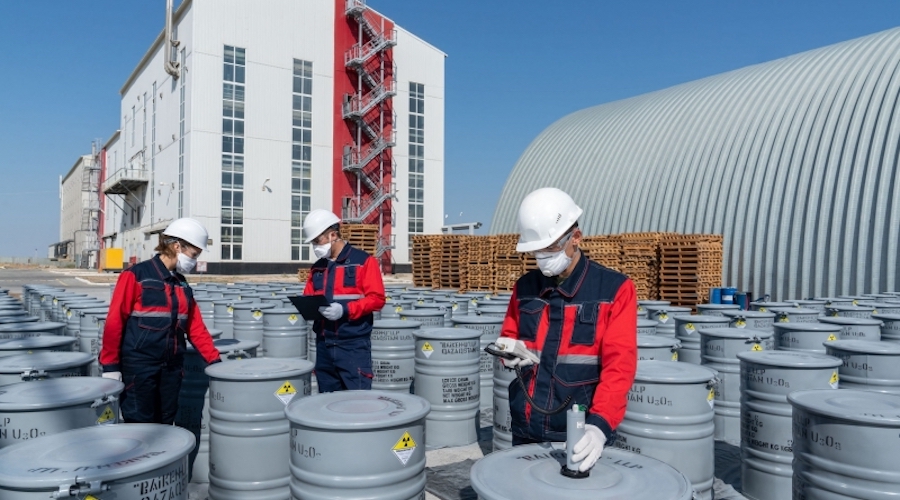
Cameco suspends uranium production at Inkai JV in Kazakhstan over bureaucratic holdup


State-run Kazatomprom operates 26 deposits grouped into 14 asset clusters, all of which are located in Kazakhstan. (Image courtesy of Kazatomprom.)

Cameco’s (TSX: CCO; NYSE: CCJ) Inkai joint venture project in Kazakhstan has suspended uranium production because of a bureaucratic holdup, the Canadian producer said Thursday.


The in-situ recovery JV, in which Cameco holds a 40% stake and state-owned Kazatomprom (LSE: KAP) holds 60%, didn’t get an extension to submit its project paperwork because of a delayed submission to Kazakhstan’s energy ministry.

The extension was expected to come through last year, and as recently as Dec. 26 reports hadn’t indicated that production might be suspended, Cameco said in a release.

The Saskatoon-based company’s shares gained 1.8% to C$75.28 apiece on Thursday morning in Toronto, for a market capitalization of C$32.7 billion ($2.2 billion). Its shares traded in a 52-week range of C$48.71 to C$88.18.

Shares in Kazatomprom fell 2.1% to $36.95 apiece in London, giving it a market cap of £7.8 million ($9.6 million).
Production increase questions

The Inkai suspension adds more uncertainty to Kazakhstan’s near-term uranium production ramp up, BMO Capital Markets analyst Alexander Pearce wrote in a note on Thursday.

Kazatomprom’s announcement suggests the paperwork approvals should be resolved shortly, Pearce said. Meantime the spot uranium price could rise if Cameco and Kazatomprom have to purchase supplies to meet sales commitments, he said.

“The company highlighted that documentation is expected to be submitted in the next couple of weeks, but it is not clear on a timeline for the approvals process and commencement of operations,” Pearce said.

Still, Kazatomprom doesn’t expect any significant impact on its production forecast this year of 65-68.9 million tonnes of uranium oxide (U3O8), Pearce said. BMO puts the same forecast at 65.6 million tonnes of U3O8.

As the largest uranium operation in the Central Asian country, Inkai’s output should total 9.3 million lb. this year, representing 14% of Kazakhstan’s production and 16% for Cameco, BMO forecasts.

Raymond James analyst Brian MacArthur wrote that the timing of Cameco’s roughly 4 million lb. of U3O8 annual output from Inkai can vary since shipments use the TransCaspian International Transport Route, outside of Russian rail lines and ports.

“The timing of these deliveries, in turn, can impact the timing/amount of dividends (Cameco) receives from JV Inkai,” he said.

The uranium spot price was at $73 per lb. as of Dec. 31, down 5.8% from $77.13 at the end of November, and down 27.5% from the energy metal’s 17-year high of $100.25 one year ago, according to Trading Economics.
ECOCIDE

Sandfire America wins water rights ruling in Montana

Staff Writer | January 3, 2025 | 

Site of Black Butte project in Montana. Credit: Sandfire Resources America

Sandfire Resources America (TSXV: SFR) has received another positive court ruling in Montana, this time regarding its leasing of mitigation water rights for the Black Butte copper project, which has been challenged by local communities for years.


In March 2020, Sandfire subsidiary Tintina Montana received preliminary approval from the Montana Department of Natural Resources and Conservation (MT DNRC) for the issuance of a beneficial groundwater permit, but was subsequently challenged by five environmental organizations.

A district court judge upheld the MT DNRC’s decision in 2023 when the environmental groups lost their challenge at a MT DNRC hearing and petitioned for Judicial Review, ruling that both the DNRC and the hearing examiner had properly determined that “mine dewatering is not a beneficial use of water.”

On Friday, Sandfire announced the Montana Supreme Court has affirmed the district court ruling on its determination of “beneficial use of water” with a 5-2 decision.

This decision follows the February 2024 Supreme Court ruling that reinstated the company’s operating permit after it was invalidated by the District Court in April 2022 following a lawsuit by local conservation groups against Tintina Montana and the Montana Department of Environmental Quality (MT DEQ).

Sandfire CEO Lincoln Greenidge said the Black Butte copper project now has all permits to proceed, as it had reached the feasibility stage in 2020. At the time, Sandfire’s management called it “one of the few fully permitted and development-ready copper assets globally.”

The feasibility study was based on mining from the Johnny Lee deposit, which underpins an 8-year mine life and is designed to be mined at 1.2 million tonnes of ore per annum. Average annual production is estimated at approximately 23,000 tonnes of copper at a cash cost of $1.51/lb.

Shares of Sandfire America surged 38.3% to C$0.42 apiece by 12:15 p.m. ET, near its 52-week high of C$0.46. The company has a market capitalization of C$424.7 million ($294m).