It’s possible that I shall make an ass of myself. But in that case one can always get out of it with a little dialectic. I have, of course, so worded my proposition as to be right either way (K.Marx, Letter to F.Engels on the Indian Mutiny)
Monday, January 06, 2025
ArcelorMittal South Africa to Close Long-Steel Works, Sees Loss
NATIONALIZE UNDER WORKERS CONTROL
By Ana Monteiro
January 06, 2025
A red hot steel beam is shaped by a rolling machine inside the ArcelorMittal HighVeld Steel & Vanadium Corp. plant in eMalahleni, South Africa, on Tuesday, June 6, 2017. Steelmakers have seen profit buoyed with metal prices at the highest in more than two years in key markets such as the U.S. and Europe.
(Waldo Swiegers/Bloomberg)
(Bloomberg) -- ArcelorMittal South Africa Ltd. will close its business that makes long-steel products, potentially affecting about 3,500 jobs.
Persistent high logistics and energy costs, together with insufficient policy interventions by the government, left the business unsustainable, the company said in a statement Monday. The wind-down will hit both its Newcastle and Vereeniging Works, as well as rail and structures unit Amras. A scaled-back coke-making operation at Newcastle will continue, reflecting reduced demand, it said.
The company said steel production will likely cease by the end of the month and it has yet to determine the final number of job losses.
A decision to shutter the business was previously announced last February, but the company delayed the move after consulting with the government and state-owned freight firm.
South African steel industry “is facing its greatest sustained challenge” since the 2008 financial crisis, the firm said, adding that deteriorating global and local steel markets, high expenses and surging low-cost imports — particularly from China — have damaged the business.
“We are disappointed that all our efforts over the last year have not translated into a sustainable solution,” Chief Executive Officer Kobus Verster said. “The issues tabled for resolution sought to level the playing field,” and could “firmly address the structural problems within the South African steel industry.”
The news comes as a blow to the business-friendly coalition government’s desire to revive industry in a nation whose economy has expanded at an average of less than 1% annually over the past decade, outpaced by population growth.
ArcelorMittal South Africa expects to report a bigger loss for the year through December. The headline loss per share will range from 4.06 rand to 4.41 rand compared with 1.70 rand a year earlier, it said.
Microsoft to Spend $80 Billion on AI Data Centers This Year
By Brody Ford,
Bloomberg News
January 03, 2025
(Bloomberg) -- Microsoft Corp. plans to spend $80 billion this fiscal year building out data centers, underscoring the intense capital requirements of artificial intelligence.
More than half of this projected spending through June 2025 will be in the US, Microsoft President Brad Smith wrote in a blog post Friday. Recent AI progress is thanks to “large-scale infrastructure investments that serve as the essential foundation of AI innovation and use,” Smith wrote.
Cloud infrastructure providers like Microsoft and Amazon.com Inc. have been racing to expand computing capacity by constructing new data centers. In the previous fiscal year ending in June 2024, Microsoft spent more than $50 billion on capital expenditures, the vast majority related to server farm construction fueled by demand for artificial intelligence services.
More: Why Artificial Intelligence Is So Costly to Develop: QuickTake
Smith also cautioned the incoming Trump administration against “heavy-handed regulations” related to AI. “The most important US public-policy priority should be to ensure that the US private sector can continue to advance with the wind at its back,” Smith wrote.
The country needs “a pragmatic export control policy that balances strong security protection for AI components in trusted data centers with an ability for US companies to expand rapidly and provide a reliable source of supply to the many countries that are American allies and friends,” Smith wrote.
Much of the spending on data centers goes toward high-powered chips from companies including Nvidia Corp. and infrastructure providers such as Dell Technologies Inc. The massive AI-enabled server farms require lots of power, which prompted Microsoft to strike a deal to reopen a reactor at the Three Mile Island nuclear power plant in Pennsylvania, the site of a notorious partial meltdown in 1979. Amazon and Google have also signed nuclear power agreements.
(Updates with additional context on data centers in sixth paragraph.)
Lion Electric announced Friday it’s temporarily laying off around 150 workers in Canada and the U.S., in the context of its ongoing proceedings under the Companies' Creditors Arrangement Act (CCAA). The Montreal-based maker of electric buses and trucks says the latest round of layoffs affects all departments.
Lion Electric, which has been going through financial difficulties, officially obtained creditor protection mid-December.
In 2024, Lion Electric announced four waves of layoffs affecting around 920 workers, with the last one announced at the beginning of December.
Over the past few years, the company has been financially supported by the federal and Quebec governments, the Fonds de solidarité FTQ and Fondaction, particularly through loans.
This report by The Canadian Press was first published Jan. 3, 2025.
Companies in this story: (TSX:LEV)
A QUISLING COMPRADOR
‘Great Deal’: Trudeau’s Conservative Rival Makes Energy Pitch to Trump
By Thomas Seal,
Bloomberg News January 03, 2025
(Bloomberg) -- Since winning the US election, Donald Trump has taunted Canadian Prime Minister Justin Trudeau by calling him governor of a 51st US state, threatened 25% tariffs, and vented that the US is getting ripped off by its northern neighbor because of a trade deficit.
Pierre Poilievre — the Conservative leader who is the front-runner to beat Trudeau’s party in the next election — says he could increase Canada’s exports to the US and strike a “great deal” with Trump anyway.
Poilievre sketched out an elevator pitch to the US president-elect during an interview with right-wing Canadian influencer Jordan Peterson, posted online Thursday. If elected, Poilievre said he plans to speed up approvals to build oil refineries, liquefied natural gas plants, nuclear facilities and hydro power. Canada has the ability to grow its electricity surplus with the US, helping to run the data centers that are essential to its booming artificial intelligence sector, he added.
“If you look at the history of President Trump, he negotiates very aggressively and he likes to win, but in the end, he doesn’t appear to have a problem if his counterparty also wins,” Poilievre said. “And so I think that we can get a great deal that will make both countries safer, richer, and stronger.”
But Trump should also be aware that Canada currently sells its oil and gas to the US at “enormous discounts,” Poilievre told Peterson.
“Yes, it is a ripoff — Canada is ripping itself off,” the Conservative politician said.
The US trade deficit in goods with Canada was $50.5 billion through the first 10 months of the year. It would be larger, but Canadian crude is sold cheaply to US refineries, particularly in the Midwest.
The discount exists because Canada has few alternatives. There’s only one oil-export pipeline that goes to an ocean port in British Columbia, and the country is only now developing a liquefied natural gas industry with the capacity to ship large quantities of gas to Asia. So most of the fuel goes south.
“That is the true story — it’s the pathetic story — of our trade surplus, is that we’re actually handing over our resources, stupidly,” Poilievre said. “It’s not the Americans’ fault, it’s our fault, we’re stupid. And we’re going to stop being stupid when I’m prime minister.”
Poilievre argued that Trump has reason to be annoyed with US deficits with China and Mexico — “from a mercantilist point of view” — because they siphon away American jobs. But the trade gap with Canada is different, the Conservative leader said, because it’s driven by the sale of commodities that Canada has and the US needs, and actually supports American jobs where they’re processed downstream.
“The last thing he should want to do is to block the underpriced Canadian energy from going into his marketplace,” he continued, appealing to Trump. “In fact, what I would encourage him to do is to approve the Keystone pipeline,” he added, referring to a long-running Keystone XL project designed to ferry some 800,000 barrels a day from Alberta’s oil sands to southeast Nebraska, where it would link up with existing pipelines.
President Joe Biden revoked a key permit for that project after taking office in 2021, effectively killing it. Trump is in favor of Keystone XL, but there has been no sign yet that South Bow Corp., owner of the Keystone system, would want to revive it.
Lost Jobs
If Trump somehow stopped Canada’s trade surplus with the US immediately, American workers at refineries would lose their jobs and consumers would pay higher prices, Poilievre said. He argued that Canada should instead ramp up extraction of resources such as critical minerals that so both countries can get richer while weaning themselves off supplies from unfriendly states like China.
Poilievre added that he’s held talks with the conservative leaders of hydrocarbon-rich provinces Alberta and Saskatchewan, asking them to be ready to expedite resource project approvals.
Poilievre said he would address US concerns about border trafficking and military spending, adding that a Conservative government would invest the planned gains of his energy-exporting strategy in Arctic security. Trump has long complained the US is being shortchanged by allies, and Canada is currently far short of the North Atlantic Treaty Organization goal to spend 2% of gross domestic product on defense.
“I can fund a more robust military and continental defense if I have more free trade with the greatest economy the world has ever seen — and we can both win,” he said.
Prime Minister Justin Trudeau took part in a virtual meeting of the Canada-U.S. relations cabinet committee on Friday, as people inside and outside the Liberal caucus call for him to resign as leader.
The committee, which was reinstated after Donald Trump was elected in November, is gathering as his Jan. 20 inauguration quickly approaches.
He’s also been taunting Trudeau on social media, suggesting Canada should become the 51st U.S. state and calling Trudeau its governor, while arguing that the U.S. subsidizes Canada through its trade relationship.
A spokesperson from the Prime Minister’s Office said Trudeau is not an official member of the U.S.-Canada relations committee, but his attendance underscores the importance of the committee’s work in protecting Canadian interests.
Its membership and leadership were shuffled after the cabinet shuffle that followed Chrystia Freeland’s resignation from cabinet. Public Safety Minister David McGuinty is now a member of the committee, with Finance Minister Dominic LeBlanc replacing Freeland as chair.
Trudeau and LeBlanc travelled to Florida on Nov. 30 to meet with Trump, and several top cabinet ministers met with the Trump team last Friday.
On Friday morning, Green Party Leader Elizabeth May took aim at the incoming Trump administration, emphasizing that Canada will never become the 51st state.
“Honestly, President Trump, get used to it,” May said at a press conference that she said she hoped would be viewed as antagonistic to the Trump administration.
“We love our country. And it’s a country. It’s a nation. And we do not aspire to be (the) 51st state. So let’s not hear it anymore. If it was a joke, it was never funny, and it ends now.”
May said while she doubts her comments will be seen by Trump, she thinks many Canadians want to hear the country’s leaders be more explicit in dismission the ongoing narrative of Canada joining the United States.
May referenced a newspaper column earlier this week by former Liberal MP Clifford Lincoln as such an example.
Conservative Leader Pierre Poilievre also dismissed the notion before the holidays.
On Friday afternoon, Trudeau went to the U.S. Embassy in Ottawa and signed a book of condolences for former U.S. president Jimmy Carter, who died at the age of 100 on Dec. 29. He did not speak to media at the event and has no other public events on his itinerary for Friday.
Trudeau continues to face pressure to step down as Liberal leader after Freeland’s decision to quit as finance minister last month.
Before the holiday break, Natural Resources Minister Jonathan Wilkinson told The Canadian Press that Trudeau was taking time to reflect on his future.
Trudeau himself has not spoken about Freeland’s resignation or his future since Dec. 16. His last public statement was on Dec. 20 following a meeting of his recently shuffled cabinet, when he talked about the U.S. tariff threat.
The questions about his leadership of the party come as opposition parties are moving to oust the Liberal government from power altogether.
The Conservatives plan to bring forward a non-confidence motion at a House of Commons committee next week, which could potentially trigger an election if it succeeds in a vote in the House. That vote could come as early as Jan. 30.
Both the Bloc Québécois and NDP have said they are in favour of bringing down the minority Liberal government.
Julien Newman, a former NDP staffer under leader Tom Mulcair, is circulating a petition among NDP supporters calling for Singh to vote down the government before Feb. 25, the day Singh qualifies for his MP pension. The Conservatives have been attacking the NDP for supporting the Liberals, accusing Singh of wanting to wait until he’s pension-eligible before triggering an election.
Newman said his petition has more than 1,000 signatures so far and he’s looking for an MP to present it in the House of Commons.
On Dec. 20, Singh said the NDP would bring forward a non-confidence motion at its earliest opportunity no matter who leads the Liberal party.
However, May said Friday she doesn’t think Canadians should go to the polls so soon, given the situation with the United States.
“What happens with an election is that there’s only a caretaker role for whatever government is place, during the time that the Trump White House is forming,” May said.
This report by The Canadian Press was first published Jan. 3, 2025.
— With files from Nick Murray
WORKERS CAPITAL CPP Investments selling stake in Goodman logistics partnership
TORONTO — The Canada Pension Plan Investment Board says it is selling its stake in a logistics investment partnership it established with Australia’s Goodman Group.
CPP Investments says it will realize about US$2.2 billion in net proceeds from its investment in Goodman North American Partnership.
The partnership was established in 2012 with a mandate to invest in high-quality logistics and industrial property in key North American markets.
CPP Investments owned a 45 per cent stake, while Goodman Group held 55 per cent ownership.
Max Biagosch, global head of real assets and head of Europe for CPP Investments, says the sale of the stake is an opportunity to lock in strong returns for the CPP Fund and redeploy capital towards new investment opportunities.
Goodman and CPP Investments retain partnerships across several markets.
This report by The Canadian Press was first published Jan. 3, 2025.
U.S. nuclear energy 'revival' led by tech companies, government investment
By Joe Fisher Jan. 3, 2025 Microsoft agreed to a deal with Constellation, a Baltimore based energy company, to restart the Three Mile Island Unit 1 nuclear plant in Londonderry Township, Pa.
Photo courtesy of the U.S. Nuclear Regulatory Commission/Flickr
Jan. 3 (UPI) -- A string of announcements about big investments in nuclear energy production signal a revival for the industry that already produces about 20% of U.S. electricity.
Google, Microsoft and Amazon are among the technology companies looking to nuclear power to produce energy with a smaller carbon footprint. Environmental organizations remain skeptical, if not outright opposed to the use of nuclear energy.
Disasters at nuclear plants in Chernobyl in 1986 and the Fukushima Daiichi plant in Japan in 2011 play a large role in the minds of opponents.
"Anyone who thinks the public perception is overwhelmingly pro-nuclear is probably kidding themselves," Dr. Lane Carasik, assistant professor in the Virginia Commonwealth University Department of Mechanical and Nuclear Engineering, told UPI. "A lot of work needs to continue to be done by organizations to make sure the public is appropriately informed about the benefits and dangers of nuclear power. There are both."
The benefits touted by companies making the investments and the U.S. government center around reducing carbon emissions. This goal has been a crucial point of emphasis for the Biden administration in the face of increasingly destructive and frequent extreme weather events around the globe.
The U.S. Department of Energy announced in October it is opening applications for $900 million in funding to build small modular nuclear reactors. The program is part of the Bipartisan Infrastructure Law that passed in 2021.
"Revitalizing America's nuclear sector is key to adding more carbon free energy to the grid and meeting the needs of our growing economy -- from A.I. and data centers to manufacturing and healthcare," Jennifer M. Granholm, U.S. secretary of energy, said in a statement.
Earlier in the fall, the Biden administration announced the approval of a $1.52 billion loan to restart the Palisades nuclear plant in Covert Township, Mich. It would be the first restart of a nuclear plant once believed to be permanently out of commission in U.S. history.
Carasik said he is not surprised that the government is playing a role in revitalizing the nuclear energy industry. Along with the need for a diverse slate of energy sources, he said it is imperative that the United States nurture the field of nuclear science or risk losing experts to other countries.
"If we do not train in nuclear science-adjacent fields, we could lose them potentially to other countries and potentially to adversarial countries," Carasik said.
Support for nuclear energy has been burgeoning in Michigan even prior to the announcement.
A bipartisan, bicameral caucus was formed in the state legislature. The state has agreed to put $300 million toward the Palisades restart. The Michigan Chamber of Commerce and Gov. Gretchen Whitmer have also called it a positive development.
Holtec International, the company that purchased the Palisades plant in 2022, has agreed to sell a portion of the energy it produces to Hoosier Energy in Indiana.
The plant is capable of producing 800 megawatts of electricity, enough to power about 800,000 homes. More capacity may be coming as Holtec International is developing two small modular reactors to be built near the Palisades plant capable of producing 300 megawatts each.
That additional energy will be needed as Microsoft and telecommunications company Switch eye building new data centers in western Michigan, according to Ed Rivet, executive director of the Michigan Conservative Energy Forum.
Existing data centers consume about 4% of all electricity generated in the United States. That need is expected to more than double by 2030 as more data centers are constructed, according to the Department of Energy.
"It's pretty shattering from a paradigm sense, seeing companies like Google (request for proposal) to the private sector 'Will you build a nuclear plant next to our data center?'" Rivet said.
The investments from the tech industry play a large role in the recent nuclear resurgence. Energy hungry data centers will require a reliable energy source. Rivet's organization calls for an "all of the above" approach to powering the nation's grid, including wind and solar energy. He believes nuclear energy must be part of that equation as well.
Unlike wind and solar, nuclear energy is produced on a constant basis regardless of the elements. Nuclear energy has no carbon footprint and its physical footprint -- the land a nuclear plant sits on -- is drastically smaller than the land covered by solar panels to produce the same amount of energy.
Christopher Ortiz, senior communications specialist with Kairos Power, told UPI that energy density is an attractive feature of nuclear reactor technology.
"Kairos Power's advanced reactor technology offers incredible energy density," Ortiz said. "One golf-ball-sized fuel pebble can produce the same amount of energy as burning four tons of coal."
Google signed an agreement to buy nuclear energy produced by Kairos Power's small modular reactors to support the needs of its artificial intelligence systems.
"This landmark announcement will accelerate the transition to clean energy as Google and Kairos Power look to add 500 (megawatts) of new 24/7 carbon-free power to U.S. electricity grids," Michael Terrell, Google senior director of energy and climate, said in a statement.
The projects in this agreement are slated to be finished and in operation across multiple plants by 2035.
Kairos Power, based in California, was founded in 2016 and employs more than 480 people. The company has hired more than 130 employees at its plant in Albuquerque, N.M., with an average salary of more than $100,000. It will also create more than 55 "high-skilled, high-paying" jobs to build, operate and decommission the Hermes Low-Power Demonstration Reactor near Oak Ridge, Tenn.
Construction on the Hermes reactor began in July. It will be used to develop the company's commercial advanced nuclear reactor technology.
Nuclear energy accounts for about 50% of U.S. clean energy production, according to the U.S. Department of Energy.
The Hermes reactor is projected to be complete in 2027.
The Palisades Nuclear Plant is not the only U.S. plant set to be brought back online. Microsoft agreed to a deal with Constellation, a Baltimore based energy company, to restart Three Mile Island Unit 1 in Londonderry Township, Pa.
The plant will produce 835 megawatts of electricity and create an estimated 3,400 jobs. It was shut down in 2019.
Three Mile Island Unit 2 was the site of a meltdown in 1979, leading to the evacuation of thousands of people. Like Chernobyl and Fukushima, Three Mile Island evokes memories of what can go wrong with nuclear power.
Dr. Arthur Motta of the Ken and Mary Alice Lindquist Department of Nuclear Engineering at Penn State told UPI that the Three Mile Island meltdown brought about positive changes to the industry. Better reporting and sharing of information about malfunctions among plants internationally has increased safety and reliability.
The challenge nuclear energy faces in the realm of public perception is cutting through the fear that has been harnessed in decades of pop culture depictions of nuclear disasters. Godzilla, the Fallout video game series and Homer Simpson bumbling around the Springfield power plant have fed into misconceptions about the industry, Motta said.
"It strikes something in the human psyche that makes people afraid," Motta said. "People evaluate risk based on their familiarity. Nuclear is the unknowable. People don't know about it."
Critics of nuclear energy have raised questions about waste disposal. Nuclear waste looks far different from the barrels filled with glowing green liquid that create three-eyed fish on The Simpsons. Instead, most waste comes in the form of nuclear fuel rods. They are highly radioactive but are not voluminous.
Motta explains that the total volume of the nuclear waste produced in the United States in the last 40 years could be stacked 2 to 3 meters high across one football field. There is about 90,000 metric tons of spent nuclear waste in the country, according to the U.S. Government Accountability Office. The Department of Energy is responsible for disposing high-level waste -- like the nuclear fuel rods -- in a yet-to-be-built repository.
In 1987, the government designated the Yucca Mountain in Nevada to be the site of a waste repository. However, the government turned away from nuclear energy through the Obama administration while lawmakers came to an impasse over next steps. The Obama administration also began to explore alternatives to the Yucca Mountain.
Currently nuclear waste remains stored in spent fuel pools -- large, reinforced concrete casks lined with steel. The fuel is submerged in 40 feet of water and cooled for five years or more before being moved to a dry cask to be stored for up to 40 more years.
This method of storage is considered temporary by the U.S. Nuclear Regulatory Commission.
The radioactivity of nuclear waste decays over time. After 40 years, the radioactivity of a spent fuel rod is about one-thousandth of what it was when it was first placed in storage, according to the World Nuclear Association.
Motta said the chief concern about storage of waste among skeptics is that radiation will make its way into the water table due to the containment casks corroding and the waste dissolving.
"The water table goes very deep. You bury the waste 5,000 feet and you're still well above the water table," he said. "There is no way for the waste to be released, especially because of the corrosion-resistant canisters and drip shields. Really, it's a question of if you believe the disposal proceeding can be done safely and I think it can."
Constellation to supply US federal sector under record contract
Friday, 3 January 2025
The ten-year, USD840 million contract to supply electricity to federal facilities is the first-ever long-term multi-agency purchase of electricity by the US General Services Administration, and will support licence extensions and capacity uprates at Constellation's nuclear plants.
(Image: Pixabay)
The agreement to supply an estimated 10 million MWh over the contract's ten-year term to 80 federal facilities is part of over USD1 billion in combined contracts awarded to Constellation by the General Services Administration (GSA) to supply power to more than 13 government agencies and perform energy savings and conservation measures at five GSA-owned facilities. The contract is set to begin April.
The GSA, which provides centralised procurement and shared services for the US federal government, said the purchase - a portion of which is "bundled CFE" (carbon pollution-free electricity) - will increase resilience and reliability for federal agencies while protecting against price increases.
"This historic procurement locks in a cost-competitive, reliable supply of nuclear energy over a 10-year period, accelerating progress toward a carbon-free energy future while protecting taxpayers against future price hikes," GSA Administrator Robin Carnahan said. "We're demonstrating how the federal government can join major corporate clean energy buyers in spurring new nuclear energy capacity and ensuring a reliable, affordable supply of clean energy for everyone."
The procurement covers the supply of electricity to federal facilities in the territory of regional transmission operator PJM Interconnection, which extends over portions of eleven mid-Atlantic and Midwest states and the District of Columbia. Facilities to be supplied with energy include the Architect of the Capitol, the GSA, the Social Security Administration, the Army Corps of Engineers, the Department of Veterans' Affairs, the Department of Transportation, the US Mint, the US Railroad Retirement Board, the National Archives and Records Administration, the Federal Bureau of Prisons, the Federal Reserve System, the National Park Service, the National Oceanic and Atmospheric Administration, and the Washington Metropolitan Area Transit Authority.
The procurement agreement will see GSA purchase 2.4 million MWh of nuclear capacity added by Constellation via licence extensions and uprates (together with the associated Energy Attribute Certificates) over the life of the 10-year contract. "Together with CFE already on the electrical grid, the purchase will enable the agencies covered in the procurement to transition to 100% carbon pollution-free electricity by 2030," GSA said.
The US federal government's more than 300,000 buildings and 600,000 vehicles make it the nation's largest energy consumer. The Federal Sustainability Plan aims to achieve net-zero emissions for federal operations by 2050 by transitioning to zero-emission vehicles, energy efficient buildings and CFE, with the government seeking to transition to 100% CFE by 2030, at least half of which will be locally supplied clean energy to meet 24/7 hourly-matched demand.
Minnesota plant set for operations to 2050 after licence renewal
Friday, 3 January 2025
US regulators have issued a 20-year subsequent licence renewal for Xcel Energy's Monticello, clearing the single-unit boiling water reactor plant to operate until 2050.
Monticello (NRC/Xcel Energy)
The US Nuclear Regulatory Commission (NRC) announced in the Federal Register that it had issued Subsequent Renewed Facility Operating License No DPR-22 to the licensee, Xcel subsidiary Northern States Power Company, on 30 December.
The subsequent licence renewal is the culmination of a multi-year process which included numerous NRC inspections, audits and reviews of all technical aspects of the plant to ensure it met or exceeded standards for safety, environmental impact and other considerations, Xcel said. The NRC accepted the application for the subsequent licence renewal in March 2023, although the company announced as long ago as 2019 its intention to operate the plant until at least 2040.
Approval from state-level regulators will also be required to allow Monticello to operate until 2050. Xcel has already received approval from the Minnesota Public Utilities Commission to extend operations at Monticello for the first half of this period, to 2040, and said it "will return to the PUC to seek approval for the additional 10 years in the future".
"For over 50 years, we have maintained, invested in and improved the Monticello plant to ensure it can continue to deliver for the communities we serve," Xcel Energy Chief Nuclear Officer Chris Church said. "By extending operations at the plant, we are carrying this commitment forward, and at the same time renewing our investment in the community of Monticello and the surrounding region."
The plant began commercial operation in 1971 and as well as the relicensing, Xcel recently completed a project to replace components and to increase its generating capacity from 600 to 671 MWe - which the company says is enough energy to power 500,000 homes.
Under the US Atomic Energy Act, the NRC is authorised to issue licences for commercial power reactors to operate for up to 40 years. These initial licences can then be renewed for an additional 20 years, for 60 years of operation: Monticello received its initial licence renewal in 2006, allowing it to operate until 2030. Subsequent licence renewals cover a further 20 years of operation beyond 60 years and focus on the management of plant ageing during the 60-80 year operating period.
Xcel also owns the two-unit Prairie Island pressurised water reactor plant, for which it has told the NRC it intends to submit an application for a subsequent licence renewal in the fourth quarter of 2026.
Second Koeberg unit returns to service
Friday, 3 January 2025
Unit 2 of the Koeberg Nuclear Power Station in Cape Town was reconnected to the South African grid on 30 December after the completion of extensive maintenance to extend the unit's operational lifespan by an additional 20 years.
Koeberg (Image: Eskom)
The maintenance programme included the replacement of three steam generators, comprehensive inspections, and refuelling activities to ensure the reactor's continued safe and efficient performance. These enhancements align with Eskom's broader strategy to secure the future of Koeberg's reactors, which the state-owned company says are critical to South Africa's energy security: unit 2's 930 MWe contribution plays a significant role in Eskom's goal to increase the company's capacity by 2500 MW by March 2025, it said.
Unit 2 was taken offline for its maintenance outage on 11 December 2023, shortly after unit 1 returned to service following the completion of similar work. In July, South Africa's National Nuclear Regulator granted Eskom a licence to continue operating unit 1 for another 20 years, until 21 July 2044, and is expected to decide on a similar extension of unit 2's operational licence later this year. Unit 1 has shown "exceptional reliability" since its return to service, Eskom said. Together, the two units supply around 5% of South Africa's total electricity and play a vital role in reducing loadshedding and stabilising the grid.
"As South Africa phases out some of the aging coal-fired power plants by 2030, nuclear energy is poised to provide a reliable and stable baseload supply. Unlike intermittent renewable sources, nuclear power ensures continuous electricity generation, meeting the needs of both residential and industrial users. Its ability to produce carbon-free energy also supports South Africa's climate goals by reducing greenhouse gas emissions," Eskom Group Executive for Generation Bheki Nxumalo said.
Although projects like the long-term operation (LTO) programme at Koeberg require high initial upfront investment, their long-term benefits make them indispensable, according to Eskom Group Chief Executive Dan Marokane. "Koeberg exemplifies how nuclear power can align economic and environmental priorities to create a sustainable energy future. Through the successful execution of the LTO project, our Koeberg team has once more demonstrated the exceptional skills we have to support our country's nuclear ambitions," he added.
Groundworks begin for new Chinese plant
Friday, 3 January 2025
Excavation work has started for the foundation of the nuclear island of unit 1 at the Bailong nuclear power plant in China's Guangxi Zhuang Autonomous Region.
(Image: Guangxi Nuclear Power)
The construction of Phase I (units 1 and 2) of the Bailong plant was among approvals for 11 new reactors granted by China's State Council in August last year. State Power Investment Corporation (SPIC) plans to build two CAP1000 pressurised water reactors - the Chinese version of the Westinghouse AP1000 - as the first phase of the plant. An investment of about CNY40 billion (USD5.6 billion) is planned for the two units, which are expected to take 56 months to construct.
"The negative excavation of the nuclear island is an important node in the construction of nuclear power, marking another solid step forward in the construction of the Bailong nuclear power plant," said SPIC subsidiary Guangxi Nuclear Power Company Ltd.
The company noted that "vertical slope" construction technology - which involves "supporting first and then excavating" - has been adopted for the excavation of unit 1's foundation pit. Since 25 November, a total of 137 cast-in-place piles of the foundation pit retaining structure have been completed and negative excavation started on 30 December.
Excavation of about 66,000 cubic metres of earth to form the foundation pit - which will eventually be 12.2 metres deep and cover an area of about 3000 square metres - is expected to be completed by the end of March this year.
Once Bailong units 1 and 2 are put into operation, the annual power generation of the plant will be about 20 billion kilowatt-hours, Guangxi Nuclear Power said. It noted that this can reduce the consumption of standard coal by about 6 million tonnes and reduce carbon dioxide emissions by about 16 million tonnes annually.
Four CAP1400 reactors are also planned to be built at the site - located about 24 kilometres from the border with Vietnam and about 30 kilometres southwest of China General Nuclear's Fangchenggang nuclear power plant - in later phases.
Reactor vessel installed at third Akkuyu unit
Friday, 3 January 2025
The assembly of the reactor has been completed at unit 3 of Turkey's Akkuyu nuclear power plant. Meanwhile, the fuel to be used in the second unit has also been delivered to the site.
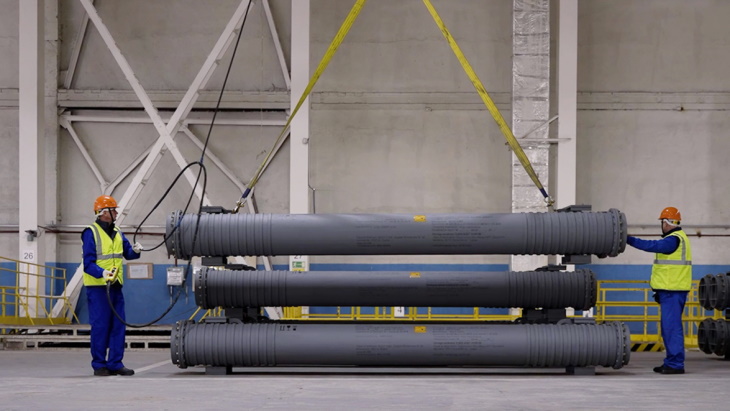
The vessel of unit 3 is hoisted into place (Image: Akkuyu Nuclear)
The cylindrical reactor pressure vessel (RPV) - measuring 11.45 metres in length and 5.7 metres in width - was produced by the Volgodonsk branch of AEM-Technologies JSC of Atommash, part of Atomenergomash, the machine production division of Rosatom. The 350-tonne vessel was delivered by sea to the construction site in November 2023 and has since been held in storage.
The RPV has now been installed using the 'open top' method. This method allows large equipment to be loaded into the reactor building using a heavy-duty crane before the reactor dome is closed. It can significantly cut the time taken to carry out installation work.
Following the completion of the reactor pressure vessel assembly, a commission consisting of experts from Akkuyu Nuclear Inc. as well as independent auditing organisation Türk Loydu and the Turkish Nuclear Regulatory Authority carried out an inspection of the reactor vessel assembly quality.
"As in previous years, the dynamics of the field work in 2024 were very high," said Sergei Butckikh, First Deputy CEO of Akkuyu Nuclear JSC. "We carried out the main operations envisaged in the project plan. The heart of the third power unit of Akkuyu NPP was established, that is, we successfully completed the critical work on the assembly of the nuclear reactor vessel.
"As with all other construction and installation operations on the site, the installation of the reactor vessel required meticulous preparation, highly qualified experts and special precision at every stage."
The Akkuyu plant, in the southern Mersin province, is Turkey's first nuclear power plant. Rosatom is building four VVER-1200 reactors, under a so-called BOO (build-own-operate) model. Construction of the first unit began in 2018. The 4800 MWe plant is expected to meet about 10% of Turkey's electricity needs, with the aim that all four units will be operational by the end of 2028.
The RPVs of units 1 and 2 were installed in June 2021 and September 2022, respectively.
Fuel delivered for second unit
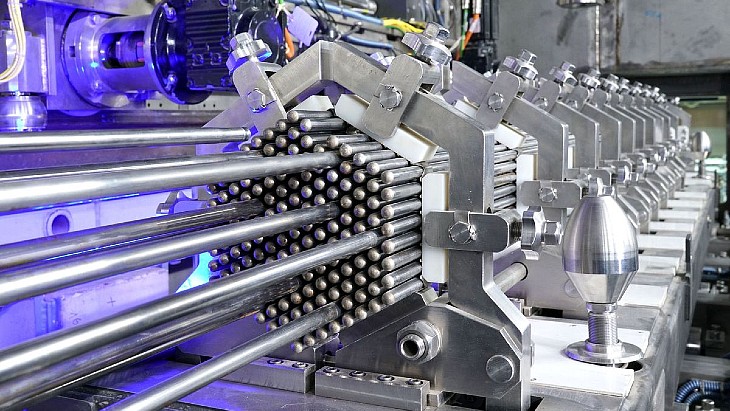
In late December, the nuclear fuel produced for unit 2 arrived at the Akkuyu site. The fuel assemblies - produced at the Novosibirsk Chemical Concentrator Plant, part of Rosatom's fuel company TVEL - were delivered to the site in special transport containers and placed in the fresh fuel storage facility.
Fuel for Akkuyu unit 2 (Image: Akkuyu Nuclear)
"The fuel was transported to Turkey by land and sea in leak-proof containers under close coordination between the relevant units of Akkuyu Nuclear JSC, the production facility and the inspection authorities," Butckikh said. "Before being loaded into the reactor, the containers will be kept under special conditions in the fresh fuel storage facility at the NPP site."
One fuel load for the VVER-1200 reactor consists of 163 fuel assemblies containing uranium enriched to 5% uranium-235.
A ceremony was held in April 2023 to mark the arrival of the first fuel for unit 1 of the Akkuyu plant ahead of its expected start up later this year. The delivery of nuclear fuel marked the moment of Akkuyu officially becoming a nuclear power plant and also of Turkey being categorised as a country with nuclear energy capacity.
BREST-OD-300 fuel fabrication facility begins pilot operation
Friday, 3 January 2025
The unit for fabrication/refabrication of nuclear fuel for the BREST-OD-300 lead-cooled fast neutron reactor has been put into pilot operation, Rosatom has announced.
(Image: Siberian Chemical Combine)
The facility, in Seversk, Tomsk Region, in Siberia, has already manufactured prototype fuel assemblies with depleted uranium nitride fuel pellets. It will have a complete staff of about 250 people.
There are four production focuses: carbothermal synthesis of mixed uranium and plutonium nitrides; fabrication of fuel pellets; manufacturing of fuel elements; and assembly of complete fuel bundles.
The BREST-OD-300 fast reactor is part of Rosatom's Proryv, or Breakthrough, project to enable a closed nuclear fuel cycle. The 300 MWe unit will be the main facility of the Pilot Demonstration Energy Complex at the Siberian Chemical Combine site. The complex will demonstrate an on-site closed nuclear fuel cycle with the facility for the fabrication/re-fabrication of mixed uranium-plutonium nitride nuclear fuel, as well as a used fuel reprocessing facility.
At the moment the operators are fabricating BREST-OD-300 bundles with depleted uranium fuel matrix in compliance with the current licence from regulator Rostechnadzor. Once the regulator approves the handling of plutonium, production will start of mixed dense nitride uranium-plutonium fuel (MNUP). Prior to the initial core loading of the BREST-OD-300, more than 200 MNUP fuel bundles are scheduled for fabrication.
Rosatom says it will be a world first to have all the facilities on one site with reprocessed irradiated fuel sent for refabrication so the site will be "practically autonomous and independent of external supplies of energy resources".
Alexey Likhachev, CEO of Rosatom, noted the progress of the company's development of Generation IV nuclear technologies: "According to the International Atomic Energy Agency classification, this implies higher efficiency in the use of fuel raw materials, increased safety standards for the operation of nuclear plants, as well as a significant reduction in the amount of nuclear waste generation. All these principles are fully consistent with the technological solutions adopted at the Pilot Demonstration Energy Complex, such as the fuel made of depleted uranium and plutonium, the BREST reactor facility based on the principles of natural safety, and the latest more efficient radiochemical technologies for irradiated fuel reprocessing.”
The supergiant West Qurna 1 oilfield in Iraq is expected to have its production capacity raised to 1.2 million bpd by 2035, the project’s subsurface manager, Cai Kaiping, has said.
Oil production at the field has increased to 550,000 barrels per day (bpd) since China National Petroleum Corporation (CNPC) took over the operations a year ago.
At the beginning of 2024, CNPC officially took over from U.S. oil giant ExxonMobil as the lead contractor of the West Qurna 1 oilfield in Iraq, near Basra in the southern part of the country.
West Qurna 1 is one of the largest oil fields in the world, with reserves estimated at more than 20 billion barrels of recoverable hydrocarbons.
West Qurna 1 is located around 65 kilometers (40 miles) from southern Iraq’s key oil and export hub of Basra and holds a considerable part of the estimated 43 billion barrels of recoverable reserves held in the entire supergiant West Qurna field.
By last year, the average yearly production at West Qurna 1 increased to 541,000 bpd, Iraqi officials and Chinese executives said this week at the opening of the new operation headquarters of the West Qurna 1 oilfield in Basra.
The field’s oil production has now reached 550,000 bpd, Iraq’s Oil Minister Hayan Abdul Ghani said, as carried by China Daily.
Going forward, CNPC has planned major expansions to the field’s production capacity.
“We expect production capacity to reach 800,000 barrels per day by 2028 and 1 million barrels per day by 2030, and in the next phase, production capacity will reach 1.2 million barrels per day by 2035,” China Daily quoted the project’s subsurface manager Cai Kaiping as saying this week.
This year, the commissioning of four key projects at West Qurna 1 is expected to help raise production capacity by 200,000 bpd, according to the Chinese executive.
By Tsvetana Paraskova for Oilprice.com
U$ EV Sales Rise as Trump Threatens to End Tax Credits
Bloomberg: EV sales rose 12% in the fourth quarter of 2024.
Plug-in vehicles now make up about 8% of the US car market.
Donald Trump plans to dismantle federal EV incentives, including the $7,500 tax credit.
At least for the time being, EV sales are still pushing higher.
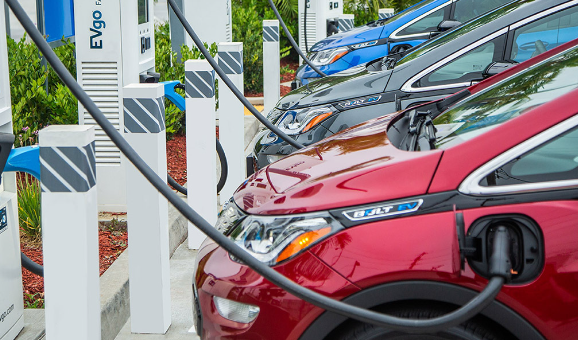
Helped along by Trump's threat to end EV tax credits, sales of EVs were up 12% in the fourth quarter of 2024, according to a new report from Bloomberg. Forecasts from researcher Cox Automotive put the year's total at 1.3 million EVs sold.
Plug-in vehicles now make up about 8% of the US car market, only slightly more than last year, despite a rise in sales from the prior quarter's 8% growth rate. A strong fourth quarter boosted total car sales, with the annualized 2024 rate hitting 15.9 million, up from 15.5 million in 2023.
Bloomberg writes that this EV growth may not continue into 2025. Only 25% of shoppers are considering an EV, down two points from last year, per JD Power.
Jonathan Smoke, Cox’s chief economist said last month: “Threats and worries” sparked a “sense of urgency to buying. That’s true in overall purchase activity, and it’s also very much true to the EV story.”
Donald Trump plans to dismantle federal EV incentives, including the $7,500 tax credit, calling Biden’s EV policies “insane.” Proposed tariffs on Canada and Mexico could also raise car prices.
Improved interest rates, manufacturer incentives, and post-election confidence have boosted 2024 car sales forecasts, despite earlier setbacks from inflation and a dealership cyberattack. GM led US sales with 2.7 million vehicles, while Stellantis fell to sixth with a 15% decline.
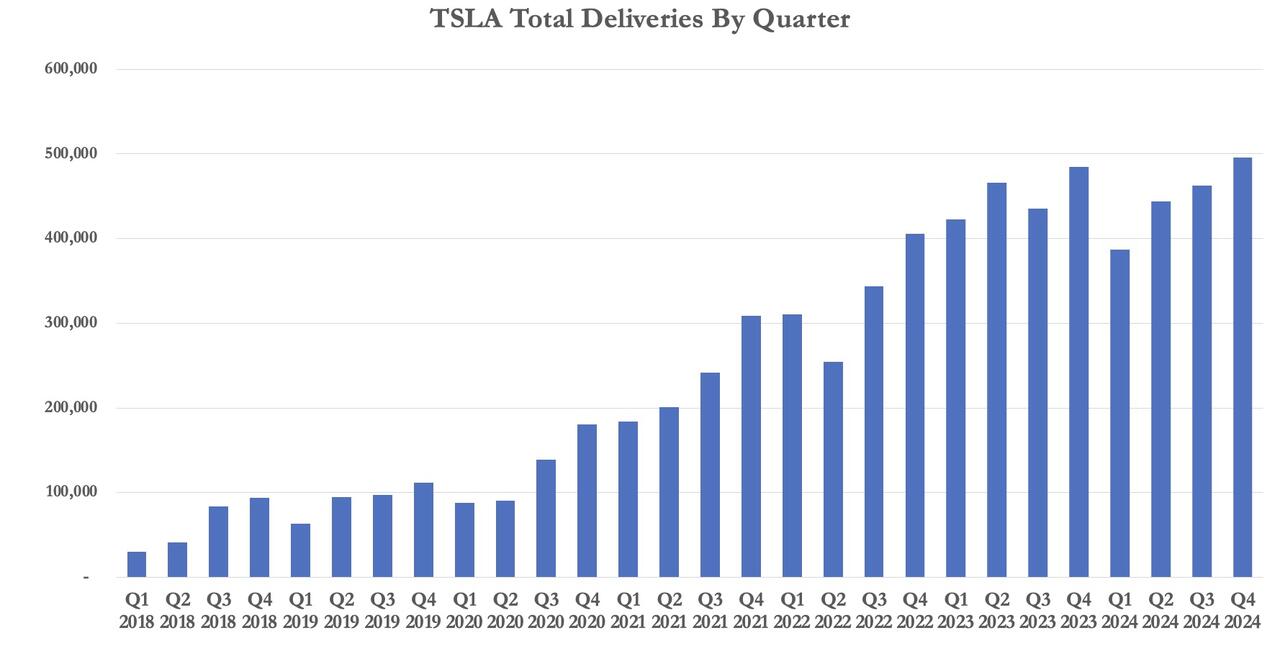
Tesla remains the top EV seller but saw its first annual sales drop in over a decade, as we detailed this week. For the year, the company reported sales of 1.79 million vehicles for the year, falling short of the 1.8 million delivered in 2023 and missing analysts' consensus estimate of 1.8 million.
High costs and limited charging infrastructure keep EVs out of reach for many, with demand projected to fall by 27% if tax credits are removed, the article says.
Meanwhile, hybrids continue gaining favor as automakers like Stellantis and Ford delay EV launches to focus on more affordable options. Hyundai plans to double its hybrid lineup, while Ford pledges hybrid versions across its models by 2030.
By Zerohedge.com
Trump Calls on the UK to Open Up the North Sea and Get Rid of Wind Farms
U.S. President-elect Donald Trump has called for opening up the UK North Sea to oil and gas and getting rid of windmills, in response to the recent announcement by Texas-based Apache that it would cease oil and gas production in the region due to the uneconomical windfall tax.
“The U.K. is making a very big mistake. Open up the North Sea. Get rid of Windmills!” President-elect Trump posted late on Thursday on social media platform Truth Social.
Trump attached an article about Apache’s recent announcement that it would exit the UK North Sea.
In November 2024, U.S. oil producer Apache said that it plans to cease oil production at its assets in the UK North Sea by 2030, due to the windfall tax on operators.
Apache’s parent company APA Corporation said in an SEC filing that its assessment of the impact of the windfall tax, officially known as the Energy Profits Levy (EPL), resulted in findings that continued production in the UK North Sea would be uneconomical.
The ruling Labour Party’s Autumn Statement confirmed that the windfall tax on UK North Sea operators is rising to 38% from 35%, effective November 1, 2024. The tax will now expire on 31 March 2030, a year later than the previous tax regime. The government is also removing the 29% investment allowance.
Since the tax was initially introduced by the Conservative government at the height of the energy crisis in 2022, oil and gas companies operating in the UK North Sea have been calling for certainty in the regulatory and tax framework. Recent changes in policies and the rising taxes have driven away operators, who say that a lack of North Sea investments would only make the UK more dependent on oil and gas imports.
U.S. President-elect Trump, for his part, has been a vocal critic of offshore wind. In the United States, offshore wind faces an uncertain future under Trump’s second-term administration. The President-elect has criticized offshore wind as the most expensive form of energy which, Trump says, also ruins the environment.


_20517.jpg)
_45097.jpg)
_56164.jpg)
_45740.jpg)
_67258.jpg)