After outgoing US President Joe Biden cleared Cuba from Washington's list of state sponsors of terrorism on Tuesday, the US-sanctioned country announced a deal negotiated alongside the Catholic Church that would free 553 prisoners – including jailed protesters and other "political prisoners".
Issued on: 15/01/2025
By: NEWS WIRES

Cubans walk in a street of Havana on January 14, 2025.
© Yamil Lage, AFP
Cuba said Tuesday it would release 553 prisoners in response to Washington removing the communist country from its list of terror sponsors in a deal hailed by relatives of jailed protesters.
The White House said President Joe Biden was removing Cuba from the list of state sponsors of terrorism in one of his last official acts before Donald Trump is sworn in next Monday.
The move will likely be overturned by Trump, who reinstated Cuba's terror designation in the final days of his first term of office in 2021.
"An assessment has been completed, and we do not have information that supports Cuba's designation as being a state sponsor of terrorism," a senior Biden administration official told reporters.
The deal was negotiated with the help of the Catholic Church for the release of "political prisoners in Cuba and those who have been detained unjustly," the official added.
Family members of jailed protesters hailed the announcement, including Liset Fonseca, mother of 41-year-old Roberto Perez, sentenced to 10 years' imprisonment.
He had taken part in anti-government protests with thousands of other Cubans in July 2021, fueled by power blackouts and soaring food prices.
"All the mothers of prisoners want our children to be free and out of that suffering, out of that hell that is the prisons in Cuba. They should never have been in prison," Fonseca told AFP.
One person was killed and dozens injured in the protests, which Havana accused Washington of orchestrating.
According to official Cuban figures, some 500 people were given sentences of up to 25 years in prison for participating, but rights groups and the US embassy say the figure is closer to 1,000.
Some have already been freed after serving their sentences.
'Diverse crimes'
Cuba welcomed Washington's announcement Tuesday as a step in the "right direction," but lamented it was still under US sanctions in place since 1962.
The foreign ministry later announced that 553 people imprisoned for "diverse crimes" will be released.
Cuba blames the US blockade for its worst economic crisis in decades, marked by shortages of fuel, food, medicines and electricity.
Trump's first presidential term from 2017 to 2021 saw a tightening of sanctions against Cuba that had been loosened during a period of detente under his predecessor Barack Obama.
Before assuming office, Biden had promised changes in US policy towards the island, but postponed these after Havana's crackdown on the 2021 protests.
Analysts say the Covid-19 pandemic, which tanked tourism, and economic mismanagement by the government have contributed greatly to the poor state of the economy.
But Cuba's President Miguel Diaz-Canel has described US sanctions as "genocidal" and said his country was prepared for "more difficult circumstances" after Trump's election.
The incoming president's allies immediately criticized Biden over Tuesday's announcement, with Ted Cruz -- a Cuban-American member of the US Senate's Foreign Relations Committee -- calling it a "rank appeasement of the Cuban regime."
Trump has nominated Senator Marco Rubio, a Cuban-American highly critical of communism and the left at large, to serve as his secretary of state.
A White House statement said Biden would also waive part of the so-called Libertad Act underpinning the US embargo of Cuba.
Biden would also rescind a Trump-era policy called "National Security Presidential Memorandum 5," ending restrictions on financial transactions with certain Cuban entities.
Colombia's leftist President Gustavo Petro and a political party made up of the country's disarmed ex-FARC guerrilla group, welcomed the White House announcement.
Cuba had hosted the talks from 2012 to 2016 that saw the FARC agree to lay down arms.
(AFP)
Cuba begins release of jailed protesters under US terror list deal
Honoring a deal with US President Joe Biden's administration which saw it removed from the US list of state sponsors of terrorism, the Cuban government started releasing jailed protesters on Wednesday, despite the possibility of incoming US President Donald Trump reversing Biden's decision.
16/01/2025 -
Families' joy
Under the deal brokered by the Vatican, Cuba promised to release 553 prisoners, which a senior US official said included "political prisoners" and others "detained unjustly."
Vatican number two Cardinal Pietro Parolin said it was "significant" that Havana had responded to an appeal by Pope Francis for clemency.
Social media in Cuba lit up on Wednesday morning with relatives and friends of prisoners confirming their loved ones had been released.
"We received a call yesterday evening to go to the prison today," Rosabel Loreto, daughter-in-law of prisoner Donaida Perez Paseiro, told AFP.
Perez Paseiro had been sentenced to eight years' imprisonment for participating with thousands of others in the 2021 protests -- the biggest in Cuba since the revolution, which Havana accused Washington of orchestrating.
In a video posted on social media, she vowed to continue to "fight for Cuba's freedom."
In Havana, a woman who asked to remain anonymous said her husband remained behind bars for demonstrating against the government, but her daughter -- who had been arrested on the same charges -- was freed Wednesday.
The Miami-based Cuban NGO Cubalex said it had confirmed the release of 20 people, all jailed.
According to official Cuban figures, some 500 protesters were given sentences of up to 25 years in prison, but rights groups and the US Embassy say the figure is closer to 1,000.
'Detained unjustly'
With authorities providing no list of those due for release, many prisoners' families were still anxiously waiting for news of their relatives.
Liset Fonseca, mother of 41-year-old Roberto Perez, who is serving a 10-year jail term for joining the 2021 protests, said she had no news of his possible release.
Havana on Tuesday had welcomed its removal from the terrorism sponsor listing as a step in the "right direction," but lamented that the trade embargo was still in place.
Cuba blames the blockade for its worst economic crisis in decades, which has seen hundreds of thousands of people emigrate to the United States in the last two years, either legally or illegally, according to US figures.
Trump's first presidential term from 2017 to 2021 saw a tightening of sanctions against Cuba that had been loosened during a period of detente under his predecessor Barack Obama.
Before assuming office, Biden had promised changes in US policy towards the island, but held off after Havana's 2021 crackdown.
(AFP)

Cuba said Tuesday it would release 553 prisoners in response to Washington removing the communist country from its list of terror sponsors in a deal hailed by relatives of jailed protesters.
The White House said President Joe Biden was removing Cuba from the list of state sponsors of terrorism in one of his last official acts before Donald Trump is sworn in next Monday.
The move will likely be overturned by Trump, who reinstated Cuba's terror designation in the final days of his first term of office in 2021.
"An assessment has been completed, and we do not have information that supports Cuba's designation as being a state sponsor of terrorism," a senior Biden administration official told reporters.
The deal was negotiated with the help of the Catholic Church for the release of "political prisoners in Cuba and those who have been detained unjustly," the official added.
Family members of jailed protesters hailed the announcement, including Liset Fonseca, mother of 41-year-old Roberto Perez, sentenced to 10 years' imprisonment.
He had taken part in anti-government protests with thousands of other Cubans in July 2021, fueled by power blackouts and soaring food prices.
"All the mothers of prisoners want our children to be free and out of that suffering, out of that hell that is the prisons in Cuba. They should never have been in prison," Fonseca told AFP.
One person was killed and dozens injured in the protests, which Havana accused Washington of orchestrating.
According to official Cuban figures, some 500 people were given sentences of up to 25 years in prison for participating, but rights groups and the US embassy say the figure is closer to 1,000.
Some have already been freed after serving their sentences.
'Diverse crimes'
Cuba welcomed Washington's announcement Tuesday as a step in the "right direction," but lamented it was still under US sanctions in place since 1962.
The foreign ministry later announced that 553 people imprisoned for "diverse crimes" will be released.
Cuba blames the US blockade for its worst economic crisis in decades, marked by shortages of fuel, food, medicines and electricity.
Trump's first presidential term from 2017 to 2021 saw a tightening of sanctions against Cuba that had been loosened during a period of detente under his predecessor Barack Obama.
Before assuming office, Biden had promised changes in US policy towards the island, but postponed these after Havana's crackdown on the 2021 protests.
Analysts say the Covid-19 pandemic, which tanked tourism, and economic mismanagement by the government have contributed greatly to the poor state of the economy.
But Cuba's President Miguel Diaz-Canel has described US sanctions as "genocidal" and said his country was prepared for "more difficult circumstances" after Trump's election.
The incoming president's allies immediately criticized Biden over Tuesday's announcement, with Ted Cruz -- a Cuban-American member of the US Senate's Foreign Relations Committee -- calling it a "rank appeasement of the Cuban regime."
Trump has nominated Senator Marco Rubio, a Cuban-American highly critical of communism and the left at large, to serve as his secretary of state.
A White House statement said Biden would also waive part of the so-called Libertad Act underpinning the US embargo of Cuba.
Biden would also rescind a Trump-era policy called "National Security Presidential Memorandum 5," ending restrictions on financial transactions with certain Cuban entities.
Colombia's leftist President Gustavo Petro and a political party made up of the country's disarmed ex-FARC guerrilla group, welcomed the White House announcement.
Cuba had hosted the talks from 2012 to 2016 that saw the FARC agree to lay down arms.
(AFP)
Cuba begins release of jailed protesters under US terror list deal
Honoring a deal with US President Joe Biden's administration which saw it removed from the US list of state sponsors of terrorism, the Cuban government started releasing jailed protesters on Wednesday, despite the possibility of incoming US President Donald Trump reversing Biden's decision.
16/01/2025 -
FRANCE24
By: NEWS WIRES

By: NEWS WIRES
Liset Fonseca, whose son was sentenced to 10 years' imprisonment for his participation in anti-government protests, shown in San José de las Lajas, Mayabeque Province, Cuba, January 15, 2025. © Yamil Lage, AFP
Cuba began releasing people Wednesday who had been jailed for protesting against the regime under a deal that saw departing US President Joe Biden remove the communist island from a list of terrorism sponsors.
Biden's eleventh-hour outreach to Cuba is part of a series of actions designed to cement his legacy before handing power next Monday to Donald Trump.
The agreement brought joy to the families of Cubans held since 2021 for demonstrating over recurring power blackouts, food shortages and soaring prices.
A first group of around 20 prisoners were released on Wednesday, their families and NGOs told AFP.
The delisting paves the way for increased US investment in the Caribbean island, which has been under a US trade embargo for over six decades.
But in a sign that the thaw may be short-lived, Trump's pick for secretary of state, Marco Rubio, suggested he could reverse Biden's decision.
'Literally collapsing'
Rubio, the son of Cuban immigrants, who is vociferously opposed to Fidel Castro's 1959 revolution, said Trump's incoming administration was not bound by Biden's policies.
"Cuba is literally collapsing," Rubio told his US Senate confirmation hearing, calling it a "fourth-world country" run by "corrupt" and "inept" Marxists.
"There is zero doubt in my mind that they meet all the qualifications for being a state sponsor of terrorism," he said.
Cuban Foreign Minister Bruno Rodriguez admitted that Biden's decision to undo the terror designation levied by Trump during the last days of his first presidency could be reversed.
But he argued that the repeated addition and removal of Cuba to the list by successive US administrations had robbed it of its meaning, turning it into a "vulgar instrument of political coercion."
Cuba began releasing people Wednesday who had been jailed for protesting against the regime under a deal that saw departing US President Joe Biden remove the communist island from a list of terrorism sponsors.
Biden's eleventh-hour outreach to Cuba is part of a series of actions designed to cement his legacy before handing power next Monday to Donald Trump.
The agreement brought joy to the families of Cubans held since 2021 for demonstrating over recurring power blackouts, food shortages and soaring prices.
A first group of around 20 prisoners were released on Wednesday, their families and NGOs told AFP.
The delisting paves the way for increased US investment in the Caribbean island, which has been under a US trade embargo for over six decades.
But in a sign that the thaw may be short-lived, Trump's pick for secretary of state, Marco Rubio, suggested he could reverse Biden's decision.
'Literally collapsing'
Rubio, the son of Cuban immigrants, who is vociferously opposed to Fidel Castro's 1959 revolution, said Trump's incoming administration was not bound by Biden's policies.
"Cuba is literally collapsing," Rubio told his US Senate confirmation hearing, calling it a "fourth-world country" run by "corrupt" and "inept" Marxists.
"There is zero doubt in my mind that they meet all the qualifications for being a state sponsor of terrorism," he said.
Cuban Foreign Minister Bruno Rodriguez admitted that Biden's decision to undo the terror designation levied by Trump during the last days of his first presidency could be reversed.
But he argued that the repeated addition and removal of Cuba to the list by successive US administrations had robbed it of its meaning, turning it into a "vulgar instrument of political coercion."
Families' joy
Under the deal brokered by the Vatican, Cuba promised to release 553 prisoners, which a senior US official said included "political prisoners" and others "detained unjustly."
Vatican number two Cardinal Pietro Parolin said it was "significant" that Havana had responded to an appeal by Pope Francis for clemency.
Social media in Cuba lit up on Wednesday morning with relatives and friends of prisoners confirming their loved ones had been released.
"We received a call yesterday evening to go to the prison today," Rosabel Loreto, daughter-in-law of prisoner Donaida Perez Paseiro, told AFP.
Perez Paseiro had been sentenced to eight years' imprisonment for participating with thousands of others in the 2021 protests -- the biggest in Cuba since the revolution, which Havana accused Washington of orchestrating.
In a video posted on social media, she vowed to continue to "fight for Cuba's freedom."
In Havana, a woman who asked to remain anonymous said her husband remained behind bars for demonstrating against the government, but her daughter -- who had been arrested on the same charges -- was freed Wednesday.
The Miami-based Cuban NGO Cubalex said it had confirmed the release of 20 people, all jailed.
According to official Cuban figures, some 500 protesters were given sentences of up to 25 years in prison, but rights groups and the US Embassy say the figure is closer to 1,000.
'Detained unjustly'
With authorities providing no list of those due for release, many prisoners' families were still anxiously waiting for news of their relatives.
Liset Fonseca, mother of 41-year-old Roberto Perez, who is serving a 10-year jail term for joining the 2021 protests, said she had no news of his possible release.
Havana on Tuesday had welcomed its removal from the terrorism sponsor listing as a step in the "right direction," but lamented that the trade embargo was still in place.
Cuba blames the blockade for its worst economic crisis in decades, which has seen hundreds of thousands of people emigrate to the United States in the last two years, either legally or illegally, according to US figures.
Trump's first presidential term from 2017 to 2021 saw a tightening of sanctions against Cuba that had been loosened during a period of detente under his predecessor Barack Obama.
Before assuming office, Biden had promised changes in US policy towards the island, but held off after Havana's 2021 crackdown.
(AFP)

'Far Too Little, Far Too Late,' Say Critics as Biden Finally Removes Cuba From Terror List
"Seriously? You wait until six days before leaving office to do what you promised to do during your 2020 campaign?" said one observer.
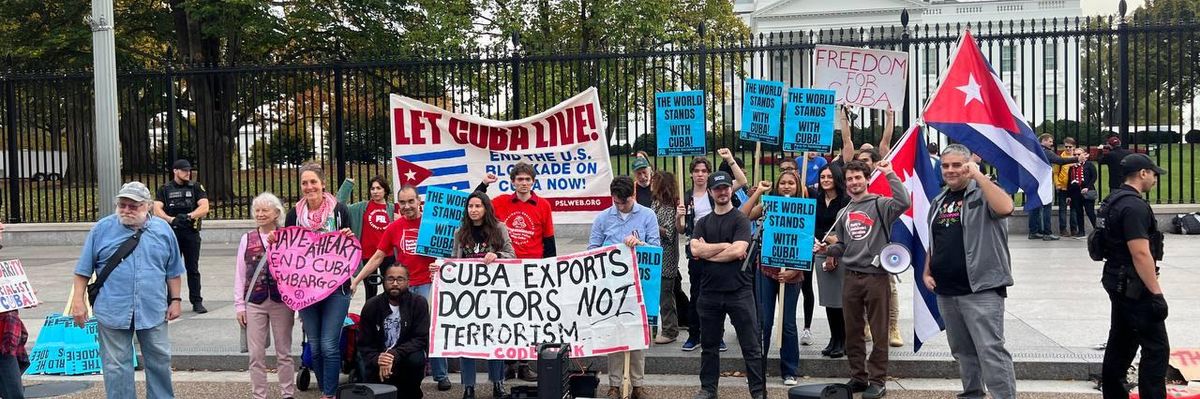
CodePink led a November 2, 2022 rally against the U.S. economic blockade of Cuba outside the White House in Washington, D.C.
(Photo: CodePink)
Brett Wilkins
Jan 14, 2025
COMMON DREAMS
In a move likely to be reversed by the incoming Trump administration, President Joe Biden on Tuesday notified Congress of his intent to remove Cuba from the U.S. State Sponsors of Terrorism list, a designation that critics have long condemned as politically motivated and meritless.
Noting that "the government of Cuba has not provided any support for international terrorism" and has "provided assurances" that it will not do so in the future, the White House said in a memo that the Biden administration is moving to rescind the first Trump administration's January 2021 addition of Cuba to the State Sponsors of Terrorism (SSOT) list and take other measures to ease some sanctions on the long-suffering island of 11 million inhabitants.
Cuba's SSOT designation was based mostly on the socialist nation's harboring of leftist Colombian rebels and several U.S. fugitives from justice for alleged crimes committed decades ago, even though no other country has been placed on the SSOT list for such a reason and despite right-wing Cuban exile terrorists enjoying citizenship—and even heroic status—in the United States.
"Despite its limited nature, it is a decision in the right direction and in line with the sustained and firm demand of the government and people of Cuba, and with the broad, emphatic, and repeated call of many governments, especially Latin America and the Caribbean, of Cubans living abroad, political, religious and social organizations, and numerous political figures from the United States and other countries," the Cuban Ministry of Foreign Affairs said in a statement.
"It is important to note that the economic blockade and much of the dozen coercive measures that have been put into effect since 2017 remain in force to strengthen it, with full extraterritorial effect and in violation of international law and human rights of all Cubans," the ministry added.
For 32 straight years, the United Nations General Assembly has overwhelmingly voted for resolutions condemning the U.S. blockade of Cuba. And for 32 years, the United States, usually along with a small handful of countries, has opposed the measures. Last year's vote was 187-2, with Israel joining the U.S. in voting against the resolution.
Cuba followed Biden's move by announcing it would "gradually" release 553 political prisoners following negotiations with the Catholic Church, The New York Timesreported.
Many progressives welcomed Biden's shift. Congresswoman Nydia Velázquez (D-N.Y.) said in a statement that Cuba's SSOT designation "has only worsened life for the Cuban people without advancing U.S. interests" and "has made it harder for Cubans to access humanitarian aid, banking services, and the ability to travel abroad."
"It has also deepened food and medicine shortages and worsened the island's energy crisis, especially after Hurricane Rafael," she added. "These hardships have driven an unprecedented wave of migration, leading to the largest exodus in Cuba's history."
Rep. Ilhan Omar (D-Minn.) called Biden's move "a long overdue action that will help normalize relations with our neighbor."
"This is a step toward ending decades of failed policy that has only hurt Cuban families and strained diplomatic ties," Omar added. "Removing this designation will help the people of Cuba and create new opportunities for trade and cooperation between our nations. I look forward to continuing the work to build bridges between our countries and supporting policies that benefit both the American and Cuban people."
David Adler, the co-general coordinator at Progressive International, called the delisting "far too little, far too late."
"POTUS removing Cuba's SSOT designation in the final days of his presidency only means one thing: He knew—from day one—that the designation was simply an excuse to punish the Cuban people," Adler added. "But he maintained it anyway. Sickening."
The peace group CodePink released a statement welcoming Biden's shift, but adding that "it is unacceptable that it took this administration four years to address these injustices."
"President Biden made the inhumane decision every single day to not alleviate the suffering of millions of Cubans by keeping this designation in place," the group added. "As we mark this overdue progress, we can only hope that the Trump administration does not reverse these crucial steps towards justice and diplomacy."
Trump's nominee for secretary of state, Sen. Marco Rubio (R-Fla.) is the son of Cuban immigrants and a fierce critic of Cuba's socialist government. In 2021, Rubio introduced legislation aimed at blocking Cuba's removal from the SSOT list. Trump has also tapped Mauricio Claver-Carone—a staunch supporter of sanctioning Cuba—as his special envoy for Latin America.
"Seriously? You wait until six days before leaving office to do what you promised to do during your 2020 campaign?" said one observer.
CodePink led a November 2, 2022 rally against the U.S. economic blockade of Cuba outside the White House in Washington, D.C.
(Photo: CodePink)
Brett Wilkins
Jan 14, 2025
COMMON DREAMS
In a move likely to be reversed by the incoming Trump administration, President Joe Biden on Tuesday notified Congress of his intent to remove Cuba from the U.S. State Sponsors of Terrorism list, a designation that critics have long condemned as politically motivated and meritless.
Noting that "the government of Cuba has not provided any support for international terrorism" and has "provided assurances" that it will not do so in the future, the White House said in a memo that the Biden administration is moving to rescind the first Trump administration's January 2021 addition of Cuba to the State Sponsors of Terrorism (SSOT) list and take other measures to ease some sanctions on the long-suffering island of 11 million inhabitants.
Cuba's SSOT designation was based mostly on the socialist nation's harboring of leftist Colombian rebels and several U.S. fugitives from justice for alleged crimes committed decades ago, even though no other country has been placed on the SSOT list for such a reason and despite right-wing Cuban exile terrorists enjoying citizenship—and even heroic status—in the United States.
"Despite its limited nature, it is a decision in the right direction and in line with the sustained and firm demand of the government and people of Cuba, and with the broad, emphatic, and repeated call of many governments, especially Latin America and the Caribbean, of Cubans living abroad, political, religious and social organizations, and numerous political figures from the United States and other countries," the Cuban Ministry of Foreign Affairs said in a statement.
"It is important to note that the economic blockade and much of the dozen coercive measures that have been put into effect since 2017 remain in force to strengthen it, with full extraterritorial effect and in violation of international law and human rights of all Cubans," the ministry added.
For 32 straight years, the United Nations General Assembly has overwhelmingly voted for resolutions condemning the U.S. blockade of Cuba. And for 32 years, the United States, usually along with a small handful of countries, has opposed the measures. Last year's vote was 187-2, with Israel joining the U.S. in voting against the resolution.
Cuba followed Biden's move by announcing it would "gradually" release 553 political prisoners following negotiations with the Catholic Church, The New York Timesreported.
Many progressives welcomed Biden's shift. Congresswoman Nydia Velázquez (D-N.Y.) said in a statement that Cuba's SSOT designation "has only worsened life for the Cuban people without advancing U.S. interests" and "has made it harder for Cubans to access humanitarian aid, banking services, and the ability to travel abroad."
"It has also deepened food and medicine shortages and worsened the island's energy crisis, especially after Hurricane Rafael," she added. "These hardships have driven an unprecedented wave of migration, leading to the largest exodus in Cuba's history."
Rep. Ilhan Omar (D-Minn.) called Biden's move "a long overdue action that will help normalize relations with our neighbor."
"This is a step toward ending decades of failed policy that has only hurt Cuban families and strained diplomatic ties," Omar added. "Removing this designation will help the people of Cuba and create new opportunities for trade and cooperation between our nations. I look forward to continuing the work to build bridges between our countries and supporting policies that benefit both the American and Cuban people."
David Adler, the co-general coordinator at Progressive International, called the delisting "far too little, far too late."
"POTUS removing Cuba's SSOT designation in the final days of his presidency only means one thing: He knew—from day one—that the designation was simply an excuse to punish the Cuban people," Adler added. "But he maintained it anyway. Sickening."
The peace group CodePink released a statement welcoming Biden's shift, but adding that "it is unacceptable that it took this administration four years to address these injustices."
"President Biden made the inhumane decision every single day to not alleviate the suffering of millions of Cubans by keeping this designation in place," the group added. "As we mark this overdue progress, we can only hope that the Trump administration does not reverse these crucial steps towards justice and diplomacy."
Trump's nominee for secretary of state, Sen. Marco Rubio (R-Fla.) is the son of Cuban immigrants and a fierce critic of Cuba's socialist government. In 2021, Rubio introduced legislation aimed at blocking Cuba's removal from the SSOT list. Trump has also tapped Mauricio Claver-Carone—a staunch supporter of sanctioning Cuba—as his special envoy for Latin America.
Alex Main, director of international policy at the Center for Economic and Policy Research, said Tuesday that "while this decision, which comes years after 80 members of Congress urged Biden to reverse Trump's 'total pressure' approach should have been made long ago, it is better late than never."
"Sixty years of failed policy should be more than enough, and hopefully the new administration will have the wisdom and the courage to pursue a new course, one that's in the best interest of both the U.S. and the Cuban people," Main added.
Cuba was first placed on the SSOT list by the Reagan administration in 1982 amid an ongoing, decadeslong campaign of U.S.-backed exile terrorism, attempted subversion, failed assassination attempts, economic warfare, and covert operations large and small in a futile effort to overthrow the revolutionary government of longtime leader Fidel Castro. Cuba says U.S.-backed terrorism has killed or wounded more than 5,000 Cubans and cost its economy billions of dollars.
In stark contrast, Cuba has not committed any terrorism against the United States.
Former President Barack Obama removed Cuba from the SSOT in 2015 during a promising but ultimately short-lived rapprochement between the two countries that abruptly ended when Trump took office for the first time in 2017.
"Cuba will continue to confront and denounce this policy of economic war, the interference programs, and the disinformation and discredit operations financed each year with tens of millions of dollars from the United States federal budget," the Cuban Foreign Ministry said Tuesday. "It will also remain ready to develop a relationship of respect with that country, based on dialogue and noninterference in the internal affairs of both, despite differences."
"Sixty years of failed policy should be more than enough, and hopefully the new administration will have the wisdom and the courage to pursue a new course, one that's in the best interest of both the U.S. and the Cuban people," Main added.
Cuba was first placed on the SSOT list by the Reagan administration in 1982 amid an ongoing, decadeslong campaign of U.S.-backed exile terrorism, attempted subversion, failed assassination attempts, economic warfare, and covert operations large and small in a futile effort to overthrow the revolutionary government of longtime leader Fidel Castro. Cuba says U.S.-backed terrorism has killed or wounded more than 5,000 Cubans and cost its economy billions of dollars.
In stark contrast, Cuba has not committed any terrorism against the United States.
Former President Barack Obama removed Cuba from the SSOT in 2015 during a promising but ultimately short-lived rapprochement between the two countries that abruptly ended when Trump took office for the first time in 2017.
"Cuba will continue to confront and denounce this policy of economic war, the interference programs, and the disinformation and discredit operations financed each year with tens of millions of dollars from the United States federal budget," the Cuban Foreign Ministry said Tuesday. "It will also remain ready to develop a relationship of respect with that country, based on dialogue and noninterference in the internal affairs of both, despite differences."
'Little Marco!' Protesters use Trump's slur to violently interrupt Rubio hearing
David Edwards
January 15, 2025
Several protesters were quickly escorted from the hearing room.
Trump first used the "Little Marco" slur while attacking Rubio in the 2016 Republican presidential primary.
David Edwards
January 15, 2025
RAW STORY

Senate Foreign Relations Committee/screen grab
Protesters used a slur created by President-elect Donald Trump during the 2016 presidential campaign while interrupting a nomination hearing for his would-be secretary of state.
During Sen. Marco Rubio's (R-FL) Wednesday confirmation hearing before the Senate Foreign Relations Committee, Rubio spoke about the end of the Second World War when the outburst occurred.
"And we've had forever wars ever since!" a protester shouted. "Little Marco, keep your hands off our country!"
Senate Foreign Relations Committee/screen grab
Protesters used a slur created by President-elect Donald Trump during the 2016 presidential campaign while interrupting a nomination hearing for his would-be secretary of state.
During Sen. Marco Rubio's (R-FL) Wednesday confirmation hearing before the Senate Foreign Relations Committee, Rubio spoke about the end of the Second World War when the outburst occurred.
"And we've had forever wars ever since!" a protester shouted. "Little Marco, keep your hands off our country!"
Several protesters were quickly escorted from the hearing room.
Trump first used the "Little Marco" slur while attacking Rubio in the 2016 Republican presidential primary.