Thursday, January 16, 2025

Impossible’ to protect all undersea infrastructure: NATO commander

By AFP
January 16, 2025


Investigators suspect one act of sabotage was carried out by the Eagle S
 - Copyright AFP Omar AL-QATTAA

NATO members face an “impossible task” trying to protect their vast network of critical undersea cables and pipelines from sabotage, the head of the alliance’s centre for securing the infrastructure said Thursday.

Nations around the Baltic Sea are scrambling to bolster their defences after the suspected sabotage of undersea cables in recent months.

After several telecom and power cables were severed, experts and politicians accused Russia of orchestrating a hybrid war against the West as the two sides square off over Ukraine.

NATO this week announced it was launching a new monitoring mission in the Baltic Sea involving patrol ships and aircraft, aimed at deterring any attempts to target undersea infrastructure in the region.

Danish Navy Captain Niels Markussen, director of NATO’s Maritime Centre for Security of Critical Undersea Infrastructure warned that it was not possible to stop every act of sabotage.

“You can’t put a ship over every nautical mile of pipeline or cable — it’s an impossible task,” Markussen told AFP.

“There are approximately 50,000 big ships out there worldwide and they can drop anchors and drag them over infrastructure.”

Markussen said that while the Baltic mission would not be able to stop all incidents it “will bring much more focus on it, monitoring, and a better picture of what and who is operating out there.”

“It will have a deterrence.”

– ‘Grave concern’ –

Tensions have mounted around the Baltic Sea since Russia’s invasion of Ukraine in February 2022.

In October 2023, an undersea gas pipeline between Finland and Estonia was shut down after it was damaged by the anchor of a Chinese cargo ship.

Two telecom cables in Swedish waters were severed on November 17-18 last year.

Just weeks later, on December 25, the Estlink 2 electricity cable and four telecom cables linking Finland and Estonia were damaged.

Investigators suspect the cables were damaged by the anchor of the Eagle S, a Cook Island-flagged oil tanker believed to be part of a so-called “shadow fleet” used to export Russian oil.

Investigations are ongoing into these incidents, but NATO says the spate of cases is a cause for “grave concern” and suspicions have pointed at Moscow.

Protecting underwater infrastructure has often been seen as the job of the private firms operating it, or individual countries.

But Markussen said NATO members were rapidly ramping up coordination and cooperation to try to protect their vital energy and communication links.

NATO countries are also increasingly turning to technology including artificial intelligence and underwater drones to try to tackle the threat, he said.

One first issue however has been to get a clear sense of where exactly NATO members’ undersea infrastructure lies: countries and companies have often been reluctant to share the location of strategic assets.

“We need to understand the total system of our infrastructure — what is out there and what it’s doing,” Markussen said.
Oil giant BP cuts thousands of jobs to slash costs

By AFP
January 16, 2025


British oil giant BP has announced it will cut thousands of staff jobs. 
- Copyright AFP/File STR

Alexandra BACON

British energy giant BP on Thursday said it would axe 4,700 staff jobs, or about five percent of its workforce, and is cutting thousands of contractor roles to reduce costs.

The move is part of a “multi-year programme to simplify” the group and improve performance, BP said in a statement.

It comes as BP chief executive Murray Auchincloss puts emphasis on oil and gas to boost profits, scaling back on the group’s key climate targets since taking the helm one year ago.

“We have got more we need to do through this year, next year and beyond, but we are making strong progress as we position BP to grow as a simpler, more focused, higher-value company,” he said in an email sent to employees and seen by AFP.

Speaking about the job cuts, which include more than 3,000 contractor roles, he added:

“I understand and recognize the uncertainty this brings for everyone whose job may be at risk, and also the effect it can have on colleagues and teams.”

BP, which has around 90,000 permanent staff based around the globe, indicated that more job reductions were on the horizon.

“We expect around 4,700 roles to be impacted… accounting for much of the anticipated reduction in our headcount this year,” the company said.

“We are also reducing our contractor numbers by more than 3,000 — with 2,600” positions having already ended.

The company’s share price rose around one percent in early afternoon deals on London’s top-tier FTSE 100 index, which was trading higher overall.

– Cost saving effort –

Auchincloss, who took the top job after the departure of Bernard Looney, announced last year “at least” $2.0 billion in cost savings by the end of 2026.

He added in Thursday’s statement that 30 projects have been stopped or paused since June to focus on the “highest value opportunities”.

The company is looking to boost its share price which lags behind that of other oil majors, including rivals Shell, ExxonMobil and Chevron.


BP last month said it would “significantly reduce” investment in renewable energy through to 2030, as it separated out its offshore wind operations into a standalone joint venture with Japanese power company Jera.

That echoed an announcement by rival Shell that it will no longer develop new offshore wind projects.

BP and Shell recently reported falls to their third-quarter profits and are set to announce annual results in the coming weeks.

Read more: https://www.digitaljournal.com/business/oil-giant-bp-cuts-thousands-of-jobs-to-slash-costs/article#ixzz8xYOh1qED
Canada ex-central banker Mark Carney launches PM bid


HE IS A GREEN CAPITALI$T

By AFP
January 16, 2025


Mark Carney (L) pitches himself as an outsider and an unconventional politician with strong economic chops - Copyright AFP STR

Mark Carney, the former governor of Canada’s central bank, on Thursday launched his bid to succeed Justin Trudeau as Liberal Party leader and prime minister, immediately becoming a frontrunner in the race.

The 59-year-old Harvard- and Oxford-educated economist kicked off his campaign at a hockey rink in Edmonton, Alberta where he grew up.

“I’m doing this because Canada is the best country in the world, but it still could be even better,” Carney told a crowd of supporters.

Pitching himself as an outsider and an unconventional politician with strong economic chops, he vowed to get the Canadian economy “back on track” and beat back Donald Trump’s tariffs threat.

Carney is expected to go head-to-head with his friend, former deputy prime minister Chrystia Freeland, who is scheduled to announce her leadership bid on Sunday.

Freeland’s surprise resignation in December, after clashing with her boss over how to respond to Trump’s threat to impose 25 percent tariffs on Canadian imports, precipitated a political crisis that saw Trudeau last week announce he was quitting too.


Canadian Prime Minister Justin Trudeau resigned on Monday, facing dwindling domestic political support and a possible trade war with the United States – Copyright AFP David Swanson

Whoever wins the leadership will automatically become prime minister and inherit a party that is 20 points behind the Conservatives led by Pierre Poilievre in the polls. They could also face snap elections as early as March.

A relative unknown to most Canadians, on Thursday Carney immediately went on the offensive against Poilievre, accusing him of putting forward “bad ideas, naive and dangerous ideas.”

At the same time, the former UN special envoy on climate action acknowledged that Canada’s climate measures such as a carbon levy — which Poilievre wants to scrap — have not worked for all Canadians.


Justin Trudeau has made it clear that a merger with the US is not on. — © AFP

Meanwhile, in a recent appearance on “The Daily Show” Carney playfully pushed back at Trump’s unlikely plan for Canada to become the 51st US state, telling host Jon Stewart: “We’re not moving in with you.”

“We can be friends,” he added. “Friends with benefits.”

Stewart responded that he felt like Carney was breaking up with him during the interview.

Read more: https://www.digitaljournal.com/world/canada-ex-central-banker-mark-carney-launches-pm-bid/article#ixzz8xYMBkUUW
PALEONTOLOGY

How ancient flying reptiles ruled the skies – new research

The Conversation
January 16, 2025 


The Rhamphorhynchus had a kite-shaped vane on its tail. Natalia Jagielska, CC BY-NC-SA

Scientists have long puzzled over how pterosaurs became the first vertebrates to master flight. Some pterosaur species, such as the Quetzalcoatlus were the largest known animals to ever take to the skies, with wingspans of over ten meters (on par with military aircraft like the Spitfire). My team’s new study may help solve the evolutionary mystery, revealing how a vane on the tip of their tails may have helped these ancient animals fly more efficiently.

It took some time for active flight to evolve in the natural world. The first flying animals were insects similar to dragonflies, which flapped their wings over swampy forests of the Carboniferous period (over 300 million years ago). Around 100 million years later (in a period known as the Triassic), the first bony animals, vertebrates, took to the skies. These vertebrates were pterosaurs, which dominated the skies of the Mesozoic era som 251-66 million years ago, swooping over the heads of dinosaurs.

Pterosaurs were unlike any animal known today. Imagine a flying squirrel hybridized with a lizard. All known members of this animal group order went extinct 66 million years ago and left no surviving descendants.

Their wings were made of a dynamic membrane hoisted on an elongated fourth finger and were probably covered in a fur-like outer protective layer. You might think it’s difficult to know what animals predating humanity by hundreds of millions of years looked like. And yet, technology can help us travel back in time and figuratively put flesh on the bones of extinct animals.

Our research used a new technology, Laser Stimulated Fluorescence (LSF), which helps us to see fossilised tissues invisible to the human eye. The laser stimulates different minerals and chemical traces in the fossil, making it emit colourful fluorescence and stand out against the grey rock it is encased in. It can reveal claws, beaks, skin, feathers, even delicate toepads of animals like dinosaurs that otherwise would be invisible. The final image looks like a photograph of a Jurassic roadkill.

Our team of paleontologists from the University of Edinburgh and the Chinese University of Hong Kong collected pterosaur fossils held in museums (such as the Natural History Museum in London or the National Museum of Scotland in Edinburgh) and photographed them in darkrooms, capturing the long exposure under the laser.


To our surprise, detailed images of tail membranes popped out in a handful of specimens, along with a lattice of supporting structures, never seen before. The pterosaurs we studied come from the same species, Rhamphorhynchus. Rhamphorhynchus was a moderately sized pterosaur, on par, if not a tad smaller than a modern albatross. It had a slender beaked jaw filled with needle-like interlocking teeth, perfect for squid-snatching. It soared above the lagoons of Jurassic Central Europe almost 150 million years ago.
Jurassic insights

Birds flapped into existence sometime in the Jurassic, tens of million years later than the first pterosaurs (around 130 millions of years ago). Bats were last to the race. These flying mammals took flight after dinosaur demise, appearing in the Eocene epoch, 50 million years ago.


Most flying vertebrates evolved shorter bony tails as they took to the skies. Early pterosaurs differed from other flying animals, as they sported long, thin, bony tails with a paddle-like “vane” that changed shape depending on the species and age of the animal. For example, in the early pterosaur Rhamphorhynchus, baby specimens have teardrop-shaped tail vanes. In their teenage years the vane took a kite-like shape and in adulthood it resembles a triangular heart.

The specimens studied in our research had a kite-shaped tail vane, which was filled with intersecting structures, resembling ribs and spars in an airplane wing. The internal lattice could have allowed the membrane to dynamically tense up, like sail on a ship, and limit flutter that would hinder flight performance.

As pterosaurs evolved and became lighter and larger, their tails got smaller, and eventually disappeared.

Understanding the tail function can help us understand the evolution of flight, which in turn can inspire future technologies, such as planes, drones, even tent design. We can also learn about the behavior and appearance of animals we will never be able to observe alive.

Pterosaurs were pioneers of flight, forever gone in a mass extinction. It is possible pterosaurs had many flight-aiding adaptations, which, in the fossil record, are invisible to the human eye. But with evolving technologies like the LSF we might find more clues to their aerial success and appearance. We now can see how this extinct creature could look like, live and function. A safer version of the Jurassic Park movies.

Natalia Jagielska, PhD Researcher in Geosciences , University of Edinburgh


This article is republished from The Conversation under a Creative Commons license. Read the original article.
ARACHNOLOGY

Spiders ‘smell’ with their legs – new research


The Conversation
January 16, 2025 

Male garden spider, Araneus diadematus. (Robert Adami/Shutterstock)


Spiders have always lived alongside humans, so it’s surprising how much we still don’t know about them. One long-standing mystery was related to how spiders detect smells. Now, our latest research has finally uncovered the secret.

In a study published in Proceedings of the National Academy of Sciences, we demonstrated that male spiders use olfactory hairs called wall-pore sensilla on their legs as a “nose” to detect the sex pheromones released by female spiders.

Our discovery puts an end to a decade-long search for these elusive sensilla, which have now been both identified and mapped. It also opens up opportunities for in-depth studies on the mechanism underlying spiders’ olfaction.

Although spiders – which have been evolving for about 400m years – are renowned for their vibration sense and some, like jumping spiders, for excellent vision, surprisingly little is known about their sense of smell. There has been plenty of evidence showing that spiders can detect odours such as sex pheromones, but two big questions remained unanswered.

First, as spiders do not have antennae as insects, what is their primary olfactory organ? Second, previous studies suggested that spiders lack wall-pore sensilla, the specialised structures that insects rely on for smell. Without these, how do spiders detect odors at all?

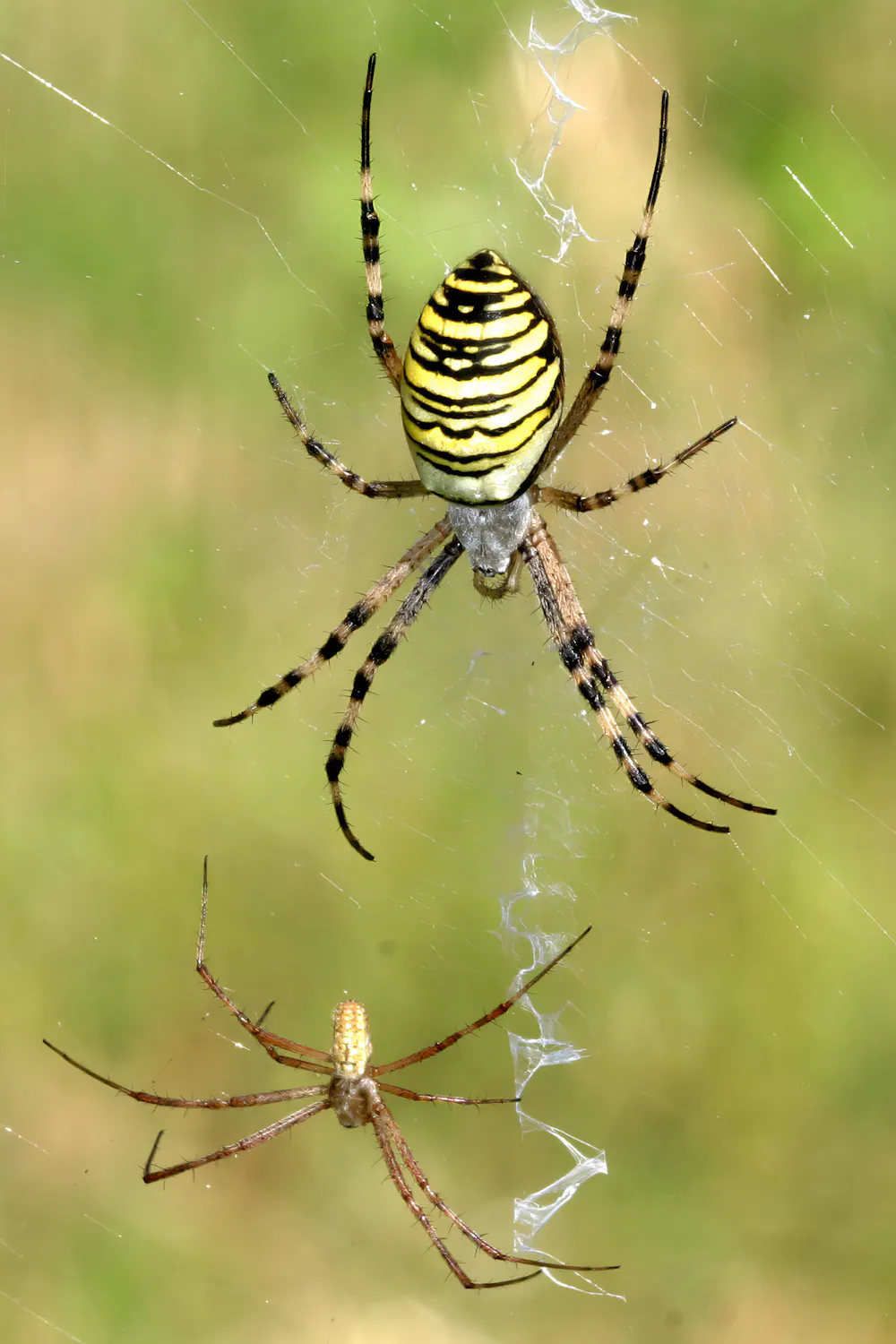
Our study has solved these long-standing questions. We discovered previously overlooked wall-pore sensilla on the walking legs of male wasp spiders (Argiope bruennichi) and demonstrated that they can use them to detect airborne sex pheromones with high sensitivity.

We showed that the wall-pore sensilla are not unique to wasp spiders but are prevalent across the spider tree of life.

Under the microscope

We examined male and female A. bruennichi spiders by high-resolution scanning electron microscopy. We discovered thousands of wall-pore sensilla on all walking legs of male spiders and revealed specific features of these sensilla. In fact, they are different from those found in insects and other arthropods.


Male (bottom) and female (top) wasp spiders (A. bruennichi). Michael Schmitt

The wall-pore sensilla are located on the upper part of the male’s legs (close to the body), areas that hardly come in contact with the surface when spiders walk, capture preys or mate. This is complementary with the distribution of “putative gustatory sensilla” (the tip-pore sensilla) found in the lower part of legs, which frequently make contact with the surface.


This distribution pattern already suggested the role of wall-pore sensilla in detecting airborne odors (olfaction). Interestingly, wall-pore sensilla were found exclusively in adult male spiders, not in juvenile males or females, which strongly indicates their function in mate searching and recognition.
Evidence of neuronal activities

A. bruennichi is one of the few spider species in which the chemical structure of the sex pheromone has actually been identified. Female spiders release gaseous pheromones that attract males from a distance.

We decided to test whether the wall-pore sensilla respond to the pheromone compound. In these experiments, we carefully mounted live male spiders under a microscope and poked a recording electrode into the base of single wall-pore sensilla.

We then exposed each sensillum to a puff containing the pheromone compound. We found that even a tiny amount of the pheromone compound — just 20 nanograms — was sufficient to elicit a clear response as a burst of activity in neuronal cells from a wall-pore sensillum, and the response became stronger as the dose increased. We consistently observed the response of wall-pore sensilla to the pheromone compound, regardless of which leg pair was tested.

Our results show that spiders’ olfactory sensilla are incredibly sensitive, comparable to the most sensitive sex pheromone communication systems in insects. The thousands of sensilla on all walking legs will enable male spiders to detect even the faintest traces of sex pheromones in the air.

Other species


To explore the broader presence of wall-pore sensilla, we examined 19 additional species spanning 16 families across the spider tree of life. We found that wall-pore sensilla occur in most species, and were also specific to males.

However, the sensilla are absent in basally branching spider groups such as the basal trapdoor spiders found in Asia. The pattern we found suggests that wall-pore sensilla evolved independently multiple times within spiders and were lost in some lineages.


Our study paves the way for exciting future discoveries about how spiders perceive the world through olfaction. Many intriguing questions await further investigation.

How do female spiders smell without wall-pore sensilla? And beyond sex pheromones, what other chemicals can spiders detect and how are these relevant to their behavior and ecology? Also, what is the molecular and neural basis of spiders’ olfaction? Finally, how has the sense of smell evolved across the vast diversity of spider species?

These questions set the stage for an exciting new chapter in our understanding of spider biology.

Dan-Dan Zhang, Researcher of Sensory Biology, Lund University


This article is republished from The Conversation under a Creative Commons license. Read the original article.
Trump allies say FBI failed to stop New Orleans attack due to focus on white supremacy

Jordan Green, Investigative Reporter
January 16, 2025
RAW STORY

REUTERS/Eduardo Munoz

In the aftermath of the ISIS-inspired terror attack committed by a man who plowed his truck through a crowd of New Year’s Eve revelers and killed 14 people in New Orleans, some of Donald Trump’s allies have suggested the FBI failed to prevent the attack because the agency was too focused on white supremacist investigations.

The criticism leveled at the FBI by Kimberly Guilfoyle, who has received an appointment to serve as ambassador to Greece, and Steve Bannon, the former White House strategist, on Jan. 2 compounds a series of social media posts by the president-elect suggesting that lax security at the border enabled the attack. The rhetoric by the president-elect and his allies ignored the fact that the attacker, Shamsud-Din Jabbar, was a U.S. citizen and Army veteran who lived in Houston.

Guilfoyle piled onto the president-elect’s rhetorical conflation of Islamic extremism with unauthorized border crossings, where no such connection exists, in a commentary opening her show on the streaming video platform Rumble one day after the attack.

“This terror attack follows years of Joe Biden’s open border, allowing countless terrorists to flood across our border,” Guilfoyle said. “This is a scary reminder that the threat of Islamic terrorism is active. But DHS Secretary Alejandro Mayorcas thinks the problem is white supremacy.

“It’s fun to mock and laugh at woke politics, but the consequences of liberal lunacy can be deadly,” she added.

Bannon, for his part, said on the Jan. 2 edition of his “War Room” podcast devoted to the New Orleans attack: “One of the issues is that the apparatus thinks that the MAGA base is the problem. They think their collection of radicalized white nationalists, white separatists — I don’t know what they’ve concocted — but that’s the problem [FBI Director Christopher] Wray’s been focused on.”

The FBI did not respond to a request to comment on this story.

Elizabeth Neumann, who served as assistant secretary for threat prevention and security policy at the Department of Homeland Security during the first Trump administration, told Raw Story that Guilfoyle and Bannon’s conclusions about the New Orleans attack ignore the data on terrorist acts committed on U.S. soil and what researchers know about what is most effective in disrupting terror attacks.

“I’m not seeing an FBI that is ignoring the threat,” she said. “I’m seeing an FBI that has caught up to the fact that we also have threats from domestic violent extremists, which include white supremacists and anti-government extremists. They are the most lethal of the bunch.”

Guilfoyle and Bannon both turned to critics of the FBI to unpack the circumstances surrounding the New Orleans attack.

Guilfoyle interviewed Kyle Seraphin, a former special agent suspended from the agency. Seraphin revealed an internal FBI memo that provided the basis for a congressional report by House Republicans accusing the agency of abusing its authority to target Catholics as potential domestic terrorists.

Seraphin told Guilfoyle that, in his view, the FBI “got upside down” by “putting political priorities on your intelligence gathering — when you say white supremacy is the biggest threat to the homeland, and you start ignoring the real danger that we used to know about, starting on September 12th of 2001, which is called international terrorism.


“They got ahead of their skis, and they went after the convenience, and they forgot to go after the real thing, which has caused a lot of damage; it’s killed far more people in the last 25 years in America. Right?” Seraphin said. “It’s the reason we went to war and were there for two decades. And they let all these people in and they allowed something to happen that had no business happening in the first place, because they got their eye off the ball and they politicized intelligence collection.”

Seraphin’s claim that Islamic extremists are responsible for the highest number of fatalities in the past 25 years is correct, considering the catastrophic Sept. 11, 2001 attack that took 2,980 lives, not counting the attackers. But jihadi-inspired terrorism peaked in 2016 with the Pulse Nightclub shooting, while white supremacist attacks steadily increased from 2012 through 2019 and have remained a persistent challenge. (Another aspect of his statement is contradicted by the fact that the U.S. government did not “let in” Shabbar, who is a citizen.)

Prior to Shabbar’s attack, there hadn’t been a lethal Islamic extremist attack on U.S. soil since 2019, Jon Lewis, a researcher at the George Washington University’s Program on Extremism, confirmed. In December 2019, Mohammed Saeed Alshamrani, a member of the Royal Saudi Air Force studying at Naval Air Station Pensacola, fatally shot three U.S. sailors at the base.


Seraphin responded to a request for an interview by commenting on X about Raw Story’s efforts to reach him. He proposed doing an interview in an X thread or on a publicly streamed X space. Raw Story declined to agree to the interview under Seraphin's conditions.

On his show, Bannon interviewed retired Army Col. Derek Harvey, who served as a senior aide to former Rep. Devin Nunes (R-CA), the chairman and later ranking member of the House Intelligence Committee. Under Nunes’ leadership, the Republicans on the committee aggressively challenged the FBI’s 2016 investigation into potential linkages between the Trump campaign and Russia. Nunes brought on Kash Patel to investigate the matter on behalf of the committee. Now, Patel is set to assume leadership of the FBI.

Echoing Seraphin’s criticism, Harvey told Bannon: “When you look at what the FBI and the [intelligence community] have been doing, they’ve been focused on the wrong targets.


Harvey suggested the FBI should be focusing on the Muslim Brotherhood, a group that President-elect Trump unsuccessfully sought to designate as a foreign terrorist organization during his first administration.

“And we’ve got sophisticated networks coordinated by the Muslim Brotherhood, financed by Qatar and other outside entities, influencing mosques, recruiting and placing imams that are denying the legitimacy of the U.S. Constitution and indoctrinating people into hating the U.S. Constitution and America,” Harvey said.

Harvey did not present any evidence that the Muslim Brotherhood has helped facilitate any terror attacks on U.S. soil or is actively planning any attacks, and he could not be reached for comment for this story.


“The rampant disinformation and false narratives in the aftermath of the New Orleans attack are part of continued, broader efforts to stoke anti-immigrant hatred and promote anti-government conspiracies which undermine the legitimacy of the FBI,” Lewis, the research fellow at Project on Extremism, said in an email to Raw Story. “These claims — that the suspect had recently crossed the border, or that the FBI was hiding evidence and ‘lied about it to the world’ — are dangerous and have repeatedly served as inspiration for lone actors seeking justification to commit acts of violence.”

Neumann, the former Department of Homeland Security official, told Raw Story that Guilfoyle and Bannon’s commentary appears to be calculated to advance a specific political agenda.

“They’re trying to prepare the case for Trump to do drastic actions at the border and implement the third version of the travel ban,” she said. “They need to say scary people are coming across the border.”

Those who have carried out significant jihadi-inspired terror attacks on U.S. soil since Sept. 11, 2001, have come from a range of backgrounds, from citizens to immigrants who were lawfully present in the United States.


The travel ban ordered by Trump when he took office in early 2017 likely stemmed from an ISIS-inspired terror attack carried out by Syed Rizwan Farook and Tashfeen Malik, a couple who opened fire and killed 14 people at a Christmas party in San Bernardino, Calif. in December 2015.

Farook was an American citizen of Pakistani descent, while his wife was a green card holder from Pakistan who had lived in Saudi Arabia. In response to the attack, Trump called “for a total and complete shutdown of Muslims entering the United States until our country’s representative can figure out what the hell is going on.”

In 2017, Farook’s sister-in-law pleaded guilty to federal immigration fraud charges related to a sham marriage with a man who would later admit to conspiring with Farook to plan two earlier terror attacks that were not ultimately carried out.


Prior to the San Bernardino attack, the deadliest jihadi-inspired attack on U.S. soil since Sept. 11, 2001, was carried out by Nidal Hassan, a U.S. citizen and U.S. Army major. Hassan opened fire at the Soldier Readiness Processing Center at Fort Hood in Texas and killed 13 soldiers in November 2009.

Tamerlan and Dzokar Tsarnaev, the brothers who carried out the Boston Marathon attack in 2013 while reportedly obtaining bomb-making instructions from an online magazine published by al-Qaeda in the Arabian Peninsula, were both born in the Russian republic of Dagestan.

Muhammad Youssef Abdulazeez, who shot dead four Marines at military recruiting centers in Chattanooga, Tenn. in July 2015 and was also believed to have been inspired by al-Qaeda in the Arabian Peninsula, was born in Kuwait and moved to the United States with his family as an infant.


Esteban Santiago, who killed five people in a shooting at the Fort Lauderdale-Hollywood International Airport on behalf of ISIS, is an American citizen who was born in New Jersey.

Sayfullo Saipov, who killed eight people in an ISIS-inspired vehicular attack in New York City in October 2017, is an Uzbeki national who had emigrated to the United States seven years earlier and became a legal permanent resident.

Trump’s original travel ban, issued in March 2017, targeted Iran, Iraq, Libya, Somalia, Sudan, Syria and Yemen, but Pakistan, Russia, Kuwait or Tajikistan were not on the list.

Most of the Islamic extremist attacks carried out in the 2010s fell under the FBI’s “homegrown violent extremists” rubric, which is distinct from the “domestic violent extremists” framework that includes white supremacist, anti-government and anarchist extremist threats monitored by the FBI.

Seraphin argued on Guilfoyle’s show that FBI leaders embraced the “domestic violent extremist” framework because they ran out of jihadis to investigate.

“Once you run out of HVEs, you’re already looking within your own house for terrorism,” Seraphin said. “And they still had to justify this budget. And it’s my belief that that’s when they pivoted from HVE to DVE. Those are domestic violent extremists. Those are you and me. Those are MAGA people. Those are anti-government, anti-authority, violent extremists. It’s the fake white supremacy threat that’s always out there.”

Seraphin didn’t mention that the FBI and the Department of Homeland Security started to take notice of white supremacist terrorism during the first Trump administration.

“It’s not like it was the Biden administration that pivoted,” Neumann told Raw Story. “It was a counterterrorism aha moment. I have said that it was too late…. We had this aha moment in 2018 and 2019. It was the Pittsburgh synagogue shooting, the Christchurch massacre in New Zealand, and then we had El Paso. We were grappling with this as a community for over a year. We realized we had a big problem.”

Robert Gregory Bowers, who fatally shot 11 Jewish worshipers at the Tree of Life synagogue in Pittsburgh in October 2018, had complained on social media prior to the attack that a nonprofit called Hebrew Immigrant Aid Society “likes to bring invaders in that kill our people.”

He said: “I can’t sit by and watch my people get slaughtered. Screw your optics, I’m going in.”

In March 2019, an Australian national named Brenton Tarrant fatally shot 51 Muslim worshipers at two mosques in Christchurch, New Zealand, leaving behind a manifesto that promoted the white supremacist conspiracy theory known as “Great Replacement.”

The Christchurch massacre and “Great Replacement” were cited as an inspiration by Patrick Crusius, who drove more than 650 miles to carry out a mass shooting at Walmart in El Paso, Texas, killing 23 people in August 2019. Crusius said in his own manifesto that he was concerned about a “Hispanic invasion.”

More than two years later, Payton Gendron would also cite Christchurch and “Great Replacement” as inspiration when he fatally shot 10 Black people at the Tops grocery store in Buffalo, N.Y. In a diary detailing planning for the attack, Gendron revealed that he selected the target based on the ZIP code that had the highest concentration of Black people proximate to where he lived.

Neumann’s assessment of the evolving nature of the threat of terrorism was shared by her former boss, Chad Wolfe, who served as acting secretary of homeland security at the end of the first Trump administration.

In a Homeland Threat Assessment released in October 2020, Wolfe declared that “domestic violent extremism is a threat to the homeland.” He added that he was “particularly concerned about white supremacist violent extremists who have been exceptionally lethal in their abhorrent, targeted attacks in recent years.”

While the FBI has recalibrated to meet the threat posed by white supremacists, Lewis said it’s not as though the agency ever stopped investigating Islamic extremists.

“In reality, counterterrorism is not and cannot be an either-or proposition,” he said. Lewis said 10 ISIS supporters were arrested in the United States last year, and the FBI has “made it clear that ISIS is an enduring homegrown threat,” adding that “law enforcement is more than capable of fighting numerous forms of violent extremism simultaneously.”

Regardless of whether it’s white supremacy or radical Islam, Neumann said if law enforcement is only focused on ideology, they’ll miss the opportunity to disrupt terror plots.

“Whether you’re inspired by ISIS or inspired by a militia or antifa, the underlying psycho-social factors of potential perpetrators show a lot of similarities,” Neumann said. Noting the commonalities of factors such as job loss, divorce and addiction among terrorists, she said that the motivation for terrorism often “boils down to loss of significance and belonging.”

While it’s “quite frightening” to witness the first jihadi-inspired attack in five years, Neumann said, “If we want to stop this, we have to focus on what all the research tells us — that we need to build the capability for bystanders to recognize there are concerning signs and get that person into appropriate care and treatment.”

Jordan Green is a North Carolina-based investigative reporter at Raw Story, covering domestic extremism, efforts to undermine U.S. elections and democracy, hate crimes and terrorism. Prior to joining the staff of Raw Story in March 2021, Green spent 16 years covering housing, policing, nonprofits and music as a reporter and editor at Triad City Beat in North Carolina and Yes Weekly. He can be reached at jordan@rawstory.com. More about Jordan Green.
'Chaos': Frantic scenes as immigrants rush ICE office before Trump takes office

Jennifer Bowers Bahney
January 16, 2025 


Abigail Suarez, a Venezuelan migrant, holds her daughter, as she speaks during an interview with Reuters, in Riohacha, Colombia December 2, 2024. REUTERS/Luisa Gonzalez TPX IMAGES OF THE DAY

A news station in Charlotte, NC, reported "extraordinarily long lines" at the city’s Homeland Security Office as migrants desperately tried to have their cases heard before Donald Trump takes office on Monday.

Trump has vowed to begin deporting undocumented migrants immediately, claiming at one campaign rally, "On day one, I will launch the largest deportation program in American history to get the criminals out.”

The Washington Post reported Thursday that while ICE "has long prioritized immigrants with criminal records, there are other subgroups that could be at a higher risk of deportation. They include millions of newcomers who arrived during the record border influx under President Joe Biden, as well as those who have exhausted their legal appeals but haven’t left the United States."

Reporter Joe Bruno with WSOC-TV posted a photo of the long lines to social media, writing, "Chaos in southwest Charlotte as hundreds of people try to get into the ICE office to have their cases heard ahead of President Donald Trump taking office on Monday. Some people have been sleeping in the parking lot trying to get a walk-in appointment."

Video on the news station's website showed people covering up with blankets as they waited in the 22-degree weather.

"A few of the people we spoke with said they’ve tried for the past few days to get in to have their hearings and were turned away," said reporter Eli Brand. "One man told Channel 9 this is his third try since his original hearing date of Jan. 9. He got to the building at 3 a.m. Thursday to make sure he was near the front of the line. Even then, he was behind a few dozen people."

U.S. Immigration and Customs Enforcement (ICE) told WSOC in a statement, "they believe there’s a longer backlog after office closures for the holidays and the National Day of Mourning for the death of former President Jimmy Carter. They also said they’ve seen multiple people from other states showing up to try and get hearings."

Brand spoke to one man who said, “It says on my paperwork, if they tell me to surrender for removal, I have to surrender. There would be no one standing and fighting for my case saying, ‘no he was here!’ There’s no one here who can vouch for me other than these people standing in line.”

Read and watch the WSCO report here.


'It’s ugly': Tape surfaces of Tulsi Gabbard's 'spiritual guru' spewing antigay slurs

LIKE THE LEADER OF THE GALUN FONG
Matthew Chapman
January 16, 2025 

Tulsi Gabbard (Reuters)

PSEUDO HINDUISM


A "spiritual guru" behind a tiny religious group that former Hawaiian Rep. Tulsi Gabbard — Trump's pick for director of national intelligence — belonged to spewed hateful invective and slurs against LGBTQ people, The Daily Beast reported Thursday.

The guru, Chris Butler, headed up the Science of Identity Foundation, a self-described Hindu group in Hawaii and a splinter faction of the Hare Krishna movement.

"Butler, who has taken the name Jagad Guru Siddhaswarupananda Paramahamsa and is addressed as 'Jagad Guru,' is estimated by some former members to have as many as 10,000 followers," reported Daniel Bates and Emell Derra Adolphus. "'Jagad Guru' means 'teacher of the world' and also that he is the ultimate authority to his followers."

The tapes, which date back to a period in which Gabbard was in the group, show Butler calling gay people "perverts," liberally using the slurs "f----t" and "dy-e," and comparing same-sex relations to having “sex with fire hydrants.”

He particularly raged against anti-discrimination laws that protect LGBTQ people.

"You have to go to court and be asked: 'Are you prejudiced against fairies? Are you prejudiced against dy--s? Are you prejudiced against people who have sex with fire hydrants?' You go, 'Oh no, I think it’s perfectly normal, I promise.' Whatever! If you say it’s quite abnormal for a man to have sex with another man, I think it’s sinful, I think it’s ugly, I think it’s unhealthy, I think it’s unnatural. Why? Is there a law against that? As a matter of fact there is!" He went on to describe sex acts in explicit detail and denounced them as not "normal."

Hindu doctrine does not take a firm position either way on same-sex relationships, with some followers and clerics both in support and opposed to acceptance.

Gabbard, who attended a boarding school affiliated with the group and whose father ran a group opposed to gay rights, had an anti-gay platform when she first ran for office as a Democrat. She later disavowed these positions in office. The Trump campaign, asked for comment, has denounced any questions about Gabbard's affiliation with the group as "bigoted."

All of this comes as Gabbard faces deep opposition from national security experts, and even skepticism from some Republicans, over her lack of experience in the intelligence community and her embrace of pro-Russia conspiracy theories. She has tried to assuage GOP fears by reversing her opposition to a key surveillance program.


Herbicide under U.S. scrutiny over potential Parkinson's link

Agence France-Presse
January 16, 2025 

An undated photo of David Jilbert, a Parkinson's patient, shows him spraying his Ohio vineyard with herbicides (Handout)

by Issam AHMED

First came the slow hand movements, then the tremor, and now the looming fear of what lies ahead.

David Jilbert's devastating Parkinson's diagnosis three years ago changed his life irrevocably.

It's a condition the 65-year-old farmer believes he wouldn't have if it weren't for paraquat, a herbicide he once relied on to control weeds in his vineyard in the midwestern US state of Ohio.
USED IN THE VIET NAM WAR TO CLEAR JUNGLE

"Now it's not just about me, I'm part of this community -- let's get something going," Jilbert said during a recent hearing in the US Congress where he was joined by others claiming the same link.

Banned in more than 70 countries -- including Britain, where it is manufactured; Switzerland, home to the Syngenta company that owns the brand; and China, where the state-run conglomerate that owns Syngenta is based -- paraquat remains available in the United States.

The US Environmental Protection Agency (EPA) has long maintained that the herbicide is safe for use under strict regulations -- something Parkinson's advocates vehemently disagree with and are pressing to change.

The agency is set to issue a final report on the issue by January 17 -- this Friday -- after considering 90 new scientific studies submitted by the Michael J. Fox Foundation.

- Maker denies causation -

"We have great sympathy for those suffering from the debilitating effects of Parkinson's disease," a spokesperson for Syngenta said in a statement to AFP.

"However, it is important to note that the scientific evidence simply does not support a causal link between paraquat and Parkinson's disease, and that paraquat is safe when used as directed."

Multiple credible studies have found that agricultural workers who handle paraquat -- or live near areas where it is applied -- face a higher incidence of Parkinson's disease, which can eventually turn even the simplest movements into daunting challenges.

Animal research further underscores paraquat's toxic effects on nerve cells, although proving direct causation for individuals affected by Parkinson's remains difficult.

"I find it extraordinarily frustrating that the chemical companies have hidden behind the concept of being able to show causation, and they've used that as an excuse," Australia-based neurologist David Blacker said in an interview with Pesticide Action UK.

"That's where the precautionary principle comes in," he added. "If there is a doubt, especially if there are alternatives, it then becomes, in my mind, ethically and even morally unsound to continue."

- 'It's scary' -


Jilbert, a longtime environmental engineer and environmental safety inspector, dreamed of becoming a farmer after retirement.

In 2011, he purchased his land and, over the following years, began using paraquat -- often sold as Gramoxone -- to manage his weeds.


By the end of the decade, he noticed his hands moving slowly and his gait turning into a shuffle.

When his Parkinson's diagnosis finally came, he was horrified and wondered if he'd been condemned to a "death sentence."

His condition is more manageable for now, thanks to medications, but he said he feels disappointed in his own government for not looking out for him.


"You think if you use the stuff in the way the label tells me to use it, then I'm not going to get sick," he said.

Like Jilbert, 85-year-old Charlene Tenbrink -- who owns a 250-acre farm in Dixon, California -- also trusted that the chemicals available to farmers were safe when handled properly.

She sprayed paraquat on her prune trees in the 1990s and was diagnosed with Parkinson's in 2020.

Tenbrink, Jilbert and thousands of others are now suing Syngenta in federal and California state courts.


Sarah Doles, a lawyer and co-lead for that federal litigation, compared it to the cases against Big Tobacco.

She contends Syngenta had an obligation to disclose harms it knew about paraquat from research going back decades, but hid from consumers.

"It's a legal duty of what they knew and then failed to do -- they concealed the information," she told AFP.


Regardless of which direction the EPA rules, these legal cases will continue.

Tenbrink said it's vital to get the product off the market, and admits she's terrified for her own future.

"This is a terrible disease and we know there's no cure, we know it's going to get worse. It's scary," she said.


© Agence France-Presse
'Damning' New Poll Shows Price Kamala Harris Paid for Backing Israeli Genocide in Gaza


"Israel is a liability," said one Palestinian-American rights advocate.


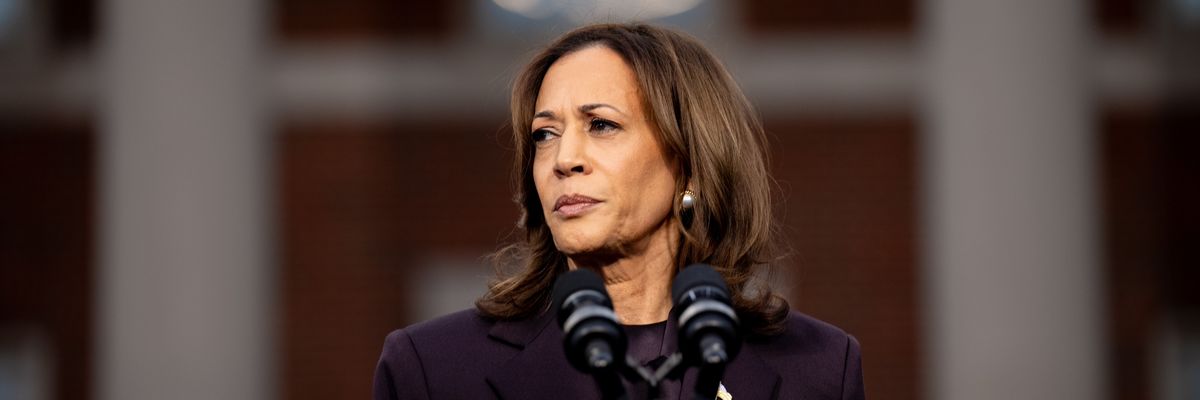
U.S. Vice President Kamala Harris makes her concession speech after the 2024 presidential election at Howard University on November 6, 2024 in Washington, D.C.
(Photo: Andrew Harnik/Getty Images)

Julia Conley
Jan 15, 2025
COMMON DREAMS

As a cease-fire and hostage release deal was reportedly reached between Hamas and Israel on Wednesday, new polling made it clearer than ever that Vice President Kamala Harris' refusal to break with the Biden administration's position on Israel's relentless assault on Gaza had an impact on her support from voters, and contributed to millions of potential Democratic voters deciding to stay home on Election Day.

A YouGov poll backed by the Institute for Middle East Understanding (IMEU) Policy Project and released on Wednesday showed that among the 19 million people who voted for President Joe Biden in 2020 but did not vote in 2024, nearly a third named Israel's U.S.-backed war on Gaza as a top reason for staying home.

"The top reason those non-voters cited, above the economy at 24% and immigration at 11%, was Gaza: a full 29% cited the ongoing onslaught as the top reason they didn't cast a vote in 2024," wrote Ryan Grim at Drop Site News, the first outlet to report the news.

In states that swung from Biden in 2020 to President-elect Donald Trump in 2024, 20% of non-voters said Gaza was the reason they didn't cast a ballot in November.

After replacing Biden as the nominee in July, Harris faced pressure—as the president had—to take decisive action to end U.S. support for Israel's assault on Gaza, which has now killed more than 46,000 Palestinians, the majority of whom have been civilian men, women, and children.

Advocates called on Harris to support an arms embargo on Israel—one that would have placed the U.S. in compliance with its own laws, such as Section 620I of the Foreign Assistance Act, which bar the government from providing military aid to any country that is blocking U.S. humanitarian aid.

The U.S. has made more than 100 military transfers to Israel since it began bombarding Gaza in October 2023 in retaliation for a Hamas-led attack. Israel's near-total blockade on humanitarian aid has left parts of the enclave facing famine, according to the World Food Program and international experts.

"We want to support you, Vice President Harris, and our voters need to see you turn a new page on Gaza policy that includes embracing an arms embargo to save lives," one leader of the Uncommitted National Movement told Harris at an event in August. At the same event, the vice president accused protesters who chanted, "We won't vote for genocide!" of wanting "Donald Trump to win."

At Drop Site News, Grim wrote that Harris later emphasized, "I am not Joe Biden" and insisted that her presidency "not be a continuation of Joe Biden's presidency" because of her "life experiences, [her] professional experiences, and fresh and new ideas"—but she continued to back the White House's position on the bombardment of Gaza.

"Of course, diverging from Biden on Gaza risked losing voters who supported his policy," wrote Grim. "But a close look at the survey suggests that risk was low compared to the potential reward."

YouGov asked voters who turned out for Harris and had also backed Biden in 2020 whether a shift away from the White House policy on Israel and Gaza would have made them more or less likely to vote for Harris.

"By a 35 to 5 margin, they said doing so would have made them more enthusiastic to vote for her, with the remainder saying it would have made no difference," reported Grim.

Huwaida Arraf, a Palestinian-American who co-founded the International Solidarity Movement, said the "damning new poll" shows that "Israel is a liability."


Grim noted some caveats, pointing out that "even if October 7 and the resulting genocide had never happened, it's fair to assume some number of those non-voters still would not have voted, and would have cited a different top reason for not voting."

"Still, even the most biased poll can only manufacture so much of a response," wrote Grim. "Even if the true numbers aren't as stark as this survey found, it points in a clear direction: Biden's ruthless support for Israel's genocide, and the refusal of Democratic presidential nominee Kamala Harris to break with him, hurt her among voters who stayed home."

The IMEU Policy Project called on the Democratic Party to "come to terms with the real reasons it lost the presidency in November, including because after over a year of unprecedented protests and calls for Biden to stop sending weapons to Israel, party leadership failed to listen to its own voters."


"As the Democratic Party looks for its future leaders in 2028 and beyond," said the organization, "they need to understand that voters they lost in 2024 overwhelmingly say they would prefer to support officials who have opposed sending more weapons to Israel."