Thursday, January 23, 2025

Bulgarian sailors return home after being freed by Yemen's Houthis

January 23, 2025 

MEMO


The skipper of the cargo ship Galaxy Leader, Lyubomir Chanev is seen at Sofia Airport with his family on 23 January 2025 in Sofia, Bulgaria. [Hristo Vladev – Anadolu Agenc

Two Bulgarian sailors and a Romanian crew member returned home after being held for 14 months by Yemen’s Houthis, receiving a warm welcome from their families and officials at Sofia airport on Thursday, Reuters reports.

The trio were part of the 25-member international crew of the vessel, “Galaxy Leader”, that the Houthis seized off Yemen’s Red Sea coast more than a year ago.

They were released on Wednesday and handed to Oman following the three-day-old ceasefire in Gaza’s war between Israel and Palestinian group, Hamas, Houthi-owned Al Masirah TV reported.

Captain Lyubomir Chanev and First Officer, Danail Veselinov, arrived in Sofia aboard a government airplane that was sent to pick them up from Muscat in Oman on the order of Prime Minister, Rosen Zhelyazkov, local media reported.

Galaxy Leader Crew Released After 14 Months Captivity by Houthis
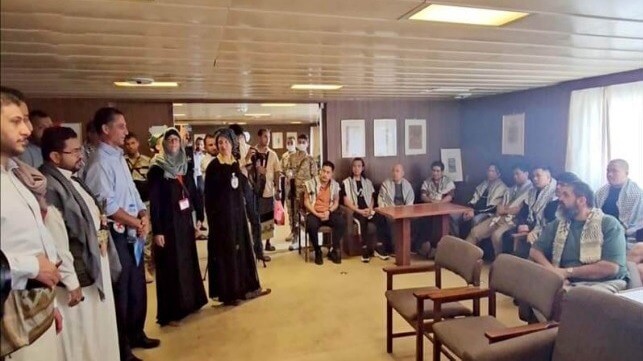
Galaxy Leader crew
Crew of the Galaxy Leader was released to negotiators from Oman (Al Masiarh TV)

Published Jan 22, 2025 9:34 AM by The Maritime Executive


The governing body of the Houthi movement released a statement first reported by Al Masirah TV confirming the crew of the car carrier Galaxy Leader has been released. The crew was held for nearly 14 months by the Houthis which said it was “port of the battle to support Gaza.”

The Supreme Political Council issued a brief statement today, January 22, announcing the release which had been rumored as imminent in recent days.  According to the statement, the release came after “communication” with the Hamas movement in Gaza and efforts by negotiators in Oman. 

The Houthis said the release “comes in support of the ceasefire agreement in Gaza.” The rebels committed to supporting the truce negotiated by Oman, Egypt, and the United States but warned any violations could prompt further attacks. The Houthis released a statement on Sunday, January 19 saying they would permit the passage of foreign vessels in the Red Sea while continuing to target ships linked to Israel.

Al Masirah TV released images of the crew reportedly during the handover to representatives from Oman. The crew consists of 25 people from the Philippines, Bulgaria, Romania, Ukraine, and Mexico. It is believed the crew will travel to Oman but no details were announced on the repatriation. 

The Galaxy Leader was the first vessel attacked by the Houthis with their forces boarding the car carrier on November 19, 2023, while it was under charter to Japan’s NYK and sailing without cargo to India. The Houthis cited the Israeli-linked ownership interests of the ship's commercial operator, UK-based Ray Car Carriers, as the reason for the seizure of the vessel and its crew. The vessel was diverted to an anchorage near Hodeidah, Yemen where it became a public spectacle including a visit by the Houthi military to “welcome the crew to Yemen.”

The Philippines and other nations as well as the IMO and other shipping organizations made repeated appeals for the release of the crew. They highlight their nationalities while saying the crew had no direct involvement in the conflict. The Philippines which had the majority of the crewmembers aboard the vessel repeatedly said the situation was complicated by “politics” warning it was likely to be a drawn-out process for the crew’s release.

IMO Secretary-General Arsenio Dominguez immediately released a statement today saying, “This is a moment of profound relief for all of us - not only for the crew and their families, but also to the wider maritime community... Today’s breakthrough is a testament to the power of collective diplomacy and dialogue, recognizing that innocent seafarers must not become collateral victims in wider geopolitical tensions.”

The Galaxy Leader (17,127 dwt) was built in 2002. The vessel is registered in the Bahamas. Today’s statement made no mention of the release of the vessel.


Mysterious Airfield Near Houthi Hot Zone Gets First Aircraft

Abd al Kuri Airfiled, October 14 (Sentinelhub)

Published Jan 22, 2025 1:34 PM by The Maritime Executive


The runway at the mystery airfield on the Yemeni island of Abd Al Kuri remains enigmatically incomplete, with the gap at the northern end of the runway still extant as of January 22, 2025. However, the airfield may have had its first visiting aircraft. Early on January 17, what appears to be a medium-sized winged aircraft was parked on the apron in front of the small terminal building.  It was aligned with nose wheel guidelines for parking aircraft. 

With a wingspan of approximately 25 meters, if it was an aircraft it was not a C-17 or C-130, but bigger than a Twin Otter. It could possibly be a C-295 short take-off and landing aircraft used both for transport and maritime surveillance missions, for which the 1800 meters of completed runway would have been more than sufficient. Higher resolution satellite imagery will no doubt provide a more reliable answer on aircraft activity in due course.

Although the Gaza ceasefire has generated a statement from the Houthis that in the future, they will restrict their attacks on shipping to vessels that are either Israeli-flagged or owned, tensions remain high in the area while the true intentions of the Houthis become clear. The larger shipping companies in particular are likely to be cautious about re-routing vessels through the Suez Canal until the situation in Gaza becomes clearer. But recent air strikes on Houthi infrastructure have been significantly more damaging than attacks last year, and the ceasefire may have provided an off-ramp for the Houthis, which they were likely seeking.

Western countries appear to be taking no chances. The latest assessed plot of naval forces present in the region shows a heavy presence of naval vessels in the Internationally Recommended Transit Corridor to the north of Abd Al Kuri and Socotra. The Commander US Navy Central Command has also confirmed that the Iranian IRGC spy ship MV Behshad has also returned to the Gulf of Aden area, escorted by IRINS Alborz (F-72) and IRINS Bushehr (422) from the Iranian Navy’s 100th Naval Flotilla.


UN Confirms Level of Damage to Yemen’s Ports

damage Yemen port
Damage after the Israeli strikes on December 19 (Houthi media)

Published Jan 22, 2025 2:40 PM by The Maritime Executive


Officials from the Untied Nations provided the first independent confirmation to the level of damage that has been inflicted on Yemen’s Red Sea ports. The officials estimated that less than a quarter of the port capacities remain available expressing concern about the ability to get relief supplies to the citizens of Yemen.

"(The) impact of airstrikes on Hodeidah harbor, particularly in the last weeks, is very important," Reuters reports Julien Harneis, U.N. resident and humanitarian coordinator in Yemen, told a U.N. meeting in Geneva on Tuesday, January 21. Harneis did not assign responsibility for the damage but warned it would impede the efforts to delivery food and fuel to Yemen. 

Reports from Yemen indicate there is about two months of cereal and fuel inventories in the ports. UN officials have been working with the local authorities attempting to maintain aid and had a long-term plan to repair damage to the Red Sea ports which have been under the control of the Houthis for a decade. In approximately 2018, the UN conducted an extensive survey of the port facilities and documents the lack of maintenance and problems that needed to be addressed.

In Hodeidah they are now saying four of the port’s five tugboats were sunk and the fifth damaged. Local officials claim the port’s capacity in Hodeidah, Salif, and at the Ras Issa oil terminal was reduced by 70 percent.

UN officials said the ports had been targeted four times in the past six months. U.S. raids focused on key assets during the long-running conflict in the Red Sea region, while the Israel Defense Force carried two large raids in December. 

The Israeli raids were in response to repeated missile and drone attacks launched by the Houthis. On December 19, they were there were a total of seven raids targeting Hodeidah as well as one on Salif and two on the oil terminal. In addition, Israel staged four raids on a power station south of Sanaa and two on another power station north of Sanaa.

The Houthi missile attacks continued and on December 26 the IDF conducted a second wave of attacks. That involved a reported 25 Israeli Air Force planes and included the port of Hodeidah as well as the power station and oil terminal. There was also heavy damage including the control tower, runways, and buildings at the Sanaa airport as well as additional targeting of the power station south of Sanaa.

Local officials are saying a total of eight tugs essential to the port operations were damaged. 

"The civilian crews who man them (the tugs) are obviously very hesitant,” warned Harneis. “The capacity of the harbor is down to about a quarter," he added, saying the port was used to transit a significant portion of imported aid.

The Houthis continued to launch missile attacks on Israel through January 18 and the announcement of the Gaza ceasefire. They have however threatened to continue to target Israeli shipping and warned more widespread attacks would resume if the truce is violated.

Harneis told the UN briefing that the danger remains high for additional attacks. He also said it was hampering UN mediation efforts to reach a political solution to the conflict. The Houthi forces seized the western areas of Yemen in 2014 and early 2015.

Wednesday, January 22, 2025

South Korea’s Conservatives Are Trying to Cling to Power

Tuesday 21 January 2025, by Kap Seol


South Korea’s right-wing president, Yoon Suk-yeol, has finally been arrested after his attempt to stage a coup. But Yoon’s supporters are still mobilizing aggressively, hoping that Donald Trump will take their side over false claims of electoral fraud.

On January 15, law enforcement officials finally arrested Yoon Suk-yeol, South Korea’s impeached far-right president, for plotting an insurrection in the form of an attempt to impose martial law late last year. This came twelve days after a humiliating failed attempt by an anti-corruption agency to capture Yoon, who had been holed up in his presidential residence in southern Seoul.

The scene, livestreamed on YouTube, was nothing short of spectacular, with more than 1,200 elite detectives trained in martial arts and the control of felons storming the residence in their predawn raid. This time, soldiers and many of Yoon’s security detail members chose to stay in their barracks instead of forming human shields as they had during the previous attempt.

Under South Korean law, the Corruption Investigation Office for High-ranking Officials (CIO) can hold Yoon for forty-eight hours before it seeks a detention warrant. Given the gravity of his crime, punishable by life imprisonment or even death, and the country’s stringent bail practices, the sitting president-turned-coup-ringleader will likely remain behind bars until his sentencing.
Yoon’s Defiance

However, Yoon still emerged defiant and even stronger once outside his fortified residence, from which he had spent the previous month riling up his base and sapping his legislative opposition. In the latest Gallup Korea poll of 1,004 adults aged eighteen and over, conducted last week, only 64 percent supported Yoon’s impeachment, down 11 percentage points from an earlier survey conducted ahead of a National Assembly vote to impeach him. Yoon’s People Power Party surged to 34 percent support, almost neck and neck with the Democratic Party of Korea (DPK) at 36 percent. The DPK currently has a majority of seats in the assembly.

Public fatigue amid rising cost-of-living expenses and political instability appears to be one factor in Yoon’s turnaround. The postcoup turns and twists have undermined earlier feelings of optimism that South Korea’s masses will smoothly navigate the toughest stress test for democracy since the late 1980s, when they freed themselves from the grip of military dictatorship. The last month and a half have shown the coup was not an aberration in the country’s young but resilient democracy, but rather the result of profound contradictions and fragilities long embedded in that system.

The country is now governed by Choi Sang-mok, the deputy prime minister for economic affairs, who is simultaneously serving as acting prime minister and acting president, having replaced Han Duck-soo. Han, the former prime minister, was impeached after calling for a bipartisan compromise over candidates to fill three vacancies at the nine-seat Constitutional Court, the highest judicial body, which is set to rule on Yoon’s impeachment. Choi has since appointed two of the three candidates endorsed by the DPK-controlled National Assembly to the court, with at least six votes from the judges required to approve the impeachment.

If Yoon could barricade himself for more than a month in his hilltop residence overlooking Seoul, it was not merely because he was at first surrounded by more than two hundred security guards who loyally followed orders before later defying the commands of their superiors and abandoning their positions. It was also because the former prosecutor general could contest the validity of his arrest warrant, citing the CIO’s lack of legal authority to investigate allegations of insurrection.

Formed just four years ago in a move to curb the overreach of the prosecution service, the office has an incomplete mandate and is ill-equipped for a case as significant as a failed coup. The DPK has been pushing for the National Assembly to appoint a special counsel. In the meantime, the CIO has little option but to turn to the police and the prosecution service — Yoon’s former stronghold — for the investigation. This exposes the institutional vulnerability that Yoon will attempt to exploit so he can get off the hook on a technicality.
The Coup Plan

There is a sealed eighty-three-page indictment against Kim Yong-hyun, Yoon’s defense minister, now in detention, a copy of which I obtained through a lawmaker. According to the indictment, the coup plot began brewing in August 2024, when Yoon promoted his security chief Kim, whom he had known since their days in high school, to the position of defense minister in a rare personnel shift.

Kim orchestrated the plot alongside commanders of two military intelligence agencies, putting together a crack force of about 1,500 elite soldiers from these agencies, special warfare brigades, and a corps tasked with guarding Seoul. Yoon planned to dissolve the National Assembly and replace it with his own rubber-stamp legislative body, the indictment contends.

However, this attempt to subvert the basic democratic order quickly backfired, with thousands of ordinary citizens converging at the National Assembly to block soldiers from occupying it. Mobilized without prior knowledge of the gravity of their mission, soldiers also balked at carrying out the order.

An impatient Yoon called the officer on the scene twice, ordering him to blow up the doors of the assembly hall and yank lawmakers out of it before they could rescind the martial law imposition. As the situation worsened, a desperate Yoon urged the officer to arrest three legislative leaders, including the head of his own PPP and his former right-hand man, instead of the initially targeted fourteen.

The plot took yet another twist with the involvement of Noh Sang-won, who had rebranded himself as a psychic in 2017 after being dishonorably discharged as army intelligence commander for sexually assaulting a female officer. Noh was tapped to lead a task force investigating the National Election Commission. Yoon purported to believe that agents of North Korea and/or China hacked the commission’s servers to manipulate the tally of last year’s general election, securing a solid majority for the DPK.

On the night of the coup, military intelligence agents attempted to arrest key personnel and to seize the servers before the overturning of martial law. According to the indictment, they were on the verge of blindfolding and abducting election officials to a black site in an underground bunker, where Noh and his henchmen were planning to torture them into making confessions.

In reality, electoral manipulation through server hacking is out of the question, as South Korea still manually counts the votes — not once, but twice — while maintaining a solid paper trail at each critical juncture. Over the years, the country has made its electoral system watertight in order to break with the authoritarian past, when dictators regularly manipulated the system to perpetuate their rule.

This did not stop far-right conspiracy theorists, who spread rumors of electoral fraud through social media platforms. It is unclear how much Yoon really became convinced of the truth of this conspiracy theory. Whether or not he truly believed such claims, he used them to justify an attempt to overthrow democracy and bring back the practice of torture.

In the course of resisting arrest, Yoon has repeatedly propagated the election conspiracy theory to rally his supporters, who daily mounted anti-impeachment protests at his residence, defying the cold snap and blizzards. In a rare occurrence for the far right, they have often come close to matching anti-Yoon crowds in both size and intensity.
MAGA-fication of Korea’s Right

The rise of the far right has further pushed the conservative PPP to the right, with a new hard-line leadership evicting a more moderate team. The new leadership is now calling on pro-impeachment lawmakers to leave the party. This in turn has emboldened the far right on the streets, some of whom have formed vigilante units named after the White Skull Squad — a violent plainclothes arrest squad from the dictatorship era, known for their white helmets, which waded deep into protests to brutalize and arrest demonstrators.

In the lead-up to Yoon’s arrest, the far right received a noticeable boost from young males joining in their rallies, in stark contrast to the pro-impeachment protests that were predominantly populated by women in their twenties and thirties. Yoon also took notice of this development in a recorded statement before the arrest: “Our youths have become aware of the importance of liberal democracy again and exhibited their passion for it.”

It was the support of young men three years ago that catapulted Yoon to the presidency by a razor-thin margin of 0.73 percent. Yoon leaned heavily on a misogynistic platform, tapping into the frustrations of male youth who believe they have been unfairly falling behind their female rivals in Korea’s notoriously competitive job market. This perception is at odds with reality. As of 2023, South Korea has the widest gender pay gap among countries in the Organization for Economic Cooperation and Development, with women earning about 69 percent of the average male wage.

It is true that women have benefited from a South Korean equivalent of diversity, equity, and inclusion (DEI), often at the expense of male perceptions of status loss. In this context, compulsory military service can typify male grievances: all able-bodied men in their twenties are drafted into the military for eighteen months, without the benefits of labor market preferences that are granted to draftees in other countries, some of which also subject women to compulsory service. But the crux of the problem stems from South Korea’s ruthless form of capitalism that takes no prisoners in pitting working men and women against one another, as attested by the country’s plunging birth rate of 0.72 percent, the lowest in the world.

Young men are drawn to the far right because they feel both the liberals and the Left have failed them. Men and women alike often see the DPK as a bunch of hypocrites who have little to offer in terms of gender or labor issues. During the heyday of the global Me Too movement, one of the DPK’s two presidential hopefuls ended his own life after being accused of sexual harassment, while the other was incarcerated for sexual misconduct.

This paved the way for the rise of the party’s current presidential front-runner Lee Jae-myung, who is embroiled in a series of financial and electoral scandals. Meanwhile, South Korea’s left parties have yet to offer a meaningful policy framework or campaign capable of addressing gender and class issues comprehensively.
Trump to the Rescue?

The MAGA slogan “Stop the Steal” has become a staple at Korean far-right rallies. Protesters are wagering that Donald Trump will come to Yoon’s rescue, believing that the incoming US president also fell victim to election fraud four years earlier. Historically, the country’s far right is in close contact with its US counterpart.

These ties, initially forged through evangelical churches and military connections, were further solidified in 2019 with the formation of the Korean Conservative Political Action Conference (KCPAC) as an official partner with the US CPAC. The KCPAC has since injected MAGA ideas into the Korean far right. Matt Schlapp, chairman of the American Conservative Union, a prominent MAGA advocate and close friend of KCPAC founder Annie Chan, was the first (and to date only) American to meet with Yoon since his impeachment.

This quiet maneuvering should alarm the DPK and its leader, Lee Jae-myung. Paradoxically, some liberals — and even some left-wing nationalists — pinned their hopes on a Trump win, believing that he would resume direct talks with North Korea’s Kim Jong-un for a denuclearized Korean peninsula, making the ignorant assumption that peace on the peninsula can come at the expense of democratic rights in the United States. If such talks were to take place again, both the US and North Korea would sideline the South, since neither would see the need for an intermediary.

The Trump administration would likely prefer a far-right president to succeed Yoon, since they would be more compliant with his strategic stance against China than a liberal who might attempt to strike a delicate balance between the United States and China. We can find echoes of this thinking in a report published by the Congressional Research Service after the coup. The report noted Yoon’s “greater willingness than prior ROK leaders to publicly criticize China’s actions,” contrasting this with “DP leader Lee, who has questioned this approach.”

The conservatives are docile toward the United States while the liberals lack clarity and resoluteness. The DPK’s attempt to counterbalance US influence is bound to fail unless it takes a fundamentally radical stance. South Korea hosts the largest overseas US base, Camp Humphreys, which is strategically located closer to Shanghai or Beijing than Taipei.

For its part, China has been attempting, often clumsily, to pull this pivotal state away from its pro-US alignment. In June 2023, during a meeting with the DPK’s Lee, the Chinese ambassador to Seoul, Xing Haiming, abruptly pulled a note from his pocket, openly criticizing South Korea for “betting on the US’s win and China’s loss.” Lee remained silent in the face of Xing’s out-of-protocol rudeness.

Government officials from Washington and Beijing clashed over two versions of the impeachment motion against Yoon following the coup. The first version, which failed to reach a quorum due to a boycott by the PPP, accused Yoon of undermining peace on the peninsula through his trilateral alliance with the United States and Japan against North Korea, China, and Russia.

The US protested the motion, arguing that it unduly condemned the alliance. The second version, which omitted the criticism of the trilateral alliance, passed with the help of twelve rebel votes from the PPP. The omission in turn sparked protests from China.
What Next?

Since the coup, each week in South Korea has been full of dramatic developments. Few expected a resurgence of the far right and the possibility of the PPP’s rebound. Disappointment was palpable when the Korean Confederation of Trade Unions (KCTU), the country’s largest independent union federation, called off a national strike. Yet hope is rekindling as organized labor has begun to play a larger role than it did eight years ago during the similar wave of protests that led to President Park Geun-hye’s impeachment.

Back then, the DPK-controlled rallies often did not allow labor leaders to speak from the platform, although individual labor unionists were critical in keeping momentum going. This time, the landscape is shifting. Many unions joined the rallies as contingents, offering their services to demonstrators.

The 190,000-strong Korea Metal Workers’ Union, whose collective bargaining contract already includes LGBTQ protections, expressed solidarity with LGBTQ protesters, flying a rainbow-themed union flag. Moves like these are piquing interest in organized labor among young protesters, many of whom are attending political rallies for the first time.

Yoon has probably now gone from the stage, but the system that produced him still endures. The country’s immediate future hinges on how organized labor and the Left will incorporate this new generation of protesters into their own agenda, building a broad movement capable of challenging the antidemocratic forces and their international allies attempting to resuscitate the ancient regime.

17 January 2025

Source: Jacobin.

Attached documentssouth-korea-s-conservatives-are-trying-to-cling-to-power_a8825-2.pdf (PDF - 924.8 KiB)
Extraction PDF [->article8825]


Kap Seol


Kap Seol is a Korean writer and researcher based in New York. His writings have appeared in Labor Notes, In These Times, Business Insider, and other publications. In 2019, his exposé for Korean independent daily Kyunghyang revealed an imposter who falsely claimed to be a US military intelligence specialist posted to the South Korean city of Gwangju during a popular uprising in 1980.


International Viewpoint is published under the responsibility of the Bureau of the Fourth International. Signed articles do not necessarily reflect editorial policy. Articles can be reprinted with acknowledgement, and a live link if possible.
Germany: Alstom, staff cuts, closures, relocation

Wednesday 22 January 2025, by Heinrich Neuhaus


One thing is indisputable: the management of Alstom, the French global manufacturer of rail technology, is sticking to its current strategy, which has been dictated by its major shareholders, and the effects of which can be seen in Mannheim-Käfertal.

This strategy is not entirely new, and is known as the ‘dictatorship of numbers’. It was invented in 1981 by Jack Welch, then head of General Electric, whose motto for the company was ‘Fix it, sell it or close it’ in order to generate maximum profits from GE subsidiaries. Welch’s nickname was ‘Neutronic Jack’, and he was a notorious anti-unionist.

In Mannheim-Käfertal, the disastrous consequences of this unscrupulous approach on the industrial site formerly belonging to Alstom Power are well documented. Just a few hundred metres away is the site of what is now Alstom Transport Deutschland. Around 1,000 people work there. Following the announcement of job cuts by the group’s management in October, the fear of job losses is once again being felt by them.
A clear programme of cuts

The main points of Alstom’s programme of cuts in Germany, known as the ‘new German footprint’, include the closure of the traditional wagon-building plant in Görlitz in March 2026, the closure of new train construction in Berlin-Hennigsdorf, the relocation of the drive technology division there to India, and the transformation of the plant into a service and IT site. The service activities are to be transferred from Kassel to Hennigsdorf. For Alstom Siegen - and indeed for all its employees in Germany - a reduction in staff numbers is planned, with figures not yet available.

Alstom Mannheim is also massively affected by the destructive plans of the group’s management. For example, the repair business is to be transferred to Hennigsdorf, the production of new-build prototypes to Trápaga in the Basque Country, the development of new-build projects and the manufacture of ‘Green Traction’ prototypes to Tarbes in France, and the digital D&IS sector and the corresponding repair and maintenance activities to Hennigsdorf. The traction test laboratory, the only one of its kind in the Group, is about to disappear.
Employment agreement violated

As things stand, at least 140 jobs are set to be lost in Mannheim. The sale of the entire site is on the agenda. The remaining staff are to be transferred to an office building yet to be acquired, possibly outside the scope of the collective agreements of IG Metall Baden-Württemberg.

On 9 June 2023, Alstom and the IG Metall trade union concluded a ‘collective agreement for the future’ for approximately 9,600 employees at 13 sites in Germany. Among other things, it was intended to set the course for greater competitiveness in Germany and secure jobs and sites there for the next three years. This agreement was reached at the cost of forgoing contractual benefits. It is clearly worth no more than the paper it was signed on. This only confirms the rejection of this ‘deal’ by Alstom’s workforce in Mannheim.
Resistance

The central works council of Alstom Germany and the Mannheim works council have both announced their opposition to the aggressive plans of the group’s management. They openly question the ‘arguments’ put forward by management.

The chances of success for the resistance depend on a number of factors. Will we succeed in developing our own alternatives and active resistance not only at Alstom’s various German sites, but also throughout Germany? Will we also succeed in organising resistance within the group at international level? Lastly, how can we create an alliance with the movement for the railway turnaround?

IG Metall is now called upon to present a combative perspective, also based on social and transport policy, beyond the routine negotiations on interest compensation and social plans. ‘Our chance - Resistance’ applies today more than ever.

L’Anticapitaliste, 16 Januaey 2025


Attached documentsgermany-alstom-staff-cuts-closures-relocation_a8827-2.pdf (PDF - 905.8 KiB)
Extraction PDF [->article8827]


International Viewpoint is published under the responsibility of the Bureau of the Fourth International. Signed articles do not necessarily reflect editorial policy. Articles can be reprinted with acknowledgement, and a live link if possible.

The Long Overdue Pardon of Marcus Garvey


Facebook

January 22, 2025

In pardoning Marcus Garvey, Joe Biden did something that was long overdue.

Many today do not know who Garvey was or the grave injustice that was done to him.

Born in Jamacia in 1887, he was educated in London and worked for the African Times and Orient Review, a publication that highlighted Pan-African nationalism and influenced his thinking.

In 1914, he founded the Universal Negro Improvement Association (UNIA) in Jamaica, an organization that tried to  achieve Black nationalist aims by celebrating African history and culture. Through the UNIA, he pushed for a “back to Africa” movement, going so far as to create the Black Star Line to act as a Black owned passenger line that would carry patrons back and forth to Africa

This was all derailed by the United States Government when he brought his ideas to America. The Black folks in this country were inspired by his message and began to organize around his ideas. To quell this, Garvey was charged and convicted of mail fraud in 1923 and sentenced to five years’ imprisonment, a sentence that was later commuted by President Calvin Coolidge in 1927.

Congressional leaders and civil rights advocates pushed for Biden to pardon Garvey, with supporters arguing that Garvey’s conviction was politically motivated and an effort to silence the increasingly popular leader who spoke of racial pride. After Garvey’s conviction, he was deported to Jamaica where he died in 1940.

Rev. Martin Luther King Jr. said of Garvey: “He was the first man, on a mass scale and level” to give millions of Black people “a sense of dignity and destiny.”

Yet, outside of classes taught by teachers who make it a point to highlight Garvey, he is not taught in classrooms around America. There are few monuments to his name by way of schools or statues. Americas who found his message distasteful succeeded in erasing him from the public consciousness.

He was convicted largely because of what he taught. The same is true of other Black thikers.

Mumia Abu-Jamal and Assata Shakur are but two Black nationalists who were wronged by the government and never got the treatment they deserve.

Pardoning Garvey is long overdue. It is also admitting, weak as it is, the wrong that America has done to people who 1: looked like Garvey and 2: thought as he did.

I hope it does not end here. America has a great deal of work to do when it comes to recognizing other Black leaders who embraced nationalism and were wronged by the government.

But that certainly won’t happen until after this administration.

Lawrence Ware is a professor of philosophy at Oklahoma State University. He is also the Associate Director of the University’s Center for Africana Studies. He can be reached at:  Law.writes@gmail.com.


Trump’s war on China in Latin America


Published 

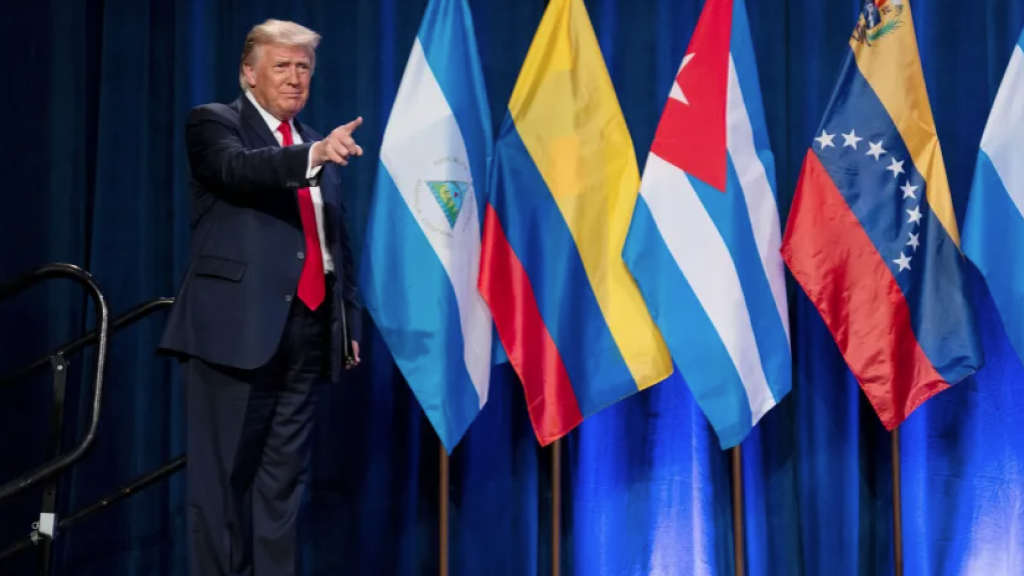
Then-President Donald Trump arrives for a Latinos for Trump event, in Doral, Fla., Sept. 25, 2020

An abridged version of this article was first published in Jacobin.

US President Donald Trump’s threats to take over the Panama Canal, convert Canada into the 51st state and purchase Greenland may not be as ludicrous as they seemed. The proposals, albeit unachievable, lay the groundwork for a more “rational” strategy of targeting China (not so much Russia) and singling out real adversaries (as opposed to Canada and Panama), which include Cuba and Venezuela, with Bolivia not far behind. The strategy is what James Carafano of the Heritage Foundation calls the “Rejuvenation of the Monroe Doctrine,” which, after all, in its day encompassed Canada and Greenland in addition to Latin America.

Trump’s choice of anti-Cuba zealot Marco Rubio as secretary of state reinforces the perception that the Trump administration’s foreign policy will pay special attention to Latin America and that Latin American policy will prioritise two enemies: China and the continent's leftist governments. Carafano calls the strategy “a pivot to Latin America.”

Political analyst Juan Gabriel Tokatlian writing in Americas Quarterly was more specific. After citing Trump’s plans for military action against Mexico, Cuba and Venezuela in his first administration, Tokatlian reasons “a second Trump White House may well lack some of the more rational voices that averted more rash actions the first time around.”

Honouring the Monroe Doctrine

The pundits are at odds as to whether Trump was fantasising and hallucinating when he made all three threats or was acting out his “Art of the Deal” strategy of intimidation to extract concessions. But both interpretations miss the broader context which suggests that a larger strategy of US interventionism is on the table.

The Panama threat is a reminder that currents on the right and within the Republican Party still denounce the “canal giveaway.” Ronald Reagan warned against it in his attempt to secure the Republican presidential nomination in 1976 and again raised the issue in his successful bid for the presidency four years later. Two decades later in the lead-up to the turning over of the canal, a prominent journalist, Thomas DeFrank, alleged that Panamanians were incapable of maintaining standards of efficiency. He concluded that once the US pulled out, Panamanians would “suffer more economic woes, let the canal languish and decline, and prove Ronald Reagan a prophet.”

The “Reagan Doctrine,” which justified US intervention in Nicaragua, El Salvador and elsewhere on grounds of combating Soviet influence, was an update to the Monroe Doctrine. Subsequently, in 2013, Secretary of State John Kerry declared “the era of the Monroe Doctrine is over,” though he did not renounce US interventionism, only unilateral intervention. The neocons and the Republican right rejected even this bland position.

The “rejuvenated” Monroe Doctrine promises to direct attention at practical targets south of the border, as the US invasions of Grenada in 1983 and Panama in 1989 clearly demonstrated. Both were quick, “clean” operations, in stark contrast with the drawn-out wars in Vietnam, Iraq and Afghanistan.

Carafano of the Heritage Foundation — which does much of Trump’s strategising — writes that a revived Monroe Doctrine “would comprise partnerships between the US and like-minded nations in the region that share common goals, such as mitigating the influence of Russia, China and Iran.” As for the enemy closer to home, Carafano singles out the Sao Paulo Forum consisting of leftist governments and movements in Latin America. Trump was even more specific when he announced that Venezuela was one “of the hottest spots around the world” that his Presidential Envoy for Special Missions Richard Allen Grenell would be dealing with.

Trump’s remarks on the Panama Canal, Canada and Greenland may foreshadow forceful, if not military, actions to achieve regime change against the real adversaries. Trump holds a special grudge against Venezuela’s Nicolás Maduro. He may want a second chance to topple Maduro after the first chance, beginning with the recognition of the parallel government of the inept Juan Guaidó in 2019, turned out to be such a fiasco. The same can be said for Rubio who at the time called on the Venezuelan military to throw its allegiance behind Guaidó and added that US military intervention was an option. The well-publicised questioning of the validity of the Venezuelan presidential elections of last July 28 provides Trump and Rubio a golden opportunity.

The new right that has emerged in the 21st century, with Trump as its most visible figure, is more fixated on combating Communists and leftists such as Maduro than were conservatives of the prior years following the end of the Cold War. And Latin America is the only region in the world where leftist governments abound in the form of the so-called “Pink Tide” (Nicolas Maduro, Luiz Inacio Lula da Silva, Gustavo Petro, Claudia Sheinbaum, etc). Those nations are in the crosshairs of Trump and his close allies.

Elon Musk is a prime example. Having assimilated the new right’s McCarthyism (which Trump inherited from Roy Cohen), Musk tweeted “Kamala vows to be a communist dictator.” In the four days following Venezuela’s July 28 elections, he wrote more than 500 messages about Venezuela, one of which was a tweet that read “shame on dictator Maduro.” Musk also applauded the right-wing coup against Evo Morales in 2019 and after Morales’ party returned to power in Bolivia, he brazenly warned: “We will coup whoever we want.”

The McCarthyite new right targets the more leftist Pink Tide leaders such as those of Venezuela and Cuba, but it is not letting moderate ones such as Lula off the hook. Rubio calls Lula Brazil’s a “far-left leader,” while Musk has expressed certainty that he will not be reelected in 2026. Some analysts have raised the possibility that Trump will slap the Lula government with tariffs and sanctions to support the return to power of Jair Bolsonaro and the Brazilian far right.

Since its initial formulation, the Monroe Doctrine has been given different readings. While Monroe’s principal message in 1823 has been summarised as “America for the Americans,” Latin Americans recalled the Monroe Doctrine’s 200-year legacy of countless US interventions. Viewing it from a different perspective, Trump invokes the Monroe Doctrine as a warning to China to stay clear of the US’s hemisphere.

The China target

Trump’s real target in all three threats was China. Trump posted the Panama canal “was solely for Panama to manage, not China,” and “we would and will NEVER let it fall into the wrong hands!” In reality, a Hong Kong-based company is administering two of Panama’s five ports, a far cry from Trump’s claim that Chinese soldiers are operating the canal.

Trump made his case for the annexation of the Panama Canal, Canada and Greenland (a gateway to the Arctic) by arguing for the need to block China’s growing presence in the hemisphere. Trump’s threat to annex the territory of a sovereign nation says a lot about the bellicose mentality of the US president. It is also a reflection of the desperation of segments of the US ruling class in the face of the nation’s declining economic, but not military, power. The real reason why Trump is targeting China, while he plays peacemaker between Russia and Ukraine, is economic.

In the 21st century, China’s investment in and trade with Latin America have increased exponentially. China has now surpassed the US as South America’s top trading partner. Some economists predict that the net value of trade, which in 2022 was valued at $450 billion, will exceed $700 billion by 2035.

When it comes to Washington’s anti-China rhetoric, competition with the U.S. on the economic front receives less attention than it merits. If ever the “it’s the economy stupid” statement was apropos, it is in the case of China’s challenge to US hegemony.

The Heritage Foundation’s 38,000-word “Plan for Countering China,” enumerates an endless number of non-economic threats posed by China. Many of the threats put the spotlight on Latin America due to its proximity. For example: “China’s role in global drug trafficking, exploiting instability in the U.S. and Latin America caused by illegal migration… The U.S. government should close loopholes in immigration law and policy that China is exploiting.” 

Other areas of concern attributed to China and originating largely from Latin America include “transnational criminal activity,” “war drills” carried out in Latin America, and China’s Cuban-based espionage. In addition, in a conversation with the Chinese government, Treasury Secretary Janet Yellen raised concerns regarding that nation’s alleged sponsorship of “malicious cyber activities”.

Particularly unfounded is the allegation that China seeks to export autocracy, or, in the words of then Secretary of State Mike Pompeo, “validate its authoritarian system and spread its reach.”

Washington’s discourse on China’s threat to democracy resonates among the far right in Latin America. Leopoldo López, for a long time “our man in Caracas” on the far right of the political spectrum, testified before the US Senate Committee on Foreign Relations in 2023 that “autocrats” such as Maduro and “Chinese communists,” were threatening Venezuelan democracy, with Russia and China “at the center of [an] autocratic network.”

Yet there is little evidence to back up Pompeo’s and López’s accusations. China is hardly preaching the virtues of authoritarian rule. In fact, Beijing’s repetition of the phrase “socialism with Chinese characteristics” indicates how little interested it is in exporting a model, at least in comparison to Moscow throughout the history of the Soviet Union.

Jeffrey Sachs has made the point clearly that the US-China clash is not really about ideology, but rather economic growth: “Then we have the tensions with China. This is blamed on China, but it's actually an American policy that began under former President Barack Obama because China's success triggered every American hegemonic antibody that says China's becoming too big and powerful.”

If economic rivalry is the real source of worry in Washington, then China is clearly a larger concern than Russia. Carafano notes: “There are persistent calls in the U.S. to pivot to Asia and leave Russia as Europe’s problem. Others suggest an accommodation with Moscow to undercut relations between Russia and China.”

The renowned international relations scholar John Mearsheimer is the foremost advocate of the position that the Chinese threat to the US is second to none. For Mearsheimer, ideology is not at play, but rather China’s unanticipated, rapid economic growth. He argues “it would be a mistake to portray China as an ideological menace today,” and adds contemporary China “is best understood as an authoritarian state that embraces capitalism. Americans should wish that China were communist; then it would have a lethargic economy.”

The right versus Latin America’s economic elite

As in the US, powerful economic groups in Latin America support the far-right, but their interests and viewpoints do not always coincide. This is the case with agro and other business sectors that stand a lot to lose from the Latin American right’s hostility toward China, which jeopardises markets and the influx of investments. Indeed, local business groups have come into conflict with right-wing politicians and often find themselves at odds with Washington’s anti-China campaign.

True to form, the Latin American right along with Washington has put up resistance to initiatives promoting cooperation with China. For instance, the decision of Panamanian president Juan Carlos Varela to sever diplomatic relations with Taiwan and extend them to Beijing in 2017 was not free of controversy. The Trump administration reacted by withdrawing its ambassador in protest leading Varela to demand “respect ... just as we respect the sovereign decisions of other countries.” This was followed by a scandal known as “VarelaLeaks,” involving an alleged $142 million in bribe money from mainland China to secure the deal. China adamantly denied the charge.

Upon reaching power, far-right leaders such as Bolsonaro and Argentine president Javier Milei could not have been nastier in their language regarding China. In Bolsonaro’s first year in office, for instance, his foreign affairs minister Ernesto Araújo declared that Brazil will not “sell its soul” to “export iron ore and soy” to Communist China. But in both cases, pressure from economic groups resulted in surprising turnabouts. 

Milei, for his part, at first thwarted the implementation of agreements with Beijing and called its leaders “murderers” and “thieves,” but then opted for pragmatism. After an exceptionally friendly encounter with Chinese President Xi Jinping at the G20 Summit in Rio last November, a currency swap deal worth billions of dollars was resumed.

All this indicates that the Trump administration will probably face resistance to its anti-China campaign in Latin America from an unexpected source, namely local business interests.

A Cold War rerun?

The Heritage Foundation’s foreign policy statement designed for a second Trump presidency is titled Winning the New Cold War: A Plan for Countering China. The title is deceptive. The US-China rivalry lacks the basic ideological dimension of the former Cold War, which consisted of a confrontation between two distinct political-economic systems, both of which were fervently defended as superior dogmas.

Furthermore, China does not practice the “internationalism” that characterised the Soviet Union, which counted on the loyalty of Communist Parties throughout the world. Indeed, prominent leftists have criticised Beijing’s alleged lack of solidarity with left-wing movements and governments elsewhere.

In addition, China’s model consists of over 400 billionaires (according to Forbes), even while the new right’s discourse demonises Chinese Communism. Scratching beneath the surface, the new narrative blames China and its economic expansion, partly driven by Chinese capitalists, for the inroads of the Latin American left. The twisted logic recalls Hitler’s vitriolic attacks on Jewish capitalists for being responsible for the advance of Communism.

Similarly, the Heritage Foundation calls out Latin American Pink Tide governments for “opening the region to China.” Carafano points to the leftist leaders of Cuba, Venezuela, Nicaragua and Bolivia, whose parties belong to the Sao Paulo Forum, for their nations’ “expanding relations” with China, Russia and Iran.

In the spirit of conspiracy theory, Carafano writes: “The [Sao Paulo] Forum formulates increasingly active and aggressive policies to undermine pro-U.S. regimes in the region and accepts transnational crime, including networks from the Middle East, as a helpful tool for destabilization.” In addition to the failure of the Forum’s detractors to present concrete evidence linking the group to crime and terrorism, its heterogeneity, which includes grassroots labour, ethnic and environmental movement as well as ones inspired by the Catholic Church, clearly puts the lie to the claim.

The Heritage Foundation’s Mike Gonzalez critically writes on the Forum’s 2023 meeting in Brasilia, Brazil. Gonzalez expresses scepticism of the Forum’s opening declaration which praised China for its “defence of the principles of International Law, in particular the no intromission in the internal affairs of Latin American nations.” Indeed, China adheres to this principle in its opposition to Washington-imposed sanctions on Cuba and Venezuela and other regime change attempts.

The Pink Tide’s support for China’s position on national sovereignty is a far cry from imitating the Chinese model, as the new right claims. The Pink Tide’s opposition to interventionism and support for a “multi-polar world” is more in line with “Third Worldism” than any kind of socialist or Communist dogma. That said, market socialism as practiced in China has influenced Pink Tide leaders such as Maduro to pursue “friendly relations with private capital.”

Economic rivalry, not ideological differences nor plain maliciousness, is the essence of the confrontation between the US and China in Latin America. The Heritage Foundation and the rest of the new right are doing Washington policymakers a disservice by drawing attention to secondary issues, if not bogus ones, in its efforts to highlight the danger posed by China-Latin American relations.

The real issue is China’s increasing economic ties in the region including huge investments in the form of the Belt and Road Initiative for ambitious infrastructure projects, which 22 Latin American Caribbean nations have signed on to.

President Joe Biden attempted to counter the Belt and Road Initiative with his “Americas Partnership for Economic Prosperity,” which he launched at the Summit of the Americas in 2022. He called it a “new and ambitious economic agenda.” The think tank Council on Foreign Relations characterised Biden’s investments to counter the Belt and Road Initiative as paltry.

Under Trump, the prospects are likely to be worse. In his recent Americas Quarterly article forecasting the trends of Trump’s second administration, Tokatlian wrote “if recent history is any guide, Washington is unlikely to offer much of an alternative when it comes to investments or help with infrastructure.” If this is the case, the US will be in no position to win the hearts and minds of Latin Americans. If the Chinese do, it will be because of their vibrant economy, not because of the export of ideology.

Steve Ellner is an Associate Managing Editor of Latin American Perspectives and a retired professor at the Universidad de Oriente in Venezuela, where he lived for over 40 years. His latest book is his co-edited Latin American Social Movements and Progressive Governments: Creative Tensions Between Resistance and Convergence (2022).