Saturday, January 25, 2025

Big Oil's $445 Million Investment in Trump and GOP 'Already Paying Off'

"Donald Trump's Day 1 actions have shown where his loyalties lie—executing the industry's wishlist at the expense of working Americans," said one climate campaigner.


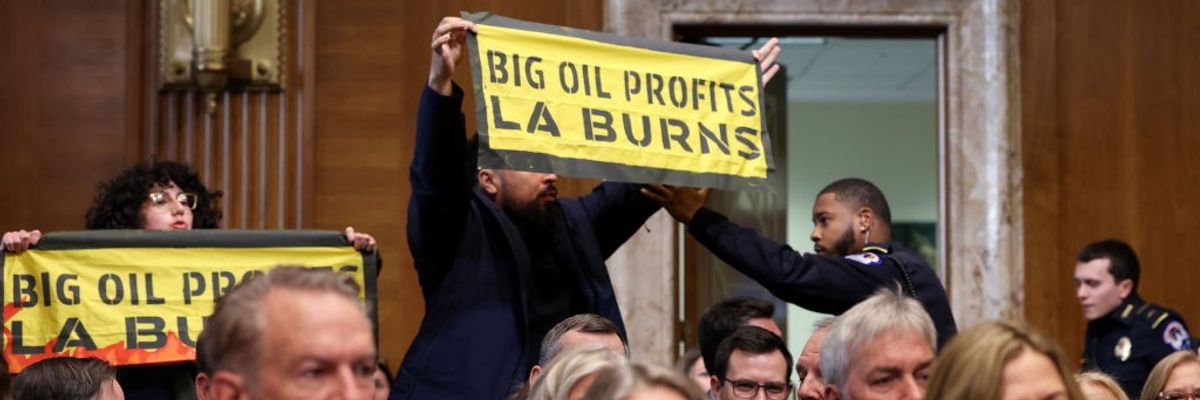
Protestors hold up a sign that reads "Big Oil Profits LA Burns" as U.S. President-elect Donald Trump's energy secretary nominee testifies at a Senate hearing on January 15, 2025.
(Photo: Kayla Bartkowski/Getty Images)

Jake Johnson
Jan 23, 2025
COMMON DREAMS

A report released earlier this week estimates that fossil fuel industry interests spent nearly $450 million during the 2024 election cycle on campaign donations, lobbying, and other efforts to bolster U.S. President Donald Trump, his Republican allies, and policies that benefit oil and gas corporations.

That investment "is already paying off," said Alex Witt, senior adviser for oil and gas at Climate Power, the advocacy group behind the new analysis.

According to the report, Big Oil's total known spending in the last election cycle amounted to "an astounding $445 million."

"Importantly, however, the oil and gas industry also routes undisclosed funds through dark money groups that do not have to reveal their donors, making it nearly impossible to understand the full scope of their impact," the report notes.

"Trump's energy agenda will raise costs for families, strip away energy choices, dirty our air and water, and put 400,000 new clean energy jobs at risk."

Climate Power found that $96 million of the $445 million in total spending was "direct donations" to Trump's presidential campaign, which openly solicited fossil fuel industry cash. Fossil fuel interests also spent close to $80 million on advertising in support of Trump and the GOP, more than $25 million backing down-ballot Republican candidates, and $243 million lobbying the U.S. Congress, according to the new analysis.

The latter investment is "likely to pay dividends when the Senate votes on Trump's Cabinet appointments and as budget and legislative priorities are set," the report states.

"'Energy Czar' and Department of the Interior nominee Doug Burgum helped Donald Trump deepen his oil and gas donor Rolodex," the report adds. "Trump named fracking evangelist and fossil fuel company CEO Chris Wright to lead the Department of Energy and Lee Zeldin, who accepted more than $400,000 in Big Oil campaign contributions, to lead the Environmental Protection Agency."

Soon after taking office earlier this week, Trump declared a "national energy emergency" as part of his sweeping effort to ramp up fossil fuel production, which was already at record levels under the Biden administration. Trump also withdrew the U.S. from the Paris climate accord and moved to unleash drilling in Alaska's Arctic National Wildlife Refuge, a step that one environmental group condemned as a "giveaway to Big Oil CEOs."

"Donald Trump's Day 1 actions have shown where his loyalties lie—executing the industry's wishlist at the expense of working Americans," Witt said Wednesday. "Trump's energy agenda will raise costs for families, strip away energy choices, dirty our air and water, and put 400,000 new clean energy jobs at risk."
Warren Tells DOGE Chair Musk How to Cut $2 Trillion in a Decade

The Massachusetts Democrat has proposals on healthcare programs, Pentagon contracts, tax reform, and more.


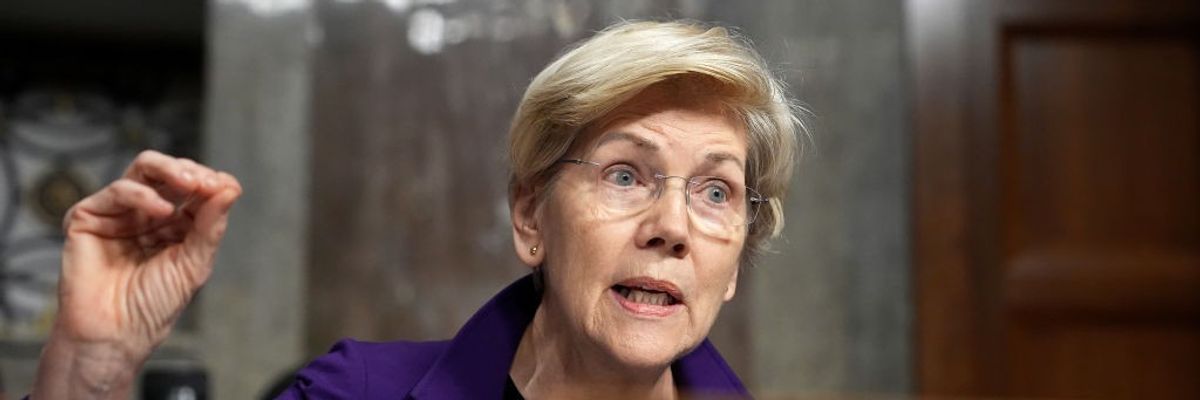
U.S. Sen. Elizabeth Warren (D-Mass.) speaks at a Senate Armed Services hearing on January 14, 2025 in Washington, D.C.
(Photo: Andrew Harnik/Getty Images)

Jessica Corbett
Jan 23, 2025
COMMON DREAMS

While U.S. President Donald Trump's Department of Government Efficiency has faced intense criticism and even multiple lawsuits, some progressive groups and lawmakers are also engaging, including Sen. Elizabeth Warren on Thursday.

When Trump announced DOGE in November, he said the presidential advisory commission would work to "slash excess regulations, cut wasteful expenditures, and restructure Federal Agencies." Warren (D-Mass.) on Thursday detailed 30 proposals that would cut at least $2 trillion of government spending over the next decade.

In a lengthy letter to the chair of DOGE, billionaire Elon Musk, that was first reported by Time, Warren highlighted that "you have publicly called for sizable cuts in funding—from $500 billion in annual spending to 'at least' $2 trillion in cuts to federal spending—although recently, you said you may not actually be able to meet that goal."

"I have very serious concerns about both the DOGE process and the policies that you have publicly discussed to date," she wrote. "With regard to process, as I raised in a still-unanswered letter to President-elect Trump regarding Mr. Musk sent on December 16, 2024, it is not clear that you and other DOGE leaders are able to identify and mitigate your conflicts of interest and adhere to commonsense ethics standards. As a result, the committee appears to be a venue for corruption, allowing well-connected billionaires to put government policies in place that enrich them while hurting ordinary Americans."

"I am disturbed by the dangerous proposals you have discussed and released to date: proposals from you and your allies to cut Medicare, Medicaid, Social Security, veterans' benefits, and other programs."

"With regard to policy, I am disturbed by the dangerous proposals you have discussed and released to date: proposals from you and your allies to cut Medicare, Medicaid, Social Security, veterans' benefits, and other programs that tens of millions of Americans count on and rely on are unrealistic and cruel. It would be outrageous to cut these programs in the name of government thriftiness while handing out trillions of dollars in tax cuts for billionaires and big corporations," she continued. "But, your broad point—that the federal government spends trillions of dollars on wasteful spending is correct. And if you are serious about working together in good faith to cut government spending—in a way that does not harm the middle class—I have proposals for your consideration."

The letter features several recommendations to cut spending at the U.S. Department of Defense, which has never passed an audit. Specifically, it says: negotiate better contracts, recreate a renegotiation board to challenge excess profits, stop using the military to perform civilian jobs, end corporate welfare for Pentagon contractors and foreign governments, instruct the agency to stop gaming the budget process, boost energy efficiency and industry competition, tackle repair restrictions on military equipment, and "avert wasteful government spending on plutonium pit production at the Savannah River Site."

Warren also has suggestions for federal healthcare programs, such as curbing taxpayer abuse by Medicare Advantage insurers, engaging in more Medicare negotiations to lower prescription drug costs, supporting efforts to crack down on pharmacy benefit managers, quashing patent abuses by the pharmaceutical industry, exercising march-in rights to reduce medication prices, breaking up conglomerates, and keeping private equity out of the industry.

To save on education, the senator called for eliminating or reducing funding for the federal Charter Schools Program and making for-profit colleges ineligible for federal grant aid. On the taxation front, she advised fully funding the Internal Revenue Service as well as clawing back tax expenditures and closing loopholes for the wealthy.

Her letter further suggests keeping the federal government's cloud and other information technology markets competitive, reducing waste in unnecessary federal arrests and detention programs, and working with the Government Accountability Office, inspector general offices, and other watchdogs "to detect and combat fraud, waste, and abuse."

"DOGE's agenda has focused on limiting the size of the federal government to increase efficiency and save taxpayer dollars. As the list above indicates, there are many opportunities for identifying savings that would not hurt the middle class, and that would eliminate wasteful special interest spending," Warren wrote. "But focusing solely on cutting federal budgets is myopic and counterproductive, and misses key ways in which the government can cut costs for ordinary Americans, saving them billions of dollars."


"For example, the federal government should continue its efforts to target abusive surprise fees charged by businesses across the economy," she noted, pointing to rules from the Consumer Financial Protection Bureau, U.S. Department of Transportation, and Federal Trade Commission (FTC) targeting "junk fees."

Empowering the U.S. Department of Justice and the FTC "to break up monopolies and ensure competition would have extraordinary benefits for families," the senator wrote. She also argued that "DOGE should ensure that federal agency contracts do not create monopolies that can hike prices for small businesses and consumers indefinitely."

"By making the tax code fairer, DOGE recommendations could provide a roadmap for additional government revenues that could be used for important investments or to cut the deficit," she added, spotlighting the anticipated benefits of ending tax breaks and loopholes for offshoring jobs and profits, raising the corporate tax rate and the corporate alternative minimum tax rate, and enacting her "Ultra-Millionaire Tax."

"In the interest of taking aggressive, bipartisan action to ensure sustainable spending, protect taxpayer dollars, curb abusive practices by giant corporations, and improve middle-class Americans' quality of life," Warren concluded, "I would be happy to work with you on these matters."


Warren's letter followed an MSNBCop-ed that Rep. Ro Khanna (D-Calif.) wrote in December, offering Musk some recommendations, and a report that the watchdog Public Citizen released earlier this month identifying "what an efficiency agenda based on evidence, not ideology, would include," in the words of the group's co-president, Robert Weissman, who has formally requested to join DOGE to serve as a voice "for the interests of consumers and the public."

While some of Warren, Khanna, and Public Citizen's proposals could win bipartisan support, many would likely be met with strong resistance from the Trump White House and Republican-controlled Congress. As Time put it, "Her missive might do more to make a point than spur an improbable collaboration."


UAW Touts Stellantis Vow to Reopen Belvidere Plant as Win for Workers

"The future of Illinois manufacturing depends on the power of our workforce," said Sen. Tammy Duckworth (D-Ill.)


An aerial view shows and American flag flying next to a UAW flag outside of the Stellantis Belvidere Assembly Plant on September 19, 2023 in Belvidere, Illinois.
(Photo: Scott Olson/Getty Images)

Eloise Goldsmith
Jan 23, 2025
COMMON DREAMS

The automaker Stellantis announced Wednesday that it will build the next generation Dodge Durango at its Detroit Assembly Complex and will reopen the Belvidere Assembly Plant in Illinois—two issues that the United Auto Workers union said the firm had agreed to in a 2023 union contract, but then had tried to walk back.

According to the announcement, the reopening of the Belvidere plant will return some 1,500 UAW-represented employees back to work there, and the plant will also be used to produce a new mid-sized pick up truck.

Democratic lawmakers and the UAW leadership cheered the development. In a letter released Wednesday, UAW president Shawn Fain and UAW Stellantis Department director Kevin Gotinsky wrote that the "victory is a testament to workers standing together."

On X, Sen. Tammy Duckworth (D-Ill.) wrote: "The future of Illinois manufacturing depends on the power of our workforce. Proud to see Stellantis honor their historic deal with UAW—bringing 1,500+ jobs back to their Belvidere Assembly Plant. Incredible win for Illinois." The AFL-CIO posted on X, cheering the development, as did Sen. Gary Peters (D-Mich.) and Rep. Debbie Dingell (D-Mich.).

The United Auto Workers represents unionized workers at Stellantis (formerly Chrysler), as well as General Motors and Ford. UAW-represented workers ratified a contract with the three automakers, collectively known as "the Big Three," that yielded worker wage gains in 2023.

According to the union, Stellantis agreed in the 2023 contract to reopen the Belvidere plant and to manufacture the next generation Dodge Durango in Detroit, but the company's old leadership had failed to uphold those commitments.

Former CEO Carlos Tavares, who spearheaded aggressive targets for sales and cost cuts and tangled with both the board and the union, according to Reuters, resigned in December. The letter from Fain and Gotinsky credited the union members with his exit.

"Thank you to the thousands of members and leaders who rallied, marched, filed grievances, and talked to coworkers. Your solidarity forced Carlos Tavares out as CEO of this company, and it's been a game-changer. Since Antonio Filosa has taken over as North American COO at Stellantis, we have been meeting with their team, and the difference is clear," according to the letter from Fain and Gotinsky.

The union had filed charges with the National Labor Relations Board accusing the automaker of unlawfully refusing to release information about plans to move Dodge Durango production from a Detroit factory to one outside of the United States, and also filed grievances over delays in reopening the plant in Belvidere, according to The Associated Press. Union members had threatened to strike over the issue of the Belvidere plant.

In October 2024, members of the Senate and the House of Representatives sent two separate letters to Stellantis leadership urging them to keep the company's commitments.

On Wednesday, Stellantis "also committed to a significant investment in Kokomo, announcing plans to build Phase II of the GME-T4 EVO engine beginning in 2026, reversing plans to move work out of this country. There will be no change to existing GME-T4 EVO production at the Dundee Engine Plant. Finally, the company committed to increased component production at the Toledo Machining Plant," according to a press statement from UAW.
'Corruption in Plain Sight': AOC Warns Laken Riley Act a Boon to Private Prison Industry

"Look at what members of Congress are invested in private prison companies," said Ocasio-Cortez.


Congresswoman Alexandria Ocasio-Cortez (D-N.Y.) speaks on the fooor of the House of Representatives in Washington, D.C. on January 22, 2025.
(Photo: YouTube/screen grab)

Brett Wilkins
Jan 22, 2025
COMMON DREAMS

"It's corruption in plain sight."

That's how U.S. Rep. Alexandria Ocasio-Cortez (D-N.Y.) described congressional colleagues who support Republican-authored legislation that immigrant rights advocates warn is a right-wing power grab under the guise of public safety.

The Laken Riley Act—named after a young woman murdered last year by a Venezuelan man who, according to U.S. Immigration and Customs Enforcement (ICE), entered the United States illegally—was passed by a vote of 263-156 in the House of Representatives on Wednesday afternoon. Forty-six Democrats and every Republican present voted "yes." That was a near-identical tally to the 264-159 vote on a previous version of the bill passed earlier this month.

Senate lawmakers passed the bill on Monday, with 12 Democrats joining 52 Republicans in voting for the measure, which, among other things, expands mandatory federal detention of undocumented immigrants who are accused of even relatively minor crimes. With the House's Wednesday vote, the Laken Riley Act is set to be the first bill signed into law since President Donald Trump returned to office.


Speaking on the House floor on Wednesday, Ocasio-Cortez said:
I want the American people to know, with eyes wide open, what is inside this bill because we stand here just two days after President Trump gave unconditional pardons to violent criminals who attacked our nation's Capitol on January 6th, and these are the people who want you to believe, who want us to believe that they're trying to quote unquote "keep criminals off the streets," when they are opening the floodgates...

In this bill, if a person is so much as accused of a crime, if someone wants to point a finger and accuse someone of shoplifting, they will be rounded up and put into a private detention camp and... sent out for deportation without a day in court, without a moment to assert their right, and without a moment to assert the privilege of innocent until proven guilty without being found guilty of a crime they will be rounded up, that is what is inside this bill, a fundamental suspension of a core American value, and that is why I rise to oppose it.

"You may wonder why so many of our friends across the aisle who care so deeply about the rule of law happen to be so desperate to pass this bill," Ocasio-Cortez continued. "Look no further than the price tag of this bill, $83 billion. [Lawmakers] know that it can't be paid for. They know that the capacity is not there, and you know what will be there? Private prison companies are going to get flooded with money."

"Look at what members of Congress are invested in private prison companies who receive this kind of money and look at the votes on this bill," she added. "It is atrocious that people are lining their pockets with private prison profits in the name of a horrific tragedy and the victim of a crime. It is shameful. It is absolutely shameful."

The congresswoman's comments came two days after Trump reversed a 2021 executive order issued by former Democratic President Joe Biden meant to phase out U.S. Department of Justice contracts with private prisons. Despite Biden's order, more than 90% of people held by ICE in July 2023 were locked up in for-profit facilities, which are rife with serious human rights abuses, according to the ACLU and other advocacy groups.

Anthony Enriquez, vice president of U.S. advocacy and litigation at Robert F. Kennedy Human Rights and Hill opinion contributor, recently called the Laken Riley Act "a sweetheart deal for the private prison industry."

"Private prison executives look poised to pull off a multibillion-dollar cash grab at taxpayer expense via a cynical ploy to capitalize on the tragic death of a Georgia nursing student," he warned.

Shares in private prison stocks, which had been languishing for much of 2024, have soared since Trump's victory in November, with GeoGroup surging more than 127% since Election Day and competitor CoreCivic up over 63%.

Responding to reporting that ICE is preparing to more than double its detention capacity by opening 18 new facilities, American Immigration Council senior fellow Aaron Reichlin-Melnick said on social media Wednesday: "That would likely mean tens of billions in taxpayer funds sent to private prison companies. They are salivating."
AOC: Democrats Must Be 'Brawlers for the Working Class' to Counter Trumpism

"One of the things that we need to do is to talk to people directly," said the congresswoman. "There need to be Democrats who walk the walk and talk the talk."


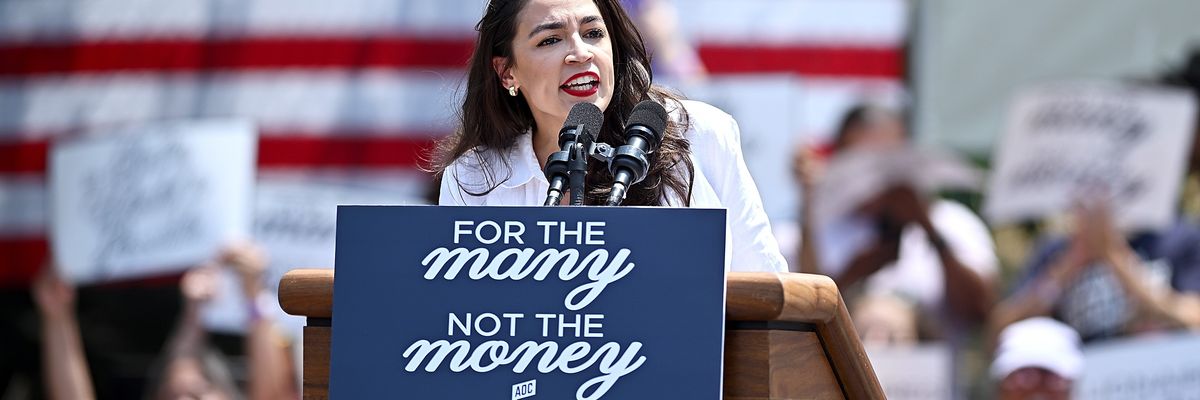
U.S. Rep. Alexandria Ocasio-Cortez (D-N.Y.) speaks at a rally in The Bronx, New York on June 22, 2024 in New York City.
(Photo: Steven Ferdman/GC Images)

Julia Conley
Jan 24, 2025
COMMON DREAMS

As Democratic lawmakers grappled with the reality of President Donald Trump's second term this week, U.S. Rep. Alexandria Ocasio-Cortez on Thursday urged the party to see the president's devotion to billionaires and corporations—after he campaigned as a champion for the forgotten working class—as an opportunity to make clear that Democrats, not Republicans, will fight for the interests of "everyday people."

First, the New York Democratic congresswoman said in an interview with Jon Stewart on his podcast, "The Weekly Show," the party must abandon its own allegiances to the billionaire class.

Trump, his close ties with tech billionaires like Tesla founder Elon Musk, his plans to extend the 2017 tax cuts that primarily benefited the wealthy, and his promises of deregulation to oil executives ahead of the election all highlight "ways that we can fight back," said Ocasio-Cortez.

"One of the things that we need to do is to talk to people directly," said the congresswoman. "There need to be Democrats who walk the walk and talk the talk. There is an insane amount of hypocrisy, and the hypocrisy is what gets exploited [by Republicans]."

Ocasio-Cortez pointed to the example of "insider trading" by lawmakers, with members of Congress who receive briefings on the defense industry, pharmaceuticals, and other businesses able to use information not available to the public to predict future stock prices. As Common Dreamsreported in December, dozens of members of Congress bought or sold up to $113 million worth of shares in Pentagon contractors last year, with three Democrats—Reps. Josh Gottheimer (D-N.J.), Nancy Pelosi (D-Calif.), and Suzan Delbene (D-Wash.)—trading the most.

Pelosi, the former House speaker, is among the lawmakers who have vehemently defended stock trading by lawmakers, while Ocasio-Cortez has frequently spoken out against the practice.

"People think that everyday people are stupid," Ocasio-Cortez told Stewart on Thursday. "Do you really think that people don't see this shit? ...And then we're supposed to act like money only corrupts Republicans? Give me a fucking break."


Trump won the support of working class people across the country, increasing his support among voters who earn less than $100,000 per year despite the fact, as Ocasio-Cortez said, "that he has a Supreme Court that guts labor rights, that [Republicans] are overwhelmingly opposed to raising a minimum wage, that they are really gutting the civil rights around working people and organizing."

Wealthier voters shifted toward the Democratic Party in the election, supporting Democratic candidate former Vice President Kamala Harris.

To respond to Trump's victory, Ocasio-Cortez said, "we need to be a party of brawlers for the working class."

"We've been chasing this affluent group and making all of these little concessions and hoping that working people don't notice," she added.


The congresswoman—who campaigned for a top House Oversight Committee seat in recent weeks but lost to a more senior Democrat—has been a leading proponent of the Green New Deal, which would fight the climate emergency while creating millions of green energy jobs over a decade; the push to expand Medicare coverage to every American; and a supporter of tuition-free public college, which was offered to students across the U.S. until at least the 1970s.

Her interview with Stewart came as Semaforreported that Democratic leaders are "wrestling with how much resistance to mount to Trump's Cabinet."

"We're obviously in a bit of disarray," one Democratic senator told the outlet. "I don't think people are really completely sure about what lesson is to be learned in this election."

Jesse Brenneman, an editor for the podcast "Know Your Enemy," commented that "the fact Democrats don't know what to do tells you everything about their priorities."


In an email to supporters the day after Trump was inaugurated this week, Ocasio-Cortez stuck to the same message she shared with Stewart.

Pointing to the tech billionaires who attended the inauguration, with many elected officials "kicked to the curb," the congresswoman told supporters: "You're getting ripped off. All of us are going to be getting ripped off for the next four years, but what do we do about it?"

"The Trump trifecta has taken hold, and so have their billionaire right-wing donors," she said. "Our movement for real progress will have to push harder than ever these next four years."


If Democrats want to win, they need to fight like AOC


Rep. Alexandria Ocasio-Cortez (D-N.Y.) in Queens, New York on April 24, 2021
 (Image: Shutterstock)
January 24, 2025
ALTERNET

The thing that keeps me up at night is not totalitarian drift. It’s the lack of fighting spirit among people who say they love this country.

I mean, I get that right now the congressional Democrats don’t have any power. I get that there’s nothing they can do in the face of Donald Trump’s illegal and unconstitutional executive orders. Ditto for his disgusting pardon of traitors, liars, thieves and murderers. And I get that the Democrats are outnumbered by Senate Republicans who are bent on confirming the unworthiest administration of our lifetimes.

Powerlessness, however, isn’t the same thing as impotence. There’s a lot the Democrats can do, the most important of which is saying no to Donald Trump and telling the truth about America’s totalitarian drift.

Bill Kristol put it well when he asked: “What can [the Democrats] do now? Tell the truth — and do it clearly, and do it loudly. Tell the truth about Pete Hegseth and Kash Patel. Tell the truth about Trump’s cruel and damaging immigration policies. Tell the truth about Trump’s plutocrats and corruption and grift. Tell the truth about Trump’s assault on the rule of law. For now, the public’s wondering what to think about Trump. Explaining how damaging and dangerous Trump’s policies will be would be important. Do it forcefully. Do it often.”

Here, though, is another problem – the part about “the truth.”

That’s a complicated subject for liberal types, because we don’t agree on what it is. We don’t agree because the truth about the truth is usually tied up in who we think we are as individuals. It can get so complicated that liberals talk themselves out of a united front. That’s a problem these days – when one side seeks common ground in spite of differences while the other side seeks the other side’s annihilation.

I was thinking of this yesterday while watching a video posted by New York Congresswoman Alexandria Ocasio-Cortez. I’m guessing you recognize AOC as one of the most outspoken liberals and one of the best communicators in today’s Democratic Party. In the video, she responded to Elon Musk giving the Nazi salute on Inauguration Day. She responded by flipping populism around so the “us” in “us versus them” is patriotic Americans and the “them” is fascists like Musk.

Related Story

AOC: Private Prisons and Politicians Will Profit From Laken Riley Act
“Look at what members of Congress are invested in private prison companies … and look at the votes on this bill.” By Sharon Zhang , Truthout January 23, 202


“This is the United States of America,” Representative Ocasio-Cortez said. “I don’t care what Elon Musk is doing behind the presidential seal, [but] in this country, we hate Nazis. Kind of like a foundational, defining thing. Two of the foundational things about American history is that we beat the Confederates and we beat the Nazis” (my bold).

She went on:

“I don’t know what side people may be on today, but I still am not rocking with anyone sympathetic to Nazis. And I will do that until I am six feet in the ground. Kind of foundational to me as a human being.

https://bsky.app/profile/acyn.bsky.social/post/3lgcfqzjipl2a

This is the fighting spirit that we need. Tolerating the intolerant is what got us here. We now have a demented criminal president who is:threatening to withhold federal funding from blues states;
suppressing federal research on viruses, including the covid;
using pardons to encourage murders and other criminals;
purging the government of “DEI hires,” aka non-white people;
demanding interest rates bend to his moods and whims;
redefining the meaning of citizenship in terms of whiteness;
and in general restoring the original white-power order.

It’s time to stop asking the haters to stop hating.


It’s time to hate them.

Unfortunately, some of the reaction to AOC’s commentary suggests that too many people still don’t get it. They’d rather argue about “the truth” instead of telling it. They would rather be right than fight. It seems the most important thing is not stopping evil and all those who will serve evil, but appearing virtuous in the eyes of their peers. The consequence of this is the impossibility of speaking with one voice.

I mean, with friends like these, who needs enemies?

If you are telling me that, ackshully, America has always been friendly to Nazis and to rightwing authoritarianism in general, you are not telling me anything I don’t already know. The genocide of indigenous Americans inspired Adolf Hitler – yes. The Jim Crow sadism of the former slaver states inspired Adolf Hitler – yes. Henry Ford’s antisemitism inspired Adolf Hitler – yes. All true. There is no debate. But I guess some people can’t help themselves. They gotta debate even though debating is beside the point of fighting totalitarian drift.


What I like most about AOC’s commentary is that it puts evil at the center of our attention. She doesn’t say evil is a distraction from the real issues. She doesn’t say evil prevents us from finding compromise on things that matter to all of us. She doesn’t say evil is “playing politics” while she and the Democrats are trying to get things done.

No, she’s saying evil is evil, and we should hate evil.

That’s the fighting spirit we need right now.


Betrayed by US Again, Afghan Evacuees Stranded After Refugee Program Suspension

About 1,600 Afghans approved to come to the US are now in limbo as the State Department cancels travel plans.
January 23, 2025
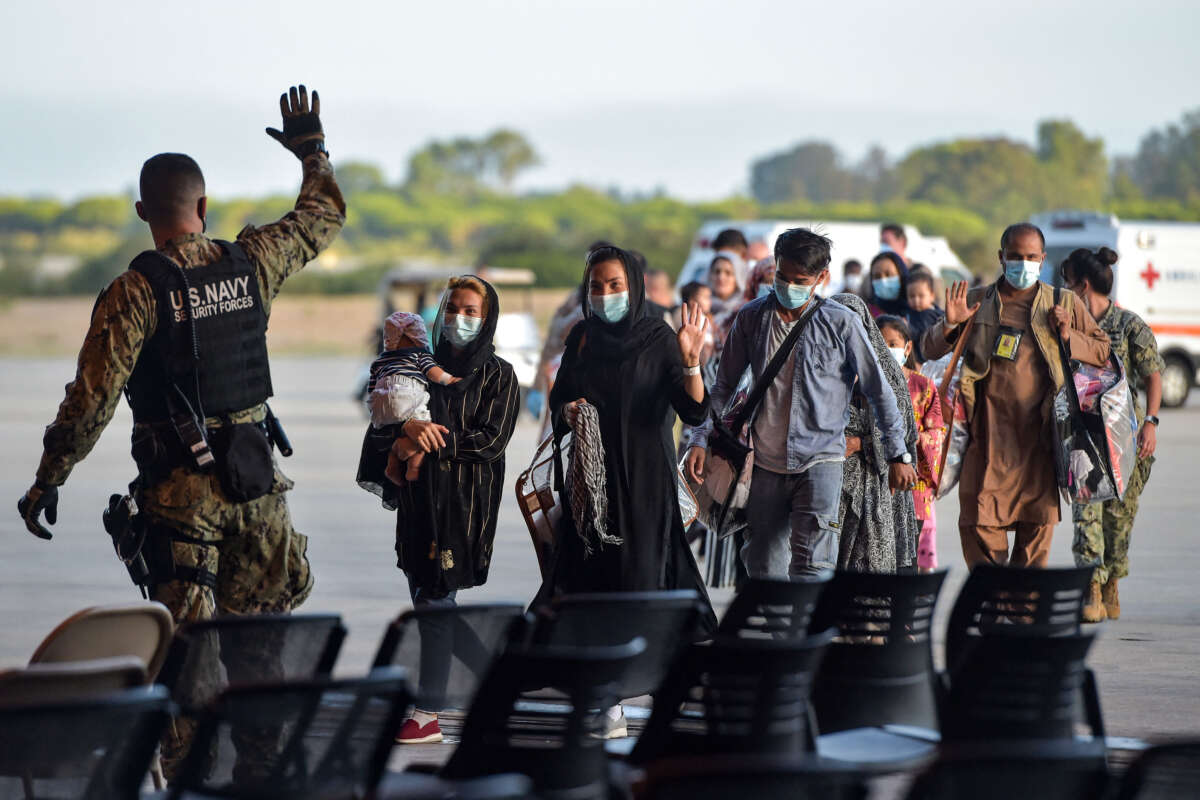
Refugees receive instructions from a U.S. Navy soldier as they disembark from a U.S. Air Force aircraft after an evacuation flight from Kabul at the Rota naval base in Rota, southern Spain, on August 31, 2021.Cristina Quicler / AFP via Getty Images

Back in 2020, President Donald Trump inked a deal with the Taliban for the eventual withdrawal of U.S. troops from Afghanistan. The deal was noteworthy for a variety of reasons, among them Trump’s bypassing of the U.S.-backed Afghan government at the time. Many critics — including top U.S. military brass — would later say the deal set conditions for a botched U.S. withdrawal in 2021 and the Taliban’s quick return to power.

By then Trump was out of office, leaving the messy job of actually withdrawing the remaining U.S. forces in Afghanistan to the Biden administration. The final chaotic withdrawal in August 2021 was widely seen as a spectacular and deadly failure at the bitter end of a catastrophic war. President Joe Biden’s poll numbers took a hit and never recovered. In 2024, Trump bet voters would forget his deal with the Taliban and hammered Biden over the conditions of the withdrawal on the campaign trail.

Almost immediately after taking office this week, President Trump once again threw a wrench in the plans of Afghans seeking refuge from the Taliban. As part of a deluge of executive orders designed to stretch the limits of presidential power, Trump shut down the U.S. refugee resettlement program, leaving thousands of Afghan evacuees who are seeking safety in the U.S. stranded across the world.

Uncompromised, uncompromising news

Get reliable, independent news and commentary delivered to your inbox every day.

Email*


About 1,600 Afghans who are vetted and cleared to resettle in the U.S. — including unaccompanied minors reuniting with family members and Afghans at risk of retribution from the Taliban for assisting the U.S. during the 20-year war — had their entry to the U.S. blocked. Some even had their flights to the U.S. canceled as a result of Trump’s new policy, according to Shawn VanDiver, director of the #AfghanEvac coalition of U.S. veterans and advocacy groups. The Associated Press reported on Wednesday that thousands of other refugees who were cleared to resettle are stranded across the globe as well.

“Our lives are in danger,” said Humayun Bayat, an Afghan refugee stuck in Pakistan, in an interview with Radio Free Europe/Radio Liberty this week. “We won’t be able to go to Afghanistan either because I worked against the Taliban.”

Early Wednesday morning, #AfghanEvac posted on social media an email sent overnight from the State Department indicating that the new administration had suspended refugee movement and case processing globally.

“Pausing refugee resettlement without exempting Afghan allies is not just a policy decision — it’s a betrayal of those who risked everything for America,” VanDiver said in an email.

VanDiver told Truthout that tens of thousands of other Afghans and their families are vetted and ready to resettle, or are in the process of being vetted for admission into the U.S. as refugees, but they are stuck in increasingly unfriendly countries such as Pakistan, where Afghans are under surveillance and increasingly targeted for deportation back to the Taliban-controlled Afghanistan.

“The State Department’s sudden global pause leaves vetted Afghan refugees stranded, further endangering their lives and separating families who have waited years for reunification,” VanDiver said. “It really is a matter of national security; the word of the United States needs to be as good as gold and can’t be conditional or temporary.”

VanDiver said Trump’s order allows his secretary of state and secretary of Homeland Security to accept individual refugees into the U.S. on a case-by-case basis, but he doubts Trump administration will take the time to review and approve thousands of Afghan allies and their close family members. The order requires these top officials to advise the White House in 90 days on whether refugee admissions are in the national interest and should resume.

During the Biden administration, about 200,000 Afghans evacuees were vetted and resettled across the U.S. after leaving Afghanistan under programs meant to protect military interpreters, human rights activists, former civil servants, and other U.S. allies, according to VanDiver.

However, Afghan community groups in the U.S. fear these recent arrivals could be swept up in attacks on immigrants and Muslims by the Trump administration, and that their status as refugees rather than permanent residents might especially put them in peril. Arash Azizzada, an advocate for Afghan refugees and co-founder and executive director of Afghans For A Better Tomorrow, said Afghans are at risk of being caught in the massive surveillance, detention and deportation apparatus that has rapidly expanded under both Democratic and Republican administrations.

“Both parties built a deportation machine that is going to target not just Afghans, but other immigrants as well,” Azizzada said. “Everywhere an Afghan turns in the world in order to seek safety or shelter, they are eventually targeted by surveillance and deported, and it could happen here for our community.”

Trump’s order does not apply to holders of Special Immigrant Visas (SIVs), a class of visa created by Congress to allow military translators and others who worked for the U.S. in Afghanistan and Iraq to become permanent U.S. residents. However, U.S. veterans fighting for the safety of their comrades have complained about the limits of the SIV program for years. VanDiver said most Afghan evacuees did not receive SIVs, including fighters who trained with the U.S., family of U.S. service members and lawyers for the U.S.-backed government who prosecuted the Taliban.

Azizzada does not expect Trump to expand or respect the SIV program and other directives from Congress on immigration. Despite the risk of retaliation for helping the U.S. occupation, the Afghans stranded today are refugees, not SIV holders on a path to a green card.

A separate executive order issued by Trump requires federal agencies to increase vetting of all visa applications to the U.S. to the “maximum degree possible” in order to protect against “foreign terrorists” and “public safety threats.” Trump has long conflated Muslims with terrorists and immigrants with imagined threats to public safety. Azizzada said Afghan refugees could be targeted and denied entry, regardless of whether they assisted the U.S. in Afghanistan.

“I don’t think [Trump] cares about folks who qualify as Afghan allies, people who stood next to the U.S.,” Azizzada said. “If the Trump administration actively ends this pipeline to resettlement — which it looks like it will, it is moving forward with that — it will be another stab in the back of those left behind, our allies in Afghanistan, another deep betrayal by America for our community.”

During the final months and weeks of the Biden administration, advocacy groups put mounting pressure on officials to surge resources toward processing and resettling stranded Afghan refugees before Trump took office. However, Azizzada said the Biden team did not want to be reminded about the Afghans left behind, suggesting the administration’s reluctance to act was because the 2021 withdrawal was so politically damaging to the Biden-Harris reelection campaign.

“They were not forthcoming and transparent … we made a laundry list of demands and questions that would protect Afghans in the waning days of the Biden administration, and I can tell you they didn’t return most of our calls,” Azizzada said.

The Biden administration evacuated 124,000 Afghans during the withdrawal in 2021, but still needed time to vet and process them. Afghans ended up stranded for months at “lily pad” sites in Kosovo, Qatar, Pakistan, and other countries across the world, sometimes in what appeared to be prison-like conditions, according to internal documents released under the Freedom of Information Act to legal advocates earlier this month.

“Under the Biden administration, Afghans have been stranded at U.S.-facilitated sites for over three years, awaiting individualized case processing and family reunification,” said Sadaf Doost, the human rights program manager at the Abolitionist Law Center, in an email. “And now, because of the Biden administration’s lack of progress and prolonged holding of Afghan civilians, Afghans are subjected to further uncertainty.”

The dates on the documents range from 2021 to 2023; VanDiver said most Afghans have moved on from these holding sites but their future as refugees is once again in limbo due to Trump’s order. However, Doost said attorneys continue to request transparency about the sites and movement of Afghans that the Biden administration failed to provide.

“It is our understanding that Afghans still remain at these sites — information the government has a duty to provide to the public under the Freedom of Information Act as it relates to federal government activity,” Doost said.

The U.S. invasion and occupation of Afghanistan in 2001 became a blood-soaked boondoggle for two decades to come, but Azizzada said the U.S. legacy goes back more than 40 years to the late-President Jimmy Carter, who covertly armed opposition to a Soviet-backed government. The rise of al-Qaeda in Afghanistan and bloody “war on terror” launched by President George W. Bush followed interventions made by Carter and President Ronald Reagan in the 1980s.

“We’ve had 45-plus years of military intervention and military occupation … all this pain and all this suffering,” Azizzada said. “The U.S. is responsible for this harm and must repair this harm, and one way to repair this harm is to allow Afghans to seek safety in the United States.”

Simmering anger as Turkey begins burying 76 fire victims


By AFP
January 22, 2025


The fire began before dawn, ripping through the Grand Kartal Hotel near the northwestern town of Bolu - Copyright AFP Demiroren News AAgency
Fulya OZERKAN

Turkey was preparing to bury its dead Wednesday a day after a huge fire killed 76 people at a ski resort hotel, as questions grew over safety measures at the luxury establishment.

As the nation observed a day of mourning, dozens of families were preparing to bury their loved ones who died as the blaze ripped through the 12-storey hotel.

But alongside the grief there was anger, with many newspapers publishing allegations of negligence at the mountaintop hotel in Kartalkaya, which lies about two hours northwest of Ankara.

“It was not the fire but the negligence which was responsible for so many deaths,” said the pro-government Hurriyet newspaper.

The fire, which began in the dead of night, struck at peak season for the Grand Kartal Hotel, which had 238 guests staying at the start of a two-week winter break.

More than 30 people remained in hospital on Wednesday, one of whom was in intensive care, officials said.

On a freezing foggy morning, with flags flying at half-mast, rescuers resumed their search of the charred and blackened structure on Wednesday, where Turkish media said entire families had died.

Among those who were to be buried on Wednesday was a neurologist, his wife and their three children, including twin boys.


– ‘Profoundly disturbing’ –


The blaze broke out around 3:30 am (0030 GMT), sending huge clouds of smoke into the night air and sparking panic among the guests, many of whom tried to climb out of the windows, using bedsheets as ropes.

“I saw one kid hanging from the hotel window calling for help,” said Islam, who works at a nearby hotel and did not give his surname.

“I was profoundly disturbed. I still cannot forget the image,” he told AFP, saying he knew some of the hotel staff who died.

By Tuesday night, investigators had identified 52 of the dead and returned 45 bodies to their families for burial, Interior Minister Ali Yerlikaya said.

President Recep Tayyip Erdogan was expected to attend the funeral of seven family members of a local official from his ruling AKP in the nearby town of Bolu.

Yerlikaya said nine people, including the owner, had been arrested in connection with the blaze, with investigators looking into the cause of the fire, possible negligence and who was responsible.

Speaking to Turkish media on Tuesday, several guests said that no fire alarms nor smoke alarms had sounded, and that there were no fire escapes.

“No fire alarm went off… and there was no fire escape,” Atakan Yelkovan told IHA news agency, saying it had taken “between an hour and an hour-and-a-half” for the firefighters to arrive.


But Tourism Minister Nuri Ersoy said the hotel had two fire escapes and had passed inspections “in 2021 and 2024”.

“No issues related to fire safety had been flagged by the fire department,” he said on Tuesday.
ZIONIST IMPERIALISM

Netanyahu Says Israeli Forces Will Stay in Lebanon Past Ceasefire Deadline

Israel has reportedly violated its ceasefire deal with Hezbollah hundreds of times already, killing numerous people.
January 24, 2025

Israeli army vehicles move in a village in southern Lebanon as seen from a position on the Israeli side of the border on January 23, 2025.Amir Levy / Getty Images

The Israeli military is planning to continue occupying southern Lebanon past the deadline set forth in Israel’s ceasefire agreement with Hezbollah, Israel Prime Minister Benjamin Netanyahu has said.

Under the terms of the deal, agreed to in November, Israel and Hezbollah were supposed to withdraw from southern Lebanon by this Sunday, January 26. They were to be replaced by troops from the United Nations Interim Force in Lebanon (UNIFIL), and then the Lebanese army in the region in order to help oversee implementation of the ceasefire. The U.S. is also in charge of helping to ensure implementation.

In a statement on Friday, however, Netanyahu’s office said that Israeli forces are going to remain in southern Lebanon past the deadline, claiming that the Lebanese army has not deployed quickly enough in the region.

Don’t miss a beat

Get the latest news and thought-provoking analysis from Truthout.

Email*


“Since the cease-fire agreement has not yet been fully enforced by Lebanon, the gradual withdrawal process will continue under full cooperation with the United States,” the statement said.

Lebanese officials have said that they can only send their troops into the region when Israeli troops are gone.

Related Story  

Op-Ed |
2024 Will Be Remembered as the Year Israel’s Global Legitimacy Fully Unraveled
After over a year of genocide, more Americans than ever are calling for an end to US military backing of Israel. By Khury Petersen-Smith , Truthout January 2, 2025


The Israeli military has been suggesting for weeks now that it is going to maintain its presence in the area, as part of its long history of violating international agreements and law. In late December, Israeli authorities said they were satisfied with the implementation of the agreement until that point, but still signalled they were planning to stay in Lebanon.

The ceasefire agreement has already been imperiled as Israel has repeatedly violated the ceasefire, continuing to attack Lebanon even after hostilities were supposed to end under the agreement. In the first week alone, Israel reportedly violated the ceasefire at least 100 times, and has now violated the agreement hundreds of times, Lebanese sources say. Israel has killed numerous people amid these seeming violations.

Israeli soldiers have also prevented Lebanese people from returning to their homes in the south, reports say.

The ceasefire deal doesn’t specify consequences for violations of the ceasefire. In recent days, Israeli officials have been in talks with the U.S. to discuss staying in Lebanon past the deadline. Israeli media have reported that Israel has asked for 30 more days to withdraw, claiming that Hezbollah has also violated the ceasefire agreement.

Hezbollah has only carried out one strike since the ceasefire, dropping a bomb on a military base in retaliation to Israeli attacks. Israel retaliated to that strike by killing at least nine people in air raids on Lebanon.

Since October 2023, Israel has killed over 4,000 people in Lebanon, many of them civilians. A BBC investigation published on Friday found that on September 29, 2024, in the single deadliest attack of Israel’s war with Hezbollah, Israel killed at least 62 civilians in a strike on south Lebanon. The attack collapsed an entire apartment building, which Israel claimed it targeted because it was a Hezbollah “command center.”

Israel has invaded Lebanon six times in the past 50 years. The Israeli military’s longest occupation of Lebanon began in the 1980s, when it invaded and occupied southern Lebanon until it was forced to withdraw in 2000, largely due to resistance from Hezbollah, which had risen to prominence during the occupation.

Violating Cease-Fire Deal, Israel Won't Withdraw Troops From Lebanon Before Deadline

"A renewal of hostilities would be a devastating blow for civilians still struggling to rebuild their lives," said one humanitarian worker.


Destruction resulting from Israeli attacks is seen as citizens return to their homes in Al-Khiyam town, Nabatieh Governorate of southern Lebanon on January 23, 2025.
(Photo: Ramiz Dallah/Anadolu via Getty Images)


Julia Conley
Jan 24, 2025
COMMON DREAMS

The Trump administration on Friday called for a "short, temporary cease-fire extension" between Israel and Lebanon after Israeli Prime Minister Benjamin Netanyahu said the country's troops will not complete its withdrawal from southern Lebanon as it agreed to in a 60-day truce that began in late November.


Under the terms of the cease-fire, Israel agreed to withdraw its military from southern Lebanon by January 26, and the Lebanese political and paramilitary group Hezbollah was required to move its forces north of the Litani River and dismantle all military infrastructure in the south.

Netanyahu's office claimed Friday that "the cease-fire agreement has not yet been fully enforced by the Lebanese state" and said its "gradual withdrawal process will continue, in full coordination with the United States."

Israel asserted that the truce allowed for the withdrawal process to "continue beyond 60 days—a claim the Lebanese government and Hezbollah refuted—and claimed the Lebanese army had allowed Hezbollah to regroup since the cease-fire began.

Hezbollah called Israel's plan to maintain a military presence in southern Lebanon past the deadline a "blatant violation of the agreement."

As Hezbollah warned it would consider the cease-fire null and void if Israel does not withdraw by January 26, White House National Security Council spokesperson Brian Hughes said an extension of the deadline is "urgently needed."

Emile Hokayem of the International Institute for Strategic Studies said Israel's "unilteral extension... is clearly a violation of the November cease-fire," while Lebanese American journalist Rania Khalek noted that Israel "has been violating the cease-fire the entire time with zero international condemnation."


The Norwegian Refugee Council (NRC) said that while the cease-fire has significantly reduced casualties in Lebanon following 14 months of fighting between the Israel Defense Forces and Hezbollah, at least 29 civilians have been killed since the truce began.

"While the cease-fire seems intact on paper, civilians in Lebanon continued to be killed and their homes blown up by the Israeli military," said Maureen Philippon, Lebanon country director for the NRC.

Prior to the cease-fire deal in November, the conflict killed at least 3,823 people and injured 15,859, as well as displacing tens of thousands of people in Israel and over 1 million in Lebanon. More than 100,000 people in Lebanon have still been unable to return to their homes.

"We have been displaced from our village for 16 months," a Lebanese citizen named Rakad, who fled the border town of Yarine, told the NRC. "We are all waiting for the 27th to go back, kiss the soil of our land, and breathe the air of our village."

Israel's likely delay in withdrawing troops comes as Lebanese residents have begun returning to their villages in the south, but the Lebanese military on Friday called on civilians not to return to the coastal town of Naquora, which Mayor Abbas Awada told Al Jazeera "has become a disaster zone of a town."

"The bare necessities of life are absent here," said the mayor.

The NRC warned that the "continued presence of Israeli troops in dozens of villages in southern Lebanon severely restricts the freedom of movement and leaves many in a prolonged state of displacement."

Philippon called on regional and international mediators to "ensure this truce evolves into a lasting cease-fire, with a firm commitment to protecting all civilians and civilian infrastructure."

"A renewal of hostilities would be a devastating blow for civilians still struggling to rebuild their lives," said Philippon. "Lebanese villagers are still being warned against returning to their homes and lands, while many others don't even know what happened to the house they left months ago. These people will need all the stability and support they can get to get back on their feet after. Israel must withdraw from these villages so that thousands can go back."

TikTok Shouldn’t Be Banned, But It Still Values Profit Over Privacy

A ban would be a nightmare for civil liberties. But TikTok, like all Big Tech platforms, is no friend to the left.
January 21, 2025


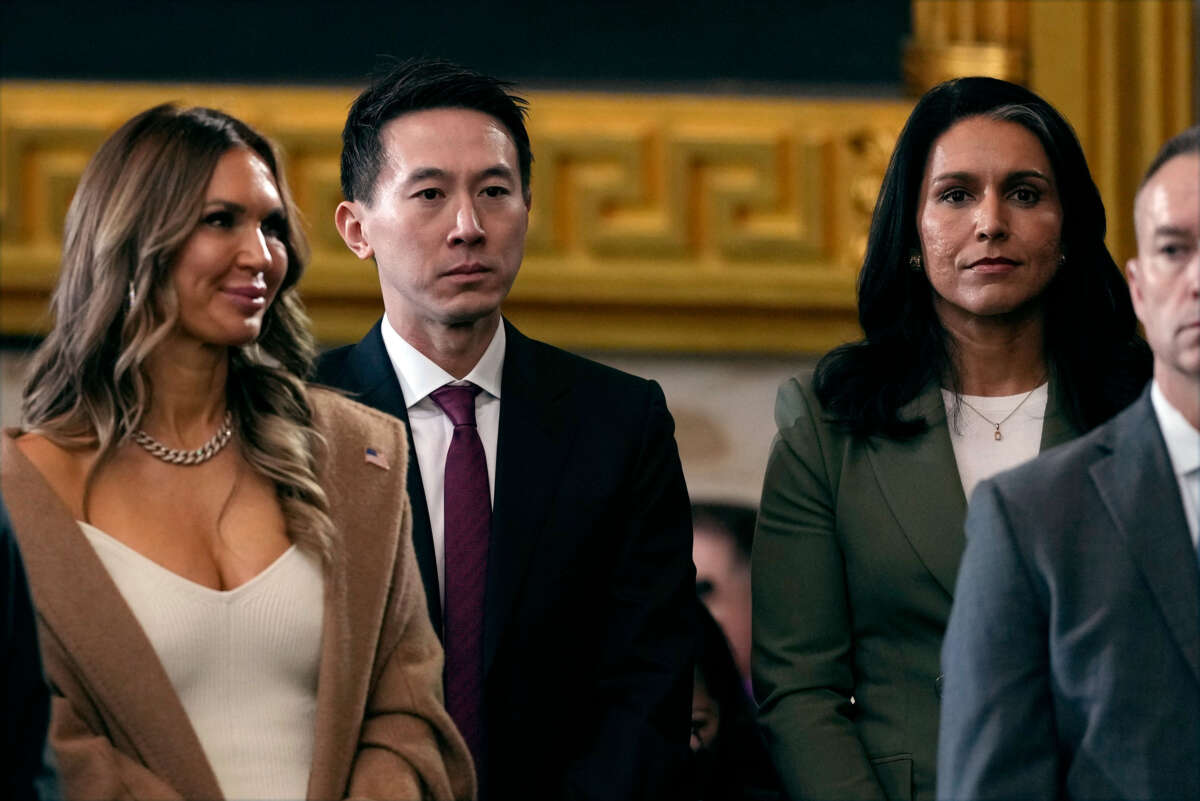
TikTok CEO Shou Zi Chew (left) and Tulsi Gabbard, the nominee to be the next director of national intelligence, attend the inauguration of President Donald Trump at the U.S. Capitol Rotunda on January 20, 2025, in Washington, D.C.
Julia Demaree Nikhinson - Pool / Getty Images

The shutdown only lasted a few hours, but it generated no shortage of content.

“Fascist countries ban apps. Fascist countries ban websites,” one TikTok user said in a video with more than 12 million views. “TikTok was never just an app. It was a battleground and a sanctuary,” another creator wrote in a viral Instagram post.

Similar sentiments proliferated across social media in the days and weeks leading up to TikTok’s brief black-out on Sunday. ByteDance, TikTok’s Chinese parent company, paused the app’s services in the United States after the Supreme Court unanimously upheld a federal law that aims to ban TikTok, classifying it as a dangerous “foreign adversary controlled application.” ByteDance must sell TikTok to a U.S. company, a bipartisan slate of Congressional members decided, or shut down by January 19.

Stay in the loop

Never miss the news and analysis you care about.

Email*


The TikTok ban sparked rightful outrage from civil liberties and free speech advocates, who’ve noted that shutting down entire platforms is a tactic favored by anti-democratic regimes. But the response across social media has often trended toward careless oversimplification — in protesting TikTok’s shutdown, creators have uplifted the platform as a bastion of progressive thought and left activism. What this full-throated embrace misses is that TikTok, like any other platform owned by a multibillion-dollar tech giant, was never intended to serve the public interest. It is at best an imperfect tool. And the debacle over the app’s future underscores how imperative it is that we look beyond these platforms if we are to build lasting social movements.

Within hours of going offline, TikTok returned with a message: “As a result of President Trump’s efforts, TikTok is back in the U.S.!” The about-face arrived before Trump was inaugurated, but after he’d promised to sign an executive action temporarily halting the app’s shutdown — never mind that he was the first elected official to attempt banning it. Trump’s pivot, a clear ploy to curry favor with the country’s youth, shows the TikTok ban for what it is: Sinophobic fearmongering masked as national security. And both Republicans and Democrats are culpable.

Related Story

TikTok Exposed Youth to Genocide in Gaza — Is That Why Electeds Want It Banned?
Vocal proponents of a TikTok ban are among the top recipients of donations from the pro-Israeli lobby group AIPAC. By Derek Seidman , Truthout April 11, 2024


In August 2020, Trump signed an executive action ordering ByteDance to divest its U.S. holdings or face sanctions, stating that TikTok “threatens to allow the Chinese Communist Party access to Americans’ personal and proprietary information.” A federal judge blocked Trump’s order, but Congress was happy to pick up the baton, passing a bill that President Joe Biden later signed into law.

In reality, any national security risk posed by TikTok is largely speculative. In 2022, a Forbes investigation found that, in at least two cases, an internal team at ByteDance had planned to use TikTok data to monitor the location of specific U.S. users, but it’s unknown whether that data was actually collected. A year later, a former ByteDance employee alleged that the Chinese government had used TikTok to spy on protesters in Hong Kong. But the fear that the Chinese government obtains reams of data about U.S. citizens from TikTok remains unproven, and these isolated testimonies are hardly a smoking gun for a mass surveillance campaign.

“The United States’ foreign foes easily can steal, scrape, or buy Americans’ data by countless other means,” the Electronic Frontier Foundation, a nonprofit digital rights group, wrote in a statement on the Supreme Court’s ruling. “The ban or forced sale of one social media app will do virtually nothing to protect Americans’ data privacy.”

Of course, if U.S. citizens are really concerned about surveillance, they need not look abroad for examples of tech companies infringing on digital privacy. Twitter, and its later Elon Musk-owned iteration, X, has long partnered with the artificial intelligence company Dataminr, which supplies social media monitoring data to police agencies. In 2020, for instance, Dataminr helped law enforcement officials digitally surveil protesters at Black Lives Matter demonstrations. Twitter/X have facilitated such spying by selling Dataminr an unfiltered feed of every public piece of information shared by its users.

In addition to police surveillance, the Brennan Center for Justice, a nonprofit democracy think tank, has expressed concerns about the U.S. government’s unregulated and growing use of social media to spy on citizens, spanning many federal agencies, from the Drug Enforcement Administration to the Federal Bureau of Investigation. This can include tools like Dataminr, public social media monitoring or obtaining warrants for backdoor searches of private communications, location data and other sensitive information.

So, does the all-pervasive nature of digital surveillance in the modern age mean that every platform should get a free pass? Far from it. Singling out TikTok in the name of China-bashing is wrong, but what’s clear is that users don’t have an expectation of privacy on any app, regardless of what major company owns it. We deserve better, comprehensive data protections — a cohesive framework aimed at ensuring everyone’s freedom of speech and right to privacy — not piecemeal bans intended to sow fear.

Then there’s the issue of censorship. It’s interesting to see creators’ recent reframing of TikTok as a tool for subverting oppressive state interests, when many of those same creators engage in “algospeak,” or linguistic substitutions that supposedly evade algorithmic censorship. On the platform, “sex” is overwhelmingly written as “seggs,” “kill” is “unalive,” “sexual assault” is “S.A.” and lesbian becomes “le$bean” or “le dollar bean,” among many other neologisms. Creators have said that TikTok suppresses pro-Palestine content, while Republican lawmakers claim the app is influencing young people to “support Hamas.”

Perhaps all of the above can be true at once. TikTok’s algorithm is, after all, a black box — and this is also not unique. TikTok algospeak has spread to Meta-owned Instagram and Facebook, though the extent to which those platforms punish certain words is also unclear. What’s more, the parameters for censored content are subject to frequent change, often at the whims of tech companies’ billionaire executives.

On January 8, Meta CEO Mark Zuckerberg announced that it would replace its third-party fact-checking process on Instagram and Facebook with a crowdsourced “community notes” system. While Zuckerberg claimed the change would foster free speech, critics point out how the billionaire is sucking up to the incoming president, who has long decried Facebook’s moderation policies. Trump ally and megadonor Elon Musk implemented a similar community notes system when he took ownership of Twitter.

Alongside the elimination of fact-checking, Meta has also expanded its guidelines on what users are free to post. Newly permissible speech includes hateful and derogatory remarks about immigrants, LGBTQ people, racial minorities and ethnic groups, internal documents recently obtained by The Intercept reveal. Meta already had a track record of censoring content supporting Palestine and using inconsistent standards for content restriction across groups that call for violence. The new policies mirror the ones Musk put in place after his takeover of Twitter in 2022, which was accompanied by a rise in hate speech and increased engagement on far right accounts.

The chaos of the TikTok ban, the shifting Meta policies and the odiousness of Musk-owned X are all symptoms of the same broader paradox. The platforms we use to receive and disseminate information, express ourselves and foster human connections are beholden to state and corporate interests outside of our control. Safeguarding access to them is crucial for ensuring free speech, and yet that speech is never truly free — always regulated by a black box of algorithms, always harvested and sold by profit-seeking companies. Many of us know this, of course, but the politicization of the TikTok ban has sparked a social media frenzy that risks drowning out more complex truths.

On Monday, Musk, Zuckerberg, and other major tech executives, with a collective net worth of $1.3 trillion, attended Trump’s inauguration. They were seated in front of the incoming president’s own cabinet picks. Also present at the Capitol Rotunda was none other than TikTok CEO Shou Chew.