Saturday, January 25, 2025

Los Angeles Fires Underscore Activists’ Call: Make Polluters Pay for Disasters


In New York, a “Superfund” law makes fossil fuel firms pay for aid in climate disasters. Could California do the same?
January 24, 2025

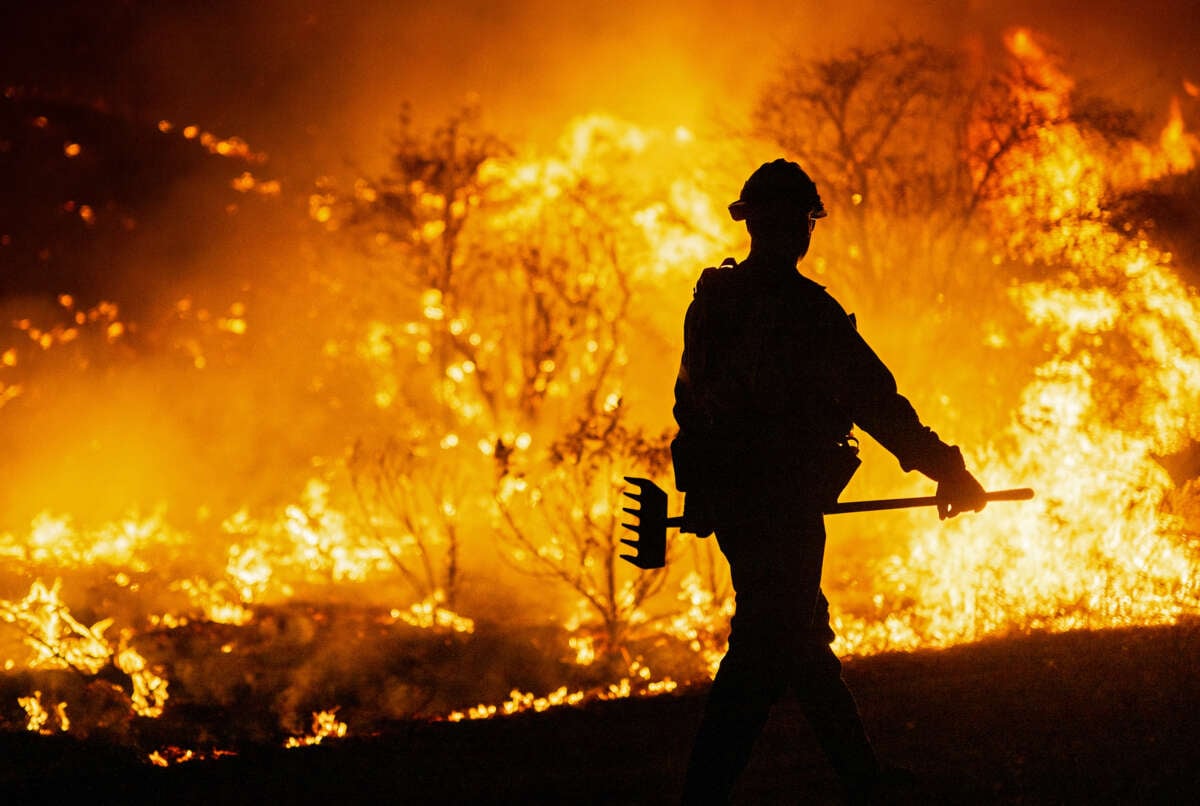
A firefighter works as the Hughes Fire burns on January 22, 2025, in Castaic, California
Brandon Bell / Getty Images

The day after Christmas in 2024, New York Gov. Kathy Hochul signed the Climate Change Superfund Act (CCSA) into law. Widely acclaimed by environmental advocates, the CCSA is a milestone: As the first climate legislation of its kind, it will bring the power of the state to bear on fossil fuel industries, mandating a meaningful degree of corporate accountability for the climate crisis.

The moment seems primed for action, and corporate liability for climate change is of course long overdue. Climate advocates hope that this model can be replicated nationwide, as vast amounts of mitigation and relief funding will be essential in the very near future — as the catastrophic fires still engulfing large areas of Los Angeles County, California have underscored to grim effect.
Novel Restitution

New York’s CCSA is modeled on the 1980 Comprehensive Environmental Response, Compensation, and Liability Act (CERCLA) — popularly known as the Superfund program. Like its noteworthy namesake, the CCSA will charge polluting corporations for the cleanup costs of their noxious effluents. However, the “climate Superfund” policy does differ from its predecessor, by virtue of the fact that the harms of carbon emissions are geographically distributed.

Namely, rather than being obligated to cover the cleanup of a particular site, New York State’s top polluters — the list will be determined by state agency review — will now have to earmark some of their grotesque profits to pay into a fund dedicated to climate-related disaster and mitigation costs in the state. Accruing at a rate of around $3 billion a year for the next 25 years, this is a not-inconsiderable sum, exceeding even the state’s largest single annual climate investment to date.

The oil industry has long hewn to the classic formula of privatizing the profits and socializing the costs, continuing to amass obscene returns while knowing full well that the price is a livable planet. Climate Superfund legislation represents a robust means of rebalancing such warped excesses. Naturally, advocates are eager to replicate this new restitution framework elsewhere.

Related Story
Mutual Aid Networks That Emerged in Housing Crisis Are Mobilizing Amid LA Fires
“If you can make a sandwich, you can start a mutual aid network,” one Los Angeles organizer told Truthout. By Schuyler Mitchell , Truthout  January 16, 2025


The notion that all of the costs incurred by climate change might be dodged by the perpetrators of the crisis is a distasteful one, to say the least. After all, the alternative to making polluters bear the cost of a disaster is to allow it to redound to the taxpayer, as it would more or less by default. That aspect alone helped earn the CCSA a wide base of support. The New York Public Interest Research Group (NYPIRG), a student-led policy research nonprofit that was instrumental in creating the CCSA, counted the backing of over 400 youth, faith and environmental organizations, along with more than 100 in-state elected officials.

“What certainly moved the needle on this was the sheer volume of organizations who were in support,” NYPIRG Executive Director Blair Horner told Truthout.

“It’s in a sense a policy unicorn” because of the way that, in this instance, environmental benefits harmonized with cost savings for local governments, creating an alignment of incentives, as Horner explained. “That’s why we had this widespread support among local elected officials, who [would otherwise] have to raise property taxes when the road gets washed out.”

Not that there weren’t major obstacles. “Any time you advocate for a measure that’s never been done before, it’s a steep hill to climb,” he said. “And when you’re taking on the oil industry, that is a very steep hill to climb.”

Horner described how lawmakers often mistakenly assumed the measure was a carbon tax — a reliably unpopular proposal. There were also questions of legal viability, and of contesting the predictable industry counternarrative that the legislation would cost consumers at the pump. But think tank research found the legal obstacles surmountable, and the latter charge totally baseless.

The concept of the climate Superfund had initially come out of work on climate resiliency that accompanied NYPIRG’s advocacy for the 2019 Climate Leadership and Community Protection Act. High mitigation needs were projected, noted Horner, and yet no funding was in place to meet them.

“Policy makers have just been whistling past the graveyard, talking about the need to do something about it — and no one was doing anything about it,” Horner said. “Unless something was done, the cost would be 100 percent borne by taxpayers. And we didn’t think that was right. We thought the polluters should pay.”


New York State’s top polluters now have to earmark some of their grotesque profits to pay into a fund dedicated to climate-related disaster and mitigation costs in the state.

In conversations with State Sen. Liz Krueger, who would become a co-sponsor of the eventual state-level CCSA, Horner and NYPIRG helped devise the Superfund-based model. In 2021, a federal bill along those lines was introduced in the Senate by Sen. Chris Van Hollen of Maryland and backed by notables like Senators Elizabeth Warren and Bernie Sanders, with companion legislation led by Rep. Jamaal Bowman in the House. The sponsors “worked hard to put that into the reconciliation package that would be in Build Back Better,” said Horner. “But as you know, Build Back Better didn’t go anywhere.”

In response, NYPIRG and other planners and advocates shifted to retarget the state level, with ultimate success. The analogous legislation that was passed around the same time in Vermont, Act 122, was also the result of organizing efforts that were interconnected with and inspired by NYPIRG and other CCSA advocates’ initiatives.

The CCSA quickly became a lodestar, a testament to what is possible. In Massachusetts, Maryland, New Jersey and California, as well as at the federal level in the House and Senate, climate Superfund bills have already been advanced. But so far, these other cases have not met with such swift and comprehensive victory — far from it, unfortunately.

Replicating the wins in New York and Vermont will not be easy, as a number of fortuitous circumstances aided the passage of those bills. Notably, in the case of New York, industry opposition groups were far outnumbered by supporting organizations, and the oil lobby was generally caught off guard. “Now why is that?” ventured Horner. “Well, I think it’s partly because we organized and we did a good job. But partly it’s because I think [oil] people didn’t think it was going to happen. The industry focused on other issues.”

Moreover, even the CCSA and Act 122 will undoubtedly face significant legal and political challenges to their implementation. Already, the industry has “filed a lawsuit to block Vermont,” Horner pointed out. With corporations now aware that such bills are politically feasible, future incarnations will face intensified resistance. Indeed, in opposing California’s climate Superfund effort, the fossil fuel lobby has already proven that its influence is far from spent.
The New Abnormal

Truman Capps, 36, is a writer who has lived in Los Angeles for 15 years. Anticipating some amount of fire is just part of being Californian — but the infernos that have now consumed 40,000 acres and 12,000 structures around metropolitan Los Angeles are jarring outliers, a new and sudden extreme. Capps spoke of how he and his family were forced into a frantic evacuation as a result of the Sunset Fire in Runyon Canyon.

“We’re all used to fires being something that happens nearby, but far away: Santa Clarita, or Santa Barbara, or the Inland Empire,” Capps told Truthout. “A very ‘it can’t happen here’ mindset.” Previous Los Angeles brushfires, he added, “have always been extinguished so quickly that I think I had a certain false sense of security.”

The stunning escalation, and the scale of loss to both culture and human life, involved in these fires has brought the impending toll of climate change into unpleasantly sharp focus for many, shaking complacency and long-held certainties. The fire risk now reaches past the far fringes of the exurbs and into highly developed areas.

“What was most jarring about these fires was how quickly they went from being minor brushfires to massive, existential threats,” said Capps. “In a matter of minutes, we went from hanging out and cooking dinner to running around the apartment in a panic trying to figure out which of our belongings we wanted to bring with us and which ones we’d be fine never seeing again.”

The fires — certain to be a disaster for insurance as well as the state budget and economy — are making an urgent and unsettling case for climate Superfund legislation. Even before the recent fires, studies had anticipated Los Angeles County alone would need approximately $780 million per year in climate protection costs.

A CCSA-like measure, the Polluters Pay Climate Cost Recovery Act, SB 1497, was introduced in the California legislature in February 2024 by Democratic State Sen. Caroline Menjivar; it could have raised tens of billions within two decades. Unfortunately, SB 1497 failed to receive the necessary votes in committee, and Menjivar was forced to render it inactive. California, an oil-producing state, has a fossil fuel lobby of immense power. That might account in part for why, so far, climate Superfund efforts have stalled in Sacramento.

Woody Hastings is the director of the “Phase Out Polluting Fuels” program at the nonprofit advocacy group and think tank The Climate Center (TCC). The TCC was a staunch advocate of SB 1497, and will be pressing for a new version of the bill as the two-year legislative session begins.


So far, climate Superfund efforts have stalled in Sacramento.

As Hastings told Truthout, SB 1497 “was a number-one priority bill for us.… We made sure to do the best we could to get it through the legislature. That meant showing up and speaking in support, signing coalition letters, meeting with legislators, educating legislators, reaching out to constituents — all those things you do in a campaign to try to move the needle.”

Perhaps it’s telling that, as quoted by Politico, one Kevin Slagle of the Western States Petroleum Association (WSPA), echoed Hastings’s words, in the precise inverse: “This was certainly a priority bill for us,” the oil industry spokesperson said. In other words, it was the industry’s priority to eliminate it. The WSPA and the California Chamber of Commerce came out against Menjivar’s bill, releasing a “Floor Alert” to legislators that deemed SB 1497 a “JOB KILLER” in shrieking red capitals. (“A very, very stale talking point from the oil industry,” Hastings remarked.)

Yet even the oil lobby’s threats, though well-worn and predictable, still have purchase: Hastings agreed that the Floor Alert might well have helped keep SB 1497 from winning the necessary votes in committee. Asked if it could have had an impact, he replied, “It always does, it always does … that kind of thing does influence the legislature every single year, yes. It’s going to be an uphill battle.”

Using its obscene profits, Hastings said, the industry has “spent record amounts of money lobbying the California legislature to stop the legislature from adopting or enacting commonsense bills, on everything from clean energy to frontline community support.” Indeed, Chevron and the WSPA top the list of total state lobbying expenses. (California would also be well-served to limit its enormous loopholes for oil companies to fix budget issues that have, among myriad other harms, deprived firefighters of adequate water supply in fighting the Los Angeles blazes.)

But despite the daunting task, the bill’s sponsors, The Climate Center, and other advocates are unswervingly dedicated to taking on the giants of fossil fuels. Their next attempt at moving the Polluters Pay Climate Fund Act forward is just getting started in the legislative session presently underway.

Just as hearteningly, in fact, something similar is occurring at the federal level — the defunct federal climate Superfund legislation that NYPIRG helped create has been reintroduced in the Senate by Sen. Chris Van Hollen, joining its counterpart in the House. While a second Trump administration and a Republican-dominated Congress will make for unpredictable circumstances, climate advocates, who have already won meaningful and real change, have proven that they will refuse to fold.

For his part, Los Angeles evacuee Truman Capps said he, and likely his fellow voters, would be very eager to support a climate Superfund law in his state. “I’d love to see California force corporations to pony up for disaster relief. Forcing big corporations to pay to clean up after climate disasters is an easy sell with California’s electorate.”

As he reflected, “What’s most concerning to me in the wake of these fires is how our elected officials appear to be completely uninterested in making any changes in light of this new reality.… It seems like [leaders’] plan is to just keep doing what we were doing before and hope that nothing bad happens again.”

NYPIRG’s Blair Horner expressed hopes that this sort of complacency will be shaken. “God knows what the fires in California are going to cost, but one thing’s for sure: [the price] will be massive … I would think that if anything, the wildfires in California would make taxpayers in California acutely more sensitive to the overwhelming financial burden of climate change.”

This article is licensed under Creative Commons (CC BY-NC-ND 4.0), and you are free to share and republish under the terms of the license.

On Bluesky? We created a starter pack to make it easy for you to follow Truthout folks there.

Tyler Walicek is a freelance writer and journalist in Portland, Oregon.


LA fires cast light on climate change insurance crisis

David Braneck
DW
January 24, 2025

With wildfires still ongoing, the blazes in California are highlighting how the climate crisis is making it difficult or impossible for those living in risk zones to insure their homes against weather disasters.

Devastating wildfires, like those that have hit Los Angeles, will become more frequent due to the climate crisis
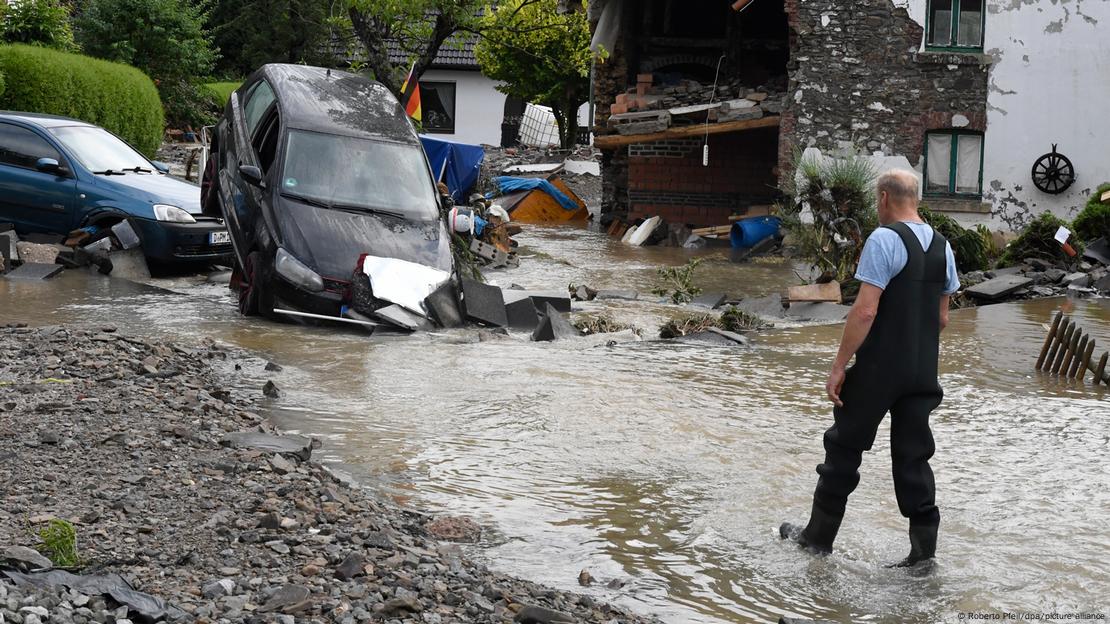
Image: David Ryder/REUTERS

The deadly Los Angeles infernos have laid waste to entire communities, forcing thousands of people to evacuate and destroying at least 16,000 structures, many of them homes.

It's likely to be one of the costliest wildfires in US history, with a preliminary estimate from AccuWeather projecting damages and economic losses of up to $250 billion (€239 billion). The US weather forecasting service calculated the costs based on factors like long-term cleanup, health and medical impacts, and shifting home values.

The fire and its aftermath have also highlighted how increasingly, climate change-related disasters are making homeowners' insurance unaffordable or inaccessible for many in at-risk regions.

California officials have had to announce a yearlong moratorium on insurance companies dropping policyholders in areas affected by the LA fires.

"The home insurance system in the US is fatally flawed," said Moira Birss, a public policy researcher at the Climate and Community Institute, a US climate and economy-focused think tank. "The cost of damage that private insurers cannot or will not insure is either being borne by households and leading to individual financial ruin."
'Climate crisis is an insurance crisis'

In the US, yearly average homeowners' insurance premiums nearly tripled from $536 to $1,411 between 2001 and 2021, largely due to the increased risk in disasters related to planetary heating. They've risen highest and most rapidly in high-risk areas.

In many cases, coverage doesn't include events like fire and flooding, which are often sold separately. Renters are also feeling the pinch, as landlords are likely to pass costs onto their tenants.

"In some cases, we can be talking about many thousands of dollars extra per year. I see it as a working- and middle-class issue that is really widespread," said Zac Taylor, a climate finance expert at Delft Technology University in the Netherlands.

Insurance against damage caused by floods or heavy rainfall will become significantly more expensive everywhere, including in Germany
Image: Roberto Pfeil/dpa/picture alliance

Insurance costs aren't just climbing in the US. In Germany, where floods are striking more often, home insurance premiums are predicted to double in the next 10 years. In Australia — frequently ravaged by wildfires and flooding — 15% of households are experiencing "home insurance affordability stress," which means they're plowing more than four weeks of their annual income into premiums.

Spiraling costs mean many living in at-risk regions are being forced to choose between buying minimal insurance or foregoing it entirely. Moving is another option. But given the difficulty of upping sticks during a global housing crisis, many are choosing to stay put — with no insurance protection — even as disasters become likelier.

In other cases, households decide to forego maintenance and retrofits, so they can afford insurance and other rising housing costs, said researcher Birss.

"When a big disaster hits, those homes are both more susceptible to damage, but also those residents might have fewer resources to recover with," Birss told DW.


Even if people can afford to shell out for homeowner and disaster insurance, major insurers are leaving high-risk regions in California and Florida in droves.

One consequence in the US is that without homeowners' insurance, it's impossible to get a mortgage and without a mortgage, most cannot buy a home. Another is even higher insurance premiums because the vacuum in the market is typically filled with smaller companies that take on the heightened risk in exchange for even more exorbitant fees.

"The climate crisis is an insurance crisis. We're at a tipping point. Many people in the US can actually no longer get insurance in the private sector," said Paula Jarzabkowski, an expert on the insurance industry from the University of Queensland in Australia.

Globally, rising prices and insurers exiting regions as frequent disasters threaten profits have contributed to the "insurance protection gap." That's the difference between insured and uninsured losses. In 2024, global natural disasters, like Hurricane Helene that hit the southeastern US as well as severe monsoon flooding in China, caused $320 billion in damages. Only $140 billion of that was insured.

Fixing insurance and reducing risk

In California, officials have urged insurers to remain in at-risk regions for now, but Jarzabkowski said this is not a long-term solution. Making insurance affordable and accessible would require taking a new approach to the entire industry, rather than leaving insurance to the private market.

"We need to start moving beyond individuals and thinking of insurance as a societal good," said Jarzabkowski.

Designing comprehensive plans that cover all kinds of disasters and are widely available, if not mandatory — like how many countries approach health insurance — would help. Jarzabowski said countries like SpainFrance and Switzerland have taken this tack, often with state backing, to help spread risk and keep costs down.

Reforming insurance can help ease costs and support those struck by climate catastrophe. But more thoughtful risk mitigation, like climate-proofing houses with fire-resistant roofing or sturdy siding in hurricane and typhoon-prone regions, would mean there's less to rebuild in the first place. This could also work for major public infrastructure, and not just retrofitting individual buildings.

"In the Netherlands, there's a tradition of building strong physical infrastructure to deal with flood risk. Dikes, water gates, complex and large-scale infrastructure to physically reduce risk," said Zac Taylor.

During droughts, dikes in the Netherlands are sprayed with water to prevent them from breaking and stop flooding
Image: Koen Van Weel/dpa/picture alliance

"That means that most people living in the low-lying parts of the Netherlands, large parts of which are below sea level, don't have flood insurance. They just don't need it," he continued.

Another potential long-term solution is encouraging people to relocate to other areas, via initiatives like tax incentives and even state-funded buyouts of houses in disaster-prone areas.

Experts say a broader approach to risk and wider efforts to keep housing and insurance affordable and accessible will require significant state coordination and investment. But with rebuilding after a fire costing more than $100 billion, it could pay off.

"The more we build resistance, the less we need to rely on that safety net of insurance," said Birss.

Edited by: Jennifer Collins
Is Colombia seeing more war than peace?

Marco Müller
DW
25/01/2025

When President Gustavo Petro took office in 2022, he aimed to bring about comprehensive peace in Colombia. But this now seems a remote dream amid the latest violence. DW presents questions and answers on the situation.

Colombian police are trying to quell the violence in the Catatumbo region
Image: Fernando Vergara/AP Photo/picture alliance


What is the current situation in Colombia?

Since January 16, the guerilla group ELN and offshoots of the former militant organization FARC have been fighting each other in the Catatumbo region in the northeast of Columbia near the border to Venezuela. At least 80 people have died so far in the violence.

At least 20 more people have been killed in clashes in the Amazonas region in the south of the country between rival splinter groups of FARC.

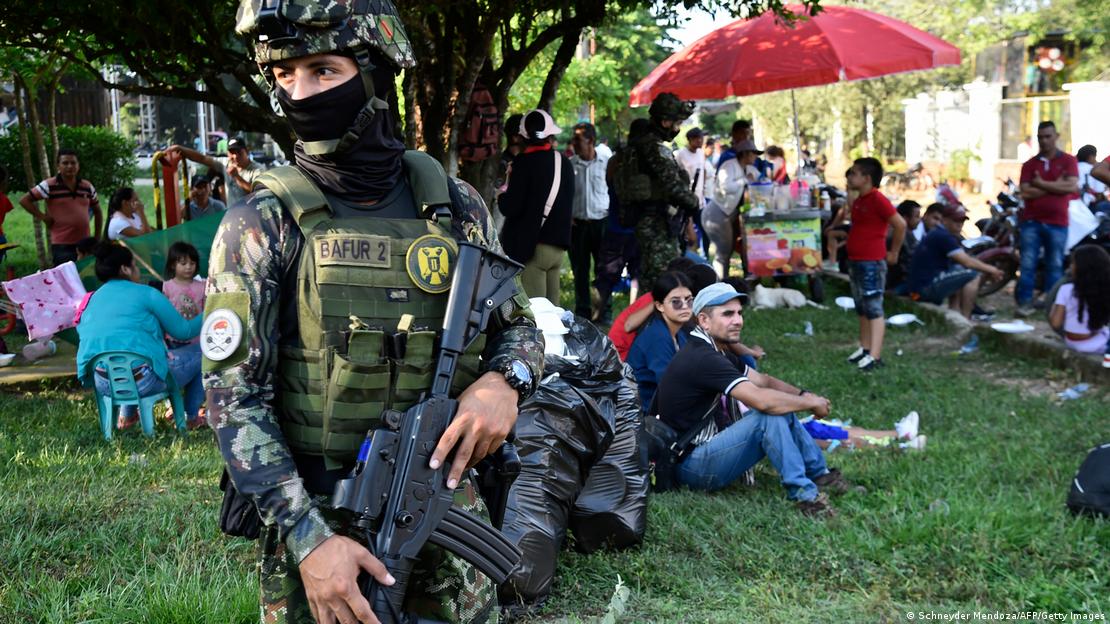
According to the Colombian military, almost 20,000 people have fled their homes for safer areas amid the extreme violence.

"They have pulled people from their houses and cruelly murdered them," army commander General Luis Emilio Cardozo said in an internet video. "It is our job as the national army to stabilize the region."

UN Secretary General Antonio Guterres has called for an "immediate cessation of acts of violence against the civilian population," said UN spokesperson Stephane Dujarric. "The secretary-general is deeply concerned about the recent violence in the Catatumbo region of Colombia," Dujarric said.

The rival left-wing extremist groups in the Catatumbo region are seeking to gain control over human trafficking, the weapons trade, illegal mining, the cultivation of drugs and the cocaine trade.

The region is seen as strategically important, as drugs can be transported out of the country from there.

Daniel Parra, a researcher for the Peace and Reconciliation Foundation in Cucuta in the northeast of Colombia, says he cannot say precisely what has triggered the current clashes between the ELN and the FARC splinter groups.

"Some national media have cited military intelligence that everything happened after the loss of a cocaine delivery and the murder of an ELN head of finance," he told DW. "But we know nothing for certain about why this armed confrontation broke out."

According to Roberto Garcia Alonso, a professor for law and politics at La Sabana University, the basic reason for the present violence is clear: Drugs.

"The fight for territorial control and the drug trade, which have always been central elements in this conflict, is putting more and more pressure on this border region, which serves as a corridor for the drug trade with Venezuela," he said.
The fighting has displaced large number of people
Image: Schneyder Mendoza/AFP/Getty Images


How long have such conflicts been going on?

There have been armed conflicts between leftist guerilla groups, drug gangs, right-wing paramilitaries and the army in Colombia since the 1960s, leading to the deaths of hundreds of thousands of people.

Some 7 to 8 million people were displaced, and some 80,000 Colombians are classified as "missing."

Who are the actors?

The Revolutionary Armed Forces of Colombia (FARC) were previously by far the biggest guerilla group in Colombia. In 2016, they signed a peace agreement with the government of the time. The FARC disbanded, but several splinter groups rejected the peace deal.

The so-called National Liberation Army (ELN) was founded in 1964. It was not involved in the peace agreement and is seen as the strongest rebel organization still active in Colombia.
ELN fighters are involved in the latest violence
Image: Daniel Munoz/AFP

What role does President Gustavo Petro play?

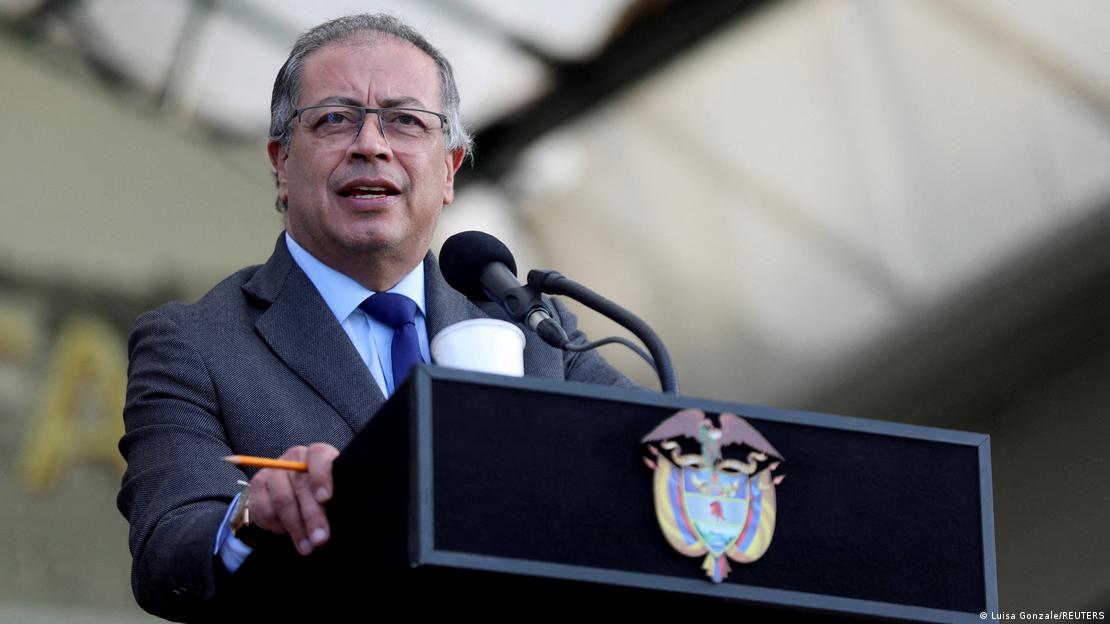
Gustavo Petro has been Colombia's head of state since mid-2022. When he took office, he promised to take up negotiations with all the country's armed groups with the objective of achieving a broad peace.

After the escalation of violence in the north of Colombia, Petro spoke of war crimes and stopped the peace negotiations with the ELN guerillas. He imposed a state of emergency and declared war on the ELN, writing on X: "The ELN has chosen the path of war, and that's what they will get."

Petro himself was once the member of an armed group, an urban guerilla organization called M-19.

Petro has said he wants to achieve comprehensive peace in Colombia
Image: Luisa Gonzale/REUTERS


What comes next?

It currently seems doubtful whether the peace process can be advanced in the near future.

"It is very difficult, because what is happening here is eating away at President Petro's already low popularity," Garcia Alonso said. "What is more, the policy of a comprehensive peace has not delivered any results."

For this reason, he said, it is not clear whether the government will continue on that path. The outbursts of violence are also causing the population to lose much of its trust in the peace process, according to Garcia Alonso.

Daniel Parra is also skeptical. At first, Petro announced that negotiations with the ELN would be suspended, and now one saw with amazement that war had been declared on the guerilla group, he said.

"This worries us greatly because an armed conflict between guerilla fighters and the police would just cause more victims, more murders, more killings. We are wondering how the police will proceed," he said.

But Parra is not holding his breath. The ELN has been carrying on an armed fight for 60 years, and Colombia's government has not succeeded in getting the better of the rebel organization with direct force in all that time, he said.

Emilia Rojas Sasse contributed to this article.

The article was originally written in German.

WWIII

Philippine vessels suspend survey after China's 'harassment'


Two Philippine ships had to call off their scientific probe after Chinese vessels and a helicopter intercepted them near the Spratly archipelago, according to the Philippines' coast guard.


The survey was being conducted near Thitu island
Image: Philippine Coast Guard/AFP


The Philippines said its fishing vessels were harassed by Chinese coast guard and navy on Saturday, prompting the Philippine ships to suspend a scientific survey they were conducting in the South China Sea.

According to the Philippine coast guard, two vessels from the Bureau of Fisheries were on the way to collect sand samples from Sandy Cay, three small uninhabited sandbars in the Spratly archipelago. Their destination was located near the Thitu island controlled by the Philippines and an artificial island where China had erected a military base.

What happened to the vessels

They were met with three Chinese Coast Guard vessels, and faced "aggressive maneuvers" including four small boats that were deployed to "harass" the Philipino boats, the Philippine Coast Guard said in a statement.

A Chinese navy helicopter was also present, hovering at an "unsafe altitude," it said.

The Philippines' vessels had to maneuver to avoid collision. They decided to suspend their survey due to "this continuous harassment and the disregard for safety exhibited by the Chinese maritime forces," the coast guard said.

The coast guard released videos collaborating the account, with one of them showing a Chinese Coast Guard ship sailing very close to a Philippine vessel and another video showing a Chinese helicopter flying low near a boat with a Philippines' flag.

No accidents were reported from the confrontation.

Responding to the incident, Beijing said that it has "indisputable sovereignty" over the Spratly Islands. It also said the Philippine vessels had entered without permission and tried to "illegally" land on the reef to collect sand samples.

The Philippines and China often have clashes in the South China Sea. Beijing claims ownership of almost the entire sea, which is also claimed in parts by Philippines, Indonesia, Malaysia and Vietnam.

An international arbitration court in 2016 had ruled that Chinese claims over the waterway have no basis in international law.

Who's challenging Beijing in the South China Sea?  15:26


tg/dj (AFP, AP, Reuters)
Germany: Thousands march as AfD election campaign begins

Thousands of people protested the rise of the far right in cities across Germany on Saturday, as the Alternative for Germany (AfD) party campaign kicked off.

Thousands of people took part in the protests, with the banner here saying: "Never again is now"
Image: Christoph Reichwein/dpa/picture alliance


Thousands of Germans took to the streets in several cities to protest the rise of far-right extremism and the growing popularity of the anti-immigrant Alternative for Germany (AfD) party.

At Berlin's Brandenburg Gate, people blew whistles and sang anti-fascist songs, and in the western city of Cologne, protesters carried banners denouncing the AfD.

The protests also came as the AfD opened its election campaign in the central city of Halle, where around 4,500 AfD supporters gathered at the venue where party leader Alice Weidel, who is also AfD's candidate for chancellor, addressed people.
Large crowds of protesters took to the streets of Berlin, with the banner here reading: "All of Berlin hates AfD"Image: Monika Wendel/dpa/picture alliance

About 20,000 people took part in demonstrations in the western city of CologneImage: Christoph Reichwein/dpa/picture alliance
Migration at center of electoral debate before snap elections on February 23

Weidel began her address on a topic that has moved to the forefront of the electoral campaign, especially this week in Germany, that being migration.

Two people were killed, including a two-year-old child, in a knife attack in Aschaffenburg earlier in the week.

An Afghan man who was due to be deported was taken into custody on suspicion of having carried out the attack.

The official manifesto of the AfD seeks faster deportations of declined asylum seekers and those who entered the country illegally and the party has been severely criticized due to several controversial ideas.

AfD in buoyant mood with second place in polls

The far-right AfD is in second place at 20% according to the latest poll tracker, while the center-right bloc of the Christian Democratic Union (CDU) and its Bavarian sister party, Christian Social Union (CSU), currently leads competitors with 31%.

Chancellor Olaf Scholz's Social Democrats (SPD) currently stands in third place at 15%, just ahead of the Greens with 14%.

Elon Musks joins AfD campaign launch

US billionaire and adviser to President Donald TrumpElon Musk again backed the AfD, as he appeared via videolink at the campaign launch ahead of the address of the party's lead candidate, Alice Weidel.

"I'm very excited for the AfD. I think you are really the best hope for Germany," Musk — who has been accused of meddling in European politics — said and added that it was OK to "take pride" in being German.

"I think there is frankly too much of a focus on past guilt, and we need to move beyond that. Children should not be guilty of the sins of their parents or even their great-grandparents," he said.

At Trump's inauguration on Monday, Musk attracted attention with a gesture reminiscent of a Hitler salute.

Weidel conveyed her best wishes for the US, now under the Trump administration and adapted Trump's slogan and said: "Make Germany great again."

Germany's domestic intelligence agency, the Federal Office for the Protection of the Constitution (BfV), has classified the AfD as a "suspected" far-right extremist organization.

Musk hosts X talk with German far-right leader Weidel  09:01

Tens of thousands protest over right-wing extremism

The event was met with protests in Halle while tens of thousands of others took part in demonstrations against right-wing extremism in several cities.

Cologne police estimated the number of participants on Saturday afternoon at "significantly more than 20,000 people."

The organizers had initially registered between 5,000 and 10,000 participants.

Despite the large crowds, a police spokeswoman said that everything had been running smoothly.

kb/rm (dpa, AFP)

Elon Musk addresses German far-right rally by video link

Halle (Saale) (Germany) (AFP) – US tech billionaire Elon Musk gave a video address to a campaign rally of Germany's anti-immigration AfD party Saturday, his latest show of support ahead of the country's election next month.


Issued on: 25/01/2025
FRANCE24


Musk told AfD supporters that their party was 'the best hope for the future of Germany' © - / AFP

Musk told a gathering of thousands of AfD supporters in the eastern city of Halle that their party was "the best hope for the future of Germany".

Musk has raised concern from some mainstream leaders who have accused him of interfering in European politics with comments on his social platform X about politicians in countries including Germany and Britain.

He also drew criticism this week for making a public hand gesture that was seen by some as resembling a straight-armed Nazi salute.

"The German people are really an ancient nation which goes back thousand of years," he said in Saturday's address.

"I even read Julius Caesar was very impressed (by) the German tribes," he said, urging the supporters to "fight, fight, fight" for their country's future.

He said the AfD wanted "more self-determination for Germany and for the countries in Europe and less from Brussels", a reference to European Union authorities.


Musk is a close associate of US President Donald Trump, who has appointed him to head a new department of "government efficiency" in his administration.

Like Trump, the AfD opposes immigration, denies climate change, rails against gender politics and has declared war on a political establishment and mainstream media it condemns as censorious.

Ahead of Germany's February 23 elections, it is polling at around 20 percent, a new record for a party that has already shattered a decades-old taboo against the far right in post-war Germany.

The mainstream conservative grouping CDU/CSU leads on about 30 percent.

© 2025 AFP


SO CALLED;'SHITHOLE COUNTRIES'

African healthcare at a crossroads after United States pulls WHO funding

Africa's reliance on World Health Organization support faces a critical test after Donald Trump withdrew the United States – and the considerable funding it contributes – from the global body. The move could have serious consequences across the continent, but one senior African health official told RFI it could also push African nations to take greater control of their health systems.


Issued on: 23/01/2025 - RFI

A health worker at Queen Elizabeth Central Hospital in Blantyre, Malawi takes oxygen cylinders to Covid-19 wards during the pandemic in January 2021. 
AP - Thoko Chikondi

Between 2022 and 2023, Washington contributed $1.28 billion to the World Health Organization (WHO) – more than any other country.

But hours after taking office on Monday, Donald Trump signed an executive order announcing that the United States was leaving the WHO and taking its funding with it, citing dissatisfaction over its handling of the Covid-19 pandemic and the inequality of contributions.

China, with a population of 1.4 billion, has 300 percent of the population of the United States, yet contributes nearly 90 percent less to the WHO," the order read.

The move has raised concerns on the African continent about how the loss of finance could impact the fight against HIV-Aids, and the growing mpox epidemic – which the African Union's health watchdog (Africa CDC) has declared a public health emergency.

On Wednesday, the African Union expressed dismay over the withdrawal, urging the Trump administration to reconsider.

RFI spoke to Professor Yap Boum II, deputy coordinator of the CDC's mpox response unit.

RFI: What are your thoughts on the decision announced by the new American president?

Professor Yap Boum II: The decision was anticipated, it had been in the air. Dr Tedros Ghebreyesus, director-general of the World Health Organization, addressed it this week, so it’s not surprising.

However, it will have a significant impact. For instance, in responding to the mpox epidemic the WHO and Africa CDC are coordinating efforts, and out of the projected funding of $1 billion, the US contributes $500 million – half of the total. This withdrawal could have substantial consequences. We need to consider what the US's exit from the WHO signifies. Does it imply a reduction in US support for global health? These are distinct issues. It’s crucial to understand the practical implications so that we can all adapt accordingly.

WHO regrets Trump move to pull US from organization

RFI: Historically, the US has been a significant contributor to public health emergency appeals.

YB: Yes. For instance, the US is the largest contributor to the fight against HIV-Aids in Africa and globally. In response to major epidemics like Covid-19 and now mpox, the US has provided half of the funding. The impact will be considerable, depending on how the situation unfolds.

Is the WHO all there is to health? That’s the key question. Could this open the door for other agencies, such as USAID or various organisations, to receive the funds. And, couldn’t this also be an opportunity for African philanthropists for example to contribute more to the Africa CDC? Couldn’t this lead to a reorganisation of the global health landscape? We’ll get more clarity on this in the coming weeks and months.

Number of African-born millionaires to skyrocket over next decade: report

RFI: So you’re not dismissing the possibility of other players stepping in?

YB: Absolutely not. As the saying goes, nature abhors a vacuum. If there are crises – and there will be – needs will continue to grow. We’ll need individuals, institutions and even nations to fill that gap. The current Davos summit presents an opportunity to discuss how certain philanthropists can take on the funding that the US might give up. I’m currently in Kinshasa, Democratic Republic of Congo, focusing on how African entities, countries and member states can invest more in the health of their communities in response to mpox.

WHO reports 30,000 suspected mpox cases in Africa, mainly in DRC

RFI: Have you observed African governments being willing to increase their contributions to financing African structures, especially Africa CDC?

YB: Absolutely. To kickstart the response to the mpox epidemic, member states were the first to invest. Here in the DRC, the government was quick to release funds to support the response efforts. There’s a strong desire for sovereignty that allows us to respond to epidemics.

However, we currently lack the critical mass to do this alone. So in some respects the pressure [stemming from the US’s withdrawal from the WHO] could act as a catalyst for member states, as well as for philanthropists and investors. We’ve never had so many African billionaires. Now is the time to invest more seriously to ensure national and even continental sovereignty.

This interview, adapted from the original in French, has been lightly edited for clarity.
French woman not 'at fault' for refusing sex with husband, European court rules

A French woman blamed for her divorce because she refused to have sex with her husband has won a landmark case at Europe’s top human rights court. The case has become a talking point in the renewed debate over women's rights in France.

Issued on: 23/01/2025 - RFI

The European Court of Human Rights over-ruled the French court's decision that the woman was 'at fault' in her divorce. 
AFP - FREDERICK FLORIN


The European Court of Human Rights (ECHR) on Thursday ruled in favour of the 69-year-old French woman, whose husband had obtained a divorce on the grounds that she had stopped having sex with him.

The Strasbourg-based court said that a woman who refuses to have sex with her husband should not be considered "at fault" by divorce courts, and any concept of marital duties needed to take into account consent as the basis for sexual relations.

It ruled that France had violated article 8 of the European Convention on Human Rights, relating to the right to respect for private and family life.

The mother of four from the suburbs of Paris, who wished to remain anonymous and was identified only as HW, welcomed the ruling. "I hope that this decision will mark a turning point in the fight for women's rights in France," she said in a statement.


"This victory is for all the women who, like me, find themselves faced with aberrant and unjust court rulings that call into question their bodily integrity and their right to privacy."

The ruling comes as French society debates the concept of consent, with women's rights advocates saying it should be added to France's legal definition of rape.

France urged to place consent at centre of rape law reform
Grounds for divorce

The woman did not complain about the divorce, which she had also sought, but rather about the grounds on which it had been granted, the court said.

"The court concluded that the very existence of such a marital obligation ran counter to sexual freedom, (and) the right to bodily autonomy," a statement from the court said. "Any non-consensual act of a sexual nature constituted a form of sexual violence."

France announces new measures to combat violence against women

It added: "The applicant's husband could have petitioned for divorce submitting the irretrievable breakdown of the marriage as the principal ground and not, as he had done, as an alternative ground."

The couple married in 1984 and had four children, including a disabled daughter who needed the constant presence of a parent, a role that her mother took on.

Relations between husband and wife deteriorated when their first child was born. The woman began experiencing health problems in 1992. In 2002, her husband began abusing her physically and verbally, the court said. In 2004, she stopped having sex with him and in 2012 petitioned for divorce.

In 2019, an appeals court in Versailles dismissed the woman's complaints and sided with her husband, while the Court of Cassation dismissed an appeal without giving specific reasons. She turned to the ECHR, which acts as a court of last instance where all domestic legal avenues are exhausted, in 2021.
'Sexual servitude'

"It was impossible for me to accept it and leave it at that," the woman said.

"The Court of Appeal's decision condemning me was and is unworthy of a civilised society, because it denied me the right not to consent to sexual relations, depriving me of my freedom to make decisions about my body. It reinforced the right of my husband and all spouses to impose their will."

Her case has been supported by two women's rights group, the Fondation des Femmes (Women's Foundation) and Collectif feministe contre le viol (Feminist Collective Against Rape).

In a joint statement in 2021, these groups said: "Marriage is not and must not be sexual servitude."

While French criminal justice abolished the concept of conjugal duty in 1990, "civil judges continue to impose it through an archaic vision of marriage," they said.

Delphine Zoughebi, a member of the woman's defence team, said: "This decision is all the more fundamental given that almost one in two rapes is committed by a spouse or partner."

The ECHR is part of the 46-member Council of Europe pan-European rights body. It enforces the European Convention on Human Rights and its rulings are legally binding and not advisory.

(with AFP, Reuters)
French PM under fire for plans to split controversial assisted dying bill

Prime Minister François Bayrou has drawn strong criticism after proposing to split France's long-awaited end-of-life legislation into two separate laws. Opponents warn the move could delay assisted dying reforms.


Issued on: 24/01/2025 - RFI

Prime Minister Francois Bayrou is under fire for allegedly giving in to pressure from opponents of euthanasia, particularly on the conservative right. 
AP - Remy de la Mauviniere

The legislation, which would legalise assisted dying and improve palliative care, followed years of public consultation including a citizens' convention that recommended comprehensive changes to both areas.

The original single bill reached parliament in early 2024 but stalled when the National Assembly was dissolved in June.

Bayrou, a devout Catholic, now wants to separate the two issues into distinct laws, a move that has exposed divisions both within parliament and the governing coalition.


Mounting criticism

"This is a way of abandoning the project to legalise assisted dying," said left-wing lawmaker Éric Coquerel.

The move has drawn particular anger from opposition parties who see it as a tactical maneuver rather than a genuine attempt at reform.

"We know François Bayrou's convictions on this subject. The position of a minority prime minister in a very precarious political context cannot be imposed on the National Assembly," said Socialist MP Jérôme Guedj.

French lawmakers open tense two-week debate on assisted dying

Even within the government coalition, the plan has caused unease. Former minister Prisca Thevenot questioned the change.

"I was minister when the bill was presented as a single block. Perhaps we should also respect this desire, which is not just the will of some people but of a citizens' convention, with citizens who worked on it for several months," Thevenot said.
Right-wing backing

However, conservative politicians have welcomed splitting the legislation.

"The aspect everyone agrees on is the need to strengthen palliative care. On the rest, there are debates," said Éric Ciotti from the Union of the Right for the Republic – a party aligned with the far-right National Rally.

Meanwhile government spokesperson Sophie Prima underlined assisted dying reforms would not be abandoned.

"This issue will be on the agenda as soon as possible. It's a question of parliamentary votes on subjects that are distinct in nature," she said.

Sources close to Bayrou said both palliative care and assisted dying would be examined in the "same parliamentary timeframe", though no specific schedule was provided.

The lack of a clear schedule has fuelled concerns among critics that assisted dying reforms could face lengthy delays.
French films storm Oscar nominations as Audiard's Emilia Perez breaks records

French director Jacques Audiard said he was "thrilled" after his musical Emilia Perez scooped 13 Oscar nominations this week, a record for a non-English-language film. His compatriot Coralie Fargeat and her film The Substance, starring Demi Moore, got five nods, including for best director.


Issued on: 25/01/2025 - RFI

Jacques Audiard holds the Jury Prize award for 'Emilia Perez' at the Cannes Film Festival in May 2024. Andreea Alexandru/Invision/AP - Andreea Alexandru

Emilia Perez – the surreal telling of the gender transition of a Mexican drug lord – picked up nominations for best picture, best director, best adapted screenplay and best international film, as well as nods in the song, score and sound categories.

The movie's star Karla Sofia Gascon became the first openly trans nominee for best actress, while her co-star Zoe Saldana was nominated for best supporting actress.

Audiard said his film, a musical interspersed with Spanish dialogue, was an example of "hybrid cinema". "I wonder if it's becoming a trend – a desire to make films with different linguistic elements, unique actors, and distinctive themes," the 72-year-old told French news agency AFP.

Set in Mexico but filmed entirely in a Paris studio, the film won the Jury Prize and Best Performance by an Actress at the Cannes Film Festival in 2024. It also went on to win four Golden Globes earlier this month, including Best Musical.

Eight films from the Official Selection at Cannes made the Oscars shortlist this year, in 17 categories, totalling 31 nominations. Among them is the Cannes Palme d'Or winner Anora by Sean Baker, with six nominations.

French trans gangster musical 'Emilia Perez' wins four Golden Globe awards
Criticism in Mexico

Despite its international success, Emilia Perez has faced criticism in Mexico, where it is accused of trivialising drug-related violence and the problem of missing people.

Audiard told reporters it was a topic "close to his heart," but admitted he might have "handled it clumsily".

"My intentions seem virtuous to me but I recognise there's an issue over there."

Audiard said he spent more than four years researching the film. "At some point you have to stop doing research because otherwise you end up doing a documentary," he said, adding: "It's an opera and an opera is not very realistic."

Audacious musical Emilia Perez brings accolades for French composers

This year's best director category features another French filmmaker, Coralie Fargeat, the only woman to be nominated for the award.

The Substance is the story of a fading movie star who is abruptly fired from her hit TV fitness show as she turns 50. It stars Demi Moore, who is nominated for best actress.

The film, which won Best Screenplay Award in Cannes in 2024, has received five Oscar nominations.
Director Coralie Fargeat and cast members Demi Moore and Dennis Quaid at a photocall for the film "The Substance" at the Cannes Film Festival in May 2024
. REUTERS - Stephane Mahe


'The power of representation'

"I made this film with my guts and my heart, which is why it's so visceral and uncompromising. I'm proud that it resonated with audiences and voters. It means the film was understood," Fargeat told AFP.

"The most touching messages that I've received are from young women directors," she said after her nomination. "It makes us believe it's possible. I deeply believe in the power of representation."

The other 2025 best director nominees are Sean Baker for Anora, Brady Corbet for The Brutalist and James Mangold for A Complete Unknown.

Erotic dancer comedy-drama wins top prize at Cannes Film Festival

Only three women have won the best director award, beginning with American Kathryn Bigelow for her 2009 war film The Hurt Locker.

French Culture Minister Rachida Dati hailed the two French films in the category, saying they were "evidence once again of the genius of French cinema".

Audiard has previous experience of the Academy Awards, having seen his 2009 film A Prophet nominated in the best foreign language film category. "But it wasn't the same pressure," he said.

The Oscars ceremony is set for 2 March.

(with AFP)
Macron’s Africa 'reset' stumbles as leaders call out colonial overtones

French President Emmanuel Macron’s efforts to “reset” France’s relationship with its former African colonies appear to be faltering. Seven years after coming to power with promises of reform, a growing number of West African nations are asking for French troops to leave, signalling a breakdown in relations.


Issued on: 25/01/2025 - RFI

A French soldiers mans a machine gun on board a Caiman transport helicopter during a night mission in Gao, Mali, in June 2021. AP - Jerome Delay


By: Melissa Chemam


Seven former French colonies have changed their cooperation policy with France in recent months. Mali, Burkina Faso, Niger and Gabon made the move in the past three years, followed by Senegal, Chad and Côte d'Ivoire in recent weeks.

Some have gone as far as demanding a complete withdrawal of French forces.

During his annual address to ambassadors this month, Macron criticised what he called African nations’ “ingratitude” toward France. He said leaders had failed to say "thank you" for France’s military interventions, including the 2013 operation in the Sahel.

“It’s no big matter, it will come with time,” Macron said, adding that without France’s counterterrorism efforts, “none of them” would be governing a sovereign nation today.


Angry reactions

The comments drew sharp rebukes from African leaders.

Burkina Faso’s junta leader, Captain Ibrahim Traoré, called Macron’s remarks an insult. “To him, we are not human beings,” Traoré said.

Senegalese Prime Minister Ousmane Sonko also criticised Macron, reminding him that African soldiers had fought for France during World War II. “It was thanks to our ancestors that France exists today,” Sonko said.

Macron also claimed that the recently announced withdrawal of French troops from Chad and Senegal had been negotiated. However, leaders from both nations have publicly denied this, calling his statements inaccurate.

The loss of influence in Chad, Senegal and Côte d’Ivoire – long considered French allies in Africa – marks a significant shift. Chad has played a central role in French military strategy in the Sahel, while Senegal has been one of West Africa’s most stable democracies.

Senegal and Chad rebuke Macron over 'inaccurate' French troop withdrawal claims
Policy backfire

Experts argue that anti-French sentiment in Africa is not new but has intensified in recent years.

In November 2024, Macron's new envoy, Jean-Marie Bockel, told RFI that none of these African partners wanted the French to leave. The following weeks proved him wrong.

“Hostility towards the former colonial power has been shaped by a history of domination, arrogance and indifference,” said Senegalese economist Ndongo Samba Sylla.

In a recent report, he argued that resentment has been building for decades over what many see as exploitative and dismissive French policies.

“Longstanding resentment towards former colonial powers in francophone African countries has been shaped by a history of oppressive rule and disregard for local populations,” he wrote.

France’s reliance on military interventions has been described as a major policy backfire.

Thierry Vircoulon, an Africa researcher at the French Institute for International Relations (IFRI), added that Macron’s unfiltered remarks often worsen diplomatic tensions.

“He is very much used to speaking his mind publicly, which of course is not a good idea," he said. "The problem is that, with social media now, these kinds of little sentences become the main argument."

Roland Marchal, a researcher at CNRS and Sciences Po in Paris, told RFI: “In Mali in particular, when the French mission left, the security situation had deteriorated significantly. It was a failure, in all honesty.”

Other analysts, such as Gilles Holder, say France’s reliance on military interventions has alienated local populations.

“Unlike the British, France has not invested enough in economic and cultural fields since independence,” Holder told Le Monde.
Economic pivot

Faced with deteriorating relations in francophone Africa, France is pivoting toward stronger economic partnerships with Anglophone nations like Nigeria, but also Morocco and Angola.

Africa and defence specialist Jonathan Guiffard, of Institut Montaigne, said France cannot afford to abandon all ties in West Africa but may need to reduce its military presence.

“France will keep ties with these countries but will have to leave Chad, as the fall-out is too deep,” he said.

Experts agree that France needs to rebuild its African partnerships with less focus on military interventions. Antoine Glaser, a specialist on African politics, said France’s reliance on security pacts was anachronistic.

“France must recognise that it has remained present for too long by replacing African armies in terms of security,” Glaser told RFI.

Vircoulon said the historical reasons for France’s military presence in Africa have largely disappeared.

“Instead of demilitarising the relationship, the French government is trying to invent a new model of military partnership that is politically risky,” he said.

Marchal warned that as Sahel states transition to civilian rule, France risks missing an opportunity to build a different kind of relationship with these nations – one that is peaceful and finally more respectful.

MAYOTTE CYCLONE

Post-cyclone curfew lifted in Mayotte as recovery continues and schools reopen

The curfew in Mayotte has been lifted ahead of the incremental reopening of schools next week, as recovery efforts continue.


Issued on: 25/01/2025 - RFI

People, affected by cyclone Chido, receive food during a distribution at Paulette Henry Primary School in the city of Mamoudzou, on the French Indian Ocean territory of Mayotte on 29 December 2024. Schools across the archipelago are due to reopen from Monday 27 January 2025. © Patrick Meinhard / AFP

The curfew introduced in mid-December in the Mayotte archipelago devastated by cyclone Chido was lifted on Saturday, according to police authorities.

In a statement published by Mayotte's prefecture on social media: "From Saturday 25 January 2025, the curfew is lifted" in the Indian Ocean territory.

"As the cyclone protection phase is still underway, everyone is asked to exercise the utmost caution when travelling to allow the internal security forces, emergency services and the various services still involved in crisis management and network restoration to take action," the statement added.

Mayotte schools to reopen, more than a month after devastating cyclone


Aid flows from French cities to Mayotte a month after devastating cyclone

A curfew from 10pm to 4am was introduced on 17 December in a bid to prevent looting in the wake of the cyclone.

Chido – the most devastating cyclone to hit Mayotte in 90 years – killed at least 39 people on 14 December and injured more than 5,600.

The lifting of the curfew comes just two days before the start of the new school year for Mayotte's 117,000 pupils, who are returning to classes from Monday under conditions that some teachers and parents have criticised.

The start of the new school year – initially scheduled for 13 January – was first postponed to 20 and then to 27 January to deal with the damage caused by the cyclone.

Last Monday, it was the teachers who went back to school, only to discover that some schools had been destroyed and were unfit for purpose.