Saturday, January 25, 2025

GREENLAND

Amaroq Awarded Johan Dahl Land Licence and Positive Initial Exploration Results

Expanding Presence across the South Greenland Copper Belt


January 22, 2025 02:00 ET | Source: Amaroq Minerals
Share


Reykjavík, Jan. 22, 2025 (GLOBE NEWSWIRE)
-- (“Amaroq” or the “Company” or the “Corporation”)

Amaroq Awarded Johan Dahl Land Licence and Positive Initial Exploration Results

**Results of up to 12.3g/t Au and 5.1%Cu Recorded**

TORONTO, ONTARIO – January 22, 2025 – Amaroq Minerals Ltd. (AIM, TSXV, NASDAQ Iceland: AMRQ), an independent mining development Company with an extensive land package of gold and strategic mineral assets across Southern Greenland, is pleased to announce that it has been awarded the Johan Dahl Land licence (MEL 2025-17). This newly acquired licence expands Amaroq’s footprint in the South Greenland Copper Belt, a region demonstrating high potential for copper-gold mineralization, complementing the Company’s existing portfolio in the area.

HighlightsThe Johan Dahl Land licence encompasses an area of 666.51 km², increasing Amaroq’s total land holdings to 6,800.1 km².
This significant expansion of the Company’s critical metal portfolio now sees Amaroq hold 3,147 km2 of the South Greenland Copper Belt, through its Gardaq Joint Venture.
Initial exploration at the newly defined Ukaleq Target identified gold grades up to 12.3 g/t Au and copper grades up to 5.1% Cu, hosted in quartz and copper sulphide veins.
A further copper-gold anomalism covering an area extending up to 19 km² has been identified, highlighting the broader exploration potential.
Geochemical signatures suggest the presence of an intermediate-to-high sulphidation epithermal system. Such systems are globally recognized for their copper, gold, and silver potential.
These findings are believed to be key structures, consistent with the geological framework of the South Greenland Copper Belt.

References to the accompanying presentation on the Johan Dahl Land results can be accessed on the website by clicking the link below:

https://www.amaroqminerals.com/investors/presentations/

James Gilbertson, VP Exploration for Amaroq, commented:

“The award of the Johan Dahl Land licence and the promising early exploration results reaffirm Amaroq’s commitment to unlocking Greenland’s critical mineral potential. The South Greenland Copper Belt is rapidly emerging as a significant exploration district, and our work at the Ukaleq Target has already demonstrated its significant resource potential. We are excited to advance exploration efforts and build on these discoveries to position Amaroq as a leader in sustainable mineral development in Greenland.”

Exploration Summary

Prior to the final award of the Johan Dahl Land licence, Amaroq conducted an intensive field program across the Ukaleq Target area. Building on the Company's geological expertise in the South Greenland Copper Belt, sampling of exposed quartz and copper sulphide veins returned highly encouraging assay results. These included gold grades up to 12.3 g/t Au and copper grades reaching 5.1%, indicative of a robust mineralizing system.

Broader reconnaissance efforts identified a 19 km² zone of copper-gold anomalism, supported by detailed geochemical analyses. The geochemical signature suggests a potential intermediate-to-high sulphidation epithermal system, comparable to similar high-potential systems globally.

Strategic Expansion in South Greenland

The Johan Dahl Land licence will be held under the Company’s Gardaq Joint Venture and represents a key addition to Amaroq’s extensive portfolio in the South Greenland Copper Belt. This region is becoming increasingly recognised for its critical mineral resources, offering a unique opportunity for Amaroq to contribute to the global supply of essential metals while supporting Greenland’s sustainable economic development.

Next Steps

Amaroq intends to integrate the results from the 2024 exploration program into a broader exploration strategy for 2025. Planned activities include:Detailed geophysical surveys to refine initial drill targets across the Ukaleq Target;
Advanced geochemical sampling to further delineate high-grade zones within the 19 km² anomalous area; and
Regional exploration across the Johan Dahl Land licence to identify additional mineralized systems.


Amaroq is committed to working in close collaboration with Greenland’s government and communities to ensure a responsible development of the region’s mineral resources.

Enquiries:

Amaroq Minerals Ltd.
Eldur Olafsson, Executive Director and CEO
eo@amaroqminerals.com
Indonesia pressures commodity firms with earnings rule

AND WELL THEY SHOULD

Bloomberg News | January 22, 2025 |


Credit: Vale Indonesia

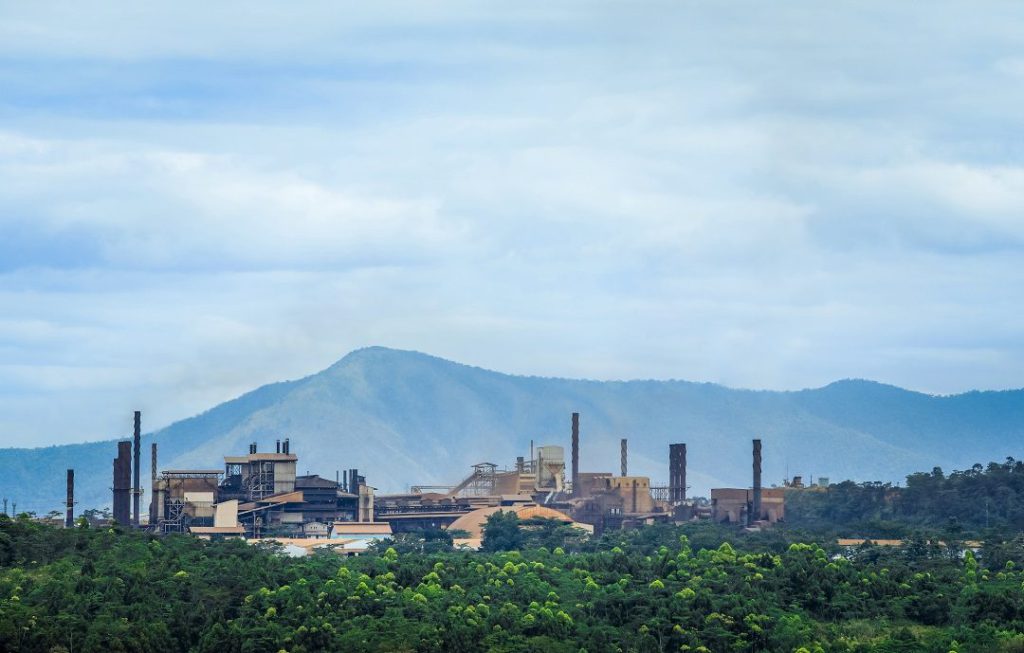
Indonesia plans to force commodity firms to keep their export earnings onshore for at least a year, tightening an existing requirement for a sector already facing mounting regulatory uncertainty.


The policy, due to take effect on March 1, is aimed at bolstering Indonesia’s foreign-exchange reserves and supporting the rupiah. Exporters, however, have complained it will impact their ability to manage cash flow and force them to take out larger loans to finance everyday expenses. Currently, exporters are required to keep 30% of proceeds in Indonesia for at least three months.

“A sudden move could shock businesses and impact their cash flow,” said David Sumual, chief economist at Bank Central Asia. “If they’re unprepared, it will be challenging.”

The Indonesian rupiah has been under pressure from a resurgent dollar, weakening more than 7% since the end of September despite multiple interventions by the central bank. Bank Indonesia’s surprise interest rate cut last week added to the country’s predicament.

But the new rule comes as Indonesia’s natural resources sector, the cornerstone of its economy, faces other sudden shifts in policy under recently inaugurated President Prabowo Subianto. The country is weighing cuts to nickel mining quotas to boost prices, Bloomberg reported last year, potentially worsening global shortages.

Indonesia’s biggest copper mine, owned by Freeport McMoran Inc. and a state-owned partner, is currently unable to ship its output overseas as ministers prevaricate over whether or not to temporarily relax a ban on exports.


While the new government had already signaled its intent to extend the foreign-exchange lock-up, the scale of the changes has taken exporters by surprise. It marks a shift in approach from the more measured policy of Prabowo’s predecessor, Joko Widodo, who relied on tax incentives and well-telegraphed export bans to stimulate investment into the processing of raw commodities.

It also comes at a time when coal and nickel, two of Indonesia’s highest-earning commodities, are trading near multi-year lows. Both sectors will be affected by the measure, as well as the country’s huge palm oil plantations.

“In the mining and plantation sectors, such a retention rule could trigger potential layoffs due to unhealthy company cash flows,” Sutrisno Iwantono, head of public policy division at the Indonesian Employers Association, said in statement. “There are also fears of a knock-on effect of reduced coal and mineral production.”

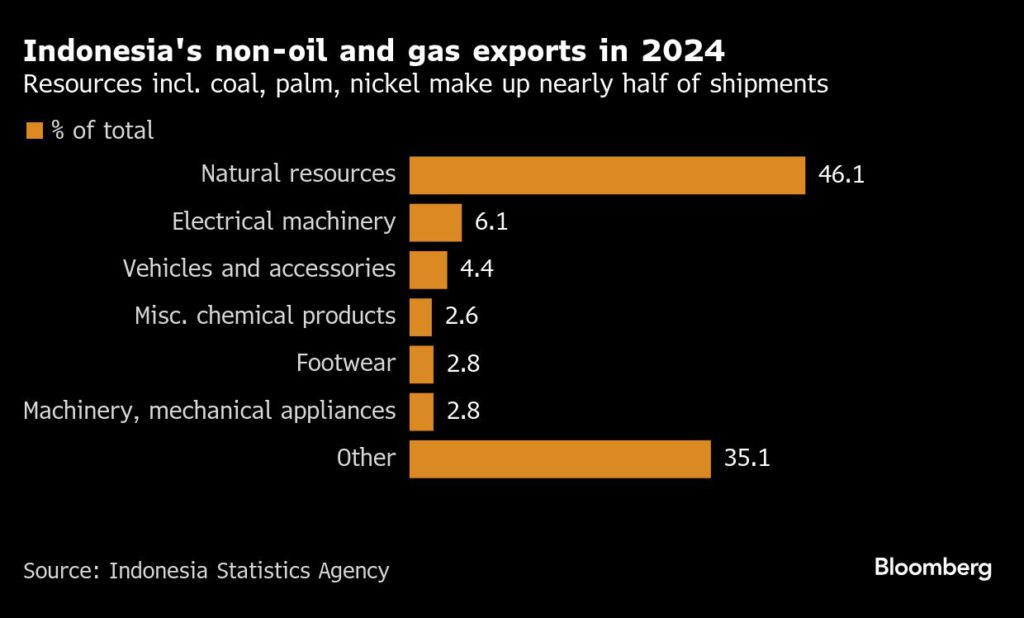
The commodities covered under the new rule account for nearly half of Indonesia’s non-oil and gas exports. Shipments of mining, agricultural, forestry and fisheries products reached almost $115 billion last year.

Coordinating Minister for Economic Affairs Airlangga Hartarto said exporters can use their foreign currency proceeds to pay state levies, taxes, and dividends, according to a statement from the presidential palace. They are also encouraged to convert their funds into rupiah and use a specific deposit instrument as back-to-back collateral for loans from banks or Indonesia Exim bank, it added.

“We are already supporting the program by providing FX deposit instruments at attractive interest rates and hedging through FX swaps,” Bank Indonesia Governor Perry Warjiyo said on Wednesday. He added BI is preparing two foreign currency-denominated securities, known as SVBI and SUVBI, in which exporters can place their earnings, in addition to term deposits and swaps offered under the current policy. The instruments can be traded in the secondary market.

(By Eddie Spence and Chandra Asmara)
CRIMINAL CAPITALI$M & ECOCIDE

Gold’s price surge drives Narcos into illegal mining in the Amazon

Bloomberg News | January 24, 2025 | 

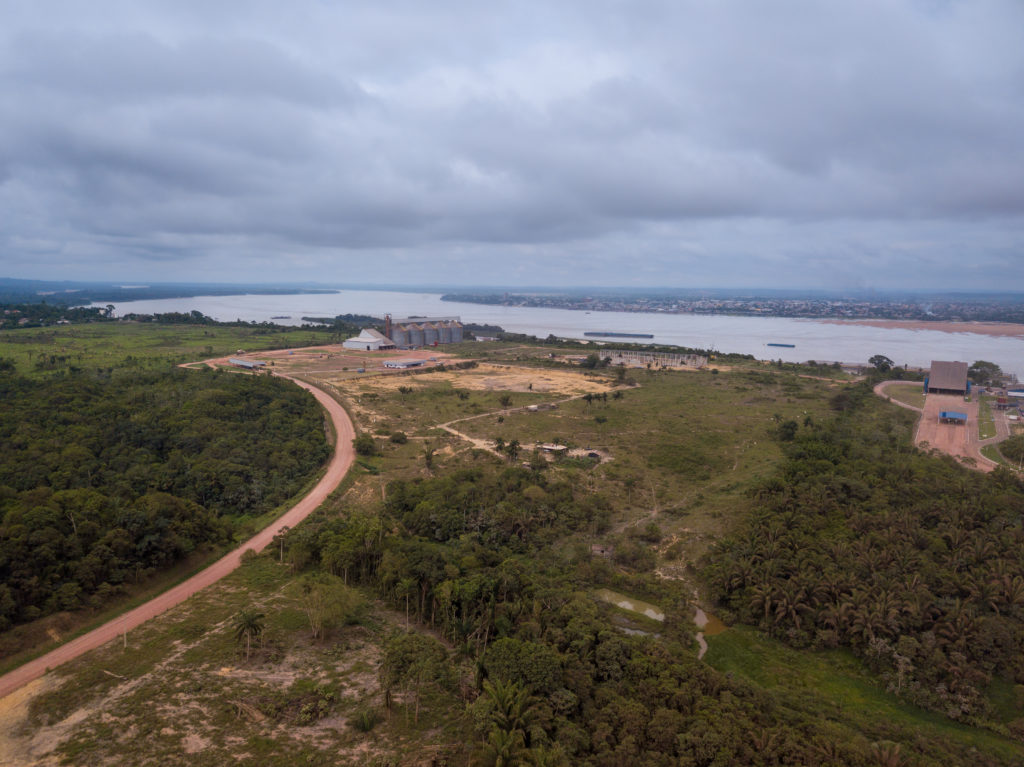
View of Tapajos river, Itaituba, Brazil. Stock image.


LONG READ 

The sun had just barely broken over the horizon when Benildo Rodrigues took off that morning. His single-propeller Cessna plane was loaded with more than 100 pounds of gold that had been extracted from deep inside the Amazon. The haul, worth more than $4 million at today’s prices, had been pulled out of the rainforest illegally.


Police were already monitoring the plane when Rodrigues left Itaituba, the place locals affectionately call Nugget City that’s become the unofficial capital of Brazil’s illegal gold trade. The town sits just on the edge of the jungle — the gateway between hundreds of illegal mining operations and the merchants, traders and smugglers that move the precious metal into regional and international markets.

He landed the Cessna in Manaus, the capital of neighboring Amazonas state. Rodrigues was picked up at the airport by the owner of the plane, who was driving a white Volkswagen Gol. Their plan was to eventually transport the gold all the way to the US, according to law enforcement officials.

Within minutes, two vehicles pulled up on Rodrigues and opened fire. It was an ambush by one of Brazil’s most notorious drug gangs.

The showdown from roughly a year ago lays bare the rise of the Narco gold diggers. Wildcat miners, known as the garimpeiros, have existed for the better part of a century, deforesting the land and dirtying the waters. But now, a federal crackdown on environmental crimes and a gold rally that’s sent prices to record highs has driven the industry into further darkness.


Visits by Bloomberg News to mining sites, along with dozens of interviews with miners, experts, locals and officials, unveil a world that is becoming increasingly lethal as a decades-old industry comes under the influence of drug gangs.

“The criminal organizations that have been dedicated to drug trafficking for a long time have discovered a new market,” said Andre Luiz Porreca Ferreira Cunha, a federal prosecutor assigned to illegal mining investigations across the Amazon, including the Rodrigues case. “They are creating parallel states in the middle of the Amazon. It’s terrifying.”

Across the globe, if you buy gold, there’s a growing chance that you’re bankrolling bad actors.

About 20% of the world’s bullion output comes from informal, small-scale mining. The producers are sometimes called “artisanal miners,” but it’s an industry that’s typically illegal, untaxed and often in violation of environmental and other regulations. In Brazil, the miners are a major factor in the destruction of the Amazon. And globally, the sector is the planet’s single biggest source of global mercury contamination, exceeding even coal-fired power plants, according to a study from the United Nations.

Gold – often dubbed the world’s oldest currency – has for millennia attracted underworld characters. But that has been supercharged by a historic rally, which gives illegal miners greater incentive to dig it up any way they can. Spot prices jumped 27% in 2024. The metal reached an all-time high of $2,790.10 an ounce in late October and has more than doubled since the end of 2018.

In Brazil, illegal mining began rising to another level under the administration of the previous president, Jair Bolsonaro, the far-right, pro-garimpeiro leader who slashed funding to combat environmental crimes and fueled rain forest destruction in the interest of economic growth. When his leftist rival President Luiz Inacio Lula da Silva then took the reins in 2023, he launched a weaponized campaign against the wildcatters, with militarized, sometimes deadly, police raids.

“The lack of oversight” during the previous administration “provided an opportunity for drug traffickers and factions to move into the Amazon and occupy this space,” Marta Machado, Brazil’s national secretary for drug affairs, said in an interview.

While the raids have caused some illegal operations to shut down, they’ve driven others deeper into the black market, where hardened criminals and drug traffickers are undeterred by the increased oversight.

Rodrigo Chagas, a social sciences professor at Roraima’s Federal University, has been interviewing garimpeiros for years as part of his research on crime in the Amazon. As recently as 2019, he didn’t hear much at all about gang members in the mining camps, but by the end of 2022 “it was full of narcotraffickers,” he said. The mining by the drug gangs mostly happens on Indigenous lands in remote parts of the Amazon, he said.

The first indisputable evidence of this development was in 2021 at the indigenous settlement of Palimiu on the the Uraricoera River. The town came under attack from garimpeiros associated with the First Capital Command, Brazil’s most efficient and organized drug-trafficking group that’s known as the PCC. The next day the same gangsters opened fire on federal police officers who arrived to secure the hamlet.

“From that moment on, it became evident that a faction of the PCC was wildcatting,” Chagas said. “The impression is that this has exploded.”

By backing bullion operations, the gangs not only profit off of the mining revenue, they use the gold itself as an untraceable currency and can also launder cocaine cash through the precious-metals market.

Northern Mexico, where entire regions are controlled by cartels, serves as a warning for what could happen to parts of Brazil’s Amazon if drug trafficking and associated criminal activity goes unchecked.

The clearest confirmation of the interconnections between Brazil’s gangs and gold comes during shootouts that authorities report on — like the one that Rodrigues was caught in on the roads in Manaus.

Rodrigues and his companion both suffered gunshot wounds and fled their vehicle to seek shelter in nearby businesses. Federal police, who were tracking the flight as part of the crackdown against illegal mining, arrived on the scene within a few minutes and seized the gold stash.

The attackers had just enough time to take off in a getaway car. They left a van behind along with a Glock pistol, ammunition, camouflage outfits and tire-puncture spikes. They are linked to the transnational crime group called Red Command that originated in Rio de Janeiro, according to Adriano Sombra, a federal police chief for Amazonas state who has arrested suspects in the case.

Authorities who took Rodrigues and his associate into custody are still trying to figure out which criminal gang they work for. But officials say that the size the bullion hoard, the largest gold seizure in the history of Amazonas state, makes it clear that a sophisticated organization with plenty of funding must have been involved.

“The large quantity seized reveal that the carriers were involved in a much larger criminal operation, with a clear structure and division of labor, probably an organized crime group,” Federal Judge Marcelo Pires Soares wrote in a decision related to the case.

Rodrigues and his associate were convicted in March and received a three-year non-custodial sentence and additional fines. (The maximum sentences for illegally transporting gold are relatively lax in Brazil.) Before that Rodrigues spent nearly four months at prison healthcare facilities. A bullet caused bone damage in one of his arms and he had to undergo surgery to avoid losing the limb, according to his lawyer, Leandro Rebelo de Paula.

Rodrigues declined to be interviewed out of fear for his personal safety, Rebelo de Paula said. Public prosecutors and the defense have both submitted appeals that are before a court. Authorities sold the illegally mined gold at auction for 16.6 million reais (about $2.8 million), the court in Amazonas state that is handling the case said in a response to questions.

The city of Itaituba took off in the 1950s with the discovery of gold-rich stream beds, and it still cherishes its culture of wildcatting. Most locals descend from settlers who were urged by military governments in the 20th century to mine and clear forests. The municipal hymn is an ode to the gold diggers, and a statue of a garimpeiro panning for metal nuggets is the most prominent landmark on the riverfront boardwalk. It’s similar to how California still celebrates the 1849 gold rush by calling itself the Golden State, or Denver’s Nuggets basketball team, which is named for the ore-rich mountains nearby.

From 2015 through 2020, nearly half of all the gold produced in Brazil, 229 tons worth more than $20 billion at current prices, was illegal or of suspect origin, according to Instituto Escolhas, a think tank. Itaituba and two neighboring municipalities produced or laundered 86% of Brazil’s illegal gold between 2019 and 2020, according to a report by federal prosecutors.

Most of the so-called artisanal mines of today are a far cry from a prospector setting out with a pickax, or a panner sitting by the stream. These are massive operations, and it takes deep pockets to fund them. When five garimperios who belonged to a regional drug gang were killed by police during a September raid, authorities then went in to make some of the assets unusable: Officials destroyed 30 excavators and 22 pickups at the site on indigenous lands in Mato Grosso state.

Garimpeiros dig out the headwaters of jungle streams to filter gold dust and nuggets from the soil. They gradually expand downstream, excavating the banks and building terraced pools to collect water. The jungle is crisscrossed with miles upon miles of airstrips for transporting machinery in and gold out, and the rivers are dotted with hulking mining barges.

Across the Amazon, drug runners have a history of sharing logistics with garimpeiros that dates back at least to the 1990s, and the continued growth in the cocaine trade has spawned more transit routes.

Cocaine production continues to boom in neighboring Colombia, Peru and Bolivia. In 2022, it surged 20% to 2,757 tons, according to the most recent data from the United Nations Office on Drugs and Crime. Demand for the powerful stimulant is growing across Europe while it appears to be contracting in the US, according to the agency. This shift in the market makes trafficking routes through Brazil’s Amazon more important. Most of the cocaine smuggled through the rainforest to the Atlantic coast goes to Africa and then on to Europe.

“The same logistics used for narcotrafficking are used for illegal mining,” said Francisco Xavier Medeiros de Castro, a colonel with Roraima state’s military police who currently serves in an advisory role for the state’s legislature on security. Pilots in the region “don’t want to know if they are working for traffickers or garimpeiros. They do their flights and get paid,” he said.

Sometimes, gangs start out selling drugs to garimpeiros and then end up in mining for themselves, said Joao Paulo Berte, a police chief in Mato Grosso state who carries out operations against illegal miners on the Sarare indigenous territory.

“People from Red Command spend time at the mines because they need money,” Berte said. “This is the danger — that the activities get mixed.”

Under Lula, more than a year of raids against illegal mining means that many of the small-scale operators are shutting down. But the people who have worked in the jungle for generations have no viable alternatives for work. Interviews with those involved in the industry show that instead of returning to towns like Itaituba, the workers are scattering, going deeper into the forest and into the hands of the gangs like the PCC and Red Command.


“What is the economic alternative for 30,000 to 40,000 garimpeiros,” said Chagas of Roraima’s Federal University. “The fear is that this link between narcos and garimpeiros grows, and turns into something more violent — that it goes completely out of control.”

The rise of narco gold diggers underscores how Latin America pays a disproportionate price for the consequences of global drug prohibition. Trafficking proceeds undermine the rule of law across the region and encourage destruction of ecosystems.

One of the investigations that Sofia Freitas Silva, a federal prosecutor for Brazil’s western Amazon, took on in 2024 includes evidence that PCC members were involved in an illegal mining operation. Still, she’s careful to note that most illegal mining investigations don’t have proven links to narcos.

“It’s not a majority of the cases,” she said.

Daruich Hammoud, a lawyer who was based in Itaituba until recently and has defended garimpeiros, said that one major problem stems from the government not clearly distinguishing between those operating mines illegally and those that have all the necessary permits. The broad crackdown has left many without much alternate choice than to go underground.

“Gold didn’t stop getting produced at all these places,” Hammoud said. “The government is forcing them to work illegally.”

Claudio Atilio Mortari, a second-generation garimpeiro who operates a permitted mine, agrees. He resents being grouped with criminal miners and traffickers who invade indigenous lands to extract gold. It was, after all, the government that encouraged his father to move to Itaituba more than 40 years ago. He sued Brazil’s environmental regulator in 2023 for destroying a backhoe, generators and other equipment at his camp during a raid.

“Before, they used to say we were heroes,” Mortari said. “Now, we’re treated like bandits.”

To get to Mortari’s mine, first you fly up and across the Tapajos river. The water, unlike the silty brown Amazon, is a vibrant greenish blue. Blankets of smoke waft through the air as ranchers set fires to clear brush. The terrain then gives way to the classic Amazon forest canopy: The deep green is dotted with yellow and purple flowering trees. As you approach the Serra Dourada mining settlement, you begin to see long, meandering garimpeiro sites that stretch for miles into the horizon.

Locals like Mortari are determined to continue their frontier way of life. When the government cracks down on one area, many garimpeiros pack up and move to other mineral-rich parts of Brazil’s Amazon that aren’t being targeted, or into neighboring countries.

After the raid at Mortari’s mine last year, the 20 mine workers on site didn’t want to go back to Itaituba. They spread out to other mines in the area, many of which operate illegally — and some, most assuredly, are under the influence of the Narcos.

“They can’t stop,” Mortari said. “They have to keep on working.”

(By Peter Millard and Mariana Durao)
AND SO IT BEGINS...
Canada, Mexico steelmakers refuse new US orders

Bloomberg News | January 24, 2025 | 


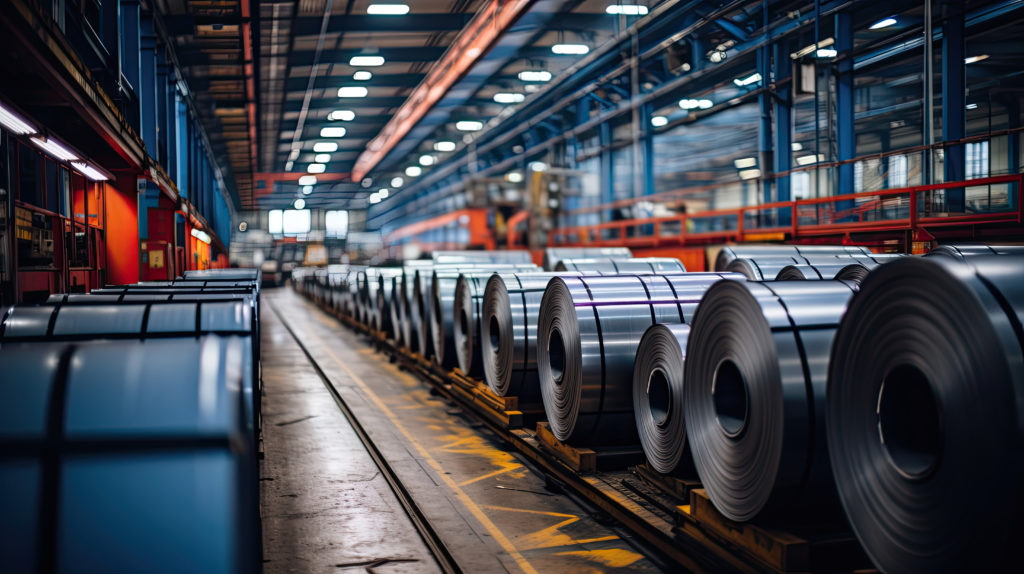
Rolls of galvanized steel sheet. Stock image.

Some steelmakers in Canada and Mexico are telling customers that they are refusing new orders to the US on concerns that President Donald Trump soon will reimpose duties.


Canada’s Stelco has been telling US-based consumers it is pausing sales quotes, according to a person familiar with the matter. Mexico-based steel suppliers also stopped taking orders for material this week as they await potential action from Trump, according to Flack Global Metals, a large buyer.


Trump this week signaled plans to impose previously threatened tariffs of as much as 25% on Mexico and Canada by Feb. 1. While the two countries are exempt from a sweeping 25% steel tariff the US imposed during the first Trump administration, there’s increasing concern in the industry that the metal won’t receive a carve out.

“There’s a lot of trepidation and changing commercial policy by the Mexican steelmakers with regards to their approach to this market,” Jeremy Flack, chief executive officer of Arizona-based steel distributor Flack Global Metals, said in an interview. “They’re off balance because of this. They’ve gone from concerned to unconcerned to concerned again.”

Canada is the top foreign import source of steel into the US and Mexico is the third largest, according to US Commerce Department data. The US consumed about 91 million tons of steel in 2023, with imports accounting for about 27% of that total demand, according to research by Morgan Stanley.

Stelco parent Cleveland-Cliffs Inc., based in the US, didn’t immediately respond to requests for comment.

Cleveland-Cliffs, the second-largest US steel producer, agreed to buy Canada-based Stelco last year. When asked last week at a briefing about the possibility that Trump would slap tariffs on the company’s newly owned Canadian steel, CEO Lourenco Goncalves said he will abide by Trump’s policies.

“President Trump will do what President Trump wants to do. He has a plan, and I will play accordingly,” Goncalves said. “I’m a big boy. I bought Stelco knowing that Stelco is in Canada. And you know what? America first.”

(By Joe Deaux)


AME Roundup: BC Premier unveils a 3-pronged approach to ‘bizarre’ US tariffs threat

Henry Lazenby - The Northern Miner | January 23, 2025 | 


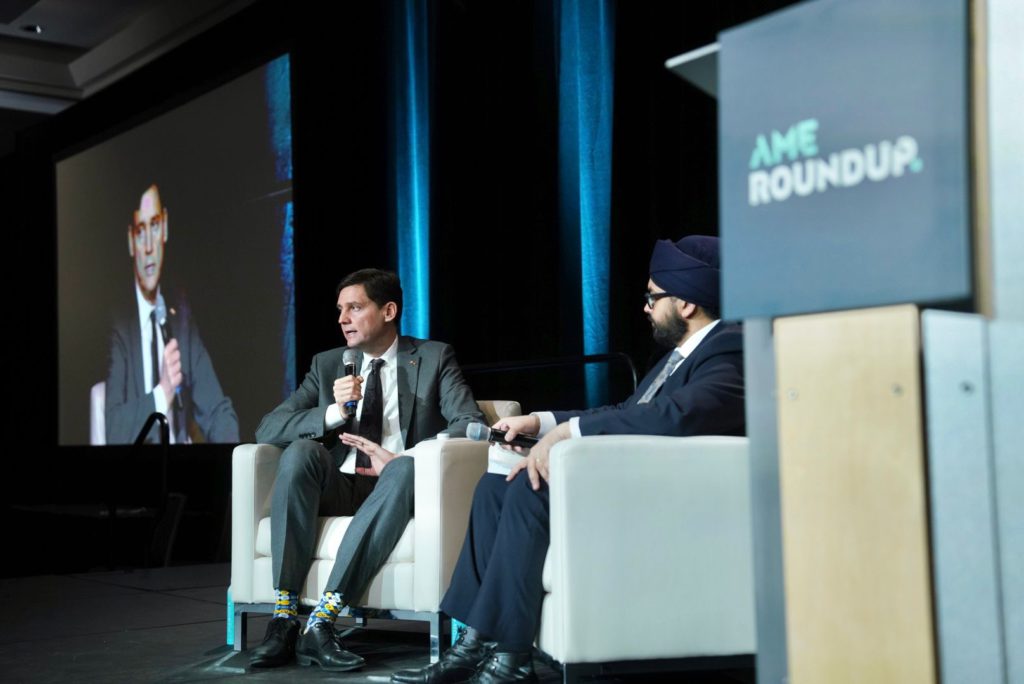
British Columbia’s Premier, David Eby (L) in conversation with AME president and CEO Keerit Jutla during the final day of the AME Roundup conference in Vancouver. Photo Credit: AME/Velour

British Columbia Premier David Eby on Thursday outlined a three-part plan to counter proposed United States tariffs on Canadian imports during remarks at the AME Roundup conference in Vancouver.


Eby says the province will support federal ‘everything’s-on-the-table’ tariffs. It will work to strengthen B.C.’s economy through providing additional mining supports and by diversifying trade away from the U.S. The province’s mineral wealth is increasingly being treated as the province’s main bargaining chip and economic strength.

“It’s bizarre to see the U.S. Department of Defense investing in Canadian mines one week and then labeling those same resources a threat deserving tariffs the next,” Eby said at the Association for Mineral Exploration’s Roundup conference.


The 25% tariffs, threatened by newly sworn-in U.S. President Donald Trump, show the fragility of Canada’s trade relationship with its largest partner, the premier said.

Mining remains key to B.C.’s economy and its resilience amid external pressures, Eby said. The premier, with a new majority mandate after the Oct. 19 election, minted the new Mining and Critical Minerals portfolio and appointed Minister Jagrup Brar to head the ministry.


$46bn in mineral exports

In 2023, Canada exported 77% of its goods to the United States, its largest trading partner. Metals and minerals made up a large part of these exports. They were worth $46.97 billion, and that made Canada the U.S.’s largest supplier of these resources, U.S. International Trade Commission data from Jan. 14 shows.

Eby pledged full support for Ottawa’s response. It includes targeting Republican-led areas with countermeasures. “We are fully supportive of the federal government applying retaliatory tariffs in the U.S., especially focused on Republican jurisdiction, to encourage those key decision makers on whom the President relies for assistance to pass his bills of the close connection that we share with the U.S., their friends, their family,” Eby said.

Eby plans to meet with U.S. governors and business leaders in Washington next week. He wants to stress that tariffs would harm the economy. “Everything from the cost of pasta to housing will rise if these tariffs take effect,” he said.

Bargaining chip


Mining forms the backbone of B.C.’s countermeasures. Government data reveals that In 2023, British Columbia’s mineral exploration expenditures totalled C$552.1 million, down 13% from the previous year’s C$643.5 million, but still the fourth-highest on record.


Mining’s production value is forecast to reach C$16.5 billion this year, with private investment doubling since 2017 to C$4 billion.

Eby pointed to Teck Resources’ (TSX: TECK.A, TECK.B; NYSE: TECK) Trail smelter. It’s the only North American source of germanium, a critical mineral for U.S. defence and tech.

“If the U.S. doesn’t get germanium from Canada, it can’t get it anywhere,” Eby said.

“The success of mining is the success of our province,” Eby said. “We will work with you to ensure B.C. remains a global leader in resource development.”
Prospecting’s place

The premier acknowledged the role prospectors and explorers play in preparing the province for the bargaining table. They boost B.C.’s economy and its bargaining power. He said prospectors’ work ensures the province’s leverage in global trade.

“When you identify resources unavailable elsewhere, you bolster our economy and bargaining power,” he said.

Trade diversification

To reduce dependence on the U.S., B.C. is expanding trade with Asian markets, including Japan, South Korea and Vietnam. B.C. has geographic proximity to those markets and the government aims to implement diversification strategies, to make it the least U.S.-dependent province in Canada.

B.C.’s critical minerals, which meet many ethical and sustainability standards, give the province an edge in securing international markets.

“You don’t want to buy metals and minerals from authoritarian regimes. Canada is your partner in democracy and sustainability,” Eby said.

Also speaking this week during the Roundup event was the Mining and Critical Minerals Minister Brar. He also stressed the need to diversify the province’s trade. He showcased recent investments in infrastructure and permits to support sector growth.

MTA update


The provincial government says it has reduced permitting delays to help speed up mining projects. So-called notice-of-work approvals now take an average of 140 days, down from 166, while major mine permitting timelines have fallen by over 30%. Yet, challenges persist.

Victoria also works to address changes to the Mineral Tenure Act (MTA) after a court ruled that authorities must consult more with First Nations. A court deadline for updated legislation looms in late March.

Eby told explorers that the government should manage these talks. This way, prospectors can keep working without extra challenges.

Keerit Jutla, AME president and CEO, underlined the importance of collaboration in resolving these challenges. “We either learn to compromise, or our collective future will be compromised,” he said.

The premier acknowledged concerns about the act’s implementation but promised minimal disruption. He says a new $1 billion fund is to support First Nation participation in resource development, including equity partnerships.

“When First Nations are equity partners in a mine, permits move faster because everyone has a shared interest,” he said.


AME Roundup: Newmont eyes expansion in copper-rich British Columbia
AME Roundup conference in Vancouver British Columbia this week

Amanda Stutt | January 24, 2025 | 


Erin Workman, Newmont’s group head, exploration and geoscience,
 Credit: AME/Velour.

US giant Newmont Corp. (NYSE: NEM, TSE: NGT), the world’ biggest gold miner, increased both its presence in the Canadian province of British Columbia and its exposure to copper when it acquired Newcrest in a $17 billion deal in 2023.


The acquisition brought two operations in the province’s northwest — the Bruce Jack and the Red Chris mine — into its portfolio, and the miner is planning a lengthy presence in the area, Newmont’s group head, exploration and geoscience, Erin Workman told an audience at the AME Roundup conference in Vancouver British Columbia this week.

Northwest British Columbia lies within the famous Golden Triangle, home to world-class deposits of gold and copper – a metal key to the green energy transition.

Newmont signalled renewed interest in BC by acquiring a 50% stake in the Galore Creek copper-gold project in 2018 in a joint venture with Teck Resources (TSX: TECK B).

“Both operations represent our commitment to building a multi-decade presence in this province anchored by sustainable and responsible mining practices,” Workman said.

A McKinsey study projects that global copper demand will increase by 30% by 2035, yet Canada’s copper production has declined by 20% over the last decade, and this growing supply-demand gap represents an enormous opportunity for British Columbia, Workman noted.

The area of Northwest BC is home to 75% of Canada’s known copper resources. Conventionally known as the Golden Triangle, we also view this region as the Copper Corridor. The significance of the geology cannot be overstated.Newmont’s group head, exploration and geoscience, Erin Workman

“The area of Northwest BC is home to 75% of Canada’s known copper resources. Conventionally known as the Golden Triangle, we also view this region as the Copper Corridor. The significance of the geology cannot be overstated,” she said. “The energy transition is a global imperative. Copper is at the heart of this transition.”

Newmont plans to to add underground block cave mining to its open pit operations at Red Chris, which it operates and holds a 70% stake in. Imperial Metals (TSE: III) holds the remaining 30%.

The Red Chris block cave project alone has the potential to increase Canada’s copper production by about 15% and the Galore Creek project could increase national production by over 35%, Workman said.

“Together, these projects position British Columbia as a potential global leader in responsibly mined critical minerals,” Workman said, adding that partnerships with First Nations and advancing mining projects with integrity are integral to success.

“We believe BC’s mineral exploration and mining factor has an important global role to play in providing materials for global energy transition and new technologies and setting a precedent for reconciliatory resource development,” she said.


Advancing First Nations reconciliation

Mining is a key driver of economic activity in British Columbia and, as the largest industrial partner and employer of Indigenous peoples in Canada, can provide pathways to Indigenous leadership, Workman said.

The province is working to address changes to the Mineral Tenure Act after BC Supreme Court ruled that the province must consult with Indigenous groups before granting mineral claims, upholding the Crown’s duty to these communities. A court deadline for updated legislation is in late March.

BC’s Tahltan Nation’s territory covers about 11% of the province and sits on an estimated 50.6 million ounces of gold and 12.5 billion pounds of copper, according to data mapping provider DigiGeoData.

The Tahltan nation has unique powers due to a combination of land rights, legal clout, financial heft and the ability to conduct their own economic and environmental assessments on projects in their territory.

Newmont has formal agreements with the Taltan, the Nisga’a, the Git’nyan, and the Sitka Maha Nations.

“These agreements aren’t just legal documents,” Workman said. “They’re frameworks for partnerships, ensuring that communities benefit from our operations through employment, procurement opportunities, and direct economic contribution.”

“Mining responsibly means partnering with indigenous communities, minimizing environmental impact, and ensuring that economic benefits are broadly shared,” she said. “Reconciliation is not just a goal, it’s a process. One that requires commitment, respect, and collaboration.”

“We believe reconciliation must be central to how we operate in British Columbia. The mining industry has a complex history with indigenous communities, and we can’t ignore the mistakes of the past. But today, we have a chance to redefine this relationship, and we’re seeing meaningful progress right here in British Columbia.”


Damen Cuts Steel on Latest Island Class Vessel for BC Ferries

Damen Shipyards Group
Damen cuts steel on latest Island Class vessel for BC Ferries

Published Jan 25, 2025 12:18 PM by The Maritime Executive


[By: Damen Shipyards Group]

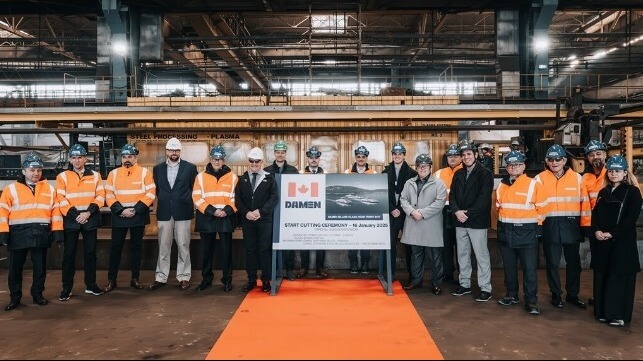
On 16th January, Damen Shipyards Galati cut steel on the third vessel in an order of four Island Class Ferries from Canada’s BC Ferries. At the same time, another vessel in the series reached the grand block assembly stage of construction at the yard. The vessels, based on Damen’s double-ended 8117 E3 Ferry, will be the first fully electric ferries to sail in the organisation’s fleet. They will bring the total number of Damen vessels operated by BC Ferries to ten.

Enabling sustainable ambitions
BC Ferries’ fully electric vessels are a critical part of the company’s broader strategy to reduce corporate emissions by 2030. The four new electric ferries will contribute to this goal by eliminating approximately 10,000 tonnes of CO 2 equivalent annually.The ferries carry Damen’s in-house E3 notation, which stands for Environmentally Friendly, Efficient in Operation, and Economically Viable.

Vessels evolving to client needs
The steel cutting ceremony was attended by David Tolman, BC Ferries’ Program Manager for the Island Class series of vessels, as well as BC Ferries’ on-site team. Representatives from Damen, including Damen Shipyards Group Chairman Kommer Damen, were also in attendance.

Speaking during the event, Mr Damen said, “It is a pleasure to attend this milestone event, together with our client. The long-standing relationship we have with BC Ferries is a prime example of how Damen works to support its customers. BC Ferries operates a number of Damen Ferries, based on proven standard designs, and adapted to their evolving needs. The vessels we are building demonstrate increasing sustainability. Previously, we have delivered hybrid propulsion vessels, already representing a step towards lower emissions. These fully electric ferries prepare the ground for zero emissions operations, bringing BC Ferries’ efficiency goals within reach.”

Ed Hooper, Executive Director of Shipbuilding at BC Ferries, said, “Reaching the steel cutting and grand block assembly milestones for two of our four new Island Class vessels is a great signal of the progress being made towards welcoming these new electric vessels into our fleet. Each stage of construction brings us closer to delivering cleaner, quieter, and more efficient vessels that align with our commitment to serving coastal communities.”

Total solution
In addition to the vessels, Damen is also providing BC Ferries with the charging towers. The ferries will recharge their batteries between services, as passengers are embarking and disembarking. Able to transport up to 390 passengers and 47 vehicles, the four ferries will operate between Nanaimo and Gabriola Island and Campbell River and Quadra Island, entering service by 2027. Damen Shipyards Galati currently has six fully electric ferries under contract for Canada; the four Island Class vessels, plus two ferries for the city of Toronto.

The products and services herein described in this press release are not endorsed by The Maritime Executive.


Op-Ed: Tide is Turning on Maritime Corruption, But We Must Finish the Job

Cash

Published Jan 24, 2025 1:15 PM by Cameron Mitchell


The maritime industry is notoriously susceptible to the virus of corruption. However, after spending a year as member of the Maritime Anti Corruption Network (MACN), I believe we are starting to see signs that concerted action is beginning to pay off.  It is now becoming better understood that the layers of bureaucracy that surround a ship in port - up to seven industry organizations and seven government bodies - can no longer be exploited with impunity.

The MACN can take large credit for this. Founded in 2011, its work has gathered pace in the last five years in particular. It now has 220 members, including ship owners representing a quarter of global tonnage. In addition, regulators such as flag states like ourselves are adding ballast to the campaign. Far from being a paper tiger, this is giving the MACN teeth evidenced by the now 65,000 anonymous incident reports detailing first-hand accounts of corrupt demands across more than 1,300 ports.  This includes more than 5000 bribery reports in 2023.

Having the ability to report incidents anonymously is vital to encourage senior officers to blow the whistle on the totally unacceptable pressures they are put under. For too long, ship captains have had to endure threatening behavior to pay a bribe or benefit in kind to get their ships and cargos in and out of port on time, facing for example bogus inspections or detentions. For shippers grappling with daily charter rates and severe financial consequences for delays, their options have previously been limited. 

The nonchalant culture of corruption has been so endemic in some countries we have heard of receipts for bribes being handed out signed by the culprit. Not any longer. This kind of casual crime is now perfect evidence, and ship captains are now more aware than ever they have the power to push back, with the MACN ready to raise the alarm with government agencies.  By reporting incidents, the MACN can work with port and customs officials, NGOs, local businesses and governments to highlight areas of corruption risk and take collective action.

The MACN has set up ‘collective action’ projects in countries where the problems have been most acute, starting in Nigeria more than 10 years ago and replicating the model in India, Argentina, Bangladesh, Egypt, Indonesia, Malaysia, Ukraine, Pakistan and Ghana. This is yielding results. For example, the Isle of Man Ship Registry and MACN recently contacted the heads of four Government departments in one of the collective action countries to lobby for consistent processes and procedures on seafarer immigration. This is enabling us to speed up seafarers repatriation, slashing bogus red tape.

Seafarer immigration is a vital area. In data compiled by MACN, vessel captains reported:

  • 7% of all reported corruption incidents at ports over the last decade involved the Immigration Service. 
  • In 2024 10% of reported incidents to MACN have implicated immigration services. 
  • Of the 19 possible reasons cited for these incidents, 50% of cases allege "Improper documentation for crew members." 
  • 58% of these incidents are reportedly resolved through bribery, predominantly involving large cash payments. 

More broadly, the MACN’s work has seen reductions in demands for payments in the Suez Canal, new regulations in Argentina that make it more difficult for officials to demand bribes and improved ease of operations in Nigerian ports, with the implementation of standardized operating procedures.  I was particularly pleased to see the Suez Canal Authority speak at the MACN conference in Copenhagen last year. Getting the Suez Canal Authority to attend shows the MACN’s growing leverage to bring key players to the table. This followed India’s former director general of Shipping Deepak Shetty, speaking at an MACN’s event in Mumbai in 2023. Shetty has joined MACN as an advisor, opening doors to senior-level stakeholders across India’s public and private sectors. All signs the noose is tightening.

As a category 1 member of the Red Ensign Group, the Isle of Man Ship Registry wants to support the MACN at the IMO and believes this collaboration is critical to putting the issue at the forefront of the global maritime governance agenda. At the IMO headquarters in London, the MACN is sharing its data around Port State Control Inspections, highlighting weaknesses and potential risks.  As an industry we must get behind the MACN’s campaign at this top level to maintain and increase the pressure on countries prone to corruption. If we let up, it sends a message to corrupt officials that we as an industry are prepared to turn a blind eye, opening the floodgates to yet more kickbacks, phony inspections and bogus detentions. Seafarers are on the frontline of this awful behavior, making their job harder and more stressful. We owe it to them to give them the tools to defend themselves.

The MACN calculates maritime corruption is increasing the cost of transport and logistics by 15 percent, costing more than $162 million a year and hurting companies and jobs. If the corruption culture is stamped out, that cash could be retained in shipping lines and maritime businesses to create jobs and growth. And that is something worth fighting for.

Cameron Mitchell is the director of the Isle of Man Ship Registry.
The opinions expressed herein are the author's and not necessarily those of The Maritime Executive.

Japan’s Top LNG Buyer Plans More Purchases From the U.S.


By Tsvetana Paraskova - Jan 24, 2025


JERA, the largest LNG buyer in Japan, plans to boost purchases from the United States to diversify its supply portfolio, a top company executive told Reuters on Friday.

Japan, the world’s second-largest LNG importer after China, is looking to increase its energy security with diverse sources of supply and could face steeper competition from fellow Asian importer South Korea, the world’s third-biggest, as well as from Europe.

U.S. President Donald Trump has threatened “tariffs all the way” if Europe doesn’t boost purchases of American oil and gas.

South Korea, for its part, is looking to import more crude and LNG from the United States to diversify its energy supply and reduce its trade surplus with America, South Korean Energy and Trade Minister, Ahn Duk-geun, said last week.

South Korea is considering more energy imports from the U.S. to potentially stave off tariffs that President Trump has promised to introduce on trade partners.

In this global context, Japan’s JERA seeks to diversify its LNG supply to reduce exposure to exporters from the Asia Pacific region such as Australia, Indonesia, and Malaysia.

JERA currently buys almost half of all its LNG from these exporters.

“This accounts for very high exposure. My plan is to rebalance that and to make our LNG supply portfolio more diversified,” JERA’s head of LNG division, Ryosuke Tsugaru, told Reuters on the sidelines of the World Economic Forum in Davos.

The largest Japanese utility and LNG buyer wants to raise its exposure to U.S. LNG export projects under long-term contracts, Tsugaru said.

The executive, however, added that JERA would be monitoring the U.S. policies for their long-term sustainability.

Apart from more U.S. LNG, the Japanese firm is also looking at Qatar, the world’s second-largest LNG exporter after the United States, for additional supply.

“I am hopeful to continue and grow long-term LNG partnership with Doha,” Tsugaru told Reuters.

By Tsvetana Paraskova for Oilprice.com


New $2.6B Containership Order in Korea Linked to CMA CGM

LNG fueled containership bunkering
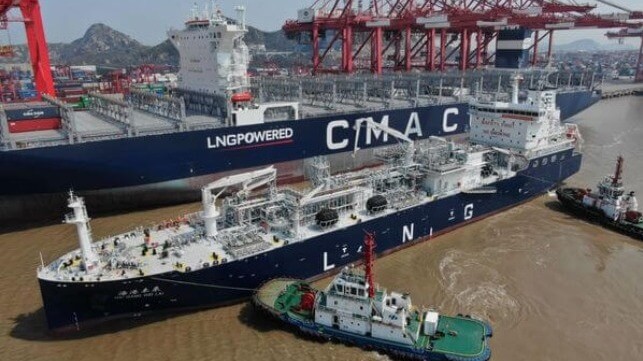
CMA CGM is linked to a larger order for LNG dual-fuel containerships to be built in Korea (CMA CGM file photo)

Published Jan 23, 2025 12:08 PM by The Maritime Executive


The boom in containership construction and the transition to alternative fuels continues with South Korea’s HD Korea Shipbuilding & Offshore Engineering reporting its first order of 2025. The shipbuilder which is part of HD Hyundai booked an order valued at approximately $2.58 billion which is being widely linked to French shipping giant CMA CGM Group.

Reports from South Korea reported a letter of intent was in place and the industry was broadly reporting the order as a follow-on move by CMA CGM which continues to be at the forefront of the move to LNG dual-fuel vessels. KSOE provided few details other than the order is for 12 “mega” containerships which will be delivered by December 2028.

Media reports indicate the vessels will each have a capacity of 15,500 TEU with deliveries commencing in late 2027. It follows CMA CGM’s order in the second quarter of 2024 order for a dozen 15,000 TEU liquefied natural gas vessels from Hyundai Heavy Industries.

CMA CGM, which is currently ranked third with a capacity of over 3.8 million TEU, has been investing in the energy transition as part of a fleet modernization and expansion program. As of the third quarter of 2024, the group highlighted more than 40 operational alternative fuel vessels and a total investment of $18 billion for 131 vessels by 2028 that will be capable of running on low-carbon energy, including biomethane, biomethanol, and synthetic fuels.

The new order represents a strong start for HD KSOE which announced a target of $18.05 billion for orders in 2025, which while a 34 percent increase over the 2024 target projects a decline in total orders versus those booked in 2024. The group reported orders valued at over $20 billion in 2024. This first order of the year represents 14 percent of the group’s target for 2025.

The order continues the strong buildout for LNG-powered vessels and specifically containerships. DNV’s Alternative Fuel Insight database shows a total of 641 LNG-fueled vessels with 142 containerships in service. It reports LNG represents 10 percent of the current order flow and based on orders, the LNG-fueled fleet will double to 1,273 vessels by 2030.

Speaking at the Davos Forum in Switzerland this week, Executive Vice President of HD Hyundai Chung Ki-sun pointed to the continuing efforts in shipbuilding to lead the transition to alternative fuels. The group is focusing on a digital transformation outlining its blueprint for the future of the shipyards. HD Hyundai is partnered with big data company Palantir Technologies and highlighted a strategy for a 30 percent improvement in productivity and a 30 percent reduction in CO2 emissions by 2030.


Capital Group & FORCE Technology Launch Extended Reality Bridge Simulator

FORCE Technology
AR Bridge ready

Published Jan 25, 2025 12:17 PM by The Maritime Executive


[By: FORCE Technology]

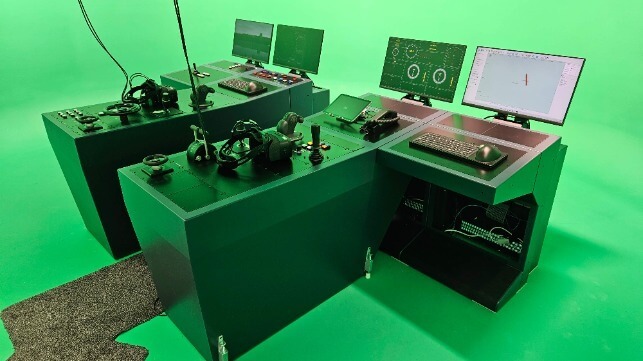
Capital Group and FORCE Technology are proud to announce their partnership in creating Europe’s first Extended Reality (XR) Full Mission Bridge simulator. This groundbreaking initiative represents a major advancement in maritime training, combining cutting-edge technology with decades of expertise. The simulator will be housed at Capital Group’s state-of-the-art training facility at the port of Chios Island, Greece, which is slated to open in 2025. Designed to enhance seafarers' skills, this modern center of excellence reinforces Capital Group’s dedication to innovation, sustainability, and maritime leadership.

“This project underscores our steadfast dedication to driving innovation and excellence in maritime training, with a strong focus on safe and sustainable operations,” said Panagiotis Drosos, Chief Operations Officer of Capital Ship Management Corp. “By embracing cutting- edge XR technology, we are empowering our seafarers to meet the dynamic challenges of the maritime industry, while reinforcing Greece’s position as a leader on the global maritime stage.”

Leveraging over 50 years of FORCE Technology’s expertise in simulation systems, the training equipment incorporates advanced XR headsets with features like eye tracking to deliver focused, efficient, and highly realistic training.

“Our new SimFlex simulator sets a new benchmark for operational training,” said Stelios Koukouvios, Global Business Development Manager at FORCE Technology. “By embedding real vessel equipment into a virtual bridge environment, we provide an unmatched experience of precision and immersion. This technology also enables global teams to train together in shared scenarios, unlocking exciting possibilities for collaboration.”

The system’s design features a fully green-screened environment, integrating real bridge equipment supplied by FURUNO Hellas S.A —such as the latest models of ECDIS (FMD- 3005), Autopilot (FAP-3000) and Chart Radar systems (FAR-3xx5) —with a high-fidelity virtual landscape. This seamless integration creates a realistic and immersive training experience.

In addition to its technical innovations, the XR simulator minimizes environmental impact by reducing energy consumption and the need for travel. It offers flexible remote training options, thus reshaping maritime training and aligning technological innovation with sustainability and global connectivity.

The products and services herein described in this press release are not endorsed by The Maritime Executive.

External Experts Confirm High Propulsion Efficiency of the SCHOTTEL SRP-D

SCHOTTEL
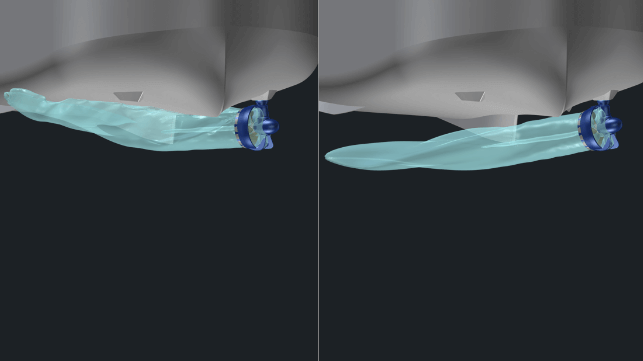
Due to the additional eight degrees downward tilt of the lower gearbox, the interactions between propulsion unit and hull are reduced. This results in increased thrust efficiency in DP operation and minimizes forbidden zones. Source: SCHOTTEL

Published Jan 24, 2025 7:35 AM by The Maritime Executive


[By: SCHOTTEL]

The increased performance of the SCHOTTEL RudderPropeller Dynamic SRP-D has once again been confirmed by external sources. At the request of the Dutch Damen Group, the Maritime Research Institute Netherlands (MARIN) carried out extensive research to demonstrate the added value of the SRP-D for Commissioning Service Operation Vessels (CSOV). While an earlier study had already demonstrated a reduced DP footprint and fuel savings, Damen’s latest research focused particularly on propulsion efficiency during thruster interactions. The results obtained show a significant increase in thrust yield as well as reduced forbidden zones with the SRP-D compared to conventional rudder propellers.

“Our clients will have life-long benefits by selecting this combination”
“In our continuous strive for offering optimal vessels to our clients, SCHOTTEL’s developments are a great step”, says Mark Couwenberg, Product Portfolio Manager SOVs at Damen. “The SRP-D thrusters mounted under Damen’s optimized hulls result in vessels with a smaller footprint while at the same time reducing fuel use and further improving comfort on board. Combined with SCHOTTEL’s robust methods of design, engineering and construction we are convinced that our clients will have life-long benefits by selecting this combination.”

Higher positioning accuracy
With the SRP-D optimized for DP operation, SCHOTTEL is meeting the increased efficiency and reliability requirements for CSOV vessels. The thruster is marked by an additional eight-degree tilt of the lower gearbox and a vertically integrated electric drive motor (LE-Drive). In addition, the SRP-D is characterized by reduced propeller acceleration/deceleration times. In combination with a high-speed azimuth steering system with reinforced gear components, the SRP-D enables faster thrust allocation than conventional rudder propellers. Thanks to the shorter response times, it is possible to react faster and in a more targeted manner to external forces such as wind and currents, thus achieving a higher positional accuracy of the vessel.

Offshore basin as testing facility
The research was carried out on a model of a CSOV equipped with a SCHOTTEL SRP-D on starboard and a regular 90-degree thruster on portside. To perform the tests, the model was placed in a 45-metre-long and 36-metre-wide offshore basin. A three-component measurement frame with calibrated sensors was installed on the model for data acquisition.

98-degree tilted propeller shaft significantly reduces thrust losses
The first part of the study measured the interactions between propulsion unit and hull. It was found that the additional eight-degree downward tilt of the SRP-D propeller shaft could significantly reduce thrust losses, both for azimuth variations and thrust variations. For example, CSOVs with 98-degree thrusters experience only 10 percent thrust losses in transverse direction, compared to 35 percent with 90-degree thrusters. The study shows that a key factor for the improved system performance is a reduced Coand? effect with the SRP-D.

The second part of the research focuses on the propeller flow interactions. Again, significantly lower thrust losses occur when operating CSOVs with the SRP-D: While 50 percent losses are observed when the 90-degree thruster is blowing the wake into the second thruster (in-line thrust losses), only 20 percent thrust losses occur with the 98-degree thruster. When the 90-degree thruster is blowing the wake into the second one while being perpendicular to it (transverse thrust losses), the thrust in transverse direction is decreased by about 40 percent, compared to 20 percent with the 98-degree thruster. In both cases, the 98-degree variant thus induces lower losses at the other thruster than the 90-degree variant and therefore enables a higher remaining force during DP.

Fuel-efficient and safe operation throughout the year
As the research shows, the additional eight-degree tilt of the SRP-D gearbox significantly optimizes thrust yield and thrust distribution, since thruster-hull- and thruster-thruster-interactions are minimized. Consequently, the forbidden zones of the thrusters may be reduced, which leads to an additional increase of the DP performance for the vessel. Furthermore, CSOVs can significantly lower their fuel consumption. Overall, the vessels operate much more efficiently and safely, extending their operating time throughout the year.

The products and services herein described in this press release are not endorsed by The Maritime Executive.