Saturday, January 25, 2025

SO MUCH FOR RENEWABLES

Exxon Begins Drilling for Natural Gas Offshore Cyprus


By Tsvetana Paraskova - Jan 24, 2025


ExxonMobil and its partner offshore Cyprus, QatarEnergy, on Friday started drilling for natural gas in an exploration block in the island nation’s exclusive economic zone, the President of Cyprus, Nikos Christodoulides, said.

The U.S. supermajor and Qatar’s state energy giant launched drilling activities in Block 5, Christodoulides wrote on X.

“Cyprus progresses exploration activities, aiming to be an alternative and reliable source of Natural Gas for the EU,” the Cypriot president added.

Cyprus has been hoping that its waters could hold giant natural gas resources, similar to the ones discovered in the Eastern Mediterranean offshore Egypt and Israel.

Exxon previewed at the end of last year that it would start drilling in January 2025 an exploration well offshore Cyprus, targeting natural gas.

“We've spent the last two years collecting very detailed, three dimensional seismic data ... We've identified several large prospects, and the next stage is to bring in a drilling rig and to test those,” John Ardill, Vice-president for global exploration at ExxonMobil, told Reuters in November.

“There is huge potential for gas exploration,” Ardill said, adding that Exxon sees the Electra prospect as “highly promising.”

Other international majors have been also exploring for natural gas offshore Cyprus.

Italy’s Eni and its partner, France’s TotalEnergies, made two discoveries in 2022—Cronos and Zeus.

Last year, Eni said it had completed the drilling of a second appraisal well at the Cronos gas discovery offshore Cyprus, estimating additional production capacity as it looks to fast-track development of the field. Eni is a partner and operator in seven exploration licenses offshore the country.

Cyprus could begin its first-ever production of natural gas as soon as 2026, the Mediterranean country’s Commerce, Industry, and Energy Minister George Papanastasiou told Reuters in an interview in early 2024.

Exxon and the other U.S. supermajor, Chevron, are also looking to explore for oil and gas offshore Greece in the Mediterranean.

By Tsvetana Paraskova for Oilprice.com

Chevron starts $48 billion Kazakh oilfield expansion

Reuters | January 24, 2025 

Oil & gas pipelines. AI-generated stock image.

Chevron said on Friday it had started production at a $48 billion expansion of the giant Tengiz oilfield which will bring its output to around 1% of global crude supply.


The Tengiz field accounts for a large part of landlocked Kazakhstan’s oil production and has been a major cash generator for Chevron for decades. But its exports depend almost entirely on a pipeline that runs through Russia to the Black Sea, putting it effectively under Moscow’s control.


Flows could also be impacted by Kazakhstan’s agreement with OPEC and other major oil producers to curtail global supply in recent years.

The expansion is expected to reach full capacity of 260,000 barrels per day by June, lifting overall production at Tengiz to around 1 million barrels of oil equivalent per day, Chevron’s head of international exploration and production Clay Neff told Reuters.

Chevron shares were down 0.25% at 1240 GMT.

Tengiz is one of the world’s deepest and most complex fields due to high levels of sulphur and harsh weather conditions.

The expansion has suffered delays and huge cost overruns since launching in 2012. Investment was “at the low end” of $48 billion to $49 billion, Neff said, making it one of the world’s most expensive developments.

Chevron has a 50% stake in the Tengizchevroil joint venture which it operates, with Exxon Mobil holding 25%, Kazakh oil firm KazMunayGas 20% and Russian oil producer Lukoil the remaining 5%.

Tengizchevroil is expected to generate $4 billion of free cash flow in 2025 and $5 billion next year at an average Brent price of $60 a barrel, Neff said. Benchmark Brent crude oil is currently trading at around $80 a barrel.

“What this project allows us to do is not only increase production today but also extend the life of the field over time,” Neff told Reuters.

The expansion is part of Chevron’s plans to increase its own production by around 3% per year over the next five years along with strong growth in the US Permian shale basin.

(By Ron Bousso; Editing by Kirsten Donovan)
Trump Reignites Coal Industry at Davos


DID HE ENDORSE THE RETURN OF STEAMPOWER TOO?!


By Julianne Geiger - Jan 24, 2025


In classic Trump fashion, the President declared at the World Economic Forum in Davos, “Nothing can destroy coal. Not the weather, not a bomb. It’s a great backup.”

These words, delivered with signature bravado, sent a warm glow through U.S. coal producers—along with a noticeable bump in their stock prices. Peabody Energy Corp. surged over 7%, Core Natural Resources Inc. climbed nearly 3%, and the coal subsector index shot up by over 4%.

For an industry that’s been left out in the cold in recent years, the moment was nothing short of a resurrection.

Trump’s stance on coal isn’t new, but let’s be honest, it’s been sitting in the back seat as oil and gas steal the energy spotlight. Yet, this fresh endorsement has reminded not just Davos but the world that coal isn’t just yesterday’s energy—at least not in Trump’s America. In his first-day-in-office executive order, President Trump declared a national energy emergency, tearing down regulatory barriers and throwing a lifeline to fossil fuels.

Oil and gas are front and center, but coal isn’t getting overlooked entirely, securing the equivalent of a wink and a “we’ve got your back.”

The President’s message, delivered by video at Davos, is this: dominance is the goal, and no stone—or coal seam—will be left unturned. Trump’s sweeping policies aim to make U.S. energy production not just robust but untouchable. Federal lands and waters are open for exploration, infrastructure projects will be fast-tracked, and bureaucratic red tape will be shredded with glee.

Critics may clutch their pearls over coal’s carbon footprint, but Trump isn’t sweating it. To him, “clean coal” is “very strong as a backup.”

With the administration’s renewed focus on domestic energy security, coal won’t be going quietly into that good night. In a world where market share is the name of the game, the U.S. is making its energy play—and coal is still on the team.

By Julianne Geiger for Oilprice.com


WTF?!

Trump Freezes Department of Energy’s $50 Billion Budget


By Julianne Geiger - Jan 24, 2025, 


In a sweeping move that halts billions in spending, President Trump’s administration has frozen the Department of Energy's (DOE) activities pending a comprehensive review of its alignment with his priorities. According to a memo from acting Energy Secretary Ingrid Kolb, the freeze affects grants, loans, procurement, studies, and even personnel decisions, effectively bringing the agency’s $50 billion budget to a standstill.

Beyond bureaucratic tinkering, the halt is a direct shot at dismantling Biden-era climate policies. The DOE’s Loan Programs Office, holding $41.2 billion in conditional commitments to energy technology companies, now finds its purse strings tightly cinched. Other critical missions, like nuclear waste cleanup and maintenance of emergency crude reserves, are similarly on pause.

The order mirrors an earlier Trump directive freezing funds tied to Biden’s Inflation Reduction Act and a bipartisan infrastructure law, both of which allocated billions for clean energy initiatives. Trump, who has championed fossil fuels as a cornerstone of his energy policy, has made it clear that climate-focused spending is no longer a federal priority.


The Interior Department issued a similar freeze on wind and solar project leases on federal lands and waters.


While the Trump administration’s goal is to “unleash” American energy by cutting red tape, critics argue that freezing investments in innovative technologies jeopardizes long-term energy security. For now, the DOE and the clean energy sector are left in limbo pending the results of a review that could redefine the nation’s energy landscape.

While critics—including US oil companies—have highlighted Trump’s seemingly contradictory approach to oil markets: pressuring OPEC to lower global oil prices while promoting a “drill, baby, drill” mantra domestically, his regulatory rollbacks and anti-renewable agenda appear to be a bone tossed to U.S. oil companies, clearing the way for fossil fuel development and potentially boosting their bottom lines, even as global oil dynamics remain a tug-of-war.

The Trump administration’s energy strategy is trying to walk a fine line between prioritizing American energy independence and responding to market realities.

By Julianne Geiger for Oilprice.com
U.S. Oil Drilling Rig Count Falls As Uncertainty Mounts

By Julianne Geiger - Jan 24, 2025, 12:22 PM CST


The total number of active oil and gas drilling rigs in the US decreased by four to 576.

US crude oil production fell to 13.477 million bpd, down from 13.481 million bpd the previous week.

The Primary Vision’s Frac Spread Count, an estimate of the number of crews completing wells, fell for the second week in a row to 188.


The total number of active drilling rigs for oil and gas in the United States fell this week, according to new data that Baker Hughes published on Friday, after a 4-rig drop in the week prior.

The total rig count fell by four rigs, to 576, according to Baker Hughes, down 45 from this same time last year.

The number of oil rigs dipped by 6—down by 27 compared to this time last year. The number of gas rigs rose by 1, reaching 99, a loss of 20 active gas rigs from this time last year. Miscellaneous rigs rose by 1, to 5.

The latest EIA data showed that weekly U.S. crude oil production for the week ending January 10 dipped again, this time to 13.477 million bpd, from 13.481 million bpd in the week prior. The figure is roughly 150,000 bpd shy of the all-time high of 13.631 million bpd reached during the week of December 6, 2024.

Primary Vision’s Frac Spread Count, an estimate of the number of crews completing wells that are unfinished also fell, for the second week in a row. Finishing crews are now down to 188 during the week of January 17, falling from 195 in the week prior. The frac spread count is now at its lowest level since March 2021.

There was a dropoff in drilling activity in the Permian Basin, falling by 6 rigs to 298 active rigs—a figure that is 12 fewer than this same time last year. The count in the Eagle Ford rose by 1 rig for the second week in a row, to 45. Rigs in the Eagle Ford are now 9 below where they were this time last year.

Oil prices were trading down on Friday before the data release. At 12:46 pm. ET, the WTI benchmark was trading down $0.32 per barrel (-0.43%) on the day at $74.30, down nearly $4 per barrel compared to last Friday’s price. The Brent benchmark was trading down $0.08 (-0.10%) on the day at $78.21—down $3 per barrel compared to last Friday’s price.

By Julianne Geiger for Oilprice.com

Bolivia's Lithium Ambitions Face Economic and Environmental Headwinds

By Haley Zaremba - Jan 24, 202


Bolivia holds the world's largest proven lithium reserves but faces challenges in developing them due to low lithium purity, lack of infrastructure, and political instability.

The country has signed deals with Chinese and Russian firms to extract lithium, but these deals are facing opposition and are contingent on lithium prices remaining high.

Lithium extraction poses environmental risks, particularly to water security in the arid region where the Uyuni Salt Flats are located.


Bolivia is making a play to become a major global lithium producer by partnering with Russian and Chinese firms – but who has the better end of the deal? Increasingly vocal opposition groups comprising lawyers as well as constituents argue that the nation’s most recent deals with Russia and China, currently pending congressional review, are a sweetheart deal for the international firms and, therefore, a raw deal for Bolivia. But backers of the developments argue that these steps are both prudent and necessary to develop Bolivian lithium as well as the nation’s economy.

In 2023, a Chinese firm built Bolivia’s first industrial-scale lithium plant. In 2024, the Bolivian government inked deals with Russia’s Uranium One Group and China’s CBC. Those deals are currently awaiting approval from congress. “With the two new contracts, we plan to reach 49,000 tons of lithium carbonate annually within three years,” Omar Alarcon, president of state-owned lithium company YLB, was quoted by Bloomberg. “And we plan to send a new contract to Congress in the first quarter of the year.”

Bolivia is home to the biggest proven lithium deposits on the globe but, to date, does not produce any meaningful share of the world’s commercial lithium. The form in which the nation’s lithium naturally occurs – a magnesium-rich brine under the country’s Uyuni Salt Flats – is costly to process due to its low levels of purity. Plus, Bolivia is one of just two land-locked countries in South America, meaning that ports to export lithium to China and other buyers are far away and require border crossings to access.

Bolivia consistently ranks as South America’s poorest nation, so developing the country’s naturally rich deposits of lithium could provide a key inroad to developing the national economy. However, Bolivia has been unable to woo private investors. According to a recent summation from Bloomberg, “Bolivia’s history of political and social unrest and a state-led approach to natural resources have been deterrents to private capital.”

With no public capital to speak of and no sway with private capital, Bolivia has little choice but to collaborate with better-resourced nations like China. “Bolivia may be rich in natural resources, but it is a very poor nation, which makes the prospects of autonomously operating lithium-mining projects slim,” says the Harvard International Review.

But even with investment from Chinese and Russian firms, Bolivia faces considerable challenges to building a healthy and profitable industry. In addition to the lack of national capacities and the relatively impure form of lithium that exists in abundance in Bolivia, there are also unfavorable international market trends to contend with. Lithium demand growth saw a major slowdown in 2024 as EV demand slumped on a global level. As a result, lithium prices have tanked in recent months.

The contracts that Bolivia has inked with China and Russia are constructed on much higher average lithium prices, with an estimate of $30,000 per ton. Current prices are hovering more around the $10,000 mark. Omar Alarcon, president of Bolivian state-owned lithium company YLB, says that a minimum price point of $10,000 is necessary to keep the plants economically viable. Under the stipulations of the agreements, Bolivia will repay the approximately $2 billion in Chinese and Russian investments in kind, with lithium carbonate.

In addition to the potentially sticky economics of these contracts, the arrangement will likely harm more than help Bolivian locals. While the investing dollars are highly unlikely to trickle down to poor Bolivians, they stand to bear the brunt of the negative environmental externalities associated with lithium extraction. The high desert where the Salt Flats are located is one of the driest places in the world, and lithium extraction requires massive amounts of water, posing serious threats to local water security.

By Haley Zaremba for Oilprice.com
Solar Energy Outshines Coal in EU's Energy Mix for the First Time


By Haley Zaremba - Jan 24, 2025


In 2024, solar power became the leading source of electricity in the EU, surpassing coal for the first time.

The rise of solar and wind energy has reduced the EU's reliance on fossil fuel imports, saving billions of dollars.

Despite the solar boom, challenges remain, including a predicted slowdown in global solar installations and the continued use of coal power plants in Germany.


A new report shows that the European Union just passed a major milestone in its journey toward decarbonization. For the first time, in 2024, the share of electricity generated from solar power overtook that of coal in the bloc’s energy mix. Not only did solar eclipse coal in the EU, it was the single fastest growing power source in the region. This marks a serious turn in the continent’s battle to phase out fossil fuels – as well as to ease its reliance on Russian energy imports.

The report, published this week by energy think tank Ember’s annual European Electricity Review, shows that all together, renewable energies accounted for 47% of the European Union’s energy mix last year, a massive 10% gain from the previous year. Meanwhile, the share of coal – the dirtiest fossil fuel – shrank to just 10%.

“Fossil fuels are losing their grip on EU energy,” said Chris Rosslowe, senior analyst and lead author of the Ember report. “At the start of the European Green Deal in 2019, few thought the EU’s energy transition could be where it is today; wind and solar are pushing coal to the margins and forcing gas into structural decline,” he went on to say.

A large part of the solar boom comes thanks to instability in Russian energy markets. After Russia invaded Ukraine in February of 2022, gas prices soared in global markets and particularly in Europe, which was largely dependent on Russian fuel imports to keep the lights on. In the years since the invasion, Western leaders have taken great pains to wean themselves off of Russian imports in the interest of economic sanctions against the Kremlin, but also to find more affordable alternatives as millions of Europeans plunged into energy poverty.


As a result of growing wind and solar energy capacities, the European Union has circumvented nearly $61 billion (€58.6 billion) worth of fossil fuel imports since 2019, according to the Ember report. "This is sending a clear message that their energy needs are going to be met through clean power, not gas imports," Pieter de Pous, an analyst at European think tank E3G, was recently quoted by DW.

However, the breakneck growth of solar energy is likely to slow down on a global level in 2025. Worldwide, 495 GW of solar were added in 2024. But this year, an estimated 493 GW (DC) of solar will be added. That’s according to forecasts from energy data and analytics firm Wood Mackenzie, who foresee a slowdown based on a changing policy environment and shifting economic factors, including rising solar module prices.

“Post-election uncertainty, waning incentives, power sector reforms and a shift towards less ambitious climate agendas will drive solar installations to stagnate at 493 GWdc after years of exponential growth,” Sylvia Leyva Martinez, Wood Mackenzie’s principal analyst for utility-scale solar in North America, was recently quoted by PV Magazine.

Much of this year’s solar energy installations will take place in China, where a strongly favorable policy environment and huge manufacturing base will continue to drive the industry forward. In fact, China is currently working on a solar project of epic proportions, expected to cost $48 billion USD and create 50,000 jobs. The so-called ‘Great Wall of Solar’ would stretch over 400 kilometers through the Kubuqi Desert of Inner Mongolia.

Meanwhile, in Europe, squashing that last 10% share of coal in the region’s energy mix may prove more difficult than anticipated. It was recently publicized that Germany, the largest coal-fired energy producer in the European Union, will likely have to keep its receive coal plants around larger than originally projected as planned gas plants run far behind and far over budget. If current trends continue, coal plants will be needed as a backup for energy security “well into the next decade.”

By Haley Zaremba for Oilprice.com


The Middle East Is Bracing for a Solar Energy Boom

By Felicity Bradstock - Jan 25, 2025


Several Middle Eastern countries are investing heavily in solar power projects, aiming to significantly increase the share of renewable energy in their power generation mix.

Solar PV is expected to contribute over half of the Middle East's power supply by 2050, driven by increasing power demand and government initiatives to diversify energy sources.

Countries like Oman, UAE, Qatar, and Saudi Arabia are leading the solar charge with ambitious targets and large-scale solar power plant projects.


With abundant sunlight available to produce vast amounts of clean energy, several countries across the Middle East are investing in giant solar power projects. From Oman and Saudi Arabia to the United Arab Emirates and Qatar, the future of Middle East energy is appearing increasingly green.

There has been a significant energy shift in the Middle East in recent years, as many governments in the region welcome the era of renewables – although many continue to see a future in fossil fuels too. Green energy is expected to outpace fossil fuel usage by 2040, according to a Rystad Energy report, with solar photovoltaic (PV) coming out on top. Solar PV is expected to contribute over half of the Middle East’s power supply by 2050, from just 2 percent in 2023. Renewable energy sources are expected to contribute around 70 percent of the region’s power generation mix by this time.

Power demand in the Middle East is expected to reach around 2,000 terawatt-hours (TWh) from 1,200 TWh at present. Fossil fuels currently contribute around 93 percent of the region’s power generation, and natural gas is seen as pivotal to mid-term energy security. However, several countries are investing heavily in green energy to eventually shift away from a reliance on fossil fuels. This goes hand in hand with the economic diversification highlighted in several of the region’s development strategies.

In Oman, the government aims to increase the contribution of renewable energy to the energy mix to 30 percent by 2030, between 60 and 70 percent by 2040, and 100 percent by 2050. This month, the government inaugurated the Manah 1 and Manah 2 solar photovoltaic (PV) power plants in the Wilayat of Manah in Al Dakhiliyah Governorate. Together, they have a production capacity of 1 GW and are the largest to date in Oman. They consist of over 2 million PV panels and almost 1,800 automated dry-cleaning robots, to boost efficiency and reduce water use. The plants should increase Oman’s renewable energy production from 6.6 percent to 11 percent and reduce carbon emissions by around 1.4 million tonnes a year, providing enough electricity to supply around 120,000 households.

In the UAE, the Dubai Clean Energy Strategy 2050 states a target of 75 percent clean energy by 2050 and Abu Dhabi’s Vision 2030 aims to achieve 30 percent renewable energy within five years. In January, the government opened a 24-hour solar power facility from renewable energy firm Masdar, which consists of 5.2 GW of solar capacity and 19 GWh of battery storage, allowing for the generation of 1 GW of renewable energy around the clock.

The Minister of Industry and Advanced Technology Sultan Al Jaber stated, “For decades, the biggest barrier facing renewable energy has been intermittency — to be able to source uninterrupted clean power day and night.”

In September, QatarEnergy announced plans to develop a 2 GW solar power plant in Qatar, which could double the state’s solar capacity by the end of the decade. The state-owned oil company plans to build the facility in Qatar’s Dukhan area. QatarEnergy and TotalEnergies launched their first 800 MW Al-Kharsaah solar power plant in 2022 and QatarEnergy plans to develop two more projects, with a combined capacity of 875 MW, in the Ras Laffan and Mesaieed industrial cities. Expanding Qatar’s solar capacity to 4 GW by 2030 would contribute around 30 percent of the country’s power generation needs.

The Minister of State for Energy Affairs Saad Sherida Al-Kaabi stated that “Developing solar power plants is one of Qatar’s most crucial initiatives to reduce CO? missions, develop sustainability projects and diversify electricity production, reducing carbon dioxide emissions by more than 4.7 million tonnes per annum.”

In Saudi Arabia, the government signed agreements for 30 GW of domestic solar PV manufacturing. Saudi Arabia’s Public Investment Fund (PIF) signed two solar PV manufacturing agreements with the Chinese manufacturers JinkoSolar and TCL Zhonghuan Renewable Energy; one for a 20 GW ingot and wafer solar photovoltaic manufacturing plant and another for the development of 10 GW of annual capacity for n-type solar cells and PV module manufacturing.

The Deputy Governor and Director of MENA Investments at PIF Yazeed Al-Humied stated, “The new agreements are part of PIF’s efforts to localise advanced technologies in the renewable sector in Saudi Arabia and deliver on commitments to increase the proportion of local content as well as well as how to contribute to localising the production of 75 percent of the components of Saudi Arabia’s renewable projects by 2030.”

In October, Saudi Power Procurement Co. (SPPC) announced the shortlist of bidders for the final phase of the fifth round of the government's National Renewable Energy Programme (NREP). Projects include the 2 GW Al Sadawi plant located in the east of Saudi Arabia, the 1 GW Al Masa’a project located in the northern Hail province, the 400 MW Al Henakiyah 2 plant in the western Madinah province and the 300 MW Rabigh 2 project in the western Makkah province.

By Felicity Bradstock for Oilprice.com
MONOPOLY CAPITALI$M

Critical Minerals Boom Drives Mining Sector Consolidation


By Felicity Bradstock - Jan 25, 2025

Rio Tinto and Glencore have discussed a potential merger that could create a mining giant worth $150 billion.

The demand for critical minerals is expected to double by 2040, driving consolidation in the mining sector.

BHP and Lundin Mining recently completed a joint purchase of Filo Corp. for $2.78 billion, highlighting the trend of mergers and acquisitions in the industry.


It seems like the mining sector is following in the footsteps of oil and gas with the era of the megamerger in full swing. There is great speculation about the potential merger between industry giants Rio Tinto and Glencore and expectations for more mergers across the board. Last week, it was widely reported that the British-Australian multinational Rio Tinto and Switzerland-based Glencore were in discussions over a potential merger. Rio Tinto is the world’s second-largest mining company, and Glencore is a major coal and copper miner, meaning that if a deal is made it could be the largest seen by the industry to date. The combined market value of the two firms is around $150 billion, so if they were to merge the company would overtake $127 billion BHP as the global industry leader.

According to one Bloomberg article, “The discussions took place as recently as late last year but are not currently active.” However, neither company has publicly commented on the potential merger. Glencore previously proposed a merger with Rio Tinto in 2014. The purchase of Glencore would provide Rio with a stake in the Collahuasi mine in Chile, one of the largest copper reserves on the planet.

Rio has pivoted away from fossil fuels to focus on critical mineral mining, while Glencore continues to rely heavily on coal mining for its revenue. In 2023, Glencore made a bid to purchase Teck Resources Ltd. but when that was unsuccessful it agreed to buy the smaller company’s coal unit.

However, many in the sector do not understand the purpose of the potential merger. Maxime Kogge, an equity analyst at Oddo BHF, stated, “I think everyone’s a bit surprised.” Kogge added, “Honestly, they have limited overlapping assets. It’s only copper where there is really some synergies and opportunity to add assets to make a bigger group.”

With the mineral mining industry set to boom, more companies will likely seek to merge their assets to strengthen their position in global mining. Investment in critical minerals mining grew by around 30 percent in 2022 and 10 percent in 2023. Meanwhile, the demand for lithium rose by 30 percent in 2023, and for nickel, cobalt, and graphite by between 8 and 10 percent. The demand for critical minerals is expected to double by 2040, and the market value is expected to also double, from $325 billion in 2023 to around $770 billion in 2040.

In July 2024, Russ Mould, the investment director at investment firm AJ Bell, explained, “Mergers and acquisitions are one quick way to boost scale and grow output, and if shareholders in the target are prepared to accept stock rather than cash then all the better, as this avoids the need to add fresh debt to a carefully repaired balance sheet.”

Last year, Rio Tinto considered taking over Anglo American, after a $39 billion bid by BHP for Anglo fell through. However, in August, Rio Tinto’s CEO Jakob Stausholm said that mergers and acquisitions could “derail the whole company” after the firm had repaired its balance sheet and restored its reputation. Stausholm went on to say, “That doesn’t mean I’m ruling out big M&A, not at all.” He talked about the copper market, “It’s not an easy market to buy into.” And in reference to lithium Stausholm stated, ““Could we add more [lithium projects]? Absolutely… But obviously, I don’t want to add more assets than what my team are able to develop.”

This month, BHP and Lundin Mining Corp. completed the joint purchase of the Toronto-listed copper exploration firm Filo Corp. for $2.78 billion. The 50/50 joint arrangement, known as Vicuña Corp., will allow BHP and Lundin to develop an emerging copper district with significant export potential.

Jack Lundin, the President and CEO of Lundin Mining, stated, “Vicuña is targeting a mineral resource estimate for both the Filo del Sol and Josemaria deposits within the first half of 2025. This resource estimate will form the basis of an integrated technical report which will outline the development plan for the phased construction of the district.” Lundin added, “The district represents an opportunity to deliver on the world’s growing copper needs in a meaningful way, both in terms of scale and operational excellence. The Joint Arrangement is committed to applying international industry standards to each facet of the business, from innovation in technology to the commitment of sustainability and capacity building.”

Although there is no great certainty around the Rio Tinto-Glencore merger, mining experts expect there to be several mergers across the sector as companies look to boost their capabilities to position themselves well in the rapidly growing global mining industry. As the demand for critical minerals sends the value of the industry soaring over the coming decades, companies from all areas of the world will be hoping to get a piece of the action.


By Felicity Bradstock for Oilprice.com
WAR IS ECOCIDE

Ukrainian Drones Strike Russia’s Oil Heartland

By Julianne Geiger - Jan 24, 2025

Ukrainian drones struck a major Russian oil refinery in Ryazan, causing significant damage and disrupting operations.

The attack highlights Ukraine's increasing ability to target critical Russian infrastructure and its focus on disrupting Moscow's war effort.

Former President Trump called on OPEC to lower oil prices, arguing that high prices are funding Russia's war in Ukraine.


In an escalation of war, Ukrainian drones targeted the massive Ryazan oil refinery, one of Russia’s most critical energy assets. The overnight attack set a 20,000-ton oil storage tank ablaze and damaged vital infrastructure, including a hydrotreater and railway loading rack. This refinery, which processes 262,000 barrels per day (bpd)—nearly 5% of Russia's refining capacity—ground to a halt, underscoring the vulnerabilities of Russia’s energy sector amidst the ongoing conflict.

Videos of large blazes in the city of Ryazan are circulating on social media.

A power station in the city has also been hit.

Moscow is now claiming it intercepted 121 drones across 13 regions, but the strike on Ryazan speaks to Ukraine’s growing precision in targeting high-value sites. Kyiv’s strategic hit is in line with the country’s desire to disrupt Russian military logistics, as the refinery’s products, including jet fuel and diesel, are key to sustaining Moscow’s war effort.

As flames lit the night sky in Ryazan, the message was clear: energy infrastructure is fair game, and the repercussions extend far beyond the battlefield.


The Russia-Ukraine conflict has intensified its energy infrastructure warfare component in recent weeks, with Russian airstrikes continuing to target Ukraine’s critical infrastructure in western Ukraine and Ukraine targeting the TurkStream pipeline that runs through southern Russia.

President Donald Trump made some remarks at the World Economic Forum earlier, explicitly urging Saudi Arabia and OPEC to lower oil prices, arguing that high prices were enabling Russia to fund its war in Ukraine. “If the price came down, the Russia-Ukraine war would end immediately,” Trump said, sending a clear message to OPEC producers to act quickly.

Trump’s comments at Davos stated that he wanted to meet with Russian President Vladimir Putin soon and “stop this ridiculous war.”

By Julianne Geiger for Oilprice.com
Saudi Arabia weighs global mining deals as sector consolidates

Bloomberg News | January 23, 2025 | 


Stock image.

Saudi Arabia is looking for mining deals in a push to secure supplies of critical minerals for its industrialization plan, just as a wave of attempted consolidation sweeps the sector.


Joining the consolidation drive “could be a good way of entering the market or getting at least access to different assets in a more structured way,” Saudi Arabia’s Minister of Industry and Mineral Resources Bandar Alkhorayef said in an interview at the World Economic Forum in Davos. He didn’t elaborate whether this would be buying stakes in assets or buying companies outright.

Deals have been on Saudi Arabia’s radar for a while as it pushes through with an ambitious economic transformation plan. The overseas drive has had limited results so far with just one major completed deal and another in the works in Pakistan, but recent dealmaking efforts by major companies may give the Saudis an opportunity to deploy their cash.

Alkhorayef said Manara Minerals Investment Co., a Saudi firm backed by the sovereign wealth fund, could be interested in Barrick Gold Corp.’s stake in a Chilean Zaldivar copper mine. “Chile is a great mining country and the relations between Barrick and Manara are very good,” he said at the World Economic Forum.

Barrick is looking to sell its 50% holding in the Zaldivar mine in Chile, Bloomberg News reported earlier this week. Antofagasta Plc owns the remainder of the stake.
Big-ticket deals

The mining industry has had a series of big-ticket deal attempts in the past year. Rio Tinto Group and Glencore Plc have held early stage talks about combining their businesses to create a giant to rival longstanding industry titan BHP Group. BHP too last year tried to buy Anglo American Plc in a $49 billion transaction — forcing Anglo to accelerate an overhaul of its business as part of its defense strategy — before eventually walking away empty handed.

Alkhorayef compared the global mining push with Saudi moves in the food industry. State-owned Saudi Agricultural and Livestock Investment Co. bought a stake in Brazil’s biggest poultry producer BRF SA in 2023. Salic also made a $4 billion bid to fully take over Olam Group Ltd.’s agribusiness unit last year.

Saudi Arabia has made its first big foray into international mining with the acquisition of a 10% holding in Brazilian company Vale SA’s base metals unit in 2023. In Pakistan, the purchase of a stake in a copper and gold mining project controlled by Barrick Gold is still in the process of negotiating key details, including where the minerals will be processed, Pakistan’s petroleum minister said this month.

“There are very small things to be ironed out from a commercial point of view,” Alkhorayef said. “I’m hoping we can close this deal very soon.”

(By Cagan Koc and Dinesh Nair)


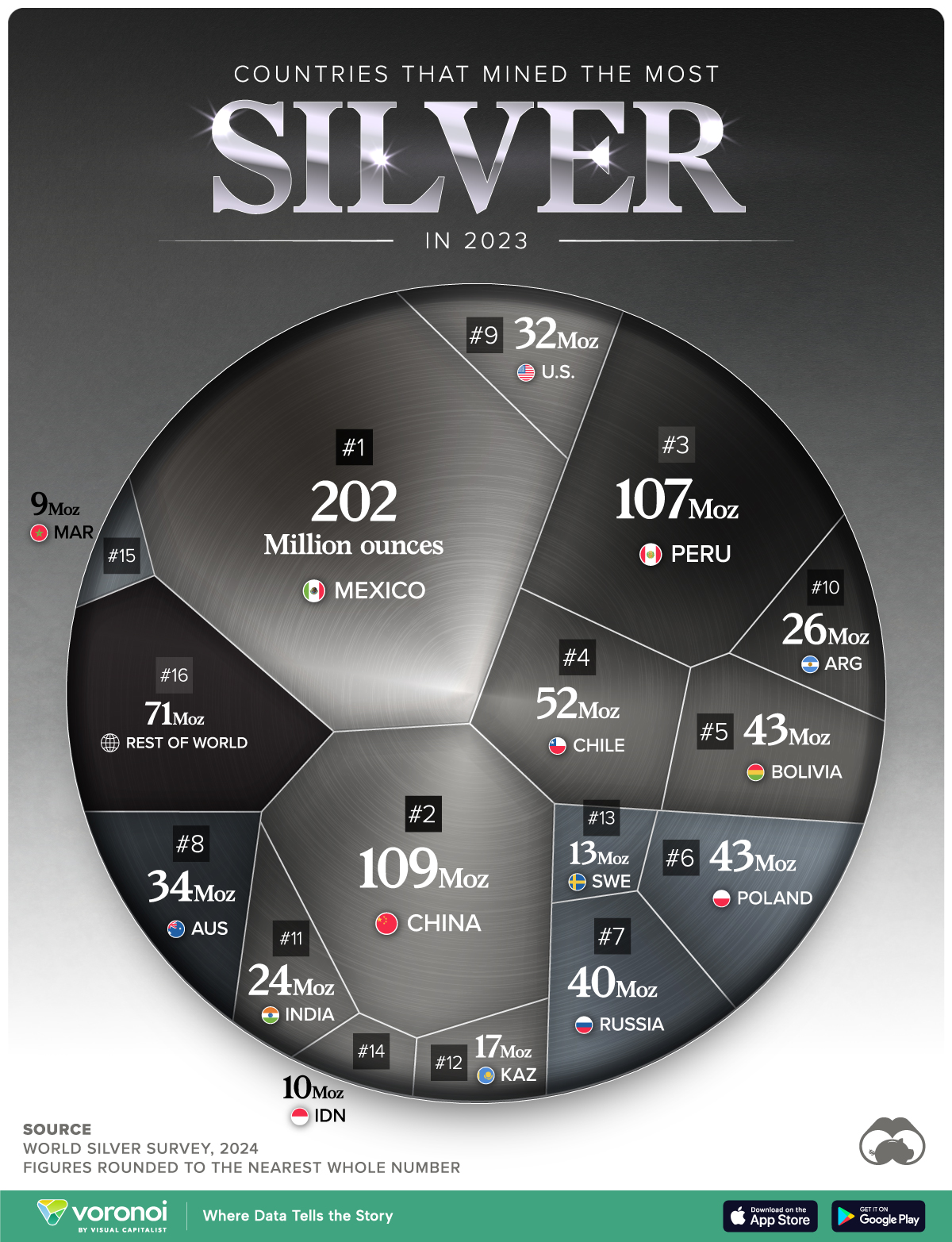
Ranked: The World’s Largest Silver Producers, by Country


Top Silver Mining Countries in 2023

This was originally posted on our Voronoi app. Download the app for free on iOS or Android and discover incredible data-driven charts from a variety of trusted sources.

Silver is one of the world’s most precious metals, and for the last 5,000 years, it’s been used in various ways, from everyday jewelry to coins and alloys.

So, in this graphic, we used data from The Silver Institute’s World Silver Survey 2024 to explore the drivers behind silver demand and analyze each country’s silver production in 2023.

What Drives Silver Mining?

In recent years, silver’s use as a brazing alloy or solder and within electronics has seen industrial demand grow consistently, and between 2022 and 2023, total industrial demand grew by 11%.

One of the key reasons behind this industrial growth is the critical role silver plays in solar photovoltaics. Consequently, demand for the silver used for this technology has grown 64% between 2022 and 2023.

Despite industrial growth, total silver production dipped slightly in 2023 (-1%). One potential reason for this dip is the considerable drop in demand for jewelry and silverware—13% and 25%, respectively.


Ranking Global Silver Production by Country

In 2023, global silver mining produced over 831 million ounces (Moz) of silver. Here’s how this breaks down by country:

Rank  Nation  Mined   Silver (Moz)  Share (%)

1  
  
                                                                     Mexico 202 24%
2 China 109 13%
3 Peru 107 13%
4 Chile 52 6%
5 Bolivia 43 5%
6 Poland 43 5%
7 Russia 40 5%
8 Australia 34 4%
9 United States 32 4%
10 Argentina 26 3%
11 India 24 3%
12 Kazakhstan 17 2%
13 Sweden 13 2%
14 Indonesia 10 1%
15  
                                                                                               Morocco 9 1%
16  
                                                                       Rest of World  71 8%  Global Total  831 100%


Three countries dominated global silver mining in 2023: Mexico (24%), China (13%), and Peru (13%). These nations collectively accounted for over half of the world’s silver production.

However, the significance of silver in modern technologies has spurred increased production in certain countries. For instance, Chile experienced a 24% surge in silver production between 2022 and 2023, and Papua New Guinea increased output by 42%.

The data for this visualization was sourced from the World Silver Survey 2024, a publication by one of our data partners, The Silver Institute. Our data partnerships are commercial agreements that may or may not include compensation, and partners are not involved with our editorial or graphical processes in any capacity.