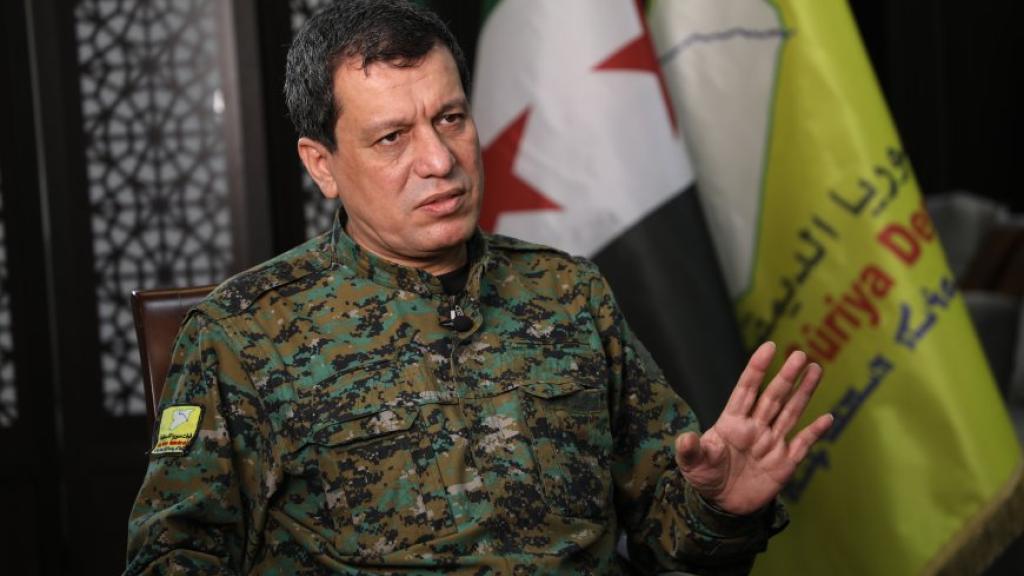
Mazloum Abdi (Syrian Democratic Forces): ‘The HTS administration and those seeking a solution to the Syrian crisis must work to stop the attacks on North and East Syria’
First published at Hawar News Agency. Slightly abridged and edited for clarity.
In this interview, Syrian Democratic Forces (SDF) Commander-in-Chief Mazloum Abdi assessed the rapid developments and changes on the military, security, and political fronts since the fall of the Assad regime in Syria. Abdi also discussed the continuous attacks launched by the Turkish occupation state and its mercenaries and the latest developments in the dialogue with the Hay’at Tahrir al-Sham administration and between Kurdish political parties.
He praised the role of the people and youth in resisting the attacks and strengthening their forces, noting the continuation of dialogue with the HTS administration. He emphasized the importance of political dialogue to end the Syrian crisis, calling on the international community to put pressure on the Turkish occupation to stop its attacks as a first step towards building a new Syria.
A month and a half have passed since the fall of the previous Syrian regime. During this period, Syria has witnessed significant military and diplomatic developments. How do you assess this phase? What is the current reality in Syria from your perspective?
In fact, more than a month and a half have passed since the fall of the Ba’athist regime and the historic change in Syria. The Syrian people, regardless of their different components, are generally pleased and happy with this change, especially the coexisting components in the regions of North and East Syria, including the Kurds. This is because, with the start of the Syrian revolution in 2011, the people of the region were among the first to participate in the protests and sit-ins against the regime. Therefore, they, more than any other parties, are happy with the fall of the Assad regime.
Today, gradually, the situation is becoming clearer and more evident, but the situation has not yet taken a clear direction for everyone in Syria. Syria has entered a new phase, and there will be no turning back; the country will not return to previous stages. All parties, starting from the Syrian people, through the regional countries, and up to the international powers, no longer wish to see the country experience a civil war or any disturbances and tensions again. All parties are striving to benefit from this current change and seize the opportunity to build a new Syria.
At first, the international powers were apprehensive about the phase and the change and who had reached Damascus, but the situation and positions of those parties have become clearer and more evident. Now, those parties want to continue with the new administration in Damascus, but at the same time, they want to push that administration to change some of its aspects.
We, in the SDF, and also the representatives of the components of North and East Syria, want the current change to be a foundation for a new phase in Syria.
The new phase in Syria is met with significant challenges that generate concerns among the general Syrian population. The most important of these is the existing and evident security vacuum. We hear about violations by parties seeking to destabilize the security of Syrian regions. The economic situation remains deteriorating and continues to worsen.
Syria is still under sanctions. Economic sanctions have not yet been lifted from the country, and international powers have not reached a complete consensus to lift those sanctions, because the country has not yet reached the new administrative form required by the Syrians, and the responsible parties have not yet reached a stable position. Additionally, there are challenges and concerns such as how the new administration will politically approach the future of the country, and foremost among all this is the continuation of external attacks on Syrian territory.
All these matters are considered challenges facing the Syrian people and hindering the country’s return. However, in general, we can say that we are going through a historic and new phase, and it is necessary for everyone, whether the Syrian community or international and regional powers, to cooperate and work together to build a Syria based on acceptance of others.
Over the course of approximately 14 years of the Syrian revolution, three administrations have emerged on the ground. One of them collapsed, which was the previous Ba’ath regime, and it has now been replaced by HTS. There are also two existing administrations known as the Euphrates Region and the West Euphrates Region. The West Euphrates Region is managed by the interim government, which is not favored in its form and system, and it is interim in name based on past experiences and its reality.
Our current administration [the Autonomous Administration of North and East Syria, AANES] has produced results in our regions, whether on the institutional, political or military level. We have an administration that works to empower the principles of democracy, and we certainly wish to play an effective and significant role in the new Syria.
In light of calls for dialogue as a path to achieving sustainable peace in Syria and the approach to building Syria, the region of North and East Syria are subjected to intense attacks by the Turkish occupying state and its mercenaries, especially in the Tishrin and Qaraquzak dams. What are the objectives of these attacks, and what are the most significant field developments related to them?
This is a significant and obvious contradiction, as the majority of Syria is witnessing a phase of war cessation. There may be some minor skirmishes, but there is relative stability, and there is no ongoing war or battles. There are only attacks on areas in North and East Syria. As you mentioned, there are attacks on our areas such as Qaraquzaq and the Tishrin Dam, and our other areas are still subjected to daily bombardment by Turkish warplanes and artillery.
This is a major contradiction from Turkey and does not align with the situation of Syria that is currently being discussed, which suggests that Syria has entered a phase of crisis resolution. At such a time, the groups linked to Turkey, called or referred to as the “[Syrian] National Army” [SNA], supported by Turkish air and artillery, continue to attack our areas.
With the fall of the Assad regime, and in order to stop these attacks and the war, so that our people, like the rest of the Syrian people, can enjoy a state of stability and the cessation of war, we have proposed many initiatives and suggestions. As you know, for example, what we proposed to stop the attack on Kobani, and we are still proposing, and now to stop these attacks on the Tishrin Dam and the Qaraquzaq Bridge, there are suggestions we are making and work is being done on that through intermediaries, foremost among them the United States of America. There are also other parties working on that, and we have efforts, and we approach any proposal that comes to us to stop these attacks with all positivity.
I want to emphasize that these attacks contradict and hinder both domestic and international efforts to resolve the Syrian crisis. Therefore, the administration in Syria and the parties seeking to find a solution to the Syrian crisis must, above all, work to stop the attacks on the region of North and East Syria. Without this, we, as the peoples of North and East Syria, cannot work effectively in the upcoming political phase for Syria. Thus, our support and efforts for Syria are conditional upon stopping the attacks on our regions.
What are the latest field developments in the Qaraquzaq and Tishrin Dam fronts. Why is there such insistence from Turkey and its mercenaries to attack and escalate specifically in those two fronts, despite all the proposals?
The Tishrin Dam and the Qaraquzak area are geographically located between Manbij and Kobani. In order to prevent the continuation of attacks and war, and to completely stop the war, we reached an agreement with the other party to withdraw our forces from Manbij. However, what we have witnessed are attempts to cross the agreed-upon borders, move to the east of the Euphrates, and continue the attacks.
The borders where it was agreed that the attacks would stop are the natural geographical borders. We left Manbij based on an agreement that ensured the war would stop at the banks of the Euphrates River from the west of the Euphrates, and we were open to the Turkish army reaching the site of the Tomb of Suleiman Shah. On the other hand, the agreement extended to the countryside of Manbij but it extended to the area of the Tishrin Dam, which was not among the areas that the SNA would reach.
But we have witnessed that they tried to reach the eastern Euphrates and control the region by crossing either from the Qaraquzaq Bridge or the Tishrin Dam to besiege Kobani. However, the resistance of the local people thwarted that and pushed them back to the western Euphrates after some of their groups crossed to the eastern Euphrates from the Qaraquzaq Bridge. They are still trying to reach the eastern Euphrates from that front. If the goal is to return the tomb of Suleiman Shah to its location, we are open to that. But if it is a prelude to a new war on the region, we will certainly not allow it and we will continue to confront those attempts.
As for the Tishrin Dam area, they tried to advance and seize the Tishrin Dam and cross to the east of the Euphrates and to the Serrin area to complete the siege of Kobani. The battles and their attacks are still ongoing, and since their plan is exposed to us, we repelled those attacks. Our defense in the Tishrin Dam area is part of protecting Kobani from that plan.
Our decision is summarized in not allowing the implementation of that plan and the forceful entry into our areas. We know that until a general and comprehensive ceasefire is reached with Turkey and the armed groups associated with it, the plan to occupy other areas of the region will continue. Therefore, our resistance and confrontation will also continue. Our forces’ decision is clear and we reaffirm it once again: we will not allow the crossing of the dam and reaching the eastern Euphrates, no matter the cost.
Are there any surprises in terms of military developments that will be revealed in the upcoming stages of confronting the Turkish occupation and its mercenaries? Just as we have recently seen the emergence of aerial units within your forces?
I mentioned in previous meetings that the SDF are not what they used to be. For about four years now, our forces have been working on developing their military capabilities and resorting to various military tactics, all within the context of defense, because we are a force formed for self-defense, not for attack. Among these are protection methods, tunnel warfare and trenches, as well as measures to protect against aerial bombardment. There are many significant measures that have been implemented across all our regions. In the context of these measures, everyone should know that any attack on our regions will not be a walk in the park. At this stage, we have proven this through the methods of protecting our forces from Turkish aerial bombardment.
And also on the technical front, we have measures that have proven successful in thwarting and failing attacks launched against our regions, whether they are ground attacks as we witness today in the Tishrin Dam area, or aerial attacks, including what we have demonstrated by downing several Turkish drones. We have many other new methods that are being worked on more extensively to thwart aerial and ground attacks on our regions. What has been revealed so far is just a part of those measures to protect our areas, and they are local products with local names that will be known later.
After the announcement of general mobilization and recruitment by the SDF and the AANES, the residents responded widely. What is your message to them in this critical phase?
We have entered a historical phase, as I mentioned, and the general mobilization was necessary to align with this phase, as the region is in the process of consolidating and ensuring the achieved gains. All peoples in such phases resort to this, and it is essential. There is an aspect of this general mobilization that pertains to the entire people of North and East Syria, and we witness this general mobilization today among the entire population.
Everyone is mobilized to protect their areas in various ways and methods. We see the protection of neighborhoods, villages, and towns being carried out voluntarily, ensuring security and stability alongside their security and military forces. These are efforts we highly appreciate, and this is what we have come to expect from the peoples of the region in such types of attacks and phases that we have witnessed throughout our revolution within the Syrian crisis.
The other aspect is related to the youth within the community and their involvement in the military forces to confront external attacks and strengthen the SDF. Yes, our SDF has significant strength, but it needs to be reinforced to become even stronger because we are heading towards a future beyond just achieving gains. This phase requires greater involvement in these forces, whether temporarily or in the long term, in terms of volunteering and engagement.
It is the responsibility of the youth at this stage to strengthen the SDF, because strengthening these forces will enhance the position of the Syrian DDF in the upcoming stages, whether in negotiations with the HTS administration in Damascus or in repelling external attacks on the region. Therefore, everyone must fulfill their national duty.
Since late November, the SDF and the people of the region have resisted the attacks of the Turkish occupation and its mercenaries, starting from Afrin and al-Shahba to Kobani and the Tishrin Dam. How do you assess the resistance shown by the fighters and the people? What is its impact on Syrian and international public opinion?
The decision to resist and confront is not just the decision of our fighters or a specific military leadership, but rather a popular decision that our people in North and East Syria believe in, because they are certain and aware of the Turkish plans and those connected to them. This is evident in what we see with our people heading to the Tishrin Dam and protesting there.
On this occasion, we highly appreciate and evaluate the moral support and the protests of our people against these attacks, and we consider it a historical resistance. It is an expression of their deep connection to their forces and their achieved gains, and we commend their continuous resistance. Our people desire nothing but the cessation of attacks on their regions, facilities, and forces, and to live in security and stability within the upcoming Syria after the fall of Assad.
What is your assessment of the international stance on the recent Turkish attacks? What is your message to the United Nations and the international community regarding the Turkish attacks and the situation in North and East Syria?
From the beginning, there have been attempts and endeavors to stop these attacks, most notably the Global Coalition and the US, and this popular resistance from the people of the region, with its various components, has the greatest influence that pushes these parties to these positions, and these endeavors are still ongoing. An example of this is what we witnessed regarding Kobani, and what we are witnessing today with the region remaining in a kind of stability and in the rest of the regions of the region, is the result of the continuous support of these parties for our forces and the peoples of the region.
The popular resistance and the resistance of the SDF fighters in the Qaraquzak area, as well as the ongoing resistance in Tishrin Dam, contributed to pushing all parties to increase support for our forces and increased the efforts of international parties to mediate for a permanent ceasefire, so just as there was a move for Kobani, there are efforts to cease fire in the Tishrin Dam area, the efforts have limited the expansion of these attacks, but have not yet yielded results to stop the attacks in the Tishrin Dam and Qaraquzak area.
Therefore, we believe that we must continue our historic resistance, and the attacking parties must be certain that they will not be able to enter the dam and cross it by force and with such ease. Our decision is clear, which is not to allow the occupation and to confront it, and our forces have always proven that they are capable of implementing the pledges and decisions that they make to themselves. Our military resistance on the one hand, and our diplomatic efforts on the other hand, will continue, and we believe that in this way we will ensure that the stage ends with victory.
The resistance of our fighters and the resistance of our people in the Tishrin Dam area will direct us to a new stage that begins with a comprehensive ceasefire and entering the post-war, dialogue and construction stage. Therefore, all parties, primarily the international powers and the Global Coalition, must be aware of the demands of our people and stand by them and pressure all parties, primarily Turkey, to stop these attacks. I am confident that stopping these attacks will turn into the beginning of political dialogue in Syria.
There are repeated allegations of tension and clashes between the SDF and HTS. Which parties are pushing for this? Who benefits from fueling a conflict between the two parties? What is the impact of this on the Syrian people and their future?
So far, no clashes have occurred between us. When the “Deterrence of Aggression” operation [by HTS] began, they contacted me and explained that their target was the Syrian regime, and that they were not targeting areas of the SDF, and that they were not seeking to cause clashes or clashes between us and them. To this day, with the help of mediators, there is coordination between us militarily in Raqqa, Deir-ez-Zor, and even in the city of Aleppo.
Many parties spread these allegations with the aim of destabilizing the security and stability of the region and pushing the two parties to clash in order to exploit it for other agendas, but we in the SDF and the other party, HTS, are aware of these plans and who is behind them, so we will only say that their plans will fail.
Do you mean to say that there is a third party trying to drag you into a fight with HTS? If that happens, what are its repercussions and which of those parties will benefit from that?
Of course there is a third party, there are local parties, and some countries are trying hard and by all means to cause a fight between us, and there are also Syrian figures, in addition to some groups that spread discord, and this is happening openly and not in secret. Sometimes we see them go out in Umayyad Square in Damascus and talk about clashes and fighting, and they call for that. But in general all parties, including the SDF, HTS and international powers, while there is dialogue and a national project, believe the fighting should not return.
Certainly with the return of the fighting, all parties will be harmed by it, and before everyone else, the Syrian forces are the ones who will receive the greatest harm, and the interests of the international powers present in the region will be harmed. I believe that everyone is aware of this matter, and that is why no one seeks to resolve the Syrian crisis through armed conflict. Resuming the internal Syrian conflict again will not be in the interest of any party.
There is ongoing talk about negotiations between you and the leadership of HTS. What is the nature of the relationship between the two parties currently? What are the most prominent points that you are discussing in these discussions, what have you agreed upon and what are the points of disagreement between the two parties?
I believe that our people and all components of North and East Syria are seeking to know the nature of the relationship between us, what we have reached, what we are discussing. Currently, the discussions are ongoing.
First, we went to Damascus to know their opinions and point of view, and they were also trying to know our point of view. We held a long meeting with the leadership of HTS, Mr. Ahmed al-Sharaa, and common points emerged between us and we agree on them, regarding the future and nature of the SDF within the Syrian army in the future, the unity of Syrian lands, the rejection of division, and the necessity of activating dialogue and a political solution.
We think about Syria as a whole, we want a unified Syria, and we have no intention of separatism. Many are promoting that we are working to build two armies in Syria and establish a state within a state. We have no intention in this direction. Our goal and political plan are clear. In the basic lines, there is no disagreement between the two parties.
But there are ongoing discussions and negotiations about the mechanism, how and the content of implementing these points, and the timing of translating these matters. We agree that Syria should have one army and the SDF should be part of it, but in what way will the SDF be integrated with the Syrian Ministry of Defense? The SDF has been present for ten years and consists of all the components of North and East Syria, and it has many military institutions affiliated with it. There are also preparations underway to build a new force, not a previously unified force, and we must join it.
Having a new army requires a lot of time and work. There is a disagreement between us and them about the timing of the period in which this army should be formed, and about how to activate the closed crossings within the areas of the Autonomous Administration, and for this reason the meetings will continue.
Currently, there are clashes and fighting in the Tishrin Dam, and the dam is a national institution and concerns Syria in general, and for this reason this problem must be resolved with the Damascus administration. As I said, previously in the basic lines we agree and there is no disagreement between us, and most importantly there is the intention of dialogue between the two parties. For this reason things must proceed slowly and with complete patience. There are some parties trying to rush the matter, but we see that any action that is done in a hurry can have negative results. We say that matters must be resolved step by step without thinking about time in order to have a solid foundation and not be a reason for problems to appear again.
Also, we are currently working on how to include this region in the political process, and they must also be clear in this context: how we will join the national dialogue that will be held or the transitional government that they say will be formed within two or three months? What is our place in this government? These points must be clarified. Also, on what principles will the future Syria be built, whether it is democratic or not, and what is the form of the state, as it concerns all Syrians.
In the end, I can say that we agree that the Syrian situation should be resolved through dialogue, and blocking the way for parties that are trying to spread discord. There is encouragement from the parties and international powers to work in the context of the dialogue, and for us to be present in Damascus. They also, as the Damascus government, have representatives in our regions.
A few days ago, a meeting was held, we shared our point of view with them, and they also presented some demands, and in turn, we sent them our demands, and I believe that we will be responded to, and when some points are clarified, we can hold meetings at the level of the General Command between us and them, in order to work on implementing some practical steps, but the steps that will be implemented must be discussed and clarified between us.
I am confident that from now on we can work on some points, including the issue of fighting terrorism and ISIS. There is al-Hol Camp where thousands of people from inside Syria are held, and for this reason a delegation or a committee from Damascus must go to our areas to coordinate between us and al-Hol Camp administration and clarify how to return them to their areas, and study opening the crossings, including Qamishlo and Tal Kocher, since the crossings are linked to the government in Damascus.
Could you please tell us about the demands you received from the HTS administration, if it is possible to disclose them of course?
We have previously explained some of them in the context of our dialogue, and since those demands are under discussion and dialogue, I do not want to go into detail about those demands. Now I would like to apologize, and I believe that the information we have provided about our relationship is sufficient for this moment.
Conflicting statements have been issued by HTS administration officials regarding the SDF, some of which talk about an ongoing dialogue and others call for the dissolution of the forces and the surrender of weapons. How do you evaluate these statements? What can you conclude from that?
There are many reasons for this contradiction in the statements. There is pressure being exerted on them and there are demands from international powers and regional countries, and there are challenges on the ground. For us, the most important are the statements of the HTS leadership, Mr. Ahmed al-Sharaa. We have direct channels of communication with the HTS leadership and the Damascus administration, and there are parties moving between us and they are present in Damascus and come to us. Our relations are conducted at the leadership level. In this context, I do not believe that there is any disagreement between us regarding the dialogue and its continuation.
Regarding the unity of the Kurdish ranks in the region, especially after your recent visit to Erbil and meeting with the leadership of the Kurdistan Democratic Party, have you met with other Kurdish parties? What is the position of those parties? What are the latest developments in this area (the unity of the Kurdish parties in Syria)?
The visit we made to Hewler was private, no other meetings took place outside the framework of this visit, but a phone call took place between us and the President of the Kurdistan Region, Nechirvan Barzani, and as you know we have relations with the President of the Patriotic Union of Kurdistan, Pavel Talabani, and we are in constant contact with him. In general, this is a new stage for everyone and for the Kurds as well, and therefore steps must be taken, as achieving Kurdish unity at this stage is more important than ever.
We in the SDF are not only concerned with the Kurdish people, but with all the components of North and East Syria. There are some parties that systematically seek to limit the issue of North and East Syria to the Kurds only, this is not true. All components of the region have been fighting for ten years in one trench, and the blood of all components has been shed in the same trench. The SDF are made up of the sons of all components of North and East Syria.
We will continue our struggle to ensure the rights of the components of North and East Syria in the future Syria, and our efforts in this regard will continue, but this does not mean that we put the Kurdish issue on the sidelines; on the contrary, the more the Kurds show strength at this stage and unite their ranks and voices, we will achieve our goals and protect our gains. There is an urgent and greater need than before to achieve Kurdish unity.
The position of the Kurdistan Region is positive, and they want to provide assistance to Rojava and North and East Syria in our dialogue and negotiations with Damascus. In my opinion this is a positive and important position at this stage, and all Kurdish forces must stand by Rojava so that Rojava can guarantee its rights. The support and assistance of the Kurdistan Region to Rojava at this stage is very important and what is happening in this regard so far is good.
It is necessary in the coming days for the Kurdish political parties in Rojava to meet. For our part, we discussed this issue during our visit to Erbil and it was one of the main topics and it also enjoys support from Hewler as well.
As part of what we have learned from our visit, we will meet with the Kurdish forces in Rojava in the coming days, and we will try to unify their position and political program regarding the Kurds in Rojava, and form a unified body in the name of the Kurds to go to Damascus to conduct negotiations. This will support the position of the AANES and the SDF on the issue of North and East Syria. The communication channels between us are continuous and have not been interrupted, there is a positive atmosphere, everyone is ready for that. We are waiting for a meeting program to be set, to meet with all parties, and to gather them at one table to discuss the issues.
Earlier in 2020, there were meetings between them and they had common political visions, and according to the situation, they should meet again to make some adjustments. They should unify their demands and determine what they want.
The main goal of the dialogues is to form a unified body called Rojava to go to Damascus and demand their rights. First, they should agree on a unified program and go to Damascus to present their demands to the Damascus administration. I believe that this is urgent and necessary on the one hand, and on the other hand, the conditions are favorable for the Kurdish forces to agree, and we will help them in this matter until the end.
Yes, as soon as possible, in the next few days, I think we may start holding these meetings tomorrow.