It’s possible that I shall make an ass of myself. But in that case one can always get out of it with a little dialectic. I have, of course, so worded my proposition as to be right either way (K.Marx, Letter to F.Engels on the Indian Mutiny)
Saturday, February 01, 2025
ARIZONA
Student protest overwhelms anti-immigrant event at ASU
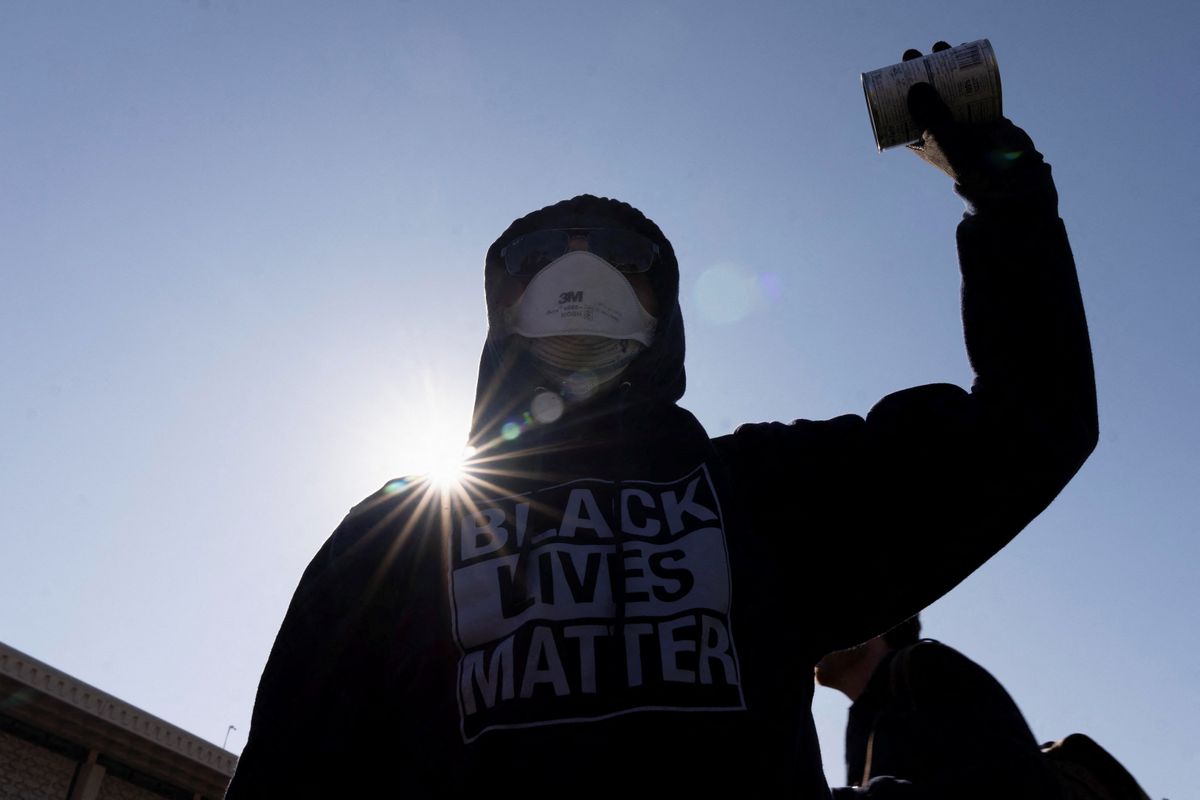
AZ Mirror January 31, 2025 A pro-immigration protester holds a can of food, a reference to President Donald Trump’s remarks that protesters should throw cans, not bricks, as Arizona State University College Republicans United invites students to turn in their undocumented classmates to U.S. Immigration and Customs Enforcement at Arizona State University in Tempe, Arizona, U.S., January 31, 2025. REUTERS/Rebecca Noble
On the same day that a white supremacy aligned university club encouraged students to report their classmates to ICE, hundreds of Arizona State University Sun Devils responded by marching in support of their undocumented classmates.
Crowds of students waving Mexican flags and posters with supportive messages, including “Education not deportation” and “Stand with ASU Dreamers,” surrounded a small gathering of College Republicans United at Hayden Library as they held up their own signs with information on how to tip off immigration officials about classmates suspected of being in the country illegally.
Loud shouts of “Down with deportation!”” and “No hate, no fear, everyone is welcome here!” resounded throughout the campus.
Earlier this week, College Republicans United announced on social media that it would staff a table at the university’s central building to provide information on how to file reports against classmates believed to be undocumented, including recipients of Deferred Action for Childhood Arrivals — people with temporary authorization who wouldn’t be subject to President Donald Trump’s mass deportation plan.
The student organization has frequently courted scandal, inviting Jared Taylor, a white nationalist who espouses racist talking points to speak in 2022. The new event spurred immediate backlash from immigration advocates, who slammed the move as likely to encourage racial discrimination.
Reyna Montoya, the founder and CEO of Aliento, a local organization that serves DACA and other undocumented youth, criticized the event as a bid to instill fear in students without legal status who are simply trying to get an education, and called on protestors to respond with activism.
“They wanted to intimidate students,” she shouted through a bullhorn as march attendees took a short break. “They wanted to ensure that they don’t get their degrees, and the best way to fight back is with love, with compassion — and by getting an education!”
The group made several circuits around Hayden Library and the nearby Memorial Union, with the intent of letting Dreamer students who might be listening to their chants know that they “are not alone,” before settling in front of the union to hear speeches.
Ayla Moreno stumbled on the protest by accident and quickly joined it. She listened to the speeches with tears streaming down her face, and when she noticed some of her white classmates in the crowd, she ran up to them and thanked them for their participation.
Moreno said she’s struggled with all the anti-immigrant news in the past few weeks since Trump took office, and hearing about students who vocally advocated for helping deport Latino students at her school was especially painful. Her paternal grandparents immigrated to the country from Chihuahua, Mexico, many years ago, and she said they would be astonished by the vitriol.
“They never would have expected this to happen,” she said, still wiping away tears. “I didn’t think we’d go back in time like this.”
But, she added, she was reassured by the fact that so many showed up to the protest, and that pro-immigrant advocates outnumbered the few handful of representatives from College Republicans United.
“It’s clear that there are a lot more people here, than there are against us,” Moreno said.
Nineteen-year-old Sharik Luengas, wrapped up in a Colombian flag, said it “baffled” her that anyone would be willing to call ICE on their fellow classmates. She said the news angered her as the first generation child of immigrants, and spurred her to join the march.
“Any chance I have to speak up for my family, I will,” she said.
Jesus Verdini also wore a flag to the protest, one that was half of the American flag and half of the Mexican flag, in acknowledgement of both his heritage and his U.S. citizenship. He said he was disappointed that ASU allowed the anti-immigrant event to go on, and that students just trying to get an education and help their families succeed had to deal with hostility just steps away from their classrooms. He added that he’s concerned about the risk of racial profiling, saying that there’s no way to know a person’s immigration status from just looking at them.
“You don’t know who is or isn’t an immigrant,” he said. “Immigrants are just normal people. And it’s so unjust and racist that people are allowed to discriminate against them like this.”
In a press release, ASU denounced the College Republicans United event, but said that it could not prevent it from taking place without violating free speech protections. One journalist reported that only four of the people at CRU’s event were students at ASU; they were joined by prominent white nationalist advocates.
“Encouraging ASU students to make indiscriminate complaints to law enforcement about fellow students is not in keeping with the principles which underlie our academic community,” reads the statement. “We are here to teach and learn — not to engage in self-aggrandizing conduct meant solely to generate as much media attention and controversy as possible. But we must also recognize that we live in a country that protects individual free speech, even speech that is hurtful.”
Just three years ago, the university was designated a Hispanic-serving Institution by the U.S. Department of Education, in recognition of its high rate of Hispanic student enrollment and opening it up to new federal funding. For the fall 2021 semester, the university’s Hispanic student enrollment was over 30,200. And that number is only expected to keep growing after Arizona voters approved in-state tuition for Dreamers in 2022.
Aliento at ASU, the student-run chapter of the larger statewide organization, drafted a letter to ASU administration officials demanding that ICE officials be prohibited from stepping foot on campus without a judicial warrant, that school administrators ensure student clubs don’t violate guidelines and assurances that students won’t be targeted by their peers without consequences and that all students can fully participate in academic activities without fear of harassment. According to Emily Sotelo, the co-chair of Aliento at ASU, the letter has so far garnered more than 4,000 student signatures. All students, regardless of their legal status, Sotelo said at the march, deserve to seek an education without fear.
“Whether they’re Dreamers or they have DACA, and they’re pursuing an education and they want to be here, they have the right to be here just like everybody else,” she said.
'Probably a scam': Federal employees reject Trump buyout, say they’re 'not going anywhere'
Earlier this week, President Donald Trump's administration sent an email to federal workers asking them to quit in exchange for several months' pay. But many federal employees are wary of the offer.
That's according to a recent CNN article, which reported that workers throughout several federal agencies are hesitant to take the president at his word. After Trump's Office of Personnel Management (OPM) offered millions of federal employees pay through September if they voluntarily left their positions, the American Federation of Government Employees (AFGE) warned that the Trump administration is legally unable to follow through on its promise given that Congress has only appropriated enough funding to keep federal agencies funded through mid-March.
"Employees should not take the Program at face value," the AFGE cautioned, adding that the OPM's email offered no guarantee that workers who quit "will receive the benefits that the Program purports to offer."
Stephen Miller, who is Trump's deputy chief of staff for policy, said without offering any evidence that "a significant number of federal workers have accepted the buyout offer." But several workers told CNN that they have no plan to accept the offer, which expires on Thursday, February 6.
“They’re trying to change everything overnight. They’re trying to reinvent the government, and I don’t think they can do it," one unnamed U.S. Department of Agriculture employee told the network. "I retire by 60. I have my 25 years. I’m vested. I’m not going anywhere."
Outside of the AFGE, other unions representing federal workers are also skeptical of the buyout offer. Doreen Greenwald, who is the national president of the National Treasury Employees Union, said the OPM's letter was "written in a very negative tone, in a threatening manner," and that the administration "provided no clarity on what was being offered."
"There were no answers provided in that document, and so we had to provide that information to our members to protect them," she said.
Randy Erwin, who is the national president of the National Federation of Federal Workers, also warned his members against accepting the offer. He called it "a scare tactic designed to pressure federal workers into quitting" and that the proposal to pay them through the fall was "illegal and unenforceable."
"Unlike structured programs that the federal government offered in the past to decrease the number of federal employees, this maneuver is intended to panic civil servants into accepting what seems like a sweet deal but is probably a scam," Erwin said.
Firing federal workers en masse will likely be easier said than done. Despite Trump and billionaire Tesla and SpaceX CEO Elon Musk — who Trump has made his government efficiency czar — promising to hollow out the federal workforce, President Joe Biden's OPM implemented new protections for the civil service last spring. The rule was explicitly designed to "safeguard federal employees from political firings" and could not be easily rolled back.
“An executive order would not have impact with this regulation in place,” a senior Biden official told CNN in April. “A future administration would have to go through a new regulatory process, which would also entail like explaining specifically through that rulemaking process why a different rule is better than the existing regulations that OPM (the Office of Personnel Management) finalized and are announced... and how that new approach was consistent with the law.”
Two anti-abortion activists who made sensational videos of Planned Parenthood officials nearly a decade ago pleaded no contest this week to a felony count of illegally recording someone without consent.
David Daleiden and Sandra Merritt secretly filmed Planned Parenthood executives in California and edited the clips in a way that purported to show them selling fetal remains. Monday’s plea deal and felony conviction ends a criminal case that has dragged through the court system since 2017.
Their explosive videos triggered multiple state investigations into the allegations, some of which were led by Republican attorneys general. Those inquiries cleared Planned Parenthood of any wrongdoing, but court cases related to the videos are ongoing.
Daleiden and Merritt pleaded no contest in San Francisco Superior Court and waived any right to appeal. A sentencing hearing will happen roughly a year from now.
Attorney General Rob Bonta, who has taken a firm stance supporting abortion access, said in a statement that the conviction helps ensure California residents can exercise their state constitutional rights to reproductive health care.
“We will not hesitate to continue taking action against those who threaten access to abortion care — whether by recording confidential conversations or other means,” Bonta said.
The conviction comes less than a week after President Donald Trump limited federal enforcement of a law meant to protect abortion clinic workers and pardoned 23 anti-abortion activists convicted of harassing abortion clinic workers.
The terms of the plea agreement prohibit Daleiden and Merritt from contacting or naming any of the victims of the illegal recordings. They must also obey all laws.
Daleiden downplayed the felony conviction in a statement on his website, Center for Medical Progress, saying that the conviction comes with “zero punishment.”
“After enduring 9 years of weaponized political prosecution, putting an end to the lawfare launched by Kamala Harris is a huge victory for my investigative reporting and for the public’s right to know the truth about Planned Parenthood’s sale of aborted baby body parts,” Daleiden said. At the time, then-California Attorney General Kamala Harris launched an investigation into Daleiden and Merritt’s actions after they published a series of videos showing covertly filmed conversations of Planned Parenthood executives discussing abortion procedures and how tissue is collected and exchanged with research companies.
Donating fetal tissue to researchers and recouping expenses is legal under U.S. law and states may impose additional regulations.
The recordings sparked a firestorm of national outrage, particularly from conservative activists and lawmakers who oppose abortion, fueling calls to defund Planned Parenthood. The subjects of the recordings received death threats in the aftermath. Planned Parenthood won a $2.2 million civil lawsuit in San Francisco against Daleiden and Merritt for violating fraud, trespassing and recording laws.
In an unsigned statement, Bonta’s office said it disagreed with Daleiden’s characterization of the plea deal.
“Make no mistake: the defendants are now convicted felons. They are guilty of feloniously recording private communications.”
Under California law, Daleiden and Merritt are eligible to ask a judge to reduce the conviction to a misdemeanor in 12 months if they adhere to the terms of the plea deal.
Supported by the California Health Care Foundation (CHCF), which works to ensure that people have access to the care they need, when they need it, at a price they can afford. Visit www.chcf.org to learn more.
ANCESTOR WORSHIP, ANIMISM
St. Thomas Aquinas’ skull just went on tour − here’s what the medieval saint himself would have said about its veneration The skull of St. Thomas Aquinas during a stop at St. Patrick Church in Columbus, Ohio, in December 2024. Nheyob/Wikimedia Commons
Once, on a road trip in Greece, I stopped with my husband and dad at a centuries-old Orthodox monastery to view its famous frescoes. We were in luck, the porter said: It was a feast day. The relics of the monastery’s saintly founder were on view for public veneration.
As a Catholic and a medievalist, I can never resist meeting a new saint. The relic, it turned out, was the saint’s hand, though without any special ornament or reliquary, the ornate containers in which relics are often displayed. Nothing but one plain, severed hand in a glass box, its fingers partly contorted, and its discolored skin shriveled onto the bones.
We gathered around the shrine, silently, to pray. Then my dad, whose piety sometimes runs up against his penchant for dramatic storytelling, leaned over and whispered, “What if at the hotel, in the middle of the night, I hear a scratching sound, and then The Claw …” His own hand started crawling dramatically up his shirt and then flew to his throat.
“Dad!” I hissed furiously, with a horrified glance at the monks praying nearby.
Relics can admittedly feel a bit morbid – and yet, so holy. What exactly is their appeal?
To me, it’s the physical closeness, especially with parts of a saint’s own body – what the Catholic Church calls “first class” relics, which can be as small as a chip of bone. There are also objects the saint used during life: “second class” relics, such as the gloves worn by the Italian mystic Padre Pio.
The veneration of relics of saints was already well established in the early church. But controversies go back hundreds of years. During the Protestant Reformation, for example, reformers decried the shameless use of relics to drive donations and the proliferation of faux relics. Today, the idea of intentionally dismembering and displaying human body parts can seem shocking, even repulsive.
Yet venerating relics remains far from a “relic” of the past. At the end of 2024, the skull of St. Thomas Aquinas – the great Dominican medieval thinker whose writings I study – made its first tour of the United States. The journey commemorated the “triple anniversary” of 700 years since his canonization, 750 years since his death and 800 years since his birth.
What might Aquinas himself have thought about all the attention to his traveling skull – that fragile and now empty case for the brain behind one of the most productive minds of European philosophy?
Aquinas’ answer lies in a short but poignant text from “Summa Theologiae,” his best-known work. Christians should venerate relics, Aquinas says, because the saints’ bodies were dwelled in by God. The very parts of their bodies were the instruments, or “organs,” of God’s actions.
The saints as “organs” of God: What a riveting image! God is so intimately present to his friends, the saints, that their very bodies are sanctified by his presence. Those hands, now dead and desiccated, performed God’s own actions as they cared for the sick, fed the hungry, celebrated Mass and reconciled the lost sheep.
According to Aquinas, honoring saints’ relics is ultimately about honoring this divine activity, a superhuman love working through ordinary human beings. But as he notes elsewhere, God is present in all of creation, working “most secretly” through all creatures at every moment. So by recognizing the special holiness of saints’ relics, Christians can better perceive the universal holiness that radiates through the whole created world.
Cherished keepsakes
Yet in discussing relics, Aquinas has some challenging things to say about what is perhaps their most immediate draw: the sense that when I see or touch a relic, I am physically present to a saint.
Because the saints are brothers and sisters in the Christian family, he says, Christians should cherish their physical remains just as people cherish a memento of a loved one, like “a father’s coat or ring.”
I did a double-take when I read this: A memento? Surely the saint’s body is more than that.
Stained glass in St. Patrick Church in Columbus, Ohio, depicts a mystical vision St. Thomas Aquinas had in the 13th century. Nheyob/Wikimedia Commons, CC BY-SA
But Aquinas insists that physical remains really are more like mementos of the deceased than parts of them. When St. Teresa of Calcutta died, for instance, she left behind a corpse and a soul. These bodily remains shouldn’t be confused with the saint herself, who was a living, breathing, bodily person. If I kiss a saint’s relic, as Catholics often do, I am not kissing the saint but something that was formerly part of a saint. The word “relic” literally goes back to the Latin word for “leaving something behind.”
The holiness of a relic, then, derives from the person it was once part of, not what it is now.
Not just “once was,” though, but also “will be.” Aquinas adds – and to me this is one of the most beautiful aspects of his reflections on relics – that venerating a relic is also a way of looking forward to the future resurrection of the body. Christian doctrine teaches that at the end of time, God will restore each person’s body, reuniting it with their soul. Relics represent that hope for everlasting life.
Later this year, the skull formerly known as Aquinas’ will wend its way back to its permanent place of rest, buried under the altar of the Dominican church in Toulouse, France. During its visit to the U.S., I was down with pneumonia and never got a chance to pay my respects. But I cherish the “third class” relic that my sister-in-law mailed me from Cincinnati: a holy card that she had touched to the skull’s reliquary. Therese Cory, Associate Professor of Thomistic Studies, University of Notre Dame
An explosive New York magazine cover story details accusations of assault, coercion or abuse against Neil Gaiman by eight women. Four of them were among the five who previously detailed their experiences on a UK podcast last year. Included are two employees, one a former nanny who was in her mid-20s at the time of the first incident, and five fans – one just 18 when she met the star fantasy author.
Gaiman, through his representatives, told the magazine these were all consensual encounters. Today, in an online statement, he denied the allegations and said, “I have never engaged in non-consensual sexual activity with anyone”. He continued: “some of the horrible stories now being told simply never happened, while others have been so distorted from what actually took place that they bear no relationship to reality”.
People who flock to fantasy conventions and signings make up an “inherently vulnerable community”, one of Gaiman’s former friends, a fantasy writer, told reporter Lila Shapiro. They “wrap themselves around a beloved text so it becomes their self-identity”. These fans’ connection to the writer through their work means when they meet them in real life, a meaningful relationship may already exist.
I have researched teenage fans of romantasy author Sarah J. Maas, and her series A Court of Thorns and Roses. I spoke to six young women several times over the course of a year about their experience of reading the series, and was struck by how intimately they felt they knew the author. Readers often feel a very strong connection to authors of series they love.
The latest accusations against Gaiman, which come months after stories first began circulating in July 2024, raises the question: what moral and ethical responsibilities do authors have when engaging with fans? And what does the unequal power relationship between author and fan mean for consent? Consent, power and #MeToo
Gaiman, whose bestselling books include children’s horror fantasy Coraline (2002) and the Sandman graphic novels, has had a dedicated following for years. He has sold more than 50 million books, and has long been a fan favourite, particularly among women. He has almost three million followers on X. Shapiro tells how one woman “fell to her knees and wept” when she encountered him at a convention.
All this gives him extraordinary power in the fantasy book community. A key aspect of the #MeToo movement, which began in 2017, has been acknowledging how unequal power relationships change a person’s ability to consent to sex.
When one person has more power than the other because, for example, they are an award-winning author, consent is not clear-cut. It is the responsibility of the person with that power to acknowledge it and act accordingly. Research shows young people understand that unequal power implicitly influences their ability to consent freely. But even then, this isn’t always recognisable in the moment.
Since #MeToo, and the wide cultural recognition of the need for enthusiastic and informed consent it has brought, the need for authors to act responsibly with their fans is clear.
One of Gaiman’s former friends, a fantasy writer, told Shapiro if “you have morality around” dealing with fans, “you say no”. There is even a lengthy Reddit thread for and by authors on dealing with fans who cross boundaries. Other fantasy authors
Gaiman is not the first fantasy or science-fiction author to be the subject of serious allegations
.
In 2014, Moira Greyland, the daughter of bestselling late fantasy author Marion Zimmer Bradley, accused her mother of having abused her as a child, calling her “cruel and violent”.
Greyland told the Guardian she hadn’t spoken out earlier “because I thought that my mother’s fans would be angry with me for saying anything against someone who had championed women’s rights and made so many of them feel differently about themselves and their lives”.
In 2018, blockbuster author James Dashner, author of the young adult Maze Runner science-fiction series, was dropped by his publisher as a result of harassment allegations.
Fandoms have faced moral dilemmas over their favourite fantasy worlds in other contexts, too. Harry Potter author J.K. Rowling has been “cancelled” by some for her views on trans women and feminism. Some Harry Potter fans have argued for separating for the artists from the art, while others have chosen not to.
Gaiman fans face the same dilemma now – and have since the allegations first surfaced.
How fans read
Gaiman’s writing has also been criticised for the way it depicts romantic relationships. Shapiro cites the protagonist of Sandman, Madoc, a man who sexually assaults his muse (and, it should be acknowledged, is punished for it). The genre of fantasy more broadly is often criticised for the way it minimises abuse in romantic relationships.
Studies have shown representations of sexual intimacy provide a behavioural script for young readers, which are put to use during their own sexual encounters.
Stephenie Meyer’s Twilight series began more than 20 years ago. At the peak of its popularity, many were concerned about how its depiction of relationships would affect young people. Women’s studies lecturer Danielle Borgia claimed the fantasy series glamorised negative behaviours such as stalking and emotional codependency, in ways the public would only accept “veiled in the cloak of the supernatural”.
But other research – including my own – shows readers are much more savvy, and can easily identify the difference between the real world and the fantasy of the text.
The teenage girls I spoke to, all fans of romantasy author Sarah J. Maas, indicated they could see the difference between life in the novels, and how real life should be.
#MeToo has created a space for victims of sexual assault to tell their stories – sometimes, as in the Harvey Weinstein case, despite signing non-disclosure agreements, or NDAs. Two of Gaiman’s accusers have also broken NDAs to tell their story.
If there’s anything this latest literary controversy confirms, it’s the need for continued consent education and cultural transformation that empowers women to call out abuse.
Lunar new year is the most important traditional festival for the Chinese people, symbolising unity, prosperity and hope for the future. It is, however, celebrated all over Asia and in the diaspora.
Unlike, the new year that is celebrated only on December 31 and January 1, lunar new year celebrations begin the month before and end days after the start of the new year.
In the Chinese tradition, new year celebration begins on the eighth day of the 12th lunar month with the Laba festival (腊八节). On this day, it is customary to eat Laba congee, a porridge which is also known as “eight-treasure congee” because it’s often made with eight or more ingredients. This year the Laba festival fell on January 7.
The biggest day in this period of celebration is, of course, new year, which this year falls on January 29.
According to historical records, the Chinese people have been celebrating the lunar new year for over 4,000 years. Around 2,000BC, Shun, an ancient Chinese leader, ascended to the throne and led his followers in a worship ceremony to honour heaven and earth.
This day was regarded as the beginning of the year, corresponding to the first day of the first lunar month. This event is believed to mark the origin of the lunar new year.
During this festival, people typically express their hopes for prosperity and health in the coming year through family reunions and ancestor worship. Communities also host traditional activities to celebrate, such as lion dances, the giving of red envelopes, and putting up of spring couplets (pairs of poems written on red paper with black or gold characters), all of which symbolise good fortune and abundance.
The traditional Chinese lunar new year reunion dinner includes many symbolic dishes. For example, eating fish represents abundance, dumplings symbolise reunion and wealth, and rice cakes signify progress and success.
But this day isn’t the end of celebrations. Instead, new year is celebrated up until the 15th day of the first lunar month when the lantern festival (元宵节) is celebrated. This festival coincides with the first full moon of the lunar year. On this day reconciliation, peace and forgiveness are sought.
To celebrate, people will cover their houses with colourful lanterns, often with riddles written on them. Children will go out and try to solve these to win small gifts. There might be lion and dragon dances as well as parades and fireworks. People eat small glutinous rice balls, known as yuanxiao or tangyuan. The round shape symbolises wholeness and unity within the family.
This year’s lantern festival – and the end of lunar new year celebrations – is on February 12. By this time, we will be well into 2025, which is the year of the snake.
The year of the snake
The year of the snake holds profound meaning and special significance in Chinese culture. The animal symbolises wisdom, spirituality, elegance and renewal.
In Chinese traditions, the snake is also considered a “small dragon” and has a unique presence. Many scholars believe that the basic form of the dragon has evolved from the snake, with the snake’s body forming the main structure of the mythical beast.
In ancient art, images of dragons and snakes often overlap, with motifs that appear simultaneously dragon-like and snake-like being very common.
In ancient China, the snake was regarded as a mysterious and powerful creature. Its strong reproductive ability symbolised a continuous lineage and abundant offspring, while its ability to shed its skin and renew itself represented life and longevity. This process of renewal and rebirth highlighted the snake’s connection to cycles of growth and the passage of time.
Beyond its physical traits, the snake was also revered for its intelligence and adaptability, often being portrayed as a creature of wisdom and strategy.
These qualities have translated into cultural beliefs about people born in the year of the snake. For instance, for those born in this year, the snake’s flexibility and patience are seen as representing wisdom in problem-solving and overcoming challenges.
Thousands of Filipino protesters call for VP Duterte impeachment
Agence France-Presse January 31, 2025 Protesters holding placards shout slogans during a rally at the People Power monument in Manila (TED ALJIBE/AFP)
Thousands of protesters took to the streets of Manila on Friday, urging the Philippine House of Representatives to impeach Vice President Sara Duterte.
Duterte faces three impeachment complaints over alleged misconduct and misuse of millions of dollars in government funds, but legislators have yet to tackle them just days before Congress adjourns next week ahead of the May midterm elections.
The 46-year-old vice president, who is estranged from President Ferdinand Marcos but remains his constitutional successor in case he is unable to perform his duties, has denied the allegations.
Marcos himself has urged Congress not to pursue Duterte's impeachment, calling it a "storm in a teacup" that would distract the legislature from its primary responsibilities.
Protesters mostly wearing white shirts held placards calling for Duterte's removal and chanted "Impeach! Impeach Sara now!" as they gathered beside Manila's busiest avenue.
Around 4,000 people took part in the morning rally, police said, with authorities deploying 7,400 riot police to keep the peace.
Those numbers were dwarfed by a mammoth rally held on January 13 by a conservative sect that opposes Duterte's impeachment.
House of Representatives member Percival Cendana, who backs one of the impeachment complaints, joined Friday's rally and urged his colleagues to move fast.
Every day of inaction "condones the impunity, the abuse of power and the harassment that Duterte is doing to our country's leaders", he told reporters.
An impeachment will only proceed if it is backed by a third of House of Representatives members, and an impeached official can be removed from office by a two-thirds vote in the Senate.
"The Filipino people are here, ready to stand for truth and justice. Let's not fail them," Cendana said.
FBI logo. (Photo credit: Jonathan Weiss / Shutterstock)
As President Donald Trump's administration moves to terminate FBI officials who were involved in criminal investigations against him, a picture began to go viral of a redecorating project taking place at the FBI's training academy at Quantico, which many viewed as symbolic of what is to come for federal law enforcement under Trump's leadership.
The image showed an official covering a wall with gray paint, which had previously been a mural of words espousing values FBI agents are meant to embody, like "Fairness," "Diversity," "Integrity," "Respect," and "Compassion."
The FBI told The Washington Post in a statement that all visual and informational materials promoting diversity as a core value were being removed.
“The FBI is fully complying with the executive order regarding DEI programs,” the statement said. “While diversity is no longer an organizational core value for our employees, the FBI continues its work to serve and protect all Americans.”
Commenters on social media exploded over the image.
"FBI academy, Quantico, VA, 2025," wroteTrump University prosecutor Tristan Snell. "Donald Trump, literally graywashing the values out of America."
"This photograph was taken two days ago at the FBI Academy in Quantico and submitted to the NYT under the condition of anonymity," wrote Texas pastor Zach W. Lambert. "If a picture is usually worth a thousand words, this one is worth millions."
"Literally white washing the FBI," wrote reporter Jennifer Schulze. "Out: integrity, stability, respect, leadership, fairness, diversity; In: revenge, enemies lists, prosecuting the prosecutors, lawlessness, chaos."
"Overheard from LGBT servicemember: 'If only it had occurred to us to paint diversity, equity, inclusion word clouds onto the sides of our rusting warships in December, this administration might actually be accomplishing something useful right now,'" wrote Duffel Blog writer and satirist "Dark Laughter."
"Assuming we make it through the next couple of decades, this will be an incredible image for future historians/students of the Trump era," wrote historian Nicholas Guyatt.
'Not normal': Trump admin trashed as government websites expected to go dark
Most federal government websites will go dark at 5 p.m. EST on Friday, Jennifer Jacobs of CBS News reported. The information was confirmed to her about 10 minutes before the sites went offline.
Ryan Broderick, a former BuzzFeed tech reporter who now runs The Garbage Day newsletter, posted on Bluesky that a source sent him a copy of the anti-gender ideology memo that was being shared around federal government agencies on Friday.
"This was sent to the Department of Health and Human Services. They have a 5 PM deadline to take down 'all outward facing media... that inculcate or promote gender ideology,'" he said.
Jacobs said a reporter asked if the websites were going dark to remove any DEI-related content.
"If they want to scrub the websites, that's OK with me," Trump told reporters.
Politico reported from an internal email that Department of Agriculture staff was ordered to delete pages on climate change.
Reuters said that the U.S. Centers for Disease Control and Prevention, as well as other federal health agencies, were ordered to remove webpages, forms, and programs that had anything to do with what Republicans call "gender ideology extremism."
"HOW ARE PEOPLE SUPPOSED TO GET RESOURCES? Americans use these websites every day to access basic government services!" exclaimed Michigan Rep. Haley Stevens (D).
Open government advocate Alexander B. Howerd noted: "There are several federal websites that are mandated by Congress, like http://FOIA.gov & @usdatagov & @usaspending, but most are not, along with the data on them. Not seeing widespread takedowns yet, but would welcome any and all tips."
Lori Lodes, the executive director of Climate Power, noted on X that when she worked for Barack Obama's administration, she oversaw the websites for HealthCare.gov and Medicare.gov.
"Government websites do more than provide critical information to help people — they connect people to life-saving services. Families and kids will pay a steep price for Trump dismantling the government," she said.
Investigative reporter Steven Monacelli from the Texas Tribune posted on X, "It appears that the destruction of information, and the consequent confusion that destruction creates, is a feature of this administration's strategy."
Parkland school shooting victim father Fred Guttenberg was not as kind. "F--K THIS MAFIA DON IN THE WHITE HOUSE. As for his elected enablers, the next two years are about you. Election season has begun."
The aides Elon Musk brought to help him purge the federal workforce have locked staffers of a U.S. government human resources agency out of the computer systems with millions of employees' personal information.
Reuters cited two agency officials revealing that Musk, who has not been hired, appointed, or confirmed to any government position, is at work trying to cut $2 trillion from the annual U.S. budget. Musk would still need to find over $1.3 trillion in additional cuts if every federal employee was cut. The cost of the entire federal workforce in 2022 was approximately $271 billion, the Bureau of Labor Statistics reported.
The New York Times reported this week that billionaire Musk brought in his computer engineers to handle his ongoing demands.
As Musk brings his staff to the Office of Personnel Management, senior officials' access to data systems is being revoked.
"We have no visibility into what they are doing with the computer and data systems," one of the officials said. "That is creating great concern. There is no oversight. It creates real cybersecurity and hacking implications."
One key database, the officials cited, is Enterprise Human Resources Integration, which has "all of the birthdates, Social Security numbers, appraisals, home addresses, pay grades and lengths of service of government workers."
Reuters spoke with University of Michigan Professor Don Moynihan, at the Ford School of Public Policy, who warned that there doesn't seem to be any congressional oversight over Trump and Musk.
"This makes it much harder for anyone outside Musk's inner circle at OPM to know what's going on," Moynihan said.
The officials said they still have the power to log on and access their emails but there's no access to the massive datasets they managed.
Musk demands that his team work overnight and 80-hour weeks to find all of the necessary cuts, violating federal labor laws unless a worker is paid overtime. However, it's unclear whether Musk or American taxpayers are paying those workers.
Musk had sofa beds brought into the OPM office on Jan. 20, the day Trump took office, to ensure his personal team could work non-stop. The area can only be accessed with a special security badge or a security escort, an OPM employee said.






_-_Skull_of_St._Thomas_Aquinas_during_2024_U.S._tour_2.jpg)
_-_religious_sisters_venerating_the_skull_of_St._Thomas_Aquinas.jpg)
_-_stained_glass,_St._Thomas_Aquinas,_detail.jpg)