It’s possible that I shall make an ass of myself. But in that case one can always get out of it with a little dialectic. I have, of course, so worded my proposition as to be right either way (K.Marx, Letter to F.Engels on the Indian Mutiny)
Tuesday, February 04, 2025
ECOCIDE
Guinea sees maximum Simandou output in second year of operation
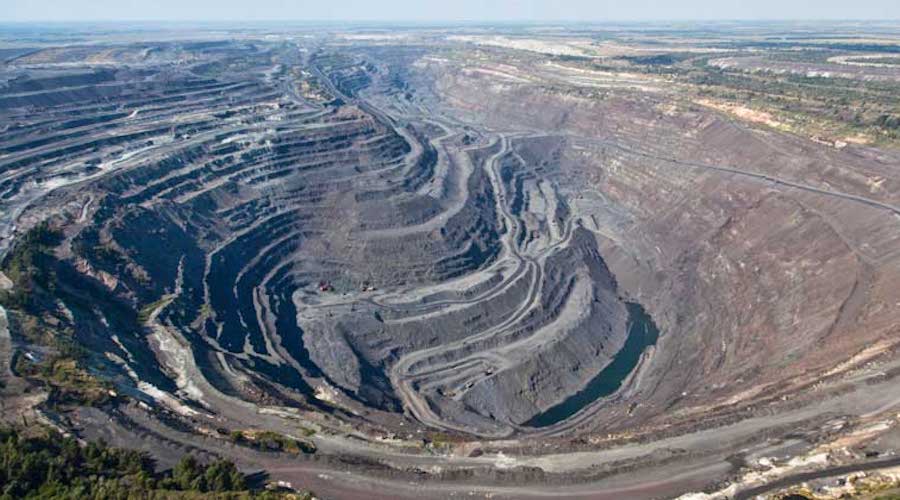
Simandou deposit, Guinea. (Image courtesy of Rio Tinto.)
Guinea expects the giant Simandou iron ore project, which is expected to begin production by December, to achieve maximum output by its second year of operation.
The government projects the two mines at the world’s largest untapped iron ore deposit will produce 30 million tons each in the first year, Mines and Geology Minister Bouna Sylla told Bloomberg TV in an interview. Output is then expected to double to 60 million tons at each cite the following year, he said on Tuesday on the sidelines of the Mining Indaba conference in Cape Town.
For a mine “to arrive at 60 million tons, that will take roughly two years because you have the ramp-up time,” Sylla said.
The Simandou project is divided into four blocks, with blocks 1 and 2 controlled by Winning Consortium Simandou, backed by Chinese companies including China Baowu Steel Group. Rio Tinto Plc and Aluminum Corp. of China, known as Chinalco, own blocks 3 and 4.
In addition to its iron ore deposits, Guinea is also the world’s biggest exporter of bauxite, a raw material used to make aluminum.
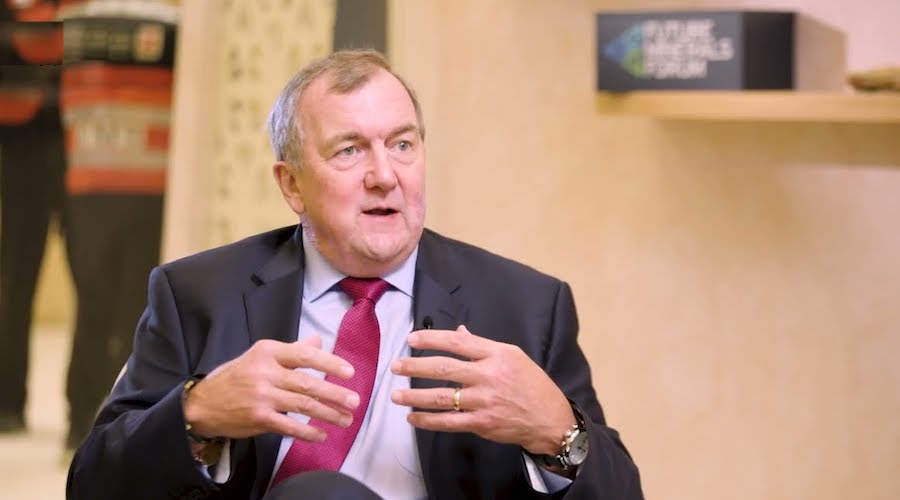
Barrick Gold CEO, Mark Bristow. in interview at the Future Minerals Forum 2024. (Screenshot from FMF TV.)
Barrick Gold Corp. chief executive officer Mark Bristow said the company is “making progress” in its dispute with Mali’s military regime, but the advances haven’t come as fast as expected.
The Canadian company last month suspended operations at the vast Loulo-Gounkoto complex in Mali after the government started removing gold from the nation’s biggest mine in the latest escalation of a months-long dispute. Barrick and Mali’s military rulers are locked in a standoff over the distribution of revenue from an asset that’s key for both the company and the government
The state has blocked Barrick from shipping the precious metal out of the country since November, and put out an arrest warrant for Bristow. The miner has begun arbitration proceedings against Mali.
“Mali has got itself in a position where it is really trying to shake out some short-term cash out of the industry, and this industry is the very foundation of the economy,” Bristow said. “We’re making progress, not as fast as I would expect, but I’m sure everyone is a little cautious.”
The CEO of the world’s No. 2 gold producer also said more consolidation was needed in the mining industry, with too many companies running too few assets. Barrick would continue to grow organically and buy back shares, Bristow said.
The Barrick chief said there’s still “a lot of upside” in gold, which held near a record after US President Donald Trump’s 10% tariffs on China prompted swift retaliation from Beijing, buoying haven demand.
“We are seeing a continuation of de-dollarization, fueled by the actions coming out of Washington and the White House,” Bristow said. “Conflicts on every continent. Gold has really arrived as the ultimate store of value and people are buying the physical.”
(By Dylan Griffiths and Jennifer Zabasajja)
Ferrexpo plunges 51% after $3.8 billion Ukrainian civil claim
Shares in London-listed miner Ferrexpo PLC sank as much as 51% after the company said a civil claim worth 157 billion Ukrainian hryvnias ($3.8 billion) had been filed against its subsidiary in the Eastern European country.
The Swiss-headquartered iron ore producer saw its biggest intraday drop on record, before paring losses to 23%. Earlier Tuesday the company issued a statement informing investors that its Ukrainian subsidiary Ferrexpo Poltava Mining was facing a claim for allegedly illegally mining and selling subsoil, which is said to have caused damage to the environment.
Ferrexpo rejected the allegations, and said the accusations it faced had “transformed” from earlier ones accusing the company of alleged illegal sale of waste products. The subsidiary intends to defend its position in the Ukrainian courts, according to a market update released by the company.
In mid-January, Ferrexpo issued a statement in response to reports in Ukrainian media concerning accusations made by the Prosecutor General’s Office of Ukraine against four senior managers of its subsidiary, concerning the alleged illegal mining and sale of waste products.
The company said the minerals in question were not a separate mineral resource, and that it had been selling waste products for many years until September 2021, which had been subject to state inspections.
Ferrexpo’s Poltava operation, located in central Ukraine, is the group’s largest mine. Before Russia’s invasion of Ukraine in 2022, Ferrexpo PLC was the world’s third-largest exporter of iron ore pellets.
(By Jack Ryan)
Russia says Trump comments on Ukrainian rare earth minerals amount to request to buy US aid
The Kremlin said on Tuesday that comments by US President Donald Trump suggesting he wants Ukraine to supply Washington with rare earth minerals show he now wants Kyiv to pay for US assistance rather than receive it for free.
Trump told reporters on Monday that Ukraine was willing to engage in the exchange, adding that he wants “equalization” from Ukraine for Washington’s “close to $300 billion” in support.
Kremlin spokesman Dmitry Peskov said the comment demonstrated the US is no longer willing to provide free aid to Kyiv.
(By Dmitry Antonov and Lucy Papachristou; Editing by Andrew Osborn)
China hits back at US tariffs with mineral export curbs
China unveiled a series of retaliatory measures against the United States on Tuesday, including restrictions on the export of five critical metals used in defence, clean energy, and other industries. The move comes in response to President Trump’s announcement on Friday of a blanket 10% additional tariff on Chinese imports.
Beijing’s new export controls target tungsten, tellurium, bismuth, indium, and molybdenum, stating that export licenses will only be granted to companies complying with “relevant regulations.” However, the Chinese government has not provided details about the specific criteria for compliance.
While significant, these measures fall short of the mineral export bans that China imposed on the US in December, which included gallium, germanium, antimony, and so-called superhard materials.
Some of the newly imposed controls are expected to have minimal impact on US industries. For instance, the United States is a major producer of molybdenum, a metal used to strengthen steel and reduce corrosion, and relies on negligible imports of it from China, according to the latest data from the US Geological Survey (USGS).
Additionally, US tariffs on indium and tungsten — set at 25% since last year — have already driven American importers to diversify their supply chains. Over the past four years, less than 10% of US indium imports have come from China, with South Korea, Japan, and Canada emerging as key suppliers, according to the USGS.
Still, vulnerabilities remain. The US ceased mining tungsten, a mineral critical for alloys and specialty steels, in 2015 and has not produced refined bismuth since 1997, relying entirely on imports for both materials.
Despite a declining share of tungsten imports from China, the country remains the primary supplier, making any sudden disruptions potentially damaging to US industries reliant on this resource.
Counter tariffs
China’s finance ministry also announced additional tariffs on US goods. Starting February 10, the country will impose a 15% duty on coal and liquefied natural gas (LNG) imports and raise tariffs by 10% on American crude oil, agricultural equipment, and certain cars.
President Trump, now in his second term, recently directed his administration to investigate China’s adherence to a trade deal reached during his first presidency in 2020. Economists note that the final results of this review, expected by April 1, could pave the way for further tariff measures.
In his first term in 2018, Trump launched a fierce two-year trade war with China, targeting its significant trade surplus with the US through tit-for-tat tariffs on hundreds of billions of dollars in goods. The conflict disrupted global supply chains and strained the world economy.
In 2020, China agreed to purchase an additional $200 billion in US goods annually to end the trade war. However, the covid-19 pandemic derailed the agreement, and China’s trade deficit with the US grew to $361 billion last year, according to the country’s customs data released in December.
China’s Critical Mineral Export Curbs Could Upend Market
China announced curbs on the exports of three critical minerals in December 2024.
China looks to curb lithium battery tech exports as a retaliatory measure to U.S. trade policy.
Beijing’s export restriction move only highlights China’s already well-known dominance in transition technology and the rest of the world’s near complete reliance on it for this technology.
In early December, China announced curbs on the exports of three critical minerals, including antimony, gallium, germanium, and several other minerals, to the United States. The price of these minerals soared, especially in antimony, which is a key ingredient in semiconductors and weapons. Now, China is reportedly planning to do the same to lithium battery tech exports, which could completely upend the critical minerals market.
The United States is the primary target of these limits as President Trump hardens the tariff rhetoric—and action—on both U.S. neighbors and China. In his latest squeeze on major trade partners, Trump threatened to impose 25% import tariffs on Mexican and Canadian products, which got most of the media attention. Yet he also imposed an additional 10% tariff on Chinese imports to make his point about the U.S. being shortchanged on trade.
In this context, China’s bans, although chronologically preceding the Trump tariffs, are a retaliatory measure to U.S. trade policy. In a more specific context, however, the context of the energy transition, Beijing’s export restriction move only highlights China’s already well-known dominance in transition technology and the rest of the world’s near complete reliance on it for this technology. When it comes to the transition, in other words, China holds all the cards.
Recent antimony price developments are a case in point. When China announced it would curb exports of the critical mineral, antimony prices surged to all-time highs, ending 2024 at $40,000 per ton for a total annual rise of a whopping 250%. “We have already sold some small quantities for $40,000,” a metals trader from Europe told Reuters at the time. “Non-Chinese sellers...will charge more to maximize profits.”
The problem is that it’s not just antimony that is being restricted. Indeed, an Argus senior analyst told the South China Morning Post last month that “There is a risk that China might expand its export restrictions on critical materials in the near term.” Ellie Saklatvala also told the SCMP that “In the short term, it will be very difficult for the US to significantly reduce its reliance on China for critical minerals – it usually takes many years and huge investments to develop new supply sources.”
That last comment sums up the challenges lying ahead for the United States and, to a much larger extent, Europe in securing enough critical minerals for the energy transition and balancing this priority with its foreign policy objectives, which seem to focus on containing China’s global influence. That would certainly be a tough act, and it is an act that the United States no longer has to try and master—because Trump has essentially pulled the brakes on the whole transition push.
Yet even without the energy transition as a top priority, the U.S. still needs critical minerals for its tech and defense industries—and China knows this well, which is precisely why it is curbing exports. And there is nothing importers can do except scramble to tap the limited pool of non-Chinese supplies. A further complication arose just this month when the U.S. president imposed those tariffs on Canada—which also produces critical minerals.
Indeed, analysts were quick to point out that Canada could use its mining industry as a bargaining chip in tariff negotiations with Trump because it either already mines or at least has resources of 16 out of 50 critical minerals that would come in handy as alternatives to Chinese supply, including germanium and gallium.
Meanwhile, the issue with critical mineral supply is becoming increasingly urgent because China is not just curbing exports—it is doubling down on cementing its global dominance in the sector with massive ongoing investments and reserve reporting mandates for Chinese miners operating abroad.
By Irina Slav for Oilprice.com
Italian Navy and Messina Hold Exercise Practicing Boarding and Inspection
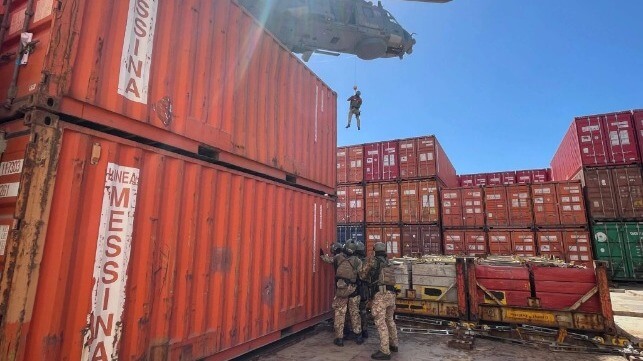
Italian Navy practices boarding another Messina vessel in a2024 exercise (Linea Messina)
The Italian Navy is highlighting one of its regular training exercises working with the merchant fleet. It is part of a long-term project also involving the trade association Assarmatori designed to build cooperation and familiarize the navy personnel and merchant sailors in the routine for vessel inspections.
The vessel selected for the latest exercise was the Jolly Verde of Ignazio Messina (Linea Messina). Built in 2007 and previously operating under charter to MSC Mediterranean Shipping Company, the containership became the largest vessel in the Messina fleet when she was acquired in April 2024. The vessel which is 80,000 dwt is 928 feet (283 meters) in length and has a capacity for 6,300 TEU. She operates with a crew of 22.
Jolly Verde was sailing in the Eastern Mediterranean yesterday, February 3, from Spain to the Suez Canal. Messina reported when they acquired the ship last year that it would be deployed on a route to the Middle East and India. The exercise involved the Italian frigate Alpino.
The trade association reports initially, radio contact was established between the Italian frigate and the merchant ship, with the Command of the military unit declaring its intentions and requesting the commander to proceed with the boarding of the inspection teams. The military reached the containership to inspect it, verifying the regularity of the ship and cargo documents before permitting it to resume regular navigation.
“Exercises of this kind are now taking place frequently and their success testifies to the high level of collaboration achieved between the Navy, our association, and the shipping companies,” said Stefano Messina, President of Assarmatori. “A particularly valuable relationship,” he noted is formed with a view to guaranteeing crews high safety standards and protecting cargo and traffic even on potentially risky routes. He notes currently it is, “a difficult and highly challenging historical period.”
They note the exercise gives the navy team practice at boarding a vessel. For the merchant ship, it provides the opportunity to understand the procedure and how to interact with the navy during an inspection.
The Italian Navy has participated in the recent NATO efforts to ensure the safety of merchant ships sailing both in the Gulf of Guinea and off the Horn of Africa. The exercises which take place every few months focus on elements such as boarding, inspection, and intervention during incidents of piracy.
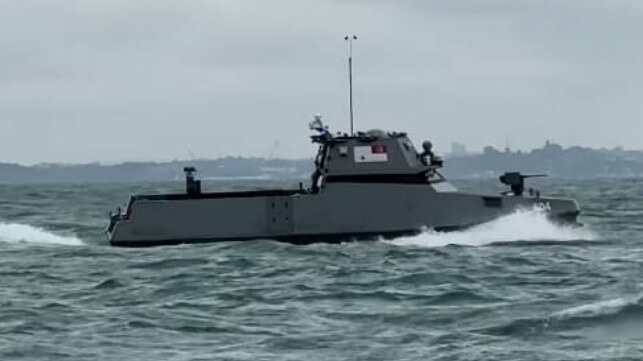
The efforts to monitor and protect shipping around Singapore, one of the busiest shipping lanes in the world, have gained a new remotely-controlled, autonomous patrol boat. The Singapore Navy put its new autonomous boats on display with a demonstration of its capabilities as it began patrols in the harbor.
The Marsec USV was designed and built in Singapore using the latest in automation and AI technology. The Straits Times newspaper witnessed the demonstration while the Navy also posted a video about the crafts online.
According to the report, three of the vessels have begun patrols and a fourth will be added later in the year. Each is 17 meters (approximately 56 feet) and 30 tonnes. They are powered by two diesel engines using water jets which give the patrol boats a top speed of over 25 knots. They can carry a 20-foot container or its equivalent, and they are designed for continuous operations of up to 36 hours.
Operations are overseen from a shoreside control station, but the vessels also incorporate a high level of autonomy in managing their navigation. They are outfitted with collision detection and avoidance systems employing a series of sensors, radar, and cameras. The video feed also provides a 360-degree perspective for the operators.
Each of the vessels is outfitted with a range of capabilities for their monitoring and enforcement roles. They have long-range acoustic devices, sirens, and speakers to issue voice commands. They also have a stabilized, remotely operated machine gun and a laser system to disorient perpetrators.
The vessels were deployed in 2025 after over 1,000 hours of testing. The Straits Times reports Navy officers said during the briefing that they conducted manned trials, but the operators never needed to intervene during the trials.
In addition to its current role in monitoring, the Navy reports it is looking at additional missions for the vessels. This could include mine detection or deploying countermeasures.
Trump Plans to Restore "Maximum Pressure" Sanctions on Iranian Oil
On Tuesday, the Trump administration announced plans to strengthen restrictions on Iranian oil exports, which have been sanctioned by the United States since President Trump's first term (with varying degrees of enforcement since). An official told Reuters that Trump will soon sign a memorandum instructing the Department of the Treasury to maximize pressure on Iran's energy exports.
An estimated 150 tankers are engaged in the "dark fleet" trade of Iranian oil, which is almost exclusively sold to Chinese customers. Much of the cargo is transshipped between tankers at anchorages in Southeast Asia, putting a veneer on its origins before final-mile delivery. The trade is tracked in detail by commodity market intelligence firms and vetting agencies like TankerTrackers.com, along with the advocacy group United for a Nuclear Iran (UANI), and has been well documented in the media.
Despite occasional high-profile accidents, Iran has had little difficulty in evading U.S. sanctions and arranging tonnage for its export sales. In November it sold an estimated 1.8 million barrels per day - two percent of all global production, shipped almost exclusively to Chinese buyers. Its output is higher now than at any point since the imposition of "snap back" sanctions in 2018, and brought in more than $50 billion in sales last year.
Oil and gas account for an estimated 25 percent of Iran's government revenue, and the funding is essential to Iranian military ambitions. Iran is the primary backer of Yemen's Houthi rebel group, which repeatedly attacked foreign shipping in the Red Sea last year, and Tehran also provides critical support to Lebanese Islamist militia Hezbollah.
Trump's National Security Advisor Mike Walz has advocated encouraging Beijing to shut down Iranian oil imports, clamping down on the trade on the demand side. On the supply side, a U.S. official told Reuters on Tuesday that the Trump White House wants to reinstitute "maximum pressure" on Iran's oil trade to drive its energy exports down to zero.
The White House is focused on impeding Iran's nuclear program. After Israel's retaliatory airstrikes destroyed Iranian air defense and missile production sites last October, the Iranian government quickly ramped up its uranium enrichment program to make more 60-percent-purity uranium-235. This grade has few civilian uses, and is considered a jumping-off point for manufacturing weapons grade uranium-235. Iran denies any interest in procuring nuclear weapons, though it has invested heavily in nuclear-capable ballistic missiles.
Crude oil prices immediately jumped in response to news that the globally-traded oil supply could drop. WTI rallied by $2 to reverse an earlier slide, and Brent gained 0.6 percent. U.S. export-grade Louisiana Light - which could serve Chinese refiners as a substitute for sanctioned Iranian Light - rose by 1.4 percent.
RBOB wholesale gasoline futures (an index of investor expectations for future gas prices) rose about two percent following the news of tightened sanctions enforcement.
Oil prices took a sharp turn today as traders weighed President Trump’s latest “maximum pressure” push against Iran. Brent crude rose to $76.34 per barrel (+0.50%), while WTI’s loss from early in the day shrunk to just a 0.31% dropoff at $72.93 per barrel.
While a quick glance at today’s oil prices could suggest traders aren’t convinced just yet that the Iran situation could have a profound effect, oil prices are indeed on the rise from their earlier downward trend—a rather quick turn, in fact.
Trump’s plan? Squeeze Iran’s oil exports down to zero—a bold move considering Iran still ships as much as 1.3 million barrels per day, mostly to China. The White House’s playbook includes fresh sanctions, tighter enforcement, and rolling back existing waivers. Translation: If the administration makes good on these threats, global supply could tighten overnight.
The last time Trump went all-in on Iranian sanctions, oil prices spiked north of $80. The market remembers. This time, with Middle East tensions already simmering and OPEC+ struggling to maintain discipline, the upside risk is real.
Of course, oil traders are a cynical bunch. They’ve seen this movie before. Crude flows tend to find a way—whether through shady ship-to-ship transfers or creative bookkeeping in Beijing. But if Washington actually gets aggressive with enforcement (hello, secondary sanctions), even China’s appetite for cheap Iranian crude might take a hit. That’s when Brent could break out.
For now, the market is playing it cool. But don’t be surprised if crude traders wake up tomorrow and suddenly decide that cutting off a key OPEC producer is, in fact, a big deal.
Crude prices were trading down prior to the announcement after China responded to US tariffs on China. WTI was down nearly 3% earlier in the day, with Brent down almost 2%.
By Julianne Geiger for Oilprice.com
Changes in Oil Trading Raise Doubts About SPOT Terminal
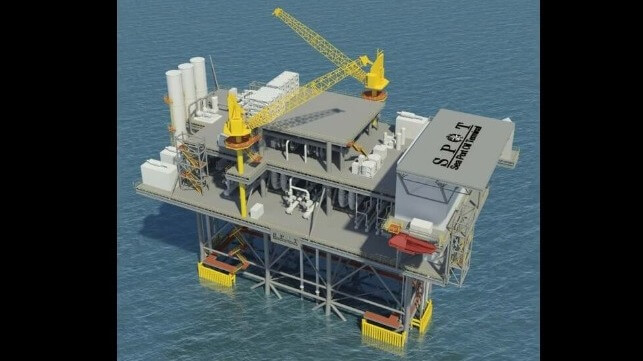
The proposed SPOT platform (illustration courtesy Enterprise Products Partners)
A lack of customer interest and a delay in permitting have created doubt about the future of Enterprise Products Partners' Sea Port Oil Terminal (SPOT), a deepwater tanker loading facility off the Texas coast.
If built, Enterprise's SPOT would be the largest offshore terminal in the United States, bigger even than the Louisiana Offshore Oil Port (LOOP). It would add two million barrels per day to U.S. export capacity, an increase of about 50 percent.
Last year, Enterprise had positive news to report about SPOT. After years of effort it received an operating license from the Maritime Administration, the only one of its kind in years. However, in an earnings call Tuesday, CEO Jim Teague said that it had encountered commercial and regulatory headwinds.
"I believe that SPOT should be the poster child for the need for permit reform. It took five years to get the SPOT license, including four years to get the record of decision," Teague said. "The process we went through due to federal bureaucracy pushed us beyond the drop-dead date. It allowed our anchor customer to opt out of their contract, which they did."
He added that the permit application totaled 30,000 pages, and that Enterprise had to answer 80,000 questions during two public comment periods, primarily from NGOs.
SPOT was designed in 2019, when all forecasts suggested that the U.S. would soon be exporting millions of barrels a day to customers in Asia. That long-haul trade favors VLCCs for economies of scale, and SPOT was specifically intended to allow full VLCC loading in one step - a capability not found elsewhere on the U.S. Gulf Coast (except at LOOP). However, because of the Russian invasion of Ukraine, a larger share of U.S. oil is going to Europe to make up for sanctioned Russian volumes. That shorter transatlantic trip can be done with a smaller Suezmax or Aframax, he said, reducing the demand for VLCC loadings.
"We have not gotten enough traction in commercializing SPOT," Teague said. "If we cannot achieve [commercial terms] within a reasonable amount of time, we will move on. This is not a 'build it and they will come' project."
Noble Sells Off Two Relatively Young Drillships for Possible Scrapping
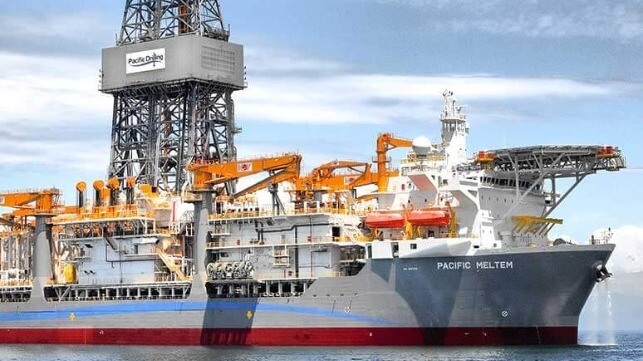
Noble Drilling has decided to decommission two relatively young, cold-stacked drillships, remnants of the idle fleet that accumulated in the Canary Islands during the offshore downturn of the mid-2010s.
The vessels named for possible demolition sale are Pacific Meltem (built 2014) and Pacific Scirocco (built 2011), both constructed by Samsung for the former Pacific Drilling fleet. They are rated to 12,000 feet of water depth, and both are anchored at Las Palmas.
Noble acquired Pacific Drilling in 2021, followed by Diamond Drilling in 2024. The wave of consolidation left Noble with 28 floaters, including 14 7th-generation drillships. While Meltem and Scirocco are comparatively young in ship years (11 and 14 respectively), they have been in storage for a long time; Noble has decided to divest of both in order to eliminate the cost of upkeep.
The sale will ensure the retirement of both ships from the drilling market, including the possibility of scrapping.
"Our decision to retire these non-contributing assets is based on a continuous cost-benefit evaluation of idle capacity. These retirements will be immediately cash flow accretive and result in a leaner, fitter fleet composition for Noble going forward," said Robert W. Eifler, President and CEO of Noble.
Tanker Targeted by Houthis Returns to Suez as Canal Seeks More Traffic
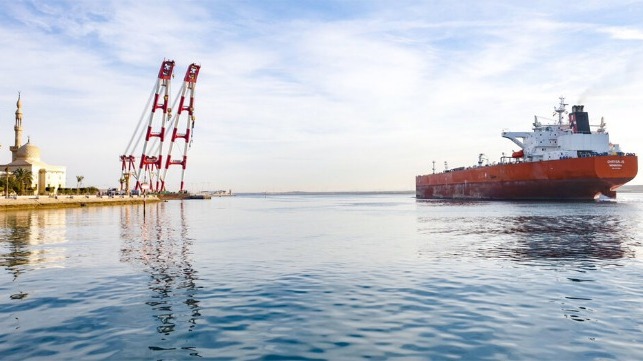
Chrysalis returned to the Suez Canal eight months after being attacked by the Houthis (SCA)
The Suez Canal Authority is increasing its efforts to rebuild traffic through the canal highlighting the return to stability in the region. Yesterday, February 3, a tanker targeted by the Houthis eight months ago made its first transit reports the authority as part of its marketing campaign.
The Houthis announced they would honor the Gaza cease-fire reached last month and suspended their attacks on commercial shipping in the Red Sea. While many of the major shipping lines have taken a wait-and-see attitude stressing their focus on security the Suez Canal Authority is anxious to restore traffic.
The Suez Canal is a major source of revenue for Egypt. Reuters is citing a comment from Egyptian President Abdel Fattah al-Sisi saying the diversions of ships from the canal cost Egypt around $7 billion in revenues in 2024.
The tanker Chrysalis (115,867 dwt) made the transit only with ballast on February 3 traveling from Seka, India to the Sidi Kerir oil terminal in Alexandria, Egypt. It was an important moment for the Suez Canal Authority as in July 2024 the Houthis had claimed to heavily damaged the vessel due to its association with Israel. The tanker built in 2010 in South Korea is registered in Liberia and reported to be owned by Turkish interests.
The Houthis claimed to have launched missiles targeting the tanker on July 12, 2024, while it was entering the Red Sea. Later as it transited the Bab el-Mandeb, they reportedly launched drones for a second attack on the tanker.
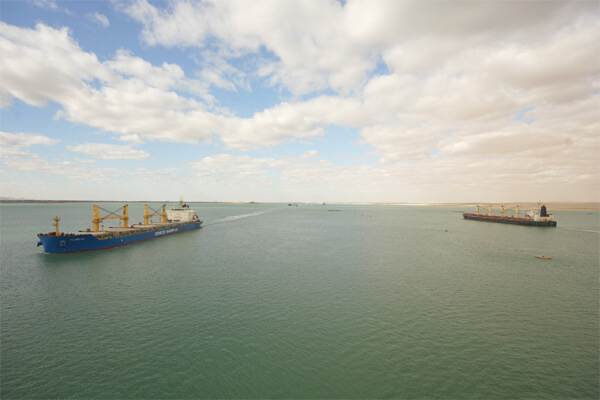
Additional lanes for two-way traffic recently opened in the southern reaches of the Suez Canal (SCA)
The Suez Canal Authority used the transit to emphasize its messages of the higher cost and increased fuel use to divert around the Cape of Good Hope. They also pointed to the lack of necessary navigation support services for vessels on the route around Africa.
The messages were also part of the authority’s presentation during a conference in Oman and last week when the Chairman and Managing Director of the Suez Canal Authority Admiral Ossama Rabiee met with representatives of the major shipping companies and agencies in Egypt. The authority highlighted that 23 companies participated in the meeting to discuss “the impact of the return of relative stability in the Red Sea and Bab el-Mandab.”
The authority emphasized that it has continued to pursue enhancements while vessels were diverting. This includes the recent opening of the additional two-lane traffic in the southern sections of the canal as well as deepening sections of the waterway from 66 to 72 feet. The additional sections of the canal they report will permit six to eight additional vessels to make the transit each day while the improvements to the waterway are increasing navigation safety and reducing the impact of water and air currents.
Rabiee told the shipping company representatives that the authority was “keen on keeping its flexibility by maintaining its pre-crisis transit pricing policies.” He said it would be extending its rebate programs to support shipping’s return to the Suez Canal. They also highlighted the addition of new services to support shipping. This includes salvage services, water ambulances, pollution control, and expanding the maintenance and bunkering services.