Wednesday, February 05, 2025

 World Nuclear News


Belgian government seeks to reverse nuclear phase-out policy


Tuesday, 4 February 2025

Belgium's new coalition government has announced plans to continue operating two of the country's reactors for an additional 10 years beyond the 10-year extension already agreed - and said it aims to construct new reactors.

Belgian government seeks to reverse nuclear phase-out policy
The Doel nuclear power plant (Image: Electrabel)

Following the 2024 Belgian federal and regional elections, government formation talks began on 10 June. After months of negotiations, on 31 January the parties forming the Arizona coalition (Les Engagés, MR, Vooruit, CD&V and N-VA) reached an agreement on forming a government and its policies. Bart De Wever was sworn in as prime minister on 3 February.

"In terms of energy, the agreement provides for the development of a long-term strategy ensuring an affordable, safe and carbon-neutral energy mix composed of renewables, nuclear energy and other forms of carbon-neutral energy, which guarantees security of supply, affordability for citizens and businesses, and sustainability," Les Engagés said. 

"It will also involve lifting the ban on the construction of new nuclear capacities in the very short term and taking all necessary measures to extend the life of units that meet safety standards. Specifically with regard to Doel 4 and Tihange 3, the agreement aims to extend their lifetime by at least 10 additional years in addition to the 10 years already agreed."

Belgium currently has five power reactors in operation: Doel units 1, 2 and 4 and Tihange units 1 and 3, with a combined generating capacity of about 4 GWe.

Under a plan announced by Belgium's coalition government in December 2021, Doel 3 was shut down in September 2022, while Tihange 2 shut down at the end of January 2023. The newer Doel 4 and Tihange 3 would be shut down by 2025. However, following the start of the Russia-Ukraine conflict in February 2022 the government and Electrabel began negotiating the feasibility and terms for the operation of the reactors for a further 10 years.

Belgium finalised plans in December 2023 to extend the lifetimes of Doel 4 and Tihange 3 by 10 years, providing capacity of 2 GWe from the reactors, which are 89.8% owned by Engie's Electrabel and 10.2% by EDF's subsidiary Luminus. The decision to extend their lifetimes was designed to boost the country's energy security while keeping carbon emissions as low as possible.

The European Commission opened an in-depth investigation in July last year into whether the support for the lifetime extension of the two reactors was in line with its rules on acceptable state aid.

Last week, Engie CEO Vincent Verbeke said it was "unthinkable" to keep the reactors in operation beyond the initial 10-year period.

In addition to maintaining the current 4 GWe of nuclear generating capacity, the government aims to construct a further 4 GWe of capacity, Energy Minister Mathieu Bihet was quoted as saying by financial daily Tijd.

"It's 4 gigawatts plus 4 gigawatts," Bihet said, without specifying locations and timing for the new reactors. He noted that building new small modular reactors (SMRs) alone could not provide sufficient capacity. "Which technology we will use, we still have to evaluate. But it is clear that it will not only be SMRs. Only small reactors will not suffice."

Industry stands ready to help
 

The agreement announced by the Arizona coalition partners was welcomed by the Belgian Nuclear Forum, saying it "puts the revival of nuclear power at the centre of its major concerns".

It added: "There is no time to lose on the energy issue. We must, without further delay and as a priority, adapt or even repeal the law on the nuclear phase-out, so that there is no longer any legal obstacle to the extension of existing reactors and the construction of new nuclear reactors."

The organisation said it was now "urgent" to set up a task force bringing together all stakeholders "who will enable this revival of nuclear power".

"It is important that we get to work immediately so that this relaunch of nuclear power in Belgium is carried out on time and within the budget planned to deal with the electricity shortage announced, in particular by [transmission system operator] Elia," it said. "We cannot afford to repeat the mistakes of the past by working in separate silos. We call on governments at different levels of power (federal, community, regional and communal) to work together, in close collaboration with the task force mentioned above."

The Forum said that if Engie maintains its stance against a further extension to the operation of the units "the government will have to switch to an alternative plan as soon as possible with the help of the task force. This means that it will be necessary to find another interested operator(s) to continue operating the existing nuclear reactors".

It added that Belgium must also develop a long-term vision that includes the development of new nuclear capacity. "This involves, in particular, a significant simplification of administrative procedures, at the level of granting licences and permits. It is also essential to ensure the necessary legal framework in order to reassure private investors, as well as potential new operators."

"All these elements are essential in the eyes of the nuclear sector to be able to build the new reactors within the announced deadlines and budgets. The nuclear sector is already putting itself at the service of the new government, to help it achieve our country's objectives in terms of energy transition and in terms of security of energy supply."

USA

Georgia Power plans additional nuclear capacity


Tuesday, 4 February 2025

Georgia Power has filed its 2025 Integrated Resource Plan, saying it has proposed power uprates at four units at its Hatch and Vogtle nuclear power plants and that additional nuclear power capacity will be needed over the long-term.

Georgia Power plans additional nuclear capacity
The four-unit Vogtle plant (Image: Georgia Power)

The 2025 Integrated Resource Plan (IRP) - filed on 31 January with the Georgia Public Service Commission (PSC) - details the company's plan to meet the energy needs of customers and support the state's expected continued extraordinary growth. In the plan, the company has proposed necessary investments in its generation fleet and transmission system to help ensure Georgia Power can continue to provide its customers with "the reliability and resiliency they deserve and expect, as well as demand-side and customer programmes".

Over the next six years, Georgia Power projects about 8200 MW of electrical load growth – an increase of more than 2200 MWe in peak demand by the end of 2030 when compared to projections in the 2023 IRP Update, which was approved by the Georgia PSC in April 2024.

The company said it has "identified opportunities to upgrade several of its existing nuclear units to provide additional capacity. This additional baseload energy can aid in meeting growing capacity needs without the need for incremental transmission system investment". 

Georgia Power - a subsidiary of Southern Company - is proposing extended power uprates (EPU) upgrades at units 1 and 2 of its Vogtle nuclear power plant and units 1 and 2 at its Hatch plant. Between 2028 and 2034, it plans to add a total of an additional 112 MWe of capacity at the four units: 27 MWe each at Vogtle 1 and 2; 30 MWe at Hatch 1 and 28 MWe at Hatch.

Extended power uprates involve significant modifications to major plant equipment to increase the thermal output of the reactor. "The EPU process includes an extensive analysis of plant systems and components to verify the capability and identify needed modifications to support the power upgrade at each facility," Georgia Power said.

For the Hatch units, the company is also planning to complete a necessary upgrade to boiler water reactors (BWRs) called the 'Maximum Extended Load Line Limit (MELLA+)' enhancement. This increases capacity by allowing for higher thermal power without increasing core flow to support EPU for BWRs. In addition to the upgrades described above, the company is considering an option for Vogtle units 1 and 2 that would transition the outage window to a 24-month cycle. This upgrade would extend unit runtimes and decrease the number of refueling outages across the fleet.

Georgia Power said it is working with the US Nuclear Regulatory Commission (NRC) as a part of the required review and licensing process. The NRC will review the licence amendment request that contains the detailed analysis to support the power upgrades and concur with approval to allow the upgrade of each facility.

Nuclear new build possible
 

"The company believes that additional nuclear power will be needed over the long-term to reliably and economically serve the energy needs of its customers," Georgia Power said. "Similarly, nuclear power provides a long-term pathway to reduce carbon emissions and mitigate the cost pressures that potential future environmental regulations could impose on the existing fossil-fired fleet and future new fossil resources."

The company said it develops "multiple views of future cost and performance of generating technologies, multiple views of future electricity consumption, and multiple views of the future price of fuels to support expansion planning for future years of need. Accordingly, B2025 scenarios select nuclear generation in six of nine scenarios over the 20-year planning horizon and as early as 2037."

However, it says: "Even with new nuclear generation's numerous benefits, undertaking the construction of new nuclear generation carries substantial risks for all stakeholders involved. Before proposing additional new nuclear generation, the company believes that solutions must be developed to adequately balance and mitigate risks to stakeholders."

It adds that "preserving viable new nuclear generation options for the benefit of customers is a priority" for the company. Accordingly, it continues to perform in-depth assessments of potential project sites, evaluate available and emerging technologies, and engage with stakeholders in developing improved methods to deploy new nuclear generation projects. "Over the long-term, with adequate additional risk mitigations and leveraging the experience gained with Vogtle units 3-4, the company believes customers would benefit from additional new nuclear in the future."

"At Georgia Power, our vision extends far beyond today - we plan for tomorrow, the next ten years and decades to come," said Kim Greene, chairman, president and CEO of Georgia Power. "As Georgia continues to grow, this state is well-positioned for the future thanks to proactive planning, policies, and processes like the Integrated Resource Plan. The 2025 IRP provides a comprehensive plan to support Georgia's continued economic growth and serve Georgians with clean, safe, reliable and affordable energy well into the future."

Grossi visits Ukrainian substation, stresses its nuclear safety role


Tuesday, 4 February 2025

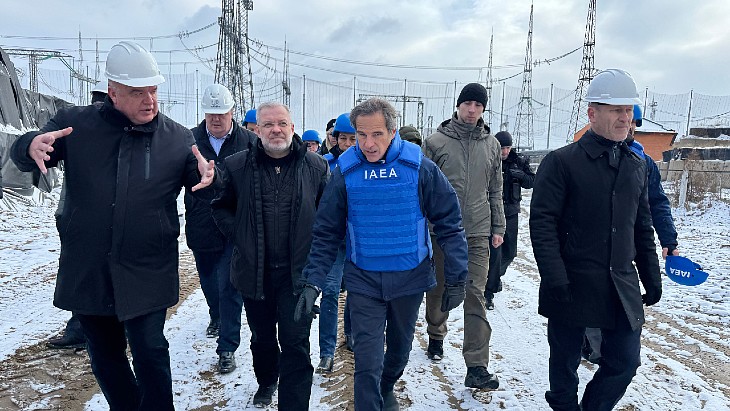
Ensuring there are external power supplies for nuclear plants is a key safety issue, International Atomic Energy Agency Director General Rafael Mariano Grossi said as he visited a substation in Ukraine.
Grossi visits Ukrainian substation, stresses its nuclear safety role
(Image: IAEA)

Grossi, on his 11th visit to the country since the war with Russia began, toured the Kyivska electricity substation.

Speaking to reporters alongside Ukraine's energy minister Herman Halushchenko and Energoatom's Petro Kotin, he said he wanted to assess the situation personally, saying the substation was very important to the functioning of the grid.

"Having external power supply is essential. A nuclear power plant produces power, electricity, but it also needs electricity in order to ensure its safety operation. When a power plant is not getting it - and it's through these kind of installations that it is getting it - it's like a blackout, so this compromises the safety of a power plant and it could eventually lead to an accident," he said.  

Grossi added that it was clear that the "infrastructure has been degraded" but he had been "impressed with the work, the effort, being put in to ensure nuclear safety".

The IAEA has a team of experts stationed at the Zaporizhzhia nuclear power plant, which has been under Russian military control since early March 2022, and at Ukraine's three other operating nuclear power plants. He said they have also extended their inspections to nine substations that "are critical for the safe functioning of the nuclear power plants ... a nuclear accident can come with a direct attack on a nuclear power plant, but it can also be the result of disruption in the power grid".

Grossi is expected to have talks in Ukraine and in Russia during February as the IAEA continues its efforts to ensure the safety of nuclear power plants. The main focus remains on the six-unit Zaporizhzhia nuclear power plant, which is located by the frontline between Ukrainian and Russian troops.

The IAEA has set out basic rules to help ensure nuclear safety - namely that nuclear power plants should not be fired at, or fired from, and should not be used as a military base.

Leningrad unit 3 gets approval to operate to 2030


Tuesday, 4 February 2025

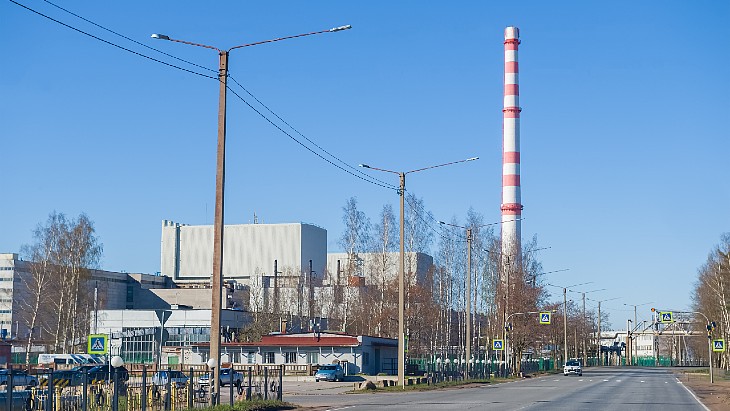
Russia's nuclear regulator Rostakhnadzor has issued a licence for Leningrad nuclear power plant's third unit to operate for a further five years, to 2030.
Leningrad unit 3 gets approval to operate to 2030
(Image: sikaraha/stock.adobe.com)

The RBMK-1000 unit, which entered commercial service in 1980, has generated more than 290 billion kWh of electricity, and had already had its original 30-year operating life extended by 15 years.

Rosenergoatom said that the licence was issued after a comprehensive analysis of the condition of equipment and documentation to ensure the unit's compliance with modern safety and reliability requirements, as well as the implementation of measures to modernise equipment where necessary.

It said that the assessment concluded that it would be safe to extend operation to 50 years.

Director of the Leningrad NPP Vladimir Pereguda, said: "Work to extend the lifetime of existing power units of Russian nuclear power plants has been carried out since 1998. Our units are no exception. An additional period of operation is not only about generating electricity. These are jobs, and the continuation of the production of unique isotope products, and systematic work on the construction and commissioning of two more new VVER-1200 units."

The operator is also in the process of seeking a licence for the operation of Leningrad unit 4 to 2030. Elsewhere in Russia, work is taking place to extend the lifetimes of Kursk 3 and 4, Smolensk 1, 2 and 3 and Kalinin unit 1.

The Leningrad plant is one of the largest in Russia, with an installed capacity of 4400 MWe, and provides more than 55% of the electricity demand of St Petersburg and the Leningrad region, or 30% of all the electricity in northwest Russia.

Leningrad units 1 and 2 - both 1000 MWe RBMK units - shut down in 2018 and 2020, respectively. As the first two of the plant's four RBMK-1000 units shut down, new VVER-1200 units started at the neighbouring Leningrad II plant. The 60-year service life of these fifth and sixth units (also known as Leningrad II-1 and Leningrad II-2) secures power supply until the 2080s. Units 7 and 8 - scheduled to be commissioned in 2030 and 2032 respectively - will replace units 3 and 4 as they are shut.


ONTARIO


Third Bruce unit begins refurbishment


Tuesday, 4 February 2025

The start of the Major Component Replacement outage at Bruce 4 marks the middle of the project to renew six units as part of Bruce Power's plan to extend the operating life of the Ontario plant.

Third Bruce unit begins refurbishment
Image: Bruce Power

Major Component Replacement - or MCR - involves removing and replacing key reactor components including steam generators, pressure tubes, calandria tubes and feeder tubes and adding 30-35 years to the reactor's operating life. The process has already been completed at Bruce 6, which returned to commercial service in September. Unit 3 is currently undergoing MCR. Units 5, 7 and 8 are also be refurbished, with units in overlapping MCR outages until 2033.

The CAD13 billion (USD9 billion) refurbishment project is Canada’s third largest infrastructure project, Ontario’s largest clean-energy infrastructure project and is being funded through private investment.

Unit 4's refurbishment outage will last three years, and successive refurbishments will build on the experiences and lessons learned from previous ones, such as the innovative use of robotic tooling used for the first time in the Bruce 3 MCR.

“Our Life-Extension Program and Major Component Replacement is more than a construction project,” Bruce Power President and CEO Eric Chassard said. “By completing each of the MCR outages safely, on plan, and to a high-quality standard, we are securing the future of the Bruce site, sustaining our communities, and powering Ontario through a time when electricity demand is growing rapidly.”

The MCR and Life-Extension projects will also increase the output of the entire Bruce plant from 6,550 MWe today to more than 7,000 MWe in the 2030s, with the programme and ongoing site operations creating and sustaining 22,000 direct and indirect jobs per year and contributing some CAD4 billion in annual economic benefits for communities in Ontario, according to Bruce Power.

- World Nuclear News

$150 Billion Upstream Opportunities Remain Despite Shale M&A Slowdown

By Rystad Energy - Feb 03, 2025

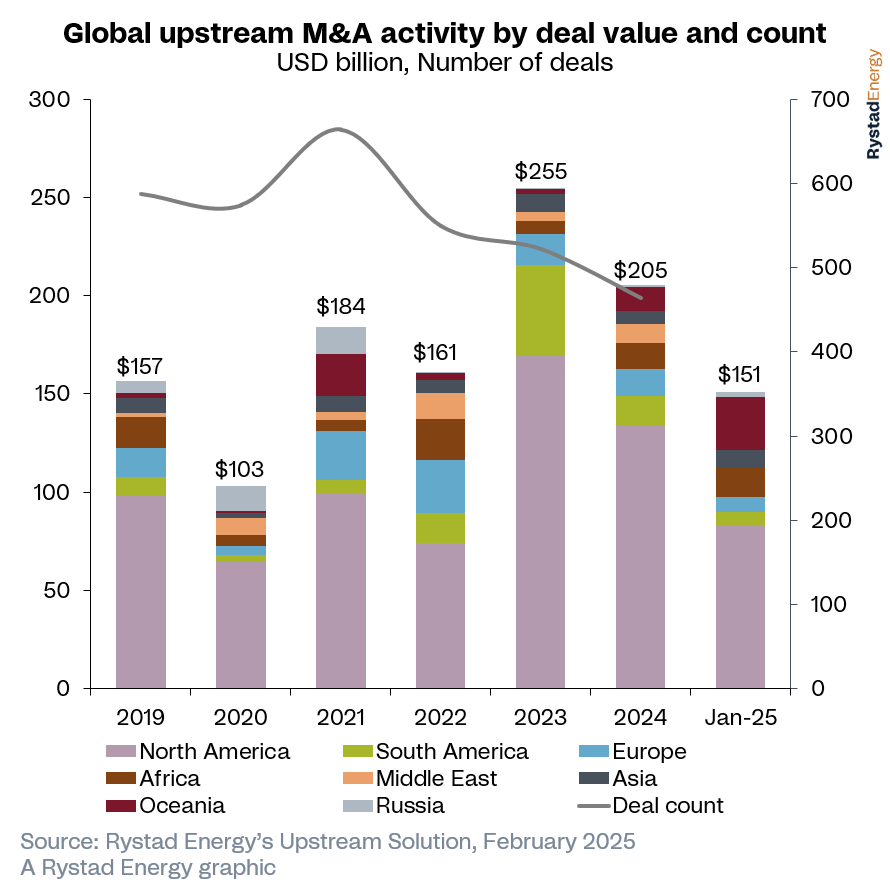
Global upstream M&A activity is expected to slow down in 2025 following a peak driven by US shale consolidation.

North America continues to lead M&A activity, while the Middle East emerges as a significant hub due to LNG expansion.

Geopolitical tension, fiscal policy uncertainty, and the ongoing conflict in Ukraine pose challenges for the M&A market.


Upstream merger and acquisition (M&A) activity is expected to slow significantly in 2025 following two years of record-high transactions driven by US shale mergers. The global deal pipeline value stands at approximately $150 billion as much of the sector’s consolidation has run its course, making a return to recent peaks unlikely. Furthermore, geopolitical tension in the Middle East, the ongoing conflict in Ukraine and the UK’s challenging fiscal environment are expected to create notable headwinds for market participants.

North America will continue to lead global M&A activity, driven by nearly $80 billion in upstream opportunities on the market. Elsewhere in the Americas, South American deal value rose from $3.6 billion in 2023 to $14.1 billion in 2024 (excluding Chevron’s acquisition of Hess), largely due to regional exploration and production (E&P) growth ambitions — and despite Petrobras halting its divestment program.

Last year marked a significant year of consolidation in the US shale sector, with approximately 17 consolidation-focused deals, compared to just three acquisitions in late 2023. Activity was always expected to fall after such dramatic highs, but there is still plenty of business to be done. North America is still a leader in M&A activity and will continue to play a key role in maintaining the market's health. There is also potential for further upside if US shale gas M&A activity increases, assuming Henry Hub prices remain stable and conducive to dealmaking.

Atul Raina, Vice President, Oil & Gas Research, Rystad Energy


Learn more with Rystad Energy’s Upstream Solution.

Looking beyond traditional hubs, the Middle East is rapidly emerging as a significant center for M&A activity. Bolstered by liquefied natural gas (LNG) expansion plans, the region recorded its second-highest year of M&A activity since 2019, with deal value reaching nearly $9.65 billion in 2024, following a five-year peak of $13.3 billion in 2022. The surge in activity can be attributed to Middle Eastern national oil companies with major projects under way, such as QatarEnergy’s North Field expansion and ADNOC’s Ruwais LNG.

The North Field expansion aims to elevate QatarEnergy’s LNG production to 142 million tonnes per annum (Mtpa) by the early 2030s. ADNOC is reportedly considering awarding an additional 5% stake in Ruwais LNG to an international partner. However, ongoing geopolitical tension in other parts of the region may dampen or delay dealmaking.

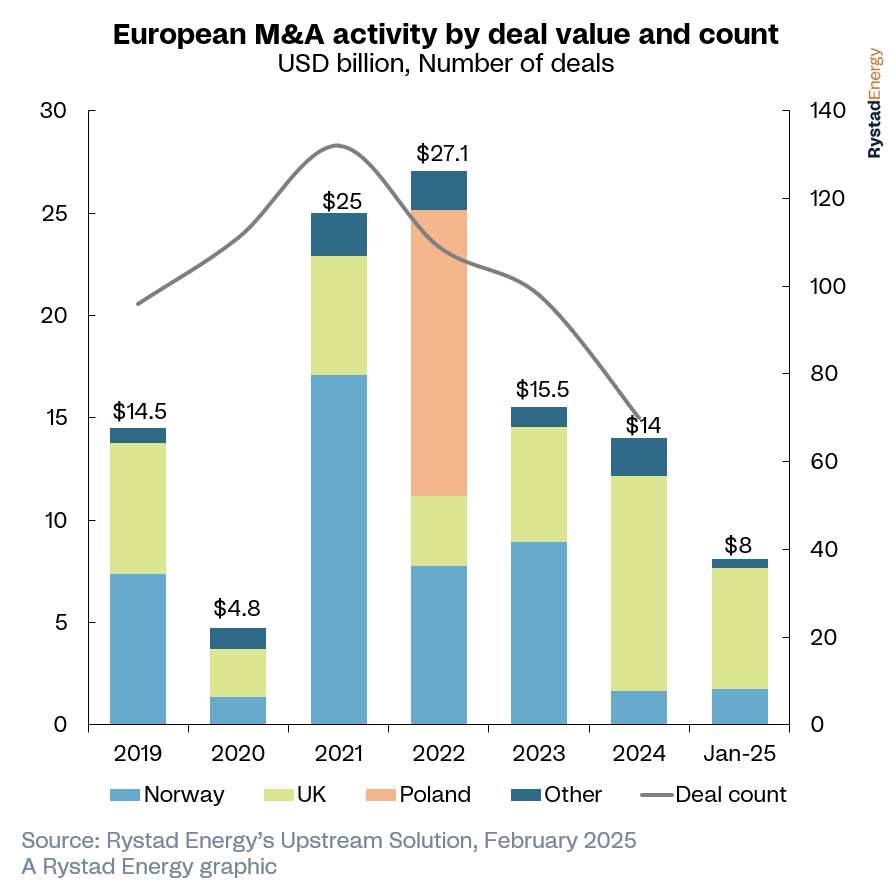
M&A deal value in Europe decreased by around 10% year-on-year, to $14 billion in 2024. Around 75% of the regional total centered on the UK, where majors have been adopting an autonomous model strategy to expand their presence in the North Sea. The largest deal this year involved Shell and Equinor merging their UK North Sea upstream portfolios, excluding some of Equinor's cross-border assets. The combined entity will become the largest producer in the UK North Sea, with a projected output of around 140,000 barrels of oil equivalent per day (boepd) by 2025.

Despite $8 billion worth of upstream opportunities in the region, the outlook for future M&A activity in Europe remains uncertain due to fiscal policy in the UK, which accounts for 73% of the potential deals, valued at about $5.9 billion. Tightened government fiscal terms for offshore oil and gas threaten to dampen buyer interest. However, combining portfolios that balance deferred tax positions and future expenditure could be an emerging trend in the country’s M&A landscape, given the current fiscal challenges.


By Rystad Energy


Are Georgia and Kyrgyzstan Helping Russia Evade Car Sanctions?

  • Georgia's car exports to Kyrgyzstan surged in 2024, raising suspicions that the vehicles are being re-exported to Russia in violation of international sanctions.

  • Discrepancies between Georgian and Kyrgyz trade data suggest that many cars are not reaching their stated destination.

  • Despite pressure from the US and new regulations in Kyrgyzstan, the illicit car trade appears to be continuing unabated.

In 2023, Georgia’s government banned the re-export of automobiles to Russia, a move intended to align with international sanctions against Moscow. But recent trade data is buttressing suspicions that Georgia is still serving as a key waypoint in a network used by Russia to import goods, especially automobiles. 

According to figures released by the National Statistics Office of Georgia, for the second year in a row, cars were the most exported item from Georgia in 2024, totaling more than $2.4 billion and accounting for 37 percent of the country’s overall volume of exports. Curiously, the top destination for all exports was not a neighboring country, but Kyrgyzstan, a Central Asian nation state situated more than a thousand miles away. Exports from Georgia to Kyrgyzstan totaled $1.3 billion last year, marking a remarkable 85 percent increase over the previous year’s total.

The Georgian-Kyrgyzstan connection has long faced scrutiny for being a major supply channel relied on by Russia to overcome Western sanctions.

Since Western nations started sanctioning Russia after its invasion of Ukraine, the Kremlin has used Kyrgyzstan as a backdoor to obtain sanctioned goods, especially dual-use components that help keep the Russian war effort going. Autos are also a big import item: the number of cars entering Kyrgyzstanexploded to more than 180,000 in 2023, up from around 40,000 in 2022, the year the Russia-Ukraine war began.

Georgia has long been known as a regional purveyor of used cars. But the latest data represents a change in the dynamic of Georgian exports. In 2023, Azerbaijan was the country’s top trading partner, and automobiles comprised the bulk of exports from Georgia, according to local media, with Azerbaijan importing more than $430 million in automobiles. That figure decreased last year, although Azerbaijan – a country that has also been accused of re-exporting sanctioned goods, including automobiles, to Russia – was still Georgia’s third-largest trading partner in 2024.

Observers note that discrepancies in official data figures indicate that many cars ostensibly sold by Georgian sellers to Kyrgyz buyers aren’t making it to their supposed destination. Instead, they may be diverted to Russia.

“According to Georgian statistics, in [the first] 10 months of [2024] … cars worth $964 million were sold as re-exports from Georgia to Kyrgyzstan. According to the statistics of Kyrgyzstan, cars worth about $50 million entered from Georgia. Where did goods worth more than $900 million disappear?” asked Georgian opposition politician Roman Gotsiridze last November, adding that he believes the cars are ending up in Russia.

Authorities in both countries claim they are striving to contain illicit trade. While Georgian officials seem to be turning a blind eye to the passage of sanctioned dual-use goods through the country, their counterparts in Kyrgyzstan have nominally taken measures of late to corral sanctions-busting practices.

Last fall, under pressure from the United States, Kyrgyz officials started requiring traders to confirm that goods they are paying for will arrive in Kyrgyzstan within 60 days. The government also established a new state regulatory entity to monitor trade.

The impact of such measures is not reflected in the 2024 trade data, and whether the new rules and procedures are being effectively implemented remains uncertain. 

By Brawley Benson va Eurasianet.org 


Tariffs on Oil Are a Major Problem for U.S. Refiners

  • US tariffs on Canadian and Mexican imports will add to the financial burden of US refiners struggling with declining profit margins.

  • Canada may divert oil exports to Asia due to the tariffs, while Mexico could retaliate with limitations on oil supplies to the US.

  • Industry leaders warn that the tariffs could ultimately benefit Asian refiners while harming US consumers with higher fuel prices.

Tariffs on imports from Canada and Mexico will further weaken the position of U.S. refiners who are already facing headwinds due to declining refining margins, Energy Aspects director of research Amrita Sen told Bloomberg on Monday.

On Saturday, the U.S. Administration announced that additional tariffs would be implemented on Canada, Mexico, and China this week. Canada and Mexico face 25% tariffs, with Canadian energy slapped with a lower, 10%, tariff.

The 10% tariff on Canadian oil imports doesn’t break U.S. refining, but it will add to the costs of refiners in the Midwest and the West Coast, although a weakened Canadian dollar would absorb some of that tariff, Sen told Bloomberg.

Canada could send more of its oil to Asia from its Pacific Coast after the expansion of the Trans Mountain pipeline, while the U.S. has to pay up for alternatives, Sen said.

The bigger problem for U.S. refiners would be the 25% tariff on imports from Mexico. Refiners in the U.S. Gulf Coast face much higher costs for 400,000 bpd of Mexican crude and another 200,000 bpd of fuel oil imports.

Essentially, the tariffs “are a boon to Asian refiners,” Sen told Bloomberg.

“It’s a win for a lot of the rest of the world, just a massive loss for US refining,” she added.

It will be an unintended consequence “but that is absolutely how it’s going to play out,” Sen said.

Commenting on the tariff announcement, American Fuel & Petrochemical Manufacturers (AFPM) President and CEO Chet Thompson said, “We are hopeful a resolution can be quickly reached with our North American neighbors so that crude oil, refined products and petrochemicals are removed from the tariff schedule before consumers feel the impact.”

“American refiners depend on crude oil from Canada and Mexico to produce the affordable, reliable fuels consumers count on every day,” Thompson added.

American Petroleum Institute President and CEO Mike Sommers commented that API would continue to work with the Trump administration “on full exclusions that protect energy affordability for consumers, expand the nation’s energy advantage and support American jobs.”

By Charles Kennedy for Oilprice.com


Shell Resumes Production From UK North Sea Oilfield After Redevelopment

Shell has restored oil and gas production from the Penguins field in the UK North Sea with a new floating, production, storage and offloading (FPSO) facility, the UK-based supermajor said on Tuesday, days after a court ruled that government approvals for two planned UK fields were unlawful.

The new Shell-operated FPSO facility will be the new export route for the Penguins field’s oil and gas production, replacing the previous export route via the Brent Charlie platform, which ceased production in 2021, and is being decommissioned.

As a result, the Penguins field, 150 miles northeast of the Shetland Islands, was redeveloped by drilling additional wells, which are tied back to the new FPSO.

Discovered in 1974, the field previously produced oil and gas between 2003 and 2021.

Shell estimates peak production from Penguins at around 45,000 barrels of oil equivalent per day (boed). Currently, the field has an estimated discovered recoverable resource volume of approximately 100 million boe.

Although primarily oil production, Penguins will also produce enough gas to heat around 700,000 UK homes per year, Shell said in a statement.

The new FPSO will have 30% lower operational emissions compared with Brent Charlie and is expected to extend the life of this field by up to 20 years.

Natural gas will be transported through the existing pipeline to the St Fergus gas terminal in the northeast of Scotland, which supplies the UK’s national gas network.

“Today, the UK relies on imports to meet much of its demand for oil and gas,” said Zoë Yujnovich, Shell’s Integrated Gas and Upstream Director.

“The Penguins field is a source of the secure domestic energy production people need today.”

The restart of Penguins comes days after the Scottish Court of Session ruled that the government approval for Shell’s Jackdaw and Equinor’s Rosebank fields in the UK North Sea was unlawful, dampening industry hopes that new domestic oil and gas production could begin soon and help reduce the UK’s reliance on imported oil and gas.

At the end of last year, Equinor and Shell announced they would merge their UK oil and gas assets in a 50/50 joint venture which will be the largest independent oil and gas producer in the UK North Sea.

By Tsvetana Paraskova for Oilprice.com

Back in Iraq: BP Puts $25B On the Table

By Julianne Geiger - Feb 04, 2025


BP is about to make a big bet on Iraq—again. After years of false starts, geopolitical chaos, and stalled negotiations, the British oil major is reportedly gearing up to invest up to $25 billion in Iraq’s Kirkuk oil and gas fields. That’s according to a senior Iraqi official who spoke to Reuters in an exclusive.

That’s a hefty price tag for a region that’s seen more than its fair share of conflict and instability—but with crude prices hovering near the $75 mark and Iraq eager to reclaim its position as a top global oil supplier, the timing might just be right.

The Road to Kirkuk


BP’s history in Kirkuk runs deep. The company was part of the original consortium that discovered oil there almost a century ago, but its more recent attempts to develop the fields have been anything but smooth. A 2013 agreement with Baghdad was scrapped after ISIS tore through northern Iraq in 2014. Then, in 2017, the Iraqi government wrested control of the region from Kurdish forces after a failed independence referendum, adding to the existing political drama. By 2019, an exasperated BP had walked away entirely after failing to reach an expansion deal.

Now, BP is back—this time with a profit-sharing agreement that could stretch over 25 years. If it sticks, this deal would be one of the largest foreign investments in Iraq’s oil sector since the TotalEnergies $27 billion megadeal in Basra last year.

What’s in It for BP?


For BP, the allure is simple: Iraq holds the world’s fifth-largest oil reserves, and Kirkuk alone is sitting on about 9 billion barrels of recoverable crude. Under the deal, BP is expected to boost production from 300,000 barrels per day (bpd) to 450,000 bpd within two to three years.

Unlike Iraq’s usual technical service contracts—which pay oil companies a flat fee for their work—this profit-sharing model allows BP to recover costs first and then start making real money once production rises above current levels. That’s a major departure from past agreements that had left foreign oil companies grumbling about thin margins.

What's In It For Iraq?

Iraq may have massive oil reserves, but it also has serious infrastructure problems. Years of war, corruption, and government mismanagement have crippled production capacity, and investors have been skittish about diving back in. Iraq is OPEC’s second-largest producer, but its oil industry is operating well below its potential.

Baghdad desperately needs foreign investment to modernize its aging fields and improve natural gas capture, especially since much of the country’s associated gas is flared rather than utilized. This BP deal isn’t just about pumping more crude—it’s also supposed to help expand Iraq’s domestic energy production to meet rising electricity demand.

The Risks and Realities

Of course, this is Iraq--and even with relatively stable oil prices, political instability remains a major concern. The country’s oil sector is still fraught with overbearing bureaucracy, security risks, and shifting alliances between Baghdad and the semi-autonomous Kurdish Regional Government (KRG).

And with President Trump ramping up pressure on Iran and its regional allies, Iraq could easily get caught in the crossfire. BP, already operating in Iraq’s southern Rumaila oilfield, will have to navigate all of this while trying to turn a profit in Kirkuk.

Worth the Gamble?

At $25 billion over 25 years, BP is making a massive bet that Iraq can stabilize its oil sector and provide the kind of investment-friendly climate that has eluded the country for decades. If the project succeeds, BP could have a major foothold in one of the world’s most oil-rich regions.

But if Iraq’s history of instability repeats itself, BP might find itself right back where it was in 2019—packing up its marbles and going home.

By Julianne Geiger for Oilprice.com

Snubbed in Syria, Russia Now Makes a Move on Syrian Oil

  • Following the ousting of Bashar al-Assad, Syria's new government is inviting investment in its oil and gas sector.

  • The U.S. and its allies are maneuvering to counter Moscow’s longstanding influence in Syria.

  • With proven oil and gas reserves and crucial Mediterranean access, Syria remains a valuable energy hub.

Following the sudden removal of longtime Syrian President Bashar al-Assad from office on 8 December, the new caretaker government has issued public tenders for the development of the country’s oil and oil products sector. At the same time, its caretaker Oil Minister Ghiath Diab said that Syria wants to resume major exploration and production activities for both its oil and gas operations. Given the vital geopolitical importance of the country that lies in the heart of the Middle East and has a long Mediterranean coastline, competition between the major global powers to establish a strong foothold in the state’s new political order is already hotting up.

First to pay an official high-level visit to Syria was Russia, with Deputy Foreign Minister Mikhail Bogdanov arriving in Damascus on 28 January. He met with the new President of Syria, Ahmed al-Sharaa, together with his Foreign Minister Asaad al-Shaibani and Minister of Health Maher al-Sharaa. Saudi Arabian by birth, Al-Sharaa is also the emir of the radical Islamist group Hayat Tahrir al-Sham (HTS) which spearheaded the final lightning-fast removal of al-Assad. He fought for al-Qaeda in Iraq for three years from 2003 and then founded the radical Islamist al-Nusra front in 2012, after being imprisoned by the U.S. from 2006 to 2011. He is still listed by the U.S. State Department as a ‘Specially Designated Global Terrorist’ and had a US$10 million reward for information leading to his capture offered by Washington. Following a meeting in December 2024 between al-Sharaa and a U.S. delegation led by Assistant Secretary of State for Near Eastern Affairs, Barbara Leaf, the bounty was withdrawn.  According to a press release from the Russian Foreign Ministry, the recent meeting between Bogdanov and al-Sharaa focused on Moscow’s ‘unwavering support for the unity, territorial integrity, and sovereignty of the Syrian Arab Republic’. It added that both parties ‘agreed to maintain bilateral engagement with a view to formalising pertinent arrangements, reflecting a mutual resolve to deepen comprehensive ties and understanding between Moscow and Damascus, including in foreign policy spheres’.

It is little wonder that Moscow is so keen to get on the right side of al-Sharaa given that Syria is vital to its key strategic interest for three key reasons, as analysed in full in my latest book on the new global oil market order. First, it is the biggest country on the western side of the Shia Crescent of Power that Russia had been studiously developing for years as a counterpoint to the U.S.’s own sphere of influence centred then on Saudi Arabia (for hydrocarbons supplies) and Israel (for military and intelligence assets). Second, it offers a long Mediterranean coastline from which Russia could send oil and gas products – or anything else – from itself or from its allies (notably Iran) for export either into major oil and gas hubs in Turkey, Greece and Italy or into north, west and east Africa. And third, it is a vital military and intelligence hub for the Kremlin, with one major naval base (Tartus – and Russia’s only Mediterranean port), one major air force base (Khmeimim) and one major listening station (just outside Latakia).

Russia had also intended to make its Syrian client state an essentially self-financing operation, once it had fully resuscitated the country’s once-sizeable oil and gas industries. At the time civil war broke out in Syria in 2011, the country had been producing around 400,000 barrels per day (bpd) of crude oil from proved reserves of 2.5 billion barrels. Before recovery began to drop off due to a lack of enhanced oil recovery techniques being employed at the major fields – mostly located in the east near the border with Iraq or in the centre of the country, east of the city of Homs – it had been producing nearly 600,000 bpd. For the period when the largest producing fields – including those in the Deir-ez-Zour region, such as the biggest field, Omar – were under the control of ISIS, crude oil and condensates production fell to about 25,000 bpd before recovering again. Europe imported at least US$3 billion worth of oil per year from Syria up to the beginning of 2011, and many European refineries were configured to process the heavy, sour ‘Souedie’ crude oil that makes up much of Syria’s output, with the remainder being the sweet and lighter ‘Syrian Light’ grade. Most of this – some 150,000-bpd combined – went to Germany, Italy, and France, from one of Syria’s three Mediterranean export terminals: Banias, Tartus, and Latakia. Syria’s gas sector was at least as vibrant as its oil one, and less of that was damaged in the first few years of the conflict. With proven reserves of 8.5 trillion cubic feet (tcf) of natural gas, the full year 2010 – the last under normal operating conditions – saw Syria produce just over 316 billion cubic feet per day (bcf/d) of dry natural gas. The build out of the South-Central Gas Area by Russia’s Stroytransgaz – had started up by the end of 2009 and had boosted Syria’s natural gas production by about 40% by the beginning of 2011. This allowed Syria’s combined oil and gas exports to generate a quarter of government revenues at that point, and to make it the eastern Mediterranean’s leading oil and gas producer at the time.

In November 2017, a re-worked version of an original 2015 Russia-Syria Cooperation Plan was signed, encompassing not just the restoration of at least 40 energy facilities in Syria, including offshore oil fields, but a lot more as well, as also detailed fully in my latest book on the new global oil market order. For a start, focus would turn to expanding the power sector, based on from a plan signed between Syria’s then-Electricity Minister Mohammad Zuhair Kharboutli and Russia’s Minister of Energy Alexander Novak. The deal covered the full reconstruction and rehabilitation of the Aleppo thermal plant, the installation of the Deir Ezzor power plant and the expansion of capacity of the Mharda and Tishreen plants, with a view to re-energising Syria’s power grid and restoring the main control centre for the grid back to Damascus. This accorded with comments as early as the middle of December 2017 (by then-Russian Deputy Prime Minister Dmitry Rogozin, following talks in Syria with then-President Bashar al-Assad) that: “Russia will be the only country to take part in rebuilding Syrian energy facilities.” Over and above the four power plant projects that were to be optimised as a priority, the key infrastructure project was the complete repair and capacity-boosting upgrading of the Homs oil refinery (Syria’s other was then in Banias). The practical project work was led by Iran’s Mapna and Russian companies, with the initial target capacity being 140,000 bpd. Phase 2’s objective was 240,000 bpd and Phase 3’s was 360,000 bpd. The intention was that it could also be used to refine Iranian oil coming through Iraq if needed, before onward shipment into southern Europe. It is precisely this wide-ranging multi-layered energy, military, and political cooperation plan that Russia wants to re-establish with the new regime.

If for no other reason than to screw with Russia’s grand plan – a powerful enough idea in the zero-sum game of superpower politics – the U.S. and its allies have a different agenda for the country. As echoed in the December meeting between the U.S. delegation and al-Sharaa, several formerly impeccable senior security and energy sources in Washington, London, and Brussels exclusively told OilPrice.com just after al-Assad’s removal that the sudden – and otherwise inexplicable – success of the Syrian rebels led by HTS was in no small part connected to a massive surge in U.S. and U.K. support for them in the run-up to the coup. “The U.S. wanted to put Moscow’s and Tehran’s leadership on notice that Washington can easily redraw and restructure borders and regimes in not just the Middle East but also in Eastern Europe, if it wants to,” a senior security source in the European Union (E.U.) told OilPrice.com. “As he’s [al-Assad] gone now, I can’t see either Washington sitting back and allowing anyone to benefit from this other than the U.S., and if the reconstruction is done in a gradual and inclusive [with Syria’s principal former rebel groups], the outcome may be better than seen elsewhere in the region,” he concluded.

By Simon Watkins for Oilprice.com