Wednesday, February 05, 2025

What is Trump’s economic endgame? Here’s what an expert had to say
February 04, 2025

Ian lee from Carleton University says Trump’s vision is ‘audacious’ and ‘radical’, and his goal is to reform the world’s economic system.

In a move that has caught many allies off-guard, the Trump administration is pursing an “audacious” plan to reshape the international economic system that has governed global trade since the end of the Second World War, according to an expert.

In an interview with CTV’s Your Morning Tuesday, Ian Lee, an associate professor at Carleton University’s Sprott School of Business, said, “(This vision) is radical, in my judgment, it is nothing less than the reform of an entire international economic system … often just simply called multilateralism.”

Lee said according to a key document, published by Stephen Miran, the chief economist to Donald Trump in the White House, the U.S. president is seeking to use tariffs and market access as leverage to force other countries to open protected parts of their economies to U.S. corporations.

Lee said contrary to what Canada’s federal and provincial leaders have said about Trump’s lack of vision, Trump does have a plan that seeks to “rewrite the rules.”

“He can get away with it because they are the largest economy in the world,” Lee said. “Almost everybody wants access to the American market. So, the fact that everyone wants to access to sell into the American market is (America’s) card. That’s their lever.”

The document, titled “User’s Guide to the Reform of the International Economic System,” argues that the U.S. has been taken advantage of for decades by both friends and foes who demand full access to the massive American market while protecting parts of their own economies. Trump’s team believes it’s time to flip the script.

“This contradicts all the trade agreements. That is not what is said in the NAFTA agreement, or CUSMA or the WTO,” Lee said, referencing agreements that are built on mutual market access.

Beyond just demanding access to protected sectors, Trump’s team is also making more demands such as rescinding digital service taxes on U.S. tech giants and requiring countries to contribute more to international security, according to Lee.


“They argue that they’ve paid the overwhelming share of the trillion spent since 1945 on international security,” Lee said.

In a recent deal with the U.S., Mexico’s tariffs will be paused for a month in exchange for a fortified border, shared with the U.S., where 10,000 members of the national guard will be tasked with blocking drugs like fentanyl.

Canada’s deal with the U.S. followed in which Prime Minister Justin Trudeau, after a pair of calls with Trump, announced that both sides agreed to a delay in tariffs for 30 days as Canada plans to implement a $1.3 billion border plan that includes 10,000 personnel and other surveillance measures.

Canada also aims to launch a cross-border “Strike Force” to target organized crime, fentanyl and money laundering.

As Canada and other U.S. allies grapple with the new reality, the stakes continue to be raised.

For Canada, a close trading partner of the U.S., this poses challenges. Lee argues that Canada must deeply understand Trump’s blueprint to effectively negotiate and protect its interests, rather than being caught off guard.

“You have to do opposition research. We’re now learning, very belatedly, what the U.S. government is up to. We’ve got to do a better job,” Lee explained.


Dorcas Marfo

CTVNews.ca Journalist

What did U.S. get from deals to pause tariffs on Canada and Mexico? Not that much, observers say

By Josh Boak, María Verza And Rob Gillies, 
The Associated Press
February 04, 2025 

Mexican National Guards prepare to board an aircraft at the International Airport in Merida, Mexico, Tuesday, Feb. 4, 2025, to travel north to reinforce the country's border with the United States. (AP Photo/Martin Zetina)

WASHINGTON (AP) — President Donald Trump’s threatened tariffs against Canada and Mexico — now on hold for a month — risked blowing up North America’s economy. What did the United States get out of his deals to pause the import taxes against the two nations?

Not all that much, according to people outside the administration looking at the agreements.

The U.S. president has been openly pugnacious with America's two largest trade partners. His orders to impose a 25% tariff on all imports from Mexico and on most imports from Canada, with a lesser 10% tax on its energy products, created a sudden political and economic firestorm. Separately, 10% tariffs went into effect on China on Tuesday.

By agreeing to the pause for Mexico and Canada, Trump has been able to tell his supporters that he brokered a smart deal and to declare victory in addressing illegal immigration and drug trafficking. Canada will have a new “fentanyl czar,” and Mexico pledged to deploy 10,000 members of its National Guard. The White House sent out an email with 68 Republican lawmakers praising him after the pauses were announced.

But many of those outside the White House looking at the tariffs drama say little was accomplished, arguing that the measures taken by the two U.S. neighbors were already in place or likely could have been achieved without Trump's ultimatums. Even the financial markets seemed to shrug off the showdown with a modest sell-off on Monday.


What Canada and Mexico offered the United States

Weeks ago, Canada offered $1.3 billion Canadian dollars ($900 million) for border security with a package that included drones, helicopters, more border guards and the creation of a joint task force. On Monday, Canadian Prime Minister Justin Trudeau said after talks with Trump that they added the fentanyl czar and agreed to list Mexican drug cartels as terrorist organizations.

“Canada did not bend the knee,” Newfoundland and Labrador Premier Andrew Furey said. “There is such a small flow of fentanyl into the United States from Canada that it will be tough to show the president that there’s been gigantic reduction because there’s not a gigantic start to begin with compared to the southern border.”

The Trump team saw it as win that Mexican President Claudia Sheinbaum agreed to station 10,000 members of her country’s National Guard on its border with the United States. But those troops are essentially being shifted from other parts of the country, rather than newly deployed.

The Associated Press observed more than 100 members of the National Guard boarding a plane Tuesday morning in the southeastern city of Merida, bound for Ciudad Juarez. Additional units were scheduled to depart Cancun and Campeche, while still others were expected to move north by road.

They would join the more than 10,000 troops already stationed along Mexico’s northern border, whose presence has been unable to stifle persistent violence in a region closely held by organized crime to allow the smuggling of drugs, migrants and guns.

“It did not get the United States much at all from what it already had substantively,” said Josh Lipsky, a senior director at the Atlantic Council, a foreign policy think tank in Washington. Lipsky said Trump could have achieved the same results without the bad will generated by tariff threats.

Trump's pattern: Find a way to declare a win

Inu Manak, a fellow for trade policy at the Council on Foreign Relations, said Trump's tariff threats "were certainly not necessary,” but his objectives in making the threats are “purposefully vague so that he can declare victory regardless of the outcome.”

“A win is anything Trump wants it to be,” she said. “There isn’t any grand strategy or rational explanation for what he’s doing. It’s chaos for the sake of chaos.”

Trump often stirs up drama and then tries to take credit for actions that might not resolve the underlying problems. After the recent wildfires in Los Angeles, Trump made a big show of having water released on Friday from reservoirs in California, even though the water does not flow to Los Angeles County. He's also taken credit for corporate investments in artificial intelligence that predated his presidency.


But what also matters to Trump is showing that he can get others to act. His tariff threats this year echo what he's done before, with similar but less durable results for Mexico.

In 2019, then-President Andrés Manuel López Obrador reached a similar deal with Trump to head off another tariff threat. At that time, López Obrador pledged 15,000 members of the newly created National Guard to help stem the flow of migrants at the northern border and another 6,500 at Mexico’s southern border.

Trump posted on X after the 2019 deal that the tariffs “are hereby indefinitely suspended.” But this time, Mexico bought itself only 30 more days until the taxes could begin.

Trump's defense that his approach works

The White House did not respond to questions about which parts of its agreement with Canada and Mexico were new and what could be produced from the upcoming talks.

Peter Navarro, Trump's White House trade adviser, said Tuesday at a Politico event that the tariffs threat meant that fewer U.S. citizens would die from fentanyl addiction. He suggested additional concessions could come from talks over the next month and that Trump's seemingly mercurial approach to Canada and Mexico had succeeded.

“When he does stuff and it looks like things are a little chaotic, it’s not,” Navarro said. “It’s genius and he delivers.”

Navarro said that what Canada and Mexico had offered was not “minor” because “it's a 30-day thing” and more concessions could result.

Building or burning bridges with trade partners?

The risk for Canada and Mexico is that Trump could easily end his tariff suspensions and again threaten to charge the import taxes. While White House officials have said the taxes were about stopping illegal drugs, Trump himself has said the talks also need to address America's trade imbalance with its neighbors.

All of that means other countries might be less likely to trust Trump going forward.

“Would you threaten to burn down the house of your friendly neighbor to get some salt or sugar from them?” said Daniel Beland, a political science professor at McGill University in Montreal. “President Trump’s approach to bargaining is destructive, and it erodes trust. Most Canadians are unlikely to forget what just happened, even if his tariffs are never imposed upon Canada.”

___

Verza reported from Mexico City, and Gillies reported from Toronto. Associated Press Writer Amy Taxin in Santa Ana, California, contributed to this report.

Josh Boak, María Verza And Rob Gillies, The Associated Press
Canada Oil Tariffs Seen Adding 8% to US Northeast Heating Bills

By Simone Foxman, 
Bloomberg News
February 03, 2025

(Bloomberg) -- Supply Lines is a daily newsletter that tracks global trade. Sign up here.

The cost to heat a home with oil this winter in the US Northeast would rise 8% if tariffs on Canadian energy products are enacted, an energy nonprofit estimates.

The levies would on average add $117 to heating bills for the duration of the winter season in New England, Pennsylvania, New York and New Jersey, states that account for three-quarters of heating oil use in the US, Mark Wolfe, executive director of National Energy Assistance Directors Association, said in an email. The organization advises states on a federal program that helps low-income families pay heating and cooling bills.

Trump on Saturday imposed a 10% tariff on US imports of Canadian energy products and a 25% duty on other goods from the country. Those levies are set to take effect at 12:01 a.m. Washington time on Tuesday. Economists and refineries have been warning consumers they quickly could bear the brunt of tariffs on Canadian energy products.

“In the absence of additional federal assistance to offset these higher prices, low-income families will be hit hardest by these increases and many will be forced to choose between paying for home heating and other essentials including food, clothing and medicine,” Wolfe said.

Wolfe estimated households who must buy an additional tank of oil this winter will likely spend $85 to do so. About 4.8 million households in the US used heating oil to heat their homes last year, according to the U.S. Energy Information Administration.

©2025 Bloomberg L.P.
Canada tech leaders launch group to influence political upheaval

IF IT'S 'NON-PARTISAN'; IT'S RIGHT WING

By Thomas Seal, 
Bloomberg News
February 04, 2025

A group with the backing of top Canadian tech entrepreneurs has launched an effort to promote policies ahead of a general election this year.

The “Build Canada” website appeared on Tuesday with a list of supporters featuring several members of the executive team at Shopify Inc., venture capitalist and entrepreneur Anthony Lacavera, as well as the co-founders of AI startup Cohere Inc. and fintech startup Wealthsimple Inc. Its core team includes former Shopify Vice President Daniel Debow and former government official Lucy Hargreaves, now head of corporate affairs at tech company Patch.

The site bemoans the “small thinking, bureaucratic inertia and special interests” holding Canada back. It says it’s non-partisan, and features articles by business figures with policy ideas such as talent-driven immigration reform - instead of “providing residency as a form of charity” - revamping programs to promote pro-Canadian cultural content, updating and integrating health records, and centralizing transportation regulation. It also promotes “selling more Canadian products and resources.”

Canada is due to hold a general election by October. The public focus by tech leaders on policy making echoes the role their American peers played in November’s U.S. election. That influence was epitomized by the efforts of Tesla Inc. Chief Executive Officer Elon Musk, who poured more than $250 million into political groups and helped President Donald Trump create the Department of Government Efficiency.

Much lower political donation limits prevent the same playbook from being employed in Canada. Build Canada, Shopify, Wealthsimple and Cohere didn’t immediately respond to requests for comment.

©2025 Bloomberg L.P.
Quebec premier says North American free-trade agreement should be reopened now

By The Canadian Press
February 04, 2025 


Quebec Premier Francois Legault makes a statement on U.S. President Donald Trump's tariffs at the legislature in Quebec City, Tuesday, Feb. 4, 2025.
 THE CANADIAN PRESS/Jacques Boissinot

Talks should begin as soon as possible on renegotiating the North American free-trade agreement, Quebec Premier François Legault said Tuesday in the legislature, as he and other leaders pondered how to respond to the major economic threat south of the border.

Legault made the comments in a special speech to the national assembly, one day after United States President Donald Trump paused for 30 days the implementation of 25 per cent tariffs on Canadian and Mexican goods and services.

“Obviously, we hope that these tariffs will never be put in place,” Legault said. “But when you listen to Mr. Trump, you can’t take the risk of betting on that.”

The premier said the uncertainty that is being created by the constant threats of U.S. tariffs is like injecting “poison” into the economy. If Trump is unhappy with the North American free-trade agreement, then the U.S., Canada and Mexico should begin talks immediately instead of waiting for a scheduled review in 2026, Legault said.

The Canada-United States-Mexico Agreement, signed in 2018 and entered into force in 2020, governs trade across the continent and replaces the original deal that went into effect in 1994.

Legault said that in light of Trump’s tariff plans — what the premier described as a “brutal economic attack” — the province must move to diversify its economy and make it less dependent on the U.S. “We have to bet on ourselves above all,” the premier said.

If the Trump administration ends up imposing 25 per cent tariffs across all Canadian goods and services, Quebec could see up to 100,000 jobs losses and businesses struggling to survive, particularly in forestry, aluminum processing and the agri-food industry, Legault said. Priority No. 1 will be supporting those affected businesses, he added.

Parti Québécois Leader Paul St-Pierre Plamondon said Legault’s plan lacked specifics and was full of “clichés.”

“What we want from the government in delicate and complex situations is not for it to amplify fear and anxiety, nor to stage media spectacles like we saw during the pandemic,” St-Pierre Plamondon said, sparking outrage among Legault’s party.

According to the PQ leader, the provincial government must offer “fiscal incentives for our entrepreneurs.”

“We believe that this government has excessively subsidized businesses in general over the past seven years. And the results have not been there, as evidenced by a historic $11-billion deficit,” he argued, adding that it was necessary to reduce “bureaucracy and red tape.”

Interim Liberal leader Marc Tanguay said Legault’s Coalition Avenir Québec government was unprepared to deal with Trump, and he called on the premier to be more active with diplomacy in the U.S. Legault must name a chief negotiator for the province, Tanguay said.

“Quebec diplomacy exists. We need to take action to prepare for what is likely to happen in 30 days and ensure that the pressure comes from within the United States,” Tanguay said, suggesting the province lobby U.S. leaders to pressure the Trump administration to drop its tariff threat. “We have asked for this, but we do not see any tangible and concrete activation of bilateral diplomatic relations.”

Québec solidaire’s Ruba Ghazal said Trump is a wild card and can’t be trusted. “We have before us a rogue emperor, a bully of the worst kind, an intimidator who does not care about laws, rules or treaties.”

“There will be some who say that the storm will pass, there will be some who say that Uncle Sam will come to his senses, that Donald Trump will end up understanding that it is in the interest of the American economy and the American people to cultivate good relations with its neighbours,” said Ghazal, whose party called for Tuesday’s debate in the legislature.

“We, Quebecers, are optimistic people, but we are also lucid,” Ghazal said.


This report by The Canadian Press was first published Feb. 4, 2025.

— By Sidhartha Banerjee in Montre

Canadian Purolator buys customs broker Livingston amid heightened trade uncertainty
February 04, 2025


A Purolator plane sits on the tarmac at the John C. Munro Hamilton International Airport in Hamilton, Ont., Friday, Feb. 23, 2024. THE CANADIAN PRESS/Nick Iwanyshyn

Purolator Inc. has acquired Livingston International, one of Canada’s largest customs brokers, in a bid to boost its trade expertise in the Trump era.

The purchase, which closed Tuesday for an undisclosed amount, will allow one of the country’s biggest couriers help clients steer through shifting international rules and supply chains, said Purolator chief executive John Ferguson.

In an interview he acknowledged the instability brought on by U.S. President Donald Trump’s threat to impose sweeping tariffs of 25 per cent on Canadian imports, but said demand for customs brokers will only rise as a result.

“Obviously it’s a significant issue and it’s created a lot of uncertainty,” Ferguson said.

“With uncertainty and trade complexity, these services that we’re bringing on are actually highly beneficial to our customers, because they have a significant trade consulting practice,” he said of Livingston.

“That is really going to be able to help companies that are trying to navigate all the tariffs and global re-engineering of supply chains.”

Some 30 per cent of Purolator’s business stems from cross-border deliveries, he noted, making it vulnerable to the potential tariffs and retaliatory duties on $155 billion worth of American goods announced by Prime Minister Justin Trudeau over the weekend.

However, Ferguson said he believes trade between the two countries will rise in the coming decades, benefiting the Canada Post-owned company.

“I don’t see trade dampening in the long term, and we really are a long-term strategic investor.”

Livingston, based in Toronto, says it employs about 2,700 workers at more than 50 border crossings, seaports and airports across the continent as well as in Europe and Asia.

It was sold to Purolator by Platinum Equity, a Los Angeles-based private equity firm that bought the 80-year-old brokerage in 2019.

Livingston is Canada’s biggest customs broker and the fifth-largest entry filer in the U.S., Platinum said.

Ferguson said customs brokerages enjoy enviable client retention, describing them as “extremely sticky.”

“People look at their customs brokers like they do their doctors, (who) they really depend on.”

This report by The Canadian Press was first published Feb. 4, 2025.
STFU

Alberta's Smith says Canada should ‘stop making excuses,’ address Trump concerns to avoid tariffs


By Spencer Van Dyk
February 04, 2025 


Alberta Premier Danielle Smith talks about extending the 30-day freeze on U.S. tariffs by addressing fentanyl and other issues that are irritating the U.S.

The premier of Alberta says if Canada wants to avoid U.S.-imposed tariffs on Canadian imports in a month’s time, federal and provincial governments should “stop making excuses” and heed President Donald Trump’s border security demands.

“He wants us to recognize that Canada enjoys a very special relationship with the U.S. that no other country in the world enjoys, and just show the respect of taking seriously the fact that they’ve got people dying and they want it to stop,” Danielle Smith said, referencing the fentanyl overdose crisis, Trump’s stated reasoning for the tariff threat.

In an interview on CTV’s Power Play with Vassy Kapelos on Tuesday, Smith said the comparison many Canadian officials are making — that the amount of fentanyl seized at the Canada-U.S. border is a fraction of that seized at the Mexico-U.S. border — is “not a very persuasive argument.”

“We should stop making excuses,” Smith said. “Stop saying, ‘Yeah, but we’re not as bad as the other guys.’ We should just say, ‘Yes, we agree, and we’re going to take care of our part of the issue, so you don’t have to worry about us anymore.’”

When pressed by Kapelos on accepting Trump’s characterization of the border and drug issue rather than pushing back with the facts, Smith insisted her approach would lead to a better outcome.


“I think it’s just a serious issue for me in my province as it is for the Americans in their country, and that we’ve got to crack down on it, and this is our opportunity,” she said.

According to U.S. Customs and Border Protection, only 43 pounds of fentanyl has been seized at the Canada-U.S. border in the past year, compared to 21,148 pounds at its southern border with Mexico. CBP statistics suggest less than one per cent of fentanyl seized by authorities in the U.S. comes from Canada.

Trump signed an executive order on Saturday that would implement a 25 per cent across-the-board tariff on Canadian imports, and a 10 per cent tariff on Canadian energy, as of Tuesday.

Following two phone calls with Prime Minister Justin Trudeau on Monday — the pair’s first conversations since Trump’s inauguration on Jan. 20 — the president said he’d delay the tariffs pending progress on Canada’s border plan.

“Canada has agreed to ensure we have a secure northern border,” Trump announced on Truth Social, adding the tariffs he announced on Saturday “will be paused for a 30-day period to see whether or not a final economic deal with Canada can be structured.”

Amid Trump’s early assertion that border security is the main reason for the tariffs, Canada earmarked $1.3 billion in the fall economic statement to add resources.

The federal government then laid out its new border plan late in December, which includes helicopters, drones and surveillance towers, and pledges 24-7 surveillance between ports of entry, among other measures.

“Through Canada’s Border Plan, we’re deploying thousands more frontline personnel to the border, launching a precursor chemical detection unit, and building a new drug profiling centre to combat the fentanyl trade,” Trudeau wrote in a social media post on Tuesday. “This drug trade is a global, deadly issue — and Canada is tackling it head-on.”

Smith said “hopefully” the 30-day extension will give Canada time to make “enough progress that we can move on to some of the other issues.”
‘There are two tariffs’: Smith

Speaking to reporters in the Oval Office between the first and second calls with Trudeau on Monday, Trump restated his desire to see Canada become the “51st state,” adding that should that occur, “there would be some pain, but not a lot.”


He also repeated his assertions of an unfair trade deficit with Canada.

“I look at some of the deals made. I say, ‘Who the hell made these deals? They’re so bad.’”

The current Canada-United States-Mexico Agreement (CUSMA) free trade agreement was signed by Trump during his first term in office, and according to the Canadian government, data indicates when energy exports are excluded, the U.S. has a trade surplus with Canada.

When asked by Kapelos whether she believes extending the pause on tariffs is predicated on action at the border — despite Trump’s comments about CUSMA and wanting to annex Canada — Smith said there are “two conversations” happening between Canada and the U.S. administrations, and “two tariffs.”

“One conversation is the tariffs related to fentanyl, and the second conversation is all of the irritations that the administration has with the CUSMA agreement, and I don’t think we should intermingle those two,” Smith said.

She’s also calling for a federal election sooner rather than later.

Trudeau announced on Jan. 6 he would be stepping down as Liberal leader and prime minister. The race to replace him is now underway in earnest, with the new leader set to be announced on March 9.

The opposition parties, meanwhile, have committed to voting to bring down the government at the earliest possible opportunity, once Parliament comes back from prorogation at the end of March.

“I think we’ve got to address the fentanyl issue to avoid the 25 per cent tariffs, and then the second stage is having an election so we can have a government that can spend four years renegotiating the CUSMA,” Smith told Kapelos.

The Alberta premier pointed to issues such as the digital media tax, the banking industry, telecoms, and supply management as a few that are “irritating to the Americans.”

“Those keep coming up, but those are can only be resolved in the context of a broader renegotiation of the Canada-U.S.-Mexico free trade agreement, and that’s not scheduled to be done until 2026, so we need an election,” she said. “We can’t have one prime minister start those discussions, a second prime minister carry it a few yards, and then a final prime minister negotiates it.”

With files from CTV News’ Rachel Aiello

Spencer Van Dyk

Writer & Producer, Ottawa News Bureau, CTV News

CANADA

Investors, businesses should brace for uncertainty amid ‘forever changed’ trade landscape: experts

By Daniel Johnson
February 04, 2025 

Experts say investors and businesses should brace for continued volatility after U.S. tariffs on Canada were put on hold, with one analyst saying he expects tariffs to still come at some point.

U.S. President Donald Trump and Prime Minister Justin Trudeau were able to come to some kind of mutual understanding during a phone call Monday, resulting in tariffs being put on hold for 30 days. The pause came after Trudeau said Canada would expand its $1.3 billion border protection plan. Brooke Thackray, research analyst at Global X, said in an interview with BNN Bloomberg Tuesday the issue “isn’t done yet” and he thinks there will be more market volatility and uncertainty regarding tariffs going forward.

“I think the volatility will increase, and that’s going to shake a lot of investors out. You’re going to see a lot of fear being driven into the markets, in the equity market and also the fixed income market as well,” Thackray said.

The pause came after Trump signed an executive order on Saturday to impose a 25 per cent tariff on all goods from Canada that would have taken effect on Tuesday, with an exception for energy which would face a 10 per cent tariff.

Barry Schwartz, a partner and portfolio manager at Baskin Wealth Management, said in an interview with BNN Bloomberg Tuesday that investors should get used to volatility of this kind as “the next four years are going to be a roller coaster.”

“These are the conversations that we’re going to have with clients, and we’ll have to calm them down, and I know the right things to do. Own good companies and be patient,” he said.

Thackray highlighted the Chicago Board Options Exchange’s CBOE Volatility Index (VIX), a tool used by traders to measure volatility, which spiked Monday morning on tariff fears but later came back down.

“This really comes back to that you can’t really panic in the moment because you would’ve been battered around all over the place,” he said.
What’s next?

Thackray also said he doesn’t think tariff issues between Canada and the U.S. are over and predicts tariffs of some kind to take shape.

“I think this isn’t over…I think this is just a pause here and maybe we end up with tariffs that aren’t 25 per cent,” he said.

“Maybe they’re 15 per cent, maybe they’re 10 per cent, maybe they’re five per cent. I think there’s going to be tariffs down the road at some point. Trump has basically also said on the other side that he wants to use tariffs as a revenue generating tool.”

David Detomasi, professor of international business at Smith School of Business, said in an interview with BNNBloomberg.ca Tuesday that Trump knew that from an economic perspective, “these tariffs were a bad idea.”

“But I do think he believes that the threat of importing tariffs or the actual execution of putting on tariffs, is a viable tool to compel governments to do what he thinks they ought to in a variety of noneconomic areas,” he said.

Detomasi added that he doesn’t think the pause on tariff discussions will be the “end of the story.” He said Trump most recently used the threat of tariffs to get border changes that were likely to come anyway.

“But I do think he’ll pull out the tariffs again in a month or two months, or six months when he wants something else from us,” Detomasi said.

‘Forever changed’ trade landscape

As tariffs have been put on hold for 30 days, Charmaine Goddeeris, the director of BDO Canada’s customs and international trade practice, said in an interview with BNNBloomberg.ca Tuesday that she is advising clients not to take their “foot off the pedal in contingency planning.”

“I believe that the trade landscape has forever changed now, and companies need to realize that and put in solid plans to manage their business and mitigate their costs going forward,” she said.

According to Goddeeris, supply chains rely on predictable and efficient customs processes, which are disrupted by tariffs.

“It is imperative that businesses really get a handle on what their supply chain looks like right now, what the duty and tax impact is, and pressure test, let’s take a look at how much your bottom line can withstand, and then do some planning from there,” she said.

Detomasi said that his advice to Canadian businesses would be to become less reliant on the U.S.

“I think we need to think about how we can build internal strengths ourselves to try to break that assumption that the U.S. will always be there for us,” he said.


Daniel Johnson

Journalist, BNNBloomberg.

 World Nuclear News


Belgian government seeks to reverse nuclear phase-out policy


Tuesday, 4 February 2025

Belgium's new coalition government has announced plans to continue operating two of the country's reactors for an additional 10 years beyond the 10-year extension already agreed - and said it aims to construct new reactors.

Belgian government seeks to reverse nuclear phase-out policy
The Doel nuclear power plant (Image: Electrabel)

Following the 2024 Belgian federal and regional elections, government formation talks began on 10 June. After months of negotiations, on 31 January the parties forming the Arizona coalition (Les Engagés, MR, Vooruit, CD&V and N-VA) reached an agreement on forming a government and its policies. Bart De Wever was sworn in as prime minister on 3 February.

"In terms of energy, the agreement provides for the development of a long-term strategy ensuring an affordable, safe and carbon-neutral energy mix composed of renewables, nuclear energy and other forms of carbon-neutral energy, which guarantees security of supply, affordability for citizens and businesses, and sustainability," Les Engagés said. 

"It will also involve lifting the ban on the construction of new nuclear capacities in the very short term and taking all necessary measures to extend the life of units that meet safety standards. Specifically with regard to Doel 4 and Tihange 3, the agreement aims to extend their lifetime by at least 10 additional years in addition to the 10 years already agreed."

Belgium currently has five power reactors in operation: Doel units 1, 2 and 4 and Tihange units 1 and 3, with a combined generating capacity of about 4 GWe.

Under a plan announced by Belgium's coalition government in December 2021, Doel 3 was shut down in September 2022, while Tihange 2 shut down at the end of January 2023. The newer Doel 4 and Tihange 3 would be shut down by 2025. However, following the start of the Russia-Ukraine conflict in February 2022 the government and Electrabel began negotiating the feasibility and terms for the operation of the reactors for a further 10 years.

Belgium finalised plans in December 2023 to extend the lifetimes of Doel 4 and Tihange 3 by 10 years, providing capacity of 2 GWe from the reactors, which are 89.8% owned by Engie's Electrabel and 10.2% by EDF's subsidiary Luminus. The decision to extend their lifetimes was designed to boost the country's energy security while keeping carbon emissions as low as possible.

The European Commission opened an in-depth investigation in July last year into whether the support for the lifetime extension of the two reactors was in line with its rules on acceptable state aid.

Last week, Engie CEO Vincent Verbeke said it was "unthinkable" to keep the reactors in operation beyond the initial 10-year period.

In addition to maintaining the current 4 GWe of nuclear generating capacity, the government aims to construct a further 4 GWe of capacity, Energy Minister Mathieu Bihet was quoted as saying by financial daily Tijd.

"It's 4 gigawatts plus 4 gigawatts," Bihet said, without specifying locations and timing for the new reactors. He noted that building new small modular reactors (SMRs) alone could not provide sufficient capacity. "Which technology we will use, we still have to evaluate. But it is clear that it will not only be SMRs. Only small reactors will not suffice."

Industry stands ready to help
 

The agreement announced by the Arizona coalition partners was welcomed by the Belgian Nuclear Forum, saying it "puts the revival of nuclear power at the centre of its major concerns".

It added: "There is no time to lose on the energy issue. We must, without further delay and as a priority, adapt or even repeal the law on the nuclear phase-out, so that there is no longer any legal obstacle to the extension of existing reactors and the construction of new nuclear reactors."

The organisation said it was now "urgent" to set up a task force bringing together all stakeholders "who will enable this revival of nuclear power".

"It is important that we get to work immediately so that this relaunch of nuclear power in Belgium is carried out on time and within the budget planned to deal with the electricity shortage announced, in particular by [transmission system operator] Elia," it said. "We cannot afford to repeat the mistakes of the past by working in separate silos. We call on governments at different levels of power (federal, community, regional and communal) to work together, in close collaboration with the task force mentioned above."

The Forum said that if Engie maintains its stance against a further extension to the operation of the units "the government will have to switch to an alternative plan as soon as possible with the help of the task force. This means that it will be necessary to find another interested operator(s) to continue operating the existing nuclear reactors".

It added that Belgium must also develop a long-term vision that includes the development of new nuclear capacity. "This involves, in particular, a significant simplification of administrative procedures, at the level of granting licences and permits. It is also essential to ensure the necessary legal framework in order to reassure private investors, as well as potential new operators."

"All these elements are essential in the eyes of the nuclear sector to be able to build the new reactors within the announced deadlines and budgets. The nuclear sector is already putting itself at the service of the new government, to help it achieve our country's objectives in terms of energy transition and in terms of security of energy supply."

USA

Georgia Power plans additional nuclear capacity


Tuesday, 4 February 2025

Georgia Power has filed its 2025 Integrated Resource Plan, saying it has proposed power uprates at four units at its Hatch and Vogtle nuclear power plants and that additional nuclear power capacity will be needed over the long-term.

Georgia Power plans additional nuclear capacity
The four-unit Vogtle plant (Image: Georgia Power)

The 2025 Integrated Resource Plan (IRP) - filed on 31 January with the Georgia Public Service Commission (PSC) - details the company's plan to meet the energy needs of customers and support the state's expected continued extraordinary growth. In the plan, the company has proposed necessary investments in its generation fleet and transmission system to help ensure Georgia Power can continue to provide its customers with "the reliability and resiliency they deserve and expect, as well as demand-side and customer programmes".

Over the next six years, Georgia Power projects about 8200 MW of electrical load growth – an increase of more than 2200 MWe in peak demand by the end of 2030 when compared to projections in the 2023 IRP Update, which was approved by the Georgia PSC in April 2024.

The company said it has "identified opportunities to upgrade several of its existing nuclear units to provide additional capacity. This additional baseload energy can aid in meeting growing capacity needs without the need for incremental transmission system investment". 

Georgia Power - a subsidiary of Southern Company - is proposing extended power uprates (EPU) upgrades at units 1 and 2 of its Vogtle nuclear power plant and units 1 and 2 at its Hatch plant. Between 2028 and 2034, it plans to add a total of an additional 112 MWe of capacity at the four units: 27 MWe each at Vogtle 1 and 2; 30 MWe at Hatch 1 and 28 MWe at Hatch.

Extended power uprates involve significant modifications to major plant equipment to increase the thermal output of the reactor. "The EPU process includes an extensive analysis of plant systems and components to verify the capability and identify needed modifications to support the power upgrade at each facility," Georgia Power said.

For the Hatch units, the company is also planning to complete a necessary upgrade to boiler water reactors (BWRs) called the 'Maximum Extended Load Line Limit (MELLA+)' enhancement. This increases capacity by allowing for higher thermal power without increasing core flow to support EPU for BWRs. In addition to the upgrades described above, the company is considering an option for Vogtle units 1 and 2 that would transition the outage window to a 24-month cycle. This upgrade would extend unit runtimes and decrease the number of refueling outages across the fleet.

Georgia Power said it is working with the US Nuclear Regulatory Commission (NRC) as a part of the required review and licensing process. The NRC will review the licence amendment request that contains the detailed analysis to support the power upgrades and concur with approval to allow the upgrade of each facility.

Nuclear new build possible
 

"The company believes that additional nuclear power will be needed over the long-term to reliably and economically serve the energy needs of its customers," Georgia Power said. "Similarly, nuclear power provides a long-term pathway to reduce carbon emissions and mitigate the cost pressures that potential future environmental regulations could impose on the existing fossil-fired fleet and future new fossil resources."

The company said it develops "multiple views of future cost and performance of generating technologies, multiple views of future electricity consumption, and multiple views of the future price of fuels to support expansion planning for future years of need. Accordingly, B2025 scenarios select nuclear generation in six of nine scenarios over the 20-year planning horizon and as early as 2037."

However, it says: "Even with new nuclear generation's numerous benefits, undertaking the construction of new nuclear generation carries substantial risks for all stakeholders involved. Before proposing additional new nuclear generation, the company believes that solutions must be developed to adequately balance and mitigate risks to stakeholders."

It adds that "preserving viable new nuclear generation options for the benefit of customers is a priority" for the company. Accordingly, it continues to perform in-depth assessments of potential project sites, evaluate available and emerging technologies, and engage with stakeholders in developing improved methods to deploy new nuclear generation projects. "Over the long-term, with adequate additional risk mitigations and leveraging the experience gained with Vogtle units 3-4, the company believes customers would benefit from additional new nuclear in the future."

"At Georgia Power, our vision extends far beyond today - we plan for tomorrow, the next ten years and decades to come," said Kim Greene, chairman, president and CEO of Georgia Power. "As Georgia continues to grow, this state is well-positioned for the future thanks to proactive planning, policies, and processes like the Integrated Resource Plan. The 2025 IRP provides a comprehensive plan to support Georgia's continued economic growth and serve Georgians with clean, safe, reliable and affordable energy well into the future."

Grossi visits Ukrainian substation, stresses its nuclear safety role


Tuesday, 4 February 2025

Ensuring there are external power supplies for nuclear plants is a key safety issue, International Atomic Energy Agency Director General Rafael Mariano Grossi said as he visited a substation in Ukraine.

Grossi visits Ukrainian substation, stresses its nuclear safety role
(Image: IAEA)

Grossi, on his 11th visit to the country since the war with Russia began, toured the Kyivska electricity substation.

Speaking to reporters alongside Ukraine's energy minister Herman Halushchenko and Energoatom's Petro Kotin, he said he wanted to assess the situation personally, saying the substation was very important to the functioning of the grid.

"Having external power supply is essential. A nuclear power plant produces power, electricity, but it also needs electricity in order to ensure its safety operation. When a power plant is not getting it - and it's through these kind of installations that it is getting it - it's like a blackout, so this compromises the safety of a power plant and it could eventually lead to an accident," he said.  

Grossi added that it was clear that the "infrastructure has been degraded" but he had been "impressed with the work, the effort, being put in to ensure nuclear safety".

The IAEA has a team of experts stationed at the Zaporizhzhia nuclear power plant, which has been under Russian military control since early March 2022, and at Ukraine's three other operating nuclear power plants. He said they have also extended their inspections to nine substations that "are critical for the safe functioning of the nuclear power plants ... a nuclear accident can come with a direct attack on a nuclear power plant, but it can also be the result of disruption in the power grid".

Grossi is expected to have talks in Ukraine and in Russia during February as the IAEA continues its efforts to ensure the safety of nuclear power plants. The main focus remains on the six-unit Zaporizhzhia nuclear power plant, which is located by the frontline between Ukrainian and Russian troops.

The IAEA has set out basic rules to help ensure nuclear safety - namely that nuclear power plants should not be fired at, or fired from, and should not be used as a military base.

Leningrad unit 3 gets approval to operate to 2030


Tuesday, 4 February 2025

Russia's nuclear regulator Rostakhnadzor has issued a licence for Leningrad nuclear power plant's third unit to operate for a further five years, to 2030.

Leningrad unit 3 gets approval to operate to 2030
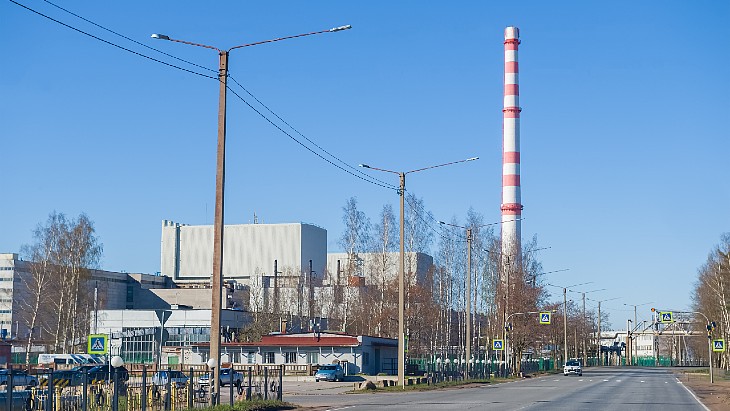
(Image: sikaraha/stock.adobe.com)

The RBMK-1000 unit, which entered commercial service in 1980, has generated more than 290 billion kWh of electricity, and had already had its original 30-year operating life extended by 15 years.

Rosenergoatom said that the licence was issued after a comprehensive analysis of the condition of equipment and documentation to ensure the unit's compliance with modern safety and reliability requirements, as well as the implementation of measures to modernise equipment where necessary.

It said that the assessment concluded that it would be safe to extend operation to 50 years.

Director of the Leningrad NPP Vladimir Pereguda, said: "Work to extend the lifetime of existing power units of Russian nuclear power plants has been carried out since 1998. Our units are no exception. An additional period of operation is not only about generating electricity. These are jobs, and the continuation of the production of unique isotope products, and systematic work on the construction and commissioning of two more new VVER-1200 units."

The operator is also in the process of seeking a licence for the operation of Leningrad unit 4 to 2030. Elsewhere in Russia, work is taking place to extend the lifetimes of Kursk 3 and 4, Smolensk 1, 2 and 3 and Kalinin unit 1.

The Leningrad plant is one of the largest in Russia, with an installed capacity of 4400 MWe, and provides more than 55% of the electricity demand of St Petersburg and the Leningrad region, or 30% of all the electricity in northwest Russia.

Leningrad units 1 and 2 - both 1000 MWe RBMK units - shut down in 2018 and 2020, respectively. As the first two of the plant's four RBMK-1000 units shut down, new VVER-1200 units started at the neighbouring Leningrad II plant. The 60-year service life of these fifth and sixth units (also known as Leningrad II-1 and Leningrad II-2) secures power supply until the 2080s. Units 7 and 8 - scheduled to be commissioned in 2030 and 2032 respectively - will replace units 3 and 4 as they are shut.


ONTARIO


Third Bruce unit begins refurbishment


Tuesday, 4 February 2025

The start of the Major Component Replacement outage at Bruce 4 marks the middle of the project to renew six units as part of Bruce Power's plan to extend the operating life of the Ontario plant.

Third Bruce unit begins refurbishment
Image: Bruce Power

Major Component Replacement - or MCR - involves removing and replacing key reactor components including steam generators, pressure tubes, calandria tubes and feeder tubes and adding 30-35 years to the reactor's operating life. The process has already been completed at Bruce 6, which returned to commercial service in September. Unit 3 is currently undergoing MCR. Units 5, 7 and 8 are also be refurbished, with units in overlapping MCR outages until 2033.

The CAD13 billion (USD9 billion) refurbishment project is Canada’s third largest infrastructure project, Ontario’s largest clean-energy infrastructure project and is being funded through private investment.

Unit 4's refurbishment outage will last three years, and successive refurbishments will build on the experiences and lessons learned from previous ones, such as the innovative use of robotic tooling used for the first time in the Bruce 3 MCR.

“Our Life-Extension Program and Major Component Replacement is more than a construction project,” Bruce Power President and CEO Eric Chassard said. “By completing each of the MCR outages safely, on plan, and to a high-quality standard, we are securing the future of the Bruce site, sustaining our communities, and powering Ontario through a time when electricity demand is growing rapidly.”

The MCR and Life-Extension projects will also increase the output of the entire Bruce plant from 6,550 MWe today to more than 7,000 MWe in the 2030s, with the programme and ongoing site operations creating and sustaining 22,000 direct and indirect jobs per year and contributing some CAD4 billion in annual economic benefits for communities in Ontario, according to Bruce Power.

- World Nuclear News

$150 Billion Upstream Opportunities Remain Despite Shale M&A Slowdown

By Rystad Energy - Feb 03, 2025

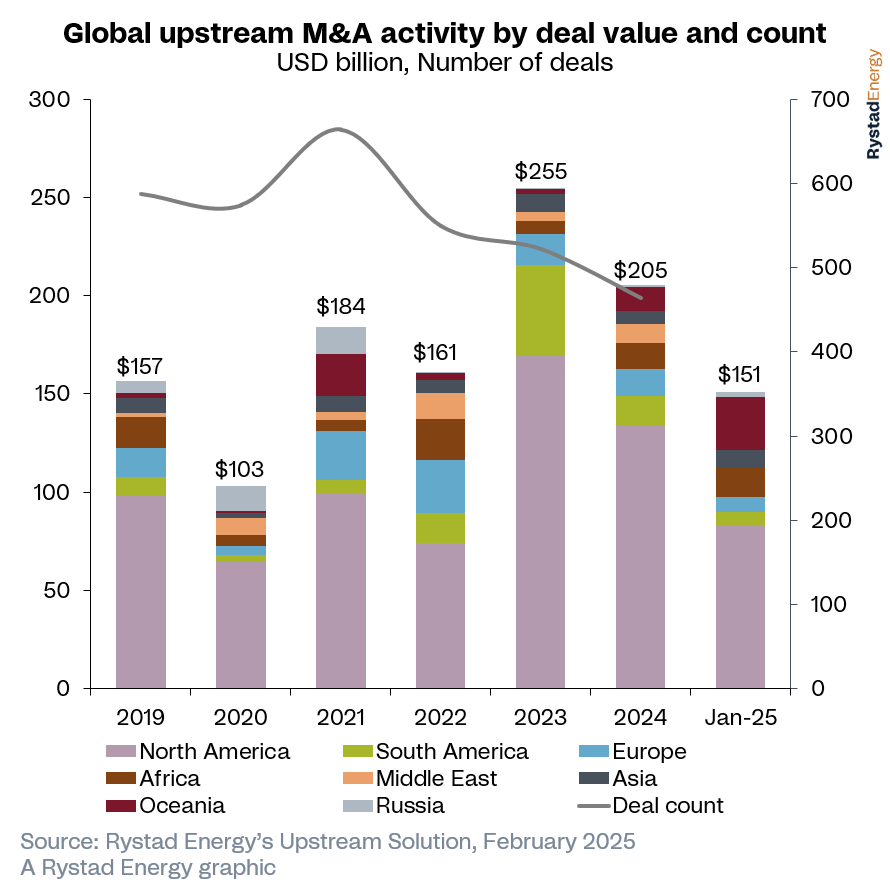
Global upstream M&A activity is expected to slow down in 2025 following a peak driven by US shale consolidation.

North America continues to lead M&A activity, while the Middle East emerges as a significant hub due to LNG expansion.

Geopolitical tension, fiscal policy uncertainty, and the ongoing conflict in Ukraine pose challenges for the M&A market.


Upstream merger and acquisition (M&A) activity is expected to slow significantly in 2025 following two years of record-high transactions driven by US shale mergers. The global deal pipeline value stands at approximately $150 billion as much of the sector’s consolidation has run its course, making a return to recent peaks unlikely. Furthermore, geopolitical tension in the Middle East, the ongoing conflict in Ukraine and the UK’s challenging fiscal environment are expected to create notable headwinds for market participants.

North America will continue to lead global M&A activity, driven by nearly $80 billion in upstream opportunities on the market. Elsewhere in the Americas, South American deal value rose from $3.6 billion in 2023 to $14.1 billion in 2024 (excluding Chevron’s acquisition of Hess), largely due to regional exploration and production (E&P) growth ambitions — and despite Petrobras halting its divestment program.

Last year marked a significant year of consolidation in the US shale sector, with approximately 17 consolidation-focused deals, compared to just three acquisitions in late 2023. Activity was always expected to fall after such dramatic highs, but there is still plenty of business to be done. North America is still a leader in M&A activity and will continue to play a key role in maintaining the market's health. There is also potential for further upside if US shale gas M&A activity increases, assuming Henry Hub prices remain stable and conducive to dealmaking.

Atul Raina, Vice President, Oil & Gas Research, Rystad Energy


Learn more with Rystad Energy’s Upstream Solution.

Looking beyond traditional hubs, the Middle East is rapidly emerging as a significant center for M&A activity. Bolstered by liquefied natural gas (LNG) expansion plans, the region recorded its second-highest year of M&A activity since 2019, with deal value reaching nearly $9.65 billion in 2024, following a five-year peak of $13.3 billion in 2022. The surge in activity can be attributed to Middle Eastern national oil companies with major projects under way, such as QatarEnergy’s North Field expansion and ADNOC’s Ruwais LNG.

The North Field expansion aims to elevate QatarEnergy’s LNG production to 142 million tonnes per annum (Mtpa) by the early 2030s. ADNOC is reportedly considering awarding an additional 5% stake in Ruwais LNG to an international partner. However, ongoing geopolitical tension in other parts of the region may dampen or delay dealmaking.

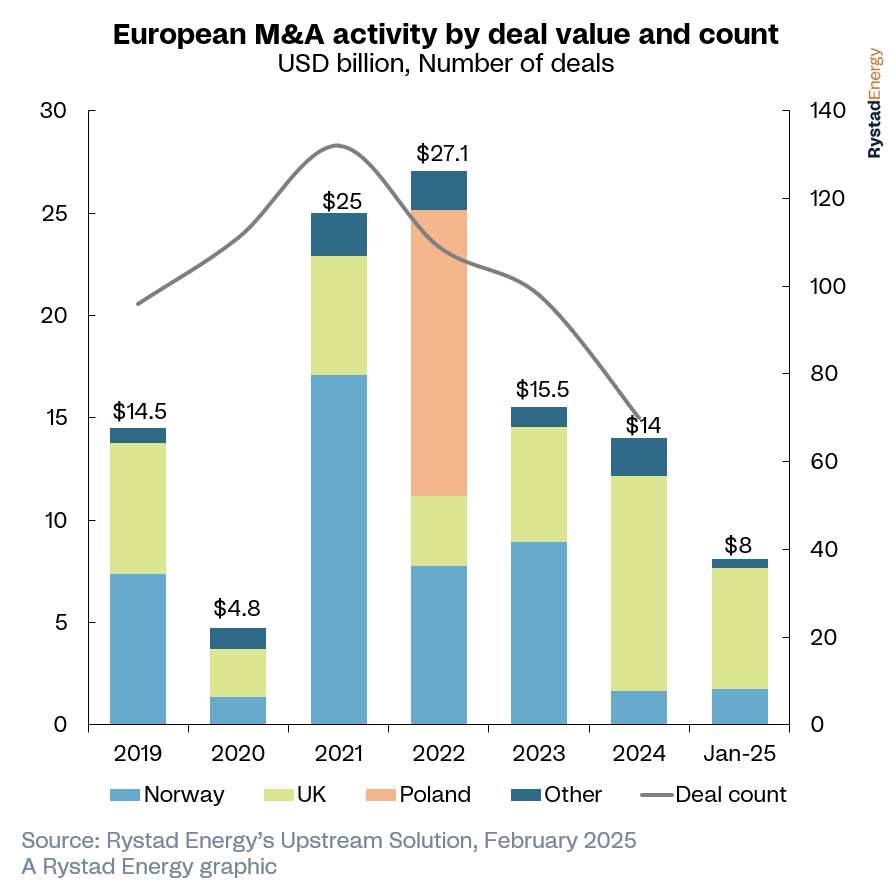
M&A deal value in Europe decreased by around 10% year-on-year, to $14 billion in 2024. Around 75% of the regional total centered on the UK, where majors have been adopting an autonomous model strategy to expand their presence in the North Sea. The largest deal this year involved Shell and Equinor merging their UK North Sea upstream portfolios, excluding some of Equinor's cross-border assets. The combined entity will become the largest producer in the UK North Sea, with a projected output of around 140,000 barrels of oil equivalent per day (boepd) by 2025.

Despite $8 billion worth of upstream opportunities in the region, the outlook for future M&A activity in Europe remains uncertain due to fiscal policy in the UK, which accounts for 73% of the potential deals, valued at about $5.9 billion. Tightened government fiscal terms for offshore oil and gas threaten to dampen buyer interest. However, combining portfolios that balance deferred tax positions and future expenditure could be an emerging trend in the country’s M&A landscape, given the current fiscal challenges.


By Rystad Energy