Thursday, February 06, 2025


Risk it or kick it? Study analyzes NFL coaches’ risk tolerance on fourth down


BYU study reveals how NFL coaches, including Super Bowl contenders Andy Reid and Nick Sirianni, weigh risk on fourth down.


Brigham Young University

NFL Risk Tolerance Rsearch 

image: 

A BYU study analyzes NFL coaches’ fourth-down decisions, revealing how their risk tolerance compares to analytics-driven strategies.

view more 

Credit: Nate Edwards


During the Super Bowl, every decision matters. With millions of fans watching, the game often comes down to a single play call. And no call is more scrutinized than what a coach decides to do on fourth down. Punt? Attempt a field goal? Or go for it?

A new BYU study explains why NFL coaches, including Super Bowl contenders Andy Reid (Kansas City Chiefs) and Nick Sirianni (Philadelphia Eagles), may behave too conservatively on fourth down. Despite growing acceptance of analytics-driven decision-making, most coaches, including these two, are more cautious than the numbers suggest they should be.

The study, recently published in the Annals of Applied Statistics, was conducted by BYU statistics professor Nate Sandholtz. He used an inverse optimization approach to assess the risk tolerance of NFL coaches based on their fourth-down decisions. Instead of trying to determine what coaches should do on fourth-down, this approach flipped the script. Researchers assumed that the coaches' actual decisions are the optimal answers—but that the problem the coaches were trying to solve is unknown. Sandholtz and his co-authors constructed a decision-making problem that, when solved, replicates what the coaches did.

By doing so, researchers learned about the hidden risk preferences that drove the coaches’ behavior. The findings indicate that coaches tend to make riskier fourth-down decisions when the ball is in opponent territory, but they still fall short of what win probability models recommend.

Sandholtz also ranked each NFL coach on how risky their fourth down calls usually are. According to the research, Sirianni demonstrated a higher risk tolerance than Reid. Out of the 85 NFL coaches analyzed, Sirianni was the sixth riskiest. So, in Sunday’s game, football fans can probably expect him to go for it on fourth down. Reid, on the other hand, tends to be more conservative and falls in the middle of the pack when it comes to taking risks on fourth downs.

The research reveals that while coaches have become more aggressive over time, they’re still more conservative than win probability estimates suggest. This means that some coaches are likely leaving points on the field.

Of course, coaches don’t make decisions like statistical models do. While a statistical model might spit out a ‘perfect’ fourth down call that is optimized for win probability, an NFL coach on the sideline of an intense game has a lot more to consider.

“Coaches think about factors beyond just the win or loss of a game,” Sandholtz said. “Reputation, personal experience, and their perception in the eyes of owners, managers and fans all factor into their coaching decisions. Our model accounts for these factors through coach-specific risk parameters.”

NFL coaches are not risk-neutral in their decision-making, which explains the discrepancy between analysts’ prescriptions and coaches’ behavior.

The study also highlights how risk tolerance varies depending on field position. Coaches tend to be more conservative on their own side of the 50 but show more willingness to go for it as they get closer to scoring territory.

So, what does this mean ahead of Super Bowl LIX on Sunday? Sandholtz says given Reid’s and Sirianni’s track records, fans can expect both coaches to take calculated risks. In a game that could be decided by a single possession, the decision to keep the offense on the field or send out the special teams unit might just be the difference between hoisting the Lombardi Trophy or going home empty-handed.

Reid’s connection to BYU makes his fourth-down philosophy particularly relevant to Cougar fans. A former BYU offensive lineman and graduate assistant coach, Reid has carried his strategic mindset from Provo to NFL sidelines. Known for his innovative offensive schemes, Reid leads the Chiefs in the pursuit of a Super Bowl three-peat.

“In general, NFL coaches are trending towards the optimal behavior that we estimate in statistical models.” Sandholtz said. “It'll be interesting to see if the risk tolerances we estimated for Reid and Sirianni play out in Sunday’s game.”


Nutrition labels meant to promote healthy eating could discourage purchases


University of Florida
Food labels 

image: 

Food labels used in the study.

view more 

Credit: UF/IFAS


Some food labels designed to nudge Americans toward healthier food choices can have the opposite effect, new University of Florida research shows.

The study is particularly compelling because it comes as the U.S. Food and Drug Administration weighs whether to require front-of-package food labels. Through a newly proposed rule, the agency introduced labels highlighting saturated fat, sodium and added sugar. Each value on the labels, a percent of the recommended daily value, corresponds to one of three levels: low, medium and high.

The UF/IFAS study, published in the journal Food Policy, examined front-of-package labels professing the contents inside as “healthy.” Researchers found the labels decreased consumers’ willingness to pay for yogurt unless the claim was supported by FDA backing and an explanation about the agency’s criteria for the designation.

“This research highlights the importance of helping consumers understand what a label means,” said study author Jianhui “Jeffrey” Liu, a doctoral candidate in the UF/IFAS food and resource economics department.

Liu and his team asked 308 subjects to review front-of-package label designs for strawberry Greek yogurt and indicate how much they were willing to pay for it. One package design included a “healthy” label, one included a “great taste” label, one included both labels and the last design, the control, did not feature either label.

Compared to the control, respondents were willing to spend 18% less for the “healthy” yogurt and 25% less for the yogurt labeled both “healthy and “great taste.” “Great taste” labels presented alone, however, did not positively or negatively affect respondents’ willingness to pay.

The findings suggest health labels might evoke a perception of compromise on taste and indulgence.

“Simply putting ‘healthy’ on a product may not be enough — it can even backfire if consumers are left wondering what qualifies the food as healthy or if they associate the label with less desirable attributes, such as poor taste,” Liu said.

Notably, the negative discount associated with the “healthy” label was mitigated when accompanied by the following text: “The product you have just observed features a ‘healthy’ symbol. This label indicates that the product meets the FDA’s proposed criteria for being designated as ‘healthy,’ which specifically requires the product to be low in saturated fat, added sugar and sodium.”

Although consumers may be confused or skeptical about health claims, their perceived credibility of authoritative sources influences their behavior, according to the study.

Liu hopes the study can help policymakers and food industry professionals design effective package labels that empower consumers to make informed decisions about the food they eat.

“This research supports a cultural shift toward healthier eating patterns, improving the health and well-being of the nation while reducing the burden of diet-related diseases,” Liu said. “It has the potential to impact every consumer and food manufacturer in the country by setting the stage for more transparent, effective and impactful public health interventions.”

Electric utility admits its equipment likely started one of California’s wildfires


The California wildfires were driven by gusting winds and extremely dry conditions

Julia Musto
in New York
Thursday 06 February 

One of California’s largest utility companies said Thursday that its equipment had likely sparked one of the wildfires that tore through Los Angeles County last month.

The fire broke out on January 7, the same day that the deadly Palisades and Eaton fires took the lives of at least 29 people and destroyed thousands of homes and businesses.


The Hurst fire, which spread over nearly 800 acres was put out more than a week after its start, but did not destroy any structures or result in any deaths.

The admission by Southern California Edison came in a required filing with California utility regulators.

A request for comment from the utility was not immediately returned.


open image in galleryCalifornia utility Southern California Edison said Thursday that its equipment had likely sparked one of the wildfires that tore through Los Angeles County last month (Middle East Images/AFP via Getty)

The utility acknowledged last month that fire agencies are investigating whether its equipment may have started the Hurst fire, which scorched about 1.25 square miles around the Sylmar neighborhood of Los Angeles.

“Absent additional evidence, SCE believes its equipment may be associated with the ignition of the Hurst fire,” Thursday’s filing said.

In a second filing, the utility said it is also looking into whether an idle transmission line became energized and possibly sparked the deadly Eaton fire, which devastated Altadena.


However, it still maintains there’s no evidence that its equipment was responsible for starting that fire.


open image in galleryMultiple California wildfires scorched tens of thousands of acres of Southern California last month. They fires resulted in the deaths of at least 29 people (Getty Images)

A new video claimed to show the start of that 14,000-acre blaze, which lawyers suing the utility said indicated the start after “an apparent arc on SoCal Edison lines.” But, a spokesperson for the utility told The Independent in January that it is “premature” for anyone to comment on the video until experts complete a review.


Numerous wildfires started in the region in January, fueled by the dangerous Santa Ana winds reaching hurricane-force speeds. The fires were also worsened by the impacts of climate change. The region hadn’t seen rain in months before the fires.

“All the pieces were in place for a wildfire disaster – low rainfall, a build-up of tinder-dry vegetation, and strong winds,” Park Williams, a professor of geography at UCLA, explained in a statement provided by the group World Weather Attribution.

The Associated Press contributed to this report
UK's Grenfell Tower to be demolished after 2017 disaster

The UK government has decided to demolish Grenfell Tower, the site of Britain’s deadliest residential fire since World War II, sparking outrage among survivors.

The New Arab Staff & Agencies
06 February, 2025


London's Grenfell Tower was the scene of Britain's worst residential fire since World War II [Getty]


London's Grenfell Tower - scene of Britain's worst residential fire since World War II - is set to be demolished seven years after 72 people died in a blaze there, survivors and families of victims said Thursday.

Housing Secretary and Deputy Prime Minister Angela Rayner "announced her decision about Grenfell Tower to a room full of survivors and next of kin" Wednesday, Grenfell Next of Kin, which represents some families, said in a statement on X.

The decision comes more than seven years after an inferno destroyed the 24-storey block in west London, with the fire, which started in a faulty freezer, spreading rapidly due to highly combustible cladding fixed to the building's exterior.

Rayner will communicate "her decision on the future of the Grenfell Tower" to the bereaved and survivors before making an official announcement, a spokesperson for the housing ministry said.

"This is a deeply personal matter for all those affected, and the deputy prime minister is committed to keeping their voice at the heart of this."

Grenfell United, which represents some of the survivors and families, slammed the decision as "disgraceful" and said victims were ignored by the "short" consultation.

"Today's meeting showed just how upset bereaved and survivors are about not having their views heard or considered in this decision," Grenfell United said on X.

"Ignoring the voices of the bereaved on the future of our loved one's gravesite is disgraceful and unforgivable."

However, Grenfell Next of Kin said it was a "sensitive decision" which "came after a thorough engagement process" and was informed by "safety concerns" surrounding the structural integrity of the scaffolded remains of the building.
Related

Grenfell inquiry: Families of UK fire victims seek prosecutions


'Out of sight and mind'


Emma O'Connor, a survivor of the blaze, warned the demolition could put the disaster "out of sight and mind".

"To me, it just seems like if it's out of sight, it's definitely out of mind for the people that are actually responsible for the lack of respect to human beings," O'Connor told BBC radio.

"We understand that it's unsafe, but if it's out of sight it will definitely be out of mind."

An inquiry report last year found the 72 deaths were "all avoidable" and blamed the "systematic dishonesty" of building firms.

Since the inquiry and report, which also revealed decades-long government and regulatory failures, victims groups have criticised the government for failing to implement fire safety recommendations swiftly enough.


Families have also condemned the delay in bringing criminal charges against those blamed for the disaster in the inquiry.

The housing ministry spokesperson could not confirm to AFP any details of the decision or when it might be announced, after reports that it could come on Friday.

WORKERS CAPITAL

Canadian pension fund BCI takes UK infrastructure fund BBGI private for £1bn

By Razak Musah Baba
6 February 2025


British Columbia Investment Management Corporation (BCI) is taking BBGI Global Infrastructure private in a £1.06bn (€1.27bn) deal.

The C$250bn (€168bn) Canadian pension fund’s infrastructure and renewable resources (I&RR) arm is offering BBGI shareholders 147.5 pence per share in cash, representing a 21.1% premium over the UK-listed infrastructure fund’s most recent closing price.

BBGI’s portfolio, consisting of 56 assets spread across five different geographies, had an estimated value of £993m as at the end of December 2024.


The BBGI board said it intends to unanimously recommend that shareholders accept the offer and vote in favour of the resolutions at a general meeting.

Duncan Ball, CEO of BBGI, said that since BBGI’s launch in 2011, the firm has grown to become one of the UK’s largest listed infrastructure funds, with a globally diversified portfolio of 56 low-risk, core infrastructure assets that deliver sustainable and long-term index-linked cash flows. Over this period, BBGI has delivered a total net asset value return of 176.3%.


Ball said: “Although both the BBGI supervisory board and the BBGI management board are confident that BBGI can continue to deliver sustainable cash flows to BBGI shareholders, the offer from BCI represents a premium to undisturbed share price and to net asset value, and provides BBGI shareholders with the opportunity to realise the value of their holdings in cash, at an attractive value in excess of the reasonable medium-term prospects for BBGI on a standalone basis.

“As a result, both the BBGI supervisory board and BBGI management board have concluded that the offer is in the best interests of BBGI shareholders and BBGI as a whole.”

Grant Hodgkins, senior director of BCI’s C$28bn I&RR business, said: “We believe BBGI will be a compelling and strategic addition to BCI’s infrastructure and renewable resources portfolio, with a diversified mix of international holdings across the transport, clean energy, healthcare, education and social infrastructure sectors.

“We see many opportunities to leverage our expertise, global relationships, and access to long-term capital, alongside BBGI’s experienced management team and proven asset management strategies, to drive further growth and value creation across the BBGI portfolio.”

The offer is expected to be completed in the third quarter of 2025, after which BBGI shares are expected to be delisted from the Official List and the London Stock Exchange’s Main Market.

COP30 president urges most ambitious emissions targets possible


By AFP
February 6, 2025


As tech companies seek energy sources to meet these demands while maintaining their zero-carbon emission commitments, nuclear power has emerged as a compelling option - Copyright GETTY IMAGES NORTH AMERICA/AFP ALEX WONG

Anna PELEGRI

Countries must aim as high as possible when setting new goals to reduce greenhouse gas emissions, Andre Correa do Lago, the president of the COP30 climate conference to be hosted by Brazil in November, told AFP in an interview.

With just days to go until the February 10 deadline for signatories of the Paris climate accord to unveil their new goals for 2035, major players such as the European Union and China have yet to announce their targets.

Under the accord, countries agreed in 2015 to try to hold warming to 1.5 degrees Celsius above pre-industrial levels — which has already been breached over the past two years.

Europe’s climate monitor said Thursday that last month was the hottest January on record.


Correa do Lago, the secretary in Brazil’s foreign ministry for climate energy and the environment, said it did not matter if countries took their time to announce their new targets, but they needed to be ‘as ambitious as possible’ – Copyright AFP/File Manjunath KIRAN

Correa do Lago, the Brazilian foreign ministry’s secretary for the environment, said it did not matter if countries took their time to announce their new targets, but they needed to be “as ambitious as possible.”

“They have to be more ambitious than they were before, so that’s a rule, but we want them to be particularly ambitious and… compatible with avoiding a 1.5 percent increase in temperature.”

Brazil will host the COP30 meeting in the Amazonian city of Belem — the first time the conference will be held in a region considered so crucial to the global climate.

This year’s climate conference will come after US President Donald Trump withdrew his country from the Paris accord for a second time and doubled down on the use of fossil fuels.

Correa do Lago said there were still “several ways to talk to the United States” about climate change, such us through the G20 or the UN Framework Convention on Climate Change.

– Increasing climate financing –


After much tortuous haggling, the last COP held in Azerbaijan ended in a deal that would see wealthy nations pay $300 billion a year to developing countries, which are worst affected by climate change.

This was criticized by poorer nations as falling short of what was needed to tackle the impact of a changing climate.

Correa do Lago said that aside from the presentation of the new Paris accord goals, “there are a number of negotiations that are still ongoing.”

“There is also a mandate for Brazil, together with Azerbaijan, to present alternatives so that we can increase financial resources from $300 billion to $1.3 trillion.”

Under leftist President Luiz Inacio Lula da Silva, Brazil — the world’s ninth largest oil producer — is seeking to position itself at the forefront of efforts to combat climate change.

While the country has managed to reduce deforestation in the Amazon, Lula has come under fire for pushing for the expansion of oil exploration, particularly in a controversial offshore basin near the mouth of the Amazon River.

Correa do Lago said the energy transition “is something that will be very different depending on the country.”

“This process may have paths that some consider tortuous or not in a straight line. The example that is always remembered is that when Germany decided to abandon nuclear energy, which does not emit greenhouse gases, it went back to using coal. But this is a process.”


International NGOs call for complete ban on trade between EU and Israeli settlements in Occupied Palestinian Territories

Human rights organizations called on the EU Tuesday to enact a complete ban on all trade and business with Israeli settlements in Occupied Palestinian Territories. In a joint letter to the EU president more than 160 human rights groups, trade unions, and civil society groups urged the European Commission to adhere to obligations set out under international law.

The letter refers to the International Court of Justice advisory opinion from July that “the State of Israel’s continued presence in the Occupied Palestinian Territory is unlawful,” and that states are under legal obligation “not to render aid or assistance in maintaining the situation created by the presence of the State of Israel in the Occupied Palestinian Territory.” The EU responded shortly after this ruling that it “takes good note of the Advisory Opinion,” and agreed with the conclusions made by the court.

ActionAid, one of the organizations that signed the joint letter, said that the EU and EU member states are breaching legal obligations set out in the World Court’s ruling and are “simultaneously contributing to serious and systemic human rights and other international law abuses underpinning the settlement enterprise.”

The letter states that a current EU policy which distinguishes “between goods produced in Israel” and settlements allows for both goods to “enter the EU market.” The organizations urged the EU to adhere to its international obligations and called for the following actions to be taken by the European Commission: a total ban on trade and investments with Israeli settlements and a “strengthened business advisory” with the aim of discouraging any businesses based in Europe from continuing beneficial engagement with Israeli settlements.

UPDATED

Trump says US will take over Gaza Strip, create 'Riviera of the Middle East'

President Donald Trump said Tuesday the United States would "take over" the Gaza Strip, resettle Palestinians in other countries and turn the territory into "the Riviera of the Middle East" in a startling announcement that drew audible gasps during a joint press conference with Israeli Prime Minister Binyamin Netanyahu.


Issued on: 05/02/2025 -
FRANCE24
By: NEWS WIRES
Video by: Andrew HILLIAR

01:54
US President Donald Trump gives a news conference with Israel's Prime Minister Binyamin Netanyahu at the White House on February 4, 2025. © Bryan Dozier, AFP


President Donald Trump said the US would take over the war-ravaged Gaza Strip and develop it economically after Palestinians are resettled elsewhere, moves that would shatter decades of US policy toward the Israeli-Palestinian conflict.

Trump unveiled his surprise plan, without providing specifics, at a joint press conference on Tuesday with visiting Israeli Prime Minister Binyamin Netanyahu.


Trump says US will 'take over' Gaza
00:26
US President Donald Trump greets Israel's Prime Minister Benjamin Netanyahu as he arrives at the White House in Washington on February 4, 2025. © Jim Watson, AFP

The announcement followed Trump's shock proposal earlier on Tuesday for the permanent resettlement of Palestinians from Gaza to neighbouring countries, calling the enclave – where the first phase of a fragile Israel-Hamas ceasefire is in effect – a "demolition site."

Trump can expect allies and foes alike to strongly oppose any US takeover of Gaza. The US taking a direct stake there would run counter to longtime policy in Washington and for much of the international community, which has held that Gaza would be part of a future Palestinian state that includes the occupied West Bank.


"The US will take over the Gaza Strip, and we will do a job with it too," Trump told reporters. "We'll own it and be responsible for dismantling all of the dangerous unexploded bombs and other weapons on the site."

"If it's necessary, we'll do that, we're going to take over that piece, we're going to develop it, create thousands and thousands of jobs, and it'll be something that the entire Middle East can be very proud of," Trump added.

"I do see a long-term ownership position and I see it bringing great stability to that part of the Middle East," he said, adding that he had spoken to regional leaders and they supported the idea.

Asked who would live there, Trump said it could become a home to "the world's people." Trump touted the narrow strip, where Israel's military assault in response to Hamas' Oct. 7, 2023, cross-border attack has leveled large swaths, as having the potential to be “The Riviera of the Middle East.”


Fraser Jackson reports from Washington DC
01:22
Trump says US will take over Gaza Strip, create 'Riviera of the Middle East' © France 24


Trump did not directly respond to a question of how and under what authority the US can take over and occupy Gaza, home to around two million people with a long, violent history over control of the coastal strip. Successive US administrations, including Trump in his first term, had avoided deploying US troops there.

Netanyahu, referred to a few times by Trump by his nickname, “Bibi,” would not be drawn into discussing the proposal in depth other than to praise Trump for trying a new approach.

The Israeli leader, whose military had engaged in more than a year of fierce fighting with Hamas militants in Gaza, said Trump was "thinking outside the box with fresh ideas" and was "showing willingness to puncture conventional thinking."

Some experts have suggested Trump sometimes takes an extreme position internationally to set the parameters for future negotiations. In his first term, Trump at times issued what were seen as over-the-top foreign policy pronouncements, many of which he never implemented.

Trump proposes permanent 'resettlement'

Jonathan Panikoff, former deputy US national intelligence officer for the Near East, said Trump's plan would mean a lengthy US military commitment and if it came to fruition would be viewed by the Arab world as Washington "not learning its lessons from nation building in Iraq and Afghanistan."

Trump earlier repeated his call for Jordan, Egypt and other Arab states to take in Gazans, saying Palestinians there had no alternative but to abandon the coastal strip, which must be rebuilt after nearly 16 months of a devastating war between Israel and Hamas militants.

But this time Trump said he would support resettling Palestinians "permanently," going beyond his previous suggestions that Arab leaders had already steadfastly rejected.

Forced displacement of Gaza's population would likely be a violation of international law and would be fiercely opposed not only in the region but also by Washington's Western allies. Some human rights advocates liken the idea to ethnic cleansing.

Senior Hamas official Sami Abu Zuhri condemned Trump's calls for Gazans to leave as "expulsion from their land."

“We consider them a recipe for generating chaos and tension in the region because the people of Gaza will not allow such plans to pass," he said.

Trump, a Republican, offered no specifics on how a resettlement process could be implemented but his proposal echoed the wishes of Israel's far right and contradicted Democratic former President Joe Biden's commitment against mass displacement of Palestinians.

The Saudi government, in a statement, stressed its rejection of any attempt to displace Palestinians from their land and said it would not establish relations with Israel without establishment of a Palestinian state.


Critics decry expansionist rhetoric

Just two weeks into his second term, Trump was hosting Netanyahu at the White House to discuss the future of the Gaza ceasefire, strategies to counter Iran and hopes for a renewed push for an Israeli-Saudi normalization deal.

His Gaza proposal followed a frenetic first two weeks in office in which Trump has talked about a US takeover of Greenland, warned of the possible seizure of the Panama Canal and declared that Canada should be the 51st US state.

Some critics have said Trump's expansionist rhetoric echoes old-style imperialism, suggesting it could encourage Russia in its war in Ukraine and give China justification for invading self-ruled Taiwan.

Trump described the Gaza Strip as a longtime "symbol of death and destruction" and said Palestinians there should be housed in "various domains" in other countries. He said the US will take over the Gaza Strip, "level the site" and create economic development but did not say how.

Trump, who had a career of developing real estate before getting into politics, cast a broad-brush, optimistic vision of a US takeover of Gaza while skirting details on how the United States would go about possessing the enclave and securing it.

He was also vague on where the Palestinian inhabitants of Gaza would go, saying he was confident Egypt and Jordan would take many of them, despite those governments already rejecting the idea.

Democratic Senator Chris Coons told NBC News Trump's suggestion that the US will 'take over' Gaza was "insane".

"I can’t think of a place on Earth that would welcome American troops less and where any positive outcome is less likely,” Coons added.

What impact Trump's proposals have on negotiations over the second phase of the Gaza ceasefire deal was unclear, as Hamas has adamantly insisted it wants to remain in Gaza while Netanyahu has vowed to destroy the group and never allow it to again rule the territory.

Trump's Middle East envoy, Steve Witkoff, played a key role in helping the Biden administration secure the long-sought Gaza deal before the Jan. 20 transfer of power in the US The first phase has led to Hamas' release of 18 hostages and Israel's release of hundreds of jailed Palestinians.

"We're in Phase 2 now," Witkoff told reporters earlier. He said he met Netanyahu on Monday to discuss parameters for the policy negotiations and would meet the prime minister of Qatar, a mediator in the negotiations, in the US on Thursday.

(REUTERS)


White House appears to backtrack after Trump’s Gaza takeover plan sparks global outcry

Modified: 06/02/2025 -
By: FRANCE 24
US President Donald Trump speaks alongside newly confirmed Attorney General Pam Bondi during her swearing in ceremony in the Oval Office at the White House on February 5, 2025 in Washington, DC. © Andrew Harnik, AFP

The Trump administration appeared to backtrack after US President Donald Trump’s shock proposal to take over the Gaza Strip Tuesday sparked condemnation from Palestinians, world leaders and the United Nations. Secretary of State Marco Rubio on Wednesday said any population transfer would be temporary and the White House said there had been no commitment to sending US troops. Read our blog to see how the day's events unfolded.

Summary

President Donald Trump told White House reporters Wednesday that “everybody loves” his proposal to take over control of the Gaza Strip and own it “long term”, after he had earlier suggested that displaced Palestinians could be resettled elsewhere.
Trump made his shock announcement at a joint news conference with Israel’s Binyamin Netanyahu, who praised the US president for “thinking outside the box”.
The proposal immediately sparked global condemnation, with US allies Saudi Arabia, Jordan and Egypt rejecting the displacement of Palestinians and reiterating their calls for a two-state solution.
The Palestinian ambassador to the UN said Gaza was “part of Palestine”, while Hamas called Trump's plan “ridiculous and absurd


Arab American, Muslim leaders decry Trump comments on Gaza


US Arab American and Muslim leaders, including some who supported Donald Trump in the 2024 election, criticised the president's proposal for the US to take over Gaza and resettle Palestinians, but some of them said they still believed he was the best option for lasting peace in the region.

The leaders largely dismissed Trump's comments as unrealistic bluster and said he was unlikely to pay a big political price in the community.

"We believe that his ideas, as well-intentioned as they might be, rubbed a lot of people the wrong way," Bishara Bahbah, who founded Arab Americans for Trump and helped rally support for him in Michigan and other battleground states, told Reuters.

"We're opposed to any transfer of Palestinians, whether voluntarily or involuntarily, out of their homeland."


Any forced displacement of Palestinians would be 'unacceptable', Macron and Sisi say

Any "forced displacement" of the Palestinian population in Gaza or the West Bank would be "unacceptable", French President Emmanuel Macron and his Egyptian counterpart Abdel Fattah al-Sisi said after a telephone discussion Wednesday.

"It would be a serious violation of international law, an obstacle to the two-state solution and a major destabilising force for Egypt and Jordan," the two leaders said, according to a statement from the French presidency.

The statement came after US President Donald Trump proposed "long-term ownership" of Gaza by the United States, triggering an international uproar.

Macron and Sisi said they wanted to work for a "credible solution" that paved the way for a two-state solution for the territory.

'All options on Gaza' on the table, US defense secretary says


US Defense Secretary Pete Hegseth says he is prepared to consider all options on Gaza.


US plan to rebuild Gaza 'generous' and 'not hostile', US Secretary of State Rubio says

US Secretary of State Marco Rubio said Wednesday that President Donald Trump’s proposal to take “ownership” of Gaza and redevelop the area into “the Riviera of the Middle East” was a “generous” offer.

“It was not meant as a hostile move,” Rubio said. “It was meant as a, I think, a very generous move.”

He said the Palestinian terriory is “akin to a natural disaster” and people can’t live there because there are unexploded munitions, debris and rubble.

“In the interim, obviously people are going to have to live somewhere while you’re rebuilding it,” the top diplomat said during a news conference in the US capital.

Trump has 'not committed' to send US troops to Gaza, White House says


US President Trump has not committed to putting US troops on the ground in Gaza as part of his proposal for a US takeover of the Palestinian enclave, the White House said on Wednesday.

White House press secretary Karoline Leavitt told reporters that the president believes the United States needs to be involved in the rebuilding of Gaza "to ensure stability in the region."

"That does not mean boots on the ground in Gaza," she said.


Andrew Caballero-Reynolds, AFP


Five hurdles to Donald Trump's Gaza-takeover plan

US President Donald Trump put forward his proposal to "take over" and "own" Gaza on Tuesday but despite the US president's inflammatory rhetoric there are likely to be overwhelming roadblocks to his proposal. The idea aligns with other grandiose schemes Trump has proclaimed, such as annexing Greenland and making Canada a US state.


Issued on: 05/02/2025 - 
FRANCE24
By: NEWS WIRES


Here are five reasons Trump's Gaza proposal appears unworkable:


Palestinian roots

Trump ignores Palestinians' deep attachment to their land. After the Gaza ceasefire, half a million displaced people rushed back north.

"This is the happiest day of my life," one of them, Lamees al-Iwady, said on January 28.


The Palestinian envoy to UN, Riyad Mansour, dismissed the idea outright.

"Our homeland is our homeland," he said. "For those who want to send them to a happy, nice place, let them go back to their original homes inside Israel, there are nice places there, and they will be happy to return to these places."

Arab opposition


Contrary to Trump's assertions, Arab states have firmly rejected the plan.

On Saturday, EgyptJordanQatarSaudi Arabia and the United Arab Emirates denounced any "infringement of the inalienable rights" of Palestinians.

Palestinian Authority president Mahmud Abbas went to Jordan on Wednesday to consult King Abdullah II, signalling deep concern in Amman and Ramallah.

Public opinion in Arab states is also expected to be unanimously hostile to the proposal.

"Expect reactions to range from confusion to outrage, including demonstrations across the Middle East and beyond in the coming days," Emily Harding of the Washington-based Center for Strategic and International Studies wrote on X.


Intervention fatigue

Trump's proposal involves sending US troops into Gaza. Any such deployment would be an immediate reversal of a key campaign promise not embroil Washington in foreign wars.

Those forces would meet fierce opposition from Palestinian militants Hamas -- much weakened by 15 months of war against Israel but by no means eradicated.

Hamas and its ally, Islamic Jihad, have shown the ability to sustain a violent insurgency against conventional military force of the kind that looms large in the American memory following failed military operations in Afghanistan, Iraq and Vietnam.


International law


With an intervention in Gaza, Trump would tear apart international law, the inheritance of the post-war international order that until recently Washington had proudly championed, at least in its rhetoric.

"The US could only take control of Gaza with the consent of the sovereign authority of the territory. Israel can't cede Gaza to the US," said Tamer Morris, a specialist in international law at the University of Sydney.

"A government, such as the Palestinian Authority, cannot give this consent on behalf of a people. People have a right to self-determination -- the right to determine their own future," Morris wrote on The Conversation website.

The legal expert added even if Trump's proposal doesn't come to fruition, his casual dismissal of international norms is damaging on its own.

"The nonchalant way Trump is discussing things such as taking over a territory and moving a population gives the impression these rules can easily be broken, even if he doesn't break them himself," Morris said.

Underlining the legal ramification of Trump's proposal, the United Nations reiterated international law strictly prohibits any expulsion of people from an occupied territory.

Israeli caution


While Netanyahu and his supporters have appeared emboldened by Trump's declarations, Israel's wider political class have appeared cautious as they eye legislative elections in a year's time.

"The far right is ecstatic, jubilant," said David Khalfa, a researcher at the Fondation Jean-Jaures in Paris.

"The more moderate, centrist elements of parliament are congratulating Trump but expressing doubts about the feasibility of his plan."

The researcher pointed to remarks by opposition leader Yair Lapid following Trump's announcement, stressing the need for Israeli leadership to present plans rather than rely on the United States.

Khalfa said Lapid's remarks showed the Israeli politician "believes the plan is not at all realistic, or even counter-productive".

"Trump is fundamentally and above all a businessman," the Paris-based researcher said.

And the US president's plan was conceived as "a way of getting all the players in the region on board, to get out of the Israeli-Palestinian face-off, doomed to a repetition of the same tragedy," he added.

(AFP)


Trump’s global policy ideas have some wondering how the president went from America First to America Everywhere

Nation Feb 6, 2025 


WASHINGTON (AP) — President Donald Trump promised voters an administration that wouldn’t waste precious American lives and taxpayer treasure on far-off wars and nation building.

But just weeks into his second go-around in the White House, the Republican leader laid out plans to use American might to “take over” and reconstruct Gaza, threatened to reclaim U.S. control of the Panama Canal and floated the idea that the U.S. could buy Greenland from Denmark, which has shown no interest in parting with the island.

The rhetorical shift from America First to America Everywhere is leaving even some of his allies slack-jawed — and wondering if he’s really serious.

WATCH: Former USAID administrator describes global impact of agency’s ‘destruction’

“The pursuit for peace should be that of the Israelis and the Palestinians,” a flummoxed Sen. Rand Paul, the Kentucky Republican and Trump ally, posted Wednesday on social media. “I thought we voted for America First. We have no business contemplating yet another occupation to doom our treasure and spill our soldiers’ blood.”

The president’s shocking declaration Tuesday that he wants to remove roughly 1.8 million Palestinians from Gaza and redevelop the war-scarred territory into the “Riviera of the Middle East” with “long-term” American ownership raises anew questions about the direction of Trump’s foreign policy during his norm-breaking second term.

Is Trump’s imperialist talk just meant to appear tough on the world stage? Is he merely trying to give Israeli Prime Minister Benjamin Netanyahu cover with far-right members of his governing coalition who oppose moving forward with the second phase of the ceasefire deal with Hamas? Is the Gaza takeover proposal a land grab by a president who sees the world through the prism of a New York real estate developer? Or is it, possibly, a bit of all of above?

Whatever the answer, Trump’s play on Gaza has perplexed Washington — and the world — as they try to make sense of the president’s foreign policy doctrine.

Trump advisers try to temper concerns

The president’s advisers sought Wednesday to temper concerns about his plans for the territory, just a day after Trump shocked the world with his call for a “world-class” American rehab of Gaza that would take place after relocating Palestinians to neighboring Arab nations.

Both his top diplomat, Secretary of State Marco Rubio, and his press secretary, Karoline Leavitt, edged away from Trump’s suggestion that Gazans would be relocated “permanently.”

Rubio said Trump’s proposal to take “ownership” of Gaza and redevelop the area should be seen as a “generous” offer.

“It was not meant as a hostile move,” Rubio said during his visit to Guatemala. “It was meant as … a very generous move.”

Rubio added that the moment was “akin to a natural disaster.” People won’t be able to live in Gaza for years to come because there are unexploded munitions, debris and rubble.

“In the interim, obviously people are going to have to live somewhere while you’re rebuilding it,” he said.
Trump would not rule out the possibility of U.S. troops being deployed to carry out his plan.

But Leavitt downplayed the prospects that Trump’s plan would come with a cost to American taxpayers or that Trump would deploy U.S. forces.

“It’s been made very clear to the president that the United States needs to be involved in this rebuilding effort, to ensure stability in the region for all people,” Leavitt told reporters at the White House. “But that does not mean boots on the ground in Gaza. It does not mean American taxpayers will be funding this effort.”

The White House has yet to explain under what authority Trump could carry his Gaza proposal. Nor has the administration clarified how Trump would get around stiff opposition to any relocation of Gaza’s population from Arab allies, including Egypt and Jordan, that he expects to take in Palestinians.

Still, they insist that Trump is just looking for an answer to the generational strife between Israelis and Palestinians that’s convulsed the region for decades and foiled many of his White House predecessors.

“Insanity is doing the same thing over and over again and expecting different results,” Leavitt said. “President Trump is an outside-of-the-box thinker and a visionary leader who solves problems that many others, especially in this city, claim are unsolvable.”

Democrats criticize expansionist talk

The expansionist talk in Gaza is playing out as Trump has begun an effort to shut down the U.S. Agency for International Development, the federal agency that provides crucial aid that funds education and fights starvation, epidemics and poverty overseas. Trump sees it as a poster child of government waste and advancement of liberal social programs.

That split screen has galled some of Trump’s Democratic detractors.

Sen. Chris Coons, D-Del., called Trump’s Gaza proposal “offensive and insane and dangerous and foolish.” Even worse, he said, it “risks the rest of the world thinking that we are an unbalanced and unreliable partner because our president makes insane proposals.”

Coons added that it was particularly infuriating that Trump floated the idea at a moment when he is also insisting that USAID be dismantled in the name of fighting government waste.

“Why on earth would we abandon decades of well-established humanitarian programs around the world, and now launch into one of the world’s greatest humanitarian challenges?” Coons said.

Mideast allies reject moving displaced Palestinians in Gaza

Trump’s push was roundly rejected Wednesday by European and Middle East allies, including those he’s calling on to take in hundreds of thousands of Palestinians who have been left homeless by the war.

The Arab League, the 22-member regional grouping, said the proposal “represents a recipe for instability.” British Prime Minister Keir Starmer said displaced Palestinians in Gaza “must be allowed home.” German Foreign Minister Annalena Baerbock said displacement of the Palestinian civilian population from Gaza would be “unacceptable” and “against international law.”

Sen. Lindsey Graham, a Trump ally, said “the idea of Americans going in on the ground in Gaza is a nonstarter for every senator.”

“So I would suggest we go back to what we’ve been trying to do, which is destroy Hamas and find a way for the Arab world to take over Gaza and the West Bank, in a fashion that would lead to a Palestinian state that Israel can live with,” Graham said.

But even as his Gaza proposal was panned, Trump continued to insist that it has widespread support.

“Everybody loves it,” Trump said in a brief exchange with reporters.

And Netanyahu reiterated his praise, telling Fox News’ Sean Hannity: “It’s a remarkable idea and I think it should be really pursued. Examined, pursued and done, because I think it will create a different future for everyone.”
___
Associated Press writers Jill Lawless in London, Matthew Lee in Guatemala City, Guatemala, and Farnoush Amiri and Stephen Groves in Washington contributed to this report.


Elon Musk, who arrived in the U.S. at age 31, is being questioned on his citizenship again. What to know

Tech entrepreneur attacked by ex-congresswoman Liz Cheney in latest online spat
Thursday 06 February 2025 

Former Republican congresswoman Liz Cheney has attacked the world’s richest man Elon Musk and drawn attention to the fact that he has not always been a US citizen as part of a social media spat between the pair.

Musk – whose Department of Government Efficiency (DOGE) is at work scrutinizing the running of the federal government with a view to implementing cost-cutting measures at the behest of new president Donald Trump – began the argument by circulating a post on his X platform drawing attention to Cheney’s early career working for the U.S. Agency for International Development (USAID).

Musk suggested Cheney was “spawned” by USAID, which is tasked with handing out foreign aid and which he is targeting for abolition, earlier this week referring to it as a “criminal organization” without explaining himself.


Dozens of agency officials have since been placed on leave and billions of dollars have been frozen as the Trump administration attempts to merge it with the State Department.

Cheney did indeed work for USAID before she enrolled at the University of Chicago Law School in 1996 and again during the George W Bush administration, serving on projects in Hungary and Poland.

Now a pariah to the MAGA movement for working on the House committee that investigated January 6 and for campaigning with Kamala Harris in last year’s election, Cheney responded to the billionaire’s post about her USAID background by saying: “Damn right, Elon. I’m proud of what America did to win the Cold War, defeat Soviet communism, and defend democracy.

“Our nation stood for freedom. You may be unfamiliar with that part of our history since you weren’t yet an American citizen.”

In light of her comments, here’s a look at Musk’s citizenship status and what it might mean for his future political ambitions.

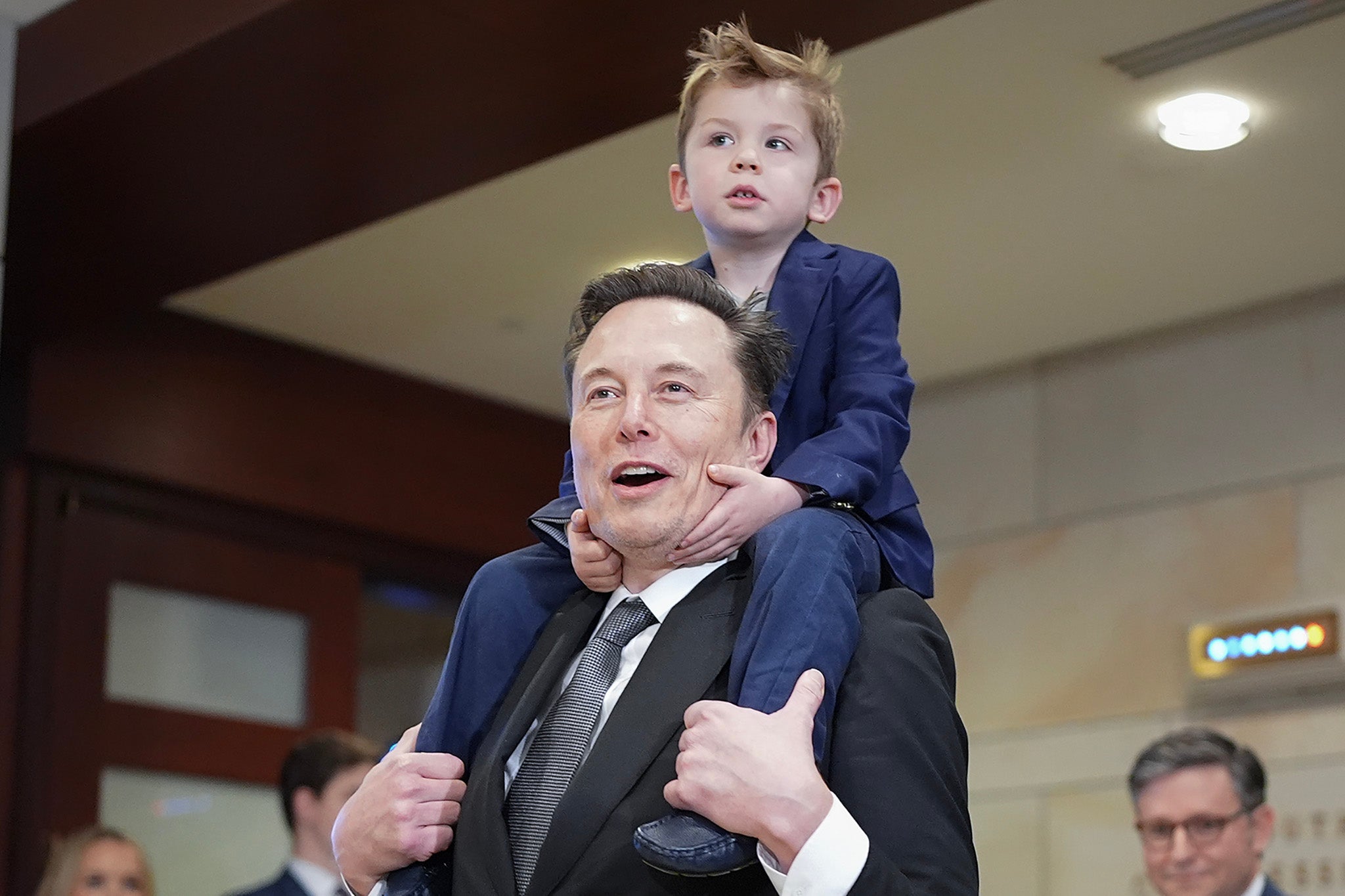
Elon Musk carries his son "X" on his shoulders during a visit to the US Capitol in Washington D.C. on December 5 2024 (Andrew Harnik/Getty)

Does Elon Musk have American citizenship?

Yes. Although Musk was born and raised in Pretoria, South Africa, he emigrated to the United States as a student in 1992 and obtained American citizenship in 2002, according to Walter Isaacson’s 2023 biography of the tech entrepreneur.

Musk himself said in an X post last year that he originally arrived in the country on a J-1 visa, which permits foreign students to study in the U.S., before transitioning to a H-1B temporary work visa.

Can he run for the White House?

No he cannot. The US Constitution says that only people who are natural-born citizens are eligible to become American presidents.

However, naturalized citizens may hold other high federal offices, including within an America-born president’s cabinet.

Where else does he have citizenship?

In addition to his American citizenship, Musk also retains South Africa citizenship and is also a Canadian citizen through his mother Maye Musk, who was born and raised in Canada but lived most of her adult life in South Africa.


Her connection to the country enabled Elon to obtain a Canadian passport in 1989 and study for two years at Queen’s University in Kingston, Ontario, before arriving in the U.S.


What citizenship do his children have?

Elon Musk has fathered 12 children in total, the first six of which were born to his first wife, Canadian author Justine Wilson, between 2002 and 2006, with the couple’s first born Nevada tragically passing away from sudden infant death syndrome at the age of 10 weeks.

He has more recently had two more children with the Canadian pop star Grimes and a further three with Canadian tech executive and venture capitalist Shivon Zilis.

Musk’s children all have Canadian citizenship thanks to the shared nationality of their three mothers while any born in the United States will also have automatic American citizenship, assuming Trump does not succeed in ending the principle of birthright citizenship, which he has attempted to do as part of his crackdown on illegal immigration but which has already faced a series of legal challenges.