Saturday, February 08, 2025


Source: Naked Capitalism

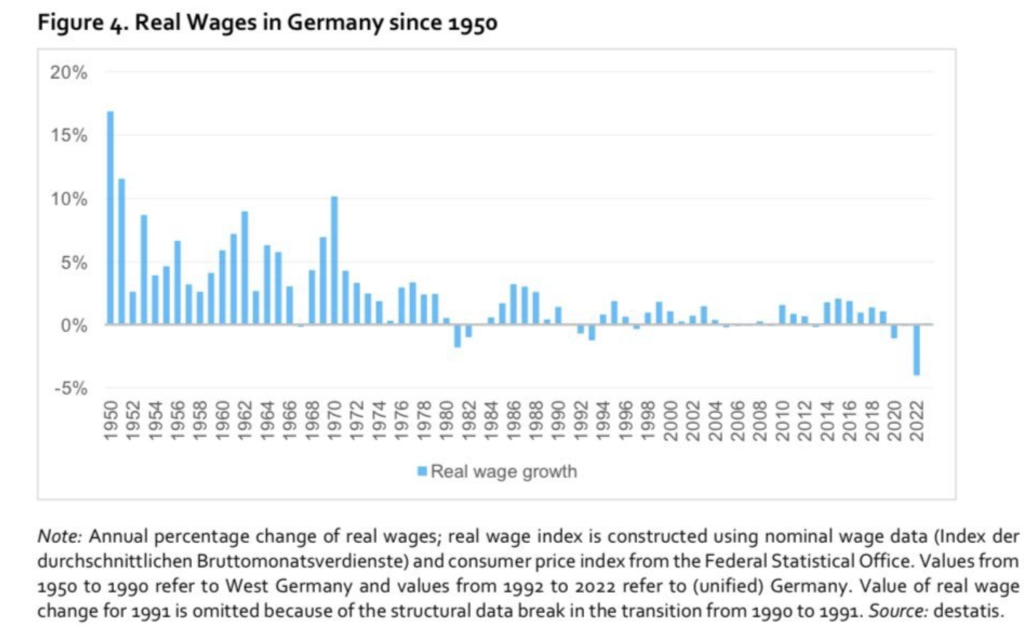
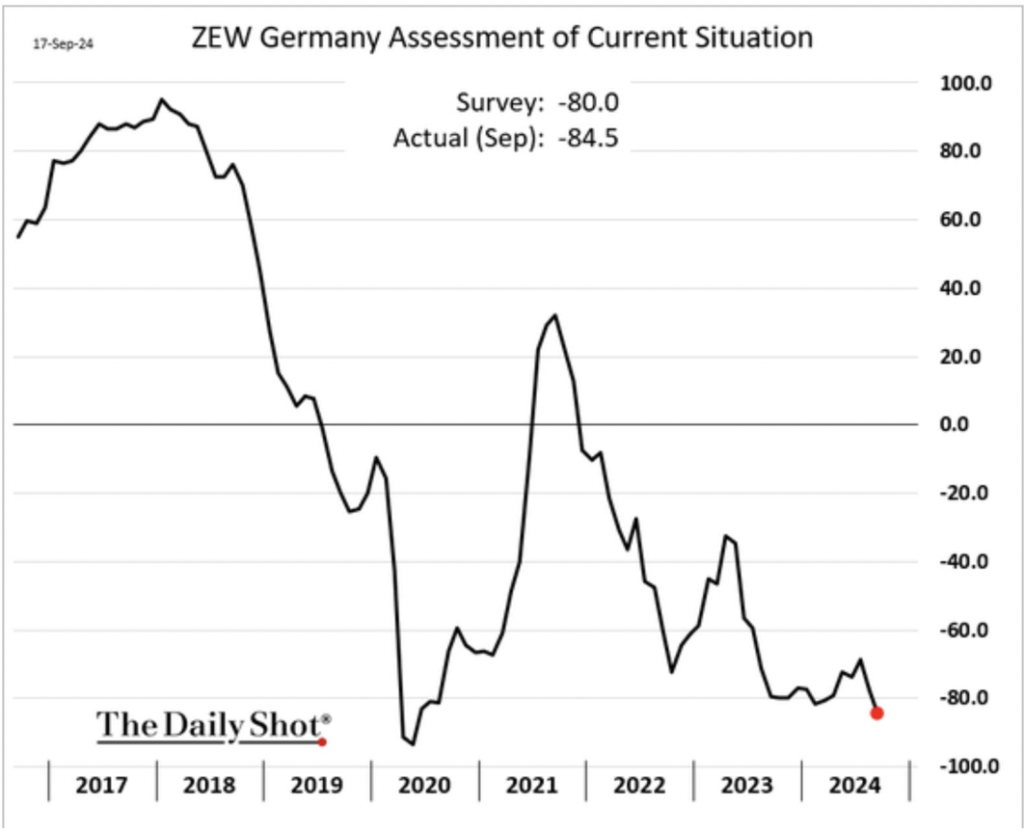
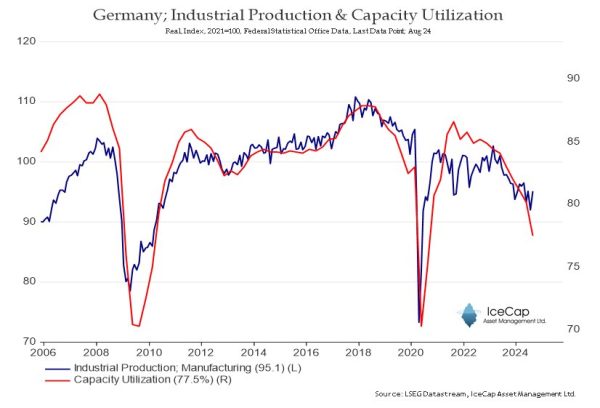
Germans will go to the polls in less than a month after the collapse of the hapless government led by Chancellor Olaf Scholz. The German economy is in an awful state with no reason for hope on the horizon. There are cases to be made for long structural issues and mismanagement, but the answer to the country’s current malaise lies in the wreckage of the Nord Stream pipelines on the bottom of the Baltic Sea.

Not only did the loss of the cheap and reliable pipeline gas from Russia blow up the German economic model but the omerta among the political-media class over the likely US involvement in the destruction of Nord Stream represents all that has continued to plague Germany ever since.

A brief sampling of the fallout:
A quarter of the 84 million Germans’ income is insufficient to make ends meet. Despite all this, it has not led to a rethink (yet) of Germany’s subservient relationship to the US and the accompanying belligerence towards Russia.

The delusion only grows.

Foreign Minister Annalena Baerbock’s office is taking a lead role in trying to ramp up militarization of the Baltic Sea and sanctions against tankers transporting Russian oil without Western insurance — although it looks like her and other hawkish Atlanticists are starting to get some pushback from some Blob actors the US. There’s also talk of the EU going hat in hand to Russia and asking to buy pipeline gas again; that could also be part of an effort to keep the Americans in and profiting from energy sales to Europe.

Meanwhile here’s the German Institute for International and Security Affairs, a Berlin think tank that advises the Bundestag and federal government, telling us that it’s the Russian economy that is in trouble.

While the German election approaches, there is a heavy focus in the country on the issue of immigration with some parties like the Alternative for Germany, Christian Democratic Union and the Sahra Wagenknecht alliance pledging a tougher stance than others like the Social Democrats and the Greens.
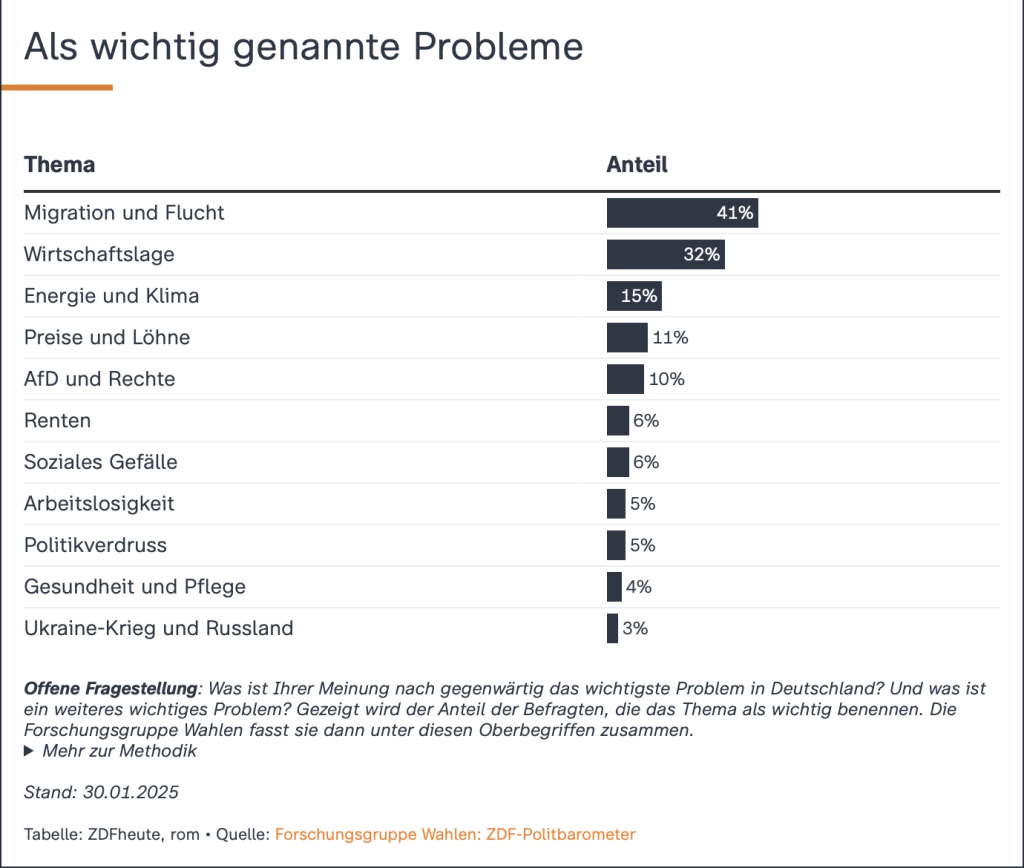
While immigration comes out on top in most polls of voters’ most important issues, we can see that the economic situation, energy, and inflation and wages — all issues directly affected by Berlin’s Russia policy — are a combined 58 percent.

The following article will focus primarily on Germany’s foreign policy and specifically if any of the political parties will take the country (and therefore to a certain extent, Europe) in a different direction?

The AfD Firewall Comes Down

For a long time it looked like the Alternative for Germany party was the one to do so.

The party that started out as an anti-EU and morphed more into an anti-immigrant has long been hated and feared by the German political-media establishment. Yes, it has a small core support from neo Nazis, but the real reason  was its anti-NATO stance, brutal honesty about Berlin being a “slave” to the US, and a desire to make nice with Moscow seeing as it is in the national interest of Germany to do so.

Well, last month the AfD adopted a motion in support of Germany and the US building closer relations.

And now lo and behold the “firewall” against the AfD is coming down at the national level. The CDU on January 29th passed — with votes from the AfD — a non-binding motion aimed at turning back illegal and undocumented migrants at the nation’s borders. Chaos ensued. The “center” parties have nothing to run on other than AfD “threat to democracy” and so they are. They vigorously denounced the CDU for destroying democracy by cooperating with the AfD. There were protests around the country, which led to the evacuation of CDU headquarters in Berlin and the occupation of the CDU office in Hanover:

On Friday the Influx Limitation Act, which would limit migration to Germany, failed following the uproar and refusal of the Greens, SPD, and others to negotiate with the CDU. The fallout from Merz’s dance with the AfD remains to be seen. Will it motivate voters for the SPD, Greens and other “center” parties? Will it stop CDU voters from migrating to the AfD? As of now, the AfD is gaining slightly in the polls:
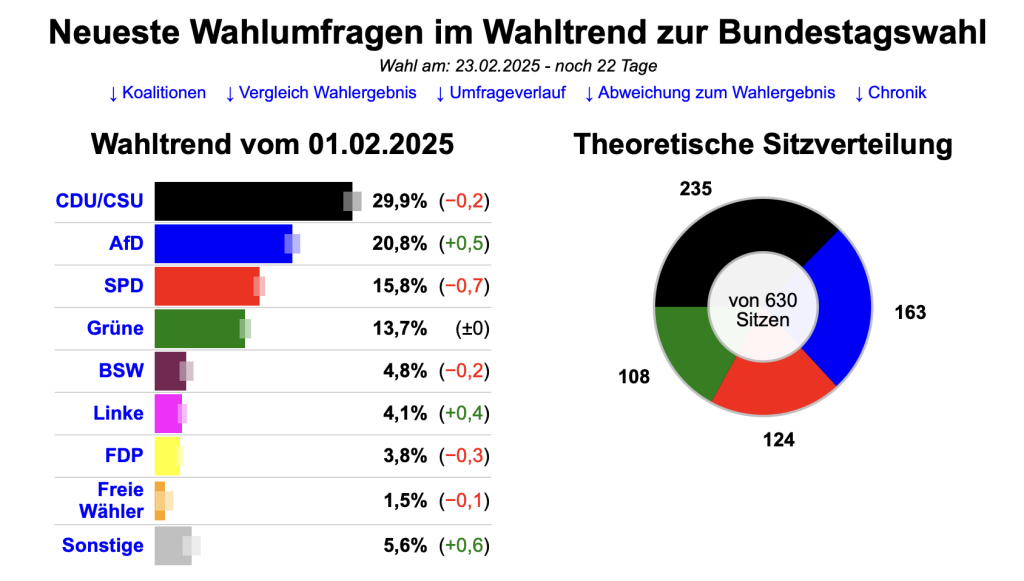
And as German current affairs commentator Eugypius points out, the uproar and refusal of the rest of the “center” to work with the CDU now provides “an excuse to force the Union parties to vote with AfD yet again” — and potentially form a government together.

This continues a trend of the “center” effectively ushering the AfD into power. Let us count the ways Scholz’s government put out the welcome mat: They brought in record levels of immigrants during a housing crisis and while the government is cutting social spending and torpedoing the economy with its Russia energy policies. Oh, and when voters looking for an alternative turn to the AfD they howl about the sanctity of democracy while threatening to ban the party.

Despite the awfulness and ineptitude of the German “center” it is now an open question if the AfD name is a misnomer — at least on its policy towards Germany’s American overlords. Its embrace of Elon Musk and the Trump administration calls into question its nationalist bona fides. For example, will the AfD remain opposed to the stationing of US medium range missiles in Germany if the Trump administration wants them there as part of a maximum pressure campaign against Moscow?

We’re likely seeing the “Melonization” of the AfD. The Italian Prime Minister and her Brothers of Italy party came to power in 2022 amid howls of fascism, but instead of a new march on Rome, Meloni was more a model of how to use faux nationalism to rebrand American vassalage. She’s been one of the empire’s more dutiful subjects with regards to Russia and China, selling off Italian publicly-owned assets, and has made sure capital in Italy maintains its access to exploitable immigrant labor — and she looks set to become even more servile under Trump.

Despite the AfD’s embrace of the US, there’s still talk of the party being a bridge between Washington and Moscow. It’s easy to forget now, but Meloni was once supposed to perform that role as well, picking up the long tradition of Italy of maintaining strong ties with both sides. She was a long opponent of sanctions on Russia due to the need to protect Italian exports and its energy interests, and shortly before the beginning of Russia’s special military operation, she said it was essential it was to remain on good terms with Moscow and accused Biden of “using foreign policy to cover up the problems he has at home.” That all changed once she became prime minister in October of 2022, and Italians are worse off because of it.

With the AfD’s embrace of the US and the CDU reaching across the firewall to pass legislation last week, it looks increasingly possible — if not likely — that the AfD will join a CDU-led government following the upcoming elections.

What will the party represent if they get there?

Where the party has yet to compromise is in its insistence that today’s Germany should rid itself of any remnants of collective guilt for the horrors of the Nazis.

Elon Musk agrees, saying two days before the 80th anniversary of the liberation of Auschwitz (Russia was not invited to the commemoration event despite the Red Army liberating the camp) that Germany should ‘move beyond Nazi guilt.’

The way the AfD wants that process to unfold is remarkably similar to what has been going on in the West and former USSR states for years. Rehabilitation of Nazis started in 1945, but really picked up steam over the past few decades.

As we highlighted at the time, Elon Musk and AfD co-chair Alice Weidel’s X history lesson equating communism with Nazism was right in line with the “rules-based international order’s” longtime efforts to rehabilitate fascists, blame the Russians for WWII, and rewrite history in Ukraine, other former Soviet states, and increasingly in the West itself.

Musk and Weidel are propagating a historical view that fits right in with Atlanticists who have been so busy for so long trying to equate WWII-era Nazism and communism. While originally more of a fringe view, it started to go more mainstream in 2008 when the European Parliament adopted a resolution establishing August 23 as the “European Day of Remembrance for the victims of Stalinism and Nazism” — effectively equating the two Also called Black Ribbon Day, the US in 2019 adopted a resolution to observe the date.

The same year, the European Parliament went even further and adopted a resolution “on the importance of European Remembrance for the Future of Europe.” It proclaims that the Molotov-Ribbentrop pact was responsible for World War II, and consequently that Soviet Russia is as guilty of the war as Nazi Germany.

As Efraim Zuroff, director of the Simon Wiesenthal Centre, told the Guardian way back in 2009:

“People need to wake up to what is going on. This attempt to create a false symmetry between communism and the Nazi genocide is aimed at covering up these countries’ participation in mass murder.”

I think it does more than that. While the USSR might be long gone, this rewriting of history to turn the liberators of Europe (the Soviets) into villains makes fascists the victims and feeds into modern Russophobia. Case in point:

The EU’s genocide-supporting, anti-free-speech, war-with-russia “center” has been embracing this right kind of “right” for some time — from Armenia to the Baltics and of course Ukraine. They have been nurturing it across the West, and we’re now a step away from open declarations to fulfil Hitler’s quest for lebensraum.

And how does the German center respond? Scholz had this to say about the world’s richest man putting his finger on the scale for the AfD and helping spread the rewriting of German WWII history far and wide: “If you look at the print press in Germany, you will see that there are many billionaires that also intervene in politics. That’s not new. What is new is that he is intervening in favor of right-wing politicians all over Europe. And this is really disgusting.”

Perhaps the AfD deserved some benefit of the doubt before considering how the establishment media comes down like a ton of bricks on any hint of inside threat to the “rules-based order,” and one could argue some of the party’s considerable baggage was worth the cost in order to break the US stranglehold over Europe.

But by aligning itself with the US, what does the party offer other than a rebrand of Germany’s vassalage?

On the bright side, the AfD’s turn likely means less work for the European Commission. Following the December overturning of the election in Romania, European officials were casually talking about Germany being at risk of the same bogus social media “disinformation” as Romania — the implication being that the will of the German voters could be similarly cancelled if too many of them choose the wrong party. While the Commission is still running “stress tests” of social media platforms in Germany ahead of the election, it’s unlikely it concocts a half-baked operation like in Romania against the an AfD in the good graces of the Trump administration.

Sahra Wagenknecht Tries to Crash the Party

While the other parties have differences in economic, immigration, and climate policies, they are all more or less united in their slavishness to the US and antagonism toward Russia.

There is one exception.

Despite only forming at the beginning of last year, the Sahra Wagenknecht Alliance (BSW) picked up between 10 and 15 percent in three federal-state elections last year — although they were on formerly East German turf friendlier to the party.

While doing well for a newcomer, BSW is struggling in the polls to get above the five-percent barrier to gain seats in the new parliament and is far from being a player in coalition building. Nonetheless, should it get there Wagenknecht has vowed to do all she can to block militarization spending.

The partiy’s election manifesto “Our Country Deserves More!” correctly diagnoses the war in Ukraine as “a proxy war between Russia and the US”.

Elsewhere the party manifesto calls for EU powers being transferred back to national states and no new countries joining the EU — especially not Ukraine.

And the party calls for restrictions on immigration, at least until Germany gets its house in order and can find a better way to integrate arrivals.

Yet BSW hasn’t gained the traction that the AfD has.

Despite all the media efforts to lump Wagenknecht and the AfD together as Kremlin-controlled, anti-democratic far-right threats, the parties are largely polar opposites. Just a few examples:

  • BSW proposes a fairer tax system that benefits the working class, such as the demand for an excess profits tax in the industrial sector. The AfD wants to slash taxes across the board, including those that are progressive and serve to redistribute wealth, such as the inheritance tax
  • BSW believes in global warming and wants to continue to take climate action but work to soften the economic blow to the working class. The AfD rejects climate science. In its EU election manifesto, it says that the “claim of a threat through human-made climate change” is “CO2 hysterics,” and it would do away with climate laws that reduce prosperity and freedoms.
  • BSW wants a higher national minimum wage and pensions, cheaper and better public transport, more social housing, a national rent cap, more money for education and health, free school meals, stronger consumer protection, the scrapping of VAT on essential foodstuffs. The AfD wants none of this and stresses the limits of the state’s role.

One can only wonder why Musk and Vice President JD Vance spoke out in favor of the upstart AfD and not Wagenknecht.

The Question Bigger than this Election

Where do Germans go if/when the new government makes no progress in turning the ship around?

The reality is much of Germany’s fortunes depend on Washington. Even if the Trump administration finds some agreement with Moscow over Ukraine and wider spheres of influence, will it bring reprieve for Germans?

The US is accelerating extraction efforts from its vassals, which will continue regardless of an agreement with Russia. See Trump’s efforts to force NATO members to up military spending to five percent of GDP, buy more US oil and LNG, an American tech takeover of the EU, using Europe as chess piece in the confrontation with China, and all the while poaching European industry.

Meanwhile there’s increasing talk from all corners about reforming the country’s debt brake — Germany’s constitutional limit on government spending. The brake played a central role in the downfall of the last government when it struck down a workaround attempt. Coalition infighting over spending plans stressed by Ukraine aid, weapons purchases, and energy crisis relief ultimately collapsed the government.

Should Germany say goodbye to the debt brake, where will the borrowed money go? To rebuild the crumbling Deutsche Bahn or more reckless wagers on the collapsing of Russia and into the pockets of American oligarchs?

Merz says military expansion will be a budgetary priority.

After the past three years of social spending cuts in order to pay for more military purchases, Project Ukraine, and self-inflicted energy debacles, Merz says it was redistributive. It was — upwards — but that isn’t what he’s talking about, and he promises his government will right the ship by cutting social spending and attracting more private investment in the economy. Okay, then.

On foreign policy, while he talks tough against Russia his moves will largely be dictated by Washington, although he says his government will be more willing to wade deeper into the conflict. Just as important, he’s eager to take a more active role in the empire’s confrontation with China even if it means more pain for German businesses.

Essentially this means that regardless of the makeup of the next government — whether an AfD-CDU coalition or a grand variety of the CDU-SPD-Greens — the standard of living for the majority of Germans will continue declining.

And that’s probably a best-case scenario.

For a glimpse of a worse version we can turn to Professor Sergey Karaganov, honorary chairman of Russia’s Council on Foreign and Defense Policy, and academic supervisor at the School of International Economics and Foreign Affairs Higher School of Economics in Moscow. He writes the following:

Sending Ukrainian cannon fodder to slaughter, they are preparing a new one—Eastern Europeans from a number of Balkan states, Romania and Poland. They have begun to deploy mobile bases, where contingents of potential landsknechts are trained. They will try to continue the war not only to the “last Ukrainian”, but soon to the “last Eastern European”…

…the sooner the better it is necessary to announce that our patience, our readiness to sacrifice our men for the sake of victory over this bastard will soon run out and we will announce the price—for every killed Russian soldier, a thousand Europeans will die if they do not stop indulging their rulers who are waging war against Russia. We need to tell the Europeans directly: your elites will make the next portion of cannon fodder out of you, and in the event of the transition of the war to the nuclear level, we will not be able to protect the civilian population of Europe, as we are trying to do in Ukraine. We will warn about strikes, as promised by Vladimir Putin, but nuclear weapons are even less selective than conventional weapons. Of course, at the same time, the European elites must be confronted with the fact: they, their places of residence, will become the first targets for nuclear retaliation strikes. It will not be possible to sit it out.

A grim scenario, although an understandable position when one considers that it is Western aid and arms propping up Kiev and killing Russians. It’s not just Trump who can make threats.

Will anyone in the next German government heed the types of warnings coming from Karaganov?

It would appear not as the likely next chancellor Merz is an Atlanticist to the bone and takes a hard line against Russia. The Greens and SPD remain subservient to Washington, and the AfD is now in the pocket of Musk and Trump.

While it looks increasingly likely that the AfD “firewall” could come down, and it could join the CDU-led government, what happens when the German economy continues to sink? And how much longer will the transatlantic facade hold until the relationship starts to receive more serious pushback?

And can it be done successfully by democratic means?

Three Students Sue Columbia Over Suspension Tied To Pro-Palestine Organizing

The lawsuit comes as nearly 200 Harvard students, staff, and faculty file discrimination complaints
February 8, 2025
Source: Prism


Three Columbia University graduate students who were suspended last year for attending protests against Israel’s genocide in Gaza filed a lawsuit against the university on Feb. 3. The civil suit, filed with the New York State Supreme Court, alleges that the university repeatedly singled out the plaintiffs for unwarranted scrutiny and harassment over their involvement in the school’s Gaza solidarity encampment and other pro-Palestine actions.

The lawsuit goes on to say that the university disregarded “its established disciplinary procedures to unlawfully persecute the plaintiffs based on their protected status and speech,” and that “the University engaged in extreme and outrageous behavior that exceeds all bounds of decency.” It further alleges that billionaire donors and New York City Mayor Eric Adams “successfully pressured the University to call the police on to campus to arrest plaintiffs and other protestors.”

The suit comes as nearly 200 Harvard University faculty, students, staff, and alumni submitted discrimination complaints to the university, according to a Feb. 4 press release, citing that Harvard has created a hostile environment on campus for Palestinians, Arabs, and Muslims, as well as Jewish and other community members who support Palestinian human rights.

The Council on American-Islamic Relations (CAIR) recently added Harvard to its list of “hostile campuses” after the university agreed to adopt an alarming definition of antisemitism that encompasses many types of criticism of Israel. Columbia has been on the list since it launched Jan. 8 due to its disciplinary actions against students.

Columbia refused to comment on impending litigation.

Catherine Curran-Groome, a plaintiff in the Columbia case and an Arab student enrolled in the Master of International Affairs program, said the students were suing because of Columbia’s refusal to be held accountable for the harm it has inflicted.

“We waited for the last year and a half and sought recourse, sought justice through the university’s own systems. We’ve filed complaints, we’ve written emails to the university administration,” Curran-Groome said. “We have engaged in every form of what they considered legitimate protest, from sanctioned political education events to sanctioned protests to democratic referendums, and every step of the way, we were met with repression—and many times violent repression—by the university and its agents.”

Curran-Groome said that despite the university implementing rules and procedures to protect student demonstrators after the 1968 Vietnam War protests, she has seen the same dynamics play out in the disciplinary process, where those rules are being flouted.

“We’re seeing Columbia commit the same harms and the same grave injustices today that they committed in 1968” Curran-Groome said, when more than 700 students were violently arrested after occupying campus buildings while calling for Columbia to cut its ties to research for the war.

Curran-Groome and Aidan Parisi, another plaintiff in the lawsuit, were first suspended on an interim basis for their involvement in a political education event planned by the Palestine Working Group, an official student group Curran-Groome belonged to. The event, held in March 2024, focused on historicizing Palestinian resistance. University officials told the group to move the event to Zoom, to a different date, or off campus, according to the lawsuit. They chose to move it off campus but were told afterward that it was an unsanctioned and unapproved event. The administration launched an investigation into the event, and the students claim they were placed on interim suspension without due process.

According to the lawsuit, the plaintiffs received notice on April 3, 2024 that they were being placed on interim suspension “effective immediately and until further notice,” in order “to ensure the safety of the Columbia University community.” In addition to barring the plaintiffs from their classes, campuses, and academic and extracurricular activities, plaintiffs were given 24 hours to vacate their off-campus apartments, leased to them by the university, before their access would be suspended, the lawsuit claims.

Brandon Murphy was placed on interim suspension over alleged “disruptive behavior,” “vandalism,” and other violations of the university’s guidelines, based on his alleged presence at the student encampment on April 17, 2024. Despite Murphy’s requests, the university did not provide any evidence of the claims, the lawsuit says.

As a result, Murphy lost access to his health care plan, and the status of his full scholarship is uncertain, according to the lawsuit.

On Aug. 23, 2024, Murphy was notified that he was being suspended for one year as punishment for violating the terms of his interim suspension through his alleged presence at an April 30 protest. He appealed the decision, but his appeal was denied.

Curran-Groome and Parisi, too, received longer suspensions for allegedly violating the interim suspensions by being present on campus. The pair said they were never shown any evidence for why the original suspension order was issued.

Curran-Groome received a two-year suspension, and her scholarship was revoked, without which she may not be able to afford to return to Columbia. She believes that this is one of the harshest punishments any student has received for something like this, since the 1968 protests when 30 students were suspended, and that her Arab identity has played a role. Parisi and Murphy have received one-year suspensions each.

At Harvard, the medical school canceled a non-compulsory lecture planned for Jan. 21 on wartime health care that would have had speakers from Gaza who were receiving treatment in Boston, on the basis that the panel was one-sided and did not include Israeli speakers, said Dr. Titi Afolabi, Harvard Medical School alumna and medical staff at Harvard-affiliated hospital.

Afolabi describes this action as the “straw that broke the camel’s back.” Over the last year, concerns of Arab and Palestinian community members have been largely ignored, and it has become more acceptable to discriminate against them, she said. “There is a reporting system for discrimination claims that anyone in the university can submit to, and it just has come to light through CAIR that Harvard has been ignoring or not taking action on many of the complaints that are relating to anti-Arab discrimination.” Canceling the event was another “red flag” she said, adding to the discrimination and harm students are feeling on campus.

“We are hoping that the institution formally recognizes that Arab and Palestinian members of the community exist, and they, too, experience discrimination and harm that needs to be taken seriously,” said Afolabi, who is also a member of the ad-hoc coalition of Harvard faculty and staff for inclusion and belonging. “And on top of that, there is an act of genocide against them occurring right now that is also contributing to the unsafe environment that’s being cultivated on campus.”

Ekaterina Pesheva, Harvard Medical School’s senior director of science communications and media relations, told Prism in an emailed statement, “Harvard Medical School remains committed to combatting [sic] all forms of discrimination and harassment. We will continue to advance our efforts to ensure that all community members belong on our campus and in our classrooms, and are supported in their learning, research, and professional work.”

Pesheva said the medical school “remains committed to finding ways that allow students to voice concerns and constructively explore medical and healthcare delivery issues, including those stemming from war and other forms of geopolitical conflict.”

Similar allegations of ignored concerns from Arab students and those involved in pro-Palestine activism fueled the plaintiffs filing the lawsuit against Columbia, the plaintiffs said.

At a rally on Jan. 19, 2024, pro-Palestine protesters were attacked with “skunk,” a chemical weapon regularly used by the Israeli military on Palestinians, leaving numerous participants seeking hospital treatment, including Curran-Groome, the lawsuit said. After being sprayed with this chemical, students reported burning eyes and nausea, among other symptoms.

Parisi, who was also a victim of this attack, said that they reached out to public safety at Columbia, but their concerns were dismissed because they did not have any clothes to submit as evidence and they had not gone to the hospital. Further, during one of their disciplinary hearings, they reported doxxing and threats of violence, only to be dismissed again. “This was also experienced by numerous other students, and so this, the lack of care for our safety and concern for us, greatly contributed to why we needed to file this lawsuit,” Parisi said.

“The courts are really our only recourse at this point,” Curran-Groome said. “Columbia has left us no alternative.”

How Finland’s Left Is Beating the Far Right

By Li Andersson, Grace Blakeley 
February 8, 2025
Source: Tribune


Finland’s Left Alliance is countering the far right by rejecting austerity and championing workers’ rights and climate action. Grace Blakeley sits down with its leader, Li Andersson, to discuss the lessons for the European left.

I met Andersson at Käänne Festival — a conference she organised to bring the left together in the wake of a strong performance in the recent European Parliament elections. While the far-right made across much of the bloc, Finland bucked the trend. The left won 17 percent of the vote, and Andersson was elected an MEP with more votes than any candidate has ever received in a European Parliament election in Finland.

‘This is the first time we’ve had this festival,’ she told me as we sat down in the conference green room, above a bustling restaurant in the centre of Helsinki. ‘It’s really exciting for me.’

Andersson is the former leader of the Left Alliance, Finland’s main left party. The left put in a good performance in the 2019 elections, winning 16 seats and entering a coalition with the social democrats. The coalition was led by one of the coolest politicians in Europe, the SDP’s Sanna Marin, who you may have seen in the news after she was forced to apologise for going clubbing during COVID.

As we sit down, Andersson waves goodbye to Marin with a warm smile. The two have just finished a panel discussion on the reduction of working hours (alongside Will Stronge of Autonomy). I note the goodwill that clearly exists between Andersson and Marin with interest — it’s unusual for social democrats and leftists to get along so well.

The two do have a fair amount in common. Both are young, charismatic, intelligent women seen as modernisers within their respective parties. And they have some common views when it comes to policy. Andersson served in the Marin-led coalition as Education Minister, and at the conference, both seemed very keen on the idea of the four-day week.

The Cost of Austerity


Andersson believes that the last left government did not go far enough to transform the Finnish economy to the benefit of working people, which is why they lost power in the wake of the cost of living crisis.

‘You might have read the quote “Unemployment hurts governments, inflation kills them.” During the last government, we didn’t really discuss tools for address inflation. We were very much stuck on fiscal policy and not asking questions like “Do we use price caps?”’

Now the right is in power again, in coalition with the far-right Finns Party, imposing a harsh austerity agenda.

‘Austerity has been the main way of doing economic policy ever since the financial crisis. The only exception ever since 2011 was the government coalition that we had from 2019 to 2023.

‘The argument of the right is that we have to live within our means, we can’t take on more debt. But, of course, they have not succeeded in lowering the debt ratio because austerity has led to low growth and high unemployment.’

Finland is often lumped in with the other Nordic countries as an economy with solid labour rights and a strong social safety net. But thanks to the policies of successive right-wing governments, Andersson argues this characterisation is no longer justified.

‘I think it’s fair to say that we’re not really a Nordic model country anymore.’

In a story that has been repeated countless times across Europe, the right’s failed austerity agenda has abetted the rise of the far right.

‘The fuel for the far right comes from disillusionment. From the lack of vision, the lack of hope. When you have no credible alternatives for a better future, people turn their anger and frustration towards other groups.’

The difference in Finland is that the far right is actually in power.

‘This is a place where we have seen exactly what the cooperation between the right and the far right really means. They’ve imposed historic cuts to social security and healthcare and implemented a lot of highly criticised right-wing labour market reforms.

‘If you look at the rest of Europe, these parties still have the luxury of just portraying themselves as the voice of the people. But here we can really see what these parties do when they are in power. People have felt the impact of their policies. And it’s just Thatcherism with racism.’

Andersson compares the Finnish experience with Sweden’s, where the far-right party has become, as she puts it, ‘the formal support party of government.’ This institutionalisation is beginning to erode support for the party, whose vote share declined in the recent European elections.

Rebuilding Support


Andersson notes that in both Finland and Sweden, the parties best positioned to take advantage of the institutionalisation of far-right parties are the new ‘red green’ parties of the left.

‘We have done the work of creating a modern left alternative for as many voters as possible. We have combined environmental policy with ambitious policies for redistribution, but we have also been very clear when it comes to international law and human rights.’

The left alliance has been very focused on supporting both Gaza and Ukraine. Andersson says that opposition to Russian aggression, which is a critical issue in Finnish politics, has placed her at odds with some parties of the ‘old left’ across Europe. But she is adamant that the European left has to put aside its differences and try to work together.

‘A really uniting theme for all of us is challenging the broken economic model. The world is in such a terrible state that we need to build broad coalitions on the themes that unite us.

‘Sometimes the left tends to think that cooperation means we have to sit down and write a resolution where everyone agrees on every word, but that means you lose a lot of time and energy on stuff people don’t care about.’

Andersson is rigidly focused on the ‘stuff people care about.’ She is extremely well-versed on a multitude of policy issues. Over the course of our conversation, she speaks at length on topics ranging from Spain’s introduction of a 37.5 hour working week, to Isabella Weber’s proposal of using price controls to target inflation.

When I ask her about her own policy priorities, she says the focus is on policies that will deliver a ‘better working life.’ She is particularly focused on labour market reforms, such as the introduction of a real minimum wage and limitations on working hours. She also emphasises the importance of strengthening workers’ rights, which have been eroded by successive governments.

‘Here [the government] has restricted the right to strike. We want to work on reinstating the right to strike as it’s so fundamental. We’re also working on issues that have to do with representation in companies and company democracy.’

I ask her what the party’s relationship is like with the unions that would presumably benefit from these policy initiatives.

‘At the moment, it’s very good. There have been times when it has been more distant because the Left Party was going through this transition of incorporating environmental policies into our agenda. That created tensions with the trade unions at the time.

Now, it’s a very different situation because I think that they have understood the implications of the environmental disaster we’re living in. And because of everything that has happened [with the far-right government], we now have a lot in common in terms of policy.’

The Alternative


This tension between modern left parties and the labour movement over climate is an issue all over the world (read this book to learn how organisers are overcoming this divide). But Andersson is adamant that what she calls ‘red green’ politics is the only way forward — for both pragmatic and ideological reasons.

‘We just got news now that the Finnish forest is no longer a carbon sink because there has been so much logging. The forests are now a source of emissions. And that’s also a redistributive issue because it’s a source of profit for the logging industry, and the consequences will be paid for by taxpayers.’

When I ask her about the greatest challenge for the left in Finland, she talks about the apparent closure of the ‘progressive’ space across Europe. Sure, Finnish left parties did well in the recent European elections, but that took place against a background of right resurgence.

‘I think Finland should be used as an example outside our own borders. I hope we won’t see many other countries where the far right actually gets into power, so we should use the Finnish example to help people to understand that their policies have nothing to do with supporting workers or increasing equality.

‘And the left needs to continue to work on our proposals for an alternative economic model. We need to be brave on that.’

Li Andersson is chairperson of Finland’s Left Alliance and a member of parliament for Finland Proper,


Source: Declassified UK

Peter Mandelson, Keir Starmer’s choice for British ambassador to the US, co-owns a business that helps companies “see opportunities in politics, regulation and public policy”.

Mandelson, who has a long history of favouring corporations in often scandalous situations, looks set to keep his shares in this company while supposedly representing the UK.

He founded his lobbying company, Global Counsel, in 2010, creating a lucrative business from his political contacts built up while a minister under Tony Blair and Gordon Brown. 

Mandelson stood down from Global Counsel’s board last year – probably in preparation for a post with Starmer’s government – but remains one of the two largest shareholders of the firm, owning over 25% of the company. 

According to Companies House he is a “person with significant control” of Global Counsel. 

I asked the Foreign Office if Mandelson must give up his ownership of Global Counsel to be ambassador. 

They did not answer directly, telling me: “There is an established regime in place for the management of interests held by ambassadors or High Commissioners. This ensures that steps are taken to avoid or mitigate any actual, potential or perceived conflicts of interest.”

The Foreign Office would not give any more detail of this “regime”.

Conflict of interest?

It seems likely Mandelson will remain a Global Counsel owner while US ambassador as long as he puts aside active involvement in the company and informs civil servants of any awkward moments.

Global Counsel’s latest accounts say they are expanding to grab “the significant market opportunity arising from increasing geo-political uncertainty and the need for companies globally to pre-empt and react to the consequential change”including “opening offices in Washington DC”. 

In other words, they are focussing on the US just as Mandelson gets the top UK job in Washington.

The risk that Mandelson will use his time as ambassador to make friends with multinational and US corporations rather than represent UK interests seems obvious.

Mandelson has repeatedly left his public appointments due to scandals, so an early return to Global Counsel is possible. 

Global Counsel’s recent clients include Palantir, the defence oriented US tech company owned by Trump supporting billionaire Peter Thiel currently chasing NHS contracts, and Sequoia Capital, a US tech investor that is a “partner” of Elon Musk’s SpaceX.

Peter Mandelson’s rise

Mandelson was one of the architects of Blair’s “New Labour”. Once a teenage Communist Party member, undoubtedly very clever and drily funny, Mandelson used his knowledge of the Left to steer Labour sharply rightwards.

His manoeuvring earned him the nickname the “prince of darkness”. In politics his one consistent manoeuvre was making Labour suck up to big business, often with bad results.

Back then the US Embassy wanted Blair’s Labour government to accommodate American utility company Enron. They had a bad reputation, including involvement with human rights abuses. 

Other Labour ministers kept Enron at a distance, but Mandelson met them, backed them and allowed them to open power stations and buy Wessex Water. 

In 2001 Enron was exposed as more than a bad company: they were a criminal conspiracy built on financial fraud that collapsed in scandal. 

Mandelson also had responsibility for the “Millennium Dome” – a bizarre corporate sponsored celebration of the year 2000 that swallowed up government attention and ended in shambolic failure.

The Jeffrey Epstein connection

Mandelson had to leave Cabinet twice because of scandals about relations with businessmen. But his most scandalous association with a businessman was revealed long after he left government.

US financier Jeffrey Epstein mixed his business dealings with sex trafficking and exploiting underage girls. Emails between Epstein and US bank JP Morgan show he was close to  Mandelson. 

In 2009 Epstein emailed JP Morgan bankers boasting about their friendship, saying “Well for all intends [sic] and purposes Peter Mandelson is now deputy prime minister.” 

Mandelson seemed willing to overlook Epstein’s offences to be close to a financial ‘mover and shaker’.  

Emails suggest Mandelson stayed at Epstein’s Manhattan mansion in 2009, while Epstein was in prison for soliciting prostitution from a minor. 

Epstein also said Mandelson stayed with him in Paris in 2011 – when Epstein was a registered sex offender – and referred to him as “Petie” in emails to JP Morgan bankers.

Cashing in

Mandelson helped lead Labour to defeat in 2010, then left politics (albeit keeping a seat in the Lords) to found Global Counsel. It made Mandelson wealthy. Latest accounts show the firm has a £16m turnover and currently owes Mandelson £1.3m.

Starmer’s announcement specifically cited Mandelson’s role as “co-founder of Global Counsel” when appointing him ambassador, but the firm’s record raises multiple potential conflicts of interest.

Global Counsel’s website says the firm “advises international clients on Russian market entry, the impact of Russian sanctions and navigating Russian policymaking”. 

A 2020 Guardian investigation based on leaked documents showed in 2015 and 2016 Global Counsel helped gig-economy taxi firm Uber build Russian business as Mandelson “used his access to pro-Kremlin oligarchs, including some now under sanctions”.

This was after Russia had invaded Crimea. Mandelson’s friendship with now-sanctioned Kremlin-friendly oligarch Oleg Deripaska was key to putting Uber in touch with firms like now-sanctioned state-owned bank Sberbank.

Until June 2017 Mandelson was also personally a director of Sistema, an oligarch-owned Russian industrial conglomerate with defence interests which was sanctioned by the UK and US after Russia’s Ukraine invasion.

Angering Trump

Team Trump are reportedly angry with Starmer’s choice of Mandelson for ambassador, objecting to his links with China, seen by the Republicans as a dangerous rival nation.

Mandelson personally wrote advice for “Chinese investors” on how to “navigate populism” and deal with “Trump’s isolationist policies” on the Global Counsel website.

Global Counsel’s recent clients include Chinese social media firm TikTok and, reportedly, Chinese clothing giant Shein. Until 2023 Mandelson was president of the Great Britain China Centre, a Foreign Office body encouraging China-UK trade. 

Trump’s administration is also trying to bully Starmer’s government, so Mandelson’s appointment has become another flash point.  

For their part, Team Starmer seem deeply committed to giving old “New Labour” figures jobs regardless of the consequences – perhaps because they depend heavily on ageing Blairites for a political direction, or perhaps because they hope they too will be offered similar positions by a future Labour government even if their careers end in scandal.

There are suggestions Trump will refuse to accept Mandelson as an ambassador. It seems equally likely the public denigration is designed to make Mandelson into a more easily cowed, lame-duck ambassador. 

It doesn’t seem hard to persuade Mandelson to represent US corporate interests, no matter how bad they are for UK public policy. 

After all, recent clients of Mandelson’s firm Global Counsel include JP Morgan, the Bank of America and “Fair Civil Justice”, a campaign launched by an arm of the US Chamber of Commerce to try to stop “joint action” lawsuits against big businesses, which critics say would have stopped campaigns against injustice like that of the imprisoned Sub Postmasters.


Source: Craig Murray

Four UN Special Rapporteurs have written jointly to the UK government demanding explanation of its inappropriate persecution of journalists and political activists under the Terrorism Act. They state that those persecuted:

appear to have no credible connection to “terrorist” or “hostile” activity

The cases taken up by the United Nations are those of Johanna Ross (Ganyukova), John Laughland, Kit Klarenberg, Craig Murray (yes, me), Richard Barnard and Richard Medhurst. The UN letter is signed by:

Ben Saul
Special Rapporteur on the promotion and protection of human rights and fundamental freedoms while countering terrorism

Irene Khan
Special Rapporteur on the promotion and protection of the right to freedom of opinion and expression

Gina Romero
Special Rapporteur on the rights to freedom of peaceful assembly and of association

Ana Brian Nougrères
Special Rapporteur on the right to privacy


Under this UN special procedure, the letter is sent to the government in question which has sixty days to respond. This letter was sent by the UN to Starmer’s government on 4 December. No reply having been received, it has now been published.

It is worth noting that even with the UN letter on its desk and ignored, Starmer’s government in fact stepped up the use of the Terrorism Act against pro-Palestinian journalists and activists in this period. The cases of Asa Winstanley, Sarah Wilkinson and Tony Greenstein, among others, happened after the letter was drafted.


I should be clear that I was, working with Justice for All International (for which we had a crowdfunder last year in relation to the Assange case at the UN), heavily involved in assisting with preparation of this initiative, and made three visits to the UN in Geneva on the subject together with Sharof Azizov, and on one occasion Richard Medhurst. Your subscriptions and donations to this blog are the only funding I have to make such activity possible, so thank you.


The letter is in two parts. The first consists of an outline of the information received by the UN on each case and a request for a response from the British government.

But the second part is a devastating critique of the UK’s terrorism laws and their inappropriate use to stifle dissent and freedom of expression. This legal analysis on lack of conformity with the UK’s human rights obligations is not dependent on any of the particular cases cited.


While we do not wish to prejudge the accuracy of these allegations, we
express our concern regarding the potential misapplication of counter-terrorism laws
against journalists and activists who were critical of the policies and practices of
certain governments, which may unjustifiably interfere with the rights to freedom of
expression and opinion and participation in public life, lead to self-censorship and
have a serious chilling effect on the media, civil society and legitimate political and
public discourse.
We are particularly concerned by the broad scope of section 12(1A) and
schedule 7 of the Terrorism Act 2000 and schedule 3 of the Counter-Terrorism and
Border Security Act 2019…


We are concerned at the vagueness and overbreadth of the offence in
section 12(1A) of the Terrorism Act 2000, which criminalizes expressing an opinion
or belief that is supportive of a proscribed organisation and being reckless as to
whether it encouraged support for that organisation…


The term “support” is undefined in the Act and in our view is vague and
overbroad and may unjustifiably criminalize legitimate expression.


…the meaning of expressing support for a
proscribed organization is ambiguous and could capture speech that is neither
necessary nor proportionate to criminalize, including legitimate debates about the de-
proscription of an organization and disagreement with a government’s decision to
proscribe…


We note that there is no requirement that the expression of support relate to
the commission of violent terrorist acts by the organization. As such, the offence may
unjustifiably criminalize the expression of opinion or belief that is not rationally,
proximately or causally related to actual terrorist violence or harms. The offence
further does not require any likelihood that the support will assist the organization in
any way. It goes well beyond the accepted restrictions on freedom of expression under
international law concerning the prohibition of incitement to violence or hate speech…


We note that some proscribed organizations are de facto authorities
performing a diversity of civilian functions, including governance, humanitarian and
medical activities, and provision of social services, public utilities and education.
Expressing support for any of these ordinary civilian activities by the organization
could constitute expressing support for it, no matter how remote such expression is
from support for any violent terrorist acts by the group…


Further, the section 12(1A) offence does not require the person to intend to
encourage others to support the organization…


We are further concerned that the absence of legal certainty may have a
chilling effect on the media, public debate, activism, and the activities of civil society,
in a context where there is a heightened public interest in discussion of the conflict in
the Middle East, including the conduct of the parties and the underlying conditions
conducive to violence in the region. We are further concerned that a person could be
prosecuted for isolated remarks or sentences that mischaracterize the overall position
of the individual, or despite the individual’s intentions or continued and express
disavowal of terrorist violence, given the subjectivity and contested meanings of
certain expressions in relation to sensitive or controversial political conflicts…


We encourage your Excellency’s Government to repeal section 12(1A), or
otherwise to amend it to protect freedom of expression, and to develop prosecutorial
guidelines for its appropriate use to avoid the unnecessary or disproportionate
incrimination of political dissent…


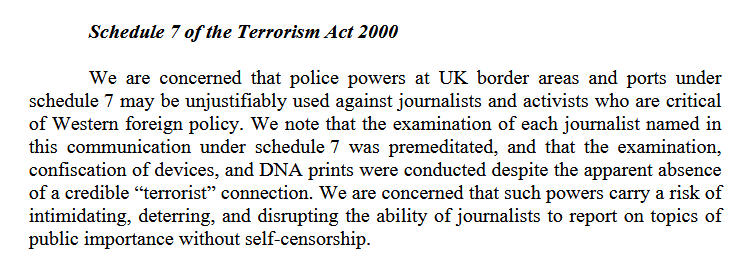
We are concerned that police powers at UK border areas and ports under
schedule 7 may be unjustifiably used against journalists and activists who are critical
of Western foreign policy. We note that the examination of each journalist named in
this communication under schedule 7 was premeditated, and that the examination,
confiscation of devices, and DNA prints were conducted despite the apparent absence
of a credible “terrorist” connection. We are concerned that such powers carry a risk of
intimidating, deterring, and disrupting the ability of journalists to report on topics of
public importance without self-censorship…


We are concerned that the distinction between “examination” and “detention”
under the Act is artificial given the punitive sanctions for of non-compliance, and that
this distinction may be inconsistent with the accepted meaning of “arrest” or
“detention” under article 9 of the ICCPR. We are further concerned that the extensive
powers authorised under section 2 do not require any degree of suspicion that a person
falls within the meaning of “terrorist” at section 40(1)(b). The extreme breadth of
such power enables unnecessary, disproportionate, arbitrary or discriminatory
interference with an individual’s rights, including freedom from arbitrary detention,
freedom of movement under article 12(1) of the ICCPR, and the rights to leave and
enter one’s own country under article 12(2) and (4) of the ICCPR…


we refer your
Excellency’s government to article 17 of the ICCPR which requires that “[n]o one
shall be subjected to arbitrary or unlawful interference with [their] privacy, family,
home or correspondence, nor to unlawful attacks on [their] honour and reputation”.
We note that several journalists detained under schedule 7 have had their electronic
devices confiscated for a significant period of time and have not been updated on the
use, retention or destruction of their data, or advised in relation to their personal data
protection rights.


We urge your Excellency’s Government to consider the growing number of
instances where schedule 7 may have been inappropriately directed towards
journalists and activists, and to consider addressing this through amendments to the
legislation, guidance for relevant officials, and training of border security officers. We
further encourage your Excellency’s Government to address the judiciary’s concerns
regarding the retention of electronic data

It is a stunning letter well worth reading in full; the legal language and diplomatic formality does not disguise the extreme concern of the UN at the extraordinary authoritarian attack on freedom of speech in the UK.


I might reveal that some of the UN Special Rapporteurs who signed were very sceptical of the issue until studying the details. One told me personally they were too busy to look at such a minor problem; their attitude changed completely when faced with papers on the cases involved.


There is no sign the UN has given the Starmer government pause; human rights are extremely low on their agenda. Support for Israel and the crushing of pro-Palestinian sentiment, or of any criticism of western foreign policy, is extremely high on their agenda.


The legislation concerned has been brought into disrepute by the widespread support in public from Establishment figures for HTS in Syria, even though it remains a proscribed organisation and any expression of support is an offence under the Terrorism Act. To my knowledge, not one person has been charged or even questioned for supporting the HTS coup in Syria.


This occurred after the UN letter, but they could now mention extreme arbitrariness in police and prosecutorial application of the law in their critique. The Terrorism Act is being used to criminalise peaceful criticism of western foreign policy. There can be no doubt about that at all.


It also remains the case that there has not been one reference in UK mainstream media to the persecution of dissident journalists using terrorism laws. I don’t expect the prostitute stenographers to power to change that by covering this censure from the United Nations.