It’s possible that I shall make an ass of myself. But in that case one can always get out of it with a little dialectic. I have, of course, so worded my proposition as to be right either way (K.Marx, Letter to F.Engels on the Indian Mutiny)
Monday, February 10, 2025
Mitsubishi Shipbuilding Advances Concept for Smaller LCO2 Carrier
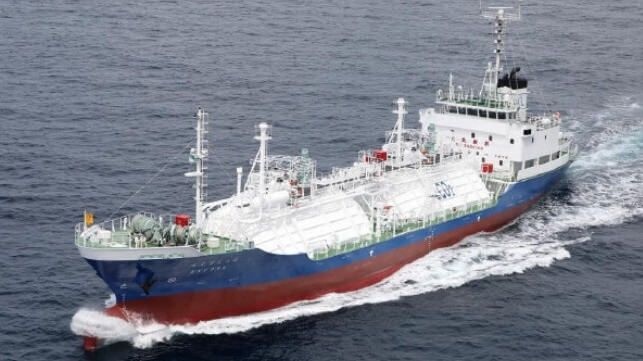
Mitsubishi Shipbuilding completed a demonstration LCO2 carrier in 2023 and continues to develop solutions for the emerging market ("K" Line)
Mitsubishi Shipbuilding Co. working in conjunction with Nippon Gas Line continues to make progress on the development of its concept for a liquified CO2 carrier vessel. While much of the focus in the industry is on the need for more and larger CO2 carriers to meet the anticipated needs of the carbon capture and storage industry, this project focused on a specialized LCO2 carrier tailored to the coastal market in Japan.
Mitsubishi has been actively promoting the development of LCO2 carriers and the establishment of CCS value chains. In a project working with Nihon Shipyard Co., it is jointly pursuing the development of an ocean-going liquified CO2 carrier while working with NYK they developed concepts for a vessel that could transport both CO2 and ammonia. Another project that also involves Nippon Gas Line looks to develop the value chain including moving the captured CO2 to Malaysia for storage under the seabed.
Demand for LCO2 carriers is expected to grow in tandem with CCS (carbon dioxide capture and storage) projects involving marine transport of CO2 captured in Japan to storage sites. Mitsubishi Shipbuilding and Nippon Gas Line worked jointly on a study exploring the need to transport CO2 captured at smaller sites in the Seto Inland Sea area and transport it to overseas storage sites.
Mitsubishi Shipbuilding in late 2023 completed the construction of a small-scale demonstration LCO2 carrier with a cargo tank capacity of 1,450 cubic meters. The project sponsored by the Japanese government was to develop expertise in the sector and was followed by a program to establish standard specifications and designs for LCO2 carriers along with a focus on the steps to establish a construction supply chain.
Mitsubishi Shipbuilding and Nippon Gas Line have now completed a concept study for a low-pressure type coastal LCO2 carrier for the needs of emitters in the Seto Inland Sea area. ClassNK (Nippon Kaiji Kyokai) reviewed the designs and awarded Approval in Principle for the carrier to serve in coastal transport. The study explored domestic storage sites or acting as a feeder operation for overseas shipping.
The companies expect the AiP certification to support the efforts to develop opportunities for highly versatile small-sized LCO2 carriers to consolidate CO2 collection in Japan for transfer through overseas shipping.
Previously, the companies have said the goal would be to start construction on LCO2 carriers by 2027. They anticipate beginning a commercial service by 2028.
South Korean Firm Begins Construction of New Cebu Port in Philippines
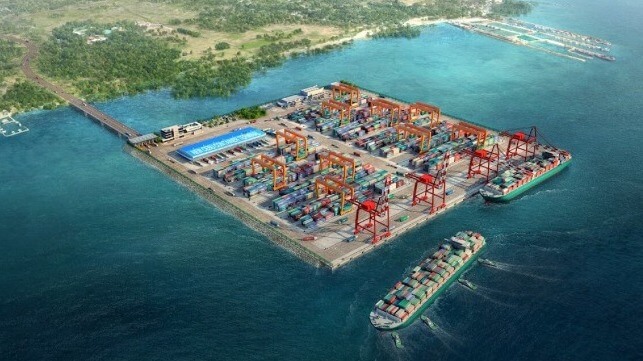
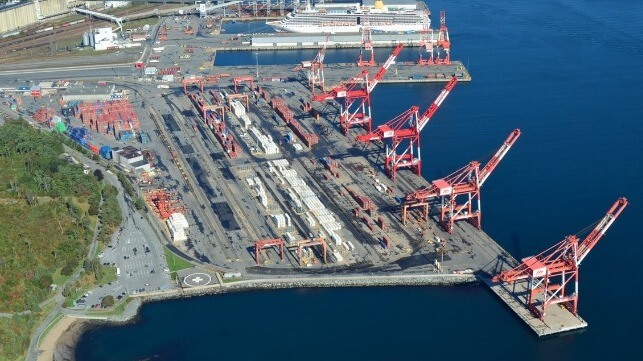
After a long delay, the construction of the New Cebu International Container Port (NCICP) in the Philippines has finally kicked off. The Transportation Secretary Jamie Bautista in company of other senior government officials this week led the groundbreaking ceremony for the port. The $290 million NCICP is located in Tayud, a district at the northern end of Cebu City.
The project was first mooted in the early 2000s but experienced approval delays. However, in December the government gave the contractor the green light to begin civil works. President Ferdinand Marcos, Jr. signed the project contract with the Korean company HJ Shipbuilding.
“This project is set to improve Cebu’s cargo handling capacity, alleviate congestion at the existing facility (Cebu Baseport) as well as establish Cebu as a regional logistics hub. The construction is expected to be completed by 2028,” said Cebu Port Authority (CPA).
The project involves transforming 60 acres of reclaimed land into an international container port with an annual handling capacity of 395,000 TEU. The terminal will have five quayside cranes, a 500-meter berth and a water depth of 12 meters. This will allow the terminal to accommodate two 2,000 TEU feeders at any given time.
The NCICP project is being implemented under a bilateral partnership between the Philippine and Korean governments. The Import-Export Bank of Korea (KEXIM) is contributing around $172 million and the rest is coming from the Philippines’ national government. The International Finance Corporation of the World Bank is acting as the transaction adviser.
“NCICP will significantly boost economic engagement between the Philippines and South Korea, especially with the bilateral free trade agreement (FTA), which came into force on December 31. Trade and cargo volumes between the two countries is expected to increase significantly in the future,” said the Korean Embassy in Manila.
With the Philippines working to improve connectivity and supply chains within its 82 provinces, the country has announced major port expansion projects. Last month, the Philippine Ports Authority (PPA) issued tenders for the expansion of three major ports worth $14 million. The targeted ports include San Jose Port in the Province of Dinagat Islands, Roxas Port in Oriental Mindoro and Guinsiliban Port in Camiguin.
Chinese Bulker Runs Aground in a Storm Off Sakhalin
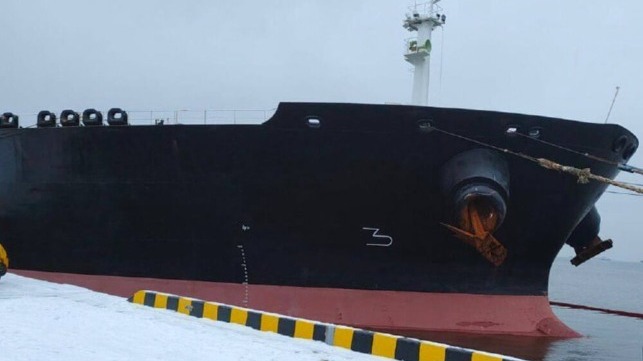
A Chinese bulker has gone aground on the shores of Sakhalin Island in the Russian Far East, and first responders have not yet been able to reach the scene.
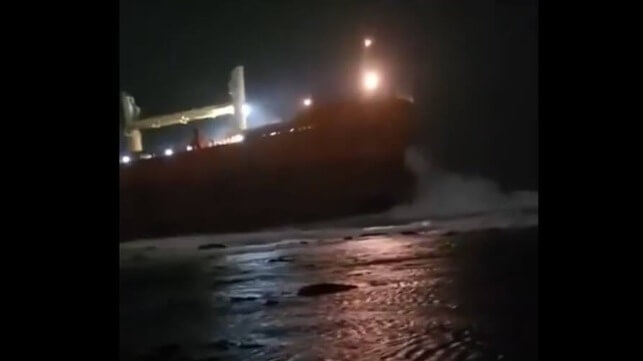
Videos released by state media show that the Chinese bulker An Yang 2 is hard aground on a rocky shore just south of the port of Nevelsk, on the southwestern end of Sakhalin. The vessel is exposed to heavy wave action and is broadside to the surf zone.
Because of rough conditions from a winter storm, salvors have not yet been able to reach the ship to evaluate its condition, said regional governor Valery Limarenko in a statement on the Russian social media application Telegram. "A high alert regime has been introduced in the district," he said.
Bystander photos show that the vessel's starboard anchor is deployed. The crew are still aboard and are reportedly safe, and local authorities are in contact with them as they discuss next steps.
According to the Ministry of Emergency Situations, An Yang 2 has 1,000 tonnes of coal in her holds, along with 56 tonnes of diesel and 700 tonnes of fuel oil. No pollution has been reported.
"The main task now is to eliminate environmental risks. All necessary measures are already being taken," said Limarenko. "This is not the first case: in 2021, another Chinese ship ran aground in the Kholmsky District. Then its owners refused to solve the problem, shifting all costs to the region."
An Yang 2 is a 2010-built bulker of 56,000 dwt tonnes, owned and managed by a shipping company in Hainan.
It is the second major casualty in Russia in two days. On Sunday, a tanker partially sank at the pier after an engine room explosion at the port of Ust-Luga, near St. Petersburg.
First Custom-Designed LCO2 Carrier Arrives in Norway to Start CCS
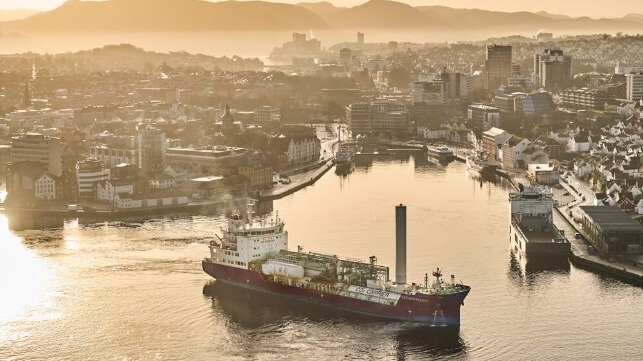
Northern Pioneer arriving in Stavanger, Norway (Tom Haga photo courtesy of Northern Lights)
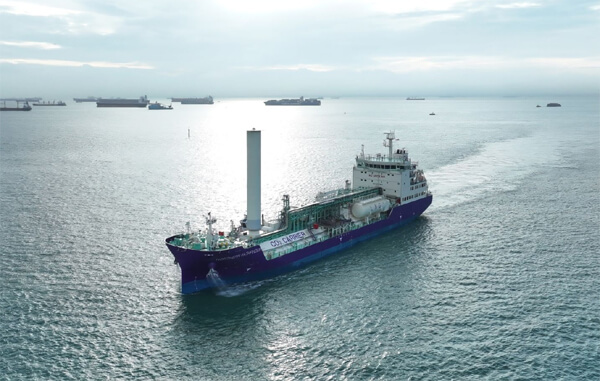
The world’s first custom-designed and built carrier for the commercial transport of liquified CO2 arrived on February 6 in its homeport of Stavanger, Norway. The vessel, Northern Pioneer (10,000 dwt), will be undergoing commissioning as it prepares to launch the first commercial operation for the transport of captured CO2 from industrial sites in Northern Europe and ultimately injection under the seabed of the North Sea.
The vessel has the capacity to transport approximately 7,500 cbm of liquified CO2. The cargo transport conditions are a maximum of 19 bar (g) pressure and a minimum of negative 35 C temperature. The first of four ships being built for the operation, Northern Pioneer, will shuttle between the receiving terminals in Øygarden and Brevik, where the first commercial customer, Heidelberg Materials, is located on the southern coast of Norway.
Northern Pioneer is the first LCO2 carrier completed for commercial CCS operations (Northern Lights)
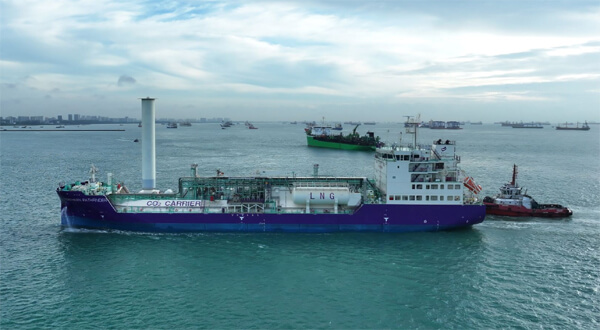
The vessel was built in China at the Dalian Shipbuilding Industry Company (DSIC) and delivered in November. She undertook a delivery trip stopping in Singapore to load LNG and rounding Africa before a stop in Las Palmas. She departed on January 25 for the final leg bringing her home to Norway.
The ship, which is 130 meters (426 feet) is registered in Norway but will be managed by Japan’s Kawasaki Laisha (“K” Line). It operates on LNG and also has a wind rotor and air lubrication under its hull.
The ship was christened today in Stavanger by Norway’s former Minister of Petroleum and Energy, Tina Bru. She was in the Norwegian Parliament in 2019 when the project then known as Longship was first proposed and instrumental in helping to advance the grounding-breaking project. Known as Northern Lights, it is a partnership between Equinor, TotalEnergies, and Shell.
Northern Pioneer made a service call in Singapore to load LNG during its delivery trip to Norway (Nothern Lights)
Northern Lights reports the vessel carried out testing and optimization of the energy-saving devices on the repositioning trip from China to Norway. The ship will now undergo mechanical commissioning at the receiving terminal and interface training between the ship and shore staff ahead of starting operations. Construction of the terminals was completed in 2024 preparing the operation to begin this year.
The second ship, Northern Pathfinder, was delivered at the end of December. She departed Singapore on January 17 and is currently nearing Walvis Bay, South Africa on her repositioning trip. An order for two additional vessels was also placed with DSIC as Northern Lights looks to expand its operations.
QatarEnergy's New LNG Carrier Fleet Begins to Take Shape
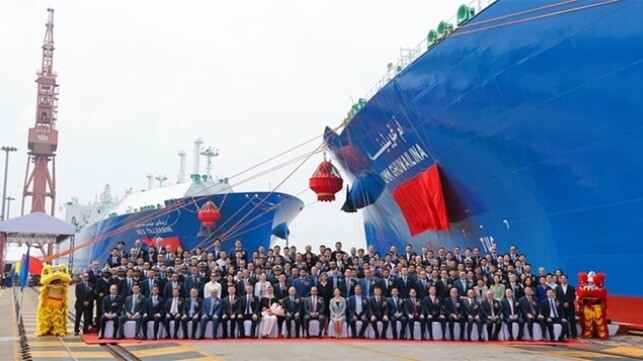
The LNG tankers Rex Tillerson and Umm Ghuwailina at their launch ceremony at Hudong-Zhonghua shipyard (QatarEnergy)
Following on from the news from the Gulf that Oman’s Asyad Shipping is expanding its fleet by acquiring a further 30 ships, QatarEnergy is now seeing the first deliveries of what will be a fleet of 128 new vessels by 2030.
QatarEnergy has said that its reinforced fleet will be a "floating pipeline," carrying a continual flow of LNG from Qatar’s expanding gas fields, mostly to Asia on tankers on long-term charters. The expansion will also cater to the shipping needs of QatarEnergy’s North Golden Pass LNG Terminal at Sabine Pass in Texas.
Though the Qatari firm orchestrated the newbuild program and negotiated with shipyards to reserve space for construction, the tankers were purchased by top global shipowners (or joint ventures) to charter to QatarEnergy on a long-term basis. The list of companies selected to buy and operate tonnage for QatarEnergy includes China Merchants Group, Shandong Marine Group, China LNG Shipping, Mitsui OSK, COSCO, Shandong Marine Energy, MISC Berhad, K-Line and Hyundai Glovis.
The new QatarEnergy LNG tankers, a mix of QC-Max and Q-Flex LNG vessels, are being built in China and South Korea. 43 of the vessels will be chartered-in by affiliate QatarEnergy Trading, to transport the portion of Qatar’s gas exports that are not covered by long-term supply contracts. This will reinforce its aspirations to become a leading global LNG trader.
The largest shipowner in the newbuild program is Nakilat, formally titled the Qatar Gas Transport Company Limited (QPSC). Nakilat is a publically-quoted company headquartered in Doha, whose shareholdings are dominated by the Qatari state and members of the royal family, but which also includes a broad spectrum of Qatari institutional as well as private shareholders. Qatari shareholders and pension funds hold about 40% of the company. With a targeted annual dividend yield of 5%, this means that a cross-section of Qatari society is benefitting from Nakilat and Qatari gas earnings, and which by sharing out wealth and prosperity also has a political stability dividend. It is a model being replicated in Oman, where Asyad plans to float an initial 20% of its shares via an IPO on the local Muscat Securities Market, with a block of shares reserved for Omani institutional and private investors.
Nakilat also operates the floating storage regasification unit FSRU Exquisite, stationed in a channel of the Indus River east of Karachi. It also owns the specialist Erhama Bin Jaber Al Jalahma Shipyard at Ras Laffan, and is tied into Milaha, the Qatari logistics company, via a shareholding.
Canadian and European Ports Increase Cooperation on Energy Transition
Canada and a section of major European ports have announced further steps in their collaboration in energy transition. Last week, Canada’s Minister of Transport and Internal Trade Anita Anand announced an investment of up to $17 million for the Halifax Port Authority. Part of this funding includes $15 million for development of the Halifax- Hamburg green shipping corridor.
Halifax and Hamburg ports signed a Memorandum of Understanding(MoU) to establish a green shipping corridor back in 2022. With the funding now available, Halifax will prepare for the green transition by establishing a hydrogen production facility, electrifying port equipment to reduce emissions and launching an incentive program to shift freight traffic from road to rail. In addition, the port will ready bunkering facilities to accommodate and refuel alternative fuel-powered vessels.
“Transport Canada’s Green Corridor investment will help to competitively position the Port of Halifax for the future. Around the world, there is interest to decarbonize shipping. The awarded funding will help fund feasibility work, assessments, new equipment and workforce development here at the port,” said Fulvio Fracassi, CEO of Halifax Port Authority.
The remaining $2 million will go into financing the Ship to Shore Crane infrastructure project. This is targeted at expanding terminal capacity and boost efficiency when servicing larger vessels at the Port of Halifax.
Meanwhile, the European North Sea Port has strengthened trade and energy cooperation with five Canadian ports, located in the south west region of the country. These include Montreal, Quebec, Saguenay, Sept-Îles and Trois-Rivières ports. This initiative is expected to improve connectivity of supply chains between the Saguenay- St. Lawrence maritime corridor and the North Sea corridor. In addition, the ports pledged to collaborate and achieve results together in areas such as decarbonization and knowledge transfer.
“Canada is North Sea Port’s fourth most important trading partner in terms of cargo throughput. Our location in western Europe is of great strategic importance for cooperation with these five Canadian ports,” said Maarten den Dekker, the Chief Sustainability Officer of North Sea Port.
Baltic Anchor-Drag Incident May Have Also Hit a Russian Telecom Cable
Tanker Eagle S, detained in the Baltic on Christmas Day after a suspected subsea sabotage attack (Finnish Border Guard)
After four serious subsea cable damage incidents in little more than a year, NATO's Baltic members are alert to the risk of possible sabotage attacks sponsored by Russia's intelligence agencies, and have increased their maritime security efforts in response. But Russian cables have also been damaged, according to Russian state communications company Rostelecom. Over the weekend, the cable operator told state news outlet TASS that "some time ago," one of its links under the Baltic was cut "as a result of external influences."
The company confirmed that repairs to the cable are currently under way, and the cable ship Sivuch is on scene for the work. As the location is within the Finnish EEZ, a Finnish Coast Guard patrol vessel is on scene and monitoring the work.
Finnish outlet YLE reports that Rostelecom informed Finland's government of the outage on December 27, two days after the tanker Eagle S dragged anchor and severed multiple Finnish subsea cables in the same area. Eagle S was boarded by Finnish police and detained, and nine members of her crew are under investigation.
Open-source analyst Auonsson noted that the current AIS location of the repair ship Sivuch aligns with Eagle S' trackline on the day of the casualty voyage - as well as the charted location of the Baltika subsea comms cable, which connects St. Petersburg with the exclave of Kaliningrad.
The Baltika cable may have also been damaged previously in the Newnew Polar Bear anchor-drag incident in October 2023.
After Evacuating Tartus, Russian Flotilla Leaves Mediterranean
A Russian military convoy carrying equipment from the naval base at Tartus has exited the Strait of Gibraltar, answering the question of whether Moscow would be repatriating the military gear it had deployed to Syria over the past decade.
In early December, U.S.-designated terror group Hay'at Tahrir al-Sham (HTS) ousted Syrian dictator Bashar al-Assad, driving Assad's Russian military backers to retreat to Tartus, home of the only Russian naval base in the Mediterranean. HTS did not attack Russian forces, even though Russia had bombarded HTS and its allies for most of Syria's 13-year civil war, but the Islamist group did cancel Russia's 49-year operating lease on the commercial portion of the seaport.
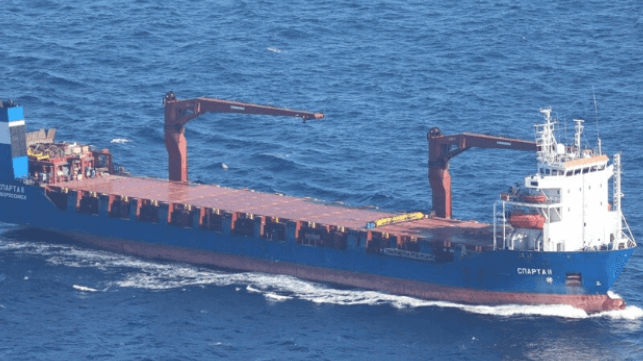
As HTS advanced, Russian Navy's Mediterranean Flotilla left Tartus en masse and took up station off the coast. In January, after weeks of negotiation, the military cargo vessels Sparta and Sparta II entered the port and backloaded large quantities of military equipment and containerized cargo that had been staged on the pier. As Moscow and HTS continued high-level talks on the future of Russia's presence in Syria, the ships departed for an unknown destination - prompting speculation about possible new basing arrangements for the Russian Navy in the Mediterranean.
Whether Russia secures an alternative base site from another friendly government remains to be seen, but this convoy - and its naval escorts, the remaining warships of Russia's Mediterranean Flotilla - appears to be headed home. Sparta and Sparta II exited the Strait of Gibraltar over the weekend, heading north towards Russia's ports in the Baltic. Given Russia's need for equipment on the battlefield, their cargoes are likely destined for the front line in Ukraine.
Tanker Suffers Engine Room Explosion at Russian Port of Ust-Luga
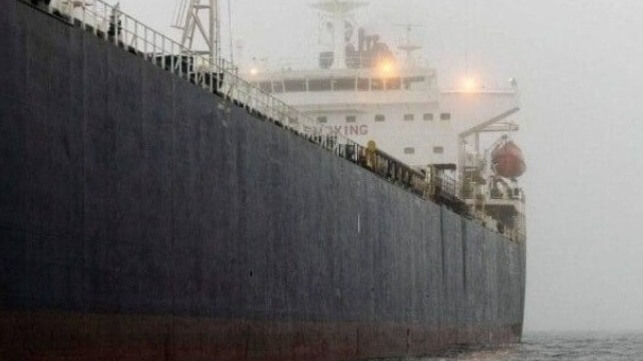
A tanker full of fuel oil sustained an explosion and may have partially sunk at the pier at the key Russian Baltic port of Ust-Luga, according to Russian sources.
Security services-linked channel Baza reports that the tanker Koala was preparing to depart Ust-Luga in the early hours of Sunday morning when she suffered an engine room explosion. Three separate blasts were reported as the vessel was preparing to depart, and the 24 crewmembers abandoned ship onto the pier.
The engine room flooded, and the tanker settled slowly by the stern until it made contact with the bottom, Baza reported The majority of the ship remains afloat, and at present no pollution has been reported. None of the crewmembers were injured.
Official reports have presented conflicting information. Russia's Marine and River Transport Agency reports that the tanker is not in danger of sinking and that its cargo tanks are undamaged. According to the regional governor of Leningrad, the explosions were a "man-made incident" during engine startup, and the tanker remains securely moored at the pier. The cause of the casualty is under investigation.
Koala is a Turkish-owned, Cypriot-managed Suezmax of 160,000 dwt capacity. She is 22 years old, past the typical retirement age for a crude oil tanker, and has changed her flag state four times in the past year. Her port state control inspection record shows infrequent checks, but no recent deficiencies.
The blast was the second major casualty of the weekend in Russia. On Saturday, the Chinese bulker An Yang 2ran aground on a rocky shoreline off Sakhalin in the Russian Far East.
Finnish Prime Minister Petteri Orpo said Sunday that Finland is monitoring the situation and has put its oil spill response capabilities on alert as a precautionary measure.
Offshore Wind Lifts Taiwan's Wind Power Generation to Record Levels
Last week, Taiwan reported peak wind production levels with presence of a strong northeast monsoon off its coast. The state-owned utility company Taipower said that wind power generation started to rise on Thursday, surpassing 3.1 GW by early hours of Friday morning. This record output accounted to 10 percent of the total electricity generation in Taiwan.
The peak production is a positive outcome as Taiwan doubles-down on investments in the offshore wind sector. In January, the Ministry of Economic Affairs (MoEA) issued an updated plan for the renewable energy, targeting to install 8.2 GW of solar and offshore wind by the end of 2026. This will see renewable energy account for 20 percent of electricity generation by 2026.
In addition, Taipower reported on the steady growth in Taiwan’s wind power generation. The output has rose from around 3 billion kilowatt-hours in 2022 reaching nearly 10 billion kWh last year. These levels of wind power are helping Taiwan meet peak electricity demand during the evening hours while solar power provides a stable output during the day.
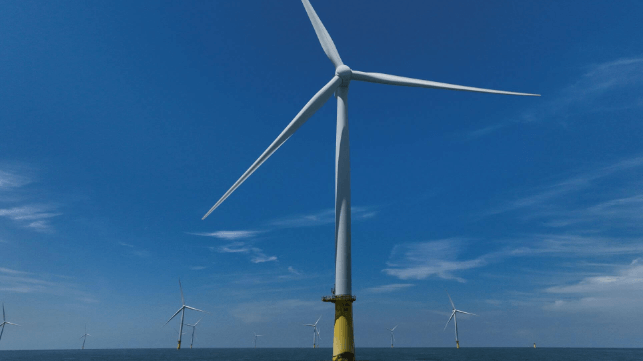
One of Taiwan’s largest offshore wind farms, the Yunlin project, entered operation last week. The Yunlin wind farm is now producing clean energy at its design capacity of 640 MW. It is located in the Taiwan Strait, between 5 and 11 miles off the west coast of Taiwan, and comprises 80 wind turbines connected to two onshore substations in Yunlin County. The development and operation of the wind farm is led by a consortium comprising Skyborn Renewables, TotalEnergies, EGCO Group and Sojitz Corp.
“We are pleased with the completion of the Yunlin offshore wind farm. This project realized with our partners will help Taiwan reach its 2025 target of 5.7 GW of offshore wind power,” said Olivier Jouny, Senior Vice President Renewables at TotalEnergies.
Mitsubishi Takes $340M Impairment on its Offshore Wind Portfolio
In its latest quarterly report, Japanese industrial conglomerate Mitsubishi revealed that it is taking a $340 million hit in connection with the reduced prospects of its domestic offshore wind portfolio, which it has placed under review.
Mitsubishi Corporation has announced plans to restructure its offshore wind portfolio in Japan, citing disruptions in the macroeconomic environment. It will be reviewing the future of three projects, including the 480 MW Noshiro Mitane Oga project off Akita Prefecture, 820 MW Yurihonjo City Offshore wind farm off Akita Prefecture and the 400 MW Choshi City project off the coast of Chiba Prefecture.
Mitsubishi was selected the operator of these projects in December 2021, when Japan completed its first fixed-bottom wind auction.
“In the wake of the pandemic and the Ukraine crisis, the business environment for offshore wind power has significantly changed and is continuing to change worldwide due to factors such as inflation, the depreciation of the yen, tight supply chains and rising interest rates. We will consider the appropriate next steps after thoroughly examining the results of our review,” said Mitsubishi.
Across major markets, investments in offshore wind continue to face economic pressure, especially in Europe and the U.S. In Japan, there is also a noticeably bearish market sentiment on the profitability of offshore wind projects. In the third wind auction concluded in December, at least 15 companies in the sector, including Mitsubishi Corp. and Cosmo Energy Holdings, did not participate, according to Nikkei. This is despite some of these companies having conducted environmental assessments in readiness for the auction.
Japan heavily relies on energy imports for its electricity needs and is targeting offshore wind as a stable supply that can be tapped locally. The country’s goal is to install 10 GW by 2030 and 45 GW by 2040.
Meanwhile, the Japanese government has signaled raising the local content goal for offshore wind farms to 70 percent from the current 60 percent. Reportedly, the expert panel reviewing the local content rules begins meeting this month and is expected to finalize its findings by summer. Some of the issues to be deliberated include the necessary degree of government support to the wind sector.
The tightening of the local content rules is meant to reduce reliance on foreign companies, especially in the manufacturing of wind farm core components. Currently, Japan relies on imports of these components from western companies such as Siemens Gamesa and Vestas. Japanese firms are mainly concentrated in offering services like the installation and operation of offshore wind farms.
Report: Offshore Wind Energy Surpassed Installed Capacity of 80 GW in 2024
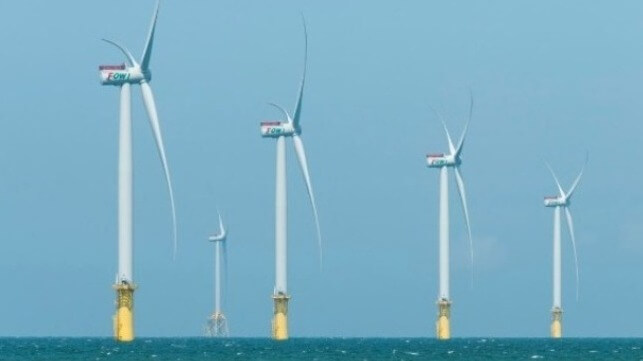
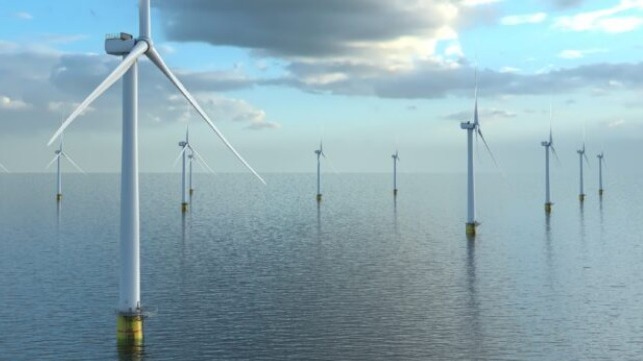
Denmark launched the first offshore wind farm in 1991 and now the industry exceeded 80 GW for the first time
While many critics continue to question the viability of offshore wind energy, the UK trade group RenewableUK is out with a new market analysis highlighting the “extraordinary speed” of growth for the sector. The report details that installed capacity grew by 15 percent in the past 12 months as leading countries accelerated installations and new countries also adopted the increasingly accepted source of renewable energy.
The report calls out several key firsts including that global capacity surpassed 80.9 GW, the first time it has been at that level coming from a base of 70.2 GW just a year earlier. Additional countries are also making process with the first projects including the introductory offshore wind projects in Indonesia, Chile, and Malta which were confirmed in 2024.
Recently, Greece mapped out its first project while on the other side of the globe, Australia finalized additional zones and reported progress with its likely first projects to win regulatory approval. The United States officially commissioned its first commercial-scale offshore wind farm in 2024 while others are proceeding in the construction phase.
“Our latest EnergyPulse Insights report shows that the global offshore wind market is continuing to grow at an extraordinary speed year after year, as more countries look to seize the industrial, economic, and environmental opportunities which the technology offers,” comments RenewableUK’s Chief Executive Dan McGrail.
The report however also shows a continued concentration among a few countries while others work to accelerate the next phase of growth. Two countries, China (adding 6.9 GW) and the Netherlands (adding 1.7 GW) accounted for 63 percent of the total capacity added in the offshore segment in 2024. Further, for the first time, a single country, China (41 GW installed) now accounts for more than half the industry’s current capacity.
The first offshore wind farm, Vindeby installed in Denmark, was commissioned in 1991. The UK entered the sector in 2003 and by 2008 had become the leader, a position it maintained till 2021. China took the lead in 2021 and two years later in 2023 was over 31 GW. The UK remains second but far behind with 14.7 GW installed and Germany is third at 8.5 GW.
The growth is set to continue predicts RenewableUK reporting that the number of projects in the global offshore wind pipeline has increased from 1,461 to 1,555 over the last twelve months. It notes that the number of countries involved in the sector is up from 41 to 44 as new markets continue to emerge.
The project pipeline they believe looks strong when considering offshore wind farms at all stages of development. The report reviews fully operational, under construction, consented, in the planning system, and early development projects.
China has the largest defined pipeline with 247 GW across 437 projects, while the UK remains in second place with 96 GW across 123 projects. The U.S. has significant potential according to the report with its 79 GW of defined projects placing it ahead of Germany which has 68 GW and Sweden which was reported with 55 GW. Sweden, however, recently blocked many of the projects due to concerns raised by the military for defense and of course, Donald Trump has taken steps since his inauguration to stop the progress in the U.S. industry.
RenewableUK also used the report to highlight the opportunities in the UK. It is urging the UK government to maximize its investment in new offshore wind capacity. Wind energy became the UK’s largest source of electricity surpassing gas in 2024. In the upcoming Allocation round 7, 13 UK offshore wind projects with a total capacity of 7.3 GW are eligible. The government received 72 responses during the consultation round and is expected to launch the next auction in March.
Supporting the growth are also developments in new technology. Media reports indicate Siemens Gamesahas received consent to proceed with the development of a prototype 21 MW offshore turbine that will rial the largest announced in China. RewnewableUK emphasizes a large potential saying the industry cold surpass 254 GW by the end of 2030 while expect the emerging floating offshore wind segment could have 3.9 GW installed by 2030.
Interior Department Cancels Wind Project Meetings Following Trump’s Order
Empire Wind is proceeding while BOEM canceled meetings to review the plan for Vineyard Mid-Atlantic (Equinor)
The first demonstration of the new Trump administration’s efforts to derail the offshore wind energy sector emerged as the Department of Interior began reversing steps taken in the last days of the Biden administration. The Bureau of Ocean Energy Management canceled meetings for the review of an offshore wind project while the Department of the Interior highlighted that it was taking “steps to streamline processes that will enhance efficiency and innovation.”
BOEM announced it was canceling the virtual public meetings scheduled by the Biden administration to begin comments and review of the Construction and Operations Plan submitted by Vineyard Mid-Atlantic. The first meeting had been scheduled for February 6, followed by sessions on February 11 and 19 for comments on the plan. It, however, noted that written comments could still be submitted before the March 3 deadline.
The prior administration on January 14 launched the review process for the wind farm that would be developed by Copenhagen Infrastructure Partners and be located approximately 20 miles offshore New York and 36 miles offshore New Jersey. The lease was awarded in 2022 as part of the auction for the New York Bight and the construction plan called for 2 GW of electricity from up to 117 wind turbines, enough to power more than 700,000 homes.
The Department of the Interior and BOEM said in announcing the cancellation that it is implementing President Trump’s memorandum temporarily halting offshore wind leasing on the Outer Continental Shelf. The memorandum also pauses new or renewed approvals, rights-of-way, permits, leases, or loans for offshore wind projects pending a review of federal wind leasing and permitting practices.
The new Secretary of the Interior, Doug Burgum, however during his first day in the position on February 3, signed measures to “immediately identify all emergency and legal authorities available to facilitate the identification, permitting, leasing, development, production, transportation, refining, distribution, exporting and generation of domestic energy resources and critical minerals,” and to “expedite the authorization” of key projects. Burgum said there would be an emphasis on deregulation and unlocking resources in Alaska following Trump’s directions.
Despite the new policies and move away from offshore wind energy, two projects highlighted that they are continuing to move forward. Equinor today, February 5, announced its year-end financial results and detailed its outlook including a continued commitment to the Empire Wind project. It completed the financing for the 800 MW project at the end of 2024 and highlights a low cost of entry as well as the utilization of project financing which along with future tax credits will cover the remaining CAPEX for Empire Wind. At the right time, it will also bring in a partner for the project which is due to be completed by 2027.
The commitment to Empire Wind comes as the company reported it is “high-grading its portfolio, reducing the investment outlook for renewables and low carbon solutions, and improving cost across the organization” as part of an effort to improve returns and free cash flow generation. Equinor said it was proceeding with Empire Wind, “a project in a challenging market with returns under pressure and uncertainty,” while reiterating that it will continue to deliver above 10 percent equity return on its current and renewable assets in operations.
Similarly, Dominion Energy highlighted its continued commitment and progress for its Coastal Virginia Offshore Wind project. It reported yesterday that the installation has reached the halfway mark and that the offshore work remains on budget and on time. Due for completion at the end of 2026, the project with 176 wind turbines and a capacity of 2.6 GW, is slated to be the largest offshore wind farm in the United States.
Dominion holds rights for two other offshore wind projects in the mid-Atlantic region while Equinor has another one in New England and one in the mid-Atlantic. Those are listed as longer-term prospects, and likely to be delayed by the new Trump policies.