Tuesday, February 11, 2025

Trump’s Goal of Burying History Won’t Work If Teachers Refuse to Stop Teaching

Trump wants education to become indoctrination, and the Democratic Party isn’t fighting back. But we can.

They fear students who read Frederick Douglass and Thomas Paine and aren’t afraid to consider what their ideas mean for our society today.

By Jesse Hagopian
Truthout
February 11, 2025

Great Oak High School students leave campus in protest of the district's ban of critical race theory curricula, at Patricia H. Birdsall Sports Park in Temecula, California, on December 16, 2022.Watchara Phomicinda / The Press-Enterprise via Getty Images

Did you know that Truthout is a nonprofit and independently funded by readers like you? If you value what we do, please support our work with a donation.

President Donald Trump is waging an all-out assault on education by issuing executive orders designed to privatize schooling, attack immigrant and transgender students, prohibit solidarity with Palestine, chill dissent on college campuses and censor discussions of race, gender, sexuality and systemic oppression in schools.

One of his latest orders, misnamed Ending Radical Indoctrination in K-12 Schooling, threatens federal funding for schools that teach truthfully about Black, Indigenous, and people of color’s history or structural inequality, while also banning discussions of gender identity. These actions are about indoctrinating young people with what I call “uncritical race theory” — an ideology that denies systemic racism, either dismissing it altogether or reducing it to nothing more than isolated individual bias.

As if this wasn’t enough, Trump is preparing to escalate his assault on education by issuing an executive order to abolish the Department of Education (DOE). While only Congress has the legal authority to completely end the DOE, The Washington Post reports that Trump’s order “directs the agency to begin to diminish itself. …The new administration has been trying to reduce the workforce by putting scores of employees on administrative leave and pressuring staff to voluntarily quit.”

Let’s call this move what it is: an extremist power grab designed to dismantle public schools and enforce ideological conformity. If successful, this order would gut $18.4 billion in Title I funding, which provides crucial support to high-poverty schools, and strip $15.5 billion from disability education under the Individuals with Disabilities Education Act (IDEA), leaving millions of students without legally required accommodations. The Department of Education’s Office for Civil Rights, which protects students from racial, gender and disability discrimination, would be hollowed out, further fueling the school-to-prison pipeline and allowing systemic inequities to go unchecked. And Trump’s attack on the DOE isn’t just about K-12 education — it also threatens the federal student loan system, throwing $1.6 trillion in student debt into chaos and potentially stripping away protections that prevent borrowers from being preyed upon by private lenders. This isn’t about “local control” or efficiency; it’s a direct attack on public education, paving the way for corporate profiteering and right-wing ideological supremacy.

Let’s call this move what it is: an extremist power grab designed to dismantle public schools and enforce ideological conformity.

Trump’s Executive Order Is Illegal


Trump’s executive order to defund schools that allow students to investigate aspects of history and identity he doesn’t want them to learn about is not only immoral — it’s illegal. Title 20, Section 1232a of the United States Code (20 U.S.C. § 1232a) explicitly prohibits the federal government from directing or controlling school curricula — a provision that directly contradicts Trump’s attempt to ban discussions of equity, making his executive order not only authoritarian but also unlawful — stating:

No provision of any applicable program shall be construed to authorize any department, agency, officer, or employee of the United States to exercise any direction, supervision, or control over the curriculum, program of instruction, administration, or personnel of any educational institution, school, or school system…

This law, first enacted in 1970 as part of the General Education Provisions Act (GEPA) and later amended, was designed to ensure that education remains under local and state control, preventing federal overreach in dictating what schools can and cannot teach. Even when federal funds are allocated to education programs, they cannot be used as a mechanism for controlling school curricula. Yet, in a staggering display of hypocrisy, Trump and the GOP — who endlessly champion “states’ rights” and “local control” when it suits their agenda — are now using federal power to dictate school curricula and punish educators who refuse to comply.

Trump’s Order and the Tradition of Hiding History


The attack on truthful education is part of a long history of erasing Black resistance and maintaining white supremacy in schools. From the United Daughters of the Confederacy’s efforts to rewrite textbooks and glorify the Confederacy; to the Dunning School at Columbia University that promoted a white supremacist interpretation of Reconstruction, portraying it as a tragedy of corrupt Black rule to justify Jim Crow laws; to the Florida Board of Education today whose official state curriculum proclaims slavery to have been of “personal benefit” to Black people; reactionary forces have always sought to control historical memory.

Trump’s policies are a continuation of these efforts. Through executive order, he has reestablished the 1776 Commission, a body designed to promote a sanitized, celebratory version of American history while discrediting historical truths about oppression and struggle. The Commission is tasked with implementing a “Presidential 1776 Award” to recognize students for their “knowledge of the American founding.” But what does it mean to truly understand the founding of the United States?

This isn’t about “local control” or efficiency; it’s a direct attack on public education, paving the way for corporate profiteering and right-wing ideological supremacy.

When I teach high school students about the American War for Independence, I introduce my students to Thomas Paine, the English-born writer whose best-selling pamphlet Common Sense helped galvanize the colonies to break from British rule. But Paine did more than advocate for independence — he also exposed the hypocrisy of revolutionaries who fought for liberty while enslaving Black people. In March 1775, he published African Slavery in America, one of the earliest antislavery articles in the colonies, and excoriated his peers by asking, “With what consistency, or decency, they complain so loudly of attempts to enslave them, while they hold so many hundred thousands in slavery, and annually enslave many thousands more…?” Paine’s words anticipated the powerful critique Frederick Douglass would later make in What to the Slave Is the Fourth of July?:

What, to the American slave, is your 4th of July? I answer; a day that reveals to him, more than all other days in the year, the gross injustice and cruelty to which he is the constant victim. … Go where you may, search where you will, roam through all the monarchies and despotisms of the Old World, travel through South America, search out every abuse, and when you have found the last, lay your facts by the side of the everyday practices of this nation, and you will say with me, that, for revolting barbarity and shameless hypocrisy, America reigns without a rival.

This is the history that Trump and his fellow uncritical race theorists don’t want you to learn. For all their braying about patriotism and the importance of 1776, it’s doubtful that a student in my class who knows the truth about Fredrick Douglass or about Thomas Paine — one of the most influential of the American revolutionaries — would be eligible for the “Presidential 1776 Award.”

Yet as the right escalates its war on history, the Democratic Party has largely refused to mount a meaningful defense of antiracist education or a serious opposition to Trump. The February 2 New York Times headline captures this reality: “‘We Have No Coherent Message’: Democrats Struggle to Oppose Trump.”

The subheading continues, “More than 50 interviews with Democratic leaders revealed a party struggling to decide what it believes in, what issues to prioritize and how to confront an aggressive right-wing administration.”

While Democrats often offer rhetorical opposition to book bans and curriculum censorship, they have refused to take bold, structural action to protect educators, students and schools from these attacks. The Biden administration, for example, did condemn Republican efforts to censor history but did little to enforce federal protections against racial discrimination in education. As book bans escalated and states prohibited teaching about Black history, the Democratic Party never launched a national campaign to combat these laws, and certainly never supported the annual Teach Truth Day of Action organized by the Zinn Education Project and supported by educators, students and families all over the country.

As the right escalates its war on history, the Democratic Party has largely refused to mount a meaningful defense of antiracist education or a serious opposition to Trump.

When confronted by conservatives on education, Democratic politicians often respond by insisting that Critical Race Theory (CRT) isn’t being taught in K-12 schools. While it’s true that most educators had little familiarity with CRT before Republicans launched their crusade against it, the right — amplified by media outlets — successfully rebranded any form of antiracist teaching as CRT. Instead of challenging this false narrative head-on, liberal politicians largely relied on denial, repeatedly insisting that CRT wasn’t in schools, without addressing the deeper question of whether teaching about systemic racism belonged in the curriculum at all. This defensive strategy backfired, making it seem as though they were evading the issue rather than standing up for the right of students to learn about racism, oppression and history. The reality is that many Democrats feared that openly defending antiracist education — whether Black studies, ethnic studies, or CRT — would cost them politically. Their reluctance to take a principled stance left them vulnerable to right-wing attacks and signaled a broader unwillingness to fight for a truthful education system. As professors Daniel Kreiss, Alice Marwick and Francesca Bolla Tripodi argued in an article for Scientific American:


Rather than dismissing manufactured concerns over CRT as fake, Democrats should embrace the robust teaching of America’s racial history in our public schools and make an affirmative case for why it matters for American values of fairness, equality and justice. Democrats should then focus on articulating how attacks on CRT are meant to divide people of all races who otherwise share interests. Rather than dismissing these attacks as isolated incidents, Democrats should mount their own sustained and coherent campaign to argue affirmatively for diversity, equity and inclusion programs and for complementary efforts such as the 1619 Project.

The refusal of the Democrats to defend honest education about race has been so flagrant that it has angered or demoralized wide swaths of its base in the wake of the 2024 presidential election. The evidence of this is abundant. As Paul Waldman and Greg Sargent argued in a column for The Washington Post, “When Republicans turned an obscure academic topic known as critical race theory into a national boogeyman supposedly poisoning the minds of our youth, Democrats were caught flat-footed. They weren’t sure how to react: Debate what it actually means? Explain that it isn’t something that gets taught to kids? In the face of relentless conservative demagoguery, they were flummoxed. … And Democrats still seem uncertain how to respond.”

The way to respond was clear to many millions of educators, students and families around the country: banning history and books are the marks of despotic regimes and should be forcefully opposed. Yet even in the face of intensifying authoritarian policies that have led to many teachers being targeted, being fired, or receiving death threats for teaching about race or gender, Democratic Party politicians have largely refused to passionately defend teaching honestly about history and identity — a result of their obsequiousness to the same billionaire class that funds the Republican Party.

In the wake of Trump’s presidential victory, many Democratic Party establishment figures blamed their loss on the party being too “woke” and pontificated that if they had just further abandoned trans people and communities of color, in favor of advancing arguments to defend the working class, they could have won the election. It is true that the Democrats’ failure to fight for working class issues like raising the minimum wage, curbing inflation, fighting for affordable housing or taxing the rich to pay for education contributed to their defeat. But the truth is that trans people and communities of color are part of the working class — and as long as the wealthiest one percent can convince people that trans people, immigrants, or Black people are the problem in our society, various sections of the working class will be fighting each other in a squid game while the rich look on in amusement. That is why honest education that helps the young see each other’s humanity is so important.

Resisting the Truthcrime Laws

Trump and his allies certainly fear the power of an informed generation. Unfortunately, too many corporate Democrats also subscribe to uncritical race theory and too often would rather accommodate Trump than risk the upheaval and potential shift in power that can occur from young people learning — and acting on — historical lessons of social movements.

For all their bravado, the uncritical race theorists are terrified of youth who are armed with the lessons of history and ready to act — as the 2020 uprising for Black lives, largely led by young people, exposed. They fear students who read Frederick Douglass and Thomas Paine and aren’t afraid to consider what their ideas mean for our society today. They fear the hundreds of students in Los Angeles who recently walked out of school in protest of Trump’s latest attacks on immigrants. They fear the thousands of educators around the country participating in the Black Lives Matter at School Week of Action, defiantly teaching the lessons that Trump and his enforcers want banned.

And most of all, they fear an education that exposes young people to a wide range of ideas and teaches students not what to think, but how to think critically and question everything.

As Jason Stanley explains in Erasing History: How Fascists Rewrite the Past to Control the Future, “If we are to stop the United States’ drift toward fascism, we must recognize the nature of the challenge facing our educational institutions. Schools and universities are indeed on the front lines of the multi-decade far-right effort to reinforce anti-democratic myths.”

The difficult truth is no one is coming to save us from the banning of history and this slide into fascism — including the Democratic Party. But once we understand this, our task becomes clear. We must build robust, independent, social movements and fight to teach the truth — because no executive order, no political intimidation, and no forced ignorance can erase history, so long as we refuse to stop teaching it.

This article is licensed under Creative Commons (CC BY-NC-ND 4.0), and you are free to share and republish under the terms of the license.

Jesse Hagopian is a Seattle educator, the director of the Zinn Education Project’s Teaching for Black Lives Campaign, and the author of the book, Teach Truth: The Attack on Critical Race Theory and the Struggle for Antiracist Education. You can follow him on Instagram or Bluesky.

Leaked Memo Details How Intrusive Anti-Trans Passport Policy Will Be Implemented


“These rules make it more difficult for transgender people to obtain a passport,” said researcher Allison Chapman.
Truthout
February 11, 2025

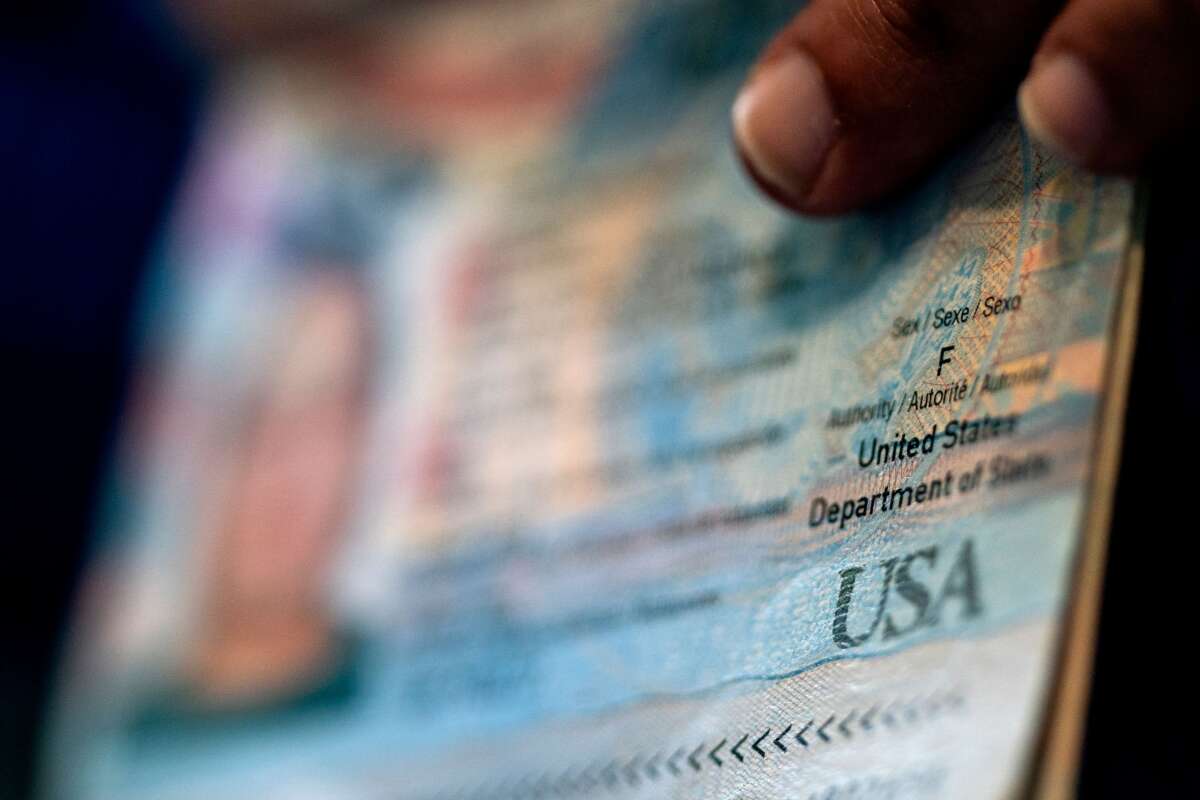
A person shows the Female gender marker on their current US passport, prior to beginning the process of filling out a passport application with an X gender marker, at their home in Alexandria, Virginia, on April 11, 2022.Stefani Reynolds / AFP

The State Department has updated its guidelines on passports with “X” sex markers and on requests to modify a passport’s sex marker, according to a leaked memo published by independent investigative journalist Ken Klippenstein.

These changes follow an anti-trans executive order signed by President Donald Trump on his first day back in office, directing federal agencies to recognize only two fixed sexes assigned at conception. The order led to widespread administrative confusion as agencies struggled to implement its rigid definition of sex without clear guidance.

“Trump’s order will … prevent transgender and intersex people from obtaining new passports, visas, and trusted traveler documents that reflect who they are and how they are perceived in the world,” Gillian Branstetter, communications strategist for the American Civil Liberties Union (ACLU), said in an explainer on the executive order.

Anticipating restrictive changes, LGBTQ advocates had urged transgender people to update their federal documents before the inauguration, as passports remain valid for ten years. Many also feared that they might need to leave the country for their safety, which requires a valid passport.

Within 24 hours of Trump’s anti-trans order, the State Department ceased issuing U.S. passports with “X” gender markers and suspended applications for gender marker updates. It also began retaining some passports and supporting documents — such as birth certificates and court orders — submitted by transgender applicants. Others saw their applications denied and received new passports reflecting their sex assigned at birth.

Related Story

How Is Trump’s Anti-Trans Executive Order Being Used? Here’s What We Know.
Trans people in federal custody are already feeling immediate impacts of the order, the ACLU’s Gillian Branstetter says.
By Schuyler Mitchell , TruthoutJ anuary 27, 2025

In fact, the ACLU reports that more than 1,500 transgender people and their family members have reached out through its legal intake form, many with suspended or pending passport applications. The organization is now suing the administration on behalf of seven people who have been denied passports that align with their identity or that are at risk of being affected upon renewal.

“The plaintiffs in this case have had their lives disrupted by a chaotic policy clearly motivated by animus that serves zero public interest,” Sruti Swaminathan, staff attorney for the ACLU’s LGBTQ & HIV Project, said in a press release about the lawsuit.

According to the new State Department memo, existing unexpired passports will remain valid. The memo does not mention confiscation, and transgender journalist Erin Reed believes this is unlikely. However, the policy on renewals remains ambiguous. Applications will be evaluated based on a “preponderance of evidence,” a relatively low standard of proof, but the memo clarifies that this applies strictly to biological sex at birth, not gender identity. Applicants may need to provide birth certificates or early medical records to confirm their sex assigned at birth matches the requested marker.

“While it is a relief that the official guidance allows existing passports to remain valid, the red tape and requirements to prove your gender is absurd,” LGBTQ legislative researcher Allison Chapman told Truthout. “For a government all about efficiency, it seems inefficient to scrutinize passports on the basis of gender markers.”

The guidance also eliminates the “X” marker, requiring those with that marker on their passport to switch to either “M” or “F” based on their recorded sex at birth. If documentation is unclear or conflicting, applications may be suspended until further proof is provided, creating significant barriers for transgender and intersex people. However, the memo does clarify that identity documents already issued with an “X” sex marker remain valid until they are replaced or expire.


“These rules make it more difficult for transgender people to obtain a passport, and adds the potential for additional delays in granting a passport if the state department decides they think you are transgender,” Chapman said.


'Careful What You Post': ICE Expanding Surveillance of Social Media Critics

"ICE's attempt to have eyes and ears in as many places as we exist both online and offline should ring an alarm for all of us," said one campaigner.


A man holds a Mexican flag during a February 8, 2025 protest against U.S. Immigration and Customs Enforcement in Seattle.
(Photo: Jason Redmond/AFP via Getty Images)


Brett Wilkins
Feb 11, 2025
COMMON DREAMS

U.S. Immigration and Customs Enforcement is seeking to hire a contractor as part of an effort to expand the monitoring of negative social media posts about the agency, its personnel, and operations, according to a report published Monday.

According toThe Intercept's Sam Biddle, ICE is citing "an increase in threats" to agents and leadership as the reason for seeking a contractor to keep tabs on the public's social media activity.

The agency said the contractor "shall provide all necessary personnel, supervision, management, equipment, materials, and services, except for those provided by the government, in support of ICE's desire to protect ICE senior leaders, personnel, and facilities via internet-based threat mitigation and monitoring services."

"These efforts include conducting vulnerability assessments and proactive threat monitoring," ICE added, explaining that the contractor will be required to provide daily and monthly status reports and immediately alert supervisors of "imminent threats."

ICE will require the monitor to identify and report "previous social media activity which would indicate any additional threats to ICE," as well as any information indicating that individuals or groups "making threats have a proclivity for violence" and anything "indicating a potential for carrying out a threat."

According to Biddle:
It's unclear how exactly any contractor might sniff out someone's "proclivity for violence." The ICE document states only that the contractor will use "social and behavioral sciences" and "psychological profiles" to accomplish its automated threat detection.

Once flagged, the system will further scour a target's internet history and attempt to reveal their real-world position and offline identity. In addition to compiling personal information—such as the Social Security numbers and addresses of those whose posts are flagged—the contractor will also provide ICE with a "photograph, partial legal name, partial date of birth, possible city, possible work affiliations, possible school or university affiliation, and any identified possible family members or associates."

The document also requests "facial recognition capabilities that could take a photograph of a subject and search the internet to find all relevant information associated with the subject." The contract contains specific directions for targets found in other countries, implying the program would scan the domestic speech of American citizens.


"Careful what you post," Biddle warned in a social media post promoting his article.

ICE is already monitoring social media posts via contractor Giant Oak, which was hired during the first Trump administration and former Democratic President Joe Biden's term. However, "the goal of this [new] contract, ostensibly, is focused more narrowly on threats to ICE leadership, agents, facilities, and operations," according to Biddle.

Cinthya Rodriguez, an organizer with the immigrant rights group Mijente, told Biddle that "the current administration's attempt to use this technology falls within the agency's larger history of mass surveillance, which includes gathering information from personal social media accounts and retaliating against immigrant activists."

"ICE's attempt to have eyes and ears in as many places as we exist both online and offline should ring an alarm for all of us," Rodriguez added.

The search for expanded ICE social media surveillance comes as President Donald Trump's administration is carrying out what the Republican leader has promised will be the biggest mass deportation campaign in U.S. history. The U.S. Department of Homeland Security has been deporting migrants on military flights, with some deportees imprisoned at Guantánamo Bay, the notorious offshore U.S. military prison in Cuba.


Despite Catastrophic Fires, Federal Court in California Dismisses Youth Climate Case

"Wildfires are ravaging these children's communities in California, but the court claims that their suffering is too 'indirect' to matter," said the plaintiffs' lawyer. "This ruling is nothing short of judicial dereliction."


People watch the smoke and flames from the Palisades Fire in the Pacific Palisades neighborhood on January 7, 2025 in Los Angeles, California.
(Photo: Tiffany Rose/Getty Images)

Jessica Corbett
Feb 11, 2025
COMMON DREAMS

With Californians still reeling from what is expected to be "the costliest wildfire disaster in American history," a federal judge in the state on Tuesday dismissed a constitutional climate case that young people brought against the U.S. government.

The firm Our Children's Trust filed the equal protection lawsuit on behalf of 18 children in the Central District of California on December 10, 2023. Genesis B. v. United States Environmental Protection Agency initially just targeted the EPA and its administrator, but the plaintiffs later added the Office of Management and Budget and its director as defendants.

Since the beginning of the case, the Biden administration fought for its dismissal. U.S. District Judge Michael Fitzgerald, an appointee of Democratic former President Barack Obama, previously dismissed the case last May but also allowed the youth plaintiffs' lawyers to amend their complaint. The judge dismissed the case again on Tuesday, the first major development since Republican President Donald Trump—a noted enemy of climate action—returned to the White House last month.

"We are fighting not just for ourselves, but for every young person who deserves a world where their lives, their health, and their future matter."

Responding in a Tuesday statement, Our Children's Trust slammed the "extraordinary decision to dismiss the case by disregarding key evidence showing the harmful effects of the EPA's policies and the unique vulnerability of children's bodies to climate pollution," highlighting expert testimony from economist Joseph Stiglitz and Dr. Elizabeth Pinsky, a psychiatrist and pediatrician.

"By dismissing this case, the court is turning a blind eye to the real-world harms youth are enduring right now. Wildfires are ravaging these children's communities in California, but the court claims that their suffering is too 'indirect' to matter," said Julia Olson, chief legal counsel for the plaintiffs.

"This ruling is nothing short of judicial dereliction in the face of a climate emergency," she asserted. "The court refused to consider that the government's devaluation of children isn't just bad policy—it's a violation of fundamental equal rights."

The young plaintiffs also expressed disappointment with Fitzgerald's decision in the wake of January blazes that experts tied to the climate emergency—specifically, the World Weather Attribution found that fossil fuel-driven global warming made the weather conditions that caused the Los Angeles County fires 35% more probable.

"The court's decision to dismiss this case before we could even present our evidence is a gut punch," lead plaintiff Genesis B said Tuesday. "We are living with the consequences of these policies every single day—wildfires, choking smoke, evacuation orders. And now, with the strongest storm of the year set to hit Southern California this week, our case is more urgent than ever."

"Forecasters are warning of widespread flooding, landslides, and dangerous debris flows, especially in areas devastated by wildfires," Genesis B. explained. "We wanted the chance to show the court the science, the economics, and the lived experiences that prove the government's actions are harming us. Instead, we were denied that opportunity. He just shut the door on us, made up his own facts, and never listened to the real experts. He never gave us the opportunity to testify."


Despite the setback in court on Tuesday, the young plaintiffs in this case are determined to keep fighting and are now considering potential next steps with their lawyers.

"We are not backing down. This fight is about refusing to let our lives be discounted, and we won't stand by as our future is treated as expendable," declared plaintiff Maya W. "We are fighting not just for ourselves, but for every young person who deserves a world where their lives, their health, and their future matter."

This case is just one of many that young people have pursued in recent years, some of which are ongoing and many that involve Our Children's Trust. The group said that earlier Tuesday, attorneys representing a dozen youth plaintiffs in the constitutional climate case Layla H. v. Virginia presented their case virtually before the state Supreme Court.

In another Our Children's Trust case, Juliana v. United States, 43 members of Congress last month submitted a brief to the U.S. Supreme Court supporting the 21 plaintiffs. That filing came less than a month after the Montana Supreme Court upheld a 2023 decision that the state government's promotion of fossil fuels violates young residents' state constitutional rights. Earlier last year, Hawaii's governor and Department of Transportation announced an "unprecedented" settlement in another youth climate case.

Dem Lawmakers Introduce 'Contraception Begins at Erection' Bills in Multiple States

"If you think it's absurd to regulate men, then you should think it's equally absurd to regulate women," said the author of an Ohio bill, who is also an OB-GYN.


Brett Wilkins
Feb 11, 2025
COMMON DREAMS

Faced with relentless Republican attacks on reproductive freedom including efforts to give embryos and fetuses legal rights from the moment of conception, Democratic lawmakers in two states have recently introduced legislation that would ban men from ejaculating for purposes other than making babies, with some exceptions.

Last month, Mississippi state Sen. Bradford Blackmon (D-21) introduced S.B. 2319, the Contraception Begins at Erection Act, which would "make it unlawful for a person to discharge genetic material (sperm) without the intent to fertilize an embryo, effectively criminalizing certain male reproductive behaviors," according to an official artificial intelligence summary of the proposal. The bill—which died in committee last week—contains exceptions for "genetic material donated or sold to a facility for future embryo fertilization, and genetic material discharged using a contraceptive method intended to prevent fertilization."

"If you're going to penalize someone for an unwanted pregnancy, why not penalize the person who is also responsible for the pregnancy?"

"All across the country, especially here in Mississippi, the vast majority of bills relating to contraception and/or abortion focus on the woman's role when men are 50% of the equation," Blackmon explained, according toNBC News. "This bill highlights that fact and brings the man's role into the conversation. People can get up in arms and call it absurd but I can't say that bothers me."

Meanwhile in Ohio, state Reps. Dr. Anita Somani (D-11) and Tristan Rader (D-13) have introduced their own Contraception Begins at Erection Act, which would fine violators $10,000 per unauthorized discharge, with exceptions for when contraception is used during sex, or in cases of masturbation, and sex between members of the LGBTQ+ community.

"If you're going to penalize someone for an unwanted pregnancy, why not penalize the person who is also responsible for the pregnancy?" Somani, who is also a licensed OB-GYN, asked in an Ohio Capital Journal article published Sunday. "You don't get pregnant on your own."


Responding to Republicans who have called her bill "absurd," Somani said, "If you think it's absurd to regulate men, then you should think it's equally absurd to regulate women."

While observers have questioned the seriousness of these bills—and with Somani and others giving nods to a famous number in Monty Python's 1979 black comedy The Life of Brian—they come at a nadir for reproductive freedom in the United States.

Since the right-wing U.S. Supreme Court canceled half a century of federal abortion rights in the 2022 Dobbs v. Jackson Women's Health Organization ruling, a dozen states including Mississippi have also passed near-total abortion bans, while numerous other states have enacted restrictions on the procedure.

Eight states have also enacted or proposed restrictions on access to contraception, according to the Guttmacher Institute. Last year, Senate Republicans blocked consideration of the Right to Contraception Act. Republican President Donald Trump has signaled support for federal restrictions on contraception, and far-right U.S. Supreme Court Justice Clarence Thomas has suggested that the tribunal "should reconsider" past rulings upholding the right to birth control.

In Ohio, voters decisively enshrined abortion rights in the state constitution via a 2023 ballot measure. Nevertheless, anti-abortion activists haven't given up—Republican activist Austin Beigel told the Capital Journal that GOP lawmakers are preparing to introduce legislation for a total abortion ban in the coming weeks.

"It just says human life begins at conception," he explained. "Therefore, all the protections that are offered to other people under the state law are also offered to the pre-born."

This isn't the first time that semi-satirical legislation has been introduced to highlight the hypocrisy of banning women from controlling their bodies. In 2019, a Democratic state lawmaker in Georgia introduced a "Testicular Bill of Rights" that would, among other things, have required men to get permission from their sexual partners before obtaining erectile dysfunction medication and enacted a 24-hour "waiting period" for men who want to buy porn or sex toys.


'Important Victory': Judge Directs Health Agencies to Restore Web Materials Taken Down After Trump Order

"This order puts a stop, at least temporarily, to the irrational removal of vital health information from public access," wrote the legal counsel for the plaintiff.


Exterior of the Center for Disease Control (CDC) headquarters is seen in Atlanta, Georgia.
(Photo by Jessica McGowan/Getty Images)

Eloise Goldsmith
Feb 11, 2025
COMMON DREAMS

A federal judge has implemented a temporary restraining order forcing the U.S. Department of Health and Human Services, the U.S. Centers for Disease Control and Prevention, the U.S. Food and Drug Administration to restore several webpages and datasets that had been previously taken down in response to a White House executive order "defending women from gender ideology extremism."

President Donald Trump's executive order, which asserts that "it is the policy of the United States to recognize two sexes, male and female," was followed up by a memo from the Office of Personnel Management (OPM), which orders agencies to take down "outward facing media" that "inculcate or promote gender ideology," according to a lawsuit filed in early February by the nonprofit advocacy group Doctors for America (DFA).

In response, the CDC and FDA did remove webpages and datasets, according to the suit.

The legal arm of the watchdog group Public Citizen is serving as the plaintiff's counsel on the lawsuit, which names the OPM, the CDC, the FDA, and the Department of Health and Human Services (of which the CDC and FDA are a part) as defendants.

"DFA and the physicians and medical trainees that constitute its membership rely on webpages and datasets that have been removed in response to OPM's memorandum, including several pages that related to current evidence and guidelines for providing clinical care, guidance documents on FDA's website... and numerous publicly available datasets that inform targeted public health interventions," according to the complaint.

Following OPM's memo, materials pertaining to HIV testing for transgender people, resources supporting LGBTQ+ youth health, and a survey conducted every two years to assess the health behaviors of teens were all taken down, according to The Washington Post.

The lawsuit highlights other resources that went dark, such as a report titled PrEP for the Prevention of HIV Infection in the U.S.: 2021 Guideline Summary.

U.S. District Judge John D. Bates, an appointee of former President George W. Bush, ruled Tuesday that the agencies had to restore access to all the materials identified by the plaintiff by the end of the day.

"The judge's order today is an important victory for doctors, patients, and the public health of the whole country," said Zach Shelley, a Public Citizen Litigation Group attorney and lead counsel on the case, in a Tuesday statement. "This order puts a stop, at least temporarily, to the irrational removal of vital health information from public access."

Courts have delivered a series of setbacks to the Trump administration's efforts in recent days, including another blow to Trump's attempt to curtail birthright citizenship.

U.S. Sen. Ed Markey (D-Mass.) took to the platform X to tally the wins, writing "BLOCKED" next to court rulings that have hampered Trump initiatives.
'Crystal Clear' Polling Shows Voters Oppose Trump's Tax Cuts for Rich


"Voters are clear about what they want: lower prices, better jobs, vital programs protected and expanded, and for the wealthy to pay their fair share in taxes."


Julia Conley
Feb 11, 2025
COMMON DREAMS


The Republican Party is intent on permanently extending the 2017 tax cuts which primarily benefited the wealthiest earners and corporations—a priority that would cost an estimated $4.6 trillion and which has sent lawmakers searching for potential spending offsets including cuts to Medicare, food assistance, and renewable energy programs.

But polling released Tuesday suggested the GOP is likely to face widespread outcry—and potential opposition from vulnerable Republicans who don't want to risk angering voters—as a majority of Americans are vehemently opposed to paying for tax cuts for the wealthy by slashing public programs.

The new poll, taken by Data for Progress on behalf of the progressive advocacy groups Groundwork Collaborative and the Student Borrower Protection Center, found that although Republican lawmakers have demonized efforts to provide relief to student loan borrowers, the party's potential overhaul of the income-based repayment program isn't popular among voters of any political ideology.

Nearly two-thirds of respondents said they don't want the repayment plan eliminated, including 56% of Republican voters and 70% of Independents who said they oppose funding cuts for federal student loans and grants.

The GOP's plan would save an estimated $127.3 billion over 10 years by forcing the average student loan borrower to pay nearly $200 more per month.

"Most people don't have an extra $200 a month to throw toward their student loan bill," Michele Shepard Zampini, senior director of college affordability at the Institute for College Access & Success, toldCNBC on Monday.

"Voters overwhelmingly reject efforts to cut critical supports that working families rely on."

Despite that fact, said Aissa Canchola Bañez, policy director for the Student Borrower Protection Center, the GOP's budget proposals would "cut taxes for their billionaire buddies by raiding the pockets of Americans with student debt and families already struggling to pay for college."

"This polling makes it crystal clear," she said. "Voters overwhelmingly reject efforts to cut critical supports that working families rely on."

Republicans can also expect to see pushback if they attempt cuts to Medicare and Medicaid, the survey found. Ninety percent of respondents said they want Medicare funding to increase or remain the same; 87% said the same for Medicaid. Republicans are planning to unveil the first-ever work requirements for Medicaid, which provides healthcare coverage for low-income people and those with disabilities, in an upcoming budget bill.


As Politico reported Sunday, Republican lawmakers are "increasingly alarmed" that Rep. Jodey Arrington (R-Texas), chair of the House Budget Committee, "keeps raising Medicare reforms as a potential spending offset."

More than 80% of respondents also don't want Republicans to make cuts to the Supplemental Nutrition Assistance Program (SNAP), commonly known as food stamps, which the GOP is also planning to make subject to expanded work requirements.

Those who want funding for SNAP to increase or stay the same include 67% of Republicans and 75% of Independents.

The polling may leave Republican leaders wondering what programs they will be able to cut without facing outcry from angry voters who rely on public services—but Elizabeth Pancotti, managing director of policy and advocacy for Groundwork Collaborative, suggested in a statement Tuesday that the answer is simple: The GOP must abandon its plan to dole out more tax breaks for the rich.

"Voters are clear about what they want: Lower prices, better jobs, vital programs protected and expanded, and for the wealthy to pay their fair share in taxes," said Pancotti. "And yet, Republicans in both chambers of Congress are working overtime to achieve the exact opposite."

President Donald Trump has called on the GOP to advance his taxation, immigration, and energy agenda in "one big, beautiful bill," while Senate Republican leaders have begun work on two separate bills, with taxes dealt with later in the year.


"Whether one bill or two," said Pancotti, "House and Senate GOP members are aligned on wanting to cut lifesaving programs in order to enrich their billionaire friends and donors, and voters are taking note."


GOP Ready Plan to Gut Medicaid to 'Pay for Tax Cuts for Billionaires'

Defeating Republican efforts to slash health coverage for the nation's poor, said one observer, is also an opportunity "to expose and deepen the fractures in Trump's coalition, and to shatter the illusion that he can't be stopped."


Paramedic visits the home of a patient at her home in Watertown, Massachusetts on July 30, 2024.
(Photo by Kieran Kesner for The Washington Post via Getty Images)

Jon Queally
Feb 11, 2025
COMMON DREAMS


Defenders of Medicaid are sounding the alarm over plans by the Republican Party—led by President Donald Trump and House Speaker Mike Johnson—to eviscerate the nation's healthcare system used by low-income individuals and families, warning that the attack would jeopardize healthcare for tens of millions of the poorest Americans as part of an effort to give the wealthiest individuals and corporations massive tax breaks.

Internal divisions within the House GOP caucus have hinged on the overall size of cuts to federal spending in their yet-to-be-released budget blueprint, with competing proposals ranging from $1.25 trillion in cuts up to $2.5 trillion. Of that overall number, hundreds of billions in Medicaid cuts may come in the form of block grants to states, caps on per capita costs, and work requirements.

"For months," wrote Paul Heideman on Monday in Jacobin, "Republicans have said that their budget will cut spending in order to pay for making permanent Trump's tax cuts for the rich, which are set to expire this year."

One of the key targets of their austerity plan, he notes, is Medicaid, which Republicans, as reported by Politico on Tuesday believe they can cut by an estimated $800 billion or more over the next decade.

"They are cutting healthcare to pay for tax cuts for billionaires."

Echoing the call of other progressive voices, Heideman argues that opponents should seize on the tensions within the GOP—where right-wing hardliners are openly calling for cuts while those in more swing districts have expressed increasing anxiety about what happens politically if they take the axe to a program that is resoundingly popular with voters.

CNNreporting on Monday about the behind-the-scenes maneuvering within the caucus quoted one unnamed Republican lawmaker who said that some members want "to cut to the bone" when in it comes to Medicaid and other programs. While the lawmaker said they were "willing to cut a lot" from the federal budget, "if you cut the essential stuff that affects people every day, you will lose the majority in two years. I can guarantee it.”

Meanwhile, Politico offered more evidence that Trump and House Republicans are still not on the same page:
GOP leaders told senior Republicans in a series of private meetings Monday that Trump wasn’t yet on board with the major Medicaid cuts it would take to secure up to an additional $800 billion in savings, according to three people familiar with the conversations who, like the others, were granted anonymity to describe the private talks.

Johnson and senior Republicans are wary of pursuing the Medicaid reforms only for Trump to publicly bash the move. GOP leaders indicated in private meetings Monday that "they need to work with Trump" on the Medicaid issue before proceeding, according to one of the people.


As Heideman notes, one can't fully understand the attacks on Medicaid—which could boot tens of millions of people out of the program—without recognizing the GOP's parallel strategy for massive tax giveaways for the rich and corporations:
Republicans are hoping to extend the tax cuts passed in Donald Trump's first term. These tax cuts, which were the only substantial legislative accomplishment of Trump's first term, were massively skewed toward the rich. The average household in the top 1 percent of income earners received about $60,000, while the average of the bottom 80 percent of households received only $762.

All of this largesse for the rich was expensive; estimates are it will cost the government nearly $2 trillion over ten years. Because of this, a number of Republicans in Congress insist that any extension of the tax cut must be accompanied by spending cuts to prevent it from adding massively to the deficit. With a razor-thin majority in the House, these deficit hawks could sink any attempt by Trump and the GOP leadership to ram the cuts through in spite of their impact on the deficit. Finding a way to substantially cut Medicaid spending has thus become central to the larger GOP budget plan.


On Tuesday, the Center on Budget and Policy Priorities (CBPP) detailed how one Republican approach to cutting Medicaid—a federal spending freeze that would cap per capita costs—would drastically increase financial pressure on the state programs that administer Medicaid programs.

"If federal funding drops sharply," warned Elizabeth Zhang, a CBPP research assistant, "states would be forced to scale back Medicaid by cutting people from the program, slashing benefits for remaining enrollees, reducing payments to hospitals and physicians—or a combination of all three. This would harm Medicaid enrollees across the program."

Pushing back against the proposed assault on a program that serves over 80 million people each year, all 47 members of the Senate Democratic Caucus on Monday sent a letter to Majority Leader John Thune (R-S.D.) saying he and his Republican colleagues should "reject proposals that use Medicaid as a piggy bank for partisan priorities and continue to defend the importance of this vital program." According to the letter:
Republicans are proposing cuts to the Medicaid program from hundreds of billions to multiple trillions of dollars. Cuts to Medicaid through drastically changing the program's financing structure or imposing additional barriers to coverage are dangerous to the millions of people who rely on the program. These proposals will also force states to make difficult decisions that will result in millions getting kicked off their coverage and providers struggling to keep their practices open. States simply cannot absorb these massive funding cuts without hurting children, seniors, people with disabilities, tribal populations, patients with chronic illnesses, and many other Americans who rely on Medicaid.


"The American people should be assured," the letter concluded, "that Medicaid will be protected."

Last week, as Common Dreamsreported, a separate CBPP report estimated that a GOP proposal to institute work requirements for Medicaid recipients could result in 36 million people being axed from the life-saving program. Predictions such as this could be why, as Politico noted, that "Trump and his team are worried those cuts will invite political blowback."

The problem for progressives, is that Republicans have discovered that while cuts to Medicaid are demonstrably unpopular with the voting public, the implementation of so-called "work requirements" has received more traction in opinion polls. As such, GOP leaders, including House Majority Leader Rep. Steve Scalise (R-La.), may believe they have a new way to trick people into helping them undermine or destroy the program.


This is why Heideman argues it is key for Medicaid defenders to be adamant in their opposition and clear in their messaging when it comes to work requirements or other deceptive messaging about Republican intentions.

Work requirements for Medicaid, Heideman argues, should be called exactly what they are: cuts. As he explains:
During the first Trump administration, states were granted waivers to institute work requirements. Only Arkansas actually implemented the policy, and the results are instructive. About a quarter of Medicaid recipients subject to the requirement (about 18,000 people) lost coverage while the waiver was in effect. Yet the requirement produced zero effect on employment. People kicked off Medicaid were no more likely to have jobs than they were while they were on it.

The reason for this is simple. Most people on Medicaid are already working. Among those that aren’t, most are either disabled, taking care of a family member, or going to school. There simply aren’t that many people on Medicaid who could go get a job, even if their health care is cut off. Moreover, work requirements often lead to people who technically shouldn’t be removed from the program being kicked off because they haven’t supplied the proper paperwork establishing their employment. Work requirements do nothing to make people work more. They simply kick people off the rolls.

Larry Levitt, executive vice president for health policy at Kaiser Family Foundation, pointed out last week that "92% of Medicaid adult enrollees are working, or are not working due to caregiving, an illness or disability, or school attendance."


So while Speaker Johnson and other Republican leaders have tried to say they are not proposing cuts to Medicaid in their pending budget blueprint, informed critics are pointing out that this a blatant falsehood.


Heideman says that battle to defend the program is important in its own right, but also has broader political implications.

"Defeating Medicaid cuts is an urgent priority over the coming months," he argues. "It's an opportunity to reestablish the popularity of the welfare state as a principle of American politics, and to hand Trump and the GOP a much-needed defeat. Because of the GOP's disarray, it also has the potential to hamstring the party's only substantive legislative priority. Finally, this kind of work can provide some balance and ability for longer-term coordination amid the daily outrage that the administration is committing. The Left should not let this opportunity slip by."

Economist warns Trump's tariffs are just a way to fund tax cuts for the rich


February 10, 2025

With 10% tariffs on all goods from China now in effect, economist Justin Wolfers wrote on X Sunday that U.S. President Donald Trump's "tariff-for-tax cut swap" is aimed at getting working Americans to foot the bill for his promised tax cuts.

The so-called "swap" is "very cleverly disguised populist policy that sounds like it's all about beating up on China to help American workers," wrote Wolfers, a professor of economics and public policy at the University of Michigan. "The reality is that it's about tax cuts for the rich, paid for by import taxes on the American working and middle class," he said.

The costs of tariffs, which are a form of tax applied on imports and can be used to support homegrown industries that employ American workers, are largely passed on to American consumers.

China has responded to Trump's tariffs by levying 15% tariffs on U.S. coal, liquefied natural gas, and other products. Tit-for-tat tariffs with China were a feature of the first Trump administration and many of the protectionist measures Trump imposed against China were continued under former President Joe Biden.

Trump has pushed for using revenue from higher tariffs to fund an extension of his tax cuts, according to Reuters.

"Instead of taxing our citizens to enrich other countries, we will tariff and tax foreign countries to enrich our citizens. For this purpose, we are establishing the External Revenue Service to collect all tariffs, duties and revenues. It will be massive amounts of money pouring into our treasury coming from foreign sources," Trump said during his inaugural address.

The Congressional Budget Office estimated in spring 2024 that extending the expiring provisions of Trump's 2017 Tax Cuts and Jobs Act would cost $4.6 trillion over 10 years.

When Trump announced the 10% tariffs on China, he also signed executive orders mandating 25% tariffs on both Mexico and Canada, each of which were able to strike a deal that delayed the imposition of those tariffs.

Following the initial announcement of the suite of tariffs against China, Mexico, and Canada, Rep. Greg Casar (D-Texas), the chair of the Congressional Progressive Caucus, wrote that "instead of using tariffs to protect U.S. jobs, Trump is on an ego trip and is using tariffs to pursue petty fights with other nations while raising prices on Americans."

Meanwhile, more tariffs may be coming. Trump said while speaking with reporters on Sunday that he will impose a 25% tariff on aluminum and steel imports on Monday, according to multiple outlets.

"Any steel coming into the United States is going to have a 25% tariff," Trump said. "Aluminum too," he said, according to NBC News.

He also said that he plans to announce reciprocal tariffs on "every country" this week, per NBC News.

While Trump did not single out China when announcing his intention to impose tariffs on steel and aluminum, China—which is currently flooding non-U.S. markets with its steel and aluminum exports—is "at the heart" of these new promised tariffs from Trump, according to The New York Times.

'Extremely Dangerous Time': Sanders Warns of Oligarchs' War on Working Class

"Does anyone really think that the oligarchs give a damn about ordinary Americans?" the senator asked. "Trust me, they don't."


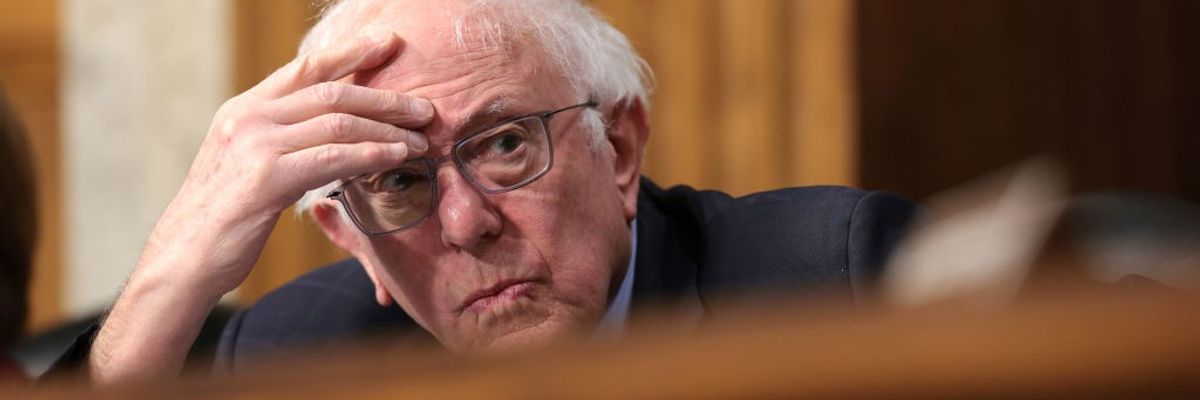
U.S. Sen. Bernie Sanders (I-Vt.) attends a Senate hearing on January 29, 2025 in Washington, D.C.
(Photo: Win McNamee/Getty Images)


Jessica Corbett
Feb 11, 2025
COMMON DREAMS


As U.S. President Donald Trump and billionaire Elon Musk on Tuesday continued their effort to gut the federal government, Sen. Bernie Sanders warned that "the oligarchs, with their unlimited amounts of money, are waging a war on the working class of our country, and it is a war that they are intent on winning."

A week after delivering a speech that sounded the alarm about "America's dangerous movement toward oligarchy, authoritarianism, and kleptocracy," Sanders (I-Vt.) took the Senate floor again to target the world's three richest people—Musk, Jeff Bezos, and Mark Zuckerberg—and the politicians who serve them.

"We are living in an extremely dangerous time," the seantor said Tuesday. "Future generations will look back at this moment—what we do right now—and remember whether we had the courage to defend our democracy against the growing threats of oligarchy and authoritarianism."

As chair of Trump's so-called Department of Government Efficiency (DOGE), Musk's targets have included the U.S. Agency for International Development, Consumer Financial Protection Bureau, Department of Education, National Oceanic and Atmospheric Administration, and a critical U.S. Treasury Department payment system. Reporting—and remarks from the billionaire—suggest that the agencies responsible for Medicaid, Medicare, and Social Security are next.

"As we speak, right now, Elon Musk, the wealthiest man on the planet, is attempting to dismantle major agencies of the federal government which are designed to protect the needs of working families and the disadvantaged," said Sanders. "These agencies were created by the U.S. Congress and it is Congress' responsibility to maintain them, to reform them, or to end them. It is not Mr. Musk’s responsibility. What Mr. Musk is doing is patently illegal and unconstitutional—and must be ended.


Sanders also detailed Trump and his allies' attacks on the federal judiciary, which has delivered a series of blows to the Republican president's agenda since he took office last month.

"Mr. Trump and his friends are not just trying to undermine two of the three pillars of our constitutional government—Congress and the courts—they are also going after the media, in a way that we have never seen in the modern history of this country," the senator said. While recognizing that the media "makes mistakes every day," he added that "I do hope that every member of Congress understands that you cannot have a functioning democracy, you cannot have a free flow of information, you cannot have the pursuit of truth, without an independent press."

The senator also how the top three billionaires impact what information reaches people by buying news outlets and social media platforms—as Musk did with Twitter, which he rebranded X, and Bezos did with The Washington Post and Twitch. Zuckerberg, meanwhile, has made his money through Meta, the parent company of Facebook and Instagram.

"They will use the enormous media operations they own to deflect attention away from the impact of their policies while they 'entertain us to death,'" Sanders warns. "They and their fellow oligarchs will continue within our corrupt campaign finance system to spend huge amounts of money to buy politicians in both major political parties."

"Does anyone really think that the oligarchs give a damn about ordinary Americans?" he asked. "Trust me, they don't."

Sanders warned that "if we do not stop them, they will soon be going after the healthcare, nutrition, housing, and educational programs that protect the most vulnerable people in our country—all so that they can raise they money they need to provide huge tax breaks for themselves and for others billionaires. As modern-day kings who believe they have the absolute right to rule, they will sacrifice, without hesitation, the well-being of working people in order to protect their power and their privileges."

However, he also stressed that "the worst fear of the ruling class of our country is that the American people—whether they are Black or white or Latino, whether they are urban or rural, whether they are young or old, gay or straight, whatever—the fear of the ruling class is that the American people come together to demand a government that represents all of us, not just the people on top."

"The oligarch's nightmare is that we will not allow ourselves to be divided up by race, religion, sexual orientation, or country of origin and will come together and have the courage to take them on," he declared. "If we stand together, we're gonna win this fight, and not only will we save American democracy, we're gonna create the kind of nation that I think most of us know we should become."


30,000 tons of food 'going to waste' in Houston after Trump halted aid


Djiboutian workers fill bags with wheat destined for Ethiopia, provided by the United States Agency for International Development (USAID), at the Port of Djibouti, Africa, Jan. 7, 2013. Wikimedia Commons

February 07, 2025
ALTERNET

About 30,000 tons of food is stuck at a port in Houston after Trump halted foreign aid for 90 days. The food, intended to feed people overseas, is stalled at a warehouse, the Houston Chronicle reported Thursday.

The food was being distributed by the Food for Peace program, which is a part of the U.S. Agency for International Development, a part of the government overseeing aid to more than 100 countries that the Trump administration is looking to shut down.

“The food stuck in Houston totaled more than 31,000 tons and was part of more than 500,000 tons of food valued at $450 million now at risk of going to waste,” writes the Chronicle’s James Osborne. USAID food shipments are also being held up in Boston, New York, and Miami, as well as four other ports.

The freeze is hurting American farmers. According to a 2021 report by the Congressional Research Service, American farms supply about 40 percent of the food that USAID distributes.

"Purchases of commodities from farmers that power Food for Peace have stopped. Hundreds of tons of American-grown wheat are stranded in Houston right now," U.S. Rep. Angie Craig (D-Ark.). Craig is a ranking member on the House Agriculture Committee, told the Chronicle.

"This hostile takeover of USAID is illegal and unacceptable and creates uncertainty and instability for the agricultural economy,” she said.

“You’re talking about a direct impact on American products and American jobs,” George Ingram, a senior fellow at the Center for Sustainable Development at the Brookings Institution, told the Post.

A White House spokesperson told the Chronicle that the move was "ensuring that taxpayer-funded programs at USAID align with the national interests of the United States, including protecting America’s farmers."

Trump "will cut programs that do not align with the agenda that the American people gave him a mandate to implement and keep programs that put America First," the spokesperson said.

“USAID plays a critical role in reducing hunger around the world while sourcing markets for the surplus foods America’s farmers and ranchers grow,” Dave Salmonsen, senior director of government affairs at the American Farm Bureau Federation, said in a statement