Wednesday, February 19, 2025

ONTARIO PROV ELECTION

Indo-Canadian candidate apologises for controversial social media posts
HE BELONGS TO THE SAME PARTY AS TRUDEAU

ByAnirudh Bhattacharyya
Feb 19, 2025 


These posts are related to the killing of pro-Khalistan figure Hardeep Singh Nijjar and Canadian Prime Minister Justin Trudeau

Toronto: An Indo-Canadian candidate running in the Ontario provincial election has issued a public apology after offensive social media posts attributed to him came to light

.
Screenshot from the campaign website of Viresh Bansal, Liberal Party candidate for the forthcoming Ontario provincial election (vireshbansal.ca)

These posts related to the killing of pro-Khalistan figure Hardeep Singh Nijjar in Surrey, British Columbia, on June 18, 2023, and a homophobic slur against Canadian Prime Minister Justin Trudeau.

Viresh Bansal, the Liberal Party candidate from the riding of Oshawa, made these comments in 2023, though his X and Facebook accounts now appear to have been sanitized.

On Tuesday, Bansal issued the apology, through a post on X, in which he said, “I deeply regret the hurtful and thoughtless comments I posted on Twitter in the heat of the moment. I want to sincerely apologize, especially to the Sikh and LGBTQ2S+ communities. My words were offensive and wrong, and I take full responsibility for the harm they caused. I want to express my sincere remorse to the Sikh community, and also to my friends and family of the Sikh faith.”

He added, “Sikhs have long faced discrimination and violence, and my comments only added to that pain. That kind of language should never be used, anywhere, let alone in the context of a Canadian’s murder. I am deeply sorry for my words, and I am committed to learning from this. I will ensure that I never make this mistake again.”

Bonnie Crombie, leader of the provincial Liberal Party, condemned the posts, as she said, “I understand that people can post some really terrible things on their social media. But I want to say that I condemn those statements, I don’t stand for them, they don’t reflect who I am. I don’t think they reflect the values of the Ontario Liberal party,” according to the outlet CityNews.

The posts included a response to New Democratic Party leader Jagmeet Singh accusing India of involvement in Nijjar’s killing, said, “You can thank India for cleaning trash people.”

It added, “Ask your gay friend @JustinTrudeau to do the same.”

THIS IS AN OLD  TROPE FROM THE WHITE RIGHT IN CANADA DATES BACK TO HIS DAD PIERRE ELLIOT TRUDEAU AND ALSO JOHN TURNER (LIBERAL PARTY LEADER)

Singh’s post came on September 18, 2023, after Trudeau’s statement in the House of Commons that there were “credible allegations” of a potential link between Indian agents and Nijjar’s murder.

In a reply to a post from Conservative Party MP Tim Uppal, a handle believed to be that belonging to Bansal, said, “It’s Indian internal matter. You better take care of your own. Dekhi kitten tere naal vi kutt khanni na hoje (be careful or something may happen to you).”

Uppal’s post on March 18, 2023, had referred to actions taken in India against the movement of Amritpal Singh, leader of Waris Punjab De, which subsequently led to his arrest and incarceration.

The emergence of these posts led to demands for Bansal’s candidature to be cancelled by the provincial Liberal Party. No such announcement has been made as yet.

The race in in the riding (as constituencies are called in Canada) is primarily between sitting member of the provincial parliament or MPP Jennifer French of the NDP, and the ruling Conservative Party’s Jerry Ouellette.

The ruling Conservatives have called snap elections, which will be held on February 27. They are expected to comfortably retain power with recent polling showing them leading the Liberals by a dozen points or more.
CRIMINAL CRYPTO CAPITALI$M

Milei crypto scandal widens with allegations against his sister


Feb 19,2025

The political uproar over Argentine President Javier Milei’s role in a crypto scandal has cast the spotlight on his closest adviser and gatekeeper: his sister.

Hayden Davis, a key figure behind the Libra token — which surged then crashed on Friday night after Milei promoted it on X — bragged in a text message to another investor that he was paying Karina Milei to get the president to do his bidding, according to separate reports Tuesday by Argentina’s marquee La Nación newspaper and crypto industry site CoinDesk.

Davis, who hasn’t responded to multiple requests for comment, denied to CoinDesk that he had made payments to the president.

It was also Karina who first took a meeting at the presidential palace with local crypto consultant Mauricio Novelli, who later introduced her brother to several of the parties involved in the memecoin, La Nación reported Sunday.

Milei to meet Musk, IMF chief in Washington following crypto controversy

The token’s crash and the government’s botched attempts to reclaim the narrative have snowballed into the biggest scandal the libertarian has faced since taking power more than a year ago. First, it infuriated a horde of investors and then it hit the market. Argentine assets endured more volatility Tuesday as sovereign bonds performed worse than emerging market peers. The stock market, however, surged six percent after falling by a similar amount the previous day.

An adviser to Karina Milei redirected Bloomberg’s request for comment to Milei’s chief spokesperson, who declined to comment on the news reports.

Davis acknowledged in an interview with Barstool Sports Monday that he had made money from Libra and was seeking ways to make things right. He described the situation as a botched launch.


Explainer: A look at the ‘cryptogate’ scandal involving Milei and Argentina


Davis said he firmly believes Milei is not corrupt, and said the money from the venture belongs to people on the President’s team or whom he “thought was Milei’s team.”

Milei, too, has vociferously denied knowing that his influence could cause unsuspecting investors to quickly lose money.

But that’s all Milei and Davis seem to agree on. The two have offered conflicting accounts over what transpired.

While both sides confirmed that Milei met Davis more than once in Buenos Aires, the Argentines have downplayed the relationship and denied that Davis had or has any connection to the government. Davis, meanwhile, described himself as an adviser to the president who was working on him with a “tokenisation.”

Milei’s bid to diffuse the situation unraveled Monday night when local news network Todo Noticias accidentally broadcast a hot mic moment where journalist Jonatan Viale allowed Milei’s adviser, Santiago Caputo, to interrupt the interview and omit a question. The seemingly rigged interview only drew more negative attention to the scandal.

Karina Milei, whose official role is presidential chief-of-staff, quickly emerged as the president’s most powerful adviser, accompanying him to meet Donald Trump and other world leaders abroad, while lobbying for reforms in Congress.

Unlike President Milei’s prolific use of social media, Karina Milei never speaks to the press and rarely talks in public outside campaign rallies. Both are scheduled to arrive in Washington Thursday where they could meet Trump on the sidelines of a conservative political event.

Karina is not only Milei’s top adviser and strategist, but his gatekeeper. “Talk to Kari” is one of the most common phrases tossed around the president’s circle when it comes to accessing the man himself.

When reflecting on his takeaway from the memecoin debacle, Milei cited the level of access to both himself and his sister.

“We have decided we obviously can’t keep living how we did before and allow that everybody have access to us so easily,” Milei said in the Monday TV interview. “Sadly we have to understand that our role has to have filters.”

by Manuela Tobias & Patrick Gillespie, Bloomberg

Germany elections: Far-right AfD surging as center-right loses protest votes, says pollster

19/02/2025, Wednesday
AA


File photo

AfD has almost doubled its support since 2021 because of voter dissatisfaction with Scholz's coalition government, says Manfred Guellner, head of the Forsa polling institute


- Unpopularity of chancellor frontrunner Merz, particularly among women and young people, has made it difficult for the CDU/CSU to woo disillusioned voters, according to expert

- If all small parties enter parliament, Merz's CDU/CSU will need a more complex three-party coalition, potentially creating political instability that the AfD could exploit, says Guellner

Germany's far-right Alternative for Germany (AfD) is gaining support as center-right parties have failed to capture protest votes, a senior polling expert has told Anadolu ahead of Sunday's elections.

Manfred Guellner, head of the Forsa polling institute, said many Germans were dissatisfied with Chancellor Olaf Scholz's collapsed three-party coalition, but the main opposition Christian Democrats (CDU/CSU) failed to win over these voters.

“Christian Democratic Union (CDU) leader Friedrich Merz was unpopular even in the early days of his political activity, and this has not changed even to this day,” he said. “Merz is unpopular especially among female voters, young people, and also voters in East Germany.”

With just days to go, Merz's Christian Democrats hold a clear lead of 27% in latest polls, but this represents a sharp decline from the conservative alliance's previous electoral showings – 41.5% in 2013, 41.4% in 1994, and 48.8% in 1983.

The far-right AfD, meanwhile, has almost doubled its tally since the previous election, from 10.3% in 2021 to approximately 20% in current polls.

According to Guellner, the AfD has attracted protest votes from those uncomfortable with the policies of Scholz's coalition government – commonly known as the “traffic light coalition” due to the party colors of its members: the Social Democratic Party (SPD), the Greens, and the liberal Free Democratic Party (FDP).

The AfD has now become the first far-right party in Germany's post-WWII history to gain such broad public support, as past surveys show that right-wing extremist views were never supported by more than 10% of German voters.


“The AfD's vote share now surpasses that of any previous right-wing radical movement – groups that have existed continuously in the Federal Republic since the collapse of National Socialism,” Guellner said, referring to the collapse of Adolf Hitler's Nazi regime in 1945.

“The AfD has not only won over these right-wing radical voters, but has also benefited from dissatisfaction with Chancellor Scholz's traffic light coalition. Those unhappy with this coalition have turned to the AfD rather than the main opposition Christian Democrats,” he explained.

Scholz's coalition fell apart in November after escalating disagreements over government spending and borrowing plans.


Its three-year term generated widespread public discontent, struggling to address rising energy prices, increased living costs, migration challenges, and broader socioeconomic issues.

- AfD protest voters ‘beginning to embrace extremist views'

Guellner said the number of undecided voters remains unusually high this time compared to previous pre-election surveys.

He attributed this partly to the unpopularity of both chancellor candidates – frontrunner Merz and the incumbent Scholz.

While the AfD has largely benefited from public discontent, the expert highlighted a concerning trend: many who initially supported the AfD as protest voters are now beginning to embrace the party's extremist views.


“The main core of AfD voters are those who have always been susceptible to a right-wing extremist world view, for xenophobia and ethnic-nationalist ideas, and the others have started to support the AfD out of protest,” he explained.

“But they also adopt the AfD way of thinking, and that is the danger. They are now not letting themselves change their mind in their decision to vote for the AfD,” he added.

In recent years, several prominent members of the AfD have sparked controversy with their anti-immigrant, xenophobic, and antisemitic remarks.

AfD leaders have repeatedly promoted their controversial “remigration” proposal – a vague term the party uses to describe mass deportations of immigrants from the country.


Critics accuse the party of stirring up fear of terrorism for political gain, spreading negative propaganda about immigrants, and encouraging anti-Muslim racism and Islamophobia in the country.

- Fragmented results in AfD's favor

After the elections, analysts expect Merz's CDU/CSU alliance to seek a two-party coalition with either Scholz's SPD or the Greens. However, if three small parties surpass the 5% parliamentary threshold, the CDU/CSU will need to form a three-member coalition instead, as mainstream parties would hold fewer seats.

According to the latest YouGov poll, the socialist Die Linke is set to enter parliament with 9%, while the left-populist BSW polled at 5%, barely clearing the threshold. The liberal FDP stands at 4%, falling short of parliamentary entry.


With support for the AfD rising and voters increasingly disillusioned with the center-right and center-left parties that have long governed Germany through coalitions, Guellner warned that a fragmented election result could delay the formation of a stable government.

This, he said, could lead to weeks of negotiations and political uncertainty, potentially increasing the far-right AfD's support even further.

Despite the AfD's significant rise in polls, the party remains politically isolated in the German political landscape. All mainstream parties have consistently refused to form coalitions or cooperate with the far-right party, citing its extremist positions and anti-democratic tendencies.

“If all the small parties get over 5% and enter the parliament – the FDP, the BSW (Sahra Wagenknecht Alliance), and Die Linke (The Left) – then there could be a situation of instability,” he warned.

“The formation of a two-party coalition government between the CDU/CSU and SPD might also be at risk, and that is a situation that the AfD could also exploit again if there is no stable new government.”​​​​​​​

Germany Snap Polls 2025: 
Olaf Scholz And 3 Others In Fray For Chancellor | About The Candidates

On the list for the next chancellors are the incumbent, the opposition leader, the current vice-chancellor, and — for the first time — a far-right party leader.

Outlook Web Desk
Updated on: 18 February 2025 


German Chancellor Olaf Scholz | Photo: AP

With Germany's snap elections set for Sunday, a total of four candidates are in the running for the top post of Chancellor.

On the list for the next chancellors are the incumbent, the opposition leader, the current vice-chancellor, and — for the first time — a far-right party leader

Germany Snap Elections | Who Are The Top Candidates For Chancellor?

Olaf Scholz


Olaf Scholz, 66-year-old, has been Germany's chancellor since December 2021. The center-left Social Democrat has a wealth of government experience, having previously served as Hamburg's mayor and German labor and finance minister. Quickly finding himself dealing with unexpected crises, he launched an effort to modernize Germany's military after Russia invaded Ukraine and made Germany Ukraine's second-biggest weapons supplier.

He also tried to prevent an energy crunch and tried to counter high inflation. But his three-party coalition became infamous for infighting and collapsed in November as it argued over how to revitalize the economy.


Friedrich Merz


Germany's 69-year-old opposition leader Friedrich Merz has been the front-runner in the election campaign, with his centre-right Union bloc leading the poll

He became the leader of his Christian Democratic Union party after longtime Chancellor Angela Merkel — a former rival — stepped down in 2021.

He has taken his party in a more conservative direction. During the election campaign, he made curbing irregular migration a central issue.


Robert Habeck

The 55-year-old is the candidate from the environmentalist Greens party. He's also Germany's current vice chancellor and the economy and climate minister, with responsibility for energy issues.


From 2018 to 2022, he co-led the Greens and helped the party grow in popularity. However, in 2021, he decided to step down and allow Annalena Baerbock, who is the foreign minister, to lead the party's first-ever bid for the chancellorship.


Alice Weidel


With Weidel's contest for the top post, the 46-year-old is making the first bid from the far-right, anti-immigration Alternative for Germany (AfD). An economist by nature, Weidel joined the party shortly after it was founded in 2013. Since the party first secured seats in Germany's national legislature in 2017, she has served as co-leader of her party's parliamentary group. In 2022, she became a co-leader of the party alongside Tino Chrupalla. and in December, she was nominated as the AfD's candidate for chancellor.

However, other parties have made it clear they won't collaborate with the AfD, so at this point, her chances of becoming chancellor are highly unlikely.

Why Is Germany Holding Snap Elections?

In the country's last federal election in 2021, Scholz's center-left Social Democrats (SPD) formed a coalition with the Greens and the pro-business Free Democrats (FDP).

The FDP was the most junior member of the coalition, representing just 11% of the electorate. However, ex-Finance Minister Christian Lindner, the leader of the FDP, openly disagreed with Scholz and other cabinet members on multiple occasions, most notably about the government's 2025 budget.


On November 6, the chancellor asked President Steinmeier to dismiss Lindner, which he did the next day. The FDP The FDP pulled its support from the coalition, leaving Scholz and the Greens as a minority government.

The SPD holds 207 seats in the 733-seat Bundestag, while the Greens have 117.Minority governments are frowned upon in Germany, and the collapse of a coalition is relatively rare compared to other European countries. It has only happened five times since Germany adopted its current constitution in 1949.

(With AP inputs)


German ‘bureaucracy monster’ on everyone’s election hit list


By AFP
February 18, 2025


Slashing bureaucracy was a key demand at a recent Berlin protest called by business groups wanting to revive the stagnating economy - Copyright AFP/File JOSH EDELSON
Clement Kasser with Louis Van Boxel-Woolf in Frankfurt

German politicians make a lot of laws and regulations but on the campaign trail many rage against the country’s notorious bureaucracy, labelling it a monster that needs to be slayed.

Whatever else divides them, almost all candidates in the February 23 vote agree with the popular idea that Europe’s biggest economy needs to slash back its thicket of rules, often labelled a “jungle of paragraphs”.

Some want to take a chainsaw to it all, inspired by Argentina’s neoliberal President Javier Milei, even if their true intent at times may be to weaken troublesome labour or environmental standards.

Conservative poll frontrunner Friedrich Merz — who once famously argued a tax return should fit onto a beer coaster — has vowed to go to war against the “bureaucracy monster”.

Merz and others want to free companies from national and EU reporting obligations, especially the Supply Chain Due Diligence Act, that they regard as headache-inducing as its German tongue twister name, the “Lieferkettensorgfaltspflichtengesetz”.

Tech billionaire Elon Musk, in a controversial recent online chat to support Germany’s far-right AfD, claimed that the approval documents for his Tesla plant near Berlin amounted to an entire truckload of paper, each page stamped by hand.


– ‘Suffocated’ –


At a recent Berlin protest called by business groups who demanded steps to revive the stagnating economy, property firm manager Urs Moeller, 44, fumed about being “suffocated” by red tape.

“The accident insurance people keep inventing new procedures where they do nothing but send us a bill,” he told AFP.

“Taxes and bureaucracy are making it harder and harder to be efficient and pay attractive wages.”

The problem is real, and there is a report to prove it. The number of regulations has grown by 18 percent in Germany since 2014, according to government figures.

Critics charge that the time workers spent doing paperwork is a serious problem for a struggling economy already battered by high energy costs and growing Chinese competition.

Time spent filling in forms cost the German economy 65 billion euros ($67 billion), says the Normenkontrollrat, an independent body advising the government on regulation.

The Ifo economic institute, factoring in a series of indirect costs, puts the figure even higher — at a whopping 146 billion euros or 3.4 percent of German economic output.

Digitisation is often touted as the answer — the foreign ministry this year was proud to announce it had finally moved visa applications online — but IT does not always prove to be the magic bullet.

Lutz Krause, who owns a construction company, said a new electronic invoicing system designed to help the government keep better track of receipts was causing paperwork to multiply.

And there are other issues — he said government clients were now the most difficult to deal with.

To get work on a construction site at Berlin Airport, he said, employees had to pass a security course that included written exams.

“More and more, we’re just avoiding government work,” he said.


– ‘Red tape radar’ –


German bureaucracy, according to Ifo rankings, is far heavier than in France or the Nordic countries, though not as onerous as in some other developed nations.

Like many other Europeans, Germans complain of a rising tide of EU rules emanating in Brussels.

The problem is made worse by German federalism, according to Ifo economist Oliver Falck, since the country’s 16 states often implement EU directives in different ways.

Germany’s tradition of decentralised administration only adds to the problem since “companies often have to give information to someone that they have already given to someone else“, he said.

The western state of Hesse has tried to fight this perception by appointing a minister for de-bureaucratisation, Manfred Pentz.

He is proud of the “red tape radar”, an online service through which 6,700 people have reported problems in dealing with authorities.

“Bureaucracy needs to be tackled so the economy can work again, so people aren’t turned off by the government,” he said.

But economist Falck is sceptical that much will change, having seen little progress in the past 20 years despite the subject never quite leaving the headlines.

Businessman Krause shares that fear: “Germans seem to have paperwork in their DNA.”


SOCIAL EUROPE

“Researching Precariousness Across the Paid/Unpaid Work Continuum”,

The Politics of Unpaid Work

This new book published by Oxford University Press presents the findings of the multiannual ERC research project “Researching Precariousness Across the Paid/Unpaid Work Continuum”,
led by Valeria Pulignano (KU Leuven), which are very important for the prospects of a more equal Europe.

Unpaid labour is no longer limited to the home or volunteer work. It infiltrates paid jobs, eroding rights and deepening inequality. From freelancers’ extra hours to care workers’ unpaid duties, it sustains precarity and fuels inequity. This book exposes the hidden forces behind unpaid labour and calls for systemic change to confront this pressing issue.

DOWNLOAD HERE FOR FREE


What kind of impact is artificial intelligence (AI) having, or likely to have, on the way we work and the conditions we work under? Discover the latest issue of HesaMag, the ETUI’s health and safety magazine, which considers this question from many angles.


WSI European Collective Bargaining Report 2023/2024 Cover

WSI European Collective Bargaining Report 2023/2024

Real wages in the European Union continued their decline in 2023—despite an acceleration in nominal wage growth and falling inflation rates. For the current year, there are only tentative signs of a slow recovery in the purchasing power of wages.

A resumption of real wage growth would stabilize the functional distribution of income and strengthen domestic demand. However, even under this benign scenario, the crisis is far from over from workers' point of view. They have borne the brunt of real income losses associated with the energy-price shock resulting from the Russian invasion of Ukraine.

The lingering reduction in real wage levels means that wage policy still needs to catch up to contribute to a fairer distribution of the burden between labor and capital.


MEXICO

Pemex’s Gas Waste Sparks Economic and Environmental Alarm


By RT Staff Reporters
February 19, 2025


Pemex, Mexico’s state oil giant, squandered 8.7% of its natural gas production during Andrés Manuel López Obrador’s term, report locala media.

This translates to 411 million cubic feet daily, nearly doubling the 4.6% (257 million) lost under Enrique Peña Nieto. From January to September 2024, venting hit 296 million cubic feet daily, or 6.4% of output, down from 7.3% (372 million) in 2023.

This waste stems from Pemex’s failure to meet the Comisión Nacional de Hidrocarburos’ 98% gas utilization rule, set since 2016. The company hasn’t hit this target since 2013, peaking at 13.7% waste in 2021 amid pandemic woes.

Earlier, Peña Nieto’s era saw a high of 9.2% in 2016, later dropping to 3.2% by 2018. Under AMLO, yearly losses averaged over 5%, costing $2 billion annually, says Comener’s Juan Acra.

Flaring and venting release methane, a gas 25 times more potent than carbon dioxide, derailing Mexico’s climate goals. Acra notes this blocks clean energy progress, while Pemex’s $3 billion 2016 plan to curb flaring stalled

.
Pemex’s Gas Waste Sparks Economic and Environmental Alarm. (Photo Internet reproduction)

Meanwhile, capturing gas could yield 160 jobs per million cubic feet, vital for Mexico’s economy. Historically, Pemex thrived, once fueling half of Mexico’s revenue, but outdated infrastructure and policy shifts hurt efficiency.

The 2014 Energy Reform ignored gas capture, and AMLO’s oil-first focus deepened losses. Now, new CEO Víctor Rodríguez pledges 99.9% gas use by 2030, targeting methane cuts and energy self-reliance.

Businesses watch closely as Pemex’s $100 billion debt and import reliance clash with its 5 billion cubic feet daily production goal. Rodríguez’s plan hinges on private partnerships and tech upgrades, yet past failures cast doubt. This story matters: wasted gas bleeds money and harms the planet, testing Mexico’s energy future.
Bangladesh campus clashes leave 150 students injured

2 Border Guard Bangladesh (BGB) platoons called in at Khulna University of Engineering and Technology in southwestern Khulna district after clashes

Aamir Latif |19.02.2025 - TRT/AA


KARACHI, Pakistan

Security forces were called in after 150 students were injured in clashes between two rival student groups at a university in Bangladesh’s southwestern Khulna district, local media reported on Wednesday.

Clashes erupted on Tuesday at Khulna University of Engineering and Technology (KUET) between activists from Bangladesh Jatiotabadi Chatradal, a student organization affiliated with the Bangladesh Nationalist Party of former Prime Minister Khalid Zia, and the Anti-Discrimination Student Movement (ADSM), a group that led the uprising that forced former Prime Minister Sheikh Hasina to flee to India last August, according to local daily Prothom Alo.

Clashes broke out after the youth wing of Zia's party attempted to recruit students but was stopped by ADSM activists.

Both sides used bricks and other objects to attack one another.

Two Border Guard Bangladesh (BGB) platoons were deployed to control the situation.

According to ADSM secretary Zahidur Rahman, 50 colleagues were severely injured in the clashes, while over 150 students received minor injuries.

While confirming that 150 students were injured in the clashes, police said they arrested at least five people on charges related to their involvement.


GAZA NAKBA 2.0

Oxfam Warns Gaza’s Water Crisis Deepens Amid Reported Waterborne Diseases  

February 18, 2025
in GazaReports


DayofPal– The humanitarian crisis in Gaza is escalating as water shortages reach critical levels, fueling a surge in disease and deepening an already dire health catastrophe, according to Oxfam organization.

Oxfam reports that Palestinians in both northern and southern Gaza are now surviving on less than 7% of the water available before the war, with devastation to water infrastructure leaving families desperate for even a single drop.

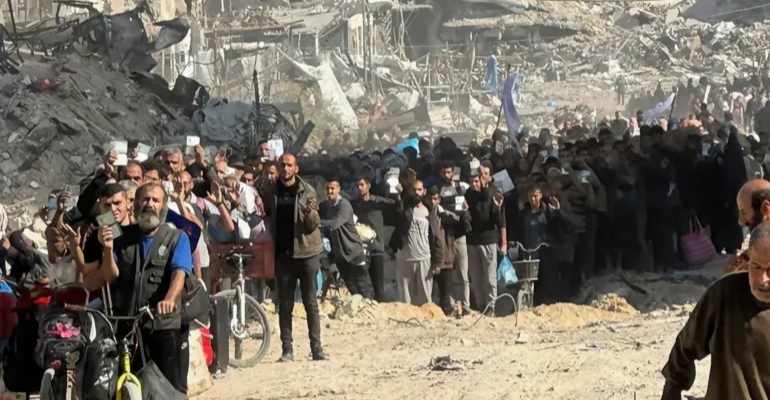
In North Gaza, encompassing areas like Jabalia, Beit Hanoon, and Beit Lahiya, the destruction has been near-total, with almost all water wells rendered inoperable.

The situation in the southern Rafah governorate is equally grim with over 90% of wells and reservoirs having been damaged, leaving water production at just five% of its previous capacity.

Even as efforts to restore water systems continue following the ceasefire, the damage to Gaza’s pipelines has resulted in catastrophic losses.

Oxfam estimates that 60% of water is leaking into the ground instead of reaching homes, leaving densely areas without the most basic necessity for survival.

Clemence Lagouardat, Oxfam’s humanitarian head of response in Gaza, said “Now that the bombs have stopped, we are only beginning to grasp the sheer scale of destruction to Gaza’s water and sanitation infrastructure.”

“Most vital networks have been entirely lost or paralyzed, creating catastrophic hygiene and health conditions,” he added.

The consequences are harrowing. Oxfam describes desperate scenes where people plead for water in the streets, and parents forego drinking so their children can have the little that remains. Some children are walking miles just to fill a single jerrycan.

With safe water scarce, waterborne diseases are spreading at an alarming rate. A World Health Organization (WHO) study found that 88 percent of environmental samples tested across Gaza were contaminated with polio, warning of an imminent outbreak.

Other infectious diseases, including acute watery diarrhea and respiratory infections—now the leading causes of death—are surging, with 46,000 cases reported weekly, primarily among children.

Chickenpox, scabies, and impetigo are also rampant, particularly among displaced families in the hardest-hit northern areas. Overflowing sewage, lack of sanitation, and overcrowded living conditions are accelerating the crisis.

“Rebuilding water and sanitation is vital for Gaza to have a path to normalcy after 15 months of horror,” said Lagouardat. “The ceasefire must hold, and fuel and aid must flow so that Palestinians can rebuild their lives.”

As Gaza’s residents battle both the physical and humanitarian aftermath of war, the urgent call for aid, fuel, and restoration of water infrastructure grows louder. Without immediate intervention, the enclave risks plunging further into an unprecedented public health disaster.

Rebuilding Gaza Will Cost Over $50 Billion, Says World Bank

AND THATS WITHOUT HOTELS OR BOARDWALK

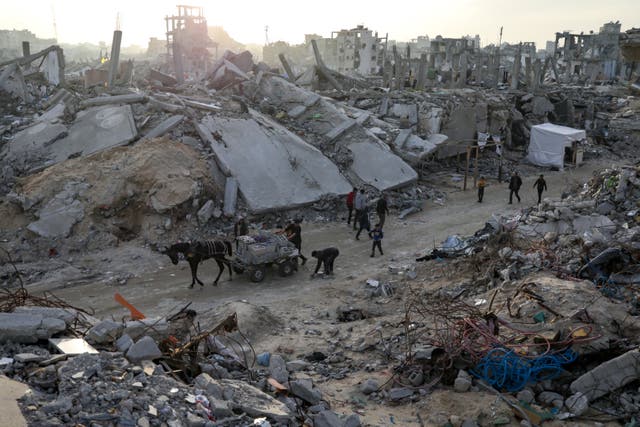
Palestinians walk past tents lining the streets amid the rubble of destroyed buildings in Jabalia, in the northern Gaza Strip on February 18, 2025, as people return to northern parts of Gaza during a current ceasefire deal in the war between Israel and Hamas. (AFP)

19 February 2025 
AD ـ 20 Sha’ban 1446 AH

The World Bank, United Nations and the European Union are pointing to a formidable international reconstruction effort ahead for Gaza, which they estimate will cost $53.2 billion.

“Funding will require a broad coalition of donors, diverse financing instruments, private sector resources and significant improvements in the delivery of reconstruction materials to Gaza,” said the report released Tuesday.

The organizations said they would work with partners to devise a “strategic plan” to oversee the recovery and reconstruction.

The report identified almost $30 billion in damage as a result of the war — with nearly half of that due to destruction of homes. The war has displaced an estimated 90% of Gaza’s population, and since a ceasefire took effect last month, many displaced Palestinians have returned to find their former homes in ruins.

The report said Gaza would require about $20 billion for recovery and reconstruction needs over the next three years.

It says an additional $33 billion will be needed in the long term, including funds to rebuild the territory’s social and health services and the battered economy.


UAE tells U.S.' Rubio it rejects displacement of Palestinians


1 of 3
U.S. Secretary of State Marco Rubio walks with United Arab Emirates President Sheikh Mohamed bin Zayed Al Nahyan as they meet at ADNEC Centre Abu Dhabi in Abu Dhabi, United Arab Emirates, February 19, 2025. REUTERS/Evelyn Hockstein/Pool

2 of 3
U.S. Secretary of State Marco Rubio walks with United Arab Emirates President Sheikh Mohamed bin Zayed Al Nahyan as they meet at ADNEC Centre Abu Dhabi in Abu Dhabi, United Arab Emirates, February 19, 2025. REUTERS/Evelyn Hockstein/Pool

3 of 3
U.S. Secretary of State Marco Rubio walks with United Arab Emirates President Sheikh Mohamed bin Zayed Al Nahyan as they meet at ADNEC Centre Abu Dhabi in Abu Dhabi, United Arab Emirates, February 19, 2025. REUTERS/Evelyn Hockstein/Pool››

UPDATED Feb 19, 2025,

DUBAI - The United Arab Emirates leader told the United States' secretary of state on Wednesday that his country rejects a proposal to displace Palestinians from their land, the Emirati state news agency WAM reported.

President Sheikh Mohammed bin Zayed Al Nahyan's comments came after U.S. President Donald Trump proposed a U.S. takeover of Gaza and resettling its Palestinian inhabitants in Jordan and Egypt, prompting widespread opposition among Arab countries and Western allies.

Nahyan told U.S. Secretary of State Marco Rubio during a meeting in Abu Dhabi that it was important to link the reconstruction of Gaza to a path leading to "a comprehensive and lasting peace based on the two-state solution" to the Israel-Palestinian conflict.


The UAE's stance on the conflict is important because it is one of four Arab countries that normalised ties with Israel during the first Trump administration and because it has played a role financing reconstruction work after previous conflicts.

Arab diplomacy on Gaza is aimed at developing an alternative to Trump's plan for the territory, most of which lies in ruins after Israel's 15-month military campaign against Hamas, with nearly all the 2.3 million inhabitants now homeless.

The leaders of Egypt, Saudi Arabia, Jordan, the UAE and Qatar are expected to discuss the plan in Riyadh this month before it can be presented to an Arab League summit in Cairo in March. 

REUTERS


US, Israel push plan to relocate Gazans to Jordan


2025-02-19 04:19

The sources told Shafaq News that despite Arab states' opposition to the forced displacement of Gazans, backdoor efforts continue to pressure Egypt and Jordan. Egypt has proposed rebuilding Gaza with Arab funding over 5 to 10 years while temporarily housing residents in shelters within Palestine or at border crossings. However, the US and Israel are reportedly using financial aid threats to push their plan forward.

The plan involves multiple stages, beginning with relocating around 2,000 families with children in need of medical care. Under this pretext, more individuals would be gradually transferred to Jordanian refugee camps, similar to previous resettlement waves. Palestinian families would be housed in over ten refugee camps, including Zarqa, Hitteen, and Soukhneh in Zarqa province, as well as Irbid and Martyr Azmi al-Mufti camps in Irbid, and Jerash camp in Jerash province.

Upcoming meetings, including the Arab summit in Saudi Arabia, the emergency Arab League Summit in Cairo and ordinary one in Baghdad, are expected to produce a unified stance against plans to partition Palestine or impose a two-state solution that undermines Palestinian rights, particularly in Gaza and the West Bank the sources stressed.

US priorities in the region have shifted significantly. Washington’s focus is now on securing key economic resources in what it envisions as a “New Middle East.” Gaza holds valuable energy reserves and a strategic location, making it a potentially lucrative tourist destination. Combined with its agricultural wealth, these factors are seen as motivations for gaining control over the territory without provoking mass resistance according to the sources.

Jordan’s King Abdullah II stated last week in Washington that Egypt would respond to former US President Donald Trump’s proposed plan, which Arab states are set to discuss in upcoming talks in Riyadh.

Trump sparked global outrage last week by proposing US control over Gaza, with a plan to rebuild the war-torn enclave and transform it into the "Riviera of the Middle East"—but only after forcibly relocating its population elsewhere with no right of return.

Netanyahu appoints adviser with Trump ties to lead ceasefire talks


Israeli Prime Minister Benjamin Netanyahu has appointed a close confidant to lead negotiations for the second stage of the ceasefire with Hamas (Jehad Alshrafi/AP)

Israeli Prime Minister Benjamin Netanyahu has appointed a close confidant to lead negotiations for the second stage of the ceasefire with Hamas, an official said on Wednesday.

US-born Ron Dermer is a Cabinet minister who is widely seen as Mr Netanyahu’s closest adviser.

He previously served as Israel’s ambassador to the US and is a former Republican activist with strong ties to the Trump White House.

Israel and Hamas have yet to negotiate a second and more difficult phase of the ceasefire, and the first ends in early March.

Palestinians and Arab countries have universally rejected US President Donald Trump’s proposal to remove the Palestinian population from the Gaza Strip and take over the territory.

Since the war in Gaza was sparked by Hamas’s attack on October 7 2023, more than 50,000 people have died in Gaza and Lebanon and nearly 70% of the buildings in Gaza have been devastated, according to health ministries in Gaza and Lebanon.

Around 1,200 people were killed in Israel during the October 7 attack.

People walk amid destruction caused by the Israeli air and ground offensive in Jabaliya, Gaza Strip (Jehad Alshrafi/AP)

Also on Wednesday, Lebanon’s state-run National News Agency said an Israeli drone strike on a car in a border village killed one person.

The strike in the village of Aita al-Shaab was the first since Israeli troops withdrew from southern border areas a day earlier as part of a US-brokered ceasefire between Israel and Hezbollah.

The agency also said Israeli troops opened fire on the Lebanese side of the border, injuring two people.

There was no immediate comment from Israel.

Meanwhile, Israeli military prosecutors have charged five soldiers with assault over an attack on a Palestinian detainee in which they sodomised him with a knife.

The military said attack in the Sde Teiman facility on July 5 2024 “caused severe physical injury to the detainee, including cracked ribs, a punctured lung and an inner rectal tear”.

It said the soldiers took the detainee to a separate area, blindfolded and handcuffed him and then assaulted him. It said the evidence for the attack is “extensive” and included footage from a security camera.

The five were among nine Israeli reservists arrested last July over the attack.

A defence lawyer at the time denied the allegations, saying the soldiers responded with force when the detainee attacked them.


The Transatlantic Alliance Is Dying—What Comes Next for Europe?

With US power in retreat, Europe must decide: unite, or face irrelevance in a dangerous world.


SOCIAL EUROPE

u421983462e c2ec 4dd2 90a4 b9cfb6856465 1

The last great constant of the postwar order is breaking before our eyes. What set American hegemony apart from the old colonial empires and the former Soviet bloc—or at least what once distinguished it—was the United States’ willingness to invest in a system of voluntary alignment. States were, as a rule, not coerced into submitting to the US-led order. They retained the freedom to place themselves under the protection of American power. Washington was prepared to involve Europeans as (junior) partners in maintaining a global order dominated by Western interests. While the relationship was not one of equals, the United States still took allied interests into account. This was not a system of subjugation but of integration—one in which every state acknowledged US leadership but retained the capacity to articulate its own concerns.

For the United States, this voluntary cooperation with weaker nations was a source of strength. American dominance rested not only on military and economic power, but also on the attractiveness of a democratic community of values—a coalition that offered allies respect and a voice. The construction of multilateral institutions like the United Nations, the IMF, the World Bank, the WHO, the WTO, and NATO after World War II was a diplomatic masterpiece by the American superpower.

States do not want to be at the mercy of others. That is why many countries favour a rules-based world order, even when those rules skew in favour of the powerful. In a multilateral system, even the smallest nations have a voice. That voice may carry little weight, but small states can seek to make themselves heard and, in concert with others, wield influence.

Under Joe Biden, US support for Ukraine was an attempt to reassert American leadership of the West in the 21st century. The new US administration sees it differently. For years, America has been rightly criticized for its double standards on human rights. Yet in the face of an “America First” policy devoid of standards altogether, it becomes clear how valuable it is when the powerful feel at least an obligation not to ignore principles of democracy and human rights altogether. International law and the postwar order—largely crafted by the United States—no longer seem to guide the thinking of the new President and his circle.

Many experts are tearing their hair out. Surely, any rational person should see that the old hegemonic system is better even for the US itself. But this view is rooted in a bygone era of transatlantic consensus. The humiliation of Western democratic leaders in Europe and Canada is easier to grasp when viewed through the lens of America’s domestic political struggle. To Trump and his Republican allies, Europeans lean toward the camp of Biden and Obama rather than Trumpism—siding, in other words, with those Trump fights at home. In a friend-enemy framework, yesterday’s allies become today’s opponents. To Trump and the American right, the liberal democracies of Europe are not friends but potential enemies of their domestic agenda. Regime change in these nations is part of a new hegemonic strategy that fuses plutocratic power expansion with a cultural counter-revolution. Or, as JD Vance quipped in Munich: The firewall against the AfD is more dangerous than China or Russia.

But beyond political shifts in the US, Europe’s diminishing significance also contributes to the decline of the transatlantic partnership as the core of Western hegemony. Beneath the surface of institutional continuity, power dynamics have shifted. It is anachronistic that France and Britain retain their Security Council vetoes or that Europeans and Americans still claim the top posts at the IMF and World Bank. Over the past 45 years, the EU’s share of global GDP has fallen from 27 percent to 14.5 percent, while China’s has risen from 2 percent to 19 percent. In 1960, Europe accounted for 20 percent of the world population; today, it is just 9 percent. Europe has literally lost value and weight as a strategic partner to the US.

The sympathy of rising powers in the Global South—India, Indonesia, South Africa, Brazil—for a multipolar world stems partly from the reluctance of the established powers to adapt the rules of the international system to new realities. UN Security Council reform is stalled; the industrialized nations shirk their fair share of the climate burden; and they resist offering developing countries better terms for agricultural exports under the WTO. Trump’s decision to engage Russia over Ukraine and Europe’s heads is a public rebuke of Europe and a disaster for both Ukraine and Volodymyr Zelenskyy. For three years, Ukrainian diplomacy has been uncompromising—legally barring talks with Putin, insisting on maximalist peace terms predicated on Russian defeat, and publicly criticizing allies for insufficient arms deliveries. Western leaders, in unison, declared that only Ukraine could decide on peace, its territorial integrity was non-negotiable, NATO membership was coming, and any ceasefire rewarding Russian aggression was unacceptable.

Trump now makes clear that those with power call the shots. With Trump’s election, Zelenskyy has retreated from one position after another: admitting the occupied territories cannot be reclaimed militarily, seeking security guarantees instead of NATO membership, and finally, signalling readiness to negotiate with Putin. Trump has been offered Ukrainian resources to pay for US arms. No blame should fall on Zelenskyy—appeasing America is his only choice. The mercantile pivot is stark: the US now demands 50 percent of Ukraine’s mineral wealth in return for military aid, without linking this extraction deal to security guarantees.

Speculating about alternative Ukrainian strategies over the past three years is futile. Ukraine is now in a position of desperate weakness. Trump knows Ukraine has no choice but to accept whatever the US and Russia agree upon. Europe is reduced from junior partner to auxiliary force just asked to fill in a questionnaire on security guarantees for Ukraine. The impotence of European militaries underscores NATO’s reality: everyone shares costs, but only the US holds the military keys.

Unlike China, Russia, or the US, Europe can only survive as a multilateral project. The EU is the most successful supranational community of values and cooperation, an antithesis to the neo-nationalisms of other powers. It stands as a liberal countermodel to party dictatorship, plutocracy, and kleptocracy. Europe is both the most attractive and fragile of the great political forces—which is why rivals agree on weakening it. Ironically, Europe’s right-wing nationalists are courted by both Trump and Putin.

Everything now hinges on Germany. A European response is impossible without Berlin, and even with its best intentions, it will be a Herculean task. European states are weighing integration against national self-interest. From an American perspective, Europe is weakened most if Germany and France are punished while others—for example Poland, Italy, Hungary—are rewarded. Imagine high tariffs on German cars paired with duty-free access for goods from other European countries.

Germany must choose: invest in Europe as a power or carve out a national niche. If it seeks to avoid sliding into voluntary irrelevance, it must lead generously and cooperatively. This means joint debt for industrial policy and defence, majority decisions in foreign and security policy, fiscal alignment, investment in social peace and participation in peacekeeping in Ukraine..

Europe’s deepening and transformation cannot be brokered in Brussels backrooms while nationalist sentiments reign outside. We need public mobilization for Europe as a bastion of freedom, security, social justice and democracy. That demands smart politics, compromise, and charismatic leadership. The hour calls for nothing less.

Frankl Hoffer

Frank Hoffer is non-executive director of the Global Labour University Online Academy.