Tuesday, March 04, 2025

'Brain Drain': Study Shows Workers Fleeing States With Abortion Bans

"Workers are not willing to trade their health and autonomy for a paycheck," said one advocate.


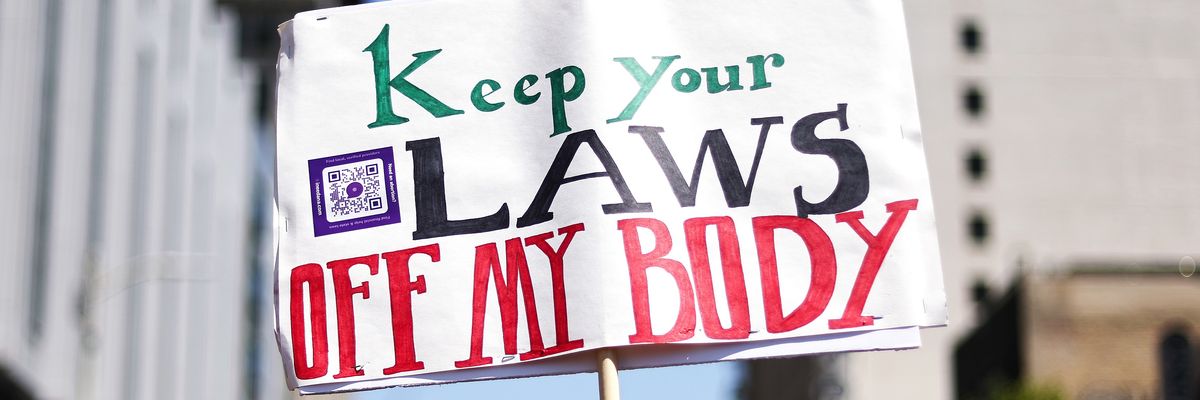
Protestors demonstrate at the March for Reproductive Rights organized by Women’s March L.A. on April 15, 2023 in Los Angeles, California.
(Photo: Mario Tama/Getty Images)


Julia Conley
Mar 03, 2025
OMMON DREAMS

Republican lawmakers across the United States are determined to force people who become pregnant to carry their pregnancies to term by passing abortion bans and "fetal personhood" laws, but a new report shows that in many states, they are choosing choosing restrictions on reproductive rights over their states' workforce.

"Workers are not willing to trade their health and autonomy for a paycheck," said Dr. Jamila K. Taylor, president and CEO of the Institute for Women's Policy Research (IWPR) as the group released a report Monday on "brain drain" in states with abortion bans.

The group analyzed a survey of 10,000 adults by Morning Consult and found that 1 in 5 respondents who are planning to have children in the next decade has moved to a new state due to abortion restrictions, or knows someone who has.

Among people with advanced degrees, 14% have moved out-of-state because of anti-abortion laws or know someone who has.

Nancy Northrup, president of the Center for Reproductive Rights (CRR), which advised on the study, said the report showed that "reproductive healthcare is a personal issue and workplace imperative."

"For business leaders and policymakers, protecting reproductive rights isn't just the right thing to do—it's essential for talent and long-term economic stability," said Northrup.

The two groups said the study showed employees' demands for policymakers and workplaces in states that are hostile to abortion rights.

"Access to reproductive healthcare is a fundamental component of workplace equity, and businesses can no longer afford to ignore the impact of abortion restrictions on their workforce."

Fifty-seven percent of workers who plan to have children prioritize employers who offer reproductive healthcare benefits and 56% person think companies should actively engage with lawmakers to protect abortion rights.

In states with restrictive abortion laws, people broadly support family-friendly workplace policies, according to the report, including 83% of Mississippi residents who back paid sick leave; 56% of people in West Virginia who think employers should offer paid time off for fertility treatments; and 70% of people in Alabama who support paid leave for pregnancy-related healthcare.

"Access to reproductive healthcare is a fundamental component of workplace equity, and businesses can no longer afford to ignore the impact of abortion restrictions on their workforce," said Taylor. "Our report makes it clear that companies who fail to address these needs risk losing their competitive edge. To build a resilient workforce and thriving economy, it's up to corporate leaders and lawmakers to take decisive action and make reproductive health care a top priority."

Workers expect their employers to not only provide reproductive healthcare and family-friendly benefits, but also to "stand up for these rights at a policy level," the report reads.

"Companies can play a critical role in helping to shape more accessible state policies and creating an environment that respects and safeguards access to comprehensive reproductive healthcare," it continues.

The report suggests that with workers thinking of moving to new states to get away from anti-abortion laws, employers will likely be incentivized to help ensure their states safeguard "access to comprehensive reproductive healthcare."

"Most employees are deeply concerned about their ability to access healthcare services while building their families, and they expect their employers to take an active role in protecting them," reads the report. "Accepting that reality and then making decisions from there will enable companies to attract and retain talent and, by advocating to improve the reproductive landscape across the U.S., drive economic progress."


Lyft, Uber Drivers Banned From Tennessee Airport After Caravan for Pro-Worker Bill

"Uber, Lyft, and Metro Nashville Airport Authority are engaging in an inappropriate and malicious alliance to destroy dozens of livelihoods," said the Tennessee Drivers Union.


A traveler walks toward the Uber ride-hailing vehicle pickup area at Los Angeles International Airport on February 8, 2023 in Los Angeles, California.
(Photo: Mario Tama/Getty Images)

Jessica Corbett
Mar 03, 2025
COMMON DREAMS


A Tennessee union announced Monday that 34 Uber and Lyft drivers received messages "informing them that they had been permanently banned" from working at Nashville's airport after joining scores of workers for a peaceful caravan there last month to support a state bill that would impact the companies.

The Tennessee Drivers Union (TDU) said in a statement that some participants, "including those in the passenger's seat not driving," were banned from providing rides at Nashville International Airport following the February 14 action, during which "participating Uber and Lyft drivers had their apps turned off."

In a message to one Uber driver obtained by Common Dreams, the company said that "Nashville International Airport (BNA) notified us that you conducted a pickup on the arrivals level of the terminal. Please note that all pickups must occur in the Uber-designated zone."

"Due to the nature of the incident, the airport is restricting certain driver-partners from accepting rides or dropping passengers off at BNA permanently, pursuant to the terms of Uber's agreement with the airport," Uber continued. "Your account appeared on the list. For that reason, your account has been permanently blocked from operating at BNA. Contact the airport for more information."

A message to a Lyft driver similarly said that "it has been reported that you were conduct detrimental to the orderly operation of the airport. That being said, at the request of the airport, you are prohibited from operating on BNA airport property indefinitely."

"To prevent future suspensions, carefully review the BNA rules and regulations," Lyft added. "Please note, citations may be given if you operate on BNA property during your suspension, and you will be responsible for paying them."

Lyft and Uber have not responded to Common Dreams' requests for comment on the bans, which come as working people face high costs and a billionaire-led assault on the federal government.

TDU said Monday that "Uber, Lyft, and Metro Nashville Airport Authority are engaging in an inappropriate and malicious alliance to destroy dozens of livelihoods. The airport is one of the only opportunities for ride-share drivers to make barely above minimum wage."

"This is an attack against dozens of workers, their families, and their communities," the union continued, noting the millions of dollars in fees the airport gets from drivers and Metro Nashville Airport Authority CEO Doug Kreulen's $600,000 salary.


As Common Dreams reported last year, TDU has sounded the alarm about working conditions for drivers at BNA. Union members kicked off Labor Day weekend in 2024 with a strike to draw attention to demands including a cap on the number of ride-share drivers in the area, an expansion of their airport lot, and clean, working bathrooms on-site.

TDU said Monday that "this retaliation isn't a mistake," arguing that "Uber and Lyft are threatened" by Tennessee House Bill 879/Senate Bill 818, introduced last month by state Rep. Rush Bricken (R-47) and Sen. Joey Hensley (R-28).

The bill text begins by highlighting that "Tennessee is the only state in the Southeast that allows out-of-state ride-hail drivers to operate within the state, while Tennessee ride-hail drivers may not work in surrounding states."

"Tennesseans who live and work in our communities, contributing directly to our local economy, struggle to compete with an oversaturated market of out-of-state drivers," the legislation explains, calling for "a basic licensing regime."

The bill would require ride-hail drivers operating in the state to have a "transportation network license," which would require a Tennessee driver's license, or proof of residency in DeSoto County, Mississippi, or Crittenden County, Arkansas.

Companies that allow drivers to provide rides without a Tennessee-issued transportation network license would be hit with a $1,000 penalty per violation and could ultimately be banned from operating in the state.
Dems Should Not Attend Trump’s State of the Union But With Fury in Their Hearts

Democrats should not signal to a nationally televised audience that what we’re living through is normal.


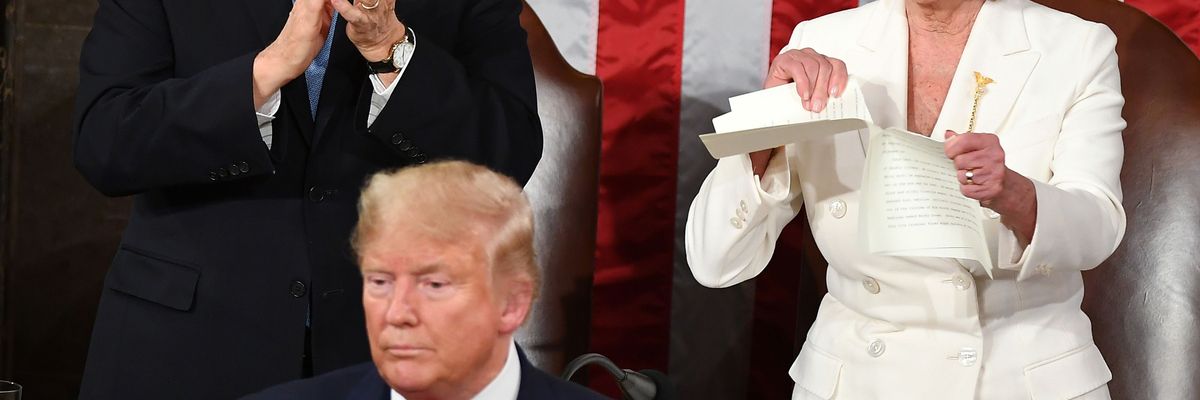
Then-speaker of the U.S. House of Representatives Nancy Pelosi (D-Calif.) rips a copy of U.S. President Donald Trump's speech after he delivered the State of the Union address at the U.S. Capitol in Washington, D.C., on February 4, 2020.
(Photo: Mandel Ngan/ AFP via Getty Images)

Robert Reich
Mar 04, 2025
Inequality Media


U.S. President Donald Trump is killing the economy, reducing the U.S. government to rubble, and destroying our relationships with our allies. Russian President Vladimir Putin may love it, but it’s a catastrophe for us and much of the rest of the world.

Many of you ask me: Where’s the Democratic Party?

I wish I had a good answer. At a time when America needs a strong, bold, courageous opposition, the Democrats’ silence is deafening.

What the hell does it mean to be a “moderate” today anyway? When the choice we’re facing is between democracy and dictatorship, where’s the midpoint?

My old friend James Carville advises Democrats to “roll over and play dead.” With due respect to James, he’s full of sh*t.

Democrats have been rolling over and playing dead too long. That’s one reason the nation is in the trouble we’re in.

If Democrats had had the guts years ago to condemn big money in politics, fight corporate welfare, and unrig a market that’s been rigged in favor of big corporations and the rich, Trump’s absurd bogeymen (the deep state, immigrants, socialists, trans people, diversity-equity-inclusion) wouldn’t have stood a chance.

My simple advice to congressional Democrats: Wake the hell up!

Tonight, Trump will address both chambers of Congress. He has taken over the brains and intestines of Republican lawmakers, who will applaud his stream of lies.

Democrats will do—what? Sit on their hands? Applaud a few insipid things?

Ideally, Democrats should boycott the whole event. Even sitting in the well of the House as if this were just another president addressing just another Congress legitimizes Trump’s coup.

Democrats should not signal to a nationally televised audience that what we’re living through is normal.

If Democratic lawmakers feel they must be there, then make good and loud trouble. Disrupt Trump’s speech. Arrive in Revolutionary War costumes and hold signs proclaiming America is not a monarchy. Wave American flags and copies of the Constitution.

Every time he utters the word “tariff,” hold up a sign that says “It’s a tax.”

When Trump lies—about Ukraine, about DOGE, about immigration, about the tariffs he’s just put into effect, about his plan for robbing working people to give another huge tax cut to the rich—boo loudly. Hold up a “lie meter” for the cameras.

Then walk out en masse.

Show America there’s still life in the democratic opposition, even as America slides toward dictatorship.

The good news is most of America is firmly against Trump (and with Democrats) on the big things. According to polls:Most don’t want a Trump Republican budget that cuts almost $1 trillion out of Medicaid, food stamps, and child nutrition in order to make way for a $4.5 trillion tax cut mostly for the wealthy.
Most don’t want the richest person in the world destroying departments and agencies that protect our health, safety, financial security, and environment.
Most don’t side with Putin. Most don’t want us to abandon Ukraine. Most don’t want us to turn against our traditional allies that are democracies in favor of a bloodthirsty dictator.
Most don’t want tariffs that drive up the prices they pay for food, gas, housing, and clothing. Most understand that tariffs are taxes paid by American consumers.
Most don’t want a government of, by, and for billionaires.
Most believe in democracy and the rule of law and don’t want Trump trampling on the Constitution, acts of Congress, and federal court orders.

Not only should Democrats be making noise (and hay) about all this, but Democrats should not rely on so-called “moderates” (such as Michigan’s Sen. Elissa Slotkin) to speak for them. Democrats selected Slotkin to deliver the Democrats’ “response” to Trump’s address tonight.

Democrats need Sen. Bernie Sanders (I-Vt.), Sen. Elizabeth Warren (D-Mass.), Rep. Alexandria Ocasio-Cortez (D-N.Y.), or anyone else with fight in their hearts and rage in their bellies who can make the case that Trump is bad for working people and terrible for America and the world.

What the hell does it mean to be a “moderate” today anyway? When the choice we’re facing is between democracy and dictatorship, where’s the midpoint?

We are in clear and present danger. Democrats must stand up for American ideals at a time when Trump, Vice President JD Vance, and Elon Musk are riding roughshod over them.

The rest of you, my friends, should make a ruckus, too. Call your Democratic senators and Democratic representatives (if you have any) today, and tell them what I’ve just told you. Again, the Capitol switchboard is 202-224-3121.

During or after Trump’s speech tonight, call the White House and tell the operator that you disagree with what Trump has said. White House operators keep track of positive and negative responses. (The White House switchboard is 202-456-1414.)

Have no doubt that we are the true patriots of this nation. We are the voices of democracy, freedom, social justice, and the rule of law. We are the people.

Our lawmakers—including Trump and Vance (and even de facto lawmakers like Musk)—are supposed to be working for us.
Trump Set to Whack US Working Class With Historic $3,000 Tax Hike


There is an old saying in Washington that if you want to understand politicians, look at what they do, not what they say. On that front there is no ambiguity. The Republican president is imposing big new taxes, and he is doing it in a way that does not require congressional approval.


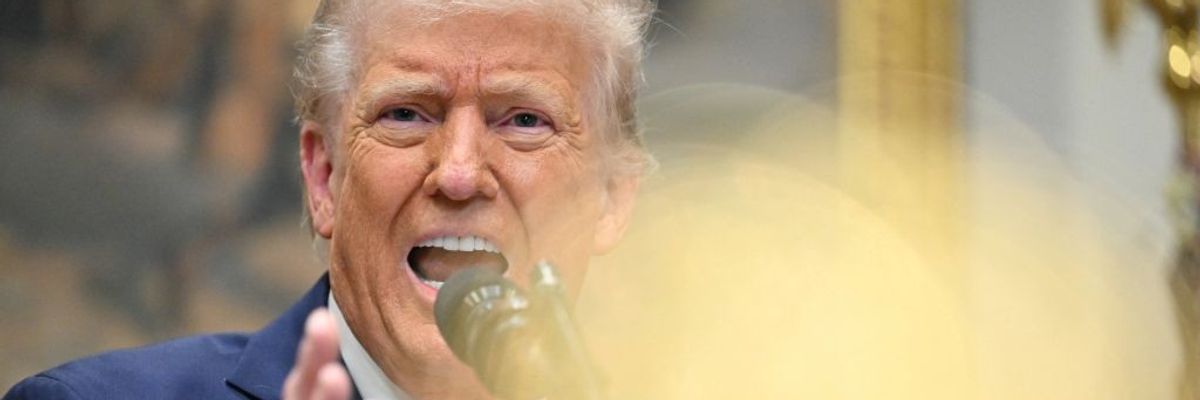
U.S. President Donald Trump speaks in the Roosevelt Room of the White House in Washington, DC, on March 3, 2025. Trump said chip-making giant TSMC will invest "at least" $100 billion in the United States to build "state of the art" chip manufacturing facilities.
Photo by Roberto Schmidt / Getty Images)

Dean Baker
Mar 04, 2025
Beat the Press

The waiting is almost over, Donald Trump is about to hit America’s workers with the largest tax increase they have ever seen. Trump’s taxes on imports (tariffs) from Canada, Mexico, and China will cost people in the United States somewhere around $400 billion a year or around $3,000 a household.

This is far larger than any tax increase we’ve seen in the last half-century, and unlike tax increases put in place by Clinton and Obama, it will primarily hit low and middle-income households. Their tax increases primarily hit the top 1% percent, which is probably why they got so much more attention from the media.

It is not clear what our reality TV show president hopes to accomplish with these tax hikes. His stated reasons don’t make much sense. Canada, Mexico, and China are already cooperating with the U.S. on the issues he is complaining about. There is a minimal flow of fentanyl and undocumented immigrants from Canada.

If Trump can’t find major savings in the budget, then he will have to raise other taxes if he doesn’t want to hugely increase the deficit with his tax cuts for the Elon Musk crowd. This is the most obvious explanation for Trump hitting us with his huge import taxes.

Mexico sharply curtailed the flow of undocumented immigrants following a deal with Biden last summer. We can look to reduce the flow further, but that could probably be accomplished by negotiations rather than imposing a big tax on U.S. households.

China has also cooperated in reducing the flow of precursor substances for making fentanyl. Here also there were probably better prospects for further reductions through a path of negotiations rather than Donald Trump’s big tax increases.

Also, unlike Canada and Mexico, China’s economy is not that dependent on its trade with the U.S. China’s exports to the U.S. come to less than 2.5 percent of its GDP. If Donald Trump’s taxes reduce that by half, it could look to export to other countries (like Canada or Mexico) or increase domestic demand.

It seems implausible that Donald Trump’s stated reasons for his tax increase are his actual reasons. In principle, taxes on imports can be used as part of an industrial strategy to build up key industries, as was explicitly the case under Biden. His tariffs were intended to promote the advanced semi-conductor industry, as well as solar and wind energy and electric cars.

However, it would be difficult to find any evidence of an industrial strategy in Trump’s plans. He actually is deliberately sabotaging the industries Biden sought to foster.

There is an old saying in Washington that if you want to understand politicians, look at what they do, not what they say. On that front there is no ambiguity. Donald Trump is imposing big new taxes, and he is doing it in a way that does not require congressional approval.

He has made no secret of his intention to cut taxes on the wealthy. While Elon Musk and DOGE boys have put on a good show with the chain saw and breaking into various government agencies, the savings they can actually identify don’t amount to much.

If Trump can’t find major savings in the budget, then he will have to raise other taxes if he doesn’t want to hugely increase the deficit with his tax cuts for the Elon Musk crowd. This is the most obvious explanation for Trump hitting us with his huge import taxes. It sounds much better to pretend he’s cracking down on fentanyl and illegal immigration than to say he’s whacking ordinary workers with a big tax increase. But that is what Donald Trump is doing.

As Economic Warnings Flash Red, Trump Plows Forward With Massive Tax Hike on Ordinary Americans


After a monthlong delay, Trump administration tariffs on Mexican and Canadian imports went into effect Tuesday.


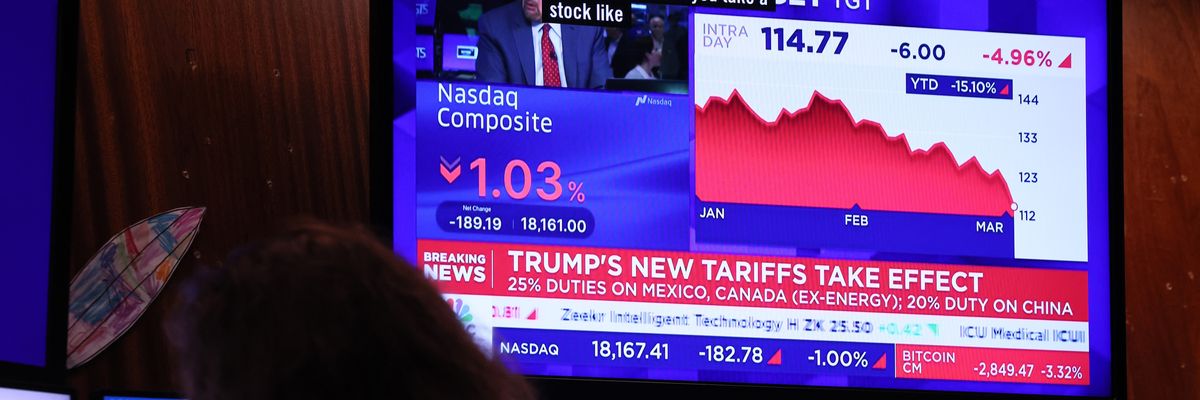
Financial news is seen on a television on the floor of the New York Stock Exchange during morning trading on March 4, 2025 in New York City.
(Photo: Michael M. Santiago/Getty Images)


Eloise Goldsmith
Mar 04, 2025
COMMON DREAMS


As the Trump administration's purge of federal workers continues and tariffs imposed on key U.S. trade partners Mexico and Canada take effect Tuesday, multiple economic indicators are warning of potential pain ahead.

On Monday, the Federal Reserve Bank of Atlanta released an estimate for GDP performance in the first quarter of 2025, which showed an economic contraction of 2.8%. The "GDPNow" estimate is a model-based projection that is not an official forecast from the Atlanta Fed, but it does paint a different economic picture from just a few weeks ago, when the same model-based projection estimated growth of almost 3% in early February.

"Basically unprecedented for a new administration to inherit a strong economy and immediately tank it as both businesses and consumers internalize its agenda," wrote Bharat Ramamurti, a former deputy director at the National Economic Council, in response to the prediction from the Atlanta Fed.

Stocks also tumbled Monday after Trump announced that 25% tariffs on Canada and Mexico would go into effect the next day. Trump also reiterated that the U.S. would impose an additional 10% tariff on China, on top of 10% tariffs that were already in effect.

Meanwhile there are also signs that consumer confidence is declining. The research group the Conference Board released its Consumer Confidence Index for February on Tuesday, which showed the largest monthly decline in consumer confidence since August 2021. "Respondents to the board's survey expressed concern over inflation with a significant increase in mentions of trade and tariffs, the board said," according to The Associated Press. The retail giant Target said Tuesday that consumer confidence is waning, according to CNN.

In a video discussing the Atlanta Fed's "GDPNow" estimate, journalist Krystal Ball reminded listeners that billionaire Elon Musk, the man Trump has deputized to help oversee cuts to the federal spending and bureaucracy, said that the work of his Department of Government Efficiency would cause pain. Musk in October 2024 said that then yet-to-be-created body's work would "necessarily involve some temporary hardship," according to Vox.

The Trump administration has so far already cut tens of thousands of workers, but even if Trump successfully carried out his proposed mass firings of probationary workers (which a judge recently said were likely illegal), possibly impacting 200,000 people, that "on its own, is not recessionary," according to economist Ernie Tedeschi, director of economics at the Yale University Budget Lab, who was interviewed by CNBC.

The U.S. Bureau of Labor Statistics' February employment situation report will be released on Friday, and economist Dean Baker, who works for the left-leaning Center for Economic and Policy Research, wrote Tuesday that the numbers "are not not likely to pick up much of the effect of the DOGE cuts." That's partly because the data will not capture the time period when many of the cuts went into effect, according to Baker.

The impact of tariffs, however, is more certain. China, Mexico, and Canada account for over 40% of U.S. imports, and key goods imported from the three countries include crude petroleum, cars, computers, telephones, and car parts and accessories, according to the The New York Times.

Tariffs are essentially a tax on imported goods that economists say are largely passed on to consumers.

According to analysis released in early February, the Peterson Institute for International Economics found that the tariffs that were previously announced but went into effect on Tuesday constitute the "the largest tax increase in at least a generation."

Taking into account the 25% tariffs on goods from Canada (aside from the lower rate for Canadian energy) and Mexico, and the 10% increase in tariffs on imports from China, "the direct cost of these actions to the typical, or median, U.S. household would be a tax increase of more than $1,200 a year."

After the Trump administration announced the tariffs on Mexico and China, which the White House said were being implemented to pressure the three countries into halting the flow of fentanyl and immigrants, Trump agreed in February to delay their imposition on Canada and Mexico for a month after those countries announced concessions.

The left-leaning economist Paul Krugman called the tariffs on Mexico and Canada, two countries with whom Trump once helped negotiate a free trade deal, "a profoundly self-destructive move."

"It will impose huge, possibly devastating costs on U.S. manufacturing, while significantly raising the cost of living—without any visible justification," he wrote.


Top Economist Has Winning Idea for Trump's Trade War: Tariffs for US Oligarchs

"If it's a trade war Trump wants, consumers in Mexico, Canada, Europe, and beyond should unite to ensure that Musk and his fellow oligarchs feel the cost."


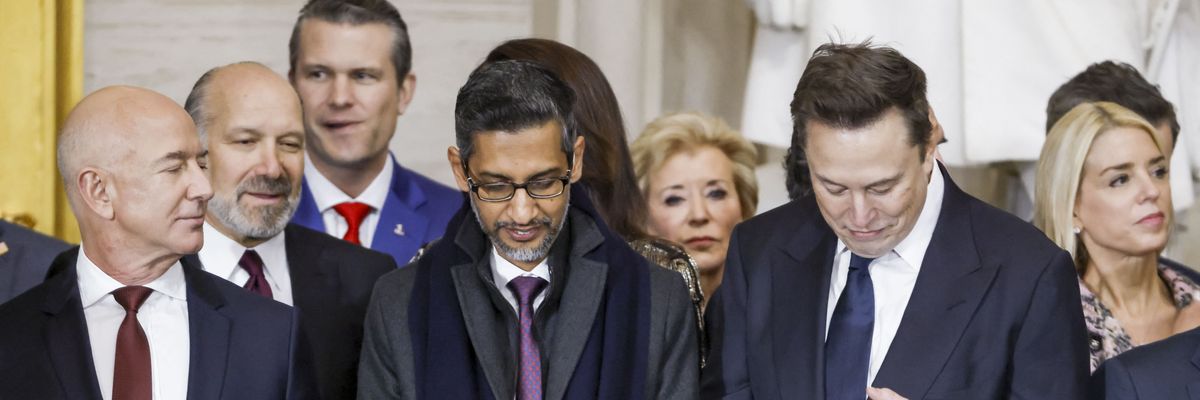
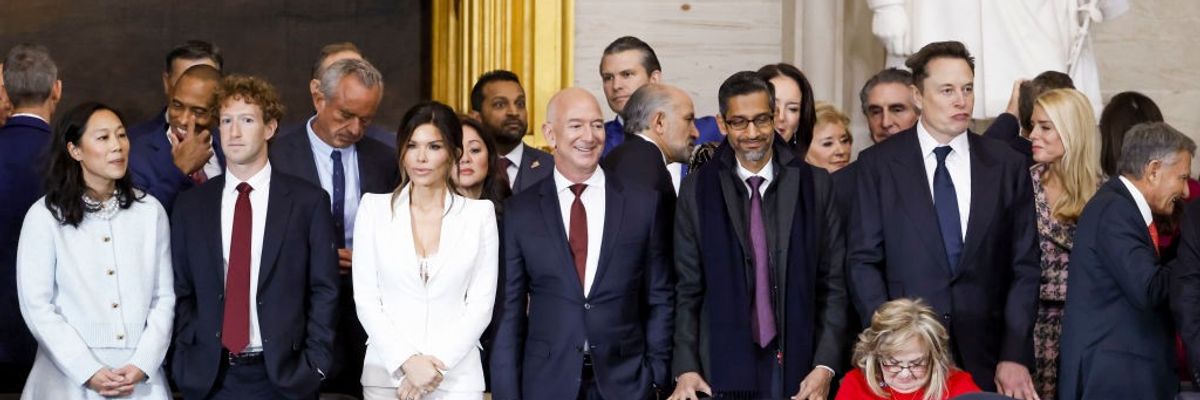
Amazon founder Jeff Bezos, Alphabet CEO Sundar Pichai, and Tesla CEO Elon Musk attend the inauguration ceremony of U.S. President Donald Trump in Washington, D.C., on January 20, 2025.
(Photo: Shawn Thew/POOL/AFP via Getty Images)

Julia Conley
Mar 03, 2025
COMMON DREAMS


As U.S. President Donald Trump weighed 25% tariffs he plans to impose on Canada and Mexico on Monday, with the White House sending mixed messages in recent days about when the levies will go into effect, a top progressive economist has proposed foreign countries should respond to "the trade war Trump seems determined to stoke" by targeting the "Achilles heel" embedded in the Trump administration.

"Mexico, Canada, and Europe have leverage," wrote Gabriel Zucman, director of the E.U. Tax Observatory, in a column Friday, pointing to the country's "highly internationalized oligarchy: a small group of ultra-wealthy individuals whose fortunes depend on access to global markets."

Commerce Secretary Howard Lutnick indicated Monday morning that Trump has yet to decide whether tariffs on Canadian and Mexican imports—including produce, lumber, vehicles, and electronics—will go forward just after midnight on Tuesday as previously planned; the president has also recently said the tariffs could be delayed until April 2.

But Zucman wrote that whenever the policy does enter force, Canada, Mexico, and any other countries affected "should retaliate by taxing U.S. oligarchs."


Powerful business owners like Tesla CEO Elon Musk—now also spearheading Trump's gutting of federal agencies through the Department of Government Efficiency (DOGE)—Amazon founder Jeff Bezos, and Meta CEO Mark Zuckerberg all rely on markets outside of the U.S. to enrich their companies, which "gives foreign governments influence," Zucman continued.

"If Tesla wants to sell cars in Canada and Mexico, Elon Musk—Tesla's primary shareholder—should be required to pay taxes in those jurisdictions," he wrote. "Of course, this strategy is explicitly extraterritorial, since it applies tax obligations on foreign actors in exchange for access to local markets. But rather than fearing extraterritoriality, countries should embrace it as a tool for enforcing minimum standards, curbing inequality, preventing tax evasion, and promoting sustainability."

Tariffs on oligarchs could fight against Trump's attacks on environmental regulations, push for tax giveaways to billionaires at the cost of crucial public services, and advocacy for re-segregating workplaces, suggested Zucman, while shifting "the economic conflict from a battle between countries—which fuels nationalist tensions and economic retaliation—to one between consumers and oligarchs."

Countries could also "collect taxes that multinationals have dodged elsewhere, gradually eroding the appeal of tax competition" and triggering a "virtuous cycle," added the economist, who focuses on wealth inequality and international tax policy.

With tariffs on oligarchs in place, he said, firms would no longer be incentivized to move to countries that hand out corporate tax breaks because their savings would be offset by the tariffs levied by countries with large markets.

Governments have been accused in taking part in a "race to the bottom" as they try to attract large multinational companies run by some of the richest people in the world, with huge tax breaks that weaken "national safety nets, [kill] jobs by subsidising capital at the expense of labor, [allow] elites to escape the rule of law, and [reduce] productivity and economic growth," as the Tax Justice Network wrote in a 2020 report.

With tariffs for oligarchs, said Zucman "the race to the bottom would soon be replaced by a race to the top."

While the first weeks of Trump's second term in the White House have raised fears over a looming trade war, attacks on immigrants and transgender Americans, mass firings of federal workers, and the United States' withdrawal from international agreements and organizations, Zucman said the Trump presidency "also presents an opportunity."

"This is a moment to rethink international economic relations, calmly but radically," wrote Zucman. "The best response is a new global economic framework that neutralizes tax competition, fights inequality, and protects our planet. Under such a framework, importing countries would enforce tax justice beyond their borders, ensuring that multinational corporations and their billionaire owners pay their fair share."

"If it's a trade war Trump wants," he said, "consumers in Mexico, Canada, Europe, and beyond should unite to ensure that Musk and his fellow oligarchs feel the cost."


With Dropped Enforcement, Trump Accused of 'Inviting a Corporate Crime Spree'

"President Trump talks 'tough on crime,' but his administration is once again betraying a preference for going soft on corporations that break the law."


ROGUES GALLERY

Meta CEO Mark Zuckerberg, Amazon founder Jeff Bezos, Alphabet CEO Sundar Pichai, and businessman Elon Musk attend U.S. President Donald Trump's inauguration on January 20, 2025 in Washington, D.C.
(Photo: Shawn Thew-Pool/Getty Images)

Jessica Corbett
Mar 04, 2025
OMMON DREAMS

U.S. President Donald Trump "is handing out 'get out of jail free' cards to corporate lawbreakers," declared Rick Claypool, author of a Tuesday report about the administration ending probes and enforcement actions against dozens of companies.

Claypool is a research director for the watchdog Public Citizen. His report "covers 429 separate investigations and cases against 361 corporations over alleged lawbreaking—including at least 25 involving allegations of criminal misconduct."

During the first six weeks since the inauguration, the researcher found, the Trump administration halted or moved to dismiss actions against 89 corporations—or 25% of the companies in Public Citizen's tracker of prominent cases.

"The consequences for the public when corporations face a diminished threat of enforcement are disastrous," Claypool warned in a statement. "Meanwhile, honest businesses that are not Trump administration insiders—or that refuse to play along with the ultra-MAGA ideological agenda—may face serious disadvantages from Trump's politicized approach to enforcement."

As his report, Corporate Clemency, details, the beneficiaries of the recent dismissals are:All 42 corporations facing Consumer Financial Protection Bureau (CFPB) cases and investigations (seven dismissals have been sought so far);
Twenty corporations facing Department of Justice (DOJ) and Securities and Exchange Commission (SEC) cases and investigations into possible Foreign Corrupt Practices Act violations;
Eight corporations facing DOJ Civil Rights Division cases and investigations (one dismissal, a case against Elon Musk's SpaceX, has been sought so far);
Seven corporations facing DOJ Environment and Natural Resources Division cases and investigations;
Seven cryptocurrency corporations facing SEC cases and investigations, five of which the Trump administration has filed to dismiss; and
Six employers facing Equal Employment Opportunity Commission (EEOC) cases for discrimination against transgender and nonbinary workers, which the Trump administration has filed to dismiss.

"Additionally, firings of National Labor Relations Board (NLRB) members and EEOC commissioners mean these regulators lack the quorum needed for finalizing enforcement decisions, including NLRB cases against 100 corporations included in the tracker," the report explains. "There are nearly 27,000 open NLRB cases in total."

The corporations that began the Trump administration with the greatest number of probes or cases in the Public Citizen tracker are Musk's Tesla (eight) and SpaceX (four), billionaire Jeff Bezos' Amazon (seven), Big Pharma's Pfizer (five), banking giant Wells Fargo (four), and the insurance company UnitedHealthcare (four).

The report highlights that "of the 361 corporations facing federal enforcement actions, 56 have close ties with the Trump administration," 17 of which "are benefiting from the enforcement pauses that have halted investigations and cases."

The document also identifies 34 companies that collectively gave at least $34 million toward Trump inaugural festivities.

Amazon and Pfizer each gave $1 million, as did many others: Adobe, Apple, AT&T, Boeing, Coinbase, ExxonMobil, Ford Motor Company, General Motors, Goldman Sachs, Google, Hyundai and its affiliate, Johnson & Johnson, Kraken, Lockheed Martin, Meta, Microsoft, OpenAI, Stanley Black & Decker, Stellantis, and Toyota.

Ripple, Robinhood Markets, and Uber gave even more, while Abbott Laboratories, Bank of America, Citibank, Coca-Cola, CoreCivic, Ericsson, Hewlett Packard, and Syngenta gave less or an undisclosed amount.

Apple and OpenAI's contributions came from the companies' chief executives, Tim Cook and Sam Altman, while Uber had a corporate donation and one from CEO Dara Khosrowshahi. All three of them appear on the report's list of "Big Tech oligarchs seeking corporate clemency from the Trump administration," alongside Musk, Bezos, TikTok's Shou Zi Chew, Mark Zuckerberg of Meta—which owns Instagram and Facebook—and Sundar Pichai of Alphabet, the parent company of Google.


"President Trump talks 'tough on crime,'" the report says, "but his administration is once again betraying a preference for going soft on corporations that break the law."

Public Citizen co-president Robert Weissman similarly called out not only Trump—who was convicted of 34 felonies—but also Attorney General Pam Bondi and Federal Bureau of Investigation Director Kash Patel, who all "bloviate about how tough they are on crime."

"The reality is the Trump administration by its actions is inviting a corporate crime spree," Weissman said in a statement. "Not only does the wholesale abandonment of cases against alleged corporate wrongdoers let bad actors off the hook, it invites—and virtually guarantees—a surge in consumer rip offs, endangerment of workers, poisoning of the air and water, discriminatory employment practices, and more."

Public Citizen's analysis comes amid mounting alarm over Trump's so-called Department of Government Efficiency, led by Musk, the richest person on Earth. As Common Dreamsreported Monday, the Center for Biological Diversity noted in a new lawsuit that Trump's executive order establishing the government-gutting initiative requires all federal agencies to form DOGE teams.

The center's complaint stresses that "Mr. Musk and other billionaire and tech executives working with DOGE stand to benefit personally and financially from the DOGE teams' work, including by securing government contracts, slashing environmental rules that apply to their companies, and reducing the government's regulatory capacity and authority, including by targeting specific agencies, statutes, and spending decisions that affect their businesses."


The Real Reason for Soaring Egg Prices? Gouging by the 'Rotten Egg Oligarchy'

A new Food & Water Watch report details how "corporations use the worsening bird flu crisis to jack up egg prices, even as their own factory farms fuel the spread of disease."


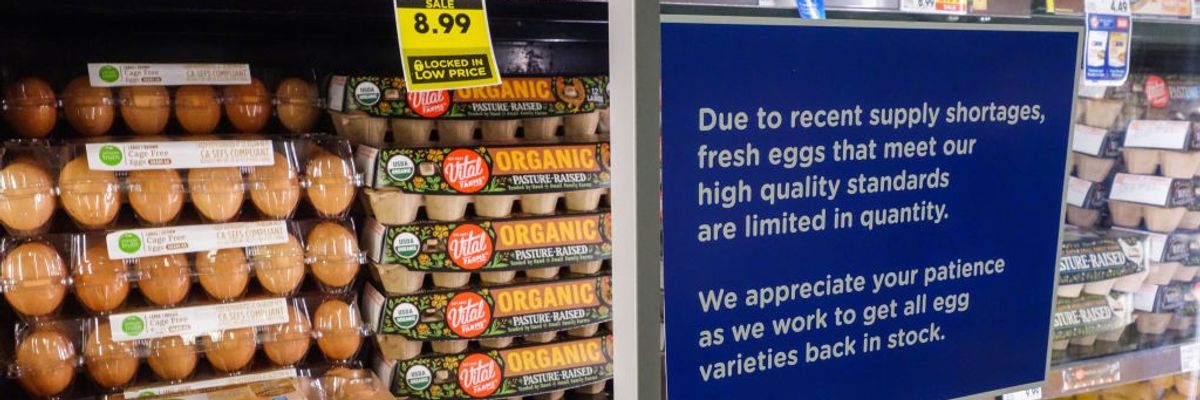
Eggs are seen for sale priced $8.99-$13.39 per dozen at a Glendale, California supermarket on January 6, 2025.
(Photo: Robyn Beck/AFP via Getty Images)

Brett Wilkins
Mar 04, 2025
COMMON DREAMS

The nation's largest egg producers would have American consumers believe that avian flu and inflation are behind soaring prices, but a report published Tuesday shows corporate price gouging is the real culprit driving the record cost of the dietary staple.

The fourth installment of Food & Water Watch's (FWW) Economic Cost of Food Monopolies series—titled The Rotten Egg Oligarchy—reports that the average price of a dozen eggs in the United States hit an all-time high of $4.95 in January 2025. That's more than two-and-a-half times the average price from three years ago.

"While egg prices spiral out of reach, making eggs a luxury item, Big Ag is profiting hand over fist," FWW research director Amanda Starbuck said in a statement. "But make no mistake—today's high prices are built on a foundation of corporate price gouging. Our research shows how corporations use the worsening bird flu crisis to jack up egg prices, even as their own factory farms fuel the spread of disease."


FWW found that "egg prices were already rising before the current [avian flu] outbreak hit U.S. commercial poultry flocks in February 2022, and have never returned to pre-outbreak levels."

Furthermore, "egg price spikes hit regions that were bird flu-free until recently," the report states. "The U.S. Southeast remained free of bird flu in its table egg flocks until January 2025, and actually increased egg production in 2022 and 2023 over 2021 levels. Nevertheless, retail egg prices in the Southeast rose alongside January 2023's national price spikes."

"The corporate food system is to blame for exacerbating the scale of the outbreak as well as the high cost of eggs," the publication continues. "Factory farms are virus incubators, with the movement of animals, machines, and workers between operations helping to spread the virus."

"Meanwhile, just a handful of companies produce the majority of our eggs, giving them outsized control over the prices paid by retailers, who often pass on rising costs to consumers," the paper adds. "This highly consolidated food system also enables companies to leverage a temporary shortage in one region to raise prices across the entire country."

Cal-Maine, the nation's top egg producer, enjoyed a more than 600% increase in gross profits between fiscal years 2021-23, according to FWW. The Mississippi-based company did not suffer any avian flu outbreaks in fiscal year 2023, during which it sold more eggs than during the previous two years. Yet it still sold conventional eggs at nearly three times the price as in 2021, amounting to over $1 billion in windfall profits. Meanwhile Cal-Maine paid shareholders dividends totaling $250 million in 2023, 40 times more during the previous fiscal year.

The report highlights how factory farming creates ideal conditions for the spread of avian flu, a single case of which requires the extermination of the entire flock at the affected facility, under federal regulations.


"These impacts cannot be understated," FWW stressed. "Today's average factory egg farm confines over 800,000 birds, with some operations confining several million. This magnifies the scale of animal suffering and death, as well as the enormous environmental and safety burden of disposing of a million or more infected bird carcasses."

Citing U.S. Department of Agriculture (USDA) figures, The Guardianreported Tuesday that more than 54 million birds have been affected in the past three months alone.

Egg producers know precisely how the supply-and-demand implications of these outbreaks and subsequent culls can boost their bottom lines. Meanwhile, they play a dangerous game as epidemiologists widely view a potential avian flu mutation that can be transmitted from birds to humans as the next major pandemic threat—one that's exacerbated by the Trump administration's withdrawal from the World Health Organization and cuts to federal agencies focused on averting the next pandemic.

"We cannot afford to place our food system in the hands of a few corporations that put corporate profit above all else."

So far, 70 avian flu cases—one of them fatal—have been reported in the United States, according to the U.S. Centers for Disease Control and Prevention. However, under Trump, the CDC has stopped publishing regular reports on its avian flu response plans and activities. The USDA, meanwhile, said it "accidentally" terminated staffers working on avian flu response during the firing flurry under Elon Musk's Department of Government Efficiency. The agency is scrambling to reverse the move.

"We cannot afford to place our food system in the hands of a few corporations that put corporate profit above all else," the FWW report argues. "Nor can we allow the factory farm system to continue polluting our environment and serving as the breeding ground for the next human pandemic."

"We need to enforce our nation's antitrust laws to go after corporate price fixing and collusion," the publication adds. "We also need a national ban on new and expanding factory farms, while transitioning to smaller, regional food systems that are more resilient to disruptions."

That is highly unlikely under Trump, whose policies—from taxation to regulation and beyond—have overwhelmingly favored the ultrawealthy and corporations over working Americans. Meanwhile, one of the president's signature campaign promises, to lower food prices "on day one," has evaporated amid ever-rising consumer costs.

According to the USDA's latest Food Price Outlook, overall food prices are projected to rise 3.4% in 2025. Eggs, however, are forecast to soar a staggering 41.1% this year—and possibly by as much as 74.9%.

"If President Trump has any interest in fulfilling his campaign pledge to lower food prices," Starbuck stressed, "he must begin by taking on the food monopolies exploiting pandemic threat for profit."
Trump Set to Install Anti-Union Attack Dog as Director of Key Labor Office

One watchdog group warned that Elisabeth Messenger is "a real ideologue" whose selection underscores the Trump administration's hostility to organized labor.


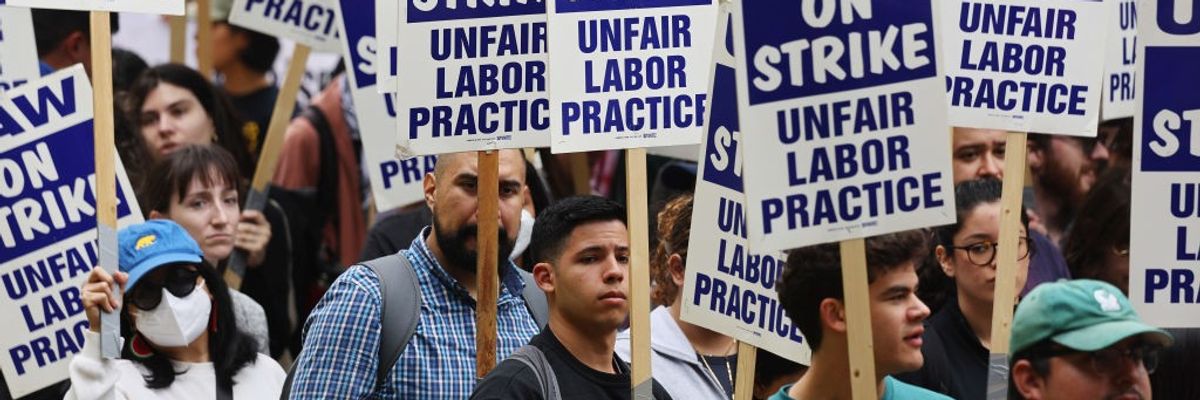
UCLA academic workers from United Auto Workers Local 4811 picket on the first day of their strike on May 28, 2024 in Los Angeles, California.
(Photo: Mario Tama/Getty Images)

Jake Johnson
Mar 04, 2025
CPMMON DREAMS

U.S. President Donald Trump is reportedly expected to pick the former head of an anti-union organization that supports so-called "right-to-work" laws to lead a key office within the Department of Labor, where the administration is working to gut enforcement efforts against lawbreaking employers.

Citing two unnamed sources, HuffPostreported Monday that Elisabeth Messenger, former CEO of Americans for Fair Treatment (AFFT), is set to become director of the Office of Labor-Management Standards (OLMS), whose purpose is to promote "labor-management transparency by making available reports showing unions' financial condition and employers' expenditures for their activities in persuading workers during union organizing campaigns."

HuffPost noted that "as the head of OLMS, Messenger would be charged with making sure unions, as well as anti-union consultants, make lawful disclosures to the government about their work."

Bob Funk, director of the watchdog group LaborLab, told HuffPost that Messenger is "a real ideologue" and her selection signals that the Trump administration will likely "go after not just public-sector unions but worker centers, too."

The outlet observed that AFFT "promotes right-to-work laws and advises public-sector workers like teachers on how to opt out of paying union dues."


After posturing as a champion of American workers on the campaign trail, Trump kicked off his second White House term with what one observer described as "rapid-fire anti-worker actions," including mass firings of federal employees and the termination of key labor officials.

One of the fired officials, former National Labor Relations Board Chair Gwynne Wilcox, is suing Trump in federal court arguing her termination was illegal.

News that Trump is poised to install Messenger at the helm of OLMS comes roughly two weeks after former Rep. Lori Chavez-DeRemer (R-Ore.), the president's pick to lead the Labor Department, vowed during her Senate confirmation hearing to defend "right-to-work laws" and said she no longer supports pro-union legislation that would dramatically weaken them.

That legislation, the Protecting the Right to Organize (PRO) Act, is set to be reintroduced Tuesday by Sen. Bernie Sanders (I-Vt.), a group of congressional Democrats, and Rep. Brian Fitzpatrick (R-Pa.).
Trump Threatens Campus Protesters With Imprisonment


"Trump here is is referring to pro-Palestine protests so you won’t hear a peep from conservatives or even pro-Israel liberals," said one journalist.


Attendees gather for a vigil organized by the Students for Justice in Palestine at the University of Maryland on October 7, 2024 in College Park, Maryland.
(Photo: Chip Somodevilla/Getty Images)

Julia Conley
Mar 04, 2025
COMMON DREAMS

In a move that one critic said was likely preemptively targeted at "protests against the long list of horrific measures" President Donald Trump plans to impose as well as Palestinian rights demonstrations, the president on Tuesday threatened students with imprisonment if they take part in "illegal protests" on campus.

Trump didn't cite any law or executive authority that would permit him to order the arrest of students who exercise their First Amendment right to participate in protests, noted Enzo Rossi of the University of Amsterdam.

"What does "'illegal' mean?" wrote Rossi. "An occupation? A sit-in? Ignoring arbitrary police commands?"


In addition to threatening students with imprisonment, the president said he would end federal funding for "any college, school, or university that allows illegal protests."

The threat came nearly a year after nationwide campus protests began over Israel's U.S.-backed bombardment of Gaza, with students assembling on their campuses and setting up encampments to demand that administrators divest from weapons manufacturers and other companies profiting from Israel's apartheid policies and attacks on Palestinians.

Those protests, though protected under the U.S. Constitution, were the subject of major crackdowns by police in New York City, Los Angeles, Atlanta, and other cities, with more than 3,100 students, faculty members, and supporters arrested for demonstrating against the U.S. government's broadly unpopular support for Israel's slaughter of Palestinians.

Former U.S. President Joe Biden said last year that he supported non-violent protests but suggested student demonstrators were causing "chaos" and signaled support for the nationwide police crackdown.

An analysis last May by the Armed Conflict Location and Event Data Project found that 97% of the demonstrations were non-violent—but pro-Israel academics and politicians from both sides of the aisle repeatedly condemned the protests.

Alejandra Caraballo, a clinical instructor at Harvard Law Cyberlaw Clinic, said that "a lot of cowards in academia will use [Trump's directive] as an excuse to crack down on campus protest," as many university officials did last year.

Journalist Jeremy Scahill pointed out right-wing policymakers' and commentators' frequent claims that they aim to defend "free speech on campus"—a rallying cry that tends to target progressive ideologies.

"If Trump or [Vice President] JD Vance or any of these hypocrites who claim to be free speech warriors actually believed in free speech, they would vociferously defend speech they hate, including pro-Palestine/anti-genocide speech," said Scahill. "But they don't. This has been the con from the start with that crowd."

Self-proclaimed "free speech absolutists" like Tesla CEO and Trump ally Elon Musk "would be going mad" if Biden had suggested protests "by conservative students or pro-life groups" were illegal, added journalist Mehdi Hasan.


Trump's statement came weeks after he signed an executive order that was purported to "combat antisemitism" by threatening international students with deportation if they join campus protests that the president characterized as consisting of "pro-Hamas vandalism and intimidation."

On Monday, the Department of Health and Human Services, Department of Education, and the U.S. General Services Administration announced they were reviewing $51.4 million in federal contracts for Columbia University, which was a center of the student protests last year.

Students occupied school buildings last spring to demand Columbia divest from Israel. The Trump administration on Tuesday accused administrators of "ongoing inaction" against antisemitism on campus.

The agencies were acting under Trump's executive order, which also created a multi-agency Task Force to Combat Antisemitism.

Author Jeff Sharlet said college professors on Tuesday should speak out against Trump's latest threat in their classrooms, and suggested the president's ultimate goal is to militarize university campuses.

"This is targeted first at international students, but it's deliberately broad enough to lay groundwork for a scene Trump and [Defense Secretary Pete] Hegseth have fantasized: troops on campus."


Why the Trumpian chainsaw to the global order may be an opportunity for Pakistan

Washington’s chainsaw to the old order may look terrifying from the outside, but if Pakistan uses this as the impetus to unleash its own process of creative destruction, the country can find its footing in a rapidly changing global landscape.

Published March 3, 2025 
PRISM/DAWN


In recent weeks, the Trump administration has mounted an aggressive effort to reshape the post-Cold War world order. The foundational belief driving this shift is that access to the American market — and the broader international system aligned with the United States — is a privilege, not a right.

For far too long, the Trumpian view holds, adversaries and allies alike have been free riders taking advantage of the United States. Times have changed, and so has the thinking. America must change its strategic approach and be much more transactional — and ruthless — in its dealings with the rest of the world.

This is a major shift from a neoliberal policy — pushed by Democrats and Republicans alike — where the free movement of trade, capital, and people were seen as being good things in and of themselves. In addition, the view was that American influence largely was derived through the provision of global public goods. The Trump administration does not subscribe to these beliefs, and it sees access to American markets, capital, and security as a point of leverage through which the United States can and must demand certain strategic and economic concessions from both friends and foes.


Tariffs are the most visible and broadly discussed part of this new strategic approach. By slapping tariffs on countries that do not align closely with Washington’s priorities, the White House has effectively raised the price of entering the American market. If countries want a lower price, then they must also lower the barriers that prevent American businesses from fairly competing in and taking advantage of market opportunities on their own turf. And if this is not possible, then other concessions in the strategic and national security domains must be made.

The message is clear: if you want access to US consumers and businesses, you must be willing to strike what President Trump considers a fair deal, whether it pertains to trade, economics, or national security.

Recent cases demonstrate Washington’s new approach to making deals. Take, for instance, the administration’s move to pressure Mexico into tightening border security by threatening tariffs if American demands were not met. In another example, critical mineral deals with Ukraine highlight how Washington is seeking to lock in supply chain advantages for key resources in return for continued strategic support. These actions underscore that the administration sees a world where America extracts tangible benefits — geopolitical or economic — in exchange for the privilege of trading with and being integrated into its market.

At the same time, Trump and his officials — led by Elon Musk — are taking an axe to the institutions that have executed the old ways of doing business with the world. Whether this would be an effective strategy remains to be seen, but the reality is that institutions, bureaucracies, and personnel that continue to operate from the old playbook of American engagement are no longer welcome.
Where does Pakistan stand?

For Pakistan, this development poses both a serious threat and a historic opportunity. On the one hand, the threat is clear: Pakistan depends heavily on exports to the United States and relies on bailouts from American-led institutions such as the International Monetary Fund (IMF) and the World Bank. As the Trump administration’s policies disrupt these institutions — sometimes even calling into question their future relevance —Pakistan’s reliance on IMF packages and other forms of international financing becomes increasingly precarious.

Khurram Husain pointed this out in a recent article as well, arguing that without institutions like the IMF and World Bank providing access to capital, “Pakistan will not be able to pay the bills for its overdeveloped state apparatus and its consumption-driven economy built on outmoded technology.”

Khurram is right. The old model, in which Islamabad occasionally stumbles into a crisis and then negotiates a bailout with the IMF, can no longer be taken for granted in a world where the very pillars of the global order are undergoing a radical shift.

This volatility, however, also presents a historic opportunity for Pakistan as these once-in-a-century changes give the country an opening to shape both the external and internal environment influencing its political economy. For decades, Pakistan has relied on tariff and non-tariff barriers that effectively pick winners and losers in its economy — often protecting inefficient sectors at the expense of competitiveness and innovation. Such barriers, in practice, are a tax on exports. They raise input costs, hamper Pakistani firms from scaling up, and dissuade entrepreneurs from venturing into global markets.

As American tariffs increasingly take a reciprocal shape and international financial institutions face volatility, Pakistan faces severe headwinds. But these can be averted through measures that engage in creative destruction at home.
The need for creative destruction

The first target of this creative destruction must be tariff and non-tariff barriers that have stifled market forces in the country. By doing away with these barriers radically and across sectors, a new, more open economic model can be developed. This is all the more important as a strategic approach in a world where the United States is keen to take a transactional approach to its trading relations with the world, primarily focusing on trade deficits and barriers as a starting point for bilateral negotiations.

Of course, removing barriers is far from sufficient on its own. Other structural reforms — especially those that address the longstanding issues of high energy costs for industry and the overall ease of doing business — are essential complements. Pakistan’s high cost of energy hobbles its manufacturing sector and cumbersome regulations deter entrepreneurs from scaling up or even starting new ventures.

Tackling these issues also creates tailwinds in terms of getting attention from the Trumpian forces reshaping the American and global economy. In addition, wholesale reform of institutions that unleash market forces is critical to attracting capital in order to modernise the economy, something which a Trump administration may want to enable in cases where partner countries are seen as being aligned with their priorities.

For starters, Pakistan should seek to push through these changes in particular sectors that can bolster trade with the United States — this would be critical in preventing undue turbulence in the bilateral relationship. India, for example, has adopted a similar approach, reducing import tariffs in a variety of important sectors for the United States, including motorcycles.

The shift in Washington’s approach is also an opportunity for Pakistan to rebalance strategic parts of its economy as well. These parts have increasingly become dominated by China in recent years — a particular risk for a country that relies on access to Western markets and capital to stay afloat.

Pakistani policymakers argue time and time again that they do not want to choose between the United States and China as the strategic rivalry between the two powers heats up. This is the right approach, but executing on this strategy requires ensuring that China does not by default dominate key sectors.

As a result, Pakistan must make tangible efforts to align with American companies in three key sectors: critical minerals, telecommunications, and emerging technologies. In critical minerals, Barrick’s operations at Reko Diq provide a blueprint for attracting other western companies in the mining space; in telecommunications, the Starlink licensing process should be accelerated and completed; and in terms of emerging technologies, Pakistan must devise a regulatory and legal framework that positions the country as having a pro-innovation hub.

Critics of this approach would argue that Pakistan’s domestic realities make the recommended approach dangerous. However, Pakistan is in need of urgent reform precisely because of the country’s fragility. For far too long, the country has ignored mounting pressures for reform and, as a result, fallen behind its peers over the decades. Missing an opportunity to engage with global shifts — particularly those led by the United States — risks further decline. By preemptively aligning with emerging global norms, Pakistan can secure the breathing space and external support needed to strengthen its institutions, rather than letting them collapse under the weight of an outdated economic model.

The idea is to pursue targeted and strategic reforms that improve competitiveness and rebalance Pakistan’s growing dependencies. The worsening external financing and debt servicing needs have already severely curtailed Pakistan’s sovereignty — failure to adjust to a new world order risks losing access to crucial markets and capital, potentially forcing even greater concessions under far less favourable terms in the future.

This approach also aligns with Pakistan’s historical relationship with the United States, which has been transactional at best. In an era where Washington is openly transactional, Pakistan once again has an opportunity to find new areas of potential alignment with Washington. But taking advantage of this moment requires policymakers in Pakistan to abandon their old playbook of doing business.

The global order, shaped by the Trump administration and possibly by future administrations that share its worldview, is moving swiftly. In this environment, business as usual poses serious risks for Islamabad and waiting passively for conditions to improve is a road to disaster.

The biggest problem for Pakistan, though, is that the executors of this potential shift are likely to be the same bureaucratic and institutional structures that are beneficiaries of the status quo political economy. To change course, the first disruption that has to occur is at this institutional level because the structure of governance and bureaucracy that has developed in Pakistan over the decades is incapable of imagining a different reality and bringing it to fruition.

Finally, it goes without saying that without political stability and the rule of law, none of these things are going to work. International investors and capital are never going to sustainably flow into a country where domestic investors and ordinary citizens alike are unsure about the security of life, property, and contracts, and where policies change on a whim.

Pakistan’s policymakers need to see this moment for what it is: an opportunity to align the country’s economic architecture with a world where competitive advantage wins out over protectionism. By embracing lower tariff barriers, pursuing market reforms, and removing cumbersome regulations, Pakistan can position itself as a credible trade partner and investment destination.

It is precisely in moments of upheaval that strategic clarity can emerge. Washington’s chainsaw to the old order may look terrifying from the outside, but if Pakistan uses this as the impetus to unleash its own process of creative destruction, the country can find its footing in a rapidly changing global landscape.

In this new era, action, not hope, should be the order of the day.

Uzair Younus is a Principal at The Asia Group, where he advises global companies on developing and executing strategies to align their business strategy with public good needs across South Asia. He is also host of the podcast Pakistonomy.