Thursday, March 06, 2025


Yes, Trump is Vulgar. But the US Global Shakedown is the Same One as Ever


The US president looked like a gangster as he roughed up Zelensky. But he wasn’t the one who stoked a war that’s killed huge numbers of Ukrainians and Russians


 [First published by Middle East Eye]

If there is one thing we can thank US President Donald Trump for, it is this: he has decisively stripped away the ridiculous notion, long cultivated by western media, that the United States is a benign global policeman enforcing a “rules-based order”.

Washington is better understood as the head of a gangster empire, embracing 800 military bases around the world. Since the end of the Cold War, it has been aggressively seeking “global full-spectrum domination”, as the Pentagon doctrine politely terms it.

You either pay fealty to the Don or you get dumped in the river. Last Friday Ukrainian President Volodymyr Zelensky was presented with a pair of designer concrete boots at the White House.

The innovation was that it all happened in front of the western press corps, in the Oval Office, rather than in a back room, out of sight. It made for great television, Trump crowed.

Pundits have been quick to reassure us that the shouting match was some kind of weird Trumpian thing. As though being inhospitable to state leaders, and disrespectful to the countries they head, is unique to this administration.

Take just the example of Iraq. The administration of Bill Clinton thought it “worth it” – as his secretary of state, Madeleine Albright, infamously put it – to kill an estimated half a million Iraqi children by imposing draconian sanctions through the 1990s.

Under Clinton’s successor, George W Bush, the US then waged an illegal war in 2003, on entirely phoney grounds, that killed around half a million Iraqis, according to post-war estimates, and made four million homeless.

Those worrying about the White House publicly humiliating Zelensky might be better advised to save their concern for the hundreds of thousands of mostly Ukrainian and Russian men killed or wounded fighting an entirely unnecessary war – one, as we shall see, Washington carefully engineered through Nato over the preceding two decades.

Henchman Zelensky

All those casualties served the same goal as they did in Iraq: to remind the world who is boss.

Uniquely, western publics don’t understand this simple point because they live inside a disinformation bubble, created for them by the western establishment media.

Henry Kissinger, the long-time steward of US foreign policy, famously said: “It may be dangerous to be America’s enemy, but to be America’s friend is fatal.”

Zelensky just found that out the hard way. Gangster empires are just as fickle as the gangsters we know from Hollywood movies. Under the previous Joe Biden administration, Zelensky had been recruited as a henchman to do Washington’s bidding on Moscow’s doorstep.

The background – the one western media have kept largely out of view – is that, following the collapse of the Soviet Union, the US tore up treaties crucial to reassuring Russia of Nato’s good intent.

Viewed from Moscow, and given Washington’s track record, Nato’s European security umbrella must have looked more like preparation for an ambush.

Keen though Trump now is to rewrite history and cast himself as peacemaker, he was central to the escalating tensions that led to Russia’s invasion of Ukraine in 2022.

In 2019, he unilaterally withdrew from the 1987 Treaty on Intermediate-Range Nuclear Forces. That opened the door to the US launching a potential first strike on Russia, using missiles stationed in nearby Nato members Romania and Poland.

He also sent Javelin anti-tank weapons to Ukraine, a move avoided by his predecessor, Barack Obama, for fear it would be seen as provocative.

Repeatedly, Nato vowed to bring Ukraine into its fold, despite Russia’s warnings that the step was viewed as an existential threat, that Moscow could not allow Washington to place missiles on its border, any more than the US accepted Soviet missiles stationed in Cuba back in the early 1960s.

Washington pressed ahead anyway, even assisting in a colour revolution-style coup in 2014 against the elected government in Kyiv, whose crime was being a little too sympathetic to Moscow.

With the country in crisis, Zelensky was himself elected by Ukrainians as a peace candidate, there to end a brutal civil war – sparked by that coup – between anti-Russian, “nationalistic” forces in the country’s west and ethnic Russian populations in the east. The Ukrainian president soon broke that promise.

Trump has accused Zelensky of being a “dictator”. But if he is, it is only because Washington wanted him that way, ignoring the wishes of the majority of Ukrainians.

Reddest of red lines

Zelensky’s job was to play a game of chicken with Moscow. The assumption was that the US would win whatever the outcome.

Either Russian President Vladimir Putin’s bluff would be called. Ukraine would be welcomed into Nato, becoming the most forward of the alliance’s forward bases against Russia, allowing nuclear-armed ballistic missiles to be stationed minutes from Moscow.

Or Putin would finally make good on his years of threats to invade his neighbour to stop Nato crossing the reddest of red lines he had set over Ukraine.

Washington could then cry “self-defence” on Ukraine’s behalf, and ludicrously fear-monger western publics about Putin eyeing Poland, Germany, France and Britain next.

Those were the pretexts for arming Kyiv to the hilt, rather than seeking a rapid peace deal. And so began a proxy war of attrition against Russia, using Ukrainian men as cannon fodder.

The aim was to wear Russia down militarily and economically, and bring about Putin’s overthrow.

Zelensky did precisely what was demanded of him. When he appeared to waver early on, and considered signing a peace deal with Moscow, Britain’s prime minister of the time, Boris Johnson, was dispatched with a message from Washington: keep fighting.

That is the same Boris Johnson who now breezily admits that the West is fighting a “proxy war” against Russia.

His comments have generated precisely no controversy. That is particularly strange, given that critics who pointed this very obvious fact out three years ago were instantly denounced for spreading “Putin disinformation” and Kremlin “talking points”.

For his obedience, Zelensky was feted a hero, the defender of Europe against Russian imperialism. His every “demand” – demands that originated in Washington – was met.

Ukraine has received at least $250bn worth of guns, tanks, fighter jets, training for his troops, western intelligence on Russia, and other forms of aid.

Meanwhile, hundreds of thousands of Ukrainian and Russian men have paid with their lives – as have the families they leave behind.

Mafia etiquette

Now the old Don in Washington is gone. The new Don has decided Zelensky has been an expensive failure. Russia isn’t lethally wounded. It’s stronger than ever. Time for a new strategy.

Zelensky, still imagining he was Washington’s favourite henchman, arrived at the Oval Office only to be taught a harsh lesson in mafia etiquette.

Trump is spinning his stab in the back as a “peace agreement”. And in some sense, it is. Rightly, Trump has concluded that Russia has won – unless the West is ready to fight World War III and risk a potential nuclear war.

Trump has faced up to the reality of the situation, even if Zelensky and Europe are still struggling to.

But his plan for Ukraine is actually just a variation of his other peace plan – the one for Gaza. There he wants to ethnically cleanse the Palestinian population and, on the bodies of the enclave’s many thousands of dead children, build the “Riviera of the Middle East” – or “Trump Gaza” as it is being called in a surreal video he shared on social media.

Similarly, Trump now sees Ukraine not as a military battlefield but as an economic one where, through clever deal-making, he can leverage riches for himself and his billionaire pals.

He has put a gun to Zelensky and Europe’s head. Make a deal with Russia to end the war, or you are on your own against a far superior military power. See if the Europeans can help you without a supply of Washington’s weapons.

Not surprisingly, Zelensky, Britain’s Prime Minister Keir Starmer and French President Emmanuel Macron huddled together at the weekend to find a deal that would appease Trump. All Starmer has revealed so far is that the plan will “stop the fighting”.

That is a good thing. But the fighting could have been stopped, and should have been stopped, three years ago.

Money, not peace

It is deeply unwise to be lulled into tribalism by all this – the very tribalism western elites seek to cultivate among their publics to keep us treating international affairs no differently from a high-stakes football match.

No one here has behaved, or is behaving, honourably.

A ceasefire in Ukraine is not about peace. It’s about money, just as the earlier war was. As all wars are, ultimately.

An acceptable ceasefire for Trump, as well as for Putin, will involve a carve-up of Ukraine’s goodies. Rare earth minerals, land, agricultural production will be the real currency driving the agreement.

Zelensky now understands this. He knows that he, and the people of Ukraine, have been scammed. That is what tends to happen when you cosy up to the mafia.

If anyone doubts Washington’s insincerity over Ukraine, look to Palestine for clarity.

In his earlier presidency, Trump tried to bring about what he termed the peace “deal of the century” whose centrepiece was the annexation of much of the Occupied West Bank.

The hope was that the Gulf states would ultimately fund an incentivisation programme – the carrot to Israel’s stick – to encourage Palestinians to make a new life in a giant, purpose-built industrial zone in Sinai, next to Gaza.

That plan is still simmering away in the background. At the weekend, Israel received a green light from Washington to revive its genocidal starvation of Gaza’s population, after Israel refused to negotiate the second phase of the original ceasefire agreement.

The Trump administration and Israeli Prime Minister Benjamin Netanyahu are now spinning their own bad faith as Hamas “rejectionism”.

They and the echo chamber that is the western media are blaming the Palestinian group for refusing to be gulled into an “extension” of what was never more than a phoney ceasefire – Israel’s fire never ceased. Israel wants all the hostages back, without having to leave Gaza, so that Hamas has no leverage to stop Israel reviving the full genocide.

The people of Gaza are still being fed into the Washington mafia’s meatgrinder, just as the Ukrainian people have been.

Trump wants them out of the way so he can develop a Mediterranean playground for the rich, paid for with Gulf oil money and the so-far untapped natural gas reserves just off Gaza’s coast.

Unlike his predecessors, Trump doesn’t pretend that Ukraine and Gaza are anything more than geostrategic real estate for Washington.

The big shakedown

Zelensky’s shakedown did not come out of the blue. Trump and his officials had been flagging it well in advance.

Two weeks ago, the industrial correspondent for Britain’s Daily Telegraph wrote an article headlined “Here’s why Trump wants to make Ukraine a US economic colony”.

Trump’s team believes that Ukraine may have rare-earth minerals under the ground worth some $15 trillion – a treasure trove that will be critical to the development of the next generation of technology.

In their view, controlling the exploration and extraction of those minerals will be as important as control over the Middle East’s oil reserves was more than a century ago.

And most important of all, the US wants China, its chief economic – if not military – rival excluded from the plunder. China currently has an effective monopoly on many of these critical minerals.

Or as the Telegraph puts it, Ukraine’s “minerals offer a tantalising promise: the ability for the US to break its dependence on Chinese supplies of critical minerals that go into everything from wind turbines to iPhones and stealth fighter jets”.

A draft of the plan seen by the Telegraph would, in its words, “amount to the US economic colonisation of Ukraine, in legal perpetuity”.

Washington wants first refusal on all deposits within the country.

At their Oval Office confrontation, Trump reiterated this goal: “So we’re going to be using that [Ukraine’s rare earth minerals], taking it, using it for all of the things we do, including AI, and including weapons, and the military. And it’s really going to very much satisfy our needs.”

All of this means that Trump has a keen incentive to get the war finished as quickly as possible, and Russia’s territorial advance halted. The more territory Moscow seizes, the less territory is left for the US to plunder.

Self-sabotage

The battle against China over rare-earth minerals isn’t a Trump innovation either – and adds an additional layer of context for why Washington and Nato have been so keen over the past two decades to prise Ukraine away from Russia.

Last summer, a Congressional select committee on competition with China announced the formation of a working group to counter Beijing’s “dominance of critical minerals”.

The chairman of the committee, John Moolenaar, noted that the current US dependence on China for these minerals “would quickly become an existential vulnerability in the event of a conflict”.

Another committee member, Rob Wittman, observed: “Dominance over global supply chains for critical mineral and rare earth elements is the next stage of great power competition.”

What Trump appears to appreciate is that Nato’s proxy war against Russia in Ukraine has, by default, driven Moscow deeper into Beijing’s embrace. It has been self-sabotage on a grand scale.

Together, China and Russia are a formidable opponent, and one at the centre of the ever-growing Brics group – comprised of Brazil, Russia, India, China and South Africa. They have been seeking to expand their alliance by adding emerging powers to become a counterweight to Washington and Nato’s bullying global agenda.

But a deal with Putin over Ukraine would provide an opportunity for Washington to build a new security architecture in Europe – one more useful to the US – that places Russia inside the tent rather than outside it.

That would leave China isolated – a long-time Pentagon goal.

And it would also leave Europe less central to the projection of US power, which is why European leaders – led by Keir Starmer – have been looking and sounding so unnerved over the past few weeks.

The danger is that Trump’s “peacemaking” in Ukraine simply becomes a prelude to the fomenting of a war against China, using Taiwan as the pretext in the same way Ukraine was used against Russia.

As Moolenaar implied, US control over critical minerals – in Ukraine and elsewhere – would ensure the US was no longer vulnerable in the event of a war with China to losing access to the minerals it would need to continue the war. It would free Washington’s hand.

Trump may be behaving in a vulgar manner. But the gangster empire he now heads is conducting the same global shakedown as ever.Facebookmail

Jonathan Cook, based in Nazareth, Israel is a winner of the Martha Gellhorn Special Prize for Journalism. His latest books are Israel and the Clash of Civilisations: Iraq, Iran and the Plan to Remake the Middle East (Pluto Press) and Disappearing Palestine: Israel's Experiments in Human Despair (Zed Books). Read other articles by Jonathan, or visit Jonathan's website.


Only the US Defense Department’s Budget Will NOT be Cut


All U.S. federal Departments except the Defense Department will have their budgets reduced this year.

60% of U.S. military expenses get paid out from the Defense Department (the Pentagon), which is the only U.S. federal Department that has never passed an audit — never been audited — and is also the only federal Department that pays America’s military-weapons manufacturers, such as Lockheed Martin — the companies that depend mainly or even entirely on purchases by the federal Government. The Trump Administration has decided not to cut that Department’s budget, and might even increase it. The details, so far as they are yet known, were first published, on February 28, by In These Times magazine, in an article by Stephen Semler and Sarah Lazare, titled “As Trump and Musk slash social spending, military spending is set to soar.” An excellent article explaining this in a broader context than merely that Department’s budget was then published on March 2nd by the Naked Capitalism site, and headlined “The Empire Rebrands,” by Conor Gallagher.

Already, U.S. military expenses (including from all federal Departments) amount to 65% of the entire world’s military expenses; and yet, as-of 24 October 2024, the most-respected international ranking of nations’ militaries, the one in U.S. News & World Report, rated the top three in order, as: #1. Russia, #2. U.S., and #3. China. A lower-regarded ranking, by  “Global Firepower,” ranked: #1. U.S., #2. Russia, and #3. China. The site “Military Empires: A Visual Guide to Foreign Bases,” as-of 30 October 2024, showed the nations with the largest number of foreign military bases, as being #1. U.S., with 917 foreign military bases; #2. Turkiye, with 128; #3. UK, with 117; and #4. Russia, with 58. China was #10, with 6. (Numbers 5-9 were: India, Iran, France, and UAE.) However, the U.S. is overwhelmingly the most powerful empire, because right after FDR’s death on 12 April 1945, when Truman took over, the U.S. — which had entered WW2 the last of the major world powers and therefore suffered the lowest casualties and least destruction from it — was the only nation that had the assets by which to establish the post-WW2 international order, and did that for his imperialistic purposes, exactly contrary to FDR’s plan, as a consequence of which, the U.S. Government still controls the IMF, World Bank, and many other international institutions, and dominates even the U.N. (which FDR invented and was developing his plan for, but Truman mainly controled the writing of the U.N.’s Charter). So, most of America’s power doesn’t come from its military — which is America’s most-corrupt federal Department. The main purpose of the U.S. Government today is to boost its stock-markets, which are overwhelmingly controlled by its billionaires, and “93% of U.S. households’ stock market wealth (not 93% of the stock market) is held by the wealthiest 10% of those households.” So, this Government’s top concern is to pay-off the political high-donors and especially the mega-donors (all of whom are billionaires). It is a sophisticated type of bribery-operation. And by far the most lucrative segement of the U.S. stock markets is its “Defense and Aerospace” segment (that being the segment which sells to the Government instead of to the public — so, the U.S. Government is the main benefctor to America’s billionaires, and they know this). (For example: Jeff Bezos’s Washington Post headlined on February 26, “Elon Musk’s business empire is built on $38 billion in government funding: Government infusions at key moments helped Tesla and SpaceX flourish, boosting Musk’s wealth.” And on 25 March 2018, I reported that “since 2014, Amazon Web Services has supplied to the U.S. Government (CIA, Pentagon, NSA, etc.) its cloud-computing services, which has since produced virtually all of Amazon’s profits (also see “Cloud Business Drives Amazon’s Profits”), though Amazon doesn’t even so much as show up on that list of 100 top contractors to the U.S. Government; so, this extremely profitable business is more important to Jeff Bezos (the owner also of the Washington Post) than all the rest of his investments put together are.” This is called “neo-liberalism” or “libertarianism” but by any name means “Let the wealth rule, NOT the people rule.” It is the reigning principle in the U.S. empire.

On February 25, I reported that:

On February 14th, the AP headlined “Where US adults think the government is spending too much, according to AP-NORC polling”, and listed in rank-order according to the opposite (“spending too little”) the following 8 Government functions: 1. Social Security; 2. Medicare; 3. Education; 4. Assistance to the poor; 5. Medicaid; 6. Border security; 7. Federal law enforcement; 8. The Military. That’s right: the American public (and by an overwhelming margin) are THE LEAST SUPPORTIVE of spending more money on the military, and the MOST SUPPORTIVE of spending more money on Social Security, Medicare, Education, Assistance to the poor, and Medicaid (the five functions the Republican Party has always been the most vocal to call “waste, fraud, and abuse” and try to cut). Meanwhile, The Military, which actually receives 53% (and in the latest year far more than that) of the money that the Congress allocates each year and gets signed into law by the President, keeps getting, each year, over 50% of the annually appropriated federal funds.

An important point to be made here is that both #s 4&5, Assistance to the poor, and Medicaid, are “discretionary federal spending” (i.e., controlled by the annual appropriations that get voted into law each year), whereas #s 1&2 (Social Security and Medicare) are “mandatory federal spending” (i.e., NOT controlled by Congress and the President). So, Trump and the Republicans are going after the poor because they CAN; they can’t (at least as-of YET) reduce or eliminate Social Security and Medicare. However, by now, it is crystal clear that Trump’s Presidency will be an enormous boon to America’s billionaires, and an enormous bane to the nation’s poor. The aristocratic ideology has always been: to get rid of poverty, we must get rid of the poor — work them so hard they will go away (let them seek ‘refugee’ status SOMEWHERE ELSE).

This is an excellent example of a libertarian (or neo-liberal) Government.FacebookTwitterReddit

Eric Zuesse is an investigative historian. His new book, America's Empire of Evil: Hitler’s Posthumous Victory, and Why the Social Sciences Need to Change, is about how America took over the world after World War II in order to enslave it to U.S.-and-allied billionaires. Their cartels extract the world’s wealth by control of not only their ‘news’ media but the social ‘sciences’ — duping the public. Read other articles by Eric.


Why Class Matters

After the last election, Democratic Party functionaries were puzzled that voters — usually attuned closely to the economy — failed to show proper appreciation for the Biden economic miracle. They cited the billions in federal money flowing toward economic growth; they repeated aggregate growth figures more robust than other advanced economies; they showed that consumer spending continued to show surprising vigor; they noted that aggregate incomes grew faster than inflation; and they reminded us of the often-mentioned markers of rising stock market and housing values.

Baffled by the voters who shunned Bidenomics and complained about the economy, Democratic Party pundits are convinced that voters are simply ignorant of the facts.

Today, perhaps more than ever, the failure to recognize social-class divisions produces ill-informed, arrogant judgments like those prominent within Democratic Party circles. While aggregate numbers may tell one story, they fail to tell the story of the economic well-being of the classes and strata that make up the aggregate, even the by-far-largest segment of that aggregate. Could it be that Biden’s economic victory was a victory for the wealthiest, the most generously compensated among the US population, while leaving the majority of US citizens (and voters) in the rear-view mirror?

The answer is an unequivocal ‘yes.’

And the answer comes, not from a left-leaning think tank, but from Federal Reserve data by way of Moody’s Analytics and summarized in the Wall Street Journal.

As reported in the WSJ, the top 10% of “earners” — those households reporting $250,000 in income or more — are responsible for 49.7% of consumer spending. In other words, nearly half of all consumer spending is accounted for by those in the top 10% of all those reporting their incomes. This is the largest share for this elite segment since the Federal Reserve began tracking in 1989. In just three decades, the top 10%’s portion has increased from over a third to nearly half of all consumer spending.

According to the WSJ:

Taken together, well-off people have increased their spending far beyond inflation, while everyone else hasn’t. The bottom 80% of earners spent 25% more than they did four years earlier, barely outpacing price increases of 21% over that period. The top 10% spent 58% more…

Between September 2023 and September 2024, the high earners increased their spending by 12%. Spending by working-class and middle-class households, meanwhile, dropped over the same period.

Democratic Party consultant James Carville likes to say “it’s the economy, stupid!” that decides US elections. If he is right, the celebration of Bidenomics was widely off the mark. During the Biden years, for 80% of US voters, their economy was stagnant, at best. In that light, the election results are far more understandable as reflective of pocketbook issues.

US economic growth is often portrayed by the major media as driven by household consumption (around two-thirds of gross US economic activity comes from household consumption). However, these reports are deceptive if they fail to acknowledge that nearly all of the consumption growth impacting GDP growth comes from the wealthiest 10% of the population. Arguably, so-called luxury spending is the driving force behind economic growth in the US in our time.

Thus, the widely heralded mantra of capitalist apologists that “a rising tide lifts all boats” has it backwards. In fact, the privileged 10% of all boats that rise constitute the tide.

Economy 101 preaches that working people spend nearly all that they make (or need to borrow more to make ends meet). That same conventional wisdom tells us that the rich reinvest or save most of their earnings. Both may be and are true, though inequality of income has grown so much that the richest 10% can save and reinvest while spending lavishly and conspicuously.

Since late 2021, the excess savings of the bottom 90% has dropped from about $1.1 trillion dollars to $300 billion at the end of 2024. In roughly the same period, the uppermost 10% has maintained an excess savings of about $1.3-1.4 trillion, according to Moody’s Analytics. Clearly, the bottom 90% was forced to draw down savings over the last four years in order to get by. It is important to notice that the concept of the “bottom 90%” masks the reality that each successive lower decile of household income below the top 10% has fewer means and lesser savings to meet a reasonably adequate standard of living. In short, the pain induced by a system maintaining such vast income inequality grows more acute as the level of income declines.

While not a proper class analysis of US society (not to be expected from official government statistics), the Federal Reserve data, as interpreted by Moody’s Analytics, provides a material basis for understanding the most recent US election.1 As opposed to dire conclusions of a fascist mentality sweeping the country or wild celebrations of the revival of a mythical conservative past, the economic unraveling of the last period fed the electorate’s profound thirst for change, any change.

In the wake of a deep economic collapse in the first decade of a new century — a crisis unlike any seen for generations — US voters turned, at that time, to a fresh-faced Democrat promising change. He won voters with his earnest, unbounded hope. He produced little change, but more of the same blindness to inequality.

Now, in the wake of the economic stagnation and hardship for the majority 90% struggling through the Biden years, another snake oil salesman returns, capturing one of the two decadent parties with another message of change  — Make America Great Again.

And again, voters act out of desperation.

Don’t blame the voters, blame the bankrupt two-party system and the economic system dominated by and for the rich and powerful.

ENDNOTE:

  • 1
    A proper economic class analysis will not evoke income or wealth– simply contingent, quantified signifiers of inequality– but qualitative indicators of socio-economic position or status. For Marxists, class is defined by an agent’s function within a particular mode of production with regard to the economic relation of exploitation. Thus, under capitalism, class is a division between exploiters — capitalists — and the exploited — workers. One class commands the means of production, the other class sells the former its labor power.

    Of course, there are strata within and outside of the two classes: the haute and petit bourgeoisie, the ‘labor aristocracy,’ industrial workers, lumpen-proletariat, etc.

    In general, income and wealth inequality are a result of class division and exploitation under capitalism and not its cause.
    Facebook
Greg Godels writes on current events, political economy, and the Communist movement from a Marxist-Leninist perspective. Read other articles by Greg, or visit Greg's website.


The Five Excuses for Genocide

On Monday I interviewed a member of the Executive Committee of AIPAC. I asked him how he could defend and promote apartheid and genocide. He was not a legal witness; I could not order him not to change the subject. Still, he provided pretty clear (if very weak) excuses for genocide, which I think can be broken up into five types.

  1. Others have done it.

The U.S. killed Native Americans, he pointed out. The U.S. starved Germans and Japanese. Israel labels half the people it kills as Hamas, and a ratio of 1 proper person killed to 1 improper person killed is well within the norms of recent wars and massacres.

Of course, horrific outrages committed by the U.S. government or anyone else do not justify or legalize them from Israel. Murdering tens of thousands of people “accidentally” but in proper proportion to murdering tends of thousands of other people “intentionally” isn’t legal or moral. Neither half of that sick calculation is legal or moral.

  1. Israel isn’t doing it.

Hamas is causing Israel’s actions, over which Israel has no power or responsibility, and any non-Hamas people could survive just fine by living underground.

Others will claim that Israel causes Hamas’s actions, but in fact everyone causes their own actions. Israel’s atrocities in the West Bank where there is no Hamas are no more or less Israel’s responsibility than Israel’s genocide in Gaza. Blaming a population for not living underground while you bomb their homes flat won’t convince people who haven’t been paid to be convinced.

  1. Those aren’t people.

They’re savages.

Dehumanizing, labeling certain people “savages,” is the oldest propagandistic nonsense in the book.

  1. You are an anti-Semite.

If you haven’t objected exactly as strongly to every other murderous outrage in world history as you do to this one, you’re an anti-Semite.

My interviewee may have actually believed that the only war I’ve ever objected to is the one he’s currently shilling for. But correcting him couldn’t sway his belief that the world in general, the International Court of Justice, the International Criminal Court, and various human rights groups — including Israeli ones — are all simply prejudiced against Jews / Israel (the two being the same apparently). And yet, what if the entire world including me were actually anti-Semitic and for that reason objecting only to this particular incident of mass murder? Wouldn’t it still be mass murder? Wouldn’t we be right, not wrong, to object at least this one time?

  1. Israel kills people for the benefit of the United States.

It doesn’t even ask for U.S. troops to die.

And yet the people of the United States do not benefit from the killing and ought to object to anyone dying.

There are variations on these five themes, but I think you’ll find that supporters of the genocide in Gaza generally switch from one of them to a different one when challenged, rather than producing any actually substantive or convincing case for the horrific destruction, torture, and murder.

I asked this AIPAC Executive Committee member other questions too, such as why AIPAC spends so many millions of dollars on the U.S. electoral bribery system. He replied by claiming that the money doesn’t impact the elections. I’m sure AIPAC’s donors will be delighted to hear that.

I asked him whether he supported the denial of freedom of speech and assembly on college campuses — he being on boards at Yale and Columbia — and he replied that he pays for the education of one Palestinian student (presumably a good savage). You can probably tell (without even getting an education from Yale or Columbia) that this response does not even attempt to answer the question.

  • First published at World Beyond War.FacebookTwitterRedditEmail
  • David Swanson is an author, activist, journalist, and radio host. He is director of WorldBeyondWar.org and campaign coordinator for RootsAction.org. Swanson's books include War Is A Lie. He blogs at DavidSwanson.org and War Is a Crime.org. He hosts Talk Nation Radio. Follow him on Twitter: @davidcnswanson and FaceBookRead other articles by David.


    Donald Trump and Depression Economics


    Arrival of the New World Monarch


    Somewhere in the universe is a man known as Donald Trump. He has residences in New York, Palm Beach, Florida, and a white columned house at 1600 Pennsylvania Avenue, Washington, D.C. From these well-furnished bungalows, where supplicants meet to greet, monarch butterfly Trump governs his territory ─ planet earth. When the monarch desires a change in scenery and craves another mansion, he sends his henchman to the selected area, has them arrange an offer that cannot be refused, and gives the area the glitz his personality favors. Donald Trump imagines he is everywhere. He does not realize he is nowhere. Donald Trump is a walking manic- depressive, bringing America to international isolation and national depression — economic and public.

    Trump professes a smooth and clever operator, a master of the art of the deal, which is a business term for international diplomacy. He is a frenetic wheeler-dealer, which is a business term for gunboat diplomacy. Before Ukraine’s rare earth minerals begged to be mined by U.S. corporations, there was nothing Donald Trump relished from Ukraine President Zelensky; nice to end the war, but the war is not harming the United States. The war is harming Russia, and there is much the United States can gain from Russia, including rare earth minerals, by having Putin believe the U.S. is not siding with the Kremlin, which includes a truce. Trump has done nothing for the United States and all for Putin by siding with the Russian leader. He could have done much for the United States by pretending to side with Zelensky and eschewing his art of the deal for legitimate international diplomacy

    Entrance of the rare earth minerals to the discussion is baffling and contradictory. An agreement by Zelensky to having American construction crews drilling close to the Russian border and American industrialists investing in a nation that Putin wanted neutral would end “peace negotiations.” Russian troops would press on to capture the cherished rocks and align so that citizens from a NATO nation do not operate close to its territory. If Trump coveted the materials, why did he antagonize its owner?Doubts exist of the extent of Ukraine’s possession of the minerals within its non-occupied territory, and if it is physically and economically viable to access and use them. What is this all about? Was Trump setting a trap for Zelensky?

    Trump’s response to Zelensky’s statement that “a deal to end the war with Russia was very far away and the war may not end soon, “is strange and alarming. Trump said, “He better not be right about that.” This is not advice from a sympathetic soul. Sounds as if America is in the war and he wants Ukraine to surrender. Trump’s overzealous support of Russia will harvest more than a truce. It allows a sterner position and more severe demands from Russia ─ a Russian proposal that requests Odessa, Kharkiv, and Kyiv incorporated into Bear country. Zelensky wants guarantees that his nation will be protected. That makes sense. Once there is a peace treaty, Ukraine territory is lost, never to be regained. What stops a superior Russia from restarting the conflict and seeing more territory? Not complying with Zelensky’s request is not being sincere about an agreeable peace. The militant charge for peace has no relation with the war, with Putin, and with making America great again. Donald Trump is eager to win the Nobel peace prize and scoundrel, Volodymyr Oleksandrovych Zelensky, is preventing it.

    International Isolation

    War, as an instrument of U.S. foreign policy, is the U.S. preferred method to advance its hegemony ─ economic warfare against those who can contend the U.S., and military warfare against weaker foes. It is welcoming to learn that war will no longer be the vanguard of U.S. foreign policy. Is it true? Will Trump learn that the U.S military-industrial complex only knows war, that it is a permanent feature of the U.S. psyche? Without war, the constituted U.S. is not a global leader.

    Europeans won’t readily invite nation executives who do not listen to others and demand everyone listen to them. The inexperience of those who occupy Trump’s cabinet is anathema to the mostly well-groomed European counterparts. The executives and legislators operate at different levels and correspond at no level. Future communications and relations between the disUnited States and semi-unitedEuropean nations will be difficult.

    Trump believes he has sympathetic recognition from Putin and Xi. He has that posture toward them; doubtful he has that posture from them. These leaders are professional statespersons. They exercise care in their relations with leaders who behave erratically, are petulant, not diplomatic, have inconsistent policies, and uncertain direction. They want to be sure they understand with whom they are dealing. The Russian and Chinese leaders may pay lip service to Trump, but will act with caution.

    Economic depression

    Some of the rash moves by Trump and his official “bull in the China shop,” the Musk ox, have merit and national support. America’s president failed to learn how and why we got here from there before he started making here no more. His knowledge of issues is nil and those advising him reinforce his nilness. Decisions from whims and meager knowledge are coin tossing and not careful decisions. His policies date back to the 1920’s and the result will be same as occurred in the 1920’s ─ depression.

    Trump adores private debt and abhors government debt.
    Government debt is not the problem. A system that exists by debt is the problem. Government deficit is one of several methods to increase the money supply (debt) and create demand. In times of economic stress, government borrowing exhibits advantages.

    (1) Government borrows at lower interest rates than consumers and its debt is easily rolled over.

    (2) The government can always pay its debt and cannot go bankrupt. Artful debtors (such as Trump), receiving funds from careless creditors, have gone bankrupt and spiraled the economy into declines.

    During the seven years between 1924 and 1930, federal government debt slowly decreased from $395B to $304B. Herbert Hoover eschewed debt and coveted balanced budgets. In 1930, the low debt U.S. began its Great Depression.

    Trump wants low taxes

    Taxes transfer money between the government and the taxpayers; neither method adds or subtracts money in the economy nor allows more or less available spending to the economy; the purchasing power stays the same; the total purchases of goods and services remain the same; and the GDP remains the same.

    Lowering taxes assists the already employed, and that is not the major priority. Who pays taxes ─ the employed. Who receives tax breaks ─ those who pay taxes. In effect, lowering taxes redistributes federal assistance from needy persons to the employed. Which is preferable, redistributing income so the employed have more to spend or redistributing the income so the underemployed have something to spend?

    Stimulating the economy by tax breaks is a psychological phenomenon. The talk, exaggerations, promises, and general optimism of tax breaks fashion a more optimistic public, which supposedly stimulates spending, investment, and courage to carry more debt. Creeping in to the debate is another assumption ─ those who have excess funds will invest and stimulate growth. Not considered is they invest in speculative ventures that only churn money or they might purchase imports, which decreases purchasing power in the domestic economy.

    GDP has steadily grown, with a few bumps, in the last 70 years, and no relation to lowering of taxes is proven. A government report: Taxes and the Economy: An Economic Analysis of the Top Tax Rates Since 1945, Thomas L. Hungerford Specialist in Public Finance, September 14, 2012, concludes:

    … results of the analysis suggest that changes over the past 65 years in the top marginal tax rate and the top capital gains tax rate do not appear correlated with economic growth. The reduction in the top tax rates appears to be uncorrelated with saving, investment, and productivity growth. The top tax rates appear to have little or no relation to the size of the economic pie. However, the top tax rate reductions appear to be associated with the increasing concentration of income at the top of the income distribution.

    Trump‘s economic plans are guided by “achieving increasing concentration of income at the top of the income distribution.”

    Tax rates fell from 60 percent for top earners in 1920 to 25 percent in 1924 and slightly lower to 23 percent in 1929. Did the lower taxes help the economy? The Hungerford report indicates otherwise. For sure, the lower taxes did not prevent the Depression and might have contributed to its extension.

    Trump craves low interest rates

    Optimum interest rates are not arbitrary, they are a calculated tool for the Federal Reserve to delicately regulate the money supply and the economy; lowering rates (increasing money supply) when the economy is heading downward and raising rates (limiting increases in money supply) when the economy is overheated, inflation is rising, and speculation is rampant. Several economists offer a leading factor in the Great Depression as “differences of opinion contributed to the Federal Reserve’s most serious sin of omission: failure to stem the decline in the supply of money. From the fall of 1930 through the winter of 1933, the money supply fell by nearly 30 percent. The declining supply of funds reduced average prices by an equivalent amount. This deflation increased debt burdens; distorted economic decision-making; reduced consumption; increased unemployment; and forced banks, firms, and individuals into bankruptcy.”

    Trump wants low interest rates to achieve a short-term gain in the economy and make his record look good; after him, the deluge. He will have speculation, more uncertain private debt, and money leaving the country to seek higher interest rates; all followed by potential economic collapse.

    Immigration

    The word immigrant irks the pure white American, Donald Trump. A highly industrialized nation with upward mobility requires an increasing work force and consuming population to grow. When encountering a low population growth, immigration is the avenue for revitalizing the economy. Arguing past immigration and not preparing for future immigration is setting the doomsday clock on a capitalist system. Trump is headed for a pyrrhic victory.

    Tariffs

    In the Trump world, tariffs obtain revenue for the government, which might enable a decrease in income taxes, and give an added opportunity for American industry to compete. The first proposition is obviously false; tariffs raise the price of imported goods and shift the relief of the income tax burden to an equal import tax burden. It is a wash. Stimulating production facilities to discard their mothballs and become alive again is speculation. Tax the imports of one nation and another nation steps in with low price goods.

    Canadian and Mexican exports to the United States are highly valued added products. The U.S. ships unfinished products to those nations. They add their labor and resources and ship finished products to the United States. Keeping Canadian and Mexican added value to a minimum is mandatory for U.S. manufacturers. Tariffs augment prices of the imported goods, which, from producer perspective, is equivalent to augmenting the added value. American producers cannot look inward for relief. They must look outward and find labor from other nations that can fabricate the finished products.

    And there is always retaliation. Looming in the tariff debate is the spectra of the1930 Smoot-Hawley tariff, “that raised tariffs on over 20,000 imported goods to protect American businesses and farmers during the Great Depression. However, it led to retaliatory tariffs from other countries and significantly decreased international trade, worsening the economic situation.”

    Government downsizing

    Another bugaboo, from those who rail against inefficiency and free riders, is the swollen government bureaucracy. Government and bureaucracy are one word; always swollen, the government absorbs unemployed whose paychecks circulate in the economy. Their lack of productive activities does little harm. Yes, there are workers who get a free ride. This is bothersome and not resolved by the stampede of a Musk ox.

    The government is not a business with a profit and loss sheet. It can downsize but not without consideration that inefficiency it is not an employee fault; at the day of hire, the government owed the hire person proper training, proper supervision, and proper tasks. The correct way to downsize is for departments to submit and defend budgets. After that, attrition and incentives are used to streamline the departments so that all seats are warm and office temperature rises from the heat of the more energetic civil servants.

    Depressing and Depression

    Depressing to observe the disUnited States thump its chest, while trending into a thinning of its constitution. The heralded phrase of U.S. foreign policy experts, “We had to destroy them in order to save them is mirrored, “We had to destroy ourselves to save ourselves.” Might be just what Americans and the world needs. The Trump era has sputtered before Tesla is able to pass Nissan in U.S. automobile market share. Antagonizing the entire world, especially those who share borders, is the ultimate constraint to a successful America. Replaying 1930 brings back the events of 1930. Trump’s mania, expressed in his outbursts, has been visited upon the American public. Bring back the Prozac, manic depression is now a standard U.S. disease. Trump will soon be seen as another Nicolae Ceausescu, integrated into the disintegrating American dream.Facebook

    Dan Lieberman publishes commentaries on foreign policy, economics, and politics at substack.com.  He is author of the non-fiction books A Third Party Can Succeed in AmericaNot until They Were GoneThink Tanks of DCThe Artistry of a Dog, and a novel: The Victory (under a pen name, David L. McWellan). Read other articles by Dan.
    THE TIN MAN OF ASIA

    Column: Tin bulls in retreat as Myanmar flags return of key mine


    Reuters | March 4, 2025 | 


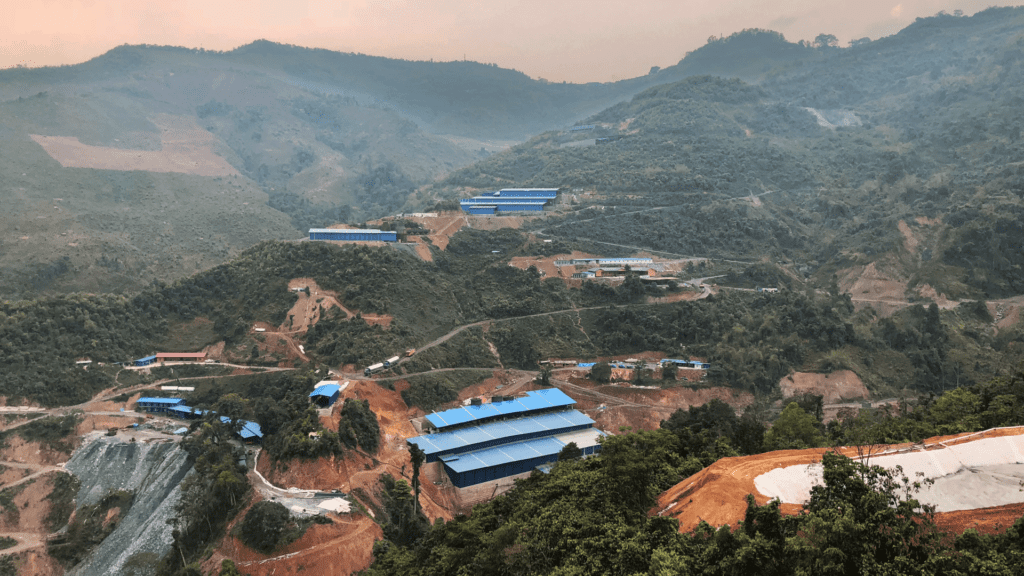
    Man Maw tin mine. Credit: International Tin Association


    The Wa State, a semi-autonomous region of Myanmar, has finally broken its year-long silence on the fate of the Man Maw tin mine.


    The mine is the jewel in Myanmar’s tin crown and its suspension since August 2023, ostensibly for an audit, has reduced the flow of tin raw materials to Chinese smelters, constraining output of refined metal.

    The Wa authorities have now said they are ready to accept applications for mining and processing licences at Man Maw, flagging its likely return later this year.

    The news, officially confirmed by the International Tin Association (ITA), has wrong-footed tin bulls and sent the London Metal Exchange (LME) tin price tumbling.
    China’s imports of tin concentrates and ore
    Man Maw returns

    Myanmar is the world’s third largest source of mined tin after China and Indonesia and Man Maw, until its suspension, was by some margin the country’s largest producing tin asset.

    The Wa State, which controls Myanmar’s tin sector, has no smelters so everything that is mined is shipped over the border to feed smelters in China’s Yunnan province.

    Raw material shipments were little changed in the months immediately after the suspension of operations as above-ground stocks at Man Maw were processed.

    But China’s imports from Myanmar have slowed significantly over the last nine months, falling to 21,500 metric tons in the second half of 2024 from 54,900 tons in the first half of the year and 94,600 tons in the year-earlier period.

    While some smaller tin mines have re-opened, they are clearly nowhere near as significant a supplier as Man Maw.

    Chinese producers have tried to compensate by lifting imports from other countries such as the Democratic Republic of Congo, Australia and Bolivia.

    But total imports of tin raw materials were still down by 36% year-on-year in 2024 and at 156,700 tons were the lowest since 2020.

    The lack of raw material has pressured smelter operating margins and acted as a major constraint on China’s refined metal production.

    Fund positioning on the LME tin contract


    Bulls wrong-footed

    News of Man Maw’s return has unsurprisingly caused a sell-off in the London tin market.

    LME three-month metal surged to a four-month high of $33,790 per ton on February 21, at which stage tin was the best performer among the LME base metals with year-to-date gains of 15.8%.

    Funds had been steadily lifting their bull bets on still higher prices. Long positioning reached a record high of 5,172 contracts, equivalent to almost 26,000 tons, at the end of last week.

    The ITA’s confirmation that Man Maw will return saw the price tumble to $31,050 at the end of last week, although it has this week bounced back as far as $32,145 per ton.

    The partial price recovery is not illogical given it may be several months before the mine actually starts generating tin again.
    Structural supply risk

    The announcement by the Wa State it is ready to grant licences is only the very first step on the way to a full re-opening.

    As the ITA notes, even once licenses are granted, it will take a couple of months at least for workers, mainly from China, to get work permits and move back to Myanmar.

    It is also likely the mine will have to be de-watered after such a long suspension, meaning that shipments to China will realistically only start to build momentum in the second half of the year.

    Chinese smelters will continue to struggle with low raw materials availability and refined metal production will continue to be affected until the flow of raw materials recovers to pre-suspension levels.

    In the interim, the tin market has other supply concerns in the form of the M23 rebel advances in the east of Congo.

    The country’s Bisie mine, which last year produced 17,324 tons of contained tin in concentrates, has so far been unaffected.

    It is located some 200 kilometres west of the area now under insurgent control but owner Alphamin Resources Corp has warned that the risk profile at Bisie has increased.

    This underlines tin’s structural supply problems. A market that is touted as a big beneficiary of both the energy transition and the internet of things is still beholden to a very limited number of global suppliers.

    The return of Man Maw doesn’t change that structural supply risk.

    (The opinions expressed here are those of the author, Andy Home, a columnist for Reuters.)

    (Editing by David Evans)

    Kazakhstan overturns $54.5m award to  Canadian miner;  World Wide Minerals, extending decades-long uranium dispute

    This marks the second time the award has been set aside, prolonging a dispute that has spanned more than two decades.

    March 4, 2025

    This move also highlights the challenges foreign investors face in Kazakhstan’s uranium industry. 
    Credit: Vladimir Tretyakov/Shutterstock.

    Kazakhstan has overturned a $54.5m arbitration award previously granted to World Wide Minerals, a Canadian junior miner, concerning a terminated uranium processing project.

    This is the second award cancellation for the company, prolonging a dispute that has spanned more than two decades.

    It also highlights the challenges foreign investors face in Kazakhstan’s uranium industry.


    The dispute originates from the late 1990s when World Wide Minerals invested in Kazakhstan’s uranium sector, overseeing one of the nation’s largest uranium processing plants.

    The company reached agreements with the Kazakh Government, pledging resources to upgrade the country’s uranium processing facilities.

    Subsequent measures taken by the Kazakh authorities, such as revoking essential licences and introducing bureaucratic obstacles, resulted in the suspension of World Wide Minerals’ operations and the eventual seizure of its assets.

    An international arbitration tribunal found Kazakhstan in breach of international law and the Canada-USSR Bilateral Investment Treaty in October 2019.

    This resulted in WWM being awarded more than $40m in damages, with total compensation exceeding $50m when including legal costs.

    Kazakhstan contested this decision, and in November 2020, the English High Court overturned the quantum findings of the arbitral award, referring issues related to causation and the calculation of loss back to the tribunal for further review.

    World Wide Minerals will now have to submit an appeal to an arbitral tribunal for a third time.

    World Wide Minerals president and CEO Ann Marie Carroll said: “World Wide Minerals strongly disagrees with the High Court’s ruling and is deeply disappointed that the Court has again interfered with the company’s decades-long efforts to obtain justice for Kazakhstan’s proven violation of the relevant investment treaty.

    “World Wide will continue to pursue its rights with respect to Kazakhstan’s breach of international law, which has now been firmly established by an esteemed arbitral tribunal in two separate Awards.”

    In a related development, in January 2025, Kazakhstan national uranium producer Kazatomprom’s majority-owned JV Inkai temporarily halted production at block No. 1 of the domestic Inkai uranium deposit.

    The suspension, effective from 1 January 2025, is in place as JV Inkai awaits approval for its revised Project for Uranium Deposit Development Documentation.


    Sign up for our daily news round-up!
    Give your business an edge with our leading industry insights.

    Equinor Makes Gas Discovery in Norwegian Sea      

    By Tsvetana Paraskova - Mar 05, 2025


    Equinor on Wednesday announced a new gas and condensate discovery in the Norwegian Sea, which could contribute to Norway’s efforts to boost natural gas production and exports to Europe.


    Equinor and its partners, Okea and Pandion Energy, have proven gas and condensate in the Mistral Sør exploration well in the Halten area in the southern part of the Norwegian Sea.

    Early estimates put the volume of the discovery at 19-44 million barrels of recoverable oil equivalents.


    The important thing for the explorers is that the discovery was made in a well-developed area in the Norwegian Sea, Ã…sgard and Kristin. The new find is just north of Linnorm, the largest gas discovery on the Norwegian continental shelf (NCS) that has yet to be developed, Equinor said.

    “Norwegian gas is in high demand and is crucial to Europe’s energy security. That’s why it’s important for us to continue exploring and making new discoveries so we can maintain a high level of deliveries,” said Grete Haaland, Equinor’s senior vice president for Exploration & Production North.

    “This discovery was made in an area where gas infrastructure is already in place, and which we’re also continuing to develop.”

    Equinor is currently exploring for oil and gas in the area, and has made several discoveries in recent years.

    The Norwegian energy major has recently announced it would cut renewable energy targets and investments and prioritize high-return developments of oil and gas. For Europe and for Equinor, finding and developing more gas fields has been a focus since the Russian invasion of Ukraine and the halt to most Russian gas supply to Europe in 2022.

    Earlier this year, gas export system operator Gassco said that Norway’s natural gas exports hit a record level in 2024 and are expected to remain close to this all-time high in the next few years.

    By Tsvetana Paraskova for Oilprice.com
    WAIT, WHAT?!  
    Trump’s Secret Plan To Restart Nord Stream 2 Sparks Backlash in Germany  

    By Alex Kimani - Mar 05, 2025, 11:45 AM CST


    Germany is exploring ways to prevent the resumption of the Nord Stream 2 pipeline under an agreement between the US and Russia as part of the settlement of the war in Ukraine, Bild has reported. According to Bild, secret talks between representatives of Russia and the United States have been going on for several weeks about American investors buying the damaged pipeline in the Baltic Sea.

    Last year, Russia's Foreign Minister Sergei Lavrov claimed the United States issued the order for the 2022 attacks on the Nord Stream gas pipelines. Back in September 2022, a series of underwater explosions occurred on 3 of 4 pipes of the Nord Stream 1 (NS1) and Nord Stream 2 (NS2) natural gas pipelines. Both pipelines were built by the Russian majority state-owned gas company, Gazprom, to transport natural gas from Russia to Germany through the Baltic Sea. Lavrov made the comments when speaking to reporters during a visit to Azerbaijan on Monday, echoing Moscow's long-stated claims that the West was involved.

    "It is clear that to carry out such a terrorist attack, there was a command from the very top, as they say. The very top for the West is, of course, Washington," Lavrov told Izvestia newspaper in a video interview published on its Telegram channel.

    According to Lavrov, "attempts to blame everything on a group of drunken officers," were not serious. Back then, the Wall Street Journal reported that Ukraine's top military commander at the time, Valery Zaluzhny, oversaw the plan to blow up the pipelines. Ukraine's President Volodymyr Zelensky approved of the plan, but tried to have it aborted after Washington warned him against it.

    Europe’s imports of Russian gas have declined from about 450 million cubic meters per day (mcm/d) at the end of 2021 to about 150 mcm/d currently. However, commodity analysts at Standard Chartered have reported that the continent has made little progress in cutting any more Russian supplies in nearly two years despite calls from some nations to completely do away with Russian energy commodities even as the war in Ukraine shows no signs of slowing down. On the contrary, Europe’s gas imports from Russia have climbed ~50% since Q1-2023.

    By Alex Kimani for Oilprice.com
    UK Stranded Oil and Gas Assets Could Reach $2.3 Trillion by 2040


    By Irina Slav - Mar 06, 2025


    The decarbonization push could result in $2.3 trillion worth of stranded oil and gas assets by 2040, a sustainable finance outlet from the UK has warned in a report.

    According to the UK Sustainable Investment and Finance Association, the UK has a disproportionately large exposure to this risk, with a potential $141 billion in losses on the line, should the net-zero transition succeed.

    “Based on current green transition policies, mid-term action plans to cut emissions, and long-term net zero targets, the report finds that global economic exposure to fossil fuel asset stranding risk amounts to $2.28 trillion by 2040,” the UKSIF wrote, adding that “In comparison to the cost of climate inaction, this is still a much smaller loss to bear. In a warming scenario between 2.5°C and 2.9°C, climate-intensified natural disasters may lead to $12.5 trillion in economic losses by 2050.”

    Such projections of the effects of climate change on natural disasters are normally the product of computer modelling, using inputs from researchers based on data that is also not infrequently derived from computer models along with observed temperature records.

    The threat of stranded assets has been a popular one in the transition space for years. With governments in the West throwing their full weight behind the transition, the idea that much of the oil, gas, and coal reserves being developed today could end up unwanted and loss-making due to lack of demand seemed quite plausible.

    Actual energy consumption data, however, has dispelled that idea, with coal consumption, no less, running at a record despite those governments’ efforts to transition away from hydrocarbons in favor of alternative sources of energy. Oil and natural gas consumption are also on the rise, especially natural gas. The clearest evidence of the not so gloomy outlook for hydrocarbons is Big Oil’s recent pivot back to its core business of producing those very same hydrocarbons and ditching transition goals.

    By Irina Slav for Oilprice.com