Thursday, March 06, 2025

How Mesopotamia’s Urban and Industrial Revolution Started Politics as We Know It Today

 March 6, 2025
Facebook

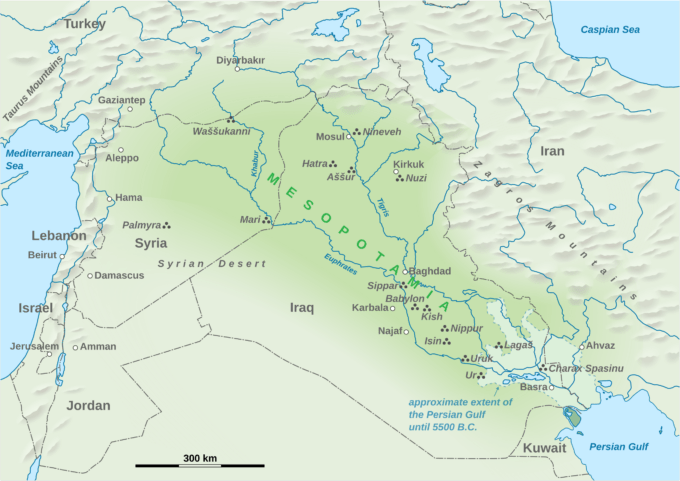
Image Source: Goran tek-en – CC BY-SA 4.0

Archaeologist and scholar Giorgio Buccellati’s book At the Origins of Politics describes how Mesopotamia’s urban revolution in the late fourth millennium BC shaped a new mentality. The segmentation and specialization of industrial production required written recordkeeping, standardization of weights and measures, and surveying and allocation of land planning. This inherent logic of handicraft production and its related organization of trade and market exchange, especially with the palace and temple institutions, led to new forms of social interaction, with the state and its laws and religion consolidating the new managerial hierarchies.

I met Buccellati in 1994 at the first of what would become a decade-long series of Harvard-based colloquia to compile an economic history of the Bronze Age Near Eastern origins of money and interest, land tenure, and its public obligations. Since these innovations were shaped largely by relations with the temples and palaces, our group started by focusing on just what it meant to be public or private.

It was fairly clear what “privatization” meant, but calling the palace or temples “public” was problematic. Royal price schedules for grain, silver, and other key commodities applied only to transactions with these large institutions, which were corporately distinct from the rest of the economy where prices were free to vary. Hammurabi’s laws focused on the relations between the palatial sector and the family-based economy on the land, which followed its own common law tradition for wergild-like personal offenses and other legal problems not involving the palace. How far beyond the palace did the state extend?

Buccellati’s paper focused on a broader philosophical idea of “public” as referring to the overall system of social and economic organization: “The dichotomy between public and private is coterminous with the origin of the city.”1 As he points out in At the Origins of Politics: “The increased size of the settlements created a critical mass, whereby face-to-face association no longer was possible among each member of the social group.” The relationship was political. “On the etymological level, the terms ‘urbanism’ and ‘politics’ are equivalent, given that they both derive from the word for ‘city’ in Latin and Greek respectively.” His term “state-city” emphasizes the overall political and administrative context.

He views industrialization as the economic dimension of the urban revolution that occurred in the late fourth millennium BC. The scale and social complexity of mining (or trading for metal) and metallurgy, beer-making, and weaving involved increasingly impersonal relationships as industrial organizations created products beyond the ability of individuals to make by themselves. The evolution was from direct personal contact to being part of a long, specialized chain.

Describing this takeoff as the first Axial Age, Buccellati explains how economic and social relations had been transformed over the 50,000-year evolution from small Paleolithic groups to urban industrial production, trade, and property relations. The technology and administration of production transformed the character of labor and what Buccellati calls para-perceptual thought. The moral principles of mutual aid, group solidarity, protection of the needy, and basic rights to means of self-support were retained from pre-urban practice but were administered on the state level.

“The state was never able to eliminate or even ignore the people… political ideology became a way for the leadership to justify itself in front of the base,” bolstered by religious attitudes to popularize an “Ideology of Control… the ideology of command, of leadership not necessarily based on coercive means.” Even in the face of “ever-increasing gaps in prestige and economic ability,” the rhetoric of kingship promoted “a sense of solidarity that transcends the limit of reciprocal face-to-face recognition.”

For the king, the aim was to make “submission not just tolerable but actually desirable.” That enabled Mesopotamian rule to be personal and indeed dynastic. “The king was not just the most powerful private individual; he embodied a distinct organism.” Kings were described as serving heaven, as reflected in Hammurapi’s stele depicting him presenting his laws to the god of justice, Shamash (or in some interpretations, receiving them from Shamash).

“The private model was thus superimposed from scratch on the public one,” merging the state and religion as every new king pointed to his ancestors as if this meant continuity of the law. The principle of kings being hereditary was accepted “without ever being formulated in theoretical terms.”

From Living in a State of Nature to a Stratified Managerial Order

Buccellati describes production as evolving from interpersonal and small scale to institutional and large scale. He describes how Paleolithic hunters and gatherers met their needs by using what they found in nature. They napped flints to make spear points and cutting tools, and wove plant fibers to make clothing, baskets, and other artifacts, but these materials were as they found them. And personal wealth took the form of shells or other objects found in nature. However, the increasing complexity of industrial organization transformed the character of producers in that they ceased to have face-to-face relations with the users of the objects they made. Products evolved increasingly beyond objects found in nature, and also beyond the ability of single individuals to make them as they required chains of transformation via metallurgy and manufacturing.

Although Buccellati does not focus on land tenure, money, and credit in this volume, his analytic schema of the transition from “nature” to man-made institutional structures suggests how land and credit relations evolved along similar lines, from informal and spontaneous to formal and standardized. If there was an archaic relationship with the land, it was for an Indigenous tribe to claim territory as belonging to itself for hunting and gathering and for ceremonial or religious functions.

Most exchange was domestic, taking the form of reciprocal gifts, often of the same food types simply as a means of binding groups together in the spirit of mutual aid. But artifacts were traded among Indigenous communities already in the Ice Age, from one tribal group to another, sometimes passed along over long distances.

Gathering places for such exchange existed already in the Ice Age, often at river crossings or natural meeting points. These would have been seasonal sites, with chieftains responsible for keeping the lunisolar calendar to time when to travel to such spots. If anything, such gathering places were the opposite of the later city that Buccellati describes. The idea was to prevent any one group from dominating others or restricting territorial control. The result was akin to the amphictyonic centers of classical antiquity, neutral zones set aside from political cities and rivalries, with careful equality of participants as a condition for amicable relations.

Deities often were trees, woods, or natural rock formations such as those that survived in Germanic religion into the first millennium of our era, and Japan’s Shinto religion. Lunar and solar deities were part of an astronomical cosmology reflecting the rhythms of nature. By the Bronze Age, gods took on the role of patrons of social authority and justice as urbanization transformed the natural environment.

Technology enabled the production of new shapes and “artifacts that have no analogy in nature.” Mud bricks became standardized to build walls. “Stone is no longer seen as an adaptation of pre-existing forms” but was shaped to produce new building structures. Fire played an important role in controlling the environment, not only to cook food but also to bake mud bricks and harden ceramics, and to refine metal from ores and make alloys such as bronze to produce tools, weapons, and other implements. The potter’s wheel and spindles for weaving were developed, and a managerial class came into being as manufacturing such products required increasingly complex organization, from producers and traders to armies.

The Neolithic agricultural revolution saw the standardization of land, allotted to community members in lots sufficient to support their families, with proportional obligations attached—obliging their holders to serve in the army and provide seasonal corvée labor on communal building projects.

These obligations were what defined land tenure rights. That created a strict relationship with the emerging urban centers that transformed “the village as it existed in prehistory… in the sense of autonomous villages that found an end in themselves. … Agricultural or manufactured production did not have as its end point the village, but rather and especially the urban markets.” Rural villages became part of the city, and local conflicts were settled by traveling urban judges.

Monetization of Exchange Between the Rural and Urban Centers

Money evolved as part of the valuation dimension of exchange. Anthropologists studying surviving Indigenous communities have found that artifacts typically are valued for their rarity or lineage of ownership. In archaic times such objects were often buried with their wearers, having become part of their personal identity. In time, they took a proto-monetary signification of esteem. But it was in southern Mesopotamia that money became formalized as a measure of valuation, simultaneously for domestic agrarian and industrial exchange—mainly for grain and wool—and for foreign trade. In both cases, the palace and temples played a key role. A standardized measure of value was needed for the economy’s own industrial and institutional functioning, not merely for personal decoration and status.

Foreign trade was necessary to obtain raw materials not found in the region’s river-deposited soil. Copper and tin were the key metals that were needed, the alloy of which gave its name to the Bronze Age (3500-1200 BC), but silver was adopted as the main measure of value for palace transactions and those of entrepreneurs, presumably because of its role in religious symbolism. Silver and other commodities were obtained by a mercantile class of entrepreneurs, whose major customers were the palace and temples, which also supplied most of the textiles being exported.

The largest categories of debts and fiscal obligations were inter-sectoral, owed by citizens on the land and mercantile entrepreneurs to the palace sector and its temples. The seasonal character of agriculture made credit necessary to bridge the gap between planting and harvesting, to be paid on the threshing floor when the crop was in. Grain served as the main domestic agrarian measure of value and the medium for paying agrarian debts.

The palace and temples integrated their economic accounts by setting the silver mina and shekel that denominated the value of commodities obtained in foreign trade (and consignments of what was exchanged for them) as equal to corresponding measures of grain, while dividing the relevant measures into 60ths to facilitate the allocation of food and raw materials based on the 30-day administrative month used by the large institutions.

The resulting monetary system of account-keeping for credit and fiscal collection was part of a broader economic context in which standardized weights and measures were used to quantify and calculate the various magnitudes of the inputs required by the large institutions for producing commodities in their workshops, along with the amounts of the charges, fees, and rents payable to the institutions and fiscal collectors.

The surplus grain rent paid to the large institutions supported dependent labor in the weaving and handicraft workshops. Commodities no longer were made by individual craftpersons known to the users, but by many, whose identities were institutional and hence collective and impersonal as far as the buyers or users were concerned. The workforce consisted largely of war widows and orphans, and also slaves captured from the mountains surrounding Mesopotamia. (A typical word for slave was “mountain girl.”)

The textiles woven by this labor were consigned to merchants to act as intermediaries between the large institutions or the growing class of private estate holders and foreign purchasers. Interest charges (usually equal to the original loan value for consignments of five years) served as a means for consigners and backers to obtain their share of the gain that merchants were expected to make on their trade.

Bucellati shows how the urban revolution’s “evolutionary process in motion” to transform society and with it “the very nature of human existence.” The development of writing, for instance, had a deep effect in transforming thought processes, much as the creation of languages had served to “externalize thought.” It enabled the communication of ideas to others without having to rely on memory.

Originally used by the eighth millennium BC to oversee and quantify trade and exchange transactions, it came to be used for accounting and credit, and increasingly to preserve, arrange and order thoughts, public announcements, treaties, poetry, and laws. The written word became a new medium for thought. Buccellati describes this “reification of thought” as part of the “removal from nature.” That was part of the evolving uniformity that spread from the production of commodities to shape the overall social order.

Debt Strains Lead Rulers to Protect Their Economies From Polarizing

Industry and entrepreneurial foreign trade concentrated control and wealth in the hands of managers and “big men.” Their economic gains caused a wealthy class to emerge, initially within the large institutions, with credit being used to pry labor away from palace control. Creditor claims on indebted cultivators accumulated, largely at the institutional level of landholders, merchant-creditors, and also ale-women, whose customers ran up tabs for their beer, to be settled at “payday” on the threshing floor when crops were harvested.

It was inevitable that strains would develop as a result of the rising role of credit and debt relations, especially in times of flooding or crop failure. As rent and other payment arrears and interest charges mounted up, private lending (often by royal or temple officials acting on their own account) became the major initial way to obtain the labor of debtors, by requiring them to work off their debts. That prevented cultivators from performing the stipulated corvée and military service that they owed in exchange for their land tenure rights.

The result was a threefold conflict: first, creditors against debtors; second, creditors against the palace over the appropriation of labor via debt bondage; and third, the assertion of creditor power against traditional communal moral ideas of equity and mutual aid. Archaic communities traditionally sought to minimize economic inequality, perceiving much personal wealth as being achieved by exploiting others, above all by indebting them. By the third millennium, indebted cultivators faced the threat of being disenfranchised, losing their personal freedom and self-support land through foreclosure.

As Buccellati observed in our 1994 colloquium royal protection of homesteaders, canceling the overgrowth of personal debt resulted “more from a concern for the public domain than as a phenomenon of privatization.” Rulers from the third millennium BC onward protected palace claims on the labor of their citizens from being disrupted by debt strains of the type to which subsequent Western civilization has succumbed. Sumerian rulers made sure that these strains would not be permanent because that would have been at the expense of the palace’s own requirements for corvée and military service from agrarian debtors.

Buccellati pertinently notes that three main considerations shaped Near Eastern public laws: “the concept of rules, the sense of justice, [and] the decisive moments in resolving conflict.” Hammurapi’s “code” was simply a collection of judgments, but his andurarum proclamations were enforced by the courts to cancel personal debts (but not mercantile debts), liberate bondservants (but not slaves), and redistribute self-support land (but not townhouses) that had been forfeited to creditors or sold under economic duress. These Clean Slates were the most basic royal administrative acts of Mesopotamian rulers from Sumerian times onward. They were the moral pillar of the state.

The Mesopotamian State Solved the Debt Problem That Western Civilization Has Not

Buccellati sees the transformation of production, economic control, and ways of perceiving and thinking about one’s place in society as progressing toward a geopolitical peak with the Assyrian Empire. What enabled and made this sustained achievement so successful were royal laws to regularly restore economic balance on a system-wide level. Clean Slate proclamations prevented a creditor oligarchy from emerging to rival palace claims on the labor and crop surpluses of citizens on the land. In this respect, the distinction between financial and industrial gain-seeking—and the socially destructive character of usury and creditor self-interest—was recognized already in the third millennium BC in the Hymn to Shamash, the Akkadian god of justice (lines 103-106):

What happens to the loan shark who invests his resources at the (highest) interest rate?
He will lose his purse just as he tries to get the most out of it.
But he who invests in the long term will convert one measure of silver into three.
He pleases Shamash and will enrich his life.2

Buccellati rightly states that “We are the heirs of Mesopotamian perception and political experience.” Modern civilization, however, has retrogressed from the Bronze Age Mesopotamian achievement of avoiding deepening financial and economic imbalance. He notes that modern society defines property as being alienable, but in the West securing property rights always has entailed the “right” to forfeit it to creditors or sell under duress—irreversibly. That has been the case ever since Near Eastern commercial and credit practices were brought to the Aegean and Mediterranean lands in the first millennium BC.

The West has adopted the basic economic practices invented in the fourth and third millennia BC, but not the economically protective measures that rulers took to annul the buildup of creditor claims to reverse the increase in debt bondage and loss of land by debtors. That decontextualization is what in my view makes the West “Western.”

Bronze Age Near Eastern practice was so different from the Western worldview that most modern historians resist recognizing and appreciating the relevance of the region’s takeoff in the fourth and third millennia BC. Indeed, today’s anti-state economic ideology denies that money and industrial enterprise could have been innovated by what Buccellati calls the state, that is, the palatial authority.

This ideology obscures a great question posed for the West: How is it that Near Eastern “divine kingship” achieved what Western democracy has failed to do: check the emergence of a creditor rent-seeking oligarchy, which in classical antiquity would strip the Greek, Italian, and other populations of their means of self-support that had formed the basis of economic liberty for the first 3,000 years of the Mesopotamian takeoff that this book so comprehensively describes.

Notes.

1. Buccellati, Giorgio, “The Role of Socio-Political Factors in the Emergence of ‘Public’ and ‘Private’ Domains in Early Mesopotamia,” in Hudson, Michael and Levine, Baruch (eds.), Privatization in the Ancient Near East and Classical Antiquity (Cambridge, Mass: Peabody Museum [Harvard], 1996):131.

2. In Giorgio Buccellati, “When on High the Heavens…”: Mesopotamian Religion and Spirituality with Reference to the Biblical World (London, 2024):194, citing Reiner, Erica, Your Thwarts in Pieces, Your Mooring Rope Cut: Poetry from Babylonia and Assyria (Ann Arbor, 1985): 68-84, and W.G. Lambert, W.G., Babylonian Wisdom Literature (Oxford, 1960): 122-138.

This text is adapted from Michael Hudson’s foreword to At the Origins of Politics by Giorgio Buccellati, and this excerpt was produced by Human Bridges.

Michael Hudson’s new book, The Destiny of Civilization, will be published by CounterPunch Books next month.

Belgium: First mass mobilisation against the federal government

Tuesday 4 March 2025, by Mélodie Vandelook


After eight months of negotiations and political theatre in Belgium, the new federal coalition (N-VA, MR, Les Engagés, CD&V and Vooruit), which ranges from the right to the social liberals via the Christian Democrats and is called ‘Arizona’ because of the political colours of the parties that make it up, finalised its government agreement at the end of January, with the blessing of the employers. Its programme constitutes a major anti-social offensive and is already meeting with significant resistance from the population.

Declaration of social war

This government and its attacks are part of a worldwide trend towards far right extremism. To maintain their sources of profit and accumulation, the ruling classes see no other option than to dispossess the workers, by force, from a series of social conquests. But for this inhumane policy to be acceptable, it needs scapegoats, even imaginary ones. Hence the incessant media and political attacks on unemployed workers, migrants and asylum seekers, Muslims, woke people, transgender people and so on.

‘Arizona’ is planning a wave of anti-social, sexist and racist measures on a scale that has not been seen for decades: 22 billion in savings on workers, both employed and unemployed, documented and undocumented, and a pitiful little capital gains tax to try and make up for it. Here are just a few examples of the measures: limiting unemployment benefit to two years; forcing the long-term sick back to work; reducing the number of places in reception centres for asylum seekers by a third, but doubling the number in closed centres; withdrawing social assistance for refugees for five years; attacking retirement pensions, with particular effects on women, and cracking down on trade unions and mutual societies. All the while increasing the defence budget...
Social resistance is getting organised

The response to this declaration of social war was swift. On Thursday 13 February, 100,000 people marched through the streets of Brussels in response to a call from the common trade union front. A multitude of sectors (trade unions, feminists, anti-fascists, ecologists, among many others) mobilised against the attacks of the new federal government. This remarkable turnout represented a real acceleration in social tension.

This first showdown marks the start of a real action plan. The union leaderships have announced a general strike for 31 March. This will be a decisive stage in the balance of power, but before that, we are calling for mobilisation to continue, sector by sector: postal workers at bpost have been on a militant strike for a week now; railway workers, Audi subcontractors and teachers have already announced strikes and actions that are the embers of a broader mobilisation. It will be crucial for the feminist strike on 8 March to be part of this fight against ‘Arizona’, showing the harmful impact of the measures on women; the same goes for the actions on 21 March, International Day Against Racism, which will be an opportunity to denounce the murderous migration policy of the new government. The general strike on 31 March will be effective if it is supported by a broad popular mobilisation from below, going beyond a simple 24-hour work stoppage. The challenge over the next few weeks is to ensure that the protest movement continues to spread, with a clear objective: the fall of the De Wever government.

Attached documentsbelgium-first-mass-mobilisation-against-the-federal_a8882.pdf (PDF - 904.7 KiB)
Extraction PDF [->article8882]


Mélodie Vandelook

Mélodie Vandelook is a member of Gauche Anticapitaliste, Belgian section of the Fourth International.


International Viewpoint is published under the responsibility of the Bureau of the Fourth International. Signed articles do not necessarily reflect editorial policy. Articles can be reprinted with acknowledgement, and a live link if possible.
Palestine: still on the brink of catastrophe

Wednesday 5 March 2025, by Édouard Soulier


The second phase of the ceasefire agreement should come into force next week, but it will probably be postponed by Israel. In a break with plans, Benyamin Netanyahu and his cabinet have suspended the release of 600 Palestinians under the terms of the agreement until further notice.


The pretext for refusing the release is Hamas’s ‘staging’ of the release of the Israeli prisoners. The Israeli authorities denounced a degrading ritual - even though it resembled in every way those of previous releases, the difference being that one of the Israeli prisoners kissed two fighters on the forehead before being handed over to the Red Cross. This ‘provocation’, as the Israelis put it, caused a stir in the international press, but as usual much more so than the degrading conditions in which the Palestinian prisoners were released, often mutilated, injured and emaciated, with the Israeli police preventing the celebrations with tear gas.

The pressure continues on the releases


As agreed, Hamas also returned the bodies of three members of the Bibas family. Hamas indicated that these captives had been killed by a bombardment in November 2023 - this had already been announced at the time. But Israel accused Hamas of deliberately killing the hostages ‘with their bare hands’. This version was also widely reported in the Western media, as if we had already forgotten the lies about babies being beheaded or put in ovens.

The pressure game continues on the part of Israeli society and above all its government, with the explicit or tacit support of the imperialist leaders, against the backdrop of a possible resumption of the bombardments, while there is still a 7th wave of releases (out of 8) before phase 2 of the ceasefire, which we do not really know if it is going to start or not since the negotiations have stalled. It is therefore very possible that the bombings will resume despite pressure from the United States. Moreover, Trump seems to have abandoned his plan for ethnic cleansing in Gaza. He does not have the political means to pressure countries like Egypt and Jordan to accept the Palestinians at the risk of their own stability in the very short term.

In the West Bank, settlement continues


Meanwhile, in the town of Jenin, the Israeli army has deployed tanks for the first time in 23 years. The Israeli army has also extended its offensive into the north of the West Bank in the town of Qabatiya. Israeli bulldozers immediately began ripping out water pipes in the streets. Israel’s war minister admitted that Israeli forces had expelled 40,000 Palestinians from three refugee camps in Jenin and Tulkarem, a figure reported by UNRWA several weeks ago. He said that the refugee camps were now ‘empty of residents’ and that ‘UNRWA’s activities in the camps have also been halted’, claiming that he had ordered the Israeli army not to allow camp residents to return to their homes for a whole year. ‘We will not return to the reality of the past’, he declared. ‘We will continue to cleanse the refugee camps and other centres of terror in order to dismantle the terrorist battalions and infrastructure’. This is ethnic cleansing and the extension of colonisation.

Israel does not want peace and remains confident in its impunity, particularly in the West Bank. It is this impunity that we, for our part, must absolutely challenge, because the future of the Palestinian people as a whole is at stake.

L’Anticapitaliste 27 February 2025


Attached documentspalestine-still-on-the-brink-of-catastrophe_a8883.pdf (PDF - 905.1 KiB)
Extraction PDF [->article8883]


International Viewpoint is published under the responsibility of the Bureau of the Fourth International. Signed articles do not necessarily reflect editorial policy. Articles can be reprinted with acknowledgement, and a live link if possible.
“America First” and the great upheaval in international relations

Thursday 6 March 2025, by Gilbert Achcar


The “America First” logic, adopted by the US neofascist movement known as MAGA, may seem rational to those who are not familiar with the economic history of international relations. According to Trump and his acolytes, America has spent huge sums of money protecting its allies, especially the rich countries among them, i.e. the geopolitical West (Europe and Japan in particular) and the Gulf Arab oil states. It is time for them to pay off the debt: all these countries must foot the bill by escalating their investments in the United States and their purchases from it, especially their purchases of weapons (which is what Trump means by his constant pressure on the Europeans to increase their military spending). All of this naturally falls within the mercantile logic consistent with the nationalist fanaticism that characterizes neofascist ideology (see “The Age of Neofascism and Its Distinctive Features”, 04/02/2025).


From this perspective, US military expenditure – which has truly exceeded not only that of America’s allies but almost equalled at one point the military spending of all other countries in the world combined – has been a major sacrifice for the benefit of others. According to the same logic, the large deficit in the US trade balance is but the outcome of other countries exploiting US goodwill, which is why Trump wants to reduce it by imposing tariffs on all countries that export to the United States more than they import from it. In doing so, he also seeks to increase the federal state’s income in order to offset his reduction of the same income by means of tax cuts benefitting the rich and big business.

The historical truth, however, is very different from this simplistic portrayal of things. First, US military spending after World War II was, and remains, a major factor in the specific dynamics of the US capitalist economy, which has since been based on a “permanent war economy” (this is explained in detail in my book The New Cold War: The United States, Russia, and China, from Kosovo to Ukraine, UK edition, US edition, 2023). Military spending has played, and continues to play, a major role in regulating the course of the US economy and in financing technological research & development (the latter role was prominent in the ICT revolution, a field that restored the United States to technological pole position after the relative decline of its traditional industries).

Second, the military protection that the United States provided to its allies in Europe, Japan, and to Arab Gulf states was part of a feudal-like relationship, in which these countries provided great economic privileges to the US overlord, in addition to their participation in its military network under its exclusive command. The truth completely contradicts Trump’s and his acolytes’ portrayal of the United States’ relations with its allies as being based on their exploitation of it. The reality is the exact opposite, as Washington has imposed on its allies, especially the rich countries among them, a pattern of economic relations through which it has exploited them, especially by imposing its dollar as an international currency, so that these countries directly and indirectly financed the twin deficits of the US trade balance and federal budget. The dollars of the US trade deficit, along with sundry dollar resources of various countries, have continually returned to the US economy, some of them directly financing the US treasury.

Thus, the United States lived, and continues to live, far beyond its own means, a fact that is evident in the size of its trade deficit, which approached a trillion dollars last year, and the size of its enormous debt, which exceeds 36 trillion dollars, equivalent to 125 percent of its GDP. The United States is the ultimate epitome of a large and powerful debtor who lives at the expense of wealthy creditors in a relationship of domination of the former over the latter, instead of the other way around.

Even towards Ukraine, the $125 billion the United States has given to that country so far (far from Trump’s fanciful figures, where he claims that his country has spent $500 billion in this regard) is equivalent to what the European Union alone has provided (even though the EU’s GDP is about 30% less than that of the US), not counting what Britain, Canada and other traditional US allies have contributed. In fact, what the United States has spent in funding the Ukrainian war drive served its policy of weakening Russia as an imperial rival. Washington is primarily responsible for creating the conditions that facilitated the neofascist transformation in Russia and led to its invasion of its neighbour. It deliberately stoked hostility towards Russia and China after the Cold War to consolidate the subordination of Europe and Japan to its hegemony.

However, when Trump and his acolytes acknowledge the responsibility of previous US administrations in creating the situation that led to Russia’s invasion of Ukraine, they do not do so out of their love for peace as they hypocritically claim (their position on Palestine is the best evidence of their hypocrisy), but rather in the context of their transitioning from considering Russia a rival imperialist state – an approach that Washington has increasingly pursued since the 1990s despite the collapse of the Soviet Union and Russia’s return to the fold of the global capitalist system – to considering Putin as their partner in neofascism, looking forward to cooperating with him in strengthening the far-right in Europe and the world, in addition to benefiting from Russia’s large market and great natural resources. Whereas they see in Europe’s liberal governments an ideological opponent and an economic competitor at once, they see in Russia an ideological ally that cannot compete with them economically.

On the other hand, China, in the eyes of Trump and his acolytes, is the greatest political opponent and economic and technological competitor. Joe Biden followed this same policy, establishing a continuity between Trump’s first and second terms with regard to hostility to China. While the Trump team may hope to separate Moscow from Beijing, just as China separated from the Soviet Union in the 1970s and allied with the United States, Putin will not risk taking this path as long as he is not sure of the permanence of the US neofascists at the helm of their country.

The big question now is whether the European liberal axis is ready to take the path of emancipation from US tutelage, which requires stopping its alignment with Washington in hostility towards China and consolidating cooperative relations with it. This also requires European countries to be prepared to work within the framework of international law and contribute to strengthening the role of the United Nations and other international institutions, two things that Beijing has been constantly calling for.

Europe’s economic interest is clear in this regard, of course, especially the interest of the largest European economy, the German economy, which has extensive relations with China. The irony is that China is now joining forces with the Europeans in defending global trade freedom against the mercantile approach adopted by Trump and his acolytes, and in defending environmental policies against their rejection, accompanied by climate change denial, that characterizes various brands of neofascists. The sharp positions expressed by the incoming German Prime Minister, Friedrich Merz, in criticising Washington and calling for Europe’s independence from the United States, if they lead to an actual attempt to follow this path, may get reflected in the European Union’s attitude towards China, especially since the French position is leaning in the same direction.

All these matters confirm the death of the Atlantic liberal system and the world’s entry into a stormy phase of reshuffling the cards, of which we are still at the beginning. The US Congressional elections next year will play a major role in pushing this process forward or curbing it, depending on whether they lead to strengthening or weakening neofascist dominance over US institutions. Meanwhile, the US neofascist movement has begun to imitate its counterparts in various countries in gradually undermining electoral democracy and laying its hands on US state institutions in an effort to perpetuate its control over them.

Source: Gilbert Achcar


Attached documentsamerica-first-and-the-great-upheaval-in-international_a8888.pdf (PDF - 912.5 KiB)
Extraction PDF [->article8888]


Gilbert Achcar

Gilbert Achcar grew up in Lebanon. He is currently Professor of Development Studies and International Relations at the School of Oriental and African Studies (SOAS) in London. A regular and historical contributor to the press of the Fourth International, his books include The Clash of Barbarisms. The Making of the New World Disorder (2006), The Arabs and the Holocaust: The Arab-Israeli War of Narratives (2012), The People Want: A Radical Exploration of the Arab Uprising (2022). His most recent books are The New Cold War: The United States, Russia and China, from Kosovo to Ukraine (2023) and the collection of articles Israel’s War on Gaza (2023). His next book, Gaza, A Genocide Foretold, will come out in 2025. He is a member of AntiCapitalist Resistance in Britain.


International Viewpoint is published under the responsibility of the Bureau of the Fourth International. Signed articles do not necessarily reflect editorial policy. Articles can be reprinted with acknowledgement, and a live link if possible.


Recognising fascism in India: If not now, then when?


Published 

FacebookTwitterEmail
Recognising fascism Rebel Politic

First published at CPIML Liberation.

Ahead of the forthcoming 24th Congress of the Communist Party of India (Marxist), an internal note issued by the party politburo, and widely reported in the media, has attracted more public attention than the draft resolution released earlier. The draft, in a couple of places, had used the expression “neo-fascist characteristics” to describe the current political situation and the Narendra Modi government. The note now clarifies that the expression “neo-fascist characteristics” means only features or trends and by no means describes the Modi government as a fascist or neo-fascist regime. This is where, the note points out, the CPI(M) differs from the Communist Party of India or Communist Party of India (Marxist-Leninist) in their analysis of the current state of affairs in India.

Perhaps the expression “neo-fascism” had confused the CPI(M) ranks that the main difference between the CPI(M) and CPI(ML) in the current context revolved only around the epithet “neo”, so the note had to take the trouble of “clarifying” that, as of now, fascism in India is only a tendency, the characteristics on display are only emerging and not entrenched or decisive enough to define the nature of the regime. The note wants to make sure that the party cadres do not read much into the word neo-fascist which appears for the first time in a CPI(M) document. In other words, while the situation is such that the “f” word cannot be avoided anymore, the note seeks to warn the party against “overestimating” the fascist danger.

The note describes fascism in Italy and Germany as “classical fascism” and points out how the emerging trend of neo-fascism differs from the classical variety. Part of these differences are contextual — fascism arose in Italy and Germany in the wake of World War I in a situation of heightened inter-imperialist rivalry leading to world wars and an acute crisis of capitalism known as the Great Depression. The note however does not stop there and identifies one more difference which is more intrinsic — while classical fascism negated bourgeois democracy, the “neo” variety is apparently compatible and even comfortable with bourgeois democracy, especially the electoral system. In other words, while classical fascism had no internal checks and unleashed a furious storm of destruction that ravaged every bit of democracy, there is something self-limiting or self-regulating in the neo-fascist variety.

This distinction that is being sought to be made between classical fascism and its “neo” avatar certainly merits closer attention, as does the CPI(M) claim that what India is witnessing and experiencing now are just some “neo-fascistic tendencies” at work which, if unchecked, may in future grow into neo-fascism. Talking about the historical context of the rise of fascism in the 1920s, there was something more than fierce inter-imperialist conflict and acute economic crisis — the fear of revolution. In 1848 itself the Communist Manifesto had begun with the iconic sentence: “A spectre is haunting Europe — the spectre of communism.” The spectre became far more real in the wake of the victorious socialist revolution in Russia in November 1917. While revolutionary possibilities elsewhere in Europe did not fructify, by the time of the fifth anniversary of the Russian revolution, fascism had acquired power in Italy.

At the very inception of fascism in Europe, it became clear that while fascism was an international phenomenon, it was bound to display national peculiarities shaped by respective historical realities and social conditions of respective countries. By the time fascism manifested itself in Germany it had already acquired a new brand name: Nazism or national socialism. Certainly nobody in India is today talking of an exact replica of the models of European fascism we saw in the first half of the twentieth century. A Marxist analysis of India today has to take into account Indian particularities as well as the unmistakable fundamental features that have been common to all instances of fascism in history. It will surely make sense to consider the CPI(M)’s note of clarification from this perspective.

The CPI(M) is in agreement with the wider progressive opinion in India and internationally, which considers the RSS fascist. It is significant that right since its inception the RSS had drawn quite heavily on what the note calls the classical models of fascism in Italy and Germany, borrowing considerable inputs from them in terms of ideological foundation, organisational structure as well as operational pattern, with Muslims in India being identified as the ultimate internal enemy as Jews were in Germany. It is another thing that colonial India was not post-war Italy or Germany. While fascists came to power within a few years of their rise in Italy and Germany, in India they remained a marginal force during the period of the freedom movement or in the initial decades of India’s journey as a constitutional republic.

There is perhaps no other example of a fascist trend in the world sustaining itself for so long, adapting itself to the changing socio-political dynamics to accumulate strength and insidiously penetrating the institutional network of the republic to attain the kind of control and domination that the RSS enjoys today. What use will a fascist force make of its growing grip on political power: will it proceed towards unleashing and enforcing the whole gamut of its fascist agenda or comply eternally with bourgeois democracy and play by its so-called rules of the game? The track record of the RSS through all its ups and downs, tactical retreats and strategic advances, over the one hundred years of its existence and especially over the last four decades of its dramatic rise and consolidation must leave no one in the slightest of doubt.

The escalation of the Ram Janambhoomi campaign through Advani’s rath yatra and the eventual demolition of the Babri Masjid on 6 December 1992 gave us the first unmistakable glimpse of the Sangh brigade’s brazen fascist design. It was not just aggressive communalism or fundamentalist frenzy at work, but a clear attempt to redefine the identity of India on the basis of Hindu supremacy and ignite the imagination of a Hindu Rashtra. CPI(ML) identified this moment as a communal fascist threat to India’s composite culture and constitutional republic. Comrades Vinod Mishra and Sitaram Yechury both wrote extensively about the RSS design and alerted the left and progressive ranks about the ideological-political implications of this turning point. Progressive academics Tapan Basu, Sumit Sarkar, Pradip Datta, Tanika Sarkar and Sambuddha Sen produced their brilliant booklet exposing the fascist design of the RSS called Khaki Shorts and Saffron Flags.

The BJP’s isolation in the wake of the Babri Masjid demolition was however quite short-lived and within five years the party managed to gather an all-India coalition. By the turn of the century India was already under NDA rule, the first non-Congress dispensation to survive a full term. The lynching of Graham Stuart Staines and his sons Philip and Timothy by Bajrang Dal leader Dara Singh and his group in January 1999 and the anti-Muslim pogrom perpetrated in Gujarat three years later sent out loud signals of the Sangh brigade’s unfolding agenda. While the Gujarat carnage overseen by the Modi government was widely denounced in India and abroad and played a major role in ensuring the defeat of the NDA in 2004, the refusal of the Sangh-BJP establishment to take any action against Modi made it clear that the Sangh brigade was ready to take the next leap towards its Hindu Rashtra goal.

Even though the UPA government ran two full terms, the BJP consolidated itself in Gujarat and corporate India too began to rally increasingly around the Modi brand in the biennial investment summits called Vibrant Gujarat. The clamour to bring Modi to Delhi grew louder with the decisive backing of corporate India, the Tata group too joining the Adani-Ambani chorus, and by 2014 we had the advent of the Modi era. It is important not to forget this trajectory of corporate-communal convergence. The systematic and rapidly escalating execution of the long cherished Sanghi agenda of subjecting secular democratic India to a Hindu supremacist fascist order will tell us that there is a lot more to this blueprint of fascist disaster than just a crisis of neoliberalism, however acute.

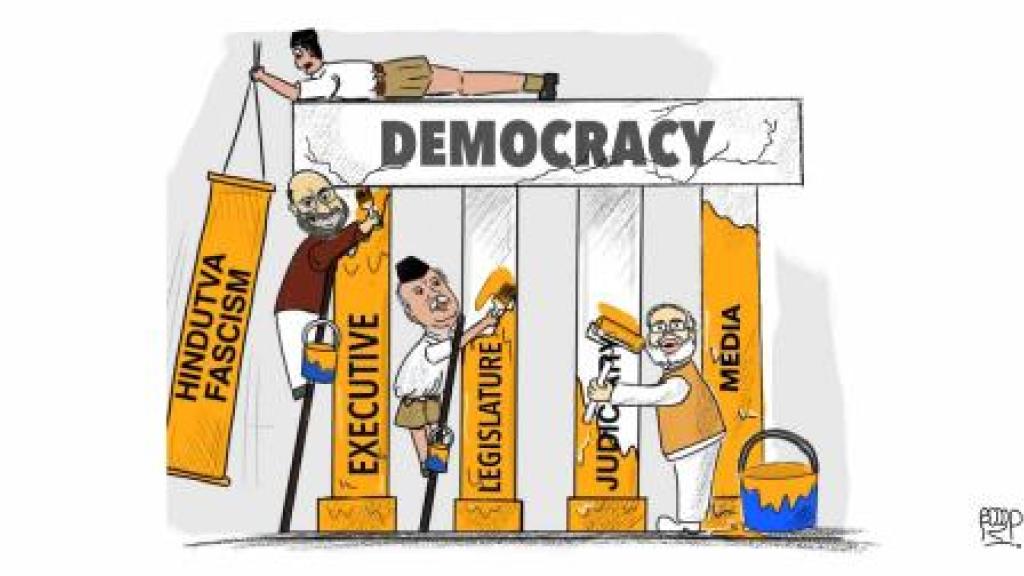
Some eighty years ago, Ambedkar had warned us “if Hindu Raj becomes a fact, it will, no doubt, be the greatest calamity for this country” and he could not have been more prophetic. From amending laws and changing the very framework of law and justice to legislating new measures in complete violation of the basic spirit of the Constitution and subverting the entire institutional framework and environment that governs our republic, this government is doing everything to destroy democracy and erode the rights and liberties of citizens. Add to this the impunity granted to state-sponsored hate and violence targeting the Muslim community, various weaker sections of society and voices of dissent, and we get an idea of the unprecedented daily onslaught on the constitutional foundation of our democratic republic. Explicit calls for a new constitution are also being voiced from different quarters and the Union Home Minister himself made derogatory remarks about Babasaheb Ambedkar in the course of the parliamentary discussion on the 75th anniversary of the adoption of the Constitution of India.

Elections are of course still happening in India, but can that be a substantive safeguard for India’s beleaguered democracy when the Election Commission is under the complete control of the government and when the entire election process right from the preparation of electoral rolls to the counting of votes is becoming increasingly opaque and arbitrary? Let us remember that Adolf Hitler too came to power through the electoral route and gradually delegitimised the entire opposition to secure 99% vote and enforce a permanent dictatorship. In India, Amit Shah keeps talking about ruling uninterruptedly for fifty years. And we have already seen any number of instances of the BJP’s desperate and sinister bid to win every election and cling to power. Elections in India are being rendered increasingly farcical, meant to serve as a spectacle for global optics and claiming internal legitimacy.

It is true that the BJP has found several allies and enablers in its political journey thus far. Apart from the support of its formal allies, it often also receives wider support around the neoliberal agenda as also on the basis of the soft Hindutva continuum. On issues like persecution of dissenting voices, demonisation of Islam, virulent campaign of hate and violence against Muslims and other minorities and marginalised groups, and erosion of civil liberties, democratic rights and democratic spaces, there is still little sensitivity and vocal opposition in India’s public discourse. No wonder Ambedkar had termed the Constitution just a top dressing of democracy on an undemocratic soil. This makes it all the more imperative for Communists to take the lead in building resistance to fascism and act as the most consistent and committed champions of democracy in the face of the growing fascist offensive.

The CPI(M) resolution recognises certain neo-fascist characteristics and the note says that if unchecked the characteristics may grow into full-scale “neo-fascism”. The note even introduces further qualifications by using the expression “ingredients of proto neo-fascism” — implying perhaps that we still have time till these “proto ingredients”, three times removed from “classical fascism”, mature into a complete case study of fascism in the twenty-first century. If the direction is set and the question is only one of assessing the degree or intensity of the fascist danger, can Communists have the luxury of ignoring what has already happened and is happening every day right in front of our eyes, taking comfort from the degree of democracy that still survives in India in comparison with Benito Mussolini’s Italy and Hitler’s Germany? If fascism in India has had a slow and protracted rise, it is largely because of India’s vast scale and innate diversity, and the Modi regime is not losing a moment to bulldoze this diversity with its “one nation” formula of uniformity.

The note says the Indian state is not a fascist state. Well, nobody has said that the state in India has turned into a full-blown fascist institution, but can we ever overlook the fact that institutional resistance from within the larger state apparatus is very weak and a real attempt is underway to decimate the residual components or potential of democracy in India? This is why Ambedkar and the Constitution, and now increasingly the legacy of the freedom movement that informed the constitutional vision and found its eloquent articulation in the inspiring Preamble to the Constitution, have become such a great source of irritation to the Sangh-BJP establishment. The people on the ground who find themselves at the receiving end of this fascist aggression are rallying around the Constitution to defend themselves. From the Shaheen Bagh protests against the divisive and discriminatory new citizenship law to the Dalit-Adivasi-Bahujan concern about social dignity and the intensifying peasant-worker struggles against corporate loot, we can see how the people are rediscovering the Constitution as a weapon of democracy.

After eleven years of unchecked consolidation of fascist forces at the helm of power, should Indian communists still wait longer to call the growing disaster by its historically known name? Paraphrasing the famous Bob Dylan song we may say “how much more damage must we all suffer before we call them fascists”. Any downplaying of the fascist danger at this juncture, any ambiguity in distinguishing the fascist danger from the general categories of neoliberalism and authoritarianism, can only erode the electoral strength and moral authority of the Communists. On the other hand, if Communists can take up the challenge of resisting fascism by championing the radical legacy of the freedom movement and the radical contribution of Ambedkar in advancing the battle for social equality and laying the constitutional foundation of democracy, and take bold initiatives to unite the working people and the intelligentsia on all their core concerns and uphold the banner of anti-imperialist nationalism when the Modi government is visibly capitulating to the Donald Trump Administration, the Communist movement can turn the tables and push the fascists back.

One can understand the political and electoral complexities of Kerala and West Bengal, historically the strongest bastions of the CPI(M), and can only hope that the CPI(M)’s dilemma in identifying and naming the advent of fascism is not informed by the immediate electoral circumstances faced by the party in these two states. The repeated failure of the CPI(M) in the Lok Sabha elections in Kerala in spite of being in power in the state is surely as much a matter of concern as is its continuing decline in West Bengal. What is more disturbing is the continuing migration of sections of CPI(M) voters and perhaps also of some erstwhile organisers and leaders to the BJP fold.

The party should of course prioritise its independent growth and role, but must that be pitted against the equally important task of forging a broad anti-fascist unity? Of the four seats currently held by the party in Lok Sabha, three have come from Tamil Nadu and Rajasthan, as part of the INDIA coalition. And can any Communist party really increase its strength and role by obfuscating the central political question of the day? We still hope that no section of the Communist movement will falter at this crucial juncture of modern India and together we will be able to strengthen the Communist stream of anti-fascist resistance to save India from the growing calamity of fascism before the latter unleashes its fullest fury.