Friday, March 07, 2025


Thousands of destroyed government web pages saved amid Trump purge


Photo by John Schnobrich on Unsplash
March 01, 2025

Thousands of informational government webpages have been taken down so far in the second Trump administration, including on public health, scientific research and LGBTQ rights. Amid this mass erasure of public information, the Internet Archive is racing to save copies of those deleted resources. The San Francisco-based nonprofit operates the Wayback Machine, a popular tool that saves snapshots of websites that may otherwise be lost forever, and it has archived federal government websites at each presidential transition since 2004. While it’s normal for a new administration to overhaul some of its online resources, the Trump administration’s pace of destruction has shocked many archivists. “There have been thousands and thousands of pages removed,” says Mark Graham, director of the Wayback Machine, who notes that even a page about the U.S. Constitution was scrubbed from the White House website.


This is a rush transcript. Copy may not be in its final form.

AMY GOODMAN: This is Democracy Now!, democracynow.org. I’m Amy Goodman.

We end today’s show with Mark Graham, director of the Wayback Machine at the Internet Archive, to look at efforts to preserve thousands of government webpages being deleted by the Trump administration.

In this first part of our interview that we do, Mark, if you can tell us what exactly is happening?

MARK GRAHAM: Sure. Let me first give a little bit of context. The Internet Archive is a nonprofit digital library with a mission of universal access to all knowledge. About 28 years ago, the founder of the Internet Archive, Brewster Kahle, pressed record on a new media called the web. And we’ve been working very hard every day since getting better at doing just that: archiving much of the public web. We archive more than the web. We archive books and television news and microfiche and microfilm and academic papers, and I could go on and on. But the bread and butter of the operation here, and through the Wayback Machine, is archiving the public web.

What I think we want to focus on today is efforts around archiving and making available material from the U.S. government. So, in 2004, and every four years since, we have, in collaboration with others, focused on archiving much of what is published by the U.S. government before and after each presidential election. This is referred to as the End of Term Archive. You can read more about this by going to EOTArchive.org. So, every four years, we do a deep dive on tens of thousands of government websites and millions and millions of pages.


So, this last time around, we endeavored to do this. We compiled a list of webpages and websites in collaboration with the Library of Congress, the National Archives and Records Administration and the U.S. Government Publishing Office. So we had this big list. And before the election, we went through and we worked to archive as much of that material as we could. That was phase one. We did a second phase after the election, and we’re now involved in a third phase of this work, which we started post-inauguration.

AMY GOODMAN: So, can you tell us about what you understand the Trump administration is doing right now, removing thousands of pages related to what?

MARK GRAHAM: Yeah.

AMY GOODMAN: Diversity and gender ideology, as they say, as well as targeted —


MARK GRAHAM: Yeah.

AMY GOODMAN: — scientific research and environmental justice data?

MARK GRAHAM: Yeah, absolutely. There have been thousands and thousands of pages removed, many websites. For example, the USAID site, if you go to it right now, it just basically tells you how you can get your materials if you had been an employee there. A site called ReproductiveRights.gov. I could go on. Many, many sites are just gone. And then, like I said, at least 8,000 — we don’t actually know the number at this time — webpages have been removed. These are webpages that deal with topics like education and health issues, climate change, aviation, weather. There was even a webpage on the White House website about U.S. Constitution that’s not there anymore.

And so, the good news is that we’ve gotten pretty good at this effort. We, as I said, had done a very thorough job of archiving this material. I should also say that we do this work in collaboration with many other organizations. This End of Term Archive is a team effort. We work with Harvard’s Library Innovation Lab, the University of North Texas, Stanford Libraries, the Common Crawl Foundation and EDGI, Environmental Data and Governance Initiative. And I want to highlight the work of EDGI, because what they have historically done is, after the fact, after a change of presidential administration, they’ve gone in and tried to analyze what, in fact, had changed when the new administration came in. So they’re deep doing that work now. We also, at the Internet Archive —


AMY GOODMAN: We have 20 seconds for the segment, Mark.

MARK GRAHAM: Excellent, OK. So, you know, I’d say the Wayback Machine is available to anyone. It’s a free public service at web.archive.org.

AMY GOODMAN: Will it stay up? Will it be — will it stay up?

MARK GRAHAM: It’s stayed up for 28 years, and we’re pretty sure it’s going to stay up for at least 28 more. Absolutely.


AMY GOODMAN: So, Mark, we want you to stay with us. This is all too important. Mark Graham is the director of the Wayback Machine at the Internet Archive, also part of the End of Term Archive for federal websites. We’ll do Part 2, web exclusive, post it online. I’m Amy Goodman. Thanks so much for joining us.
One Flew Over The Cuckoo’s Nest: 50 years on, Jack Nicholson’s greatest performance


ScreenProd/Photononstop/Alamy Stock Photo
Jack Nicholson in One Flew Over the Cuckoo’s Nest.
March 04, 2025

Director Miloš Forman’s masterpiece, One Flew Over the Cuckoo’s Nest, turns 50 this year. Despite this milestone, it remains a fresh and timeless piece of cinema from the New Hollywood movement.

Combining iconic performances and universal themes of individualism versus the establishment, Forman’s film is perhaps Jack Nicholson’s greatest performance. He plays Randle Patrick McMurphy, a charismatic convict feigning mental illness in order to serve his sentence at a psychiatric hospital and avoid prison labour.

Here, he becomes an unlikely leader to the ward’s patients, helping them to discover self-belief and confidence. He also attempts to steer them away from the regime of the cold and oppressive nurse, Mildred Ratched, brilliantly played by Louise Fletcher. Fletcher’s performance earned her an Oscar for best actress (along with best actor for Nicholson, and three other wins for best picture, director and adapted screenplay).The trailer for One Flew Over The Cuckoo’s Nest.

Forman’s film achieves the seemingly impossible by having the audience root for a morally corrupt character (McMurphy’s convictions include statutory rape). This detail is mentioned just once, early in the film, and is seemingly forgotten in order to reorient him as an unlikely saviour, rather than unsavoury character. Nicholson’s magnetism certainly helps.

Scenes of the anti-hero warmly bonding with his fellow male patients are in stark contrast to the bureaucratic iciness of Ratched, who coldly controls the men of the asylum.

The hospital ward becomes the metaphorical arena for a battle between individual and establishment. The timeliness of this story – and of the problematic treatment of mental health patients – is one of the reasons the film remains so timeless.

Another is the significant role that games play in bringing the group of outsiders together.
The magic circle

Johan Huizinga was one of the first cultural theorists to analytically consider the role of games, describing play as a type of “magic circle”.

This was because it marked out a separate space from the rest of the world. Examples of this term can range from the football pitch to the card table or even a stage, where an audience gather to watch a play, rarely crossing the invisible line.

Huizinga’s term carved out a separate area purely for those players involved in the act of play. In One Flew Over the Cuckoo’s Nest, McMurphy galvanises his fellow patients through play, teaching them a range of games from blackjack to basketball. He introduces some of them to baseball through his endeavour to watch the World Series on television, forbidden by Ratchet’s ward policy.Games and play in One Flew Over The Cuckoo’s Nest. By Daniel O'Brien.

As he opens these magical circles to his ward-mates, so the confidence of his peers grows, animated with joy and camaraderie. The strict bureaucratic rules from Ratched are filtered with rules from games. McMurphy becomes a reluctant leader, initialling conning the men, but then desperately trying to help them live.

Another moment of play occurs when McMurphy dupes his way into taking the patients out on a fishing trip. He impersonates a doctor and passes the patients off as his colleagues.

In the fishing boat scene, one of the most optimistic within the film (and the only one that takes place away from the hospital grounds), the patients come together like a family. McMurphy is the metaphorical father, teaching them how to bait a hook.

The film circumvents this obvious opportunity for McMurphy’s escape. He instead chooses to offer a form of escape to his companions, enabling them to see what freedom and independence looks like, if only for an afternoon.

Looking for something good? Cut through the noise with a carefully curated selection of the latest releases, live events and exhibitions, straight to your inbox every fortnight, on Fridays. Sign up here.

Play of course is also a central factor in McMurphy’s presence at the hospital from the beginning. It’s left uncertain whether or not he is simulating mental illness in order to avoid a tougher sentence.

Viewers are reminded of this pretence after McMurphy is forced to undergo electroshock therapy. He returns to the ward acting as though he is now cognitively impaired, before flashing the classic Nicholson grin, which lights him up (to paraphrase McMurphy himself) like a pinball machine.

His play is often weaponised as an attack on Ratched and her rules – or perhaps even on her entire gender. McMurphy’s deck of erotic playing cards is often presented at moments of play to remind us of his unbridled sexuality and ambiguous morality.

But of course, this film isn’t just about McMurphy or Ratched. It’s an ensemble film, beautifully performed by outstanding actors, including Will Sampson, Christopher Lloyd, Brad Dourif and Danny DeVito.

The film has been parodied many times, from The Simpsons to British sitcom Spaced, reminding viewers over many years of its cultural significance. In 2008 one of its original stars, DeVito, parodied the film in his sitcom, It’s Always Sunny in Philadelphia.

Fifty years on, One Flew Over the Cuckoo’s Nest has lost none of its power. So find a copy and hit play for a rewatch; its still as fresh as a new pack of Juicy Fruit.

Daniel O'Brien, Lecturer, Department of Literature Film and Theatre Studies, University of Essex

This article is republished from The Conversation under a Creative Commons license. Read the original article.
A Palestinian-Israeli film just won an Oscar — So why is it so hard to see?


Maya Dehlin Spach/Getty Images
Left to right: Basel Adra, Rachel Szor, Hamdan Ballal and Yuval Abraham pose with their Oscars for ‘No Other Land’ at the 2025 Academy Awards.

March 04, 2025

For many low-budget, independent films, an Oscar win is a golden ticket.

The publicity can translate into theatrical releases or rereleases, along with more on-demand rentals and sales.

However, for “No Other Land,” a Palestinian-Israeli film that just won best documentary feature at the 2025 Academy Awards, this exposure may not translate into commercial success in the U.S. That’s because the film has been unable to find a company to distribute it in America.

“No Other Land” chronicles the efforts of Palestinian townspeople to combat an Israeli plan to demolish their villages in the West Bank and use the area as a military training ground. It was directed by four Palestinian and Israeli activists and journalists: Basel Adra, who is a resident of the area facing demolition, Yuval Abraham, Hamdan Ballal and Rachel Szor. While the filmmakers have organized screenings in a number of U.S. cities, the lack of a national distributor makes a broader release unlikely.

Film distributors are a crucial but often unseen link in the chain that allows a film to reach cinemas and people’s living rooms. In recent years it has become more common for controversial award-winning films to run into issues finding a distributor. Palestinian films have encountered additional barriers.

As a scholar of Arabic who has written about Palestinian cinema, I’m disheartened by the difficulties “No Other Land” has faced. But I’m not surprised.

The role of film distributors

Distributors are often invisible to moviegoers. But without one, it can be difficult for a film to find an audience.

Distributors typically acquire rights to a film for a specific country or set of countries. They then market films to movie theaters, cinema chains and streaming platforms. As compensation, distributors receive a percentage of the revenue generated by theatrical and home releases.

The film “Soundtrack to a Coup D'Etat,” another finalist for best documentary, shows how this process typically works. It premiered at the Sundance Film Festival in January 2024 and was acquired for distribution just a few months later by Kino Lorber, a major U.S.-based distributor of independent films.

The inability to find a distributor is not itself noteworthy. No film is entitled to distribution, and most films by newer or unknown directors face long odds.

However, it is unusual for a film like “No Other Land,” which has garnered critical acclaim and has been recognized at various film festivals and award shows. Some have pegged it as a favorite to win best documentary at the Academy Awards. And “No Other Land” has been able to find distributors in Europe, where it’s easily accessible on multiple streaming platforms.

So why can’t “No Other Land” find a distributor in the U.S.?


There are a couple of factors at play.

Shying away from controversy

In recent years, film critics have noticed a trend: Documentaries on controversial topics have faced distribution difficulties. These include a film about a campaign by Amazon workers to unionize and a documentary about Adam Kinzinger, one of the few Republican congresspeople to vote to impeach Donald Trump in 2021.

The Israeli-Palestinian conflict, of course, has long stirred controversy. But the release of “No Other Land” comes at a time when the issue is particularly salient. The Hamas attacks of Oct. 7, 2023, and the ensuing Israeli bombardment and invasion of the Gaza Strip have become a polarizing issue in U.S. domestic politics, reflected in the campus protests and crackdowns in 2024. The filmmakers’ critical comments about the Israeli occupation of Palestine have also garnered backlash in Germany.


Locals attend a screening of ‘No Other Land’ in the village of A-Tuwani in the West Bank on March 14, 2024.Yahel Gazit/Middle East Images/AFP via Getty Images

Yet the fact that this conflict has been in the news since October 2023 should also heighten audience interest in a film such as “No Other Land” – and, therefore, lead to increased sales, the metric that distributors care about the most.

Indeed, an earlier film that also documents Palestinian protests against Israeli land expropriation, “5 Broken Cameras,” was a finalist for best documentary at the 2013 Academy Awards. It was able to find a U.S. distributor. However, it had the support of a major European Union documentary development program called Greenhouse. The support of an organization like Greenhouse, which had ties to numerous production and distribution companies in Europe and the U.S., can facilitate the process of finding a distributor.

By contrast, “No Other Land,” although it has a Norwegian co-producer and received some funding from organizations in Europe and the U.S., was made primarily by a grassroots filmmaking collective.
Stages for protest

While distribution challenges may be recent, controversies surrounding Palestinian films are nothing new.

Many of them stem from the fact that the system of film festivals, awards and distribution is primarily based on a movie’s nation of origin. Since there is no sovereign Palestinian state – and many countries and organizations have not recognized the state of Palestine – the question of how to categorize Palestinian films has been hard to resolve.

In 2002, The Academy of Motion Picture Arts and Sciences rejected the first ever Palestinian film submitted to the best foreign language film category – Elia Suleiman’s “Divine Intervention” – because Palestine was not recognized as a country by the United Nations. The rules were changed for the following year’s awards ceremony.

In 2021, the cast of the film “Let It Be Morning,” which had an Israeli director but primarily Palestinian actors, boycotted the Cannes Film Festival in protest of the film’s categorization as an Israeli film rather than a Palestinian one.

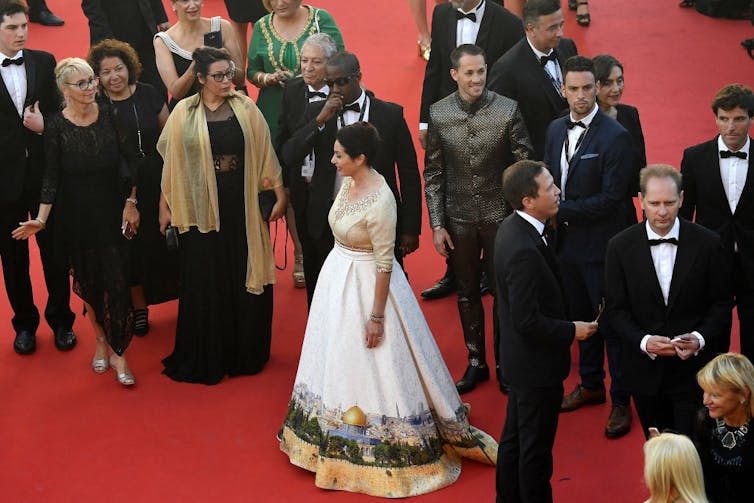
Film festivals and other cultural venues have also become places to make statements about the Israeli-Palestinian conflict and engage in protest. For example, at the Cannes Film Festival in 2017, the right-wing Israeli culture minister wore a controversial – and meme-worthy – dress that featured the Jerusalem skyline in support of Israeli claims of sovereignty over the holy city, despite the unresolved status of Jerusalem under international law.


Israeli Culture Minister Miri Regev wears a dress featuring the old city of Jerusalem during the Cannes Film Festival in 2017.Antonin Thuillier/AFP via Getty Images

At the 2024 Academy Awards, a number of attendees, including Billie Eilish, Mark Ruffalo and Mahershala Ali, wore red pins in support of a ceasefire in Gaza, and pro-Palestine protesters delayed the start of the ceremonies.

As he accepted his award, “No Other Land” director Yuval Abraham called out “the foreign policy” of the U.S. for “helping to block” a path to peace.

Even though a film like “No Other Land” addresses a topic of clear interest to many Americans, I wonder if the quest to find a U.S. distributor just got even harder.

This article has been updated to clarify that the film was a collaborative effort between Palestinian and Israeli filmmakers. It has also been updated to reflect the film’s win at the 2025 Academy Awards.

Drew Paul, Associate Professor of Arabic, University of Tennessee

This article is republished from The Conversation under a Creative Commons license. Read the original article.
I'm Still Here: a vibrant testament to female resilience that mourns Brazil’s dark past


BFA / Alamy
Fernanda Torres as the wife and mother Eunice.
March 04, 2025

Director Walter Salles’s first feature film since 2012, the Oscar-nominated I’m Still Here is a return to home ground, and a return to strength, for the Brazilian auteur. At 68, Salles reconnects with his youth, telling a story in which he does not figure, but takes up the role of witness to the pain of others.

I’m Still Here is adapted from the autobiographical novel Ainda Estou Aqui by Salles’s contemporary, the writer Marcelo Rubens Paiva. The novel recounts Paiva’s father’s disappearance in 1971, under the repressive dictatorship of Emílio Garrastazu Médici, through the memories of the author’s mother, Eunice Paiva.

In Salles’s film, the Paivas lead an enchanted life in a house facing Leblon beach in Rio de Janeiro, until the long arm of the military regime wrecks their dream.

Looking for something good? Cut through the noise with a carefully curated selection of the latest releases, live events and exhibitions, straight to your inbox every fortnight, on Fridays. Sign up here.

Beloved family head, Rubens (Selton Mello), an engineer and congressman secretly collaborating with the underground opposition, is kidnapped by state police under the pretence of a routine interrogation. It then befalls his wife Eunice (Fernanda Torres) to sustain family life and give their children a sense of future while trying to find out what happened to her husband.

It’s the second act of the film, particularly the harrowing yet restrained sequences of Eunice’s days-long detention, that reveal the stakes of the story. Her traumatic experience in jail and increasingly desperate search for her husband afterwards is framed as a transformative journey. It’s one that will culminate 25 years later, when the memory of the disappeared is reinstated in the official archives of the nation’s history.

I’m Still Here adopts a linear style of storytelling and classical three-act structure (stability, disruption, reparation) that serves historical closure, reinforced by the display of the Paiva family’s photographic archive in the closing credits.

This familiar convention takes on a special poignancy in I’m Still Here, where the private archive is a powerful alternative to a discredited “official” media narrative. The reconstruction of everyday life conveys endurance and resistance. This in turn brings to the fore the gendered dynamics of the Paiva household.

Rubens’s underground political activity against the regime means that he leads a double life to which Eunice, for all her loving closeness to her husband, remains ignorant of. This is sorely tested when Rubens disappears. With him the main source of income, it leaves Eunice and the children to cobble together a new existence in São Paulo.

Adopting Eunice’s perspective throughout, the film observes how her relationship with her eldest daughters begins to fracture as they find different ways of coping with traumatic loss and an uncertain future. However, the film stays clear of melodrama, leaving Eunice to internalise the process instead.

In the lead role, the prolific 59-year-old actor Fernanda Torres carries the film as effortlessly in fitted pencil skirts and chic geometric patterns of late 1960s fashion. Her screen chemistry with the slightly younger Selton Mello – they are the perfect couple while happiness lasts – is palpable.

Torres’s controlled, nuanced performance navigates the family’s shift in fortunes with measured calm and steely determination, even as she gradually comes to terms with the fact that she’s on her own.

In this way, the film is a clear-cut tribute to a “feminine” politics of resilience. This matches the preference for a linear biopic over focus on fraught alliances and betrayals that may have determined the course of 1970s political life in Brazil.

Despite its stark subject matter and suffering heroine, the retro pleasures of I’m Still Here form one of the film’s strongest aspects. The measure of the family’s loss is given by a sweeping first act. Despite the all too readable signs of what’s to come (the film opens with Eunice enjoying a solitary swim in crystalline waters, disturbed by the sound of helicopters hovering above), the viewer is invited to live in the joyous present of the Paiva household.

The dynamic camerawork captures the energy of the children, connecting the space of the beach with the open-doors house where Eunice and Rubens act as genial hosts for their friends.

Through references to the vibrant tropicália musical movement the film celebrates and mourns not only the centrality of music to Brazilian cultural life, but the tastes of a cosmopolitan, white liberal middle class (to which Salles also belongs) whose lives and aspirations were cut short by the dictatorship.

Torres’s real-life mother, the decorated Brazilian actress Fernanda Montenegro, plays the older Eunice in the film’s closing scenes. The match is near perfect, as they both command the same intense yet guarded look.

Eunice’s character arc signifies the nation’s rise to consciousness. She goes back to study in her forties, becoming a lawyer working on behalf of the rights of indigenous women and in support of the families of the disappeared.

This personal engagement in justice and reparation is blighted by dementia. In 2014, the nonagenarian Eunice played by Montenegro is a silent, wheelchair-bound Alzheimer sufferer. This epilogue, shot in bleached digital textures vividly contrasts with the vibrant memories captured in the (recreated) Super-8 films shot by the Paivas.

As Brazil pulls itself together after the twin catastrophes of COVID and Bolsonarism, I’m Still Here’s cautionary tale for the present may be curtailed by the fact that its emotional core is placed so firmly in mourning its past, depicted as a idyllic moment of happiness and optimism before Brazil was robbed of its future.

Belén Vidal, Reader in Film Studies, King's College London

This article is republished from The Conversation under a Creative Commons license. Read the original article.
We crushed fascists before — and it's time to do it again


Benito Mussolini in 1942 (Creative Commons)

March 05, 2025
ALTERNET

Last night, we were treated to a litany of grievance, political bulls---, and lies. Of particular note was Trump’s declaration of war against the government of the United States, particularly Social Security, which I’ll discuss at more length tomorrow.

But the larger issue, given the GOP’s adoption of neofascism, is how far Trump and his Republican enablers have dragged America from the form of government on which America was founded.

On my radio program last Wednesday, Senator Bernie Sanders said that the older he gets the more he “appreciates the genius of the Founders,” who wrote into the Constitution the separation of powers that have held our country together for almost 250 years and guaranteed that no king has ever emerged in our America.

Until now.

Republicans are going out of their way to overlook Federalist 47, published by James Madison on February 1, 1788. Titled, ”The Particular Structure of the New Government and the Distribution of Power Among Its Different Parts,” Madison wrote about how important it was that the different branches of government serve as checks and balances on each other:
“No political truth is of greater intrinsic value, or is stamped with the authority of more enlightened patrons of liberty,” wrote Madison of his concern that any one particular group might dominate all three branches of government.
He added, “The accumulation of all powers, legislative, executive, and judiciary, in the same hands, whether of one, a few, or many, and whether hereditary, self-appointed, or elective, may justly be pronounced the very definition of tyranny.”

A paragraph later, Madison quotes the Enlightenment thinker Montesquieu, inserting his own capital letters for emphasis:

“‘When the legislative and executive powers are united in the same person or body,’ says he [Montesquieu], ‘there can be no liberty, because apprehensions may arise lest THE SAME monarch or senate should ENACT tyrannical laws to EXECUTE them in a tyrannical manner.’”

In Federalist 48, Madison quotes from Thomas Jefferson’s “Notes on the State of Virginia”:
“All the powers of government, legislative, executive, and judiciary, result to the legislative body,” wrote Jefferson in this commentary quoted by his protégé, Madison, in Federalist 48. “The concentrating of these in the same hands, is precisely the definition of despotic government.

“It will be no alleviation, that these powers will be exercised by a plurality of hands, and not by a single one. One hundred and seventy-three despots would surely be as oppressive as one.”

Jefferson added in his Notes:
“An ELECTIVE DESPOTISM was not the government we fought for; but one ... in which the powers of government should be so divided and balanced among several bodies of magistracy, as that no one could transcend their legal limits, without being effectually checked and restrained by the others.
“For this reason, that Convention which passed the ordinance of government [the Constitution], laid its foundation on this basis, that the legislative, executive, and judiciary departments should be separate and distinct, so that no person should exercise the powers of more than one of them at the same time.’’


Which makes perfect sense, unless, of course, you are a Republican sponsored by the richest men in the world whose thirst for wealth and power seems to have no limits.

We’ve danced around the edge of this before, although the last time we actually defeated the American fascists.


In early 1944, the New York Times asked FDR’s Vice President Henry Wallace to, as Wallace noted, “[W]rite a piece answering the following questions: What is a fascist? How many fascists have we? How dangerous are they?”

Vice President Wallace’s answer to those questions — perhaps prescient of a rightwing billionaire buying and twisting fascistic the world’s largest social media site — was published in The New York Times on April 9, 1944, at the height of the war against the Axis powers of Germany and Japan.
“The really dangerous American fascists,” Wallace wrote, “are not those who are hooked up directly or indirectly with the Axis. The FBI has its finger on those. …
“The American fascist would prefer not to use violence. His method is to poison the channels of public information. With a fascist the problem is never how best to present the truth to the public but how best to use the news to deceive the public into giving the fascist and his group more money or more power.”


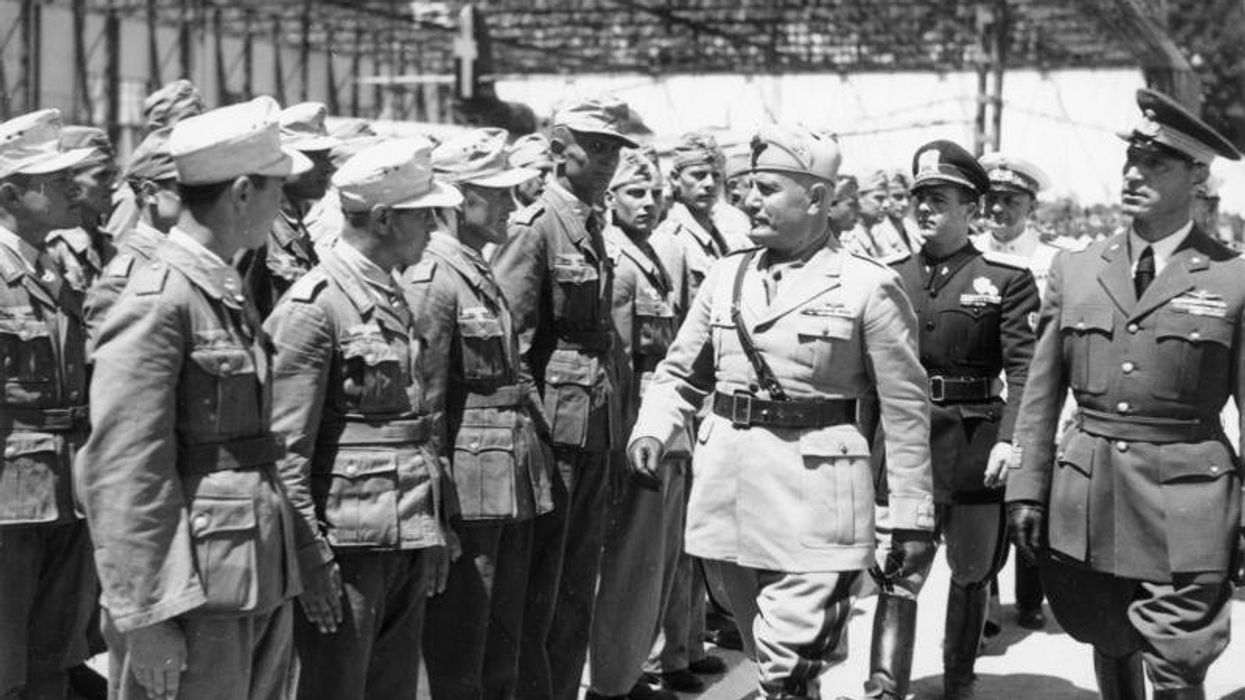
In this, Wallace was using the classic definition of the word “fascist” — the definition Mussolini had in mind when he claimed to have invented the word. (It was actually Italian philosopher Giovanni Gentile who wrote the entry in the Encyclopedia Italiana that said: “Fascism should more appropriately be called corporatism because it is a merger of state and corporate power.” Mussolini, however, affixed his name to the entry, and claimed credit for it.)


As the 1983 American Heritage Dictionary noted, fascism is:
“A system of government that exercises a dictatorship of the extreme right, typically through the merging of state and business leadership, together with belligerent nationalism.”


Mussolini was quite straightforward about all this. In a 1923 pamphlet titled “The Doctrine of Fascism” he wrote, “If classical liberalism spells individualism, Fascism spells government.” But not the government of, by, and for We The People America’s Founders envisioned: instead, it would be a government of, by, and for the richest and most powerful men in the nation and the corporations they own.

In 1938, Mussolini brought his vision of fascism into full reality when he dissolved Parliament and replaced it with the “Camera dei Fasci e delle Corporazioni” — the Chamber of the Fascist Corporations. Corporations were still privately owned, but now instead of having to sneak their money to folks like Donald Trump and covertly write legislation, they were openly in charge of the government.


Vice President Wallace bluntly laid out in his 1944 Times article his concern about the same happening here in America:
“If we define an American fascist as one who in case of conflict puts money and power ahead of human beings, then there are undoubtedly several million fascists in the United States. There are probably several hundred thousand if we narrow the definition to include only those who in their search for money and power are ruthless and deceitful. ... They are patriotic in time of war because it is to their interest to be so, but in time of peace they follow power and the dollar wherever they may lead.”


Nonetheless, at that time there were few corporate heads who had run for political office, and, in Wallace’s view, most politicians still felt it was their obligation to represent We The People instead of corporate cartels and billionaires.
“American fascism will not be really dangerous,” he added in the next paragraph, “until there is a purposeful coalition among the cartelists, the deliberate poisoners of public information...”


Noting that, “Fascism is a worldwide disease,” Wallace further suggest that fascism’s “greatest threat to the United States will come after the war” and will manifest “within the United States itself.”

In Sinclair Lewis’s 1935 novel “It Can’t Happen Here,” a conservative southern politician is helped to the presidency by a nationally syndicated radio talkshow host. The politician — Buzz Windrip — runs his campaign on “family values,” the flag, and “patriotism.” Windrip and the talkshow host portray advocates of traditional American democracy as anti-American.

When Windrip becomes President, he opens a Guantanamo-style detention center, and the viewpoint character of the book, Vermont newspaper editor Doremus Jessup, flees to Canada to avoid prosecution under new “patriotic” laws that make it illegal to criticize the President.

As Lewis noted in his novel:
“[T]he President, with something of his former good-humor [said]: ‘There are two [political] parties, the Corporate and those who don’t belong to any party at all, and so, to use a common phrase, are just out of luck!’ The idea of the Corporate or Corporative State, Secretary [of State] Sarason had more or less taken from Italy.” And, President “Windrip’s partisans called themselves the Corporatists, or, familiarly, the ‘Corpos,’ which nickname was generally used.”


Lewis, the first American writer to win a Nobel Prize, was world famous by 1944, as was his book “It Can’t Happen Here.” And several well-known and powerful Americans, including Prescott Bush, had lost businesses in the early 1940s because of charges by Roosevelt that they were doing business with Hitler.

These events all, no doubt, colored Vice President Wallace’s thinking when he wrote:
“Still another danger is represented by those who, paying lip service to democracy and the common welfare, in their insatiable greed for money and the power which money gives, do not hesitate surreptitiously to evade the laws designed to safeguard the public from monopolistic extortion.
“American fascists of this stamp were clandestinely aligned with their German counterparts before the war, and are even now preparing to resume where they left off, after ‘the present unpleasantness’ ceases.”


Fascists have an agenda that is primarily economic, but to achieve complete domination of an economy they must first seize complete political control of the nation. Fascism/corporatism is really an attempt to create a modern version of feudalism by merging billionaire and corporate interests with those of the state.

And feudalism, of course, is one of the most stable of the three historic tyrannies (kingdoms, theocracies, feudalism) that ruled nations prior to the rise of American republican democracy; it can be roughly defined as “rule by the rich.”

Thus, the neo-feudal/fascistic rich get richer (and more powerful) on the backs of the poor and the middle class, an irony not lost on author Thomas Frank, who noted in his book What’s The Matter With Kansas that, “You can see the paradox first-hand on nearly any Main Street in middle America — ‘going out of business’ signs side by side with placards supporting George W. Bush.”

The businesses “going out of business” are, in fascist administrations, usually those of locally-owned small and medium-sized companies. As Wallace wrote, some in big business “are willing to jeopardize the structure of American liberty to gain some temporary advantage.” He added:
“Monopolists who fear competition and who distrust democracy because it stands for equal opportunity would like to secure their position against small and energetic enterprise [companies]. In an effort to eliminate the possibility of any rival growing up, some monopolists would sacrifice democracy itself.”


But American fascists who would want CEOs like Trump and Vance as President and Vice President don’t generally talk to We The People about their real agenda, or the harm it does to small businesses and working people. Instead, as Hitler did with the trade union leaders and Jews, they point to a “them” to pin with blame and distract people from the harms of their economic policies.

In a comment prescient of Donald Trump’s recent suggestion that brown-skinned immigrants are “poisoning the blood of America” or Vance’s lie about Haitian immigrants eating cats and dogs, Wallace continued:
“The symptoms of fascist thinking are colored by environment and adapted to immediate circumstances. But always and everywhere they can be identified by their appeal to prejudice and by the desire to play upon the fears and vanities of different groups in order to gain power.
“It is no coincidence that the growth of modern tyrants has in every case been heralded by the growth of prejudice. It may be shocking to some people in this country to realize that, without meaning to do so, they hold views in common with Hitler when they preach discrimination...”


But even at this, Wallace noted, American fascists would have to lie to the people in order to gain power. And, because they were in bed with the nation’s largest corporations — who could gain control of newspapers and broadcast media — they could promote their lies with ease.
“The American fascists are most easily recognized by their deliberate perversion of truth and fact,” Wallace wrote. “Their newspapers and propaganda carefully cultivate every fissure of disunity, every crack in the common front against fascism. They use every opportunity to impugn democracy.”


In his strongest indictment of the tide of fascism the Vice President of the United States saw rising in America, he added:
“They claim to be super-patriots, but they would destroy every liberty guaranteed by the Constitution. They demand free enterprise, but are the spokesmen for monopoly and vested interest.
“Their final objective toward which all their deceit is directed is to capture political power so that, using the power of the state and the power of the market simultaneously, they may keep the common man in eternal subjection.”


Finally, Wallace said, speaking as if directly to Musk’s claim that he’s merely increasing the “efficiency” of the federal government by gutting it:
“The myth of fascist efficiency has deluded many people. ... Democracy, to crush fascism internally, must...develop the ability to keep people fully employed and at the same time balance the budget. It must put human beings first and dollars second. It must appeal to reason and decency and not to violence and deceit.
“We must not tolerate oppressive government or industrial oligarchy in the form of monopolies and cartels.”


This liberal vision of an egalitarian America in which very large businesses and media monopolies are broken up under the 1890 Sherman Anti-Trust Act (which Reagan stopped enforcing, leading to the mergers & acquisitions frenzy that continues to this day) was the driving vision of the New Deal (and of “Trust Buster” Teddy Roosevelt a generation earlier).

As Wallace’s President, Franklin D. Roosevelt, said when he accepted his party’s renomination in 1936 in Philadelphia:
“[O]ut of this modern civilization, economic royalists carved new dynasties.... It was natural and perhaps human that the privileged princes of these new economic dynasties, thirsting for power, reached out for control over government itself. They created a new despotism and wrapped it in the robes of legal sanction.... And as a result the average man once more confronts the problem that faced the Minute Man....”


Speaking indirectly of the fascists that Wallace would directly name almost a decade later, Roosevelt brought the issue to its core:
“These economic royalists complain that we seek to overthrow the institutions of America. What they really complain of is that we seek to take away their power.”


But, he thundered in that speech:
“Our allegiance to American institutions requires the overthrow of this kind of power!”


Today, we again stand at the crossroad Roosevelt and Wallace confronted during the Great Depression and World War II. Fascism is again rising in America, this time calling itself “MAGA.” The Trump administration’s behavior today eerily parallels the warning of 1936 when Roosevelt said:
“In vain they seek to hide behind the flag and the Constitution. In their blindness they forget what the flag and the Constitution stand for.”


President Roosevelt and Vice President Wallace’s warnings have come full circle. Which is why it’s so critical that we all stand up and speak out to stop this most recent incarnation of feudal fascism from seizing complete control of our nation.


New research shows how the Vesuvius eruption turned a man’s brain to glass


Guido Giordano et al. / Scientific Reports
A fragment of vitrified brain found at Herculaneum.
March 04, 2025

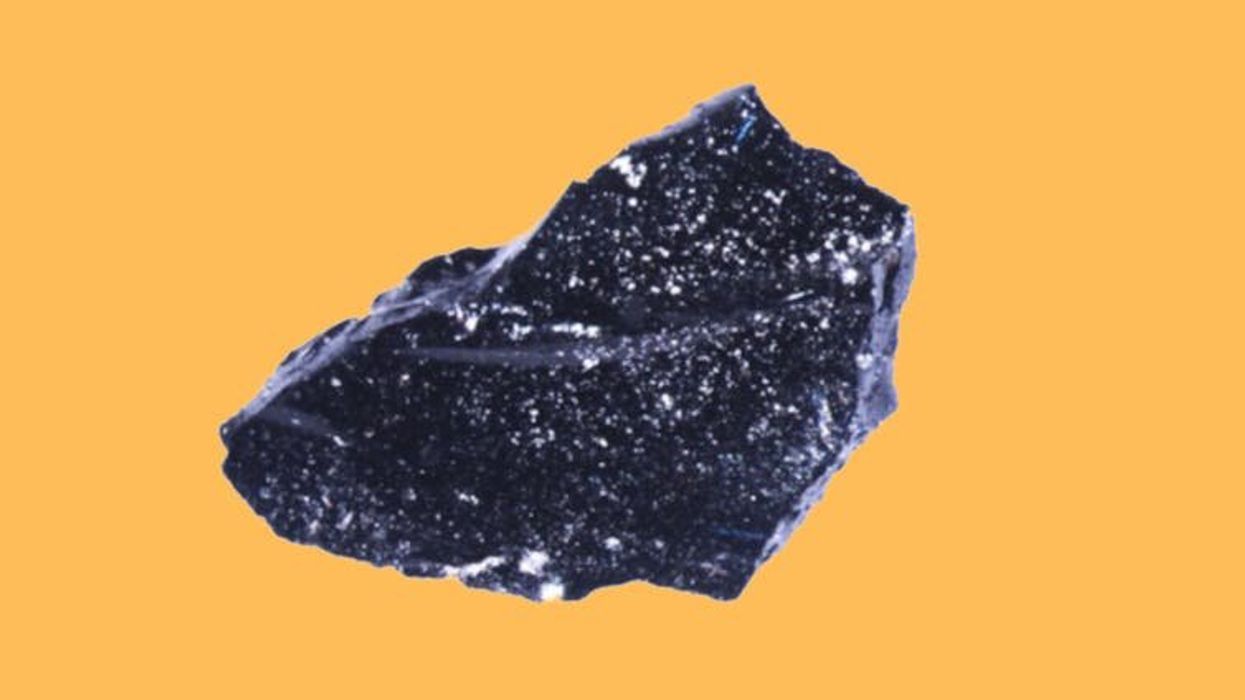
A young man killed in the eruption of Mount Vesuvius in 79 CE was likely overcome by a fast-moving cloud of gas at a temperature of more than 500°C in a process that transformed fragments of his brain into glass, according to new research.

The man’s remains were discovered in 1961, and in 2020 researchers confirmed that parts of his brain had been turned into glass. This is the only example of vitrified brain matter found to date at any archaeological site.

The new study, led by Guido Giordano of Roma Tre University and published in Scientific Reports, explains how the unusual sequence of rapid heating and cooling required to turn organic matter into glass may have occurred.
Pompeii’s less famous neighbour

The city of Pompeii is one of the most famous archaeological sites in Italy and the world. Fewer people know about its smaller neighbour, Herculaneum, which was also destroyed by the devastating eruption of Mount Vesuvius in 79 CE.

Herculaneum was settled during the sixth century BCE by Greek traders who named it after the Greek hero Herakles (whom the Romans called Hercules). By the first century CE, it had developed into a typical Roman town.
The excavated ruins of Herculaneum today. Mount Vesuvius can be seen in the background. WitR / Shutterstock

Built on a grid plan, Herculaneum boasted a forum, theatre, elaborate bath complexes, multi-storey buildings and luxurious private seafront villas with spectacular views over the Bay of Naples.

The town’s population is estimated to have been around 5,000 people at the time of the eruption. They consisted of wealthy Roman citizens, merchants, artisans, and current and freed slaves. About 7 kilometres to the east, Mount Vesuvius loomed.


A tale of two destructions


Although Pompeii and Herculaneum were both destroyed, their experiences of the eruption were different.

Located about 8km southeast of Vesuvius, Pompeii was violently pelted by falling pumice and ash for about 12 hours before its final destruction by what are called “pyroclastic surges”: fast-moving, turbulent clouds filled with hot gases, ash and steam. Pompeii’s end arrived some 18–20 hours after the eruption began.

Herculaneum’s destruction came much sooner. During the first hours it experienced light ash and pumice fall. Most of the population is believed to have left during this time.

Then, about 12 hours after the eruption began, in the early hours of the morning, Herculaneum was engulfed by a swift-moving, deadly pyroclastic surge. The deadly cloud of gas, ash and rock swept over the town at speeds greater than 150km per hour. Anyone who had not already escaped died rapidly and violently as the town was buried.


A rain of ash, a sudden heat     


Casts of the bodies of victims found at Pompeii.   
Lancevortex / Wikimedia, CC BY-SA


Because of the differences in how the eruption hit the two towns, those who died in each were preserved in different ways.

At Pompeii, victims were buried under ash that hardened around their bodies. This allowed archaeologist Giuseppe Fiorelli to develop a technique in the 1860s for creating the now-famous plaster casts that dramatically preserved the victims’ final positions at the moment of death.

At Herculaneum, extreme heat (400–500°C) from pyroclastic surges caused instant death. As a result, we see skeletal remains with signs of thermal shock: skulls fractured from boiling brain tissue and rapidly carbonised flesh.

Victims found in boat houses and along the shore at Herculaneum in the 1980s appear to have died quickly while waiting to escape by sea.
‘The custodian’

In 1961, Italian archaeologist Amedeo Maiuri discovered a skeleton in a small room of the College of the Augustales, a public building dedicated to worship of the emperor. The victim was lying face-down on the charred remains of a wooden bed.

Maiuri identified the person as male and about 20 years old, and dubbed him “the custodian” of the Augustales. What was unusual about this skeleton was the appearance of glassy, black material scattered within the cranial cavity, something archaeologists had not seen before at either Herculaneum or Pompeii.


The carbonised remains of ‘the custodian’ found at Herculaneum.
Guido Giordano et al. / Scientific Reports

In 2020, a scientific team led by anthropologist PierPaolo Petrone and volcanologist Guido Giordano conducted the first study of the glassy material using a scanning electron microscope and a neural network image-processing tool. They identified traces of the victim’s brain cells, axons and myelin in the well-preserved sample.

Petrone and Giordano concluded that the conversion of the man’s brain tissue into glass was the result of its sudden exposure to scorching volcanic ash followed by a rapid drop in temperature.

Brain of glass

The follow-up study, released today in Scientific Reports, provides a more detailed analysis of the vitrification process. The scientists estimate the temperature at which the brain transformed into glass had to be above 510°C, followed by rapid cooling.

The researchers propose the following scenario to describe the victim’s death and explain how his brain was vitrified.

The victim died when he was engulfed by the fast-moving, extremely hot ash cloud of the pyroclastic surge. His brain rapidly heated to a temperature exceeding 510°C. The thick bones of the skull may have protected the brain tissue from turning to gas and vaporising.
Fragments of the man’s brain were turned into glass by a very particular process of rapid heating and cooling.
Guido Giordano et al. / Scientific Reports


Within minutes, the ash cloud dissipated and the temperature quickly dropped to around 510°C, a temperature suitable for vitrification. The researchers also believe the fact the brain was broken into small pieces allowed it to cool quickly and therefore vitrify.

In the final phase of the eruption, Herculaneum was buried by thick, lower-temperature deposits that preserved what remained of the man’s body in cement-like material. The vitrification resulted in the preservation of complex neural structures such as neurons and axons.

This research makes a significant contribution to scientific knowledge. After centuries of archaeological research, this is still the only known example of human brain matter preserved by vitrification.

Louise Zarmati, Senior Lecturer in Humanities and Social Sciences Education, Faculty of Education, University of Tasmania

This article is republished from The Conversation under a Creative Commons license. Read the original article.
The actual 'biggest Ponzi scheme of all time'


REUTERS/Craig Hudson
U.S. President Donald Trump and U.S. First Lady Melania Trump arrive for the National Governors Association (NGA) dinner and reception in the East Room at the White House in Washington, D.C., U.S., February 22, 2025.

March 06, 2025
ALTERNET

I remain optimistic about the longer term, but I still awaken each morning with a sense of dread. I’m sure some of you do, too.

Start with Elon Musk’s bonkers comment that Social Security is “the biggest Ponzi scheme of all time.”

In a Ponzi scheme, a con artist lures investors into a fake investment project, pockets the cash, and then gets new “investors” to funnel their cash to the earlier investors — until there are no new recruits and the whole thing collapses. The last ones in are suckers left holding worthless bags.

Social Security is not a Ponzi scheme. It’s a high-functioning, universal, and exceptionally efficient part of the American social safety net — the opposite of a Ponzi scheme. Which is why the overwhelming majority of Americans oppose cutting it.

Social Security is a simple “pay as you go” program. Current workers, via the payroll tax, fund payouts for retirees and disabled people. In 2024, about 1 in 5 U.S. residents received Social Security.

I used to be a trustee of the Social Security trust fund. I know what I’m talking about.

As the Social Security Administration explains, “In 2025, when you work, about 85 cents of every Social Security tax dollar you pay goes to a trust fund. This fund pays monthly benefits to current retirees and their families and to surviving spouses and children of workers who have died. About 15 cents goes to a trust fund that pays benefits to people with disabilities and their families.”

The only reason that the Social Security trust fund is slowly running out of money is the trustees never anticipated that so much of the nation’s total income would be in the hands of so few people (such as Elon Musk).

The simple way to fix this is to lift the cap on income subject to Social Security payroll taxes, which is now $176,100.

Elon Musk, Jeff Bezos, and Mark Zuckerberg fulfilled their 2025 Social Security payroll tax obligations a few minutes past midnight on January 1. Most Americans continue paying payroll taxes all year.

If you want to see a real Ponzi scheme, look no further than the crypto investments Musk and Trump have hyped.

Trump’s new cryptocurrency, “$Trump,” soared and then crashed, just like every other Ponzi scheme. It generated enormous profits for insiders like Trump, but a cumulative $2 billion in losses for more than 800,000 other investors.

Trump claims ignorance. “I don’t know if it benefited” me, he said. “I don’t know much about it.” (The Trump family and its business partners earned nearly $100 million in trading fees alone on the coin.)

Musk has been promoting “dogecoin” since 2019. In the days following Trump’s announcement of the launch of Musk’s so-called Department of Government Efficiency (DOGE), the value of dogecoin soared over 70 percent. Since then, it’s dropped like a rock. Another classic Ponzi scheme.

With Trump now in office, crypto is back to its Ponzi ways. It’s emerging from a four-year federal crackdown on crypto fraud, market manipulation, and other scams following the collapse of Sam Bankman-Fried’s crypto exchange FTX in 2022 — one of the biggest Ponzi schemes in recent memory.


Tomorrow, Trump is even holding a “crypto summit” at which he’ll promote the idea of a federal crypto reserve that will give crypto schemes a temporary boost by increasing demand for them.

But why should American taxpayers foot the bill for a crypto reserve? The most obvious winner will be Trump, whose own crypto venture carries millions of dollars in tokens that are to be included in the reserve.

Other winners will be crypto executives, many of whom donated extensively to Trump’s reelection effort. One example: Ripple, whose XRP token is one of the five that Trump said would be included in the reserve — and which donated $45 million to an industrywide PAC that sought to help elect Trump and other Republicans.

Trump’s crypto efforts are ways to curry his favor by paying him off.


Consider Justin Sun, a Chinese cryptocurrency entrepreneur whom the Securities and Exchange Commission charged with securities fraud in March 2023.

After Trump was elected in 2024, Sun bought $30 million worth of Trump’s World Liberty Financial crypto tokens, putting $18 million directly into Trump’s pockets. Since then, Sun has invested another $45 million in WLF. Altogether, Sun’s investments have netted Trump more than $50 million.

Trump’s Securities and Exchange Commission just dropped its prosecution of Sun.

The SEC also dropped its case against the crypto trading platform Coinbase after the platform donated $75 million to a political action committee associated with Trump and $1 million to Trump’s inauguration.


To top it off, the SEC just ruled that “memecoins” aren’t securities, meaning that Trump’s novelty crypto tokens won’t be subject to any regulatory oversight. An open invitation to more Trump Ponzi schemes.

My real dread has to do with the much bigger Ponzi scheme that Trump and Musk are peddling.

They’re promising huge “savings” from destroying the federal government — including programs like Social Security and Medicaid — savings that will go to America’s wealthy and big corporations in the form of tax cuts.

At Musk’s urging, the Social Security Administration recently announced it will consolidate the current 10 regional offices it maintains into four and cut at least 7,000 jobs from an agency already at a 50-year staffing low.

The Republican budget recently pushed through the House cuts over $880 billion out of Medicaid.

Who will get left holding the bag? Most Americans.

Zoom out and you’ll see the biggest Ponzi scheme of them all — the entire Trump 2 regime.

Trump is promising to “make America great again” by raising tariffs, deporting more than 11 million people, taking a wrecking ball to the federal government, pulverizing democracy, and joining Putin and other global dictators.

Trump is the con artist behind this giant Ponzi scheme. He lured voters into this fake MAGA project, pocketed some of the cash and rewarded his billionaire backers and friends (including Musk) with more, and will leave most Americans with a corrupt and decimated society.

I’m still optimistic about our power to overcome this and our resilience in bouncing back from it. But the dread I feel when I open my eyes in the morning concerns the sheer magnitude of the largest and most cynical Ponzi scheme in history.

Robert Reich is a professor of public policy at Berkeley and former secretary of labor. His writings can be found at https://robertreich.substack.com/
It's official: The 'American Century' is over


REUTERS/Kevin Lamarque/File Photo
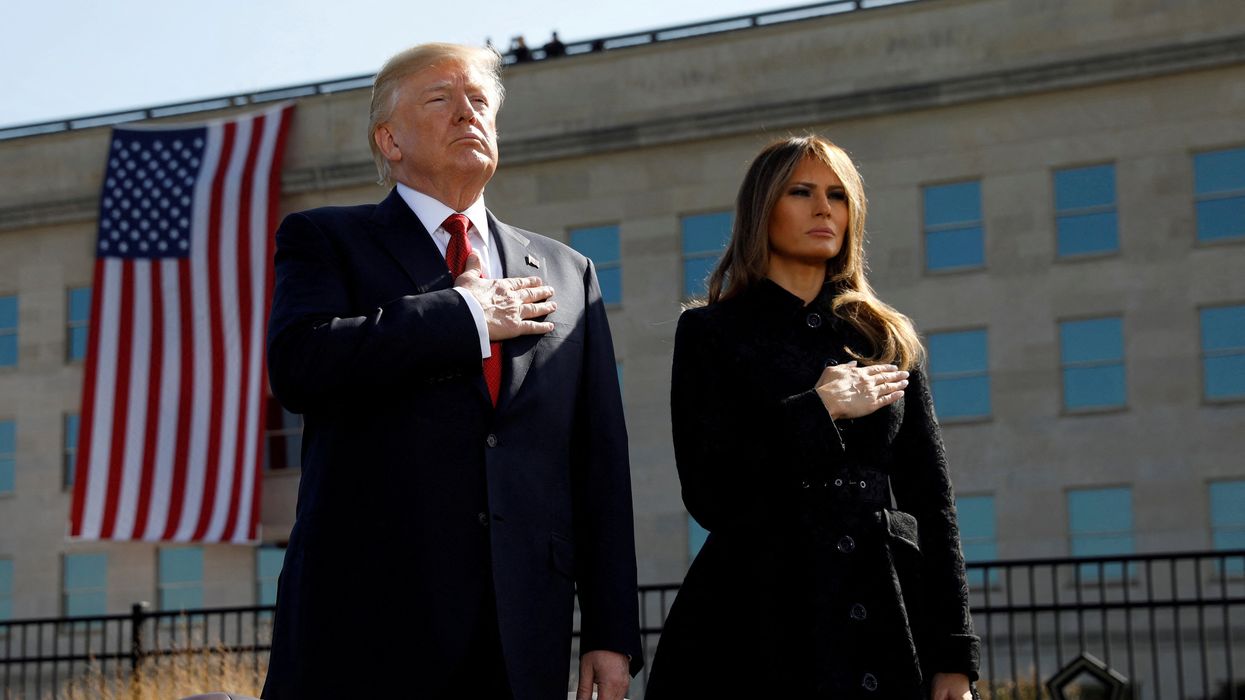
U.S. President Donald Trump and First Lady Melania Trump attend the 9/11 observance at the National 9/11 Pentagon Memorial in Arlington, Virginia, U.S., September 11, 2017.
March 07, 2025

In the weeks leading up to the recent presidential inauguration in Washington, this country and an anxious world expected many different things from what might be called, to borrow the title of a famed William Butler Yeats poem, "The Second Coming" of Donald J. Trump.

But nobody expected this. Nobody at all.

“We will restore the name of a great president, William McKinley, to Mount McKinley where it should be and where it belongs,” President Trump announced to a burst of applause during his inaugural address on Jan. 20. Continuing his celebration of a decidedly mediocre president, best known for taking this country on an ill-advised turn towards colonial conquest, Trump added: “President McKinley made our country very rich through tariffs and through talent — he was a natural businessman — and gave Teddy Roosevelt the money for many of the great things he did including the Panama Canal which has foolishly been given to the country of Panama after the United States… spent more money than ever spent on a project before and lost 38,000 lives in the building of the Panama Canal.”

Moving on from such fractured facts and scrambled history, Trump suggested the foreign policy principles that would guide his new administration, or to quote that poem, the "rough beast" as it "slouches towards" Mount McKinley "to be born."

Then, to another round of applause, he added ominously: "We have been treated very badly from this foolish gift that should have never been made, and Panama's promise to us has been broken. The purpose of our deal and the spirit of our treaty has been totally violated. American ships are being severely overcharged and not treated fairly in any way, shape, or form… And above all, China is operating the Panama Canal. And we didn’t give it to China. We gave it to Panama, and we’re taking it back."

In a quick segue, the president then promised to act with a “courage, vigor and vitality” that would lead the nation “to new heights of victory and success,” presumedly via a McKinley-esque policy of tariffs, territorial conquest and great-power diplomacy.

Remembering William McKinley

Since President William McKinley’s once-upon-a-time mediocrity was exceeded only by his present-day obscurity, few observers grasped the real significance of Trump’s remarks. To correct such a critical oversight, it’s important to ask two significant questions: Who was William McKinley and how might his legacy influence current American foreign policy? In fact, Trump and his key advisers are planning to use McKinley’s Gilded Age imperialism as their guide, even their inspiration, for overturning the liberal internationalism that has marked American foreign policy for the past 80 years.

After an otherwise undistinguished career in Congress crowned by the passage of the McKinley Tariff of 1890 with record-high import duties, he won the presidency in 1896 thanks to the influence of Mark Hanna, a wealthy industrialist — the 19th-century equivalent of a present-day tech billionaire — who tithed his fellow millionaires to create a war chest that would fund the country’s costliest political campaign up to that time. In doing so, Hanna ushered in the modern era of professional electioneering. That campaign also carried American political satire to new heights as, typically, a withering political cartoon caricatured a monstrously bloated Hanna, reclining on money bags given by millionaires like banker J.P. Morgan, declaring, “I am confident. The Working Men Are with Us.” (Sound familiar?)

As president from 1897 to 1901, McKinley enacted record-high tariffs and used the brief Spanish-American War of 1898 to seize a colonial empire of islands stretching halfway around the world from Puerto Rico to the Philippines. Instead of crowning the country with an imperial glory akin to Great Britain’s, those conquests actually plunged it into the bloody Philippine-American War, replete with torture and massacres.

Trump and his key advisers are planning to use McKinley’s Gilded Age imperialism as their guide, even their inspiration, for overturning the liberal internationalism that has marked American foreign policy for the past 80 years.

Rather than curtail his ill-fated colonial venture and free the Philippines, McKinley claimed he had gone “down on my knees and prayed to Almighty God for light and guidance.” As it happened, his God evidently told him to conquer and colonize, something that he arranged in great-power bilateral talks with Spain that determined the fate of millions of Cubans and Filipinos, even though they had been fighting Spanish colonial rule for years to win their freedom.

At the price of several hundred thousand dead Filipinos, those conquests did indeed elevate the United States into the ranks of the great powers whose might made right — a status made manifest (as in destiny) when McKinley’s vice president and successor Theodore Roosevelt pushed rival European empires out of South America, wrested the Panama Canal Zone from Colombia, and won the Nobel Peace Prize for brokering an end to the Russo-Japanese War.

With surprising speed, however, this country’s leaders came to spurn McKinley’s embrace of a colonial empire with its costly, complicated occupation of overseas territories. Just a year after he seized the Philippine islands, his secretary of state called for an “open door” in China (where the U.S. had no territorial claims) that would, for the next 50 years, allow all powers equal access to that country’s consumer markets.

After 1909, Secretary of State Philander Knox, one of the founders of the United States Steel Corporation, pursued a program of "dollar diplomacy" that promoted American power through overseas investments rather than territorial conquests. According to historian William Appleman Williams, an imperial version of commerce and capital “became the central feature of American foreign policy in the 20th century,” as the country’s economic power “seeped, then trickled, and finally flooded into the more developed nations and their colonies until, by 1939, America’s economic expansion encompassed the globe.”

Emerging from World War II, a conflict against the Axis powers — Germany, Italy and Japan — that had seized empires in Europe, Africa and Asia by military conquest, Washington built a new world order that would be defined in the U.N. Charter of 1945, guaranteeing all nations the right to independence and inviolable sovereignty. As Europe’s colonial empires collapsed amid rebellions and revolutions, Washington ascended to unprecedented global power marked by three key attributes —alliances like NATO that treated allies as peer powers, free trade without tariff barriers and ironclad assurance of inviolable sovereignty. This unique form of global power and influence (which involved the seizure of no more territory) would remain the guiding genius of American imperial global hegemony. At least that remained true until this January.

The past as prologue

Although none of us were quick to grasp the full implications of that inaugural invocation of McKinley’s ghost, Donald Trump was indeed signaling just what he planned to do as president. Leaving aside the painfully obvious parallels (like Elon Musk as a latter-day Mark Hanna), Trump’s foreign policy has already proved a surprising throwback to a McKinley-esque version of great-power politics marked by the urge to take territories, impose tariffs and conclude diplomatic deals.

Let’s start with the territorial dimension of Trump’s ongoing transformation of U.S. foreign policy. Just as McKinley moved to seize an empire of scattered islands instead of whole countries like the Congo or China, so Donald Trump has cast his realtor’s eye on an unlikely portfolio of foreign properties. Take the Panama Canal. In his first trip as secretary of state, Marco Rubio swept into Panama City where he warned its president to reduce Chinese influence over the canal or face “potential retaliation from the United States.” In Washington, Trump backed his emissary’s threats, saying: “China is running the Panama Canal… and we’re going to take it back, or something very powerful is going to happen.” Panama’s president, José Raúl Mulino, promptly pushed back, stating that Washington’s claim about China was “quite simply [an] intolerable falsehood,” but also quickly tried to placate Trump by withdrawing from Beijing’s global Belt and Road Initiative. The reaction among our Latin American neighbors to this modern edition of gunboat diplomacy was, to say the least, decidedly negative.

Next on Washington’s neocolonial shopping list was Greenland. On his sixth day in office, Trump told the press aboard Air Force One: “I think Greenland will be worked out with us. I think we’re going to have it. And I think the people want to be with us.” Invoking that thawing island’s mineral wealth, he added: “I don’t know really what claim Denmark has to it. But it would be a very unfriendly act if they didn’t allow that to happen because it’s for protection of the free world. It’s not for us, it’s for the free world.” In a whirlwind diplomatic offensive around the capitals of Europe to counter Trump’s claims, Danish prime minister Mette Frederiksen won strong support from the Nordic nations, France and Germany, whose then-leader, Olaf Scholz, insisted that “borders must not be moved by force.”

After roiling relations with America’s closest allies in Europe and Latin America, Trump topped that off with his spur-of-the-moment neocolonial claim to the Gaza strip during a Feb. 4 news conference with Israeli Prime Minister Benjamin Netanyahu. “The U.S. will take over the Gaza Strip, and we will do a job with it, too,” Trump announced to Netanyahu’s slack-jawed amazement. “We’ll own it and be responsible for dismantling all of the dangerous, unexploded bombs and other weapons on the site, level the site and get rid of the destroyed buildings. Level it out.” After relocating two million Palestinian residents to “one, two, three, four, five, seven, eight, 12” sites in places like Jordan or Egypt, the U.S. would, Trump added, “take over that piece and we’re going to develop it, create thousands and thousands of jobs, and it’ll be something that the entire Middle East can be very proud of.” Warming to his extemporaneous version of imperial diplomacy, Trump praised his own idea for potentially creating a “Riviera of the Middle East” in Gaza, which would become “one of the greatest and most spectacular developments of its kind on Earth.”

Just as McKinley moved to seize an empire of scattered islands instead of whole countries like the Congo or China, so Trump has cast his realtor's eye on an unlikely portfolio of foreign properties.

The international backlash to his urge for a latter-day colonial land grab came hard and fast. Apart from near-universal condemnation from Asia and Europe, Washington’s key Middle Eastern allies — Saudi Arabia, the United Arab Emirates, Egypt and Jordan — all expressed, as the Saudi Foreign Ministry put it, a “firm rejection of any infringement on the legitimate rights of the Palestinian people.” When Jordan’s King Abdullah visited the White House a week later, Trump pressed hard for his Gaza plan but the king refused to take part and, in a formal statement, “reiterated Jordan’s steadfast position against the displacement of Palestinians in Gaza and the West Bank.”

Setting aside Trump’s often jocular calls for Canada to become America’s “51st state,” none of his neocolonial claims, even if successfully accomplished, would make the slightest difference to this country’s security or prosperity. Think about it. America already dominates the Panama Canal’s shipping traffic (with 73% of the total) and a restoration of sovereignty over the Canal Zone would change nothing. Similarly, Washington has long had the only major military base in Greenland and its continued presence there is guaranteed by the NATO alliance, which includes Denmark. As for Gaza, it would be the money sink from hell.

Yet there is some method to the seeming madness of the president’s erratic musings. As part of his reversion to the great-power politics of the Victorian age, all of his territorial claims are sending a chilling message: America’s role as arbiter and defender of what was once known as a “rules-based international order,” enshrined in the U.N. Charter, is over. Henceforth, all-American nationalism will Trump — yes, that’s the word! — any pretense to internationalism.

Meet Tariff Man


The second key facet of Trump’s attack on the liberal international order, tariffs, is already proving so much more complicated and contradictory than he might ever have imagined. After World War II, a key feature of the liberal international order created through the U.N. Charter was a global trade regime designed to prevent a recurrence of the disastrous protective tariffs (and “tariff wars” that went with them) which deepened the devastating Great Depression of the 1930s. While the World Trade Organization sets the rules for the enormous volume of international commerce, localized treaties like the European Union and NAFTA have produced both economic efficiency and prosperity for their respective regions. And while Trump hasn’t yet withdrawn from the WTO, as he has from the World Health Organization and the Paris climate accords, don’t count on it not happening.

On the campaign trail last year, candidate Trump advocated an “all tariff policy” that would impose duties on imports so high they could even, he claimed, replace the income tax in funding the government. During his first two weeks in office, Trump promptly imposed a 25% duty on all imports from Canada and Mexico. Since North America has the world’s most integrated industrial economy, he was, in effect, imposing U.S. tariffs on the United States, too. With the thunderclouds of an economic crisis rumbling on the horizon, he “paused” those tariffs in a matter of days, only to plunge ahead with a 10% tariff on all Chinese goods and a 25% duty on aluminum and steel imports, including those from Canada and Mexico, and threats of reciprocal tariffs on all comers.

As an economist at the conservative American Enterprise Institute warned, “Introducing large increases in the prices of imported goods could breathe new life into some of the inflationary embers.” Indeed, a sudden spike in inflation seemed to put an instant crimp on his tariff strategy. Even though the U.S. economy’s integration with regional and global markets is now light years away from the McKinley Tariff of 1890, Trump seems determined to push tariffs of all sorts, no matter the economic damage to American business or the costs for ordinary consumers.

A return to great-power politics?

Consider an attempted return to the great-power politics of the Victorian age as the final plank in Donald Trump’s remaking of American foreign policy. Setting aside the sovereignty enshrined in the U.N. Charter that seats all nations, large and small, as equals in the General Assembly, he prefers to deal privately with peer autocrats like Russia’s Vladimir Putin, China’s Xi Jinping and North Korea’s Kim Jong-un.

Back in 1898, McKinley’s deal-making in Paris on behalf of uninvited Cubans and Filipinos was typical of that imperial age. He was only following in the footsteps of Germany’s Chancellor Otto von Bismarck, who had, in 1885, led his fellow European imperialists in carving up the entire continent of Africa during closed-door chats at his Berlin residence. That conference, among other things, turned the Congo over to Belgium’s King Leopold II, who soon killed off half its population to extract its latex rubber, the “black gold” of that day.

Trump’s deal-making over the Russo-Ukraine War seems a genuine reversion to such great-power diplomacy. The new administration’s first Cabinet member to visit Ukraine, Treasury Secretary Scott Bessent, arrived in Kyiv on Feb. 12 with a proposal that might have made King Leopold blush. In a blunt bit of imperial diplomacy, the secretary gave Ukraine’s president exactly one hour to sign over a full 50% of his country’s vast store of rare minerals, the value of which Trump estimated at $500 billion, as nothing more than a back payment for military aid already received from the Biden administration. In exchange, Bessent offered no security guarantees and no commitments to additional arms, prompting Ukraine’s President Volodymyr Zelenskyy to publicly reject the overture.

On Feb. 12, Trump also launched peace talks for Ukraine through a “lengthy and highly productive” phone call with Putin, agreeing that “our respective teams start negotiations immediately.” Within days, Secretary of Defense Pete Hegseth announced that “returning to Ukraine’s pre-2014 borders is an unrealistic objective” and Trump himself added that NATO membership for Kyiv was equally unrealistic — in effect, making what a senior Swedish diplomat called “very major concessions” to Moscow even before the talks started. And in the imperial tradition of great powers deciding the fate of smaller nations, the opening peace talks in Saudi Arabia on Feb. 18 were a bilateral Russo-American affair, without any Ukrainians or Europeans present.

Setting aside the sovereignty enshrined in the U.N. Charter that seats all nations as equals, Trump prefers to deal privately with peer autocrats like Russia's Vladimir Putin, China's Xi Jinping and North Korea's Kim Jong-un.

In response to his exclusion, Zelenskyy insisted that “we cannot recognize any… agreements about us without us.” He later added, “The old days are over when America supported Europe just because it always had.” Trump shot back that Zelenskyy, whom he branded a “dictator,” had “better move fast” to make peace “or he is not going to have a Country left.” He then pressured Ukraine to sign over $500 billion in minerals without any U.S. security guarantees, a classic neocolonial resource grab that he reluctantly modified by dropping that extortionate dollar limit just in time for Zelenskyy to visit the White House. While witnessing this major rupture to the once-close cooperation of the NATO alliance, European leaders convened “an emergency summit” in Paris on Feb. 17, which aimed, said British Prime Minister Keir Starmer, “to ensure we keep the U.S. and Europe together.”

Well, don’t count on it, not in the new age of Donald Trump.

Clearly, we are at the threshold of epochal change. In the words of the Yeats poem, "Things fall apart; the center cannot hold; Mere anarchy is loosed upon the world… Surely some revelation is at hand."


Indeed, that revelation is likely to be not just the end of the liberal international order but the accelerated decline of U.S. global power, which had, over the past 80 years, become inextricably interwoven with that order’s free trade, close alliances and rules of inviolable sovereignty. If these tempestuous first weeks of Trump’s second term are any indication, the next four years will bring unnecessary conflicts and avoidable suffering for so much of the world.