SPACE/COSMOS
After Latest Musk Starship Explosion, 'We Are All in the Debris Field of a SpaceX Mishap'
"Really reassuring that the SpaceX guy is taking over the FAA," one observer quipped.
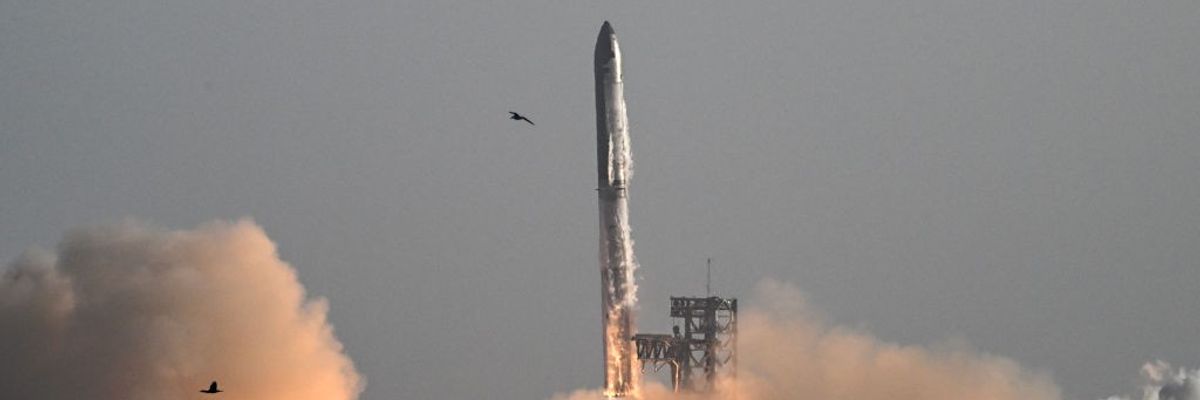
SpaceX's Starship lifts off from Starbase near Boca Chica, Texas, on March 6, 2025.
(Photo: Ronaldo Schemidt/AFP via Getty Images)
Jake Johnson
Mar 07, 2025
COMMON DREAMS
The eighth test launch of SpaceX's Starship, which billionaire CEO Elon Musk claims will be the spacecraft that eventually transports humans to Mars, ended Thursday in much the same way the seventh did: an explosive failure that sent toxic and polluting debris raining down from the sky.
"We are all in the debris field of a SpaceX mishap," remarked journalist Aaron Rupar after the spacecraft exploded just minutes following its lift-off from a launch site in Texas.
Reutersreported that "several videos on social media showed fiery debris streaking through the dusk skies near south Florida and the Bahamas after Starship broke up in space shortly after it began to spin uncontrollably with its engines cut off."
"The back-to-back mishaps occurred in early mission phases that SpaceX has easily surpassed previously, a setback for a program Musk had sought to speed up this year," the news agency added.
Musk, who is leading SpaceX while simultaneously spearheading a lawless effort to eviscerate the federal government and its workforce, wrote on his social media platform following the Starship explosion that "rockets are hard."
The explosion forced the Federal Aviation Administration (FAA)—an agency that Musk and his cronies have infiltrated—to suspend air traffic at several Florida airports, citing "space launch debris."
The New York Timesreported that falling debris from the Starship explosion impacted flights "as far away as Philadelphia International Airport."
Musk, the world's richest man, has been vocal about wanting SpaceX subsidiary Starlink to take over the FAA's air traffic control system.
Following Thursday's explosion and subsequent flight disruptions, New Yorker staff writer Philip Gourevitch wrote sardonically, "Really reassuring that the SpaceX guy is taking over the FAA."
"Really reassuring that the SpaceX guy is taking over the FAA," one observer quipped.
SpaceX's Starship lifts off from Starbase near Boca Chica, Texas, on March 6, 2025.
(Photo: Ronaldo Schemidt/AFP via Getty Images)
Jake Johnson
Mar 07, 2025
COMMON DREAMS
The eighth test launch of SpaceX's Starship, which billionaire CEO Elon Musk claims will be the spacecraft that eventually transports humans to Mars, ended Thursday in much the same way the seventh did: an explosive failure that sent toxic and polluting debris raining down from the sky.
"We are all in the debris field of a SpaceX mishap," remarked journalist Aaron Rupar after the spacecraft exploded just minutes following its lift-off from a launch site in Texas.
Reutersreported that "several videos on social media showed fiery debris streaking through the dusk skies near south Florida and the Bahamas after Starship broke up in space shortly after it began to spin uncontrollably with its engines cut off."
"The back-to-back mishaps occurred in early mission phases that SpaceX has easily surpassed previously, a setback for a program Musk had sought to speed up this year," the news agency added.
Musk, who is leading SpaceX while simultaneously spearheading a lawless effort to eviscerate the federal government and its workforce, wrote on his social media platform following the Starship explosion that "rockets are hard."
The explosion forced the Federal Aviation Administration (FAA)—an agency that Musk and his cronies have infiltrated—to suspend air traffic at several Florida airports, citing "space launch debris."
The New York Timesreported that falling debris from the Starship explosion impacted flights "as far away as Philadelphia International Airport."
Musk, the world's richest man, has been vocal about wanting SpaceX subsidiary Starlink to take over the FAA's air traffic control system.
Following Thursday's explosion and subsequent flight disruptions, New Yorker staff writer Philip Gourevitch wrote sardonically, "Really reassuring that the SpaceX guy is taking over the FAA."
'Too much diversity': Elon Musk ripped as another rocket blows up and grounds flights
Daniel Hampton
March 6, 2025

SpaceX's next-generation Starship spacecraft atop its Super Heavy booster is launched on its eighth test at the company's Boca Chica launch pad in Brownsville, Texas, U.S., March 6, 2025. REUTERS/Joe Skipper
Internet critics leveled SpaceX CEO Elon Musk after another rocket spectacularly exploded Thursday, this time temporarily halting flights into Miami, Fort Lauderdale, Palm Beach, and Orlando airports over "space launch debris."
A SpaceX Starship rocket exploded during its eighth test flight Thursday night. The blast happened shortly after the rocket reached space, with the upper stage experiencing engine failures and tumbling out of control approximately nine minutes into the flight, according to reports.
Witnesses in Florida and the Bahamas shared videos on Musk's X platform of rocket debris falling from the sky. The explosion comes after a similar incident during Starship's seventh test flight in January.
The launch began successfully at 6:30 p.m. from SpaceX's Starbase in southern Texas. The first-stage booster, known as Super Heavy, was successfully caught by the launch tower's "chopstick" arms. But the upper stage encountered problems as it ascended and SpaceX lost contact with the vehicle.
Musk, who has faced increasing criticism over his efforts to slash trillions out of the federal budget, found himself the subject of fierce mockery on social media.
"Clearly there is still too much diversity and inclusion at SpaceX," wrote Helen Kennedy, former staffer at the New York Daily News and Boston Herald.
"What isn’t Elon Musk f---ing up these days? My god," chided Emily C. Singer, a staff writer at the Daily Kos.
"Seems inefficient," jabbed YouTuber Sam Seder.
"We are all in the debris field of a SpaceX mishap," wrote independent journalist Aaron Rupar.
Watch a clip of the debris falling from the sky below or at this link.
Daniel Hampton
March 6, 2025
RAW STORY
SpaceX's next-generation Starship spacecraft atop its Super Heavy booster is launched on its eighth test at the company's Boca Chica launch pad in Brownsville, Texas, U.S., March 6, 2025. REUTERS/Joe Skipper
Internet critics leveled SpaceX CEO Elon Musk after another rocket spectacularly exploded Thursday, this time temporarily halting flights into Miami, Fort Lauderdale, Palm Beach, and Orlando airports over "space launch debris."
A SpaceX Starship rocket exploded during its eighth test flight Thursday night. The blast happened shortly after the rocket reached space, with the upper stage experiencing engine failures and tumbling out of control approximately nine minutes into the flight, according to reports.
Witnesses in Florida and the Bahamas shared videos on Musk's X platform of rocket debris falling from the sky. The explosion comes after a similar incident during Starship's seventh test flight in January.
The launch began successfully at 6:30 p.m. from SpaceX's Starbase in southern Texas. The first-stage booster, known as Super Heavy, was successfully caught by the launch tower's "chopstick" arms. But the upper stage encountered problems as it ascended and SpaceX lost contact with the vehicle.
Musk, who has faced increasing criticism over his efforts to slash trillions out of the federal budget, found himself the subject of fierce mockery on social media.
"Clearly there is still too much diversity and inclusion at SpaceX," wrote Helen Kennedy, former staffer at the New York Daily News and Boston Herald.
"What isn’t Elon Musk f---ing up these days? My god," chided Emily C. Singer, a staff writer at the Daily Kos.
"Seems inefficient," jabbed YouTuber Sam Seder.
"We are all in the debris field of a SpaceX mishap," wrote independent journalist Aaron Rupar.
Watch a clip of the debris falling from the sky below or at this link.
By AFP
March 6, 2025

The last attempted launch of Europe's new heavy-lift Ariane 6 rocket was called off minutes before blast off on Monday - Copyright AFP/File
Lillian SUWANRUMPHA
After several false starts, Europe’s new rocket Ariane 6 is aiming to finally blast off on its first commercial mission Thursday, carrying with it the continent’s hopes of bolstering its security and independent access to space.
The heavy-lift rocket, which is already years behind schedule, was just 30 minutes away from launching on Monday when a faulty valve meant the mission was postponed for a third time.
The mission carrying a French military satellite comes as Europe seeks to strengthen its defences amid doubts it can still rely on the United States as a security partner under new US President Donald Trump.
A successful launch will also mean that Europe can independently put large satellites into orbit for the first time since Russia pulled its heavy Soyuz rockets after invading Ukraine in 2022.
The launch is now scheduled to blast off from Europe’s spaceport in Kourou, French Guiana at 1:24 pm (1624 GMT) on Thursday.
Monday’s launch was called off at the last minute because of a dysfunctional valve on one of the refuelling pipes, according to the French company Arianespace which operates the rocket.
Tests before the launch showed “abnormal behaviour,” so the only choice was to postpone, Arianespace chief David Cavailloles explained.
The rocket and satellite are “stable and safe,” Arianespace said.
Previous attempts to launch the mission in December and February were also scrubbed.
Postponed launches are common for new rockets. The latest test flight of the world’s biggest rocket, SpaceX’s Starship, is also planning a Thursday launch after a last-minute cancellation on Monday.
– ‘Europe must ensure its own security’ –
Ariane 6 was initially scheduled to have its first fight in 2020, but repeated delays meant the rocket did not blast off for the first time until July last year.
Its first commercial mission is to put the CSO-3 satellite into orbit at an altitude of around 800 kilometres (500 miles) above Earth.
CSO-3 has been waiting since 2022 to complete a network of three French military imaging satellites, with the first two launched in 2018 and 2020 on Soyuz rockets.
Europe has just 10 military satellites — five French and five Italian — compared to “hundreds” for the US and China, French General Philippe Steininger said.
“Europe must ensure its own security,” the European Space Agency’s space transportation director Toni Tolker-Nielsen said in Kourou earlier this week.
He called for the number of annual Ariane 6 launches to increase to 12, compared to the five planned for this year.
Given the military role of the satellite, strict security precautions were taken to limit access at the spaceport on the northern coast of South America, with French fighter jets deployed to patrol the surrounding skies.
The European space industry has struggled to remain competitive with Elon Musk’s SpaceX, which has become increasingly dominant when it comes to launching satellites.
And SpaceX is only expected to become more central to US space efforts with the billionaire Musk becoming a prominent advisor to Trump.
Europe recently found itself without a way to independently launch missions into space due to the Ariane 6 delays, its predecessor Ariane 5 retiring in 2023, Russia pulling its Soyuz rockets and an accident that grounded the smaller Vega-C launcher for two years.
But between Vega-C resuming flights in December and Ariane 6’s first commercial launch, European space efforts are hoping to turn a page on the crisis.
bur-neo-tq-dl/giv
After several false starts, Europe’s new rocket Ariane 6 is aiming to finally blast off on its first commercial mission Thursday, carrying with it the continent’s hopes of bolstering its security and independent access to space.
The heavy-lift rocket, which is already years behind schedule, was just 30 minutes away from launching on Monday when a faulty valve meant the mission was postponed for a third time.
The mission carrying a French military satellite comes as Europe seeks to strengthen its defences amid doubts it can still rely on the United States as a security partner under new US President Donald Trump.
A successful launch will also mean that Europe can independently put large satellites into orbit for the first time since Russia pulled its heavy Soyuz rockets after invading Ukraine in 2022.
The launch is now scheduled to blast off from Europe’s spaceport in Kourou, French Guiana at 1:24 pm (1624 GMT) on Thursday.
Monday’s launch was called off at the last minute because of a dysfunctional valve on one of the refuelling pipes, according to the French company Arianespace which operates the rocket.
Tests before the launch showed “abnormal behaviour,” so the only choice was to postpone, Arianespace chief David Cavailloles explained.
The rocket and satellite are “stable and safe,” Arianespace said.
Previous attempts to launch the mission in December and February were also scrubbed.
Postponed launches are common for new rockets. The latest test flight of the world’s biggest rocket, SpaceX’s Starship, is also planning a Thursday launch after a last-minute cancellation on Monday.
– ‘Europe must ensure its own security’ –
Ariane 6 was initially scheduled to have its first fight in 2020, but repeated delays meant the rocket did not blast off for the first time until July last year.
Its first commercial mission is to put the CSO-3 satellite into orbit at an altitude of around 800 kilometres (500 miles) above Earth.
CSO-3 has been waiting since 2022 to complete a network of three French military imaging satellites, with the first two launched in 2018 and 2020 on Soyuz rockets.
Europe has just 10 military satellites — five French and five Italian — compared to “hundreds” for the US and China, French General Philippe Steininger said.
“Europe must ensure its own security,” the European Space Agency’s space transportation director Toni Tolker-Nielsen said in Kourou earlier this week.
He called for the number of annual Ariane 6 launches to increase to 12, compared to the five planned for this year.
Given the military role of the satellite, strict security precautions were taken to limit access at the spaceport on the northern coast of South America, with French fighter jets deployed to patrol the surrounding skies.
The European space industry has struggled to remain competitive with Elon Musk’s SpaceX, which has become increasingly dominant when it comes to launching satellites.
And SpaceX is only expected to become more central to US space efforts with the billionaire Musk becoming a prominent advisor to Trump.
Europe recently found itself without a way to independently launch missions into space due to the Ariane 6 delays, its predecessor Ariane 5 retiring in 2023, Russia pulling its Soyuz rockets and an accident that grounded the smaller Vega-C launcher for two years.
But between Vega-C resuming flights in December and Ariane 6’s first commercial launch, European space efforts are hoping to turn a page on the crisis.
bur-neo-tq-dl/giv
Ghosts of the radio universe’: Astronomers have discovered a slew of faint circular objects
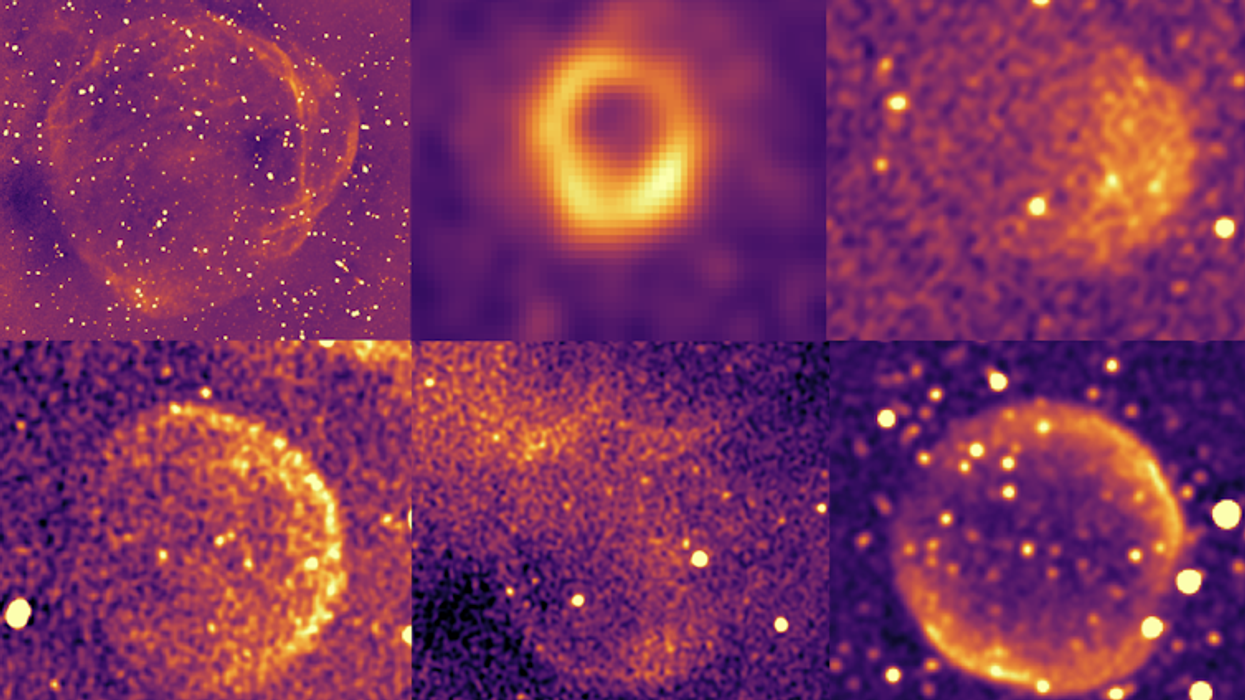
Author provided
Some of the objects captured by ASKAP.

Kyklos (left) and WR16 (r).Author provided
The ghostly ring Kýklos (from the Greek κύκλος, circle or ring) and the object WR16 both show the environment of rare and unusual celestial objects known as Wolf-Rayet stars.
When big stars are close to running out of fuel, they become unstable as they enter one of the last stages of the stellar life cycle, becoming a Wolf-Rayet star. They begin surging and pulsing, shedding their outer layers which can form bright nebulous structures around the star.
In these objects, a previous outflow of material has cleared the space around the star, allowing the current outburst to expand symmetrically in all directions. This sphere of stellar detritus shows itself as a circle.
Exploded stars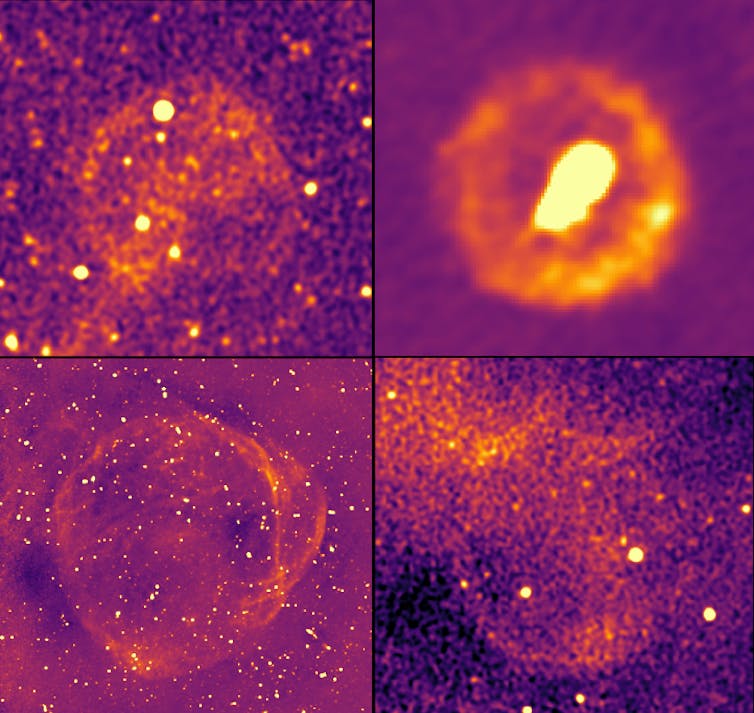
Left to right clocwise: the supernova remnants Stingray 1, Perun, Ancora and Unicycle. Author provided
Stingray 1, Perun, Ancora and Unicycle are supernova remnants. When a big star finally runs out of fuel, it can no longer hold back the crush of gravity. The matter falling inwards causes one final explosion, and the remains of these violent star deaths are known as supernovas.
Their expanding shockwaves sweep up material into an expanding sphere, forming beautiful circular features.
The supernova remnant will be deformed by its environment over time. If one side of the explosion slams into an interstellar cloud, we’ll see a squashed shape. So, a near-perfect circle in a messy universe is a special find.
Teleios – named from the Greek Τελεɩοσ (“perfect”) for its near-perfectly circular shape – is shown below. This unique object has never been seen in any wavelength, including visible light, demonstrating ASKAP’s incredible ability to discover new objects.
The shape indicates Teleios has remained relatively untouched by its environment. This presents us with an opportunity to make inferences about the initial supernova explosion, providing rare insight into one of the most energetic events in the universe.

ASKAP EMU radio image of the Teleios supernova remnant.
A cosmic mirror
Lagotis is another object that can show how new telescope data can reclassify previously discovered objects. The reflection nebula VdB-80 has been seen before, within the plane of our Milky Way galaxy. The light we see was emitted by nearby stars, and then reflected off a nearby cloud of gas and dust
Acknowledgements: Aaron Bradley and Zachary Smeaton, Masters Research Students at Western Sydney University, made valuable contributions to this article.
Miroslav Filipovic, Professor, Western Sydney University; Andrew Hopkins, Professor of Astronomy, Macquarie University; Luke Barnes, Senior Lecturer in Physics, Western Sydney University, and Nicholas Tothill, Associate professor, Western Sydney University
This article is republished from The Conversation under a Creative Commons license. Read the original article.
Author provided
Some of the objects captured by ASKAP.
March 04, 2025
Radio astronomers see what the naked eye can’t. As we study the sky with telescopes that record radio signals rather than light, we end up seeing a lot of circles.
The newest generation of radio telescopes – including the Australian Square Kilometre Array Pathfinder (ASKAP) and MeerKAT, a telescope in South Africa – is revealing incredibly faint cosmic objects, never before seen.
In astronomy, surface brightness is a measure that tells us how easily visible an object is. The extraordinary sensitivity of MeerKAT and ASKAP is now revealing a new “low surface brightness universe” to radio astronomers. It’s comprised of radio sources so faint they have never been seen before, each with their own unique physical properties.
Many of the ASKAP results presented here were obtained with one of its major observing programs called EMU (Evolutionary Map of the Universe). EMU is mapping the entire southern sky with an unprecedented sensitivity and will deliver the most detailed map of the southern hemisphere sky to date – a spectacular new radio atlas that will be used for decades to come.
EMU’s all-hemisphere coverage paired with ASKAP’s exceptional sensitivity, especially within the Milky Way, is what’s yielded so many recent discoveries.
Here’s what they’re teaching us.
Radio astronomers see what the naked eye can’t. As we study the sky with telescopes that record radio signals rather than light, we end up seeing a lot of circles.
The newest generation of radio telescopes – including the Australian Square Kilometre Array Pathfinder (ASKAP) and MeerKAT, a telescope in South Africa – is revealing incredibly faint cosmic objects, never before seen.
In astronomy, surface brightness is a measure that tells us how easily visible an object is. The extraordinary sensitivity of MeerKAT and ASKAP is now revealing a new “low surface brightness universe” to radio astronomers. It’s comprised of radio sources so faint they have never been seen before, each with their own unique physical properties.
Many of the ASKAP results presented here were obtained with one of its major observing programs called EMU (Evolutionary Map of the Universe). EMU is mapping the entire southern sky with an unprecedented sensitivity and will deliver the most detailed map of the southern hemisphere sky to date – a spectacular new radio atlas that will be used for decades to come.
EMU’s all-hemisphere coverage paired with ASKAP’s exceptional sensitivity, especially within the Milky Way, is what’s yielded so many recent discoveries.
Here’s what they’re teaching us.
Unstable stars

Kyklos (left) and WR16 (r).Author provided
The ghostly ring Kýklos (from the Greek κύκλος, circle or ring) and the object WR16 both show the environment of rare and unusual celestial objects known as Wolf-Rayet stars.
When big stars are close to running out of fuel, they become unstable as they enter one of the last stages of the stellar life cycle, becoming a Wolf-Rayet star. They begin surging and pulsing, shedding their outer layers which can form bright nebulous structures around the star.
In these objects, a previous outflow of material has cleared the space around the star, allowing the current outburst to expand symmetrically in all directions. This sphere of stellar detritus shows itself as a circle.
Exploded stars
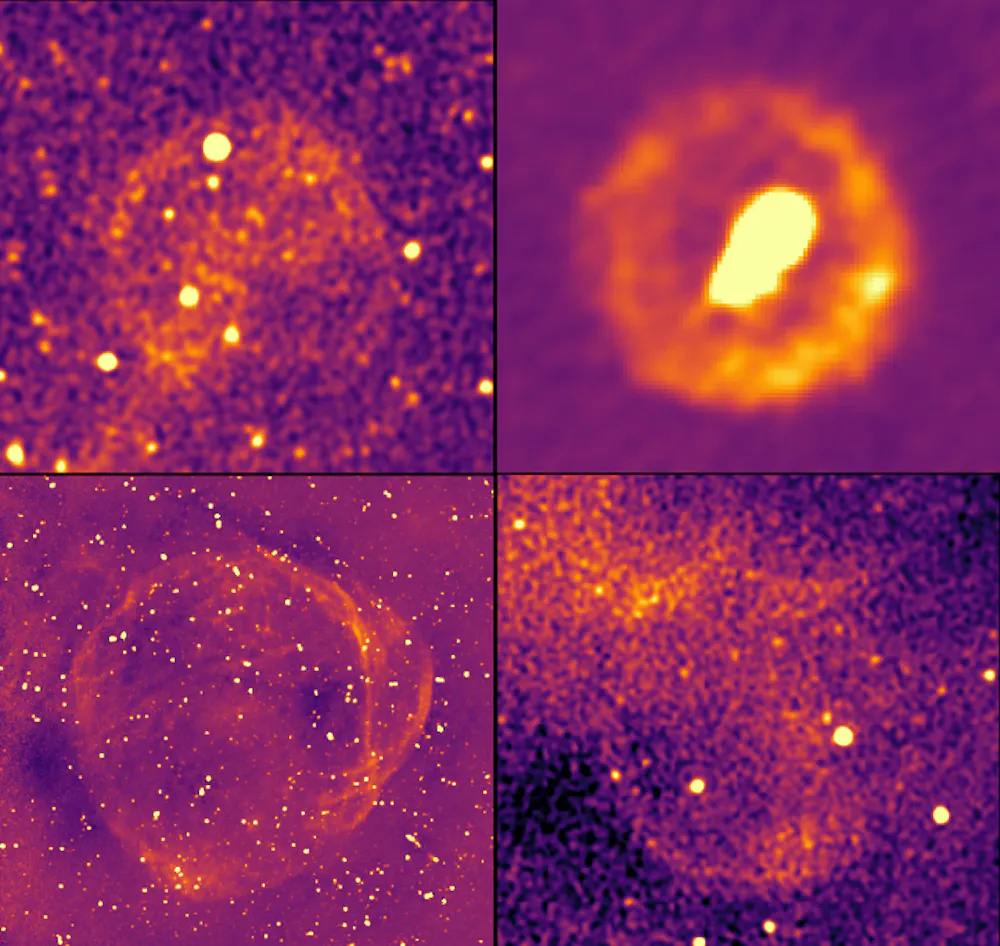
Left to right clocwise: the supernova remnants Stingray 1, Perun, Ancora and Unicycle. Author provided
Stingray 1, Perun, Ancora and Unicycle are supernova remnants. When a big star finally runs out of fuel, it can no longer hold back the crush of gravity. The matter falling inwards causes one final explosion, and the remains of these violent star deaths are known as supernovas.
Their expanding shockwaves sweep up material into an expanding sphere, forming beautiful circular features.
The supernova remnant will be deformed by its environment over time. If one side of the explosion slams into an interstellar cloud, we’ll see a squashed shape. So, a near-perfect circle in a messy universe is a special find.
Teleios – named from the Greek Τελεɩοσ (“perfect”) for its near-perfectly circular shape – is shown below. This unique object has never been seen in any wavelength, including visible light, demonstrating ASKAP’s incredible ability to discover new objects.
The shape indicates Teleios has remained relatively untouched by its environment. This presents us with an opportunity to make inferences about the initial supernova explosion, providing rare insight into one of the most energetic events in the universe.

ASKAP EMU radio image of the Teleios supernova remnant.
Author provided
At the other extreme, we can take an object and discover something entirely new about it. The Diprotodon supernova remnant is shown below.
This remnant is one of the largest objects in the sky, appearing approximately six times larger than the Moon. Hence the name: the animal Diprotodon, one of Australia’s most famous megafauna, a giant wombat that lived about 25,000 years ago.
ASKAP’s sensitivity has uncovered the object’s full extent. This discovery led to further analysis, uncovering more of the history and the physics behind this object. The messy internal structure can be seen as different parts of the expanding shell slam into a busy interstellar environment
At the other extreme, we can take an object and discover something entirely new about it. The Diprotodon supernova remnant is shown below.
This remnant is one of the largest objects in the sky, appearing approximately six times larger than the Moon. Hence the name: the animal Diprotodon, one of Australia’s most famous megafauna, a giant wombat that lived about 25,000 years ago.
ASKAP’s sensitivity has uncovered the object’s full extent. This discovery led to further analysis, uncovering more of the history and the physics behind this object. The messy internal structure can be seen as different parts of the expanding shell slam into a busy interstellar environment
.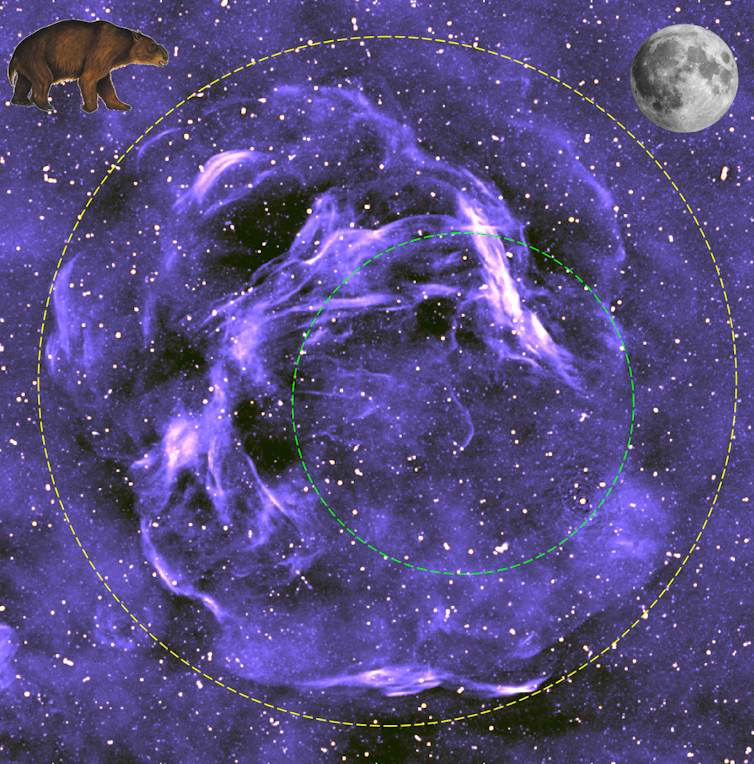
ASKAP radio image of Diprotodon, a supernova remnant. Green circle shows the previous measured size, and the yellow circle shows the new ASKAP measured size. Earth’s Moon size is shown in the top right for scale, and Diprotodon’s namesake is shown in the top left. Author provided

ASKAP radio image of Diprotodon, a supernova remnant. Green circle shows the previous measured size, and the yellow circle shows the new ASKAP measured size. Earth’s Moon size is shown in the top right for scale, and Diprotodon’s namesake is shown in the top left. Author provided
A cosmic mirror
Lagotis is another object that can show how new telescope data can reclassify previously discovered objects. The reflection nebula VdB-80 has been seen before, within the plane of our Milky Way galaxy. The light we see was emitted by nearby stars, and then reflected off a nearby cloud of gas and dust
.
Lagotis, with its cloud of ionised hydrogen or HII region seen on the right.

Lagotis, with its cloud of ionised hydrogen or HII region seen on the right.
Author provided
However, with newly available ASKAP EMU data, we were able to discover an associated cloud of ionised hydrogen (known as an HII region, pronounced “aitch two”), where stellar energy has caused the gaseous matter to lose its electrons.
This HII region is seen to coexist with the reflection nebula, sharing the same stellar centre, and is created from the star pushing into a molecular cloud. This movement is akin to burrowing, so the object earned the name Lagotis after Macrotis lagotis, the Australian greater bilby.
Outside the galaxy
ASKAP and MeerKAT are also illuminating objects from outside our Milky Way galaxy – for example, “radio ring” galaxies. When we use visible light to look at the stars in this galaxy, we see a rather plain disk.
But in radio light, we see a ring. Why is there a hole in the middle? Perhaps the combined force of many exploding supernovas has pushed all the radio-emitting clouds out of the centre. We’re not sure – we’re looking for more examples to test our ideas.
Finally, LMC-ORC is an Odd Radio Circle (ORC), a prominent new class of objects with unfamiliar origins. Only being visible in radio light, they are perhaps the most mysterious of all
However, with newly available ASKAP EMU data, we were able to discover an associated cloud of ionised hydrogen (known as an HII region, pronounced “aitch two”), where stellar energy has caused the gaseous matter to lose its electrons.
This HII region is seen to coexist with the reflection nebula, sharing the same stellar centre, and is created from the star pushing into a molecular cloud. This movement is akin to burrowing, so the object earned the name Lagotis after Macrotis lagotis, the Australian greater bilby.
Outside the galaxy
ASKAP and MeerKAT are also illuminating objects from outside our Milky Way galaxy – for example, “radio ring” galaxies. When we use visible light to look at the stars in this galaxy, we see a rather plain disk.
But in radio light, we see a ring. Why is there a hole in the middle? Perhaps the combined force of many exploding supernovas has pushed all the radio-emitting clouds out of the centre. We’re not sure – we’re looking for more examples to test our ideas.
Finally, LMC-ORC is an Odd Radio Circle (ORC), a prominent new class of objects with unfamiliar origins. Only being visible in radio light, they are perhaps the most mysterious of all
.
A radio ring galaxy (left) and LMC-ORC

A radio ring galaxy (left) and LMC-ORC
(r).Author provided
The next generation
MeerKAT and ASKAP are revealing incredible insights into the low surface brightness universe. However, they are precursors for the Square Kilometre Array, an international collaborative endeavour that will increase the abilities of radio astronomers and reveal even more unique features of the universe.
The low-surface brightness universe presents many mysteries. These discoveries push our understanding further. Currently, the EMU survey using ASKAP is only 25% complete.
As more of this survey becomes available, we will discover many more unique and exciting objects, both new to astrophysics and extensions on previously known objects.
The next generation
MeerKAT and ASKAP are revealing incredible insights into the low surface brightness universe. However, they are precursors for the Square Kilometre Array, an international collaborative endeavour that will increase the abilities of radio astronomers and reveal even more unique features of the universe.
The low-surface brightness universe presents many mysteries. These discoveries push our understanding further. Currently, the EMU survey using ASKAP is only 25% complete.
As more of this survey becomes available, we will discover many more unique and exciting objects, both new to astrophysics and extensions on previously known objects.
Acknowledgements: Aaron Bradley and Zachary Smeaton, Masters Research Students at Western Sydney University, made valuable contributions to this article.
Miroslav Filipovic, Professor, Western Sydney University; Andrew Hopkins, Professor of Astronomy, Macquarie University; Luke Barnes, Senior Lecturer in Physics, Western Sydney University, and Nicholas Tothill, Associate professor, Western Sydney University
This article is republished from The Conversation under a Creative Commons license. Read the original article.
US firm targets Moon landing with drill, rovers, hopping drone
By AFP
March 5, 2025

Intuitive Machines' Athena lander in circular orbit around the Moon - Copyright GETTY IMAGES/AFP/File Anna Moneymaker
Issam AHMED
A drill to search for ice. A 4G network test. Three rovers and a first-of-its-kind hopping drone.
After becoming the first private firm to land on the Moon last year, Intuitive Machines is aiming for its second lunar touchdown on Thursday, carrying cutting-edge payloads to support future human missions.
The Houston-based company is targeting no earlier than 12:32 pm ET (1732 GMT) at Mons Mouton, a plateau near the lunar south pole — farther south than any robot has ventured.
NASA will livestream the landing an hour before touchdown as Athena, the 15.6-foot (4.8-meter) hexagonal lander — about the height of a giraffe — begins its descent.
“It kind of feels like this mission is straight out of one of our favorite sci-fi movies,” said Nicky Fox, NASA’s associate administrator for science.
Intuitive Machines’ first landing in February 2024 was a landmark achievement but ended with its lander tipping onto its side, an outcome the company is determined to avoid this time.
The pressure is on after Texas rival Firefly Aerospace successfully landed its Blue Ghost lander on Sunday, becoming the second private company to reach the Moon.
Both missions are part of NASA’s $2.6-billion Commercial Lunar Payload Services (CLPS) program, which partners with private industry to cut costs and support Artemis, the initiative to return astronauts to the Moon and eventually reach Mars.
– A hopper named Grace –
Athena is targeting highland terrain about 100 miles (160 kilometers) from the Moon’s south pole, where it will deploy three rovers and a unique hopping drone named Grace, after late computer science pioneer Grace Hopper.
One of Grace’s boldest objectives is a hop into a permanently shadowed crater, a place where sunlight has never shone — a first for humanity.
While NASA’s Ingenuity helicopter proved flight is possible on Mars, the Moon’s lack of atmosphere makes traditional flying impossible, positioning hoppers like Grace as a key technology for future exploration.
MAPP, the largest of Athena’s rovers and roughly the size of a beagle, will assist in testing a Nokia Bell Labs 4G cellular network linking the lander, itself, and Grace — technology designed to one day integrate into astronaut spacesuits.
Yaoki, a more compact rover from Japanese company Dymon, is designed to survive drops in any orientation, making it highly adaptable.
Meanwhile, the tiny AstroAnt rover, equipped with magnetic wheels, will cling to MAPP and use its sensors to measure temperature variations on the larger robot.
Also aboard Athena is PRIME-1, a NASA instrument carrying a drill to search for ice and other chemicals beneath the lunar surface, paired with a spectrometer to analyze its findings.
– Sticking the landing –
Before any experiments can begin, Intuitive Machines must stick the landing — a challenge made harder by the Moon’s lack of atmosphere, which rules out parachutes and forces spacecraft to rely on precise thrusts and navigation over hazardous terrain.
Until Intuitive Machines’ first mission, only national space agencies had achieved the feat, with NASA’s last landing dating back to Apollo 17 in 1972.
The company’s first lander, Odysseus, came in too fast, caught a foot on the surface and toppled over, cutting the mission short when its solar panels could not generate enough power.
This time, the company has made critical upgrades, including better cabling for the laser altimeter, which provides altitude and velocity readings to ensure a safe touchdown.
Athena launched last Wednesday aboard a SpaceX Falcon 9 rocket, which also carried NASA’s Lunar Trailblazer probe — but not everything has gone smoothly. Ground controllers are struggling to re-establish contact with the small satellite, designed to map the Moon’s water distribution.
These missions come at a delicate time for NASA, amid speculation that the agency may scale back or even cancel the crewed Moon missions in favor of prioritizing Mars — a goal championed by President Donald Trump and his advisor Elon Musk.
By AFP
March 5, 2025
Intuitive Machines' Athena lander in circular orbit around the Moon - Copyright GETTY IMAGES/AFP/File Anna Moneymaker
Issam AHMED
A drill to search for ice. A 4G network test. Three rovers and a first-of-its-kind hopping drone.
After becoming the first private firm to land on the Moon last year, Intuitive Machines is aiming for its second lunar touchdown on Thursday, carrying cutting-edge payloads to support future human missions.
The Houston-based company is targeting no earlier than 12:32 pm ET (1732 GMT) at Mons Mouton, a plateau near the lunar south pole — farther south than any robot has ventured.
NASA will livestream the landing an hour before touchdown as Athena, the 15.6-foot (4.8-meter) hexagonal lander — about the height of a giraffe — begins its descent.
“It kind of feels like this mission is straight out of one of our favorite sci-fi movies,” said Nicky Fox, NASA’s associate administrator for science.
Intuitive Machines’ first landing in February 2024 was a landmark achievement but ended with its lander tipping onto its side, an outcome the company is determined to avoid this time.
The pressure is on after Texas rival Firefly Aerospace successfully landed its Blue Ghost lander on Sunday, becoming the second private company to reach the Moon.
Both missions are part of NASA’s $2.6-billion Commercial Lunar Payload Services (CLPS) program, which partners with private industry to cut costs and support Artemis, the initiative to return astronauts to the Moon and eventually reach Mars.
– A hopper named Grace –
Athena is targeting highland terrain about 100 miles (160 kilometers) from the Moon’s south pole, where it will deploy three rovers and a unique hopping drone named Grace, after late computer science pioneer Grace Hopper.
One of Grace’s boldest objectives is a hop into a permanently shadowed crater, a place where sunlight has never shone — a first for humanity.
While NASA’s Ingenuity helicopter proved flight is possible on Mars, the Moon’s lack of atmosphere makes traditional flying impossible, positioning hoppers like Grace as a key technology for future exploration.
MAPP, the largest of Athena’s rovers and roughly the size of a beagle, will assist in testing a Nokia Bell Labs 4G cellular network linking the lander, itself, and Grace — technology designed to one day integrate into astronaut spacesuits.
Yaoki, a more compact rover from Japanese company Dymon, is designed to survive drops in any orientation, making it highly adaptable.
Meanwhile, the tiny AstroAnt rover, equipped with magnetic wheels, will cling to MAPP and use its sensors to measure temperature variations on the larger robot.
Also aboard Athena is PRIME-1, a NASA instrument carrying a drill to search for ice and other chemicals beneath the lunar surface, paired with a spectrometer to analyze its findings.
– Sticking the landing –
Before any experiments can begin, Intuitive Machines must stick the landing — a challenge made harder by the Moon’s lack of atmosphere, which rules out parachutes and forces spacecraft to rely on precise thrusts and navigation over hazardous terrain.
Until Intuitive Machines’ first mission, only national space agencies had achieved the feat, with NASA’s last landing dating back to Apollo 17 in 1972.
The company’s first lander, Odysseus, came in too fast, caught a foot on the surface and toppled over, cutting the mission short when its solar panels could not generate enough power.
This time, the company has made critical upgrades, including better cabling for the laser altimeter, which provides altitude and velocity readings to ensure a safe touchdown.
Athena launched last Wednesday aboard a SpaceX Falcon 9 rocket, which also carried NASA’s Lunar Trailblazer probe — but not everything has gone smoothly. Ground controllers are struggling to re-establish contact with the small satellite, designed to map the Moon’s water distribution.
These missions come at a delicate time for NASA, amid speculation that the agency may scale back or even cancel the crewed Moon missions in favor of prioritizing Mars — a goal championed by President Donald Trump and his advisor Elon Musk.
Private US spaceship hours from Moon landing attempt
By AFP
March 1, 2025

This still image taken from a February 24, 2025, video released by Firefly Aerospace shows Firefly's Blue Ghost lander on its third lunar orbit near the far side of the Moon and a top-down view of Blue Ghost - Copyright AFP/File ADEK BERRY
Issam AHMED
After a long journey through space, a US company is just hours away from attempting a daring lunar touchdown — its spacecraft poised to become only the second private lander to achieve the feat if it succeeds.
Firefly Aerospace’s Blue Ghost Mission 1 is targeting landing no sooner than 3:34 am US Eastern time (0834 GMT) on Sunday, aiming for a site near Mons Latreille, a volcanic feature in Mare Crisium on the Moon’s northeastern near side.
“Blue Ghost is ready to take the wheel!” the company posted on X on Saturday evening, adding flight controllers had just initiated a key maneuver that lowers a spacecraft’s orbit.
Nicknamed “Ghost Riders in the Sky,” the mission comes just over a year after the first-ever commercial lunar landing and is part of a NASA partnership with industry to cut costs and support Artemis, the program aiming to return astronauts to the Moon.
The golden lander, about the size of a hippopotamus, launched on January 15 on a SpaceX Falcon 9 rocket, capturing stunning footage of Earth and the Moon along the way. It shared a ride with a Japanese company’s lander set to attempt a landing in May.
Blue Ghost carries ten instruments, including a lunar soil analyzer, a radiation-tolerant computer and an experiment testing the feasibility of using the existing global satellite navigation system to navigate the Moon.
Designed to operate for a full lunar day (14 Earth days), Blue Ghost is expected to capture high-definition imagery of a total eclipse on March 14, when Earth blocks the Sun from the Moon’s horizon.
On March 16, it will record a lunar sunset, offering insights into how dust levitates above the surface under solar influence — creating the mysterious lunar horizon glow first documented by Apollo astronaut Eugene Cernan.
– Hopping drone –
Blue Ghost’s arrival will be followed on March 6 by Intuitive Machines’ IM-2 mission, featuring its lander Athena.
In February 2024, Intuitive Machines became the first private company to achieve a soft lunar landing — also the first US landing since the crewed Apollo 17 mission of 1972.
However, the success was tempered by a mishap: the lander came down too fast, tipped over on impact, leaving it unable to generate enough solar power and cutting the mission short.
This time, the company says it has made key improvements to the hexagonal-shaped lander, which has a taller, slimmer profile than Blue Ghost, and is around the height of an adult giraffe.
Athena launched on Wednesday aboard a SpaceX rocket, taking a more direct route toward Mons Mouton — the southernmost lunar landing site ever attempted.
Its payloads include three rovers, a drill to search for ice and the star of the show: a first-of-its-kind hopping drone designed to explore the Moon’s rugged terrain.
– NASA’s private Moon fleet –
Landing on the Moon presents unique challenges due to the absence of an atmosphere, making parachutes ineffective.
Instead, spacecraft must rely on precisely controlled thruster burns to slow their descent.
Until Intuitive Machines’ first successful mission, only five national space agencies had accomplished this feat: the Soviet Union, the United States, China, India and Japan, in that order.
Now, the United States is working to make private lunar missions routine through NASA’s $2.6 billion Commercial Lunar Payload Services (CLPS) program.
The missions come at a delicate moment for NASA, amid speculation that it may scale back or even cancel its Artemis lunar program in favor of prioritizing Mars exploration — a key goal of both President Donald Trump and his close advisor, SpaceX founder Elon Musk.
By AFP
March 1, 2025
This still image taken from a February 24, 2025, video released by Firefly Aerospace shows Firefly's Blue Ghost lander on its third lunar orbit near the far side of the Moon and a top-down view of Blue Ghost - Copyright AFP/File ADEK BERRY
Issam AHMED
After a long journey through space, a US company is just hours away from attempting a daring lunar touchdown — its spacecraft poised to become only the second private lander to achieve the feat if it succeeds.
Firefly Aerospace’s Blue Ghost Mission 1 is targeting landing no sooner than 3:34 am US Eastern time (0834 GMT) on Sunday, aiming for a site near Mons Latreille, a volcanic feature in Mare Crisium on the Moon’s northeastern near side.
“Blue Ghost is ready to take the wheel!” the company posted on X on Saturday evening, adding flight controllers had just initiated a key maneuver that lowers a spacecraft’s orbit.
Nicknamed “Ghost Riders in the Sky,” the mission comes just over a year after the first-ever commercial lunar landing and is part of a NASA partnership with industry to cut costs and support Artemis, the program aiming to return astronauts to the Moon.
The golden lander, about the size of a hippopotamus, launched on January 15 on a SpaceX Falcon 9 rocket, capturing stunning footage of Earth and the Moon along the way. It shared a ride with a Japanese company’s lander set to attempt a landing in May.
Blue Ghost carries ten instruments, including a lunar soil analyzer, a radiation-tolerant computer and an experiment testing the feasibility of using the existing global satellite navigation system to navigate the Moon.
Designed to operate for a full lunar day (14 Earth days), Blue Ghost is expected to capture high-definition imagery of a total eclipse on March 14, when Earth blocks the Sun from the Moon’s horizon.
On March 16, it will record a lunar sunset, offering insights into how dust levitates above the surface under solar influence — creating the mysterious lunar horizon glow first documented by Apollo astronaut Eugene Cernan.
– Hopping drone –
Blue Ghost’s arrival will be followed on March 6 by Intuitive Machines’ IM-2 mission, featuring its lander Athena.
In February 2024, Intuitive Machines became the first private company to achieve a soft lunar landing — also the first US landing since the crewed Apollo 17 mission of 1972.
However, the success was tempered by a mishap: the lander came down too fast, tipped over on impact, leaving it unable to generate enough solar power and cutting the mission short.
This time, the company says it has made key improvements to the hexagonal-shaped lander, which has a taller, slimmer profile than Blue Ghost, and is around the height of an adult giraffe.
Athena launched on Wednesday aboard a SpaceX rocket, taking a more direct route toward Mons Mouton — the southernmost lunar landing site ever attempted.
Its payloads include three rovers, a drill to search for ice and the star of the show: a first-of-its-kind hopping drone designed to explore the Moon’s rugged terrain.
– NASA’s private Moon fleet –
Landing on the Moon presents unique challenges due to the absence of an atmosphere, making parachutes ineffective.
Instead, spacecraft must rely on precisely controlled thruster burns to slow their descent.
Until Intuitive Machines’ first successful mission, only five national space agencies had accomplished this feat: the Soviet Union, the United States, China, India and Japan, in that order.
Now, the United States is working to make private lunar missions routine through NASA’s $2.6 billion Commercial Lunar Payload Services (CLPS) program.
The missions come at a delicate moment for NASA, amid speculation that it may scale back or even cancel its Artemis lunar program in favor of prioritizing Mars exploration — a key goal of both President Donald Trump and his close advisor, SpaceX founder Elon Musk.











.jpg)