It’s possible that I shall make an ass of myself. But in that case one can always get out of it with a little dialectic. I have, of course, so worded my proposition as to be right either way (K.Marx, Letter to F.Engels on the Indian Mutiny)
Saturday, March 08, 2025
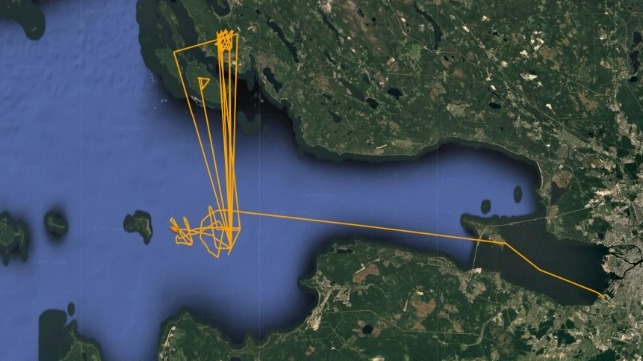
Report: GPS Jamming Sent Bangladeshi Bulker Aground in Baltic
Meghna Princess' AIS trackline shows clear indications of GPS spoofing, including relocation onto land (Pole Star)
According to Bangladeshi media, a bulker ran aground near the Russian port of Ust-Luga in late December and remained on the rocks for weeks, despite appeals to the local authorities for assistance.
The previously-unreported casualty involved the Bangladeshi-owned and -crewed bulker Meghna Princess, operated by the country's largest shipowner, Meghna Group. On December 29, the Princess went off course due to GPS jamming - a common phenomenon in the Baltic - and struck an underwater rock near Ust-Luga. It damaged its hull and flooded several tank, according to The Business Standard, which drew on reports from the Bangladesh Merchant Marine Officers' Association (BMMOA).
The Princess took on a cargo of fertilizer in St. Petersburg and got under way for Ust-Luga, where she was supposed to top up with an additional 25,000 tonnes of cargo. During a jamming event, the crew went off course at hit a rock, causing hull and propeller damage. According to the BMMOA, the crew appealed to Russian port authorities for aid, but received no response for an extended period - so long that the crew began to run short on food and had to rely on melted snow for drinking water.
With pressure from ITF, salvage assistance was finally secured. The Princess was afloat and under way again at a slow bell near Ust-Luga on March 6, with a Russian salvage tug nearby, according to AIS data.
The BMMOA reported that another Meghna Group bulker got into trouble in Venezuela at about the same time. In late January, a diver was struck and killed by the propeller while he was performing a mandatory underwater counternarcotics inspection on the Meghna Prestige. The officer on duty had started the engine because the vessel "began drifting with the wind," the master said, thereby killing the diver. Local courts detained the vessel's master on shore for six weeks pending the completion of an investigation; the crew is low on food and there is a shortage of fresh water aboard, the captain told The Business Standard.
Korean Boxship Crossing North Pacific Reports Lost and Damaged Containers
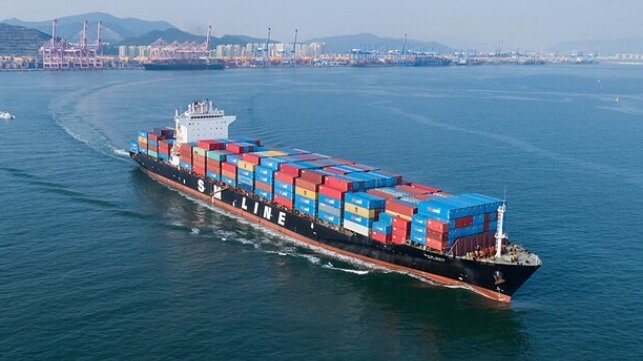
SM Line reports 115 containers were lost and damaged as its vessel was sailing in the North Pacific (SM Line file photo)
South Korea’s SM Line issued a customer alter on March 5 reporting that one of its vessels has experienced damaged and lost containers in a Pacific storm. The SM Portland (51,314 dwt) has resumed its voyage bound for Vancouver where it will be inspected by Canadian authorities.
“Due to heavy rolling by the inclement weather, unfortunately, it caused cargo damage, including container loss, collapse, and damage of 115 containers,” SM advised. Customers are being instructed to check their documents to determine if they might have had boxes onboard the vessel which had called in China and South Korea before departing for Vancouver where it was due to arrive on March 10.
The ship, the SM Portland, has a capacity of 4,228 TEU and is 856 feet (261 meters) in length. It was built in 2009 and acquired by SM Line in 2021. The company reports it encountered severe winter weather with strong winds near the Bering Sea. AIS signals show the vessel changing course early on March 4 and resuming its crossing on March 5. SM Line reports the vessel had slowed and adjusted course for safety.
When the vessel arrives off Vancouver, the line reports there will be an investigation by Transport Canada and the Canadian Coast Guard before it is permitted to berth. SM Line warns customers that it expects schedule delays.
SM Line was started in 2017 as a niche carrier and the following year, 2017, it launched service to North America. The company continues its Pacific routes in cooperation with the larger Korean carrier HMM.
This incident comes more than four years after one of the worst container loss events happened in the North Pacific in November 2020 on the ONE Apsus. The vessel also encountered heavy weather resulting in the loss of over 1,800 containers and damage to many more boxes that remained on deck. Maersk experienced a similar issue with its containerships Maersk Essen and Maersk Eindhoven, both of which also suffered container losses at sea on the Pacific that same winter season.
The heavy losses in 2020-2021 prompted new initiatives in the industry to address dangerous rolling. The shipping companies were advised to enhance training for their crews and new technologies were developed to help monitor and alert crew to potentially dangerous conditions.
The World Shipping Council in its 2024 annual report highlighted the industry’s success in reducing losses with its data showing just 221 containers were lost at sea in 2023 out of 250 million transported. The IMO also moved in 2024 to tighten the rules requiring reporting of container losses.
NTSB: Deteriorated Dock Collapsed After Normal Contact With Barge
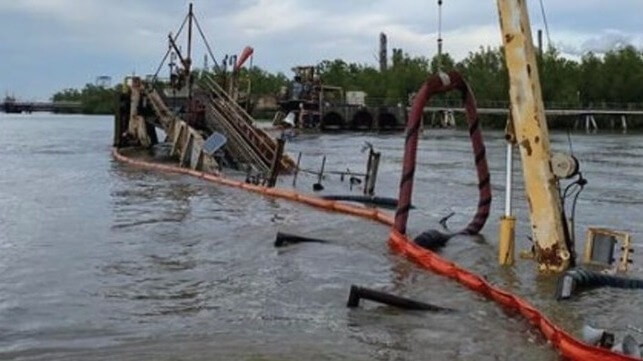
When a Louisiana refinery's mooring dock collapsed upon contact with a barge in 2023, allision damage might have been suspected - but the National Transportation Safety Board has determined that it was the dock to blame, not the vessel. A structural inspection had discovered serious deterioration of the dock six years before the accident, and no progress was made in making repairs in the year and a half before the casualty.
In the early hours of April 25, 2023, the towing vessel Ovide J was arriving at the Chalmette Refinery crude oil dock with two laden barges and a cargo of 50,000 barrels of crude. The refinery is on the Lower Mississippi near mile 89, just downriver from New Orleans. The dock was built in 1967 out of wood and steel pilings, dolphins, and access bridges. The transfer platform was located on dolphin number three, along with a boom crane and the pipe manifold.
The relief captain was at the helm as the towboat approached the dock from downriver, using the current to guide the tow slowly towards the pier. The relief captain made his final approach at 0001-0004, maneuvering slowly to make contact with the dock at about 0.3 knots.
When the tow made contact with dolphin number 3, part of the dock fell off into the river. The relief captain put the starboard side engine in neutral in order to avoid fouling the propeller with any debris from the collapse. The other two dolphins remained intact, so the crew moored to the surviving portions of the dock and notified the company of the casualty. Luckily, no one was injured.
The Ovide J and her barges sustained no damage from the incident, and the timber fendering around the dock was undamaged. Video from the pilothouse showed no signs of a hard contact (like jarring, vibration or movement of objects). The relief captain later told investigators that the maneuver - which he had performed at the same dock 20 times in the past year - had gone perfectly to plan.
"When you come in, you touch up stern first. . . . So, when I came in, I lightly touch on the stern. . . . As soon as I touched up, the dock collapsed," he said. "If I had to do it again, I would do it the same way over again. I would not change a thing."
The dock sustained about $7 million worth of damage: 150 feet of the structure collapsed, and the support piles for dolphin number three were sheared off below the waterline. But the damage may have started long before the casualty event, based on past inspection reports. In 2017, a third-party engineering inspection found major deterioration of the braces between the dolphin's pilings. Six years before the collapse, three horizontal braces on the dolphin were broken, one more was damaged and two pilings were "severely deteriorated." The dock owner informed NTSB that the recommendations from this inspection had "not been progressed" before the dock collapsed.
"Because a portion of the dock collapsed from what appeared to be a low-impact contact during docking, it is likely that the dock’s dolphin no. 3 transfer platform structure was compromised to the extent that it could not sustain the forces from a typical docking. The dock owner was aware that the dock had structural integrity issues before the collapse but had not yet taken steps to address them," NTSB concluded.
USCG Assists Marshall Islands in Search for Overdue Sea Ambulance
USCG is conducting aerial search to support the Marshall Islands patrol boats (USCG file photo)
The U.S. Coast Guard has been called in to provide support to The Republic of the Marshall Islands as a challenge search is underway for an overdue sea ambulance. Officials are citing the complex nature of the search with the U.S. Department of Defense approving the efforts to support the U.S.’s long-time partner in the Pacific.
The 37-foot fiberglass vessel departed Majuro Bridge at midday on March 3 with four personnel aboard bound for Milli Atoll, a trip of approximately 67 miles. It was operating as part of the country’s TB Mass screening campaign.
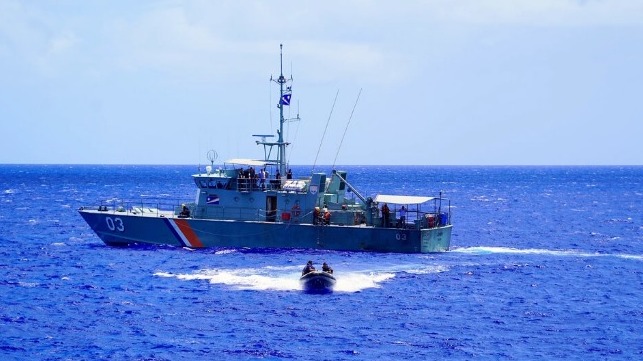
The alerts were issued at 2200 local time Monday night when the vessel was officially declared overdue. A hospital vessel from Milli Atoll launched a search while the Marshall Islands also deployed search teams aboard its patrol boats Lomor 02 and Lomor 03. The U.S. assisted with the Joint Rescue Coordination Center in Honolulu initially supplying drift calculations to the teams from the Marshall Islands.
The rescue vessels Lomor 02 and Lomor 03 reported no sightings on March 4 prompting the Marshall Islands to request U.S. Coast Guard aerial support. The U.S. deployed a USCG Hercules team from Hawaii and also a Poseidon crew from Japan. The Poseidon crew conducted a three-hour search on March 5 and returned to Guam to refuel. It reported no sightings.
The Hercules crew is also conducting searches and on March 5 deployed three marker buoys. The USCG says the buoys are providing critical GPS data to track set and drift. It is being used for search planning and providing insights into the dynamic ocean conditions.
"Searching for this vessel across the remote expanses of the Pacific tests aircrews with extreme distances and challenging conditions, but our shared commitment to this sea-connected community drives us," said Chief Warrant Officer Sara Muir, public affairs officer U.S. Coast Guard Forces Micronesia/Sector Guam. “The people of the Pacific Islands, seasoned mariners with remarkable resilience, inspire us to persist in these efforts, even when sightings remain elusive.”
The weather for Majuro's coastal waters is forecast as east winds of 15 to 20 knots, wind waves of 3 to 4 feet, and a northeast swell of 4 to 6 feet. The swells are expected to build going into the weekend.
The Coast Reports the crews continue to search with no results. Additional flights were planned for March 6.
USCG Cutter Polar Star Departs Antarctica Marking 49 Years of Operations
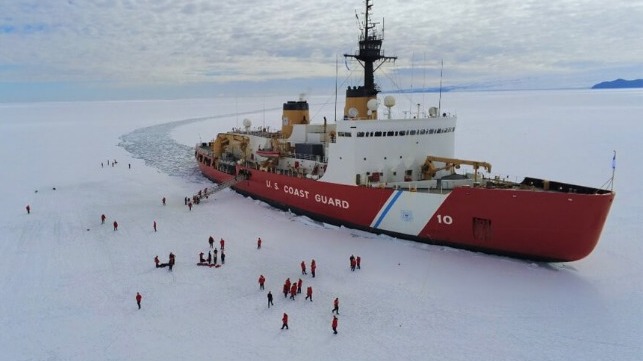
Polar Star marked 49 years of service and is expected to continue to operate until the end of the decade (USCG)
The U.S. Coast Guard Cutter Polar Star departed the Antarctic region Tuesday, March 4, after having spent 65 days south of the Antarctic Circle in support of Operation Deep Freeze 2025 the annual research and resupply mission. The Coast Guard highlights that the unique icebreaker celebrated its 49th year of operations after life extensions designed to keep the vessel operational until at least 2029 when the new icebreaker Polar Sentinel is scheduled to finally be completed.
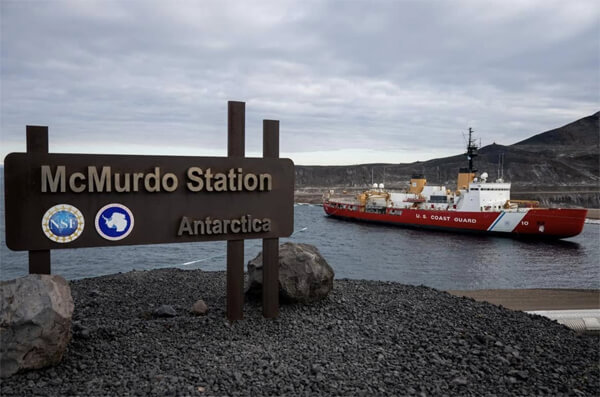
Polar Star’s crew performed icebreaking duties in McMurdo Sound, clearing routes to ensure safe passage for cargo vessels for McMurdo Station and New Zealand’s Scott Base. Polar Star also conducted a crew exchange with the New Zealand Defense Force ship Aotearoa while it was operating in the region.
The annual mission was completed this week with the Polar Star departing McMurdo Station (USCG)
“The surface ice conditions in McMurdo Sound were abnormally light this year, a welcome change of pace from the extreme conditions experienced last year,” said Captain Jeff Rasnake, Polar Star’s commanding officer. “Operation Deep Freeze presented a number of challenges, beyond those inherent in maintaining and operating a 49-year-old ship to complete this arduous mission. We benefitted tremendously from a great deployment plan which allowed us to take advantage of favorable conditions and use the elements to stay ahead of events without pressing the cutter or crew excessively.”
Polar Star also worked with the Commission for the Conservation of Antarctic Marine Living Resources (CCAMLR) to support a secure and sustainable Southern Ocean. It was the first United States surface asset to support CCAMLR. The crew’s efforts to observe and monitor fishing and other activity on the high seas safeguarded resources and U.S. national interests in the Antarctic region.
The vessel and her crew have transited nearly 16,000 miles since departing its Seattle homeport in November with stops in Honolulu, Sydney, and McMurdo Station. To celebrate its 49th year of service, the vessel also visited Cape Polar Star in the northern part of the Ross Sea. Cape Polar Star was named after the icebreaker for the scientific support provided by the cutter in the area during Operation Deep Freeze 86.
Polar Star is the United States’ only asset capable of providing access to both polar regions. The Seattle-based cutter is a 399-foot heavy polar icebreaker commissioned in 1976. It is 13,500 tons and is 84 feet wide with a 34-foot draft. The cutter's six diesel and three gas turbine engines produce up to 75,000 horsepower.
After years of delays, design challenges, and cost overruns, the U.S. Coast Guard and the Navy Integrated Program Office received approval on December 19 to begin building the Polar Sentinel, the first of three planned heavy icebreakers. The order for the vessel was placed with VT Halter which was later acquired by Bollinger Shipyards. The new vessel is slated to be larger at 460 feet (140 meters) in length and 23,300 displacement tons.
During a speech in January days after taking office, Donald Trump said the U.S. would launch a massive building program for new icebreakers. In total, he said there could be 40 vessels built although due to the complexity of the heavy icebreaker, it is unlikely that all the vessels would be of that class. The U.S. currently only has the Polar Star as the heaviest vessel, along with the medium icebreaker Healy which has been in operation since 2000, and the recent acquisition of commercial polar icebreaker Aiviq, renamed Storis, which is expected to be commissioned in 2026 to provide bridging capacity until the new fleet is in service.
GAO: USCG’s Shore Maintenance Infrastructure Backlog Has Ballooned to $7B
GAO reports on the balloning maintenace requires for USCG's shoreside infrastructure (USCG file photo)
Failure by the U.S. Coast Guard to invest in maintaining and renewing its crumpling shore infrastructure and a lack of funding from the U.S. Congress has resulted in a significant increase in the amount required to carry out the work. The Government Accountability Office (GAO) is again shining the spotlight on the agency’s mounting challenges, estimating that the USCG now requires $7 billion to rebuild its deteriorating shore infrastructures, more than double the amount required in 2019.
GOA carried out a detailed assessment in 2019 of the Coast Guard’s shore infrastructures and made recommendations to manage the growing challenges. Based on USCG assessments, GAO determined that about 50 percent of the facilities were past their expected service life. The agency needed $2.6 billion to revamp the facilities comprising assets like piers, runways, and buildings. USCG it reports has about 40,000 shore infrastructure assets with a value of $24.5 billion.
Six years later GAO finds little has been achieved and the agency is now grappling with an infrastructure maintenance backlog amounting to $7 billion. The Coast Guard admitted in a 2023 report that the condition of most of the facilities ranged from “mediocre to fair” and were contributing to the worsening operational challenges.
The Coast Guard cites budgetary constraints for the backlog, reporting the government’s budgets since 2019 failed to include requested funding levels that the agency identified were required to meet its targets in terms of shore infrastructure investments. A case in point is the 2025 financial year in which the agency requested $709 million but was only allocated $167 million by Congress.
Apart from budgetary constraints that have forced the deferment of maintenance, the agency is also attributing the surge in backlog to new facilities that are needed to accommodate new assets including the offshore patrol cutters (OPC). The agency is building 25 OPCs that will replace the aging medium endurance cutters.
“We found that the Coast Guard-estimated $7 billion cost to address its shore infrastructure is understated because there are hundreds of additional projects that lack cost estimates, and the Coast Guard has not updated all of its existing cost estimates for inflation,” said GAO.
In its report, GAO highlights that the current shore infrastructure backlog cuts across recapitalization projects that include replacing assets that have reached the end of their useful life, new construction projects that include building a boat maintenance facility, and deferred depot-level maintenance projects, such as repaving an airfield. Also affected are critical infrastructures like housing units for service members and their families, training centers, and command centers.
GAO reports it made six recommendations to the USCG in 2019, of which the Coast Guard has only fully addressed two while also taking steps toward three of the recommendations. It says the Coast Guard is in the process of systematically assessing the condition of its shore infrastructure but has not developed supporting details on project alternatives and trade-offs in congressional budget requests.
The report concludes the USCG should be taking the recommended steps to more efficiently manage existing resources, including reducing costs. It would also provide the Coast Guard and Congress with better information to address the mounting shore infrastructure challenges.
Pentagon's Logistics Chief Wants to Buy Four Foreign-Built Ships a Year
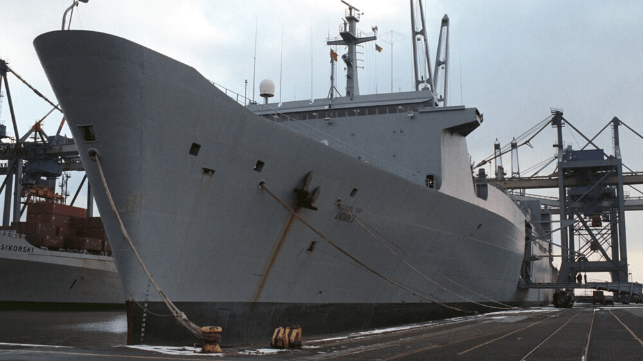
The German-built steamship Antares, ex name Sea-Land Galloway. Antares was acquired by the Navy in 1982 and is one of many foreign-built sealift ships still in service; she will be sold for demolition next year (USN file image)
The new head of U.S. Transportation Command wants to buy as many more foreign-built ships as necessary to replenish the sealift fleet, purchasing secondhand hulls abroad and repairing them in the United States to meet Military Sealift Command's standards. This acquisition strategy has been used to bolster the Ready Reserve since the Cold War, and is viewed by defense logistics planners as a rapid and cost-effective way to get new tonnage into a deteriorating sealift fleet.
"The median age of the 46 Roll-on/Roll-off ships we use to surge from the continental United States is 47 years; 14 of the 46 ships are 50 years old or older," said Gen. Randall Reed (USAF) in written testimony for the Senate Armed Services Committee. "USTRANSCOM supports the Navy’s strategy to recapitalize the government-owned fleet by acquiring foreign-built sealift ships from the commercial used market while also removing limitations on the number of used sealift vessels that the DoD can procure."
The Navy and the Maritime Administration have been buying foreign ships for the Ready Reserve for some time, and have authorization to purchase a maximum of 10 used ro/ros. That cap is approaching: seven used hulls have been bought already, and two more are expected this year.
Gen. Reed testified that the optimal course of action would be to waive the cap and buy four more a year going forward, two a year at minimum. These purchases would offset the built-in decline in capability as the fleet ages out: 30 sealift ships are on track to decommission by 2034, and the aging fleet's ability to get underway on short notice is already in doubt. Reed noted that many of the oldest ships have steam plants, and it is difficult to recruit mariners to work on these vessels.
Gen. Reed told the committee that in the short term, Transportation Command needs all the flexibility that it can get to buy used tonnage on the commercial market, and would like a waiver of the 10-ship cap on purchasing foreign-built hulls. However, he emphasized the importance of the Jones Act and the need to continue building vessels in America.
"Together we are working to get ships in any way we can. The address last night by the commander-in-chief emphasized that sealift is definitely something we need to do. He intends to make sure we can return to the seas," he said. "We need to build new and buy used."
Report: Trump Seeks Allies Support to Penalize Chinese Shipbuilding
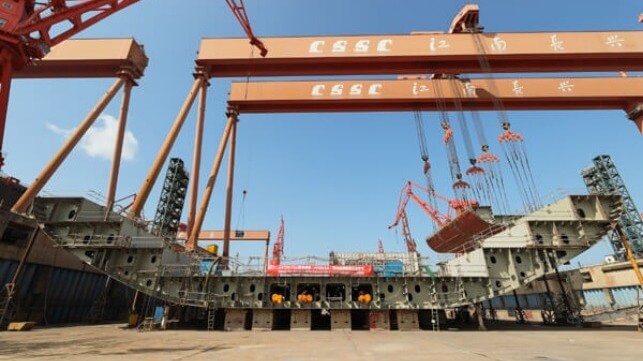
CSSC is building for all the major carriers including the keel laying seen here for MSC's large boxships (CSSC file photo)
The Trump administration is reported to be building out its plans to penalize China for its subsidy of the shipbuilding industry by seeking international support while also linking it to the rebuilding of U.S. shipbuilding and breaking China’s monopoly on cargo cranes. Reuters and The Wall Street Journal have seen drafts of executive orders proposed to Trump that follow up on the recommendations of the U.S. Trade Representative’s Office and the announced White House office on shipbuilding.
Speaking to the U.S. Congress on Tuesday night, Trump said, “We used to make so many ships. We don’t make them anymore, very much. But we’re going to make them very fast, very soon.”
The Trade Representative in the last days of the Biden administration concluded an investigation into China’s shipbuilding policies. The report called for steps to reign in China’s unfair advantages in shipbuilding which it concluded were built through government subsidies and policies. Unconfirmed reports recently said the Trump administration had taken the Biden report and was looking at fees on shipping lines using Chinese-built ships and calling at U.S. ports.
In an exclusive report from Reuters, it said it has seen a draft of the executive order proposing fees on all ships entering U.S. ports from carriers that have Chinese-built ships in their fleets. The fees would be regardless of where the individual ship was built or registered.
"The national security and economic prosperity of the United States is further endangered by the People's Republic of China's unfair trade practices in the maritime, logistics, and shipbuilding sectors," the draft order says according to Reuters.
It highlights that the draft changes from the previous reports in that it widens the potential number of ships subject to the fees. It does not say how the fees would be calculated but drops previsions that limited the fees to fleets with 25 percent or more of the ships on order or for delivery from China.
The draft order according to Reuters also calls on the U.S. to “engage allies and partners” to enact similar fees. According to Reuters if they did not support the U.S. they could “risk retaliation,” which is emerging as one of the Trump administration's bargaining tactics. Retaliation has become a key piece of the emerging trade war and tariffs and Trump’s report that on April 2 the U.S. will enact reciprocal tariffs on any nation that imposes tariffs on U.S. goods.
The report highlights that the sweeping fees would reach beyond the major Chinese carriers including COSCO and its subsidiary Orient Overseas Container Lines (OOCL). By including all fleets with Chinese-built ships, it would impact all the major carriers including MSC Mediterranean Shipping, Maersk, CMA CGM, and others.
The draft also links to the separate issue that emerged over Chinese cargo-handling equipment according to Reuters. During the Biden administration, the dominance of China’s ZPMC (Shanghai Zhenhua Heavy Industries Company) was highlighted and accusations emerged that China controlled the cranes or was using them to spy on the United States. Biden moves to place tariffs on the large cranes used by ports to load and unload containers and to reshore a U.S. capability to build large cargo cranes.
Additional tariffs would be imposed on Chinese-made cargo equipment according to Reuters’ review of the draft executive order.
The draft on the response to Chinese shipbuilding subsidies comes after The Wall Street Journal reported the White House was also working on a sweeping executive order for the shipbuilding industry. It reportedly will order Elon Musk’s Department of Government Efficiency to review procurement as it relates to shipbuilding and proposes raising wages for shipyard workers involved with nuclear shipbuilding.
Trump during his meeting at the White House on Thursday with Chairman and CEO of CMA CGM Group Rodolphe Saadé alluded to major steps coming soon in the shipbuilding and shipping industries.
CMA CGM Group Plans $20 Billion Investment in U.S. Maritime and Logistics
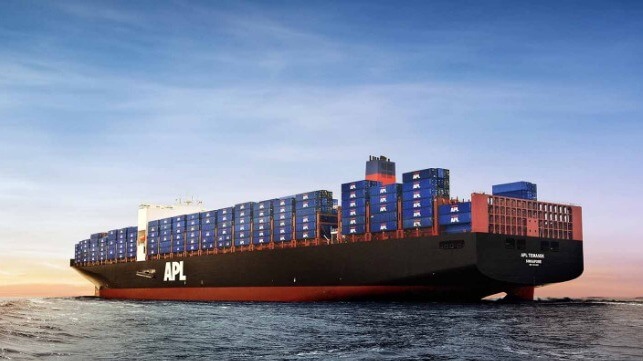
CMA CGM said it would like to triple its U.S.-flagged fleet to 30 ships (APL file photo)
CMA CGM Group announced plans for a significant $20 billion investment into the U.S. maritime and logistics sectors expanding on its previous plans to expand its U.S. port terminals and logistics operations. The announcement came as Chairman and CEO of CMA CGM Group Rodolphe Saadé met with President Donald Trump and alluded to U.S. shipbuilding plans.
The French group currently owns seven terminals in the U.S. including in the Port of New York New Jersey and Los Angeles. It also owns APL, the former American President Lines, acquired in the 2016 acquisition of Neptune Orient Lines.
“Over the next four years, we will significantly grow our U.S.-flagged fleet, expand the capacity of key container ports on both coasts, develop state-of-the-art warehousing across the country, and establish a significant air cargo hub in Chicago,” said Saadé. “I am proud to build on our long-standing relationship with the United States through this commitment of $20 billion to the country’s maritime future and logistics capabilities.”
CMA CGM Group said its investments over the next four years would contribute to the development of American maritime capabilities and advance the U.S. administration’s recently announced priority to strengthen American shipbuilding capabilities. CMA CGM highlights it has been servicing U.S. markets for 35 years and reports it handles about 5 million TEU annually in the U.S. out of the 23 million TEU carried globally in 2024.
One element they highlighted would include “bolstering APL’s U.S. flag capacity.” Saadé told Trump the company would like to triple the size of its U.S.-flagged fleet to 30 ships. It was unclear however if these vessels would be used for APL or within the CMA CGM fleet. In 2020, CMA CGM transitioned APL’s express services into the CMA CGM branded operations refocusing APL to a niche operation servicing the United States Government, providing its U.S. flag service, and continuing its service to the Guam-Pacific trade.
The company did not detail the proportions of the other investments but reported it would include its terminal and logistics operations and its expanding air cargo business.
The group said it will develop port infrastructure in key locations across the U.S., including New York, Los Angeles, Dutch Harbor, Houston, and Miami to contribute to efficient operations and supply chains. It said the new investments would accelerate digitization, improve connectivity, and increase safety for port workers and cargo.
CMA CGM in 2023 reported plans to invest $600 million after it completed the acquisition of terminals in Bayonne, New Jersey, and Staten Island, New York from Global Container Terminals. At the beginning of 2022, CMA CGM also completed the acquisition of Fenix Marine Services (FMS), which operates a terminal at the Port of Los Angeles. It is reported to be the third largest terminal in the Los Angeles/Long Beach port complex.
The other planned investments will include improving U.S. logistics and supply chain infrastructure with new warehousing and automotive logistics platforms. As part of this investment, CMA CGM Group will also expand its American air cargo capacity including a new hub in Chicago and deploying five new Boeing 777 freighters. CMA CGM will open a new logistics R&D hub in Boston, focusing on advanced robotics and automation solutions.
The planned U.S. investments are part of a larger overall growth plan for CMA CGM Group. The carrier currently owns over 300 vessels and operates in total more than 650 with reports that it has an additional 94 on order in China and South Korea. The U.S. shipbuilding plan might help to earn some relief from the Trump administration which is reported to be planning fees on carriers calling in the U.S. that build or operate Chinese-built ships. Earlier this week, the carrier was linked to a $2.6 billion order placed with China State Shipbuilding Corporation (CSSC) for a dozen new containerships. The group said in 2023 that it had ordered more than 70 containerships to be built in China.
Sovcomflot Cites U.S. Sanctions as Profits Again Plummet in 2024
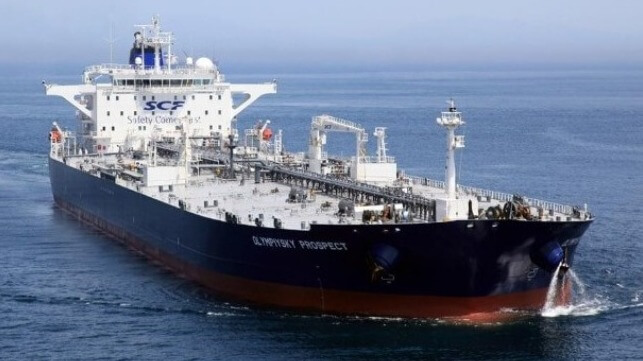
Sovcomflot cited sanctions as it reported a drop in financial results while warning of additional impact (SCF)
Russia’s energy shipping company Sovcomflot reported financial results on Friday, March 7, citing the continuing impact of Western sanctions on its operations and warning that the pressures on its operations were likely to increase this year. This came as Donald Trump posted on social media that he was “strongly considering” additional sanctions on Russia to push it to the negotiating table with Ukraine.
Sovcomflot told investors that Western sanctions have continued to erode its profits. The press release said, “The company's operations were subject to the influence of geopolitical factors and illegally imposed sanctions by unfriendly countries. The company continues to work systematically to minimize the negative impact of sanctions restrictions on its activities, consistently adhering to high standards of maritime safety and the quality of maritime operations.”
Among the factors cited was that some vessels had to be idled which the company said created “operational difficulties.” Operating costs for the year were up approximately 13 percent. This comes even after Sovcomflot downsized operations previously selling tankers and transferred vessels to companies outside the sanctions.
The result was that 2024 net profits were down by over half (55 percent) to $424 million. Revenues were down by 20 percent ($1.87 billion) as the company has also had to deal with the price cap imposed on Russian oil by the G7.
“New large-scale sanctions by the U.S. Treasury Department, introduced after the reporting date, became an additional limiting factor in the company's operations,” wrote Sovcomflot. It was referencing the January 10 announcement by the Biden administration. Before leaving office, Joe Biden imposed the largest sanction effort to date which included a new listing of Sovcomflot. The Treasury identified as blocked property 69 vessels, including 54 oil and product tankers and four liquefied natural gas (LNG) tankers, owned by Sovcomflot.
Donald Trump is now threatening to further increase the pressure on Russia writing on social media today that Russia is “’pounding’ Ukraine on the battlefield” causing him to “seriously consider” large-scale banking sanctions, other sanctions, and tariffs. He said if enacted the sanctions would be in place until a cease fire had been achieved and a final agreement on peace is reached.
Russia is reportedly anxious to loosen the sanctions which have placed an increasing hold on its economy. Energy products are one of the primary sources of revenue for Russia.
Video: Sanctioned Shadow Tanker Struck by Containership off Turkey
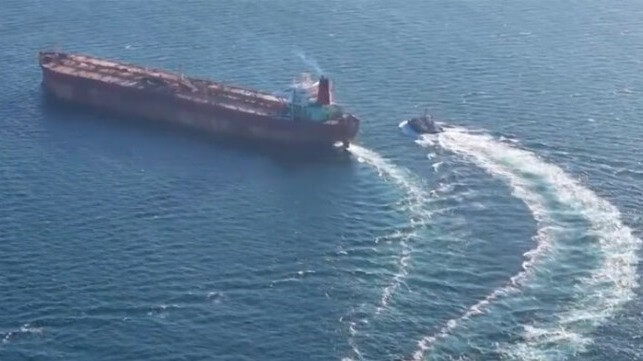
Response vessels dispatched to the shadow tanker after it was struck by the containership (Turkish TV)
One of the mysterious tankers operating in the shadow fleet and sanctioned late last year was involved in an incident off Turkey late on Friday, March 7. Turkish authorities have not commented on the allision where the tanker was hit by a Turkish-owned containership, but it was captured on video which was broadcast on Turkish TV.
The tanker named Mia (149,686 dwt) was anchored approximately 5 miles offshore near Istanbul. The vessel’s ownership is considered to be murky with a company registered in the Seychelles listed as the owner, no known manager, and no inspections on file since 2014. The U.S. sanctioned the vessel in 2024 and cited it as being registered in Guyana. The authorities in Guyana however reported that it was a false flag as the ship has no ownership ties to the country which operates a closed registry. The U.S. Office of Foreign Asset Control also places a strong likelihood the tanker also operated under the aliases Magus and Freedom.
The videos show the Orita (8,000 dwt) striking the container ship as the vessel appears to be turning. It is a small container ship with a capacity of 672 TEU. It was built in 2005, registered in Panama, and managed by a Turkish company. The vessel’s AIS signal shows it was bound for Sulina, Romania, but it is now being held at anchor.
Media reports said the tug Efes 10 which is operated by Uzmar from Marport was first on the scene. It was used to initially cordon off the area as the Coast Guard worked to determine the circumstances.
The tanker is reported to have suffered a puncture to one of its ballast tanks and was leaking dirty water which the Coast Guard considered pollution while noting it was not oil. A larger tug, Rescue 2 from the General Directorate of Coastal Safety, later reached the area.
The crew on the tanker is reported to be working on an emergency, temporary patch. They are also working to stop the leak from the ballast tank.
There are reports of “impact marks” on the containership Orita. The reports said the Coast Guard was examining the containership to determine the extent of the damage.
Cook Islands Politicians Question Role Supporting Shadow Fleet
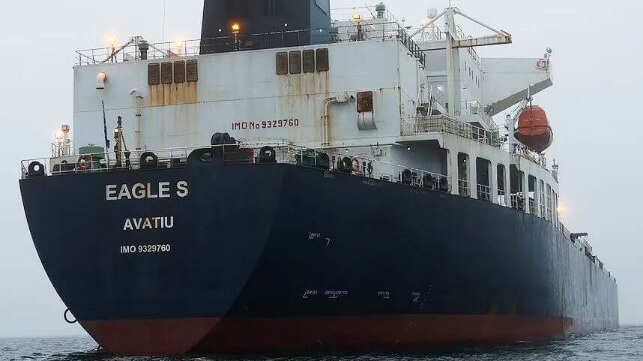
Eagle S detained in Finland for the investigation into cable damage is registered since 2023 in the Cook lslands (Finnish Border Guard)
The Cook Islands as a registry of ships has become one of the topics of the reporting on the shadow fleet of tankers servicing the Russian oil industry. Now politicians in the small Pacific Island nation are questioning their role in the shadow fleet and how the reporting is impacting the image of the nation.
After repeated news reports highlighting vessels registered in the country, the Cook Island News reports it became the issue of questions during last week’s parliamentary meeting with the Deputy Prime Minister and Minister of Transport responding. They asserted that nothing illegal was happening, but they would investigate the allegations.
According to the newspaper, Opposition Leader Tina Browne asked the Ministry of Transport to respond to the reports that vessels registered in the Cook Islands have been “arrested overseas” on allegations of transporting arms to Russia or involvement in the shadow fleet. She cited media reports of 18 vessels having been detained, questioning if it was “giving us a very bad name out there?”
Deputy Prime Minister Albert Nichols responded saying that they had not been able to find anything on the alleged 18 vessels while noting that the names of the ships had not been supplied. The Cook Islands News reports he assured parliament that if there were any merit to the allegations “rightful steps” would be taken.
The tanker Eagle S which was detained for over 50 days in Finland after the Christmas Day incident with the undersea cables is registered in the Cook Islands. The vessel was transferred to the Cook Islands’ vessel registry in July 2023 and its registered owners are listed as a company in Dubai. In addition, the U.S. sanctioned four tankers registered in the Cook Islands in its sweeping January 2025 package.
The Ministry of the Foreign Affairs of the Cook Islands said it is well aware of the situation and is taking the global media coverage “very seriously.” The government has repeatedly denied the allegations that Maritime Cook Islands has become a haven for Russian-linked tankers. It says that they comply with international sanctions. Maritime Cook Islands is an outside manager employed to administer the registry.
The Cook Islands however maintains an open registry with the media reports stating it added over seven million DWT of tankers and became a top 30 registry in 2024. The Ministry said it had not expected the number of vessels in the registry to increase so dramatically noting it is currently over 780 foreign vessels.
They asserted that there are no illegal operators as vessels have either been deregistered or have voluntarily removed themselves from the registry. A dozen tankers were removed from the registry in July 2024 for violations. Nicholas responded to Browne asking for some time to conduct a review and said if the allegations were proven to be accurate then there would be an investigation and appropriate actions taken.